local.gov.uk/pas
Biodiversity net gain consultation
Overview for LPA officers
• Make sure you name yourself (click … in corner of your video)
• We have a lot of people in the ‘room’ so you will be muted
• Questions in the Zoom chat please
• We may not get round to all your questions, but will add answers
to our biodiversity net gain FAQs page
• We will be using polls, so please answer these
• This event is being recorded and the recording will be up on our
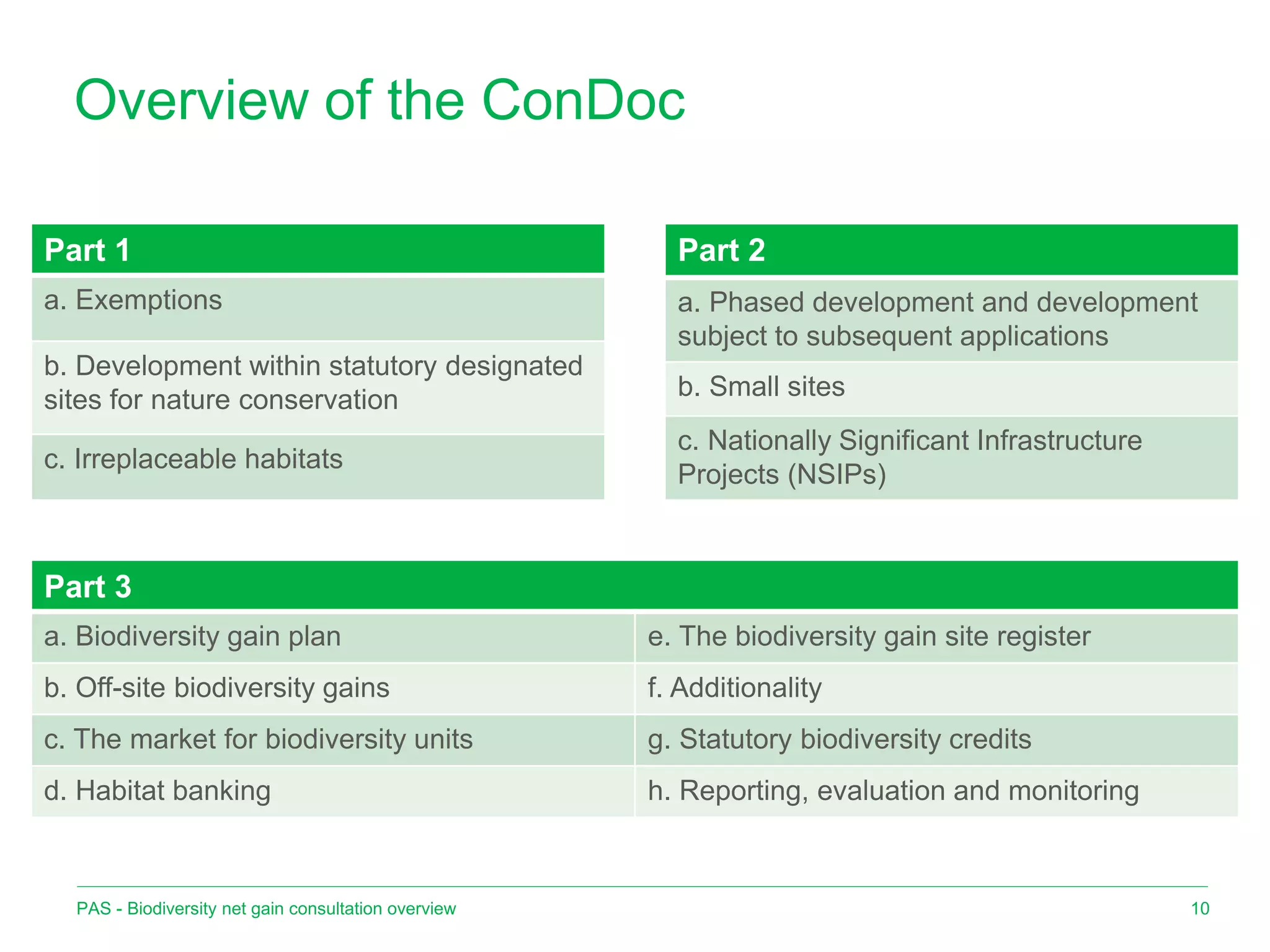
website
• We’re also running ‘deep-dive’ workshops in March
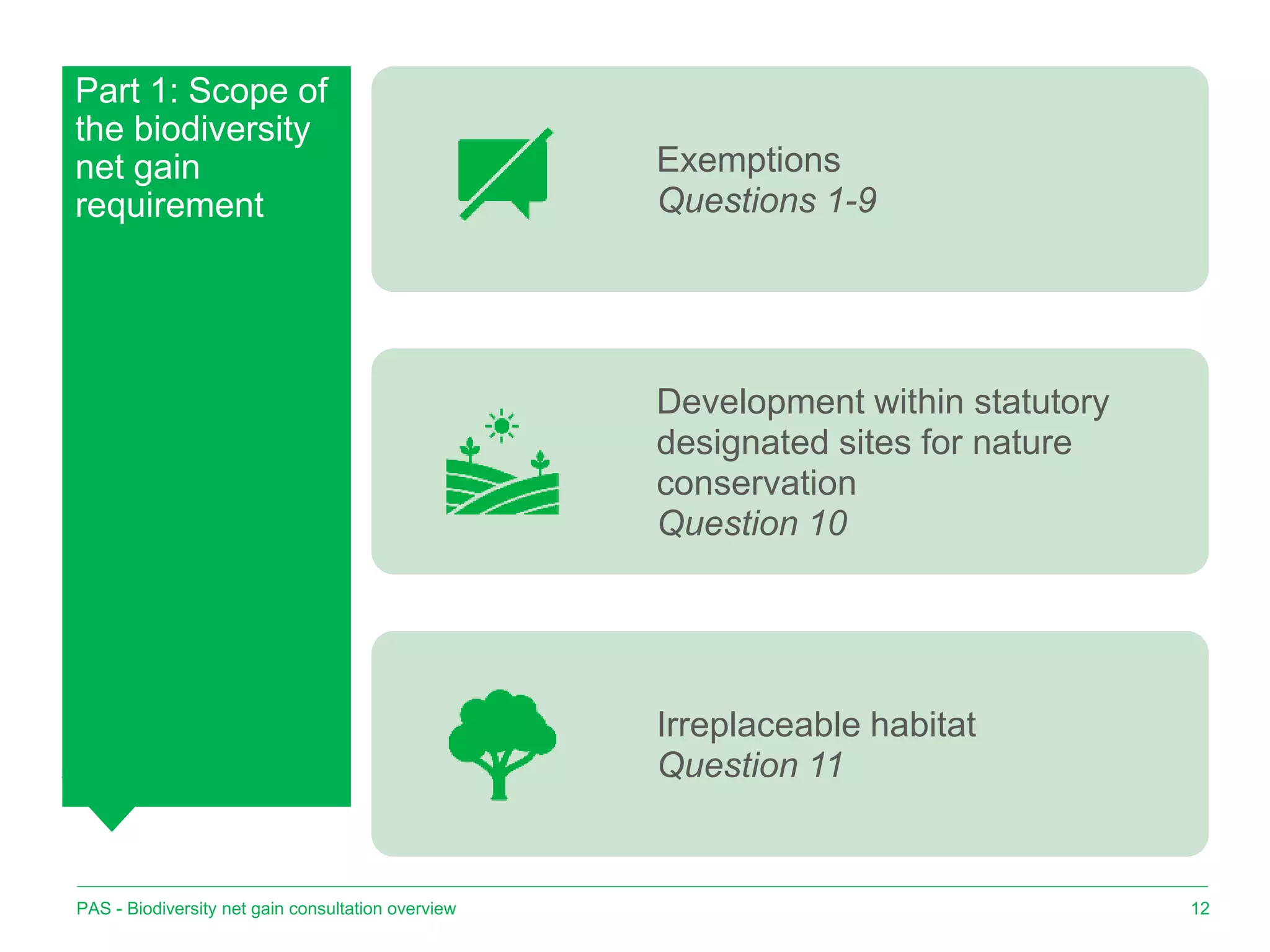
• PAS – who’s here
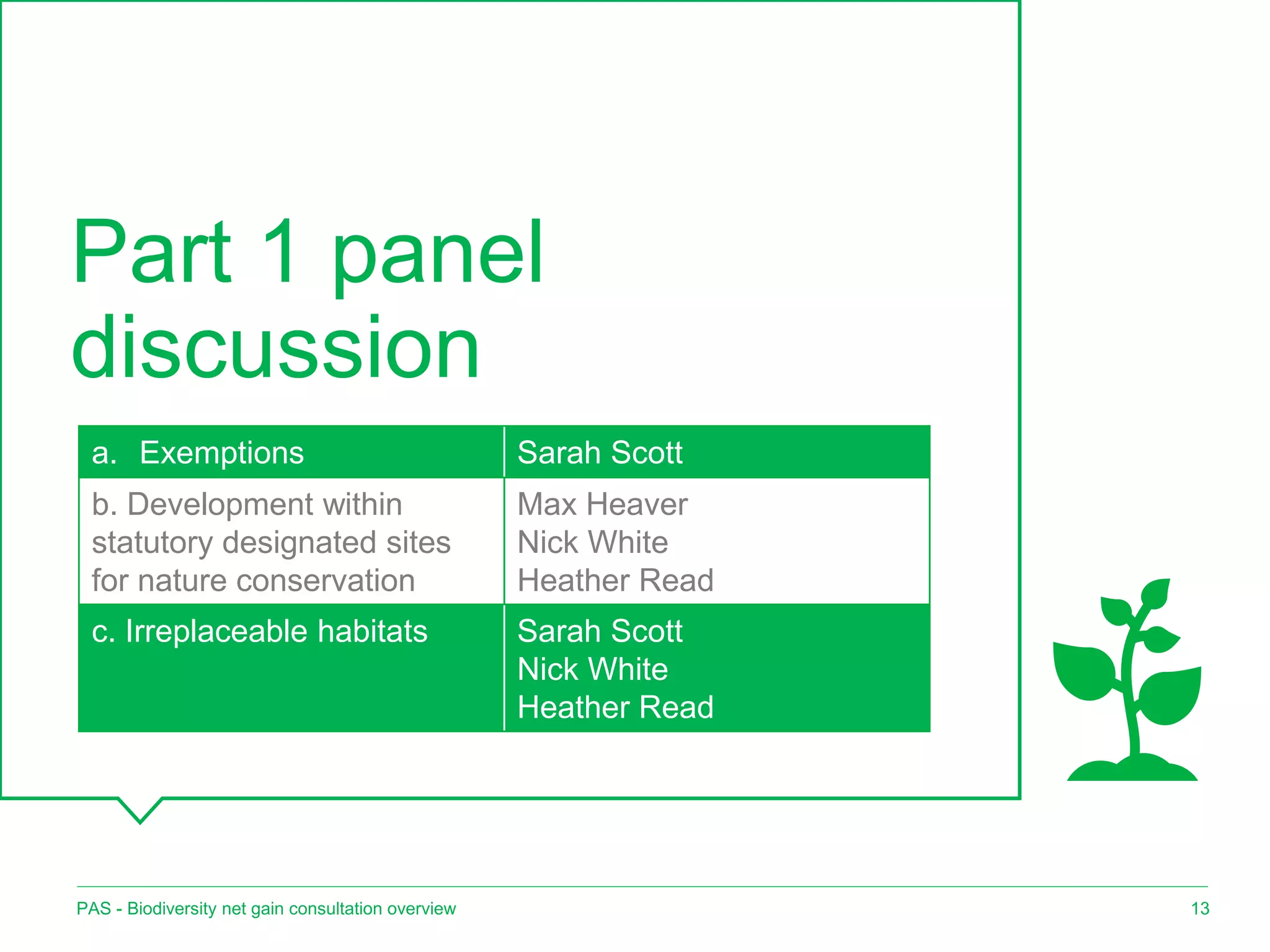
Planning Advisory Service
Biodiversity net gain
consultation overview
10 February 2022
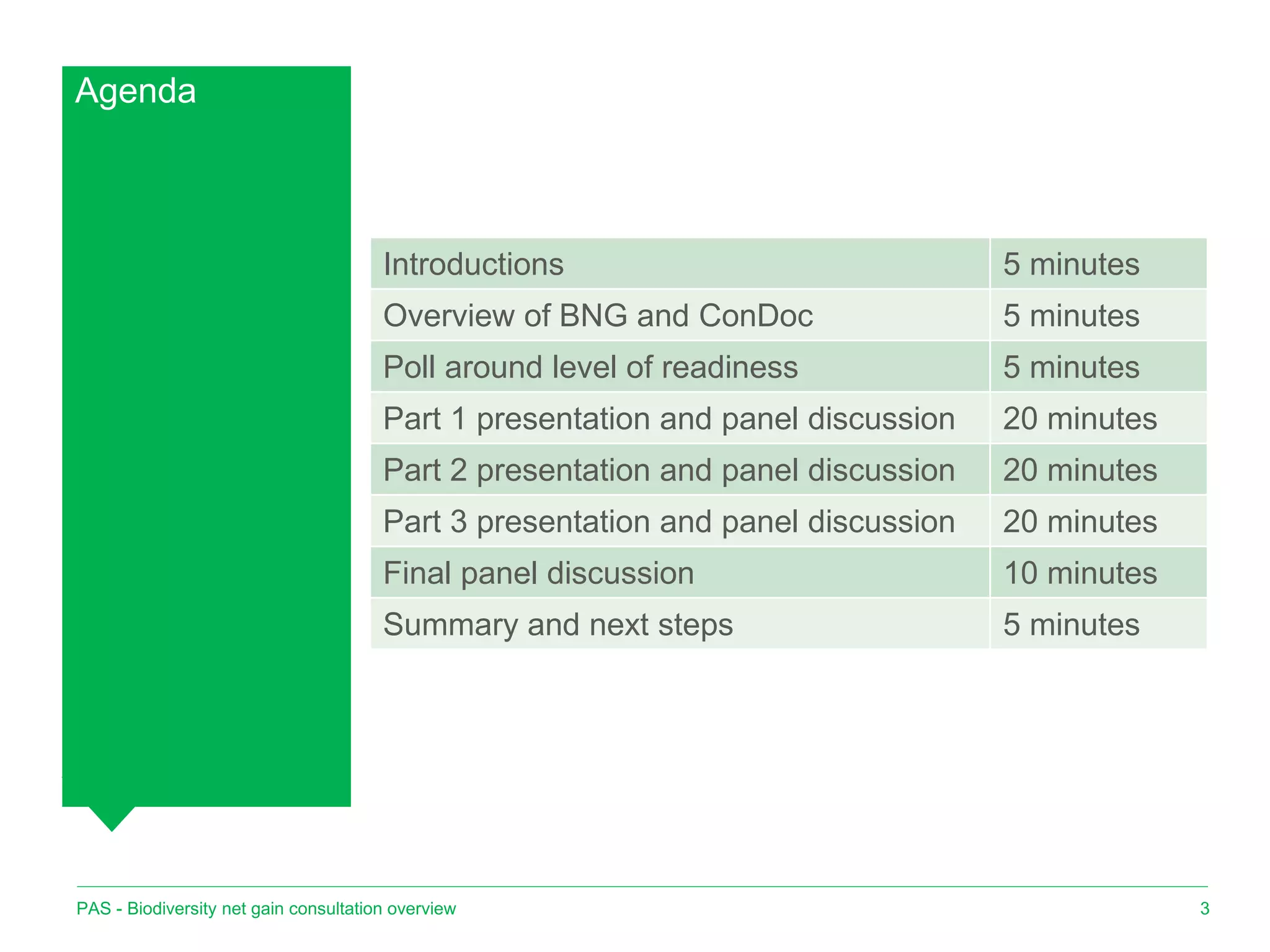
Agenda
Introductions 5 minutes
Overview of BNG and ConDoc 5 minutes
Poll around level of readiness 5 minutes
Part 1 presentation and panel discussion 20 minutes
Part 2 presentation and panel discussion 20 minutes
Part 3 presentation and panel discussion 20 minutes
Final panel discussion 10 minutes
Summary and next steps 5 minutes
3
PAS - Biodiversity net gain consultation overview
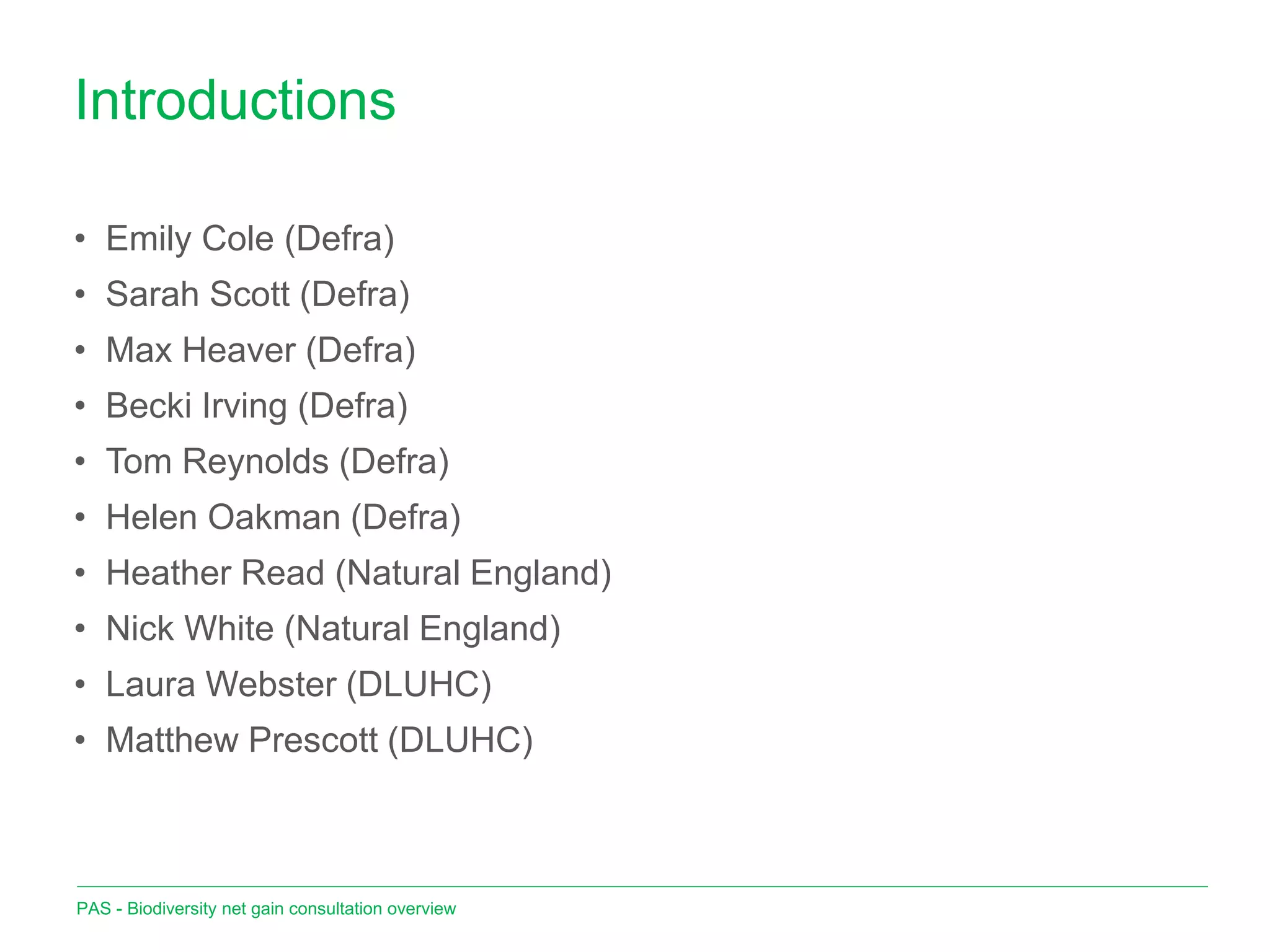
Introductions
PAS - Biodiversity net gain consultation overview
• Emily Cole (Defra)
• Sarah Scott (Defra)
• Max Heaver (Defra)
• Becki Irving (Defra)
• Tom Reynolds (Defra)
• Helen Oakman (Defra)
• Heather Read (Natural England)
• Nick White (Natural England)
• Laura Webster (DLUHC)
• Matthew Prescott (DLUHC)
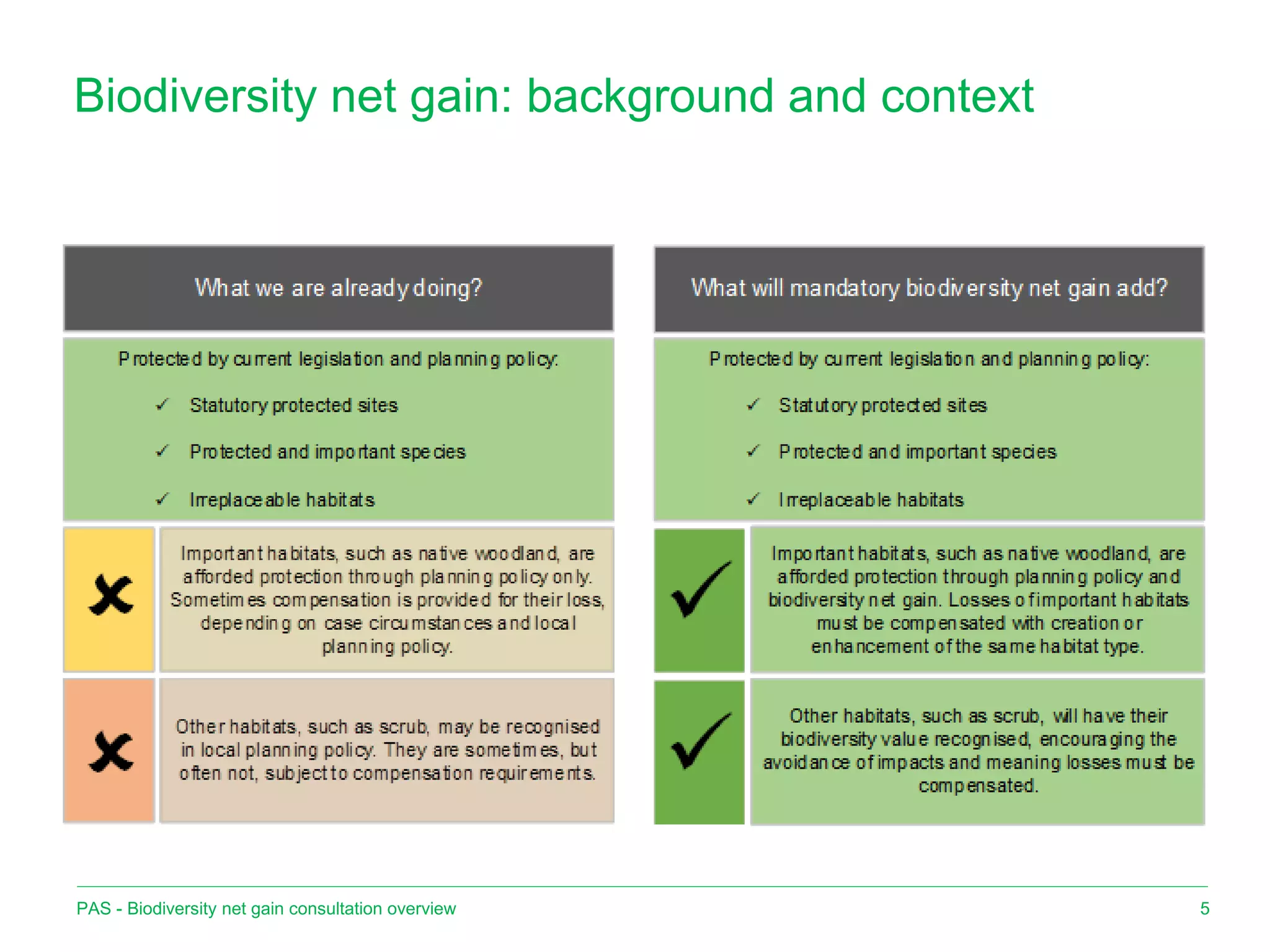
Biodiversity net gain: background and context
PAS - Biodiversity net gain consultation overview 5
Biodiversity net gain: background and context
• Planning policy
• 25 Year Environment Plan
• 2018 Consultation on net gain proposals
• Environment Act 2021
• Links with other Defra policies (LNRS,
Conservation Covenants and others)
PAS - Biodiversity net gain consultation overview 6
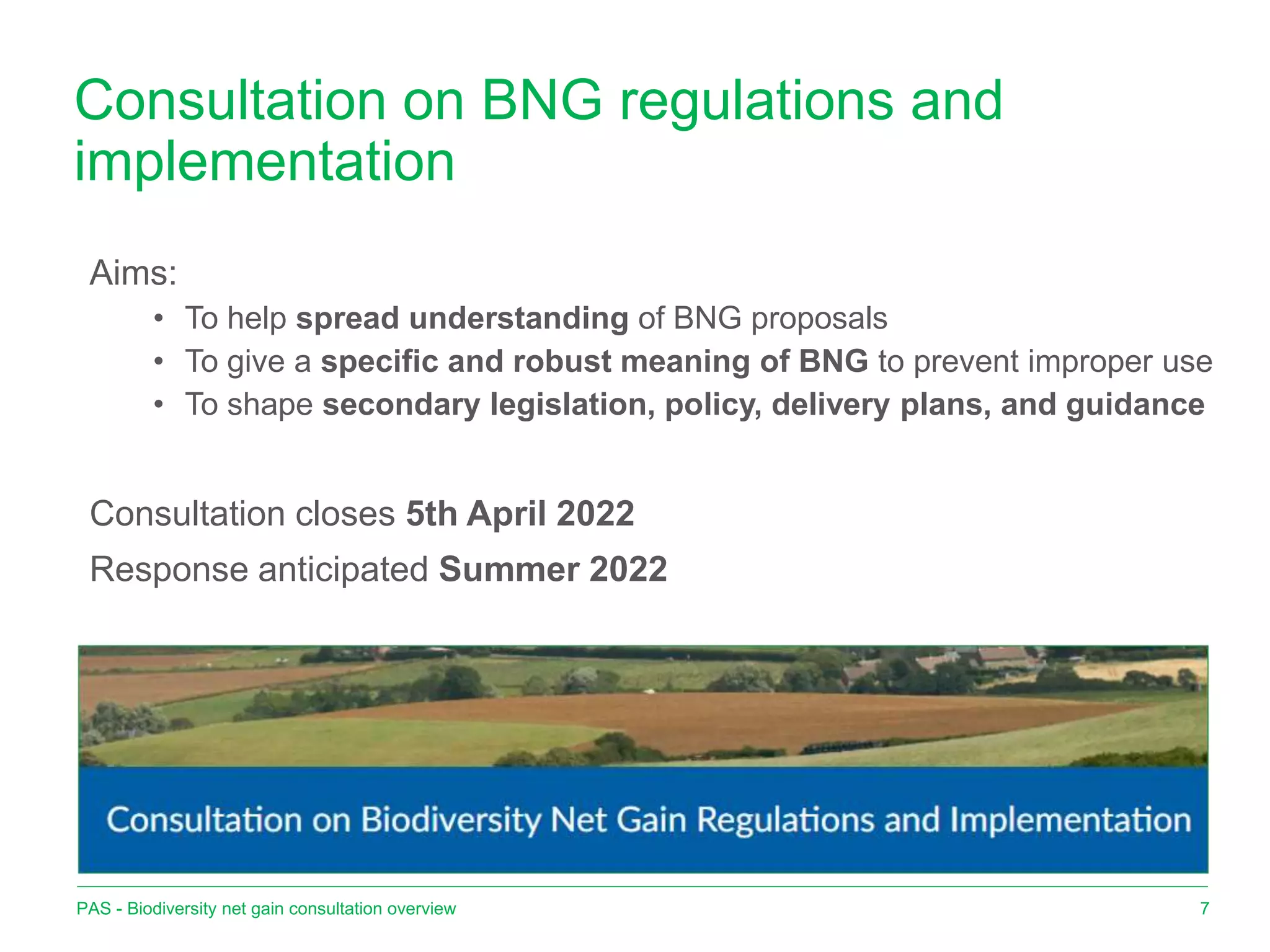
Consultation on BNG regulations and
implementation
Aims:
• To help spread understanding of BNG proposals
• To give a specific and robust meaning of BNG to prevent improper use
• To shape secondary legislation, policy, delivery plans, and guidance
Consultation closes 5th April 2022
Response anticipated Summer 2022
PAS - Biodiversity net gain consultation overview 7
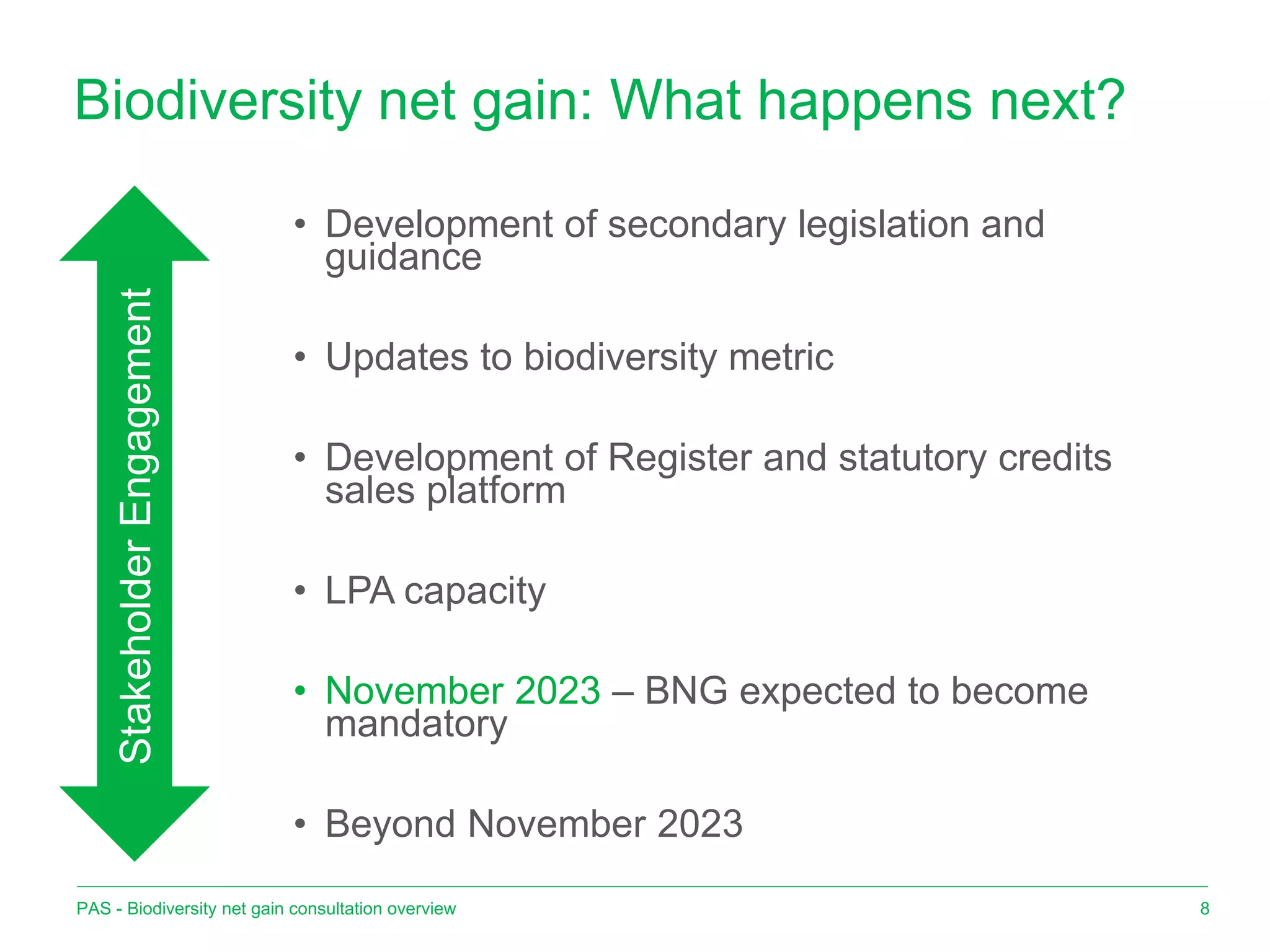
Biodiversity net gain: What happens next?
8
PAS - Biodiversity net gain consultation overview
• Development of secondary legislation and
guidance
• Updates to biodiversity metric
• Development of Register and statutory credits
sales platform
• LPA capacity
• November 2023 – BNG expected to become
mandatory
• Beyond November 2023
Stakeholder
Engagement
Poll: LPA readiness
On a scale of 1-5, how prepared do you feel for mandatory
biodiversity net gain starting in late 2023?
1 = we've got a lot to do
5 = we're ready to go tomorrow, or already applying a similar
approach!
In the chat, please share the top three things which would
help you get to a '5'.
Overview of the ConDoc
10
Part 1
a. Exemptions
b. Development within statutory designated
sites for nature conservation
c. Irreplaceable habitats
Part 3
a. Biodiversity gain plan e. The biodiversity gain site register
b. Off-site biodiversity gains f. Additionality
c. The market for biodiversity units g. Statutory biodiversity credits
d. Habitat banking h. Reporting, evaluation and monitoring
PAS - Biodiversity net gain consultation overview
Part 2
a. Phased development and development
subject to subsequent applications
b. Small sites
c. Nationally Significant Infrastructure
Projects (NSIPs)
Part 1: Defining the
scope of the biodiversity
net gain requirement for
Town and Country
Planning Act 1990
development
11
PAS - Biodiversity net gain consultation overview
ConDoc Questions 1-11
Part 1: Scope of
the biodiversity
net gain
requirement
12
Exemptions
Questions 1-9
Development within statutory
designated sites for nature
conservation
Question 10
Irreplaceable habitat
Question 11
PAS - Biodiversity net gain consultation overview
Part 1 panel
discussion
13
PAS - Biodiversity net gain consultation overview
a. Exemptions Sarah Scott
b. Development within
statutory designated sites
for nature conservation
Max Heaver
Nick White
Heather Read
c. Irreplaceable habitats Sarah Scott
Nick White
Heather Read
Part 2: Applying the
biodiversity gain
objective to different
types of development
14
PAS - Biodiversity net gain consultation overview
ConDoc Questions 12-27
Part 2: Different
types of
development
15
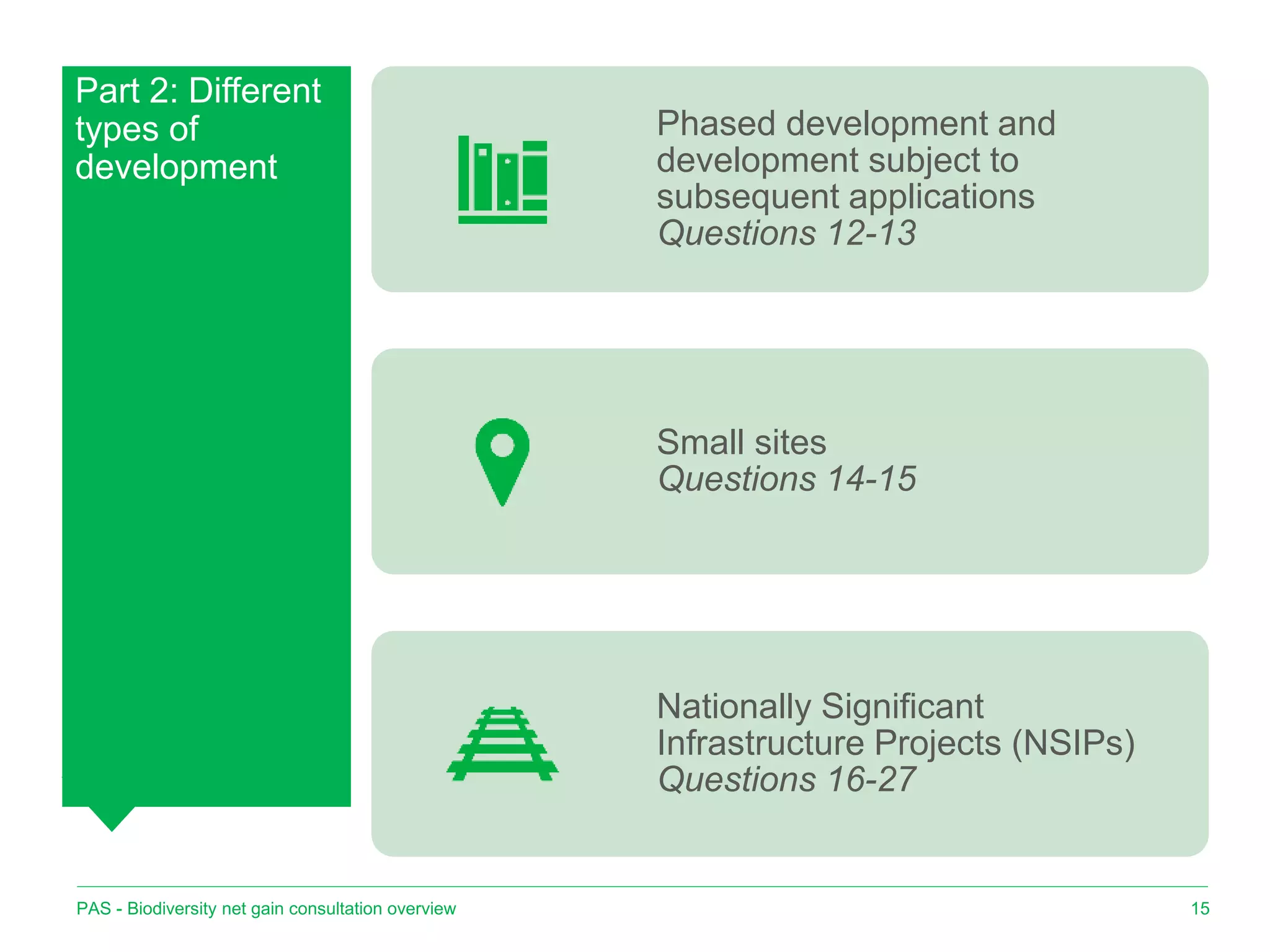
Phased development and
development subject to
subsequent applications
Questions 12-13
Small sites
Questions 14-15
Nationally Significant
Infrastructure Projects (NSIPs)
Questions 16-27
PAS - Biodiversity net gain consultation overview
Part 2 panel
discussion
16
PAS - Biodiversity net gain consultation overview
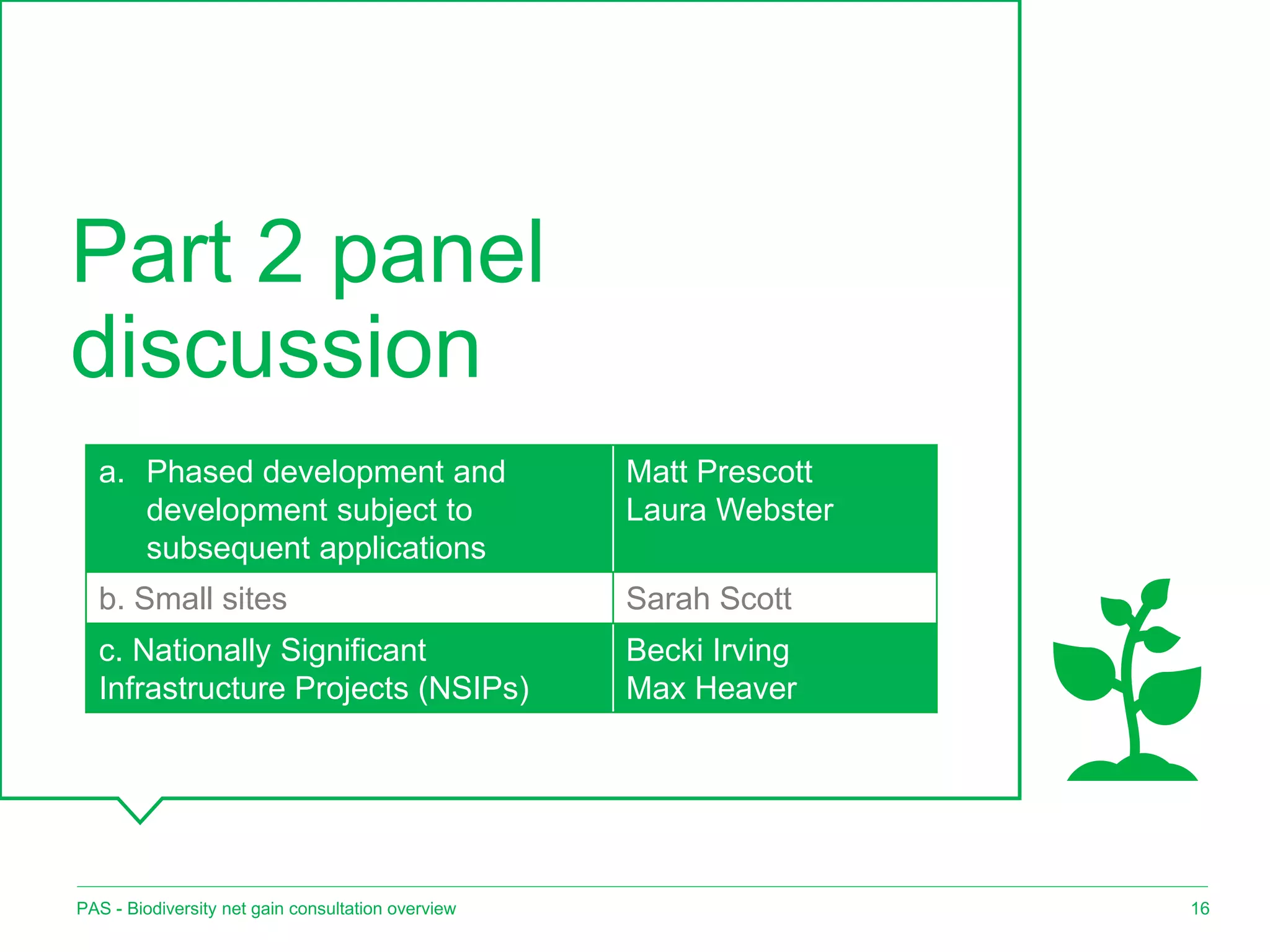
a. Phased development and
development subject to
subsequent applications
Matt Prescott
Laura Webster
b. Small sites Sarah Scott
c. Nationally Significant
Infrastructure Projects (NSIPs)
Becki Irving
Max Heaver
Part 3: How the
mandatory biodiversity
net gain requirement will
work for Town and
Country Planning Act
1990 development
17
PAS - Biodiversity net gain consultation overview
ConDoc Questions 28-55
Part 3: How it
will work
18
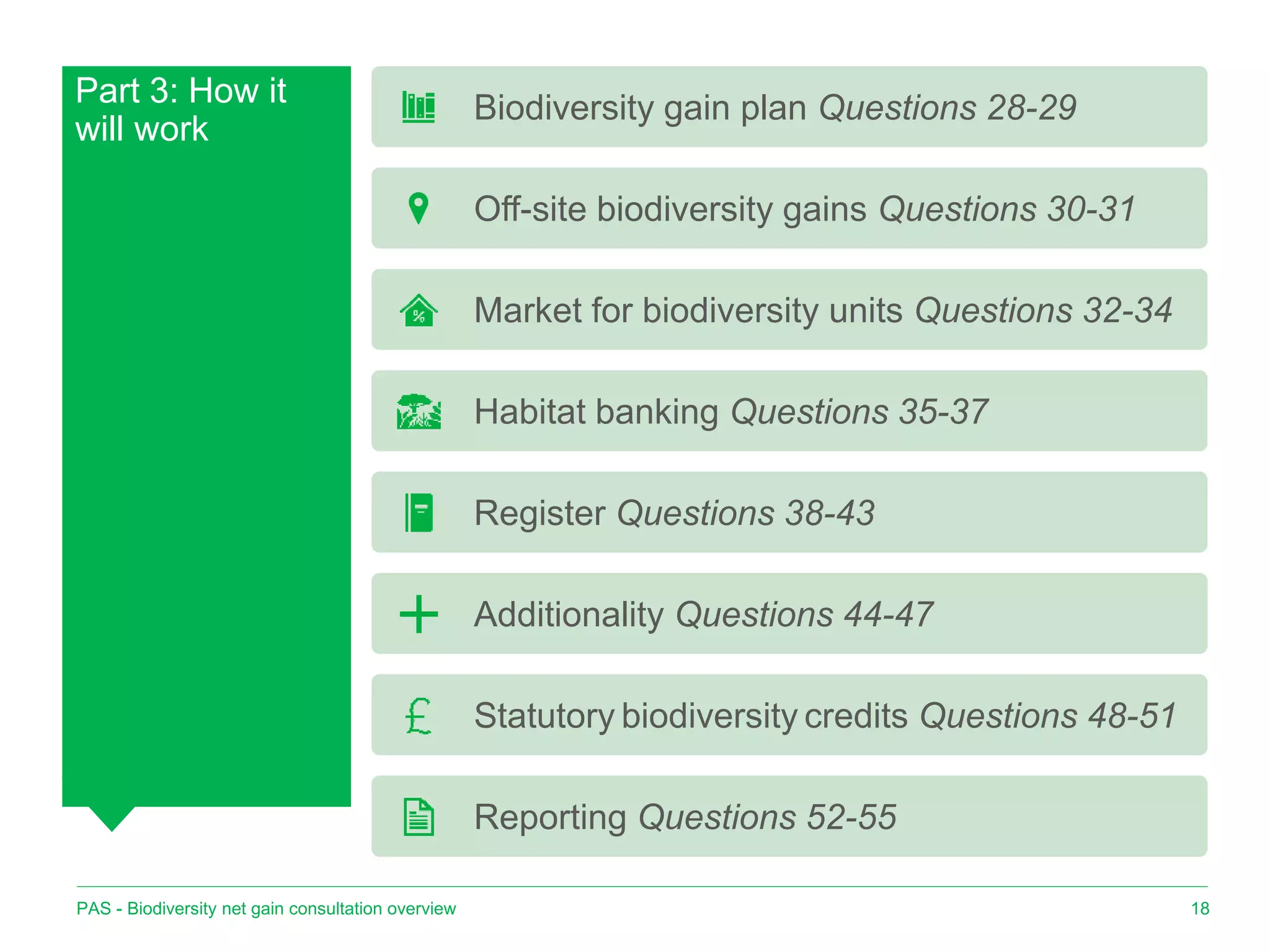
Biodiversity gain plan Questions 28-29
Off-site biodiversity gains Questions 30-31
Market for biodiversity units Questions 32-34
Habitat banking Questions 35-37
Register Questions 38-43
Additionality Questions 44-47
Statutory biodiversity credits Questions 48-51
Reporting Questions 52-55
PAS - Biodiversity net gain consultation overview
Part 3 panel
discussion
19
PAS - Biodiversity net gain consultation overview
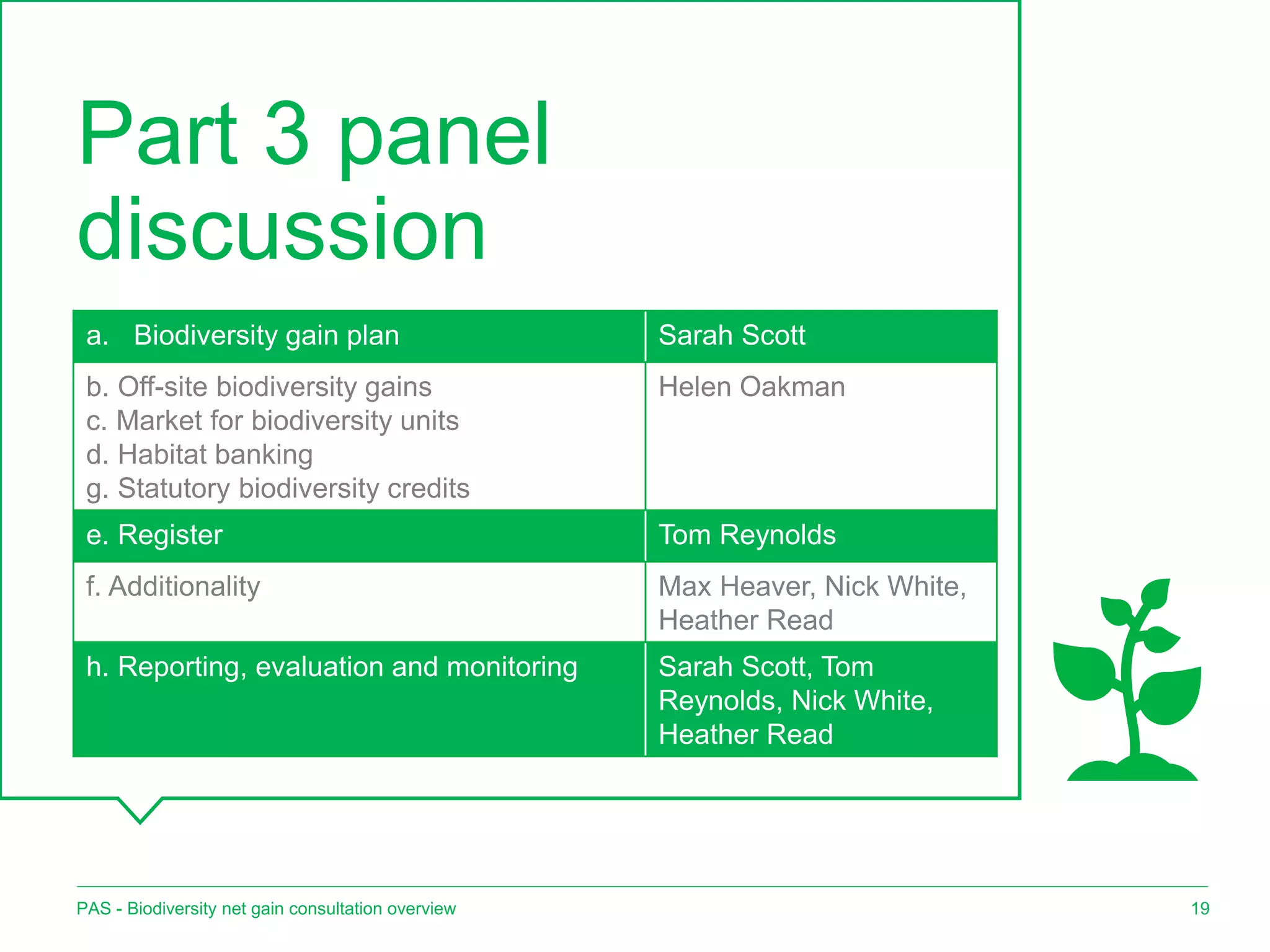
a. Biodiversity gain plan Sarah Scott
b. Off-site biodiversity gains
c. Market for biodiversity units
d. Habitat banking
g. Statutory biodiversity credits
Helen Oakman
e. Register Tom Reynolds
f. Additionality Max Heaver, Nick White,
Heather Read
h. Reporting, evaluation and monitoring Sarah Scott, Tom
Reynolds, Nick White,
Heather Read
Final panel
discussion
20
PAS - Biodiversity net gain consultation overview
How to get involved
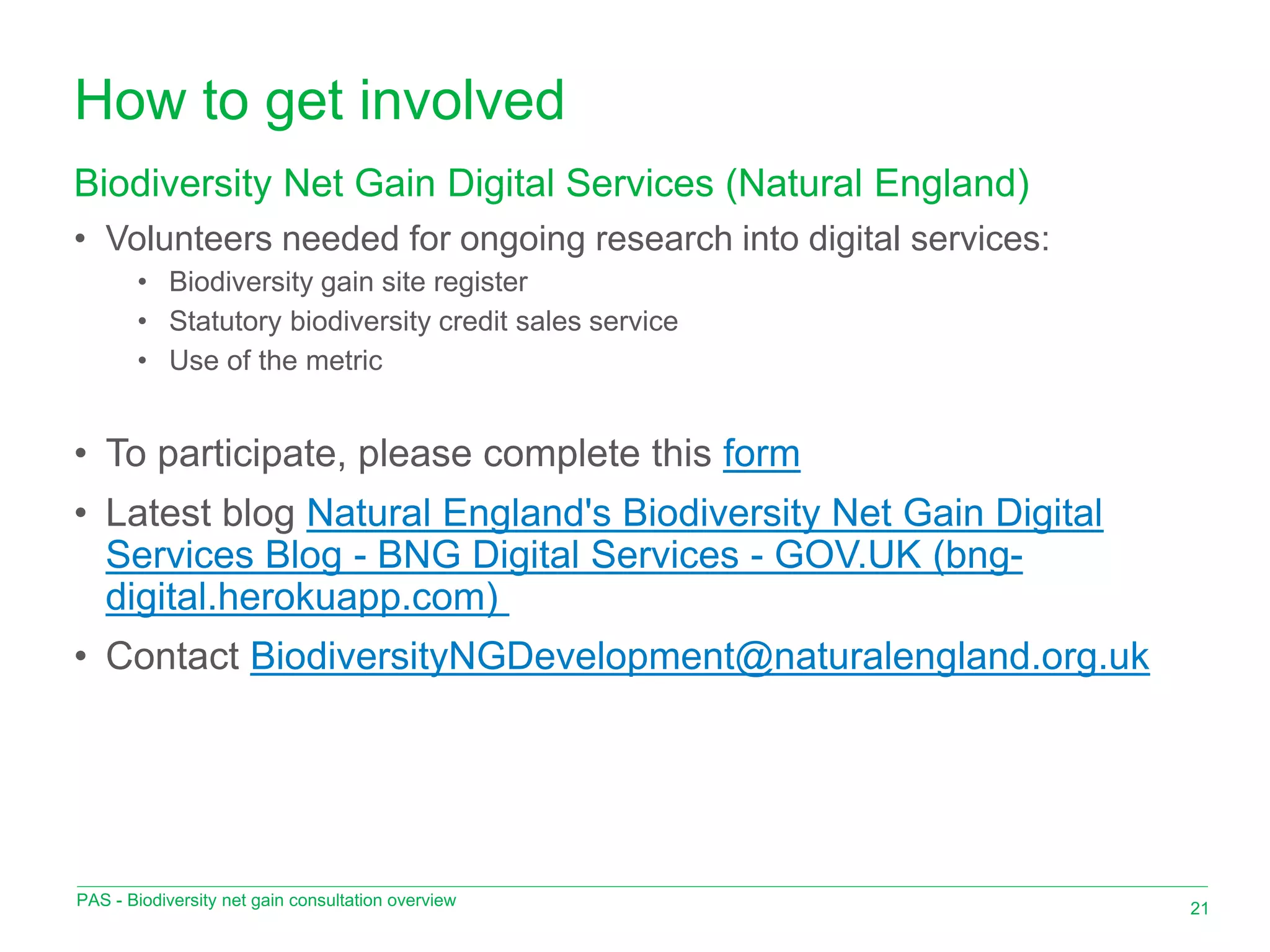
• Volunteers needed for ongoing research into digital services:
• Biodiversity gain site register
• Statutory biodiversity credit sales service
• Use of the metric
• To participate, please complete this form
• Latest blog Natural England's Biodiversity Net Gain Digital
Services Blog - BNG Digital Services - GOV.UK (bng-
digital.herokuapp.com)
• Contact BiodiversityNGDevelopment@naturalengland.org.uk
Biodiversity Net Gain Digital Services (Natural England)
21
PAS - Biodiversity net gain consultation overview
local.gov.uk/pas
Next steps
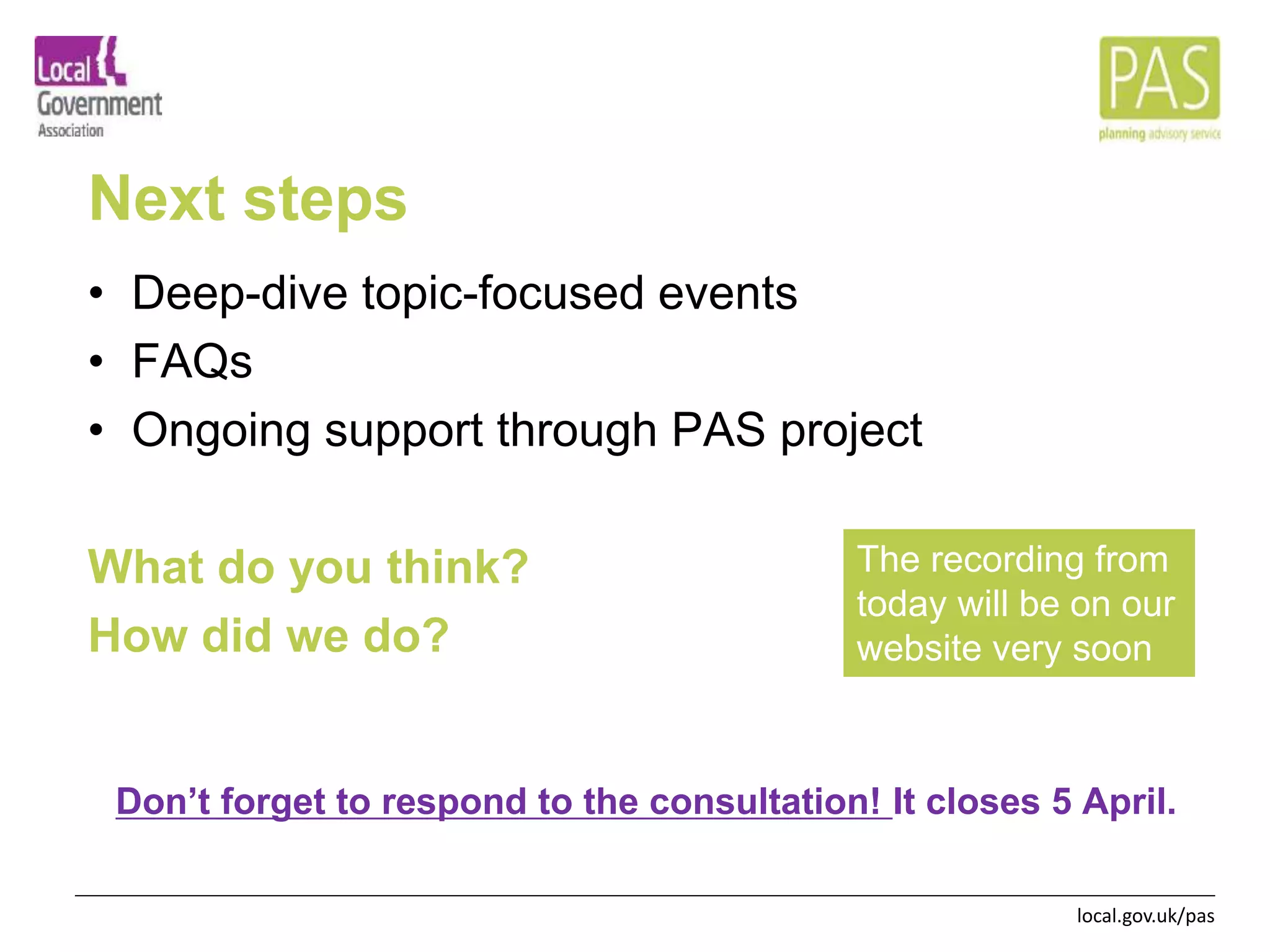
• Deep-dive topic-focused events
• FAQs
• Ongoing support through PAS project
What do you think?
How did we do?
Don’t forget to respond to the consultation! It closes 5 April.
The recording from
today will be on our
website very soon
local.gov.uk/pas
PAS BNG support for LPAs
Five workshops for LPAs – officers, councillors, London Boroughs, Summer 2021
Biodiversity Metric workshop, October 2021
Defra consultation events
Knowledge Hub discussion forum & advisory group
Web-based BNG resource centre:
- FAQs
- Governance and embedding – Policy – DM – Delivery
- ‘Journey to BNG’ - What you can do now, preparing for 2023
- Examples and case studies
Thank you

PAS Biodiversity Net Gain consultation overview - 10 February 2022

  • 1.
    local.gov.uk/pas Biodiversity net gainconsultation Overview for LPA officers • Make sure you name yourself (click … in corner of your video) • We have a lot of people in the ‘room’ so you will be muted • Questions in the Zoom chat please • We may not get round to all your questions, but will add answers to our biodiversity net gain FAQs page • We will be using polls, so please answer these • This event is being recorded and the recording will be up on our website • We’re also running ‘deep-dive’ workshops in March • PAS – who’s here
  • 2.
    Planning Advisory Service Biodiversitynet gain consultation overview 10 February 2022
  • 3.
    Agenda Introductions 5 minutes Overviewof BNG and ConDoc 5 minutes Poll around level of readiness 5 minutes Part 1 presentation and panel discussion 20 minutes Part 2 presentation and panel discussion 20 minutes Part 3 presentation and panel discussion 20 minutes Final panel discussion 10 minutes Summary and next steps 5 minutes 3 PAS - Biodiversity net gain consultation overview
  • 4.
    Introductions PAS - Biodiversitynet gain consultation overview • Emily Cole (Defra) • Sarah Scott (Defra) • Max Heaver (Defra) • Becki Irving (Defra) • Tom Reynolds (Defra) • Helen Oakman (Defra) • Heather Read (Natural England) • Nick White (Natural England) • Laura Webster (DLUHC) • Matthew Prescott (DLUHC)
  • 5.
    Biodiversity net gain:background and context PAS - Biodiversity net gain consultation overview 5
  • 6.
    Biodiversity net gain:background and context • Planning policy • 25 Year Environment Plan • 2018 Consultation on net gain proposals • Environment Act 2021 • Links with other Defra policies (LNRS, Conservation Covenants and others) PAS - Biodiversity net gain consultation overview 6
  • 7.
    Consultation on BNGregulations and implementation Aims: • To help spread understanding of BNG proposals • To give a specific and robust meaning of BNG to prevent improper use • To shape secondary legislation, policy, delivery plans, and guidance Consultation closes 5th April 2022 Response anticipated Summer 2022 PAS - Biodiversity net gain consultation overview 7
  • 8.
    Biodiversity net gain:What happens next? 8 PAS - Biodiversity net gain consultation overview • Development of secondary legislation and guidance • Updates to biodiversity metric • Development of Register and statutory credits sales platform • LPA capacity • November 2023 – BNG expected to become mandatory • Beyond November 2023 Stakeholder Engagement
  • 9.
    Poll: LPA readiness Ona scale of 1-5, how prepared do you feel for mandatory biodiversity net gain starting in late 2023? 1 = we've got a lot to do 5 = we're ready to go tomorrow, or already applying a similar approach! In the chat, please share the top three things which would help you get to a '5'.
  • 10.
    Overview of theConDoc 10 Part 1 a. Exemptions b. Development within statutory designated sites for nature conservation c. Irreplaceable habitats Part 3 a. Biodiversity gain plan e. The biodiversity gain site register b. Off-site biodiversity gains f. Additionality c. The market for biodiversity units g. Statutory biodiversity credits d. Habitat banking h. Reporting, evaluation and monitoring PAS - Biodiversity net gain consultation overview Part 2 a. Phased development and development subject to subsequent applications b. Small sites c. Nationally Significant Infrastructure Projects (NSIPs)
  • 11.
    Part 1: Definingthe scope of the biodiversity net gain requirement for Town and Country Planning Act 1990 development 11 PAS - Biodiversity net gain consultation overview ConDoc Questions 1-11
  • 12.
    Part 1: Scopeof the biodiversity net gain requirement 12 Exemptions Questions 1-9 Development within statutory designated sites for nature conservation Question 10 Irreplaceable habitat Question 11 PAS - Biodiversity net gain consultation overview
  • 13.
    Part 1 panel discussion 13 PAS- Biodiversity net gain consultation overview a. Exemptions Sarah Scott b. Development within statutory designated sites for nature conservation Max Heaver Nick White Heather Read c. Irreplaceable habitats Sarah Scott Nick White Heather Read
  • 14.
    Part 2: Applyingthe biodiversity gain objective to different types of development 14 PAS - Biodiversity net gain consultation overview ConDoc Questions 12-27
  • 15.
    Part 2: Different typesof development 15 Phased development and development subject to subsequent applications Questions 12-13 Small sites Questions 14-15 Nationally Significant Infrastructure Projects (NSIPs) Questions 16-27 PAS - Biodiversity net gain consultation overview
  • 16.
    Part 2 panel discussion 16 PAS- Biodiversity net gain consultation overview a. Phased development and development subject to subsequent applications Matt Prescott Laura Webster b. Small sites Sarah Scott c. Nationally Significant Infrastructure Projects (NSIPs) Becki Irving Max Heaver
  • 17.
    Part 3: Howthe mandatory biodiversity net gain requirement will work for Town and Country Planning Act 1990 development 17 PAS - Biodiversity net gain consultation overview ConDoc Questions 28-55
  • 18.
    Part 3: Howit will work 18 Biodiversity gain plan Questions 28-29 Off-site biodiversity gains Questions 30-31 Market for biodiversity units Questions 32-34 Habitat banking Questions 35-37 Register Questions 38-43 Additionality Questions 44-47 Statutory biodiversity credits Questions 48-51 Reporting Questions 52-55 PAS - Biodiversity net gain consultation overview
  • 19.
    Part 3 panel discussion 19 PAS- Biodiversity net gain consultation overview a. Biodiversity gain plan Sarah Scott b. Off-site biodiversity gains c. Market for biodiversity units d. Habitat banking g. Statutory biodiversity credits Helen Oakman e. Register Tom Reynolds f. Additionality Max Heaver, Nick White, Heather Read h. Reporting, evaluation and monitoring Sarah Scott, Tom Reynolds, Nick White, Heather Read
  • 20.
    Final panel discussion 20 PAS -Biodiversity net gain consultation overview
  • 21.
    How to getinvolved • Volunteers needed for ongoing research into digital services: • Biodiversity gain site register • Statutory biodiversity credit sales service • Use of the metric • To participate, please complete this form • Latest blog Natural England's Biodiversity Net Gain Digital Services Blog - BNG Digital Services - GOV.UK (bng- digital.herokuapp.com) • Contact BiodiversityNGDevelopment@naturalengland.org.uk Biodiversity Net Gain Digital Services (Natural England) 21 PAS - Biodiversity net gain consultation overview
  • 22.
    local.gov.uk/pas Next steps • Deep-divetopic-focused events • FAQs • Ongoing support through PAS project What do you think? How did we do? Don’t forget to respond to the consultation! It closes 5 April. The recording from today will be on our website very soon
  • 23.
    local.gov.uk/pas PAS BNG supportfor LPAs Five workshops for LPAs – officers, councillors, London Boroughs, Summer 2021 Biodiversity Metric workshop, October 2021 Defra consultation events Knowledge Hub discussion forum & advisory group Web-based BNG resource centre: - FAQs - Governance and embedding – Policy – DM – Delivery - ‘Journey to BNG’ - What you can do now, preparing for 2023 - Examples and case studies
  • 24.

Editor's Notes

  • #3 Welcome to this Biodiversity net gain consultation overview event in conjunction with the Planning Advisory Service
  • #4 **Sarah** The plan for today is to start with some quick intros to the team and an overview of BNG and the Consultation Document (I may refer to it as the ConDoc moving forward) We’ll move on to a poll about levels of LPA readiness, and we’ll be collecting your thoughts on what’s needed to make you feel better prepared for mandatpry net gain. The main part of today’s event will be presentations and panel discussions on each part of the ConDoc. And we’ll finish off with a final panel discussion before a quick summary and some next steps.
  • #5 **Sarah** **Remove attendees not relevant for each event** Today’s event will involve colleagues from Defra, Natural England and DLUHC (the Department for levelling up, housing and communities). Each panel discussion with have 3 or 4 leads from the list of names here, so you’ll hear a little bit from everyone at some point today.
  • #6 **Sarah to lead** I’ll kick off with a bit of background on biodiversity net gain, but I won’t dwell on this too much as I know a lot of you here today are already very familiar with the subject. Biodiversity net gain delivers measurable improvements for biodiversity, by creating or enhancing habitats in association with development or land use change. Some of you may already be familiar with the diagram here as it’s taken from the condoc. But I wanted to highlight a fundamental concept of net gain – the fact that it adds to, rather than replaces existing policy and legislation protecting nature.
  • #7 **Sarah to lead** Biodiversity net gain isn’t new. The NPPF has encouraged net gains for biodiversity to be sought through planning policies and decisions since 2012, with wording on net gain being strengthened with each update. In 2018, the Government’s 25 Year Environment Plan set out the ambition to mainstream biodiversity net gain in the planning system. Defra previously consulted on net gain in December 2018. The policy objectives set out in the response to this initial consultation are still our core objectives, and include: Securing positive outcomes for biodiversity Improving the process for developers Creating better places for local communities Following this consultation, Government announced its intention to mandate biodiversity net gain through the Environment Bill. The Bill received Royal Assent in November 2021, meaning it is now an Act of Parliament. Biodiversity net gain aligns with several other policy areas and initiatives set out in the 25 Year Environment Plan and the Environment Act. Annex A of the consultation document explains these links and interdependencies in more detail, but I’d like highlight a couple of key ones – Local Nature Recovery Strategies and Conservation Covenants. Local Nature Recovery Strategies are locally produced spatial planning frameworks for nature, informed by national maps and priorities. The biodiversity metric already includes an incentive to deliver habitats in line with Local Nature Recovery Strategies. Delivery of each Local Nature Recovery Strategies will be driven by measures in the Environment Act, including biodiversity net gain. Conservation covenants are a new, voluntary, and standalone legal mechanism that can secure long term conservation management obligations on land even if the land is sold. Conservation covenants can be used to secure habitat enhancements for biodiversity gain. We expect this will make them a valuable tool for local authorities and developers to ensure that compensatory habitats are maintained in the long term.
  • #8 **Sarah to lead** The focus of today’s session is the current biodiversity net gain consultation. We’re consulting on the practical and legal implementation details of the mandatory biodiversity net gain requirement, both for TCPA developments and, to a lesser extent, for NSIPs. Our aims are to: help improve people’s understanding of our proposals for BNG give a specific and robust meaning to BNG to remove scope for improper use, and ultimately to use the responses and feedback we receive to help shape secondary legislation, policy, delivery plans, and guidance. Ultimately, it’s a two-way process which is why events like this one today are so important. You have until the 5th April to submit your response and hopefully this event will answer any questions you may have about the consultation, give you a better understanding of biodiversity net gain, and enable you to respond to the consultation in a meaningful way.
  • #9 **Sarah to lead** Worth noting that any timelines I’ll mention here are dependent on a number of factors, but to set out our broad intentions over the next couple of years: Secondary legislation Responses from the current consultation will be used to help develop secondary legislation, which will be laid early 2023. Guidance Another key task for our team is to develop a series of guidance documents, to be made available before mandatory net gain goes live in November 2023. Metric Some of you may be familiar with Biodiversity Metric 3, which was launched in July last year. The metric enables users to assess changes in biodiversity value brought about by development or changes in land management. Release of Biodiversity Metric 3.1 is anticipated in Spring 2022, followed by a technical consultation on the metric. Responses to this metric consultation will inform updates to the metric, before a final version is released for use with mandatory net gain. Register and credits We are aiming for the biodiversity net gain site register and statutory credits sales platform to go live in Spring 2023 – we’ll talk more about this when we touch on the relevant consultation sections later today. Resourcing A new funding pot of over £4 million was announced on 11th January, to help local planning authorities and other local authorities with planning oversight prepare for mandatory biodiversity net gain.  We are currently working through the detail of the distribution of the funding and when/how it will be delivered. Further information on this will be issued as soon as possible.  Local authorities can use the funding to prepare for the introduction of the mandatory biodiversity net gain requirement. For example they could expand their ecologist capacity and upskill current ecologist resource with regards assessment of planning applications.  Individual planning authorities are best placed to decide how to use the funds in the most effective way.  November 2023 This brings us up to November 2023, the point at which biodiversity net gain is expected to become mandatory for TCPA development, following a two-year transition period in which we hope we’ll have provided planning authorities, developers, practitioners, landowners and other interested parties with the tools, training and guidance needed to successfully implement net gain. Beyond 2023 It doesn’t stop there. We’re currently developing a plan for ongoing monitoring and reporting of biodiversity net gain, which will show us whether the policy is working in practice and whether any tweaks are needed. The biodiversity metric will certainly be subject to future updates beyond 2023 – we’re already discussing what versions 4 and 5 might look like. It’s worth noting that the timeline above has focussed on TCPA developments, but the timeframe for NSIPs looks slightly different, again we’ll touch on this later today. I’d also like to point out the big green arrow illustrating that stakeholder engagement will be absolutely key throughout all the steps I’ve just mentioned. Becky will talk a bit at the end of today’s session about further engagement planned for local planning authorities.
  • #10 Type in the chat now, what are the top 3 things you need to feel more ready and we will collate them for use in future workshops Beccy to pull out key comments from the chat to provide a summary
  • #11 **Emily to start** I will be providing a brief overview of the contents of the ConDoc and then going into each part in more detail. The ConDoc is split into 3 sections, each with a list of questions where we ask for your opinion on current policy ideas. Part 1 focuses on defining the scope of the biodiversity net gain requirement for Town and Country Planning Act 1990 development and covers 3 main points: Exemptions Development within statutory designated sites And irreplaceable habitats Part 2 focuses on the BNG requirement for other types of development, covering: Phased development Small sites And Nationally Significant Infrastructure Projects Finally Part 3 focuses on how the BNG requirement will be implemented and is therefore the largest section covering 8 topics: Biodiversity gain plan Off-site The market Habitat banking Gain register Additionality Statutory biodiversity credits And finally, reporting, evaluation and monitoring
  • #12 In summary, Part 1 covers the scope of the biodiversity net gain requirement. We are aiming to strike a balance between making it suitable for a wide range of developments to address the cumulative small losses in habitat contributing to wildlife declines, but also robust enough to make sure that the losses are properly addressed.
  • #13 Exemptions: We are proposing to exempt only the most constrained types of development which do not result in substantive habitat losses. Therefore, we are proposing to exempt: Developments impacting habitats area below a minimal threshold Householder applications Change of use applications We are proposing not to exempt: Brownfield sites which meet set criteria (we had previously stated we would exempt brownfield applications but we have changed our position on this) Temporary permissions Developments for which permitted development rights are not applicable due to their location in conservation areas of national parks Two proposals to consider exempting are: Creation of biodiversity gain sites Self-build and custom housebuilding Important to note is that any exemption from mandatory biodiversity net gain would not prevent planning authorities requiring biodiversity gains to be delivered. Development within statutory designated sites for nature conservation: BNG is required for statutory designated sites and therefore not exempt. Achieving BNG should not be seen or claimed as justification for otherwise unacceptable development on stat designated sites Therefore, BNG requirement will be separate and additional to existing legal/policy requirements and a distinction will need to be made. We think there are benefits to this to ensure these sites can also achieve a net gain and provides an opportunity to go beyond what is required for stat designated sites which may result in a no net loss. Irreplaceable habitat: Irreplaceable habitat not included within the biodiversity metric calculation Non-irreplaceable habitats to remain within the calculation Planning policy already provides strong protections for these habitats, with the NPPF stating that proposals resulting in the loss of irreplaceable habitats should be refused unless there are totally exceptional reasons. If there are any losses, bespoke compensation for loss of irreplaceable habitat is still required although exempt from BNG requirement
  • #14 For this discussion on Part 1, we have Sarah and Max from Defra [and NE] to answer any questions
  • #15 Part 2 sets out how we apply the biodiversity gain objective to different types of development
  • #16  Phased development and development subject to subsequent applications​ Flexibility is required to accommodate changes over time, particularly where development is delivered over a long period, or where detailed proposals are submitted for approval through reserved matters. Therefore, we understand that there needs to be a method for securing principles around how BNG is delivered when permission is granted, with further approval processes for subsequent applications. There will be additional biodiversity gain information to be submitted with the application which we propose will consist of a strategy for achieving BNG across the whole site and how this will be delivered on a phase by phase basis This information would include: key principles to be followed, how the BNG delivery will be tracked on a phase-phase basis, the approach taken if subsequent phases do not proceed or fail to deliver BNG, that the pre-development biodiversity value would be agreed and used as the basis for agreeing the detailed proposals through subsequent applications pursuant to the approved development, and finally, a mechanism to link the framework plan to subsequent applications For any variations to a planning permission, the mandatory net gain condition imposed on the original permission will continue to apply. For any proposals that affect the post-development biodiversity value, the LPA will need to approve a new biodiversity gain plan for the proposal. The baseline used should be the same as the baseline previously applied.  for Small sites​ Small sites were kept within the scope of mandatory net gain following the 2018 consultation but were considered against four themes of variation, which we are requesting feedback on in this consultation. Firstly, A potentially longer transitionary period. One of the key questions we are asking for small sites is would an extension to the 2-year transition period (by maybe 12 months for example) benefit planning authorities​? Secondly, Lower percentage targets. No change to the 10% net gain requirement for small sites​ as all sites make a proportionate contribution to BNG. We view a smaller percentage aim as introducing more complexity. Thirdly, Simplification of the process – this involves a simplified metric and extending the transition period. Additionally, we are aware of efforts being undertaken to provide services to automate some elements of the tool and we expect further innovation to minimise burdens for small sites whilst improving ecological outcomes. And finally, a simplified metric. There is already a Simplified biodiversity metric for developments​ to be used Nationally Significant Infrastructure Projects (NSIPs)​ More recent addition to the Environment Act before Royal Assent​. Because it’s a recent addition, the policy proposals aren’t as detailed as those in the T&CP section. Consultation on details and wording for NSIP requirement. There will be further engagement on this as we know there is more work to be done in this area as it’s a recent addition We are asking what needs to be different in the approach for NSIPs so the answers on the NSIPs will work out how the approach for NSIPs needs to differ. For example, we are currently asking whether there should be any other targeted exemptions for NSIPs, and asking for people’s opinion on the transition period (to be confirmed)​
  • #17 For this panel discussion we have Max, Becki, Sarah from Defra and DLUHC to answer any questions [cameras on]
  • #18 And finally Part 3 of the ConDoc which highlights how the biodiversity net gain requirement will work. For development subject to the requirement, it will be necessary to: assess and understand the baseline habitats and design options for the site, secure and register off-site habitat enhancements if sufficient BNG cannot be secured on-site, purchase statutory biodiversity credits (if off-site enhancement cannot be secured), submit the completed biodiversity gain plan to the planning authorities, and wait for the plan to be approved before development can commence I will cover these points in more detail in each section
  • #19 BIODIVERSITY GAIN PLAN Our aim is to introduce a consistent format for developers to demonstrate whether BNG has been met and for LPAs to check whether proposals meet that BNG objective. Instead of checking a variety of different templates, the hope is that by introducing a consistent format, it will be easier for LPAs to check whether the BNG requirement has been met and will save time. We would really value any feedback you have on the template which is provided in Annex B and this will be updated based on responses. As part of the template, the biodiversity gain plan must provide: Information about how the development has taken steps to avoid and minimise impacts (by following the mitigation hierarchy) The pre and post development biodiversity value (to assess the change because of the development) Any off-site gains And any statutory credits purchased We understand that understanding early on an idea of what is being proposed for BNG is important for LPAs. We are therefore proposing through secondary legislation, that certain core information is required at planning application stage, and the full and finalised plan is not required until before commencement. This is based on recognition that certain aspects, such as landscaping are not fully developed at the planning stages. We are also aiming to produce a more concise version for small sites and different template for outline development applications. OFF-SITE BIODIVERSITY GAINS In line with the mitigation hierarchy, off-site gains should only be used when impacts could not be avoided or minimised, and on-site gains cannot be achieved. Developers will be able to deliver off-site biodiversity gains on other landholdings, or purchase biodiversity units on the market. Off-site gains will be encouraged locally by policy and guidance. Areas outside the local area will be considered if local opportunities are insufficient for the developer. We will be publishing further guidance for decision making for granting permission or approving plans based on consideration of on-site and local off-site options before looking further afield. Want to minimise delays between development impacts and delivery of compensatory habitat – we propose compensatory habitat delivery no more than 12-months after discharge of mandatory pre-commencement condition Although not a policy requirement, to prevent delays in habitat enhancements being delivered, resulting in fewer units being generated and more enhancement required, we will encourage habitat banking. This would allow enhancements to be delivered before the development takes place. Off-site gains must be maintained for at least 30 years after the completion of the initial works to create or enhance the habitat. THE MARKET FOR BIODIVERSITY UNITS (Helen) Any landowners will be able to create or enhance habitats for the purpose of selling biodiversity units – provided they meet requirements of the policy and demonstrate no significant adverse impacts on protected and priority habitats. Planning authorities will be able to sell biodiversity units from their own land or act as a broker for 3rd party units. If as a planning authority, you choose to participate in the market, you will be expected to manage any associated conflicts of interest and will need to comply with the same rules and requirements that apply to other biodiversity unit suppliers. Other things to be aware of in relation to the market as a planning authority: BNG will not enable planning authorities to direct developers to purchase biodiversity units from them in preference to other market suppliers that are able to deliver equivalent or better outcomes Planning authorities will also not be able to charge developers a general tariff for delivery of off-site gains which is not associated with specific gain sites that are registered and allocated to the development in question If a developer exceeds statutory requirement on site, we are minded to allow them to use or sell excess biodiversity units as off-site gains for another development. This area of land would need to be clearly identified in the biodiversity gain plan. To facilitate the operation of the biodiversity unit market, our priorities include: 1. Setting clear regulations and providing guidance Arranging oversight functions to ensure consistent implementation Creating supporting systems if needed Avoiding conflicts of interest in relation to the role of the UK government and other public sector bodies Establishing an approach to statutory biodiversity credit pricing, sales, and investment which supports, and does not conflict with the market Finally, we do not currently propose to establish a centralised trading platform for biodiversity units or for the UK government to take on other roles which could be performed by the private sector HABITAT BANKING (HELEN) This can help to smooth out supply and demand by completing necessary works to establish the habitat in advance and banking the resulting units, so they are available for sale when needed by developers. We recognise the benefits of habitat banking and are considering how the UK government can best support this, and how we can provide clarity on the minimum requirements to develop investment plans. A habitat bank would need to be able to record and provide suitable monitoring information to demonstrate that the initial works to create or enhance the habitat had been completed by a given date. What we want to know from this consultation is are the proposals outlined here sufficient to enable and encourage habitat banking? THE BIODIVERSITY GAIN SITE REGISTER This would be a publicly available register of off-site gains, with clear criteria in place to ensure sites are providing legitimate gains for biodiversity We would work with stakeholders to design the register to allow local communities to access information on habitat sites being delivered. This will help avoid any double counting of BU.  For off-site gains to be included in a development's gain plan, they must be registered on the biodiversity gain site register and those gains allocated to the specific development in question To be included on the register, there will be an online application and a register operator will assess whether the application meets criteria. A key point is that any development which does not require off-site units as a part of the gain plan will not require an application to the register. Register operator to determine an application against the set of criteria within a maximum of 28 days based on our assumption at this stage. Applicants can appeal a decision UK government to set a fee for registration and to impose financial penalties for provision of false or misleading information We would welcome views on whether this strikes the balance between speed and allowed the register operator sufficient time to review ADDITIONALITY Additionality is an important principle in compensation. It is defined as ‘a real increase in social value that would not have occurred in the absence of the intervention being appraised.’ Mandatory biodiversity net gain will be addressed alongside other development and environmental policies i.e., green infrastructure policies. We are aware of current uncertainty about the extent to which enhancements undertaken in response to wider policies, legislation and markets can be counted towards a development’s bng calculation. Provided that the enhancements in questions meet all other requirements for biodiversity net gain, we are proposing that the following can be used towards BNG. Any measure within development site boundary – this can be counted towards biodiversity net gain provided that the biodiversity metric recognises the uplift in biodiversity value. This includes on-site measures delivered to comply with a statutory obligation or policy Mitigation and compensation measures for protected species – these can be counted but should not make up all a development’s biodiversity net gain. The condoc states ‘at least 10% of the gain should be delivered through separate activities which are not required to mitigate or compensate for protected species impacts.’ To clarify, we are saying 10%, not 1%. 10% of the overall habitat offering should be from BNG. This is 10% of the gross grain, rather than 10% of the net gain which would be 1% gross gain. Adequate mitigation and compensation measures for any on-site and indirect impacts on statutory protected sites can be included in the biodiversity metric calculation but only when these measures have been agreed with the decision maker. Any losses to protected habitats caused by the development should also be included. Actions and measures within River Basin Management Plans can be used to achieve biodiversity net gain. Organisations subject to NERC act may generate and sell biodiversity units We are also considering whether to allow enhancement of the non-designated features of statutory protected sites however we are aware that such an approach might introduce additional complexity. We are aware that for planning authorities, biodiversity net gain can provide an important source of funding to establish and enhance local wildlife sites and local nature reserves and propose that we do not interfere with this option and its potential long-term benefits. We also propose combining payments for biodiversity units with other payments for different environmental services from the same parcel of land. This will depend on the different rules for each scheme. We plan to review this and realise we need to produce guidance for this if we do. STATUTORY BIODIVERSITY CREDITS (HELEN) The purpose of statutory biodiversity credits, which are credits sold from the UK Government to the developer, is to avoid unreasonable delays in the planning system if developers are unable to deliver net gain onsite, off-site, or by purchasing biodiversity credits on the market. The UK government expects, but cannot guarantee, that the market will meet demand for biodiversity units from day one. Therefore, the need for statutory biodiversity credits will be available to developers as a last resort. Developers must be able to demonstrate as part of the net gain plan that they are unable to achieve net gain on-site, off-site or through purchase of biodiversity credits on the market. Further guidance will be published to support decision-making by developers and planning authorities. The UK Government will undertake a credit price review to confirm how the price for statutory biodiversity credits will be set, and an initial credit price will be published in advance of biodiversity net gain becoming mandatory. Preference is for developers to purchase credits prior to final approval of the biodiversity gain plan and discharge of the pre-commencement condition Revenue from credit sales will be invested in strategic habitat creation and enhancement that delivers long-term environmental benefits REPORTING, EVALUATION AND MONITORING In the conDoc, we have split this into project level and policy level reporting, evaluation, and monitoring. At the project level, it will be developers reporting on whether habitats are meeting the target condition and reporting this to LPAs. It will be the landowner or developer’s responsibility to ensure monitoring and reporting obligations are fulfilled. To assist with this, Natural England are working on a standardised process and template for habitat management and monitoring. Any Failure to deliver will result in enforcement by the planning authority At the policy level it will be LPAs reporting to Defra on whether BNG as a policy has been a success. By knowing early on how it is working, we can tweak things. We have intentionally created opportunities to refine the policy and legislation in response to evaluation findings. There will be several biodiversity net gain mechanisms to support at the policy level: The biodiversity gain site register to provide a publicly accessible record of proposed off-site enhancement Biodiversity reports published every 5 years by planning authorities Clearer and standardised reporting of habitat losses and gains in gain plans Enhancement monitoring and habitat survey data, and The annual report on statutory biodiversity credits investment
  • #20 **Emily to hand over to panel** For this panel discussion we have reps from all teams. Max, Tom and Helen from Defra, Nick from Natural England and DLUHC
  • #21 **PAS to lead** To finish off we have our final panel discussion to ask anything that we may not have already covered. If we can’t answer everything today, we will be taking away all questions and can respond in full and feedback to PAS to pass on. **Defra, DLUHC, Natural England Managed Q&As – take away any questions we can’t answer on the day Wrap up of everything – other broad questions**
  • #22 The BNG Digital services team (Natural England) are looking for volunteers for ongoing research into the digital services to facilitate the implementation of mandatory net gain. This will include development of the biodiversity gain site register and the statutory biodiversity credit sales service, and asking users how easy they find the metric to use in it's current format.    If you would like to participate please complete this form.    You can also follow progress on developing the biodiversity gain site register in the latest blog: Natural England's Biodiversity Net Gain Digital Services Blog - BNG Digital Services - GOV.UK (bng-digital.herokuapp.com) or please do contact the team at: BiodiversityNGDevelopment@naturalengland.org.uk
  • #23 Feedback poll (Zoom)