1
Dissolution of partnership (Ways)
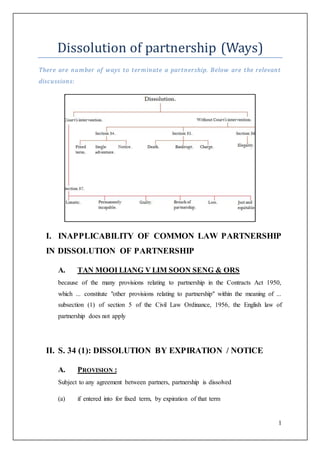
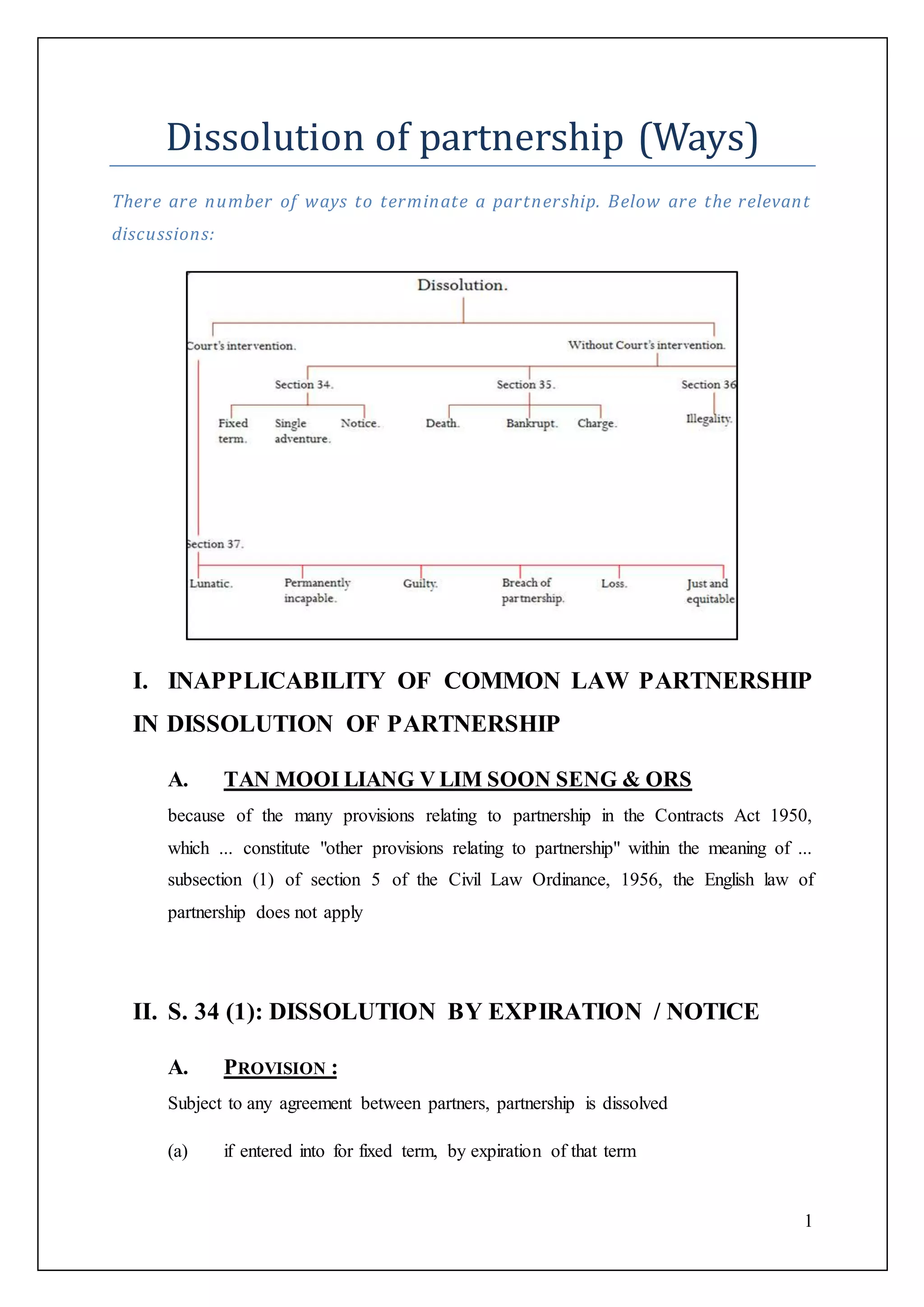
There are number of ways to terminate a partnership. Below are the relevant
discussions:
I. INAPPLICABILITY OF COMMON LAW PARTNERSHIP
IN DISSOLUTION OF PARTNERSHIP
A. TAN MOOI LIANG V LIM SOON SENG & ORS
because of the many provisions relating to partnership in the Contracts Act 1950,
which ... constitute "other provisions relating to partnership" within the meaning of ...
subsection (1) of section 5 of the Civil Law Ordinance, 1956, the English law of
partnership does not apply
II. S. 34 (1): DISSOLUTION BY EXPIRATION / NOTICE
A. PROVISION :
Subject to any agreement between partners, partnership is dissolved
(a) if entered into for fixed term, by expiration of that term
2
(b) if entered into for single adventure or undertaking, by termination of that
adventure or undertaking;
(c) if entered into for undefined time, by any partner giving notice of the other
or others of his intention to dissolve partnership
B. SECTION 34 (1)(A)MUST READ TOGOTHER WITH SECTION 29(1)
1. Provision of 29 (1) : Where a partnership entered into for a fixed term
is continued after the term has expired, and without any express new
agreement, the rights and duties of the partners remain the same as they
were at the expiration of the term, so far as is consistent with the incidents of a
partnership at will
2. Sukhinderjit Singh Muker v Arumugam Deva Rajah
Provisions under s28(1) and s34(1)(c) of act are subject to any agreement
between partners. Question that had to be considered was whether there was
implied agreement to the effect that partnership was not to be dissolved
between D and the P at time when P joined partnership and at the time when
M left the firm.
C. S. 34 (1) (C) IS CONSISTENT WITH SECTION 28 (1)
1. Provision of 28 (1) : Where no fixed term has been agreed on for the
duration of the partnership, any partner may determine the partnership at any
time on giving notice of his intention to do so to all the other partners.
3
D. ISSUE OF FORMS OF NOTICE AND ITS SUFFICIENCY TO INDICATE
INTENTION TO DISSOLVE THE PARTNERSHIP
1. Section 28 (2)
By giving the notice, it is sufficient to indicate his intention if the partnership
is constituted by written document
2. Neilson v Mossend : Bona fide, x yah show cause
Partnership for undefined time is referred to as partnership at will because any
partner may terminate the relationship at any time by notice without having to
show cause. The right to dissolve partnership must be exercised bona fide and
not for the purpose of deriving undue advantage from state of firm’s
engagements.
3. Philips v Melville : Notice of termination may be inferred from
conducts of parties
Facts: P and D carried on business in partnership as beekepeers. P sued for
account of profits of business and both in his original and amended statement
of claim asked the court to order dissolution of partnership. Although there
was no effective notice, court could order dissolution under provision of act.
4. Jorgensen v Boyce : Mere omission to act in certain circumstances
may amount to implied notice of termination.
Held : A working partnership entered into for an undefined time, may be
terminated by one of the partners ceasing to work unless he is prepared to
provide an acceptable substitute at his own expense. Decision was based on
principle that in working partnerships there is implied term that voluntary
cessation of work operates as notice of intention not to continue the
partnership.
4
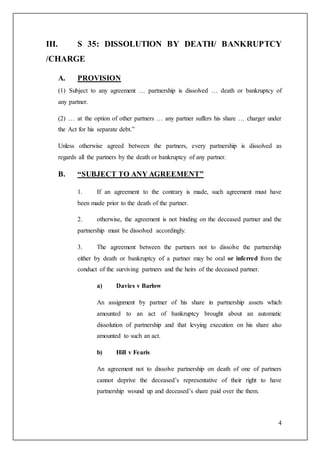
III. S 35: DISSOLUTION BY DEATH/ BANKRUPTCY
/CHARGE
A. PROVISION
(1) Subject to any agreement … partnership is dissolved … death or bankruptcy of
any partner.
(2) … at the option of other partners … any partner suffers his share … charger under
the Act for his separate debt.”
Unless otherwise agreed between the partners, every partnership is dissolved as
regards all the partners by the death or bankruptcy of any partner.
B. “SUBJECT TO ANY AGREEMENT”
1. If an agreement to the contrary is made, such agreement must have
been made prior to the death of the partner.
2. otherwise, the agreement is not binding on the deceased partner and the
partnership must be dissolved accordingly.
3. The agreement between the partners not to dissolve the partnership
either by death or bankruptcy of a partner may be oral or inferred from the
conduct of the surviving partners and the heirs of the deceased partner.
a) Davies v Barlow
An assignment by partner of his share in partnership assets which
amounted to an act of bankruptcy brought about an automatic
dissolution of partnership and that levying execution on his share also
amounted to such an act.
b) Hill v Fearis
An agreement not to dissolve partnership on death of one of partners
cannot deprive the deceased’s representative of their right to have
partnership wound up and deceased’s share paid over the them.
5
C. INTERPRETATION OF S.35 (2) –READ TOGETHER WITH S. 25 (2)
1. Where a partner's share in the partnership is charged for his separate
debt, the other partners may, at their option, decide to dissolve the partnership.
IV.S. 36 : DISSOLUTION BY REASON OF ILLEGALITY
(BY OPERATION OF LAW)
A. PROVISION
A partnership is dissolved by the happening of unlawful event for the firm to carry out
its business or for the partners to carry it on in partnership
B. IT IS IMMATERIAL WHETHER THE PARTNERS KNEW OF THE
ILLEGALITY OR NOT.
1. Hudgell Yeates & Co v Watson
[F]- One of the members of the firm carrying on business as solicitors allowed
his practicing certificate required under the relevant English legislation to
lapse.
[H]- This event brought about the dissolution of the partnership regardless
whether the partners knew of the lapse of the certificate or not.
V. DISSOLUTION BY COURT
ď‚· On application by partner, court may decree dissolution of partnership in any of
following case :
ď‚· Thein Hong Teck & Ors v Mohd Afrizan bin Husain
o the application can be made only by a partner of a partnership. A creditor such
as the respondents in the instant case cannot make an application under that s
37 to dissolve a partnership.
6
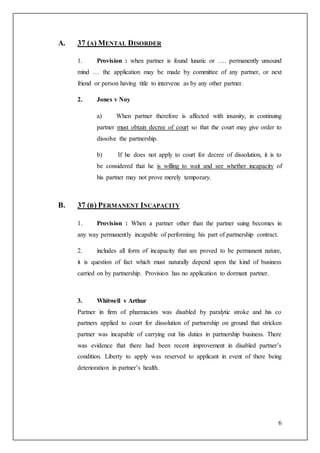
A. 37 (A) MENTAL DISORDER
1. Provision : when partner is found lunatic or …. permanently unsound
mind … the application may be made by committee of any partner, or next
friend or person having title to intervene as by any other partner.
2. Jones v Noy
a) When partner therefore is affected with insanity, in continuing
partner must obtain decree of court so that the court may give order to
dissolve the partnership.
b) If he does not apply to court for decree of dissolution, it is to
be considered that he is willing to wait and see whether incapacity of
his partner may not prove merely temporary.
B. 37 (B) PERMANENT INCAPACITY
1. Provision : When a partner other than the partner suing becomes in
any way permanently incapable of performing his part of partnership contract.
2. includes all form of incapacity that are proved to be permanent nature,
it is question of fact which must naturally depend upon the kind of business
carried on by partnership. Provision has no application to dormant partner.
3. Whitwell v Arthur
Partner in firm of pharmacists was disabled by paralytic stroke and his co
partners applied to court for dissolution of partnership on ground that stricken
partner was incapable of carrying out his duties in partnership business. There
was evidence that there had been recent improvement in disabled partner’s
condition. Liberty to apply was reserved to applicant in event of there being
deterioration in partner’s health.
7
C. 37 (C) CONDUCT PREJUDICIAL TO THE BUSINESS
1. Provision : When the partner who being sued has been guilty of such
prejudicial conduct to nature of business
2. The court will see the nature of the partnership business in determining
whether such conduct is calculated to affect prejudicially the operations of the
business.
3. Snow v Milford (1868) :The conduct is prejudiced as against the
partnership business, and not of a personal nature.
[F]- A partner committed an adultery towards another partner.
[H]- The adultery of a partner was conduct insufficient to warrant
expelling that partner or dissolving the partnership.
4. Pearce v Foster : actual effect of the prejudicial act is unnecessary
It was not necessary for applicant to prove that partnership has suffered any
actual business loss, but merely that if conduct had come to knowledge of
firm’s customers the business would have been injured.
5. The party who is guilty of prejudicial conduct cannot apply for
decree of dissolution. This is declaratory of common law rule that person
cannot base cause of action on his own wrongdoing and of equitable maxim
that a person who come to equity must do so with clean hands.
D. 37 (D) :WILLFUL / PERSISTENT BREACHES
1. Provision : When the partner who being sued is wilfully or
persistently commits a breach of partnership agreement or his conduct is not
reasonably practicable for other partners to carry on business in partnership
with him.
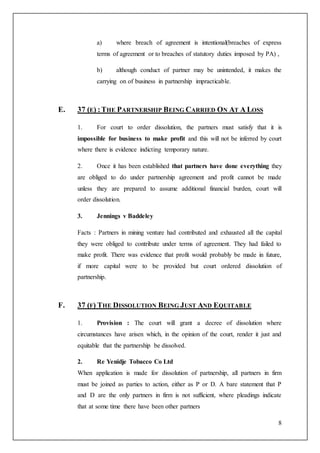
2. This section covers 2 circumstances,
8
a) where breach of agreement is intentional(breaches of express
terms of agreement or to breaches of statutory duties imposed by PA) ,
b) although conduct of partner may be unintended, it makes the
carrying on of business in partnership impracticable.
E. 37 (E) :THE PARTNERSHIP BEING CARRIED ON AT A LOSS
1. For court to order dissolution, the partners must satisfy that it is
impossible for business to make profit and this will not be inferred by court
where there is evidence indicting temporary nature.
2. Once it has been established that partners have done everything they
are obliged to do under partnership agreement and profit cannot be made
unless they are prepared to assume additional financial burden, court will
order dissolution.
3. Jennings v Baddeley
Facts : Partners in mining venture had contributed and exhausted all the capital
they were obliged to contribute under terms of agreement. They had failed to
make profit. There was evidence that profit would probably be made in future,
if more capital were to be provided but court ordered dissolution of
partnership.
F. 37 (F) THE DISSOLUTION BEING JUST AND EQUITABLE
1. Provision : The court will grant a decree of dissolution where
circumstances have arisen which, in the opinion of the court, render it just and
equitable that the partnership be dissolved.
2. Re Yenidje Tobacco Co Ltd
When application is made for dissolution of partnership, all partners in firm
must be joined as parties to action, either as P or D. A bare statement that P
and D are the only partners in firm is not sufficient, where pleadings indicate
that at some time there have been other partners
9
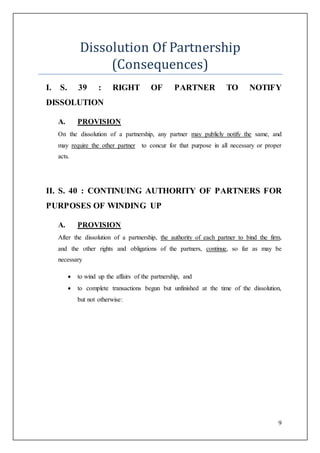
Dissolution Of Partnership
(Consequences)
I. S. 39 : RIGHT OF PARTNER TO NOTIFY
DISSOLUTION
A. PROVISION
On the dissolution of a partnership, any partner may publicly notify the same, and
may require the other partner to concur for that purpose in all necessary or proper
acts.
II. S. 40 : CONTINUING AUTHORITY OF PARTNERS FOR
PURPOSES OF WINDING UP
A. PROVISION
After the dissolution of a partnership, the authority of each partner to bind the firm,
and the other rights and obligations of the partners, continue, so far as may be
necessary
ď‚· to wind up the affairs of the partnership, and
ď‚· to complete transactions begun but unfinished at the time of the dissolution,
but not otherwise:
10
III. S. 42 : APPORTIONMENT OF PREMIUM WHERE
PARTNERSHIP PREMATURELY DISSOLVED
A. PROVISION
IV.S. 43 : RIGHTS OF PARTNERS IF THE PARTNERSHIP
IS DISSOLVED FOR FRAUD OR MISREPRESENTATION
A. PROVISION
The innocent party entitled to
(a) to a lien on, or right of retention of, the surplus of the partnership assets
(b) to stand in the place of the creditors of the firm for any payments made by him in
respect of the partnership liabilities
(c) to be indemnified by the person guilty of fraud or making the representation
against all the debts and liabilities of the firm
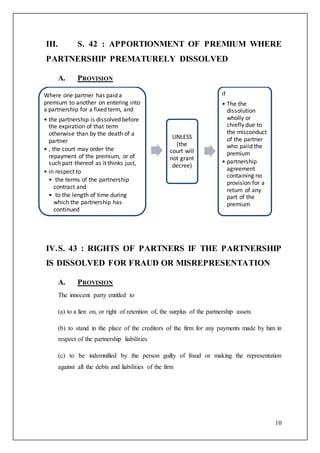
Where one partner has paid a
premium to another on entering into
a partnership for a fixed term, and
• the partnership is dissolved before
the expiration of that term
otherwise than by the death of a
partner
• , the court may order the
repayment of the premium, or of
such part thereof as it thinks just,
• in respect to
• the terms of the partnership
contract and
• to the length of time during
which the partnership has
continued
UNLESS
(the
court will
not grant
decree)
if
• The the
dissolution
wholly or
chiefly due to
the misconduct
of the partner
who paiid the
premium
• partnership
agreement
containing no
provision for a
return of any
part of the
premium
11
V. S.44: RIGHTS OF OUTGOING PARTNER TO SHARE
PROFITS MADE AFTER DISSOLUTION.
A. PROVISION
Where a partner dies or otherwise ceases to be a partner..
…the surviving partners carry on the partnership business with its capital or assets
without any final settlement ..
…entitle to such share of the profits made since the dissolution …
…subject to there being no agreement to the contrary between the outgoing partner or
his estate and the firm.
VI. S.45: RETIRING / DECEASED PARTNER'S SHARE TO
BE A DEBT
A. PROVISION
any amounts due to an outgoing partner or representatives of a deceased partner..
…such amount will be construed as a debt owing as at the date of dissolution or death
of the partner..
This position may be varied upon mutual agreement of the parties
VII. S.46: RULES FOR DISTRIBUTION OF ASSETS ON
FINAL SETTLEMENT OF ACCOUNTS.
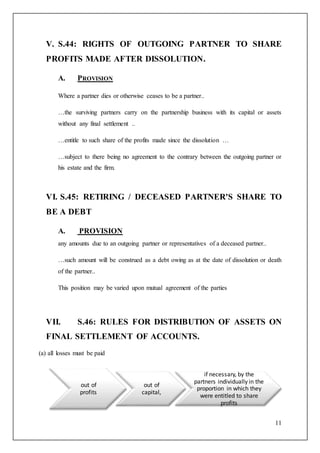
(a) all losses must be paid
out of
profits
out of
capital,
if necessary, by the
partners individually in the
proportion in which they
were entitled to share
profits
12
(b)the assets of the partnership (including the sums, if any, contributed by the partners to
make up losses or deficiencies of capital) must be applied in the following order:
payment of the debts and liabilities of the firm owing to
outsiders,
payment to each partner for his advances as
distinguished from capital,
payment to each partner rateably what is due from the
firm to him in respect of capital;] and
the ultimate residue if any, to be divided among the
partners in the proportion in which the profits are
divisible

Dissolution of partnership

  • 1.
    1 Dissolution of partnership(Ways) There are number of ways to terminate a partnership. Below are the relevant discussions: I. INAPPLICABILITY OF COMMON LAW PARTNERSHIP IN DISSOLUTION OF PARTNERSHIP A. TAN MOOI LIANG V LIM SOON SENG & ORS because of the many provisions relating to partnership in the Contracts Act 1950, which ... constitute "other provisions relating to partnership" within the meaning of ... subsection (1) of section 5 of the Civil Law Ordinance, 1956, the English law of partnership does not apply II. S. 34 (1): DISSOLUTION BY EXPIRATION / NOTICE A. PROVISION : Subject to any agreement between partners, partnership is dissolved (a) if entered into for fixed term, by expiration of that term
  • 2.
    2 (b) if enteredinto for single adventure or undertaking, by termination of that adventure or undertaking; (c) if entered into for undefined time, by any partner giving notice of the other or others of his intention to dissolve partnership B. SECTION 34 (1)(A)MUST READ TOGOTHER WITH SECTION 29(1) 1. Provision of 29 (1) : Where a partnership entered into for a fixed term is continued after the term has expired, and without any express new agreement, the rights and duties of the partners remain the same as they were at the expiration of the term, so far as is consistent with the incidents of a partnership at will 2. Sukhinderjit Singh Muker v Arumugam Deva Rajah Provisions under s28(1) and s34(1)(c) of act are subject to any agreement between partners. Question that had to be considered was whether there was implied agreement to the effect that partnership was not to be dissolved between D and the P at time when P joined partnership and at the time when M left the firm. C. S. 34 (1) (C) IS CONSISTENT WITH SECTION 28 (1) 1. Provision of 28 (1) : Where no fixed term has been agreed on for the duration of the partnership, any partner may determine the partnership at any time on giving notice of his intention to do so to all the other partners.
  • 3.
    3 D. ISSUE OFFORMS OF NOTICE AND ITS SUFFICIENCY TO INDICATE INTENTION TO DISSOLVE THE PARTNERSHIP 1. Section 28 (2) By giving the notice, it is sufficient to indicate his intention if the partnership is constituted by written document 2. Neilson v Mossend : Bona fide, x yah show cause Partnership for undefined time is referred to as partnership at will because any partner may terminate the relationship at any time by notice without having to show cause. The right to dissolve partnership must be exercised bona fide and not for the purpose of deriving undue advantage from state of firm’s engagements. 3. Philips v Melville : Notice of termination may be inferred from conducts of parties Facts: P and D carried on business in partnership as beekepeers. P sued for account of profits of business and both in his original and amended statement of claim asked the court to order dissolution of partnership. Although there was no effective notice, court could order dissolution under provision of act. 4. Jorgensen v Boyce : Mere omission to act in certain circumstances may amount to implied notice of termination. Held : A working partnership entered into for an undefined time, may be terminated by one of the partners ceasing to work unless he is prepared to provide an acceptable substitute at his own expense. Decision was based on principle that in working partnerships there is implied term that voluntary cessation of work operates as notice of intention not to continue the partnership.
  • 4.
    4 III. S 35:DISSOLUTION BY DEATH/ BANKRUPTCY /CHARGE A. PROVISION (1) Subject to any agreement … partnership is dissolved … death or bankruptcy of any partner. (2) … at the option of other partners … any partner suffers his share … charger under the Act for his separate debt.” Unless otherwise agreed between the partners, every partnership is dissolved as regards all the partners by the death or bankruptcy of any partner. B. “SUBJECT TO ANY AGREEMENT” 1. If an agreement to the contrary is made, such agreement must have been made prior to the death of the partner. 2. otherwise, the agreement is not binding on the deceased partner and the partnership must be dissolved accordingly. 3. The agreement between the partners not to dissolve the partnership either by death or bankruptcy of a partner may be oral or inferred from the conduct of the surviving partners and the heirs of the deceased partner. a) Davies v Barlow An assignment by partner of his share in partnership assets which amounted to an act of bankruptcy brought about an automatic dissolution of partnership and that levying execution on his share also amounted to such an act. b) Hill v Fearis An agreement not to dissolve partnership on death of one of partners cannot deprive the deceased’s representative of their right to have partnership wound up and deceased’s share paid over the them.
  • 5.
    5 C. INTERPRETATION OFS.35 (2) –READ TOGETHER WITH S. 25 (2) 1. Where a partner's share in the partnership is charged for his separate debt, the other partners may, at their option, decide to dissolve the partnership. IV.S. 36 : DISSOLUTION BY REASON OF ILLEGALITY (BY OPERATION OF LAW) A. PROVISION A partnership is dissolved by the happening of unlawful event for the firm to carry out its business or for the partners to carry it on in partnership B. IT IS IMMATERIAL WHETHER THE PARTNERS KNEW OF THE ILLEGALITY OR NOT. 1. Hudgell Yeates & Co v Watson [F]- One of the members of the firm carrying on business as solicitors allowed his practicing certificate required under the relevant English legislation to lapse. [H]- This event brought about the dissolution of the partnership regardless whether the partners knew of the lapse of the certificate or not. V. DISSOLUTION BY COURT  On application by partner, court may decree dissolution of partnership in any of following case :  Thein Hong Teck & Ors v Mohd Afrizan bin Husain o the application can be made only by a partner of a partnership. A creditor such as the respondents in the instant case cannot make an application under that s 37 to dissolve a partnership.
  • 6.
    6 A. 37 (A)MENTAL DISORDER 1. Provision : when partner is found lunatic or …. permanently unsound mind … the application may be made by committee of any partner, or next friend or person having title to intervene as by any other partner. 2. Jones v Noy a) When partner therefore is affected with insanity, in continuing partner must obtain decree of court so that the court may give order to dissolve the partnership. b) If he does not apply to court for decree of dissolution, it is to be considered that he is willing to wait and see whether incapacity of his partner may not prove merely temporary. B. 37 (B) PERMANENT INCAPACITY 1. Provision : When a partner other than the partner suing becomes in any way permanently incapable of performing his part of partnership contract. 2. includes all form of incapacity that are proved to be permanent nature, it is question of fact which must naturally depend upon the kind of business carried on by partnership. Provision has no application to dormant partner. 3. Whitwell v Arthur Partner in firm of pharmacists was disabled by paralytic stroke and his co partners applied to court for dissolution of partnership on ground that stricken partner was incapable of carrying out his duties in partnership business. There was evidence that there had been recent improvement in disabled partner’s condition. Liberty to apply was reserved to applicant in event of there being deterioration in partner’s health.
  • 7.
    7 C. 37 (C)CONDUCT PREJUDICIAL TO THE BUSINESS 1. Provision : When the partner who being sued has been guilty of such prejudicial conduct to nature of business 2. The court will see the nature of the partnership business in determining whether such conduct is calculated to affect prejudicially the operations of the business. 3. Snow v Milford (1868) :The conduct is prejudiced as against the partnership business, and not of a personal nature. [F]- A partner committed an adultery towards another partner. [H]- The adultery of a partner was conduct insufficient to warrant expelling that partner or dissolving the partnership. 4. Pearce v Foster : actual effect of the prejudicial act is unnecessary It was not necessary for applicant to prove that partnership has suffered any actual business loss, but merely that if conduct had come to knowledge of firm’s customers the business would have been injured. 5. The party who is guilty of prejudicial conduct cannot apply for decree of dissolution. This is declaratory of common law rule that person cannot base cause of action on his own wrongdoing and of equitable maxim that a person who come to equity must do so with clean hands. D. 37 (D) :WILLFUL / PERSISTENT BREACHES 1. Provision : When the partner who being sued is wilfully or persistently commits a breach of partnership agreement or his conduct is not reasonably practicable for other partners to carry on business in partnership with him. 2. This section covers 2 circumstances,
  • 8.
    8 a) where breachof agreement is intentional(breaches of express terms of agreement or to breaches of statutory duties imposed by PA) , b) although conduct of partner may be unintended, it makes the carrying on of business in partnership impracticable. E. 37 (E) :THE PARTNERSHIP BEING CARRIED ON AT A LOSS 1. For court to order dissolution, the partners must satisfy that it is impossible for business to make profit and this will not be inferred by court where there is evidence indicting temporary nature. 2. Once it has been established that partners have done everything they are obliged to do under partnership agreement and profit cannot be made unless they are prepared to assume additional financial burden, court will order dissolution. 3. Jennings v Baddeley Facts : Partners in mining venture had contributed and exhausted all the capital they were obliged to contribute under terms of agreement. They had failed to make profit. There was evidence that profit would probably be made in future, if more capital were to be provided but court ordered dissolution of partnership. F. 37 (F) THE DISSOLUTION BEING JUST AND EQUITABLE 1. Provision : The court will grant a decree of dissolution where circumstances have arisen which, in the opinion of the court, render it just and equitable that the partnership be dissolved. 2. Re Yenidje Tobacco Co Ltd When application is made for dissolution of partnership, all partners in firm must be joined as parties to action, either as P or D. A bare statement that P and D are the only partners in firm is not sufficient, where pleadings indicate that at some time there have been other partners
  • 9.
    9 Dissolution Of Partnership (Consequences) I.S. 39 : RIGHT OF PARTNER TO NOTIFY DISSOLUTION A. PROVISION On the dissolution of a partnership, any partner may publicly notify the same, and may require the other partner to concur for that purpose in all necessary or proper acts. II. S. 40 : CONTINUING AUTHORITY OF PARTNERS FOR PURPOSES OF WINDING UP A. PROVISION After the dissolution of a partnership, the authority of each partner to bind the firm, and the other rights and obligations of the partners, continue, so far as may be necessary ď‚· to wind up the affairs of the partnership, and ď‚· to complete transactions begun but unfinished at the time of the dissolution, but not otherwise:
  • 10.
    10 III. S. 42: APPORTIONMENT OF PREMIUM WHERE PARTNERSHIP PREMATURELY DISSOLVED A. PROVISION IV.S. 43 : RIGHTS OF PARTNERS IF THE PARTNERSHIP IS DISSOLVED FOR FRAUD OR MISREPRESENTATION A. PROVISION The innocent party entitled to (a) to a lien on, or right of retention of, the surplus of the partnership assets (b) to stand in the place of the creditors of the firm for any payments made by him in respect of the partnership liabilities (c) to be indemnified by the person guilty of fraud or making the representation against all the debts and liabilities of the firm Where one partner has paid a premium to another on entering into a partnership for a fixed term, and • the partnership is dissolved before the expiration of that term otherwise than by the death of a partner • , the court may order the repayment of the premium, or of such part thereof as it thinks just, • in respect to • the terms of the partnership contract and • to the length of time during which the partnership has continued UNLESS (the court will not grant decree) if • The the dissolution wholly or chiefly due to the misconduct of the partner who paiid the premium • partnership agreement containing no provision for a return of any part of the premium
  • 11.
    11 V. S.44: RIGHTSOF OUTGOING PARTNER TO SHARE PROFITS MADE AFTER DISSOLUTION. A. PROVISION Where a partner dies or otherwise ceases to be a partner.. …the surviving partners carry on the partnership business with its capital or assets without any final settlement .. …entitle to such share of the profits made since the dissolution … …subject to there being no agreement to the contrary between the outgoing partner or his estate and the firm. VI. S.45: RETIRING / DECEASED PARTNER'S SHARE TO BE A DEBT A. PROVISION any amounts due to an outgoing partner or representatives of a deceased partner.. …such amount will be construed as a debt owing as at the date of dissolution or death of the partner.. This position may be varied upon mutual agreement of the parties VII. S.46: RULES FOR DISTRIBUTION OF ASSETS ON FINAL SETTLEMENT OF ACCOUNTS. (a) all losses must be paid out of profits out of capital, if necessary, by the partners individually in the proportion in which they were entitled to share profits
  • 12.
    12 (b)the assets ofthe partnership (including the sums, if any, contributed by the partners to make up losses or deficiencies of capital) must be applied in the following order: payment of the debts and liabilities of the firm owing to outsiders, payment to each partner for his advances as distinguished from capital, payment to each partner rateably what is due from the firm to him in respect of capital;] and the ultimate residue if any, to be divided among the partners in the proportion in which the profits are divisible