Indian Partnership 
Act,1932
Dissolution Of Firms
Dissolutions of firms 
Sec 39 to 55 
Se. 39 lays down that the dissolution of partnership 
between all the partners of a firm is called the “ 
Dissolution of a firm”. 
Changes in the constitution of a firm does not amount to 
a Dissolution of a firm. 
Retirement of Partner does not amount a dissolution of 
firm.
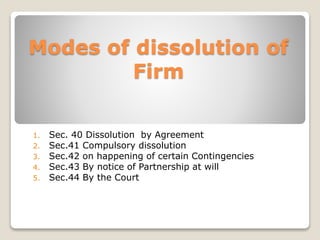
Modes of dissolution of 
Firm 
1. Sec. 40 Dissolution by Agreement 
2. Sec.41 Compulsory dissolution 
3. Sec.42 on happening of certain Contingencies 
4. Sec.43 By notice of Partnership at will 
5. Sec.44 By the Court
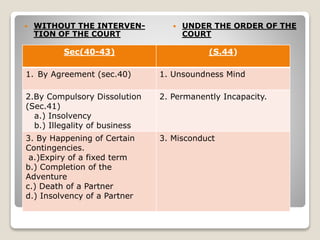
 WITHOUT THE INTERVEN-TION 
OF THE COURT 
 UNDER THE ORDER OF THE 
COURT 
Sec(40-43) (S.44) 
1. By Agreement (sec.40) 1. Unsoundness Mind 
2.By Compulsory Dissolution 
(Sec.41) 
a.) Insolvency 
b.) Illegality of business 
2. Permanently Incapacity. 
3. By Happening of Certain 
Contingencies. 
a.)Expiry of a fixed term 
b.) Completion of the 
Adventure 
c.) Death of a Partner 
d.) Insolvency of a Partner 
3. Misconduct
4. By notice from one 
partner to the others 
-In case of 
“Partnership At Will” 
(Sec.43) 
4. Partner willfully or 
Persistently commits 
a Breach Of 
Agreement 
5.Partner 
a.) Has Transferred 
the whole of his interest 
in the firm to a 3rd Party 
b.) Has allowed his 
share to be charged 
under O:-21 R:-49 of 
the Civil Procedure Code 
c.) Has allowed his 
share to be sold in the 
recovery of arrears of 
Land Revenue. 
6. Business of a firm 
cannot be carried on 
save at a loss. 
7. On any other just & 
equitable ground
Sec. 40 Dissolution by 
Agreement 
A firm may be dissolved- 
(a) With the CONSENT OF ALL THE PARTNERS; 
Example:- A firm can be discharged by the Mutual 
Agreement of the Partners. 
(Partners can, whenever they please, sit together & 
Consent to a dissolution.) (Spontaneous Consent)
Consent can be Express or Implied. 
Pandurang Vanarase V. Janardan Narain Vanarase 
1995 A1 HC 1863 (Bom) 
“When all the brothers have given in writing that they do 
not claim any share in old firm, it amounts to dissolving 
the firms.” 
b.) in accordance with a Contract between the Partners. 
Where dissolution occurs in pursuance of a contract 
previously made, the most common example being that 
of a clause in partnership deed itself, providing for the 
dissolution in certain events like “Unsoundness of 
partner”
Sec. 41 Compulsory 
Dissolution 
A firm is Dissolved:- 
(a) By the adjudication of all the partners, or all of 
the partners but one as, insolvent; Or 
where all the partners of the firm have been adjudicated 
insolvents, the partnership inevitably ends. Or only 
one partner remains solvent & all others have been 
adjudicated insolvent. 
The partnership is dissolved under clause (a) 
(b) By the happening of any event which makes it 
unlawful for the business of the firm to be carried 
on, or for the partners to carry it on in partnership.
Example:- The state Government issues an ordinance 
prohibiting liquor business in all firms. The partnership is 
automatically dissolved. 
(Sec.56 of Indian Contract Act, 1872) 
“Performance of a contract becomes unlawful, the 
contract becomes void. 
R. v. Kupfer (1915) 112 LT 1138 
Where a partnership between persons three of whom 
were in Germany & the one in England was held to have 
become illegal on the outbreak of war between 
England & Germany. 
Gherualal Parakh V. Mahadeodas AIR 1959 SC 781 
A firm to carry on a wagering business has been held by 
supreme court to be unlawful.
Sec. 42 Dissolution on the 
happening of certain 
contingencies 
Subject to contract between the partners a firm is 
dissolved,- 
(a) if constituted for a fixed term, by the expiry of that 
term; 
(b) if constituted to carry out one or more adventures or 
undertakings, by the completion thereof; 
(c) by death of a partner; and 
(d) by adjudication of a partner as an insolvent.
Noor Mohammad v. C.I.T (1991) ITR 550 (A11) 
Change in the constitution of a firm 
Where a clause in partnership deed provided that firm 
does not automatically stand dissolved on the death of a 
partner, widow of the deceased partner joined the firm 
and fresh deed of partnership was executed. 
Logical Exception 
The only logical exception is that such stipulation will be 
of no effect when the partnership consists of only two 
partners.
Sec. 43 Dissolution by 
notice of Partnership at 
will. 
1.) where the partnership is at will, the firm may be 
dissolved by any partner giving notice in writing to all 
other partners of his intention to dissolve the firm. 
2.) The firm is dissolved as from the date mentioned in 
the notice as the dissolution or, if no date is so 
mentioned, as from the date of the communication of the 
notice.
(Notice to Dissolve the Deed) 
Tilokram Ghosh v. Gita Rani AIR 1989 Cal 254 
If the firm is at will, then it can be dissolved by the 
partner or partners by giving notice in accordance with 
the provisions of Sub-sec. (1) and (2) of Sec. 43 of 
Partnership act.
Sec.44 Dissolution by 
Court 
Sec. 44 lays down Seven Important Cases in which the 
court can order of dissolution. 
A). Unsoundness of Mind / Insane 
That a partner has become of unsound mind, in which 
case the suit may be brought as well by the next friend of 
the partner who has become of unsound mind as by any 
other person. 
In such cases, dissolution become necessary to protect 
the interest both of the insane as well as other partners.
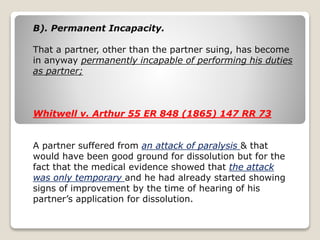
B). Permanent Incapacity. 
That a partner, other than the partner suing, has become 
in anyway permanently incapable of performing his duties 
as partner; 
Whitwell v. Arthur 55 ER 848 (1865) 147 RR 73 
A partner suffered from an attack of paralysis & that 
would have been good ground for dissolution but for the 
fact that the medical evidence showed that the attack 
was only temporary and he had already started showing 
signs of improvement by the time of hearing of his 
partner’s application for dissolution.
C.). Misconduct 
that a partner, other than a partner suing, is guilty of 
conduct which is likely to affect prejudicially the carrying 
on of the business, regard being had to the nature of the 
business; 
• Moral turpitude of a partner would be a sufficient ground 
• Snow v. Milford (1868) 18 LT 142: 16 WR 554 
• A partner of a firm of bankers committed adultery in 
the city where the business was carried on. 
• thus, adultery committed by a partner have been held 
to be sufficient grounds.
• Essel v. Hayward (1816 30 Beav. 130) 
• (breach of trust) 
• The court said that a partnership between two solicitors for 
their joint lives may be dissolved if one of the parties 
fraudulently sells out trust funds and applies the proceeds to 
his own use. 
• Professional Misconduct is also a ground of Dissolution 
•D). Persistent Breach of Agreement 
• That a partner, other than the partner suing, willfully or 
persistently commits breach of agreements relating to the 
management of the affairs of the firm or the conduct of this 
business, or otherwise so conducts himself in matters 
relating to the business that is not reasonably practicable for 
the other partners to carry on the business in partnership 
with him;
It has been held that destroying old account books, pre-paring 
false balance sheets and making false entries in 
books are sufficient grounds under this clause. 
Harrison v. tennant, (1856) 21 Beav 142. 
Any conduct which is destructive of mutual confidence 
between the partners is sufficient. 
(e) Transfer of Interest 
That a partner other than a partner suing :- 
• Has, in any way , transferred the whole of his interest in 
the firm to a third party; or 
• Has allowed his share to be charged under Order 
21,Rule 49 of the Civil Procedure Code, 1908 ; or 
• Has allowed his share to be solved in the recovery of 
arrears of land revenue, or any other dues which are 
recoverable as arrears of land revenue.
(f) Perpetual Losses 
• The reason for this ground is that the motive of every 
partnership is the acquisition of gain. If, therefore, the 
business can be constituted only at a loss. 
• It would be a good ground for the court to dissolve such 
a partnership. 
(g) Just & Equitable 
• On any other ground which renders it just & equitable 
that the firm should be dissolved. 
• Thus, if the substratum (bottom) of the partnership is 
gone or if there is a deadlock between the partners, the 
court may wind up the partnership on the ground that it 
is just & equitable to do so.
• The power of the court to dissolve a partnership on this 
ground is analogous to its power to wind up a company 
on the just & equitable ground under s. 433 of the 
Companies Act, 1956. 
• Thus, Courts have winding up of a partnership firm in 
the following cases, observing that it would be Just & 
Equitable to wind up the firm: 
a). When the substratum of the partnership was gone 
b). When there was a serious deadlock between the 
partners; 
c). Where there was a perpetual state of tense feelings 
between the partners
Difference between 
Dissolution of Firm & 
Partnership
Dissolution of Firms Dissolution of 
Partnership 
1.) complete breakdown 
of the partnership 
relation & not in any 
change in constitution of 
the Firm. 
1).Partner may by 
agreement amount 
themselves provide for 
the continuance of the 
firm. 
2.) Complete 
termination of the 
relation b/n the Partners 
2.) Partner terminates 
his relationship with the 
firm. 
3.) Business in closed. 3.)Business of the firm 
continues for the 
remaining Partner. 
4.)Assets & Liabilities of 
firms are set-off & share 
of each partner is 
calculated. 
4.) Only the share of 
out-going partner is 
calculated.
Indian partnership act,1932 "Dissolution"

Indian partnership act,1932 "Dissolution"

  • 1.
  • 2.
  • 3.
    Dissolutions of firms Sec 39 to 55 Se. 39 lays down that the dissolution of partnership between all the partners of a firm is called the “ Dissolution of a firm”. Changes in the constitution of a firm does not amount to a Dissolution of a firm. Retirement of Partner does not amount a dissolution of firm.
  • 4.
    Modes of dissolutionof Firm 1. Sec. 40 Dissolution by Agreement 2. Sec.41 Compulsory dissolution 3. Sec.42 on happening of certain Contingencies 4. Sec.43 By notice of Partnership at will 5. Sec.44 By the Court
  • 5.
     WITHOUT THEINTERVEN-TION OF THE COURT  UNDER THE ORDER OF THE COURT Sec(40-43) (S.44) 1. By Agreement (sec.40) 1. Unsoundness Mind 2.By Compulsory Dissolution (Sec.41) a.) Insolvency b.) Illegality of business 2. Permanently Incapacity. 3. By Happening of Certain Contingencies. a.)Expiry of a fixed term b.) Completion of the Adventure c.) Death of a Partner d.) Insolvency of a Partner 3. Misconduct
  • 6.
    4. By noticefrom one partner to the others -In case of “Partnership At Will” (Sec.43) 4. Partner willfully or Persistently commits a Breach Of Agreement 5.Partner a.) Has Transferred the whole of his interest in the firm to a 3rd Party b.) Has allowed his share to be charged under O:-21 R:-49 of the Civil Procedure Code c.) Has allowed his share to be sold in the recovery of arrears of Land Revenue. 6. Business of a firm cannot be carried on save at a loss. 7. On any other just & equitable ground
  • 7.
    Sec. 40 Dissolutionby Agreement A firm may be dissolved- (a) With the CONSENT OF ALL THE PARTNERS; Example:- A firm can be discharged by the Mutual Agreement of the Partners. (Partners can, whenever they please, sit together & Consent to a dissolution.) (Spontaneous Consent)
  • 8.
    Consent can beExpress or Implied. Pandurang Vanarase V. Janardan Narain Vanarase 1995 A1 HC 1863 (Bom) “When all the brothers have given in writing that they do not claim any share in old firm, it amounts to dissolving the firms.” b.) in accordance with a Contract between the Partners. Where dissolution occurs in pursuance of a contract previously made, the most common example being that of a clause in partnership deed itself, providing for the dissolution in certain events like “Unsoundness of partner”
  • 9.
    Sec. 41 Compulsory Dissolution A firm is Dissolved:- (a) By the adjudication of all the partners, or all of the partners but one as, insolvent; Or where all the partners of the firm have been adjudicated insolvents, the partnership inevitably ends. Or only one partner remains solvent & all others have been adjudicated insolvent. The partnership is dissolved under clause (a) (b) By the happening of any event which makes it unlawful for the business of the firm to be carried on, or for the partners to carry it on in partnership.
  • 10.
    Example:- The stateGovernment issues an ordinance prohibiting liquor business in all firms. The partnership is automatically dissolved. (Sec.56 of Indian Contract Act, 1872) “Performance of a contract becomes unlawful, the contract becomes void. R. v. Kupfer (1915) 112 LT 1138 Where a partnership between persons three of whom were in Germany & the one in England was held to have become illegal on the outbreak of war between England & Germany. Gherualal Parakh V. Mahadeodas AIR 1959 SC 781 A firm to carry on a wagering business has been held by supreme court to be unlawful.
  • 11.
    Sec. 42 Dissolutionon the happening of certain contingencies Subject to contract between the partners a firm is dissolved,- (a) if constituted for a fixed term, by the expiry of that term; (b) if constituted to carry out one or more adventures or undertakings, by the completion thereof; (c) by death of a partner; and (d) by adjudication of a partner as an insolvent.
  • 12.
    Noor Mohammad v.C.I.T (1991) ITR 550 (A11) Change in the constitution of a firm Where a clause in partnership deed provided that firm does not automatically stand dissolved on the death of a partner, widow of the deceased partner joined the firm and fresh deed of partnership was executed. Logical Exception The only logical exception is that such stipulation will be of no effect when the partnership consists of only two partners.
  • 13.
    Sec. 43 Dissolutionby notice of Partnership at will. 1.) where the partnership is at will, the firm may be dissolved by any partner giving notice in writing to all other partners of his intention to dissolve the firm. 2.) The firm is dissolved as from the date mentioned in the notice as the dissolution or, if no date is so mentioned, as from the date of the communication of the notice.
  • 14.
    (Notice to Dissolvethe Deed) Tilokram Ghosh v. Gita Rani AIR 1989 Cal 254 If the firm is at will, then it can be dissolved by the partner or partners by giving notice in accordance with the provisions of Sub-sec. (1) and (2) of Sec. 43 of Partnership act.
  • 15.
    Sec.44 Dissolution by Court Sec. 44 lays down Seven Important Cases in which the court can order of dissolution. A). Unsoundness of Mind / Insane That a partner has become of unsound mind, in which case the suit may be brought as well by the next friend of the partner who has become of unsound mind as by any other person. In such cases, dissolution become necessary to protect the interest both of the insane as well as other partners.
  • 16.
    B). Permanent Incapacity. That a partner, other than the partner suing, has become in anyway permanently incapable of performing his duties as partner; Whitwell v. Arthur 55 ER 848 (1865) 147 RR 73 A partner suffered from an attack of paralysis & that would have been good ground for dissolution but for the fact that the medical evidence showed that the attack was only temporary and he had already started showing signs of improvement by the time of hearing of his partner’s application for dissolution.
  • 17.
    C.). Misconduct thata partner, other than a partner suing, is guilty of conduct which is likely to affect prejudicially the carrying on of the business, regard being had to the nature of the business; • Moral turpitude of a partner would be a sufficient ground • Snow v. Milford (1868) 18 LT 142: 16 WR 554 • A partner of a firm of bankers committed adultery in the city where the business was carried on. • thus, adultery committed by a partner have been held to be sufficient grounds.
  • 18.
    • Essel v.Hayward (1816 30 Beav. 130) • (breach of trust) • The court said that a partnership between two solicitors for their joint lives may be dissolved if one of the parties fraudulently sells out trust funds and applies the proceeds to his own use. • Professional Misconduct is also a ground of Dissolution •D). Persistent Breach of Agreement • That a partner, other than the partner suing, willfully or persistently commits breach of agreements relating to the management of the affairs of the firm or the conduct of this business, or otherwise so conducts himself in matters relating to the business that is not reasonably practicable for the other partners to carry on the business in partnership with him;
  • 19.
    It has beenheld that destroying old account books, pre-paring false balance sheets and making false entries in books are sufficient grounds under this clause. Harrison v. tennant, (1856) 21 Beav 142. Any conduct which is destructive of mutual confidence between the partners is sufficient. (e) Transfer of Interest That a partner other than a partner suing :- • Has, in any way , transferred the whole of his interest in the firm to a third party; or • Has allowed his share to be charged under Order 21,Rule 49 of the Civil Procedure Code, 1908 ; or • Has allowed his share to be solved in the recovery of arrears of land revenue, or any other dues which are recoverable as arrears of land revenue.
  • 20.
    (f) Perpetual Losses • The reason for this ground is that the motive of every partnership is the acquisition of gain. If, therefore, the business can be constituted only at a loss. • It would be a good ground for the court to dissolve such a partnership. (g) Just & Equitable • On any other ground which renders it just & equitable that the firm should be dissolved. • Thus, if the substratum (bottom) of the partnership is gone or if there is a deadlock between the partners, the court may wind up the partnership on the ground that it is just & equitable to do so.
  • 21.
    • The powerof the court to dissolve a partnership on this ground is analogous to its power to wind up a company on the just & equitable ground under s. 433 of the Companies Act, 1956. • Thus, Courts have winding up of a partnership firm in the following cases, observing that it would be Just & Equitable to wind up the firm: a). When the substratum of the partnership was gone b). When there was a serious deadlock between the partners; c). Where there was a perpetual state of tense feelings between the partners
  • 22.
    Difference between Dissolutionof Firm & Partnership
  • 23.
    Dissolution of FirmsDissolution of Partnership 1.) complete breakdown of the partnership relation & not in any change in constitution of the Firm. 1).Partner may by agreement amount themselves provide for the continuance of the firm. 2.) Complete termination of the relation b/n the Partners 2.) Partner terminates his relationship with the firm. 3.) Business in closed. 3.)Business of the firm continues for the remaining Partner. 4.)Assets & Liabilities of firms are set-off & share of each partner is calculated. 4.) Only the share of out-going partner is calculated.