Kamil Trzebiatowski
(EAL Coordinator, Newland School for Girls, Kingston-upon-Hull)
EAL TeachMeet Peterborough: 25 March 2015
EAL:
Partnership Teaching
http://valuediversity-teacher.co.uk/
Frequent no-collaboration situation…
EAL Teacher Mainstream Teacher
Together
EAL and mainstream teachers
?
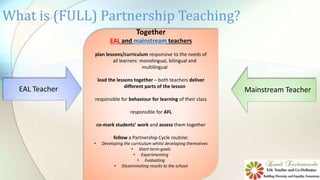
What is (FULL) Partnership Teaching?
EAL Teacher Mainstream Teacher
Together
EAL and mainstream teachers
plan lessons/curriculum responsive to the needs of
all learners: monolingual, bilingual and
multilingual
lead the lessons together – both teachers deliver
different parts of the lesson
responsible for behaviour for learning of their class
responsible for AFL
co-mark students’ work and assess them together
follow a Partnership Cycle routine:
• Developing the curriculum whilst developing themselves
• Short term-goals
• Experimenting
• Evaluating
• Disseminating results to the school
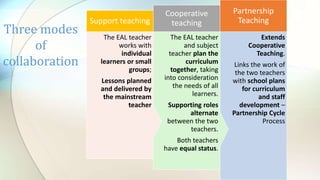
Three modes
of
collaboration
Extends
Cooperative
Teaching.
Links the work of
the two teachers
with school plans
for curriculum
and staff
development –
Partnership Cycle
Process
Partnership
Teaching
The EAL teacher
and subject
teacher plan the
curriculum
together, taking
into consideration
the needs of all
learners.
Supporting roles
alternate
between the two
teachers.
Both teachers
have equal status.
Cooperative
teaching
The EAL teacher
works with
individual
learners or small
groups;
Lessons planned
and delivered by
the mainstream
teacher
Support teaching
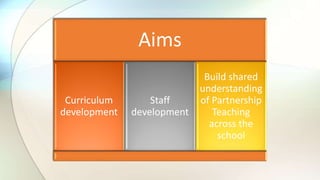
Aims
Aims
Curriculum
development
Staff
development
Build shared
understanding
of Partnership
Teaching
across the
school
Partnership Teaching Cycle
Set Goals
Experiment
EvaluateDisseminate
Review
Partnership Teaching:
• Around since 1990s (from DfE)
• Described as:
• Curriculum development
for mono- and bilingual
students
• A form of professional
development
• Most effective if school
heads and SLTs recognize
its potential and back it
up
Development
Plans include
collaborative
teaching
Partnership
Teaching as part
of CPD
Give time to
plan /
disseminate
Promote
Partnership
Teaching with
staff, parents and
children
Publish /
disseminate
case studies
In Practice…
What adverbs will I use? What will they describe?
Adverbs Actions (verbs) described
What similes will I use? Which things will I compare?
First noun
like
Second noun
What metaphors will I use? Which things will I compare?
First noun
is
Second noun
Make it alive – make it into a story!
Think of different senses: sight, hearing, smell, touch
Think of your person’s personality: what is this person like and how does he/she do
things?
How does this person react to other people?
WRITING FRAME – CHARACTER DESCRIPTION
Look at the description of our character:
Adjectives
Adverbs
Similes
A caramel-coloured, gorilla of a man, with a face like a grizzly bear, bounces like Tigger into
Twickenham Academy every morning from his home in London. He proudly sports
different, peculiar, bright socks, an upscale shirt (with a matching tie), and dark trousers.
As he solemnly settles himself into his desk, the sun hits his glasses, causing him to squint
his dark eyes. A friend leisurely walks by with a morning greeting, resulting in a smile that
reveals his cheeky grin and pearly whites. His bellowing laughter booms across the
classrooms when students ask him what he will be enjoying for lunch. His jolly attitude
carries him all the way to lunch, down the high street, as if on a sugar rush.
Adjectives
Adverbs
Similes
Metaphors
What adjectives will I use? What will they describe?
Adjectives Things / person or people described
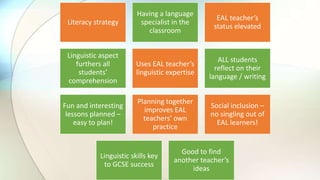
Literacy strategy
Having a language
specialist in the
classroom
EAL teacher’s
status elevated
Linguistic aspect
furthers all
students’
comprehension
Uses EAL teacher’s
linguistic expertise
ALL students
reflect on their
language / writing
Fun and interesting
lessons planned –
easy to plan!
Planning together
improves EAL
teachers’ own
practice
Social inclusion –
no singling out of
EAL learners!
Linguistic skills key
to GCSE success
Good to find
another teacher’s
ideas
Ofsted: EAL Briefing for Section 5 Inspection
9. Class/subject teachers should plan collaboratively with
EAL support teachers or teaching assistants. There should
be a focus on both language and subject content in lesson
planning.
Partnership Teaching
certainly fulfils this!
• Inservice pack for schools: Partnership Teaching:
http://www.collaborativelearning.org/partnershipteaching.pdf
• NALDIC (National Association for Language Development in the
Curriculum): http://www.naldic.org.uk/eal-advocacy/eal-news-
summary/140212
• Creese, A. (2005) Teacher Collaboration and Talk in Multilingual
Classrooms. Multilingual Matters Ltd: Clevedon, Buffalo &
Toronto
More information

Partnership Teaching

  • 1.
    Kamil Trzebiatowski (EAL Coordinator,Newland School for Girls, Kingston-upon-Hull) EAL TeachMeet Peterborough: 25 March 2015 EAL: Partnership Teaching http://valuediversity-teacher.co.uk/
  • 2.
    Frequent no-collaboration situation… EALTeacher Mainstream Teacher Together EAL and mainstream teachers ?
  • 3.
    What is (FULL)Partnership Teaching? EAL Teacher Mainstream Teacher Together EAL and mainstream teachers plan lessons/curriculum responsive to the needs of all learners: monolingual, bilingual and multilingual lead the lessons together – both teachers deliver different parts of the lesson responsible for behaviour for learning of their class responsible for AFL co-mark students’ work and assess them together follow a Partnership Cycle routine: • Developing the curriculum whilst developing themselves • Short term-goals • Experimenting • Evaluating • Disseminating results to the school
  • 4.
    Three modes of collaboration Extends Cooperative Teaching. Links thework of the two teachers with school plans for curriculum and staff development – Partnership Cycle Process Partnership Teaching The EAL teacher and subject teacher plan the curriculum together, taking into consideration the needs of all learners. Supporting roles alternate between the two teachers. Both teachers have equal status. Cooperative teaching The EAL teacher works with individual learners or small groups; Lessons planned and delivered by the mainstream teacher Support teaching
  • 5.
  • 6.
    Partnership Teaching Cycle SetGoals Experiment EvaluateDisseminate Review Partnership Teaching: • Around since 1990s (from DfE) • Described as: • Curriculum development for mono- and bilingual students • A form of professional development • Most effective if school heads and SLTs recognize its potential and back it up
  • 7.
    Development Plans include collaborative teaching Partnership Teaching aspart of CPD Give time to plan / disseminate Promote Partnership Teaching with staff, parents and children Publish / disseminate case studies
  • 8.
    In Practice… What adverbswill I use? What will they describe? Adverbs Actions (verbs) described What similes will I use? Which things will I compare? First noun like Second noun What metaphors will I use? Which things will I compare? First noun is Second noun Make it alive – make it into a story! Think of different senses: sight, hearing, smell, touch Think of your person’s personality: what is this person like and how does he/she do things? How does this person react to other people? WRITING FRAME – CHARACTER DESCRIPTION Look at the description of our character: Adjectives Adverbs Similes A caramel-coloured, gorilla of a man, with a face like a grizzly bear, bounces like Tigger into Twickenham Academy every morning from his home in London. He proudly sports different, peculiar, bright socks, an upscale shirt (with a matching tie), and dark trousers. As he solemnly settles himself into his desk, the sun hits his glasses, causing him to squint his dark eyes. A friend leisurely walks by with a morning greeting, resulting in a smile that reveals his cheeky grin and pearly whites. His bellowing laughter booms across the classrooms when students ask him what he will be enjoying for lunch. His jolly attitude carries him all the way to lunch, down the high street, as if on a sugar rush. Adjectives Adverbs Similes Metaphors What adjectives will I use? What will they describe? Adjectives Things / person or people described
  • 10.
    Literacy strategy Having alanguage specialist in the classroom EAL teacher’s status elevated Linguistic aspect furthers all students’ comprehension Uses EAL teacher’s linguistic expertise ALL students reflect on their language / writing Fun and interesting lessons planned – easy to plan! Planning together improves EAL teachers’ own practice Social inclusion – no singling out of EAL learners! Linguistic skills key to GCSE success Good to find another teacher’s ideas
  • 11.
    Ofsted: EAL Briefingfor Section 5 Inspection 9. Class/subject teachers should plan collaboratively with EAL support teachers or teaching assistants. There should be a focus on both language and subject content in lesson planning. Partnership Teaching certainly fulfils this!
  • 12.
    • Inservice packfor schools: Partnership Teaching: http://www.collaborativelearning.org/partnershipteaching.pdf • NALDIC (National Association for Language Development in the Curriculum): http://www.naldic.org.uk/eal-advocacy/eal-news- summary/140212 • Creese, A. (2005) Teacher Collaboration and Talk in Multilingual Classrooms. Multilingual Matters Ltd: Clevedon, Buffalo & Toronto More information