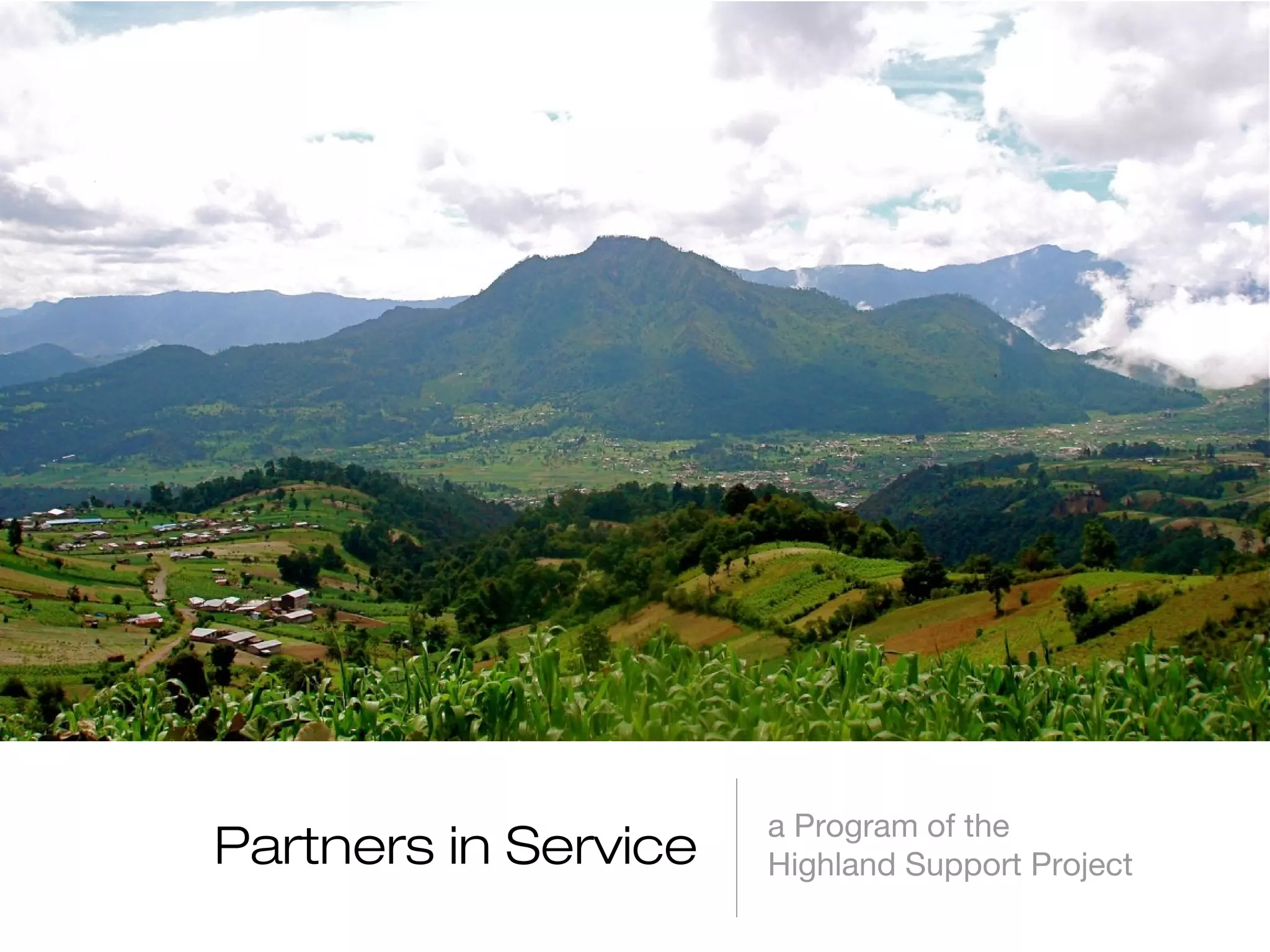
Partners in Service

a Program of the
Highland Support Project
What is the
Highland Support
Project?
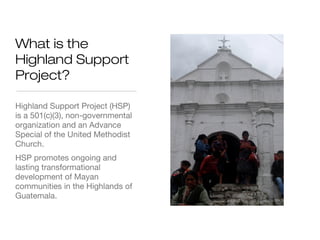
Highland Support Project (HSP)
is a 501(c)(3), non-governmental
organization and an Advance
Special of the United Methodist
Church.
HSP promotes ongoing and
lasting transformational
development of Mayan
communities in the Highlands of
Guatemala.
What is Transformational
Development?

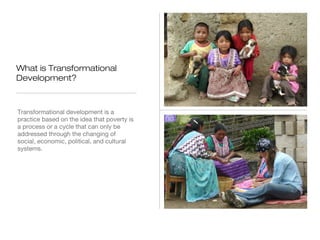
Transformational development is a
practice based on the idea that poverty is
a process or a cycle that can only be
addressed through the changing of
social, economic, political, and cultural
systems.
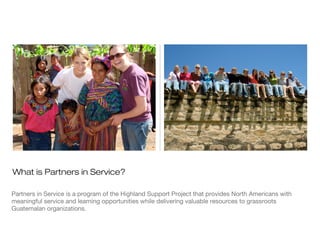
What is Partners in Service?
Partners in Service is a program of the Highland Support Project that provides North Americans with
meaningful service and learning opportunities while delivering valuable resources to grassroots
Guatemalan organizations.
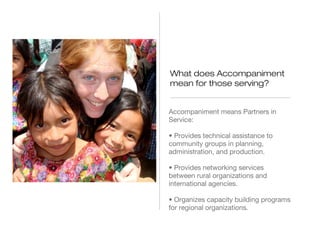
What does Accompaniment
mean for those serving?
Accompaniment means Partners in
Service:
• Provides technical assistance to
community groups in planning,
administration, and production.
• Provides networking services
between rural organizations and
international agencies.
• Organizes capacity building programs
for regional organizations.
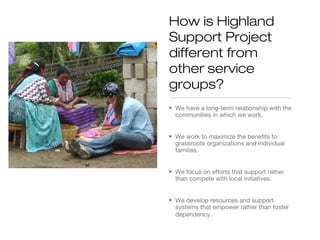
How is Highland
Support Project
different from
other service
groups?
• We have a long-term relationship with the
communities in which we work.
• We work to maximize the benefits to
grassroots organizations and individual
families.
• We focus on efforts that support rather
than compete with local initiatives.
• We develop resources and support
systems that empower rather than foster
dependency.
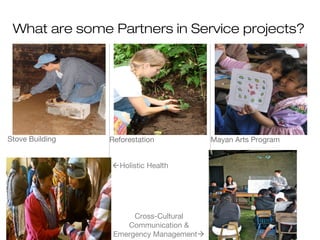
What are some Partners in Service projects?

Stove Building

Reforestation
Holistic Health

Cross-Cultural
Communication &
Emergency Management

Mayan Arts Program
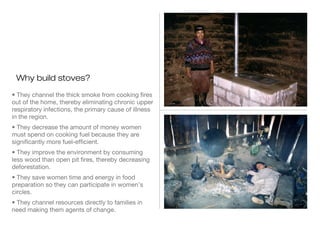
Why build stoves?
• They channel the thick smoke from cooking fires
out of the home, thereby eliminating chronic upper
respiratory infections, the primary cause of illness
in the region.
• They decrease the amount of money women
must spend on cooking fuel because they are
significantly more fuel-efficient.
• They improve the environment by consuming
less wood than open pit fires, thereby decreasing
deforestation.
• They save women time and energy in food
preparation so they can participate in women’s
circles.
• They channel resources directly to families in
need making them agents of change.
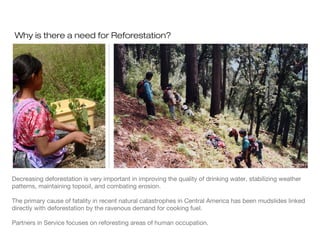
Why is there a need for Reforestation?

Decreasing deforestation is very important in improving the quality of drinking water, stabilizing weather
patterns, maintaining topsoil, and combating erosion.
The primary cause of fatality in recent natural catastrophes in Central America has been mudslides linked
directly with deforestation by the ravenous demand for cooking fuel.
Partners in Service focuses on reforesting areas of human occupation.
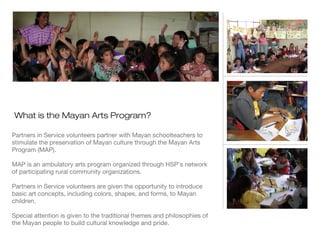
What is the Mayan Arts Program?
Partners in Service volunteers partner with Mayan schoolteachers to
stimulate the preservation of Mayan culture through the Mayan Arts
Program (MAP).
MAP is an ambulatory arts program organized through HSP’s network
of participating rural community organizations.
Partners in Service volunteers are given the opportunity to introduce
basic art concepts, including colors, shapes, and forms, to Mayan
children.
Special attention is given to the traditional themes and philosophies of
the Mayan people to build cultural knowledge and pride.
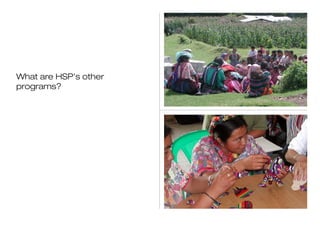
What are HSP’s other
programs?
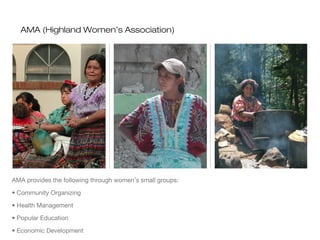
AMA (Highland Women’s Association)

AMA provides the following through women’s small groups:
• Community Organizing
• Health Management
• Popular Education
• Economic Development
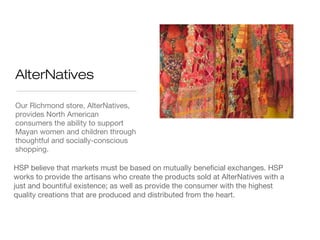
AlterNatives
Our Richmond store, AlterNatives,
provides North American
consumers the ability to support
Mayan women and children through
thoughtful and socially-conscious
shopping.
HSP believe that markets must be based on mutually beneficial exchanges. HSP
works to provide the artisans who create the products sold at AlterNatives with a
just and bountiful existence; as well as provide the consumer with the highest
quality creations that are produced and distributed from the heart.
What comes next?

Planning Your Service Trip
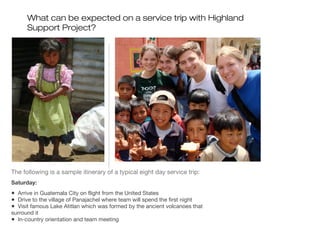
What can be expected on a service trip with Highland
Support Project?

The following is a sample itinerary of a typical eight day service trip:
Saturday:

• Arrive in Guatemala City on flight from the United States
• Drive to the village of Panajachel where team will spend the first night
• Visit famous Lake Atitlan which was formed by the ancient volcanoes that
surround it
• In-country orientation and team meeting
Sample Itinerary (continued)
• Sunday:

• Boat trip across lake Atitlan- Visit All-natural
Dye Cooperative and an Organic, ShadeGrown Coffee Plantation

Wednesday:

•
•
•

Continue service project in partner community
Relax at natural hot spring
Meet with Mayan women’s circle organizer

Thursday:

• Complete service project and celebrate with the
• Drive to the town of Quetzaltenango where
team will be housed for the week in a retreat
center

• Visit with a Mayan community activist

community
•Salsa Lesson in Quetzaltenango!!
Friday:

• Visit Maya Ruins at Iximche
•Travel to the historic capital of Antigua
• Shopping and sightseeing in Antigua
Saturday:

•Return flight to the United States
• Monday:

•

Travel to partner community for service
project orientation
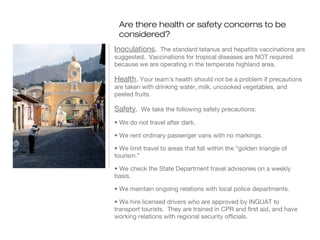
Are there health or safety concerns to be
considered?
Inoculations. The standard tetanus and hepatitis vaccinations are
suggested. Vaccinations for tropical diseases are NOT required
because we are operating in the temperate highland area.

Health. Your team’s health should not be a problem if precautions
are taken with drinking water, milk, uncooked vegetables, and
peeled fruits.

Safety. We take the following safety precautions:
• We do not travel after dark.
• We rent ordinary passenger vans with no markings.
• We limit travel to areas that fall within the “golden triangle of
tourism.”
• We check the State Department travel advisories on a weekly
basis.
• We maintain ongoing relations with local police departments.
• We hire licensed drivers who are approved by INGUAT to
transport tourists. They are trained in CPR and first aid, and have
working relations with regional security officials.
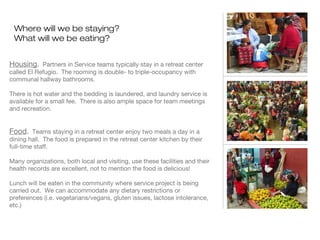
Where will we be staying?
What will we be eating?
Housing. Partners in Service teams typically stay in a retreat center
called El Refugio. The rooming is double- to triple-occupancy with
communal hallway bathrooms.
There is hot water and the bedding is laundered, and laundry service is
available for a small fee. There is also ample space for team meetings
and recreation.

Food. Teams staying in a retreat center enjoy two meals a day in a
dining hall. The food is prepared in the retreat center kitchen by their
full-time staff.
Many organizations, both local and visiting, use these facilities and their
health records are excellent, not to mention the food is delicious!
Lunch will be eaten in the community where service project is being
carried out. We can accommodate any dietary restrictions or
preferences (i.e. vegetarians/vegans, gluten issues, lactose intolerance,
etc.)
How much does a service trip with HSP
cost?

• The cost is $1700 including airfare
• This price includes food, lodging,
coordination costs, and
excursions.
• The two expenses that are not
included in this price are the cost
of a passport and a $30 exit tax.

Fair Trade Travel
HSP practices fair trade with local
service providers in order to positively
contribute to our partner communities.
It is our commitment to our service
participants to keep our costs as low as
possible to ensure that everyone has
an opportunity to serve.
HSP charges just enough per trip
participant to cover our direct
expenses of facilitating trips.
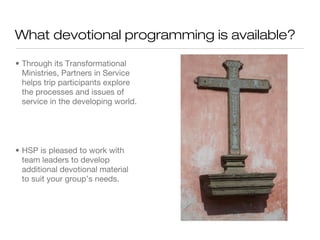
What devotional programming is available?
• Through its Transformational
Ministries, Partners in Service
helps trip participants explore
the processes and issues of
service in the developing world.

• HSP is pleased to work with
team leaders to develop
additional devotional material
to suit your group’s needs.

Partners in Service - Highland Support Project

  • 1.
    Partners in Service aProgram of the Highland Support Project
  • 2.
    What is the HighlandSupport Project? Highland Support Project (HSP) is a 501(c)(3), non-governmental organization and an Advance Special of the United Methodist Church. HSP promotes ongoing and lasting transformational development of Mayan communities in the Highlands of Guatemala.
  • 3.
    What is Transformational Development? Transformationaldevelopment is a practice based on the idea that poverty is a process or a cycle that can only be addressed through the changing of social, economic, political, and cultural systems.
  • 4.
    What is Partnersin Service? Partners in Service is a program of the Highland Support Project that provides North Americans with meaningful service and learning opportunities while delivering valuable resources to grassroots Guatemalan organizations.
  • 5.
    What does Accompaniment meanfor those serving? Accompaniment means Partners in Service: • Provides technical assistance to community groups in planning, administration, and production. • Provides networking services between rural organizations and international agencies. • Organizes capacity building programs for regional organizations.
  • 6.
    How is Highland SupportProject different from other service groups? • We have a long-term relationship with the communities in which we work. • We work to maximize the benefits to grassroots organizations and individual families. • We focus on efforts that support rather than compete with local initiatives. • We develop resources and support systems that empower rather than foster dependency.
  • 7.
    What are somePartners in Service projects? Stove Building Reforestation Holistic Health Cross-Cultural Communication & Emergency Management Mayan Arts Program
  • 8.
    Why build stoves? •They channel the thick smoke from cooking fires out of the home, thereby eliminating chronic upper respiratory infections, the primary cause of illness in the region. • They decrease the amount of money women must spend on cooking fuel because they are significantly more fuel-efficient. • They improve the environment by consuming less wood than open pit fires, thereby decreasing deforestation. • They save women time and energy in food preparation so they can participate in women’s circles. • They channel resources directly to families in need making them agents of change.
  • 9.
    Why is therea need for Reforestation? Decreasing deforestation is very important in improving the quality of drinking water, stabilizing weather patterns, maintaining topsoil, and combating erosion. The primary cause of fatality in recent natural catastrophes in Central America has been mudslides linked directly with deforestation by the ravenous demand for cooking fuel. Partners in Service focuses on reforesting areas of human occupation.
  • 10.
    What is theMayan Arts Program? Partners in Service volunteers partner with Mayan schoolteachers to stimulate the preservation of Mayan culture through the Mayan Arts Program (MAP). MAP is an ambulatory arts program organized through HSP’s network of participating rural community organizations. Partners in Service volunteers are given the opportunity to introduce basic art concepts, including colors, shapes, and forms, to Mayan children. Special attention is given to the traditional themes and philosophies of the Mayan people to build cultural knowledge and pride.
  • 11.
    What are HSP’sother programs?
  • 12.
    AMA (Highland Women’sAssociation) AMA provides the following through women’s small groups: • Community Organizing • Health Management • Popular Education • Economic Development
  • 13.
    AlterNatives Our Richmond store,AlterNatives, provides North American consumers the ability to support Mayan women and children through thoughtful and socially-conscious shopping. HSP believe that markets must be based on mutually beneficial exchanges. HSP works to provide the artisans who create the products sold at AlterNatives with a just and bountiful existence; as well as provide the consumer with the highest quality creations that are produced and distributed from the heart.
  • 14.
    What comes next? PlanningYour Service Trip
  • 15.
    What can beexpected on a service trip with Highland Support Project? The following is a sample itinerary of a typical eight day service trip: Saturday: • Arrive in Guatemala City on flight from the United States • Drive to the village of Panajachel where team will spend the first night • Visit famous Lake Atitlan which was formed by the ancient volcanoes that surround it • In-country orientation and team meeting
  • 16.
    Sample Itinerary (continued) •Sunday: • Boat trip across lake Atitlan- Visit All-natural Dye Cooperative and an Organic, ShadeGrown Coffee Plantation Wednesday: • • • Continue service project in partner community Relax at natural hot spring Meet with Mayan women’s circle organizer Thursday: • Complete service project and celebrate with the • Drive to the town of Quetzaltenango where team will be housed for the week in a retreat center • Visit with a Mayan community activist community •Salsa Lesson in Quetzaltenango!! Friday: • Visit Maya Ruins at Iximche •Travel to the historic capital of Antigua • Shopping and sightseeing in Antigua Saturday: •Return flight to the United States • Monday: • Travel to partner community for service project orientation
  • 17.
    Are there healthor safety concerns to be considered? Inoculations. The standard tetanus and hepatitis vaccinations are suggested. Vaccinations for tropical diseases are NOT required because we are operating in the temperate highland area. Health. Your team’s health should not be a problem if precautions are taken with drinking water, milk, uncooked vegetables, and peeled fruits. Safety. We take the following safety precautions: • We do not travel after dark. • We rent ordinary passenger vans with no markings. • We limit travel to areas that fall within the “golden triangle of tourism.” • We check the State Department travel advisories on a weekly basis. • We maintain ongoing relations with local police departments. • We hire licensed drivers who are approved by INGUAT to transport tourists. They are trained in CPR and first aid, and have working relations with regional security officials.
  • 18.
    Where will webe staying? What will we be eating? Housing. Partners in Service teams typically stay in a retreat center called El Refugio. The rooming is double- to triple-occupancy with communal hallway bathrooms. There is hot water and the bedding is laundered, and laundry service is available for a small fee. There is also ample space for team meetings and recreation. Food. Teams staying in a retreat center enjoy two meals a day in a dining hall. The food is prepared in the retreat center kitchen by their full-time staff. Many organizations, both local and visiting, use these facilities and their health records are excellent, not to mention the food is delicious! Lunch will be eaten in the community where service project is being carried out. We can accommodate any dietary restrictions or preferences (i.e. vegetarians/vegans, gluten issues, lactose intolerance, etc.)
  • 19.
    How much doesa service trip with HSP cost? • The cost is $1700 including airfare • This price includes food, lodging, coordination costs, and excursions. • The two expenses that are not included in this price are the cost of a passport and a $30 exit tax. Fair Trade Travel HSP practices fair trade with local service providers in order to positively contribute to our partner communities. It is our commitment to our service participants to keep our costs as low as possible to ensure that everyone has an opportunity to serve. HSP charges just enough per trip participant to cover our direct expenses of facilitating trips.
  • 20.
    What devotional programmingis available? • Through its Transformational Ministries, Partners in Service helps trip participants explore the processes and issues of service in the developing world. • HSP is pleased to work with team leaders to develop additional devotional material to suit your group’s needs.