Particle physics a comprehensive introduction 1st
Edition Abraham Seiden download pdf
https://ebookultra.com/download/particle-physics-a-comprehensive-
introduction-1st-edition-abraham-seiden/
Visit ebookultra.com today to download the complete set of
ebook or textbook!
We have selected some products that you may be interested in
Click the link to download now or visit ebookultra.com
for more options!.
Introduction to Nuclear and Particle Physics 2nd Edition A
Das
https://ebookultra.com/download/introduction-to-nuclear-and-particle-
physics-2nd-edition-a-das/
Particle Physics 1st Edition Richard A. Dunlap
https://ebookultra.com/download/particle-physics-1st-edition-richard-
a-dunlap/
Particle physics 3. ed., repr Edition Shaw
https://ebookultra.com/download/particle-physics-3-ed-repr-edition-
shaw/
Three Particle Physics and Dispersion Relation Theory 1st
Edition A. V. Anisovich
https://ebookultra.com/download/three-particle-physics-and-dispersion-
relation-theory-1st-edition-a-v-anisovich/
Alloy Physics A Comprehensive Reference 1st Edition
Wolfgang Pfeiler
https://ebookultra.com/download/alloy-physics-a-comprehensive-
reference-1st-edition-wolfgang-pfeiler/
Genocide A Comprehensive Introduction 1st Edition Adam
Jones
https://ebookultra.com/download/genocide-a-comprehensive-
introduction-1st-edition-adam-jones/
Cosmic Rays and Particle Physics 2nd Edition Thomas K.
Gaisser
https://ebookultra.com/download/cosmic-rays-and-particle-physics-2nd-
edition-thomas-k-gaisser/
Introduction to Nuclear And Particle Physics Solutions
Manual for Second Edition of Text by Das and Ferbel C.
Bromberg
https://ebookultra.com/download/introduction-to-nuclear-and-particle-
physics-solutions-manual-for-second-edition-of-text-by-das-and-ferbel-
c-bromberg/
Genocide A Comprehensive Introduction 2nd Edition Adam
Jones
https://ebookultra.com/download/genocide-a-comprehensive-
introduction-2nd-edition-adam-jones/
Particle physics a comprehensive introduction 1st Edition
Abraham Seiden Digital Instant Download
Author(s): AbrahamSeiden
ISBN(s): 9780805387360, 0805387366
Edition: 1
File Details: PDF, 49.72 MB
Year: 2005
Language: english
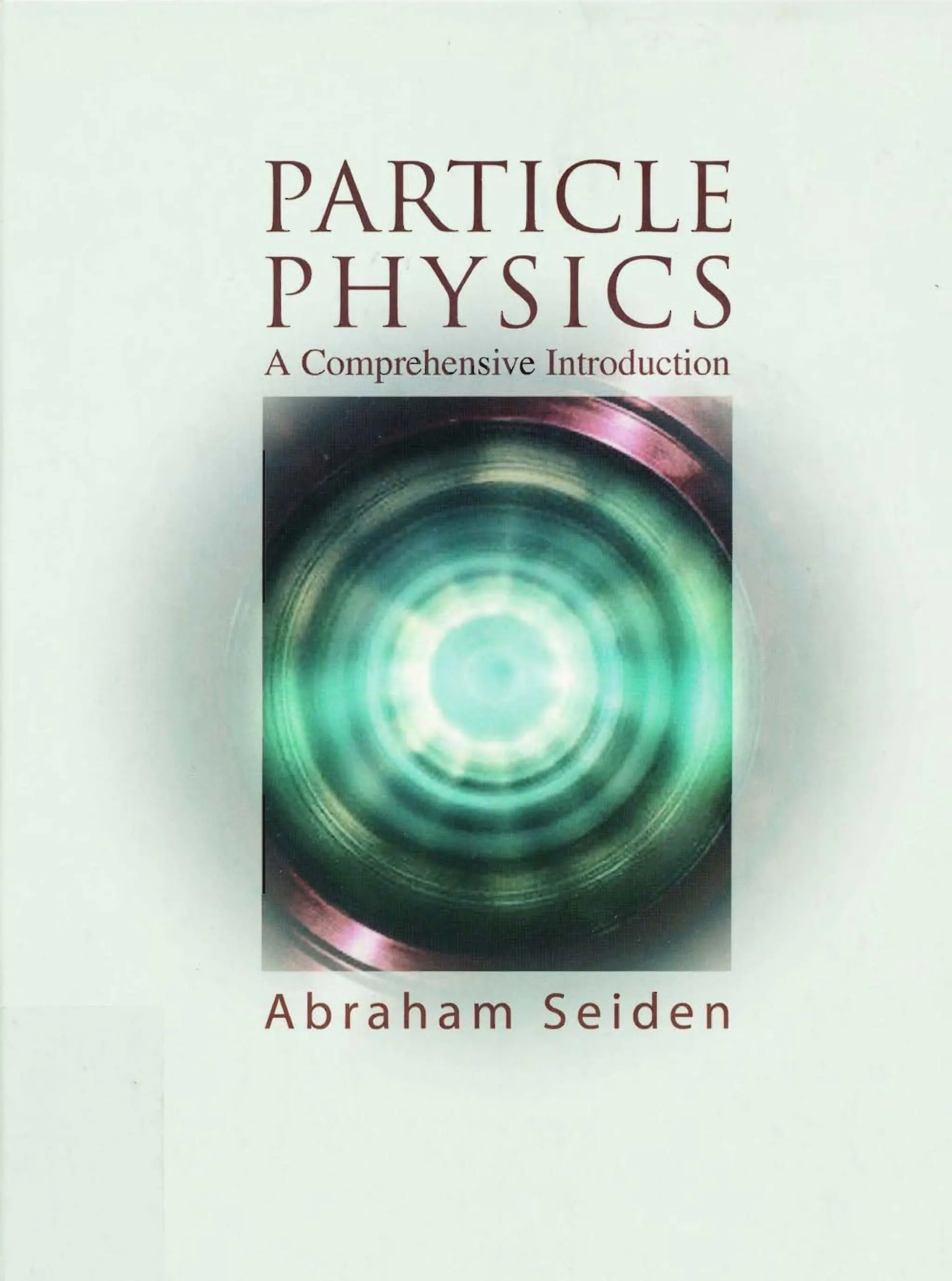
PARTICLE
PHYSICS
A Comprehensive Introduction
Abraham Seiden
PARTICLE PHYSICS
A Comprehensive Introduction
Abraham Seiden
University ofCalifornia, Santa Cruz
...
TT
Addison
Wesley
---
San Francisco Boston New York
UNIVERSIDAD
!,UTONOMA DF
MADRID
l'lBLlOTErA
('rr~C ' 1!
Capetown Hong Kong London Madrid Mexico City
Montreal Munich Paris Singapore Sydney Tokyo Toronto
~ I
Senior Executive Editor: Adam Black
Assistant Editor: Stacie Kent
Senior Production Supervisor: Corinne Benson
Senior Marketing Manager: Christy Lawrence
Managing Editor: Erin Gregg
Manufacturing Manager: Pam Augspurger
Composition: Integre Technical Publishing Co., Inc.
Cover Designer: Blakeley Kim
Library of Congress Cataloging-in-Publication Data
Seiden, A. (Abraham) Particle physics: a comprehensive introduction I Abraham Seiden.
p. cm.
Includes bibliographical references and index.
ISBN 0-8053-8736-6
I. Particles (Nuclear physics) 1. Title.
QC793.2.S422004
539.7'2-dc22
(ISBN) 0-8053-8736-6
2004009922
Copyright © 2005 Pearson Education, Inc., publishing as Addison Wesley, 130 1 Sansome St., San
Francisco, CA 94 111 . All rights reserved. Manufactured in the United States of America. This
publication is protected by Copyright and permission should be obtained from the publisher prior to
any prohibited reproduction, storage in a retrieval system, or transmission in any form or by any
means, electronic, mechanical, photocopying, recording, or likewise. To obtain permission(s) to use
material from this work, please submit a written request to Pearson Education, Inc., Permissions
Department, 1900 E. Lake Ave., Glenview, IL 60025. For information regarding permissions, call
(847) 486-2635.
..
TT
Addison
Wesley
-- 2 3 4 5 6 7 8 9 10 - DOC- 07 06 05 04
www.aw-bc.com/physics
Preface
This text covers the fundamental concepts and theories that make up the Stan-
dard Model of particle interactions. The effort to develop this model continues
the tradition of looking inside the atom and the nucleus to see how these sys-
tems are constructed and the principles that govern their behavior, providing an
understanding of matter at ever-deeper levels.
The Standard Model describes these interactions through a number of fun-
damental constituents, three families of quarks and leptons and the gauge field
quanta with which they interact. These constituents have been revealed through
the study of natural objects, as well as controlled interactions at several genera-
tions of accelerator facilities. The Standard Model has provided the quantitative
basis for understanding the very large body of data accumulated at particle accel-
erators of ever-increasing energy and luminosity. In this text the various types of
interactions are presented in sequence, allowing each part of the Standard Model
to be examined in some detail. The various concepts are always introduced in
conjunction with many detailed phenomena explained by the given idea; general
principles, stemming for example from quantum mechanics, are also emphasized.
Particle physics, at the level of this text, is usually taught in the second year
of graduate study, following advanced quantum mechanics, and often during the
same year as a field theory class. Since the sequence and numbers of classes taken
varies from one institution to another, I have attempted to make the material pre-
sented in the text self-contained. Thus the Dirac equation is presented, as well as
some material regarding field theory. This inclusion is not meant to replace a class
covering these topics more fully. I have, however, assumed that the student has an
understanding of quantum mechanics, including angular momentum and related
topics, such as Clebsch-Gordan coefficients. In the case of field theory, I have
tried to show what the mathematics is "doing," rather than attempting rigorous
derivations of the material. The material is presented using a multi-particle the-
ory, rather than the single particle equation that is often used, and hopefully this
will contribute to the appreciation of the content of field theory. The approach
taken allows a uniform treatment of fermions and bosons, as well as particles and
antiparticles. Following the introductory material, which is contained in the first
three chapters, the full phenomenology of particle physics is presented, based on
the fundamental constituents. This includes the spectrum of states of the strong in-
teractions, decays and mixing phenomena due to the various interactions, and the
behavior of scattering cross sections. In addition, a major goal is to work through
a large number of calculations, particularly for the benefit of experimentalists
v
VI Preface
who may not have an opportunity to see these calculations in any other class. A
number of homework problems accompany each chapter, allowing students to test
their understanding of the material and in some cases extend it.
In presenting particle physics we can write down a number of equations and
try to deduce their consequences, or work up through the phenomena toward a
theoretical synthesis. The material in the text is presented mostly using the latter
approach. This allows the student the opportunity to work through elements of
the theory more slowly and to understand some of the evidence that led to the
components of the Standard Model. In addition, the nonperturbative parts of the
strong interaction are mostly not rigorously calculable, so we have to develop a
separate understanding of these phenomena, which show their own regularities.
The lightest hadrons have been used for this purpose. The spectrum of these states
and their decays illustrate a numb-er of interesting phenomena. The text covers the
strong (Chapter 5), electromagnetic (Chapter 6), and weak (Chapter 8) decays of
these particles in some detail.
This text provides material for a one-year long class. It can, however, also
be used for a semester-long special topics class, for example, on the weak in-
teractions. The fraction of the material covered in the first three chapters can be
adjusted based on which other classes are taught at a given institution. Topics
covered in some detail, such as the constituent quark model and weak decays, can
be covered more briefly, with additional reading left to the student. One topic not
covered is the connection of particle physics to astrophysics and cosmology. This
is an exciting connection and I would expect that at some institutions this mate-
rial will be taught as a semester-long special topics class following the particle
physics class.
The emphasis here is pedagogical. No attempt has been made to present topics
in their historical setting. In addition, a number of important topics, such as tech-
niques used in particle detectors and particle acceleration, are not covered due to
space limitations. A number of books now cover these topics; some of these are
listed in a bibliography. They would provide interesting supplementary reading.
This text generally does not contain the references to the original scientific litera-
ture; however, many useful references are provided in the bibliography. These are
chosen for pedagogical reasons and no credit for original discovery is implied by
the selection.
The text should allow the instructor the scope for some interesting additions.
For example, although specific experiments are not discussed, the instructor can
include material relevant to the experiments at a given institution. Material can
also be added about particle detection techniques relevant to these experiments.
The calculations in Chapter II can form the basis for such a discussion. These
additions can help students make the transition to research at the given institu-
tion. In addition, the instructor can add graphic material to discussions that are
mostly algebraic or descriptive. Examples include additional Feynman diagrams
and various unitarity triangles for quark mixing.
The material presented illustrates the beautiful picture we have of particle
physics at the start of the 21st century. Important missing pieces in this picture
Preface VII
should be found in the next decade. The last chapter presents some ideas of where
nature may lead us. The discussion is very brief, since it is not clear which ideas
will prove to be a key to the future. The student can expect to learn more about
these topics over the coming years.
ACKNOWLEDGMENTS
Being a participant in a vigorous scientific community is a special privilege. The
training one receives provides the common language needed to appreciate and
enjoy the scientific progress made by the many practitioners in the field. As a truly
international activity, pmticle physics also has the additional advantage that one
can participate with a mix of interesting singular individuals from many countries.
Thus the approach that one takes to the subject reflects many fruitful interactions
with others in the community. The writing of a textbook offers the opportunity to
share the ideas and language of the field with a new generation of scientists.
The author wishes to thank Nicolo Cartiglia for a critical reading of many of the
chapters. The work on word processing by Nora Rogers, Rachel Cunningham, and
Emily Williams, over a period of several years, has made it possible to produce
the text. The author also wishes to thank the people at Addison-Wesley for their
help.
A. Seiden
Santa Cruz, California, 2004
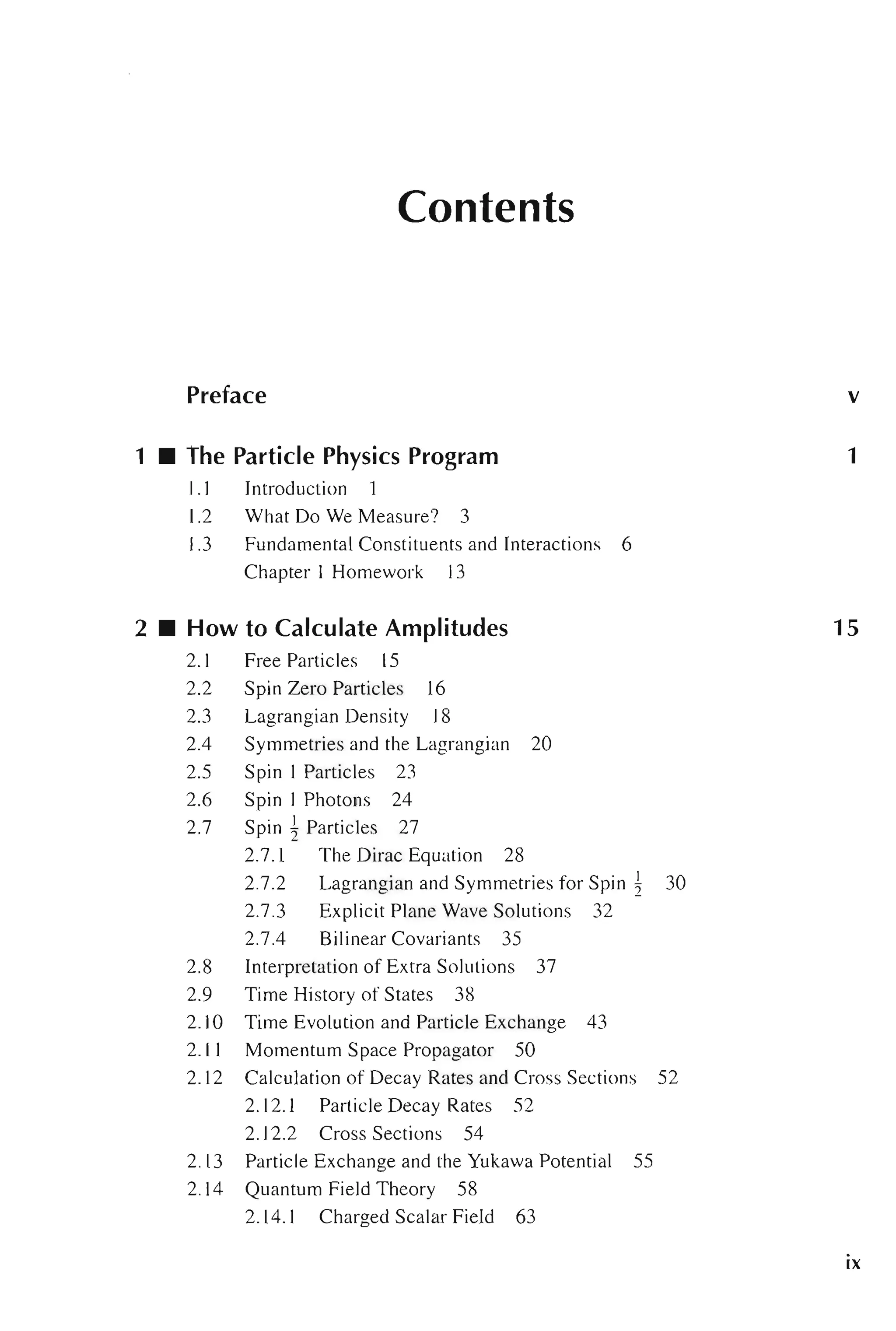
Contents
Preface
1 • The Particle Physics Program
1.1 Introduction
1.2 What Do We Measure? 3
1.3 Fundamental Constituents and Interactions 6
Chapter 1 Homework 13
2 • How to Calculate Amplitudes
2.1 Free Particles 15
2.2 Spin Zero Particles 16
2.3 Lagrangian Density 18
2.4 Symmetries and the Lagrangian 20
2.5 Spin I Particles 23
2.6 Spin 1 Photons 24
2.7 Spin ~ Particles 27
2.7.1 The Dirac Equation 28
2.7.2 Lagrangian and Symmetries for Spin ~ 30
2.7.3 Explicit Plane Wave Solutions 32
2.7.4 Bilinear Covariants 35
2.8 Interpretation of Extra Solutions 37
2.9 Time History of States 38
2.10 Time Evolution and Particle Exchange 43
2. 11 Momentum Space Propagator 50
2. 12 Calculation of Decay Rates and Cross Sections 52
2.12.1 Particle Decay Rates 52
2.12.2 Cross Sections 54
2.13 Particle Exchange and the Yukawa Potential 55
2.14 Quantum Field Theory 58
2.14.1 Charged Scalar Field 63
v
1
15
ix
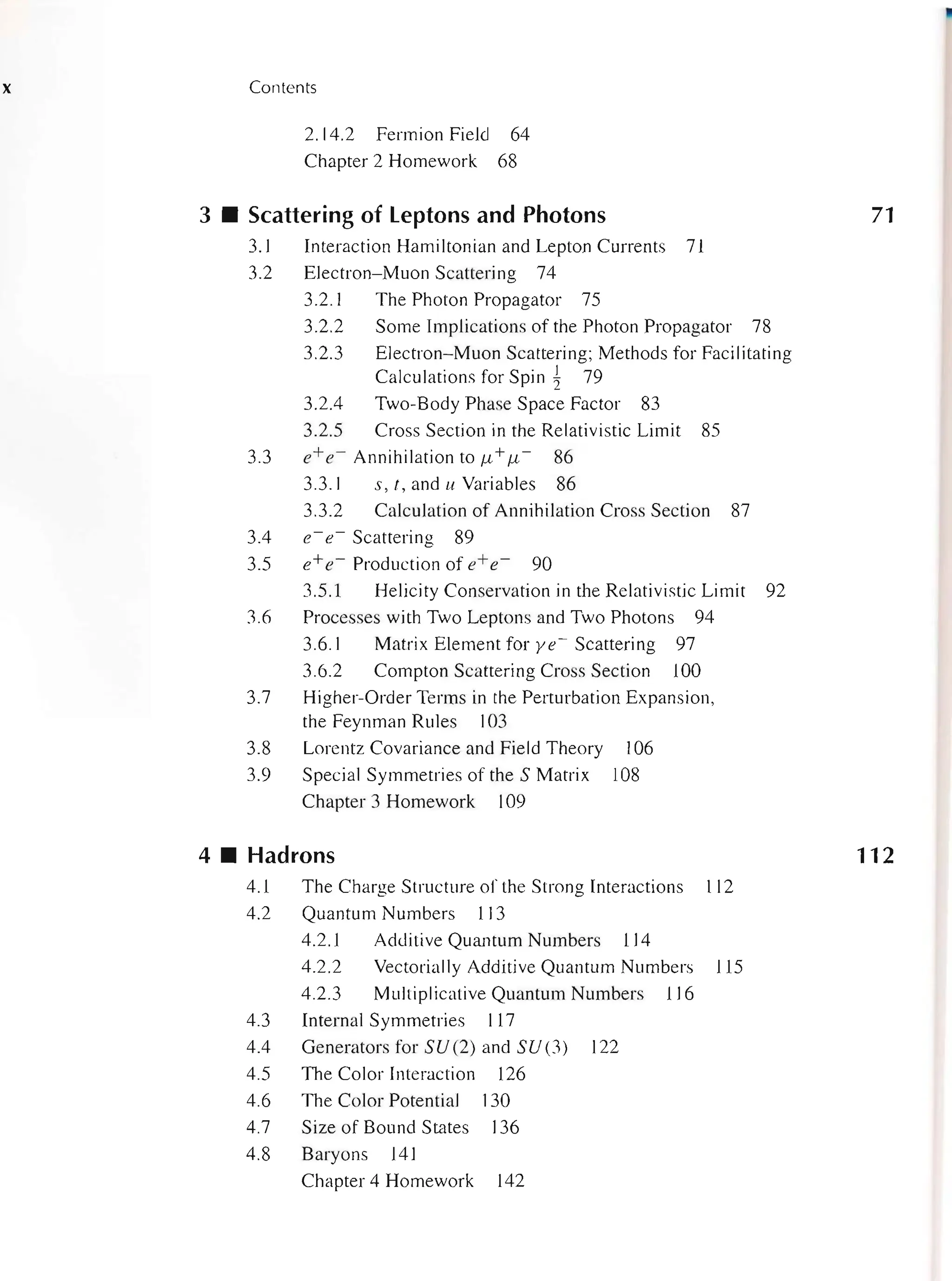
x Contents
2.14.2 Fermion Field 64
Chapter 2 Homework 68
3 • Scattering of Leptons and Photons
3.1 Interaction Hamiltonian and Lepton Currents 71
3.2 Electron- Muon Scattering 74
3.2.1 The Photon Propagator 75
3.2.2 Some Implications of the Photon Propagator 78
3.2.3 Electron-Muon Scattering; Methods for Facilitating
Calculations for Spin 1 79
3.2.4 Two-Body Phase Space Factor 83
3.2.5 Cross Section in the Relativistic Limit 85
3.3 e+ e- Annihilation to fL+ fL - 86
3.3.1 s, t,anduVariables 86
3.3.2 Calculation of Annihilation Cross Section 87
3.4 e- e- Scattering 89
3.5 e+ e- Production of e+ e- 90
3.5.1 Helicity Conservation in the Relativistic Limit 92
3.6 Processes with Two Leptons and Two Photons 94
3.6.1 Matrix Element for ye- Scattering 97
3.6.2 Compton Scattering Cross Section 100
3.7 Higher-Order Terms in the Perturbation Expansion,
the Feynman Rules 103
3.8
3.9
Lorentz Covariance and Field Theory
Special Symmetries of the S Matrix
Chapter 3 Homework 109
4 • Hadrons
106
108
4.1 The Charge Structure of the Strong Interactions 112
4.2 Quantum Numbers 113
4.2.1 Additive Quantum Numbers 114
4.2.2 Vectorially Additive Quantum Numbers 115
4.2.3 Multiplicative Quantum Numbers 116
4.3 Internal Symmetries 117
4.4 Generators for SU(2) and SU (3) 122
4.5 The Color Interaction 126
4.6 The Color Potential 130
4.7 Size of Bound States 136
4.8 Baryons 141
Chapter 4 Homework 142
71
112
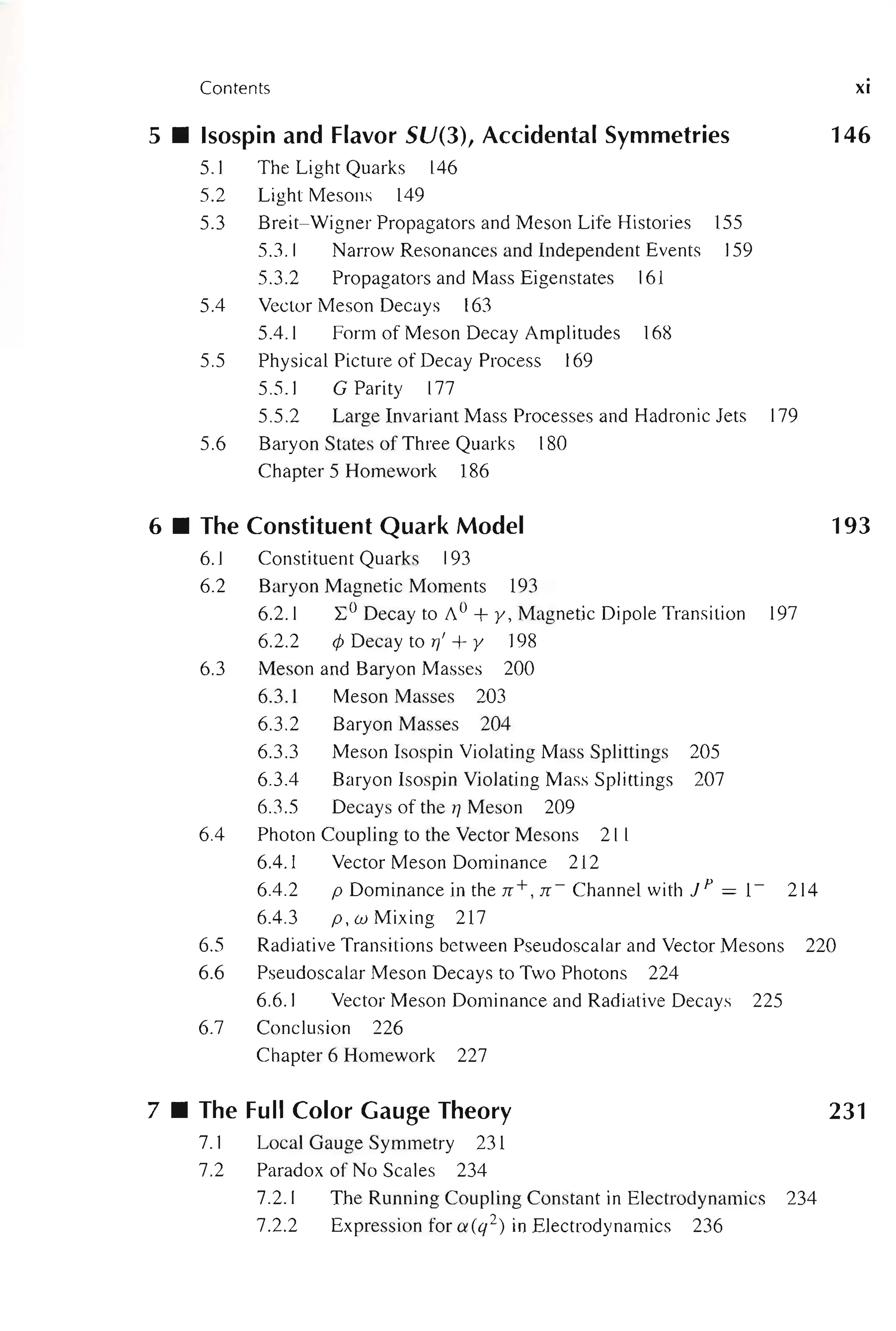
Contents
5 • Isospin and Flavor SU(3), Accidental Symmetries
5.1 The Light Quarks 146
5.2 Light Mesons 149
5.3 Breit-Wigner Propagators and Meson Life Histories 155
5.3.1 Narrow Resonances and Independent Events 159
5.3.2 Propagators and Mass Eigenstates 161
5.4 Vector Meson Decays 163
5.4.1 Form of Meson Decay Amplitudes 168
5.5 Physical Picture of Decay Process 169
5.5.1 GParity 177
5.5.2 Large Invariant Mass Processes and Hadronic Jets 179
5.6 Baryon States of Three Quarks 180
Chapter 5 Homework 186
6 • The Constituent Quark Model
6.1 Constituent Quarks 193
6.2 Baryon Magnetic Moments 193
6.2.1 L; o Decay to A0 + y, Magnetic Dipole Transition 197
6.2.2 ¢ Decay to r/ + y 198
6.3 Meson and Baryon Masses 200
6.3.1 Meson Masses 203
6.3.2 Baryon Masses 204
6.3.3 Meson Isospin Violating Mass Splittings 205
6.3.4 Baryon Isospin Violating Mass Splittings 207
6.3.5 Decays of the TJ Meson 209
6.4 Photon Coupling to the Vector Mesons 211
6.4.1 Vector Meson Dominance 212
6.4.2 p Dominance in the rr +, n- Channel with J P = 1- 214
6.4.3 p , w Mixing 217
XI
146
193
6.5 Radiative Transitions between Pseudoscalar and Vector Mesons 220
6.6 Pseudoscalar Meson Decays to Two Photons 224
6.6.1 Vector Meson Dominance and Radiative Decays 225
6.7 Conclusion 226
Chapter 6 Homework 227
7 • The Full Color Gauge Theory 231
7.1 Local Gauge Symmetry 231
7.2 Paradox of No Scales 234
7.2. 1 The Running Coupling Constant in Electrodynamics 234
7.2.2 Expression for a(q2) in Electrodynamics 236
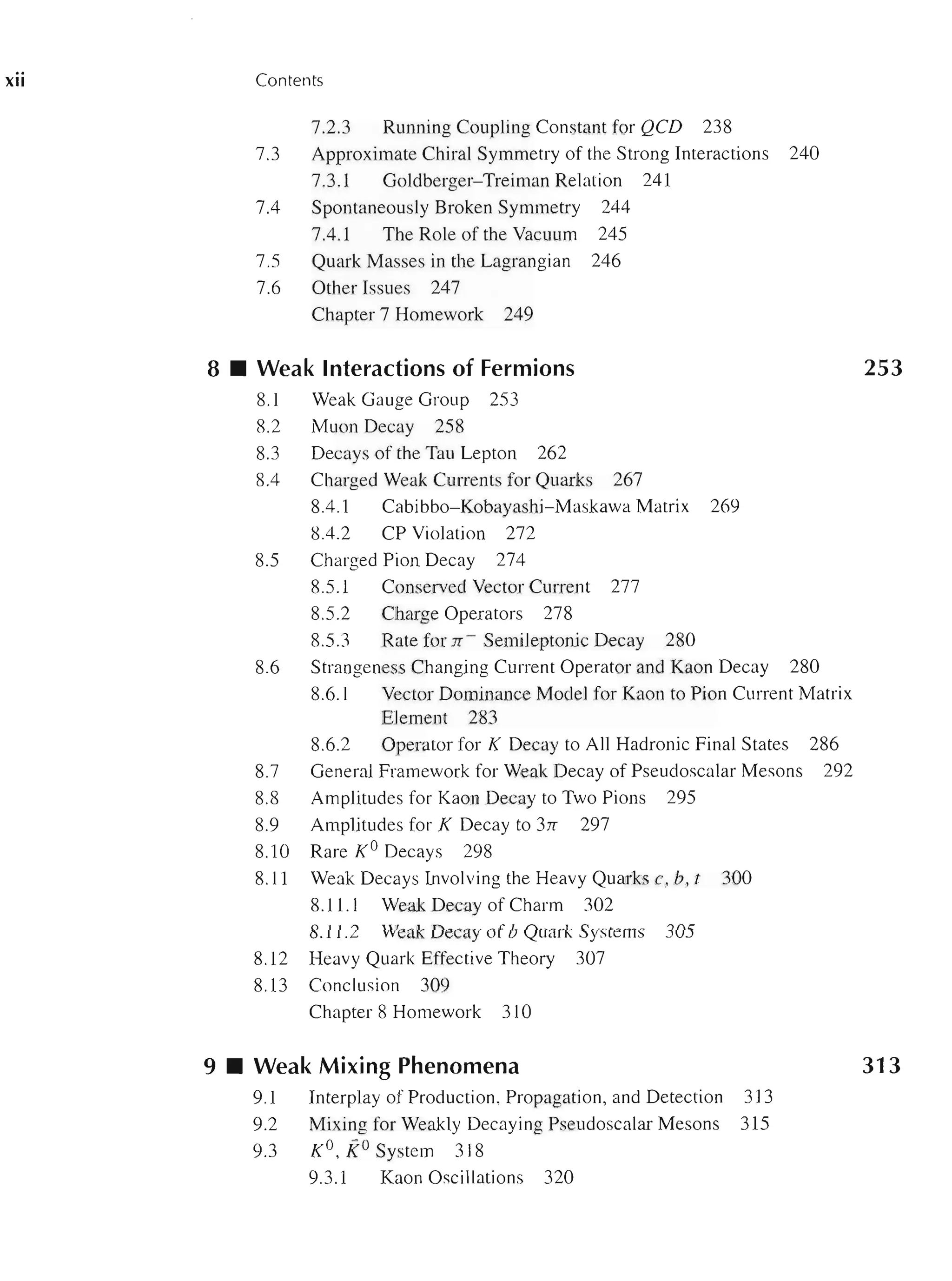
XII Contents
7.2.3 Running Coupling Constant for QeD 238
7.3 Approximate Chiral Symmetry of the Strong Interactions 240
7.3.1 Goldberger-Treiman Relation 241
7.4 Spontaneously Broken Symmetry 244
7.4.1 The Role of the Vacuum 245
7.5 Quark Masses in the Lagrangian 246
7.6 Other Issues 247
Chapter 7 Homework 249
8 • Weak Interactions of Fermions
8.1 Weak Gauge Group 253
8.2 Muon Decay 258
8.3 Decays of the Tau Lepton 262
8.4 Charged Weak Currents for Quarks 267
8.4.1 Cabibbo-Kobayashi- Maskawa Matrix 269
8.4.2 CP Violation 272
8.5 Charged Pion Decay 274
8.5.1 Conserved Vector Current 277
8.5.2 Charge Operators 278
8.5.3 Rate for n - Semileptonic Decay 280
8.6 Strangeness Changing Current Operator and Kaon Decay 280
8.6.1 Vector Dominance Model for Kaon to Pion Current Matrix
Element 283
8.6.2 Operator for K Decay to All Hadronic Final States 286
8.7 General Framework for Weak Decay of Pseudoscalar Mesons 292
8.8 Amplitudes for Kaon Decay to Two Pions 295
8.9 Amplitudes for K Decay to 3n 297
8.10 Rare KO Decays 298
8.11 Weak Decays Involving the Heavy Quarks c, b, t 300
8.1l.1 Weak Decay of Charm 302
8.1l.2 Weak Decay of b Quark Systems 305
8.12 Heavy Quark Effective Theory 307
8.13 Conclusion 309
Chapter 8 Homework 310
9 • Weak Mixing Phenomena
9.1 Interplay of Production, Propagation, and Detection 313
9.2 Mixing for Weakly Decaying Pseudoscalar Mesons 315
9.3 KO , KOSystem 318
9.3.1 Kaon Oscillations 320
253
313
Contents
9A
9.5
9.6
9.3.2 CP Violation in the Kaon System 321
DO, jjO System 327
° -0 0-0
B ,B and B s' B s Systems 329
9.5.1 CP Violation in the BO , E° System 331
Neutrino Oscillations 333
9.6.1 Three Neutrino Generations 336
9.6.2 Oscillations of Neutrinos from the Sun 338
9.6.3 Matter-Induced Oscillations in the Sun 341
9.6A CP Violation in Neutrino Mixing 344
Chapter 9 Homework 346
xiii
10 • The Electroweak Gauge Theory and Symmetry Breaking 348
10.1 Weak Neutral Current 348
10.2 Neutral Current Mixing 348
10.3 ZO Phenomenology 352
lOA Interactions among the Gauge Bosons Themselves 358
10.5 Higgs Mechanism 360
10.6 The Theory of Weinberg and Salam 365
10.7 Corrections to the Wand Z Masses 370
10.8 Generation of Fermion Masses 373
10.9 Majorana Neutrinos 375
Chapter 10 Homework 376
11 • Large Cross Section Processes
11.1 Types of Processes 378
11.2 Multiple Coulomb Scattering 380
11.2.1 Multiple Scattering Angle 382
11.2.2 Radiation Length 383
11.2.3 Energy Loss 385
11.3 Radiative Processes for Electrons and Photons 389
11.3.1 Rate Calculation for Pair Production 391
llA Inclusive Distributions in Hadronic Scattering 395
Chapter 11 Homework 401
378
12 • Scattering with Large Momentum Transfer 404
12.1 Types of Processes 404
12.2 e+e ~ Annihilation to Hadrons 405
12.2.1 Energies below ZO, the Electromagnetic Regime 405
12.2.2
12.2.3
Quark Fragmentation Functions 406
e+ e ~ Annihilation in the Electroweak Regime 410
XIV Contents
12.2.4 Energy Scale for Production of the Higgs Particle 412
12.3 Hadron Structure and Short Distance Scattering 412
12.3.1 Momentum Spectrum for Constituents 415
12.4 Deep Inelastic Lepton-Proton Scattering 417
12.4.1 Cross Section for Deep Inelastic Scattering 419
12.4.2 Structure Functions and Constituents 420
12.4.3 The Quark Picture for the Structure Function 423
12.5 Scaling Violations 429
12.5.1 Evolution Equations for Structure Functions 434
12.6 Results for Large Transverse Momentum Scattering
in jjp Reactions 436
12.7 The Next Frontier 437
Chapter 12 Homework 438
13 • Physics at Higher Energies
A • Conventions
A Units 445
B Use of Lorentz Indices 446
Bibliography
Index
441
445
449
455
CHAPTER
1 The Particle Physics Program
1.1 • INTRODUCTION
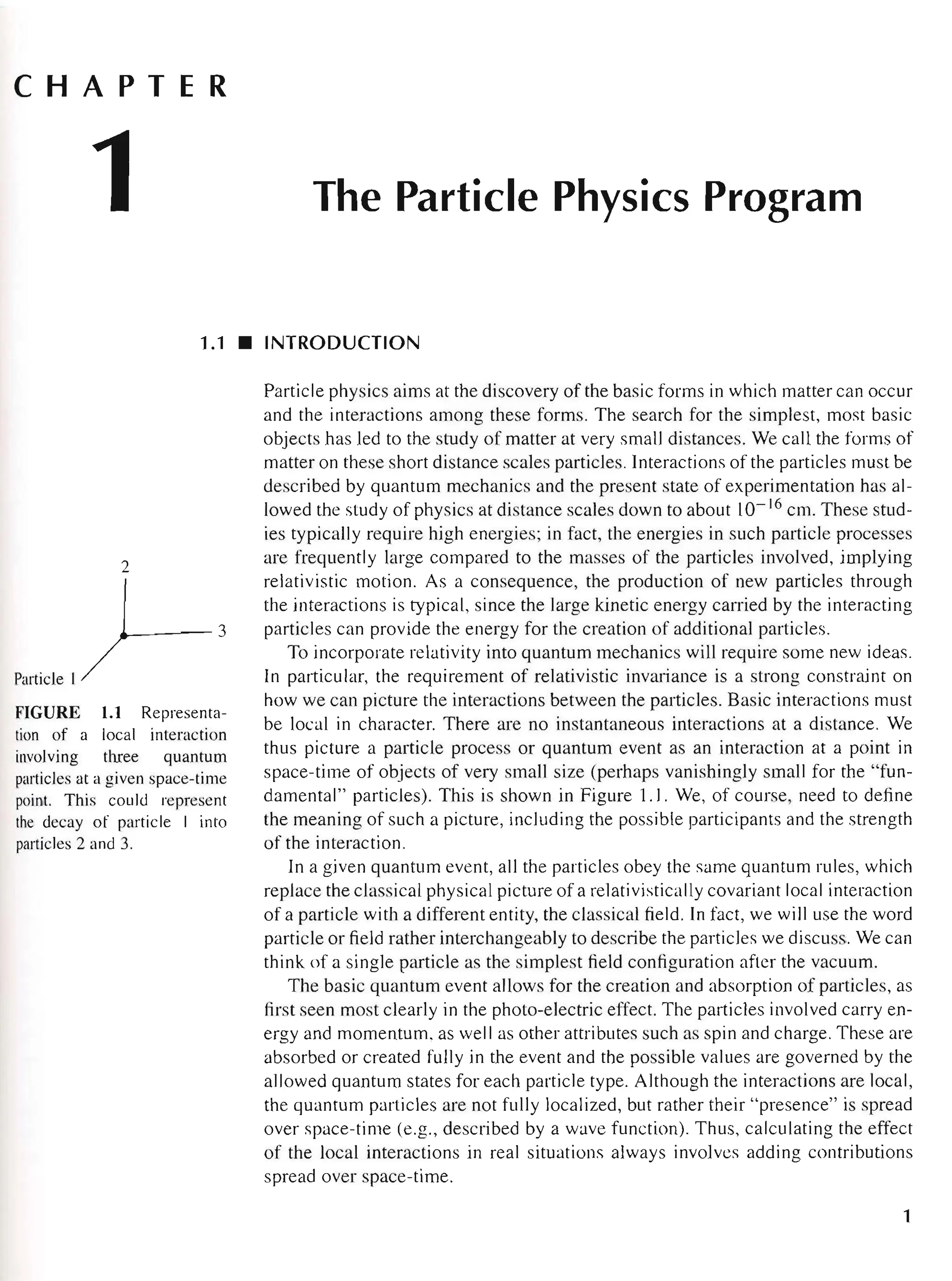
2
Pmtid,1)--3
FIGURE 1.1 Representa-
tion of a local interaction
involving three quantum
particles at a given space-time
point. This could represent
the decay of particle J into
particles 2 and 3.
Particle physics aims at the discovery of the basic forms in which matter can occur
and the interactions among these forms. The search for the simplest, most basic
objects has led to the study of matter at very small distances. We call the forms of
matter on these short distance scales particles. Interactions of the particles must be
described by quantum mechanics and the present state of experimentation has al-
lowed the study of physics at distance scales down to about 10- 16
cm. These stud-
ies typically require high energies; in fact, the energies in such particle processes
are frequently large compared to the masses of the particles involved, implying
relativistic motion. As a consequence, the production of new particles through
the interactions is typical, since the large kinetic energy carried by the interacting
particles can provide the energy for the creation of additional particles.
To incorporate relativity into quantum mechanics will require some new ideas.
In particular, the requirement of relativistic invariance is a strong constraint on
how we can picture the interactions between the particles. Basic interactions must
be local in character. There are no instantaneous interactions at a distance. We
thus picture a particle process or quantum event as an interaction at a point in
space-time of objects of very small size (perhaps vanishingly small for the "fun-
damental" particles). This is shown in Figure 1.1. We, of course, need to define
the meaning of such a picture, including the possible participants and the strength
of the interaction.
In a given quantum event, all the particles obey the same quantum rules, which
replace the classical physical picture of a relativistically covariant local interaction
of a particle with a different entity, the classical field. In fact, we will use the word
particle or field rather interchangeably to describe the particles we discuss. We can
think of a single particle as the simplest field configuration after the vacuum.
The basic quantum event allows for the creation and absorption of particles, as
first seen most clearly in the photo-electric effect. The particles involved carry en-
ergy and momentum, as well as other attributes such as spin and charge. These are
absorbed or created fully in the event and the possible values are governed by the
allowed quantum states for each particle type. Although the interactions are local,
the quantum particles are not fully localized, but rather their "presence" is spread
over space-time (e.g., described by a wave function). Thus, calculating the effect
of the local interactions in real situations always involves adding contributions
spread over space-time.
1
2 Chapter 1 The Particle Physics Program
The space-time evolution and detection of the particle systems obey the basic
principles of quantum mechanics. Primarily, these are:
1. For any system there exists a complete set of base states, which forms a
basis that we can use to describe the system when measuring its characteristics.
The values found for physical observables correspond to the values that charac-
terize the appropriate base states. The allowed values may be either discrete or
continuous. Various types of measurements mayor may not be mutually compat-
ible, leading to the limitations quantified in the uncertainty principle in the case
of incompatible measurements.
Examples of base states are the quantized energy states of atoms, molecules,
and nuclei. These begin at lowest energy with discrete bound states, followed
by a continuum representing the breakup of the system. These states are also
characterized by internal angular momenta, which are discrete.
A physical system we will often talk about is a beam of particles to be used
in a scattering experiment. The particles in such beams are usually described in
terms of a continuum of energy and momentum base states. To achieve a complete
description also requires specification of the particle spin orientation, which is a
discrete variable.
2. The evolution of a system from an initial state to a final base state is de-
scribed by a complex amplitude whose square gives the probability of finding the
system in the final base state. An example of an amplitude is the nonrelativistic
wave function, for which the particle state has been projected onto position states.
After squaring, it gives the probability density for finding the particle at a given
position as a function of time.
3. Quantum mechanics is linear. This implies that the amplitude for the evo-
lution of the system from a linear combination of initial base states to a given
final state is a linear combination of the amplitudes describing the evolution of
the individual base states, had they alone been the initial state.
For a single particle that goes from a spatially localized initial state to a well-
separated localized final state, we can calculate an amplitude for each trajectory
or path in space-time that the particle could have taken. The linearity condition
applies to these amplitudes. For indistinguishable alternative paths connecting the
initial and final state, the complex amplitudes for the alternatives add when con-
structing the full amplitude. This has long been known for light, which exhibits
various diffraction and interference phenomena, where the quantum events be-
tween which propagation occurs are the initial emission and final absorption of
the light quantum. The alternative paths are the available trajectories the light
quantum can take. Analogous interference phenomena are seen for other particles
such as neutrons or electrons.
The use of amplitudes, and the interference of alternatives, gives a wave-like
propagation between quantum events. Combined with the particle-like local in-
teraction, this gives rise to the wave-particle duality so characteristic of quantum
mechanics.
1.2 What Do We Measure? 3
4. The amplitudes must have a Lorentz covariant description, since we insist
that the physical picture of the system and its evolution must allow an equivalent
interpretation in all inertial reference frames.
The principles above have been found to be universal. For example, there can
be no strictly classical objects; all objects are quantum in nature. In addition,
there are no arbitrary potentials; rather, a potential is a consequence of the local
particle interactions and propagation. This is remarkable and exciting progress in
the development of a unified view of the rules by which nature works.
Typical of physics, the variety of phenomena allowed by the same basic rules is
truly surprising. For example, the quantum rules, when combined with the differ-
ent particle masses and interaction strengths, provide a multiplicity of structures
or systems with different characteristic dimensions and energy scales. Each such
system has its base states and amplitudes, which satisfy equations usually solved
using approximations emphasizing the relevant degrees of freedom of the system
and therefore valid over some range of distances and energies. Some examples of
increasing characteristic energy are the states within a crystal, the behavior of the
atom, the structure of the nucleus, and the nucleons within the nucleus.
1.2 • WHAT DO WE MEASURE?
The study of the forms and interactions of matter is based on observations of nat-
ural systems and on experiments arranged to create controlled interactions. The
latter, using large accelerators, have become the primary research tool for look-
ing at matter at very short distance scales. The present state of experimentation
has probed energy scales up to approximately 200 GeV This corresponds to dis-
tances on the order of 10- 16 cm. For some types of measurements we understand
the physics down to 10- 17
cm. The types of observations typically made in ex-
periments are characterized below.
The Particle Spectrum This involves the determination of the base states con-
sisting of a single stable isolated particle, along with any quantum numbers
needed for a complete description of these energy eigenstates. Such a particle
may be a composite object. These states are eigenstates of the Hamiltonian oper-
ator that determine the time evolution of the system; they provide information on
the objects and interactions the Hamiltonian describes.
Scattering of Particles In addition to seeking the spectrum of individual par-
ticles, we can create collisions between particles. This leads to measuring the
results of a scattering experiment. Here beams of particles are directed onto each
other or onto stationary targets. The resulting collisions allow us to discover new
final state particles, as well as the characteristics of the interactions of the initial
particles.
4 Chapter 1 The Particle Physics Program
Beams for scattering experiments typically originate with either low energy
electrons stripped from materials, or protons from ionized hydrogen. These par-
ticles are accelerated and can be used directly in experiments, or they can be used
to make beams of secondary particles created in collisions with intermediate tar-
gets. These secondary beams can then be used in scattering experiments.
The final collisions of interest involve two particles at a time, one from the
beam and one from the final target. Prior to collision, these were two widely
separated, noninteracting particles. Following the collision, we measure the fi-
nal particles at a distance far removed from the collision region. Here the state
can again be described in terms of separate noninteracting isolated particles. To
achieve maximum total energy, the target is often chosen to be a beam of high
momentum particles.
The states we will use to describe the motion of the initial and final particles
will usually be momentum eigenstates. Beams are usually constructed to have
reasonably well-defined momenta, and measurements on final state particles typi-
cally aim at a momentum determination. We will occasionally use states of given
angular momentum, but this is cumbersome for final states with many particles.
To complete the space-time description of a momentum eigenstate requires
specification of the spin projection along the direction of motion, called the he-
licity. Final states of different helicity are distinguishable and do not interfere.
For the initial colliding particles, the state can be specially prepared to have un-
equal populations of the various helicities providing a polarized initial state. In the
common case, where nothing is done to preferentially populate the spin states, the
initial particles contain an incoherent statistical mixture of all helicities, often re-
flecting the state from the initial particle source.
Since the evolution of the system is determined by the quantum principles, the
description of the scattering process is contained in an amplitude that is a function
of the initial and final momenta and helicities
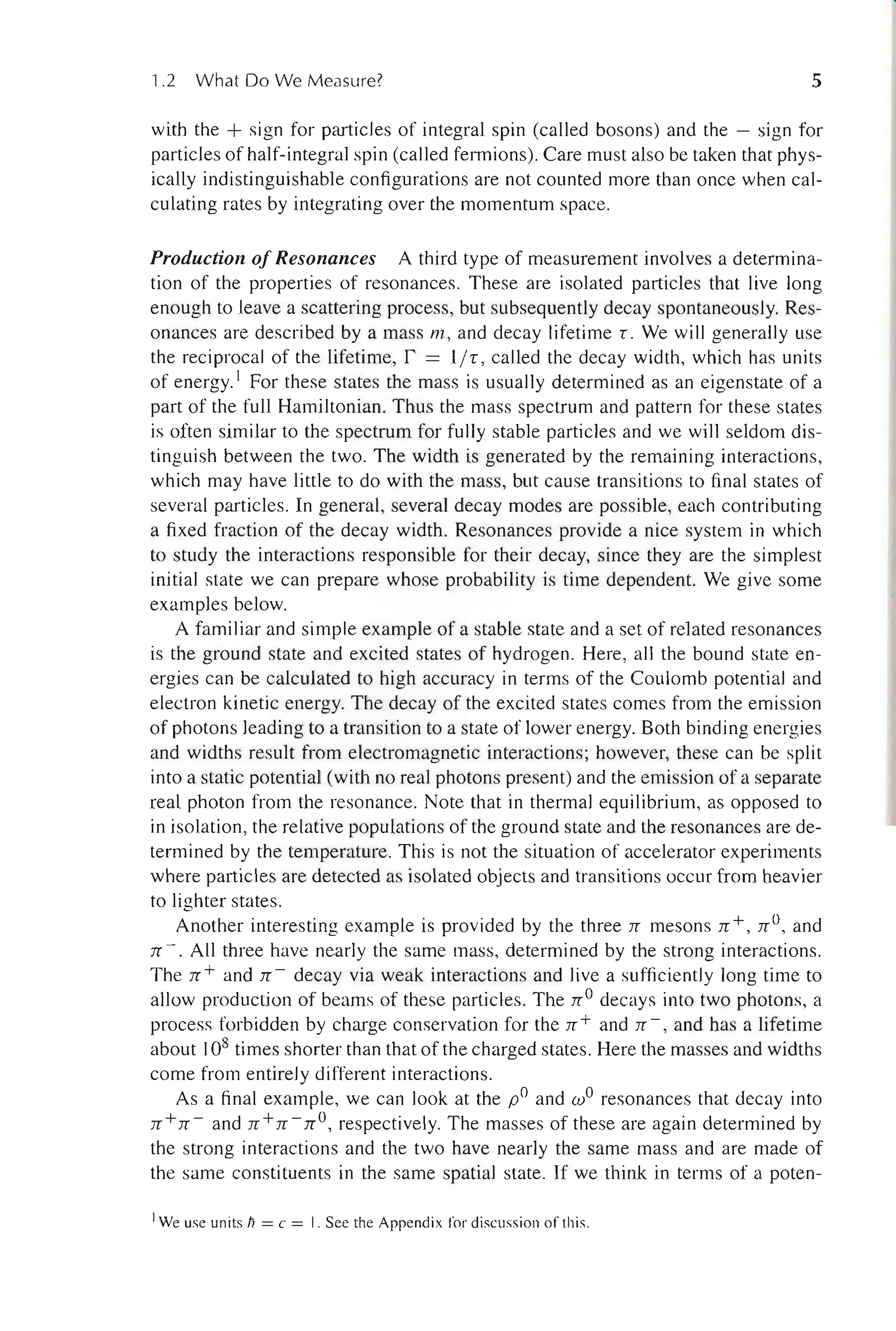
(1.1)
where PI ,A; 132 , A~ are the initial momenta and helicities and kj ,A(; ... ; kn , AI,
are the analogous quantities for the final particles, for the case of n final particles.
Rates are determined by the square of the amplitude yielding a density of events in
the momentum space describing the n final particles. The calculation must yield
an answer that is Lorentz covariant, which will provide a constraint on how the
momenta appear in the amplitude. Finally, the amplitude must be linear in the spin
degrees of freedom by the linearity requirement.
In the case of identical particles in the final state, the amplitude must reflect the
spin-statistics relation obeyed by all systems, including identical complex com-
posite systems emerging as separate isolated particles. If particles i and j are
identical, the amplitude must satisfy
A( 'k- ,f. 'k- ,f )
... , i , Ai ' ... , j , /I. j . " ==
1.2 What Do We Measure? 5
with the + sign for particles of integral spin (called bosons) and the - sign for
particles of half-integral spin (called fermions). Care must also be taken that phys-
ically indistinguishable configurations are not counted more than once when cal-
culating rates by integrating over the momentum space.
Production of Resonances A third type of measurement involves a determina-
tion of the properties of resonances. These are isolated particles that live long
enough to leave a scattering process, but subsequently decay spontaneously. Res-
onances are described by a mass m , and decay lifetime T. We will generally use
the reciprocal of the lifetime, r = liT , called the decay width, which has units
of energy. 1 For these states the mass is usuaUy determined as an eigenstate of a
part of the full Hamiltonian. Thus the mass spectrum and pattern for these states
is often similar to the spectrum for fully stable particles and we will seldom dis-
tinguish between the two. The width is generated by the remaining interactions,
which may have little to do with the mass, but cause transitions to final states of
several particles. In general, several decay modes are possible, each contributing
a fixed fraction of the decay width. Resonances provide a nice system in which
to study the interactions responsible for their decay, since they are the simplest
initial state we can prepare whose probability is time dependent. We give some
examples below.
A familiar and simple example of a stable state and a set of related resonances
is the ground state and excited states of hydrogen. Here, all the bound state en-
ergies can be calculated to high accuracy in terms of the Coulomb potential and
electron kinetic energy. The decay of the excited states comes from the emission
of photons leading to a transition to a state of lower energy. Both binding energies
and widths result from electromagnetic interactions; however, these can be split
into a static potential (with no real photons present) and the emission of a separate
real photon from the resonance. Note that in thermal equilibrium, as opposed to
in isolation, the relative populations of the ground state and the resonances are de-
termined by the temperature. This is not the situation of accelerator experiments
where particles are detected as isolated objects and transitions occur from heavier
to lighter states.
Another interesting example is provided by the three n mesons n + , nO, and
n - . All three have nearly the same mass, determined by the strong interactions.
The n + and n - decay via weak interactions and live a sufficiently long time to
allow production of beams of these particles. The nO decays into two photons, a
process forbidden by charge conservation for the n + and n -, and has a lifetime
about 108 times shorter than that of the charged states. Here the masses and widths
come from entirely different interactions.
As a final example, we can look at the pO and wO resonances that decay into
n + n - and n + n - no, respectively. The masses of these are again determined by
the strong interactions and the two have nearly the same mass and are made of
the same constituents in the same spatial state. If we think in terms of a poten-
IWe use units Ii = c = I. See the Appendix for discussion of this.
6
One Jet
Second Jet
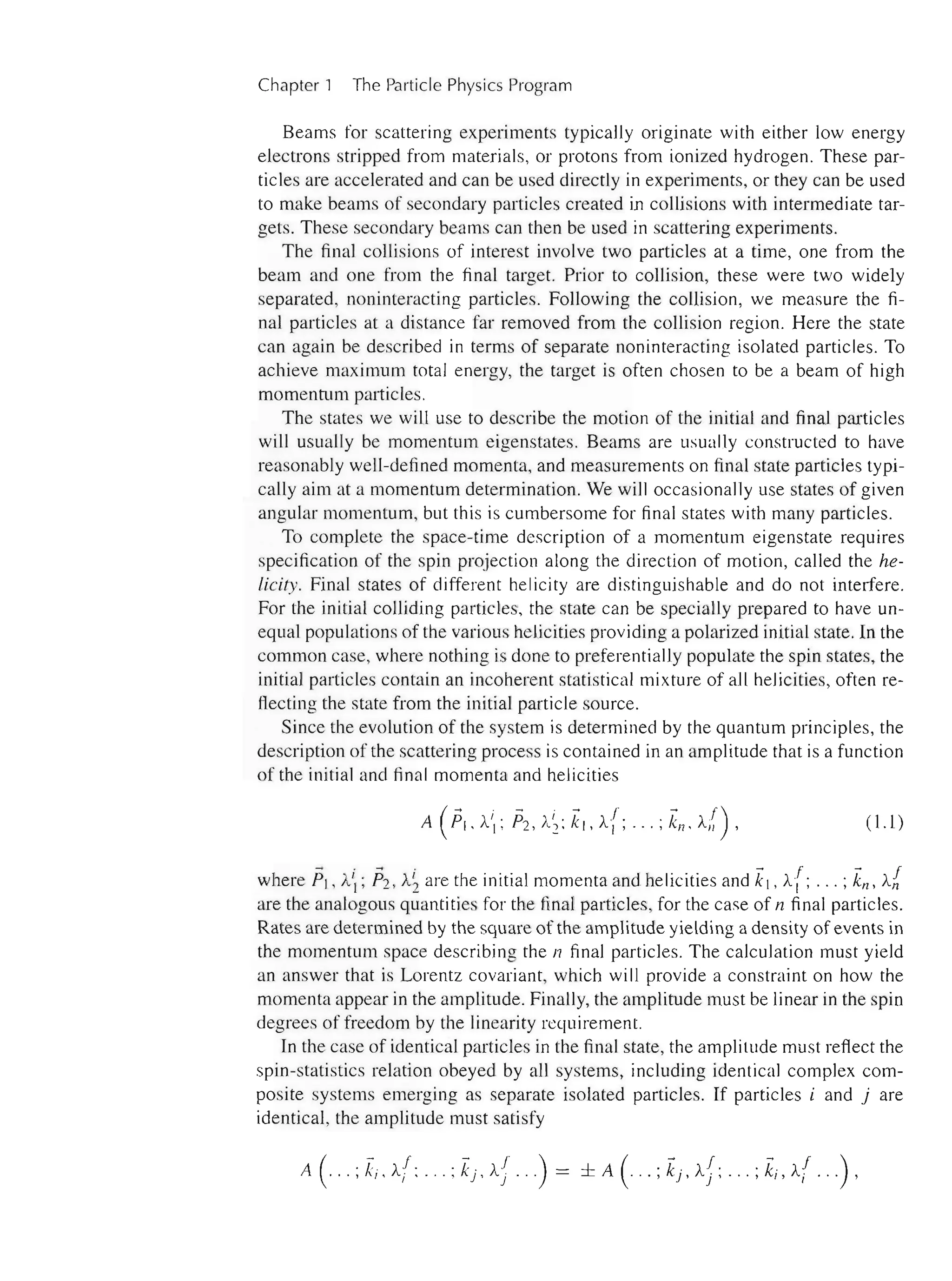
FIGURE 1.2 Two-Jet final
state that might be produced
in e+e- annihilation. Each jet
has four particles.
Chapter 1 The Particle Physics Program
tial, we might guess that it is the same for both states, given the near equality of
the masses. Both particles decay via the strong interactions, so that they live a
very short time. The decay comes again from the creation of new quanta, which
combine with the initial constituent quanta to make the final state pions. We will
discuss later the principles that dictate why one state decays into two and the other
into three pions. The net result is that r p is about 20 times rw. We see again that
widths can differ significantly for resonant states that have much in common.
In all the examples above the widths are determined by the interaction dynam-
ics. Particles have no "intrinsic" widths. Masses are also at least partially dynam-
ically determined, certainly for bound systems, and one could ask whether there
are any "intrinsic" masses. One of the surprising discoveries is that there appear
to be no "intrinsic" masses for the stable states of the spectrum, including our
familiar particle, the electron! These masses result from dynamics, although the
dynamics are not fully understood at present. We will discuss the mass-generating
interaction in some detail in Chapter 10.
Jets at High Energies In very high-energy scattering processes producing
strongly interacting particles, the number of particles produced can be very large.
Focusing on the distribution function that keeps track of all of the many particles
can obscure the global characteristics of the final state. We find that the final
state particles can often be grouped together into individual "jets" that reft.ect the
underlying physics more clearly. Each jet contains a number of particles close to-
gether in momentum space and separated from the other particles in the scattering
event. Unlike resonances, which escape the collision volume and decay through
an independent process yielding a well-defined average number of final particles
independent of the momentum of the resonance or how it originated, the jets are
not independent of each other in an event. Thus there is no well-defined average
number of particles characterizing the decay of a single jet.
The simplest process illustrating the production of jets is the annihilation of a
positron with an electron into strongly interacting particles emerging in two jets.
An example of how such a two-jet event might look is shown in Figure 1.2. The
average number of particles in the final state is determined by the pair of jets and
grows with the invariant mass (or total center of mass energy) of the jet pair. As
this energy grows, the final particles are more and more collimated into the two jet
structures, making it progressively easier to define their directions and energies.
The question then becomes, what determines the jet energy and direction? Whose
direction is it giving us? We will discuss this in the next section, where we turn
from what we measure to the forms of matter underlying the measurements.
1.3 • FUNDAMENTAL CONSTITUENTS AND INTERACTIONS
The set of all known particles and their interactions up to an energy scale on the
order of 200 GeV can be described in terms of a small set of constituents of mat-
ter. We exclude here, however, gravity, which is an extremely weak interaction for
1.3 Fundamental Constituents and Interactions 7
particle pairs at presently available energies. The particles and interactions have
a certain simplicity and unity and form what is called the Standard Model. We
will spend most of' our time developing this picture and relating what is seen ex-
perimentally to the postulated constituents. This section serves to introduce these
ideas.
We begin by describing the simplest set of particles, called leptons, and their
interactions, starting with interactions that are large at a scale of a few GeV.
There are a total of six leptons, e-, f.L-, Y -, lie, liJ-l., and Ii! (we do not list the
antiparticles as separate particles). Three of the leptons are electrically charged,
having the same charge as the electron, and three, the neutrinos, are neutral. The
masses of the neutrinos are small, and presently under very active investigation.
The charged leptons have masses:
me = 0.5110 MeV,
miL = 105.7 MeV,
m! = 1777 MeV.
There is no fundamental understanding of the mass pattern. All leptons have
spin 1and are therefore fermions.
To first approximation, at the few GeV scale, leptons interact only with the
electromagnetic field, which is described by a gauge theory that we discuss in
Chapter 2. This gauge interaction results in only one field particle, the photon,
transmitting the force. The gauge field theory guarantees several crucial features
of electromagnetism: The photon is massless, it has spin 1, and it couples to a con-
served current, determined by charged particles. The latter property is already fa-
miliar from classical electrodynamics, as is gauge invariance. The basic quantum
event describing the electromagnetic interaction of the leptons is the absorption or
the emission of individual photons, shown in Figure 1.3. Such an event is called
an interaction vertex. It is generally part of some larger process, for example the
scattering processes discussed in Chapter 3.
FIGURE 1.3 Basic vertices for the electromagnetic interaction of the charged leptons.
Neutrinos have no charge and thus have no interactions at all to this approx-
imation. The photon also can-ies no charge, so it does not interact with itself. In
this approximation there are no events that couple different leptons. Thus, all six
would be stable; none would decay into any others.
Random documents with unrelated
content Scribd suggests to you:
S
XIII.
LOWLY recovering his senses, the first thing that Elias became
conscious of, was a racking headache. By and by he opened
his eyes, and glanced around. Vaguely, as if half waking, half
dreaming, he saw that he was lying fully dressed upon his own bed
in his own bed-chamber. The gas was turned down low. By fits and
starts a puff of fresh, cool air blew through the open window,
making the curtain flap noisily, and the gas-flame flicker. Nobody
else was in the room. Pretty soon he closed his eyes again, and
again for a while was aware only of that desperate pain in the head.
But by degrees a certain sluggish perplexity began to assert itself,
a certain dull surprise and curiosity.
“There is something strange—something I don't understand. How
do I come to be here? Have I been asleep and dreaming? Or is it
true that a little while ago I was somewhere else? Where? I was
doing something—something important—something that somebody
else was doing with me. What? And then something happened. And
—and now, here I am, lying here as though I had just waked out of
a sleep, but all dressed, and with such, with such a headache——
Let me think.”
He tried hard to think; but in his mind all was impenetrable
darkness, through which his thought groped at random, catching no
gleam to follow; until of a sudden, a swift, intense lightning-flash of
memory; and in an instant of supreme horror—with a mental recoil
that communicated itself to his body, and made it start convulsively
—he beheld what he supposed to be the appalling truth. Upon that
lightning-flash, succeeded a very thunderstorm confusion in his
brain.
“Oh, God!” he cried; and again and again, “Oh, God!”
Just what was it that he remembered?
“I remembered,” says he, in another part of that letter from which
an excerpt was printed in Chapter X., “I remembered every thing
down to the moment of my falling, with unaccustomed vividness and
detail. I remembered our entering the parlor—you trembling upon
my arm!—and running the gauntlet of the guests, and coming to a
stand-still before the clergyman. I remembered the address that he
had made; and how you had listened, with downcast eyes and
blushing cheeks; and how I had—well, scarcely listened—but waited
till he should finish, with eyes fastened upon your face, and heart
beating hard for happiness.
“I remembered his asking, 'Wilt thou take this woman, Christine,
to thy wedded wife?' and the glow of joy and pride and triumph,
with which I prepared to answer. I remembered that then, just as I
was opening my lips to speak, it seemed as though suddenly a
dazzling disk of light rose before my eyes, changing color in rapid
pulsations from white through yellow to scarlet; a sudden, tingling
pain, like a powerful electric current, starting in the back of my
head, shot through my body; a hard, sharp lump stuck in my throat;
I felt that I was losing my ability to stand upright. I tried with might
and main to keep my feet, and to speak the two necessary words.
But I could not. My limbs contracted spasmodically. I heard a sharp
explosion, like the report of a pistol, which sounded and felt as
though somehow it came from within my own head. I cried out. I
believed that I was surely dying. There was a second of immense
agony—fear of death. I fell. Up to that point, I remembered every
thing perfectly. But at that point, my memory broke short off.”
And remembering these things in this way, what did he conclude?
He jumped to a conclusion which was most unwarrantable and most
deplora-able, but which, considering all the circumstances,
considering the fact that he was a Jew, born a Jew, bred a Jew, and
the fact that for countless generations his ancestors upon every side
had been Jews of the Jews, can scarcely be regarded as unnatural.
He concluded that what the rabbi had prophesied had come to pass.
He concluded that the God of Israel had indeed interfered.
The wild, black chaos, into which this conclusion hurled all his
faculties, all his ideas, all his emotions, who shall describe? Was it
not unspeakable even to himself? With horror-struck soul, the horror
quivering through every atom and fiber of his being, he could only
lie there upon his bed, shuddering, and moaning out, “Oh, God! oh,
God! oh, God!”
In wonder-tales and mystical romances, we are accustomed to see
the supernatural dealt with composedly enough. Surprise,
amazement even, it may inspire in the fictitious personages
confronted by it. But when, outside of literature, in what we call real
life, a man of ordinary sensitiveness persuades himself that he has
felt the contact of that awful, questionable Something which lies
beyond the limits of common experience, his revulsion of feeling
does not stop at amazement or surprise. All his theories and
principles of life, tacit, unconscious perhaps, though many of them
may be, are shaken from their foundations, disorganized, thrown
into confusion; and his predominant sensation, we may be sure, is
one of blood-curdling, panic horror. Such, at least, was the truth with
Elias. His heart seemed to have frozen in his bosom; and he was sick
with fear from head to foot.
Presently—how long after his recovery, he could not have told—he
felt the touch of a cool hand upon his forehead, and heard the voice
of his uncle low and gentle, say, “Elias, my poor boy, are you
suffering? Are you in pain?”
He looked up into his uncle's face.
“Oh, thank God!” he cried. “Thank God, that you have come! Stay
with me. Turn up the gas. I want light—plenty of light. Turn it up full
head. There—that's right. Now, sit down—here—near me. Don't
leave me alone. For God's sake, don't leave me alone. Oh, it is good,
so good, to have somebody with me. It was horrible to be all alone.”
The rabbi drew a chair up to Elias's bedside, and seated himself
there.
“If you could go to sleep, Elias,” he said, “it would be the best
thing for you.”
“If I could go to sleep!” Elias laughed a harsh, unmirthful laugh.
“If I could go to sleep! That's good!” Then, loudly, passionately:
“How shall I ever go to sleep again? Are you crazy, to talk to me of
sleep! Don't you know what has happened? Oh, my God, my God!
And he talks to me of sleep! Sleep! Man alive, how—how shall I ever
do any thing in all my life again, but—but—Oh!” His voice broke into
an inarticulate groan. He had started up, leaning on his elbow. Now
he fell back flat.
“You are very much excited,” said the rabbi. “You must try to calm
yourself. Is the pain very great?”
“Oh, the pain—the pain is nothing. I have a headache, yes. But
that is nothing. I wish it was ten times worse. I like the pain. If it
were worse, then I might—I might forget the fearful, awful—oh, I
can't express it. Put yourself in my place. If it had happened to you,
how do you think you would feel? Oh, it's very easy for you to sit
there comfortably, and talk to me about going to sleep.”
“If it had happened to me, Elias, I should rejoice in it,” the rabbi
answered; and then, as Elias made no retort, went quietly, gravely,
on: “Instead of agitating and terrifying you, Elias, the knowledge
that you have gained of how close the relations are between the
Lord our God and His chosen people, ought to inspire you with a
deep, serene joy, with a feeling of infinite gratitude, and of perfect
confidence. It should rejoice you, to know that the Lord is your
constant, steadfast companion, that He follows your every footstep
with the personal solicitude of a father. Awful, yes; but grand,
beautiful, inspiring, and of unspeakable comfort amid the trials and
perils of the world. Think, Elias, and try to appreciate, how great the
Lord's love for you has been shown to be—His love and His mercy.
You—were you not purposing the commission of the most deadly of
sins? A sin which would have pursued you with unceasing penalties
to your grave, and for which not you alone, but your children, and
your children's children, would have had to suffer? And in His
abundant love, what did the Lord do? He suffered you to persist up
to the very brink of the precipice, and to gaze down into the abyss
of iniquity; but before you had taken the final, fatal step, and fallen,
he! He stretched out His arm; He saved you from destruction; and,
like a forgiving parent, He brought you back to His bosom. Isn't
what I say true, Elias?”
The rabbi paused; but Elias remained silent.
“Answer me, Elias. Isn't it true?”
“Oh, I suppose it's true. Yes, yes, I suppose it's true. But what
difference does that make? You—you may analyze it as much as you
choose. I don't deny what you say. I don't care about that. But if you
had been through it—if you had been through it—— Good God! You
make me mad, sitting there, and talking philosophy to me.”
“Not philosophy—don't say philosophy—say religion. It has upset
you, because, in spite of my warning, you did not expect it, and
because you haven't thought about it sufficiently. You haven't
pierced to the innermost substance of it, and thoroughly understood
it. Reflect upon it, in the light of what I have said. Reflect that it has
simply exemplified to you the closeness, the carefulness, with which
the Lord our God looks to your welfare. As you walk among the
pitfalls of life, He holds your hand, and sustains you. He will allow no
evil to beset you. How safe you ought to feel! What courage you
ought to take!”
Elias pondered the rabbi's speech in silence. To the best of his
comprehension, deranged as it was by his terror, debauched by his
superstition, its truth seemed indisputable.
“And now,” the rabbi continued, after a brief pause, “it is apparent
that the Lord has been your guide from the beginning. You were
becoming indifferent—without knowing it, perhaps—indifferent to
your religion. You had not zeal enough. You dwelt in a Christian
community; and the Christian atmosphere was infecting you, was
corrupting you. You were, so to speak, drifting away. The Lord saw
it. He wished to call you back. He wished to awaken your slumbering
soul, to revive your flagging Judaism, to rekindle your ardor, which
had burned down to a tiny spark. Well, in His wisdom, this was the
means that He devised. He caused you to fancy yourself attached to
a Christian woman. He allowed you to harden yourself to the
thought of committing the extreme sin—to the thought of marrying
her. Then, at the last moment, He manifested Himself. He rescued
you from your danger. And thus He gave such new vitality to your
faith, that there is now no possibility of its ever becoming faint
again. Oh, have you not reason in this to praise the Lord, and to
thank Him, from the depths of your spirit? Oh, my son, son of my
sister, how signally He has blessed you!”
“It is true,” Elias answered, “the Lord has shown me great mercy—
greater than I deserved. I shall never doubt again. I shall always be
a good Jew after this.”
“And as for the—the love you talked about—”
“Oh, don't speak of it. It is dead, quite dead. The Lord has struck
it dead in my heart. It is as though it had never been—as though I
had never seen her, or known her.”
“I was sure it would be.”
“The Lord has burned it out of my heart.”
“He has breathed upon your heart and purified it. I am glad you
recognize it. I am glad, too, that you seem calmer now, and more
like yourself again.”
“Yes, I am more like myself. I see that I had no reason for getting
so wrought up. But—oh, it was frightful.” Elias shuddered. In a
minute he asked, “Can you forgive me?”
“Forgive you? For what?”
“You know—the way I acted.”
“It isn't a question of forgiveness. You didn't understand. I could
not have expected you to act otherwise.”
“You are very generous. I was, as you say, ignorant. I acted like a
brute.”
“You acted according to your light—which was dim. I understood.
The Lord gave me to understand. When you first came into my study
last night, and told me what you meant to do, the Lord gave me to
understand. He assured me that it would all come out well in the
end—that the marriage would never take place. That is why I spoke
as I did. I felt perfectly sure. I did not fear for an instant. But now,
Elias, we must stop talking. You must go to bed, and sleep.”
“I don't believe I shall be able to sleep tonight.”
“Yes, you will; for I am going to give you a sleeping potion.”
The potion had a speedy effect. Elias buried his face in the pillow,
and was soon sound asleep.
“That obstreperous old man who was to have been your father-in-
law, has called twice,” said the rabbi; “and he is coming again at five
o'clock.”
It was in the afternoon of the following day. Elias had just waked
up. The rabbi was seated upon the foot of Elias's bed.
“What did he want?” Elias asked.
“Oh, he called to inquire about you—about how you were feeling.”
“And you told him?”
“That you were asleep.”
“Is that all?”
“What else?”
“I didn't know but you might have told him of my—my change of
heart.”
“No. I thought it better that he should hear of that from your own
lips.”
“Why?”
“Several reasons. Chiefly, because then he can have no doubt
about it. You can make him understand that it is assured and
irrevocable. If I were to speak with him he might doubt my word, or
suspect that I had been influencing you. He seems to be something
of a fire-eater.”
“Well, I dare say you are right. But it will be very hard.”
“It will, undoubtedly. But there's no help for it. It's an unavoidable
nuisance. Once over and done with it, you'll feel immensely
relieved.”
“It is strange,” said Elias, “how completely my affection for her
seems to have been destroyed. Here, a little while ago, it was, and
for many months had been, the ruling passion, the single aim and
purpose of my life. I thought of nothing else, felt nothing else, cared
for nothing else, all day long, every day. And now, it seems to have
been utterly wiped out and obliterated, without even leaving a trace
behind it—just as you blow out a candle, and the flame vanishes. I
can think of her without any emotion of any kind. If I had never
known her, if she had never been more than a passing acquaintance,
my indifference could not be greater. This is very strange, isn't it?”
“No, Elias, not strange at all. You must remember that it is the act
of the Lord. As you said this morning, the Lord has struck your
passion dead in your heart. He has purified your heart with fire, and
restored to it the cleanliness it had before this woman crossed your
path, and tempted you. The truth is, you never really loved her at
all. She exerted a certain baleful fascination over you—a fascination
which the breath of the Lord has dissipated, just as the breath of the
morning dissipates the miasms that have gathered over night.”
“I suppose—I suppose it will be a heavy blow for her. She loves
me. She will suffer terribly.”
“Oh, you mustn't think of that. That isn't your affair. The Lord has
used her as His instrument. Now that her usefulness has ceased, the
Lord will dispose of her as He deems wisest.”
“But she will suffer, all the same. And here is what is strangest. It
stands to reason—it is obvious—and I know perfectly well—that she
will suffer. And yet, I seem to feel no pity, no sorrow, no sympathy,
for her—not any more than as though my heart were a stone. My
whole capacity for feeling seems to have been destroyed. Perhaps it
is so. Perhaps it has been. Perhaps the Lord—I don't know how to
say just what I mean; but it seems as though I had grown
indifferent to every thing.”
“In the main, that is the result of the shock you have sustained. It
will pass. But as for her, the Lord will not allow you to feel for her.
You have suffered enough. Her turn has come. If you have no
sympathy for her, it is because she is entitled to none. The Lord
desires that she shall receive none. She is a Christian, a Goy,
despised and abominated of the Lord. She has served her purpose.
Now she must bear her punishment.”
“And yet—”
“No, no, boy. Don't think about it. Don't let your mind dwell upon
it. You must not think of any thing but of how grateful you ought to
be for your own escape. Put all your mind and heart into
thanksgiving. Praise the Lord! It is irreverent for you to question, to
lament, the consequences which the Most High, in His wisdom, has
ordained.”
After an interim of silence, Elias said, “There is something in this
connection which, I think, I ought to tell you. Night before last, up in
my studio—” And he went on to give the rabbi an account of the
curious experience he had had with his mother's portrait. “I thought
at the time,” he concluded, “that it was simply a morbid illusion of
my senses. But now I am not so sure. What do you say? What is
your explanation?”
“I do not believe that the souls or spirits of the dead are ever
permitted to manifest themselves to the living,” replied the rabbi;
“and therefore I do not for an instant entertain the theory that it
could have been a genuine apparition of your mother. But neither do
I believe that it was a mere trick of your senses. I believe that the
Lord, as a warning to you, caused you to see what you saw—caused
an image of your mother's face to rise before you. I am not
surprised. I have known of His causing similar things to happen
before.”
“It is wonderful, it is incomprehensible,” said Elias, “why the Lord
should take such an intimate interest in the welfare of a mere
individual, like me.”
“You are a Jew. There is not a faithful Jew living, but is kept
constantly in the Lord's eye, in the Lord's mind. The longer you live,
the more perfectly will you realize the ineffable privilege you have
enjoyed in being born a Jew.”
At about five o'clock, surely enough, old Redwood called. The
maid ushered him into the rabbi's study, where Elias and his uncle
awaited him. He halted just within the threshold, and made a stiff
bow to the rabbi. Then he advanced upon Elias, with extended hand,
exclaiming, “Well, Elias, I'm glad to see you. How are you? How do
you do?”
Elias took his hand, held it for an instant, dropped it, and
responded, “How do you do?”
“That ain't answering my question,” said Redwood. “I want to
know, how do ye do?”
“Oh, I feel quite well, quite as usual, thank you,” replied Elias.
“Won't—won't you sit down?”
“Well, I guess I will—yes,” the old man assented, and did so.
“Well,” he continued, “this has been the devil's own business all
around, hasn't it? Poor Chris, poor little Chris—she's pretty near out
of her head. She's all broke up. She is, for a fact. She wanted to
come down here with me—begged and implored me to let her. But I
wouldn't. I didn't know how you might be; and, think s's I, it might
just fret her worse than ever. She's been scared about to death. Poor
little thing! I tried to comfort her, and cheer her up; but it wa'n't
much use. A father don't count for much, now-a-days, when a young
man is concerned. I suppose,” he wound up abruptly, “seeing you
feel all right again, you'll be up to the house to-night, hey? Then we
can settle on a new day for the wedding.”
Elias summoned his utmost courage. “N-no; I think not,” he said.
His voice was husky and unsteady.
Redwood did not understand. “Hey—what?” he queried.
“I say, no; I think I shall not call this evening.”
“No? Why, why not? Don't you—ain't you well enough? Chris is
just—I may say, she's just pining for a sight of ye. I really think she'll
get sick, if this thing keeps on. If you're able to leave the house, I
really think you'd better come up. She—she's nearly cried her eyes
out. I told her—just before I left—I told her: 'Now, look here, Chris,
you want to stop that crying. You want to dry your eyes, and bleach
'em, against Elias's coming,' says I, 'for he won't admire them, red
like that.' I said this, you know, to sort of make her laugh. But
seriously, I'm scared about her. I am, actually. She hasn't tasted a
mouthful of food all day. I guess I'll have to call in the doctor if she
ain't better to-morrow. But unless you're considerably worse off than
you look, I guess you'd better come up. I'll tell you what you do—
you come up with me now, and take dinner.”
Elias felt that the old man was making it more and more difficult
for him to say what would have to be said. He clenched his fists, and
gritted his teeth, and began by a great effort to force out the words.
“Mr. Redwood—there is a—a misunderstanding. I must set it right.
I—I am exceedingly sorry—to—to be compelled to tell you—to tell
you that—” Here his voice sank to a whisper. He paused for a
moment, drew a long breath, resumed aloud, “—that, owing to
circumstances which I can not perfectly explain—because, in fact, of
our difference of religion—she being a Christian, and I a Jew—the—
the engagement—between Miss Redwood and myself—will have to
be—broken off. This is quite positive. There is no help for it. Please—
please believe it, without my saying more. I am very sorry. Our
engagement will have to be broken off.”
He did not dare to look at the man to whom he had spoken. He
looked at his uncle. But the latter was watching old Redwood.
Old Redwood's face was eloquent. When Elias had begun to
speak, the old man had been smiling good-naturedly. Gradually his
smile had faded to an expression of blank incomprehension; which,
in its turn, had gradually changed to one of uttermost, indignant
astonishment. But now, this too had departed, and his features had
become set in a new smile—a smile which revealed the abyssmal
contempt, the passionate, malignant scorn, at the bottom of his
soul, far more clearly than the strongest words could have done. A
grayish pallor had overspread his brow. His eyes blazed upon Elias.
Between his drawn lips, his teeth gleamed savagely. He sat still,
nodding his head, and smiling that unpropitious smile.
For a long while, painfully long, no one spoke.
Elias, though he dared not look, knew how fiercely old Redwood
was eying him—felt the heat of old Redwood's gaze. His cheeks
flaming, his body in a tremor, he sat still, afraid to stir. He could hear
old Redwood breathe. He could hear the boisterous beating of his
own heart, in dread apprehension of the brewing storm. He could
hear the regular, metallic tick-tack of the rabbi's clock, which
increased the stress, as it measured the duration, of his suspense.
The rabbi, also, was smiling now—a smile of genial satisfaction.
At last old Redwood moved. He shifted in his chair. He cleared his
throat. With a single jerk of his tall frame, he got upon his feet. He
stood for a few seconds, silent. Presently, “Well, Elias Bacharach,” he
said, in low, dry tones, vibrant with suppressed fury, “I understand
that I am to inform my daughter from you, that, as you have said,
on account of your difference of religion, she is to consider herself
jilted and thrown over. I think that is the upshot of what you have
said.”
“Say, rather, released from her engagement,” put in the rabbi,
blandly. “And if you will permit me, I shall be happy to explain to you
the circumstances which render this step unavoidable.”
“Pardon me,” returned old Redwood, with a grand bow and
flourish. “I was not aware, sir, of having addressed you. I'm talking
to Mr. Elias Bacharach. And now, Elias Bacharach, this is what I've
got to say. I suppose you know what you air. I suppose you know
the names I could call ye, if I had a mind to demean myself to
calling names. You look in the dictionary, and you'll find them printed
in black and white. But I guess you won't need to look so far. I
guess it will do just as well if you look in your own conscience. You
know what you've done. You know how you've taken a young,
innocent girl, and won her heart, and got it set on you, so that she
don't think of any thing or any body else; and then flung her
overboard, and spoiled her life, and darkened her whole youth. And
you know what honest people think of a man who's done that.
That's all. You needn't be afraid. You needn't sit there, shaking. I
ain't going to hurt you. I ain't going to touch you, even. I'll go home
now. I'll go home, and tell the news to Christine. If it kills her, you
know who'll have to answer for her death.” Thus far, the old man
had spoken with great self-control; but here, suddenly, he forgot
himself.—“But, by God,” he thundered out, “if it does kill her, I—I'd
rather have it, by God! than have her married to you, now that I
know what you are, you damn, miserable, white-livered Jew!”
With which, he stalked from the room; and next moment the
street-door slammed behind him.
“Well, now, Elias,” said the rabbi, “now it's all over for good and
all.”
“Yes, I dare say,” replied Elias; “but I feel somehow as though it
had just begun—as though the worst of it were still to come.”
“Oh, nonsense!” cried the rabbi. “You're morbid. Cheer up. Let's
celebrate your deliverance with a bottle of wine.”
A
XIV.
PPARENTLY it did not once occur to Elias to seek a natural
explanation for what had happened; and even if it had done
so, I don't believe it would have made much difference. But
this, as has been said, in view of all the circumstances, was scarcely
strange. The supernatural explanation had, so to speak, captured his
mind by storm. With tremendous force and suddenness, it had
thrust itself upon him at a moment when he was suffering the
exhaustion and the debility consequent upon a violent shock; and,
once in possession, it clung tenaciously, and left no foothold for a
saner judgment to stand upon. Then, besides, had not the rabbi's
menaces predisposed him to accept it? And finally, there were
heredity and education and mental habitude, which in such matters
must surely count for much. Elias had been fancying that his
inherited and sedulously cultivated superstition was dead and buried.
Love, like a radiant St. George, had slain the monster. To us, wise
after the fact, it is conceivable that it had but slumbered; and now
again was wide awake, breathing fire and vengeance; and had given
its quondam executioner such a blow as might not speedily be
recovered from, if at all.
Elias, at any rate, did not doubt. He told himself that he had been
on the point of committing a mortal sin, one that would have
removed him forever beyond the pale of divine mercy, one that
would have entailed upon him, and upon his seed after him, infinite
retribution. He told himself that at the eleventh hour heaven had
intervened, and saved him from his own suicidal clutch. He
shuddered at the notion of the risk he had run. He was duly grateful
for his deliverance. It had at first surprised him to find that his love
of Christine had not survived. That which had absorbed his life, and
shaped and directed his life, and been to his life what the sunlight is
to the day, its vital, dominating, distinguishing principle, had
vanished utterly out of his life, had melted phantom-like, and left not
a shred, not a mark, not even a gap, behind, to show where, or of
what substance, or of what form it had been. It was the
extinguishment of a subtle, spiritual flame, which departs, so far as
is determinable, nowhither—is simply swallowed up and assimilated
by the inane. Three days ago, he had believed it possessed of
everlasting vigor; and now, it was gone as completely as the snows
of yesteryear. Death and dissolution had occurred simultaneously.—
But his surprise was short-lived. On reflection, he agreed with the
rabbi, that nothing else could have been expected. He adopted the
rabbi's metaphor, and said that the breath of the Lord had entered
his heart, and cleansed it. He remembered how, once before,
something similar had befallen, in answer to prayer. But the effects
of that had been transitory. The effects of this, he thought, would be
permanent. If there were the materials for melancholy here, Elias
was callous to their influence.
It seemed, indeed, that not only had his love been abolished, but
that his entire emotional system had sunken into a state of apathy,
and become unresponsive and inactive. He knew, for example,
perfectly well how Christine would suffer. The light of her youth
would be quenched, and its sweetness turned to gall and
wormwood. The world, that was so fair in her sight, would crumble
suddenly to a wide waste of dust and ashes. An agony like fire
would be kindled in her young heart, hopeless even of hope. It
might perhaps, as old Redwood had said, it might perhaps kill her.
But if it did not kill her, it would do worse. She would have to live,
and bear it. He knew all this. He could not help knowing it. It was
too big, palpable, conspicuous, to be ignored. He knew it; and he
stated it clearly, completely, circumstantially, to himself. And then he
wondered at his stolidity; for it woke not a throe either of
compunction or of compassion. He said to himself, “Altogether aside
from the personal element, from the fact that she is who she is, and
that I have been her lover; altogether aside, also, from the fact that
I, though helpless and irresponsible, am still the occasion of her
unhappiness; and simply because she is a woman, a human being,
the knowledge of her overwhelming sorrow and utter desolation,
ought to move me to deepest, keenest pity.” But it did not. It did not
move him to a single momentary qualm. His condition puzzled and
mystified him. He could imagine no way to account for it, unless by
again following the logic of the rabbi, and assuming it to be the act
of God. That it was merely the torpor, the numbness, naturally
resulting from the fright, and the immense physical and moral shock,
he had sustained, does not appear to have suggested itself to him.
On the morning after his interview with old Redwood (on the
morning, namely, of the fourth of May, 1883; date worth
remembering), Elias was established at his studio-window, watching
the play of sunlight and shadow upon the foliage opposite in the
park, and introspecting somewhat listlessly in the direction above set
forth, when there came a light tap upon his door; and, without
turning around, he called out, “Come in.” He heard the door creak
open. He heard the visitor take two or three steps forward into the
room. Then, before he had looked to see who it was, he heard his
own name pronounced shyly, by a voice that was but too well-
known:
“Elias!”
Unspeakably astounded and discomfited, he sprang to his feet,
faced her, and stood dumb.
At the moment he was not conscious of noticing especially her
appearance; but long afterward he recalled it vividly. Long afterward,
the pale face, the disordered golden hair, the large, dark, tearful
eyes, the appealing attitude—hands stretched out toward him, face
upturned—became of all his memories the strongest, the clearest,
the most constant, the one on which his remorse chiefly fed.
But now, he faced her and stood dumb, aware only of hubbub in
his brain, and dismay in his breast.
She, manifestly unprepared for this style of greeting, started back.
Her eyes filled with fear.
“Oh Elias,” she faltered, “you—you make me think that it is true.”
He, finding his voice, cried piteously: “Oh, why—why did you come
here?”
And then they were both silent.
At last she began: “I came—because I could not believe—because
my father told me something which I knew was a lie. I came to have
you tell me that it was a lie. Oh, why did he tell me such a cruel
thing? Why—why do you act like this?”
She paused, expecting him to speak. But he did not speak.
All at once she went on passionately: “Oh, you don't know what
he told me. He must have wanted to kill me. But I knew it was a lie.
I told him it was a lie—oh, such a shameful, cruel lie. Oh, God! Here,
this was it: he told me—he told me that you—Elias—oh, no, no, no! I
can not say it. But yes, yes—I will say it—I must say it. He said that
you—you did not love me any more. Oh, my God, my God!”
She had moved up toward him. Now she fell upon his breast, and
sobbed her heart out.
He passively allowed her to remain there. What to do? what to
say? he asked himself, distracted.
“Oh, Elias—my darling—I—I knew it could not be true,” she was
murmuring between her sobs.
Thus, until her grief had spent itself—until she had had her cry
out. By and by she raised her eyes to his, and smiling a forlorn little
smile, asked timidly, “You think I am very silly?”
But her smile did not last long. Suddenly, it changed to an
expression of utmost woe and terror. She fell back a step or two.
“Elias!” she cried, in a sharp, startled voice. “Why do you look at
me like that? Is—do—you can't—mean—that it is true!”
He felt that he must speak. He must gather his forces, and make
her understand. He was trying to. He was trying to find the words he
needed. But before they had come to him, the door opened, and the
rabbi glided upon the scene.
The rabbi took in the situation at a glance.
“Elias,” he said, “this is unfortunate. You ought to have called me.”
Turning to Christine: “You have forgotten yourself, madam. By
what right are you here? Did your father send you? I shall be happy
to show you the way down stairs.”
He bowed in the direction of the door.
She looked helplessly from the rabbi to his nephew; but she found
little to reassure her in Elias's face.
“Was there any thing you had to say to this young lady, before she
goes, Elias?” the rabbi queried, in a brisk, business-like tone.
“No, nothing,” Elias began faintly, “nothing, except—yes, except—”
He broke off, and drew a sharp, loud breath; suddenly he began
anew: “Christine, I am powerless. The Lord—it is the Lord's will. I—it
—what your father told you—it was the truth.”
The words found their own way out, mechanically. He could
scarcely realize that he had spoken.
For an instant she stood motionless. Then she reeled and tottered,
as if about to fall. Then she recovered herself. Slowly, with a dazed,
stunned air, groping blindly, she turned, and reached the door, and
crossed the threshold.
The rabbi followed, shutting the door behind him.
Elias dropped into a chair. Bewildered, agitated, fagged-out,
undone—he felt all this. But he felt not a pang for her.
“If I had thrown you down and trampled upon you,” he wrote, a
little less than two years afterward, “it would not have been so
brutal, so cruel; but if I had done it in my sleep, I could not have
been more insensible to your pain.”
Welcome to our website – the ideal destination for book lovers and
knowledge seekers. With a mission to inspire endlessly, we offer a
vast collection of books, ranging from classic literary works to
specialized publications, self-development books, and children's
literature. Each book is a new journey of discovery, expanding
knowledge and enriching the soul of the reade
Our website is not just a platform for buying books, but a bridge
connecting readers to the timeless values of culture and wisdom. With
an elegant, user-friendly interface and an intelligent search system,
we are committed to providing a quick and convenient shopping
experience. Additionally, our special promotions and home delivery
services ensure that you save time and fully enjoy the joy of reading.
Let us accompany you on the journey of exploring knowledge and
personal growth!
ebookultra.com
Particle physics a comprehensive introduction 1st Edition Abraham Seiden

  • 1.
    Particle physics acomprehensive introduction 1st Edition Abraham Seiden download pdf https://ebookultra.com/download/particle-physics-a-comprehensive- introduction-1st-edition-abraham-seiden/ Visit ebookultra.com today to download the complete set of ebook or textbook!
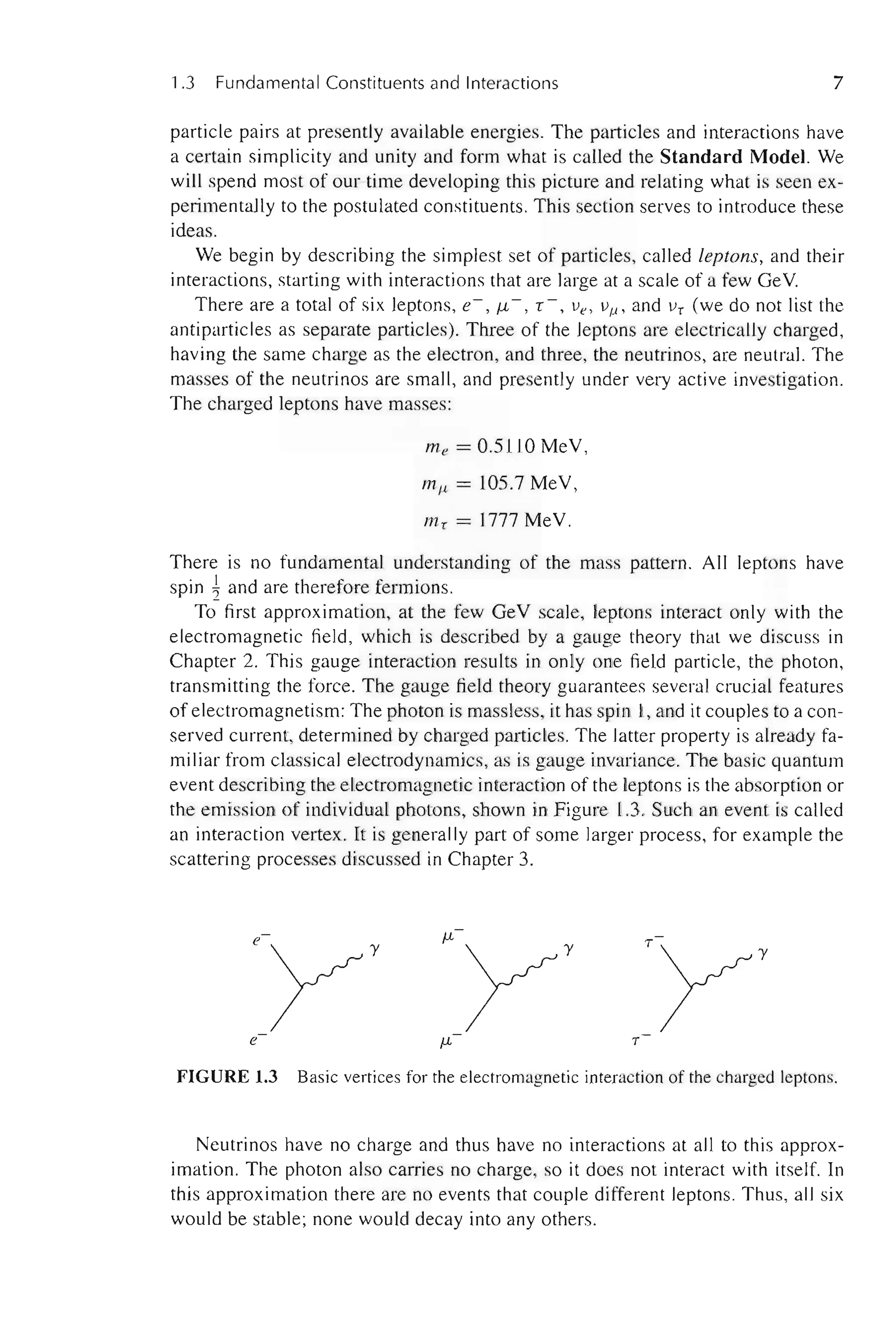
  • 2.
    We have selectedsome products that you may be interested in Click the link to download now or visit ebookultra.com for more options!. Introduction to Nuclear and Particle Physics 2nd Edition A Das https://ebookultra.com/download/introduction-to-nuclear-and-particle- physics-2nd-edition-a-das/ Particle Physics 1st Edition Richard A. Dunlap https://ebookultra.com/download/particle-physics-1st-edition-richard- a-dunlap/ Particle physics 3. ed., repr Edition Shaw https://ebookultra.com/download/particle-physics-3-ed-repr-edition- shaw/ Three Particle Physics and Dispersion Relation Theory 1st Edition A. V. Anisovich https://ebookultra.com/download/three-particle-physics-and-dispersion- relation-theory-1st-edition-a-v-anisovich/

  • 3.
    Alloy Physics AComprehensive Reference 1st Edition Wolfgang Pfeiler https://ebookultra.com/download/alloy-physics-a-comprehensive- reference-1st-edition-wolfgang-pfeiler/ Genocide A Comprehensive Introduction 1st Edition Adam Jones https://ebookultra.com/download/genocide-a-comprehensive- introduction-1st-edition-adam-jones/ Cosmic Rays and Particle Physics 2nd Edition Thomas K. Gaisser https://ebookultra.com/download/cosmic-rays-and-particle-physics-2nd- edition-thomas-k-gaisser/ Introduction to Nuclear And Particle Physics Solutions Manual for Second Edition of Text by Das and Ferbel C. Bromberg https://ebookultra.com/download/introduction-to-nuclear-and-particle- physics-solutions-manual-for-second-edition-of-text-by-das-and-ferbel- c-bromberg/ Genocide A Comprehensive Introduction 2nd Edition Adam Jones https://ebookultra.com/download/genocide-a-comprehensive- introduction-2nd-edition-adam-jones/
  • 5.
    Particle physics acomprehensive introduction 1st Edition Abraham Seiden Digital Instant Download Author(s): AbrahamSeiden ISBN(s): 9780805387360, 0805387366 Edition: 1 File Details: PDF, 49.72 MB Year: 2005 Language: english
  • 6.
  • 7.
    PARTICLE PHYSICS A ComprehensiveIntroduction Abraham Seiden University ofCalifornia, Santa Cruz ... TT Addison Wesley --- San Francisco Boston New York UNIVERSIDAD !,UTONOMA DF MADRID l'lBLlOTErA ('rr~C ' 1! Capetown Hong Kong London Madrid Mexico City Montreal Munich Paris Singapore Sydney Tokyo Toronto ~ I
  • 8.
    Senior Executive Editor:Adam Black Assistant Editor: Stacie Kent Senior Production Supervisor: Corinne Benson Senior Marketing Manager: Christy Lawrence Managing Editor: Erin Gregg Manufacturing Manager: Pam Augspurger Composition: Integre Technical Publishing Co., Inc. Cover Designer: Blakeley Kim Library of Congress Cataloging-in-Publication Data Seiden, A. (Abraham) Particle physics: a comprehensive introduction I Abraham Seiden. p. cm. Includes bibliographical references and index. ISBN 0-8053-8736-6 I. Particles (Nuclear physics) 1. Title. QC793.2.S422004 539.7'2-dc22 (ISBN) 0-8053-8736-6 2004009922 Copyright © 2005 Pearson Education, Inc., publishing as Addison Wesley, 130 1 Sansome St., San Francisco, CA 94 111 . All rights reserved. Manufactured in the United States of America. This publication is protected by Copyright and permission should be obtained from the publisher prior to any prohibited reproduction, storage in a retrieval system, or transmission in any form or by any means, electronic, mechanical, photocopying, recording, or likewise. To obtain permission(s) to use material from this work, please submit a written request to Pearson Education, Inc., Permissions Department, 1900 E. Lake Ave., Glenview, IL 60025. For information regarding permissions, call (847) 486-2635. .. TT Addison Wesley -- 2 3 4 5 6 7 8 9 10 - DOC- 07 06 05 04 www.aw-bc.com/physics
  • 9.
    Preface This text coversthe fundamental concepts and theories that make up the Stan- dard Model of particle interactions. The effort to develop this model continues the tradition of looking inside the atom and the nucleus to see how these sys- tems are constructed and the principles that govern their behavior, providing an understanding of matter at ever-deeper levels. The Standard Model describes these interactions through a number of fun- damental constituents, three families of quarks and leptons and the gauge field quanta with which they interact. These constituents have been revealed through the study of natural objects, as well as controlled interactions at several genera- tions of accelerator facilities. The Standard Model has provided the quantitative basis for understanding the very large body of data accumulated at particle accel- erators of ever-increasing energy and luminosity. In this text the various types of interactions are presented in sequence, allowing each part of the Standard Model to be examined in some detail. The various concepts are always introduced in conjunction with many detailed phenomena explained by the given idea; general principles, stemming for example from quantum mechanics, are also emphasized. Particle physics, at the level of this text, is usually taught in the second year of graduate study, following advanced quantum mechanics, and often during the same year as a field theory class. Since the sequence and numbers of classes taken varies from one institution to another, I have attempted to make the material pre- sented in the text self-contained. Thus the Dirac equation is presented, as well as some material regarding field theory. This inclusion is not meant to replace a class covering these topics more fully. I have, however, assumed that the student has an understanding of quantum mechanics, including angular momentum and related topics, such as Clebsch-Gordan coefficients. In the case of field theory, I have tried to show what the mathematics is "doing," rather than attempting rigorous derivations of the material. The material is presented using a multi-particle the- ory, rather than the single particle equation that is often used, and hopefully this will contribute to the appreciation of the content of field theory. The approach taken allows a uniform treatment of fermions and bosons, as well as particles and antiparticles. Following the introductory material, which is contained in the first three chapters, the full phenomenology of particle physics is presented, based on the fundamental constituents. This includes the spectrum of states of the strong in- teractions, decays and mixing phenomena due to the various interactions, and the behavior of scattering cross sections. In addition, a major goal is to work through a large number of calculations, particularly for the benefit of experimentalists v
  • 10.
    VI Preface who maynot have an opportunity to see these calculations in any other class. A number of homework problems accompany each chapter, allowing students to test their understanding of the material and in some cases extend it. In presenting particle physics we can write down a number of equations and try to deduce their consequences, or work up through the phenomena toward a theoretical synthesis. The material in the text is presented mostly using the latter approach. This allows the student the opportunity to work through elements of the theory more slowly and to understand some of the evidence that led to the components of the Standard Model. In addition, the nonperturbative parts of the strong interaction are mostly not rigorously calculable, so we have to develop a separate understanding of these phenomena, which show their own regularities. The lightest hadrons have been used for this purpose. The spectrum of these states and their decays illustrate a numb-er of interesting phenomena. The text covers the strong (Chapter 5), electromagnetic (Chapter 6), and weak (Chapter 8) decays of these particles in some detail. This text provides material for a one-year long class. It can, however, also be used for a semester-long special topics class, for example, on the weak in- teractions. The fraction of the material covered in the first three chapters can be adjusted based on which other classes are taught at a given institution. Topics covered in some detail, such as the constituent quark model and weak decays, can be covered more briefly, with additional reading left to the student. One topic not covered is the connection of particle physics to astrophysics and cosmology. This is an exciting connection and I would expect that at some institutions this mate- rial will be taught as a semester-long special topics class following the particle physics class. The emphasis here is pedagogical. No attempt has been made to present topics in their historical setting. In addition, a number of important topics, such as tech- niques used in particle detectors and particle acceleration, are not covered due to space limitations. A number of books now cover these topics; some of these are listed in a bibliography. They would provide interesting supplementary reading. This text generally does not contain the references to the original scientific litera- ture; however, many useful references are provided in the bibliography. These are chosen for pedagogical reasons and no credit for original discovery is implied by the selection. The text should allow the instructor the scope for some interesting additions. For example, although specific experiments are not discussed, the instructor can include material relevant to the experiments at a given institution. Material can also be added about particle detection techniques relevant to these experiments. The calculations in Chapter II can form the basis for such a discussion. These additions can help students make the transition to research at the given institu- tion. In addition, the instructor can add graphic material to discussions that are mostly algebraic or descriptive. Examples include additional Feynman diagrams and various unitarity triangles for quark mixing. The material presented illustrates the beautiful picture we have of particle physics at the start of the 21st century. Important missing pieces in this picture
  • 11.
    Preface VII should befound in the next decade. The last chapter presents some ideas of where nature may lead us. The discussion is very brief, since it is not clear which ideas will prove to be a key to the future. The student can expect to learn more about these topics over the coming years. ACKNOWLEDGMENTS Being a participant in a vigorous scientific community is a special privilege. The training one receives provides the common language needed to appreciate and enjoy the scientific progress made by the many practitioners in the field. As a truly international activity, pmticle physics also has the additional advantage that one can participate with a mix of interesting singular individuals from many countries. Thus the approach that one takes to the subject reflects many fruitful interactions with others in the community. The writing of a textbook offers the opportunity to share the ideas and language of the field with a new generation of scientists. The author wishes to thank Nicolo Cartiglia for a critical reading of many of the chapters. The work on word processing by Nora Rogers, Rachel Cunningham, and Emily Williams, over a period of several years, has made it possible to produce the text. The author also wishes to thank the people at Addison-Wesley for their help. A. Seiden Santa Cruz, California, 2004
  • 13.
    Contents Preface 1 • TheParticle Physics Program 1.1 Introduction 1.2 What Do We Measure? 3 1.3 Fundamental Constituents and Interactions 6 Chapter 1 Homework 13 2 • How to Calculate Amplitudes 2.1 Free Particles 15 2.2 Spin Zero Particles 16 2.3 Lagrangian Density 18 2.4 Symmetries and the Lagrangian 20 2.5 Spin I Particles 23 2.6 Spin 1 Photons 24 2.7 Spin ~ Particles 27 2.7.1 The Dirac Equation 28 2.7.2 Lagrangian and Symmetries for Spin ~ 30 2.7.3 Explicit Plane Wave Solutions 32 2.7.4 Bilinear Covariants 35 2.8 Interpretation of Extra Solutions 37 2.9 Time History of States 38 2.10 Time Evolution and Particle Exchange 43 2. 11 Momentum Space Propagator 50 2. 12 Calculation of Decay Rates and Cross Sections 52 2.12.1 Particle Decay Rates 52 2.12.2 Cross Sections 54 2.13 Particle Exchange and the Yukawa Potential 55 2.14 Quantum Field Theory 58 2.14.1 Charged Scalar Field 63 v 1 15 ix
  • 14.
    x Contents 2.14.2 FermionField 64 Chapter 2 Homework 68 3 • Scattering of Leptons and Photons 3.1 Interaction Hamiltonian and Lepton Currents 71 3.2 Electron- Muon Scattering 74 3.2.1 The Photon Propagator 75 3.2.2 Some Implications of the Photon Propagator 78 3.2.3 Electron-Muon Scattering; Methods for Facilitating Calculations for Spin 1 79 3.2.4 Two-Body Phase Space Factor 83 3.2.5 Cross Section in the Relativistic Limit 85 3.3 e+ e- Annihilation to fL+ fL - 86 3.3.1 s, t,anduVariables 86 3.3.2 Calculation of Annihilation Cross Section 87 3.4 e- e- Scattering 89 3.5 e+ e- Production of e+ e- 90 3.5.1 Helicity Conservation in the Relativistic Limit 92 3.6 Processes with Two Leptons and Two Photons 94 3.6.1 Matrix Element for ye- Scattering 97 3.6.2 Compton Scattering Cross Section 100 3.7 Higher-Order Terms in the Perturbation Expansion, the Feynman Rules 103 3.8 3.9 Lorentz Covariance and Field Theory Special Symmetries of the S Matrix Chapter 3 Homework 109 4 • Hadrons 106 108 4.1 The Charge Structure of the Strong Interactions 112 4.2 Quantum Numbers 113 4.2.1 Additive Quantum Numbers 114 4.2.2 Vectorially Additive Quantum Numbers 115 4.2.3 Multiplicative Quantum Numbers 116 4.3 Internal Symmetries 117 4.4 Generators for SU(2) and SU (3) 122 4.5 The Color Interaction 126 4.6 The Color Potential 130 4.7 Size of Bound States 136 4.8 Baryons 141 Chapter 4 Homework 142 71 112
  • 15.
    Contents 5 • Isospinand Flavor SU(3), Accidental Symmetries 5.1 The Light Quarks 146 5.2 Light Mesons 149 5.3 Breit-Wigner Propagators and Meson Life Histories 155 5.3.1 Narrow Resonances and Independent Events 159 5.3.2 Propagators and Mass Eigenstates 161 5.4 Vector Meson Decays 163 5.4.1 Form of Meson Decay Amplitudes 168 5.5 Physical Picture of Decay Process 169 5.5.1 GParity 177 5.5.2 Large Invariant Mass Processes and Hadronic Jets 179 5.6 Baryon States of Three Quarks 180 Chapter 5 Homework 186 6 • The Constituent Quark Model 6.1 Constituent Quarks 193 6.2 Baryon Magnetic Moments 193 6.2.1 L; o Decay to A0 + y, Magnetic Dipole Transition 197 6.2.2 ¢ Decay to r/ + y 198 6.3 Meson and Baryon Masses 200 6.3.1 Meson Masses 203 6.3.2 Baryon Masses 204 6.3.3 Meson Isospin Violating Mass Splittings 205 6.3.4 Baryon Isospin Violating Mass Splittings 207 6.3.5 Decays of the TJ Meson 209 6.4 Photon Coupling to the Vector Mesons 211 6.4.1 Vector Meson Dominance 212 6.4.2 p Dominance in the rr +, n- Channel with J P = 1- 214 6.4.3 p , w Mixing 217 XI 146 193 6.5 Radiative Transitions between Pseudoscalar and Vector Mesons 220 6.6 Pseudoscalar Meson Decays to Two Photons 224 6.6.1 Vector Meson Dominance and Radiative Decays 225 6.7 Conclusion 226 Chapter 6 Homework 227 7 • The Full Color Gauge Theory 231 7.1 Local Gauge Symmetry 231 7.2 Paradox of No Scales 234 7.2. 1 The Running Coupling Constant in Electrodynamics 234 7.2.2 Expression for a(q2) in Electrodynamics 236
  • 16.
    XII Contents 7.2.3 RunningCoupling Constant for QeD 238 7.3 Approximate Chiral Symmetry of the Strong Interactions 240 7.3.1 Goldberger-Treiman Relation 241 7.4 Spontaneously Broken Symmetry 244 7.4.1 The Role of the Vacuum 245 7.5 Quark Masses in the Lagrangian 246 7.6 Other Issues 247 Chapter 7 Homework 249 8 • Weak Interactions of Fermions 8.1 Weak Gauge Group 253 8.2 Muon Decay 258 8.3 Decays of the Tau Lepton 262 8.4 Charged Weak Currents for Quarks 267 8.4.1 Cabibbo-Kobayashi- Maskawa Matrix 269 8.4.2 CP Violation 272 8.5 Charged Pion Decay 274 8.5.1 Conserved Vector Current 277 8.5.2 Charge Operators 278 8.5.3 Rate for n - Semileptonic Decay 280 8.6 Strangeness Changing Current Operator and Kaon Decay 280 8.6.1 Vector Dominance Model for Kaon to Pion Current Matrix Element 283 8.6.2 Operator for K Decay to All Hadronic Final States 286 8.7 General Framework for Weak Decay of Pseudoscalar Mesons 292 8.8 Amplitudes for Kaon Decay to Two Pions 295 8.9 Amplitudes for K Decay to 3n 297 8.10 Rare KO Decays 298 8.11 Weak Decays Involving the Heavy Quarks c, b, t 300 8.1l.1 Weak Decay of Charm 302 8.1l.2 Weak Decay of b Quark Systems 305 8.12 Heavy Quark Effective Theory 307 8.13 Conclusion 309 Chapter 8 Homework 310 9 • Weak Mixing Phenomena 9.1 Interplay of Production, Propagation, and Detection 313 9.2 Mixing for Weakly Decaying Pseudoscalar Mesons 315 9.3 KO , KOSystem 318 9.3.1 Kaon Oscillations 320 253 313
  • 17.
    Contents 9A 9.5 9.6 9.3.2 CP Violationin the Kaon System 321 DO, jjO System 327 ° -0 0-0 B ,B and B s' B s Systems 329 9.5.1 CP Violation in the BO , E° System 331 Neutrino Oscillations 333 9.6.1 Three Neutrino Generations 336 9.6.2 Oscillations of Neutrinos from the Sun 338 9.6.3 Matter-Induced Oscillations in the Sun 341 9.6A CP Violation in Neutrino Mixing 344 Chapter 9 Homework 346 xiii 10 • The Electroweak Gauge Theory and Symmetry Breaking 348 10.1 Weak Neutral Current 348 10.2 Neutral Current Mixing 348 10.3 ZO Phenomenology 352 lOA Interactions among the Gauge Bosons Themselves 358 10.5 Higgs Mechanism 360 10.6 The Theory of Weinberg and Salam 365 10.7 Corrections to the Wand Z Masses 370 10.8 Generation of Fermion Masses 373 10.9 Majorana Neutrinos 375 Chapter 10 Homework 376 11 • Large Cross Section Processes 11.1 Types of Processes 378 11.2 Multiple Coulomb Scattering 380 11.2.1 Multiple Scattering Angle 382 11.2.2 Radiation Length 383 11.2.3 Energy Loss 385 11.3 Radiative Processes for Electrons and Photons 389 11.3.1 Rate Calculation for Pair Production 391 llA Inclusive Distributions in Hadronic Scattering 395 Chapter 11 Homework 401 378 12 • Scattering with Large Momentum Transfer 404 12.1 Types of Processes 404 12.2 e+e ~ Annihilation to Hadrons 405 12.2.1 Energies below ZO, the Electromagnetic Regime 405 12.2.2 12.2.3 Quark Fragmentation Functions 406 e+ e ~ Annihilation in the Electroweak Regime 410
  • 18.
    XIV Contents 12.2.4 EnergyScale for Production of the Higgs Particle 412 12.3 Hadron Structure and Short Distance Scattering 412 12.3.1 Momentum Spectrum for Constituents 415 12.4 Deep Inelastic Lepton-Proton Scattering 417 12.4.1 Cross Section for Deep Inelastic Scattering 419 12.4.2 Structure Functions and Constituents 420 12.4.3 The Quark Picture for the Structure Function 423 12.5 Scaling Violations 429 12.5.1 Evolution Equations for Structure Functions 434 12.6 Results for Large Transverse Momentum Scattering in jjp Reactions 436 12.7 The Next Frontier 437 Chapter 12 Homework 438 13 • Physics at Higher Energies A • Conventions A Units 445 B Use of Lorentz Indices 446 Bibliography Index 441 445 449 455
  • 19.
    CHAPTER 1 The ParticlePhysics Program 1.1 • INTRODUCTION 2 Pmtid,1)--3 FIGURE 1.1 Representa- tion of a local interaction involving three quantum particles at a given space-time point. This could represent the decay of particle J into particles 2 and 3. Particle physics aims at the discovery of the basic forms in which matter can occur and the interactions among these forms. The search for the simplest, most basic objects has led to the study of matter at very small distances. We call the forms of matter on these short distance scales particles. Interactions of the particles must be described by quantum mechanics and the present state of experimentation has al- lowed the study of physics at distance scales down to about 10- 16 cm. These stud- ies typically require high energies; in fact, the energies in such particle processes are frequently large compared to the masses of the particles involved, implying relativistic motion. As a consequence, the production of new particles through the interactions is typical, since the large kinetic energy carried by the interacting particles can provide the energy for the creation of additional particles. To incorporate relativity into quantum mechanics will require some new ideas. In particular, the requirement of relativistic invariance is a strong constraint on how we can picture the interactions between the particles. Basic interactions must be local in character. There are no instantaneous interactions at a distance. We thus picture a particle process or quantum event as an interaction at a point in space-time of objects of very small size (perhaps vanishingly small for the "fun- damental" particles). This is shown in Figure 1.1. We, of course, need to define the meaning of such a picture, including the possible participants and the strength of the interaction. In a given quantum event, all the particles obey the same quantum rules, which replace the classical physical picture of a relativistically covariant local interaction of a particle with a different entity, the classical field. In fact, we will use the word particle or field rather interchangeably to describe the particles we discuss. We can think of a single particle as the simplest field configuration after the vacuum. The basic quantum event allows for the creation and absorption of particles, as first seen most clearly in the photo-electric effect. The particles involved carry en- ergy and momentum, as well as other attributes such as spin and charge. These are absorbed or created fully in the event and the possible values are governed by the allowed quantum states for each particle type. Although the interactions are local, the quantum particles are not fully localized, but rather their "presence" is spread over space-time (e.g., described by a wave function). Thus, calculating the effect of the local interactions in real situations always involves adding contributions spread over space-time. 1
  • 20.
    2 Chapter 1The Particle Physics Program The space-time evolution and detection of the particle systems obey the basic principles of quantum mechanics. Primarily, these are: 1. For any system there exists a complete set of base states, which forms a basis that we can use to describe the system when measuring its characteristics. The values found for physical observables correspond to the values that charac- terize the appropriate base states. The allowed values may be either discrete or continuous. Various types of measurements mayor may not be mutually compat- ible, leading to the limitations quantified in the uncertainty principle in the case of incompatible measurements. Examples of base states are the quantized energy states of atoms, molecules, and nuclei. These begin at lowest energy with discrete bound states, followed by a continuum representing the breakup of the system. These states are also characterized by internal angular momenta, which are discrete. A physical system we will often talk about is a beam of particles to be used in a scattering experiment. The particles in such beams are usually described in terms of a continuum of energy and momentum base states. To achieve a complete description also requires specification of the particle spin orientation, which is a discrete variable. 2. The evolution of a system from an initial state to a final base state is de- scribed by a complex amplitude whose square gives the probability of finding the system in the final base state. An example of an amplitude is the nonrelativistic wave function, for which the particle state has been projected onto position states. After squaring, it gives the probability density for finding the particle at a given position as a function of time. 3. Quantum mechanics is linear. This implies that the amplitude for the evo- lution of the system from a linear combination of initial base states to a given final state is a linear combination of the amplitudes describing the evolution of the individual base states, had they alone been the initial state. For a single particle that goes from a spatially localized initial state to a well- separated localized final state, we can calculate an amplitude for each trajectory or path in space-time that the particle could have taken. The linearity condition applies to these amplitudes. For indistinguishable alternative paths connecting the initial and final state, the complex amplitudes for the alternatives add when con- structing the full amplitude. This has long been known for light, which exhibits various diffraction and interference phenomena, where the quantum events be- tween which propagation occurs are the initial emission and final absorption of the light quantum. The alternative paths are the available trajectories the light quantum can take. Analogous interference phenomena are seen for other particles such as neutrons or electrons. The use of amplitudes, and the interference of alternatives, gives a wave-like propagation between quantum events. Combined with the particle-like local in- teraction, this gives rise to the wave-particle duality so characteristic of quantum mechanics.
  • 21.
    1.2 What DoWe Measure? 3 4. The amplitudes must have a Lorentz covariant description, since we insist that the physical picture of the system and its evolution must allow an equivalent interpretation in all inertial reference frames. The principles above have been found to be universal. For example, there can be no strictly classical objects; all objects are quantum in nature. In addition, there are no arbitrary potentials; rather, a potential is a consequence of the local particle interactions and propagation. This is remarkable and exciting progress in the development of a unified view of the rules by which nature works. Typical of physics, the variety of phenomena allowed by the same basic rules is truly surprising. For example, the quantum rules, when combined with the differ- ent particle masses and interaction strengths, provide a multiplicity of structures or systems with different characteristic dimensions and energy scales. Each such system has its base states and amplitudes, which satisfy equations usually solved using approximations emphasizing the relevant degrees of freedom of the system and therefore valid over some range of distances and energies. Some examples of increasing characteristic energy are the states within a crystal, the behavior of the atom, the structure of the nucleus, and the nucleons within the nucleus. 1.2 • WHAT DO WE MEASURE? The study of the forms and interactions of matter is based on observations of nat- ural systems and on experiments arranged to create controlled interactions. The latter, using large accelerators, have become the primary research tool for look- ing at matter at very short distance scales. The present state of experimentation has probed energy scales up to approximately 200 GeV This corresponds to dis- tances on the order of 10- 16 cm. For some types of measurements we understand the physics down to 10- 17 cm. The types of observations typically made in ex- periments are characterized below. The Particle Spectrum This involves the determination of the base states con- sisting of a single stable isolated particle, along with any quantum numbers needed for a complete description of these energy eigenstates. Such a particle may be a composite object. These states are eigenstates of the Hamiltonian oper- ator that determine the time evolution of the system; they provide information on the objects and interactions the Hamiltonian describes. Scattering of Particles In addition to seeking the spectrum of individual par- ticles, we can create collisions between particles. This leads to measuring the results of a scattering experiment. Here beams of particles are directed onto each other or onto stationary targets. The resulting collisions allow us to discover new final state particles, as well as the characteristics of the interactions of the initial particles.
  • 22.
    4 Chapter 1The Particle Physics Program Beams for scattering experiments typically originate with either low energy electrons stripped from materials, or protons from ionized hydrogen. These par- ticles are accelerated and can be used directly in experiments, or they can be used to make beams of secondary particles created in collisions with intermediate tar- gets. These secondary beams can then be used in scattering experiments. The final collisions of interest involve two particles at a time, one from the beam and one from the final target. Prior to collision, these were two widely separated, noninteracting particles. Following the collision, we measure the fi- nal particles at a distance far removed from the collision region. Here the state can again be described in terms of separate noninteracting isolated particles. To achieve maximum total energy, the target is often chosen to be a beam of high momentum particles. The states we will use to describe the motion of the initial and final particles will usually be momentum eigenstates. Beams are usually constructed to have reasonably well-defined momenta, and measurements on final state particles typi- cally aim at a momentum determination. We will occasionally use states of given angular momentum, but this is cumbersome for final states with many particles. To complete the space-time description of a momentum eigenstate requires specification of the spin projection along the direction of motion, called the he- licity. Final states of different helicity are distinguishable and do not interfere. For the initial colliding particles, the state can be specially prepared to have un- equal populations of the various helicities providing a polarized initial state. In the common case, where nothing is done to preferentially populate the spin states, the initial particles contain an incoherent statistical mixture of all helicities, often re- flecting the state from the initial particle source. Since the evolution of the system is determined by the quantum principles, the description of the scattering process is contained in an amplitude that is a function of the initial and final momenta and helicities (1.1) where PI ,A; 132 , A~ are the initial momenta and helicities and kj ,A(; ... ; kn , AI, are the analogous quantities for the final particles, for the case of n final particles. Rates are determined by the square of the amplitude yielding a density of events in the momentum space describing the n final particles. The calculation must yield an answer that is Lorentz covariant, which will provide a constraint on how the momenta appear in the amplitude. Finally, the amplitude must be linear in the spin degrees of freedom by the linearity requirement. In the case of identical particles in the final state, the amplitude must reflect the spin-statistics relation obeyed by all systems, including identical complex com- posite systems emerging as separate isolated particles. If particles i and j are identical, the amplitude must satisfy A( 'k- ,f. 'k- ,f ) ... , i , Ai ' ... , j , /I. j . " ==
  • 23.
    1.2 What DoWe Measure? 5 with the + sign for particles of integral spin (called bosons) and the - sign for particles of half-integral spin (called fermions). Care must also be taken that phys- ically indistinguishable configurations are not counted more than once when cal- culating rates by integrating over the momentum space. Production of Resonances A third type of measurement involves a determina- tion of the properties of resonances. These are isolated particles that live long enough to leave a scattering process, but subsequently decay spontaneously. Res- onances are described by a mass m , and decay lifetime T. We will generally use the reciprocal of the lifetime, r = liT , called the decay width, which has units of energy. 1 For these states the mass is usuaUy determined as an eigenstate of a part of the full Hamiltonian. Thus the mass spectrum and pattern for these states is often similar to the spectrum for fully stable particles and we will seldom dis- tinguish between the two. The width is generated by the remaining interactions, which may have little to do with the mass, but cause transitions to final states of several particles. In general, several decay modes are possible, each contributing a fixed fraction of the decay width. Resonances provide a nice system in which to study the interactions responsible for their decay, since they are the simplest initial state we can prepare whose probability is time dependent. We give some examples below. A familiar and simple example of a stable state and a set of related resonances is the ground state and excited states of hydrogen. Here, all the bound state en- ergies can be calculated to high accuracy in terms of the Coulomb potential and electron kinetic energy. The decay of the excited states comes from the emission of photons leading to a transition to a state of lower energy. Both binding energies and widths result from electromagnetic interactions; however, these can be split into a static potential (with no real photons present) and the emission of a separate real photon from the resonance. Note that in thermal equilibrium, as opposed to in isolation, the relative populations of the ground state and the resonances are de- termined by the temperature. This is not the situation of accelerator experiments where particles are detected as isolated objects and transitions occur from heavier to lighter states. Another interesting example is provided by the three n mesons n + , nO, and n - . All three have nearly the same mass, determined by the strong interactions. The n + and n - decay via weak interactions and live a sufficiently long time to allow production of beams of these particles. The nO decays into two photons, a process forbidden by charge conservation for the n + and n -, and has a lifetime about 108 times shorter than that of the charged states. Here the masses and widths come from entirely different interactions. As a final example, we can look at the pO and wO resonances that decay into n + n - and n + n - no, respectively. The masses of these are again determined by the strong interactions and the two have nearly the same mass and are made of the same constituents in the same spatial state. If we think in terms of a poten- IWe use units Ii = c = I. See the Appendix for discussion of this.
  • 24.
    6 One Jet Second Jet FIGURE1.2 Two-Jet final state that might be produced in e+e- annihilation. Each jet has four particles. Chapter 1 The Particle Physics Program tial, we might guess that it is the same for both states, given the near equality of the masses. Both particles decay via the strong interactions, so that they live a very short time. The decay comes again from the creation of new quanta, which combine with the initial constituent quanta to make the final state pions. We will discuss later the principles that dictate why one state decays into two and the other into three pions. The net result is that r p is about 20 times rw. We see again that widths can differ significantly for resonant states that have much in common. In all the examples above the widths are determined by the interaction dynam- ics. Particles have no "intrinsic" widths. Masses are also at least partially dynam- ically determined, certainly for bound systems, and one could ask whether there are any "intrinsic" masses. One of the surprising discoveries is that there appear to be no "intrinsic" masses for the stable states of the spectrum, including our familiar particle, the electron! These masses result from dynamics, although the dynamics are not fully understood at present. We will discuss the mass-generating interaction in some detail in Chapter 10. Jets at High Energies In very high-energy scattering processes producing strongly interacting particles, the number of particles produced can be very large. Focusing on the distribution function that keeps track of all of the many particles can obscure the global characteristics of the final state. We find that the final state particles can often be grouped together into individual "jets" that reft.ect the underlying physics more clearly. Each jet contains a number of particles close to- gether in momentum space and separated from the other particles in the scattering event. Unlike resonances, which escape the collision volume and decay through an independent process yielding a well-defined average number of final particles independent of the momentum of the resonance or how it originated, the jets are not independent of each other in an event. Thus there is no well-defined average number of particles characterizing the decay of a single jet. The simplest process illustrating the production of jets is the annihilation of a positron with an electron into strongly interacting particles emerging in two jets. An example of how such a two-jet event might look is shown in Figure 1.2. The average number of particles in the final state is determined by the pair of jets and grows with the invariant mass (or total center of mass energy) of the jet pair. As this energy grows, the final particles are more and more collimated into the two jet structures, making it progressively easier to define their directions and energies. The question then becomes, what determines the jet energy and direction? Whose direction is it giving us? We will discuss this in the next section, where we turn from what we measure to the forms of matter underlying the measurements. 1.3 • FUNDAMENTAL CONSTITUENTS AND INTERACTIONS The set of all known particles and their interactions up to an energy scale on the order of 200 GeV can be described in terms of a small set of constituents of mat- ter. We exclude here, however, gravity, which is an extremely weak interaction for
  • 25.
    1.3 Fundamental Constituentsand Interactions 7 particle pairs at presently available energies. The particles and interactions have a certain simplicity and unity and form what is called the Standard Model. We will spend most of' our time developing this picture and relating what is seen ex- perimentally to the postulated constituents. This section serves to introduce these ideas. We begin by describing the simplest set of particles, called leptons, and their interactions, starting with interactions that are large at a scale of a few GeV. There are a total of six leptons, e-, f.L-, Y -, lie, liJ-l., and Ii! (we do not list the antiparticles as separate particles). Three of the leptons are electrically charged, having the same charge as the electron, and three, the neutrinos, are neutral. The masses of the neutrinos are small, and presently under very active investigation. The charged leptons have masses: me = 0.5110 MeV, miL = 105.7 MeV, m! = 1777 MeV. There is no fundamental understanding of the mass pattern. All leptons have spin 1and are therefore fermions. To first approximation, at the few GeV scale, leptons interact only with the electromagnetic field, which is described by a gauge theory that we discuss in Chapter 2. This gauge interaction results in only one field particle, the photon, transmitting the force. The gauge field theory guarantees several crucial features of electromagnetism: The photon is massless, it has spin 1, and it couples to a con- served current, determined by charged particles. The latter property is already fa- miliar from classical electrodynamics, as is gauge invariance. The basic quantum event describing the electromagnetic interaction of the leptons is the absorption or the emission of individual photons, shown in Figure 1.3. Such an event is called an interaction vertex. It is generally part of some larger process, for example the scattering processes discussed in Chapter 3. FIGURE 1.3 Basic vertices for the electromagnetic interaction of the charged leptons. Neutrinos have no charge and thus have no interactions at all to this approx- imation. The photon also can-ies no charge, so it does not interact with itself. In this approximation there are no events that couple different leptons. Thus, all six would be stable; none would decay into any others.
  • 26.
    Random documents withunrelated content Scribd suggests to you:
  • 27.
    S XIII. LOWLY recovering hissenses, the first thing that Elias became conscious of, was a racking headache. By and by he opened his eyes, and glanced around. Vaguely, as if half waking, half dreaming, he saw that he was lying fully dressed upon his own bed in his own bed-chamber. The gas was turned down low. By fits and starts a puff of fresh, cool air blew through the open window, making the curtain flap noisily, and the gas-flame flicker. Nobody else was in the room. Pretty soon he closed his eyes again, and again for a while was aware only of that desperate pain in the head. But by degrees a certain sluggish perplexity began to assert itself, a certain dull surprise and curiosity. “There is something strange—something I don't understand. How do I come to be here? Have I been asleep and dreaming? Or is it true that a little while ago I was somewhere else? Where? I was doing something—something important—something that somebody else was doing with me. What? And then something happened. And —and now, here I am, lying here as though I had just waked out of a sleep, but all dressed, and with such, with such a headache—— Let me think.” He tried hard to think; but in his mind all was impenetrable darkness, through which his thought groped at random, catching no gleam to follow; until of a sudden, a swift, intense lightning-flash of memory; and in an instant of supreme horror—with a mental recoil that communicated itself to his body, and made it start convulsively —he beheld what he supposed to be the appalling truth. Upon that lightning-flash, succeeded a very thunderstorm confusion in his brain. “Oh, God!” he cried; and again and again, “Oh, God!”
  • 28.
    Just what wasit that he remembered? “I remembered,” says he, in another part of that letter from which an excerpt was printed in Chapter X., “I remembered every thing down to the moment of my falling, with unaccustomed vividness and detail. I remembered our entering the parlor—you trembling upon my arm!—and running the gauntlet of the guests, and coming to a stand-still before the clergyman. I remembered the address that he had made; and how you had listened, with downcast eyes and blushing cheeks; and how I had—well, scarcely listened—but waited till he should finish, with eyes fastened upon your face, and heart beating hard for happiness. “I remembered his asking, 'Wilt thou take this woman, Christine, to thy wedded wife?' and the glow of joy and pride and triumph, with which I prepared to answer. I remembered that then, just as I was opening my lips to speak, it seemed as though suddenly a dazzling disk of light rose before my eyes, changing color in rapid pulsations from white through yellow to scarlet; a sudden, tingling pain, like a powerful electric current, starting in the back of my head, shot through my body; a hard, sharp lump stuck in my throat; I felt that I was losing my ability to stand upright. I tried with might and main to keep my feet, and to speak the two necessary words. But I could not. My limbs contracted spasmodically. I heard a sharp explosion, like the report of a pistol, which sounded and felt as though somehow it came from within my own head. I cried out. I believed that I was surely dying. There was a second of immense agony—fear of death. I fell. Up to that point, I remembered every thing perfectly. But at that point, my memory broke short off.” And remembering these things in this way, what did he conclude? He jumped to a conclusion which was most unwarrantable and most deplora-able, but which, considering all the circumstances, considering the fact that he was a Jew, born a Jew, bred a Jew, and the fact that for countless generations his ancestors upon every side had been Jews of the Jews, can scarcely be regarded as unnatural.
  • 29.
    He concluded thatwhat the rabbi had prophesied had come to pass. He concluded that the God of Israel had indeed interfered. The wild, black chaos, into which this conclusion hurled all his faculties, all his ideas, all his emotions, who shall describe? Was it not unspeakable even to himself? With horror-struck soul, the horror quivering through every atom and fiber of his being, he could only lie there upon his bed, shuddering, and moaning out, “Oh, God! oh, God! oh, God!” In wonder-tales and mystical romances, we are accustomed to see the supernatural dealt with composedly enough. Surprise, amazement even, it may inspire in the fictitious personages confronted by it. But when, outside of literature, in what we call real life, a man of ordinary sensitiveness persuades himself that he has felt the contact of that awful, questionable Something which lies beyond the limits of common experience, his revulsion of feeling does not stop at amazement or surprise. All his theories and principles of life, tacit, unconscious perhaps, though many of them may be, are shaken from their foundations, disorganized, thrown into confusion; and his predominant sensation, we may be sure, is one of blood-curdling, panic horror. Such, at least, was the truth with Elias. His heart seemed to have frozen in his bosom; and he was sick with fear from head to foot. Presently—how long after his recovery, he could not have told—he felt the touch of a cool hand upon his forehead, and heard the voice of his uncle low and gentle, say, “Elias, my poor boy, are you suffering? Are you in pain?” He looked up into his uncle's face. “Oh, thank God!” he cried. “Thank God, that you have come! Stay with me. Turn up the gas. I want light—plenty of light. Turn it up full head. There—that's right. Now, sit down—here—near me. Don't leave me alone. For God's sake, don't leave me alone. Oh, it is good, so good, to have somebody with me. It was horrible to be all alone.”
  • 30.
    The rabbi drewa chair up to Elias's bedside, and seated himself there. “If you could go to sleep, Elias,” he said, “it would be the best thing for you.” “If I could go to sleep!” Elias laughed a harsh, unmirthful laugh. “If I could go to sleep! That's good!” Then, loudly, passionately: “How shall I ever go to sleep again? Are you crazy, to talk to me of sleep! Don't you know what has happened? Oh, my God, my God! And he talks to me of sleep! Sleep! Man alive, how—how shall I ever do any thing in all my life again, but—but—Oh!” His voice broke into an inarticulate groan. He had started up, leaning on his elbow. Now he fell back flat. “You are very much excited,” said the rabbi. “You must try to calm yourself. Is the pain very great?” “Oh, the pain—the pain is nothing. I have a headache, yes. But that is nothing. I wish it was ten times worse. I like the pain. If it were worse, then I might—I might forget the fearful, awful—oh, I can't express it. Put yourself in my place. If it had happened to you, how do you think you would feel? Oh, it's very easy for you to sit there comfortably, and talk to me about going to sleep.” “If it had happened to me, Elias, I should rejoice in it,” the rabbi answered; and then, as Elias made no retort, went quietly, gravely, on: “Instead of agitating and terrifying you, Elias, the knowledge that you have gained of how close the relations are between the Lord our God and His chosen people, ought to inspire you with a deep, serene joy, with a feeling of infinite gratitude, and of perfect confidence. It should rejoice you, to know that the Lord is your constant, steadfast companion, that He follows your every footstep with the personal solicitude of a father. Awful, yes; but grand, beautiful, inspiring, and of unspeakable comfort amid the trials and perils of the world. Think, Elias, and try to appreciate, how great the Lord's love for you has been shown to be—His love and His mercy.
  • 31.
    You—were you notpurposing the commission of the most deadly of sins? A sin which would have pursued you with unceasing penalties to your grave, and for which not you alone, but your children, and your children's children, would have had to suffer? And in His abundant love, what did the Lord do? He suffered you to persist up to the very brink of the precipice, and to gaze down into the abyss of iniquity; but before you had taken the final, fatal step, and fallen, he! He stretched out His arm; He saved you from destruction; and, like a forgiving parent, He brought you back to His bosom. Isn't what I say true, Elias?” The rabbi paused; but Elias remained silent. “Answer me, Elias. Isn't it true?” “Oh, I suppose it's true. Yes, yes, I suppose it's true. But what difference does that make? You—you may analyze it as much as you choose. I don't deny what you say. I don't care about that. But if you had been through it—if you had been through it—— Good God! You make me mad, sitting there, and talking philosophy to me.” “Not philosophy—don't say philosophy—say religion. It has upset you, because, in spite of my warning, you did not expect it, and because you haven't thought about it sufficiently. You haven't pierced to the innermost substance of it, and thoroughly understood it. Reflect upon it, in the light of what I have said. Reflect that it has simply exemplified to you the closeness, the carefulness, with which the Lord our God looks to your welfare. As you walk among the pitfalls of life, He holds your hand, and sustains you. He will allow no evil to beset you. How safe you ought to feel! What courage you ought to take!” Elias pondered the rabbi's speech in silence. To the best of his comprehension, deranged as it was by his terror, debauched by his superstition, its truth seemed indisputable. “And now,” the rabbi continued, after a brief pause, “it is apparent that the Lord has been your guide from the beginning. You were
  • 32.
    becoming indifferent—without knowingit, perhaps—indifferent to your religion. You had not zeal enough. You dwelt in a Christian community; and the Christian atmosphere was infecting you, was corrupting you. You were, so to speak, drifting away. The Lord saw it. He wished to call you back. He wished to awaken your slumbering soul, to revive your flagging Judaism, to rekindle your ardor, which had burned down to a tiny spark. Well, in His wisdom, this was the means that He devised. He caused you to fancy yourself attached to a Christian woman. He allowed you to harden yourself to the thought of committing the extreme sin—to the thought of marrying her. Then, at the last moment, He manifested Himself. He rescued you from your danger. And thus He gave such new vitality to your faith, that there is now no possibility of its ever becoming faint again. Oh, have you not reason in this to praise the Lord, and to thank Him, from the depths of your spirit? Oh, my son, son of my sister, how signally He has blessed you!” “It is true,” Elias answered, “the Lord has shown me great mercy— greater than I deserved. I shall never doubt again. I shall always be a good Jew after this.” “And as for the—the love you talked about—” “Oh, don't speak of it. It is dead, quite dead. The Lord has struck it dead in my heart. It is as though it had never been—as though I had never seen her, or known her.” “I was sure it would be.” “The Lord has burned it out of my heart.” “He has breathed upon your heart and purified it. I am glad you recognize it. I am glad, too, that you seem calmer now, and more like yourself again.” “Yes, I am more like myself. I see that I had no reason for getting so wrought up. But—oh, it was frightful.” Elias shuddered. In a minute he asked, “Can you forgive me?”
  • 33.
    “Forgive you? Forwhat?” “You know—the way I acted.” “It isn't a question of forgiveness. You didn't understand. I could not have expected you to act otherwise.” “You are very generous. I was, as you say, ignorant. I acted like a brute.” “You acted according to your light—which was dim. I understood. The Lord gave me to understand. When you first came into my study last night, and told me what you meant to do, the Lord gave me to understand. He assured me that it would all come out well in the end—that the marriage would never take place. That is why I spoke as I did. I felt perfectly sure. I did not fear for an instant. But now, Elias, we must stop talking. You must go to bed, and sleep.” “I don't believe I shall be able to sleep tonight.” “Yes, you will; for I am going to give you a sleeping potion.” The potion had a speedy effect. Elias buried his face in the pillow, and was soon sound asleep. “That obstreperous old man who was to have been your father-in- law, has called twice,” said the rabbi; “and he is coming again at five o'clock.” It was in the afternoon of the following day. Elias had just waked up. The rabbi was seated upon the foot of Elias's bed. “What did he want?” Elias asked.
  • 34.
    “Oh, he calledto inquire about you—about how you were feeling.” “And you told him?” “That you were asleep.” “Is that all?” “What else?” “I didn't know but you might have told him of my—my change of heart.” “No. I thought it better that he should hear of that from your own lips.” “Why?” “Several reasons. Chiefly, because then he can have no doubt about it. You can make him understand that it is assured and irrevocable. If I were to speak with him he might doubt my word, or suspect that I had been influencing you. He seems to be something of a fire-eater.” “Well, I dare say you are right. But it will be very hard.” “It will, undoubtedly. But there's no help for it. It's an unavoidable nuisance. Once over and done with it, you'll feel immensely relieved.” “It is strange,” said Elias, “how completely my affection for her seems to have been destroyed. Here, a little while ago, it was, and for many months had been, the ruling passion, the single aim and purpose of my life. I thought of nothing else, felt nothing else, cared for nothing else, all day long, every day. And now, it seems to have been utterly wiped out and obliterated, without even leaving a trace behind it—just as you blow out a candle, and the flame vanishes. I can think of her without any emotion of any kind. If I had never known her, if she had never been more than a passing acquaintance, my indifference could not be greater. This is very strange, isn't it?”
  • 35.
    “No, Elias, notstrange at all. You must remember that it is the act of the Lord. As you said this morning, the Lord has struck your passion dead in your heart. He has purified your heart with fire, and restored to it the cleanliness it had before this woman crossed your path, and tempted you. The truth is, you never really loved her at all. She exerted a certain baleful fascination over you—a fascination which the breath of the Lord has dissipated, just as the breath of the morning dissipates the miasms that have gathered over night.” “I suppose—I suppose it will be a heavy blow for her. She loves me. She will suffer terribly.” “Oh, you mustn't think of that. That isn't your affair. The Lord has used her as His instrument. Now that her usefulness has ceased, the Lord will dispose of her as He deems wisest.” “But she will suffer, all the same. And here is what is strangest. It stands to reason—it is obvious—and I know perfectly well—that she will suffer. And yet, I seem to feel no pity, no sorrow, no sympathy, for her—not any more than as though my heart were a stone. My whole capacity for feeling seems to have been destroyed. Perhaps it is so. Perhaps it has been. Perhaps the Lord—I don't know how to say just what I mean; but it seems as though I had grown indifferent to every thing.” “In the main, that is the result of the shock you have sustained. It will pass. But as for her, the Lord will not allow you to feel for her. You have suffered enough. Her turn has come. If you have no sympathy for her, it is because she is entitled to none. The Lord desires that she shall receive none. She is a Christian, a Goy, despised and abominated of the Lord. She has served her purpose. Now she must bear her punishment.” “And yet—” “No, no, boy. Don't think about it. Don't let your mind dwell upon it. You must not think of any thing but of how grateful you ought to be for your own escape. Put all your mind and heart into
  • 36.
    thanksgiving. Praise theLord! It is irreverent for you to question, to lament, the consequences which the Most High, in His wisdom, has ordained.” After an interim of silence, Elias said, “There is something in this connection which, I think, I ought to tell you. Night before last, up in my studio—” And he went on to give the rabbi an account of the curious experience he had had with his mother's portrait. “I thought at the time,” he concluded, “that it was simply a morbid illusion of my senses. But now I am not so sure. What do you say? What is your explanation?” “I do not believe that the souls or spirits of the dead are ever permitted to manifest themselves to the living,” replied the rabbi; “and therefore I do not for an instant entertain the theory that it could have been a genuine apparition of your mother. But neither do I believe that it was a mere trick of your senses. I believe that the Lord, as a warning to you, caused you to see what you saw—caused an image of your mother's face to rise before you. I am not surprised. I have known of His causing similar things to happen before.” “It is wonderful, it is incomprehensible,” said Elias, “why the Lord should take such an intimate interest in the welfare of a mere individual, like me.” “You are a Jew. There is not a faithful Jew living, but is kept constantly in the Lord's eye, in the Lord's mind. The longer you live, the more perfectly will you realize the ineffable privilege you have enjoyed in being born a Jew.” At about five o'clock, surely enough, old Redwood called. The maid ushered him into the rabbi's study, where Elias and his uncle awaited him. He halted just within the threshold, and made a stiff bow to the rabbi. Then he advanced upon Elias, with extended hand, exclaiming, “Well, Elias, I'm glad to see you. How are you? How do you do?”
  • 37.
    Elias took hishand, held it for an instant, dropped it, and responded, “How do you do?” “That ain't answering my question,” said Redwood. “I want to know, how do ye do?” “Oh, I feel quite well, quite as usual, thank you,” replied Elias. “Won't—won't you sit down?” “Well, I guess I will—yes,” the old man assented, and did so. “Well,” he continued, “this has been the devil's own business all around, hasn't it? Poor Chris, poor little Chris—she's pretty near out of her head. She's all broke up. She is, for a fact. She wanted to come down here with me—begged and implored me to let her. But I wouldn't. I didn't know how you might be; and, think s's I, it might just fret her worse than ever. She's been scared about to death. Poor little thing! I tried to comfort her, and cheer her up; but it wa'n't much use. A father don't count for much, now-a-days, when a young man is concerned. I suppose,” he wound up abruptly, “seeing you feel all right again, you'll be up to the house to-night, hey? Then we can settle on a new day for the wedding.” Elias summoned his utmost courage. “N-no; I think not,” he said. His voice was husky and unsteady. Redwood did not understand. “Hey—what?” he queried. “I say, no; I think I shall not call this evening.” “No? Why, why not? Don't you—ain't you well enough? Chris is just—I may say, she's just pining for a sight of ye. I really think she'll get sick, if this thing keeps on. If you're able to leave the house, I really think you'd better come up. She—she's nearly cried her eyes out. I told her—just before I left—I told her: 'Now, look here, Chris, you want to stop that crying. You want to dry your eyes, and bleach 'em, against Elias's coming,' says I, 'for he won't admire them, red like that.' I said this, you know, to sort of make her laugh. But seriously, I'm scared about her. I am, actually. She hasn't tasted a
  • 38.
    mouthful of foodall day. I guess I'll have to call in the doctor if she ain't better to-morrow. But unless you're considerably worse off than you look, I guess you'd better come up. I'll tell you what you do— you come up with me now, and take dinner.” Elias felt that the old man was making it more and more difficult for him to say what would have to be said. He clenched his fists, and gritted his teeth, and began by a great effort to force out the words. “Mr. Redwood—there is a—a misunderstanding. I must set it right. I—I am exceedingly sorry—to—to be compelled to tell you—to tell you that—” Here his voice sank to a whisper. He paused for a moment, drew a long breath, resumed aloud, “—that, owing to circumstances which I can not perfectly explain—because, in fact, of our difference of religion—she being a Christian, and I a Jew—the— the engagement—between Miss Redwood and myself—will have to be—broken off. This is quite positive. There is no help for it. Please— please believe it, without my saying more. I am very sorry. Our engagement will have to be broken off.” He did not dare to look at the man to whom he had spoken. He looked at his uncle. But the latter was watching old Redwood. Old Redwood's face was eloquent. When Elias had begun to speak, the old man had been smiling good-naturedly. Gradually his smile had faded to an expression of blank incomprehension; which, in its turn, had gradually changed to one of uttermost, indignant astonishment. But now, this too had departed, and his features had become set in a new smile—a smile which revealed the abyssmal contempt, the passionate, malignant scorn, at the bottom of his soul, far more clearly than the strongest words could have done. A grayish pallor had overspread his brow. His eyes blazed upon Elias. Between his drawn lips, his teeth gleamed savagely. He sat still, nodding his head, and smiling that unpropitious smile. For a long while, painfully long, no one spoke.
  • 39.
    Elias, though hedared not look, knew how fiercely old Redwood was eying him—felt the heat of old Redwood's gaze. His cheeks flaming, his body in a tremor, he sat still, afraid to stir. He could hear old Redwood breathe. He could hear the boisterous beating of his own heart, in dread apprehension of the brewing storm. He could hear the regular, metallic tick-tack of the rabbi's clock, which increased the stress, as it measured the duration, of his suspense. The rabbi, also, was smiling now—a smile of genial satisfaction. At last old Redwood moved. He shifted in his chair. He cleared his throat. With a single jerk of his tall frame, he got upon his feet. He stood for a few seconds, silent. Presently, “Well, Elias Bacharach,” he said, in low, dry tones, vibrant with suppressed fury, “I understand that I am to inform my daughter from you, that, as you have said, on account of your difference of religion, she is to consider herself jilted and thrown over. I think that is the upshot of what you have said.” “Say, rather, released from her engagement,” put in the rabbi, blandly. “And if you will permit me, I shall be happy to explain to you the circumstances which render this step unavoidable.” “Pardon me,” returned old Redwood, with a grand bow and flourish. “I was not aware, sir, of having addressed you. I'm talking to Mr. Elias Bacharach. And now, Elias Bacharach, this is what I've got to say. I suppose you know what you air. I suppose you know the names I could call ye, if I had a mind to demean myself to calling names. You look in the dictionary, and you'll find them printed in black and white. But I guess you won't need to look so far. I guess it will do just as well if you look in your own conscience. You know what you've done. You know how you've taken a young, innocent girl, and won her heart, and got it set on you, so that she don't think of any thing or any body else; and then flung her overboard, and spoiled her life, and darkened her whole youth. And you know what honest people think of a man who's done that. That's all. You needn't be afraid. You needn't sit there, shaking. I ain't going to hurt you. I ain't going to touch you, even. I'll go home
  • 40.
    now. I'll gohome, and tell the news to Christine. If it kills her, you know who'll have to answer for her death.” Thus far, the old man had spoken with great self-control; but here, suddenly, he forgot himself.—“But, by God,” he thundered out, “if it does kill her, I—I'd rather have it, by God! than have her married to you, now that I know what you are, you damn, miserable, white-livered Jew!” With which, he stalked from the room; and next moment the street-door slammed behind him. “Well, now, Elias,” said the rabbi, “now it's all over for good and all.” “Yes, I dare say,” replied Elias; “but I feel somehow as though it had just begun—as though the worst of it were still to come.” “Oh, nonsense!” cried the rabbi. “You're morbid. Cheer up. Let's celebrate your deliverance with a bottle of wine.”
  • 42.
    A XIV. PPARENTLY it didnot once occur to Elias to seek a natural explanation for what had happened; and even if it had done so, I don't believe it would have made much difference. But this, as has been said, in view of all the circumstances, was scarcely strange. The supernatural explanation had, so to speak, captured his mind by storm. With tremendous force and suddenness, it had thrust itself upon him at a moment when he was suffering the exhaustion and the debility consequent upon a violent shock; and, once in possession, it clung tenaciously, and left no foothold for a saner judgment to stand upon. Then, besides, had not the rabbi's menaces predisposed him to accept it? And finally, there were heredity and education and mental habitude, which in such matters must surely count for much. Elias had been fancying that his inherited and sedulously cultivated superstition was dead and buried. Love, like a radiant St. George, had slain the monster. To us, wise after the fact, it is conceivable that it had but slumbered; and now again was wide awake, breathing fire and vengeance; and had given its quondam executioner such a blow as might not speedily be recovered from, if at all. Elias, at any rate, did not doubt. He told himself that he had been on the point of committing a mortal sin, one that would have removed him forever beyond the pale of divine mercy, one that would have entailed upon him, and upon his seed after him, infinite retribution. He told himself that at the eleventh hour heaven had intervened, and saved him from his own suicidal clutch. He shuddered at the notion of the risk he had run. He was duly grateful for his deliverance. It had at first surprised him to find that his love of Christine had not survived. That which had absorbed his life, and shaped and directed his life, and been to his life what the sunlight is to the day, its vital, dominating, distinguishing principle, had
  • 43.
    vanished utterly outof his life, had melted phantom-like, and left not a shred, not a mark, not even a gap, behind, to show where, or of what substance, or of what form it had been. It was the extinguishment of a subtle, spiritual flame, which departs, so far as is determinable, nowhither—is simply swallowed up and assimilated by the inane. Three days ago, he had believed it possessed of everlasting vigor; and now, it was gone as completely as the snows of yesteryear. Death and dissolution had occurred simultaneously.— But his surprise was short-lived. On reflection, he agreed with the rabbi, that nothing else could have been expected. He adopted the rabbi's metaphor, and said that the breath of the Lord had entered his heart, and cleansed it. He remembered how, once before, something similar had befallen, in answer to prayer. But the effects of that had been transitory. The effects of this, he thought, would be permanent. If there were the materials for melancholy here, Elias was callous to their influence. It seemed, indeed, that not only had his love been abolished, but that his entire emotional system had sunken into a state of apathy, and become unresponsive and inactive. He knew, for example, perfectly well how Christine would suffer. The light of her youth would be quenched, and its sweetness turned to gall and wormwood. The world, that was so fair in her sight, would crumble suddenly to a wide waste of dust and ashes. An agony like fire would be kindled in her young heart, hopeless even of hope. It might perhaps, as old Redwood had said, it might perhaps kill her. But if it did not kill her, it would do worse. She would have to live, and bear it. He knew all this. He could not help knowing it. It was too big, palpable, conspicuous, to be ignored. He knew it; and he stated it clearly, completely, circumstantially, to himself. And then he wondered at his stolidity; for it woke not a throe either of compunction or of compassion. He said to himself, “Altogether aside from the personal element, from the fact that she is who she is, and that I have been her lover; altogether aside, also, from the fact that I, though helpless and irresponsible, am still the occasion of her unhappiness; and simply because she is a woman, a human being,
  • 44.
    the knowledge ofher overwhelming sorrow and utter desolation, ought to move me to deepest, keenest pity.” But it did not. It did not move him to a single momentary qualm. His condition puzzled and mystified him. He could imagine no way to account for it, unless by again following the logic of the rabbi, and assuming it to be the act of God. That it was merely the torpor, the numbness, naturally resulting from the fright, and the immense physical and moral shock, he had sustained, does not appear to have suggested itself to him. On the morning after his interview with old Redwood (on the morning, namely, of the fourth of May, 1883; date worth remembering), Elias was established at his studio-window, watching the play of sunlight and shadow upon the foliage opposite in the park, and introspecting somewhat listlessly in the direction above set forth, when there came a light tap upon his door; and, without turning around, he called out, “Come in.” He heard the door creak open. He heard the visitor take two or three steps forward into the room. Then, before he had looked to see who it was, he heard his own name pronounced shyly, by a voice that was but too well- known: “Elias!” Unspeakably astounded and discomfited, he sprang to his feet, faced her, and stood dumb. At the moment he was not conscious of noticing especially her appearance; but long afterward he recalled it vividly. Long afterward, the pale face, the disordered golden hair, the large, dark, tearful eyes, the appealing attitude—hands stretched out toward him, face upturned—became of all his memories the strongest, the clearest, the most constant, the one on which his remorse chiefly fed. But now, he faced her and stood dumb, aware only of hubbub in his brain, and dismay in his breast. She, manifestly unprepared for this style of greeting, started back. Her eyes filled with fear.
  • 45.
    “Oh Elias,” shefaltered, “you—you make me think that it is true.” He, finding his voice, cried piteously: “Oh, why—why did you come here?” And then they were both silent. At last she began: “I came—because I could not believe—because my father told me something which I knew was a lie. I came to have you tell me that it was a lie. Oh, why did he tell me such a cruel thing? Why—why do you act like this?” She paused, expecting him to speak. But he did not speak. All at once she went on passionately: “Oh, you don't know what he told me. He must have wanted to kill me. But I knew it was a lie. I told him it was a lie—oh, such a shameful, cruel lie. Oh, God! Here, this was it: he told me—he told me that you—Elias—oh, no, no, no! I can not say it. But yes, yes—I will say it—I must say it. He said that you—you did not love me any more. Oh, my God, my God!” She had moved up toward him. Now she fell upon his breast, and sobbed her heart out. He passively allowed her to remain there. What to do? what to say? he asked himself, distracted. “Oh, Elias—my darling—I—I knew it could not be true,” she was murmuring between her sobs. Thus, until her grief had spent itself—until she had had her cry out. By and by she raised her eyes to his, and smiling a forlorn little smile, asked timidly, “You think I am very silly?” But her smile did not last long. Suddenly, it changed to an expression of utmost woe and terror. She fell back a step or two. “Elias!” she cried, in a sharp, startled voice. “Why do you look at me like that? Is—do—you can't—mean—that it is true!”
  • 46.
    He felt thathe must speak. He must gather his forces, and make her understand. He was trying to. He was trying to find the words he needed. But before they had come to him, the door opened, and the rabbi glided upon the scene. The rabbi took in the situation at a glance. “Elias,” he said, “this is unfortunate. You ought to have called me.” Turning to Christine: “You have forgotten yourself, madam. By what right are you here? Did your father send you? I shall be happy to show you the way down stairs.” He bowed in the direction of the door. She looked helplessly from the rabbi to his nephew; but she found little to reassure her in Elias's face. “Was there any thing you had to say to this young lady, before she goes, Elias?” the rabbi queried, in a brisk, business-like tone. “No, nothing,” Elias began faintly, “nothing, except—yes, except—” He broke off, and drew a sharp, loud breath; suddenly he began anew: “Christine, I am powerless. The Lord—it is the Lord's will. I—it —what your father told you—it was the truth.” The words found their own way out, mechanically. He could scarcely realize that he had spoken. For an instant she stood motionless. Then she reeled and tottered, as if about to fall. Then she recovered herself. Slowly, with a dazed, stunned air, groping blindly, she turned, and reached the door, and crossed the threshold. The rabbi followed, shutting the door behind him. Elias dropped into a chair. Bewildered, agitated, fagged-out, undone—he felt all this. But he felt not a pang for her.
  • 47.
    “If I hadthrown you down and trampled upon you,” he wrote, a little less than two years afterward, “it would not have been so brutal, so cruel; but if I had done it in my sleep, I could not have been more insensible to your pain.”
  • 48.
    Welcome to ourwebsite – the ideal destination for book lovers and knowledge seekers. With a mission to inspire endlessly, we offer a vast collection of books, ranging from classic literary works to specialized publications, self-development books, and children's literature. Each book is a new journey of discovery, expanding knowledge and enriching the soul of the reade Our website is not just a platform for buying books, but a bridge connecting readers to the timeless values of culture and wisdom. With an elegant, user-friendly interface and an intelligent search system, we are committed to providing a quick and convenient shopping experience. Additionally, our special promotions and home delivery services ensure that you save time and fully enjoy the joy of reading. Let us accompany you on the journey of exploring knowledge and personal growth! ebookultra.com