My experience in
Education
Who Am I as a Learner and Who Am I
Becoming as a Teacher?
Part II: Digitized Artifact Folder
Alanna Parlee
EDUC 430
As a Learner…

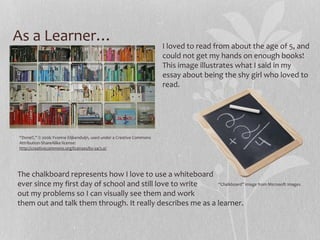
I loved to read from about the age of 5, and
could not get my hands on enough books!
This image illustrates what I said in my
essay about being the shy girl who loved to
read.

“Done!!,” © 2006 Yvonne Eiijkenduijn, used under a Creative Commons
Attribution-ShareAlike license:
http://creativecommons.org/licenses/by-sa/3.0/

The chalkboard represents how I love to use a whiteboard
“Chalkboard” Image from Microsoft Images
ever since my first day of school and still love to write
out my problems so I can visually see them and work
them out and talk them through. It really describes me as a learner.
As a Learner Cont.….
nfluential teachers make all the difference!
quote included in my essay from class that resonates with me:
“Students learn what they care about, from people they care about and
who they know, care about them.” Barbara Harrell Carson
When people care for you and cry for you, they can straighten our your
soul.” Langson Hughes
he above quotes are included in my essay and talk about Mrs.
Kaufmann. She taught me more than just math and social

studies; she taught me what optimism does for a person, how
perseverance pays off in the end, and how to create goals to
achieve the small things in life. She showed compassion
As a Learner cont.…
We need to teach each the child the way he or she learns.” Learning to
Change video
n my essay I talk about how my high school science teacher made
learning a subject that I was not interested in, fun and exciting. Mr.
Mathew focused on and paid attention to how each of his students
learned best. He would go as far as taking time after school to open
his door and invite us to come in and have extra help with him. He
would let me explain my thoughts on the chalkboard, because he
knew that I needed to talk-it-out. He really focused on the studentcentered classroom.
tahTKdEUAPk
his YouTube video, “Learning to Change Changing to Learn” shown in
class helps me think about how the way I teach will be different from
My Vision…
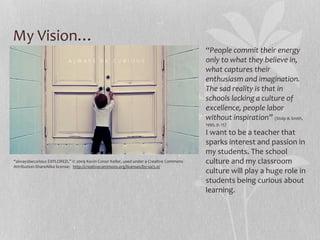
“People commit their energy
only to what they believe in,
what captures their
enthusiasm and imagination.
The sad reality is that in
schools lacking a culture of
excellence, people labor
without inspiration” (Stolp & Smith,
1995, p. 15)

“alwaysbecurious EXPLORED,” © 2009 Kevin Conor Keller, used under a Creative Commons
Attribution-ShareAlike license: http://creativecommons.org/licenses/by-sa/3.0/

I want to be a teacher that
sparks interest and passion in
my students. The school
culture and my classroom
culture will play a huge role in
students being curious about
learning.
My Vision…
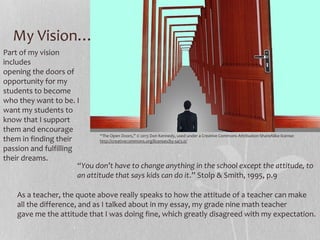
Part of my vision
includes
opening the doors of
opportunity for my
students to become
who they want to be. I
want my students to
know that I support
them and encourage
“The Open Doors,” © 2013 Don Kennedy, used under a Creative Commons Attribution-ShareAlike license:
them in finding their
http://creativecommons.org/licenses/by-sa/3.0/
passion and fulfilling
their dreams.
“You don’t have to change anything in the school except the attitude, to
an attitude that says kids can do it.” Stolp & Smith, 1995, p.9
As a teacher, the quote above really speaks to how the attitude of a teacher can make
all the difference, and as I talked about in my essay, my grade nine math teacher
gave me the attitude that I was doing fine, which greatly disagreed with my expectation.
My Vision cont.….
Don’t just teach kids how to count. Teach ‘em what counts most.”
Karne Salmansohn.
Students […] take lessons beyond the school and apply their
experiences to other areas of life.” Stolp & Smith, 1995, p.2
Schools need to develop ways to link classroom learning to other
aspects of students’ lives.” Bransford et. Al., 2000, p 26

he three quotes above all speak to the way my influential teachers
taught me, and how I, as an emerging teacher want to approach
education. It is so important for kids to get more out of school than
just math skills and English essay writing skills; they need to learn
My Vision cont.…
caffolding: The teacher provides whatever assistance students need
to enable them to engage learning activities productively. Seminar
Notes September 30, 2013
Zone of Proximal Development: “The ZPD is the distance between
what children can do by themselves and the next learning that they can
be helped to achieve with competent assistance.” Eileen Raymond.
“Learner-centered teachers present students with ‘just manageable
difficulties’ – that is, challenging enough to maintain engagement, but not
so difficult as to lead to discouragement.” Bransford et. Al., 2000, p.24
The following look at Zone of Proximal Development and Scaffolding,
which I talked about further in my essay. Being there as a teacher to assist,
but to also encourage my students is so important for me.
In Conclusion…
If you can change a single classroom, you change the world.” Learning
to Change video

his quote really stuck into me while watching the Learning to Change
– Changing to Learn video. To me, this quote means that I, as a
teacher will be able to change the world of the students that enter
my classroom. Whether that change is a life-changing event, or just a
small change in how they look at themselves in a new way. In any
case, I want my classroom to be one of safety, excitement, positive
learning and success.
References
alwaysbecurious EXPLORED,” © 2009 Kevin Conor Keller, used under a Creative Commons AttributionShareAlike license: http://creativecommons.org/licenses/by-sa/3.0/

ransford, J.D., Brown, A.L., Cocking, R.R. (Eds). (2000). How People Learn: Brain, Mind, Experience, and School
(expanded ed. Pp.3-27, 233-247). Washington, DC: National Academy Press. Link to eBook through UofC
Library:
http://ucalgary.summon.serialssolutions.com/search?s.fvf[]=ContentType%2CBook+/+eBook&s.fvf[]=ContentType%2CGo
true
Chalkboard” Image from Microsoft Images.
Done!!,” © 2006 Yvonne Eiijkenduijn, used under a Creative Commons Attribution-ShareAlike license:
http://creativecommons.org/licenses/by-sa/3.0/
earning to Change – Changing to Learn (2008, May 15). Learning to Change Changing to Learn Advancing K-12
Technology Leadership, Consortium for School Networking (COSN) [Video File]. Retrieved from
http://www.youtube.com/watch?v=tahTKdEUAPk
tolp S., & Smith S.C. (1995). Transforming School Culture: Stories, Symbols, Values & The Leader’s Role. Eric
Clearinghouse on Educational Management. 1-32. Retrieved from
https://blackboard.ucalgary.ca/webapps/portal/frameset.jsp?tab_id=_2_1&url=%2fwebapps%2fblackboard
%2fexecute%2flauncher%3ftype%3dCourse%26id%3d_155771_1%26url%3d

Part 2 digital folder

  • 1.
    My experience in Education WhoAm I as a Learner and Who Am I Becoming as a Teacher? Part II: Digitized Artifact Folder Alanna Parlee EDUC 430
  • 2.
    As a Learner… Iloved to read from about the age of 5, and could not get my hands on enough books! This image illustrates what I said in my essay about being the shy girl who loved to read. “Done!!,” © 2006 Yvonne Eiijkenduijn, used under a Creative Commons Attribution-ShareAlike license: http://creativecommons.org/licenses/by-sa/3.0/ The chalkboard represents how I love to use a whiteboard “Chalkboard” Image from Microsoft Images ever since my first day of school and still love to write out my problems so I can visually see them and work them out and talk them through. It really describes me as a learner.
  • 3.
    As a LearnerCont.…. nfluential teachers make all the difference! quote included in my essay from class that resonates with me: “Students learn what they care about, from people they care about and who they know, care about them.” Barbara Harrell Carson When people care for you and cry for you, they can straighten our your soul.” Langson Hughes he above quotes are included in my essay and talk about Mrs. Kaufmann. She taught me more than just math and social studies; she taught me what optimism does for a person, how perseverance pays off in the end, and how to create goals to achieve the small things in life. She showed compassion
  • 4.
    As a Learnercont.… We need to teach each the child the way he or she learns.” Learning to Change video n my essay I talk about how my high school science teacher made learning a subject that I was not interested in, fun and exciting. Mr. Mathew focused on and paid attention to how each of his students learned best. He would go as far as taking time after school to open his door and invite us to come in and have extra help with him. He would let me explain my thoughts on the chalkboard, because he knew that I needed to talk-it-out. He really focused on the studentcentered classroom. tahTKdEUAPk his YouTube video, “Learning to Change Changing to Learn” shown in class helps me think about how the way I teach will be different from
  • 5.
    My Vision… “People committheir energy only to what they believe in, what captures their enthusiasm and imagination. The sad reality is that in schools lacking a culture of excellence, people labor without inspiration” (Stolp & Smith, 1995, p. 15) “alwaysbecurious EXPLORED,” © 2009 Kevin Conor Keller, used under a Creative Commons Attribution-ShareAlike license: http://creativecommons.org/licenses/by-sa/3.0/ I want to be a teacher that sparks interest and passion in my students. The school culture and my classroom culture will play a huge role in students being curious about learning.
  • 6.
    My Vision… Part ofmy vision includes opening the doors of opportunity for my students to become who they want to be. I want my students to know that I support them and encourage “The Open Doors,” © 2013 Don Kennedy, used under a Creative Commons Attribution-ShareAlike license: them in finding their http://creativecommons.org/licenses/by-sa/3.0/ passion and fulfilling their dreams. “You don’t have to change anything in the school except the attitude, to an attitude that says kids can do it.” Stolp & Smith, 1995, p.9 As a teacher, the quote above really speaks to how the attitude of a teacher can make all the difference, and as I talked about in my essay, my grade nine math teacher gave me the attitude that I was doing fine, which greatly disagreed with my expectation.
  • 7.
    My Vision cont.…. Don’tjust teach kids how to count. Teach ‘em what counts most.” Karne Salmansohn. Students […] take lessons beyond the school and apply their experiences to other areas of life.” Stolp & Smith, 1995, p.2 Schools need to develop ways to link classroom learning to other aspects of students’ lives.” Bransford et. Al., 2000, p 26 he three quotes above all speak to the way my influential teachers taught me, and how I, as an emerging teacher want to approach education. It is so important for kids to get more out of school than just math skills and English essay writing skills; they need to learn
  • 8.
    My Vision cont.… caffolding:The teacher provides whatever assistance students need to enable them to engage learning activities productively. Seminar Notes September 30, 2013 Zone of Proximal Development: “The ZPD is the distance between what children can do by themselves and the next learning that they can be helped to achieve with competent assistance.” Eileen Raymond. “Learner-centered teachers present students with ‘just manageable difficulties’ – that is, challenging enough to maintain engagement, but not so difficult as to lead to discouragement.” Bransford et. Al., 2000, p.24 The following look at Zone of Proximal Development and Scaffolding, which I talked about further in my essay. Being there as a teacher to assist, but to also encourage my students is so important for me.
  • 9.
    In Conclusion… If youcan change a single classroom, you change the world.” Learning to Change video his quote really stuck into me while watching the Learning to Change – Changing to Learn video. To me, this quote means that I, as a teacher will be able to change the world of the students that enter my classroom. Whether that change is a life-changing event, or just a small change in how they look at themselves in a new way. In any case, I want my classroom to be one of safety, excitement, positive learning and success.
  • 10.
    References alwaysbecurious EXPLORED,” ©2009 Kevin Conor Keller, used under a Creative Commons AttributionShareAlike license: http://creativecommons.org/licenses/by-sa/3.0/ ransford, J.D., Brown, A.L., Cocking, R.R. (Eds). (2000). How People Learn: Brain, Mind, Experience, and School (expanded ed. Pp.3-27, 233-247). Washington, DC: National Academy Press. Link to eBook through UofC Library: http://ucalgary.summon.serialssolutions.com/search?s.fvf[]=ContentType%2CBook+/+eBook&s.fvf[]=ContentType%2CGo true Chalkboard” Image from Microsoft Images. Done!!,” © 2006 Yvonne Eiijkenduijn, used under a Creative Commons Attribution-ShareAlike license: http://creativecommons.org/licenses/by-sa/3.0/ earning to Change – Changing to Learn (2008, May 15). Learning to Change Changing to Learn Advancing K-12 Technology Leadership, Consortium for School Networking (COSN) [Video File]. Retrieved from http://www.youtube.com/watch?v=tahTKdEUAPk tolp S., & Smith S.C. (1995). Transforming School Culture: Stories, Symbols, Values & The Leader’s Role. Eric Clearinghouse on Educational Management. 1-32. Retrieved from https://blackboard.ucalgary.ca/webapps/portal/frameset.jsp?tab_id=_2_1&url=%2fwebapps%2fblackboard %2fexecute%2flauncher%3ftype%3dCourse%26id%3d_155771_1%26url%3d

Editor's Notes

  • #8 She taught me more than just math and social studies; she taught me what optimism does for a person, how perseverance pays off in the end, and how to create goals to achieve the small things in life.