Parker Pen Co.
International Marketing
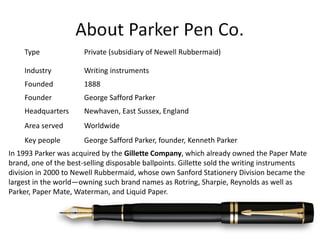
Type Private (subsidiary of Newell Rubbermaid)
Industry Writing instruments
Founded 1888
Founder George Safford Parker
Headquarters Newhaven, East Sussex, England
Area served Worldwide
Key people George Safford Parker, founder, Kenneth Parker
In 1993 Parker was acquired by the Gillette Company, which already owned the Paper Mate
brand, one of the best-selling disposable ballpoints. Gillette sold the writing instruments
division in 2000 to Newell Rubbermaid, whose own Sanford Stationery Division became the
largest in the world—owning such brand names as Rotring, Sharpie, Reynolds as well as
Parker, Paper Mate, Waterman, and Liquid Paper.
Products available in the Market
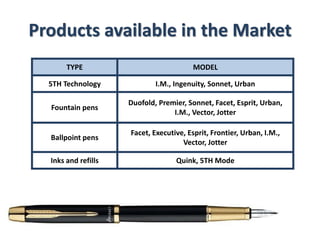
TYPE MODEL
5TH Technology I.M., Ingenuity, Sonnet, Urban
Fountain pens
Duofold, Premier, Sonnet, Facet, Esprit, Urban,
I.M., Vector, Jotter
Ballpoint pens
Facet, Executive, Esprit, Frontier, Urban, I.M.,
Vector, Jotter
Inks and refills Quink, 5TH Mode
LETS SUMMARIZE
What is the case all
about
CASE A
What we have understood and what we can derive
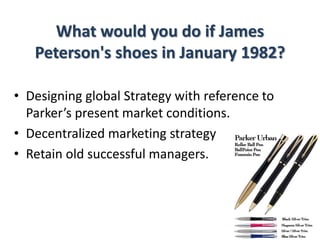
What would you do if James
Peterson's shoes in January 1982?
• Designing global Strategy with reference to
Parker’s present market conditions.
• Decentralized marketing strategy
• Retain old successful managers.
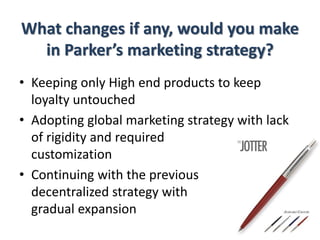
What changes if any, would you make
in Parker’s marketing strategy?
• Keeping only High end products to keep
loyalty untouched
• Adopting global marketing strategy with lack
of rigidity and required
customization
• Continuing with the previous
decentralized strategy with
gradual expansion
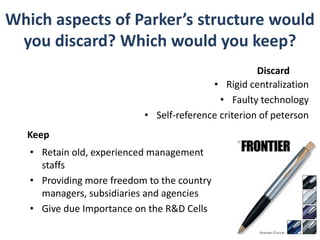
Which aspects of Parker’s structure would
you discard? Which would you keep?
Discard
• Rigid centralization
• Faulty technology
• Self-reference criterion of peterson
Keep
• Retain old, experienced management
staffs
• Providing more freedom to the country
managers, subsidiaries and agencies
• Give due Importance on the R&D Cells
Assume that you are James Peterson and you have just hired a new
management team composed oh highly qualified executives from
outside companies. You and your team are convinced that you have
the solution to Parker’s problems but there are many holdovers who
disagree with you. How would you incorporate the views of Parker
management into your plan?
This is a crucial decision for an individual as it is
hard to choose between experience and
modernization.
The best solution to this problem
would be to use the experience of the
holdovers and inculcate it into the
new teams ideas that would even give
an edge to the competitors
CASE B
What we have understood and what
we can derive
Why did Peterson’s global strategy fail?
• Self-reference criterion
• Rigid centralization
• Pursuing the market and products of lower end in
addition to higher end products
• Use of faulty technology in production plant
• Firing of successful managers
What lessons can be drawn from
the decline and fall of Parker Pen?
• One should always be careful with the customers it has
before trying to expand and grab more customers
because a rapid strategic change can affect the loyal
customers.
• All products cannot be marketed in throughout the
globe equally, centralization always doesn't work for all
products.
• For a product like pen it is very important to decide how
you want to place your Brand.
Though late but still PARKER’s management realized that the pen business consisted of “little
pocket of entrepreneurial activity around the world” were not susceptible to centralized,
standardize approach. So it is well understood that we must understand the requirement of
the market and plan their marketing effort accordingly.
Conclusion
Other wise this would hit the wall and crashed like the
effort of Mr. Peterson and will lead the company in a
riskier situation like PARKER. Again sudden shifting from
one strategy to another also proves to be disastrous for a
company. It should be done slowly and gradually giving
sufficient time to the consumer to adopt with the change.
Beside this an international marketer should also judge
and assess the differences of the varying situation
judiciously to lessen risk of his marketing effort. .
Parker pen co

Parker pen co

  • 1.
  • 2.
    Type Private (subsidiaryof Newell Rubbermaid) Industry Writing instruments Founded 1888 Founder George Safford Parker Headquarters Newhaven, East Sussex, England Area served Worldwide Key people George Safford Parker, founder, Kenneth Parker In 1993 Parker was acquired by the Gillette Company, which already owned the Paper Mate brand, one of the best-selling disposable ballpoints. Gillette sold the writing instruments division in 2000 to Newell Rubbermaid, whose own Sanford Stationery Division became the largest in the world—owning such brand names as Rotring, Sharpie, Reynolds as well as Parker, Paper Mate, Waterman, and Liquid Paper.
  • 3.
    Products available inthe Market TYPE MODEL 5TH Technology I.M., Ingenuity, Sonnet, Urban Fountain pens Duofold, Premier, Sonnet, Facet, Esprit, Urban, I.M., Vector, Jotter Ballpoint pens Facet, Executive, Esprit, Frontier, Urban, I.M., Vector, Jotter Inks and refills Quink, 5TH Mode
  • 4.
    LETS SUMMARIZE What isthe case all about
  • 5.
    CASE A What wehave understood and what we can derive
  • 6.
    What would youdo if James Peterson's shoes in January 1982? • Designing global Strategy with reference to Parker’s present market conditions. • Decentralized marketing strategy • Retain old successful managers.
  • 7.
    What changes ifany, would you make in Parker’s marketing strategy? • Keeping only High end products to keep loyalty untouched • Adopting global marketing strategy with lack of rigidity and required customization • Continuing with the previous decentralized strategy with gradual expansion
  • 8.
    Which aspects ofParker’s structure would you discard? Which would you keep? Discard • Rigid centralization • Faulty technology • Self-reference criterion of peterson Keep • Retain old, experienced management staffs • Providing more freedom to the country managers, subsidiaries and agencies • Give due Importance on the R&D Cells
  • 9.
    Assume that youare James Peterson and you have just hired a new management team composed oh highly qualified executives from outside companies. You and your team are convinced that you have the solution to Parker’s problems but there are many holdovers who disagree with you. How would you incorporate the views of Parker management into your plan? This is a crucial decision for an individual as it is hard to choose between experience and modernization. The best solution to this problem would be to use the experience of the holdovers and inculcate it into the new teams ideas that would even give an edge to the competitors
  • 10.
    CASE B What wehave understood and what we can derive
  • 11.
    Why did Peterson’sglobal strategy fail? • Self-reference criterion • Rigid centralization • Pursuing the market and products of lower end in addition to higher end products • Use of faulty technology in production plant • Firing of successful managers
  • 12.
    What lessons canbe drawn from the decline and fall of Parker Pen? • One should always be careful with the customers it has before trying to expand and grab more customers because a rapid strategic change can affect the loyal customers. • All products cannot be marketed in throughout the globe equally, centralization always doesn't work for all products. • For a product like pen it is very important to decide how you want to place your Brand.
  • 13.
    Though late butstill PARKER’s management realized that the pen business consisted of “little pocket of entrepreneurial activity around the world” were not susceptible to centralized, standardize approach. So it is well understood that we must understand the requirement of the market and plan their marketing effort accordingly. Conclusion Other wise this would hit the wall and crashed like the effort of Mr. Peterson and will lead the company in a riskier situation like PARKER. Again sudden shifting from one strategy to another also proves to be disastrous for a company. It should be done slowly and gradually giving sufficient time to the consumer to adopt with the change. Beside this an international marketer should also judge and assess the differences of the varying situation judiciously to lessen risk of his marketing effort. .

Editor's Notes

  • #12  ? Self-Reference Criterion (SRC). While crafting the new strategy for PARKER Mr. Peterson was biased due to his SRC, which mainly came from his vast work experience on global marketing concept. He totally ignored the existing situation of PARKER and forced the company to change its strategy ignoring the requirement of market. ? Rigid Centralization. Many company involved in global marketing do not rigidly centralized all their marketing effort due to the huge variety in the culture of different region. In some cases companies made little or few adjustments in their standardize global effort to meet the requirements of different environment. But Mr. Peterson and his strategy had the rigidity in following centralized packaging, pricing, and promotional materials. This rigidity was not accepted by the customers of different culture. ? Pursuing the Market and Products of Lower End in Addition to Higher End Products. Over the period of time PARKER established an image, as the seller of high end products. But the new CEO suddenly started pursuing the lower end of the market and produced with lower priced pen. This was counter to PARKER’s tradition and image and many of its loyal customers could not accept this. Ultimately this proved to be an ill – advice for PARKER. ? Use of Faulty Technology in Production Plant. Repeated mechanical fault caused disturbance in the productivity of the automated production plant. This is another reason for the failure of new strategy. ? Firing of Successful Managers. Mr. Peterson and his team fired many of veteran managers of the company. In some case a move was greeted with dismay by the employees within the company, which ultimately affected the productivity of the company.