PARETO DIAGRAM
ELLYZA MONTER GUARTE
MARIA LORNA AMPER
WHAT IS PARETO DIAGRAM?
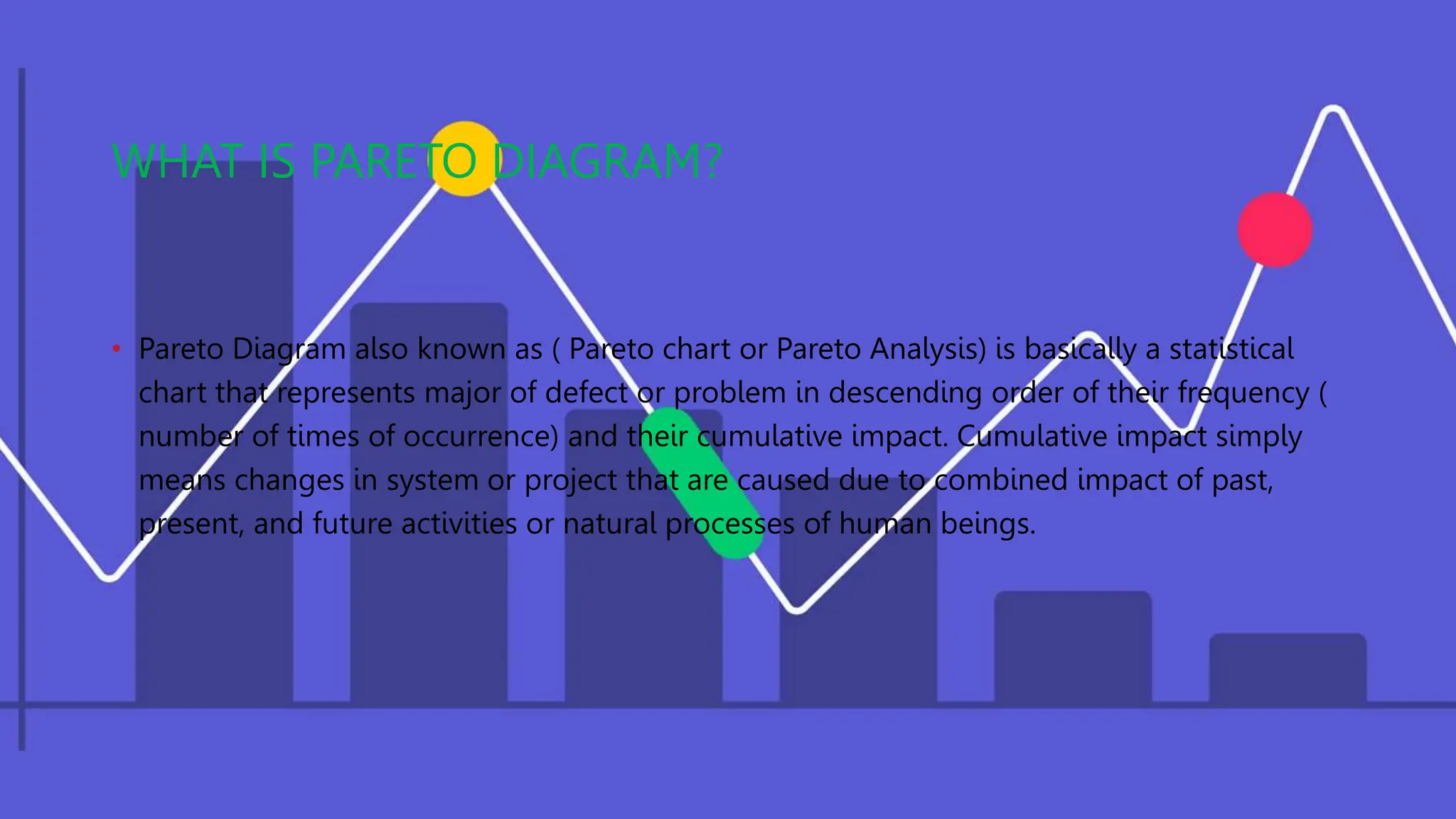
• Pareto Diagram also known as ( Pareto chart or Pareto Analysis) is basically a statistical
chart that represents major of defect or problem in descending order of their frequency (
number of times of occurrence) and their cumulative impact. Cumulative impact simply
means changes in system or project that are caused due to combined impact of past,
present, and future activities or natural processes of human beings.
BENEFITS OF PARETO DIAGRAM;
Effective tool for communication with stakeholders visually
Enhances organizational efficiency
Helps to determine the most significant causes of a problem
Enhances problem solving-skills
A visual presentation tool
Can be created easily with limited statistical knowledge
Improves decision making within the organization
WHEN TO USE PARETO DIAGRAM?
If one wants to organize and manage a lot of information and data that is needed to be
organized.
When someone wants to explain and tell about defects with higher priority to
stakeholders.
When someone wants to prioritize defect or task according to their severity i.e. according
to their impact on system or organization.
When it is essential and important to analyze data or defect.
PURPOSE OF PARETO DIAGRAM;
• Is to separate the significant aspects of a problem from the trivial ones. By graphically separating
the aspects of problem, a team will know where to direct its improvement efforts. Reducing the
largest bars identified in the diagram will do more for overall improvement than reducing the
smaller ones
ADVANTAGES
 Simply identify and determine main cause i.e root causes of defects or problems.
 Defects are organized from highest to lowest priority
 Determine cumulative impact of defect.
 Provides a better explanation regarding defects that are needed to resolved first.
 Skills of individuals are also increased in better ways like problem-solving skills, decision-making
skills, etc.
 Helps in solving issues regarding problem-solving and decision-making time management
 One can plan, analyze and resolve problems of defects .
DIASADVANTAGES
Root cause analysis cannot be done by itself in Pareto Analysis. There is requirement of
tool i.e root cause analysis for determining or identify root causes or major causes of
defect.
It does not represent severity of defect or any problem. It only shows qualitative data.
Only focuses on past data where damaged has already happened.
Cannot be applied to all cases. It is limited to some cases only.
PARETO DIAGRAM
• We decided to use Pareto Diagram in Jollibee Company. Since, total quality management can
detect errors just like pareto diagram used to defect and illustrate the major problem or how the
system wide sales and net income earnings of growth slows of our chosen company/organization
changes.
JOLLIBEE COMPANY
Products and services:
• Franchising
• Leasing
• Self- order kiosks
Work processes/operations
• Developing
• Operating
• Franchising
• Manufacturing
• marketing

PARETO-DIAGRAM.pptx

  • 1.
    PARETO DIAGRAM ELLYZA MONTERGUARTE MARIA LORNA AMPER
  • 2.
    WHAT IS PARETODIAGRAM? • Pareto Diagram also known as ( Pareto chart or Pareto Analysis) is basically a statistical chart that represents major of defect or problem in descending order of their frequency ( number of times of occurrence) and their cumulative impact. Cumulative impact simply means changes in system or project that are caused due to combined impact of past, present, and future activities or natural processes of human beings.
  • 3.
    BENEFITS OF PARETODIAGRAM; Effective tool for communication with stakeholders visually Enhances organizational efficiency Helps to determine the most significant causes of a problem Enhances problem solving-skills A visual presentation tool Can be created easily with limited statistical knowledge Improves decision making within the organization
  • 4.
    WHEN TO USEPARETO DIAGRAM? If one wants to organize and manage a lot of information and data that is needed to be organized. When someone wants to explain and tell about defects with higher priority to stakeholders. When someone wants to prioritize defect or task according to their severity i.e. according to their impact on system or organization. When it is essential and important to analyze data or defect.
  • 5.
    PURPOSE OF PARETODIAGRAM; • Is to separate the significant aspects of a problem from the trivial ones. By graphically separating the aspects of problem, a team will know where to direct its improvement efforts. Reducing the largest bars identified in the diagram will do more for overall improvement than reducing the smaller ones
  • 6.
    ADVANTAGES  Simply identifyand determine main cause i.e root causes of defects or problems.  Defects are organized from highest to lowest priority  Determine cumulative impact of defect.  Provides a better explanation regarding defects that are needed to resolved first.  Skills of individuals are also increased in better ways like problem-solving skills, decision-making skills, etc.  Helps in solving issues regarding problem-solving and decision-making time management  One can plan, analyze and resolve problems of defects .
  • 7.
    DIASADVANTAGES Root cause analysiscannot be done by itself in Pareto Analysis. There is requirement of tool i.e root cause analysis for determining or identify root causes or major causes of defect. It does not represent severity of defect or any problem. It only shows qualitative data. Only focuses on past data where damaged has already happened. Cannot be applied to all cases. It is limited to some cases only.
  • 9.
    PARETO DIAGRAM • Wedecided to use Pareto Diagram in Jollibee Company. Since, total quality management can detect errors just like pareto diagram used to defect and illustrate the major problem or how the system wide sales and net income earnings of growth slows of our chosen company/organization changes.
  • 10.
    JOLLIBEE COMPANY Products andservices: • Franchising • Leasing • Self- order kiosks Work processes/operations • Developing • Operating • Franchising • Manufacturing • marketing