OZ PHIL COLLEGE INC.
PARENTS’ ORIENTATION
S/Y 2023 -2024
Aug. 28, 2023
VISION
TO PROMOTE AND POSTER QUALITY
TEACHING AND LEARNING THAT WILL
PROVIDE STUDENTS WITH A DIVERSE
AND INCLUSIVE EXPERIENCE .
MISSION
TO DEVEOP WELL – ROUNDED
INDIVIDUALS; WITH EDUCATIONAL
ATTRIBUTES THAT EN ABLE THEM TO BE
RESPONSIVE FOR THE GLOBAL
COMMUNITIES, THEY SERVE THROUGH
THEIR ENGAGEMENT IN A RICH LEARNING
ENVIRONMENT PROVIDED BY INNOVATIVE
AND PROFESSIONAL STAFF.
VALUES:
HUMILITY – WE APPRECIATE GREATNESS BUT
ALSO THE WEAKNESS
INTEGRITY – WE DO RIGHT THING EVEN THERE
IS NO ONE LOOKING
CAREFUL OF THE WORDS WE SAY, AND THE
WAY WE SPEAK.
KINDNESS – WE PROVIDE CONDSIDERATION TO
OTHERS.
RESPECT – WE EMBRACE DIVERSITY
SCHOOL PHILOSOPHY
WE STRIVE , WE CARE
Discipline Policy
OzPhiI College approach to discipline is
through mutual Respect and self
discipline
1. An individual must feel that
he/she is valued and respected by
peers, teachers and parents in order to
develop a sense of self worth.
Discipline Policy
2. Individual rights and freedom must be
protected. Ideally through self–
discipline. This required both an
underlying framework of firm standards
and student awareness of validity of
rules,
3. self discipline cannot develop freely
with out understanding.
Goals in Discipline Policy
1. To develop students’ self – discipline and self
control.
2. To enable students to be on – task with their
learning
3. To enhance students ‘ self – steem.
4. To encourage accountability for behavior
5. To encourage the individual students to
recognize and respect the rights of others.
6. To affirm cooperation as well as
responsible
independence in learning .
7. To promote the values of honesty , fairness
and respect for others.
8. to enable rational conflict resolution.
GENERAL POLICIES
Uniform
> Represents students’ personal grooming ,
thus students represents the school and all
the ideals it upholds.
> The school uniform is intended for school wear
and for authorized representation in an activity,
( Quiz Bee, Leadership training)
> PE uniform are required for the learners to wear
during P E day.
> Faction Uniform shall be worn on the given
schedule
Hairdo/ Hair cut
> Hair must be neat tidy, and clean.
> Boys should not fall below collar line.
> Girls with hair below the collar line are to tie it back
with hair ties, use of head bands hair clips to avoid
hair covering the face.
> Fancy haircut and hair style ( punk styles, crew cuts,
shaves, spikes, wedges, ridges) and hair color are not
allowed.
> Fringes must clear the eye brow
> Loud Dyed colored hair is not allowed.
JEWELRY -
1. Expensive(gold or gold plated) watch or plain medical
alert bracelet , earrings , necklace
are not to be worn in school.
2. Other expensive jewelries such as pearl or pendant is
discourage.
3. Boys wearing earrings in school is discourage.
4.Piercing on parts of the body that are not
covered by clothing are not permitted . Ex.tongue,
nose
5. chain is inappropriate to wear.
Tattoo/ Piercing
1. Permanent tattoo and all form of body piercing are not
allowed.
2. Visible tattoos are not permitted , incase child had
enrolled with tattoo.
Personal Grooming expectation
1. Male students (JHS /SHS )are to be clean /shaven
2. Female make up is not to be worn (JHS /SHS )
3. Acrylic Fingernails are not to be worn.
4. Nail Polish is not allowed, but fingernails are to be
kept short.
Identification Card
1. is a part of the school uniform.
2. All students are required to wear the
school ID, while inside the school
premises and during activities outside
the school such as (field trip,
contest, training , seminars,
3. It must carry the recent picture of the student.
4. It should be free from any
unnecessary decorations, markings
and stickers .
5. Lending and borrowing of I.D. are strictly
prohibited and subject for disciplinary action
or sanction.
Attendance and Punctuality.
► 1. Attendance and Punctuality shall be observe at
all times
► 2. Regular and punctual attendance in all classes
and school activities including those schedule on
non – school days is expected of all students.
► 3. A student is not allowed to leave the school
premises during school hours which include recess
time, lunch break and the period between
dismissal time and the start of any school activity
after class hours .
► 4. A student is allowed to leave the school
premises only with an authorization letter from
parents or guardians.
► 5. A student who was absent must present a letter
of excuse duly signed by his/ her parents or
guardian once he/she report to class. Parents
must notify the office.
► 6. An absence is considered excused based on any
of the following reasons :
- sickness (accompanied with medical
certificate )
- death of an immediate family member
- participant or representative of an
activity officially recognized
by the school
- accidents
- calamities
► 7. A student may be dropped from school due to
any of the following reasons:
.> accumulation of 40 un excused
absences with In the school year
> absences for 10 consecutive days
with out notice.
Note: ( Parents should immediately notify the
class adviser about the cause of their child’s
absences.
8. A student who was absent from class is responsible for
the lessons that were taken up during his absence and should
arrange with his teachers for missed assignments , quizzes
and homework.
9. students from grade school ,junior high school and senior
high school are required to be in school at 7:15 A.M. every
Monday for the assembly. And 7:30 A.M from Tuesday to
Friday For Kindergarten to Junior high school, and 7:00 AM
for Senior high school from Tuesday to Friday.
Tardiness
1. A student is considered tardy if:
> He / she come to school after the official
time.
> he /she is not in the venue at the start of
each class, assembly, program or activity.
> A student may be excused from being tardy
during heavy rains, emergencies
rallies,transportation strikes, calamities )
> the adviser issues a written notice to the
parents for the three tardiness incurred in a week. A
conference will be called between the parents ,
student and adviser for discussion of possible
remedies.
> students who are late must secure tardy slip
from the principal to be presented to the teacher
in-charge upon entering the classroom.
> three (3) accumulated number of late /
tardiness is equivalent to 1 day absence.
SPECIAL Permission –( Pulling out from Classes)
⮚ Parents are not allowed to pull out their children
from their classes without valid reason/s and
approval from the Principal.
> A child will not be pulled out by any one (Fetchers,
relative or any one related or not related to the child
) without a written request or permission letter.
⮚ Procedure in getting permission for departure
pass.
- . Present a written explanation to the adviser
stating the reason for pull out.
- Get a gate pass in triplicate copies from the
principal office , duly sign by the
adviser and principal.
- Give a copy of the gate pass to the guard on
duty and sign the log book.
CELLPHONE
1. Bringing of cellphone is prohibited to Nursery, Pre
kinder, Kinder and leaners in Grade 1 to 12 levels.
2. SHS learners are allowed to bring cellphone
regardless, it is use for Learning related or advise by their
respective subject teachers for Lesson purposes.
3. Cellphone brought to school shall be surrendered in
the office and will be released after dismissal.
4. Using of cellphone during class hours, not related to
the lesson and around the campus will be confiscated and
will be returned to the parents or at the end of the school
year.
Confiscated Property
►1. Property confiscated by staff, teachers
will not receive their property back until
the end of the school year.
►2. Parents can get the confiscated
Property , unless it will not be brought to
school again or property will be returned at
the end of the school year.
ALCOHOL and OTHER DRUGS
► Alcohol and other Drugs ;
> Students are not permitted to have their
possession , or consume alcohol liquor either on the
school premises , in any public place or any school
activity.
> Possession or use of any prohibited drugs or
any dealings in such drugs is forbidden in school.
Smoking
.
> Smoking is forbidden during classes, with in the
school premises and at all times when in school
uniform , or to have smoking materials in their
possession.
Assignment / Homework Policy
► Assignment is a form of follow up, enhancement and
Mastery of the lessons.
> Assignment for Nursery to Grade 3 is in the form of
follow up for the lessons taken for the day.
Example : Read/ color Page.. finish the task given in
class on page, Bring picture
of..
> Assignment for Grade IV to VI is in the form of follow
up and enhancement of the lessons taken for the day.
Example: Read page and Answer page (limit the
questions 5 to 10)
Assignment / Home work Policy
> Complete the task you didn’t comply
for the class
► Assignment for Grade 7 to 12 is in the form of follow up,
enhancement and mastery of lesson, required for 4 nights.
> task oriented activity
> Project, Research type
> revision of task
Note: No Assignment shall be given in all levels every Friday.
ADMISSION POLICY
► Oz Phil College of Cavite welcomes learners, who have the desire to enroll
here . The school provides quality academic program, geared in the Dep Ed K-
12 Curriculum.
► Interview and proper screening and evaluation of both parents and children
are required and considered.
► Admission is also based on the credentials and willingness of parents to
partake in all the endeavors of the school and support its vision –mission.
► Requirements: > NSO / PSA Certificate ( original and photo copy)
> original Report Card – signed by the authorities of the school
last attended with the child’s Learners Reference Number ( LRN )
> Certificate of Good moral character
> Permanent Record to be requested by the school
Expected Standards Student Behavior
► It must be understood that the laws governing
individual behavior which apply in the community
outside the school will be enforced strictly with in
the school and without limiting the application of
the community ‘s laws.
► Example : relating physical assault, vandalism,
interference with other people‘s property,
trespass, offensive language and behavior.
►MINOR OFFENSES
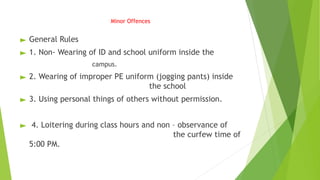
Minor Offences
► General Rules
► 1. Non- Wearing of ID and school uniform inside the
campus.
► 2. Wearing of improper PE uniform (jogging pants) inside
the school
► 3. Using personal things of others without permission.
► 4. Loitering during class hours and non – observance of
the curfew time of
5:00 PM.
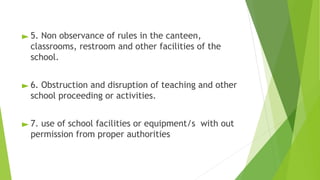
► 5. Non observance of rules in the canteen,
classrooms, restroom and other facilities of the
school.
► 6. Obstruction and disruption of teaching and other
school proceeding or activities.
► 7. use of school facilities or equipment/s with out
permission from proper authorities
8. Improper haircut for the boys
9.Hair dye (loud color) and hair styling.
10. Tattoo or piercing
11. Sporting of excessive earings , noise rings,
dangling earings, metal chain, puka shell
necklace.
12. Non- submission of letter of excuse required
from absence.
13. Unexcused Tardiness and ceaseless Tardiness.
13. Non- observance of deadlines for submission of reply
slip, report cards and other correspondence.
14.Unsigned diaries
15. Failure to bring books and notebook everyday.
16. Bringing and using of items not related to Academic work
inside the school campus without the school permission is
Prohibited.
17. Bringing and using cellphone during class hours, school
programs and activities is Prohibited.
18. Gossiping or involve in malicious talks is prohibited.
Severity Clause on Discipline
► 1. Minor misdemeanours’ or infringement are dealt with
teacher using a variety of strategies such as :
a. appropriate warnings and consequences
b. repeated minor infringement leading to
serious infringements, may lead to:
ISOLATION,
INTERNAL SUSPENSION,
Loss of PRIVILEGES
c. inform parents directly , on diary or text
messages or call.
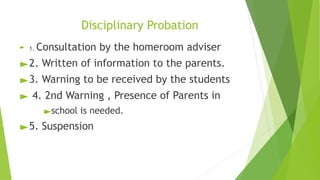
Disciplinary Probation
► 1. Consultation by the homeroom adviser
►2. Written of information to the parents.
►3. Warning to be received by the students
► 4. 2nd Warning , Presence of Parents in
►school is needed.
►5. Suspension
►MAJOR OFFENCES
MAJOR OFFENSES
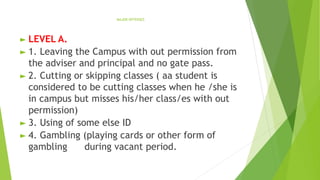
► LEVEL A.
► 1. Leaving the Campus with out permission from
the adviser and principal and no gate pass.
► 2. Cutting or skipping classes ( aa student is
considered to be cutting classes when he /she is
in campus but misses his/her class/es with out
permission)
► 3. Using of some else ID
► 4. Gambling (playing cards or other form of
gambling during vacant period.
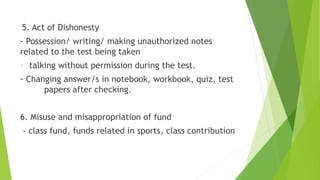
5. Act of Dishonesty
- Possession/ writing/ making unauthorized notes
related to the test being taken
- talking without permission during the test.
- Changing answer/s in notebook, workbook, quiz, test
papers after checking.
6. Misuse and misappropriation of fund
- class fund, funds related in sports, class contribution
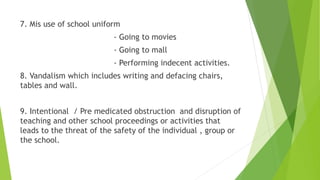
7. Mis use of school uniform
- Going to movies
- Going to mall
- Performing indecent activities.
8. Vandalism which includes writing and defacing chairs,
tables and wall.
9. Intentional / Pre medicated obstruction and disruption of
teaching and other school proceedings or activities that
leads to the threat of the safety of the individual , group or
the school.
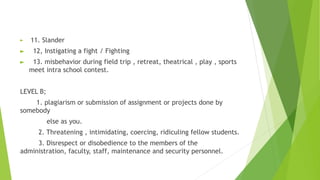
► 11. Slander
► 12, Instigating a fight / Fighting
► 13. misbehavior during field trip , retreat, theatrical , play , sports
meet intra school contest.
LEVEL B;
1. plagiarism or submission of assignment or projects done by
somebody
else as you.
2. Threatening , intimidating, coercing, ridiculing fellow students.
3. Disrespect or disobedience to the members of the
administration, faculty, staff, maintenance and security personnel.
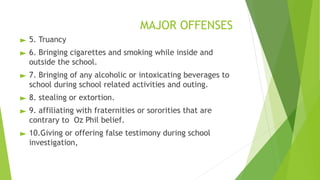
MAJOR OFFENSES
► 5. Truancy
► 6. Bringing cigarettes and smoking while inside and
outside the school.
► 7. Bringing of any alcoholic or intoxicating beverages to
school during school related activities and outing.
► 8. stealing or extortion.
► 9. affiliating with fraternities or sororities that are
contrary to Oz Phil belief.
► 10.Giving or offering false testimony during school
investigation,
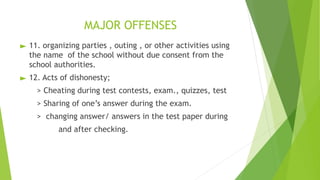
MAJOR OFFENSES
► 11. organizing parties , outing , or other activities using
the name of the school without due consent from the
school authorities.
► 12. Acts of dishonesty;
> Cheating during test contests, exam., quizzes, test
> Sharing of one’s answer during the exam.
> changing answer/ answers in the test paper during
and after checking.
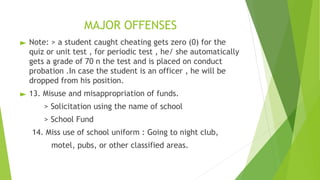
MAJOR OFFENSES
► Note: > a student caught cheating gets zero (0) for the
quiz or unit test , for periodic test , he/ she automatically
gets a grade of 70 n the test and is placed on conduct
probation .In case the student is an officer , he will be
dropped from his position.
► 13. Misuse and misappropriation of funds.
> Solicitation using the name of school
> School Fund
14. Miss use of school uniform : Going to night club,
motel, pubs, or other classified areas.
MAJOR OFFENSES
► 15. Committing imprudent acts like holding hands , kissing hugging and embracing ,
inside / outside of the school premises.
► 16. Malicious Mischief (poison letter, message in the Facebook, Forwarded emails, wed
pages or other information dissemination devices.
► All kinds of bullying.
► LEVEL C.
► 1. bringing / possessing deadly weapons / firecrackers and explosives or bladed and
pointed weapon.
► 2. hazing or inflicting or attempting to inflict body injury upon another
> Recruiting > observing Hazing procedures
> Hazing > Participating in hazing procedure
>. Finding and Allowing the use of private residence for hazing
procedure
MAJOR OFFENSES
► Note : The school does not allow any fraternity or sorority organization
to exist.
► 3. Bringing illegal substances /prohibited drugs like marijuana, shabu
and drug paraphernalia inside the school premises anb during school
activities outside the school.
► 4. acts of Academic Dishonesty
> getting , using , distributing leakage relative to test and contest
> Reviewing the exact exam , test papers to the classmates or
other students.
5. tampering : with false or falsifying official documents like report
cards , official notices, clearance and the like either to and from parents
and for submitting forged or falsified credentials / document as
previously mentioned.
Serious Infringements or repeated infringements may lead
to :
a. short probation , where behavior and
attitude are closely monitored .
b. parents would be ask to countersign any
documentation associated with this procedure.
c. Parent interviews with the teacher,
d. student / parent interviews with the principal
e. pastoral care will be provided, the student
with the opportunity to talk to the principal,
or suspend or expel student
Suspension or expulsion for the following
instances
1. Physical Violence
2. Substance abuse and /or possession of illegal / in
appropriate material
3. abuse behavior ( bullying )
4. un authorized absences from class
5. theft
6. vandalism
7. sexual harassment
►CHILD PROTECTION and
BULLYING POLICY
CHILD’S PROTECTION
► Policy and Guidelines on Protecting Children in School
from Abuse, Violence Exploitation ,Discrimination ,
Bullying and other Forms of Abuse.
► Section I. Short Title: This Department Order shall be
known as the “DepEd Child Protection Policy”
Section 2 .Statement Policy
Pursuant to the 1887 Constitution , the state
shall defend the right of the children to assistance ,
including proper care and nutrition and special protection
from all forms of neglect, abuse, cruelty, exploitation and
other conditions prejudicial to their development ( Article
XV, Section 3)
CHILD’S PROTECTION
> inculcate patriotism and nationalism
> foster love of humanity, respect for human rights,
appreciation of the role of the national heroes in the
historical development of our country
> teach the rights and duties of citizenship.
> strengthen ethical and spiritual values
>develop moral character and personal discipline
> encourage critical and creative thinking
> Broaden scientific and technological knowledge
and promote vocational efficiency.
CHILD’S PROTECTION
► The convention on the Rights of the Child (CRC)
> protect the child from all forms of physical or
mental violence , injury and abuse
neglect or negligent
treatment , maltreatment and
exploitation sexual abuse.
> right of the child to education
> schools are conducive to education.
> Collaboration with its partners and stakeholder
BULLYING POLICY
Oz Phil College is committed to providing a caring ,
friendly and safe environment for all of its pupils /students
so they can learn in a relaxed and secured atmosphere .
Pursuant to Republic Act No. 10627 also known, we have
established the anti- bullying policy set forth to ensure
everyone that bullying of any kind is un acceptable at our
school and that incidents of bullying will be dealt with
promptly and effectively.
BULLYING POLICY
► Objectives of the Policy
> All personnel, and parents should have an understanding
of what bullying is.
> All personnel should know what the school policy is on
bullying and follow it when bullying is reported.
. All pupils / students/and parents should know what the
school policy is on bullying and what they should do if
bullying arises.
> As a school we take bullying seriously, Pupils / students
and parents should be assured that they will be supported
when bullying reported.
BULLYING POLICY
► Forms of Bullying:
> Isolation > slurs
> pranks
> rumors > jokes
> gestures
> demeaning comments > drawing cartoons
> physical attacks
> threats >. Written action
> physical Actions
BULLYING POLICY
Procedure in Handling Bullying Incidents
The anti- bullying Policy of OzPhil College has its goal to ensure that all
pupil/ students experience a safe environment that is conductive o learning .
The following shall be considered;
► 1. Isolated or initial incidents which do not constitute bullying will be
handled by the teacher in charge at the time of the incident,
depending on the severity of the incidents, the parents and the
principal will be notified .
► 2. Whenever possible. Any incidents which may constitute bullying
should be reported immediately to the teacher in charge at the time
of the incident, and the teacher shall immediately deal with those
involved in the incident.
BULLYING POLICY
► 3.Every incidents shall be reported, dealt, solved and
provide written report, parents shall be notified.
► The child Protection Committee
> President > class adviser
> Principal . Student Representative
> guidance Counselor >Representative from the DSWD
ACADEMIC POLICY
Academic Policy
► Grading System - (based on the New grading System For K
– 12 Program – Dep Ed Order No. 8 , S 2015
1. Basic Guidelines
a. The Academic year is divided into four quarters
b. The school adopts the averaging System for all
levels (Nursery to Grades 12)
c. The numerical system reporting of grade is
used for all the academic.
D. The letter system is of reporting grade is use
for conduct and computer.
Academic Policy
► 2. Criteria for Grading
( Two Types of Classroom Assessment)
A. Formative Assessment - This is a form of classroom
assessment so teachers can make adjustment in their
instruction , measure and reflect on the progress of the
learners. It helps the learners identify their strengths and
weaknesses . It is given any time during the teaching and
learning process, results of the Formative Test will help the
teachers make good instructional decisions so lessons are
more suited to the needs of the learners‘ abilities .
Formative Test are recorded but not graded and not included
in the computation of the summative assessment.
Academic Policy
► 2. SUMMATIVE TEST
> The assessment which occurs at the end of a
particular unit / lesson .This form of assessment usually occurs
toward the end of a period of learning in order to describe the
standard reached by the learner. It measures whether learners
have met the content and performance standards . These are
Recorded and used to report on the learners achivement
> It is simflified into Three (3) important components
Namely: WW – Written Works
PT - Performance Task
QA – Quarterly assessment
Academic Policy
► 1. WRITTEN WORK
> identifies and set s the knowledge that shoud be
learned by the pupils / students . It ensures that students
are able to express their skill and concepts in written form .
It is basically answer the content and knowledge a nd aks the
questions WHAT should the learner KNOEW?
It comprises the quizzes, seatworks, assignments
and other areas where in the content and knowledge are the
targets for assessment.
Academic Policy
► 2. Performance Task
> This involves the assessment of the learners by
showing or performing what they know and able to do in
diverse ways, Describe the abilities and skills that learners
are expected to demonstrate in relation to the content
standard of the 21st
century skills, in the integration of
knowledge , understanding and skills is expressed . Learners
may create or innovate or do Performance based tasks which
may include individual or group demonstrate / presentation ,
oral work , research projects , journals , speech presentation
and others,
Academic Policy
► 3. Quarterly Assessment
> Measures the students learning at the end of the
quarter. All the concepts and skills which covered the entire
period. It can be in the form of the objectives tests,
performance – based assessment or combination of both. The
use of rubrics shall be applied in rating the performance
task.
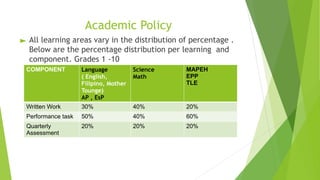
Academic Policy
► All learning areas vary in the distribution of percentage .
Below are the percentage distribution per learning and
component. Grades 1 -10
COMPONENT Language
( English,
Filipino, Mother
Tounge)
AP , EsP
Science
Math
MAPEH
EPP
TLE
Written Work 30% 40% 20%
Performance task 50% 40% 60%
Quarterly
Assessment
20% 20% 20%
Academic Policy
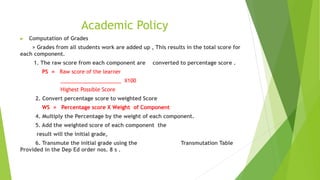
► Computation of Grades
> Grades from all students work are added up , This results in the total score for
each component.
1. The raw score from each component are converted to percentage score .
PS = Raw score of the learner
_____________________ X100
Highest Possible Score
2. Convert percentage score to weighted Score
WS = Percentage score X Weight of Component
4. Multiply the Percentage by the weight of each component.
5. Add the weighted score of each component the
result will the initial grade,
6. Transmute the initial grade using the Transmutation Table
Provided in the Dep Ed order nos. 8 s .
Academic Policy
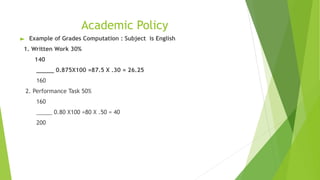
► Example of Grades Computation : Subject is English
1. Written Work 30%
140
_____ 0.875X100 =87.5 X .30 = 26.25
160
2. Performance Task 50%
160
_____ 0.80 X100 =80 X .50 = 40
200
Academic Policy
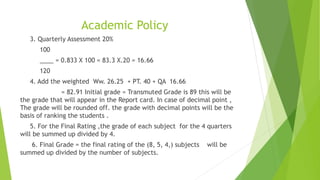
3. Quarterly Assessment 20%
100
____ = 0.833 X 100 = 83.3 X.20 = 16.66
120
4. Add the weighted Ww. 26.25 + PT. 40 + QA 16.66
= 82.91 Initial grade = Transmuted Grade is 89 this will be
the grade that will appear in the Report card. In case of decimal point ,
The grade will be rounded off. the grade with decimal points will be the
basis of ranking the students .
5. For the Final Rating ,the grade of each subject for the 4 quarters
will be summed up divided by 4.
6. Final Grade = the final rating of the (8, 5, 4,) subjects will be
summed up divided by the number of subjects.
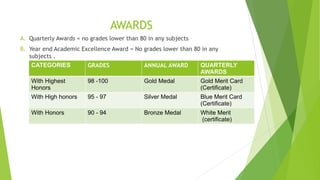
AWARDS
A. Quarterly Awards = no grades lower than 80 in any subjects
B. Year end Academic Excellence Award = No grades lower than 80 in any
subjects .
CATEGORIES GRADES ANNUAL AWARD QUARTERLY
AWARDS
With Highest
Honors
98 -100 Gold Medal Gold Merit Card
(Certificate)
With High honors 95 - 97 Silver Medal Blue Merit Card
(Certificate)
With Honors 90 - 94 Bronze Medal White Merit
(certificate)
Other Matters
► Class Schedule
> Classes will start on September 04, 2023
> Schedule to be posted:
> Field Trip
> Leadership Training
> Retreat Camp
> OZEE Night
> Musical Night
> Inter School Quizbee
THANK YOU
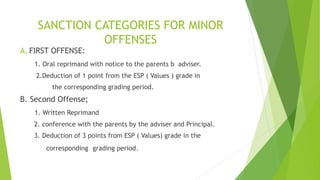
SANCTION CATEGORIES FOR MINOR
OFFENSES
A. FIRST OFFENSE:
1. Oral reprimand with notice to the parents b adviser.
2.Deduction of 1 point from the ESP ( Values ) grade in
the corresponding grading period.
B. Second Offense;
1. Written Reprimand
2. conference with the parents by the adviser and Principal.
3. Deduction of 3 points from ESP ( Values) grade in the
corresponding grading period.
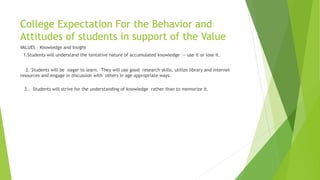
College Expectation For the Behavior and
Attitudes of students in support of the Value
VALUES – Knowledge and Insight
1.Students will understand the tentative nature of accumulated knowledge -- use it or lose it.
2. Students will be eager to learn. They will use good research skills, utilize library and internet
resources and engage in discussion with others in age appropriate ways.
3.. Students will strive for the understanding of knowledge rather than to memorize it.
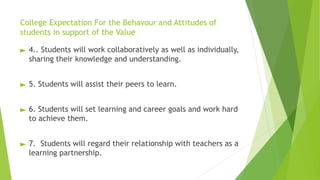
College Expectation For the Behavour and Attitudes of
students in support of the Value
► 4.. Students will work collaboratively as well as individually,
sharing their knowledge and understanding.
► 5. Students will assist their peers to learn.
► 6. Students will set learning and career goals and work hard
to achieve them.
► 7. Students will regard their relationship with teachers as a
learning partnership.
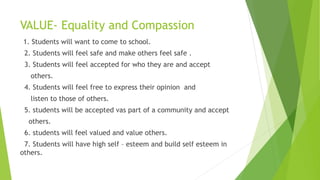
VALUE- Equality and Compassion
1. Students will want to come to school.
2. Students will feel safe and make others feel safe .
3. Students will feel accepted for who they are and accept
others.
4. Students will feel free to express their opinion and
listen to those of others.
5. students will be accepted vas part of a community and accept
others.
6. students will feel valued and value others.
7. Students will have high self – esteem and build self esteem in
others.
Value : Integration and Wholeness
► 1. Students participate with enthusiasm in a range of the
school activities.
► 2. Students participate in community activities including
community service.
► 3. Students actively interested in global issues.
► 4. Students demonstrate understanding and compassion in
the dealings with others less fortunate than them selves.
► 5. Students will protect the rights and property of others
and of the school and protect the fabric of the school.
► 6. Students will act to enhance the reputation of the
school.
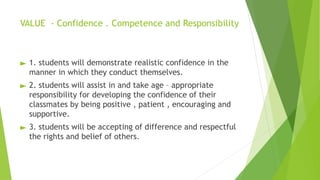
VALUE - Confidence . Competence and Responsibility
► 1. students will demonstrate realistic confidence in the
manner in which they conduct themselves.
► 2. students will assist in and take age – appropriate
responsibility for developing the confidence of their
classmates by being positive , patient , encouraging and
supportive.
► 3. students will be accepting of difference and respectful
the rights and belief of others.
VALUE - Confidence . Competence and
Responsibility
► 4. Students will have had the opportunity to demonstrate
their particular areas of competence ( strengths ) to their
classmates
► 5.students will behave responsively in relation to
themselves, the school , their classmates and the
community.
VALUE – Self-worth
► 1. students will demonstrate an appropriate degree of self
confidence.
► 2. students will interact with their peers in appropriate
ways.
► 3. students will feel accepted and understood .
► 4. Students will feel that they are not alone but have
trusted staff members to whom they can turn in times of
troubles.
► 5. students will demonstrate an appropriate understanding
of the teacher – student relationship.
► 6.Students will accept challenges

PARENTS-ELEM-Orientation-2023-2024-.pptx

  • 1.
    OZ PHIL COLLEGEINC. PARENTS’ ORIENTATION S/Y 2023 -2024 Aug. 28, 2023
  • 2.
    VISION TO PROMOTE ANDPOSTER QUALITY TEACHING AND LEARNING THAT WILL PROVIDE STUDENTS WITH A DIVERSE AND INCLUSIVE EXPERIENCE .
  • 3.
    MISSION TO DEVEOP WELL– ROUNDED INDIVIDUALS; WITH EDUCATIONAL ATTRIBUTES THAT EN ABLE THEM TO BE RESPONSIVE FOR THE GLOBAL COMMUNITIES, THEY SERVE THROUGH THEIR ENGAGEMENT IN A RICH LEARNING ENVIRONMENT PROVIDED BY INNOVATIVE AND PROFESSIONAL STAFF.
  • 4.
    VALUES: HUMILITY – WEAPPRECIATE GREATNESS BUT ALSO THE WEAKNESS INTEGRITY – WE DO RIGHT THING EVEN THERE IS NO ONE LOOKING CAREFUL OF THE WORDS WE SAY, AND THE WAY WE SPEAK. KINDNESS – WE PROVIDE CONDSIDERATION TO OTHERS. RESPECT – WE EMBRACE DIVERSITY
  • 5.
  • 6.
    Discipline Policy OzPhiI Collegeapproach to discipline is through mutual Respect and self discipline 1. An individual must feel that he/she is valued and respected by peers, teachers and parents in order to develop a sense of self worth.
  • 7.
    Discipline Policy 2. Individualrights and freedom must be protected. Ideally through self– discipline. This required both an underlying framework of firm standards and student awareness of validity of rules, 3. self discipline cannot develop freely with out understanding.
  • 8.
    Goals in DisciplinePolicy 1. To develop students’ self – discipline and self control. 2. To enable students to be on – task with their learning 3. To enhance students ‘ self – steem. 4. To encourage accountability for behavior 5. To encourage the individual students to recognize and respect the rights of others.
  • 9.
    6. To affirmcooperation as well as responsible independence in learning . 7. To promote the values of honesty , fairness and respect for others. 8. to enable rational conflict resolution.
  • 10.
  • 11.
    Uniform > Represents students’personal grooming , thus students represents the school and all the ideals it upholds. > The school uniform is intended for school wear and for authorized representation in an activity, ( Quiz Bee, Leadership training) > PE uniform are required for the learners to wear during P E day. > Faction Uniform shall be worn on the given schedule
  • 12.
    Hairdo/ Hair cut >Hair must be neat tidy, and clean. > Boys should not fall below collar line. > Girls with hair below the collar line are to tie it back with hair ties, use of head bands hair clips to avoid hair covering the face. > Fancy haircut and hair style ( punk styles, crew cuts, shaves, spikes, wedges, ridges) and hair color are not allowed. > Fringes must clear the eye brow > Loud Dyed colored hair is not allowed.
  • 13.
    JEWELRY - 1. Expensive(goldor gold plated) watch or plain medical alert bracelet , earrings , necklace are not to be worn in school. 2. Other expensive jewelries such as pearl or pendant is discourage. 3. Boys wearing earrings in school is discourage. 4.Piercing on parts of the body that are not covered by clothing are not permitted . Ex.tongue, nose 5. chain is inappropriate to wear.
  • 14.
    Tattoo/ Piercing 1. Permanenttattoo and all form of body piercing are not allowed. 2. Visible tattoos are not permitted , incase child had enrolled with tattoo. Personal Grooming expectation 1. Male students (JHS /SHS )are to be clean /shaven 2. Female make up is not to be worn (JHS /SHS ) 3. Acrylic Fingernails are not to be worn. 4. Nail Polish is not allowed, but fingernails are to be kept short.
  • 15.
    Identification Card 1. isa part of the school uniform. 2. All students are required to wear the school ID, while inside the school premises and during activities outside the school such as (field trip, contest, training , seminars, 3. It must carry the recent picture of the student. 4. It should be free from any unnecessary decorations, markings and stickers . 5. Lending and borrowing of I.D. are strictly prohibited and subject for disciplinary action or sanction.
  • 16.
    Attendance and Punctuality. ►1. Attendance and Punctuality shall be observe at all times ► 2. Regular and punctual attendance in all classes and school activities including those schedule on non – school days is expected of all students. ► 3. A student is not allowed to leave the school premises during school hours which include recess time, lunch break and the period between dismissal time and the start of any school activity after class hours .
  • 17.
    ► 4. Astudent is allowed to leave the school premises only with an authorization letter from parents or guardians. ► 5. A student who was absent must present a letter of excuse duly signed by his/ her parents or guardian once he/she report to class. Parents must notify the office.
  • 18.
    ► 6. Anabsence is considered excused based on any of the following reasons : - sickness (accompanied with medical certificate ) - death of an immediate family member - participant or representative of an activity officially recognized by the school - accidents - calamities
  • 19.
    ► 7. Astudent may be dropped from school due to any of the following reasons: .> accumulation of 40 un excused absences with In the school year > absences for 10 consecutive days with out notice. Note: ( Parents should immediately notify the class adviser about the cause of their child’s absences.
  • 20.
    8. A studentwho was absent from class is responsible for the lessons that were taken up during his absence and should arrange with his teachers for missed assignments , quizzes and homework. 9. students from grade school ,junior high school and senior high school are required to be in school at 7:15 A.M. every Monday for the assembly. And 7:30 A.M from Tuesday to Friday For Kindergarten to Junior high school, and 7:00 AM for Senior high school from Tuesday to Friday.
  • 21.
    Tardiness 1. A studentis considered tardy if: > He / she come to school after the official time. > he /she is not in the venue at the start of each class, assembly, program or activity. > A student may be excused from being tardy during heavy rains, emergencies rallies,transportation strikes, calamities )
  • 22.
    > the adviserissues a written notice to the parents for the three tardiness incurred in a week. A conference will be called between the parents , student and adviser for discussion of possible remedies. > students who are late must secure tardy slip from the principal to be presented to the teacher in-charge upon entering the classroom. > three (3) accumulated number of late / tardiness is equivalent to 1 day absence.
  • 23.
    SPECIAL Permission –(Pulling out from Classes) ⮚ Parents are not allowed to pull out their children from their classes without valid reason/s and approval from the Principal. > A child will not be pulled out by any one (Fetchers, relative or any one related or not related to the child ) without a written request or permission letter.
  • 24.
    ⮚ Procedure ingetting permission for departure pass. - . Present a written explanation to the adviser stating the reason for pull out. - Get a gate pass in triplicate copies from the principal office , duly sign by the adviser and principal. - Give a copy of the gate pass to the guard on duty and sign the log book.
  • 25.
    CELLPHONE 1. Bringing ofcellphone is prohibited to Nursery, Pre kinder, Kinder and leaners in Grade 1 to 12 levels. 2. SHS learners are allowed to bring cellphone regardless, it is use for Learning related or advise by their respective subject teachers for Lesson purposes. 3. Cellphone brought to school shall be surrendered in the office and will be released after dismissal. 4. Using of cellphone during class hours, not related to the lesson and around the campus will be confiscated and will be returned to the parents or at the end of the school year.
  • 26.
    Confiscated Property ►1. Propertyconfiscated by staff, teachers will not receive their property back until the end of the school year. ►2. Parents can get the confiscated Property , unless it will not be brought to school again or property will be returned at the end of the school year.
  • 27.
    ALCOHOL and OTHERDRUGS ► Alcohol and other Drugs ; > Students are not permitted to have their possession , or consume alcohol liquor either on the school premises , in any public place or any school activity. > Possession or use of any prohibited drugs or any dealings in such drugs is forbidden in school.
  • 28.
    Smoking . > Smoking isforbidden during classes, with in the school premises and at all times when in school uniform , or to have smoking materials in their possession.
  • 29.
    Assignment / HomeworkPolicy ► Assignment is a form of follow up, enhancement and Mastery of the lessons. > Assignment for Nursery to Grade 3 is in the form of follow up for the lessons taken for the day. Example : Read/ color Page.. finish the task given in class on page, Bring picture of.. > Assignment for Grade IV to VI is in the form of follow up and enhancement of the lessons taken for the day. Example: Read page and Answer page (limit the questions 5 to 10)
  • 30.
    Assignment / Homework Policy > Complete the task you didn’t comply for the class ► Assignment for Grade 7 to 12 is in the form of follow up, enhancement and mastery of lesson, required for 4 nights. > task oriented activity > Project, Research type > revision of task Note: No Assignment shall be given in all levels every Friday.
  • 31.
    ADMISSION POLICY ► OzPhil College of Cavite welcomes learners, who have the desire to enroll here . The school provides quality academic program, geared in the Dep Ed K- 12 Curriculum. ► Interview and proper screening and evaluation of both parents and children are required and considered. ► Admission is also based on the credentials and willingness of parents to partake in all the endeavors of the school and support its vision –mission. ► Requirements: > NSO / PSA Certificate ( original and photo copy) > original Report Card – signed by the authorities of the school last attended with the child’s Learners Reference Number ( LRN ) > Certificate of Good moral character > Permanent Record to be requested by the school
  • 32.
    Expected Standards StudentBehavior ► It must be understood that the laws governing individual behavior which apply in the community outside the school will be enforced strictly with in the school and without limiting the application of the community ‘s laws. ► Example : relating physical assault, vandalism, interference with other people‘s property, trespass, offensive language and behavior.
  • 33.
  • 34.
    Minor Offences ► GeneralRules ► 1. Non- Wearing of ID and school uniform inside the campus. ► 2. Wearing of improper PE uniform (jogging pants) inside the school ► 3. Using personal things of others without permission. ► 4. Loitering during class hours and non – observance of the curfew time of 5:00 PM.
  • 35.
    ► 5. Nonobservance of rules in the canteen, classrooms, restroom and other facilities of the school. ► 6. Obstruction and disruption of teaching and other school proceeding or activities. ► 7. use of school facilities or equipment/s with out permission from proper authorities
  • 36.
    8. Improper haircutfor the boys 9.Hair dye (loud color) and hair styling. 10. Tattoo or piercing 11. Sporting of excessive earings , noise rings, dangling earings, metal chain, puka shell necklace. 12. Non- submission of letter of excuse required from absence. 13. Unexcused Tardiness and ceaseless Tardiness.
  • 37.
    13. Non- observanceof deadlines for submission of reply slip, report cards and other correspondence. 14.Unsigned diaries 15. Failure to bring books and notebook everyday. 16. Bringing and using of items not related to Academic work inside the school campus without the school permission is Prohibited. 17. Bringing and using cellphone during class hours, school programs and activities is Prohibited. 18. Gossiping or involve in malicious talks is prohibited.
  • 38.
    Severity Clause onDiscipline ► 1. Minor misdemeanours’ or infringement are dealt with teacher using a variety of strategies such as : a. appropriate warnings and consequences b. repeated minor infringement leading to serious infringements, may lead to: ISOLATION, INTERNAL SUSPENSION, Loss of PRIVILEGES c. inform parents directly , on diary or text messages or call.
  • 39.
    Disciplinary Probation ► 1.Consultation by the homeroom adviser ►2. Written of information to the parents. ►3. Warning to be received by the students ► 4. 2nd Warning , Presence of Parents in ►school is needed. ►5. Suspension
  • 40.
  • 41.
    MAJOR OFFENSES ► LEVELA. ► 1. Leaving the Campus with out permission from the adviser and principal and no gate pass. ► 2. Cutting or skipping classes ( aa student is considered to be cutting classes when he /she is in campus but misses his/her class/es with out permission) ► 3. Using of some else ID ► 4. Gambling (playing cards or other form of gambling during vacant period.
  • 42.
    5. Act ofDishonesty - Possession/ writing/ making unauthorized notes related to the test being taken - talking without permission during the test. - Changing answer/s in notebook, workbook, quiz, test papers after checking. 6. Misuse and misappropriation of fund - class fund, funds related in sports, class contribution
  • 43.
    7. Mis useof school uniform - Going to movies - Going to mall - Performing indecent activities. 8. Vandalism which includes writing and defacing chairs, tables and wall. 9. Intentional / Pre medicated obstruction and disruption of teaching and other school proceedings or activities that leads to the threat of the safety of the individual , group or the school.
  • 44.
    ► 11. Slander ►12, Instigating a fight / Fighting ► 13. misbehavior during field trip , retreat, theatrical , play , sports meet intra school contest. LEVEL B; 1. plagiarism or submission of assignment or projects done by somebody else as you. 2. Threatening , intimidating, coercing, ridiculing fellow students. 3. Disrespect or disobedience to the members of the administration, faculty, staff, maintenance and security personnel.
  • 45.
    MAJOR OFFENSES ► 5.Truancy ► 6. Bringing cigarettes and smoking while inside and outside the school. ► 7. Bringing of any alcoholic or intoxicating beverages to school during school related activities and outing. ► 8. stealing or extortion. ► 9. affiliating with fraternities or sororities that are contrary to Oz Phil belief. ► 10.Giving or offering false testimony during school investigation,
  • 46.
    MAJOR OFFENSES ► 11.organizing parties , outing , or other activities using the name of the school without due consent from the school authorities. ► 12. Acts of dishonesty; > Cheating during test contests, exam., quizzes, test > Sharing of one’s answer during the exam. > changing answer/ answers in the test paper during and after checking.
  • 47.
    MAJOR OFFENSES ► Note:> a student caught cheating gets zero (0) for the quiz or unit test , for periodic test , he/ she automatically gets a grade of 70 n the test and is placed on conduct probation .In case the student is an officer , he will be dropped from his position. ► 13. Misuse and misappropriation of funds. > Solicitation using the name of school > School Fund 14. Miss use of school uniform : Going to night club, motel, pubs, or other classified areas.
  • 48.
    MAJOR OFFENSES ► 15.Committing imprudent acts like holding hands , kissing hugging and embracing , inside / outside of the school premises. ► 16. Malicious Mischief (poison letter, message in the Facebook, Forwarded emails, wed pages or other information dissemination devices. ► All kinds of bullying. ► LEVEL C. ► 1. bringing / possessing deadly weapons / firecrackers and explosives or bladed and pointed weapon. ► 2. hazing or inflicting or attempting to inflict body injury upon another > Recruiting > observing Hazing procedures > Hazing > Participating in hazing procedure >. Finding and Allowing the use of private residence for hazing procedure
  • 49.
    MAJOR OFFENSES ► Note: The school does not allow any fraternity or sorority organization to exist. ► 3. Bringing illegal substances /prohibited drugs like marijuana, shabu and drug paraphernalia inside the school premises anb during school activities outside the school. ► 4. acts of Academic Dishonesty > getting , using , distributing leakage relative to test and contest > Reviewing the exact exam , test papers to the classmates or other students. 5. tampering : with false or falsifying official documents like report cards , official notices, clearance and the like either to and from parents and for submitting forged or falsified credentials / document as previously mentioned.
  • 50.
    Serious Infringements orrepeated infringements may lead to : a. short probation , where behavior and attitude are closely monitored . b. parents would be ask to countersign any documentation associated with this procedure. c. Parent interviews with the teacher, d. student / parent interviews with the principal e. pastoral care will be provided, the student with the opportunity to talk to the principal, or suspend or expel student
  • 51.
    Suspension or expulsionfor the following instances 1. Physical Violence 2. Substance abuse and /or possession of illegal / in appropriate material 3. abuse behavior ( bullying ) 4. un authorized absences from class 5. theft 6. vandalism 7. sexual harassment
  • 52.
  • 53.
    CHILD’S PROTECTION ► Policyand Guidelines on Protecting Children in School from Abuse, Violence Exploitation ,Discrimination , Bullying and other Forms of Abuse. ► Section I. Short Title: This Department Order shall be known as the “DepEd Child Protection Policy” Section 2 .Statement Policy Pursuant to the 1887 Constitution , the state shall defend the right of the children to assistance , including proper care and nutrition and special protection from all forms of neglect, abuse, cruelty, exploitation and other conditions prejudicial to their development ( Article XV, Section 3)
  • 54.
    CHILD’S PROTECTION > inculcatepatriotism and nationalism > foster love of humanity, respect for human rights, appreciation of the role of the national heroes in the historical development of our country > teach the rights and duties of citizenship. > strengthen ethical and spiritual values >develop moral character and personal discipline > encourage critical and creative thinking > Broaden scientific and technological knowledge and promote vocational efficiency.
  • 55.
    CHILD’S PROTECTION ► Theconvention on the Rights of the Child (CRC) > protect the child from all forms of physical or mental violence , injury and abuse neglect or negligent treatment , maltreatment and exploitation sexual abuse. > right of the child to education > schools are conducive to education. > Collaboration with its partners and stakeholder
  • 56.
    BULLYING POLICY Oz PhilCollege is committed to providing a caring , friendly and safe environment for all of its pupils /students so they can learn in a relaxed and secured atmosphere . Pursuant to Republic Act No. 10627 also known, we have established the anti- bullying policy set forth to ensure everyone that bullying of any kind is un acceptable at our school and that incidents of bullying will be dealt with promptly and effectively.
  • 57.
    BULLYING POLICY ► Objectivesof the Policy > All personnel, and parents should have an understanding of what bullying is. > All personnel should know what the school policy is on bullying and follow it when bullying is reported. . All pupils / students/and parents should know what the school policy is on bullying and what they should do if bullying arises. > As a school we take bullying seriously, Pupils / students and parents should be assured that they will be supported when bullying reported.
  • 58.
    BULLYING POLICY ► Formsof Bullying: > Isolation > slurs > pranks > rumors > jokes > gestures > demeaning comments > drawing cartoons > physical attacks > threats >. Written action > physical Actions
  • 59.
    BULLYING POLICY Procedure inHandling Bullying Incidents The anti- bullying Policy of OzPhil College has its goal to ensure that all pupil/ students experience a safe environment that is conductive o learning . The following shall be considered; ► 1. Isolated or initial incidents which do not constitute bullying will be handled by the teacher in charge at the time of the incident, depending on the severity of the incidents, the parents and the principal will be notified . ► 2. Whenever possible. Any incidents which may constitute bullying should be reported immediately to the teacher in charge at the time of the incident, and the teacher shall immediately deal with those involved in the incident.
  • 60.
    BULLYING POLICY ► 3.Everyincidents shall be reported, dealt, solved and provide written report, parents shall be notified. ► The child Protection Committee > President > class adviser > Principal . Student Representative > guidance Counselor >Representative from the DSWD
  • 61.
  • 62.
    Academic Policy ► GradingSystem - (based on the New grading System For K – 12 Program – Dep Ed Order No. 8 , S 2015 1. Basic Guidelines a. The Academic year is divided into four quarters b. The school adopts the averaging System for all levels (Nursery to Grades 12) c. The numerical system reporting of grade is used for all the academic. D. The letter system is of reporting grade is use for conduct and computer.
  • 63.
    Academic Policy ► 2.Criteria for Grading ( Two Types of Classroom Assessment) A. Formative Assessment - This is a form of classroom assessment so teachers can make adjustment in their instruction , measure and reflect on the progress of the learners. It helps the learners identify their strengths and weaknesses . It is given any time during the teaching and learning process, results of the Formative Test will help the teachers make good instructional decisions so lessons are more suited to the needs of the learners‘ abilities . Formative Test are recorded but not graded and not included in the computation of the summative assessment.
  • 64.
    Academic Policy ► 2.SUMMATIVE TEST > The assessment which occurs at the end of a particular unit / lesson .This form of assessment usually occurs toward the end of a period of learning in order to describe the standard reached by the learner. It measures whether learners have met the content and performance standards . These are Recorded and used to report on the learners achivement > It is simflified into Three (3) important components Namely: WW – Written Works PT - Performance Task QA – Quarterly assessment
  • 65.
    Academic Policy ► 1.WRITTEN WORK > identifies and set s the knowledge that shoud be learned by the pupils / students . It ensures that students are able to express their skill and concepts in written form . It is basically answer the content and knowledge a nd aks the questions WHAT should the learner KNOEW? It comprises the quizzes, seatworks, assignments and other areas where in the content and knowledge are the targets for assessment.
  • 66.
    Academic Policy ► 2.Performance Task > This involves the assessment of the learners by showing or performing what they know and able to do in diverse ways, Describe the abilities and skills that learners are expected to demonstrate in relation to the content standard of the 21st century skills, in the integration of knowledge , understanding and skills is expressed . Learners may create or innovate or do Performance based tasks which may include individual or group demonstrate / presentation , oral work , research projects , journals , speech presentation and others,
  • 67.
    Academic Policy ► 3.Quarterly Assessment > Measures the students learning at the end of the quarter. All the concepts and skills which covered the entire period. It can be in the form of the objectives tests, performance – based assessment or combination of both. The use of rubrics shall be applied in rating the performance task.
  • 68.
    Academic Policy ► Alllearning areas vary in the distribution of percentage . Below are the percentage distribution per learning and component. Grades 1 -10 COMPONENT Language ( English, Filipino, Mother Tounge) AP , EsP Science Math MAPEH EPP TLE Written Work 30% 40% 20% Performance task 50% 40% 60% Quarterly Assessment 20% 20% 20%
  • 69.
    Academic Policy ► Computationof Grades > Grades from all students work are added up , This results in the total score for each component. 1. The raw score from each component are converted to percentage score . PS = Raw score of the learner _____________________ X100 Highest Possible Score 2. Convert percentage score to weighted Score WS = Percentage score X Weight of Component 4. Multiply the Percentage by the weight of each component. 5. Add the weighted score of each component the result will the initial grade, 6. Transmute the initial grade using the Transmutation Table Provided in the Dep Ed order nos. 8 s .
  • 70.
    Academic Policy ► Exampleof Grades Computation : Subject is English 1. Written Work 30% 140 _____ 0.875X100 =87.5 X .30 = 26.25 160 2. Performance Task 50% 160 _____ 0.80 X100 =80 X .50 = 40 200
  • 71.
    Academic Policy 3. QuarterlyAssessment 20% 100 ____ = 0.833 X 100 = 83.3 X.20 = 16.66 120 4. Add the weighted Ww. 26.25 + PT. 40 + QA 16.66 = 82.91 Initial grade = Transmuted Grade is 89 this will be the grade that will appear in the Report card. In case of decimal point , The grade will be rounded off. the grade with decimal points will be the basis of ranking the students . 5. For the Final Rating ,the grade of each subject for the 4 quarters will be summed up divided by 4. 6. Final Grade = the final rating of the (8, 5, 4,) subjects will be summed up divided by the number of subjects.
  • 72.
    AWARDS A. Quarterly Awards= no grades lower than 80 in any subjects B. Year end Academic Excellence Award = No grades lower than 80 in any subjects . CATEGORIES GRADES ANNUAL AWARD QUARTERLY AWARDS With Highest Honors 98 -100 Gold Medal Gold Merit Card (Certificate) With High honors 95 - 97 Silver Medal Blue Merit Card (Certificate) With Honors 90 - 94 Bronze Medal White Merit (certificate)
  • 73.
    Other Matters ► ClassSchedule > Classes will start on September 04, 2023 > Schedule to be posted: > Field Trip > Leadership Training > Retreat Camp > OZEE Night > Musical Night > Inter School Quizbee
  • 74.
  • 77.
    SANCTION CATEGORIES FORMINOR OFFENSES A. FIRST OFFENSE: 1. Oral reprimand with notice to the parents b adviser. 2.Deduction of 1 point from the ESP ( Values ) grade in the corresponding grading period. B. Second Offense; 1. Written Reprimand 2. conference with the parents by the adviser and Principal. 3. Deduction of 3 points from ESP ( Values) grade in the corresponding grading period.
  • 78.
    College Expectation Forthe Behavior and Attitudes of students in support of the Value VALUES – Knowledge and Insight 1.Students will understand the tentative nature of accumulated knowledge -- use it or lose it. 2. Students will be eager to learn. They will use good research skills, utilize library and internet resources and engage in discussion with others in age appropriate ways. 3.. Students will strive for the understanding of knowledge rather than to memorize it.
  • 79.
    College Expectation Forthe Behavour and Attitudes of students in support of the Value ► 4.. Students will work collaboratively as well as individually, sharing their knowledge and understanding. ► 5. Students will assist their peers to learn. ► 6. Students will set learning and career goals and work hard to achieve them. ► 7. Students will regard their relationship with teachers as a learning partnership.
  • 80.
    VALUE- Equality andCompassion 1. Students will want to come to school. 2. Students will feel safe and make others feel safe . 3. Students will feel accepted for who they are and accept others. 4. Students will feel free to express their opinion and listen to those of others. 5. students will be accepted vas part of a community and accept others. 6. students will feel valued and value others. 7. Students will have high self – esteem and build self esteem in others.
  • 81.
    Value : Integrationand Wholeness ► 1. Students participate with enthusiasm in a range of the school activities. ► 2. Students participate in community activities including community service. ► 3. Students actively interested in global issues. ► 4. Students demonstrate understanding and compassion in the dealings with others less fortunate than them selves. ► 5. Students will protect the rights and property of others and of the school and protect the fabric of the school. ► 6. Students will act to enhance the reputation of the school.
  • 82.
    VALUE - Confidence. Competence and Responsibility ► 1. students will demonstrate realistic confidence in the manner in which they conduct themselves. ► 2. students will assist in and take age – appropriate responsibility for developing the confidence of their classmates by being positive , patient , encouraging and supportive. ► 3. students will be accepting of difference and respectful the rights and belief of others.
  • 83.
    VALUE - Confidence. Competence and Responsibility ► 4. Students will have had the opportunity to demonstrate their particular areas of competence ( strengths ) to their classmates ► 5.students will behave responsively in relation to themselves, the school , their classmates and the community.
  • 84.
    VALUE – Self-worth ►1. students will demonstrate an appropriate degree of self confidence. ► 2. students will interact with their peers in appropriate ways. ► 3. students will feel accepted and understood . ► 4. Students will feel that they are not alone but have trusted staff members to whom they can turn in times of troubles. ► 5. students will demonstrate an appropriate understanding of the teacher – student relationship. ► 6.Students will accept challenges