Ed. 5920:
Music Education
Diane Boodhoo (ID #3304965)
Theresa Motilal (ID # 3305129)
Glenn Solomon (ID #3305171)
Parang
in the
Classroom
!
What is Parang?
•Parang comes from the Spanish word
know as "parranda" (action of merry
making, group of serenaders).
•In Trinidad it refers to folkloric music
of Hispanic American origins.
History of Parang.
• First theory of parang music originted during
Christianity of Amerindians by French Clergy
Indians in (Spanish) Missions.
• The second theory is that parang music was
introduced by Venezuelans imported to work
in the cocoa estates.
• Traditional parang bands often refer to as "Parenderos"
consisted of four to six singers accompanied by musicians
who played guitar, cuatro, mandolin (bandolin) , violin, cello
(violoncello), bandol (bandola), box bass, tambourine,
clapper, toc-toc (claves), wood block pollitos, tiple, scratcher
(güiro) and maracas (chac-chac or shak-shak).
Parang bands would move from house to house in
neighbourhood serenading to family and friends during
festive seasons. It would be customary for families to greet
the Paranderos with drinks and food, following specific steps
or rituals that accompanied the entry to a home, the
dedication of songs to a host, the eating and drinking, and
the departure.
Parang Instruments.
• Bandol or Bandola
• Box Bass
• Cello (violoncello)
• Claves (tock tock)
• Cuatro
• Güiro (scratcher)
• Guitar
• Mandolin /Bandolin
• Maracas (chac-chac or
“shak-shak”)
• Pollitos
• Tiple
• Violin
• Wood Block
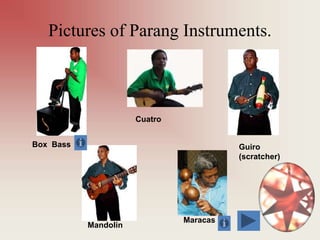
Pictures of Parang Instruments.
Box Bass
Cuatro
Guiro
(scratcher)
Mandolin
Maracas
The Box Bass
• The box bass is a box to
which a string is
attached. When the
string is pulled, it gives
out a sound. This could
be changed by varying
the tension in the string
and the movement of
the stick.
Click on the video to play.
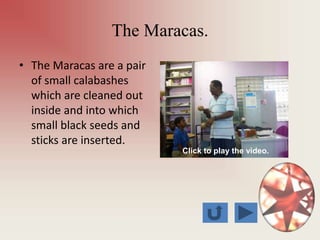
The Maracas.
• The Maracas are a pair
of small calabashes
which are cleaned out
inside and into which
small black seeds and
sticks are inserted.
Click to play the video.
Types of Parang Songs:
• Serenal or Aguinaldo
• Anunciacion
• Nacimiento
• Guarapo
• Joropo
• Vals (Castillian)
• Salsa
• Manzanare
• Estribillo
• Despedida
Popular Parang Bands:
• Los Hermanos Lara
• La Divina Pastora
• La Familia De Rio Claro
• Los Paranderos de UWI (UWI - St. Augustine)
• Los Tocadores
• San Jose Serenaders
• Los Alumnos de San Juan
• Voces Jovenes
• Carib Santa Rosa
• Los Ninos de Santa Rosa
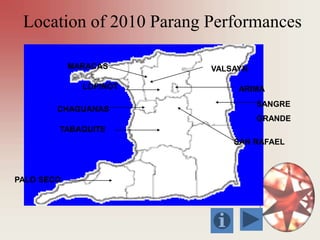
Location of 2010 Parang Performances
ARIMA
SANGRE
GRANDE
TABAQUITE
LOPINOT
MARACAS
CHAGUANAS
VALSAYN
PALO SECO
SAN RAFAEL
• Sat. Oct. 9- Parang Launch @ Parang HQ, ArimaSat. Oct.
• Sat. Oct. 16 - Sangre Grande Regional Sporting Complex
• Sat. Oct. 23 - Tabaquite Basketball Court, Tabaquite
• Sat. Oct. 30 - San Rafael Catholic Parish Hall
• Sat. Nov. 6 - Lopinot Basketball Court
• Sat. Nov. 13 - North South Parang Clash @ Petrotrin Sport
Club, Palo Seco
• Sat. Nov. 20 - Maracas/St. Joseph Community Centre
• Sat. Nov. 20 - Sun. Nov. 21 - Junior Parang Championships @
Chaguanas North Comprehensive School
• Sat. Nov. 27 - Parang Semi-Finals @ Parang HQ, Arima
• Sat. Dec. 4 - Valsayn North - Jamoboree Park
• Sat. Dec. 11 - Parang Finals @ Arima Velodrome
• Sun. Jan. 2 - Lewa - Santa Rosa de lima Catholic Church,
Arima
Feature Band:
Los Alumnos de San
Juan.• Alicia Jaggasar -
Vocalist / Guitar
• Lauren Birot - Vocalist
• Rhonda Rosales -Vocalist
• Magdalene Walcott -Vocalist
• Natasha Britto - Vocalist
• Icana Belgrooe – Vocalist
• Maria Jagdeo - Vocalist
• Wayne Jagdeo - Pan / Cuatro
• Denzil Lyons - Guitar
• Nelson Harris - Bass / Drum
• Nicholas Jaggasar - Bass Guitar
/ Marac
• Julia Torres - Mandolin
• Ian Jaggasar - Box Bass / Drum
• Alan Abraham - Marac
• Theron Shaw - Lead Guitar
• Jeremy Campbell - Toc Toc
• Adrian Redhead - Guitar /
Cuatro
• Nigel Williams - Marac /
Cuatro
History of the Band.
The band started more than twenty years ago
when a group of teenagers.
These youngsters attended the San Juan
Government Secondary School.
Band Rehearsal.
Los Alumnos de San Juan
rehearses at least once a week.
However, as parang season
approaches, the rehearsals
increase in frequency.
Many sleepless nights are given to
band practice and studio time.
Click to start the video.
Recording the music.
Los Alumnos de San Juan works with Mr. Dave
Ramoutar to produce their music.
Mr. Ramoutar, a graduate of Berkeley College
in the United States of America, is the
Manager and owner of ‘Side One Studio’. His
studio is located at Orange Grove Road, St.
Augustine, Trinidad.
Inside the studio….
Recording an album.
•Have an idea and a tune
•Meet with a producer.
•The producer will revise
the tune as needed.
•Using selected
instruments, the producer
will record a demo.
•The producer will revise
the demo.
•Recording of the tracks
onto a compact disc.
•Mr. Ramoutar uses
‘Sonar 6’recording
programme in his
digital/analog studio.
He has keyboards,
hard disc recorder,
mixing boards,
recording equipment
and microphones.
First Interview with
Mr. Dave Ramoutar.
Click to play the video.
Why does a studio need to be sound
proof?
• A recording studio with hard
walls and sharp corners is
going to bounce the audio
waves around the room,
distorting the sound and
affecting the recording. To
keep the best possible
acoustics in the room, you
need something that absorbs
the sound and doesn't allow it
to bounce. Egg crate foam is
one of the products you can
use to absorb and prevent
bounce. The ceiling of the isolation booth
Do you know why the recording studio
is kept dark??
Dimmers and florescent lamps may reduce hum into
the audio system.
Ambient lighting is good, it saves eyestrain.
It helps to cut down on the glare from the computer
monitors.
Still unconvinced?? Listen to Mr. Ramoutar….
Recording a note.
• Recording even one note can sometimes be
very challenging.
• The producer and the sound engineer has to
do several takes to make sure that the note
they are hearing is of an accurate pitch.
Making a Music Video.
•‘jcd & associates’ is an independent production company, based in
Woodbrook, Trinidad.
•They are currently filming an in-flight video for Caribbean
AirlinesCompany.
•This video will feature the talents of Los Alumnos de San Juan.
•As a spin off of this project, the group was offered a chance to
record a music video.
•It would be distributed to the local television stations to be used
as a ‘filler’ between shows.
•Los Alumnos de San Juan recorded their signature song –
‘Cantando Gloria’.
One of the mangers/producers of the video, Mr. Dennison,
spoke about equipment and procedure.
•At the site: 2 Sony Betacam D35 & D-30
1 Canon XL H1 High Definition Camera
1 Presidential Teleprompter.
•These cameras were used to shoot video footage of the band
miming their performance.
•Audio would be added in the studio. This audio would be taken
of the CD the band had done in the previous year.
•Mr. Dennison explained, the cameras were basically, “pointing
and shooting”. Several retakes were done as the band had to
have precision choreography together with their playback audio.
Video Shoot #1: Click to play Video Shoot # 2: Click to play
Video Shoot # 3: Click to play
The final product:
Cantando Gloria
Additional Marketing Strategy.
• The band has a brochure which is available
to the public.
• It has the band’s contact information as well
as the music that they feature in their
performances.
References:
• http://library2.nalis.gov.tt/Default.aspx?PageC
ontentID=112&tabid=137
• http://www.tntisland.com/parang.html
• İ Viva la familia! National Junior Parang
Festival 2009 brochure.
• http://www.ehow.com/how_5553869_use-
crate-foam-recording-
studio.html#ixzz13FWG9tys

Parang

  • 1.
    Ed. 5920: Music Education DianeBoodhoo (ID #3304965) Theresa Motilal (ID # 3305129) Glenn Solomon (ID #3305171) Parang in the Classroom !
  • 2.
    What is Parang? •Parangcomes from the Spanish word know as "parranda" (action of merry making, group of serenaders). •In Trinidad it refers to folkloric music of Hispanic American origins.
  • 3.
    History of Parang. •First theory of parang music originted during Christianity of Amerindians by French Clergy Indians in (Spanish) Missions. • The second theory is that parang music was introduced by Venezuelans imported to work in the cocoa estates.
  • 4.
    • Traditional parangbands often refer to as "Parenderos" consisted of four to six singers accompanied by musicians who played guitar, cuatro, mandolin (bandolin) , violin, cello (violoncello), bandol (bandola), box bass, tambourine, clapper, toc-toc (claves), wood block pollitos, tiple, scratcher (güiro) and maracas (chac-chac or shak-shak). Parang bands would move from house to house in neighbourhood serenading to family and friends during festive seasons. It would be customary for families to greet the Paranderos with drinks and food, following specific steps or rituals that accompanied the entry to a home, the dedication of songs to a host, the eating and drinking, and the departure.
  • 5.
    Parang Instruments. • Bandolor Bandola • Box Bass • Cello (violoncello) • Claves (tock tock) • Cuatro • Güiro (scratcher) • Guitar • Mandolin /Bandolin • Maracas (chac-chac or “shak-shak”) • Pollitos • Tiple • Violin • Wood Block
  • 6.
    Pictures of ParangInstruments. Box Bass Cuatro Guiro (scratcher) Mandolin Maracas
  • 7.
    The Box Bass •The box bass is a box to which a string is attached. When the string is pulled, it gives out a sound. This could be changed by varying the tension in the string and the movement of the stick. Click on the video to play.
  • 8.
    The Maracas. • TheMaracas are a pair of small calabashes which are cleaned out inside and into which small black seeds and sticks are inserted. Click to play the video.
  • 9.
    Types of ParangSongs: • Serenal or Aguinaldo • Anunciacion • Nacimiento • Guarapo • Joropo • Vals (Castillian) • Salsa • Manzanare • Estribillo • Despedida
  • 10.
    Popular Parang Bands: •Los Hermanos Lara • La Divina Pastora • La Familia De Rio Claro • Los Paranderos de UWI (UWI - St. Augustine) • Los Tocadores • San Jose Serenaders • Los Alumnos de San Juan • Voces Jovenes • Carib Santa Rosa • Los Ninos de Santa Rosa
  • 11.
    Location of 2010Parang Performances ARIMA SANGRE GRANDE TABAQUITE LOPINOT MARACAS CHAGUANAS VALSAYN PALO SECO SAN RAFAEL
  • 12.
    • Sat. Oct.9- Parang Launch @ Parang HQ, ArimaSat. Oct. • Sat. Oct. 16 - Sangre Grande Regional Sporting Complex • Sat. Oct. 23 - Tabaquite Basketball Court, Tabaquite • Sat. Oct. 30 - San Rafael Catholic Parish Hall • Sat. Nov. 6 - Lopinot Basketball Court • Sat. Nov. 13 - North South Parang Clash @ Petrotrin Sport Club, Palo Seco • Sat. Nov. 20 - Maracas/St. Joseph Community Centre • Sat. Nov. 20 - Sun. Nov. 21 - Junior Parang Championships @ Chaguanas North Comprehensive School • Sat. Nov. 27 - Parang Semi-Finals @ Parang HQ, Arima • Sat. Dec. 4 - Valsayn North - Jamoboree Park • Sat. Dec. 11 - Parang Finals @ Arima Velodrome • Sun. Jan. 2 - Lewa - Santa Rosa de lima Catholic Church, Arima
  • 13.
    Feature Band: Los Alumnosde San Juan.• Alicia Jaggasar - Vocalist / Guitar • Lauren Birot - Vocalist • Rhonda Rosales -Vocalist • Magdalene Walcott -Vocalist • Natasha Britto - Vocalist • Icana Belgrooe – Vocalist • Maria Jagdeo - Vocalist • Wayne Jagdeo - Pan / Cuatro • Denzil Lyons - Guitar • Nelson Harris - Bass / Drum • Nicholas Jaggasar - Bass Guitar / Marac • Julia Torres - Mandolin • Ian Jaggasar - Box Bass / Drum • Alan Abraham - Marac • Theron Shaw - Lead Guitar • Jeremy Campbell - Toc Toc • Adrian Redhead - Guitar / Cuatro • Nigel Williams - Marac / Cuatro
  • 14.
    History of theBand. The band started more than twenty years ago when a group of teenagers. These youngsters attended the San Juan Government Secondary School.
  • 15.
    Band Rehearsal. Los Alumnosde San Juan rehearses at least once a week. However, as parang season approaches, the rehearsals increase in frequency. Many sleepless nights are given to band practice and studio time. Click to start the video.
  • 16.
    Recording the music. LosAlumnos de San Juan works with Mr. Dave Ramoutar to produce their music. Mr. Ramoutar, a graduate of Berkeley College in the United States of America, is the Manager and owner of ‘Side One Studio’. His studio is located at Orange Grove Road, St. Augustine, Trinidad.
  • 18.
  • 19.
    Recording an album. •Havean idea and a tune •Meet with a producer. •The producer will revise the tune as needed. •Using selected instruments, the producer will record a demo. •The producer will revise the demo. •Recording of the tracks onto a compact disc. •Mr. Ramoutar uses ‘Sonar 6’recording programme in his digital/analog studio. He has keyboards, hard disc recorder, mixing boards, recording equipment and microphones.
  • 20.
    First Interview with Mr.Dave Ramoutar. Click to play the video.
  • 21.
    Why does astudio need to be sound proof? • A recording studio with hard walls and sharp corners is going to bounce the audio waves around the room, distorting the sound and affecting the recording. To keep the best possible acoustics in the room, you need something that absorbs the sound and doesn't allow it to bounce. Egg crate foam is one of the products you can use to absorb and prevent bounce. The ceiling of the isolation booth
  • 22.
    Do you knowwhy the recording studio is kept dark?? Dimmers and florescent lamps may reduce hum into the audio system. Ambient lighting is good, it saves eyestrain. It helps to cut down on the glare from the computer monitors. Still unconvinced?? Listen to Mr. Ramoutar….
  • 24.
    Recording a note. •Recording even one note can sometimes be very challenging. • The producer and the sound engineer has to do several takes to make sure that the note they are hearing is of an accurate pitch.
  • 26.
    Making a MusicVideo. •‘jcd & associates’ is an independent production company, based in Woodbrook, Trinidad. •They are currently filming an in-flight video for Caribbean AirlinesCompany. •This video will feature the talents of Los Alumnos de San Juan. •As a spin off of this project, the group was offered a chance to record a music video. •It would be distributed to the local television stations to be used as a ‘filler’ between shows. •Los Alumnos de San Juan recorded their signature song – ‘Cantando Gloria’.
  • 27.
    One of themangers/producers of the video, Mr. Dennison, spoke about equipment and procedure. •At the site: 2 Sony Betacam D35 & D-30 1 Canon XL H1 High Definition Camera 1 Presidential Teleprompter. •These cameras were used to shoot video footage of the band miming their performance. •Audio would be added in the studio. This audio would be taken of the CD the band had done in the previous year. •Mr. Dennison explained, the cameras were basically, “pointing and shooting”. Several retakes were done as the band had to have precision choreography together with their playback audio.
  • 28.
    Video Shoot #1:Click to play Video Shoot # 2: Click to play Video Shoot # 3: Click to play
  • 29.
  • 30.
    Additional Marketing Strategy. •The band has a brochure which is available to the public. • It has the band’s contact information as well as the music that they feature in their performances.
  • 31.
    References: • http://library2.nalis.gov.tt/Default.aspx?PageC ontentID=112&tabid=137 • http://www.tntisland.com/parang.html •İ Viva la familia! National Junior Parang Festival 2009 brochure. • http://www.ehow.com/how_5553869_use- crate-foam-recording- studio.html#ixzz13FWG9tys