www.steps-centre.org/
www.sussex.ac.uk/spru/
www.multicriteria-mapping.org
www.sussex.ac.uk/spru/people/peoplelists/person/7513
Steering Directions for Emerging Technologies:
beyond “risk, trust and public engagement”
Andy Stirling
SPRU & STEPS Centre
University of Sussex
presentation to OECD Sustainable Green Growth and Development Forum
Enabling the Next Industrial Revolution: systems innovation for green growth,
OECD Headquarters, Paris
15th
December 2015
Green Transformations are about Sustainability
17 goals; 169 targets; 304 indicators; 196 countries over 15 years;
underscore the inherent diversity and complexity of the challenge
… not carbon alone (& pyrolysis can be dangerous)
this session RISK TRUST
PUBLIC
ENGAGEMENT
Some
neglected
themes
DIRECTION
DIVERSITY
DEMOCRACY
‘Green’ is not self evident. So: queries not
just about how fast? But which way? Mr
Gurria mentions, but then not discussed.
Not just challenges; strategies, contexts,
perspectives. Not single choice between
Rotmans’ old / new; Nemet’s push / pull
Hardly mentioned so far. Geels refers to
socio-technical system change. Beinhocker
highlights optimising markets.
RISK TRUST
PUBLIC
ENGAGEMENT
DIRECTION
DIVERSITY
DEMOCRACY
For OECD, it’s member states and
wider international stakeholders
address: - key knowledge gaps
- best practice
- further work areas
Some
neglected
themes
RISK
DIRECTION
RISK
DIRECTION
Real drivers of global moves in sustainable
directions have arisen from hope-inspired
collective action by social movements
Recognise green transforrmations as
inherently political not about managing
narrow technical expert risk-based fears
RISK
DIRECTION
make space for
politics, not just
policy … and
not carbon alone
RISK
DIVERSITY
RISK
DIVERSITY
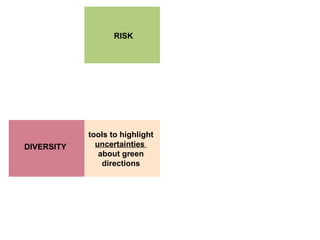
Go beyond ‘hammer’ of simple risk metrics,
assuming incumbency, many uncertainties
eg: IP-driven monoculture transgenic crops,
rather than marker assist, cisgenics, open
source participatory breeding, eco-farming
Diversity is the most robust response –
adaptation, agility, flexibility, reversibility
RISK
DIVERSITY
tools to highlight
uncertainties
about green
directions
RISK
DEMOCRACY
RISK
DEMOCRACY
As in founding values of science itself,
plurality is a source of robustness
be careful about optimising models, RCTs,
aggregated evidence based policy
empower interactive models, civic research
community monitoring, citizen science,
RISK
DEMOCRACY
prioritise not
only interests but
knowledges of
most excluded
TRUST
DIRECTION
TRUST
DIRECTION
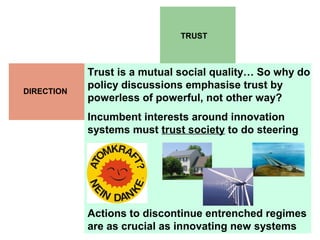
Trust is a mutual social quality… So why do
policy discussions emphasise trust by
powerless of powerful, not other way?
Incumbent interests around innovation
systems must trust society to do steering
Actions to discontinue entrenched regimes
are as crucial as innovating new systems
TRUST
DIRECTION
be clear & direct
in challenging
incumbent
system power
TRUST
DIVERSITY
TRUST
DIVERSITY
Asserting 1 managed top-down transition
can impede trust: diverse transformations
Focus less on ‘scaling up’ one privileged
strategy - and more on seeding diverse
repertoires and portfolios of pathways
No more ‘road maps’ with just one road
TRUST
DIVERSITY
not one transition
– no more ‘road
maps’ with
only one road
TRUST
DEMOCRACY
TRUST
DEMOCRACY
Much talk of quality, longevity, lifestyle
choices – but total omission of equality
Treated as if luxury. Yet in knowledge and
action, equality overturns entrenched power
From education… to empowerment
From responsibility… to accountability
From ‘sound science’… to transparency
From smart innovation… to open innovation
TRUST
DEMOCRACY
prioritise
inclusion, equality;
not responsibility
and smartness
PUBLIC
ENGAGEMENT
DIRECTION
PUBLIC
ENGAGEMENT
DIRECTION
participate for legitimacy not legitimation
Drive for aggregation and consensus is
about justifying – “what can drones do?”
Instead, all policy appraisal should open
up implications of diverse choices
PUBLIC
ENGAGEMENT
DIRECTION
participation is
for opening up,
not closing
down pathways
PUBLIC
ENGAGEMENT
DIVERSITY
PUBLIC
ENGAGEMENT
DIVERSITY
beware impatient top-down language of
urgency: “five years to save the planet”
Grassroots innovation & social technology
can seem slower, but is fast if time is right
importance shown by Danish wind as
crucial basis for current renewable surge
PUBLIC
ENGAGEMENT
DIVERSITY
empower and
fund grassroots
and social
innovation
DEMOCRACY
PUBLIC
ENGAGEMENT
DEMOCRACY
PUBLIC
ENGAGEMENT
Brundtland highlighted greater democracy
– uninvited is more crucial than invited
Previous transforms driven by bottom-up
culture change, not top down policy.
Emphasise and reinvigorate democracy,
Only fulcrum strong enough to bear load.
DEMOCRACY
PUBLIC
ENGAGEMENT
sustainability
transformations
are about hopes,
not fears
RISK TRUST
PUBLIC
ENGAGEMENT
DIRECTION
DIVERSITY
DEMOCRACY
make space for
politics, not just
policy … and
not carbon alone
tools to highlight
uncertainties
about green
directions
prioritise not
only interests but
knowledges of
most excluded
be clear & direct
in challenging
incumbent
system power
not one transition
– no more ‘road
maps’ with
only one road
empower and
fund grassroots
and social
innovation
participation is
for opening up,
not closing
down pathways
sustainability
transformations
are about hopes,
not fears
prioritise
inclusion, equality;
not responsibility
and smartness

Parallel Session A - Presentation by Andy Stirling

Editor's Notes

  • #2 roland: analytic believe in method, intuitive believe in results Abstract The governance of science and technology is conditioned by some pervasive fallacies and fantasies. None are more extensive or deeply embedded, than those concerning the ability of human agency deliberately to control key features of interest in the world. Aspects and implications of the associated dilemmas arise both in the ways knowledge itself is understood, as well as the styles of intervention that society seeks to undertake. Common to both areas, are the neglected dynamics of power - encouraging exaggeration both of the quality of knowledge and the tractability of action. Focusing on the example of energy systems, this talk will quickly review some of the practical policy implications. It will argue for attention to a range of neglected 'broader based' methods for 'opening up' policy appraisal of energy systems. It will also conclude for greater attention to governance strategies that do not depend on claims and aspirations to control. Again, some practical implications will be discussed relating to resilience rather than stability in energy systems and transformation rather than deterministic transition. In all these respects, a concrete energy policy strategy that repeatedly comes to the fore is that of deliberate diversification.