Impact of the structure of polyunsaturated soy phospholipids on the
structural parameters and functionality of their complexes with
covalent conjugates combining sodium caseinate with maltodextrins
M.G. Semenova*
, D.V. Zelikina, A.S. Antipova, E.I. Martirosova, N.V. Grigorovich,
R.A. Obushaeva, E.A. Shumilina, N.S. Ozerova, N.P. Palmina, E.L. Maltseva, V.V. Kasparov,
N.G. Bogdanova, A.V. Krivandin
N. M. Emanuel Institute of Biochemical Physics of Russian Academy of Sciences, Kosygin str., 4, 119334 Moscow, Russian Federation
a r t i c l e i n f o
Article history:
Received 18 February 2015
Received in revised form
15 June 2015
Accepted 16 June 2015
Available online 24 June 2015
Keywords:
Polyunsaturated phospholipids
Sodium caseinate
Maltodextrins
Covalent conjugates
Structural properties
Protection against oxidation
a b s t r a c t
A number of structural (the weight-average molar weight, Mw; the radius of gyration, RG; the hydro-
dynamic radius, Rh; the structure-sensitive parameter, r ¼ RG/Rh; the density, d; the intrinsic viscosity,
[h]; the z-potential), and thermodynamic (the second virial coefficient, A2, reflecting the nature and
intensity of both the biopolymerebiopolymer and biopolymeresolvent pair interactions; the molar
enthalpy of the bilayer phase transition, △Htr) parameters have been measured for the complex particles
formed between covalent conjugates of sodium caseinate (SC) with maltodextrins (MD) (dextrose
equivalent (DE) ¼ 2 and 10, Rweight ¼ MD: SC ¼ 2) and either liposomes of soy phosphatidylcholine (PC)
or micelles of soy lysophosphatidylcholine (LPC) in an aqueous medium (pH ¼ 7.0, I ¼ 0.001 M). The high
extent (>95%) of the encapsulation of both PC and LPC by the conjugates was found that led to the
formation of the highly soluble complex particles, having both essentially higher density and thermo-
dynamic affinity for an aqueous medium, as compared with the pure conjugates. LPC behaved as more
effective both inter- and intra-molecular cross-linking agent for the conjugate particles as compared with
PC. The data of the differential scanning calorimetry, electron spin resonance spectroscopy and small
angle X-ray scattering testified the maintenance of the PC bilayers under the formation of the complex
particles. The conjugates provided rather high level of the protection against oxidation to both PC and
LPC. The lowest extent of the oxidation of the phospholipids in the complexes was found for the LPC
micelles.
© 2015 Elsevier Ltd. All rights reserved.
1. Introduction
The development of smart nano-sized natural delivery systems
for biologically active compounds, containing prophylactic and
therapeutic agents for the improvement of human health (so-called
nutraceuticals), has aroused considerable interest under the novel
functional food formulation nowadays (Dickinson, 2014, chap. 1;
McClements, 2014; Semenova & Dickinson, 2010, chaps. 1-3). The
plant (a-Linolenic acid (ALA) 6-3, linoleic acid (LA) u-6) and fish
(6-3: eicosapentaenoic acid (EPA) and docosahexaenoic acid
(DHA)) polyunsaturated fatty acids (PUFAs) are one of the most
important and essential biologically active compounds, which the
human body cannot synthesize from other food components,
which is recognized to be significant for preserving health (Lee &
Ying, 2008, chap. 15; McClements, 2014; Phang & Garg, 2014,
chap. 16). The need for a balanced supply in both 6-3 and 6-6
polyunsaturated fatty acids is now supported by dietary guidelines
(Dietary Guidelines for Americans, 2010; McClements, 2014;
Michalski et al., 2013).
These essential PUFAs are building blocks of a huge diversity of
more complex natural molecules such as triacylglycerols and
phospholipids, themselves organized in various supramolecular
structures that could be generally natural delivery systems for
PUFAs (McClements, 2014; Phang & Garg, 2014, chap. 16). Recent
advance in nutrition research revealed that the supramolecular
arrangements of the lipid molecules and their physico-chemical
properties in a food matrix can modulate PUFAs release and* Corresponding author.
E-mail address: mariagersem@mail.ru (M.G. Semenova).
Contents lists available at ScienceDirect
Food Hydrocolloids
journal homepage: www.elsevier.com/locate/foodhyd
http://dx.doi.org/10.1016/j.foodhyd.2015.06.011
0268-005X/© 2015 Elsevier Ltd. All rights reserved.
Food Hydrocolloids 52 (2016) 144e160
bioavailability during digestion and their final metabolic fate,
significantly modifying their health impact (McClements, 2014;
Michalski et al., 2013; Shaw et al., 2008, chap. 7; Tamjidi,
Shahedi, Varshosaz, & Nasirpour, 2013). In particular, liposomes
and micelles of polyunsaturated phospholipids attracted significant
interest not only as the sources of the essential PUFAs, but also as
potential carriers for different kinds of both water-soluble and
water-insoluble nutraceuticals (Gibis, Rahn, & Weiss, 2013; Gibis,
Zeeb, & Weiss, 2014; Leser, Sagalowicz, Michel, & Watzke, 2006;
Liu, Ye, Liu, Liu, & Singh, 2013; Lu, Li, & Jiang, 2011; Lu, Nielsen,
Timm-Heinrich, & Jacobsen, 2011; Maherani, Arab-Tehrany,
Mozafari, Gaiani, & Linder, 2011; McClements, 2014; McClements
& Decker, 2000; Mozafari, Johnson, Hatziantoniou, & Demetzos,
2008; Singh, Thompson, Liu, & Corredig, 2012, chap. 11; Taylor,
Davidson, Bruce, & Weiss, 2005; Torchilin, 2007; Velikov & Pelan,
2008). However, currently their high susceptibility to oxidative
degradation during product preparation, transport, and storage as
well as low solubility in water (in the case of liposomes) or in
aqueous body fluids, in addition, possible both leakage and un-
controllable release of the involved nutraceuticals, pose a real
challenge for their use (McClements, 2014; Semenova & Dickinson,
2010, chaps. 1-3).
One of the general ways of improving the chemical stability of
these bioactive lipids is their encapsulation within colloidal de-
livery systems that inhibit their oxidative degradation (Gibis et al.,
2013; Mayer, Weiss, & McClements, 2013; McClements, 2014;
McClements & Decker, 2000; Salminen, Aulbach, Leuenberger,
Tedeschi, & Weiss, 2014; Waraho, McClements, & Decker, 2011).
In particular, to date it is well shown that biomacromolecules
present a great potential in such encapsulation due to mainly their
generally amphipilic nature that, on the one hand, provides surface
activity to the biomacromolecules and, on the other hand, underlies
their susceptibility to self-assembly and co-assembly with different
in nature compounds in an aqueous medium (Gibis et al., 2013;
Livney, 2008, chap. 9; McClements, 2014; Menendez-Aguirre
et al., 2014; Semenova, Anokhina, Antipova, Belyakova, 
Polikarpov, 2014b; Semenova, Belyakova, Polikarpov, Antipova, 
Anokhina, 2008; Semenova  Dickinson, 2010, chaps. 1-3;
Semenova et al.,2012, 2014a). For example, by now, the predicted
novel functional ability of casein molecules/associates to behave as
delivery nanovehicles for hydrophobic nutraceuticals has been
distinctly demonstrated for: (i) polyphenols (Esmaili et al., 2011;
Hasni et al., 2011; Rahimi  Corredig, 2012; Sahu, Kasoju,  Bora,
2008); (ii) a vitamin (D2) (Semo, Kesselman, Danino,  Livney,
2007); (iii) a polyunsaturated soy phosphatidylcholine (Semenova
 Dickinson, 2010, chaps. 1-3; Semenova et al.,2006, 2008, 2012,
2014a,b); and (iv) for the chemotherapeutic drugs (Sahu et al.,
2008; Shapira, Assaraf, Epstein,  Livney, 2010), under the elabo-
ration of non-saturated fat or low-saturated fat functional food
products (Livney, 2010; Semenova  Dickinson, 2010, chaps.1-3). In
addition, the promising abilities of nano-sized (sodium caseinate
(SC) þ maltodextrin (MD)) covalent conjugates as delivery vehicles
for hydrophobic nutraceuticals were also clearly demonstrated
(Grigorovich et al., 2012; Markman  Livney, 2012; Semenova et al.,
2014c, chap. 6). Both the high protection against oxidation for the
nutraceuticals studied (phosphatidylcholine (PC) (Semenova et al.,
2014c, chap. 6); vitamin D and epigallocatechin gallate (Markman 
Livney, 2012)) and their high solubility in the wide range of pH
(including the protein isoelectric point) in the complexes with the
conjugates in an aqueous medium were revealed. Moreover, it was
shown that the covalent conjugation of the maltodextrins to the
protein can be used in order to control the release of PC under the
action of the gastric and intestinal enzymes in the simulated con-
ditions of the gastro-intestinal (GI) tract in-vitro (Semenova et al.,
2014c, chap. 6).
The nanoscale dimensions of biomacromolecule-based nano-
vehicles, which are typical of biopolymer molecules/associates, can
offer additional advantages, because, as was suggested by Acosta
(Acosta, 2009), the size of the delivery systems, especially below
500 nm, has enabled the promise of tackling problems of low oral
bioavailability or inefficient delivery of poorly water-soluble
nutraceuticals/drugs. This is a consequence of the enhancements
based on the following factors (Acosta, 2009; Semenova 
Dickinson, 2010, chaps. 1-3): (i) the apparent solubility of the
active ingredients; (ii) the rate of mass transfer; (iii) the gastro-
intestinal retention time in the mucus covering the intestinal
epithelium; (iv) the rate of release (due to large surface area); and
(v) the direct uptake of particles by the intestinal epithelium
(Augustin  Hemar, 2009; Chen, Weiss,  Shahidi, 2006; Horn 
Rieger, 2001; Medina, Santos-Martinez, Radomski, Corrigan, 
Radomski, 2007).
Despite the almost exponential increase in the research activ-
ities in the area of the elaboration of the smart nanoparticle de-
livery systems for micronutrients and nutraceuticals during the
past decade (Augustin  Hemar, 2009; Dickinson, 2014, chap. 1;
McClements, 2014; Ransley, Donnelly,  Read, 2001; Semenova 
Dickinson, 2010, chaps. 1-3; Velikov  Pelan, 2008) our under-
standing of creating of the biopolymer-based nanovehicles with
specific functional properties is still rather limited, and a more clear
insight into both the structure e function relationships and the
physico-chemical mechanisms underlying the nanovehicles for-
mation is required to design functional biopolymer-based smart
ones more systematically (Dickinson, 2014, chap. 1; McClements,
2014; Semenova  Dickinson, 2010, chaps. 1-3).
The present work is focused on the elucidation of the structural
basis underlying the formation of the nano-sized complexes be-
tween covalent conjugates (SC þ MD) and either liposomes of soy
phosphatidylcholine (PC) or micelles of soy lysophosphatidylcho-
line (LPC) in an aqueous medium, as well as on the ability of the
conjugates to protect the polyunsaturated phospholipids against
oxidation. In parallel, a more penetrating insight is sought into the
generality and the differences in the impact of the specific structure
of the PC liposomes and LPC micelles on both the molecular
mechanisms of the formation of the complexes and their physico-
chemical properties. Moreover, the estimation of the role of the
extent of the maltodextrin polymerization, that is reflected by their
dextrose equivalent (DE ¼ 2 and 10), in both the complex formation
and the complex behavior was also one of the objectives of our
investigation.
2. Materials and methods
2.1. Materials
The sample of sodium caseinate was purchased from Sigma (New
Zealand) and used as received. The samples of maltodextrins Paselli
SA-2 and MD-10 were kindly supplied by AVEBE (Netherlands) and
used as received. These maltodextrins were prepared by the enzy-
matic hydrolysis of a potato starch and had the DE ¼ 2 (SA2) and 10
(MD10). The molar masses of the individual molecules of malto-
dextrins SA-2 and MD-10 are 9 kDa and 1.8 kDa, respectively
(Harkema, 1998). Phosphatidylcholine Lipoid S 100 and Lysophos-
phatidylcholine Lipoid LPC were purchased from Lipoid GmbH,
Germany (PC: phospholipids [g/100 g]: phosphatidylcholine (by
anhydrous weight) ¼ 94; N-acyl-phosphatidylethanolamine ¼ 0.5;
phosphatidylethanolamine ¼ 0.1; phosphatidylinositol ¼ 0.1; lyso-
phosphatidylcholine ¼ 3.0. Nonpolar lipids [g/100 g]:
triglycerides ¼ 2.0; free fatty acids ¼ 0.5; DL-a-tocopherol ¼ 0.15 ÷
0.25. Typical fatty acid composition in % to total fatty acids: palmitic
acid ¼ 12 ÷ 17; stearic acid ¼ 2 ÷ 5; oleic acid ¼ 11 ÷ 15; linoleic acid
M.G. Semenova et al. / Food Hydrocolloids 52 (2016) 144e160 145
(u-6) ¼ 59 ÷ 70; linolenic acid (u-3) ¼ 3 ÷ 7).
LPC was produced from soybean lecithin by phospholipase A2.
LPC: phospholipids [g/100 g]: lysophosphatidylcholine ¼ 98.0;
phosphatidylcholine ¼ 0.2; phosphatidylethanolamine ¼ 0.1; un-
identified components ¼ 0.5; triglycerides ¼ 1.0; free fatty
acids ¼ 0.3; DL-a- tocopherol ¼ 0.1÷0.2. Typical fatty acid compo-
sition in % to total fatty acids: palmitic acid ¼ 24 ÷ 28; stearic
acid ¼ 4 ÷ 7; oleic acid ¼ 15 ÷ 17; linoleic acid (u-6) ¼ 44 ÷ 48;
linolenic acid (u-3) ¼ 1). DL-a-phosphatidylcholine dipalmitoyl
(DPPC) (Sigma (USA), P-5911, synthetic and 99% of purity) was used
as a model phospholipid for the differential scanning calorimetry
(DSC) measurements. The phosphate buffer solutions were pre-
pared using the analytical grade reagents (Laverna, Russia) (99.9%
of purity). They were filtered through a Millipore membrane
(nominal pore size ¼ 0.2 mm) to remove dust. The pH was adjusted
with HCl/NaOH. Analytically grade (99.9% of purity) sodium azide
(Laverna, Russia) (0.02 wt/v %) was added to the buffers as an anti-
microbial agent. Analytically grade ethanol (95.6% of purity) was
used for the PC dissolution. Analytically grade (99.5% of purity)
CuSO4 was used for the purpose of the acceleration of both the PC
and LPC oxidation (Laverna, Russia). Analytically grade (99.5% of
purity) trichloroacetic acid and 2-thiobarbituric acid (TBA) (Lav-
erna, Russia) were used in the TBA test for the oxidation mea-
surements of the phospholipids. Reagents of SENTINEL
DIAGNOSTICS (Italy) were used for the direct enzymatic-
colorimetric determinations of the phospholipids. All solutions
were prepared using a double-distilled water.
2.2. Preparation of the aqueous solutions of the protein,
maltodextrins, and their covalent conjugates
Solutions of the protein (SC), the maltodextrins (MD (either SA-
2 or MD10)), and the conjugates (SC þ MD (either SA2 or MD10)
with required concentrations were prepared using a double-
edistilled water and a phosphate buffer (pH ¼ 7.0, ionic strength of
the buffer ¼ 0.001 M). In addition, both the maltodextrin and
conjugate's solutions were heated at 85 C for 5 min and thereafter
allowed to be cooled for the room temperature. Centrifugation
(4000 rpm, 30 min, at 20 C) of the all biopolymer solutions was
carried out to remove a small fraction of an insoluble material. The
concentration of the protein, the maltodextrins, and the conjugates
in the solutions after centrifugation was checked using a refrac-
tometer (Shimadzu, Japan), with reference to the determined pre-
vious values of the protein, maltodextrin, and conjugate's refractive
indexes, n, equalled, within the 10% experimental error, to
0.20 Â 10À3
m3
/kg, 0.15 Â 10À3
m3
/kg, and 0.17 Â 10À3
m3
/kg,
respectively. Besides, in order to control the concentration of the
biopolymers defined by the refractometric method we have addi-
tionally checked it by drying the biopolymer solutions up to the
constant weight and using the appropriate buffer as the blank
sample. Mixed (SC þ SA2) and (SC þ MD10) aqueous solutions for
the formation of the conjugates, having the weight ratio of the
maltodextrins to the protein (Rweight ¼ 2), were prepared from the
individual biopolymer solutions.
2.3. Preparation of the covalent conjugates (sodium
caseinate þ maltodextrins)
(SC þ MD (either SA-2 or MD10)) conjugates were prepared
according to the method described in the work (Shepherd,
Robertson,  Ofman, 2000). The lyophilized mixed (SC þ MD
(either SA-2 or MD10)) solutions were heated at 60С in a
controlled humidity environment (79% relative humidity) for 72 h.
It was previously shown that the chosen duration of heating under
the mentioned above environmental conditions was enough for
achieving of the excellent solubility, emulsification activity and
stability of the covalent (SC þ MD) conjugates even at pH ¼ 4.8, i.e.,
about the protein isoelectric point (pI) (O'Regan  Mulvihill, 2009;
Shepherd et al., 2000).
2.4. Estimation of the covalent binding between the sodium
caseinate and maltodextrins in the conjugates
The extent of the covalent binding between the SC and malto-
dextrins was estimated according to O'Regan and Mulvihill (2009)
using the trinitrobenzenesulphonate method (TNBS). The calibra-
tion curve was constructed using the pure lysine stock solution
(2.7 Â 10À4
M) by measuring the absorbance of the resultant yellow
solutions at 340 nm using a bi-distillated water treated blank as a
reference. The concentration of the available amino groups in both
pure SC and (SC þ MD) conjugates was measured by reference to
the lysine standard curve. The change in the concentration of
available amino groups in the (SC þ MD) conjugates relative to the
unreacted SC (assumed representing 100% of available amino
groups) was calculated per gram of soluble protein (determined by
the Biuret Protein Assay) and expressed as a percentage loss of
available amino groups compared to SC. Thereafter the average
number of the loss of the available originally lysine groups per
average casein molecules (24,000 Da) (Semenova  Dickinson,
2010, chaps. 1-3; Swaisgood, 2003) was calculated. As this took
place, both the primary sequences of amino acids in the individual
caseins (13 lysine residues (Lys) for aS1-casein; 21 Lys for aS2-
casein; 12 Lys for b-casein; and 9 Lys for k-casein) (Manson,
Carolan,  Annan, 1977; Swaisgood, 2003) and their proportions
in SC (38% aS1-casein, 10% aS2-casein, 36% b-casein and 13% k-
casein) (Manson et al., 1977) were taken into account under the
calculation of the originally present available lysine groups: 0.38
(13) þ 0.10 (21) þ 0.36 (12) þ 0.13 (9) ¼ 12.53.
2.5. Preparation of both PC and DPPC liposomes as well as LPC
micelles
The required amount of PC was dissolved in the pure ethanol.
The aqueous solutions of both PC (10-3
M, containing 10 v/v % of
ethanol), LPC (10-3
M) and DPPC (10-3
M) were prepared under
mixing and shaking for an hour of the PC solution in ethanol, and
both LPC and DPPC in a dry state, with an appropriate amount of the
pure buffer solution, respectively. The LPC critical micelle concen-
tration (CMC), determined by static light scattering (See the Section
2.8.), was equal to 10-3
M under the experimental conditions used
(рН ¼ 7.0, ionic strength of the buffer ¼ 0.001 M, t ¼ 25

C and
40

C). In order to remove ethanol from the PC solutions we have
used the equilibrium dialysis (Visking Dialysis Tubing (Type 36/32),
Serva; the ratio of the volumes of the outer vessel to the inner one
equalled to 20, the duration time of the dialysis was 24 h) against a
pure phosphate buffer (pH ¼ 7.0, ionic strength ¼ 0.001 M). Pre-
liminary estimation showed no transmission of the PC molecules
through the dialysing tubes. The residual amount of ethanol in the
PC containing solutions was equal to 0.5 v/v %.
2.6. Formation of the complex particles (covalent
conjugates þ phospholipids)
The buffered solutions of the conjugates with the required
concentration were mixed and shaken with the solutions of the
phospholipids (in the pure ethanol for PC and in the buffered
aqueous medium for DPPC and LPC) at 40 C for an hour in order to
get mixed solutions, containing finally 10 v/v % of ethanol in the
case of PC, and where the ultimate concentrations of the compo-
nents were the following: 1.0 wt/v % of SC, 2.0 wt/v% of MD (either
M.G. Semenova et al. / Food Hydrocolloids 52 (2016) 144e160146
SA-2 or MD10), 10-3
M of PC, 0.5 Â 10-3
M for DPPC and 10-3
M of
LPC. In order to remove ethanol from the solutions containing PC
we have used the equilibrium dialysis (Visking Dialysis Tubing
(Type 36/32), Serva; the ratio of the volumes of the outer vessel to
the inner one equalled to 20, the duration time of the dialysis was
24 h) against a pure phosphate buffer (pH ¼ 7.0, ionic
strength ¼ 0.001 M). The residual amount of ethanol in the PC
containing solutions was equal to 0.5 v/v %.
2.7. Estimation of the extent of the binding of the phospholipids (PC
and LPC) by the covalent conjugates
In the case of PC, the method of the estimation of the extent of
the PC binding by the conjugates was based on the separation of the
free PC from the aqueous solutions of its complexes with the con-
jugates by the extraction with a diethyl ether: an aliquot of 5 ml of
the tested sample solution was placed into a glass vial and then a
diethyl ether (3 ml) was added. The two-layer mixture was shaken
and aged 24 h in a cool place (~7 C). Thereafter, the organic layer
was separated and the concentration of PC in this extract was
determined using Beckman (DU-70, USA) spectrophotometer by
measuring the optical density of the extracts against the pure
diethyl ether, as a blank, at a wavelength of 215 nm. The measured
optical density was used in order to calculate the concentration of a
free and a bound PC in the tested sample. Prior to these experi-
ments, the calibration curve was constructed by plotting the optical
density values for the diethyl ether extracts of PC from the buffered
aqueous solutions (without the conjugates) against the known PC
concentrations in these solutions. The results presented in this
work are the average of at least of the three independent experi-
ments. The estimated experimental error was not higher than 10%.
In turn, to determine the amount of LPC encapsulated by the
conjugates, we have used salting-out of the conjugates with the
encapsulated LPC by the 4 M ammonium sulfate that was followed
by their precipitation using the centrifugation (4000 rpm, 30 min,
at 20 C). Thereafter the supernatant and precipitate were sepa-
rated and both the free LPC and the LPC encapsulated by the con-
jugates were determined using the enzymatic method (Jakobs,
Kasten, Demmott,  Wolfson, 1990). The results presented in this
work are the average of at least of the three independent experi-
ments. The estimated experimental error was not higher than 5%.
2.8. A combination of the static and dynamic laser light scattering
measurements
The weight-average molar mass Mw, the radius of gyration RG,
and the second virial coefficient A2 for SC and the conjugates
(SC þ MD) alone as well as for the complexes of the conjugates with
the phospholipids were measured by a static laser light scattering
in the dust-free dilute aqueous solutions (with 5e8 concentration
points at most). The Rayleigh ratio RQ at each concentration point
was measured using a vertically polarized light (633 nm) at angles
in the range 40 Q 140 (13 angles) using an LS-01 apparatus
(Scientific Instruments, St. Petersburg, Russia) calibrated with a
dust-free benzene (R90 ¼ 11.84 Â 10À6
cm-1
). Solutions were filtered
directly into the light scattering cell through a Millipore membrane
with a pore size of 0.8 mm. This allowed us to include within our
measurement nearly the whole studied samples without any sig-
nificant loss (5% at most), as indicated by checking the biopolymer
concentration of the samples in the solutions before and after
filtration by the refractometric method, using known values of the
refractive index increments. The raw data were used to plot the
angular and the concentration dependencies of the ratio (HC/DRQ)1/
2
according to the Berry method (Burchard, 1994, chap. 4;
Semenova  Dickinson, 2010, chap. 5). The experimental error in
the Mw, RG and A2 determination, which was estimated on the basis
of not less than 2 experimental repetitions, did not exceeded 10%.
It is worthy of note here that the values of the refractive index
increments, measured by a differential refractometer (Shimadzu,
Japan) at l ¼ 633 nm, for the complex particles of the conjugates
with both PC and LPC were not different from the ones inherent for
the pure conjugate particles within the experimental error (±10%):
ncomplex ¼ 0.17 Â 10À3
m3
kgÀ1
.
Values of the hydrodynamic radius Rh of the pure PC liposomes,
LPC micelles, SC, conjugates (SC þ MD), and the complex particles
of the conjugates with the phospholipids were estimated in the
buffered aqueous solutions by a dynamic laser light scattering. The
time correlation function of the scattering intensity was measured
at Q ¼ 90 with a vertically polarized light (l ¼ 633 nm) using an
LS-01 apparatus (Scientific Instruments, St Petersburg, Russia). To
determine the hydrodynamic radius from the time correlation
function, a special program was used (DYNALS Release 1.5, all rights
reserved by A. Golding and N. Sidorenko). The experimental error in
the Rh determination, which was estimated on the basis of not less
than 10 experimental repetitions, did not exceeded 10%.
The light scattering measurements were carried out at 25 C.
Based on the light scattering data the following parameters have
been determined:
À the architecture of the particles of the pure SC, the pure con-
jugates, and the complexes of the conjugates with the phos-
pholipids has been characterized by the values of the ratio RG/Rh
(the structural factor r), the utility of which in distinguishing
among different architectures of both individual macromole-
cules and their aggregates has been proven by many light
scattering experiments (Ioan, Aberle,  Burchard, 2000;
Kajiwara  Burchard, 1984; Kunz, Thurn,  Burchard, 1983;
Tuteja, Mackay, Hawker, Van Horn,  Ho, 2006);
À the density of the studied particles has been calculated using the
following equation (Tanford, 1961):
d ¼ Mw=ðNAVÞ; (1)
where Mw is the weight-averaged molar mass of a particle; NA is the
Avogadro's number; V is the volume of the particle that is
approximated by the sphere, the volume of which V ¼ 4/3pR3
G,
where RG is the radius of gyration of the particle;
À the second virial coefficient was expressed in the different units:
weight, A2, and molal, A*
2 where A*
2 ¼ 2 A2 M2
W/1000 (Wells,
1984). The advantage of a static light scattering over some
other methods of determining the second virial coefficient is the
capability to measure both thermodynamic (A2) and structural
parameters (Mw, RG) in a single experiment. This advantage
provides us with the possibility to estimate the contributions
from the excluded volume effects, Aexc
2 , to the pair interactions
between biopolymer particles in an aqueous solution
(Nagasawa  Takahashi, 1972; Semenova  Dickinson, 2010,
chaps. 1-3, 5; Tanford, 1961). The repulsive ‘steric/excluded
volume’ interactions arose from the highly thermodynamically
unfavorable overlap of full electron clouds leading to the re-
striction in the occupation of the same volume in solution by
two different particles. Thus, both the size and the shape of the
biopolymer particles, as determined by both their macromo-
lecular conformation/flexibility and their ultimate architecture,
are of the prime importance to the excluded volume repulsive
interactions (Semenova  Dickinson, 2010, chaps. 1-3, 5). In
turn, the difference between measured AÃ
2 and Aexc
2 allows an
M.G. Semenova et al. / Food Hydrocolloids 52 (2016) 144e160 147
estimation of the total contributions from the other kinds of the
interactions (electrostatic (Ael
2 ), hydrogen bonding (A
h=b
2 ) and
hydrophobic (Ah
2)) as follows:
A*
2 À Aexc
2 ¼ Ael
2 þ A
h=b
2 þ Ah
2 (2)
For the spherical particles found generally in our experiments
(1  r  2) (See Tables 2, 4 and 5) we have used the simplest case of
the interacting solid spheres and the following equation for the
calculation of the Aexc
2 (Tanford, 1961):
Aexc
2 ¼ 10À3
4pNA
.
3 ð2RÞ3
(3)
The parameter R in the Equation (3) is the radius of the equiv-
alent hard sphere representing the biopolymer particle. The
equivalent hard sphere corresponds to the space occupied in the
aqueous medium by a single biopolymer particle, which is
completely inaccessible to both other biopolymer particles and
solvent molecules. In our calculations we have used the Rh as the
radius of the equivalent hard sphere.
The critical micelle concentration (CMC) of the LPC was deter-
mined by measuring the intensity of the scattering light (I90) for the
LPC aqueous solutions having the LPC concentration in the range
(10À7
M ÷ 10-1
M), using an LS-01 apparatus (Scientific Instruments,
St. Petersburg, Russia). The sharp increase in the I90 was referred to
the CMC.
2.9. The viscosimetry in diluted solutions
The intrinsic viscosity, [h], of the buffered aqueous solutions of a
pure SC, the conjugates (SC þ MD), and their complexes with the
phospholipids was measured at 25 C using an Ubbelohde
viscometer having the capillary diameter ¼ 0.54 mm. The experi-
mental error in the [h] determination, which was estimated on the
basis of not less than 2 experimental repetitions, did not exceeded
15%.
2.10. The z-potential measurements
Electrophoretic mobilities of the biopolymer samples: a pure SC,
the conjugates (SC þ MD), and their complexes with the phos-
pholipids were determined with a Zetasizer Nano ZS Malvern (UK)
calibrated against a standard latex dispersion. The experimental
error in the z-potential determination, which was estimated on the
basis of not less than 10 experimental repetitions, did not exceeded
10%.
2.11. DSC measurements
DSC measurements of the inherent phase transition for the
DPPC liposome bilayers were performed by the high sensitivity
differential scanning calorimetry using a DASM-4M model, Differ-
ential Scanning Calorimeter (Pushino, Russia). The baseline ther-
mogram was obtained using the appropriate buffer (0.5 ml) in all
two cells including the reference cell to normalize cell to cell dif-
ferences. The measurements were carried out in the temperature
range from 10 to 110 C at the constant pressure 2.5 atm. The
heating scan rate was maintained at 0.5 C/min for the all experi-
ments. The thermograms for the investigated samples were ob-
tained by subtracting the respective baseline thermogram from the
sample thermogram using the software provided by the manu-
facturer. The peak position in the plot of the “excess heat capacity”,
DCp, versus temperature on a heating scan was taken as the tem-
perature, ttr, of the solid-like gel to the fluid liquid-crystalline phase
transition for DPPC liposome bilayers in an aqueous medium. The
thermodynamic parameters (ttr, Dt, hpeak), and function (DHtr) of
the phase transition were also computed using the same software
as reported. The experimental error in their determination, which
was estimated on the basis of not less than 2 experimental repe-
titions, did not exceeded 5%.
2.12. Electron spin resonance (ESR) study
The structural state of both PC liposomes and LPC micelles in
their pure form and in the complexes with the conjugates (1.0 wt/v
% of the conjugates with either 2 Â 10-3
M of PC (0.156 wt/v %), or
2 Â 10-3
M of LPC (0.102 wt/v %)) was studied by the electron spin
resonance spectroscopy at 25 C. ESR spectra were recorded on a
Bruker EMX spectrometer (Germany). 16-doxylstearic acid radical
(16-DSA, Sigma) was used as a spin probe. 16-DSA localizes in the
hydrophobic region of the phospholipid particles at a depth of 20 Å
of a lipid layer.
The microviscosity of the phospholipid layers was estimated by
the rotational correlation time (tс) of the 16-DSA using the equation
for a fast motion of the nitroxyl radical:
tс ¼ 6; 65$DНþ
ffiffiffiffiffi
Iþ
IÀ
s
À 1
!
$10À10
; (4)
where △Hþ represents the resonance width of the low-field
component, Iþ and IÀ are the resonance heights of the low and
the high-field components of the ESR spectra, respectively.
The experimental error of the method did not exceeded 2%.
Both the calculation of the parameters and the correction of the
ESR spectra were performed using the computer program Bruker
WIN-EPR with the subprogram SYMFONIA.
2.13. Small-angle X-ray scattering (SAXS)
The SAXS measurements were performed with an X-ray
diffractometer of a local design at room temperature. The X-ray
radiation from the fine focus Cu X-ray tube was Ni-filtered and
focused with the glass mirror collimator. X-ray scattering patterns
Table 1
The amount of maltodextrin molecules covalently attached to the individual mass-averaged casein molecule (24 kDa) comprising original sodium caseinate (SC) particles in an
aqueous medium.
Rweight Percent of the loss of the available
amino groups of lysine in the SC
Rm
a
The quantity of the maltodextrin molecules covalently
bound to the individual averaged casein molecules
The quantity of the free maltodextrin
molecules
Conjugate (SC þ SA2)
2 30 5 4 1
Conjugate (SC þ MD10)
2 45 27 6 21
a
Under the calculation of the molar ratio Rm we have taken into account the molar masses of the individual molecules of maltodextrins (9 kDa and 1.8 kDa for the
maltodextrins SA2 and MD10, respectively) (Harkema, 1998) and the individual mass-averaged casein molecules (24 kDa) (Swaisgood, 2003) comprising the original sodium
caseinate particles.
M.G. Semenova et al. / Food Hydrocolloids 52 (2016) 144e160148
were recorded with the gas-filled (85% Xe, 15% Me) one-
dimensional position-sensitive detector with delay line readout
constructed in JINR. Experimental curves were corrected for the
background scattering and processed with PRIMUS and indirect
Fourier transformation GNOM software.
In order to get the values of the SAXS intensity, which could be
enough for the accurate measurements, we have used the following
concentrations for the conjugates (2.5 wt/v% and 2.3 wt/v% for the
(SC þ SA2) and (SC þ MD10), respectively) and PC liposomes (1 wt/
v%) under their both individual and complex measurements.
2.14. Estimation of the conjugate ability to protect the
phospholipids against oxidation in their complexes
The degree of both PC and LPC oxidation in the tested samples
was estimated by the quantitative measurements of the final
product of the lipids peroxidation (malonic dialdehyde (MDA)
(Gutteridge, 1977). The quantitative determination of MDA was
carried out by the TBARS method (by the reaction of MDA with 2-
thiobarbituric acid (TBA) in the presence of trichloroacetic acid)
(Fernandez, Perez-Alvarez,  Fernandez-Lopez, 1997; Fu  Huang,
2001; Heath  Packer, 1968; Kwon, Menzel,  Olcott, 1965) by
measuring the optical density (Beckman (Du-70) spectrophotom-
eter, USA) of the colored TBA-MDA compounds at two different
wave lengths in order to prevent the effect of any slight turbidity of
the tested samples, namely, at l ¼ 532 (the maximum of the
absorbance by the TBARS) (Gutteridge, 1977; Gutteridge  Tickner,
1978; Fernandez et al., 1997; Kwon et al., 1965) and at l ¼ 580 (the
minimum of the absorbance by the TBARS) (Gutteridge  Tickner,
1978). The experimental error of the TBARS method, which was
estimated on the basis of not less than 3 experimental repetitions,
was equal to 15%.
As this took place, we had used the general for such experiments
the addition of the low concentration of Cu2 þ
ions (10À5
M CuSO4)
into the tested sample solutions in order to both accelerate of the
PC, and LPC oxidation and to make the experimental work less time
consuming. It was shown preliminarily that this concentration of
Cu2 þ
ions did not influence on the properties of the tested samples,
but accelerated the PC and LPC oxidation essentially. In addition we
have used heating of the tested samples at 60 C for 1 h. The con-
centration of MDA was measured in the tested samples after 14
days of their storage at room temperature.
3. Results and discussion
In order to gain a more penetrating insight into the generalities
and distinctions in the impact of the different structures of the
polyunsaturated phospholipids in an aqueous medium (a micellar
form for soy lysophosphatidylcholine and a liposomal form for soy
phosphatidylcholine) on the formation and functionality of their
complexes with the covalent conjugates, let us characterize first
both the structural and thermodynamic properties of the original
covalent conjugates in an aquous medium.
3.1. Amount of maltodextrin molecules attached covalently to the
individual casein molecules
First and foremost, the determination of the quantity of
maltodextrin molecules (Harkema,1998) attached covalently to the
individual mass-averaged casein molecules (24 kDa) (Semenova 
Dickinson, 2010, chap. 6), involved into the sodium caseinate par-
ticles (SC), was carried out. To accomplish this end, the measure-
ment of the loss of the free amino groups of lysine in SC, as a result
of the covalent binding with the maltodextrins, was performed.
Table 1 shows that maltodextrin MD10, having the shorter
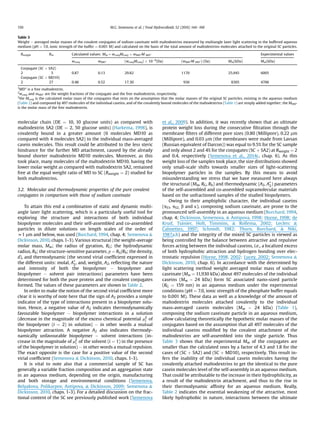
Table2
Schematicrepresentationofthenanoscalestructuresandtheexperimentaldatarelatingtotheself-assemblyofboththepureindividualcaseinsintothesodiumcaseinate(SC)particlesandtheindividualcaseinsmodifiedbythe
covalentattachmentofthemaltodextrins(eitherSA2orMD10)intotheparticlesofthecovalentconjugates(SCþSA2;SCþMD10)inabufferedaqueousmedium(pH¼7.0,ionicstrengthofthebuffer¼0.001M,25C).
Conjugate(SCþSA2)SCConjugate(SCþMD10)
SystemMw(kDa)A2Â105
(m3
molkgÀ2
)A*
2(m3
molÀ1
)Aexc
2(m3
molÀ1
)Ael
2þA
h=b
2þAh
2(m3
molÀ1
)RG(nm)r¼RG/Rhd(mg/ml)1/[h](mg/ml)z-potential(mV)
SC11,9304.412.423.6À11.21591.511.269À31.0
Conjugate(SCþSA2)60053.82.80.91.91251.751.244À22.0
Conjugate(SCþMD10)47063.10.62.6À2.01401.390.777À27.0
M.G. Semenova et al. / Food Hydrocolloids 52 (2016) 144e160 149
molecular chain (DE ¼ 10, 10 glucose units) as compared with
maltodextrin SA2 (DE ¼ 2, 50 glucose units) (Harkema, 1998), is
covalently bound in a greater amount (6 molecules MD10 as
compared with 4 molecules SA2) to the individual mass-averaged
casein molecules. This result could be attributed to the less steric
hindrance for the further MD attachment, caused by the already
bound shorter maltodextrin MD10 molecules. Moreover, as this
took place, many molecules of the maltodextrin MD10, having the
lower molar weight as compared with maltodextrin SA2, remained
free at the equal weight ratio of MD to SC (Rweight ¼ 2) studied for
both maltodextrins.
3.2. Molecular and thermodynamic properties of the pure covalent
conjugates in comparison with those of sodium caseinate
To attain this end a combination of static and dynamic multi-
angle laser light scattering, which is a particularly useful tool for
exploring the structure and interactions of both individual
biopolymer molecules and their self-assembled and co-assembled
particles in dilute solutions on length scales of the order of
z1 mm and below, was used (Burchard, 1994, chap. 4; Semenova 
Dickinson, 2010, chaps.1-3). Various structural (the weight-average
molar mass, Mw; the radius of gyration, RG; the hydrodynamic
radius, Rh; the structure-sensitive parameter, r ¼ RG/Rh; the density,
d), and thermodynamic (the second virial coefficient expressed in
the different units: molal, A*
2, and, weight, A2, reflecting the nature
and intensity of both the biopolymer À biopolymer and
biopolymer À solvent pair interactions) parameters have been
determined for both the pure protein and the covalent conjugates
formed. The values of these parameters are shown in Table 2.
In order to make the notion of the second virial coefficient more
clear it is worthy of note here that the sign of A2 provides a simple
indicator of the type of interactions present in a biopolymer solu-
tion. Hence, a negative value of A2 indicates thermodynamically
favourable biopolymer À biopolymer interactions in a solution
(decrease in the magnitude of the excess chemical potential mE
i of
the biopolymer (i ¼ 2) in solution) À in other words a mutual
biopolymer attraction. A negative A2 also indicates thermody-
namically unfavourable biopolymer À solvent interactions (in-
crease in the magnitude of mE
i of the solvent (i ¼ 1) in the presence
of the biopolymer in solution) À in other words a mutual repulsion.
The exact opposite is the case for a positive value of the second
virial coefficient (Semenova  Dickinson, 2010, chaps. 1-3).
It is vital to note also that a commercial sample of SC has
generally a variable fraction composition and an aggregation state
in an aqueous medium, depending on the origin, manufacturing
and both storage and environmental conditions (Semenova,
Belyakova, Polikarpov, Antipova,  Dickinson, 2009; Semenova 
Dickinson, 2010, chaps. 1-3). For a detailed discussion on the frac-
tional content of the SC see previously published work (Semenova
et al., 2009). In addition, it was recently shown that an ultimate
protein weight loss during the consecutive filtration through the
membrane filters of different pore sizes (0.80 (Millipore), 0.22 mm
(Millipore), and 0.03 mm (the membranes were made from Lavsan
(Russian equivalent of Darcon)) was equal to 9.5% for the SC sample
and only about 2 and 4% for the conjugates (SC þ SA2) at Rweight ¼ 2
and 0.4, respectively (Semenova et al., 2014c, chap. 6). As this
weight loss of the samples took place, the size distributions showed
only small-scale shifts towards smaller sizes of light-scattering
biopolymer particles in the samples. By this means to avoid
misunderstanding we stress that we have measured here always
the structural (Mw, RG, Rh) and thermodynamic (A2, A*
2) parameters
of the self-assembled and co-assembled supramolecular materials
based on the unfractioned samples of the studied biopolymers.
Owing to their amphiphilic character, the individual caseins
(aS1, aS2, b and k), composing sodium caseinate, are prone to the
pronounced self-assembly in an aqueous medium (Burchard, 1994,
chap. 4; Dickinson, Semenova,  Antipova, 1998; Horne, 1998; de
Kruif, Tuinier, Holt, Timmins,  Rollema, 2002; Leclerc 
Calmettes, 1997; Schmidt, 1982; Thurn, Burchard,  Niki,
1987a,b) and the integrity of the mixed SC particles is viewed as
being controlled by the balance between attractive and repulsive
forces acting between the individual caseins, i.e., a localized excess
of both hydrophobic attraction and hydrogen bonding over elec-
trostatic repulsion (Horne, 1998, 2002; Lucey, 2002; Semenova 
Dickinson, 2010, chap. 6). In accordance with the determined by
light scattering method weight averaged molar mass of sodium
caseinate (Mw ¼ 11,930 kDa) about 497 molecules of the individual
caseins (Mw ~ 24 kDa) form SC associated nano-sized particle
(RG ¼ 159 nm) in an aqueous medium under the experimental
conditions (pH ¼ 7.0, ionic strength of the phosphate buffer equals
to 0.001 M). These data as well as a knowledge of the amount of
maltodextrin molecules attached covalently to the individual
mass-averaged casein molecules (Mw ~ 24 kDa) (Table 1),
composing the sodium caseinate particle in an aqueous medium,
allow calculating theoretically the hypothetic molar masses of the
conjugates based on the assumption that all 497 molecules of the
individual caseins modified by the covalent attachment of the
maltodextrins are self-assembled into the single particle. Thus
Table 3 shows that the experimental Mw of the conjugates are
smaller than the calculated ones by a factor of 4.3 and 1.8 for the
cases of (SC þ SA2) and (SC þ MD10), respectively. This result in-
fers the inability of the individual casein molecules having the
covalently attached maltodextrins to get the identical to the pure
casein molecules level of the self-assembly in an aqueous medium.
That could be attributable to the increase in their hydrophilicity, as
a result of the maltodextrin attachment, and thus to the rise in
their thermodynamic affinity for an aqueous medium. Really,
Table 2 indicates the essential weakening of the attractive, most
likely hydrophobic in nature, interactions between the ultimate
Table 3
Weight e averaged molar masses of the covalent conjugates of sodium caseinate with maltodextrins measured by multiangle laser light scattering in the buffered aqueous
medium (pH ¼ 7.0, ionic strength of the buffer ¼ 0.001 M) and calculated on the basis of the total amount of maltodextrins molecules attached to the original SC particles.
Rweight Rm Calculated values: Mw ¼ wconjMconj þ wMD*M MD* Experimental values
wconj wMD* (wconjMconj) Â 10À6
(Da) (wMD*M MD*) (Da) Mw(kDa) Mw(kDa)
Conjugate (SC þ SA2)
2 5 0.87 0.13 29.82 1170 25,945 6005
Conjugate (SC þ MD10)
2 27 0.48 0.52 17.30 936 8305 4706
1
MD* is a free maltodextrin.
2
wconj and wMD* are the weight fractions of the conjugate and the free maltodextrin, respectively.
3
the Mconj is the calculated molar mass of the conjugates that rests on the assumption that the molar masses of the original SC particles, existing in the aqueous medium
(Table 2) and composed by 497 molecules of the individual caseins, and of the covalently bound molecules of the maltodextrins (Table 1) are simply added together; the MMD*
is the molar mass of the free maltodextrin.
M.G. Semenova et al. / Food Hydrocolloids 52 (2016) 144e160150
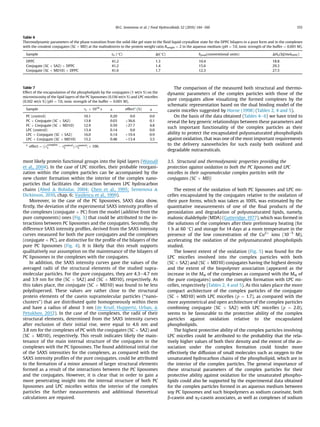
Table 5
Schematic representation of the nanoscale structures and the experimental data relating to the assembly of covalent conjugate (SC þ MD10) induced by the interactions of the conjugate with either PC liposomes or LPC micelles in
an aqueous medium (pH ¼ 7.0, ionic strength of the buffer ¼ 0.001 M, 25 C).
Conjugate (SC þ MD10) þ LPC LPC Conjugate (SC þ MD10) PC Conjugate (SC þ MD10) þ PC
1
2
3
4
System Mw (kDa) A2 Â 105
(m3
mol kgÀ2
) A*
2 (m3
molÀ1
) Aexc
2 (m3
molÀ1
) Ael
2 þ A
h=b
2 þ Ah
2 (m3
molÀ1
) RG (nm) r ¼ RG/Rh d (mg/ml) 1/[h] (mg/ml) z-potential (mV)
Conjugate (SC þ MD10) þ LPC 15,000 1.4 22.0 1.9 20.1 157 1.70 1.5 248 À26.4
Conjugate (SC þ MD10) þ PC 5900 1.6 1.1 0.5 0.6 114 1.98 1.6 83 À25.6
Table 4
Schematic representation of the nanoscale structures and the experimental data relating to the assembly of the covalent conjugate (SC þ SA2) induced by the interactions of the conjugate with either PC liposomes or LPC micelles
in an aqueous medium (pH ¼ 7.0, ionic strength of the buffer ¼ 0.001 M, 25 C).
Conjugate (SC þ SA2) þ LPC LPC Conjugate (SC þ SA2) PC Conjugate (SC þ SA2) þ PC
System Mw (kDa) A2 Â 105
(m3
mol kgÀ2
) A*
2 (m3
molÀ1
) Aexc
2 (m3
molÀ1
) Ael
2 þ A
h=b
2 þ Ah
2 (m3
molÀ1
) RG (nm) r ¼ RG/Rh d (mg/ml) 1/[h] (mg/ml) z-potential (mV)
Conjugate (SC þ SA2) þ LPC 9400 2.4 4.3 0.44 3.9 109 2.0 2.9 86 À23.4
Conjugate (SC þ SA2) þ PC 6800 2.6 2.4 0.6 1.8 112 2.0 1.9 60 À22.8
M.G.Semenovaetal./FoodHydrocolloids52(2016)144e160151
conjugate particles formed in an aqueous medium. It manifests
itself as either less negative for the case of the conjugate
(SC þ MD10) or, by contrast, positive for the conjugate (SC þ SA2)
contributions of the additive term (Ael
2 þ A
h=b
2 þ Ah
2) into the value
of the A*
2 (Eq. (2)) as compared to the pure SC. It was also found that
the lower is the molar mass of the studied biopolymer particles the
poorer is their thermodynamic affinity for an aqueous medium, as
if a greater amount of hydrophobic patches of the casein mole-
cules, combined in the conjugates, become exposing into the
aqueous medium, rather than are hidden in the interior of the
particles. That is most pronounced in the case of the particles of
the (SC þ MD10) conjugate.
In addition, Table 2 shows that the formed conjugates have the
smaller size (RG) as compared with the pure protein, keep both the
spherical shape (1  r  2) and negative, but lower in the absolute
value than the protein has the z-potential, which is reflecting the
negative total charge of the particles. It is probable that such
decrease in the absolute value of the z-potential is attributable to
the partial protein charge neutralization as a result of the facilita-
tion of the interactions between the opposite charges of the caseins
under the new form of the self-assembly of casein molecules
modified by the covalently attached maltodextrins.
In turn, the densities d of the conjugate particles (Eq. (1)) have
changed as a result of the decrease in both their molar mass, Mw,
and size, RG. Hence, there is no alteration of the density value in
the case of the conjugate (SC þ SA2) in comparison with that of
the pure SC particles, and, in turn, there is an essential decrease in
the d for the case of the conjugate (SC þ MD10) (from d ¼ 1.2 mg/
ml for SC to d ¼ 0.7 mg/ml for the conjugate). This result can be
attributed to the largest decrease in the absolute value of Mw of
the conjugate (SC þ MD10) particles, as compared with the pure
SC, that does not followed by the same extent of the decrease in
the RG value.
In order to confirm the alteration of the structural and ther-
modynamic parameters of the SC particles as a result of the
conjugation with the maltodextrins, observed by light scattering
method, we have measured the intrinsic viscosity [h] of both SC
and the conjugates in diluted aqueous solutions (Table 2). The [h]
is the most convenient parameter to this end because its value is
sensitive to changes in the size, shape, and solvation of polymer
particles (Tanford, 1961). Thus an easy comparison of the inverse
values of the [h] obtained for both SC and the conjugate particles
with the values of the densities of these biopolymer particles,
calculated from the light scattering data (Eq. (1), Table 2), dem-
onstrates a number of discrepancies in the trend of their alteration.
We have found the same densities of the conjugate (SC þ SA2) and
the SC particles in contrast to the 1.6 times decrease in the value of
the 1/[h] for this conjugate in comparison to that of the pure
protein. In turn, in the case of the conjugate (SC þ MD10), there is
1.8 times increase in the value of the 1/[h] against the 1.7 times
decrease in the values of d as compared with those parameters of
the pure SC particles. These discrepancies indicate that one should
take into account that the value of [h] of the particles is controlled
not only by their density d but also by their shape and degree of
solvation (Tanford, 1961). In particular the solvation correlates
with the thermodynamic affinity of the biopolymer particles for
solvent. It is well known that the greater extent of the solvation of
the particle as a whole leads to the increase in the value of [h] and
hence to the decrease in its reciprocal value 1/[h] due to the
retention of the solvent inside the biopolymer particle moving
together with it. Such particle may be approximated by the
equivalent solid sphere (Tanford, 1961). The protein particles seem
to accord well with this approximation. On the contrary, if the
thermodynamic quality of the solvent for the biopolymer particle
is poorer, as was found for the conjugate (SC þ MD10) particles
(the lowest positive values of both A2 and A*
2), for example,
(Table 2), that is, when the solvent is not retained much by the
biopolymer particle, the model of a more permeable for the sol-
vent biopolymer particle may be more acceptable for the
description of its hydrodynamic properties (Tanford, 1961). Hence,
it may be proposed that the higher permeability of the conjugate
(SC þ MD10) particles for the solvent is responsible for the lower
value of the [h] and hence the higher value of the 1/[h] as
compared to both the protein and the conjugate (SC þ SA2) par-
ticles even though the value of d of the conjugate (SC þ MD10)
particles is essentially lower (Table 2). In addition, with account
taken of the contribution of the different shapes of polymer par-
ticles to the value of [h], one may also provide an additional
explanation for the discrepancies mentioned above. Thus, a more
asymmetric shape of polymer particles (r  1) may be also
responsible for a higher value of [h] and consequently for a lower
value of its reciprocal value (Tanford, 1961). Really, the lowest
value of 1/[h] was found for the more asymmetric particles of the
conjugate (SC þ SA2) (r ¼ 1.75), having an intermediate thermo-
dynamic affinity for the solvent, as compared with both the pro-
tein and the conjugate (SC þ MD10) particles.
The measured structural and thermodynamic parameters of
both the pure protein and the conjugate particles allow visualizing
them by the schematic representation based on the dual binding
model of the casein ‘micelles’ as built up from the individual caseins
(aS1, aS2, b and k) and suggested by Horne (1998) (Table 2).
3.3. Encapsulation ability of the covalent conjugates relatively the
polyunsaturated phospholipids (PC and LPC)
In order to get the conjugate-based delivery systems for the
phospholipids the co-assembly of the conjugates (1 wt/v% of SC þ 2
wt/v% MD (either SA2 or MD10)) with both PC liposomes (10-3
M;
0.078 wt/v%) and LPC micelles (10-3
M; 0.051 wt/v%) was performed
under pH ¼ 7.0, at the ionic strength of the phoshate buffer
equalled to 0.001 M, and temperature (40 C).
The high extent (95%) of the encapsulation of both PC lipo-
somes and LPC micelles by the conjugates was observed in the
aqueous medium for the weight ratio of the conjugates to the
phospholipid particles used. Relying on both the literature
(Antunes, Marques, Miguel,  Lindman, 2009; Bai, Nichifor, 
Bastos, 2010; Schulz, Olubummo,  Binder, 2012; Str€omstedt,
Ringstad, Schmidtchen,  Malmsten, 2010) and our experimental
data (Istarova et al., 2005; Semenova et al., 2012, 2014a) we can
suggest the contribution of the different kinds of the interactions
(electrostatic attraction between opposite charges, hydrogen
bonding and predominantly hydrophobic attraction) into the
complex formation between the phospholipids and the conjugates.
It is significant that, as this takes place, the formed complexes show
the same high level of the solubility in an aqueous medium that is
inherent to the pure covalent conjugates (Grigorovich et al., 2012).
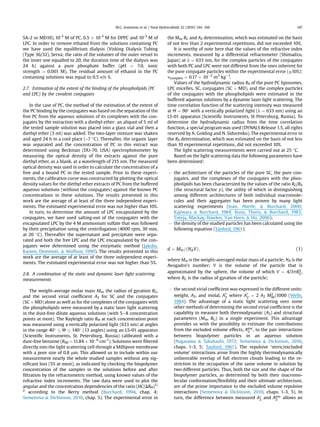
The appearance of the new peaks of the complex particles at the
size distribution diagrams obtained by dynamic light scattering
(Fig. 1) for the studied particles of pure PC liposomes, LPC micelles,
conjugates, and their complexes, give an additional evidence of the
involvement of both the conjugates and the phospholipid particles
into the complex formation. The lower polydispersity in the size
(more narrow size distributions) seems to be the common feature
of the complex particles involving both PC liposomes and LPC mi-
celles as compared with the polydispersity of the pure conjugates
(Fig. 1).
M.G. Semenova et al. / Food Hydrocolloids 52 (2016) 144e160152
3.4. Comparison of the structural and thermodynamic parameters
of the complex particles combining the covalent conjugates with
either PC liposomes or LPC micelles
Tables 4 and 5 show a comparison of the structural and ther-
modynamic parameters of the complex particles based on the
conjugates ((SC þ SA2) Table 4; (SC þ MD10) Table 5) and involving
either PC liposomes or LPC micelles. From this comparison the
generalities and distinctions in the impact of the structural orga-
nization of the phospholipids (PC liposomes or LPC micelles) on the
properties of the complex particles can be distinguished.
Firstly, it is worthy of note here that the architecture of the
random coil (1  r 2) is the general characteristic for the all
complex particles formed (Tables 4 and 5).
Secondly, the common similarity is the significant increase in
the density d of the complex particles as compared to that of the
pure conjugates (Table 2). This result could be generally attributed
to both the decrease in the size (RG) of the complex particles
accompanied with the simultaneous increase in their weight
average molar masses (Mw) (Eq. (1), Tables 2, 4 and 5). In the case of
the conjugate (SC þ MD10) the increase in the density of the
complex particles involving micelles of LPC was predominantly
caused by the greatest, namely threefold, increase in the Mw, since
the slight 1.12 times increase in the RG was found in this case
(Tables 2 and 5). It is vital to note here that both the greatest values
of the density caused by either the most contraction of the complex
particles, as in the case of the conjugate (SC þ SA2), (Tables 2 and 4)
or the most increase in their Mw, as in the case of the conjugate
(SC þ MD10) (Tables 2 and 5) were found as a result of the
encapsulation of the LPC micelles.
In support of the found increase in the density of the complex
particles, as compared to that of the pure conjugates, the similar
trend in the increase in the values of the reciprocal intrinsic vis-
cosity 1/[h] was revealed for the all complexes (Tables 2, 4 and 5).
This result indicates that the values of the intrinsic viscosity [h] of
the complex particles are mainly controlled by their densities d.
On the strength of these data it may be deduced that among the
zwitterionic phospholipids studied the LPC micelles seem to act as
more effective both inter- and intra-molecular cross-linking agents
for the conjugate particles in an aqueous medium.
The third common feature of the complex particles, including
the conjugates with either PC liposomes or LPC micelles, is the
general decrease in the values of their second virial coefficients A2
(in the weight units) characterizing the thermodynamic quality of
the solvent for the weight unity of the complex particles, whereas
there is the general rise in the positive values of their second virial
coefficients A*
2 (in the molal units), reflecting the thermodynamic
quality of the solvent for the complex particles as a whole
(Semenova  Dickinson, 2010, chaps. 1-3; Tanford, 1961). The
exception is the case of the complexes of the conjugate (SC þ SA2)
with PC liposomes. As this takes place the complex particles
involving LPC micelles have the higher thermodynamic affinity for
an aqueous medium (more positive value of A*
2) than the complexes
of the conjugates with PC liposomes (Tables 4 and 5). That is most
Fig. 1. The size distributions of the pure phospholipids (dot), pure conjugates (dash) and their complexes (solid) in the buffered aqueous medium (pH ¼ 7.0, ionic
strength ¼ 0.001 M): for the system of the conjugate (SC þ SA2) with either LPC micelles (a) or PC liposomes (b); for the system of the conjugate (SC þ MD10) with either LPC
micelles (c) or PC liposomes (d).
M.G. Semenova et al. / Food Hydrocolloids 52 (2016) 144e160 153
marked for the complex of the conjugate (SC þ MD10) with LPC
micelles. This result, on the one hand, can be attributed to the
addition of the hydrophobic patches of both PC and LPC molecules
to the weight unity of the conjugates in the complexes and, on the
other hand, to such spatial arrangements of the PC and LPC mole-
cules in the whole complex particles that is favorable to the higher
thermodynamic affinity of the latter for an aqueous medium.
Moreover, the similar for the complex particles increase in their
thermodynamic affinity for the solvent, that is the increase in the
positive value of A*
2, occurs in spite of the simultaneous, as a rule,
decrease in the positive values of the excluded volume terms (Aexc
2 )
as compared with the pure conjugates (Tables 2, 4 and 5). This
result evidently indicates the common intensification of the elec-
trostatic repulsions (the positive contribution from the Ael
2 to the
A*
2) between the complex particles and even their excess over the
excluded-volume forces. As if more hydrophobic patches of both
the conjugates and either PC liposomes and LPC micelles were
hidden in the interior of their supramolecular complexes, while the
residual charged groups of both SC, PC, and LPC molecules were
exposed simultaneously at the surface of them. This was more
pronounced in the case of the complex particles of the conjugate
(SC þ MD10) with LPC micelles, where the maximal extent of their
self-assembly into the supramolecular complex particles were
found (Tables 2 and 5). It is thought that as a result of such distri-
bution of the hydrophobic and charged patches of both the con-
jugates and either PC or LPC molecules the hydrophilic-
hydrophobic balance of the surface properties of the co-
assembled particles shifts evidently towards more hydrophilicity,
because the charged groups are hydrophilic in their nature. Actu-
ally, the z-potential measurements suggest the greater negative
charge for the complex particles involving LPC micelles in com-
parison with the complex particles involving the PC liposomes
(Tables 4 and 5). This observation agrees well with the most
contribution of the positive electrostatic term Ael
2 into the largest
positive values of the A*
2 found for the complex particles involving
the LPC liposomes (Tables 4 and 5).
On the strength of the found results and relying on both liter-
ature (Abed  Bohidar, 2004; Chen, Wu,  Johnson,1995; Vasilescu,
Angelescu, Almgren,  Valstar, 1999) and our previous experi-
mental data (Il'in, Anokhina, Semenova, Belyakova,  Polikarpov,
2005; Semenova et al., 2006) we can infer the apparent disinte-
gration of the LPC micelles inside of the complex particles, whereas
the maintenance of the integrity of the PC liposomes. This disrup-
tion could be accompanied by a simultaneous release of a great
number of surfactant molecules from the hydrophobic ‘core’ of
micelles, which could therefore increase significantly the number
of the surfactanteconjugate contacts.
In order to check our hypothesis concerning the maintenance of
the integrity of the PC liposomes we have carried out the investi-
gation of the phase state of their bilayers in the complexes with the
conjugates using differential scanning calorimetry (DSC) mea-
surements. For this purpose we have used a model saturated
phosphatidylcholine, namely dipalmitoyl phosphatidylcholine
(DPPC). The choice of DPPC was dictated by the difference in the
phase behavior of the bilayers of the saturated and unsaturated
phosphatidylcholine liposomes in an aqueous medium. By this
means DPPC bilayer shows generally the phase transition in the
vicinity of 40 C (Fig. 2 and Table 6), whereas the polyunsaturated
PC bilayer does not show any phase transition in the whole tem-
perature range (from 5 C to 120 C) accessible for the measure-
ments using the DASM-4M differential scanning calorimeter,
because it has already been in the fluid liquid-crystalline state at
any temperature exceeded 0 C (Menger et al., 2005). It is worthy of
note here that under the temperature used for the complex for-
mation between PC/DPPC liposomes and the particles of the
conjugates, namely 40 C, the model DPPC bilayer apparently ap-
proaches maximally to the fluid liquid-crystalline state of the real
polyunsaturated PC bilayer that is evidence in favor of the useful-
ness of DPPC as the model substance.
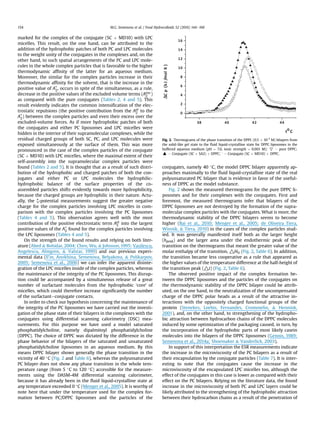
Fig. 2 shows the measured thermograms for the pure DPPC li-
posomes and for their complexes with the conjugates. First and
foremost, the measured thermograms infer that bilayers of the
DPPC liposomes are not destroyed by the formation of the supra-
molecular complex particles with the conjugates. What is more, the
thermodynamic stability of the DPPC bilayers seems to become
higher (Bai et al., 2010; Menger et al., 2005; de Oliveira Tiera,
Winnik,  Tiera, 2010) in the cases of the complex particles stud-
ied. It was generally manifested itself both as the larger height
(hpeak) and the larger area under the endothermic peak of the
transition on the thermograms that meant the greater value of the
molar enthalpy of the transition, △Htr (Fig. 2, Table 6). In addition,
the transition became less cooperative as a rule that appeared as
the higher values of the temperature difference at the half-height of
the transition peak (△t) (Fig. 2, Table 6).
The observed positive impact of the complex formation be-
tween the DPPC liposomes and the particles of the conjugates on
the thermodynamic stability of the DPPC bilayer could be attrib-
uted, on the one hand, to the neutralization of the uncompensated
charge of the DPPC polar heads as a result of the attractive in-
teractions with the oppositely charged functional groups of the
protein (Stenekes, Loebis, Fernandes, Crommelin,  Hennink,
2001), and, on the other hand, to strengthening of the hydropho-
bic attraction between hydrocarbon chains of the DPPC molecules
induced by some optimization of the packaging caused, in turn, by
the incorporation of the hydrophobic parts of most likely casein
molecules into the bilayers of the DPPC liposomes (Gennis, 1989;
Semenova et al., 2014a; Shoemaker  Vanderlick, 2003).
In support of this interpretation the ESR measurements indicate
the increase in the microviscosity of the PC bilayers as a result of
their encapsulation by the conjugate particles (Table 7). It is inter-
esting to note that the conjugates cause the increase in the
microviscosity of the encapsulated LPC micelles too, although the
effect of the conjugates in this case is lower as compared with their
effect on the PC bilayers. Relying on the literature data, the found
increase in the microviscosity of both PC and LPC layers could be
likely attributed to the strengthening of the hydrophobic attraction
between their hydrocarbon chains as a result of the penetration of
Fig. 2. Thermograms of the phase transition of the DPPC (0.5 Â 10-3
M) bilayers from
the solid-like gel state to the fluid liquid-crystalline state for DPPC liposomes in the
buffered aqueous medium (pH ¼ 7.0, ionic strength ¼ 0.001 M): 7 À pure DPPC;
: À Conjugate (SC þ SA2) þ DPPC; ^ À Conjugate (SC þ MD10) þ DPPC.
M.G. Semenova et al. / Food Hydrocolloids 52 (2016) 144e160154
most likely protein functional groups into the lipid layers (Wassall
et al., 2004). In the case of LPC micelles, their probable reorgani-
zation within the complex particles can be accompanied by the
new cluster formation within the interior of the complex nano-
particles that facilitates the attraction between LPC hydrocarbon
chains (Abed  Bohidar, 2004; Chen et al., 1995; Semenova 
Dickinson, 2010, chap. 6; Vasilescu et al., 1999).
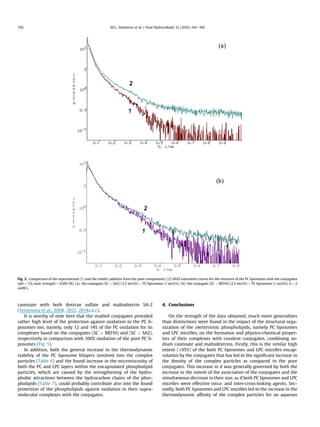
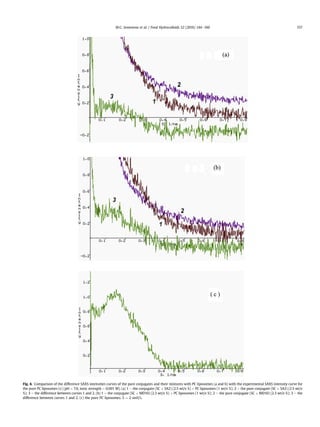
Moreover, in the case of the PC liposomes, SAXS data show,
firstly, the deviation of the experimental SAXS intensity profiles of
the complexes (conjugate þ PC) from the model (additive from the
pure components) ones (Fig. 3) that could be attributed to the in-
teractions between PC liposomes and the conjugates. Secondly, the
difference SAXS intensity profiles, derived from the SAXS intensity
curves measured for both the pure conjugates and the complexes
(conjugate þ PC), are distinctive for the profile of the bilayers of the
pure PC liposomes (Fig. 4). It is likely that this result supports
qualitatively our assumption on the maintenance of the bilayers of
PC liposomes in the complexes with the conjugates.
In addition, the SAXS intensity curves gave the values of the
averaged radii of the structural elements of the studied supra-
molecular particles. For the pure conjugates, they are 4.3e4.7 nm
and 3.9 nm for the (SC þ SA2) and (SC þ MD10), respectively. As
this takes place, the conjugate (SC þ MD10) was found to be less
polydispersed. These values are rather close to the structural
protein elements of the casein supramolecular particles (“nano-
clusters”) that are distributed quite homogeneously within them
and have a radius of about 3 nm (de Kruif, Huppertz, Urban, 
Petukhov, 2012). In the case of the complexes, the radii of their
structural elements, determined from the SAXS intensity curves
after exclusion of their initial rise, were equal to 4.6 nm and
3.8 nm for the complexes of PC with the conjugates (SC þ SA2) and
(SC þ MD10), respectively. This result indicates likely the main-
tenance of the main internal structure of the conjugates in the
complexes with the PC liposomes. The found additional initial rise
of the SAXS intensities for the complexes, as compared with the
SAXS intensity profiles of the pure conjugates, could be attributed
to the formation of a minor amount of larger structural elements
formed as a result of the interactions between the PC liposomes
and the conjugates. However, it is clear that in order to gain a
more penetrating insight into the internal structure of both PC
liposomes and LPC micelles within the interior of the complex
particles the further measurements and additional theoretical
calculations are required.
The comparison of the measured both structural and thermo-
dynamic parameters of the complex particles with those of the
pure conjugates allow visualizing the formed complexes by the
schematic representation based on the dual binding model of the
casein micelles suggested by Horne (1998) (Tables 2, 4 and 5).
On the basis of the data obtained (Tables 4e6) we have tried to
reveal the key generic relationships between these parameters and
such important functionality of the complex particles as their
ability to protect the encapsulated polyunsaturated phospholipids
against oxidation, that was one of the most important requirements
to the delivery nanovehicles for such easily both oxidized and
degradable nutraceuticals.
3.5. Structural and thermodynamic properties providing the
protection against oxidation to both the PC liposomes and LPC
micelles in their supramolecular complex particles with the
conjugates (SC þ MD)
The extent of the oxidation of both PC liposomes and LPC mi-
celles encapsulated by the conjugates relative to the oxidation of
their pure forms, which was taken as 100%, was estimated by the
quantitative measurements of one of the final products of the
peroxidation and degradation of polyunsaturated lipids, namely,
malonic dialdehyde (MDA) (Gutteridge,1977), which was formed in
the solutions of the complexes after their preliminary heating (for
1 h at 60 C) and storage for 14 days at a room temperature in the
presence of the low concentration of the Cu2þ
ions (10À5
M),
accelerating the oxidation of the polyunsaturated phospholipids
studied.
The lowest extent of the oxidation (Fig. 5) was found for the
LPC micelles involved into the complex particles with both
(SC þ SA2) and (SC þ MD10) conjugates having the highest density
and the extent of the biopolymer association (appeared as the
increase in the Mw of the complexes as compared with the Mw of
the pure conjugates) under the complex formation with LPC mi-
celles, respectively (Tables 2, 4 and 5). As this takes place the more
compact architecture of the complex particles of the conjugate
(SC þ MD10) with LPC micelles (r ¼ 1.7), as compared with the
more asymmetrical and open architecture of the complex particles
combining conjugate (SC þ SA2) with LPC micelles (r ¼ 2.0),
seems to be favourable to the protective ability of the complex
particles against oxidation relative to the encapsulated
phospholipids.
The highest protective ability of the complex particles involving
LPC micelles could be attributed to the probability that the rela-
tively higher values of both their density and the extent of the as-
sociation under the complex formation could hinder more
effectively the diffusion of small molecules such as oxygen to the
unsaturated hydrocarbon chains of the phospholipid, which are in
the interior of the complex particles. The general importance of
these structural parameters of the complex particles for their
protective ability against oxidation for the unsaturated phospho-
lipids could also be supported by the experimental data obtained
for the complex particles formed in an aqueous medium between
soy PC liposomes and such biopolymers as sodium caseinate, both
b-casein and aS-casein associates, as well as complexes of sodium
Table 6
Thermodynamic parameters of the phase transition from the solid-like gel state to the fluid liquid-crystalline state for the DPPC bilayers in a pure form and in the complexes
with the covalent conjugates (SC þ MD) at the maltodextrin to the protein weight ratio Rweight ¼ 2 in the aqueous medium (pH ¼ 7.0, ionic strength of the buffer ¼ 0.001 M).
Sample ttr (
C) Dt(
C) hpeak(conventional units) DHtr(kJ/molDPPC)
DPPC 41.2 1.3 10.4 18.8
Conjugate (SC þ SA2) þ DPPC 41.2 1.4 15.6 29.3
Conjugate (SC þ MD10) þ DPPC 41.6 1.7 12.3 27.5
Table 7
Effect of the encapsulation of the phospholipids by the conjugates (1 wt/v %) on the
microviscosity of the lipid layers of the PC liposomes (0.156 wt/v %) and LPC micelles
(0.102 wt/v %) (pH ¼ 7.0, ionic strength of the buffer ¼ 0.001 M).
Sample tС Â 1010
s ± effecta
(%) ±
PC (control) 10.1 0.20 0.0 0.0
PC þ Conjugate (SC þ SA2) 13.8 0.03 þ36.6 0.1
PC þ Conjugate (SC þ MD10) 12.9 0.50 þ27.7 4.8
LPC (control) 13.4 0.14 0.0 0.0
LPC þ Conjugate (SC þ SA2) 16.0 0.14 þ19.4 0.9
LPC þ Conjugate (SC þ MD10) 15.2 0.48 þ13.4 3.5
a
effect ¼ ½ðt
complex
C À tcontrol
C Þ=tcontrol
C Š Â 100.
M.G. Semenova et al. / Food Hydrocolloids 52 (2016) 144e160 155
caseinate with both dextran sulfate and maltodextrin SA-2
(Semenova et al., 2008, 2012, 2014a,b,c).
It is worthy of note here that the studied conjugates provided
rather high level of the protection against oxidation to the PC li-
posomes too, namely, only 12 and 14% of the PC oxidation for its
complexes based on the conjugates (SC þ MD10) and (SC þ SA2),
respectively in comparison with 100% oxidation of the pure PC li-
posomes (Fig. 5).
In addition, both the general increase in the thermodynamic
stability of the PC liposome bilayers involved into the complex
particles (Table 6) and the found increase in the microviscosity of
both the PC and LPC layers within the encapsulated phospholipid
particles, which are caused by the strengthening of the hydro-
phobic attractions between the hydrocarbon chains of the phos-
pholipids (Table 7), could probably contribute also into the found
protection of the phospholipids against oxidation in their supra-
molecular complexes with the conjugates.
4. Conclusions
On the strength of the data obtained, much more generalities
than distinctions were found in the impact of the structural orga-
nization of the zwitterionic phospholipids, namely PC liposomes
and LPC micelles, on the formation and physico-chemical proper-
ties of their complexes with covalent conjugates, combining so-
dium caseinate and maltodextrins. Firstly, this is the similar high
extent (95%) of the both PC liposomes and LPC micelles encap-
sulation by the conjugates that has led to the significant increase in
the density of the complex particles as compared to the pure
conjugates. This increase in d was generally governed by both the
increase in the extent of the association of the conjugates and the
simultaneous decrease in their size, as if both PC liposomes and LPC
micelles were effective intra- and inter-cross-linking agents. Sec-
ondly, both PC liposomes and LPC micelles led to the increase in the
thermodynamic affinity of the complex particles for an aqueous
Fig. 3. Comparison of the experimental (1) and the model (additive from the pure components) (2) SAXS intensities curves for the mixtures of the PC liposomes with the conjugates
(pH ¼ 7.0, ionic strength ¼ 0.001 M). (a): the conjugate (SC þ SA2) (2.5 wt/v%) þ PC liposomes (1 wt/v%); (b): the conjugate (SC þ MD10) (2.3 wt/v%) þ PC liposomes (1 wt/v%). S ¼ 2
sinQ/l.
M.G. Semenova et al. / Food Hydrocolloids 52 (2016) 144e160156
Fig. 4. Comparison of the difference SAXS intensities curves of the pure conjugates and their mixtures with PC liposomes (a and b) with the experimental SAXS intensity curve for
the pure PC liposomes (c) (pH ¼ 7.0, ionic strength ¼ 0.001 M). (a) 1 e the conjugate (SC þ SA2) (2.5 wt/v %) þ PC liposomes (1 wt/v %); 2 e the pure conjugate (SC þ SA2) (2.5 wt/v
%); 3 e the difference between curves 1 and 2. (b) 1 e the conjugate (SC þ MD10) (2.3 wt/v %) þ PC liposomes (1 wt/v %); 2 e the pure conjugate (SC þ MD10) (2.3 wt/v %); 3 e the
difference between curves 1 and 2. (c) the pure PC liposomes. S ¼ 2 sinq/l.
M.G. Semenova et al. / Food Hydrocolloids 52 (2016) 144e160 157
medium, in which the contribution of the electrostatic repulsions
between the complex particles played the governing role. Thirdly,
the formation of such complex particles provided the good pro-
tection against oxidation to both phospholipids.
In turn, the main distinction between the studied impact of the
structural organization of the PC liposomes and LPS micelles was
found to be in the greater impact of the LPC micelles on the
revealed changes of the physico-chemical properties of the formed
complex particles in comparison with those of the pure conjugates.
Based on the combined DSC, ERS and SAXS measurements that
provided support for the maintenance of the integrity of the PC
liposomes in the interior of the complex particles, it can be
assumed that the revealed more pronounced impact of the LPC
micelles can be attributed, by contrast, to their apparent disinte-
gration inside of the complex particles accompanied by the new
cluster formation, involving the LPC molecules, within the complex
particles. Such disintegration may be also accompanied by a
simultaneous release of a great number of LPC molecules from the
hydrophobic ‘core’ of the micelles, which could therefore increase
significantly the number of both the LPC e conjugate hydrophobic
contacts and the exposure of the great amount of the LPC polar
“heads” at the surface of the complex particles.
Hence the achieved more penetrating insight into the structural
and thermodynamic features of the formed complex particles of-
fers further ways in a molecular design of the delivery systems for
nutraceuticals, in particular based on the covalent conjugates and
the phospholipids.
Acknowledgements
This project was financially supported by the Russian Science
Foundation (Grant N 14-16-00102). We would like also to express
our gratitude to the AVEBE for the free supply of the maltodextrins
for this work. A. V. Krivandin and V.V. Kasparov were supported
financially by the Federal Agency of the Scientific organizations in
their kind assistance in conducting measurements using X-ray
diffractometer and ESR spectrometer in the IBCP Centre of the
collective use of the scientific equipment, respectively.
References
Abed, M. A.,  Bohidar, H. B. (2004). Gelatin alpha olefin sulfonate interactions
studied by dynamic light scattering. International Journal of Biological Macro-
molecules, 34, 49e54.
Acosta, E. (2009). Bioavailability of nanoparticles in nutrient and nutraceutical
delivery. Current Opinion in Colloid and Interface Science, 14, 3e5.
Antunes, F. E., Marques, E. F., Miguel, M. G.,  Lindman, B. (2009). Polymer-vesicle
association. Advances in Colloid and Interface Science, 147e148, 18e35.
Augustin, M. A.,  Hemar, Y. (2009). Nano- and micro-structured assemblies for
encapsulation of food ingredients. Chemical Society Reviews, 38, 902e912.
Bai, G., Nichifor, M.,  Bastos, M. (2010). Association and phase behaviour of cholic
acid-modified dextran and phosphatidylcholine liposomes. Journal of Physical
Chemistry Letters, 1(6), 932e936.
Burchard, W. (1994). Light scattering. In S. B. Ross-Murphy (Ed.), Physical techniques
for the study of food biopolymers (pp. 151e214). Glasgow: Blackie (Chapter 4).
Chen, H., Weiss, J.,  Shahidi. (2006). Nanotechnology in nutraceuticals and func-
tional foods. Food Technology, 60(3), 30e36.
Chen, A., Wu, D.,  Johnson, C. S. (1995). Determination of the binding isotherm and
size of the bovine serum albuminesodium dodecyl sulphate complex by
diffusion-ordered 2D NMR. Journal of Physical Chemistry, 99, 828e834.
Dickinson, E. (2014). Understanding food structures: the colloid science approach.
In M. Boland, M. Golding,  H. Singh (Eds.), Food structures, digestion and health
(pp. 3e49). London: Elsevier Academic Press (Chapter 1).
Dickinson, E., Semenova, M. G.,  Antipova, A. S. (1998). Salt stability of casein
emulsions. Food Hydrocolloids, 12, 227e235.
Dietary Guidelines for Americans. (2010). U.S. department of health and human
services PHS. Food and Drug Administration. http://health.gov/
dietaryguidelines/2010.asp#reports.
Esmaili, M., Ghaffari, M. S., Moosavi-Movahedi, Z., Atri, M. S., Sharifizadeh, A.,
Farhadi, M., et al. (2011). Beta casein-micelle as a nano vehicle for solubility
enhancement of curcumin; food industry application. LWT Food Science and
Technology, 44, 2166e2172.
Fernandez, J., Perez-Alvarez, J. A.,  Fernandez-Lopez, J. A. (1997). Thiobarbituric
acid test for monitoring lipid oxidation in meat. Food Chemistry, 59(3), 345e353.
Fu, J.,  Huang, B. (2001). Involvement of antioxidants and lipid peroxidation in the
adaptation of two cool-season grasses to localizad drought stress. Environ-
mental and Experimental Botany, 45, 105e114.
Gennis, R. B. (1989). Biomembranes: molecular structure and function. In
C. R. Cantor (Ed.), Advanced texts in chemistry. Berlin: Springer.
Gibis, M., Rahn, N.,  Weiss, J. (2013). Physical and oxidative stability of uncoated
and chitosan-coated liposomes containing grape seed extract. Pharmaceutics, 5,
421e433.
Gibis, M., Zeeb, B.,  Weiss, J. (2014). Formation, characterization, and stability of
encapsulated hibiscus extract in multilayered liposomes. Food Hydrocolloids, 38,
28e39.
Grigorovich, N. V., Moiseenko, D. V., Antipova, A. S., Anokhina, M. S., Belyakova, L. E.,
Polikarpov, Yu N., et al. (2012). Structural and thermodynamic features of co-
valent conjugates of sodium caseinate with maltodextrins underlying their
functionality. Food and Function, 3, 283e289.
Gutteridge, J. M. (1977). The measurement of malondialdehyde in peroxidised
oxbrain phospholipid liposomes. Analytical Biochemistry, 82(1), 76e82.
Gutteridge, J. M.,  Tickner, T. R. (1978). The thiobarbituric acid-reactivity of bile
pigments. Biochemical Medicine, 19, 127e132.
Harkema, Ir J. (1998). Paselli SA2 and paselli excel. In J. M. Dalzell (Ed.), Ingredients
handbook. Fat substitutes (pp. 103e133). Surrey: Leatherhead Food RA.
Hasni, I., Bourassa, P., Hamdani, S., Samson, G., Carpentier, R.,  Tajmir-Riahi, H. A.
(2011). Interaction of milk a- and b-caseins with tea polyphenols. Food Chem-
istry, 126, 630e639.
Heath, R. L.,  Packer, L. (1968). Photoperoxidation in isolated chloroplasts: I. Ki-
netics and stoichiometry of fatty acid peroxidation. Archives of Biochemistry and
Biophysics, 125, 189e198.
Horne, D. S. (1998). Casein interactions: casting light on the black boxes, the
structure in dairy products. International Dairy Journal, 8, 171e177.
Horne, D. S. (2002). Casein structure, self-assembly and gelation. Current Opinion in
Colloid and Interface Science, 7, 456e461.
Horn, D.,  Rieger, J. (2001). Organic nanoparticles in the aqueous phase d theory,
experiment, and use. Angewandte Chemie, International Edition, 40, 4330e4361.
Il’in, M. M., Anokhina, M. S., Semenova, M. G., Belyakova, L. E.,  Polikarpov, Yu N.
(2005). Calorimetric study of the interactions between small-molecule surfac-
tants and sodium caseinate with reference to the surface activity of their binary
mixtures. Food Hydrocolloids, 19, 441e453.
Ioan, C. E., Aberle, T.,  Burchard, W. (2000). Structure properties of dextran. 2.
Dilute solution. Macromolecules, 33, 5730e5739.
Istarova, T. A., Semenova, M. G., Sorokoumova, G. M., Selishcheva, A. A.,
Belyakova, L. E., Polikarpov, Yu N., et al. (2005). Effect of pH on the interactions
of sodium caseinate with soy phospholipids in relation to the foaming ability of
their mixtures. Food Hydrocolloids, 19, 429e440.
Jakobs, D. S., Kasten, B. L., Jr., Demmott, W. R.,  Wolfson, W. L. (1990). Laboratory
test handbook (2nd ed.). Baltimore: Williams  Wilkins.
Fig. 5. Relationship between the extent of the oxidation (%) of the PC liposomes and
LPC micelles in their complexes with the conjugates (the oxidation of the pure PC li-
posomes and LPC micelles was taken as 100%) and both the density, d, and the ar-
chitecture of the complex particles expressed by the values of r: 1 e conjugate
(SC þ MD10) þ LPC; 2 e conjugate (SC þ SA2) þ LPC; 3 e conjugate (SC þ MD10) þ PC;
4 e conjugate (SC þ SA2) þ PC.
M.G. Semenova et al. / Food Hydrocolloids 52 (2016) 144e160158
Kajiwara, K.,  Burchard, W. (1984). Rotational isomeric state calculations of the
dynamic structure factor and related properties of some linear chains. 1. The
r ¼ (S2)1/2(RH-1) parameter. Macromolecules, 17, 2669e2673.
de Kruif, C. G., Huppertz, T., Urban, V. S.,  Petukhov, A. V. (2012). Casein micelles
and their internal structure. Advances in Colloid and Interface Science, 171À172,
36e52.
de Kruif, C. G., Tuinier, R., Holt, C., Timmins, P. A.,  Rollema, H. S. (2002). Physi-
cochemical study of k- and b-casein dispersions and the effect of cross-linking
by transglutam-inase. Langmuir, 18, 4885e4891.
Kunz, D., Thurn, A.,  Burchard, W. (1983). Dynamic light scattering from spherical
particles. Colloid  Polymer Science, 261, 635e644.
Kwon, T. W., Menzel, D. B.,  Olcott, H. S. (1965). Reactivity of malonaldehide with
food constituents. Journal of Food Science, 30, 808e813.
Leclerc, E.,  Calmettes, P. (1997). Interactions in micellar solutions of b-casein.
Physical Review Letters, 78, 150e153.
Lee, S. J.,  Ying, D. Y. (2008). Encapsulation of fish oils. In N. Garti (Ed.), Delivery and
controlled release of bioactives in foods and nutraceuticals (pp. 370e403). Cam-
bridge: CRC Press (Chapter 15).
Leser, M. E., Sagalowicz, L., Michel, M.,  Watzke, H. J. (2006). Self-assembly of polar
food lipids. Advances in Colloid and Interface Science, 123, 125e136.
Liu, W. L., Ye, A. Q., Liu, W., Liu, C. M.,  Singh, H. (2013). Liposomes as food in-
gredients and nutraceutical delivery systems. Agro Food Industry Hi-Tech, 24(2),
68e71.
Livney, Y. D. (2008). Complexes and conjugates of biopolymers for delivery of
bioactive ingredients via food. In N. Garti (Ed.), Delivery and controlled release of
bioactives in foods and nutraceuticals (pp. 234e250). Cambridge: CRC Press
(Chapter 9).
Livney, Y. D. (2010). Milk proteins as vehicles for bioactives. Current Opinion in
Colloid and Interface Science, 15, 73e83.
Lucey, J. A. (2002). Formation and physical properties of milk protein gels. Journal of
Dairy Science, 85, 281e294.
Lu, Q., Li, D. C.,  Jiang, J. G. (2011b). Preparation of a tea polyphenol nanoliposome
system and its physicochemical properties. Journal of Agricultural and Food
Chemistry, 59(24), 13004e13011.
Lu, F. S. H., Nielsen, N. S., Timm-Heinrich, M.,  Jacobsen, C. (2011a). Oxidative
stability of marine phospholipids in the liposomal form and their applications.
Lipids, 46(1), 3e23.
Maherani, B., Arab-Tehrany, E., Mozafari, M. R., Gaiani, C.,  Linder, M. (2011). Li-
posomes: a review of manufacturing techniques and targeting strategies. Cur-
rent Nanoscience, 7(3), 436e452.
Manson, W., Carolan, T.,  Annan, W. D. (1977). Bovine as0-casein; a phosphorylated
homologue of asl-casein. European Journal of Biochemistry, 78, 411e417.
Markman, G.,  Livney, Y. D. (2012). Maillard-conjugate based coreeshell co-
assemblies for nanoencapsulation of hydrophobic nutraceuticals in clear bev-
erages. Food and Function, 3, 262e270.
Mayer, S., Weiss, J.,  McClements, D. J. (2013). Behavior of vitamin E acetate de-
livery systems under simulated gastrointestinal conditions: lipid digestion and
bioaccessibility of low-energy nanoemulsions. Journal of Colloid and Interface
Science, 404, 215e222.
McClements, D. J. (2014). Nanoparticle- and microparticle-based delivery systems:
encapsulation, protection and release of active compounds. New York: CRC Press
Taylor and Francis Group.
McClements, D. J.,  Decker, E. A. (2000). Lipid oxidation in oil-in-water emulsions:
Impact of molecular environment on chemical reactions in heterogeneous food
systems. Journal of Food Science, 65(8), 1270e1282.
Medina, C., Santos-Martinez, M. J., Radomski, A., Corrigan, O. I.,  Radomski, M. W.
(2007). Nanoparticles: pharmacological and toxicological significance. British
Journal of Pharmacology, 150, 552e558.
Menendez-Aguirre, O., Kessler, A., Stuetz, W., Grune, T., Weiss, J.,  Hinrichs, J.
(2014). Increased loading of vitamin D2 in reassembled casein micelles with
temperature-modulated high pressure treatment. Food Research International,
64, 74e80.
Menger, F. M., Chlebowski, M. E., Galloway, A. L., Lu, H., Seredyuk, V. A., Sorrells, J. L.,
et al. (2005). A tribute to the phospholipid. Langmuir, 21, 10336e10341.
Michalski, M. C., Genot, C., Gayet, C., Lopez, C., Fine, F., Joffre, F., et al. (2013).
Multiscale structures of lipids in foods as parameters affecting fatty acid
bioavailability and lipid metabolism. Progress in Lipid Research, 52, 354e373.
Mozafari, M. R., Johnson, C., Hatziantoniou, S.,  Demetzos, C. (2008). Nano-
liposomes and their applications in food nanotechnology. Journal of Liposome
Research, 18(4), 309e327.
Nagasawa, M.,  Takahashi, A. (1972). Light scattering from polyelectrolyte solu-
tions. In M. B. Huglin (Ed.), Light scattering from polymer solutions (pp. 671e723).
London: Academic Press.
de Oliveira Tiera, V. A., Winnik, F. M.,  Tiera, M. J. (2010). Interaction of amphiphilic
derivatives of chitosan with DPPC (1,2-dipalmitoyl-sn-glycero-3-
phosphocholine). Journal of Thermal Analysis and Calorimetry, 100, 309e313.
O'Regan, J.,  Mulvihill, D. M. (2009). Preparation, characterization and selected
functional properties of sodium caseinateemaltodextrin conjugates. Food
Chemistry, 115, 1257e1267.
Phang, M.,  Garg, M. (2014). Combined phytosterol and fish oil therapy for lipid
lowering and cardiovascular health. In M. Boland, M. Golding,  H. Singh (Eds.),
Food structures, digestion and health (pp. 437e463). London: Elsevier Academic
Press (Chapter 16).
Rahimi, Y. S.,  Corredig, M. (2012). Heating of milk alters the binding of curcumin
to casein micelles. A fluorescence spectroscopy study. Food Chemistry, 132,
1143e1149.
Ransley, J. K., Donnelly, J. K.,  Read, N. W. (Eds.). (2001). Food and nutritional
supplements: Their role in health and disease. Berlin, Heidelberg: Springer-Verlag.
Sahu, A., Kasoju, N.,  Bora, U. (2008). Fluorescence study of the curcumin-casein
micelle complexation and its application as a drug nanocarrier to cancer
cells. Biomacromolecules, 9, 2905e2912.
Salminen, H., Aulbach, S., Leuenberger, B. H., Tedeschi, C.,  Weiss, J. (2014). Influ-
ence of surfactant composition on physical and oxidative stability of Quillaja
saponin-stabilized lipid particles with encapsulated -3fish oil. Colloids and
Surfaces B: Biointerfaces, 122, 46e55.
Schmidt, D. G. (1982). Association of caseins and casein micelle structure. In P. F. Fox
(Ed.), Developments in dairy chemistry -1 (pp. 61e86). London: Applied Science.
Schulz, M., Olubummo, A.,  Binder, W. H. (2012). Beyond the lipid-bilayer: inter-
action of polymers and nanoparticles with membranes. Soft Matter, 8,
4849e4864.
Semenova, M. G., Anokhina, M. S., Antipova, A. S., Belyakova, L. E.,  Polikarpov, Yu
N. (2014b). Effect of calcium ions on both the co-assembly of as-casein with soy
phosphatidylcholine and the novel functionality of their complex particles.
Food Hydrocolloids, 34, 22e33.
Semenova, M. G., Antipova, A. S., Anokhina, M. S., Belyakova, L. E., Polikarpov, Yu N.,
Grigorovich, N. V., et al. (2012). Thermodynamic and structural insight into the
underlying mechanisms of the phosphatidylcholine liposome-casein associates
co-assembly and functionality. Food and Function, 3(3), 271e282.
Semenova, M. G., Antipova, A. S., Belyakova, L. E., Polikarpov, Yu N., Anokhina, M. S.,
Grigorovich, N. V., et al. (2014a). Structural and thermodynamic properties
underlying the novel functionality of sodium caseinate as delivery nanovehicle
for biologically active lipids. Food Hydrocolloids, 42, 149e161.
Semenova, M. G., Belyakova, L. E., Polikarpov, Yu N., Antipova, A. S., 
Anokhina, M. S. (2008). Utilization of sodium caseinate nanoparticles as mo-
lecular nanocontainers for delivery of bioactive lipids to food systems: rela-
tionship to the retention and controlled release of phospholipids in the
simulated digestion conditions. In P. A.Williams,  G. O. Phillips (Eds.), Gums
and stabilisers for the food industry 14 (pp. 326e333). Cambridge, UK: The Royal
Society of Chemistry. part 4.
Semenova, M. G., Belyakova, L. E., Polikarpov, Yu N., Antipova, A. S.,  Dickinson, E.
(2009). Light scattering study of sodium caseinate þ dextran sulfate in aqueous
solution: relationship to emulsion stability. Food Hydrocolloids, 23(3), 629e639.
Semenova, M. G., Belyakova, L. E., Polikarpov, Yu N., Il’in, M. M., Istarova, T. A., 
Anokhina, M. S. (2006). Thermodynamic analysis of the impact of the
surfactant-protein interactions on the molecular parameters and surface
behavior of food proteins. Biomacromolecules, 7, 101e113.
Semenova, M. G.,  Dickinson, E. (2010). Biopolymers in food colloids: thermody-
namics and molecular interactions (pp. 3e114). Leiden: Brill, 155e231.
Semenova, M. G., Moiseenko, D. V., Grigorovich, N. V., Anokhina, M. S.,
Antipova, A. S., Belyakova, L. E., et al. (2014c). Protein À polysaccharide in-
teractions and digestion of the complex particles. In M. Boland, M. Golding, 
H. Singh (Eds.), Food structures, digestion and health (pp. 169e192). London:
Elsevier Academic Press (Chapter 6).
Semo, E., Kesselman, E., Danino, D.,  Livney, Y. D. (2007). Casein micelle as a natural
nano-capsular vehicle for nutraceuticals. Food Hydrocolloids, 21, 936e942.
Shapira, A., Assaraf, Y. G., Epstein, D.,  Livney, Y. D. (2010). Beta-casein nano-
particles as an oral delivery system for chemotherapeutic drugs: Impact of drug
structure and properties on co-assembly. Pharmaceutical Research, 27(10),
2175e2186.
Shaw, L. A., Faraji, H., Aoki, T., Djordjevic, D., McClements, D. J.,  Decker, E. A.
(2008). Emulsion droplet interfacial engineering to deliver bioactive lipids into
functional foods. In N. Garti (Ed.), Delivery and controlled release of bioactives in
foods and nutraceuticals (pp. 184e206). Cambridge: CRC Press (Chapter 7).
Shepherd, R., Robertson, A.,  Ofman, D. (2000). Dairy glycoconjugate emulsifiers:
casein-maltodextrins. Food Hydrocolloids, 14(4), 281e286.
Shoemaker, S. D.,  Vanderlick, T. K. (2003). Calcium modulates the mechanical
properties of anionic phospholipid membranes. Journal of Colloid and Interface
Science, 266, 314e321.
Singh, H., Thompson, A., Liu, W.,  Corredig, M. (2012). Liposomes as food in-
gredients and nutraceutical delivery systems. In N. Garti,  D. J. McClements
(Eds.), Encapsulation technologies and delivery systems for food ingredients and
nutraceuticals (pp. 287e318). Oxford: Woodhead Publishing (Chapter 11).
Stenekes, R. J. H., Loebis, A. E., Fernandes, C. M., Crommelin, D. J. A.,  Hennink, W. E.
(2001). Degradable dextran microspheres for the controlled release of lipo-
somes. International Journal of Pharmaceutics, 214, 17e20.
Str€omstedt, A. A., Ringstad, L., Schmidtchen, A.,  Malmsten, M. (2010). Interaction
between amphiphilic peptides and phospholipid membranes. Current Opinion
in Colloid  Interface Science, 15, 467e478.
Swaisgood, H. E. (2003). Chemistry of the caseins. In P. F. Fox,  P. L. H. McSweeney
(Eds.) (3rd ed.,Advanced dairy chemistry: vol. 1. Proteins (pp. 139e202). New
York: Kluwer Academic/Plenum.
Tamjidi, F., Shahedi, M., Varshosaz, J.,  Nasirpour, A. (2013). Nanostructured lipid
carriers (NLC): a potential delivery system for bioactive food molecules. Inno-
vative Food Science and Emerging Technologies, 19, 29e43.
Tanford, C. (1961). Physical chemistry of macromolecules. New York: John Wiley and
Sons.
Taylor, T. M., Davidson, P. M., Bruce, B. D.,  Weiss, J. (2005). Liposomal nano-
capsules in food science and agriculture. Critical Reviews in Food Science and
Nutrition, 45(7e8), 587e605.
Thurn, A., Burchard, W.,  Niki, R. (1987a). Structure of casein micelles. I. Small
M.G. Semenova et al. / Food Hydrocolloids 52 (2016) 144e160 159
angle neutron scattering and light scattering from b- and k-casein. Colloid and
Polymer Science, 265(8), 653e666.
Thurn, A., Burchard, W.,  Niki, R. (1987b). Structure of casein micelles. II. as1-
casein. Colloid and Polymer Science, 265(8), 897e902.
Torchilin, V. P. (2007). Micellar nanocarriers: pharmaceutical perspectives. Phar-
maceutical Research, 24(1), 1e16.
Tuteja, A., Mackay, M. E., Hawker, C. J., Van Horn, B.,  Ho, D. L. (2006). Molecular
architecture and rheological characterization of novel intramolecularly cross-
linked polystyrene nanoparticles. Journal of Polymer Science: Part B: Polymer
Physics, 44, 1930e1947.
Vasilescu, M., Angelescu, D., Almgren, M.,  Valstar, A. (1999). Interactions of
globular proteins with surfactants studied with fluorescence probe methods.
Langmuir, 15, 2635e2643.
Velikov, K. P.,  Pelan, E. (2008). Colloidal delivery systems for micronutrients and
nutraceuticals. Soft Matter, 4(10), 1964e1980.
Waraho, T., McClements, D. J.,  Decker, E. A. (2011). Mechanisms of lipid oxidation
in food dispersions. Trends in Food Science and Technology, 22(1), 3e13.
Wassall, S. R., Caffrey, M., Cherezov, V., Bizustowics, M. R., Shaikh, C. R., 
Stillwell, W. (2004). Order from disorder, corralling cholesterol with chaotic
lipids. The role of polyunsaturated lipids in membrane raft formation. Chemistry
and Physics of Lipids, 132, 79e88.
Wells, I. D. (1984). The transformation of virial equation for polymer solutions
between different concentration scales. Chemica Scripta, 23, 202e204.
M.G. Semenova et al. / Food Hydrocolloids 52 (2016) 144e160160
All in-text references underlined in blue are linked to publications on ResearchGate, letting you access and read them immediately.

Paper_Food_Hydrocolloids_RSF_1

  • 1.
    Impact of thestructure of polyunsaturated soy phospholipids on the structural parameters and functionality of their complexes with covalent conjugates combining sodium caseinate with maltodextrins M.G. Semenova* , D.V. Zelikina, A.S. Antipova, E.I. Martirosova, N.V. Grigorovich, R.A. Obushaeva, E.A. Shumilina, N.S. Ozerova, N.P. Palmina, E.L. Maltseva, V.V. Kasparov, N.G. Bogdanova, A.V. Krivandin N. M. Emanuel Institute of Biochemical Physics of Russian Academy of Sciences, Kosygin str., 4, 119334 Moscow, Russian Federation a r t i c l e i n f o Article history: Received 18 February 2015 Received in revised form 15 June 2015 Accepted 16 June 2015 Available online 24 June 2015 Keywords: Polyunsaturated phospholipids Sodium caseinate Maltodextrins Covalent conjugates Structural properties Protection against oxidation a b s t r a c t A number of structural (the weight-average molar weight, Mw; the radius of gyration, RG; the hydro- dynamic radius, Rh; the structure-sensitive parameter, r ¼ RG/Rh; the density, d; the intrinsic viscosity, [h]; the z-potential), and thermodynamic (the second virial coefficient, A2, reflecting the nature and intensity of both the biopolymerebiopolymer and biopolymeresolvent pair interactions; the molar enthalpy of the bilayer phase transition, △Htr) parameters have been measured for the complex particles formed between covalent conjugates of sodium caseinate (SC) with maltodextrins (MD) (dextrose equivalent (DE) ¼ 2 and 10, Rweight ¼ MD: SC ¼ 2) and either liposomes of soy phosphatidylcholine (PC) or micelles of soy lysophosphatidylcholine (LPC) in an aqueous medium (pH ¼ 7.0, I ¼ 0.001 M). The high extent (>95%) of the encapsulation of both PC and LPC by the conjugates was found that led to the formation of the highly soluble complex particles, having both essentially higher density and thermo- dynamic affinity for an aqueous medium, as compared with the pure conjugates. LPC behaved as more effective both inter- and intra-molecular cross-linking agent for the conjugate particles as compared with PC. The data of the differential scanning calorimetry, electron spin resonance spectroscopy and small angle X-ray scattering testified the maintenance of the PC bilayers under the formation of the complex particles. The conjugates provided rather high level of the protection against oxidation to both PC and LPC. The lowest extent of the oxidation of the phospholipids in the complexes was found for the LPC micelles. © 2015 Elsevier Ltd. All rights reserved. 1. Introduction The development of smart nano-sized natural delivery systems for biologically active compounds, containing prophylactic and therapeutic agents for the improvement of human health (so-called nutraceuticals), has aroused considerable interest under the novel functional food formulation nowadays (Dickinson, 2014, chap. 1; McClements, 2014; Semenova & Dickinson, 2010, chaps. 1-3). The plant (a-Linolenic acid (ALA) 6-3, linoleic acid (LA) u-6) and fish (6-3: eicosapentaenoic acid (EPA) and docosahexaenoic acid (DHA)) polyunsaturated fatty acids (PUFAs) are one of the most important and essential biologically active compounds, which the human body cannot synthesize from other food components, which is recognized to be significant for preserving health (Lee & Ying, 2008, chap. 15; McClements, 2014; Phang & Garg, 2014, chap. 16). The need for a balanced supply in both 6-3 and 6-6 polyunsaturated fatty acids is now supported by dietary guidelines (Dietary Guidelines for Americans, 2010; McClements, 2014; Michalski et al., 2013). These essential PUFAs are building blocks of a huge diversity of more complex natural molecules such as triacylglycerols and phospholipids, themselves organized in various supramolecular structures that could be generally natural delivery systems for PUFAs (McClements, 2014; Phang & Garg, 2014, chap. 16). Recent advance in nutrition research revealed that the supramolecular arrangements of the lipid molecules and their physico-chemical properties in a food matrix can modulate PUFAs release and* Corresponding author. E-mail address: mariagersem@mail.ru (M.G. Semenova). Contents lists available at ScienceDirect Food Hydrocolloids journal homepage: www.elsevier.com/locate/foodhyd http://dx.doi.org/10.1016/j.foodhyd.2015.06.011 0268-005X/© 2015 Elsevier Ltd. All rights reserved. Food Hydrocolloids 52 (2016) 144e160
  • 2.
    bioavailability during digestionand their final metabolic fate, significantly modifying their health impact (McClements, 2014; Michalski et al., 2013; Shaw et al., 2008, chap. 7; Tamjidi, Shahedi, Varshosaz, & Nasirpour, 2013). In particular, liposomes and micelles of polyunsaturated phospholipids attracted significant interest not only as the sources of the essential PUFAs, but also as potential carriers for different kinds of both water-soluble and water-insoluble nutraceuticals (Gibis, Rahn, & Weiss, 2013; Gibis, Zeeb, & Weiss, 2014; Leser, Sagalowicz, Michel, & Watzke, 2006; Liu, Ye, Liu, Liu, & Singh, 2013; Lu, Li, & Jiang, 2011; Lu, Nielsen, Timm-Heinrich, & Jacobsen, 2011; Maherani, Arab-Tehrany, Mozafari, Gaiani, & Linder, 2011; McClements, 2014; McClements & Decker, 2000; Mozafari, Johnson, Hatziantoniou, & Demetzos, 2008; Singh, Thompson, Liu, & Corredig, 2012, chap. 11; Taylor, Davidson, Bruce, & Weiss, 2005; Torchilin, 2007; Velikov & Pelan, 2008). However, currently their high susceptibility to oxidative degradation during product preparation, transport, and storage as well as low solubility in water (in the case of liposomes) or in aqueous body fluids, in addition, possible both leakage and un- controllable release of the involved nutraceuticals, pose a real challenge for their use (McClements, 2014; Semenova & Dickinson, 2010, chaps. 1-3). One of the general ways of improving the chemical stability of these bioactive lipids is their encapsulation within colloidal de- livery systems that inhibit their oxidative degradation (Gibis et al., 2013; Mayer, Weiss, & McClements, 2013; McClements, 2014; McClements & Decker, 2000; Salminen, Aulbach, Leuenberger, Tedeschi, & Weiss, 2014; Waraho, McClements, & Decker, 2011). In particular, to date it is well shown that biomacromolecules present a great potential in such encapsulation due to mainly their generally amphipilic nature that, on the one hand, provides surface activity to the biomacromolecules and, on the other hand, underlies their susceptibility to self-assembly and co-assembly with different in nature compounds in an aqueous medium (Gibis et al., 2013; Livney, 2008, chap. 9; McClements, 2014; Menendez-Aguirre et al., 2014; Semenova, Anokhina, Antipova, Belyakova, Polikarpov, 2014b; Semenova, Belyakova, Polikarpov, Antipova, Anokhina, 2008; Semenova Dickinson, 2010, chaps. 1-3; Semenova et al.,2012, 2014a). For example, by now, the predicted novel functional ability of casein molecules/associates to behave as delivery nanovehicles for hydrophobic nutraceuticals has been distinctly demonstrated for: (i) polyphenols (Esmaili et al., 2011; Hasni et al., 2011; Rahimi Corredig, 2012; Sahu, Kasoju, Bora, 2008); (ii) a vitamin (D2) (Semo, Kesselman, Danino, Livney, 2007); (iii) a polyunsaturated soy phosphatidylcholine (Semenova Dickinson, 2010, chaps. 1-3; Semenova et al.,2006, 2008, 2012, 2014a,b); and (iv) for the chemotherapeutic drugs (Sahu et al., 2008; Shapira, Assaraf, Epstein, Livney, 2010), under the elabo- ration of non-saturated fat or low-saturated fat functional food products (Livney, 2010; Semenova Dickinson, 2010, chaps.1-3). In addition, the promising abilities of nano-sized (sodium caseinate (SC) þ maltodextrin (MD)) covalent conjugates as delivery vehicles for hydrophobic nutraceuticals were also clearly demonstrated (Grigorovich et al., 2012; Markman Livney, 2012; Semenova et al., 2014c, chap. 6). Both the high protection against oxidation for the nutraceuticals studied (phosphatidylcholine (PC) (Semenova et al., 2014c, chap. 6); vitamin D and epigallocatechin gallate (Markman Livney, 2012)) and their high solubility in the wide range of pH (including the protein isoelectric point) in the complexes with the conjugates in an aqueous medium were revealed. Moreover, it was shown that the covalent conjugation of the maltodextrins to the protein can be used in order to control the release of PC under the action of the gastric and intestinal enzymes in the simulated con- ditions of the gastro-intestinal (GI) tract in-vitro (Semenova et al., 2014c, chap. 6). The nanoscale dimensions of biomacromolecule-based nano- vehicles, which are typical of biopolymer molecules/associates, can offer additional advantages, because, as was suggested by Acosta (Acosta, 2009), the size of the delivery systems, especially below 500 nm, has enabled the promise of tackling problems of low oral bioavailability or inefficient delivery of poorly water-soluble nutraceuticals/drugs. This is a consequence of the enhancements based on the following factors (Acosta, 2009; Semenova Dickinson, 2010, chaps. 1-3): (i) the apparent solubility of the active ingredients; (ii) the rate of mass transfer; (iii) the gastro- intestinal retention time in the mucus covering the intestinal epithelium; (iv) the rate of release (due to large surface area); and (v) the direct uptake of particles by the intestinal epithelium (Augustin Hemar, 2009; Chen, Weiss, Shahidi, 2006; Horn Rieger, 2001; Medina, Santos-Martinez, Radomski, Corrigan, Radomski, 2007). Despite the almost exponential increase in the research activ- ities in the area of the elaboration of the smart nanoparticle de- livery systems for micronutrients and nutraceuticals during the past decade (Augustin Hemar, 2009; Dickinson, 2014, chap. 1; McClements, 2014; Ransley, Donnelly, Read, 2001; Semenova Dickinson, 2010, chaps. 1-3; Velikov Pelan, 2008) our under- standing of creating of the biopolymer-based nanovehicles with specific functional properties is still rather limited, and a more clear insight into both the structure e function relationships and the physico-chemical mechanisms underlying the nanovehicles for- mation is required to design functional biopolymer-based smart ones more systematically (Dickinson, 2014, chap. 1; McClements, 2014; Semenova Dickinson, 2010, chaps. 1-3). The present work is focused on the elucidation of the structural basis underlying the formation of the nano-sized complexes be- tween covalent conjugates (SC þ MD) and either liposomes of soy phosphatidylcholine (PC) or micelles of soy lysophosphatidylcho- line (LPC) in an aqueous medium, as well as on the ability of the conjugates to protect the polyunsaturated phospholipids against oxidation. In parallel, a more penetrating insight is sought into the generality and the differences in the impact of the specific structure of the PC liposomes and LPC micelles on both the molecular mechanisms of the formation of the complexes and their physico- chemical properties. Moreover, the estimation of the role of the extent of the maltodextrin polymerization, that is reflected by their dextrose equivalent (DE ¼ 2 and 10), in both the complex formation and the complex behavior was also one of the objectives of our investigation. 2. Materials and methods 2.1. Materials The sample of sodium caseinate was purchased from Sigma (New Zealand) and used as received. The samples of maltodextrins Paselli SA-2 and MD-10 were kindly supplied by AVEBE (Netherlands) and used as received. These maltodextrins were prepared by the enzy- matic hydrolysis of a potato starch and had the DE ¼ 2 (SA2) and 10 (MD10). The molar masses of the individual molecules of malto- dextrins SA-2 and MD-10 are 9 kDa and 1.8 kDa, respectively (Harkema, 1998). Phosphatidylcholine Lipoid S 100 and Lysophos- phatidylcholine Lipoid LPC were purchased from Lipoid GmbH, Germany (PC: phospholipids [g/100 g]: phosphatidylcholine (by anhydrous weight) ¼ 94; N-acyl-phosphatidylethanolamine ¼ 0.5; phosphatidylethanolamine ¼ 0.1; phosphatidylinositol ¼ 0.1; lyso- phosphatidylcholine ¼ 3.0. Nonpolar lipids [g/100 g]: triglycerides ¼ 2.0; free fatty acids ¼ 0.5; DL-a-tocopherol ¼ 0.15 ÷ 0.25. Typical fatty acid composition in % to total fatty acids: palmitic acid ¼ 12 ÷ 17; stearic acid ¼ 2 ÷ 5; oleic acid ¼ 11 ÷ 15; linoleic acid M.G. Semenova et al. / Food Hydrocolloids 52 (2016) 144e160 145
  • 3.
    (u-6) ¼ 59÷ 70; linolenic acid (u-3) ¼ 3 ÷ 7). LPC was produced from soybean lecithin by phospholipase A2. LPC: phospholipids [g/100 g]: lysophosphatidylcholine ¼ 98.0; phosphatidylcholine ¼ 0.2; phosphatidylethanolamine ¼ 0.1; un- identified components ¼ 0.5; triglycerides ¼ 1.0; free fatty acids ¼ 0.3; DL-a- tocopherol ¼ 0.1÷0.2. Typical fatty acid compo- sition in % to total fatty acids: palmitic acid ¼ 24 ÷ 28; stearic acid ¼ 4 ÷ 7; oleic acid ¼ 15 ÷ 17; linoleic acid (u-6) ¼ 44 ÷ 48; linolenic acid (u-3) ¼ 1). DL-a-phosphatidylcholine dipalmitoyl (DPPC) (Sigma (USA), P-5911, synthetic and 99% of purity) was used as a model phospholipid for the differential scanning calorimetry (DSC) measurements. The phosphate buffer solutions were pre- pared using the analytical grade reagents (Laverna, Russia) (99.9% of purity). They were filtered through a Millipore membrane (nominal pore size ¼ 0.2 mm) to remove dust. The pH was adjusted with HCl/NaOH. Analytically grade (99.9% of purity) sodium azide (Laverna, Russia) (0.02 wt/v %) was added to the buffers as an anti- microbial agent. Analytically grade ethanol (95.6% of purity) was used for the PC dissolution. Analytically grade (99.5% of purity) CuSO4 was used for the purpose of the acceleration of both the PC and LPC oxidation (Laverna, Russia). Analytically grade (99.5% of purity) trichloroacetic acid and 2-thiobarbituric acid (TBA) (Lav- erna, Russia) were used in the TBA test for the oxidation mea- surements of the phospholipids. Reagents of SENTINEL DIAGNOSTICS (Italy) were used for the direct enzymatic- colorimetric determinations of the phospholipids. All solutions were prepared using a double-distilled water. 2.2. Preparation of the aqueous solutions of the protein, maltodextrins, and their covalent conjugates Solutions of the protein (SC), the maltodextrins (MD (either SA- 2 or MD10)), and the conjugates (SC þ MD (either SA2 or MD10) with required concentrations were prepared using a double- edistilled water and a phosphate buffer (pH ¼ 7.0, ionic strength of the buffer ¼ 0.001 M). In addition, both the maltodextrin and conjugate's solutions were heated at 85 C for 5 min and thereafter allowed to be cooled for the room temperature. Centrifugation (4000 rpm, 30 min, at 20 C) of the all biopolymer solutions was carried out to remove a small fraction of an insoluble material. The concentration of the protein, the maltodextrins, and the conjugates in the solutions after centrifugation was checked using a refrac- tometer (Shimadzu, Japan), with reference to the determined pre- vious values of the protein, maltodextrin, and conjugate's refractive indexes, n, equalled, within the 10% experimental error, to 0.20 Â 10À3 m3 /kg, 0.15 Â 10À3 m3 /kg, and 0.17 Â 10À3 m3 /kg, respectively. Besides, in order to control the concentration of the biopolymers defined by the refractometric method we have addi- tionally checked it by drying the biopolymer solutions up to the constant weight and using the appropriate buffer as the blank sample. Mixed (SC þ SA2) and (SC þ MD10) aqueous solutions for the formation of the conjugates, having the weight ratio of the maltodextrins to the protein (Rweight ¼ 2), were prepared from the individual biopolymer solutions. 2.3. Preparation of the covalent conjugates (sodium caseinate þ maltodextrins) (SC þ MD (either SA-2 or MD10)) conjugates were prepared according to the method described in the work (Shepherd, Robertson, Ofman, 2000). The lyophilized mixed (SC þ MD (either SA-2 or MD10)) solutions were heated at 60С in a controlled humidity environment (79% relative humidity) for 72 h. It was previously shown that the chosen duration of heating under the mentioned above environmental conditions was enough for achieving of the excellent solubility, emulsification activity and stability of the covalent (SC þ MD) conjugates even at pH ¼ 4.8, i.e., about the protein isoelectric point (pI) (O'Regan Mulvihill, 2009; Shepherd et al., 2000). 2.4. Estimation of the covalent binding between the sodium caseinate and maltodextrins in the conjugates The extent of the covalent binding between the SC and malto- dextrins was estimated according to O'Regan and Mulvihill (2009) using the trinitrobenzenesulphonate method (TNBS). The calibra- tion curve was constructed using the pure lysine stock solution (2.7 Â 10À4 M) by measuring the absorbance of the resultant yellow solutions at 340 nm using a bi-distillated water treated blank as a reference. The concentration of the available amino groups in both pure SC and (SC þ MD) conjugates was measured by reference to the lysine standard curve. The change in the concentration of available amino groups in the (SC þ MD) conjugates relative to the unreacted SC (assumed representing 100% of available amino groups) was calculated per gram of soluble protein (determined by the Biuret Protein Assay) and expressed as a percentage loss of available amino groups compared to SC. Thereafter the average number of the loss of the available originally lysine groups per average casein molecules (24,000 Da) (Semenova Dickinson, 2010, chaps. 1-3; Swaisgood, 2003) was calculated. As this took place, both the primary sequences of amino acids in the individual caseins (13 lysine residues (Lys) for aS1-casein; 21 Lys for aS2- casein; 12 Lys for b-casein; and 9 Lys for k-casein) (Manson, Carolan, Annan, 1977; Swaisgood, 2003) and their proportions in SC (38% aS1-casein, 10% aS2-casein, 36% b-casein and 13% k- casein) (Manson et al., 1977) were taken into account under the calculation of the originally present available lysine groups: 0.38 (13) þ 0.10 (21) þ 0.36 (12) þ 0.13 (9) ¼ 12.53. 2.5. Preparation of both PC and DPPC liposomes as well as LPC micelles The required amount of PC was dissolved in the pure ethanol. The aqueous solutions of both PC (10-3 M, containing 10 v/v % of ethanol), LPC (10-3 M) and DPPC (10-3 M) were prepared under mixing and shaking for an hour of the PC solution in ethanol, and both LPC and DPPC in a dry state, with an appropriate amount of the pure buffer solution, respectively. The LPC critical micelle concen- tration (CMC), determined by static light scattering (See the Section 2.8.), was equal to 10-3 M under the experimental conditions used (рН ¼ 7.0, ionic strength of the buffer ¼ 0.001 M, t ¼ 25 C and 40 C). In order to remove ethanol from the PC solutions we have used the equilibrium dialysis (Visking Dialysis Tubing (Type 36/32), Serva; the ratio of the volumes of the outer vessel to the inner one equalled to 20, the duration time of the dialysis was 24 h) against a pure phosphate buffer (pH ¼ 7.0, ionic strength ¼ 0.001 M). Pre- liminary estimation showed no transmission of the PC molecules through the dialysing tubes. The residual amount of ethanol in the PC containing solutions was equal to 0.5 v/v %. 2.6. Formation of the complex particles (covalent conjugates þ phospholipids) The buffered solutions of the conjugates with the required concentration were mixed and shaken with the solutions of the phospholipids (in the pure ethanol for PC and in the buffered aqueous medium for DPPC and LPC) at 40 C for an hour in order to get mixed solutions, containing finally 10 v/v % of ethanol in the case of PC, and where the ultimate concentrations of the compo- nents were the following: 1.0 wt/v % of SC, 2.0 wt/v% of MD (either M.G. Semenova et al. / Food Hydrocolloids 52 (2016) 144e160146
  • 4.
    SA-2 or MD10),10-3 M of PC, 0.5 Â 10-3 M for DPPC and 10-3 M of LPC. In order to remove ethanol from the solutions containing PC we have used the equilibrium dialysis (Visking Dialysis Tubing (Type 36/32), Serva; the ratio of the volumes of the outer vessel to the inner one equalled to 20, the duration time of the dialysis was 24 h) against a pure phosphate buffer (pH ¼ 7.0, ionic strength ¼ 0.001 M). The residual amount of ethanol in the PC containing solutions was equal to 0.5 v/v %. 2.7. Estimation of the extent of the binding of the phospholipids (PC and LPC) by the covalent conjugates In the case of PC, the method of the estimation of the extent of the PC binding by the conjugates was based on the separation of the free PC from the aqueous solutions of its complexes with the con- jugates by the extraction with a diethyl ether: an aliquot of 5 ml of the tested sample solution was placed into a glass vial and then a diethyl ether (3 ml) was added. The two-layer mixture was shaken and aged 24 h in a cool place (~7 C). Thereafter, the organic layer was separated and the concentration of PC in this extract was determined using Beckman (DU-70, USA) spectrophotometer by measuring the optical density of the extracts against the pure diethyl ether, as a blank, at a wavelength of 215 nm. The measured optical density was used in order to calculate the concentration of a free and a bound PC in the tested sample. Prior to these experi- ments, the calibration curve was constructed by plotting the optical density values for the diethyl ether extracts of PC from the buffered aqueous solutions (without the conjugates) against the known PC concentrations in these solutions. The results presented in this work are the average of at least of the three independent experi- ments. The estimated experimental error was not higher than 10%. In turn, to determine the amount of LPC encapsulated by the conjugates, we have used salting-out of the conjugates with the encapsulated LPC by the 4 M ammonium sulfate that was followed by their precipitation using the centrifugation (4000 rpm, 30 min, at 20 C). Thereafter the supernatant and precipitate were sepa- rated and both the free LPC and the LPC encapsulated by the con- jugates were determined using the enzymatic method (Jakobs, Kasten, Demmott, Wolfson, 1990). The results presented in this work are the average of at least of the three independent experi- ments. The estimated experimental error was not higher than 5%. 2.8. A combination of the static and dynamic laser light scattering measurements The weight-average molar mass Mw, the radius of gyration RG, and the second virial coefficient A2 for SC and the conjugates (SC þ MD) alone as well as for the complexes of the conjugates with the phospholipids were measured by a static laser light scattering in the dust-free dilute aqueous solutions (with 5e8 concentration points at most). The Rayleigh ratio RQ at each concentration point was measured using a vertically polarized light (633 nm) at angles in the range 40 Q 140 (13 angles) using an LS-01 apparatus (Scientific Instruments, St. Petersburg, Russia) calibrated with a dust-free benzene (R90 ¼ 11.84 Â 10À6 cm-1 ). Solutions were filtered directly into the light scattering cell through a Millipore membrane with a pore size of 0.8 mm. This allowed us to include within our measurement nearly the whole studied samples without any sig- nificant loss (5% at most), as indicated by checking the biopolymer concentration of the samples in the solutions before and after filtration by the refractometric method, using known values of the refractive index increments. The raw data were used to plot the angular and the concentration dependencies of the ratio (HC/DRQ)1/ 2 according to the Berry method (Burchard, 1994, chap. 4; Semenova Dickinson, 2010, chap. 5). The experimental error in the Mw, RG and A2 determination, which was estimated on the basis of not less than 2 experimental repetitions, did not exceeded 10%. It is worthy of note here that the values of the refractive index increments, measured by a differential refractometer (Shimadzu, Japan) at l ¼ 633 nm, for the complex particles of the conjugates with both PC and LPC were not different from the ones inherent for the pure conjugate particles within the experimental error (±10%): ncomplex ¼ 0.17 Â 10À3 m3 kgÀ1 . Values of the hydrodynamic radius Rh of the pure PC liposomes, LPC micelles, SC, conjugates (SC þ MD), and the complex particles of the conjugates with the phospholipids were estimated in the buffered aqueous solutions by a dynamic laser light scattering. The time correlation function of the scattering intensity was measured at Q ¼ 90 with a vertically polarized light (l ¼ 633 nm) using an LS-01 apparatus (Scientific Instruments, St Petersburg, Russia). To determine the hydrodynamic radius from the time correlation function, a special program was used (DYNALS Release 1.5, all rights reserved by A. Golding and N. Sidorenko). The experimental error in the Rh determination, which was estimated on the basis of not less than 10 experimental repetitions, did not exceeded 10%. The light scattering measurements were carried out at 25 C. Based on the light scattering data the following parameters have been determined: À the architecture of the particles of the pure SC, the pure con- jugates, and the complexes of the conjugates with the phos- pholipids has been characterized by the values of the ratio RG/Rh (the structural factor r), the utility of which in distinguishing among different architectures of both individual macromole- cules and their aggregates has been proven by many light scattering experiments (Ioan, Aberle, Burchard, 2000; Kajiwara Burchard, 1984; Kunz, Thurn, Burchard, 1983; Tuteja, Mackay, Hawker, Van Horn, Ho, 2006); À the density of the studied particles has been calculated using the following equation (Tanford, 1961): d ¼ Mw=ðNAVÞ; (1) where Mw is the weight-averaged molar mass of a particle; NA is the Avogadro's number; V is the volume of the particle that is approximated by the sphere, the volume of which V ¼ 4/3pR3 G, where RG is the radius of gyration of the particle; À the second virial coefficient was expressed in the different units: weight, A2, and molal, A* 2 where A* 2 ¼ 2 A2 M2 W/1000 (Wells, 1984). The advantage of a static light scattering over some other methods of determining the second virial coefficient is the capability to measure both thermodynamic (A2) and structural parameters (Mw, RG) in a single experiment. This advantage provides us with the possibility to estimate the contributions from the excluded volume effects, Aexc 2 , to the pair interactions between biopolymer particles in an aqueous solution (Nagasawa Takahashi, 1972; Semenova Dickinson, 2010, chaps. 1-3, 5; Tanford, 1961). The repulsive ‘steric/excluded volume’ interactions arose from the highly thermodynamically unfavorable overlap of full electron clouds leading to the re- striction in the occupation of the same volume in solution by two different particles. Thus, both the size and the shape of the biopolymer particles, as determined by both their macromo- lecular conformation/flexibility and their ultimate architecture, are of the prime importance to the excluded volume repulsive interactions (Semenova Dickinson, 2010, chaps. 1-3, 5). In turn, the difference between measured AÃ 2 and Aexc 2 allows an M.G. Semenova et al. / Food Hydrocolloids 52 (2016) 144e160 147
  • 5.
    estimation of thetotal contributions from the other kinds of the interactions (electrostatic (Ael 2 ), hydrogen bonding (A h=b 2 ) and hydrophobic (Ah 2)) as follows: A* 2 À Aexc 2 ¼ Ael 2 þ A h=b 2 þ Ah 2 (2) For the spherical particles found generally in our experiments (1 r 2) (See Tables 2, 4 and 5) we have used the simplest case of the interacting solid spheres and the following equation for the calculation of the Aexc 2 (Tanford, 1961): Aexc 2 ¼ 10À3 4pNA . 3 ð2RÞ3 (3) The parameter R in the Equation (3) is the radius of the equiv- alent hard sphere representing the biopolymer particle. The equivalent hard sphere corresponds to the space occupied in the aqueous medium by a single biopolymer particle, which is completely inaccessible to both other biopolymer particles and solvent molecules. In our calculations we have used the Rh as the radius of the equivalent hard sphere. The critical micelle concentration (CMC) of the LPC was deter- mined by measuring the intensity of the scattering light (I90) for the LPC aqueous solutions having the LPC concentration in the range (10À7 M ÷ 10-1 M), using an LS-01 apparatus (Scientific Instruments, St. Petersburg, Russia). The sharp increase in the I90 was referred to the CMC. 2.9. The viscosimetry in diluted solutions The intrinsic viscosity, [h], of the buffered aqueous solutions of a pure SC, the conjugates (SC þ MD), and their complexes with the phospholipids was measured at 25 C using an Ubbelohde viscometer having the capillary diameter ¼ 0.54 mm. The experi- mental error in the [h] determination, which was estimated on the basis of not less than 2 experimental repetitions, did not exceeded 15%. 2.10. The z-potential measurements Electrophoretic mobilities of the biopolymer samples: a pure SC, the conjugates (SC þ MD), and their complexes with the phos- pholipids were determined with a Zetasizer Nano ZS Malvern (UK) calibrated against a standard latex dispersion. The experimental error in the z-potential determination, which was estimated on the basis of not less than 10 experimental repetitions, did not exceeded 10%. 2.11. DSC measurements DSC measurements of the inherent phase transition for the DPPC liposome bilayers were performed by the high sensitivity differential scanning calorimetry using a DASM-4M model, Differ- ential Scanning Calorimeter (Pushino, Russia). The baseline ther- mogram was obtained using the appropriate buffer (0.5 ml) in all two cells including the reference cell to normalize cell to cell dif- ferences. The measurements were carried out in the temperature range from 10 to 110 C at the constant pressure 2.5 atm. The heating scan rate was maintained at 0.5 C/min for the all experi- ments. The thermograms for the investigated samples were ob- tained by subtracting the respective baseline thermogram from the sample thermogram using the software provided by the manu- facturer. The peak position in the plot of the “excess heat capacity”, DCp, versus temperature on a heating scan was taken as the tem- perature, ttr, of the solid-like gel to the fluid liquid-crystalline phase transition for DPPC liposome bilayers in an aqueous medium. The thermodynamic parameters (ttr, Dt, hpeak), and function (DHtr) of the phase transition were also computed using the same software as reported. The experimental error in their determination, which was estimated on the basis of not less than 2 experimental repe- titions, did not exceeded 5%. 2.12. Electron spin resonance (ESR) study The structural state of both PC liposomes and LPC micelles in their pure form and in the complexes with the conjugates (1.0 wt/v % of the conjugates with either 2 Â 10-3 M of PC (0.156 wt/v %), or 2 Â 10-3 M of LPC (0.102 wt/v %)) was studied by the electron spin resonance spectroscopy at 25 C. ESR spectra were recorded on a Bruker EMX spectrometer (Germany). 16-doxylstearic acid radical (16-DSA, Sigma) was used as a spin probe. 16-DSA localizes in the hydrophobic region of the phospholipid particles at a depth of 20 Å of a lipid layer. The microviscosity of the phospholipid layers was estimated by the rotational correlation time (tс) of the 16-DSA using the equation for a fast motion of the nitroxyl radical: tс ¼ 6; 65$DНþ ffiffiffiffiffi Iþ IÀ s À 1 ! $10À10 ; (4) where △Hþ represents the resonance width of the low-field component, Iþ and IÀ are the resonance heights of the low and the high-field components of the ESR spectra, respectively. The experimental error of the method did not exceeded 2%. Both the calculation of the parameters and the correction of the ESR spectra were performed using the computer program Bruker WIN-EPR with the subprogram SYMFONIA. 2.13. Small-angle X-ray scattering (SAXS) The SAXS measurements were performed with an X-ray diffractometer of a local design at room temperature. The X-ray radiation from the fine focus Cu X-ray tube was Ni-filtered and focused with the glass mirror collimator. X-ray scattering patterns Table 1 The amount of maltodextrin molecules covalently attached to the individual mass-averaged casein molecule (24 kDa) comprising original sodium caseinate (SC) particles in an aqueous medium. Rweight Percent of the loss of the available amino groups of lysine in the SC Rm a The quantity of the maltodextrin molecules covalently bound to the individual averaged casein molecules The quantity of the free maltodextrin molecules Conjugate (SC þ SA2) 2 30 5 4 1 Conjugate (SC þ MD10) 2 45 27 6 21 a Under the calculation of the molar ratio Rm we have taken into account the molar masses of the individual molecules of maltodextrins (9 kDa and 1.8 kDa for the maltodextrins SA2 and MD10, respectively) (Harkema, 1998) and the individual mass-averaged casein molecules (24 kDa) (Swaisgood, 2003) comprising the original sodium caseinate particles. M.G. Semenova et al. / Food Hydrocolloids 52 (2016) 144e160148
  • 6.
    were recorded withthe gas-filled (85% Xe, 15% Me) one- dimensional position-sensitive detector with delay line readout constructed in JINR. Experimental curves were corrected for the background scattering and processed with PRIMUS and indirect Fourier transformation GNOM software. In order to get the values of the SAXS intensity, which could be enough for the accurate measurements, we have used the following concentrations for the conjugates (2.5 wt/v% and 2.3 wt/v% for the (SC þ SA2) and (SC þ MD10), respectively) and PC liposomes (1 wt/ v%) under their both individual and complex measurements. 2.14. Estimation of the conjugate ability to protect the phospholipids against oxidation in their complexes The degree of both PC and LPC oxidation in the tested samples was estimated by the quantitative measurements of the final product of the lipids peroxidation (malonic dialdehyde (MDA) (Gutteridge, 1977). The quantitative determination of MDA was carried out by the TBARS method (by the reaction of MDA with 2- thiobarbituric acid (TBA) in the presence of trichloroacetic acid) (Fernandez, Perez-Alvarez, Fernandez-Lopez, 1997; Fu Huang, 2001; Heath Packer, 1968; Kwon, Menzel, Olcott, 1965) by measuring the optical density (Beckman (Du-70) spectrophotom- eter, USA) of the colored TBA-MDA compounds at two different wave lengths in order to prevent the effect of any slight turbidity of the tested samples, namely, at l ¼ 532 (the maximum of the absorbance by the TBARS) (Gutteridge, 1977; Gutteridge Tickner, 1978; Fernandez et al., 1997; Kwon et al., 1965) and at l ¼ 580 (the minimum of the absorbance by the TBARS) (Gutteridge Tickner, 1978). The experimental error of the TBARS method, which was estimated on the basis of not less than 3 experimental repetitions, was equal to 15%. As this took place, we had used the general for such experiments the addition of the low concentration of Cu2 þ ions (10À5 M CuSO4) into the tested sample solutions in order to both accelerate of the PC, and LPC oxidation and to make the experimental work less time consuming. It was shown preliminarily that this concentration of Cu2 þ ions did not influence on the properties of the tested samples, but accelerated the PC and LPC oxidation essentially. In addition we have used heating of the tested samples at 60 C for 1 h. The con- centration of MDA was measured in the tested samples after 14 days of their storage at room temperature. 3. Results and discussion In order to gain a more penetrating insight into the generalities and distinctions in the impact of the different structures of the polyunsaturated phospholipids in an aqueous medium (a micellar form for soy lysophosphatidylcholine and a liposomal form for soy phosphatidylcholine) on the formation and functionality of their complexes with the covalent conjugates, let us characterize first both the structural and thermodynamic properties of the original covalent conjugates in an aquous medium. 3.1. Amount of maltodextrin molecules attached covalently to the individual casein molecules First and foremost, the determination of the quantity of maltodextrin molecules (Harkema,1998) attached covalently to the individual mass-averaged casein molecules (24 kDa) (Semenova Dickinson, 2010, chap. 6), involved into the sodium caseinate par- ticles (SC), was carried out. To accomplish this end, the measure- ment of the loss of the free amino groups of lysine in SC, as a result of the covalent binding with the maltodextrins, was performed. Table 1 shows that maltodextrin MD10, having the shorter Table2 Schematicrepresentationofthenanoscalestructuresandtheexperimentaldatarelatingtotheself-assemblyofboththepureindividualcaseinsintothesodiumcaseinate(SC)particlesandtheindividualcaseinsmodifiedbythe covalentattachmentofthemaltodextrins(eitherSA2orMD10)intotheparticlesofthecovalentconjugates(SCþSA2;SCþMD10)inabufferedaqueousmedium(pH¼7.0,ionicstrengthofthebuffer¼0.001M,25C). Conjugate(SCþSA2)SCConjugate(SCþMD10) SystemMw(kDa)A2Â105 (m3 molkgÀ2 )A* 2(m3 molÀ1 )Aexc 2(m3 molÀ1 )Ael 2þA h=b 2þAh 2(m3 molÀ1 )RG(nm)r¼RG/Rhd(mg/ml)1/[h](mg/ml)z-potential(mV) SC11,9304.412.423.6À11.21591.511.269À31.0 Conjugate(SCþSA2)60053.82.80.91.91251.751.244À22.0 Conjugate(SCþMD10)47063.10.62.6À2.01401.390.777À27.0 M.G. Semenova et al. / Food Hydrocolloids 52 (2016) 144e160 149
  • 7.
    molecular chain (DE¼ 10, 10 glucose units) as compared with maltodextrin SA2 (DE ¼ 2, 50 glucose units) (Harkema, 1998), is covalently bound in a greater amount (6 molecules MD10 as compared with 4 molecules SA2) to the individual mass-averaged casein molecules. This result could be attributed to the less steric hindrance for the further MD attachment, caused by the already bound shorter maltodextrin MD10 molecules. Moreover, as this took place, many molecules of the maltodextrin MD10, having the lower molar weight as compared with maltodextrin SA2, remained free at the equal weight ratio of MD to SC (Rweight ¼ 2) studied for both maltodextrins. 3.2. Molecular and thermodynamic properties of the pure covalent conjugates in comparison with those of sodium caseinate To attain this end a combination of static and dynamic multi- angle laser light scattering, which is a particularly useful tool for exploring the structure and interactions of both individual biopolymer molecules and their self-assembled and co-assembled particles in dilute solutions on length scales of the order of z1 mm and below, was used (Burchard, 1994, chap. 4; Semenova Dickinson, 2010, chaps.1-3). Various structural (the weight-average molar mass, Mw; the radius of gyration, RG; the hydrodynamic radius, Rh; the structure-sensitive parameter, r ¼ RG/Rh; the density, d), and thermodynamic (the second virial coefficient expressed in the different units: molal, A* 2, and, weight, A2, reflecting the nature and intensity of both the biopolymer À biopolymer and biopolymer À solvent pair interactions) parameters have been determined for both the pure protein and the covalent conjugates formed. The values of these parameters are shown in Table 2. In order to make the notion of the second virial coefficient more clear it is worthy of note here that the sign of A2 provides a simple indicator of the type of interactions present in a biopolymer solu- tion. Hence, a negative value of A2 indicates thermodynamically favourable biopolymer À biopolymer interactions in a solution (decrease in the magnitude of the excess chemical potential mE i of the biopolymer (i ¼ 2) in solution) À in other words a mutual biopolymer attraction. A negative A2 also indicates thermody- namically unfavourable biopolymer À solvent interactions (in- crease in the magnitude of mE i of the solvent (i ¼ 1) in the presence of the biopolymer in solution) À in other words a mutual repulsion. The exact opposite is the case for a positive value of the second virial coefficient (Semenova Dickinson, 2010, chaps. 1-3). It is vital to note also that a commercial sample of SC has generally a variable fraction composition and an aggregation state in an aqueous medium, depending on the origin, manufacturing and both storage and environmental conditions (Semenova, Belyakova, Polikarpov, Antipova, Dickinson, 2009; Semenova Dickinson, 2010, chaps. 1-3). For a detailed discussion on the frac- tional content of the SC see previously published work (Semenova et al., 2009). In addition, it was recently shown that an ultimate protein weight loss during the consecutive filtration through the membrane filters of different pore sizes (0.80 (Millipore), 0.22 mm (Millipore), and 0.03 mm (the membranes were made from Lavsan (Russian equivalent of Darcon)) was equal to 9.5% for the SC sample and only about 2 and 4% for the conjugates (SC þ SA2) at Rweight ¼ 2 and 0.4, respectively (Semenova et al., 2014c, chap. 6). As this weight loss of the samples took place, the size distributions showed only small-scale shifts towards smaller sizes of light-scattering biopolymer particles in the samples. By this means to avoid misunderstanding we stress that we have measured here always the structural (Mw, RG, Rh) and thermodynamic (A2, A* 2) parameters of the self-assembled and co-assembled supramolecular materials based on the unfractioned samples of the studied biopolymers. Owing to their amphiphilic character, the individual caseins (aS1, aS2, b and k), composing sodium caseinate, are prone to the pronounced self-assembly in an aqueous medium (Burchard, 1994, chap. 4; Dickinson, Semenova, Antipova, 1998; Horne, 1998; de Kruif, Tuinier, Holt, Timmins, Rollema, 2002; Leclerc Calmettes, 1997; Schmidt, 1982; Thurn, Burchard, Niki, 1987a,b) and the integrity of the mixed SC particles is viewed as being controlled by the balance between attractive and repulsive forces acting between the individual caseins, i.e., a localized excess of both hydrophobic attraction and hydrogen bonding over elec- trostatic repulsion (Horne, 1998, 2002; Lucey, 2002; Semenova Dickinson, 2010, chap. 6). In accordance with the determined by light scattering method weight averaged molar mass of sodium caseinate (Mw ¼ 11,930 kDa) about 497 molecules of the individual caseins (Mw ~ 24 kDa) form SC associated nano-sized particle (RG ¼ 159 nm) in an aqueous medium under the experimental conditions (pH ¼ 7.0, ionic strength of the phosphate buffer equals to 0.001 M). These data as well as a knowledge of the amount of maltodextrin molecules attached covalently to the individual mass-averaged casein molecules (Mw ~ 24 kDa) (Table 1), composing the sodium caseinate particle in an aqueous medium, allow calculating theoretically the hypothetic molar masses of the conjugates based on the assumption that all 497 molecules of the individual caseins modified by the covalent attachment of the maltodextrins are self-assembled into the single particle. Thus Table 3 shows that the experimental Mw of the conjugates are smaller than the calculated ones by a factor of 4.3 and 1.8 for the cases of (SC þ SA2) and (SC þ MD10), respectively. This result in- fers the inability of the individual casein molecules having the covalently attached maltodextrins to get the identical to the pure casein molecules level of the self-assembly in an aqueous medium. That could be attributable to the increase in their hydrophilicity, as a result of the maltodextrin attachment, and thus to the rise in their thermodynamic affinity for an aqueous medium. Really, Table 2 indicates the essential weakening of the attractive, most likely hydrophobic in nature, interactions between the ultimate Table 3 Weight e averaged molar masses of the covalent conjugates of sodium caseinate with maltodextrins measured by multiangle laser light scattering in the buffered aqueous medium (pH ¼ 7.0, ionic strength of the buffer ¼ 0.001 M) and calculated on the basis of the total amount of maltodextrins molecules attached to the original SC particles. Rweight Rm Calculated values: Mw ¼ wconjMconj þ wMD*M MD* Experimental values wconj wMD* (wconjMconj) Â 10À6 (Da) (wMD*M MD*) (Da) Mw(kDa) Mw(kDa) Conjugate (SC þ SA2) 2 5 0.87 0.13 29.82 1170 25,945 6005 Conjugate (SC þ MD10) 2 27 0.48 0.52 17.30 936 8305 4706 1 MD* is a free maltodextrin. 2 wconj and wMD* are the weight fractions of the conjugate and the free maltodextrin, respectively. 3 the Mconj is the calculated molar mass of the conjugates that rests on the assumption that the molar masses of the original SC particles, existing in the aqueous medium (Table 2) and composed by 497 molecules of the individual caseins, and of the covalently bound molecules of the maltodextrins (Table 1) are simply added together; the MMD* is the molar mass of the free maltodextrin. M.G. Semenova et al. / Food Hydrocolloids 52 (2016) 144e160150
  • 8.
    Table 5 Schematic representationof the nanoscale structures and the experimental data relating to the assembly of covalent conjugate (SC þ MD10) induced by the interactions of the conjugate with either PC liposomes or LPC micelles in an aqueous medium (pH ¼ 7.0, ionic strength of the buffer ¼ 0.001 M, 25 C). Conjugate (SC þ MD10) þ LPC LPC Conjugate (SC þ MD10) PC Conjugate (SC þ MD10) þ PC 1 2 3 4 System Mw (kDa) A2 Â 105 (m3 mol kgÀ2 ) A* 2 (m3 molÀ1 ) Aexc 2 (m3 molÀ1 ) Ael 2 þ A h=b 2 þ Ah 2 (m3 molÀ1 ) RG (nm) r ¼ RG/Rh d (mg/ml) 1/[h] (mg/ml) z-potential (mV) Conjugate (SC þ MD10) þ LPC 15,000 1.4 22.0 1.9 20.1 157 1.70 1.5 248 À26.4 Conjugate (SC þ MD10) þ PC 5900 1.6 1.1 0.5 0.6 114 1.98 1.6 83 À25.6 Table 4 Schematic representation of the nanoscale structures and the experimental data relating to the assembly of the covalent conjugate (SC þ SA2) induced by the interactions of the conjugate with either PC liposomes or LPC micelles in an aqueous medium (pH ¼ 7.0, ionic strength of the buffer ¼ 0.001 M, 25 C). Conjugate (SC þ SA2) þ LPC LPC Conjugate (SC þ SA2) PC Conjugate (SC þ SA2) þ PC System Mw (kDa) A2 Â 105 (m3 mol kgÀ2 ) A* 2 (m3 molÀ1 ) Aexc 2 (m3 molÀ1 ) Ael 2 þ A h=b 2 þ Ah 2 (m3 molÀ1 ) RG (nm) r ¼ RG/Rh d (mg/ml) 1/[h] (mg/ml) z-potential (mV) Conjugate (SC þ SA2) þ LPC 9400 2.4 4.3 0.44 3.9 109 2.0 2.9 86 À23.4 Conjugate (SC þ SA2) þ PC 6800 2.6 2.4 0.6 1.8 112 2.0 1.9 60 À22.8 M.G.Semenovaetal./FoodHydrocolloids52(2016)144e160151
  • 9.
    conjugate particles formedin an aqueous medium. It manifests itself as either less negative for the case of the conjugate (SC þ MD10) or, by contrast, positive for the conjugate (SC þ SA2) contributions of the additive term (Ael 2 þ A h=b 2 þ Ah 2) into the value of the A* 2 (Eq. (2)) as compared to the pure SC. It was also found that the lower is the molar mass of the studied biopolymer particles the poorer is their thermodynamic affinity for an aqueous medium, as if a greater amount of hydrophobic patches of the casein mole- cules, combined in the conjugates, become exposing into the aqueous medium, rather than are hidden in the interior of the particles. That is most pronounced in the case of the particles of the (SC þ MD10) conjugate. In addition, Table 2 shows that the formed conjugates have the smaller size (RG) as compared with the pure protein, keep both the spherical shape (1 r 2) and negative, but lower in the absolute value than the protein has the z-potential, which is reflecting the negative total charge of the particles. It is probable that such decrease in the absolute value of the z-potential is attributable to the partial protein charge neutralization as a result of the facilita- tion of the interactions between the opposite charges of the caseins under the new form of the self-assembly of casein molecules modified by the covalently attached maltodextrins. In turn, the densities d of the conjugate particles (Eq. (1)) have changed as a result of the decrease in both their molar mass, Mw, and size, RG. Hence, there is no alteration of the density value in the case of the conjugate (SC þ SA2) in comparison with that of the pure SC particles, and, in turn, there is an essential decrease in the d for the case of the conjugate (SC þ MD10) (from d ¼ 1.2 mg/ ml for SC to d ¼ 0.7 mg/ml for the conjugate). This result can be attributed to the largest decrease in the absolute value of Mw of the conjugate (SC þ MD10) particles, as compared with the pure SC, that does not followed by the same extent of the decrease in the RG value. In order to confirm the alteration of the structural and ther- modynamic parameters of the SC particles as a result of the conjugation with the maltodextrins, observed by light scattering method, we have measured the intrinsic viscosity [h] of both SC and the conjugates in diluted aqueous solutions (Table 2). The [h] is the most convenient parameter to this end because its value is sensitive to changes in the size, shape, and solvation of polymer particles (Tanford, 1961). Thus an easy comparison of the inverse values of the [h] obtained for both SC and the conjugate particles with the values of the densities of these biopolymer particles, calculated from the light scattering data (Eq. (1), Table 2), dem- onstrates a number of discrepancies in the trend of their alteration. We have found the same densities of the conjugate (SC þ SA2) and the SC particles in contrast to the 1.6 times decrease in the value of the 1/[h] for this conjugate in comparison to that of the pure protein. In turn, in the case of the conjugate (SC þ MD10), there is 1.8 times increase in the value of the 1/[h] against the 1.7 times decrease in the values of d as compared with those parameters of the pure SC particles. These discrepancies indicate that one should take into account that the value of [h] of the particles is controlled not only by their density d but also by their shape and degree of solvation (Tanford, 1961). In particular the solvation correlates with the thermodynamic affinity of the biopolymer particles for solvent. It is well known that the greater extent of the solvation of the particle as a whole leads to the increase in the value of [h] and hence to the decrease in its reciprocal value 1/[h] due to the retention of the solvent inside the biopolymer particle moving together with it. Such particle may be approximated by the equivalent solid sphere (Tanford, 1961). The protein particles seem to accord well with this approximation. On the contrary, if the thermodynamic quality of the solvent for the biopolymer particle is poorer, as was found for the conjugate (SC þ MD10) particles (the lowest positive values of both A2 and A* 2), for example, (Table 2), that is, when the solvent is not retained much by the biopolymer particle, the model of a more permeable for the sol- vent biopolymer particle may be more acceptable for the description of its hydrodynamic properties (Tanford, 1961). Hence, it may be proposed that the higher permeability of the conjugate (SC þ MD10) particles for the solvent is responsible for the lower value of the [h] and hence the higher value of the 1/[h] as compared to both the protein and the conjugate (SC þ SA2) par- ticles even though the value of d of the conjugate (SC þ MD10) particles is essentially lower (Table 2). In addition, with account taken of the contribution of the different shapes of polymer par- ticles to the value of [h], one may also provide an additional explanation for the discrepancies mentioned above. Thus, a more asymmetric shape of polymer particles (r 1) may be also responsible for a higher value of [h] and consequently for a lower value of its reciprocal value (Tanford, 1961). Really, the lowest value of 1/[h] was found for the more asymmetric particles of the conjugate (SC þ SA2) (r ¼ 1.75), having an intermediate thermo- dynamic affinity for the solvent, as compared with both the pro- tein and the conjugate (SC þ MD10) particles. The measured structural and thermodynamic parameters of both the pure protein and the conjugate particles allow visualizing them by the schematic representation based on the dual binding model of the casein ‘micelles’ as built up from the individual caseins (aS1, aS2, b and k) and suggested by Horne (1998) (Table 2). 3.3. Encapsulation ability of the covalent conjugates relatively the polyunsaturated phospholipids (PC and LPC) In order to get the conjugate-based delivery systems for the phospholipids the co-assembly of the conjugates (1 wt/v% of SC þ 2 wt/v% MD (either SA2 or MD10)) with both PC liposomes (10-3 M; 0.078 wt/v%) and LPC micelles (10-3 M; 0.051 wt/v%) was performed under pH ¼ 7.0, at the ionic strength of the phoshate buffer equalled to 0.001 M, and temperature (40 C). The high extent (95%) of the encapsulation of both PC lipo- somes and LPC micelles by the conjugates was observed in the aqueous medium for the weight ratio of the conjugates to the phospholipid particles used. Relying on both the literature (Antunes, Marques, Miguel, Lindman, 2009; Bai, Nichifor, Bastos, 2010; Schulz, Olubummo, Binder, 2012; Str€omstedt, Ringstad, Schmidtchen, Malmsten, 2010) and our experimental data (Istarova et al., 2005; Semenova et al., 2012, 2014a) we can suggest the contribution of the different kinds of the interactions (electrostatic attraction between opposite charges, hydrogen bonding and predominantly hydrophobic attraction) into the complex formation between the phospholipids and the conjugates. It is significant that, as this takes place, the formed complexes show the same high level of the solubility in an aqueous medium that is inherent to the pure covalent conjugates (Grigorovich et al., 2012). The appearance of the new peaks of the complex particles at the size distribution diagrams obtained by dynamic light scattering (Fig. 1) for the studied particles of pure PC liposomes, LPC micelles, conjugates, and their complexes, give an additional evidence of the involvement of both the conjugates and the phospholipid particles into the complex formation. The lower polydispersity in the size (more narrow size distributions) seems to be the common feature of the complex particles involving both PC liposomes and LPC mi- celles as compared with the polydispersity of the pure conjugates (Fig. 1). M.G. Semenova et al. / Food Hydrocolloids 52 (2016) 144e160152
  • 10.
    3.4. Comparison ofthe structural and thermodynamic parameters of the complex particles combining the covalent conjugates with either PC liposomes or LPC micelles Tables 4 and 5 show a comparison of the structural and ther- modynamic parameters of the complex particles based on the conjugates ((SC þ SA2) Table 4; (SC þ MD10) Table 5) and involving either PC liposomes or LPC micelles. From this comparison the generalities and distinctions in the impact of the structural orga- nization of the phospholipids (PC liposomes or LPC micelles) on the properties of the complex particles can be distinguished. Firstly, it is worthy of note here that the architecture of the random coil (1 r 2) is the general characteristic for the all complex particles formed (Tables 4 and 5). Secondly, the common similarity is the significant increase in the density d of the complex particles as compared to that of the pure conjugates (Table 2). This result could be generally attributed to both the decrease in the size (RG) of the complex particles accompanied with the simultaneous increase in their weight average molar masses (Mw) (Eq. (1), Tables 2, 4 and 5). In the case of the conjugate (SC þ MD10) the increase in the density of the complex particles involving micelles of LPC was predominantly caused by the greatest, namely threefold, increase in the Mw, since the slight 1.12 times increase in the RG was found in this case (Tables 2 and 5). It is vital to note here that both the greatest values of the density caused by either the most contraction of the complex particles, as in the case of the conjugate (SC þ SA2), (Tables 2 and 4) or the most increase in their Mw, as in the case of the conjugate (SC þ MD10) (Tables 2 and 5) were found as a result of the encapsulation of the LPC micelles. In support of the found increase in the density of the complex particles, as compared to that of the pure conjugates, the similar trend in the increase in the values of the reciprocal intrinsic vis- cosity 1/[h] was revealed for the all complexes (Tables 2, 4 and 5). This result indicates that the values of the intrinsic viscosity [h] of the complex particles are mainly controlled by their densities d. On the strength of these data it may be deduced that among the zwitterionic phospholipids studied the LPC micelles seem to act as more effective both inter- and intra-molecular cross-linking agents for the conjugate particles in an aqueous medium. The third common feature of the complex particles, including the conjugates with either PC liposomes or LPC micelles, is the general decrease in the values of their second virial coefficients A2 (in the weight units) characterizing the thermodynamic quality of the solvent for the weight unity of the complex particles, whereas there is the general rise in the positive values of their second virial coefficients A* 2 (in the molal units), reflecting the thermodynamic quality of the solvent for the complex particles as a whole (Semenova Dickinson, 2010, chaps. 1-3; Tanford, 1961). The exception is the case of the complexes of the conjugate (SC þ SA2) with PC liposomes. As this takes place the complex particles involving LPC micelles have the higher thermodynamic affinity for an aqueous medium (more positive value of A* 2) than the complexes of the conjugates with PC liposomes (Tables 4 and 5). That is most Fig. 1. The size distributions of the pure phospholipids (dot), pure conjugates (dash) and their complexes (solid) in the buffered aqueous medium (pH ¼ 7.0, ionic strength ¼ 0.001 M): for the system of the conjugate (SC þ SA2) with either LPC micelles (a) or PC liposomes (b); for the system of the conjugate (SC þ MD10) with either LPC micelles (c) or PC liposomes (d). M.G. Semenova et al. / Food Hydrocolloids 52 (2016) 144e160 153
  • 11.
    marked for thecomplex of the conjugate (SC þ MD10) with LPC micelles. This result, on the one hand, can be attributed to the addition of the hydrophobic patches of both PC and LPC molecules to the weight unity of the conjugates in the complexes and, on the other hand, to such spatial arrangements of the PC and LPC mole- cules in the whole complex particles that is favorable to the higher thermodynamic affinity of the latter for an aqueous medium. Moreover, the similar for the complex particles increase in their thermodynamic affinity for the solvent, that is the increase in the positive value of A* 2, occurs in spite of the simultaneous, as a rule, decrease in the positive values of the excluded volume terms (Aexc 2 ) as compared with the pure conjugates (Tables 2, 4 and 5). This result evidently indicates the common intensification of the elec- trostatic repulsions (the positive contribution from the Ael 2 to the A* 2) between the complex particles and even their excess over the excluded-volume forces. As if more hydrophobic patches of both the conjugates and either PC liposomes and LPC micelles were hidden in the interior of their supramolecular complexes, while the residual charged groups of both SC, PC, and LPC molecules were exposed simultaneously at the surface of them. This was more pronounced in the case of the complex particles of the conjugate (SC þ MD10) with LPC micelles, where the maximal extent of their self-assembly into the supramolecular complex particles were found (Tables 2 and 5). It is thought that as a result of such distri- bution of the hydrophobic and charged patches of both the con- jugates and either PC or LPC molecules the hydrophilic- hydrophobic balance of the surface properties of the co- assembled particles shifts evidently towards more hydrophilicity, because the charged groups are hydrophilic in their nature. Actu- ally, the z-potential measurements suggest the greater negative charge for the complex particles involving LPC micelles in com- parison with the complex particles involving the PC liposomes (Tables 4 and 5). This observation agrees well with the most contribution of the positive electrostatic term Ael 2 into the largest positive values of the A* 2 found for the complex particles involving the LPC liposomes (Tables 4 and 5). On the strength of the found results and relying on both liter- ature (Abed Bohidar, 2004; Chen, Wu, Johnson,1995; Vasilescu, Angelescu, Almgren, Valstar, 1999) and our previous experi- mental data (Il'in, Anokhina, Semenova, Belyakova, Polikarpov, 2005; Semenova et al., 2006) we can infer the apparent disinte- gration of the LPC micelles inside of the complex particles, whereas the maintenance of the integrity of the PC liposomes. This disrup- tion could be accompanied by a simultaneous release of a great number of surfactant molecules from the hydrophobic ‘core’ of micelles, which could therefore increase significantly the number of the surfactanteconjugate contacts. In order to check our hypothesis concerning the maintenance of the integrity of the PC liposomes we have carried out the investi- gation of the phase state of their bilayers in the complexes with the conjugates using differential scanning calorimetry (DSC) mea- surements. For this purpose we have used a model saturated phosphatidylcholine, namely dipalmitoyl phosphatidylcholine (DPPC). The choice of DPPC was dictated by the difference in the phase behavior of the bilayers of the saturated and unsaturated phosphatidylcholine liposomes in an aqueous medium. By this means DPPC bilayer shows generally the phase transition in the vicinity of 40 C (Fig. 2 and Table 6), whereas the polyunsaturated PC bilayer does not show any phase transition in the whole tem- perature range (from 5 C to 120 C) accessible for the measure- ments using the DASM-4M differential scanning calorimeter, because it has already been in the fluid liquid-crystalline state at any temperature exceeded 0 C (Menger et al., 2005). It is worthy of note here that under the temperature used for the complex for- mation between PC/DPPC liposomes and the particles of the conjugates, namely 40 C, the model DPPC bilayer apparently ap- proaches maximally to the fluid liquid-crystalline state of the real polyunsaturated PC bilayer that is evidence in favor of the useful- ness of DPPC as the model substance. Fig. 2 shows the measured thermograms for the pure DPPC li- posomes and for their complexes with the conjugates. First and foremost, the measured thermograms infer that bilayers of the DPPC liposomes are not destroyed by the formation of the supra- molecular complex particles with the conjugates. What is more, the thermodynamic stability of the DPPC bilayers seems to become higher (Bai et al., 2010; Menger et al., 2005; de Oliveira Tiera, Winnik, Tiera, 2010) in the cases of the complex particles stud- ied. It was generally manifested itself both as the larger height (hpeak) and the larger area under the endothermic peak of the transition on the thermograms that meant the greater value of the molar enthalpy of the transition, △Htr (Fig. 2, Table 6). In addition, the transition became less cooperative as a rule that appeared as the higher values of the temperature difference at the half-height of the transition peak (△t) (Fig. 2, Table 6). The observed positive impact of the complex formation be- tween the DPPC liposomes and the particles of the conjugates on the thermodynamic stability of the DPPC bilayer could be attrib- uted, on the one hand, to the neutralization of the uncompensated charge of the DPPC polar heads as a result of the attractive in- teractions with the oppositely charged functional groups of the protein (Stenekes, Loebis, Fernandes, Crommelin, Hennink, 2001), and, on the other hand, to strengthening of the hydropho- bic attraction between hydrocarbon chains of the DPPC molecules induced by some optimization of the packaging caused, in turn, by the incorporation of the hydrophobic parts of most likely casein molecules into the bilayers of the DPPC liposomes (Gennis, 1989; Semenova et al., 2014a; Shoemaker Vanderlick, 2003). In support of this interpretation the ESR measurements indicate the increase in the microviscosity of the PC bilayers as a result of their encapsulation by the conjugate particles (Table 7). It is inter- esting to note that the conjugates cause the increase in the microviscosity of the encapsulated LPC micelles too, although the effect of the conjugates in this case is lower as compared with their effect on the PC bilayers. Relying on the literature data, the found increase in the microviscosity of both PC and LPC layers could be likely attributed to the strengthening of the hydrophobic attraction between their hydrocarbon chains as a result of the penetration of Fig. 2. Thermograms of the phase transition of the DPPC (0.5 Â 10-3 M) bilayers from the solid-like gel state to the fluid liquid-crystalline state for DPPC liposomes in the buffered aqueous medium (pH ¼ 7.0, ionic strength ¼ 0.001 M): 7 À pure DPPC; : À Conjugate (SC þ SA2) þ DPPC; ^ À Conjugate (SC þ MD10) þ DPPC. M.G. Semenova et al. / Food Hydrocolloids 52 (2016) 144e160154
  • 12.
    most likely proteinfunctional groups into the lipid layers (Wassall et al., 2004). In the case of LPC micelles, their probable reorgani- zation within the complex particles can be accompanied by the new cluster formation within the interior of the complex nano- particles that facilitates the attraction between LPC hydrocarbon chains (Abed Bohidar, 2004; Chen et al., 1995; Semenova Dickinson, 2010, chap. 6; Vasilescu et al., 1999). Moreover, in the case of the PC liposomes, SAXS data show, firstly, the deviation of the experimental SAXS intensity profiles of the complexes (conjugate þ PC) from the model (additive from the pure components) ones (Fig. 3) that could be attributed to the in- teractions between PC liposomes and the conjugates. Secondly, the difference SAXS intensity profiles, derived from the SAXS intensity curves measured for both the pure conjugates and the complexes (conjugate þ PC), are distinctive for the profile of the bilayers of the pure PC liposomes (Fig. 4). It is likely that this result supports qualitatively our assumption on the maintenance of the bilayers of PC liposomes in the complexes with the conjugates. In addition, the SAXS intensity curves gave the values of the averaged radii of the structural elements of the studied supra- molecular particles. For the pure conjugates, they are 4.3e4.7 nm and 3.9 nm for the (SC þ SA2) and (SC þ MD10), respectively. As this takes place, the conjugate (SC þ MD10) was found to be less polydispersed. These values are rather close to the structural protein elements of the casein supramolecular particles (“nano- clusters”) that are distributed quite homogeneously within them and have a radius of about 3 nm (de Kruif, Huppertz, Urban, Petukhov, 2012). In the case of the complexes, the radii of their structural elements, determined from the SAXS intensity curves after exclusion of their initial rise, were equal to 4.6 nm and 3.8 nm for the complexes of PC with the conjugates (SC þ SA2) and (SC þ MD10), respectively. This result indicates likely the main- tenance of the main internal structure of the conjugates in the complexes with the PC liposomes. The found additional initial rise of the SAXS intensities for the complexes, as compared with the SAXS intensity profiles of the pure conjugates, could be attributed to the formation of a minor amount of larger structural elements formed as a result of the interactions between the PC liposomes and the conjugates. However, it is clear that in order to gain a more penetrating insight into the internal structure of both PC liposomes and LPC micelles within the interior of the complex particles the further measurements and additional theoretical calculations are required. The comparison of the measured both structural and thermo- dynamic parameters of the complex particles with those of the pure conjugates allow visualizing the formed complexes by the schematic representation based on the dual binding model of the casein micelles suggested by Horne (1998) (Tables 2, 4 and 5). On the basis of the data obtained (Tables 4e6) we have tried to reveal the key generic relationships between these parameters and such important functionality of the complex particles as their ability to protect the encapsulated polyunsaturated phospholipids against oxidation, that was one of the most important requirements to the delivery nanovehicles for such easily both oxidized and degradable nutraceuticals. 3.5. Structural and thermodynamic properties providing the protection against oxidation to both the PC liposomes and LPC micelles in their supramolecular complex particles with the conjugates (SC þ MD) The extent of the oxidation of both PC liposomes and LPC mi- celles encapsulated by the conjugates relative to the oxidation of their pure forms, which was taken as 100%, was estimated by the quantitative measurements of one of the final products of the peroxidation and degradation of polyunsaturated lipids, namely, malonic dialdehyde (MDA) (Gutteridge,1977), which was formed in the solutions of the complexes after their preliminary heating (for 1 h at 60 C) and storage for 14 days at a room temperature in the presence of the low concentration of the Cu2þ ions (10À5 M), accelerating the oxidation of the polyunsaturated phospholipids studied. The lowest extent of the oxidation (Fig. 5) was found for the LPC micelles involved into the complex particles with both (SC þ SA2) and (SC þ MD10) conjugates having the highest density and the extent of the biopolymer association (appeared as the increase in the Mw of the complexes as compared with the Mw of the pure conjugates) under the complex formation with LPC mi- celles, respectively (Tables 2, 4 and 5). As this takes place the more compact architecture of the complex particles of the conjugate (SC þ MD10) with LPC micelles (r ¼ 1.7), as compared with the more asymmetrical and open architecture of the complex particles combining conjugate (SC þ SA2) with LPC micelles (r ¼ 2.0), seems to be favourable to the protective ability of the complex particles against oxidation relative to the encapsulated phospholipids. The highest protective ability of the complex particles involving LPC micelles could be attributed to the probability that the rela- tively higher values of both their density and the extent of the as- sociation under the complex formation could hinder more effectively the diffusion of small molecules such as oxygen to the unsaturated hydrocarbon chains of the phospholipid, which are in the interior of the complex particles. The general importance of these structural parameters of the complex particles for their protective ability against oxidation for the unsaturated phospho- lipids could also be supported by the experimental data obtained for the complex particles formed in an aqueous medium between soy PC liposomes and such biopolymers as sodium caseinate, both b-casein and aS-casein associates, as well as complexes of sodium Table 6 Thermodynamic parameters of the phase transition from the solid-like gel state to the fluid liquid-crystalline state for the DPPC bilayers in a pure form and in the complexes with the covalent conjugates (SC þ MD) at the maltodextrin to the protein weight ratio Rweight ¼ 2 in the aqueous medium (pH ¼ 7.0, ionic strength of the buffer ¼ 0.001 M). Sample ttr ( C) Dt( C) hpeak(conventional units) DHtr(kJ/molDPPC) DPPC 41.2 1.3 10.4 18.8 Conjugate (SC þ SA2) þ DPPC 41.2 1.4 15.6 29.3 Conjugate (SC þ MD10) þ DPPC 41.6 1.7 12.3 27.5 Table 7 Effect of the encapsulation of the phospholipids by the conjugates (1 wt/v %) on the microviscosity of the lipid layers of the PC liposomes (0.156 wt/v %) and LPC micelles (0.102 wt/v %) (pH ¼ 7.0, ionic strength of the buffer ¼ 0.001 M). Sample tС Â 1010 s ± effecta (%) ± PC (control) 10.1 0.20 0.0 0.0 PC þ Conjugate (SC þ SA2) 13.8 0.03 þ36.6 0.1 PC þ Conjugate (SC þ MD10) 12.9 0.50 þ27.7 4.8 LPC (control) 13.4 0.14 0.0 0.0 LPC þ Conjugate (SC þ SA2) 16.0 0.14 þ19.4 0.9 LPC þ Conjugate (SC þ MD10) 15.2 0.48 þ13.4 3.5 a effect ¼ ½ðt complex C À tcontrol C Þ=tcontrol C Š Â 100. M.G. Semenova et al. / Food Hydrocolloids 52 (2016) 144e160 155
  • 13.
    caseinate with bothdextran sulfate and maltodextrin SA-2 (Semenova et al., 2008, 2012, 2014a,b,c). It is worthy of note here that the studied conjugates provided rather high level of the protection against oxidation to the PC li- posomes too, namely, only 12 and 14% of the PC oxidation for its complexes based on the conjugates (SC þ MD10) and (SC þ SA2), respectively in comparison with 100% oxidation of the pure PC li- posomes (Fig. 5). In addition, both the general increase in the thermodynamic stability of the PC liposome bilayers involved into the complex particles (Table 6) and the found increase in the microviscosity of both the PC and LPC layers within the encapsulated phospholipid particles, which are caused by the strengthening of the hydro- phobic attractions between the hydrocarbon chains of the phos- pholipids (Table 7), could probably contribute also into the found protection of the phospholipids against oxidation in their supra- molecular complexes with the conjugates. 4. Conclusions On the strength of the data obtained, much more generalities than distinctions were found in the impact of the structural orga- nization of the zwitterionic phospholipids, namely PC liposomes and LPC micelles, on the formation and physico-chemical proper- ties of their complexes with covalent conjugates, combining so- dium caseinate and maltodextrins. Firstly, this is the similar high extent (95%) of the both PC liposomes and LPC micelles encap- sulation by the conjugates that has led to the significant increase in the density of the complex particles as compared to the pure conjugates. This increase in d was generally governed by both the increase in the extent of the association of the conjugates and the simultaneous decrease in their size, as if both PC liposomes and LPC micelles were effective intra- and inter-cross-linking agents. Sec- ondly, both PC liposomes and LPC micelles led to the increase in the thermodynamic affinity of the complex particles for an aqueous Fig. 3. Comparison of the experimental (1) and the model (additive from the pure components) (2) SAXS intensities curves for the mixtures of the PC liposomes with the conjugates (pH ¼ 7.0, ionic strength ¼ 0.001 M). (a): the conjugate (SC þ SA2) (2.5 wt/v%) þ PC liposomes (1 wt/v%); (b): the conjugate (SC þ MD10) (2.3 wt/v%) þ PC liposomes (1 wt/v%). S ¼ 2 sinQ/l. M.G. Semenova et al. / Food Hydrocolloids 52 (2016) 144e160156
  • 14.
    Fig. 4. Comparisonof the difference SAXS intensities curves of the pure conjugates and their mixtures with PC liposomes (a and b) with the experimental SAXS intensity curve for the pure PC liposomes (c) (pH ¼ 7.0, ionic strength ¼ 0.001 M). (a) 1 e the conjugate (SC þ SA2) (2.5 wt/v %) þ PC liposomes (1 wt/v %); 2 e the pure conjugate (SC þ SA2) (2.5 wt/v %); 3 e the difference between curves 1 and 2. (b) 1 e the conjugate (SC þ MD10) (2.3 wt/v %) þ PC liposomes (1 wt/v %); 2 e the pure conjugate (SC þ MD10) (2.3 wt/v %); 3 e the difference between curves 1 and 2. (c) the pure PC liposomes. S ¼ 2 sinq/l. M.G. Semenova et al. / Food Hydrocolloids 52 (2016) 144e160 157
  • 15.
    medium, in whichthe contribution of the electrostatic repulsions between the complex particles played the governing role. Thirdly, the formation of such complex particles provided the good pro- tection against oxidation to both phospholipids. In turn, the main distinction between the studied impact of the structural organization of the PC liposomes and LPS micelles was found to be in the greater impact of the LPC micelles on the revealed changes of the physico-chemical properties of the formed complex particles in comparison with those of the pure conjugates. Based on the combined DSC, ERS and SAXS measurements that provided support for the maintenance of the integrity of the PC liposomes in the interior of the complex particles, it can be assumed that the revealed more pronounced impact of the LPC micelles can be attributed, by contrast, to their apparent disinte- gration inside of the complex particles accompanied by the new cluster formation, involving the LPC molecules, within the complex particles. Such disintegration may be also accompanied by a simultaneous release of a great number of LPC molecules from the hydrophobic ‘core’ of the micelles, which could therefore increase significantly the number of both the LPC e conjugate hydrophobic contacts and the exposure of the great amount of the LPC polar “heads” at the surface of the complex particles. Hence the achieved more penetrating insight into the structural and thermodynamic features of the formed complex particles of- fers further ways in a molecular design of the delivery systems for nutraceuticals, in particular based on the covalent conjugates and the phospholipids. Acknowledgements This project was financially supported by the Russian Science Foundation (Grant N 14-16-00102). We would like also to express our gratitude to the AVEBE for the free supply of the maltodextrins for this work. A. V. Krivandin and V.V. Kasparov were supported financially by the Federal Agency of the Scientific organizations in their kind assistance in conducting measurements using X-ray diffractometer and ESR spectrometer in the IBCP Centre of the collective use of the scientific equipment, respectively. References Abed, M. A., Bohidar, H. B. (2004). Gelatin alpha olefin sulfonate interactions studied by dynamic light scattering. International Journal of Biological Macro- molecules, 34, 49e54. Acosta, E. (2009). Bioavailability of nanoparticles in nutrient and nutraceutical delivery. Current Opinion in Colloid and Interface Science, 14, 3e5. Antunes, F. E., Marques, E. F., Miguel, M. G., Lindman, B. (2009). Polymer-vesicle association. Advances in Colloid and Interface Science, 147e148, 18e35. Augustin, M. A., Hemar, Y. (2009). Nano- and micro-structured assemblies for encapsulation of food ingredients. Chemical Society Reviews, 38, 902e912. Bai, G., Nichifor, M., Bastos, M. (2010). Association and phase behaviour of cholic acid-modified dextran and phosphatidylcholine liposomes. Journal of Physical Chemistry Letters, 1(6), 932e936. Burchard, W. (1994). Light scattering. In S. B. Ross-Murphy (Ed.), Physical techniques for the study of food biopolymers (pp. 151e214). Glasgow: Blackie (Chapter 4). Chen, H., Weiss, J., Shahidi. (2006). Nanotechnology in nutraceuticals and func- tional foods. Food Technology, 60(3), 30e36. Chen, A., Wu, D., Johnson, C. S. (1995). Determination of the binding isotherm and size of the bovine serum albuminesodium dodecyl sulphate complex by diffusion-ordered 2D NMR. Journal of Physical Chemistry, 99, 828e834. Dickinson, E. (2014). Understanding food structures: the colloid science approach. In M. Boland, M. Golding, H. Singh (Eds.), Food structures, digestion and health (pp. 3e49). London: Elsevier Academic Press (Chapter 1). Dickinson, E., Semenova, M. G., Antipova, A. S. (1998). Salt stability of casein emulsions. Food Hydrocolloids, 12, 227e235. Dietary Guidelines for Americans. (2010). U.S. department of health and human services PHS. Food and Drug Administration. http://health.gov/ dietaryguidelines/2010.asp#reports. Esmaili, M., Ghaffari, M. S., Moosavi-Movahedi, Z., Atri, M. S., Sharifizadeh, A., Farhadi, M., et al. (2011). Beta casein-micelle as a nano vehicle for solubility enhancement of curcumin; food industry application. LWT Food Science and Technology, 44, 2166e2172. Fernandez, J., Perez-Alvarez, J. A., Fernandez-Lopez, J. A. (1997). Thiobarbituric acid test for monitoring lipid oxidation in meat. Food Chemistry, 59(3), 345e353. Fu, J., Huang, B. (2001). Involvement of antioxidants and lipid peroxidation in the adaptation of two cool-season grasses to localizad drought stress. Environ- mental and Experimental Botany, 45, 105e114. Gennis, R. B. (1989). Biomembranes: molecular structure and function. In C. R. Cantor (Ed.), Advanced texts in chemistry. Berlin: Springer. Gibis, M., Rahn, N., Weiss, J. (2013). Physical and oxidative stability of uncoated and chitosan-coated liposomes containing grape seed extract. Pharmaceutics, 5, 421e433. Gibis, M., Zeeb, B., Weiss, J. (2014). Formation, characterization, and stability of encapsulated hibiscus extract in multilayered liposomes. Food Hydrocolloids, 38, 28e39. Grigorovich, N. V., Moiseenko, D. V., Antipova, A. S., Anokhina, M. S., Belyakova, L. E., Polikarpov, Yu N., et al. (2012). Structural and thermodynamic features of co- valent conjugates of sodium caseinate with maltodextrins underlying their functionality. Food and Function, 3, 283e289. Gutteridge, J. M. (1977). The measurement of malondialdehyde in peroxidised oxbrain phospholipid liposomes. Analytical Biochemistry, 82(1), 76e82. Gutteridge, J. M., Tickner, T. R. (1978). The thiobarbituric acid-reactivity of bile pigments. Biochemical Medicine, 19, 127e132. Harkema, Ir J. (1998). Paselli SA2 and paselli excel. In J. M. Dalzell (Ed.), Ingredients handbook. Fat substitutes (pp. 103e133). Surrey: Leatherhead Food RA. Hasni, I., Bourassa, P., Hamdani, S., Samson, G., Carpentier, R., Tajmir-Riahi, H. A. (2011). Interaction of milk a- and b-caseins with tea polyphenols. Food Chem- istry, 126, 630e639. Heath, R. L., Packer, L. (1968). Photoperoxidation in isolated chloroplasts: I. Ki- netics and stoichiometry of fatty acid peroxidation. Archives of Biochemistry and Biophysics, 125, 189e198. Horne, D. S. (1998). Casein interactions: casting light on the black boxes, the structure in dairy products. International Dairy Journal, 8, 171e177. Horne, D. S. (2002). Casein structure, self-assembly and gelation. Current Opinion in Colloid and Interface Science, 7, 456e461. Horn, D., Rieger, J. (2001). Organic nanoparticles in the aqueous phase d theory, experiment, and use. Angewandte Chemie, International Edition, 40, 4330e4361. Il’in, M. M., Anokhina, M. S., Semenova, M. G., Belyakova, L. E., Polikarpov, Yu N. (2005). Calorimetric study of the interactions between small-molecule surfac- tants and sodium caseinate with reference to the surface activity of their binary mixtures. Food Hydrocolloids, 19, 441e453. Ioan, C. E., Aberle, T., Burchard, W. (2000). Structure properties of dextran. 2. Dilute solution. Macromolecules, 33, 5730e5739. Istarova, T. A., Semenova, M. G., Sorokoumova, G. M., Selishcheva, A. A., Belyakova, L. E., Polikarpov, Yu N., et al. (2005). Effect of pH on the interactions of sodium caseinate with soy phospholipids in relation to the foaming ability of their mixtures. Food Hydrocolloids, 19, 429e440. Jakobs, D. S., Kasten, B. L., Jr., Demmott, W. R., Wolfson, W. L. (1990). Laboratory test handbook (2nd ed.). Baltimore: Williams Wilkins. Fig. 5. Relationship between the extent of the oxidation (%) of the PC liposomes and LPC micelles in their complexes with the conjugates (the oxidation of the pure PC li- posomes and LPC micelles was taken as 100%) and both the density, d, and the ar- chitecture of the complex particles expressed by the values of r: 1 e conjugate (SC þ MD10) þ LPC; 2 e conjugate (SC þ SA2) þ LPC; 3 e conjugate (SC þ MD10) þ PC; 4 e conjugate (SC þ SA2) þ PC. M.G. Semenova et al. / Food Hydrocolloids 52 (2016) 144e160158
  • 16.
    Kajiwara, K., Burchard, W. (1984). Rotational isomeric state calculations of the dynamic structure factor and related properties of some linear chains. 1. The r ¼ (S2)1/2(RH-1) parameter. Macromolecules, 17, 2669e2673. de Kruif, C. G., Huppertz, T., Urban, V. S., Petukhov, A. V. (2012). Casein micelles and their internal structure. Advances in Colloid and Interface Science, 171À172, 36e52. de Kruif, C. G., Tuinier, R., Holt, C., Timmins, P. A., Rollema, H. S. (2002). Physi- cochemical study of k- and b-casein dispersions and the effect of cross-linking by transglutam-inase. Langmuir, 18, 4885e4891. Kunz, D., Thurn, A., Burchard, W. (1983). Dynamic light scattering from spherical particles. Colloid Polymer Science, 261, 635e644. Kwon, T. W., Menzel, D. B., Olcott, H. S. (1965). Reactivity of malonaldehide with food constituents. Journal of Food Science, 30, 808e813. Leclerc, E., Calmettes, P. (1997). Interactions in micellar solutions of b-casein. Physical Review Letters, 78, 150e153. Lee, S. J., Ying, D. Y. (2008). Encapsulation of fish oils. In N. Garti (Ed.), Delivery and controlled release of bioactives in foods and nutraceuticals (pp. 370e403). Cam- bridge: CRC Press (Chapter 15). Leser, M. E., Sagalowicz, L., Michel, M., Watzke, H. J. (2006). Self-assembly of polar food lipids. Advances in Colloid and Interface Science, 123, 125e136. Liu, W. L., Ye, A. Q., Liu, W., Liu, C. M., Singh, H. (2013). Liposomes as food in- gredients and nutraceutical delivery systems. Agro Food Industry Hi-Tech, 24(2), 68e71. Livney, Y. D. (2008). Complexes and conjugates of biopolymers for delivery of bioactive ingredients via food. In N. Garti (Ed.), Delivery and controlled release of bioactives in foods and nutraceuticals (pp. 234e250). Cambridge: CRC Press (Chapter 9). Livney, Y. D. (2010). Milk proteins as vehicles for bioactives. Current Opinion in Colloid and Interface Science, 15, 73e83. Lucey, J. A. (2002). Formation and physical properties of milk protein gels. Journal of Dairy Science, 85, 281e294. Lu, Q., Li, D. C., Jiang, J. G. (2011b). Preparation of a tea polyphenol nanoliposome system and its physicochemical properties. Journal of Agricultural and Food Chemistry, 59(24), 13004e13011. Lu, F. S. H., Nielsen, N. S., Timm-Heinrich, M., Jacobsen, C. (2011a). Oxidative stability of marine phospholipids in the liposomal form and their applications. Lipids, 46(1), 3e23. Maherani, B., Arab-Tehrany, E., Mozafari, M. R., Gaiani, C., Linder, M. (2011). Li- posomes: a review of manufacturing techniques and targeting strategies. Cur- rent Nanoscience, 7(3), 436e452. Manson, W., Carolan, T., Annan, W. D. (1977). Bovine as0-casein; a phosphorylated homologue of asl-casein. European Journal of Biochemistry, 78, 411e417. Markman, G., Livney, Y. D. (2012). Maillard-conjugate based coreeshell co- assemblies for nanoencapsulation of hydrophobic nutraceuticals in clear bev- erages. Food and Function, 3, 262e270. Mayer, S., Weiss, J., McClements, D. J. (2013). Behavior of vitamin E acetate de- livery systems under simulated gastrointestinal conditions: lipid digestion and bioaccessibility of low-energy nanoemulsions. Journal of Colloid and Interface Science, 404, 215e222. McClements, D. J. (2014). Nanoparticle- and microparticle-based delivery systems: encapsulation, protection and release of active compounds. New York: CRC Press Taylor and Francis Group. McClements, D. J., Decker, E. A. (2000). Lipid oxidation in oil-in-water emulsions: Impact of molecular environment on chemical reactions in heterogeneous food systems. Journal of Food Science, 65(8), 1270e1282. Medina, C., Santos-Martinez, M. J., Radomski, A., Corrigan, O. I., Radomski, M. W. (2007). Nanoparticles: pharmacological and toxicological significance. British Journal of Pharmacology, 150, 552e558. Menendez-Aguirre, O., Kessler, A., Stuetz, W., Grune, T., Weiss, J., Hinrichs, J. (2014). Increased loading of vitamin D2 in reassembled casein micelles with temperature-modulated high pressure treatment. Food Research International, 64, 74e80. Menger, F. M., Chlebowski, M. E., Galloway, A. L., Lu, H., Seredyuk, V. A., Sorrells, J. L., et al. (2005). A tribute to the phospholipid. Langmuir, 21, 10336e10341. Michalski, M. C., Genot, C., Gayet, C., Lopez, C., Fine, F., Joffre, F., et al. (2013). Multiscale structures of lipids in foods as parameters affecting fatty acid bioavailability and lipid metabolism. Progress in Lipid Research, 52, 354e373. Mozafari, M. R., Johnson, C., Hatziantoniou, S., Demetzos, C. (2008). Nano- liposomes and their applications in food nanotechnology. Journal of Liposome Research, 18(4), 309e327. Nagasawa, M., Takahashi, A. (1972). Light scattering from polyelectrolyte solu- tions. In M. B. Huglin (Ed.), Light scattering from polymer solutions (pp. 671e723). London: Academic Press. de Oliveira Tiera, V. A., Winnik, F. M., Tiera, M. J. (2010). Interaction of amphiphilic derivatives of chitosan with DPPC (1,2-dipalmitoyl-sn-glycero-3- phosphocholine). Journal of Thermal Analysis and Calorimetry, 100, 309e313. O'Regan, J., Mulvihill, D. M. (2009). Preparation, characterization and selected functional properties of sodium caseinateemaltodextrin conjugates. Food Chemistry, 115, 1257e1267. Phang, M., Garg, M. (2014). Combined phytosterol and fish oil therapy for lipid lowering and cardiovascular health. In M. Boland, M. Golding, H. Singh (Eds.), Food structures, digestion and health (pp. 437e463). London: Elsevier Academic Press (Chapter 16). Rahimi, Y. S., Corredig, M. (2012). Heating of milk alters the binding of curcumin to casein micelles. A fluorescence spectroscopy study. Food Chemistry, 132, 1143e1149. Ransley, J. K., Donnelly, J. K., Read, N. W. (Eds.). (2001). Food and nutritional supplements: Their role in health and disease. Berlin, Heidelberg: Springer-Verlag. Sahu, A., Kasoju, N., Bora, U. (2008). Fluorescence study of the curcumin-casein micelle complexation and its application as a drug nanocarrier to cancer cells. Biomacromolecules, 9, 2905e2912. Salminen, H., Aulbach, S., Leuenberger, B. H., Tedeschi, C., Weiss, J. (2014). Influ- ence of surfactant composition on physical and oxidative stability of Quillaja saponin-stabilized lipid particles with encapsulated -3fish oil. Colloids and Surfaces B: Biointerfaces, 122, 46e55. Schmidt, D. G. (1982). Association of caseins and casein micelle structure. In P. F. Fox (Ed.), Developments in dairy chemistry -1 (pp. 61e86). London: Applied Science. Schulz, M., Olubummo, A., Binder, W. H. (2012). Beyond the lipid-bilayer: inter- action of polymers and nanoparticles with membranes. Soft Matter, 8, 4849e4864. Semenova, M. G., Anokhina, M. S., Antipova, A. S., Belyakova, L. E., Polikarpov, Yu N. (2014b). Effect of calcium ions on both the co-assembly of as-casein with soy phosphatidylcholine and the novel functionality of their complex particles. Food Hydrocolloids, 34, 22e33. Semenova, M. G., Antipova, A. S., Anokhina, M. S., Belyakova, L. E., Polikarpov, Yu N., Grigorovich, N. V., et al. (2012). Thermodynamic and structural insight into the underlying mechanisms of the phosphatidylcholine liposome-casein associates co-assembly and functionality. Food and Function, 3(3), 271e282. Semenova, M. G., Antipova, A. S., Belyakova, L. E., Polikarpov, Yu N., Anokhina, M. S., Grigorovich, N. V., et al. (2014a). Structural and thermodynamic properties underlying the novel functionality of sodium caseinate as delivery nanovehicle for biologically active lipids. Food Hydrocolloids, 42, 149e161. Semenova, M. G., Belyakova, L. E., Polikarpov, Yu N., Antipova, A. S., Anokhina, M. S. (2008). Utilization of sodium caseinate nanoparticles as mo- lecular nanocontainers for delivery of bioactive lipids to food systems: rela- tionship to the retention and controlled release of phospholipids in the simulated digestion conditions. In P. A.Williams, G. O. Phillips (Eds.), Gums and stabilisers for the food industry 14 (pp. 326e333). Cambridge, UK: The Royal Society of Chemistry. part 4. Semenova, M. G., Belyakova, L. E., Polikarpov, Yu N., Antipova, A. S., Dickinson, E. (2009). Light scattering study of sodium caseinate þ dextran sulfate in aqueous solution: relationship to emulsion stability. Food Hydrocolloids, 23(3), 629e639. Semenova, M. G., Belyakova, L. E., Polikarpov, Yu N., Il’in, M. M., Istarova, T. A., Anokhina, M. S. (2006). Thermodynamic analysis of the impact of the surfactant-protein interactions on the molecular parameters and surface behavior of food proteins. Biomacromolecules, 7, 101e113. Semenova, M. G., Dickinson, E. (2010). Biopolymers in food colloids: thermody- namics and molecular interactions (pp. 3e114). Leiden: Brill, 155e231. Semenova, M. G., Moiseenko, D. V., Grigorovich, N. V., Anokhina, M. S., Antipova, A. S., Belyakova, L. E., et al. (2014c). Protein À polysaccharide in- teractions and digestion of the complex particles. In M. Boland, M. Golding, H. Singh (Eds.), Food structures, digestion and health (pp. 169e192). London: Elsevier Academic Press (Chapter 6). Semo, E., Kesselman, E., Danino, D., Livney, Y. D. (2007). Casein micelle as a natural nano-capsular vehicle for nutraceuticals. Food Hydrocolloids, 21, 936e942. Shapira, A., Assaraf, Y. G., Epstein, D., Livney, Y. D. (2010). Beta-casein nano- particles as an oral delivery system for chemotherapeutic drugs: Impact of drug structure and properties on co-assembly. Pharmaceutical Research, 27(10), 2175e2186. Shaw, L. A., Faraji, H., Aoki, T., Djordjevic, D., McClements, D. J., Decker, E. A. (2008). Emulsion droplet interfacial engineering to deliver bioactive lipids into functional foods. In N. Garti (Ed.), Delivery and controlled release of bioactives in foods and nutraceuticals (pp. 184e206). Cambridge: CRC Press (Chapter 7). Shepherd, R., Robertson, A., Ofman, D. (2000). Dairy glycoconjugate emulsifiers: casein-maltodextrins. Food Hydrocolloids, 14(4), 281e286. Shoemaker, S. D., Vanderlick, T. K. (2003). Calcium modulates the mechanical properties of anionic phospholipid membranes. Journal of Colloid and Interface Science, 266, 314e321. Singh, H., Thompson, A., Liu, W., Corredig, M. (2012). Liposomes as food in- gredients and nutraceutical delivery systems. In N. Garti, D. J. McClements (Eds.), Encapsulation technologies and delivery systems for food ingredients and nutraceuticals (pp. 287e318). Oxford: Woodhead Publishing (Chapter 11). Stenekes, R. J. H., Loebis, A. E., Fernandes, C. M., Crommelin, D. J. A., Hennink, W. E. (2001). Degradable dextran microspheres for the controlled release of lipo- somes. International Journal of Pharmaceutics, 214, 17e20. Str€omstedt, A. A., Ringstad, L., Schmidtchen, A., Malmsten, M. (2010). Interaction between amphiphilic peptides and phospholipid membranes. Current Opinion in Colloid Interface Science, 15, 467e478. Swaisgood, H. E. (2003). Chemistry of the caseins. In P. F. Fox, P. L. H. McSweeney (Eds.) (3rd ed.,Advanced dairy chemistry: vol. 1. Proteins (pp. 139e202). New York: Kluwer Academic/Plenum. Tamjidi, F., Shahedi, M., Varshosaz, J., Nasirpour, A. (2013). Nanostructured lipid carriers (NLC): a potential delivery system for bioactive food molecules. Inno- vative Food Science and Emerging Technologies, 19, 29e43. Tanford, C. (1961). Physical chemistry of macromolecules. New York: John Wiley and Sons. Taylor, T. M., Davidson, P. M., Bruce, B. D., Weiss, J. (2005). Liposomal nano- capsules in food science and agriculture. Critical Reviews in Food Science and Nutrition, 45(7e8), 587e605. Thurn, A., Burchard, W., Niki, R. (1987a). Structure of casein micelles. I. Small M.G. Semenova et al. / Food Hydrocolloids 52 (2016) 144e160 159
  • 17.
    angle neutron scatteringand light scattering from b- and k-casein. Colloid and Polymer Science, 265(8), 653e666. Thurn, A., Burchard, W., Niki, R. (1987b). Structure of casein micelles. II. as1- casein. Colloid and Polymer Science, 265(8), 897e902. Torchilin, V. P. (2007). Micellar nanocarriers: pharmaceutical perspectives. Phar- maceutical Research, 24(1), 1e16. Tuteja, A., Mackay, M. E., Hawker, C. J., Van Horn, B., Ho, D. L. (2006). Molecular architecture and rheological characterization of novel intramolecularly cross- linked polystyrene nanoparticles. Journal of Polymer Science: Part B: Polymer Physics, 44, 1930e1947. Vasilescu, M., Angelescu, D., Almgren, M., Valstar, A. (1999). Interactions of globular proteins with surfactants studied with fluorescence probe methods. Langmuir, 15, 2635e2643. Velikov, K. P., Pelan, E. (2008). Colloidal delivery systems for micronutrients and nutraceuticals. Soft Matter, 4(10), 1964e1980. Waraho, T., McClements, D. J., Decker, E. A. (2011). Mechanisms of lipid oxidation in food dispersions. Trends in Food Science and Technology, 22(1), 3e13. Wassall, S. R., Caffrey, M., Cherezov, V., Bizustowics, M. R., Shaikh, C. R., Stillwell, W. (2004). Order from disorder, corralling cholesterol with chaotic lipids. The role of polyunsaturated lipids in membrane raft formation. Chemistry and Physics of Lipids, 132, 79e88. Wells, I. D. (1984). The transformation of virial equation for polymer solutions between different concentration scales. Chemica Scripta, 23, 202e204. M.G. Semenova et al. / Food Hydrocolloids 52 (2016) 144e160160 All in-text references underlined in blue are linked to publications on ResearchGate, letting you access and read them immediately.