❖ Kinnari Halvadiya
❖ Sem: 4
❖ Paper 15 Mass Media and
Communication
❖ E-mail:
kinuhalvadiya17@gmail.com
❖ Batch: 2019 – 2021
❖ S.B Gardi Department of
English MKBU
What is Cinema?
• Technically, the word itself derives from the
ancient Greek, kinema, meaning movement.
Historically, it’s a shortened version of the
French cinematograph, an invention of two
brothers, Auguste and Louis Lumiere, that
combined kinema with another Greek
root, graphing, meaning to write or record.
• cinema is much more than the intersection of art
and technology. It is also, and maybe more
importantly, a powerful medium of
communication. Like language itself, cinema is a
surrounding and enveloping substance that carries
with it what it means to be human in a specific
time and place.
• It mediates our experience of the world, helps us
make sense of things, and in doing so, often helps
shape the world itself. It’s why we often find
ourselves confronted by some extraordinary event
and find the only way to describe it is: “It was like
a movie.”
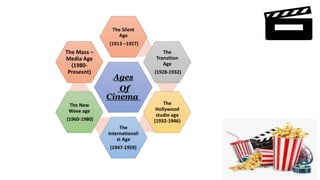
Ages
Of
Cinema
The Silent
Age
(1913 –1927)
The
Transition
Age
(1928-1932)
The
Hollywood
studio age
(1932-1946)
The
Internationali
st Age
(1947-1959)
The New
Wave age
(1960-1980)
The Mass –
Media Age
(1980-
Presesnt)
• 10 Lumière brothers' short films in Paris on 28
December 1895
• 1890s films became several minutes long
• first successful permanent theatre showing only films
was “The Nickelodeon”
• In 1929, "The Lights of New York" the first talking film
was screened.
• The early 1990s saw the development of a commercially
successful independent cinema in the United States
• In 20s The documentary film also rose as a commercial
genre for perhaps the first time.
BRIEF HISTORY OF
CINEMA
The first Indian feature film, Pundalik was made in 1912, But it
was shot by English man.
• In 1913 Dadasaheb produced the first Indian film "Raja
Harishchand“ since then to 1981 more than 15 thousand movies
were produced in India.
• In 1983 it was India's sixth largest industry, grossing around
600$ annually.
• The first ever movie to be screened in India was in Watsons
Hotel in Bombay on the 7th of July 1986.
• In 1932 Indrasabha has about 70 songs. This was the era
when music became a vital part of the industry.
• Films are made in almost 30 of the official languages but
among them few are very famous and commercialized. Those
languages are Hindi, Tamil, Malayalam, Kanada, Bengali,
Telugu. This is a great deal of mobility in the Indian film
industry
HISTORY OF
INDIAN CINEMA
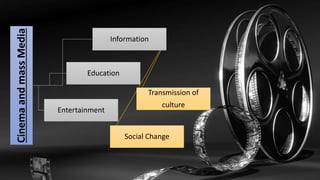
Cinema
and
mass
Media
Information
Social Change
Transmission of
culture
Education
Entertainment
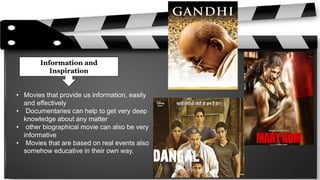
Information and
Inspiration
• Movies that provide us information, easily
and effectively
• Documentaries can help to get very deep
knowledge about any matter
• other biographical movie can also be very
informative
• Movies that are based on real events also
somehow educative in their own way.
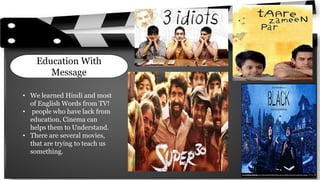
Education With
Message
• We learned Hindi and most
of English Words from TV!
• people who have lack from
education, Cinema can
helps them to Understand.
• There are several movies,
that are trying to teach us
something.
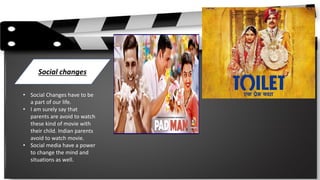
Social changes
• Social Changes have to be
a part of our life.
• I am surely say that
parents are avoid to watch
these kind of movie with
their child. Indian parents
avoid to watch movie.
• Social media have a power
to change the mind and
situations as well.
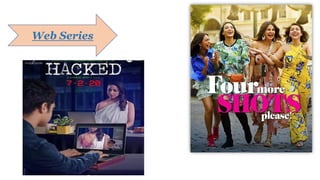
Web Series
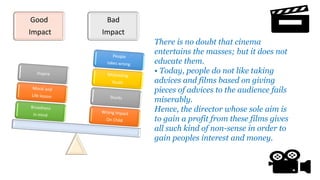
Good
Impact
Bad
Impact
There is no doubt that cinema
entertains the masses; but it does not
educate them.
• Today, people do not like taking
advices and films based on giving
pieces of advices to the audience fails
miserably.
Hence, the director whose sole aim is
to gain a profit from these films gives
all such kind of non-sense in order to
gain peoples interest and money.
Conclusion
• The film industry has grown rapidly for the past
years and has brought about a lot of changes in the
society.
• It effects in a good way also and a bad way too
• Film is a powerful and effective genre of
communication
• Films draw heavily from reality, portraying
situations that have resemblance to the everyday
stresses and aspirations of viewers' lives. The movies
recognize the link between their lives and films in
both general and specific terms.
▪ Sharman, Russell. “An Introduction to Cinema.” Moving Pictures, 18
May 2020,
uark.pressbooks.pub/movingpictures/part/introduction/.
▪ We. “Essay Writer Services.” September 2019, 1 Jan. 1970,
essaywriterservices1.blogspot.com/2019/09/.
▪ Sharman, Russell. “A Brief History of Cinema.” Moving Pictures, 18
May 2020, uark.pressbooks.pub/movingpictures/chapter/a-brief-
history-of-cinema/.
▪ Bahadkar, Siddhi. Movies and the role they play. 21 June 2010. 27
March 2018 <https://www.youthkiawaaz.com/2010/06/movies-
and- the-role-they-play/>.
▪ IndiaToday. 15 bollywood movies that educated us a lot. 9 July
2015. 28 March 2018 <https://www.indiatoday.in/education-
today/featurephilia/story/bollywood-movies-and-education-
281501- 2015-07-09>.
▪ Wikipedia. History of Film. n.d. 27 march 2018
<https://en.wikipedia.org/wiki/History_of_film>.
▪ Images From Google
Work Cited
Paper 15 mass media

Paper 15 mass media

  • 2.
    ❖ Kinnari Halvadiya ❖Sem: 4 ❖ Paper 15 Mass Media and Communication ❖ E-mail: kinuhalvadiya17@gmail.com ❖ Batch: 2019 – 2021 ❖ S.B Gardi Department of English MKBU
  • 3.
    What is Cinema? •Technically, the word itself derives from the ancient Greek, kinema, meaning movement. Historically, it’s a shortened version of the French cinematograph, an invention of two brothers, Auguste and Louis Lumiere, that combined kinema with another Greek root, graphing, meaning to write or record. • cinema is much more than the intersection of art and technology. It is also, and maybe more importantly, a powerful medium of communication. Like language itself, cinema is a surrounding and enveloping substance that carries with it what it means to be human in a specific time and place. • It mediates our experience of the world, helps us make sense of things, and in doing so, often helps shape the world itself. It’s why we often find ourselves confronted by some extraordinary event and find the only way to describe it is: “It was like a movie.”
  • 4.
    Ages Of Cinema The Silent Age (1913 –1927) The Transition Age (1928-1932) The Hollywood studioage (1932-1946) The Internationali st Age (1947-1959) The New Wave age (1960-1980) The Mass – Media Age (1980- Presesnt)
  • 5.
    • 10 Lumièrebrothers' short films in Paris on 28 December 1895 • 1890s films became several minutes long • first successful permanent theatre showing only films was “The Nickelodeon” • In 1929, "The Lights of New York" the first talking film was screened. • The early 1990s saw the development of a commercially successful independent cinema in the United States • In 20s The documentary film also rose as a commercial genre for perhaps the first time. BRIEF HISTORY OF CINEMA
  • 6.
    The first Indianfeature film, Pundalik was made in 1912, But it was shot by English man. • In 1913 Dadasaheb produced the first Indian film "Raja Harishchand“ since then to 1981 more than 15 thousand movies were produced in India. • In 1983 it was India's sixth largest industry, grossing around 600$ annually. • The first ever movie to be screened in India was in Watsons Hotel in Bombay on the 7th of July 1986. • In 1932 Indrasabha has about 70 songs. This was the era when music became a vital part of the industry. • Films are made in almost 30 of the official languages but among them few are very famous and commercialized. Those languages are Hindi, Tamil, Malayalam, Kanada, Bengali, Telugu. This is a great deal of mobility in the Indian film industry HISTORY OF INDIAN CINEMA
  • 7.
  • 8.
    Information and Inspiration • Moviesthat provide us information, easily and effectively • Documentaries can help to get very deep knowledge about any matter • other biographical movie can also be very informative • Movies that are based on real events also somehow educative in their own way.
  • 9.
    Education With Message • Welearned Hindi and most of English Words from TV! • people who have lack from education, Cinema can helps them to Understand. • There are several movies, that are trying to teach us something.
  • 10.
    Social changes • SocialChanges have to be a part of our life. • I am surely say that parents are avoid to watch these kind of movie with their child. Indian parents avoid to watch movie. • Social media have a power to change the mind and situations as well.
  • 11.
  • 12.
    Good Impact Bad Impact There is nodoubt that cinema entertains the masses; but it does not educate them. • Today, people do not like taking advices and films based on giving pieces of advices to the audience fails miserably. Hence, the director whose sole aim is to gain a profit from these films gives all such kind of non-sense in order to gain peoples interest and money.
  • 13.
    Conclusion • The filmindustry has grown rapidly for the past years and has brought about a lot of changes in the society. • It effects in a good way also and a bad way too • Film is a powerful and effective genre of communication • Films draw heavily from reality, portraying situations that have resemblance to the everyday stresses and aspirations of viewers' lives. The movies recognize the link between their lives and films in both general and specific terms.
  • 14.
    ▪ Sharman, Russell.“An Introduction to Cinema.” Moving Pictures, 18 May 2020, uark.pressbooks.pub/movingpictures/part/introduction/. ▪ We. “Essay Writer Services.” September 2019, 1 Jan. 1970, essaywriterservices1.blogspot.com/2019/09/. ▪ Sharman, Russell. “A Brief History of Cinema.” Moving Pictures, 18 May 2020, uark.pressbooks.pub/movingpictures/chapter/a-brief- history-of-cinema/. ▪ Bahadkar, Siddhi. Movies and the role they play. 21 June 2010. 27 March 2018 <https://www.youthkiawaaz.com/2010/06/movies- and- the-role-they-play/>. ▪ IndiaToday. 15 bollywood movies that educated us a lot. 9 July 2015. 28 March 2018 <https://www.indiatoday.in/education- today/featurephilia/story/bollywood-movies-and-education- 281501- 2015-07-09>. ▪ Wikipedia. History of Film. n.d. 27 march 2018 <https://en.wikipedia.org/wiki/History_of_film>. ▪ Images From Google Work Cited