PANKAJ DIXIT Page 1
RESEARCH PROJECT REPORT
(NMBA 035)
ON
“A Study On Motives Of Equity Investors At Sharekhan”
AT
SHAREKHAN PVT. LTD.
Submitted in Partial Fulfillment of
Master of Business Administration (MBA)
Programme: 2014 – 16 of
Dr.A.P.J. Abdul Kalam University, Lucknow
Under the Supervision of Submitted By
MR. ABHISHEKGUPTA PANKAJ DIXIT
Roll No ------------
Faculty of Management Science
Shri Ram Murti Smarak College of Engineering & Technology, Bareilly
(College Code – 014)
PANKAJ DIXIT Page 2
Shri Ram Murti Smarak College of Engineering & Technology, Bareilly (U.P.)
Faculty of Management Science
Certificate
This is to certify that Mr. PANKAJ DIXIT, a student of MBA IV Semester has completed
his Research Project Report titled “A Study On Motives Of Equity Investors at Sharekhan”
assigned by MBA Department under my supervision.
It is further certified that he has personally prepared this report that is the result of his
personal survey / observation. It is of the standard expected to MBA student and hence
recommended for evaluation.
(Mr. AbhishekGupta)
Asst. Professor (MBA Department)
Above statement is endorsed.
(Dr. Anant Kumar Srivastava)
Professor & Head – MBA Department
PANKAJ DIXIT Page 3
DECLARATION
This is to declare that I PANKAJ DIXIT student of M.B.A in Shri Ram Murti
Smarak College of Engineering and Technology, U.P. have given original data and
information to best of my knowledge in the report “A Study On Motives Of Equity
Investors At Sharekhan”.
I further state that no part of this information has been used for any assignment but for
partial fulfillment of the requirements towards the completion of the above mentioned
course.
PANKAJ DIXIT
PANKAJ DIXIT Page 4
ACKNOWLEDGEMENT
I, PANKAJ DIXIT, a student of MBA IIIrd Semester, sincerely thank Mr. Dev Murti, the Chairman
of Shri Ram Murti Smarak College of Engineering and Technology, Bareilly for being associated
with this reputed Institute for my MBA studies.
I am grateful and wish to place on record my sincere thanks to Dr. Anant Kumar Srivastava,
Head of Management Department, for the leadership and guidance and Mr. Abhishek Gupta
(Faculty Mentor) for the moral, academic and problem solving support without which this project
report would not have come up to its present form..
Last but not the least, I would also like to thank my colleagues and staff of the MBA department
and employees of this elite Institute for whatever they have done for helping me out every time in
completion of this project report.
I would also like to extend a vote of thanks to all those people and the websites who guided or
directed me in bringing this project to the reality. Without their guidance and proper support this
project report would not have been possible for me to prepare.
PANKAJ DIXIT
PANKAJ DIXIT Page 5
PREFACE
People invest their money for generating good returns. But in this investment some kind of risk is
involved. All investors have different attitudes towards risk. When it comes to investing, it is
important to consider your risk profile or tolerance carefully, including how comfortable you are
with the possibility of losing money, or that returns on your investments. The risk profile of
investors depends upon their demographic structures or characteristics.
The project deals with the analyzing the investment pattern on the basis of risk profile of investors
at Sharekhan Limited and what are the risk factors that influence the type of investment made by
individuals . As we all know that every person who wants to gain better returns in future they must
have to invest their money in stock market or anywhere else. This study describes the investment
pattern use by different persons while doing investment in stock market keeping different risk in
mind.
The main reason to choose this research is to find out the investment pattern behavior in respect of
their risk bearing capacity and this research helps the company to target the investors according to
their risk ability. The research process chosen by me is qualitative and quantitative research.
Questionnaires in part help me a lot in finding the actual position of the market under the survey
method.
.A sample size of about 96 respondents which includes individual investors as well as corporate
investors was taken for purpose from various parts of Delhi and N.C.R . After the survey was
completed, the data was first stored and then analyzed on the chosen parameters. This analyzed data
was later on converted into graphs. Such as pie chart, bar graphs, etc this was to make result easily
comprehensible by any one going through the report. Later on, all this information was compiled in
the form of a presentable and highly comprehensible report.
After analyzing the data, the problem which has been identified that most of the investors are ready
to bear risk in expectation of higher returns. There is a strong relationship in investment pattern and
PANKAJ DIXIT Page 6
risk bearing capacity of investors while doing investment. For analyzing the data we used chi-
square and phi-Cramer V test in SPSS V 19.0 and use MS Excel 2007 for making graphs.
PANKAJ DIXIT Page 7
CONTENTS
PART A: About the Organization
S.No.List of Tables Page No.
Chapter 1 Origin, vision & mission 9
Chapter 2 Business Profile 11
Chapter 3 Functional Area 12
Chapter 4 Organizational Structure 13
Chapter 5 Services 17
Chapter 6 Achievements/Recognitions 18
Chapter 7 SWOT Analysis 19
PANKAJ DIXIT Page 8
PART B: About the Study & Solution
S.No.List of Tables Page No.
Chapter 1 Introduction 21
Chapter 2 Scope & Objective(s) of the study 22
Chapter 3 Research design 23
Chapter 4 Data Analysis & Interpretation 25
Chapter 5 Findings, Recommendations & Limitations 39
References
Bibliography
Annexure
PANKAJ DIXIT Page 9
CHAPTER 1
ORIGIN
Sharekhan Ltd. is one the leading retail stock broking house of SSKKI group which is running
successfully since 1922 in the country. It is the retail broking arm of the Mumbai-based SSKI
Group, which has over eight decades of experience in the stock broking business. Sharekhan offers
its customer a wide range of equity related services including trade execution on BSE, NSE,
Derivatives, depository services online trading, investment advise etc. The firm’s online trading and
investment site- WWW.Sharekhan.com – was launched on Feb 8, 2000. The site gives access to
superior content and transaction facility to retail customers across the country. Known for its Jrgon-
free, investor friendly laugh and high quality research, the site has a registered base of over one lakh
customers. The content-rich and research oriented portal has stood out among its contemporaries
because of its steadfast dedication to offering customers best-of-breed technology and superior
market information. The objective has to let customers make informed decisions and to simplify the
process investing in stocks.
On April 17, 2002 Sharekhan launched Speed trade, a net-based executable application that
emulates the broker terminals along with host of other information relevant to the Day traders. This
was for the first time that a net based trading station of this caliber was offered to the traders.
In the last six months speed Trade has become a de facto standard for the day trading community
over the net.
PANKAJ DIXIT Page 10
VISION& MISSION
Vision
To be the best retail broking brand in the retail business of the stock market.
Mission
To educate and empower the individual investor to make better investment decisions through
quality advices and superior services.
PANKAJ DIXIT Page 11
CHAPTER 2
BUSINESS PROFILE
Name of the company : Sharekhan Ltd.
Year of establishment : 1925
Nature of Business : Service Provider
Services : Depository Services, Online Services
and Technical research.
Number of Employees : Over 3500
Headquarter : SSKAI A-206 Phoenix house,
Phoenix mills Lower Parel,
Mumbai Maharashtra, India
Pin-400013
Slogan : “Your Guide to the Financial Jungle”
PANKAJ DIXIT Page 12
Chapter 3
FUNCTIONAL AREA
FUNCTIONAL AREA
EQUITY
NSE
BSE
COMMODITY
MCX
Bullion Copper
Metal etc.
NCDEX
Crude Oil
Black
Papper
Menthol
etc.
CURRENCY
Euro
Dollar
Yen
Pond
PANKAJ DIXIT Page 13
Chapter 4
Organizational Structure
Mr.Dinesh Morakhiya
(Owner of Company)
MR. Tarun Shah
(CEO)
Mr. Jaideep Arora
(Director)
Mr. Shankar Vailaya
(Head of Finance &
Legal functions)
Mr.Rishi Kohali
(Vice-President of Equity
Derivatives)
Mr. Prathik Gandotra
(Head of Research of
Equity Derivatives)
Mr. Nikhil Vora
(Vive-President
Research
PANKAJ DIXIT Page 14
Mr. Dinesh Murakiya- Owner OF the company; The sharekhan group of companies was brought
to life by Mr. Dinesh Murikya. He ventured in to stock trading with an intention to raise capital for
his own independent enterprise. However, he recognized the opportunity offered by the stock
market to serve individual investors. Thus India’s first retail-focused stock broking house was
established in 1925. Under his leadership, Sharekhan became the first broking house to embrace
new technology for faster, more effective and affordable services to retail investors.
Mr. Tarun Shah – Chief Executive Officer (CEO) of the company: A science graduate from St,
Xavier college, Mumbai, Mr. Tarun Shah started his professional life in sales and marketing in a
chemicals company. His hands on approach and rigorous experience in sales led him to a higher
challenges that the capital market provided.
In 1987, he joined SKKI, a brokerage firm with over five decades of legendary service to its credit.
Mr. Shankar Vailaya heads the operations, finance and legal functions. He is responsible for
settlements, depository operations, risk and compliance and regulatory & other legal commitments
and treasury.
Shankar has managed broking operations through the most turbulent tomes of the post securities
scam period in 1992 and has managed to steer clear of a flurry of bad papers in the market during
1994-95.
Mr. Jaideep Arora – Director (Products & Technology) of the company:
Jaideep Arora completed his B. Tech from IIT (Kanpur) and his PGDM from IIM Kolkata.
Jaideep worked with ICICI for 8 years where his work spanned a gamut of functions,
PANKAJ DIXIT Page 15
Prathik Gandotra : Head of Research of Equity Derivatives
Rishi Kohli :Vice President of Equity Derivatives
Nikhil Vora : Vice President of Research
PANKAJ DIXIT Page 16
OrganisationalStructure – Sharekhan Ltd.,Bareilly (Branch
Office)
Mr. Atul Verma
(Branch Manager)
Mr. Ajay Rawat
(Astt. Manager)
Pankaj Dixit
(Trainee)
Mr. Gaurav Mathur
Mr. Abhijit Sinha
Mr. Sachin Rathaur
(Snr. R.M.)
Mr.Sarvesh Agarwal
(A.R.M.)
Mr. Chandulal
(ARM)
Mr. Alok Goswami
(Astt. Manager)
PANKAJ DIXIT Page 17
Chapter 5
Services Of Sharekhan Ltd.
The different types of services offered by Sharekhan Ltd. are as follows:
 Equity and Derivatives Trading
 Depository services
 Online services
 Commodities trading
 Dial-n-trade
 Portfolio management
 Share shops
 Fundamental research
 Technical research
PANKAJ DIXIT Page 18
Chapter 6
Achievements/Recognitions
 A wired company along with Reliance, Hll, Infosys, etc by ‘Business Today’, January 2004
edition.
 It was awarded ‘Top Domestic Brokerage House’ four times by Euro and Asia money.
 It was Winner of “Best Financial Website” award.
 India’s most preferred brokers within 5 years. “ Awaaz customers Award 2005”.
PANKAJ DIXIT Page 19
Chapter 8
SWOT Analysis
Strengths:
 It is a pioneer in online trading with a turnover of Rs.400 crores and more than 800 peoples
working in the organization.
 SSKI the parent company of Sharekhan has more than eight decades of trust credibility in the
Indian stock market. In the Asian Money Broker’s poll SSKI won the “Indian’s best broking
house for 2004” award.
 Sharekhan provides multi-channel access to all its customers through a strong online
presence with www.Sharekhan.com, 250 share shops in 130 cities and a call-center based
dial-n-trade facility.
 Sharekhan has dedicated research teams for fundamental and technical research. Which
constantly track the pulse of the market and provide timely investment advice free of cost to
its client which has a strike rate of 70-80%.
Weakness:
 Localize presence due to insufficient investments for country wide expansion.
 Lack of awareness among customers because of non-aggressive promotional strategies (print
media, newspapers etc.).
 Focuses more on HNIs than retail investors which results in meager market-share as compare
to close competitors.
PANKAJ DIXIT Page 20
Opportunities:
 It can easily tap the retail investors with small savings through promotional channels like
print media, electronic media etc.
 As interest on fixed deposits with post office and banks are all time low, more and more
small investors are entering into stock market.
 Abolition of long term capital gain tax on shares and reduction in short-term capital gain is
making stock market as hot destination for investment among small investors.
Threats:
 Aggressive promotional activities by close competitors may hamper Sharekhan’s acceptance
by new clients.
 Other players are providing margin funds to investors on easy terms whereas there is no such
facility in sharekhan.
 More and more players are venturing in to this domain which can further reduce the earnings
of Sharekhan.
PANKAJ DIXIT Page 21
PART B: About the Study & Solution
Introduction:
An investment is commitment of funds made in the expectation of some positive rate of return.
Investment generally involves real assets or financial assets. Real assets are tangible, material things
such as buildings, automobiles and text books etc which are less liquid. Moreover, it is also
necessary to have co-operation of other productive factors to reap benefits. On the other hand
financial assets, are most liquid in nature and it includes deposits, securities etc.
Investments are made to reap handsome return. Investors are interested or hope to achieve higher
reward. So they prefer investments in financial assets as it outweigh the advantages of investment in
real assets. They carefully plan, evaluate and allocate funds in various investible outlets, which offer
safety of principal and continuous return. Investment in equity shares is one of the avenues which
offer greater benefits, along with higher risk.
PANKAJ DIXIT Page 22
Objective of Study
I conducted my research to know the investment motive investors in equity shares with the
following objectives:
 Investors are interested to invest in long-term gain or short term gain.
There are also other factors that decide the equity investment.
Under this background the researcher decided to conduct a study with following
Objectives:
 To study socio economic status of the equity investors.
 To assess the motives of the investors in making investment.
 To find out the relation between the motives of investors and the factors influencing it.
PANKAJ DIXIT Page 23
Chapter 3
Research Design
The research methodology, not only the research methods are but also consider the logic behind the
methods. They are in the contest of our research studied.
And explain why we are using a particular method or techniques and we are using others.
Sampling Techniques:
Random sampling is categorized under probability method. A random sample gives every unit of the
population a known and non-zero chance of being selected in population. Random sampling is also called
proportionate sampling as each class of items is in the same proportion in the sample as in the universe. It
gives each element an equal and independent chance of being selected in sample. In this study the random
sampling is adopted as a sampling technique because there are various levels of people and the have
different mentality for their investment, which are present in the Socio-economic status of the investors.
Location-
Bareilly
The sample size
A sample size of 200 customers was taken for the analysis part. Questionnaire containing 2 questions first
one is, investors invest in equity shares for long-term or short-term. And the second question states the
socio-economic status of investor.
PANKAJ DIXIT Page 24
Toolsfordata collection
A questionnaire was given two hundred (200) samples for basically understanding the behavior of investors
in investing equity shares of Bareilly district.
Fieldwork
I made a questionnaire for the primary data collection to know about motives of Equity investors at
Sharekhan Ltd Bareilly. The questionnaires are filled up by one hundred responds. I must say that it was one
of the most challenging but interesting aspect of my project work. It was challenging because, there was of
course language problem, and convincing or detailing and survey objective was real challenge. It was also a
learning experience in other way.
Research Design
Sample Size 100
Types of data Required Primary Data
Sampling Method to be used Convenience, Judgmental
Statistical analysis to be performed Graphs And Mean.
Type of Research Descriptive
Research instrument and mode of
data collection
Personal Interview through Questionnaire.
PANKAJ DIXIT Page 25
CHAPTER 4
DATA ANALYSIS & INTREPRETATION
Data analysis is a process of gathering, modeling, and transforming data with the goal of highlighting
useful information, suggesting conclusion, and supporting decision making. Data analysis has
multiple facets and approaches, encompassing diverse techniques under a verity of names, in
different business, science, and social sciences domains. Data mining is a particular data analysis
technique that focuses on modeling and knowledge discover for predictive rather than purely
descriptive purpose. Business intelligence covers data analysis that relies heavily on aggregation,
focusing on business information. In statistical applications, some people divide data analysis into:
➢Descriptive Statistics
➢Exploratory data analysis, and
➢Confirmatory analysis
PANKAJ DIXIT Page 26
The research based will be Descriptive Research.
Type of data
1. Primary data
Primary data
The primary or the first hand data will be collectedwith the help of handing out the questionnaire to
the customers &employees.
Sampling Design
 The sample selected for survey was stratified sample. Sample size is 200 Customers
PANKAJ DIXIT Page 27
4.1 QUESTIONS & INTERPRETATION: Analysis of Relationship
Table-1: Relationshipbetween sex and motive of investment
Sex
Motive of Investment
Total
Short Term Gain Long Term gain Dividend
Male 49 (30%) 85 (52%) 30 (18%) 164
Female 7 (19%) 23(64%) 6(17%) 36
Total 56 108 36 200
0
10
20
30
40
50
60
70
80
90
Male Female
Short Term Gain
Long Term gain
Dividend
PANKAJ DIXIT Page 28
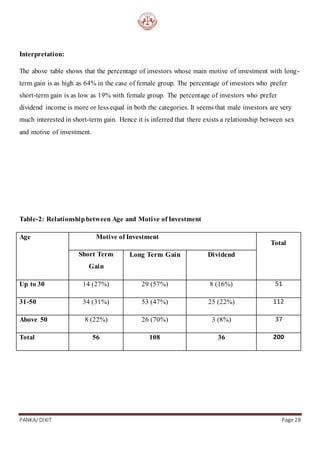
Interpretation:
The above table shows that the percentage of investors whose main motive of investment with long-
term gain is as high as 64% in the case of female group. The percentage of investors who prefer
short-term gain is as low as 19% with female group. The percentage of investors who prefer
dividend income is more or less equal in both the categories. It seems that male investors are very
much interested in short-term gain. Hence it is inferred that there exists a relationship between sex
and motive of investment.
Table-2: Relationshipbetween Age and Motive of Investment
Age Motive of Investment
Total
Short Term
Gain
Long Term Gain Dividend
Up to 30 14 (27%) 29 (57%) 8 (16%) 51
31-50 34 (31%) 53 (47%) 25 (22%) 112
Above 50 8 (22%) 26 (70%) 3 (8%) 37
Total 56 108 36 200
PANKAJ DIXIT Page 29
Interpretation:
The above table presents that the percentage of investors with the motive of short-term gain is high
(31%) in the second category and low (22%) in the third category. The percentage of investors with
the motive of long-term gain is high (70%) in the third category and low (47%) in the second
category. The percentage of investors with the motive of dividend income is high (22%) in the
second category and low (8%) in the third category. It seems that there is no relationship between
age and motive of investment.
0
10
20
30
40
50
60
Up to 30 31-50 Above 50
Short Term Gain
Long Term Gain
Dividend
PANKAJ DIXIT Page 30
Table-3: Relationshipbetween Marital Status and Motives of Investment
Marital status
Motive of Investment
Total
Short Term
Gain
Long Term
Gain
Dividend
Unmarried 16 (42%) 15 (39%) 7 (18%) 38
Married 40 (25%) 93 (57%) 29 (18%) 162
Total 56 108 36 200
Interpretation:
The above table reveals that the percentage of investors with motive of short term gain is high
(42%) in the first group and low (25%) in the second category. The percentage of investors with
long-term gain motive is high (57%) in the second category and low (39%) in the first category. The
percentage of investors whose motive of investment is dividend income, is equal in both categories.
0
10
20
30
40
50
60
70
80
90
100
Unmarried Married
Short Term Gain
Long Term Gain
Dividend
PANKAJ DIXIT Page 31
It shows that unmarried investors are highly interestedin short-term gain as compared to the
married investors.
Therefore, the marital status influences the motives of investment.
Table-4: Relationship between Educational Qualificationand Motive of Investment
Educational
Qualification
Motive of Investment Total
Short Term Gain Long Term Gain Dividend
Up to 12 12 (19%) 12 (57%) 8 (13%) 62
U.G. 11 (20%) 27 (50%) 16 (30%) 54
P.G. 16 (44%) 15 (42%) 5 (14%) 36
Professional 11 (41%) 12 (44%) 4 (15%) 27
Others 6 (29%) 42 (68%) 3 (14%) 21
Total 56 108 36 200
PANKAJ DIXIT Page 32
Interpretation:
The above table presents that the percentage of investors with the motive of short-term gain goes on
increasing with level of education except in the fourth and fifth category. And the percentage of
investors with the motive of dividend income is high (30%) in the second category and low (13%)
in the first category. It seems that there is a significant relationship between educational
qualification and motive of investment.
0
5
10
15
20
25
30
35
40
45
Up to 12 U.G. P.G. Professional Others
Short Term Gain
Long Term Gain
Dividend
PANKAJ DIXIT Page 33
Table-5: Relationshipbetween Occupation and Motive of Investment
Occupation Motive of Investment Total
Short Term Gain Long Term Gain Dividend
Agriculture 2 (9%) 17 (74%) 4 (17%) 23
Business 14 (26%) 27(51%) 12 (23%) 53
Employed 27 (30%) 47 (53%) 15 (17%) 89
Professional 9 (38%) 2 (50%) 3 (12%) 24
Unemployed 4 (36%) 5 (46%) 2 (18%) 11
Total 56 108 36 200
0
5
10
15
20
25
30
35
40
45
50
Short Term Gain
Long Term Gain
Dividend
PANKAJ DIXIT Page 34
Interpretation:
The above table explains that the percentage of investors with the motive of short-term gain is high
(38%) in the fourth category and low (9%) in first category. The percentage of investors with
motive of long-term gain is high (74%) in the first category and low (46%) in the fifth category. The
percentage of investors with the motive of dividend income is high (23%) in the second category
and low (12%) in the fourth category.
Table-6: Relationshipbetween Monthly Income and Motive of Investment
Monthly Income
Motive of Investment
Total
Short Term Gain Long Term Gain Dividend
Up to 10,000 35 (27%) 71 (55%) 24 (18%) 130
10,001-20,000 17 (31%) 28 (51%) 10 (18%) 55
Above 20,000 4 (27%) 9 (60%) 2 (13%) 15
Total 56 108 36 200
PANKAJ DIXIT Page 35
Interpretation:
The above table reveals that the percentage of investors with the motive of short-term gain is high
(31%) in the second category and low in the first and third categories (27%). The percentage of
investors with the motive long-term gain is high (60%) in the third category and low (55%) in the
first category. The percentage of investors with the motive of dividend income is high in both first
and second (18%) category.
0
10
20
30
40
50
60
70
80
Up to 10,000 10,001-20,000 Above 20,000
Short Term Gain
Long Term Gain
Dividend
PANKAJ DIXIT Page 36
Table-7: Relationship between Family Member and Motive of Investment
Family Member Motive of Investment Total
Short Term Gain Long Term Gain Dividend
Up to 2 3 (20%) 10 (67%) 2 (13%) 15
3 or 4 26 (37%) 32 (45%) 13 (18%) 71
Above 4 27 (24%) 66 (58%) 21 (18%) 114
Total 56 108 36 200
0
10
20
30
40
50
60
70
Up to 2 3 or 4 Above 4
Series 1
Series 2
Series 3
PANKAJ DIXIT Page 37
Interpretation:
The above table presents that the percentage of investors with the motive of short-term gain which
is as high as (37%) in the second category and as low as (20%). It is high (67%) in the first category
and low (45%) in the second category. The percentage of investors with the motive of dividend
income is high in both the second and third categories (18%) and low (13%) in the first categories.
Table No-8: Relationship between Sources Utilized for Investment and Motive of Investment
Sources
Motive of Investment
Total
Short-Term
Gain
Long-Tern Gain Dividend
Salary 42 (28%) 79 (54%) 27 (18%) 148
Business Income 5 (31%) 7 (44%) 4 (25%) 16
Borrowings 2 (40%) 3 (60%) NIL 5
More than One 7 (23%) 19 (61%) 5 (16%) 31
Total 56 108 36 200
PANKAJ DIXIT Page 38
Interpretation:
The above Table reveals that the percentage of investors with the motive of short-term gain is high
(40%) in the third category and low (23%) in the fourth category. The percentage of investors with
the motive of long-term gain is high (61%) in the fourth category and low (44%) in the second
category. The percentage of investors with the motive of dividend income is high (25%) in the
second category and low (nil) in the third category.
It shows that the percentage of investors using own sources for investment is higher in comparison
of rest all
0
10
20
30
40
50
60
70
80
Salary Business
income
Borrowings More than One
Sort-Term gain
Long-term Gain
Dividend Income
PANKAJ DIXIT Page 39
Findings
 Male candidates more prefer to invest in long term capital gain than female candidates.
 People belong to age of 31 to 50 years old like to invest more in stocks.
 The married people like to invest more in equity shares than unmarried people.
 The study reveals that professionals like to invest more in Equity shares.
 People who are employed they prefer to invest in stocks.
 Persons who are earning up to Rs 10,000. They like to invest in equity shares.
 Persons who have more than four candidates in his family like to invest in stocks.
 Persons who are getting salary like to invest in equity shares.
 In each Socio-economic status of candidate, the majority of investors are for long-term
capital gain.
PANKAJ DIXIT Page 40
Recommendations
 Candidates who belong to above the age of 50 years they are less interested to invest in
equity shares. Advisers should consult them to invest in equity market to earn high return.
 Unmarried people are less interested to invest in equity shares. Financial consultant should
advise them to invest in equity shares to increase their wealth.
PANKAJ DIXIT Page 41
Conclusion
The study reveals that majority of the investors selected for the study have the aim of long-term gain
and also there is no relation among the variables like Occupation, Monthly income, family member,
Sources utilized for investment in decision making. Hence, it can be concluded that the companies
who like to make public issue may publicise the issue in advance in such a way to let the investors
think in advance of their investment to earn income from the prospective of long- term gain.
PANKAJ DIXIT Page 42
Annexure
Questionnaire
Name:-
Contact No:-
Que.No1:- Please tick on your Socio-economic status?
Gender
Male
Female
Age
Up to 30
31-50 Years
Above 50 years
Marital Status
Unmarried
Married
Educational
Qualification
Up to 12th
UG
PG
Professional
Others
Occupation
Business
Agriculture
Employed
Professional
Unemployed
PANKAJ DIXIT Page 43
Monthly Income
Up to 10,000
Rs. 10,001 to Rs.20,000
Above 20,000
FamilyMember
Up to 2
3 and 4
Above 4
Sources Utilizedfor
Investment
Own Sources
Business Income
Borrowings
More than One
Que.No2:-Which return do you prefer by your investment?
1 2 3
Short Term Gain Long Term Gain Dividend
PANKAJ DIXIT Page 44
BIBLIOGRAPHY
Websites:
 www.sharekhan.com
 www.bseindia.com
 www.nseindia.com
 www.investopedia.com
Magazine:
 Outlook money
Book:
 C R Kothari

Pankaj Dixit

  • 1.
    PANKAJ DIXIT Page1 RESEARCH PROJECT REPORT (NMBA 035) ON “A Study On Motives Of Equity Investors At Sharekhan” AT SHAREKHAN PVT. LTD. Submitted in Partial Fulfillment of Master of Business Administration (MBA) Programme: 2014 – 16 of Dr.A.P.J. Abdul Kalam University, Lucknow Under the Supervision of Submitted By MR. ABHISHEKGUPTA PANKAJ DIXIT Roll No ------------ Faculty of Management Science Shri Ram Murti Smarak College of Engineering & Technology, Bareilly (College Code – 014)
  • 2.
    PANKAJ DIXIT Page2 Shri Ram Murti Smarak College of Engineering & Technology, Bareilly (U.P.) Faculty of Management Science Certificate This is to certify that Mr. PANKAJ DIXIT, a student of MBA IV Semester has completed his Research Project Report titled “A Study On Motives Of Equity Investors at Sharekhan” assigned by MBA Department under my supervision. It is further certified that he has personally prepared this report that is the result of his personal survey / observation. It is of the standard expected to MBA student and hence recommended for evaluation. (Mr. AbhishekGupta) Asst. Professor (MBA Department) Above statement is endorsed. (Dr. Anant Kumar Srivastava) Professor & Head – MBA Department
  • 3.
    PANKAJ DIXIT Page3 DECLARATION This is to declare that I PANKAJ DIXIT student of M.B.A in Shri Ram Murti Smarak College of Engineering and Technology, U.P. have given original data and information to best of my knowledge in the report “A Study On Motives Of Equity Investors At Sharekhan”. I further state that no part of this information has been used for any assignment but for partial fulfillment of the requirements towards the completion of the above mentioned course. PANKAJ DIXIT
  • 4.
    PANKAJ DIXIT Page4 ACKNOWLEDGEMENT I, PANKAJ DIXIT, a student of MBA IIIrd Semester, sincerely thank Mr. Dev Murti, the Chairman of Shri Ram Murti Smarak College of Engineering and Technology, Bareilly for being associated with this reputed Institute for my MBA studies. I am grateful and wish to place on record my sincere thanks to Dr. Anant Kumar Srivastava, Head of Management Department, for the leadership and guidance and Mr. Abhishek Gupta (Faculty Mentor) for the moral, academic and problem solving support without which this project report would not have come up to its present form.. Last but not the least, I would also like to thank my colleagues and staff of the MBA department and employees of this elite Institute for whatever they have done for helping me out every time in completion of this project report. I would also like to extend a vote of thanks to all those people and the websites who guided or directed me in bringing this project to the reality. Without their guidance and proper support this project report would not have been possible for me to prepare. PANKAJ DIXIT
  • 5.
    PANKAJ DIXIT Page5 PREFACE People invest their money for generating good returns. But in this investment some kind of risk is involved. All investors have different attitudes towards risk. When it comes to investing, it is important to consider your risk profile or tolerance carefully, including how comfortable you are with the possibility of losing money, or that returns on your investments. The risk profile of investors depends upon their demographic structures or characteristics. The project deals with the analyzing the investment pattern on the basis of risk profile of investors at Sharekhan Limited and what are the risk factors that influence the type of investment made by individuals . As we all know that every person who wants to gain better returns in future they must have to invest their money in stock market or anywhere else. This study describes the investment pattern use by different persons while doing investment in stock market keeping different risk in mind. The main reason to choose this research is to find out the investment pattern behavior in respect of their risk bearing capacity and this research helps the company to target the investors according to their risk ability. The research process chosen by me is qualitative and quantitative research. Questionnaires in part help me a lot in finding the actual position of the market under the survey method. .A sample size of about 96 respondents which includes individual investors as well as corporate investors was taken for purpose from various parts of Delhi and N.C.R . After the survey was completed, the data was first stored and then analyzed on the chosen parameters. This analyzed data was later on converted into graphs. Such as pie chart, bar graphs, etc this was to make result easily comprehensible by any one going through the report. Later on, all this information was compiled in the form of a presentable and highly comprehensible report. After analyzing the data, the problem which has been identified that most of the investors are ready to bear risk in expectation of higher returns. There is a strong relationship in investment pattern and
  • 6.
    PANKAJ DIXIT Page6 risk bearing capacity of investors while doing investment. For analyzing the data we used chi- square and phi-Cramer V test in SPSS V 19.0 and use MS Excel 2007 for making graphs.
  • 7.
    PANKAJ DIXIT Page7 CONTENTS PART A: About the Organization S.No.List of Tables Page No. Chapter 1 Origin, vision & mission 9 Chapter 2 Business Profile 11 Chapter 3 Functional Area 12 Chapter 4 Organizational Structure 13 Chapter 5 Services 17 Chapter 6 Achievements/Recognitions 18 Chapter 7 SWOT Analysis 19
  • 8.
    PANKAJ DIXIT Page8 PART B: About the Study & Solution S.No.List of Tables Page No. Chapter 1 Introduction 21 Chapter 2 Scope & Objective(s) of the study 22 Chapter 3 Research design 23 Chapter 4 Data Analysis & Interpretation 25 Chapter 5 Findings, Recommendations & Limitations 39 References Bibliography Annexure
  • 9.
    PANKAJ DIXIT Page9 CHAPTER 1 ORIGIN Sharekhan Ltd. is one the leading retail stock broking house of SSKKI group which is running successfully since 1922 in the country. It is the retail broking arm of the Mumbai-based SSKI Group, which has over eight decades of experience in the stock broking business. Sharekhan offers its customer a wide range of equity related services including trade execution on BSE, NSE, Derivatives, depository services online trading, investment advise etc. The firm’s online trading and investment site- WWW.Sharekhan.com – was launched on Feb 8, 2000. The site gives access to superior content and transaction facility to retail customers across the country. Known for its Jrgon- free, investor friendly laugh and high quality research, the site has a registered base of over one lakh customers. The content-rich and research oriented portal has stood out among its contemporaries because of its steadfast dedication to offering customers best-of-breed technology and superior market information. The objective has to let customers make informed decisions and to simplify the process investing in stocks. On April 17, 2002 Sharekhan launched Speed trade, a net-based executable application that emulates the broker terminals along with host of other information relevant to the Day traders. This was for the first time that a net based trading station of this caliber was offered to the traders. In the last six months speed Trade has become a de facto standard for the day trading community over the net.
  • 10.
    PANKAJ DIXIT Page10 VISION& MISSION Vision To be the best retail broking brand in the retail business of the stock market. Mission To educate and empower the individual investor to make better investment decisions through quality advices and superior services.
  • 11.
    PANKAJ DIXIT Page11 CHAPTER 2 BUSINESS PROFILE Name of the company : Sharekhan Ltd. Year of establishment : 1925 Nature of Business : Service Provider Services : Depository Services, Online Services and Technical research. Number of Employees : Over 3500 Headquarter : SSKAI A-206 Phoenix house, Phoenix mills Lower Parel, Mumbai Maharashtra, India Pin-400013 Slogan : “Your Guide to the Financial Jungle”
  • 12.
    PANKAJ DIXIT Page12 Chapter 3 FUNCTIONAL AREA FUNCTIONAL AREA EQUITY NSE BSE COMMODITY MCX Bullion Copper Metal etc. NCDEX Crude Oil Black Papper Menthol etc. CURRENCY Euro Dollar Yen Pond
  • 13.
    PANKAJ DIXIT Page13 Chapter 4 Organizational Structure Mr.Dinesh Morakhiya (Owner of Company) MR. Tarun Shah (CEO) Mr. Jaideep Arora (Director) Mr. Shankar Vailaya (Head of Finance & Legal functions) Mr.Rishi Kohali (Vice-President of Equity Derivatives) Mr. Prathik Gandotra (Head of Research of Equity Derivatives) Mr. Nikhil Vora (Vive-President Research
  • 14.
    PANKAJ DIXIT Page14 Mr. Dinesh Murakiya- Owner OF the company; The sharekhan group of companies was brought to life by Mr. Dinesh Murikya. He ventured in to stock trading with an intention to raise capital for his own independent enterprise. However, he recognized the opportunity offered by the stock market to serve individual investors. Thus India’s first retail-focused stock broking house was established in 1925. Under his leadership, Sharekhan became the first broking house to embrace new technology for faster, more effective and affordable services to retail investors. Mr. Tarun Shah – Chief Executive Officer (CEO) of the company: A science graduate from St, Xavier college, Mumbai, Mr. Tarun Shah started his professional life in sales and marketing in a chemicals company. His hands on approach and rigorous experience in sales led him to a higher challenges that the capital market provided. In 1987, he joined SKKI, a brokerage firm with over five decades of legendary service to its credit. Mr. Shankar Vailaya heads the operations, finance and legal functions. He is responsible for settlements, depository operations, risk and compliance and regulatory & other legal commitments and treasury. Shankar has managed broking operations through the most turbulent tomes of the post securities scam period in 1992 and has managed to steer clear of a flurry of bad papers in the market during 1994-95. Mr. Jaideep Arora – Director (Products & Technology) of the company: Jaideep Arora completed his B. Tech from IIT (Kanpur) and his PGDM from IIM Kolkata. Jaideep worked with ICICI for 8 years where his work spanned a gamut of functions,
  • 15.
    PANKAJ DIXIT Page15 Prathik Gandotra : Head of Research of Equity Derivatives Rishi Kohli :Vice President of Equity Derivatives Nikhil Vora : Vice President of Research
  • 16.
    PANKAJ DIXIT Page16 OrganisationalStructure – Sharekhan Ltd.,Bareilly (Branch Office) Mr. Atul Verma (Branch Manager) Mr. Ajay Rawat (Astt. Manager) Pankaj Dixit (Trainee) Mr. Gaurav Mathur Mr. Abhijit Sinha Mr. Sachin Rathaur (Snr. R.M.) Mr.Sarvesh Agarwal (A.R.M.) Mr. Chandulal (ARM) Mr. Alok Goswami (Astt. Manager)
  • 17.
    PANKAJ DIXIT Page17 Chapter 5 Services Of Sharekhan Ltd. The different types of services offered by Sharekhan Ltd. are as follows:  Equity and Derivatives Trading  Depository services  Online services  Commodities trading  Dial-n-trade  Portfolio management  Share shops  Fundamental research  Technical research
  • 18.
    PANKAJ DIXIT Page18 Chapter 6 Achievements/Recognitions  A wired company along with Reliance, Hll, Infosys, etc by ‘Business Today’, January 2004 edition.  It was awarded ‘Top Domestic Brokerage House’ four times by Euro and Asia money.  It was Winner of “Best Financial Website” award.  India’s most preferred brokers within 5 years. “ Awaaz customers Award 2005”.
  • 19.
    PANKAJ DIXIT Page19 Chapter 8 SWOT Analysis Strengths:  It is a pioneer in online trading with a turnover of Rs.400 crores and more than 800 peoples working in the organization.  SSKI the parent company of Sharekhan has more than eight decades of trust credibility in the Indian stock market. In the Asian Money Broker’s poll SSKI won the “Indian’s best broking house for 2004” award.  Sharekhan provides multi-channel access to all its customers through a strong online presence with www.Sharekhan.com, 250 share shops in 130 cities and a call-center based dial-n-trade facility.  Sharekhan has dedicated research teams for fundamental and technical research. Which constantly track the pulse of the market and provide timely investment advice free of cost to its client which has a strike rate of 70-80%. Weakness:  Localize presence due to insufficient investments for country wide expansion.  Lack of awareness among customers because of non-aggressive promotional strategies (print media, newspapers etc.).  Focuses more on HNIs than retail investors which results in meager market-share as compare to close competitors.
  • 20.
    PANKAJ DIXIT Page20 Opportunities:  It can easily tap the retail investors with small savings through promotional channels like print media, electronic media etc.  As interest on fixed deposits with post office and banks are all time low, more and more small investors are entering into stock market.  Abolition of long term capital gain tax on shares and reduction in short-term capital gain is making stock market as hot destination for investment among small investors. Threats:  Aggressive promotional activities by close competitors may hamper Sharekhan’s acceptance by new clients.  Other players are providing margin funds to investors on easy terms whereas there is no such facility in sharekhan.  More and more players are venturing in to this domain which can further reduce the earnings of Sharekhan.
  • 21.
    PANKAJ DIXIT Page21 PART B: About the Study & Solution Introduction: An investment is commitment of funds made in the expectation of some positive rate of return. Investment generally involves real assets or financial assets. Real assets are tangible, material things such as buildings, automobiles and text books etc which are less liquid. Moreover, it is also necessary to have co-operation of other productive factors to reap benefits. On the other hand financial assets, are most liquid in nature and it includes deposits, securities etc. Investments are made to reap handsome return. Investors are interested or hope to achieve higher reward. So they prefer investments in financial assets as it outweigh the advantages of investment in real assets. They carefully plan, evaluate and allocate funds in various investible outlets, which offer safety of principal and continuous return. Investment in equity shares is one of the avenues which offer greater benefits, along with higher risk.
  • 22.
    PANKAJ DIXIT Page22 Objective of Study I conducted my research to know the investment motive investors in equity shares with the following objectives:  Investors are interested to invest in long-term gain or short term gain. There are also other factors that decide the equity investment. Under this background the researcher decided to conduct a study with following Objectives:  To study socio economic status of the equity investors.  To assess the motives of the investors in making investment.  To find out the relation between the motives of investors and the factors influencing it.
  • 23.
    PANKAJ DIXIT Page23 Chapter 3 Research Design The research methodology, not only the research methods are but also consider the logic behind the methods. They are in the contest of our research studied. And explain why we are using a particular method or techniques and we are using others. Sampling Techniques: Random sampling is categorized under probability method. A random sample gives every unit of the population a known and non-zero chance of being selected in population. Random sampling is also called proportionate sampling as each class of items is in the same proportion in the sample as in the universe. It gives each element an equal and independent chance of being selected in sample. In this study the random sampling is adopted as a sampling technique because there are various levels of people and the have different mentality for their investment, which are present in the Socio-economic status of the investors. Location- Bareilly The sample size A sample size of 200 customers was taken for the analysis part. Questionnaire containing 2 questions first one is, investors invest in equity shares for long-term or short-term. And the second question states the socio-economic status of investor.
  • 24.
    PANKAJ DIXIT Page24 Toolsfordata collection A questionnaire was given two hundred (200) samples for basically understanding the behavior of investors in investing equity shares of Bareilly district. Fieldwork I made a questionnaire for the primary data collection to know about motives of Equity investors at Sharekhan Ltd Bareilly. The questionnaires are filled up by one hundred responds. I must say that it was one of the most challenging but interesting aspect of my project work. It was challenging because, there was of course language problem, and convincing or detailing and survey objective was real challenge. It was also a learning experience in other way. Research Design Sample Size 100 Types of data Required Primary Data Sampling Method to be used Convenience, Judgmental Statistical analysis to be performed Graphs And Mean. Type of Research Descriptive Research instrument and mode of data collection Personal Interview through Questionnaire.
  • 25.
    PANKAJ DIXIT Page25 CHAPTER 4 DATA ANALYSIS & INTREPRETATION Data analysis is a process of gathering, modeling, and transforming data with the goal of highlighting useful information, suggesting conclusion, and supporting decision making. Data analysis has multiple facets and approaches, encompassing diverse techniques under a verity of names, in different business, science, and social sciences domains. Data mining is a particular data analysis technique that focuses on modeling and knowledge discover for predictive rather than purely descriptive purpose. Business intelligence covers data analysis that relies heavily on aggregation, focusing on business information. In statistical applications, some people divide data analysis into: ➢Descriptive Statistics ➢Exploratory data analysis, and ➢Confirmatory analysis
  • 26.
    PANKAJ DIXIT Page26 The research based will be Descriptive Research. Type of data 1. Primary data Primary data The primary or the first hand data will be collectedwith the help of handing out the questionnaire to the customers &employees. Sampling Design  The sample selected for survey was stratified sample. Sample size is 200 Customers
  • 27.
    PANKAJ DIXIT Page27 4.1 QUESTIONS & INTERPRETATION: Analysis of Relationship Table-1: Relationshipbetween sex and motive of investment Sex Motive of Investment Total Short Term Gain Long Term gain Dividend Male 49 (30%) 85 (52%) 30 (18%) 164 Female 7 (19%) 23(64%) 6(17%) 36 Total 56 108 36 200 0 10 20 30 40 50 60 70 80 90 Male Female Short Term Gain Long Term gain Dividend
  • 28.
    PANKAJ DIXIT Page28 Interpretation: The above table shows that the percentage of investors whose main motive of investment with long- term gain is as high as 64% in the case of female group. The percentage of investors who prefer short-term gain is as low as 19% with female group. The percentage of investors who prefer dividend income is more or less equal in both the categories. It seems that male investors are very much interested in short-term gain. Hence it is inferred that there exists a relationship between sex and motive of investment. Table-2: Relationshipbetween Age and Motive of Investment Age Motive of Investment Total Short Term Gain Long Term Gain Dividend Up to 30 14 (27%) 29 (57%) 8 (16%) 51 31-50 34 (31%) 53 (47%) 25 (22%) 112 Above 50 8 (22%) 26 (70%) 3 (8%) 37 Total 56 108 36 200
  • 29.
    PANKAJ DIXIT Page29 Interpretation: The above table presents that the percentage of investors with the motive of short-term gain is high (31%) in the second category and low (22%) in the third category. The percentage of investors with the motive of long-term gain is high (70%) in the third category and low (47%) in the second category. The percentage of investors with the motive of dividend income is high (22%) in the second category and low (8%) in the third category. It seems that there is no relationship between age and motive of investment. 0 10 20 30 40 50 60 Up to 30 31-50 Above 50 Short Term Gain Long Term Gain Dividend
  • 30.
    PANKAJ DIXIT Page30 Table-3: Relationshipbetween Marital Status and Motives of Investment Marital status Motive of Investment Total Short Term Gain Long Term Gain Dividend Unmarried 16 (42%) 15 (39%) 7 (18%) 38 Married 40 (25%) 93 (57%) 29 (18%) 162 Total 56 108 36 200 Interpretation: The above table reveals that the percentage of investors with motive of short term gain is high (42%) in the first group and low (25%) in the second category. The percentage of investors with long-term gain motive is high (57%) in the second category and low (39%) in the first category. The percentage of investors whose motive of investment is dividend income, is equal in both categories. 0 10 20 30 40 50 60 70 80 90 100 Unmarried Married Short Term Gain Long Term Gain Dividend
  • 31.
    PANKAJ DIXIT Page31 It shows that unmarried investors are highly interestedin short-term gain as compared to the married investors. Therefore, the marital status influences the motives of investment. Table-4: Relationship between Educational Qualificationand Motive of Investment Educational Qualification Motive of Investment Total Short Term Gain Long Term Gain Dividend Up to 12 12 (19%) 12 (57%) 8 (13%) 62 U.G. 11 (20%) 27 (50%) 16 (30%) 54 P.G. 16 (44%) 15 (42%) 5 (14%) 36 Professional 11 (41%) 12 (44%) 4 (15%) 27 Others 6 (29%) 42 (68%) 3 (14%) 21 Total 56 108 36 200
  • 32.
    PANKAJ DIXIT Page32 Interpretation: The above table presents that the percentage of investors with the motive of short-term gain goes on increasing with level of education except in the fourth and fifth category. And the percentage of investors with the motive of dividend income is high (30%) in the second category and low (13%) in the first category. It seems that there is a significant relationship between educational qualification and motive of investment. 0 5 10 15 20 25 30 35 40 45 Up to 12 U.G. P.G. Professional Others Short Term Gain Long Term Gain Dividend
  • 33.
    PANKAJ DIXIT Page33 Table-5: Relationshipbetween Occupation and Motive of Investment Occupation Motive of Investment Total Short Term Gain Long Term Gain Dividend Agriculture 2 (9%) 17 (74%) 4 (17%) 23 Business 14 (26%) 27(51%) 12 (23%) 53 Employed 27 (30%) 47 (53%) 15 (17%) 89 Professional 9 (38%) 2 (50%) 3 (12%) 24 Unemployed 4 (36%) 5 (46%) 2 (18%) 11 Total 56 108 36 200 0 5 10 15 20 25 30 35 40 45 50 Short Term Gain Long Term Gain Dividend
  • 34.
    PANKAJ DIXIT Page34 Interpretation: The above table explains that the percentage of investors with the motive of short-term gain is high (38%) in the fourth category and low (9%) in first category. The percentage of investors with motive of long-term gain is high (74%) in the first category and low (46%) in the fifth category. The percentage of investors with the motive of dividend income is high (23%) in the second category and low (12%) in the fourth category. Table-6: Relationshipbetween Monthly Income and Motive of Investment Monthly Income Motive of Investment Total Short Term Gain Long Term Gain Dividend Up to 10,000 35 (27%) 71 (55%) 24 (18%) 130 10,001-20,000 17 (31%) 28 (51%) 10 (18%) 55 Above 20,000 4 (27%) 9 (60%) 2 (13%) 15 Total 56 108 36 200
  • 35.
    PANKAJ DIXIT Page35 Interpretation: The above table reveals that the percentage of investors with the motive of short-term gain is high (31%) in the second category and low in the first and third categories (27%). The percentage of investors with the motive long-term gain is high (60%) in the third category and low (55%) in the first category. The percentage of investors with the motive of dividend income is high in both first and second (18%) category. 0 10 20 30 40 50 60 70 80 Up to 10,000 10,001-20,000 Above 20,000 Short Term Gain Long Term Gain Dividend
  • 36.
    PANKAJ DIXIT Page36 Table-7: Relationship between Family Member and Motive of Investment Family Member Motive of Investment Total Short Term Gain Long Term Gain Dividend Up to 2 3 (20%) 10 (67%) 2 (13%) 15 3 or 4 26 (37%) 32 (45%) 13 (18%) 71 Above 4 27 (24%) 66 (58%) 21 (18%) 114 Total 56 108 36 200 0 10 20 30 40 50 60 70 Up to 2 3 or 4 Above 4 Series 1 Series 2 Series 3
  • 37.
    PANKAJ DIXIT Page37 Interpretation: The above table presents that the percentage of investors with the motive of short-term gain which is as high as (37%) in the second category and as low as (20%). It is high (67%) in the first category and low (45%) in the second category. The percentage of investors with the motive of dividend income is high in both the second and third categories (18%) and low (13%) in the first categories. Table No-8: Relationship between Sources Utilized for Investment and Motive of Investment Sources Motive of Investment Total Short-Term Gain Long-Tern Gain Dividend Salary 42 (28%) 79 (54%) 27 (18%) 148 Business Income 5 (31%) 7 (44%) 4 (25%) 16 Borrowings 2 (40%) 3 (60%) NIL 5 More than One 7 (23%) 19 (61%) 5 (16%) 31 Total 56 108 36 200
  • 38.
    PANKAJ DIXIT Page38 Interpretation: The above Table reveals that the percentage of investors with the motive of short-term gain is high (40%) in the third category and low (23%) in the fourth category. The percentage of investors with the motive of long-term gain is high (61%) in the fourth category and low (44%) in the second category. The percentage of investors with the motive of dividend income is high (25%) in the second category and low (nil) in the third category. It shows that the percentage of investors using own sources for investment is higher in comparison of rest all 0 10 20 30 40 50 60 70 80 Salary Business income Borrowings More than One Sort-Term gain Long-term Gain Dividend Income
  • 39.
    PANKAJ DIXIT Page39 Findings  Male candidates more prefer to invest in long term capital gain than female candidates.  People belong to age of 31 to 50 years old like to invest more in stocks.  The married people like to invest more in equity shares than unmarried people.  The study reveals that professionals like to invest more in Equity shares.  People who are employed they prefer to invest in stocks.  Persons who are earning up to Rs 10,000. They like to invest in equity shares.  Persons who have more than four candidates in his family like to invest in stocks.  Persons who are getting salary like to invest in equity shares.  In each Socio-economic status of candidate, the majority of investors are for long-term capital gain.
  • 40.
    PANKAJ DIXIT Page40 Recommendations  Candidates who belong to above the age of 50 years they are less interested to invest in equity shares. Advisers should consult them to invest in equity market to earn high return.  Unmarried people are less interested to invest in equity shares. Financial consultant should advise them to invest in equity shares to increase their wealth.
  • 41.
    PANKAJ DIXIT Page41 Conclusion The study reveals that majority of the investors selected for the study have the aim of long-term gain and also there is no relation among the variables like Occupation, Monthly income, family member, Sources utilized for investment in decision making. Hence, it can be concluded that the companies who like to make public issue may publicise the issue in advance in such a way to let the investors think in advance of their investment to earn income from the prospective of long- term gain.
  • 42.
    PANKAJ DIXIT Page42 Annexure Questionnaire Name:- Contact No:- Que.No1:- Please tick on your Socio-economic status? Gender Male Female Age Up to 30 31-50 Years Above 50 years Marital Status Unmarried Married Educational Qualification Up to 12th UG PG Professional Others Occupation Business Agriculture Employed Professional Unemployed
  • 43.
    PANKAJ DIXIT Page43 Monthly Income Up to 10,000 Rs. 10,001 to Rs.20,000 Above 20,000 FamilyMember Up to 2 3 and 4 Above 4 Sources Utilizedfor Investment Own Sources Business Income Borrowings More than One Que.No2:-Which return do you prefer by your investment? 1 2 3 Short Term Gain Long Term Gain Dividend
  • 44.
    PANKAJ DIXIT Page44 BIBLIOGRAPHY Websites:  www.sharekhan.com  www.bseindia.com  www.nseindia.com  www.investopedia.com Magazine:  Outlook money Book:  C R Kothari