 Chinese civilization - one of the few ancient
civilization to have its individual writing concept.
 The Chinese language has over 20,000 characters the
average Chinese only learns about 5,000 of these in his
lifetime.
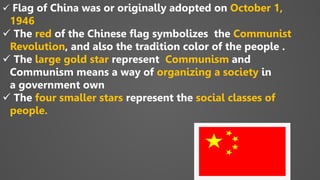
 Flag of China was or originally adopted on October 1,
1946
 The red of the Chinese flag symbolizes the Communist
Revolution, and also the tradition color of the people .
 The large gold star represent Communism and
Communism means a way of organizing a society in
a government own
 The four smaller stars represent the social classes of
people.
 The Republic of the China has an area of 9,597 million
sq. km. and the capital city of the China is Beijing
 The famous landmark in China is the Great Wall of China (also
known as the “Ten Thousand Li Wall". One Li is equals to 500
meters, the walls is over 1,500 miles in length.
 The administration of China has 23 provinces, 5 autonomous
region, 4 municipalities and 2 special administrative regions.
 The religion and beliefs of Chinese people are
Islam over 22 million, Catholicism is 4 million and
Protestant over 10 million.
 There are also Atheist who doesn’t believe in
God.
 Confucianism - an ethical teaching founded by Confucius.
 Confucius is a Chinese Teacher, editor, political and
philosopher of the spring and autumn period of Chinese
history.
Confucius
 born 28 of September 551 BC, KONG QUI
The 1st name and died 479 BC.
 he is the founder of Confucianism influence – 1 Ching,
Book of Rites
 his philosophy emphasized personal and governmental
morality, correctness of social relationship, Justice and
sincerity.
 his followers completed successfully with many other
school during the hundred school of thoughts era only to
be suppressed in favor of the legalists during the Qin
dynasty.
 He also recommend family as a basis for local government.
 He embrace the well known principle “Do not do undo
others what you don’t want others to do unto you”- the
Golden Rule.
 Culture and traditions of Chinese in wedding.
 Red is the color of wedding in China because they believe it
signifies love, joy, and prosperity to seclusion.
 Seclusion means away from other people.
 The wedding day is carefully chosen to astrological signs.
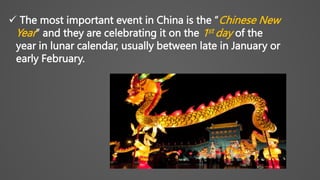
 The most important event in China is the “Chinese New
Year” and they are celebrating it on the 1st day of the
year in lunar calendar, usually between late in January or
early February.
 They also have the Lantern Festival and they are
celebrating it on the 15th day of the 1st Lunar Calendar
and in the 5th of 5th Lunar Month they are celebrating
the Dragon Boat Festival.
 The education in China has always been a highly
valued and the great master Confucius thought that it is
a pleasure to learn something and try it out at intervals.
Similarly, numerous students have been convinced that
reading books excels all others careers.
The Chinese has 7 dialects and these are:
1. Mandarin
2. Cantonese
3. Hakka
4. Wu
5. Min
6. Xiang
7. Gan
Chinese literature is one of the most major literacy with
an interrupted history and more that 30,000 years, dating
back at least to the 14th century.
4 Classes of literature
1.Classical Literature
2.Modern Literature
3.Contemporary Literature
4.Present Age Literature
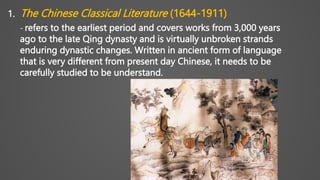
1. The Chinese Classical Literature (1644-1911)
- refers to the earliest period and covers works from 3,000 years
ago to the late Qing dynasty and is virtually unbroken strands
enduring dynastic changes. Written in ancient form of language
that is very different from present day Chinese, it needs to be
carefully studied to be understand.
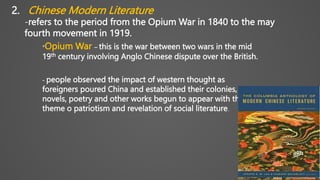
2. Chinese Modern Literature
-refers to the period from the Opium War in 1840 to the may
fourth movement in 1919.
*Opium War – this is the war between two wars in the mid
19th century involving Anglo Chinese dispute over the British.
- people observed the impact of western thought as
foreigners poured China and established their colonies,
novels, poetry and other works begun to appear with the
theme o patriotism and revelation of social literature.
3. Contemporary Literature (1919-1949)
- Spanned period from 1919 to foundation of modern in
1949 and took on a new vigor despite the fact that Chinese
was in the checkered and complicated times.
4. Present Age Literature (1949-present)
-evolved since the establishments of the people’s Republic
in 1949 during this time.
-There was a logia is a consequence of the cultural resolution
that lasted for near 10 years that era is now long past and we
now have a favorable turn events and a great number of
responsible written works.
1. Shang Dynasty (1700-1050 BC) – Development of Chinese
Writing
- 1st dynasty
- Hieroglyphics writing on bronze wares and oracle bones
- It evolved into ideographic and partly-phonetic Chinese
characters.
Dynasty in China
2. Zhou Dynasty (1045-225 BC) – Basic Philosophical and
religious Literature.
- Oldest dynasty
- Major literary achievements originated in the late Spring
and autumn and warming state period.
Dynasty in China
3. Qin Dynasty (221-206 BC) – Literary Disaster and Legalism
*Mohism – big philosophical and religious school
*Li Si – Qin emperor who introduced a writing system
and developed into Modern Chinese writing.
*Legalism – philosophical school.
Dynasty in China
4. Han Dynasty (206 – 220 BC) – Scientific and Historical Texts
-Era’s major contributions were historical texts and
scientific works.
*Sima Qian – wrote historical Records
*Historical records – major history concerning the
overall history of China from Shang Dynasty to Han
Dynasty.
*Cai Lun – 1st person in the world to create writing
paper.
5. Tang Dynasty (618-907) – Early Woodblock Printing and
Poetry
*Dufu and Li Bai – China’s greatest poets.
*Li Bai – one of the greatest Romantic poets.
*Dufu – one of the greatest realists poets.
6. Song Dynasty (960-1279) – Early Woodblock Printing,
Travel Literature, Poetry, Scientific texts and the Neb-
Confucian Classics
*5 Classics and 4 books – written in the classical
language.
*Shen Kuo and Su Song – both work scientific
treatises
*Shen – discovered the concepts of true north and
magnetic declination.
*Su Song – famous for his hydraulic-powered
astronomical clock tower.
7. Yuan Dynasty (1279-1368)- Drama and Great Fictional
novels
*Gua Hanquing – one of the best playwrights of the
times.
*Mid Summer Snow – one of the most popular
drama pieces.
*The romance of the Three Kingdoms and Water
Margin – two of the four greatest novels in Chinese
Literature.
*The Romance of the Western Chamber by Wang
Shifu – one of the best romantic dramas ever written
in China.
8. Ming Dynasty (1368-1644) – Novels
- Jouney to the west by wu Cheng’en – based on the
historical journey of a Buddhist to india
9. Qing Dynasty (1644-1911) – Novels and Pre-
moderns Literature
*Manchus – established the last dynasty.
*The Dream of the Red Chamber – last of China’s four
great classic novels.

Pananaliksik reporting

  • 2.
     Chinese civilization- one of the few ancient civilization to have its individual writing concept.  The Chinese language has over 20,000 characters the average Chinese only learns about 5,000 of these in his lifetime.
  • 3.
     Flag ofChina was or originally adopted on October 1, 1946  The red of the Chinese flag symbolizes the Communist Revolution, and also the tradition color of the people .  The large gold star represent Communism and Communism means a way of organizing a society in a government own  The four smaller stars represent the social classes of people.
  • 4.
     The Republicof the China has an area of 9,597 million sq. km. and the capital city of the China is Beijing
  • 5.
     The famouslandmark in China is the Great Wall of China (also known as the “Ten Thousand Li Wall". One Li is equals to 500 meters, the walls is over 1,500 miles in length.  The administration of China has 23 provinces, 5 autonomous region, 4 municipalities and 2 special administrative regions.
  • 6.
     The religionand beliefs of Chinese people are Islam over 22 million, Catholicism is 4 million and Protestant over 10 million.  There are also Atheist who doesn’t believe in God.
  • 7.
     Confucianism -an ethical teaching founded by Confucius.  Confucius is a Chinese Teacher, editor, political and philosopher of the spring and autumn period of Chinese history.
  • 8.
    Confucius  born 28of September 551 BC, KONG QUI The 1st name and died 479 BC.  he is the founder of Confucianism influence – 1 Ching, Book of Rites  his philosophy emphasized personal and governmental morality, correctness of social relationship, Justice and sincerity.  his followers completed successfully with many other school during the hundred school of thoughts era only to be suppressed in favor of the legalists during the Qin dynasty.  He also recommend family as a basis for local government.  He embrace the well known principle “Do not do undo others what you don’t want others to do unto you”- the Golden Rule.
  • 9.
     Culture andtraditions of Chinese in wedding.  Red is the color of wedding in China because they believe it signifies love, joy, and prosperity to seclusion.  Seclusion means away from other people.  The wedding day is carefully chosen to astrological signs.
  • 10.
     The mostimportant event in China is the “Chinese New Year” and they are celebrating it on the 1st day of the year in lunar calendar, usually between late in January or early February.
  • 11.
     They alsohave the Lantern Festival and they are celebrating it on the 15th day of the 1st Lunar Calendar and in the 5th of 5th Lunar Month they are celebrating the Dragon Boat Festival.
  • 12.
     The educationin China has always been a highly valued and the great master Confucius thought that it is a pleasure to learn something and try it out at intervals. Similarly, numerous students have been convinced that reading books excels all others careers.
  • 13.
    The Chinese has7 dialects and these are: 1. Mandarin 2. Cantonese 3. Hakka 4. Wu 5. Min 6. Xiang 7. Gan
  • 14.
    Chinese literature isone of the most major literacy with an interrupted history and more that 30,000 years, dating back at least to the 14th century. 4 Classes of literature 1.Classical Literature 2.Modern Literature 3.Contemporary Literature 4.Present Age Literature
  • 15.
    1. The ChineseClassical Literature (1644-1911) - refers to the earliest period and covers works from 3,000 years ago to the late Qing dynasty and is virtually unbroken strands enduring dynastic changes. Written in ancient form of language that is very different from present day Chinese, it needs to be carefully studied to be understand.
  • 16.
    2. Chinese ModernLiterature -refers to the period from the Opium War in 1840 to the may fourth movement in 1919. *Opium War – this is the war between two wars in the mid 19th century involving Anglo Chinese dispute over the British. - people observed the impact of western thought as foreigners poured China and established their colonies, novels, poetry and other works begun to appear with the theme o patriotism and revelation of social literature.
  • 17.
    3. Contemporary Literature(1919-1949) - Spanned period from 1919 to foundation of modern in 1949 and took on a new vigor despite the fact that Chinese was in the checkered and complicated times.
  • 18.
    4. Present AgeLiterature (1949-present) -evolved since the establishments of the people’s Republic in 1949 during this time. -There was a logia is a consequence of the cultural resolution that lasted for near 10 years that era is now long past and we now have a favorable turn events and a great number of responsible written works.
  • 19.
    1. Shang Dynasty(1700-1050 BC) – Development of Chinese Writing - 1st dynasty - Hieroglyphics writing on bronze wares and oracle bones - It evolved into ideographic and partly-phonetic Chinese characters. Dynasty in China
  • 20.
    2. Zhou Dynasty(1045-225 BC) – Basic Philosophical and religious Literature. - Oldest dynasty - Major literary achievements originated in the late Spring and autumn and warming state period. Dynasty in China
  • 21.
    3. Qin Dynasty(221-206 BC) – Literary Disaster and Legalism *Mohism – big philosophical and religious school *Li Si – Qin emperor who introduced a writing system and developed into Modern Chinese writing. *Legalism – philosophical school. Dynasty in China
  • 22.
    4. Han Dynasty(206 – 220 BC) – Scientific and Historical Texts -Era’s major contributions were historical texts and scientific works. *Sima Qian – wrote historical Records *Historical records – major history concerning the overall history of China from Shang Dynasty to Han Dynasty. *Cai Lun – 1st person in the world to create writing paper.
  • 23.
    5. Tang Dynasty(618-907) – Early Woodblock Printing and Poetry *Dufu and Li Bai – China’s greatest poets. *Li Bai – one of the greatest Romantic poets. *Dufu – one of the greatest realists poets.
  • 24.
    6. Song Dynasty(960-1279) – Early Woodblock Printing, Travel Literature, Poetry, Scientific texts and the Neb- Confucian Classics *5 Classics and 4 books – written in the classical language. *Shen Kuo and Su Song – both work scientific treatises *Shen – discovered the concepts of true north and magnetic declination. *Su Song – famous for his hydraulic-powered astronomical clock tower.
  • 25.
    7. Yuan Dynasty(1279-1368)- Drama and Great Fictional novels *Gua Hanquing – one of the best playwrights of the times. *Mid Summer Snow – one of the most popular drama pieces. *The romance of the Three Kingdoms and Water Margin – two of the four greatest novels in Chinese Literature. *The Romance of the Western Chamber by Wang Shifu – one of the best romantic dramas ever written in China.
  • 26.
    8. Ming Dynasty(1368-1644) – Novels - Jouney to the west by wu Cheng’en – based on the historical journey of a Buddhist to india
  • 27.
    9. Qing Dynasty(1644-1911) – Novels and Pre- moderns Literature *Manchus – established the last dynasty. *The Dream of the Red Chamber – last of China’s four great classic novels.