Palliative Care in Jordan
A WHO demonstration project
Global Summit on International Breast Health: optimizing
                 Healthcare Delivery
              June 9-11.Chicago,Illinois


                                                   Mohammad Bushnaq, MD
                                     Hospice and Palliative Care Consultant
                            Jordan Palliative Care Society, Chairman -Jordan
Palliative Care- Global perspective.
WHO Palliative Care Initiative.
National Palliative Care Initiative.
Palliative care is defined as:

‘Palliative care is an approach that improves the
 quality of life of patients and their families facing
 the problem associated with life-threatening
 illness, through the prevention and relief of
 suffering by means of early identification and
 impeccable assessment and treatment of pain
 and other problems, physical, psychosocial and
 spiritual’ WHO
Palliative care relieves suffering and improves
the quality of life of the living and the dying.
 More than 30 million people suffer
unnecessarily from severe pain and other
symptoms each year.
In spite of all the efforts over the last 2 decades,
most people who need palliative care are not
getting it.
  Stjernsward J, Clark D. Palliative medicine. A global perspective. In Doyle D. Oxford text book in Palliative
                                      medicine. 3rd ed. New York: oxford university press.2004. pp 1199-1224
Distribution of Palliative Care Services
There are 60 million person dying each year. 6
million of them die in pain. Only 1 million of them
receive palliative care.
It is estimated that there are 8,000
hospice/palliative care services, in about 100
countries around the world .
86% of services world wide are located only in
ten countries .
                    Journal of Public Health Policy, 2007 by Webster, Ruth, Lacey, Judith, Quine, Susan
A public health approach aims to protect and improve the
health and quality of life of a community by translating new
knowledge and skills into evidence-based, cost-effective
interventions.

it is important that all countries integrate pain relief and
palliative care into their health care systems at all levels.


     Stjernswa rd J, Stanley K, Tsechkovski M. Cancer pain relief: an urgent public health problem in
     India. Indian J Pain 1985;1:95e97.
Palliative care became a part of the National
Health Plan in Catalonia, Uganda, Mongolia,
and Georgia. The Indian state of Kerala has
successfully integrated palliative care through
community approach.


                                  Palliative Medicine-The Global Perspective: Closing the Know – Do Gap,
             Stjernsward and Xavier Gomez-Batiste. Declan Walsh, Text book of palliative medicine, page 6
The Catalonia WHO demonstration project was
the first to reach the long-term outcomes, having
covered 80% of all those needing palliative care in
a population of 6 million (now 7 million) and with
15 years of follow-up.


                                       Palliative Medicine-The Global Perspective: Closing the Know – Do Gap,
                  Stjernsward and Xavier Gomez-Batiste. Declan Walsh, Text book of palliative medicine, page 6
Palliative Care in Jordan
Jordan is a relatively small country covering
 92,3 km2.
 It has a population of 6.3 million people (estimated
in 2009), 50% of whom are under 25 years of age.
According to cancer registry; cancer incidence is
estimated to be 4332 new cases per year.
60-70% of new cancer patients in Jordan present
late to the health care system with advanced Stage
III/IV cancers.
Breast cancer in Jordan

According to the latest statistics from the Jordan
National Cancer Registry, 674 females and 10 males
were diagnosed with breast cancer in 2005, accounting
for 18.6% of the total new cancer cases. Breast cancer
ranked first among cancer in females, accounting for
36.2% of all female cancers, and is the leading cause
of cancer deaths among Jordanian women.
70% of breast cancer cases in the country are
presented at advanced stages (III-IV) during which
survival rates are low and the disease is less curable
and only 30% of cases are diagnosed in early stages
(0-II).
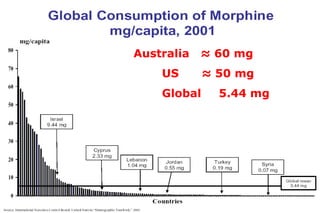
Australia   ≈ 60 mg
    US       ≈ 50 mg
    Global     5.44 mg
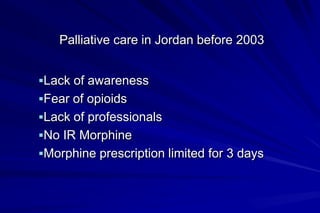
Palliative care in Jordan before 2003


Lack of awareness
Fear of opioids
Lack of professionals
No IR Morphine

Morphine prescription limited for 3 days
Jordan Initiative for
   Pain Relief &
  Palliative Care
Palliative care in Jordan..From dream into action


Started with a dream from a donor, who had a
dream to make Middle East free of pain.
Jordan Palliative Care initiative- WHO project.
National Palliative care committee.
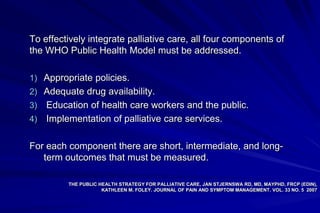
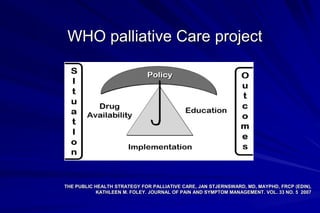
To effectively integrate palliative care, all four components of
the WHO Public Health Model must be addressed.

1) Appropriate policies.
2) Adequate drug availability.
3) Education of health care workers and the public.
4) Implementation of palliative care services.


For each component there are short, intermediate, and long-
   term outcomes that must be measured.

         THE PUBLIC HEALTH STRATEGY FOR PALLIATIVE CARE, JAN STJERNSWA RD, MD, MAYPHD, FRCP (EDIN),
                     KATHLEEN M. FOLEY. JOURNAL OF PAIN AND SYMPTOM MANAGEMENT. VOL. 33 NO. 5 2007
WHO palliative Care project


THE PUBLIC HEALTH STRATEGY FOR PALLIATIVE CARE, JAN STJERNSWARD, MD, MAYPHD, FRCP (EDIN),
           KATHLEEN M. FOLEY. JOURNAL OF PAIN AND SYMPTOM MANAGEMENT. VOL. 33 NO. 5 2007
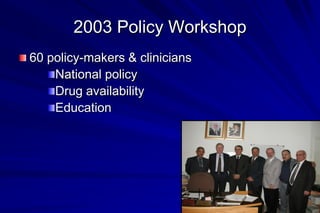
2003 Policy Workshop
60 policy-makers & clinicians
    National policy
    Drug availability
    Education
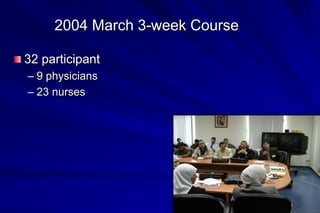
2004 March 3-week Course

32 participant
– 9 physicians
– 23 nurses
Regulations governing opioid prescribing have been
changed to facilitate effective pain management.

The national opioid quota has been increased
(From 2kg to 11 kg, 2003-2007).Cost-effective, generic,
immediate-release morphine produced.

Intensive, interactive bedside training courses.
“Champions” for palliative care have emerged who are
leading the development of palliative care in Jordan and
support neighboring countries to develop pain relief and
palliative care.
       Jan Stjernswärd, Frank D Ferris. Journal of Pain and Symptom Pages 628-6Management, Volume
                                                                            33, Issue 5, 33, May 2007
-KHCC hired the first palliative care physician, social
worker, chaplain, and clinical pharmacist in As of
December 2006.
-palliative care service is admitting 400 new patients per
year and caring for 60–80 patients per month (of which 30–
40 receive home care).
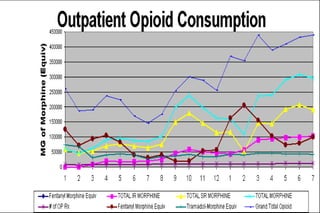
-At KHCC, opioid usage in the outpatient setting alone has
doubled from 2.5 kg in 2005 to a projected 5kg in 2006.
This is a 3.3 fold increase since 2004.
-The King Hussein Cancer Center is now developing into a
reference center of excellence, not only nationally but for
the region.
         JAN STJERNSWÄRD, FRANK D FERRIS. JOURNAL OF PAIN AND SYMPTOM MANAGEMENT,
                                            VOLUME 33, ISSUE 5, PAGES 628-633, MAY 2007
National palliative care initiatives
  From knowledge into action
There is no palliative care service outside KHCC. the
access to opioids is still limited by many factors like,
fear of opioids among health care workers and the
people, policies and roles limiting the duration of
prescribing opioids (10 days for cancer patients and 3
days for non cancer patients), and palliative care still
not integrated into national health strategy.
Strengths
Well established health care system
Palliative care committee
Well established program at KHCC
Culture
Drugs available
Policy change
In February 10th-12th, 2010; a regional Palliative Care
was conducted in Jordan as an initiative of the world
Health Organization - East Mediterranean Regional
office (WHO-EMRO). The participants were
physicians, nurses, psychologists and social workers
from Bahrain, Egypt, Jordan, Lebanon, Morocco,
Oman, Palestine and Saudi Arabia.
Arabic Consortium for Palliative Care was formed to
encourage collaboration among the Palliative Care
teams from these countries.
As for palliative care in Jordan, the SWOT analysis
showed that the main weakness points were shortage
of palliative care teams, and lack of awareness about
palliative care and pain among health care workers in
Jordan.
There was a need for a society that would take the
initiative to address the challenges and help
coordinating the efforts to implement palliative care in
Jordan.
Jordan Palliative Care Society

 To help health care workers to provide high
quality pain and symptom management, for
patient with chronic disease; by training and
education, assuring drug availability, and
creating a network for palliative care across the
country.
Knowing that education and training is the corner
stone in changing the practice of palliative care in
Jordan, JPS started with a two weeks workshop that
will be given for family medicine teams, which
includes physicians, nurses and pharmacists. The
goals are create palliative care teams across the
country. This will be followed by creating a palliative
care network for sharing knowledge and preparing
leaders for palliative care.
National Palliative Care Workshop

 A national workshop offers the most effective
 way to address the establishment of the four
 foundation measures and come up with a plan
 of action for integrating palliative care into the
 health care system; it brings together the key
 participants and organizations necessary to
 accomplish these tasks.
                             Palliative Medicine-The Global Perspective: Closing the Know – Do Gap,
        Stjernsward and Xavier Gomez-Batiste. Declan Walsh, Text book of palliative medicine, page 6
In countries with relatively destructured
governments, nongovernmental organizations
(NGOs) have had an important role in model
programs and initial projects. their more difficult
challenge is propelling projects and resources
into public health services for long-term viability.

                              Palliative Medicine-The Global Perspective: Closing the Know – Do Gap,
         Stjernsward and Xavier Gomez-Batiste. Declan Walsh, Text book of palliative medicine, page 6
Next steps
Palliative care workshops for family physicians, GP’s, and
nurses. The goal is to train- of trainers for palliative care
teams across the country.

National pain meeting, next November. The meeting will
include health care workers, decision makers, and stock
holders, to address pain issues in Jordan.

Arabic palliative Care Consortium.
Conclusion
Palliative medicine is an essential need for
patients with chronic diseases.
Many countries managed to integrate palliative
medicine into health care strategy.
Jordan WHO palliative care project reflected in
creating a center of excellence at KHCC.
There is still need to spread the culture of
palliative medicine across the country.
"Never doubt that a
small group of
thoughtful,
committed people
can change the
world. Indeed, it is
the only thing that
ever has." - Margaret
Mead.
Thank you

Paiati Cre in jrdn

  • 1.
    Palliative Care inJordan A WHO demonstration project Global Summit on International Breast Health: optimizing Healthcare Delivery June 9-11.Chicago,Illinois Mohammad Bushnaq, MD Hospice and Palliative Care Consultant Jordan Palliative Care Society, Chairman -Jordan
  • 2.
    Palliative Care- Globalperspective. WHO Palliative Care Initiative. National Palliative Care Initiative.
  • 3.
    Palliative care isdefined as: ‘Palliative care is an approach that improves the quality of life of patients and their families facing the problem associated with life-threatening illness, through the prevention and relief of suffering by means of early identification and impeccable assessment and treatment of pain and other problems, physical, psychosocial and spiritual’ WHO
  • 4.
    Palliative care relievessuffering and improves the quality of life of the living and the dying. More than 30 million people suffer unnecessarily from severe pain and other symptoms each year. In spite of all the efforts over the last 2 decades, most people who need palliative care are not getting it. Stjernsward J, Clark D. Palliative medicine. A global perspective. In Doyle D. Oxford text book in Palliative medicine. 3rd ed. New York: oxford university press.2004. pp 1199-1224
  • 5.
    Distribution of PalliativeCare Services There are 60 million person dying each year. 6 million of them die in pain. Only 1 million of them receive palliative care. It is estimated that there are 8,000 hospice/palliative care services, in about 100 countries around the world . 86% of services world wide are located only in ten countries . Journal of Public Health Policy, 2007 by Webster, Ruth, Lacey, Judith, Quine, Susan
  • 6.
    A public healthapproach aims to protect and improve the health and quality of life of a community by translating new knowledge and skills into evidence-based, cost-effective interventions. it is important that all countries integrate pain relief and palliative care into their health care systems at all levels. Stjernswa rd J, Stanley K, Tsechkovski M. Cancer pain relief: an urgent public health problem in India. Indian J Pain 1985;1:95e97.
  • 7.
    Palliative care becamea part of the National Health Plan in Catalonia, Uganda, Mongolia, and Georgia. The Indian state of Kerala has successfully integrated palliative care through community approach. Palliative Medicine-The Global Perspective: Closing the Know – Do Gap, Stjernsward and Xavier Gomez-Batiste. Declan Walsh, Text book of palliative medicine, page 6
  • 8.
    The Catalonia WHOdemonstration project was the first to reach the long-term outcomes, having covered 80% of all those needing palliative care in a population of 6 million (now 7 million) and with 15 years of follow-up. Palliative Medicine-The Global Perspective: Closing the Know – Do Gap, Stjernsward and Xavier Gomez-Batiste. Declan Walsh, Text book of palliative medicine, page 6
  • 9.
  • 11.
    Jordan is arelatively small country covering 92,3 km2.  It has a population of 6.3 million people (estimated in 2009), 50% of whom are under 25 years of age. According to cancer registry; cancer incidence is estimated to be 4332 new cases per year. 60-70% of new cancer patients in Jordan present late to the health care system with advanced Stage III/IV cancers.
  • 12.
    Breast cancer inJordan According to the latest statistics from the Jordan National Cancer Registry, 674 females and 10 males were diagnosed with breast cancer in 2005, accounting for 18.6% of the total new cancer cases. Breast cancer ranked first among cancer in females, accounting for 36.2% of all female cancers, and is the leading cause of cancer deaths among Jordanian women.
  • 13.
    70% of breastcancer cases in the country are presented at advanced stages (III-IV) during which survival rates are low and the disease is less curable and only 30% of cases are diagnosed in early stages (0-II).
  • 14.
    Australia ≈ 60 mg US ≈ 50 mg Global 5.44 mg
  • 15.
    Palliative care inJordan before 2003 Lack of awareness Fear of opioids Lack of professionals No IR Morphine Morphine prescription limited for 3 days
  • 16.
    Jordan Initiative for Pain Relief & Palliative Care
  • 17.
    Palliative care inJordan..From dream into action Started with a dream from a donor, who had a dream to make Middle East free of pain. Jordan Palliative Care initiative- WHO project. National Palliative care committee.
  • 18.
    To effectively integratepalliative care, all four components of the WHO Public Health Model must be addressed. 1) Appropriate policies. 2) Adequate drug availability. 3) Education of health care workers and the public. 4) Implementation of palliative care services. For each component there are short, intermediate, and long- term outcomes that must be measured. THE PUBLIC HEALTH STRATEGY FOR PALLIATIVE CARE, JAN STJERNSWA RD, MD, MAYPHD, FRCP (EDIN), KATHLEEN M. FOLEY. JOURNAL OF PAIN AND SYMPTOM MANAGEMENT. VOL. 33 NO. 5 2007
  • 19.
    WHO palliative Careproject THE PUBLIC HEALTH STRATEGY FOR PALLIATIVE CARE, JAN STJERNSWARD, MD, MAYPHD, FRCP (EDIN), KATHLEEN M. FOLEY. JOURNAL OF PAIN AND SYMPTOM MANAGEMENT. VOL. 33 NO. 5 2007
  • 20.
    2003 Policy Workshop 60policy-makers & clinicians National policy Drug availability Education
  • 21.
    2004 March 3-weekCourse 32 participant – 9 physicians – 23 nurses
  • 22.
    Regulations governing opioidprescribing have been changed to facilitate effective pain management. The national opioid quota has been increased (From 2kg to 11 kg, 2003-2007).Cost-effective, generic, immediate-release morphine produced. Intensive, interactive bedside training courses. “Champions” for palliative care have emerged who are leading the development of palliative care in Jordan and support neighboring countries to develop pain relief and palliative care. Jan Stjernswärd, Frank D Ferris. Journal of Pain and Symptom Pages 628-6Management, Volume 33, Issue 5, 33, May 2007
  • 23.
    -KHCC hired thefirst palliative care physician, social worker, chaplain, and clinical pharmacist in As of December 2006. -palliative care service is admitting 400 new patients per year and caring for 60–80 patients per month (of which 30– 40 receive home care). -At KHCC, opioid usage in the outpatient setting alone has doubled from 2.5 kg in 2005 to a projected 5kg in 2006. This is a 3.3 fold increase since 2004. -The King Hussein Cancer Center is now developing into a reference center of excellence, not only nationally but for the region. JAN STJERNSWÄRD, FRANK D FERRIS. JOURNAL OF PAIN AND SYMPTOM MANAGEMENT, VOLUME 33, ISSUE 5, PAGES 628-633, MAY 2007
  • 25.
    National palliative careinitiatives From knowledge into action
  • 26.
    There is nopalliative care service outside KHCC. the access to opioids is still limited by many factors like, fear of opioids among health care workers and the people, policies and roles limiting the duration of prescribing opioids (10 days for cancer patients and 3 days for non cancer patients), and palliative care still not integrated into national health strategy.
  • 27.
    Strengths Well established healthcare system Palliative care committee Well established program at KHCC Culture Drugs available Policy change
  • 28.
    In February 10th-12th,2010; a regional Palliative Care was conducted in Jordan as an initiative of the world Health Organization - East Mediterranean Regional office (WHO-EMRO). The participants were physicians, nurses, psychologists and social workers from Bahrain, Egypt, Jordan, Lebanon, Morocco, Oman, Palestine and Saudi Arabia. Arabic Consortium for Palliative Care was formed to encourage collaboration among the Palliative Care teams from these countries.
  • 29.
    As for palliativecare in Jordan, the SWOT analysis showed that the main weakness points were shortage of palliative care teams, and lack of awareness about palliative care and pain among health care workers in Jordan. There was a need for a society that would take the initiative to address the challenges and help coordinating the efforts to implement palliative care in Jordan.
  • 30.
    Jordan Palliative CareSociety To help health care workers to provide high quality pain and symptom management, for patient with chronic disease; by training and education, assuring drug availability, and creating a network for palliative care across the country.
  • 31.
    Knowing that educationand training is the corner stone in changing the practice of palliative care in Jordan, JPS started with a two weeks workshop that will be given for family medicine teams, which includes physicians, nurses and pharmacists. The goals are create palliative care teams across the country. This will be followed by creating a palliative care network for sharing knowledge and preparing leaders for palliative care.
  • 32.
    National Palliative CareWorkshop A national workshop offers the most effective way to address the establishment of the four foundation measures and come up with a plan of action for integrating palliative care into the health care system; it brings together the key participants and organizations necessary to accomplish these tasks. Palliative Medicine-The Global Perspective: Closing the Know – Do Gap, Stjernsward and Xavier Gomez-Batiste. Declan Walsh, Text book of palliative medicine, page 6
  • 33.
    In countries withrelatively destructured governments, nongovernmental organizations (NGOs) have had an important role in model programs and initial projects. their more difficult challenge is propelling projects and resources into public health services for long-term viability. Palliative Medicine-The Global Perspective: Closing the Know – Do Gap, Stjernsward and Xavier Gomez-Batiste. Declan Walsh, Text book of palliative medicine, page 6
  • 34.
    Next steps Palliative careworkshops for family physicians, GP’s, and nurses. The goal is to train- of trainers for palliative care teams across the country. National pain meeting, next November. The meeting will include health care workers, decision makers, and stock holders, to address pain issues in Jordan. Arabic palliative Care Consortium.
  • 35.
    Conclusion Palliative medicine isan essential need for patients with chronic diseases. Many countries managed to integrate palliative medicine into health care strategy. Jordan WHO palliative care project reflected in creating a center of excellence at KHCC. There is still need to spread the culture of palliative medicine across the country.
  • 36.
    "Never doubt thata small group of thoughtful, committed people can change the world. Indeed, it is the only thing that ever has." - Margaret Mead.
  • 37.