16th Chancellor Alfredo T. Ramirez
MEMORIAL LECTURE
Application of the Management Process in
Thyroid Nodules – 30 Years of Experience
Reynaldo O. Joson, MD, MHA, MHPEd, MS Surg
Family of Dr. Alfredo T. Ramirez
Ms. Bella Yan-Ramirez
Mr. Clark Alfredo Ramirez
Foundation for the Advancement of Surgical
Education, Inc.
Dr. Telesforo Gana
UPCM-PGH Department of Surgery
Dr. Nelson Cabaluna
Postgraduate Courses Committee
Dr. Orlino Bisquera
Surgical Colleagues
Surgical Learners
Friends
Ladies and Gentlemen
16th
Chancellor Alfredo T. Ramirez
Memorial Lecturer
Reynaldo O. Joson, MD, MHA, MHPEd, MS Surg
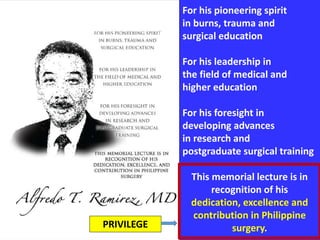
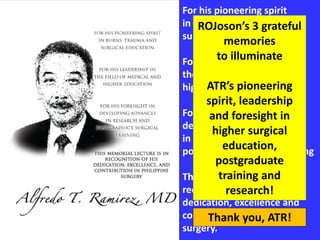
For his pioneering spirit
in burns, trauma and
surgical education
For his leadership in
the field of medical and
higher education
For his foresight in
developing advances
in research and
postgraduate surgical training
This memorial lecture is in
recognition of his
dedication, excellence and
contribution in Philippine
surgery.PRIVILEGE
For his pioneering spirit
in burns, trauma and
surgical education
For his leadership in
the field of medical and
higher education
For his foresight in
developing advances
in research and
postgraduate surgical training
This memorial lecture is in
recognition of his
dedication, excellence and
contribution in Philippine
surgery.
ROJoson’s grateful
memories
to illuminate
ATR’s pioneering
spirit, leadership
and foresight in
higher surgical
education,
postgraduate
training and
research!
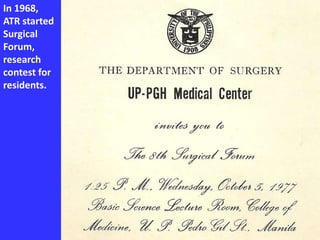
In 1968,
ATR started
Surgical
Forum,
research
contest for
residents.
In 1968,
ATR
started
Surgical
Forum,
research
contest
for
residents.
I joined it
from 1977
to 1979.
Tumors of the Parotid Gland – A
Clinicopathologic Study of 139
Cases
Reynaldo O. Joson, MD
Reynaldo O. Joson, MDCarcinoid Tumors of the
Gastrointestinal Tract
1977 Surgical Forum
In 1968,
ATR
started
Surgical
Forum,
research
contest
for
residents.
I joined it
from
1977 to
1979.
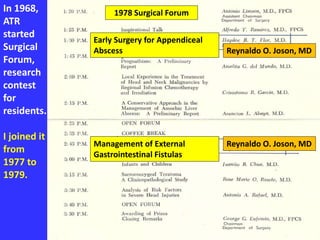
1978 Surgical Forum
Management of External
Gastrointestinal Fistulas
Reynaldo O. Joson, MD
Early Surgery for Appendiceal
Abscess Reynaldo O. Joson, MD
In 1968,
ATR
started
Surgical
Forum,
research
contest for
residents.
I joined it
from 1977
to 1979.
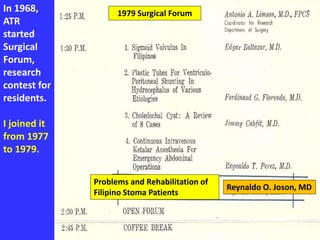
1979 Surgical Forum
Problems and Rehabilitation of
Filipino Stoma Patients
Reynaldo O. Joson, MD
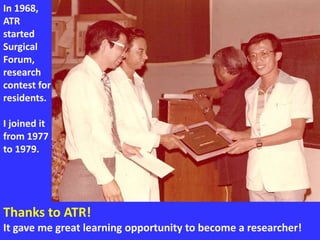
Thanks to ATR!
It gave me great learning opportunity to become a researcher!
In 1968,
ATR
started
Surgical
Forum,
research
contest for
residents.
I joined it
from 1977
to 1979.
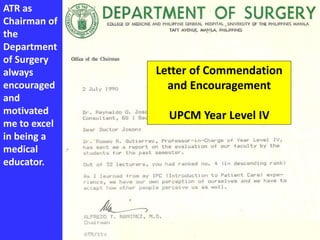
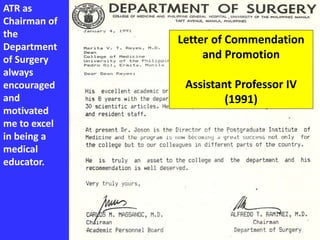
ATR as
Chairman of
the
Department
of Surgery
always
encouraged
and
motivated
me to excel
in being a
medical
educator.
Letter of Commendation
and Encouragement
UPCM Year Level IV
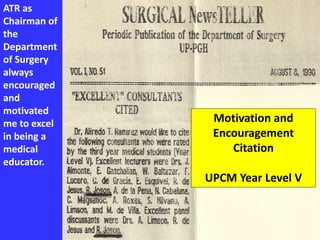
ATR as
Chairman of
the
Department
of Surgery
always
encouraged
and
motivated
me to excel
in being a
medical
educator.
Motivation and
Encouragement
Citation
UPCM Year Level V
ATR as
Chairman of
the
Department
of Surgery
always
encouraged
and
motivated
me to excel
in being a
medical
educator.
Letter of Commendation
and Promotion
Assistant Professor IV
(1991)
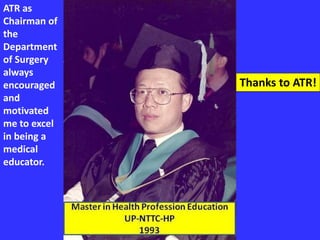
ATR as
Chairman of
the
Department
of Surgery
always
encouraged
and
motivated
me to excel
in being a
medical
educator.
Thanks to ATR!
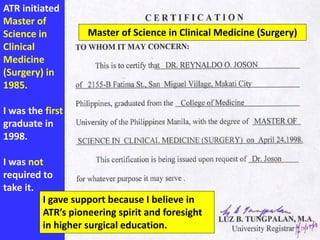
ATR initiated
Master of
Science in
Clinical
Medicine
(Surgery) in
1985.
I was the first
graduate in
1998.
I was not
required to
take it.
I gave support because I believe in
ATR’s pioneering spirit and foresight
in higher surgical education.
Master of Science in Clinical Medicine (Surgery)
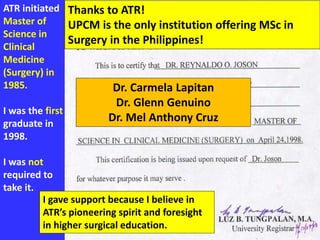
ATR initiated
Master of
Science in
Clinical
Medicine
(Surgery) in
1985.
I was the first
graduate in
1998.
I was not
required to
take it.
I gave support because I believe in
ATR’s pioneering spirit and foresight
in higher surgical education.
Thanks to ATR!
UPCM is the only institution offering MSc in
Surgery in the Philippines!
Dr. Carmela Lapitan
Dr. Glenn Genuino
Dr. Mel Anthony Cruz
For his pioneering spirit
in burns, trauma and
surgical education
For his leadership in
the field of medical and
higher education
For his foresight in
developing advances
in research and
postgraduate surgical training
This memorial lecture is in
recognition of his
dedication, excellence and
contribution in Philippine
surgery.
ROJoson’s 3 grateful
memories
to illuminate
ATR’s pioneering
spirit, leadership
and foresight in
higher surgical
education,
postgraduate
training and
research!
Thank you, ATR!
16th
Chancellor Alfredo T. Ramirez Memorial
Lecturer
Reynaldo O. Joson, MD, MHA, MHPEd, MS Surg
Dedication and excellence of ATR in medical education and
research!
16th
Chancellor Alfredo T. Ramirez Memorial
Lecture
Application of the Management Process in
Thyroid Nodules: Thirty Years of
Experience
Reynaldo O. Joson, MD, MHA, MHPEd, MSc Surg
16th
Chancellor Alfredo T. Ramirez Memorial Lecture
Application of the Management Process in
Thyroid Nodules: Thirty Years of
Experience
52th Postgraduate Course Theme
Oncologic Surgery
Current Concepts and Management
16th
Chancellor Alfredo T. Ramirez Memorial Lecture
Application of the Management Process in
Thyroid Nodules: Thirty Years of
Experience
Former students so impressed with my
• usage of patient management process circa 1985
• Thyroid Surgical Diseases book 1986
(that’s 30 years ago)
which I have been using as a basis in the
management of patients with thyroid disorders /
nodules
Pretreatment Diagnosis
Specification of treatment objectives
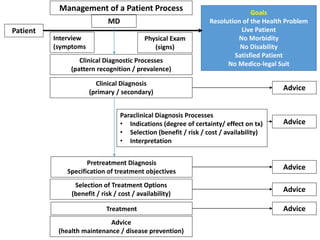
Management of a Patient Process
Patient
MD
Goals
Resolution of the Health Problem
Live Patient
No Morbidity
No Disability
Satisfied Patient
No Medico-legal Suit
Interview
(symptoms
Physical Exam
(signs)
Clinical Diagnostic Processes
(pattern recognition / prevalence)
Clinical Diagnosis
(primary / secondary)
Advice
(health maintenance / disease prevention)
Paraclinical Diagnosis Processes
• Indications (degree of certainty/ effect on tx)
• Selection (benefit / risk / cost / availability)
• Interpretation
Advice
Advice
Advice
Advice
Advice
Selection of Treatment Options
(benefit / risk / cost / availability)
Treatment
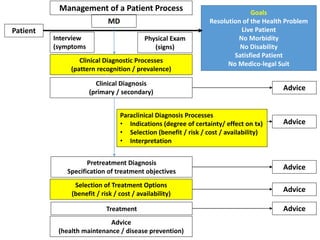
Pretreatment Diagnosis
Specification of treatment objectives
Management of a Patient Process
Patient
MD
Goals
Resolution of the Health Problem
Live Patient
No Morbidity
No Disability
Satisfied Patient
No Medico-legal Suit
Interview
(symptoms
Physical Exam
(signs)
Clinical Diagnostic Processes
(pattern recognition / prevalence)
Clinical Diagnosis
(primary / secondary)
Advice
(health maintenance / disease prevention)
Paraclinical Diagnosis Processes
• Indications (degree of certainty/ effect on tx)
• Selection (benefit / risk / cost / availability)
• Interpretation
Advice
Advice
Advice
Advice
Advice
Selection of Treatment Options
(benefit / risk / cost / availability)
Treatment
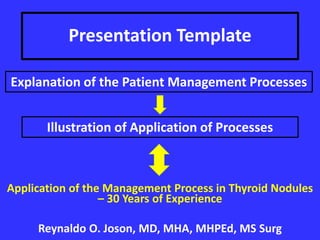
Presentation Template
Application of the Management Process in Thyroid Nodules
– 30 Years of Experience
Reynaldo O. Joson, MD, MHA, MHPEd, MS Surg
Explanation of the Patient Management Processes
Illustration of Application of Processes
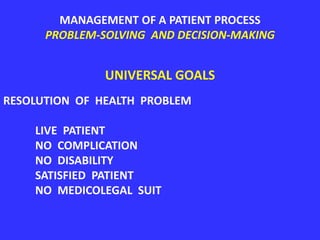
MANAGEMENT OF A PATIENT PROCESS
PROBLEM-SOLVING AND DECISION-MAKING
UNIVERSAL GOALS
RESOLUTION OF HEALTH PROBLEM
LIVE PATIENT
NO COMPLICATION
NO DISABILITY
SATISFIED PATIENT
NO MEDICOLEGAL SUIT
MANAGEMENT OF A PATIENT PROCESS
PROBLEM-SOLVING AND DECISION-MAKING
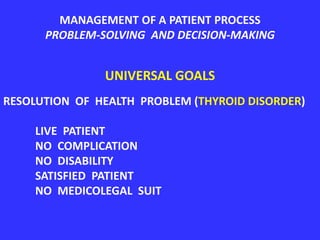
UNIVERSAL GOALS
RESOLUTION OF HEALTH PROBLEM (THYROID DISORDER)
LIVE PATIENT
NO COMPLICATION
NO DISABILITY
SATISFIED PATIENT
NO MEDICOLEGAL SUIT
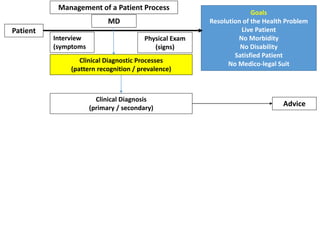
Management of a Patient Process
Patient
MD
Goals
Resolution of the Health Problem
Live Patient
No Morbidity
No Disability
Satisfied Patient
No Medico-legal Suit
Interview
(symptoms
Physical Exam
(signs)
Clinical Diagnostic Processes
(pattern recognition / prevalence)
Clinical Diagnosis
(primary / secondary)
Advice
MANAGEMENT OF A PATIENT PROCESS
CLINICAL DIAGNOSTIC PROCESS
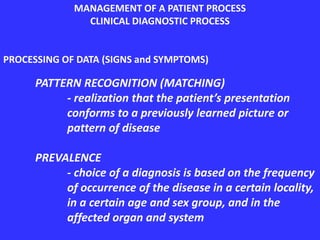
PROCESSING OF DATA (SIGNS and SYMPTOMS)
PATTERN RECOGNITION (MATCHING)
- realization that the patient’s presentation
conforms to a previously learned picture or
pattern of disease
PREVALENCE
- choice of a diagnosis is based on the frequency
of occurrence of the disease in a certain locality,
in a certain age and sex group, and in the
affected organ and system
MANAGEMENT OF A PATIENT PROCESS
CLINICAL DIAGNOSTIC PROCESS
PROCESSING OF DATA
Knowing the common manifestations of 5 different diseases as
follows:
Disease A - abcd (manifestations)
Disease B - fghi
Disease C - klmn
Disease D - pqrs
Disease E – uvwx
Given a patient manifesting with pqrs, your diagnosis is Disease D.
What is the process used?
Pattern Recognition
MANAGEMENT OF A PATIENT PROCESS
CLINICAL DIAGNOSTIC PROCESS
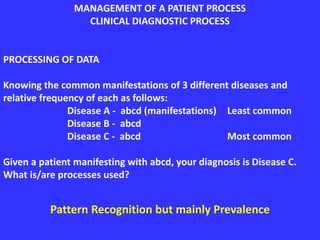
PROCESSING OF DATA
Knowing the common manifestations of 3 different diseases and
relative frequency of each as follows:
Disease A - abcd (manifestations) Least common
Disease B - abcd
Disease C - abcd Most common
Given a patient manifesting with abcd, your diagnosis is Disease C.
What is/are processes used?
Pattern Recognition but mainly Prevalence
MANAGEMENT OF A PATIENT PROCESS
CLINICAL DIAGNOSTIC PROCESS
Pattern Recognition and Prevalence
Application in Thyroid Disorders
Majority of the thyroid disorders can be recognized clinically
through pattern recognition and prevalence to the point
that a clinical diagnosis can be a histopathologic diagnosis.
Common practice by clinicians is to just stop at clinical
classification of NNTG; DTG; DNTG; NTG.
GO BEYOND CLINICAL CLASSIFICATION!
MANAGEMENT OF A PATIENT PROCESS
CLINICAL DIAGNOSTIC PROCESS
Pattern Recognition and Prevalence
Application in Thyroid Disorders
Thyroid Pathology in Philippines Can be clinically diagnosed with bases
Diffuse colloid adenomatous goiter √
Colloid adenomatous nodule/colloid cyst √
Multiple colloid adenomatous goiter √
Papillary carcinoma √
Follicular carcinoma √
Anaplastic carcinoma √
Medullary carcinoma Difficult unless there is MEN syndrome
Follicular adenoma Difficult
Acute thyroiditis / abscess √
Chronic thyroiditis Difficult
Hyperthyroidism √
Hypothyroidism √
MANAGEMENT OF A PATIENT PROCESS
CLINICAL DIAGNOSTIC PROCESS
Pattern Recognition and Prevalence
Application in Thyroid Disorders
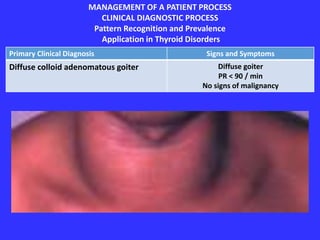
Primary Clinical Diagnosis Signs and Symptoms
Diffuse colloid adenomatous goiter Diffuse goiter
PR < 90 / min
No signs of malignancy
MANAGEMENT OF A PATIENT PROCESS
CLINICAL DIAGNOSTIC PROCESS
Pattern Recognition and Prevalence
Application in Thyroid Disorders
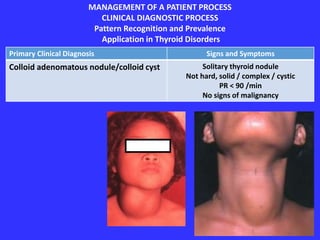
Primary Clinical Diagnosis Signs and Symptoms
Colloid adenomatous nodule/colloid cyst Solitary thyroid nodule
Not hard, solid / complex / cystic
PR < 90 /min
No signs of malignancy
MANAGEMENT OF A PATIENT PROCESS
CLINICAL DIAGNOSTIC PROCESS
Pattern Recognition and Prevalence
Application in Thyroid Disorders
Primary Clinical Diagnosis Signs and Symptoms
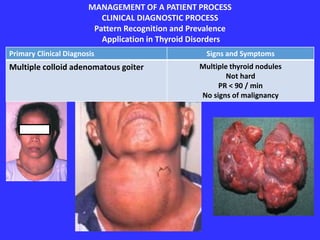
Multiple colloid adenomatous goiter Multiple thyroid nodules
Not hard
PR < 90 / min
No signs of malignancy
MANAGEMENT OF A PATIENT PROCESS
CLINICAL DIAGNOSTIC PROCESS
Pattern Recognition and Prevalence
Application in Thyroid Disorders
Primary Clinical Diagnosis Signs and Symptoms
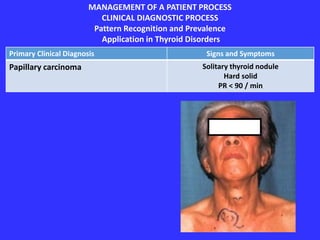
Papillary carcinoma Solitary thyroid nodule
Hard solid
PR < 90 / min
MANAGEMENT OF A PATIENT PROCESS
CLINICAL DIAGNOSTIC PROCESS
Pattern Recognition and Prevalence
Application in Thyroid Disorders
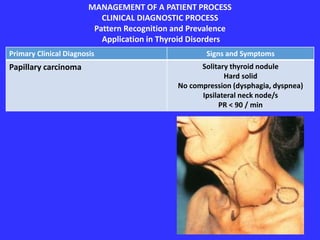
Primary Clinical Diagnosis Signs and Symptoms
Papillary carcinoma Solitary thyroid nodule
Hard solid
No compression (dysphagia, dyspnea)
Ipsilateral neck node/s
PR < 90 / min
MANAGEMENT OF A PATIENT PROCESS
CLINICAL DIAGNOSTIC PROCESS
Pattern Recognition and Prevalence
Application in Thyroid Disorders
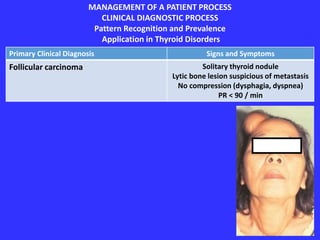
Primary Clinical Diagnosis Signs and Symptoms
Follicular carcinoma Solitary thyroid nodule
Lytic bone lesion suspicious of metastasis
No compression (dysphagia, dyspnea)
PR < 90 / min
MANAGEMENT OF A PATIENT PROCESS
CLINICAL DIAGNOSTIC PROCESS
Pattern Recognition and Prevalence
Application in Thyroid Disorders
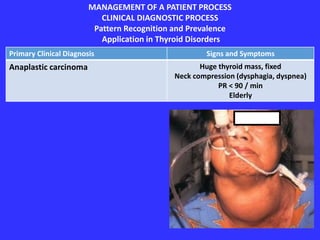
Primary Clinical Diagnosis Signs and Symptoms
Anaplastic carcinoma Huge thyroid mass, fixed
Neck compression (dysphagia, dyspnea)
PR < 90 / min
Elderly
MANAGEMENT OF A PATIENT PROCESS
CLINICAL DIAGNOSTIC PROCESS
Pattern Recognition and Prevalence
Application in Thyroid Disorders
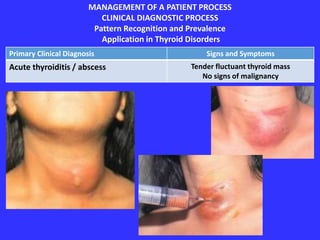
Primary Clinical Diagnosis Signs and Symptoms
Acute thyroiditis / abscess Tender fluctuant thyroid mass
No signs of malignancy
MANAGEMENT OF A PATIENT PROCESS
CLINICAL DIAGNOSTIC PROCESS
Pattern Recognition and Prevalence
Application in Thyroid Disorders
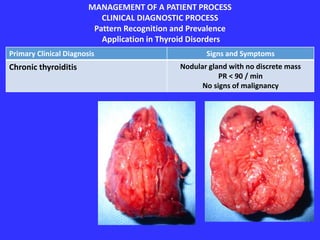
Primary Clinical Diagnosis Signs and Symptoms
Chronic thyroiditis Nodular gland with no discrete mass
PR < 90 / min
No signs of malignancy
MANAGEMENT OF A PATIENT PROCESS
CLINICAL DIAGNOSTIC PROCESS
Pattern Recognition and Prevalence
Application in Thyroid Disorders
Primary Clinical Diagnosis Signs and Symptoms
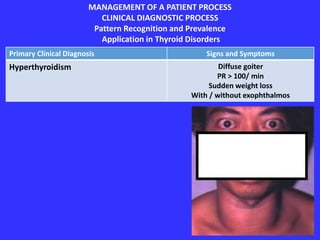
Hyperthyroidism Diffuse goiter
PR > 100/ min
Sudden weight loss
With / without exophthalmos
MANAGEMENT OF A PATIENT PROCESS
CLINICAL DIAGNOSTIC PROCESS
Pattern Recognition and Prevalence
Application in Thyroid Disorders
Primary Clinical Diagnosis Signs and Symptoms
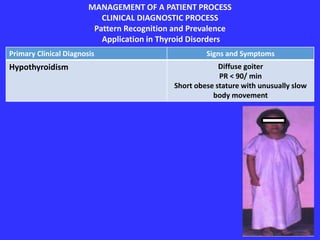
Hypothyroidism Diffuse goiter
PR < 90/ min
Short obese stature with unusually slow
body movement
MANAGEMENT OF A PATIENT PROCESS
CLINICAL DIAGNOSTIC PROCESS
Pattern Recognition and Prevalence
Application in Thyroid Disorders
Majority of the thyroid disorders can be recognized clinically
through pattern recognition and prevalence to the point
that a clinical diagnosis can be a histopathologic diagnosis.
Common practice by clinicians is to just stop at clinical
classification of NNTG; DTG; DNTG; NTG.
GO BEYOND CLINICAL CLASSIFICATION!
MANAGEMENT OF A PATIENT PROCESS
CLINICAL DIAGNOSTIC PROCESS
Pattern Recognition and Prevalence
Application in Thyroid Disorders
Rely more on pattern recognition than on prevalence as a
priority but use both.
Rely more on physical characteristics of the thyroid lesion
than on age and sex.
For further reading:
Clinical Diagnosis of Thyroid Disorders – ROJoson - 1985
http://www.slideshare.net/rjoson/clinical-diagnosis-of-thyroid-
disorders
Thyroid Surgical Diseases - 1986
MANAGEMENT OF A PATIENT PROCESS
Paraclinical
Diagnostic Process
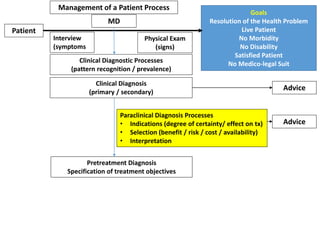
Pretreatment Diagnosis
Specification of treatment objectives
Management of a Patient Process
Patient
MD
Goals
Resolution of the Health Problem
Live Patient
No Morbidity
No Disability
Satisfied Patient
No Medico-legal Suit
Interview
(symptoms
Physical Exam
(signs)
Clinical Diagnostic Processes
(pattern recognition / prevalence)
Clinical Diagnosis
(primary / secondary)
Paraclinical Diagnosis Processes
• Indications (degree of certainty/ effect on tx)
• Selection (benefit / risk / cost / availability)
• Interpretation
Advice
Advice
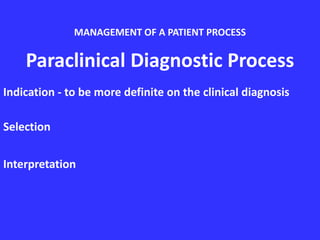
MANAGEMENT OF A PATIENT PROCESS
Paraclinical Diagnostic Process
Indication - to be more definite on the clinical diagnosis
Selection
Interpretation
Paraclinical Diagnostic Process - Indication
DATA NEEDED
PRIMARY CLINICAL DIAGNOSIS
SECONDARY CLINICAL DIAGNOSIS
MANAGEMENT OF A PATIENT PROCESS
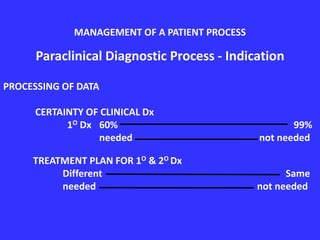
TREATMENT PLAN FOR 1O & 2O Dx
Different Same
needed not needed
Paraclinical Diagnostic Process - Indication
PROCESSING OF DATA
CERTAINTY OF CLINICAL Dx
1O Dx 60% 99%
needed not needed
MANAGEMENT OF A PATIENT PROCESS
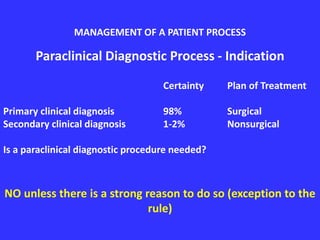
Paraclinical Diagnostic Process - Indication
Certainty Plan of Treatment
Primary clinical diagnosis 98% Surgical
Secondary clinical diagnosis 1-2% Nonsurgical
Is a paraclinical diagnostic procedure needed?
NO unless there is a strong reason to do so (exception to the
rule)
MANAGEMENT OF A PATIENT PROCESS
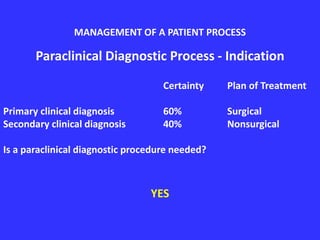
Paraclinical Diagnostic Process - Indication
Certainty Plan of Treatment
Primary clinical diagnosis 60% Surgical
Secondary clinical diagnosis 40% Nonsurgical
Is a paraclinical diagnostic procedure needed?
YES
MANAGEMENT OF A PATIENT PROCESS
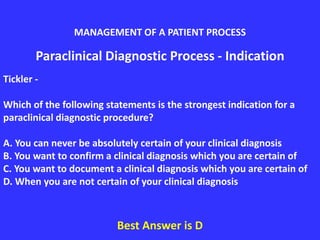
Paraclinical Diagnostic Process - Indication
Tickler -
Which of the following statements is the strongest indication for a
paraclinical diagnostic procedure?
A. You can never be absolutely certain of your clinical diagnosis
B. You want to confirm a clinical diagnosis which you are certain of
C. You want to document a clinical diagnosis which you are certain of
D. When you are not certain of your clinical diagnosis
Best Answer is D
MANAGEMENT OF A PATIENT PROCESS
Paraclinical Diagnostic Process - Selection
SELECTION PROCESS
Options Benefit Risk Cost Availability
1
2
3
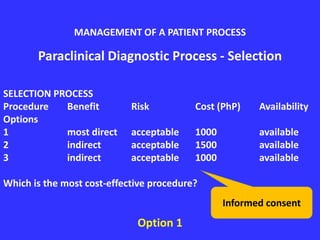
MANAGEMENT OF A PATIENT PROCESS
Paraclinical Diagnostic Process - Selection
SELECTION PROCESS
Procedure Benefit Risk Cost (PhP) Availability
Options
1 most direct acceptable 1000 available
2 indirect acceptable 1500 available
3 indirect acceptable 1000 available
Which is the most cost-effective procedure?
Option 1
MANAGEMENT OF A PATIENT PROCESS
Informed consent
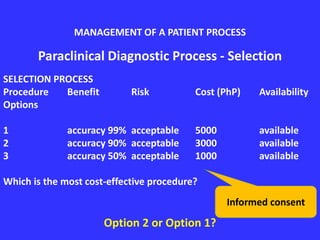
Paraclinical Diagnostic Process - Selection
SELECTION PROCESS
Procedure Benefit Risk Cost (PhP) Availability
Options
1 accuracy 99% acceptable 5000 available
2 accuracy 90% acceptable 3000 available
3 accuracy 50% acceptable 1000 available
Which is the most cost-effective procedure?
Option 2 or Option 1?
MANAGEMENT OF A PATIENT PROCESS
Informed consent
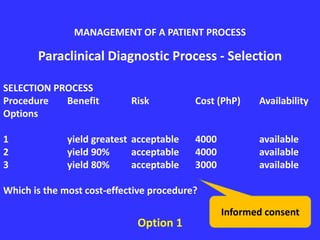
Paraclinical Diagnostic Process - Selection
SELECTION PROCESS
Procedure Benefit Risk Cost (PhP) Availability
Options
1 yield greatest acceptable 4000 available
2 yield 90% acceptable 4000 available
3 yield 80% acceptable 3000 available
Which is the most cost-effective procedure?
Option 1
MANAGEMENT OF A PATIENT PROCESS
Informed consent
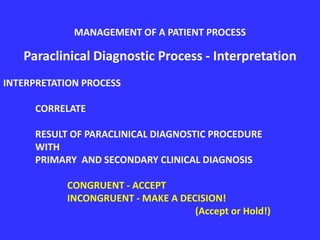
Paraclinical Diagnostic Process - Interpretation
INTERPRETATION PROCESS
CORRELATE
RESULT OF PARACLINICAL DIAGNOSTIC PROCEDURE
WITH
PRIMARY AND SECONDARY CLINICAL DIAGNOSIS
CONGRUENT - ACCEPT
INCONGRUENT - MAKE A DECISION!
(Accept or Hold!)
MANAGEMENT OF A PATIENT PROCESS
Paraclinical Diagnostic Process - Interpretation
Tickler -
Determine which paraclinical diagnosis should be accepted as the
pretreatment diagnosis and which one should be put on hold for
further decision-making. Write (A) for accept and (H) for hold.
1. Paraclinical diagnosis is the same as the primary clinical
diagnosis.
2. Paraclinical diagnosis is the same as the secondary clinical
diagnosis
3. Paraclinical diagnosis is a clinical diagnosis least considered.
4. Paraclinical diagnosis does not jibe with the clinical picture or
diagnosis.
1. A 2. A 3. H 4. H
MANAGEMENT OF A PATIENT PROCESS
PARACLINICAL DIAGNOSTIC PROCESS
Application in Thyroid Disorders
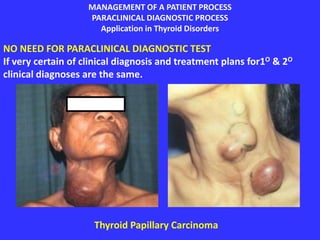
NO NEED FOR PARACLINICAL DIAGNOSTIC TEST
If very certain of clinical diagnosis and treatment plans for1O & 2O
clinical diagnoses are the same.
Thyroid Papillary Carcinoma
MANAGEMENT OF A PATIENT PROCESS
PARACLINICAL DIAGNOSTIC PROCESS
Application in Thyroid Disorders
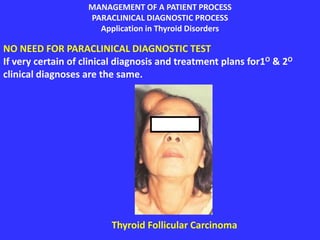
NO NEED FOR PARACLINICAL DIAGNOSTIC TEST
If very certain of clinical diagnosis and treatment plans for1O & 2O
clinical diagnoses are the same.
Thyroid Follicular Carcinoma
MANAGEMENT OF A PATIENT PROCESS
PARACLINICAL DIAGNOSTIC PROCESS
Application in Thyroid Disorders
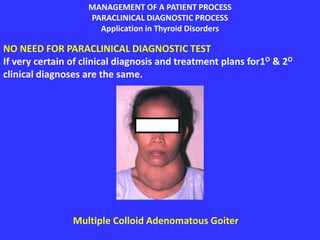
NO NEED FOR PARACLINICAL DIAGNOSTIC TEST
If very certain of clinical diagnosis and treatment plans for1O & 2O
clinical diagnoses are the same.
Multiple Colloid Adenomatous Goiter
MANAGEMENT OF A PATIENT PROCESS
PARACLINICAL DIAGNOSTIC PROCESS
Application in Thyroid Disorders
NEED FOR PARACLINICAL DIAGNOSTIC TEST
If uncertain of thyroid hormonal state
(hyperthyroid, euthyroid, hypothyroid),
do thyroid function tests.
MANAGEMENT OF A PATIENT PROCESS
PARACLINICAL DIAGNOSTIC PROCESS
Application in Thyroid Disorders
NEED FOR PARACLINICAL DIAGNOSTIC TEST
If uncertain of clinical diagnosis of thyroid
structural lesion (malignant, non-malignant),
decide on the options (needle biopsy,
ultrasound, thyroid scan, etc.)
MANAGEMENT OF A PATIENT PROCESS
PARACLINICAL DIAGNOSTIC PROCESS
Application in Thyroid Disorders
NEED FOR PARACLINICAL DIAGNOSTIC TEST
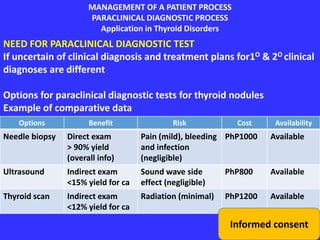
If uncertain of clinical diagnosis and treatment plans for1O & 2O clinical
diagnoses are different
Options for paraclinical diagnostic tests for thyroid nodules
Example of comparative data
Options Benefit Risk Cost Availability
Needle biopsy Direct exam
> 90% yield
(overall info)
Pain (mild), bleeding
and infection
(negligible)
PhP1000 Available
Ultrasound Indirect exam
<15% yield for ca
Sound wave side
effect (negligible)
PhP800 Available
Thyroid scan Indirect exam
<12% yield for ca
Radiation (minimal) PhP1200 Available
Informed consent
MANAGEMENT OF A PATIENT PROCESS
PARACLINICAL DIAGNOSTIC PROCESS
Application in Thyroid Disorders
NEED FOR PARACLINICAL DIAGNOSTIC TEST
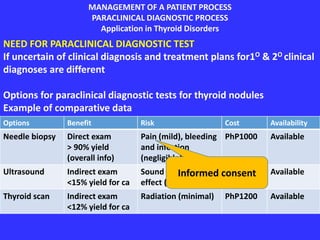
If uncertain of clinical diagnosis and treatment plans for1O & 2O clinical
diagnoses are different
Options for paraclinical diagnostic tests for thyroid nodules
Example of comparative data
Options Benefit Risk Cost Availability
Needle biopsy Direct exam
> 90% yield
(overall info)
Pain (mild), bleeding
and infection
(negligible)
PhP1000 Available
Ultrasound Indirect exam
<15% yield for ca
Sound wave side
effect (negligible)
PhP800 Available
Thyroid scan Indirect exam
<12% yield for ca
Radiation (minimal) PhP1200 Available
Informed consent
MANAGEMENT OF A PATIENT PROCESS
PARACLINICAL DIAGNOSTIC PROCESS
Application in Thyroid Disorders
FINE NEEDLE ASPIRATION BIOPSY
vs
NEEDLE EVALUATION WITH ASPIRATION BIOPSY (ROJOSON)
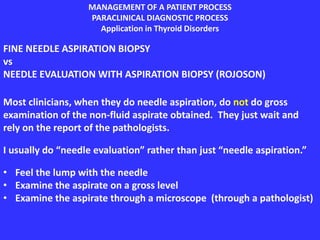
Most clinicians, when they do needle aspiration, do not do gross
examination of the non-fluid aspirate obtained. They just wait and
rely on the report of the pathologists.
I usually do “needle evaluation” rather than just “needle aspiration.”
• Feel the lump with the needle
• Examine the aspirate on a gross level
• Examine the aspirate through a microscope (through a pathologist)
MANAGEMENT OF A PATIENT PROCESS
PARACLINICAL DIAGNOSTIC PROCESS
Application in Thyroid Disorders
FINE NEEDLE ASPIRATION BIOPSY
vs
NEEDLE EVALUATION WITH ASPIRATION BIOPSY (ROJOSON)
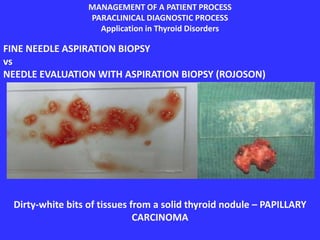
Dirty-white bits of tissues from a solid thyroid nodule – PAPILLARY
CARCINOMA
MANAGEMENT OF A PATIENT PROCESS
PARACLINICAL DIAGNOSTIC PROCESS
Application in Thyroid Disorders
FINE NEEDLE ASPIRATION BIOPSY
vs
NEEDLE EVALUATION WITH ASPIRATION BIOPSY (ROJOSON)
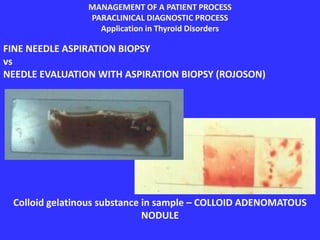
Colloid gelatinous substance in sample – COLLOID ADENOMATOUS
NODULE
MANAGEMENT OF A PATIENT PROCESS
PARACLINICAL DIAGNOSTIC PROCESS
Application in Thyroid Disorders
FINE NEEDLE ASPIRATION BIOPSY
vs
NEEDLE EVALUATION WITH ASPIRATION BIOPSY (ROJOSON)
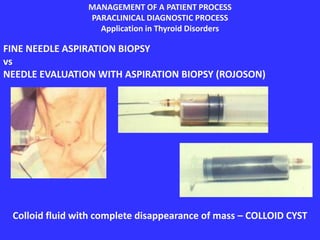
Colloid fluid with complete disappearance of mass – COLLOID CYST
MANAGEMENT OF A PATIENT PROCESS
PARACLINICAL DIAGNOSTIC PROCESS
Application in Thyroid Disorders
FINE NEEDLE ASPIRATION BIOPSY
vs
NEEDLE EVALUATION WITH ASPIRATION BIOPSY (ROJOSON)
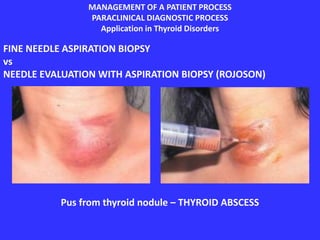
Pus from thyroid nodule – THYROID ABSCESS
MANAGEMENT OF A PATIENT PROCESS
PARACLINICAL DIAGNOSTIC PROCESS
Application in Thyroid Disorders
FINE NEEDLE ASPIRATION BIOPSY
vs
NEEDLE EVALUATION WITH ASPIRATION BIOPSY (ROJOSON)
For further reading:
Thyroid nodule aspiration: diagnostic usefulness and limitations.
Joson RO; Manalang LR; Ramirez CB; Ick JJA; Avila JM; Abelardo
AD. Philipp J Surg Spec 1989;44(2):45-57.
Needle Evaluation of Surface Lumps - 1989
Treatment Process
MANAGEMENT OF A PATIENT PROCESS
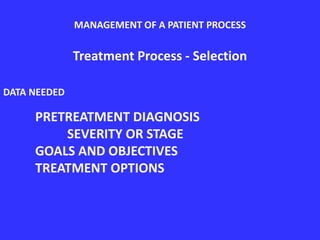
Treatment Process - Selection
DATA NEEDED
PRETREATMENT DIAGNOSIS
SEVERITY OR STAGE
GOALS AND OBJECTIVES
TREATMENT OPTIONS
MANAGEMENT OF A PATIENT PROCESS
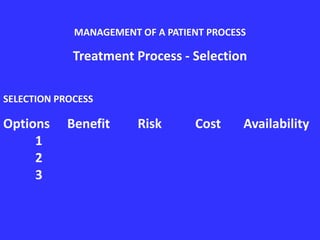
Treatment Process - Selection
SELECTION PROCESS
Options Benefit Risk Cost Availability
1
2
3
MANAGEMENT OF A PATIENT PROCESS
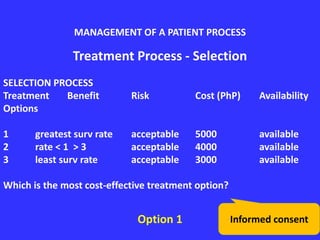
Treatment Process - Selection
SELECTION PROCESS
Treatment Benefit Risk Cost (PhP) Availability
Options
1 greatest surv rate acceptable 5000 available
2 rate < 1 > 3 acceptable 4000 available
3 least surv rate acceptable 3000 available
Which is the most cost-effective treatment option?
Option 1
MANAGEMENT OF A PATIENT PROCESS
Informed consent
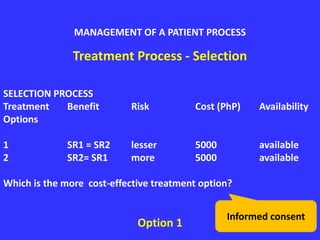
Treatment Process - Selection
SELECTION PROCESS
Treatment Benefit Risk Cost (PhP) Availability
Options
1 SR1 = SR2 lesser 5000 available
2 SR2= SR1 more 5000 available
Which is the more cost-effective treatment option?
Option 1
MANAGEMENT OF A PATIENT PROCESS
Informed consent
Treatment Process - Selection
SELECTION PROCESS
Treatment Benefit Risk Cost (PhP) Availability
Options
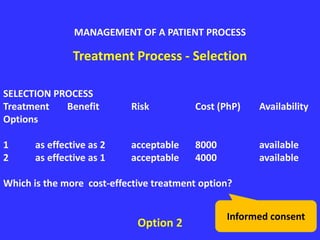
1 as effective as 2 acceptable 8000 available
2 as effective as 1 acceptable 4000 available
Which is the more cost-effective treatment option?
Option 2
MANAGEMENT OF A PATIENT PROCESS
Informed consent
MANAGEMENT OF A PATIENT PROCESS
TREATMENT PROCESS
Application in Thyroid Disorders
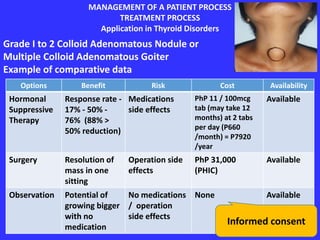
Grade I to 2 Colloid Adenomatous Nodule or
Multiple Colloid Adenomatous Goiter
Example of comparative data
Options Benefit Risk Cost Availability
Hormonal
Suppressive
Therapy
Response rate -
17% - 50% -
76% (88% >
50% reduction)
Medications
side effects
PhP 11 / 100mcg
tab (may take 12
months) at 2 tabs
per day (P660
/month) = P7920
/year
Available
Surgery Resolution of
mass in one
sitting
Operation side
effects
PhP 31,000
(PHIC)
Available
Observation Potential of
growing bigger
with no
medication
No medications
/ operation
side effects
None Available
Informed consent
MANAGEMENT OF A PATIENT PROCESS
TREATMENT PROCESS
Application in Thyroid Disorders
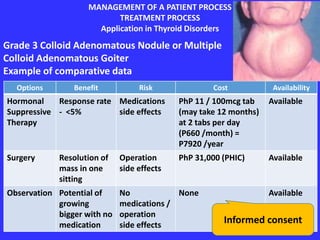
Grade 3 Colloid Adenomatous Nodule or Multiple
Colloid Adenomatous Goiter
Example of comparative data
Options Benefit Risk Cost Availability
Hormonal
Suppressive
Therapy
Response rate
- <5%
Medications
side effects
PhP 11 / 100mcg tab
(may take 12 months)
at 2 tabs per day
(P660 /month) =
P7920 /year
Available
Surgery Resolution of
mass in one
sitting
Operation
side effects
PhP 31,000 (PHIC) Available
Observation Potential of
growing
bigger with no
medication
No
medications /
operation
side effects
None Available
Informed consent
MANAGEMENT OF A PATIENT PROCESS
TREATMENT PROCESS
Application in Thyroid Disorders
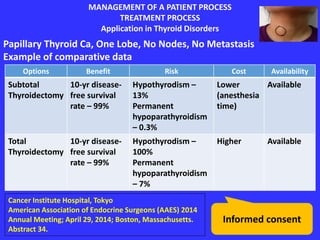
Papillary Thyroid Ca, One Lobe, No Nodes, No Metastasis
Example of comparative data
Options Benefit Risk Cost Availability
Subtotal
Thyroidectomy
10-yr disease-
free survival
rate – 99%
Hypothyrodism –
13%
Permanent
hypoparathyroidism
– 0.3%
Lower
(anesthesia
time)
Available
Total
Thyroidectomy
10-yr disease-
free survival
rate – 99%
Hypothyrodism –
100%
Permanent
hypoparathyroidism
– 7%
Higher Available
Informed consent
Cancer Institute Hospital, Tokyo
American Association of Endocrine Surgeons (AAES) 2014
Annual Meeting; April 29, 2014; Boston, Massachusetts.
Abstract 34.
MANAGEMENT OF A PATIENT PROCESS
TREATMENT PROCESS
Application in Thyroid Disorders
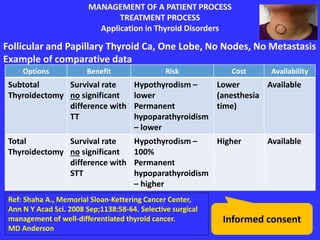
Follicular and Papillary Thyroid Ca, One Lobe, No Nodes, No Metastasis
Example of comparative data
Options Benefit Risk Cost Availability
Subtotal
Thyroidectomy
Survival rate
no significant
difference with
TT
Hypothyrodism –
lower
Permanent
hypoparathyroidism
– lower
Lower
(anesthesia
time)
Available
Total
Thyroidectomy
Survival rate
no significant
difference with
STT
Hypothyrodism –
100%
Permanent
hypoparathyroidism
– higher
Higher Available
Informed consent
Ref: Shaha A., Memorial Sloan-Kettering Cancer Center,
Ann N Y Acad Sci. 2008 Sep;1138:58-64. Selective surgical
management of well-differentiated thyroid cancer.
MD Anderson
MANAGEMENT OF A PATIENT PROCESS
TREATMENT PROCESS
Application in Thyroid Disorders
Follicular and Papillary Thyroid Ca, One Lobe, No Nodes, No Metastasis
Example of comparative data
Options Benefit Risk Cost Availability
Subtotal
Thyroidectomy
Survival rate
lower than TT
Hypothyrodism –
lower
Permanent
hypoparathyroidism
– lower
Lower
(anesthesia
time)
Available
Total
Thyroidectomy
Survival rate
higher than
with STT
Hypothyrodism –
100%
Permanent
hypoparathyroidism
– higher
Higher Available
Informed consent
Ref: National Comprehensive Cancer
Network (NCCN) Guidelines
MANAGEMENT OF A PATIENT PROCESS
TREATMENT PROCESS
Application in Thyroid Disorders
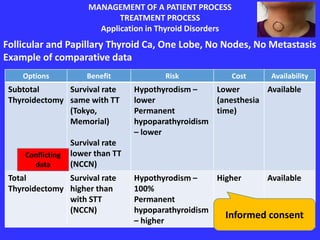
Follicular and Papillary Thyroid Ca, One Lobe, No Nodes, No Metastasis
Example of comparative data
Options Benefit Risk Cost Availability
Subtotal
Thyroidectomy
Survival rate
same with TT
(Tokyo,
Memorial)
Survival rate
lower than TT
(NCCN)
Hypothyrodism –
lower
Permanent
hypoparathyroidism
– lower
Lower
(anesthesia
time)
Available
Total
Thyroidectomy
Survival rate
higher than
with STT
(NCCN)
Hypothyrodism –
100%
Permanent
hypoparathyroidism
– higher
Higher Available
Informed consent
Conflicting
data
MANAGEMENT OF A PATIENT PROCESS
TREATMENT PROCESS
Application in Thyroid Disorders
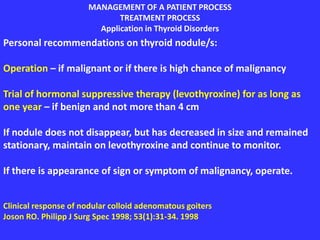
Personal recommendations on thyroid nodule/s:
Operation – if malignant or if there is high chance of malignancy
Trial of hormonal suppressive therapy (levothyroxine) for as long as
one year – if benign and not more than 4 cm
If nodule does not disappear, but has decreased in size and remained
stationary, maintain on levothyroxine and continue to monitor.
If there is appearance of sign or symptom of malignancy, operate.
Clinical response of nodular colloid adenomatous goiters
Joson RO. Philipp J Surg Spec 1998; 53(1):31-34. 1998
MANAGEMENT OF A PATIENT PROCESS
TREATMENT PROCESS
Application in Thyroid Disorders
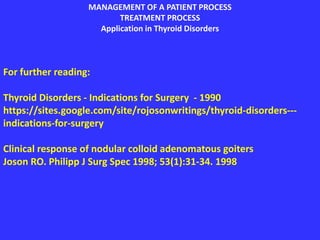
For further reading:
Thyroid Disorders - Indications for Surgery - 1990
https://sites.google.com/site/rojosonwritings/thyroid-disorders---
indications-for-surgery
Clinical response of nodular colloid adenomatous goiters
Joson RO. Philipp J Surg Spec 1998; 53(1):31-34. 1998
MANAGEMENT OF A PATIENT PROCESS
TREATMENT PROCESS
Application in Thyroid Disorders
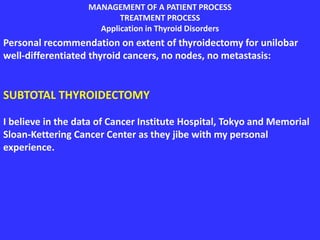
Personal recommendation on extent of thyroidectomy for unilobar
well-differentiated thyroid cancers, no nodes, no metastasis:
SUBTOTAL THYROIDECTOMY
I believe in the data of Cancer Institute Hospital, Tokyo and Memorial
Sloan-Kettering Cancer Center as they jibe with my personal
experience.
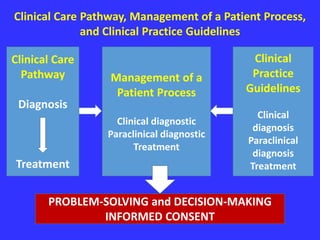
Clinical Care Pathway, Management of a Patient Process,
and Clinical Practice Guidelines
Clinical Care
Pathway
Diagnosis
Treatment
Management of a
Patient Process
Clinical diagnostic
Paraclinical diagnostic
Treatment
Clinical
Practice
Guidelines
Clinical
diagnosis
Paraclinical
diagnosis
Treatment
PROBLEM-SOLVING and DECISION-MAKING
INFORMED CONSENT
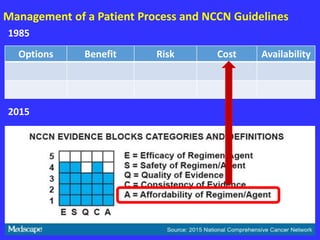
Management of a Patient Process and NCCN Guidelines
Options Benefit Risk Cost Availability
2015
1985
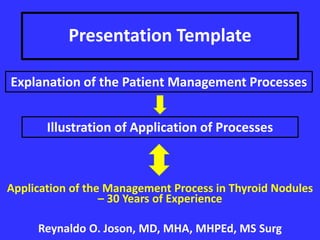
Presentation Template
Application of the Management Process in Thyroid Nodules
– 30 Years of Experience
Reynaldo O. Joson, MD, MHA, MHPEd, MS Surg
Explanation of the Patient Management Processes
Illustration of Application of Processes
16th
Chancellor Alfredo T. Ramirez Memorial Lecture
Application of the Management Process in
Thyroid Nodules: Thirty Years of
Experience
52th Postgraduate Course Theme
Oncologic Surgery
Current Concepts and Management
16th
Chancellor Alfredo T. Ramirez Memorial
Lecturer
Reynaldo O. Joson, MD, MHA, MHPEd, MS Surg
Dedication and excellence of ATR in medical education and
research!

Application of the Management Process in Thyroid Nodules

  • 1.
    16th Chancellor AlfredoT. Ramirez MEMORIAL LECTURE Application of the Management Process in Thyroid Nodules – 30 Years of Experience Reynaldo O. Joson, MD, MHA, MHPEd, MS Surg
  • 2.
    Family of Dr.Alfredo T. Ramirez Ms. Bella Yan-Ramirez Mr. Clark Alfredo Ramirez
  • 3.
    Foundation for theAdvancement of Surgical Education, Inc. Dr. Telesforo Gana UPCM-PGH Department of Surgery Dr. Nelson Cabaluna Postgraduate Courses Committee Dr. Orlino Bisquera
  • 4.
  • 5.
    16th Chancellor Alfredo T.Ramirez Memorial Lecturer Reynaldo O. Joson, MD, MHA, MHPEd, MS Surg
  • 6.
    For his pioneeringspirit in burns, trauma and surgical education For his leadership in the field of medical and higher education For his foresight in developing advances in research and postgraduate surgical training This memorial lecture is in recognition of his dedication, excellence and contribution in Philippine surgery.PRIVILEGE
  • 7.
    For his pioneeringspirit in burns, trauma and surgical education For his leadership in the field of medical and higher education For his foresight in developing advances in research and postgraduate surgical training This memorial lecture is in recognition of his dedication, excellence and contribution in Philippine surgery. ROJoson’s grateful memories to illuminate ATR’s pioneering spirit, leadership and foresight in higher surgical education, postgraduate training and research!
  • 8.
  • 9.
    In 1968, ATR started Surgical Forum, research contest for residents. I joinedit from 1977 to 1979. Tumors of the Parotid Gland – A Clinicopathologic Study of 139 Cases Reynaldo O. Joson, MD Reynaldo O. Joson, MDCarcinoid Tumors of the Gastrointestinal Tract 1977 Surgical Forum
  • 10.
    In 1968, ATR started Surgical Forum, research contest for residents. I joinedit from 1977 to 1979. 1978 Surgical Forum Management of External Gastrointestinal Fistulas Reynaldo O. Joson, MD Early Surgery for Appendiceal Abscess Reynaldo O. Joson, MD
  • 11.
    In 1968, ATR started Surgical Forum, research contest for residents. Ijoined it from 1977 to 1979. 1979 Surgical Forum Problems and Rehabilitation of Filipino Stoma Patients Reynaldo O. Joson, MD
  • 12.
    Thanks to ATR! Itgave me great learning opportunity to become a researcher! In 1968, ATR started Surgical Forum, research contest for residents. I joined it from 1977 to 1979.
  • 13.
    ATR as Chairman of the Department ofSurgery always encouraged and motivated me to excel in being a medical educator. Letter of Commendation and Encouragement UPCM Year Level IV
  • 14.
    ATR as Chairman of the Department ofSurgery always encouraged and motivated me to excel in being a medical educator. Motivation and Encouragement Citation UPCM Year Level V
  • 15.
    ATR as Chairman of the Department ofSurgery always encouraged and motivated me to excel in being a medical educator. Letter of Commendation and Promotion Assistant Professor IV (1991)
  • 16.
    ATR as Chairman of the Department ofSurgery always encouraged and motivated me to excel in being a medical educator. Thanks to ATR!
  • 17.
    ATR initiated Master of Sciencein Clinical Medicine (Surgery) in 1985. I was the first graduate in 1998. I was not required to take it. I gave support because I believe in ATR’s pioneering spirit and foresight in higher surgical education. Master of Science in Clinical Medicine (Surgery)
  • 18.
    ATR initiated Master of Sciencein Clinical Medicine (Surgery) in 1985. I was the first graduate in 1998. I was not required to take it. I gave support because I believe in ATR’s pioneering spirit and foresight in higher surgical education. Thanks to ATR! UPCM is the only institution offering MSc in Surgery in the Philippines! Dr. Carmela Lapitan Dr. Glenn Genuino Dr. Mel Anthony Cruz
  • 19.
    For his pioneeringspirit in burns, trauma and surgical education For his leadership in the field of medical and higher education For his foresight in developing advances in research and postgraduate surgical training This memorial lecture is in recognition of his dedication, excellence and contribution in Philippine surgery. ROJoson’s 3 grateful memories to illuminate ATR’s pioneering spirit, leadership and foresight in higher surgical education, postgraduate training and research! Thank you, ATR!
  • 20.
    16th Chancellor Alfredo T.Ramirez Memorial Lecturer Reynaldo O. Joson, MD, MHA, MHPEd, MS Surg Dedication and excellence of ATR in medical education and research!
  • 21.
    16th Chancellor Alfredo T.Ramirez Memorial Lecture Application of the Management Process in Thyroid Nodules: Thirty Years of Experience Reynaldo O. Joson, MD, MHA, MHPEd, MSc Surg
  • 22.
    16th Chancellor Alfredo T.Ramirez Memorial Lecture Application of the Management Process in Thyroid Nodules: Thirty Years of Experience 52th Postgraduate Course Theme Oncologic Surgery Current Concepts and Management
  • 23.
    16th Chancellor Alfredo T.Ramirez Memorial Lecture Application of the Management Process in Thyroid Nodules: Thirty Years of Experience Former students so impressed with my • usage of patient management process circa 1985 • Thyroid Surgical Diseases book 1986 (that’s 30 years ago) which I have been using as a basis in the management of patients with thyroid disorders / nodules
  • 24.
    Pretreatment Diagnosis Specification oftreatment objectives Management of a Patient Process Patient MD Goals Resolution of the Health Problem Live Patient No Morbidity No Disability Satisfied Patient No Medico-legal Suit Interview (symptoms Physical Exam (signs) Clinical Diagnostic Processes (pattern recognition / prevalence) Clinical Diagnosis (primary / secondary) Advice (health maintenance / disease prevention) Paraclinical Diagnosis Processes • Indications (degree of certainty/ effect on tx) • Selection (benefit / risk / cost / availability) • Interpretation Advice Advice Advice Advice Advice Selection of Treatment Options (benefit / risk / cost / availability) Treatment
  • 25.
    Pretreatment Diagnosis Specification oftreatment objectives Management of a Patient Process Patient MD Goals Resolution of the Health Problem Live Patient No Morbidity No Disability Satisfied Patient No Medico-legal Suit Interview (symptoms Physical Exam (signs) Clinical Diagnostic Processes (pattern recognition / prevalence) Clinical Diagnosis (primary / secondary) Advice (health maintenance / disease prevention) Paraclinical Diagnosis Processes • Indications (degree of certainty/ effect on tx) • Selection (benefit / risk / cost / availability) • Interpretation Advice Advice Advice Advice Advice Selection of Treatment Options (benefit / risk / cost / availability) Treatment
  • 26.
    Presentation Template Application ofthe Management Process in Thyroid Nodules – 30 Years of Experience Reynaldo O. Joson, MD, MHA, MHPEd, MS Surg Explanation of the Patient Management Processes Illustration of Application of Processes
  • 27.
    MANAGEMENT OF APATIENT PROCESS PROBLEM-SOLVING AND DECISION-MAKING UNIVERSAL GOALS RESOLUTION OF HEALTH PROBLEM LIVE PATIENT NO COMPLICATION NO DISABILITY SATISFIED PATIENT NO MEDICOLEGAL SUIT
  • 28.
    MANAGEMENT OF APATIENT PROCESS PROBLEM-SOLVING AND DECISION-MAKING UNIVERSAL GOALS RESOLUTION OF HEALTH PROBLEM (THYROID DISORDER) LIVE PATIENT NO COMPLICATION NO DISABILITY SATISFIED PATIENT NO MEDICOLEGAL SUIT
  • 29.
    Management of aPatient Process Patient MD Goals Resolution of the Health Problem Live Patient No Morbidity No Disability Satisfied Patient No Medico-legal Suit Interview (symptoms Physical Exam (signs) Clinical Diagnostic Processes (pattern recognition / prevalence) Clinical Diagnosis (primary / secondary) Advice
  • 30.
    MANAGEMENT OF APATIENT PROCESS CLINICAL DIAGNOSTIC PROCESS PROCESSING OF DATA (SIGNS and SYMPTOMS) PATTERN RECOGNITION (MATCHING) - realization that the patient’s presentation conforms to a previously learned picture or pattern of disease PREVALENCE - choice of a diagnosis is based on the frequency of occurrence of the disease in a certain locality, in a certain age and sex group, and in the affected organ and system
  • 31.
    MANAGEMENT OF APATIENT PROCESS CLINICAL DIAGNOSTIC PROCESS PROCESSING OF DATA Knowing the common manifestations of 5 different diseases as follows: Disease A - abcd (manifestations) Disease B - fghi Disease C - klmn Disease D - pqrs Disease E – uvwx Given a patient manifesting with pqrs, your diagnosis is Disease D. What is the process used? Pattern Recognition
  • 32.
    MANAGEMENT OF APATIENT PROCESS CLINICAL DIAGNOSTIC PROCESS PROCESSING OF DATA Knowing the common manifestations of 3 different diseases and relative frequency of each as follows: Disease A - abcd (manifestations) Least common Disease B - abcd Disease C - abcd Most common Given a patient manifesting with abcd, your diagnosis is Disease C. What is/are processes used? Pattern Recognition but mainly Prevalence
  • 33.
    MANAGEMENT OF APATIENT PROCESS CLINICAL DIAGNOSTIC PROCESS Pattern Recognition and Prevalence Application in Thyroid Disorders Majority of the thyroid disorders can be recognized clinically through pattern recognition and prevalence to the point that a clinical diagnosis can be a histopathologic diagnosis. Common practice by clinicians is to just stop at clinical classification of NNTG; DTG; DNTG; NTG. GO BEYOND CLINICAL CLASSIFICATION!
  • 34.
    MANAGEMENT OF APATIENT PROCESS CLINICAL DIAGNOSTIC PROCESS Pattern Recognition and Prevalence Application in Thyroid Disorders Thyroid Pathology in Philippines Can be clinically diagnosed with bases Diffuse colloid adenomatous goiter √ Colloid adenomatous nodule/colloid cyst √ Multiple colloid adenomatous goiter √ Papillary carcinoma √ Follicular carcinoma √ Anaplastic carcinoma √ Medullary carcinoma Difficult unless there is MEN syndrome Follicular adenoma Difficult Acute thyroiditis / abscess √ Chronic thyroiditis Difficult Hyperthyroidism √ Hypothyroidism √
  • 35.
    MANAGEMENT OF APATIENT PROCESS CLINICAL DIAGNOSTIC PROCESS Pattern Recognition and Prevalence Application in Thyroid Disorders Primary Clinical Diagnosis Signs and Symptoms Diffuse colloid adenomatous goiter Diffuse goiter PR < 90 / min No signs of malignancy
  • 36.
    MANAGEMENT OF APATIENT PROCESS CLINICAL DIAGNOSTIC PROCESS Pattern Recognition and Prevalence Application in Thyroid Disorders Primary Clinical Diagnosis Signs and Symptoms Colloid adenomatous nodule/colloid cyst Solitary thyroid nodule Not hard, solid / complex / cystic PR < 90 /min No signs of malignancy
  • 37.
    MANAGEMENT OF APATIENT PROCESS CLINICAL DIAGNOSTIC PROCESS Pattern Recognition and Prevalence Application in Thyroid Disorders Primary Clinical Diagnosis Signs and Symptoms Multiple colloid adenomatous goiter Multiple thyroid nodules Not hard PR < 90 / min No signs of malignancy
  • 38.
    MANAGEMENT OF APATIENT PROCESS CLINICAL DIAGNOSTIC PROCESS Pattern Recognition and Prevalence Application in Thyroid Disorders Primary Clinical Diagnosis Signs and Symptoms Papillary carcinoma Solitary thyroid nodule Hard solid PR < 90 / min
  • 39.
    MANAGEMENT OF APATIENT PROCESS CLINICAL DIAGNOSTIC PROCESS Pattern Recognition and Prevalence Application in Thyroid Disorders Primary Clinical Diagnosis Signs and Symptoms Papillary carcinoma Solitary thyroid nodule Hard solid No compression (dysphagia, dyspnea) Ipsilateral neck node/s PR < 90 / min
  • 40.
    MANAGEMENT OF APATIENT PROCESS CLINICAL DIAGNOSTIC PROCESS Pattern Recognition and Prevalence Application in Thyroid Disorders Primary Clinical Diagnosis Signs and Symptoms Follicular carcinoma Solitary thyroid nodule Lytic bone lesion suspicious of metastasis No compression (dysphagia, dyspnea) PR < 90 / min
  • 41.
    MANAGEMENT OF APATIENT PROCESS CLINICAL DIAGNOSTIC PROCESS Pattern Recognition and Prevalence Application in Thyroid Disorders Primary Clinical Diagnosis Signs and Symptoms Anaplastic carcinoma Huge thyroid mass, fixed Neck compression (dysphagia, dyspnea) PR < 90 / min Elderly
  • 42.
    MANAGEMENT OF APATIENT PROCESS CLINICAL DIAGNOSTIC PROCESS Pattern Recognition and Prevalence Application in Thyroid Disorders Primary Clinical Diagnosis Signs and Symptoms Acute thyroiditis / abscess Tender fluctuant thyroid mass No signs of malignancy
  • 43.
    MANAGEMENT OF APATIENT PROCESS CLINICAL DIAGNOSTIC PROCESS Pattern Recognition and Prevalence Application in Thyroid Disorders Primary Clinical Diagnosis Signs and Symptoms Chronic thyroiditis Nodular gland with no discrete mass PR < 90 / min No signs of malignancy
  • 44.
    MANAGEMENT OF APATIENT PROCESS CLINICAL DIAGNOSTIC PROCESS Pattern Recognition and Prevalence Application in Thyroid Disorders Primary Clinical Diagnosis Signs and Symptoms Hyperthyroidism Diffuse goiter PR > 100/ min Sudden weight loss With / without exophthalmos
  • 45.
    MANAGEMENT OF APATIENT PROCESS CLINICAL DIAGNOSTIC PROCESS Pattern Recognition and Prevalence Application in Thyroid Disorders Primary Clinical Diagnosis Signs and Symptoms Hypothyroidism Diffuse goiter PR < 90/ min Short obese stature with unusually slow body movement
  • 46.
    MANAGEMENT OF APATIENT PROCESS CLINICAL DIAGNOSTIC PROCESS Pattern Recognition and Prevalence Application in Thyroid Disorders Majority of the thyroid disorders can be recognized clinically through pattern recognition and prevalence to the point that a clinical diagnosis can be a histopathologic diagnosis. Common practice by clinicians is to just stop at clinical classification of NNTG; DTG; DNTG; NTG. GO BEYOND CLINICAL CLASSIFICATION!
  • 47.
    MANAGEMENT OF APATIENT PROCESS CLINICAL DIAGNOSTIC PROCESS Pattern Recognition and Prevalence Application in Thyroid Disorders Rely more on pattern recognition than on prevalence as a priority but use both. Rely more on physical characteristics of the thyroid lesion than on age and sex. For further reading: Clinical Diagnosis of Thyroid Disorders – ROJoson - 1985 http://www.slideshare.net/rjoson/clinical-diagnosis-of-thyroid- disorders Thyroid Surgical Diseases - 1986
  • 49.
    MANAGEMENT OF APATIENT PROCESS Paraclinical Diagnostic Process
  • 50.
    Pretreatment Diagnosis Specification oftreatment objectives Management of a Patient Process Patient MD Goals Resolution of the Health Problem Live Patient No Morbidity No Disability Satisfied Patient No Medico-legal Suit Interview (symptoms Physical Exam (signs) Clinical Diagnostic Processes (pattern recognition / prevalence) Clinical Diagnosis (primary / secondary) Paraclinical Diagnosis Processes • Indications (degree of certainty/ effect on tx) • Selection (benefit / risk / cost / availability) • Interpretation Advice Advice
  • 51.
    MANAGEMENT OF APATIENT PROCESS Paraclinical Diagnostic Process Indication - to be more definite on the clinical diagnosis Selection Interpretation
  • 52.
    Paraclinical Diagnostic Process- Indication DATA NEEDED PRIMARY CLINICAL DIAGNOSIS SECONDARY CLINICAL DIAGNOSIS MANAGEMENT OF A PATIENT PROCESS
  • 53.
    TREATMENT PLAN FOR1O & 2O Dx Different Same needed not needed Paraclinical Diagnostic Process - Indication PROCESSING OF DATA CERTAINTY OF CLINICAL Dx 1O Dx 60% 99% needed not needed MANAGEMENT OF A PATIENT PROCESS
  • 54.
    Paraclinical Diagnostic Process- Indication Certainty Plan of Treatment Primary clinical diagnosis 98% Surgical Secondary clinical diagnosis 1-2% Nonsurgical Is a paraclinical diagnostic procedure needed? NO unless there is a strong reason to do so (exception to the rule) MANAGEMENT OF A PATIENT PROCESS
  • 55.
    Paraclinical Diagnostic Process- Indication Certainty Plan of Treatment Primary clinical diagnosis 60% Surgical Secondary clinical diagnosis 40% Nonsurgical Is a paraclinical diagnostic procedure needed? YES MANAGEMENT OF A PATIENT PROCESS
  • 56.
    Paraclinical Diagnostic Process- Indication Tickler - Which of the following statements is the strongest indication for a paraclinical diagnostic procedure? A. You can never be absolutely certain of your clinical diagnosis B. You want to confirm a clinical diagnosis which you are certain of C. You want to document a clinical diagnosis which you are certain of D. When you are not certain of your clinical diagnosis Best Answer is D MANAGEMENT OF A PATIENT PROCESS
  • 57.
    Paraclinical Diagnostic Process- Selection SELECTION PROCESS Options Benefit Risk Cost Availability 1 2 3 MANAGEMENT OF A PATIENT PROCESS
  • 58.
    Paraclinical Diagnostic Process- Selection SELECTION PROCESS Procedure Benefit Risk Cost (PhP) Availability Options 1 most direct acceptable 1000 available 2 indirect acceptable 1500 available 3 indirect acceptable 1000 available Which is the most cost-effective procedure? Option 1 MANAGEMENT OF A PATIENT PROCESS Informed consent
  • 59.
    Paraclinical Diagnostic Process- Selection SELECTION PROCESS Procedure Benefit Risk Cost (PhP) Availability Options 1 accuracy 99% acceptable 5000 available 2 accuracy 90% acceptable 3000 available 3 accuracy 50% acceptable 1000 available Which is the most cost-effective procedure? Option 2 or Option 1? MANAGEMENT OF A PATIENT PROCESS Informed consent
  • 60.
    Paraclinical Diagnostic Process- Selection SELECTION PROCESS Procedure Benefit Risk Cost (PhP) Availability Options 1 yield greatest acceptable 4000 available 2 yield 90% acceptable 4000 available 3 yield 80% acceptable 3000 available Which is the most cost-effective procedure? Option 1 MANAGEMENT OF A PATIENT PROCESS Informed consent
  • 61.
    Paraclinical Diagnostic Process- Interpretation INTERPRETATION PROCESS CORRELATE RESULT OF PARACLINICAL DIAGNOSTIC PROCEDURE WITH PRIMARY AND SECONDARY CLINICAL DIAGNOSIS CONGRUENT - ACCEPT INCONGRUENT - MAKE A DECISION! (Accept or Hold!) MANAGEMENT OF A PATIENT PROCESS
  • 62.
    Paraclinical Diagnostic Process- Interpretation Tickler - Determine which paraclinical diagnosis should be accepted as the pretreatment diagnosis and which one should be put on hold for further decision-making. Write (A) for accept and (H) for hold. 1. Paraclinical diagnosis is the same as the primary clinical diagnosis. 2. Paraclinical diagnosis is the same as the secondary clinical diagnosis 3. Paraclinical diagnosis is a clinical diagnosis least considered. 4. Paraclinical diagnosis does not jibe with the clinical picture or diagnosis. 1. A 2. A 3. H 4. H MANAGEMENT OF A PATIENT PROCESS
  • 63.
    MANAGEMENT OF APATIENT PROCESS PARACLINICAL DIAGNOSTIC PROCESS Application in Thyroid Disorders NO NEED FOR PARACLINICAL DIAGNOSTIC TEST If very certain of clinical diagnosis and treatment plans for1O & 2O clinical diagnoses are the same. Thyroid Papillary Carcinoma
  • 64.
    MANAGEMENT OF APATIENT PROCESS PARACLINICAL DIAGNOSTIC PROCESS Application in Thyroid Disorders NO NEED FOR PARACLINICAL DIAGNOSTIC TEST If very certain of clinical diagnosis and treatment plans for1O & 2O clinical diagnoses are the same. Thyroid Follicular Carcinoma
  • 65.
    MANAGEMENT OF APATIENT PROCESS PARACLINICAL DIAGNOSTIC PROCESS Application in Thyroid Disorders NO NEED FOR PARACLINICAL DIAGNOSTIC TEST If very certain of clinical diagnosis and treatment plans for1O & 2O clinical diagnoses are the same. Multiple Colloid Adenomatous Goiter
  • 66.
    MANAGEMENT OF APATIENT PROCESS PARACLINICAL DIAGNOSTIC PROCESS Application in Thyroid Disorders NEED FOR PARACLINICAL DIAGNOSTIC TEST If uncertain of thyroid hormonal state (hyperthyroid, euthyroid, hypothyroid), do thyroid function tests.
  • 67.
    MANAGEMENT OF APATIENT PROCESS PARACLINICAL DIAGNOSTIC PROCESS Application in Thyroid Disorders NEED FOR PARACLINICAL DIAGNOSTIC TEST If uncertain of clinical diagnosis of thyroid structural lesion (malignant, non-malignant), decide on the options (needle biopsy, ultrasound, thyroid scan, etc.)
  • 68.
    MANAGEMENT OF APATIENT PROCESS PARACLINICAL DIAGNOSTIC PROCESS Application in Thyroid Disorders NEED FOR PARACLINICAL DIAGNOSTIC TEST If uncertain of clinical diagnosis and treatment plans for1O & 2O clinical diagnoses are different Options for paraclinical diagnostic tests for thyroid nodules Example of comparative data Options Benefit Risk Cost Availability Needle biopsy Direct exam > 90% yield (overall info) Pain (mild), bleeding and infection (negligible) PhP1000 Available Ultrasound Indirect exam <15% yield for ca Sound wave side effect (negligible) PhP800 Available Thyroid scan Indirect exam <12% yield for ca Radiation (minimal) PhP1200 Available Informed consent
  • 69.
    MANAGEMENT OF APATIENT PROCESS PARACLINICAL DIAGNOSTIC PROCESS Application in Thyroid Disorders NEED FOR PARACLINICAL DIAGNOSTIC TEST If uncertain of clinical diagnosis and treatment plans for1O & 2O clinical diagnoses are different Options for paraclinical diagnostic tests for thyroid nodules Example of comparative data Options Benefit Risk Cost Availability Needle biopsy Direct exam > 90% yield (overall info) Pain (mild), bleeding and infection (negligible) PhP1000 Available Ultrasound Indirect exam <15% yield for ca Sound wave side effect (negligible) PhP800 Available Thyroid scan Indirect exam <12% yield for ca Radiation (minimal) PhP1200 Available Informed consent
  • 70.
    MANAGEMENT OF APATIENT PROCESS PARACLINICAL DIAGNOSTIC PROCESS Application in Thyroid Disorders FINE NEEDLE ASPIRATION BIOPSY vs NEEDLE EVALUATION WITH ASPIRATION BIOPSY (ROJOSON) Most clinicians, when they do needle aspiration, do not do gross examination of the non-fluid aspirate obtained. They just wait and rely on the report of the pathologists. I usually do “needle evaluation” rather than just “needle aspiration.” • Feel the lump with the needle • Examine the aspirate on a gross level • Examine the aspirate through a microscope (through a pathologist)
  • 71.
    MANAGEMENT OF APATIENT PROCESS PARACLINICAL DIAGNOSTIC PROCESS Application in Thyroid Disorders FINE NEEDLE ASPIRATION BIOPSY vs NEEDLE EVALUATION WITH ASPIRATION BIOPSY (ROJOSON) Dirty-white bits of tissues from a solid thyroid nodule – PAPILLARY CARCINOMA
  • 72.
    MANAGEMENT OF APATIENT PROCESS PARACLINICAL DIAGNOSTIC PROCESS Application in Thyroid Disorders FINE NEEDLE ASPIRATION BIOPSY vs NEEDLE EVALUATION WITH ASPIRATION BIOPSY (ROJOSON) Colloid gelatinous substance in sample – COLLOID ADENOMATOUS NODULE
  • 73.
    MANAGEMENT OF APATIENT PROCESS PARACLINICAL DIAGNOSTIC PROCESS Application in Thyroid Disorders FINE NEEDLE ASPIRATION BIOPSY vs NEEDLE EVALUATION WITH ASPIRATION BIOPSY (ROJOSON) Colloid fluid with complete disappearance of mass – COLLOID CYST
  • 74.
    MANAGEMENT OF APATIENT PROCESS PARACLINICAL DIAGNOSTIC PROCESS Application in Thyroid Disorders FINE NEEDLE ASPIRATION BIOPSY vs NEEDLE EVALUATION WITH ASPIRATION BIOPSY (ROJOSON) Pus from thyroid nodule – THYROID ABSCESS
  • 75.
    MANAGEMENT OF APATIENT PROCESS PARACLINICAL DIAGNOSTIC PROCESS Application in Thyroid Disorders FINE NEEDLE ASPIRATION BIOPSY vs NEEDLE EVALUATION WITH ASPIRATION BIOPSY (ROJOSON) For further reading: Thyroid nodule aspiration: diagnostic usefulness and limitations. Joson RO; Manalang LR; Ramirez CB; Ick JJA; Avila JM; Abelardo AD. Philipp J Surg Spec 1989;44(2):45-57. Needle Evaluation of Surface Lumps - 1989
  • 77.
  • 78.
    Treatment Process -Selection DATA NEEDED PRETREATMENT DIAGNOSIS SEVERITY OR STAGE GOALS AND OBJECTIVES TREATMENT OPTIONS MANAGEMENT OF A PATIENT PROCESS
  • 79.
    Treatment Process -Selection SELECTION PROCESS Options Benefit Risk Cost Availability 1 2 3 MANAGEMENT OF A PATIENT PROCESS
  • 80.
    Treatment Process -Selection SELECTION PROCESS Treatment Benefit Risk Cost (PhP) Availability Options 1 greatest surv rate acceptable 5000 available 2 rate < 1 > 3 acceptable 4000 available 3 least surv rate acceptable 3000 available Which is the most cost-effective treatment option? Option 1 MANAGEMENT OF A PATIENT PROCESS Informed consent
  • 81.
    Treatment Process -Selection SELECTION PROCESS Treatment Benefit Risk Cost (PhP) Availability Options 1 SR1 = SR2 lesser 5000 available 2 SR2= SR1 more 5000 available Which is the more cost-effective treatment option? Option 1 MANAGEMENT OF A PATIENT PROCESS Informed consent
  • 82.
    Treatment Process -Selection SELECTION PROCESS Treatment Benefit Risk Cost (PhP) Availability Options 1 as effective as 2 acceptable 8000 available 2 as effective as 1 acceptable 4000 available Which is the more cost-effective treatment option? Option 2 MANAGEMENT OF A PATIENT PROCESS Informed consent
  • 83.
    MANAGEMENT OF APATIENT PROCESS TREATMENT PROCESS Application in Thyroid Disorders Grade I to 2 Colloid Adenomatous Nodule or Multiple Colloid Adenomatous Goiter Example of comparative data Options Benefit Risk Cost Availability Hormonal Suppressive Therapy Response rate - 17% - 50% - 76% (88% > 50% reduction) Medications side effects PhP 11 / 100mcg tab (may take 12 months) at 2 tabs per day (P660 /month) = P7920 /year Available Surgery Resolution of mass in one sitting Operation side effects PhP 31,000 (PHIC) Available Observation Potential of growing bigger with no medication No medications / operation side effects None Available Informed consent
  • 84.
    MANAGEMENT OF APATIENT PROCESS TREATMENT PROCESS Application in Thyroid Disorders Grade 3 Colloid Adenomatous Nodule or Multiple Colloid Adenomatous Goiter Example of comparative data Options Benefit Risk Cost Availability Hormonal Suppressive Therapy Response rate - <5% Medications side effects PhP 11 / 100mcg tab (may take 12 months) at 2 tabs per day (P660 /month) = P7920 /year Available Surgery Resolution of mass in one sitting Operation side effects PhP 31,000 (PHIC) Available Observation Potential of growing bigger with no medication No medications / operation side effects None Available Informed consent
  • 85.
    MANAGEMENT OF APATIENT PROCESS TREATMENT PROCESS Application in Thyroid Disorders Papillary Thyroid Ca, One Lobe, No Nodes, No Metastasis Example of comparative data Options Benefit Risk Cost Availability Subtotal Thyroidectomy 10-yr disease- free survival rate – 99% Hypothyrodism – 13% Permanent hypoparathyroidism – 0.3% Lower (anesthesia time) Available Total Thyroidectomy 10-yr disease- free survival rate – 99% Hypothyrodism – 100% Permanent hypoparathyroidism – 7% Higher Available Informed consent Cancer Institute Hospital, Tokyo American Association of Endocrine Surgeons (AAES) 2014 Annual Meeting; April 29, 2014; Boston, Massachusetts. Abstract 34.
  • 86.
    MANAGEMENT OF APATIENT PROCESS TREATMENT PROCESS Application in Thyroid Disorders Follicular and Papillary Thyroid Ca, One Lobe, No Nodes, No Metastasis Example of comparative data Options Benefit Risk Cost Availability Subtotal Thyroidectomy Survival rate no significant difference with TT Hypothyrodism – lower Permanent hypoparathyroidism – lower Lower (anesthesia time) Available Total Thyroidectomy Survival rate no significant difference with STT Hypothyrodism – 100% Permanent hypoparathyroidism – higher Higher Available Informed consent Ref: Shaha A., Memorial Sloan-Kettering Cancer Center, Ann N Y Acad Sci. 2008 Sep;1138:58-64. Selective surgical management of well-differentiated thyroid cancer. MD Anderson
  • 87.
    MANAGEMENT OF APATIENT PROCESS TREATMENT PROCESS Application in Thyroid Disorders Follicular and Papillary Thyroid Ca, One Lobe, No Nodes, No Metastasis Example of comparative data Options Benefit Risk Cost Availability Subtotal Thyroidectomy Survival rate lower than TT Hypothyrodism – lower Permanent hypoparathyroidism – lower Lower (anesthesia time) Available Total Thyroidectomy Survival rate higher than with STT Hypothyrodism – 100% Permanent hypoparathyroidism – higher Higher Available Informed consent Ref: National Comprehensive Cancer Network (NCCN) Guidelines
  • 88.
    MANAGEMENT OF APATIENT PROCESS TREATMENT PROCESS Application in Thyroid Disorders Follicular and Papillary Thyroid Ca, One Lobe, No Nodes, No Metastasis Example of comparative data Options Benefit Risk Cost Availability Subtotal Thyroidectomy Survival rate same with TT (Tokyo, Memorial) Survival rate lower than TT (NCCN) Hypothyrodism – lower Permanent hypoparathyroidism – lower Lower (anesthesia time) Available Total Thyroidectomy Survival rate higher than with STT (NCCN) Hypothyrodism – 100% Permanent hypoparathyroidism – higher Higher Available Informed consent Conflicting data
  • 89.
    MANAGEMENT OF APATIENT PROCESS TREATMENT PROCESS Application in Thyroid Disorders Personal recommendations on thyroid nodule/s: Operation – if malignant or if there is high chance of malignancy Trial of hormonal suppressive therapy (levothyroxine) for as long as one year – if benign and not more than 4 cm If nodule does not disappear, but has decreased in size and remained stationary, maintain on levothyroxine and continue to monitor. If there is appearance of sign or symptom of malignancy, operate. Clinical response of nodular colloid adenomatous goiters Joson RO. Philipp J Surg Spec 1998; 53(1):31-34. 1998
  • 90.
    MANAGEMENT OF APATIENT PROCESS TREATMENT PROCESS Application in Thyroid Disorders For further reading: Thyroid Disorders - Indications for Surgery - 1990 https://sites.google.com/site/rojosonwritings/thyroid-disorders--- indications-for-surgery Clinical response of nodular colloid adenomatous goiters Joson RO. Philipp J Surg Spec 1998; 53(1):31-34. 1998
  • 91.
    MANAGEMENT OF APATIENT PROCESS TREATMENT PROCESS Application in Thyroid Disorders Personal recommendation on extent of thyroidectomy for unilobar well-differentiated thyroid cancers, no nodes, no metastasis: SUBTOTAL THYROIDECTOMY I believe in the data of Cancer Institute Hospital, Tokyo and Memorial Sloan-Kettering Cancer Center as they jibe with my personal experience.
  • 92.
    Clinical Care Pathway,Management of a Patient Process, and Clinical Practice Guidelines Clinical Care Pathway Diagnosis Treatment Management of a Patient Process Clinical diagnostic Paraclinical diagnostic Treatment Clinical Practice Guidelines Clinical diagnosis Paraclinical diagnosis Treatment PROBLEM-SOLVING and DECISION-MAKING INFORMED CONSENT
  • 93.
    Management of aPatient Process and NCCN Guidelines Options Benefit Risk Cost Availability 2015 1985
  • 94.
    Presentation Template Application ofthe Management Process in Thyroid Nodules – 30 Years of Experience Reynaldo O. Joson, MD, MHA, MHPEd, MS Surg Explanation of the Patient Management Processes Illustration of Application of Processes
  • 95.
    16th Chancellor Alfredo T.Ramirez Memorial Lecture Application of the Management Process in Thyroid Nodules: Thirty Years of Experience 52th Postgraduate Course Theme Oncologic Surgery Current Concepts and Management
  • 96.
    16th Chancellor Alfredo T.Ramirez Memorial Lecturer Reynaldo O. Joson, MD, MHA, MHPEd, MS Surg Dedication and excellence of ATR in medical education and research!