A Presentation by:
Adnan Ahmad
Visiting PhD student from HEC Pakistan
Working Under Supervision of Dr. Laura Tomassoli
The Agricultural Research Council (CRA), Rome, Italy
Agriculture in Pakistan
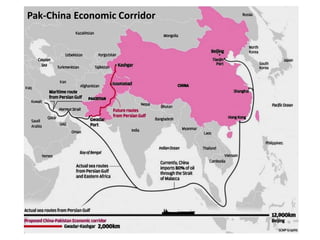
Pak-China Economic Corridor
Gawadar
Independence: August 14, 1947
Religion: Islam (97% Muslims)
Capital: Islamabad
Type of Government: Parliamentary Democracy
Population: About 20 Billion (Rough estimate)
Area: 310,404 square miles
National Language: Urdu
Regional Languages: Punjabi, Sindhi, balochi & Pashto
Unit of Currency: Pakistani Rupee
Major Crops: Wheat, Rice, cotton, Sugar cane,
Mize, Grams, pulses etc.
The Islamic Republic of Pakistan
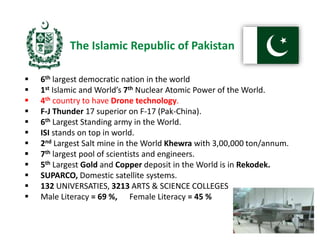
 6th largest democratic nation in the world
 1st Islamic and World’s 7th Nuclear Atomic Power of the World.
 4th country to have Drone technology.
 F-J Thunder 17 superior on F-17 (Pak-China).
 6th Largest Standing army in the World.
 ISI stands on top in world.
 2nd Largest Salt mine in the World Khewra with 3,00,000 ton/annum.
 7th largest pool of scientists and engineers.
 5th Largest Gold and Copper deposit in the World is in Rekodek.
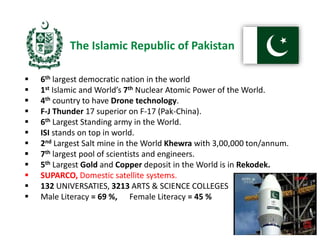
 SUPARCO, Domestic satellite systems.
 132 UNIVERSATIES, 3213 ARTS & SCIENCE COLLEGES
 Male Literacy = 69 %, Female Literacy = 45 %
The Islamic Republic of Pakistan
 6th largest democratic nation in the world
 1st Islamic and World’s 7th Nuclear Atomic Power of the World.
 4th country to have Drone technology.
 F-J Thunder 17 superior on F-17 (Pak-China).
 6th Largest Standing army in the World.
 ISI stands on top in world.
 2nd Largest Salt mine in the World Khewra with 3,00,000 ton/annum.
 7th largest pool of scientists and engineers.
 5th Largest Gold and Copper deposit in the World is in Rekodek.
 SUPARCO, Domestic satellite systems.
 132 UNIVERSATIES, 3213 ARTS & SCIENCE COLLEGES
 Male Literacy = 69 %, Female Literacy = 45 %
The Islamic Republic of Pakistan
 6th largest democratic nation in the world
 1st Islamic and World’s 7th Nuclear Atomic Power of the World.
 4th country to have Drone technology.
 JF-17 Thunder superior on F-16 (Pak-China).
 6th Largest army in the World.
 ISI stands on top in world.
 2nd Largest Salt mine in the World Khewra with 3,00,000 ton/annum.
 7th largest pool of scientists and engineers.
 5th Largest Gold and Copper deposit in the World is in Rekodek.
 SUPARCO, Domestic satellite systems.
 132 UNIVERSATIES, 3213 ARTS & SCIENCE COLLEGES
 Male Literacy = 69 %, Female Literacy = 45 %
The Islamic Republic of Pakistan
 6th largest democratic nation in the world
 1st Islamic and World’s 7th Nuclear Atomic Power of the World.
 4th country to have Drone technology.
 JF-17 Thunder superior on F-16 (Pak-China).
 6th Largest Standing army in the World.
 ISI stands on top in world.
 2nd Largest Salt mine in the World Khewra with 3,00,000 ton/annum.
 7th largest pool of scientists and engineers.
 5th Largest Gold and Copper deposit in the World is in Rekodek.
 SUPARCO, Domestic satellite systems.
 132 UNIVERSATIES, 3213 ARTS & SCIENCE COLLEGES
 Male Literacy = 69 %, Female Literacy = 45 %
The Islamic Republic of Pakistan
 6th largest democratic nation in the world
 1st Islamic and World’s 7th Nuclear Atomic Power of the World.
 4th country to have Drone technology.
 F-J Thunder 17 superior on F-17 (Pak-China).
 6th Largest Standing army in the World.
 ISI stands on top in world.
 2nd Largest Salt mine in the World Khewra with 3,00,000 ton/annum.
 7th largest pool of scientists and engineers.
 5th Largest Gold and Copper deposit in the World is in Rekodek.
 SUPARCO, Domestic satellite systems.
 132 UNIVERSATIES, 3213 ARTS & SCIENCE COLLEGES
 Male Literacy = 69 %, Female Literacy = 45 %
The Islamic Republic of Pakistan
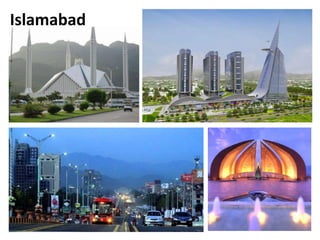
Islamabad
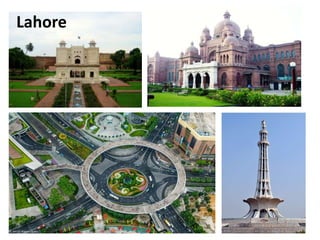
Lahore
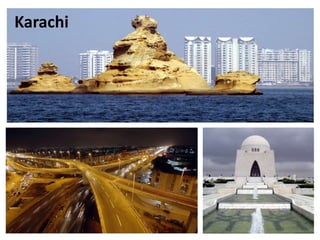
Karachi
Punjab
• Languages: Urdu, Punjabi, Saraiki
• Major cities are Lahore (Capital),
Rawalpindi, Faisalabad, Multan and
Bahawalpur.
• 56% of the country's total population.
• Main cultural, historical, administrative and
economic center.
• wheat, cotton and rice, mango, tobacco,
pulses, maize, gram etc.
• Industries, Productive lands
• Educational institutes
• Major part in GDP
• Well developed
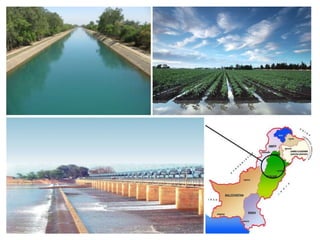
• 5 rivers, Dams, Barrages, Canals
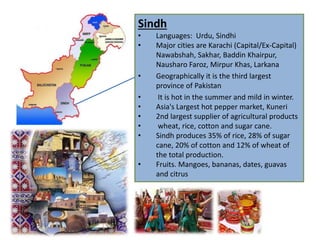
Sindh
• Languages: Urdu, Sindhi
• Major cities are Karachi (Capital/Ex-Capital)
Nawabshah, Sakhar, Baddin Khairpur,
Nausharo Faroz, Mirpur Khas, Larkana
• Geographically it is the third largest
province of Pakistan
• It is hot in the summer and mild in winter.
• Asia's Largest hot pepper market, Kuneri
• 2nd largest supplier of agricultural products
• wheat, rice, cotton and sugar cane.
• Sindh produces 35% of rice, 28% of sugar
cane, 20% of cotton and 12% of wheat of
the total production.
• Fruits. Mangoes, bananas, dates, guavas
and citrus
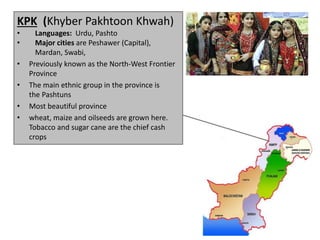
KPK (Khyber Pakhtoon Khwah)
• Languages: Urdu, Pashto
• Major cities are Peshawer (Capital),
Mardan, Swabi,
• Previously known as the North-West Frontier
Province
• The main ethnic group in the province is
the Pashtuns
• Most beautiful province
• wheat, maize and oilseeds are grown here.
Tobacco and sugar cane are the chief cash
crops
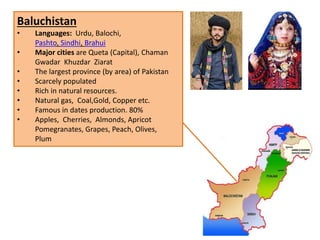
Baluchistan
• Languages: Urdu, Balochi,
Pashto, Sindhi, Brahui
• Major cities are Queta (Capital), Chaman
Gwadar Khuzdar Ziarat
• The largest province (by area) of Pakistan
• Scarcely populated
• Rich in natural resources.
• Natural gas, Coal,Gold, Copper etc.
• Famous in dates production. 80%
• Apples, Cherries, Almonds, Apricot
Pomegranates, Grapes, Peach, Olives,
Plum
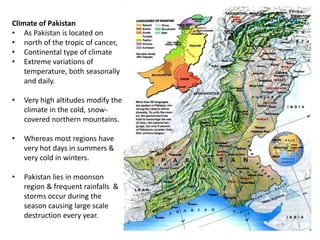
Climate of Pakistan
• As Pakistan is located on
• north of the tropic of cancer,
• Continental type of climate
• Extreme variations of
temperature, both seasonally
and daily.
• Very high altitudes modify the
climate in the cold, snow-
covered northern mountains.
• Whereas most regions have
very hot days in summers &
very cold in winters.
• Pakistan lies in moonson
region & frequent rainfalls &
storms occur during the
season causing large scale
destruction every year.
Seasons
Winter: Dec-Feb
Spring: Mar-May
Summer: Jun-Sep
Autumn: Oct-Nov
Rivers
Foods
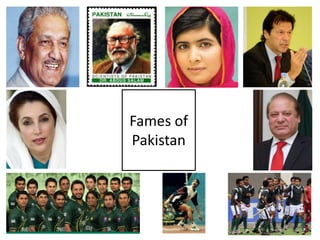
Fames of
Pakistan
Agriculture in Pakistan
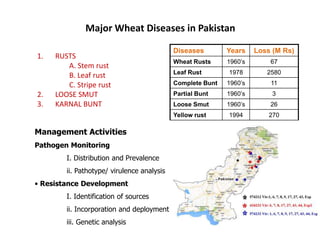
Major Wheat Diseases in Pakistan
1. RUSTS
A. Stem rust
B. Leaf rust
C. Stripe rust
2. LOOSE SMUT
3. KARNAL BUNT
Diseases Years Loss (M Rs)
Wheat Rusts 1960’s 67
Leaf Rust 1978 2580
Complete Bunt 1960’s 11
Partial Bunt 1960’s 3
Loose Smut 1960’s 26
Yellow rust 1994 270
Management Activities
Pathogen Monitoring
I. Distribution and Prevalence
ii. Pathotype/ virulence analysis
• Resistance Development
I. Identification of sources
ii. Incorporation and deployment
iii. Genetic analysis
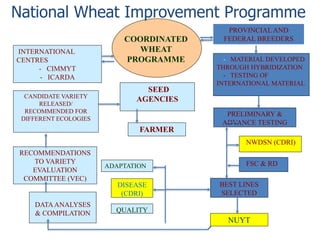
COORDINATED
WHEAT
PROGRAMME
INTERNATIONAL
CENTRES
- CIMMYT
- ICARDA
PROVINCIAL AND
FEDERAL BREEDERS
PRELIMINARY &
ADVANCE TESTING
CANDIDATE VARIETY
RELEASED/
RECOMMENDED FOR
DIFFERENT ECOLOGIES
RECOMMENDATIONS
TO VARIETY
EVALUATION
COMMITTEE (VEC)
DATAANALYSES
& COMPILATION
BEST LINES
SELECTED
NWDSN (CDRI)
FSC & RD
QUALITY
NUYT
DISEASE
(CDRI)
ADAPTATION
FARMER
SEED
AGENCIES
- MATERIAL DEVELOPED
THROUGH HYBRIDIZATION
- TESTING OF
INTERNATIONAL MATERIAL
National Wheat Improvement Programme
Current Status of wheat rusts in Pakistan
Newly wheat varieties Pirsbak-2013, Lillema-13, Shahkar-2013, Dharabi-13,
Pakistan-13 Benazir-2013 were found highly resistant to yellow rust
Galaxy-13 the newly released wheat showed ineffectiveness after release
Some candidate lines were in the pipeline for releasing as a wheat variety in
Pakistan found highly resistant to yellow rust in screening nurseries as well as other
sit
Future Challenges
Local Scenario
 Domestic Climatic Changes
 Narrowing of Wheat Season (Sowing and Harvesting)
 High Price of Cotton and Rice
 Non Availability of Certified Seed
 Continuous sowing of susceptible varieties
International
 Information Sharing
 Use of similar germplasm across borders
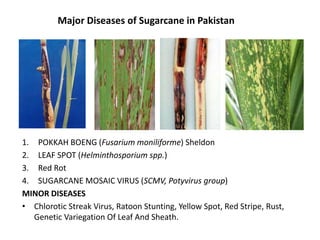
Major Diseases of Sugarcane in Pakistan
1. POKKAH BOENG (Fusarium moniliforme) Sheldon
2. LEAF SPOT (Helminthosporium spp.)
3. Red Rot
4. SUGARCANE MOSAIC VIRUS (SCMV, Potyvirus group)
MINOR DISEASES
• Chlorotic Streak Virus, Ratoon Stunting, Yellow Spot, Red Stripe, Rust,
Genetic Variegation Of Leaf And Sheath.
Diseases of mango in Pakistan
• Powdery mildew (Oidium mangiferae),
• Sooty mould (Capnodium romasum or Tripospermum acorium).
• Fruit rot (Aspergillus niger).
• Leaf blight (Pestaloptiopsis mangiferae).
• Anthracnose (Glomerella cingulata-Colletotrichum gloeosporioides).
• Stem blight or die back (Diplodia spp.).
• Root rot (Rhizoctinia and Fusarium species) and tip die back (Fusarium
equiseta, Alternaria alternate, Aspergillus niger and Rhizopus nigricans)
are recorded as fungal diseases.
• Bacterial leaf spot (Erwinia mangifera); and malformation of mango
inflorescence (the actual cause is still not confirmed) are reported from
Pakistan.
• No information regarding the extent of damage to the plant is available,
but some of these are certainly responsible for causing considerable
damage and become a limiting factor in many mango-growing areas.
Cotton Leaf Curl Virus Disease
• Epidemic in 1992, loses 5 billion US dollars.
• Cause: Begomovirus and a DNA satellite
molecule.
• High variability. Resistant breaking.
• spread by Bemisia tabaci (whitefly).
• Environmental factors also affect.
• High humidity and optimum temperature
favours the vector population
• Cotton research institute multan.
• CLCuD has been reported in Pakistan, India,
Egypt, Nigeria, Tanzania and Sudan
• Cotton leaf curl Multan, Burewala, Alaabad
Khokhran, Rajasthan virus.
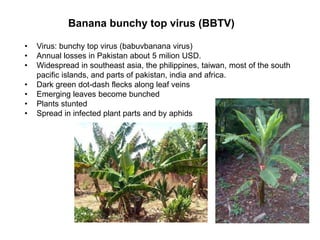
Banana bunchy top virus (BBTV)
• Virus: bunchy top virus (babuvbanana virus)
• Annual losses in Pakistan about 5 milion USD.
• Widespread in southeast asia, the philippines, taiwan, most of the south
pacific islands, and parts of pakistan, india and africa.
• Dark green dot-dash flecks along leaf veins
• Emerging leaves become bunched
• Plants stunted
• Spread in infected plant parts and by aphids
Other Diseases
• Potato and tomato bligts
• PVX, PVY, PVV
• Vegetables
• CMV, ChiVMV, PMMoV, PVMV.
• Rice Blast.
• Melodogyne spp, Tyleculus spp.
• Bio Control is not very popular in Pakistan
Thank You
Questions are Welcome

Pakistan

  • 1.
    A Presentation by: AdnanAhmad Visiting PhD student from HEC Pakistan Working Under Supervision of Dr. Laura Tomassoli The Agricultural Research Council (CRA), Rome, Italy Agriculture in Pakistan
  • 5.
  • 6.
  • 7.
    Independence: August 14,1947 Religion: Islam (97% Muslims) Capital: Islamabad Type of Government: Parliamentary Democracy Population: About 20 Billion (Rough estimate) Area: 310,404 square miles National Language: Urdu Regional Languages: Punjabi, Sindhi, balochi & Pashto Unit of Currency: Pakistani Rupee Major Crops: Wheat, Rice, cotton, Sugar cane, Mize, Grams, pulses etc. The Islamic Republic of Pakistan
  • 8.
     6th largestdemocratic nation in the world  1st Islamic and World’s 7th Nuclear Atomic Power of the World.  4th country to have Drone technology.  F-J Thunder 17 superior on F-17 (Pak-China).  6th Largest Standing army in the World.  ISI stands on top in world.  2nd Largest Salt mine in the World Khewra with 3,00,000 ton/annum.  7th largest pool of scientists and engineers.  5th Largest Gold and Copper deposit in the World is in Rekodek.  SUPARCO, Domestic satellite systems.  132 UNIVERSATIES, 3213 ARTS & SCIENCE COLLEGES  Male Literacy = 69 %, Female Literacy = 45 % The Islamic Republic of Pakistan
  • 9.
     6th largestdemocratic nation in the world  1st Islamic and World’s 7th Nuclear Atomic Power of the World.  4th country to have Drone technology.  F-J Thunder 17 superior on F-17 (Pak-China).  6th Largest Standing army in the World.  ISI stands on top in world.  2nd Largest Salt mine in the World Khewra with 3,00,000 ton/annum.  7th largest pool of scientists and engineers.  5th Largest Gold and Copper deposit in the World is in Rekodek.  SUPARCO, Domestic satellite systems.  132 UNIVERSATIES, 3213 ARTS & SCIENCE COLLEGES  Male Literacy = 69 %, Female Literacy = 45 % The Islamic Republic of Pakistan
  • 10.
     6th largestdemocratic nation in the world  1st Islamic and World’s 7th Nuclear Atomic Power of the World.  4th country to have Drone technology.  JF-17 Thunder superior on F-16 (Pak-China).  6th Largest army in the World.  ISI stands on top in world.  2nd Largest Salt mine in the World Khewra with 3,00,000 ton/annum.  7th largest pool of scientists and engineers.  5th Largest Gold and Copper deposit in the World is in Rekodek.  SUPARCO, Domestic satellite systems.  132 UNIVERSATIES, 3213 ARTS & SCIENCE COLLEGES  Male Literacy = 69 %, Female Literacy = 45 % The Islamic Republic of Pakistan
  • 11.
     6th largestdemocratic nation in the world  1st Islamic and World’s 7th Nuclear Atomic Power of the World.  4th country to have Drone technology.  JF-17 Thunder superior on F-16 (Pak-China).  6th Largest Standing army in the World.  ISI stands on top in world.  2nd Largest Salt mine in the World Khewra with 3,00,000 ton/annum.  7th largest pool of scientists and engineers.  5th Largest Gold and Copper deposit in the World is in Rekodek.  SUPARCO, Domestic satellite systems.  132 UNIVERSATIES, 3213 ARTS & SCIENCE COLLEGES  Male Literacy = 69 %, Female Literacy = 45 % The Islamic Republic of Pakistan
  • 12.
     6th largestdemocratic nation in the world  1st Islamic and World’s 7th Nuclear Atomic Power of the World.  4th country to have Drone technology.  F-J Thunder 17 superior on F-17 (Pak-China).  6th Largest Standing army in the World.  ISI stands on top in world.  2nd Largest Salt mine in the World Khewra with 3,00,000 ton/annum.  7th largest pool of scientists and engineers.  5th Largest Gold and Copper deposit in the World is in Rekodek.  SUPARCO, Domestic satellite systems.  132 UNIVERSATIES, 3213 ARTS & SCIENCE COLLEGES  Male Literacy = 69 %, Female Literacy = 45 % The Islamic Republic of Pakistan
  • 13.
  • 14.
  • 15.
  • 18.
    Punjab • Languages: Urdu,Punjabi, Saraiki • Major cities are Lahore (Capital), Rawalpindi, Faisalabad, Multan and Bahawalpur. • 56% of the country's total population. • Main cultural, historical, administrative and economic center. • wheat, cotton and rice, mango, tobacco, pulses, maize, gram etc. • Industries, Productive lands • Educational institutes • Major part in GDP • Well developed • 5 rivers, Dams, Barrages, Canals
  • 19.
    Sindh • Languages: Urdu,Sindhi • Major cities are Karachi (Capital/Ex-Capital) Nawabshah, Sakhar, Baddin Khairpur, Nausharo Faroz, Mirpur Khas, Larkana • Geographically it is the third largest province of Pakistan • It is hot in the summer and mild in winter. • Asia's Largest hot pepper market, Kuneri • 2nd largest supplier of agricultural products • wheat, rice, cotton and sugar cane. • Sindh produces 35% of rice, 28% of sugar cane, 20% of cotton and 12% of wheat of the total production. • Fruits. Mangoes, bananas, dates, guavas and citrus
  • 20.
    KPK (Khyber PakhtoonKhwah) • Languages: Urdu, Pashto • Major cities are Peshawer (Capital), Mardan, Swabi, • Previously known as the North-West Frontier Province • The main ethnic group in the province is the Pashtuns • Most beautiful province • wheat, maize and oilseeds are grown here. Tobacco and sugar cane are the chief cash crops
  • 21.
    Baluchistan • Languages: Urdu,Balochi, Pashto, Sindhi, Brahui • Major cities are Queta (Capital), Chaman Gwadar Khuzdar Ziarat • The largest province (by area) of Pakistan • Scarcely populated • Rich in natural resources. • Natural gas, Coal,Gold, Copper etc. • Famous in dates production. 80% • Apples, Cherries, Almonds, Apricot Pomegranates, Grapes, Peach, Olives, Plum
  • 22.
    Climate of Pakistan •As Pakistan is located on • north of the tropic of cancer, • Continental type of climate • Extreme variations of temperature, both seasonally and daily. • Very high altitudes modify the climate in the cold, snow- covered northern mountains. • Whereas most regions have very hot days in summers & very cold in winters. • Pakistan lies in moonson region & frequent rainfalls & storms occur during the season causing large scale destruction every year.
  • 23.
  • 27.
  • 28.
  • 29.
  • 30.
  • 34.
    Major Wheat Diseasesin Pakistan 1. RUSTS A. Stem rust B. Leaf rust C. Stripe rust 2. LOOSE SMUT 3. KARNAL BUNT Diseases Years Loss (M Rs) Wheat Rusts 1960’s 67 Leaf Rust 1978 2580 Complete Bunt 1960’s 11 Partial Bunt 1960’s 3 Loose Smut 1960’s 26 Yellow rust 1994 270 Management Activities Pathogen Monitoring I. Distribution and Prevalence ii. Pathotype/ virulence analysis • Resistance Development I. Identification of sources ii. Incorporation and deployment iii. Genetic analysis
  • 35.
    COORDINATED WHEAT PROGRAMME INTERNATIONAL CENTRES - CIMMYT - ICARDA PROVINCIALAND FEDERAL BREEDERS PRELIMINARY & ADVANCE TESTING CANDIDATE VARIETY RELEASED/ RECOMMENDED FOR DIFFERENT ECOLOGIES RECOMMENDATIONS TO VARIETY EVALUATION COMMITTEE (VEC) DATAANALYSES & COMPILATION BEST LINES SELECTED NWDSN (CDRI) FSC & RD QUALITY NUYT DISEASE (CDRI) ADAPTATION FARMER SEED AGENCIES - MATERIAL DEVELOPED THROUGH HYBRIDIZATION - TESTING OF INTERNATIONAL MATERIAL National Wheat Improvement Programme
  • 36.
    Current Status ofwheat rusts in Pakistan Newly wheat varieties Pirsbak-2013, Lillema-13, Shahkar-2013, Dharabi-13, Pakistan-13 Benazir-2013 were found highly resistant to yellow rust Galaxy-13 the newly released wheat showed ineffectiveness after release Some candidate lines were in the pipeline for releasing as a wheat variety in Pakistan found highly resistant to yellow rust in screening nurseries as well as other sit Future Challenges Local Scenario  Domestic Climatic Changes  Narrowing of Wheat Season (Sowing and Harvesting)  High Price of Cotton and Rice  Non Availability of Certified Seed  Continuous sowing of susceptible varieties International  Information Sharing  Use of similar germplasm across borders
  • 37.
    Major Diseases ofSugarcane in Pakistan 1. POKKAH BOENG (Fusarium moniliforme) Sheldon 2. LEAF SPOT (Helminthosporium spp.) 3. Red Rot 4. SUGARCANE MOSAIC VIRUS (SCMV, Potyvirus group) MINOR DISEASES • Chlorotic Streak Virus, Ratoon Stunting, Yellow Spot, Red Stripe, Rust, Genetic Variegation Of Leaf And Sheath.
  • 38.
    Diseases of mangoin Pakistan • Powdery mildew (Oidium mangiferae), • Sooty mould (Capnodium romasum or Tripospermum acorium). • Fruit rot (Aspergillus niger). • Leaf blight (Pestaloptiopsis mangiferae). • Anthracnose (Glomerella cingulata-Colletotrichum gloeosporioides). • Stem blight or die back (Diplodia spp.). • Root rot (Rhizoctinia and Fusarium species) and tip die back (Fusarium equiseta, Alternaria alternate, Aspergillus niger and Rhizopus nigricans) are recorded as fungal diseases. • Bacterial leaf spot (Erwinia mangifera); and malformation of mango inflorescence (the actual cause is still not confirmed) are reported from Pakistan. • No information regarding the extent of damage to the plant is available, but some of these are certainly responsible for causing considerable damage and become a limiting factor in many mango-growing areas.
  • 39.
    Cotton Leaf CurlVirus Disease • Epidemic in 1992, loses 5 billion US dollars. • Cause: Begomovirus and a DNA satellite molecule. • High variability. Resistant breaking. • spread by Bemisia tabaci (whitefly). • Environmental factors also affect. • High humidity and optimum temperature favours the vector population • Cotton research institute multan. • CLCuD has been reported in Pakistan, India, Egypt, Nigeria, Tanzania and Sudan • Cotton leaf curl Multan, Burewala, Alaabad Khokhran, Rajasthan virus.
  • 40.
    Banana bunchy topvirus (BBTV) • Virus: bunchy top virus (babuvbanana virus) • Annual losses in Pakistan about 5 milion USD. • Widespread in southeast asia, the philippines, taiwan, most of the south pacific islands, and parts of pakistan, india and africa. • Dark green dot-dash flecks along leaf veins • Emerging leaves become bunched • Plants stunted • Spread in infected plant parts and by aphids
  • 41.
    Other Diseases • Potatoand tomato bligts • PVX, PVY, PVV • Vegetables • CMV, ChiVMV, PMMoV, PVMV. • Rice Blast. • Melodogyne spp, Tyleculus spp. • Bio Control is not very popular in Pakistan
  • 42.