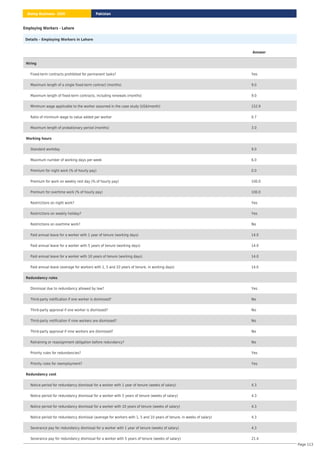
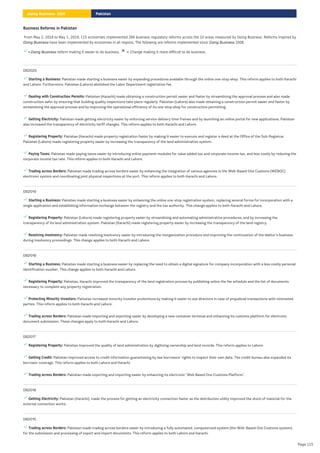
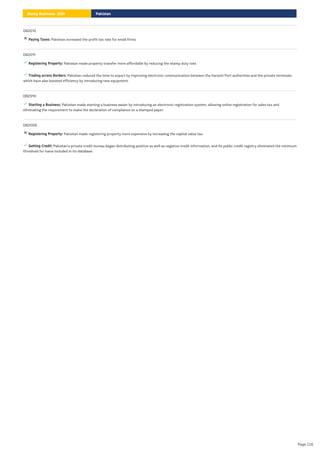
Economy Profile
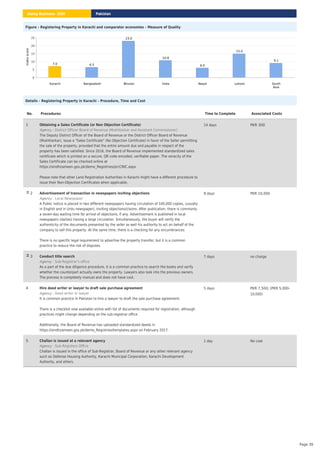
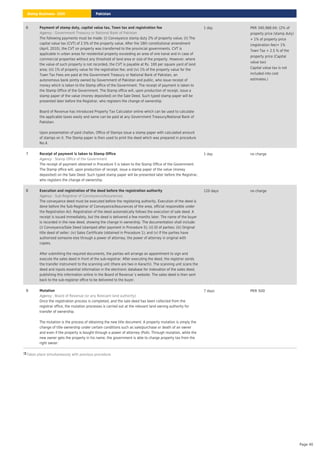
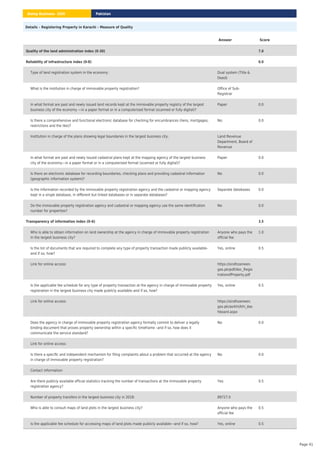
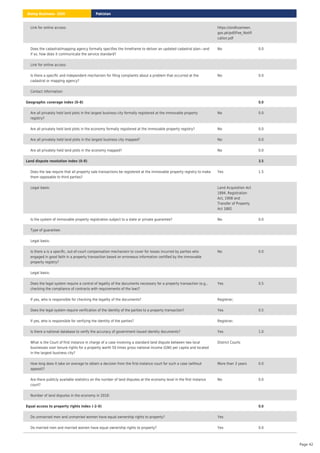
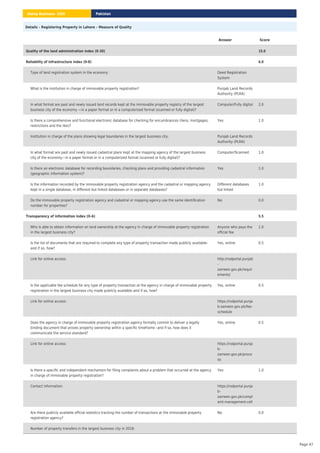
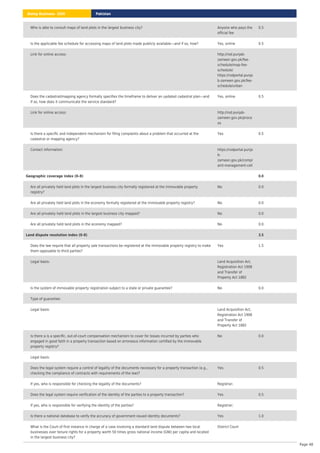
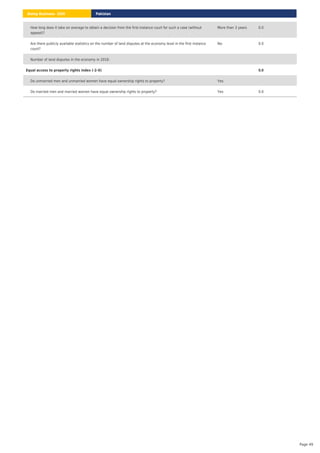
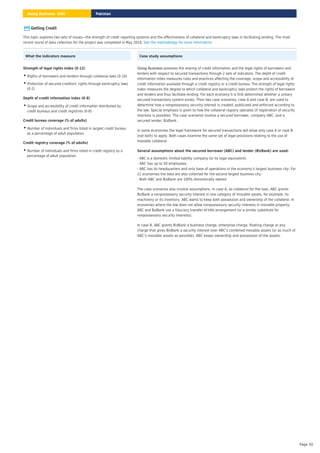
Pakistan
Pakistan
Doing Business 2020
Page 1
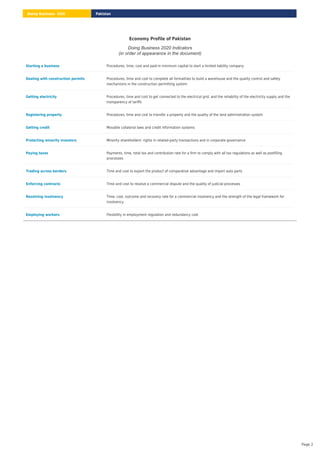
Economy Profile of Pakistan
Doing Business 2020 Indicators
(in order of appearance in the document)
Starting a business Procedures, time, cost and paid-in minimum capital to start a limited liability company
Dealing with construction permits Procedures, time and cost to complete all formalities to build a warehouse and the quality control and safety
mechanisms in the construction permitting system
Getting electricity Procedures, time and cost to get connected to the electrical grid, and the reliability of the electricity supply and the
transparency of tariffs
Registering property Procedures, time and cost to transfer a property and the quality of the land administration system
Getting credit Movable collateral laws and credit information systems
Protecting minority investors Minority shareholders’ rights in related-party transactions and in corporate governance
Paying taxes Payments, time, total tax and contribution rate for a firm to comply with all tax regulations as well as postfiling
processes
Trading across borders Time and cost to export the product of comparative advantage and import auto parts
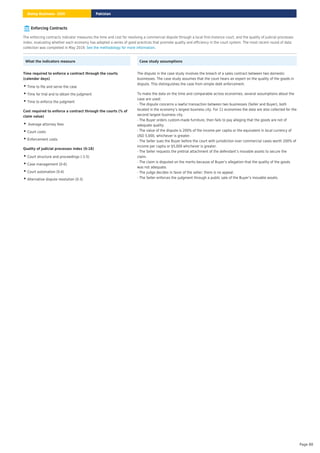
Enforcing contracts Time and cost to resolve a commercial dispute and the quality of judicial processes
Resolving insolvency Time, cost, outcome and recovery rate for a commercial insolvency and the strength of the legal framework for
insolvency
Employing workers Flexibility in employment regulation and redundancy cost
Pakistan
Doing Business 2020
Page 2
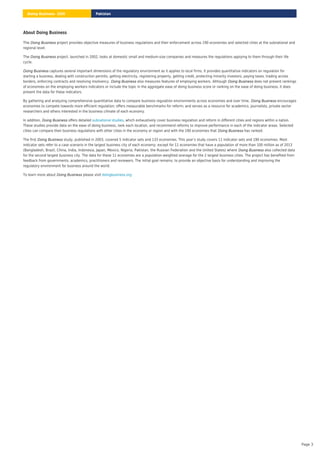
About Doing Business
The project provides objective measures of business regulations and their enforcement across 190 economies and selected cities at the subnational and
regional level.
Doing Business
The project, launched in 2002, looks at domestic small and medium-size companies and measures the regulations applying to them through their life
cycle.
Doing Business
captures several important dimensions of the regulatory environment as it applies to local firms. It provides quantitative indicators on regulation for
starting a business, dealing with construction permits, getting electricity, registering property, getting credit, protecting minority investors, paying taxes, trading across
borders, enforcing contracts and resolving insolvency. also measures features of employing workers. Although does not present rankings
of economies on the employing workers indicators or include the topic in the aggregate ease of doing business score or ranking on the ease of doing business, it does
present the data for these indicators.
Doing Business
Doing Business Doing Business
By gathering and analyzing comprehensive quantitative data to compare business regulation environments across economies and over time, encourages
economies to compete towards more efficient regulation; offers measurable benchmarks for reform; and serves as a resource for academics, journalists, private sector
researchers and others interested in the business climate of each economy.
Doing Business
In addition, offers detailed , which exhaustively cover business regulation and reform in different cities and regions within a nation.
These studies provide data on the ease of doing business, rank each location, and recommend reforms to improve performance in each of the indicator areas. Selected
cities can compare their business regulations with other cities in the economy or region and with the 190 economies that has ranked.
Doing Business subnational studies
Doing Business
The first study, published in 2003, covered 5 indicator sets and 133 economies. This year’s study covers 11 indicator sets and 190 economies. Most
indicator sets refer to a case scenario in the largest business city of each economy, except for 11 economies that have a population of more than 100 million as of 2013
(Bangladesh, Brazil, China, India, Indonesia, Japan, Mexico, Nigeria, Pakistan, the Russian Federation and the United States) where also collected data
for the second largest business city. The data for these 11 economies are a population-weighted average for the 2 largest business cities. The project has benefited from
feedback from governments, academics, practitioners and reviewers. The initial goal remains: to provide an objective basis for understanding and improving the
regulatory environment for business around the world.
Doing Business
Doing Business
To learn more about please visit
Doing Business doingbusiness.org
Pakistan
Doing Business 2020
Page 3
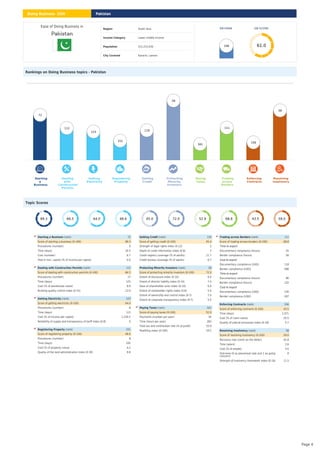
Ease of Doing Business in
Pakistan
Region South Asia
Income Category Lower middle income
Population 212,215,030
City Covered Karachi, Lahore
108
DB RANK DB SCORE
61.0
Rankings on Doing Business topics - Pakistan
72
112
123
151
119
28
161
111
156
58
Starting
a
Business
Dealing
with
Construction
Permits
Getting
Electricity
Registering
Property
Getting
Credit
Protecting
Minority
Investors
Paying
Taxes
Trading
across
Borders
Enforcing
Contracts
Resolving
Insolvency
Topic Scores
89.3 66.5 64.0 48.6 45.0 72.0 52.9 68.8 43.5 59.0
(rank)
Starting a Business 72
Score of starting a business (0-100) 89.3
Procedures (number) 5
Time (days) 16.5
Cost (number) 6.7
Paid-in min. capital (% of income per capita) 0.0
(rank)
Dealing with Construction Permits 112
Score of dealing with construction permits (0-100) 66.5
Procedures (number) 17
Time (days) 125
Cost (% of warehouse value) 8.8
Building quality control index (0-15) 13.0
(rank)
Getting Electricity 123
Score of getting electricity (0-100) 64.0
Procedures (number) 6
Time (days) 113
Cost (% of income per capita) 1,234.5
Reliability of supply and transparency of tariff index (0-8) 5
(rank)
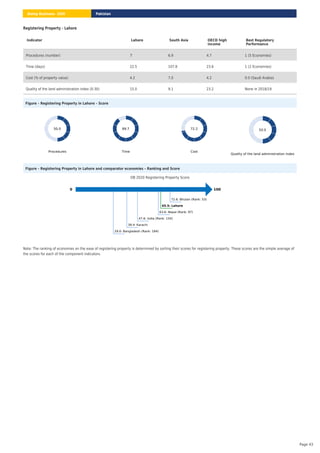
Registering Property 151
Score of registering property (0-100) 48.6
Procedures (number) 8
Time (days) 105
Cost (% of property value) 4.2
Quality of the land administration index (0-30) 9.8
(rank)
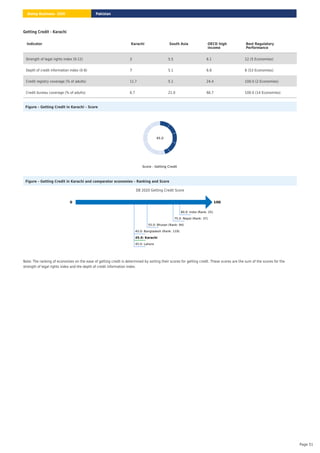
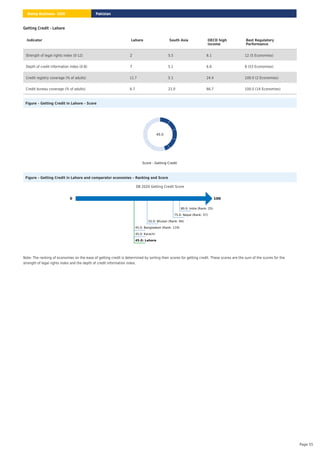
Getting Credit 119
Score of getting credit (0-100) 45.0
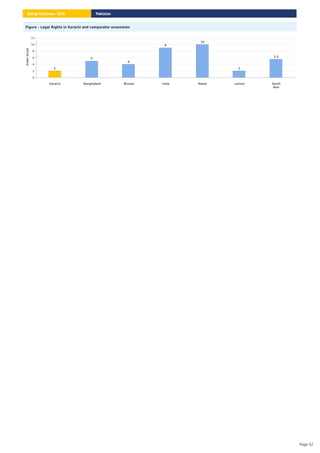
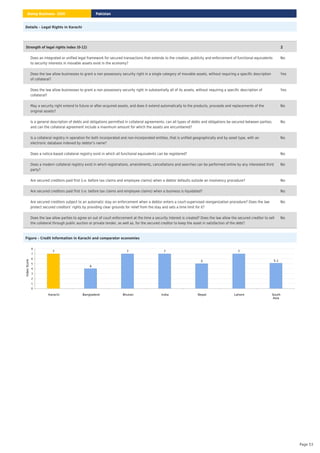
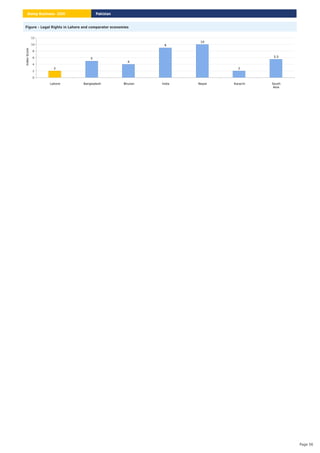
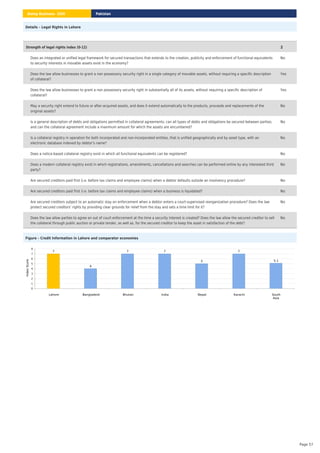
Strength of legal rights index (0-12) 2
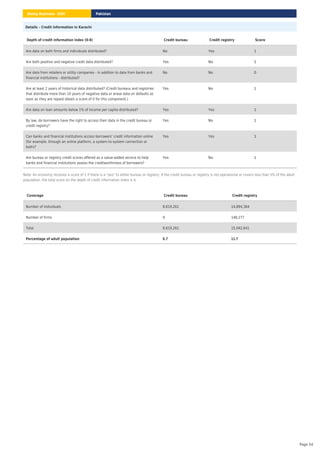
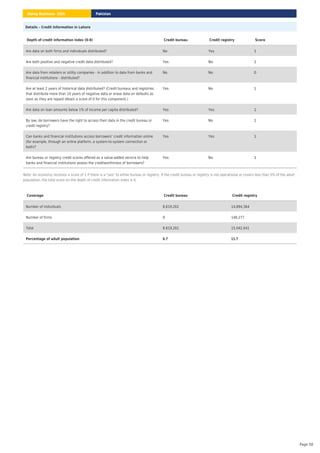
Depth of credit information index (0-8) 7
Credit registry coverage (% of adults) 11.7
Credit bureau coverage (% of adults) 6.7
(rank)
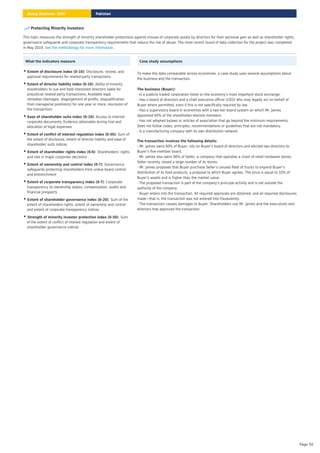
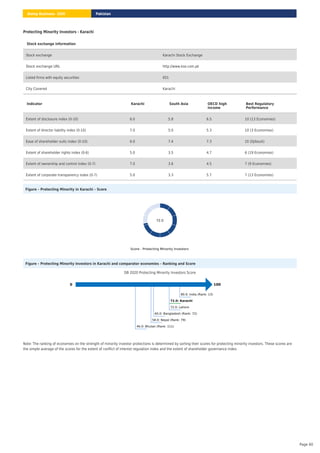
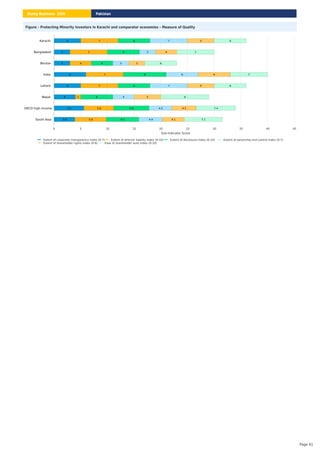
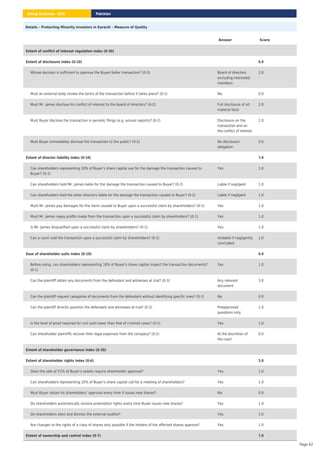
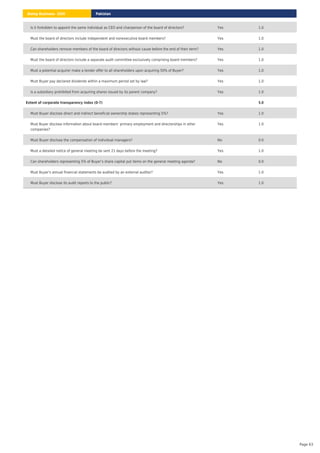
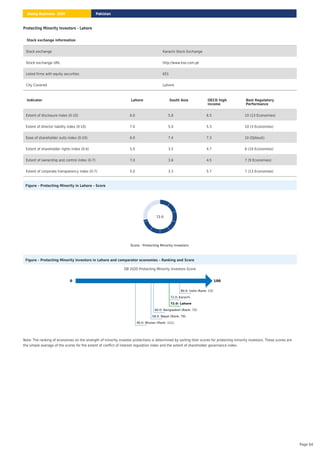
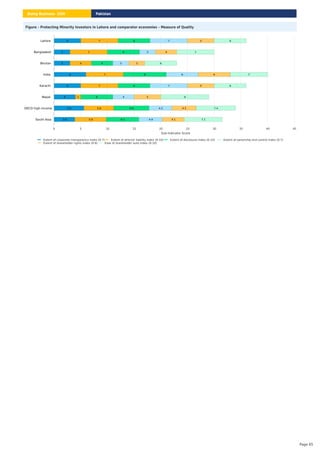
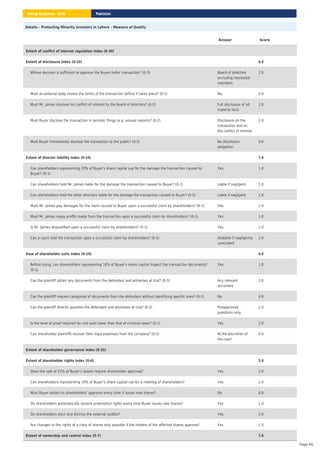
Protecting Minority Investors 28
Score of protecting minority investors (0-100) 72.0
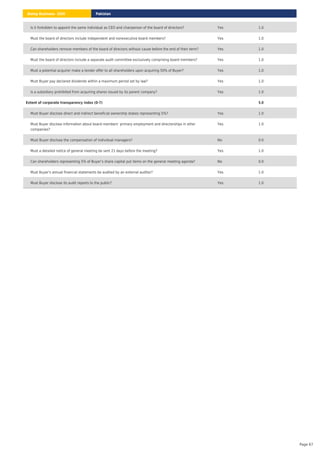
Extent of disclosure index (0-10) 6.0
Extent of director liability index (0-10) 7.0
Ease of shareholder suits index (0-10) 6.0
Extent of shareholder rights index (0-6) 5.0
Extent of ownership and control index (0-7) 7.0
Extent of corporate transparency index (0-7) 5.0
(rank)
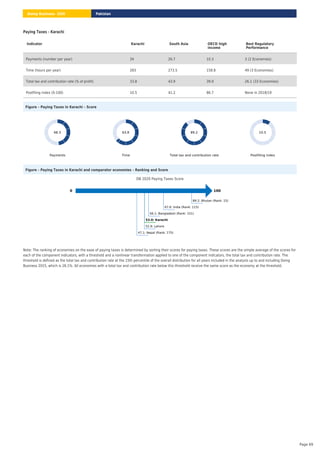
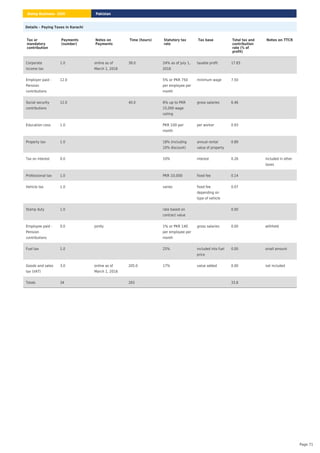
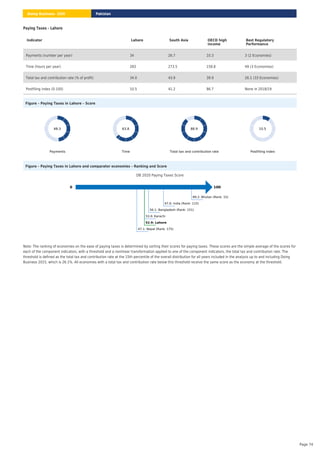
Paying Taxes 161
Score of paying taxes (0-100) 52.9
Payments (number per year) 34
Time (hours per year) 283
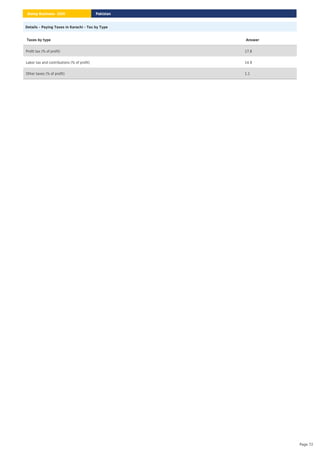
Total tax and contribution rate (% of profit) 33.9
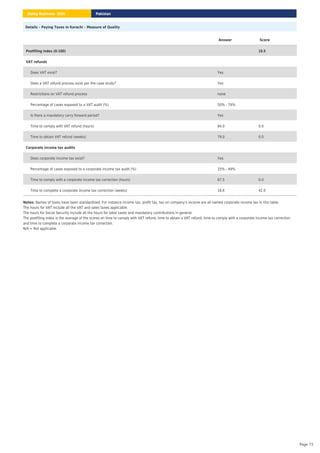
Postfiling index (0-100) 10.5
(rank)
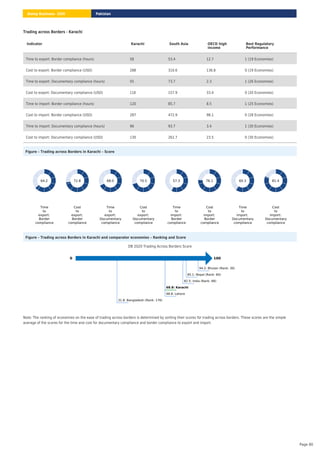
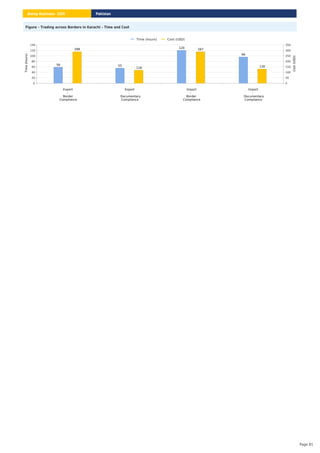
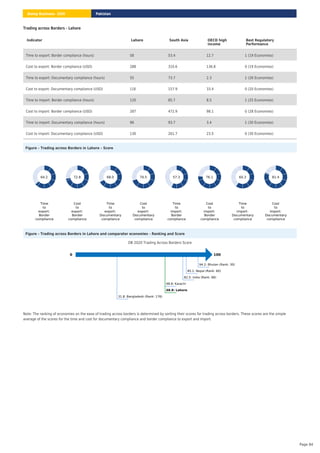
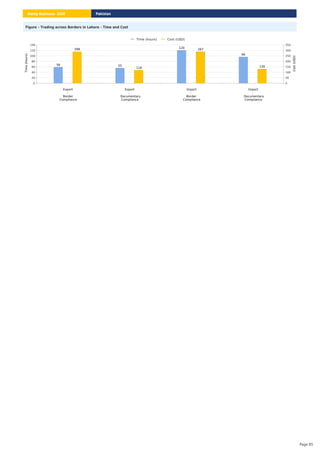
Trading across Borders 111
Score of trading across borders (0-100) 68.8
Time to export
Documentary compliance (hours) 55
Border compliance (hours) 58
Cost to export
Documentary compliance (USD) 118
Border compliance (USD) 288
Time to export
Documentary compliance (hours) 96
Border compliance (hours) 120
Cost to export
Documentary compliance (USD) 130
Border compliance (USD) 287
(rank)
Enforcing Contracts 156
Score of enforcing contracts (0-100) 43.5
Time (days) 1,071
Cost (% of claim value) 20.5
Quality of judicial processes index (0-18) 5.7
(rank)
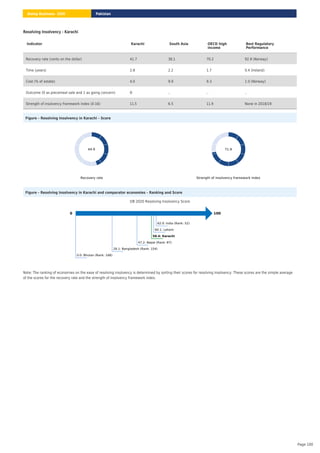
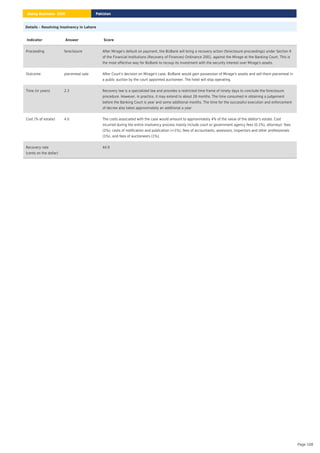
Resolving Insolvency 58
Score of resolving insolvency (0-100) 59.0
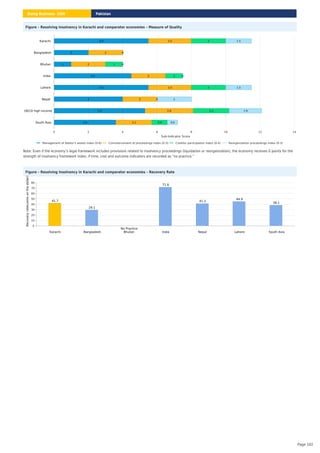
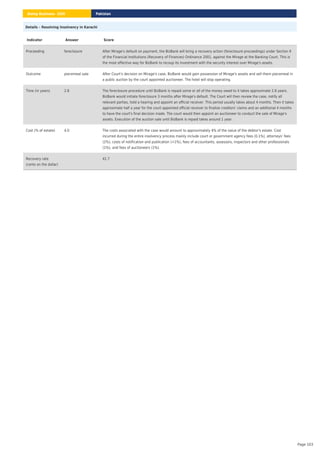
Recovery rate (cents on the dollar) 42.8
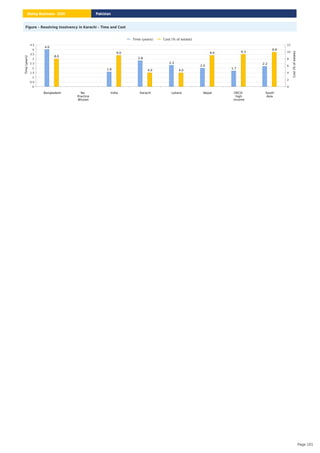
Time (years) 2.6
Cost (% of estate) 4.0
Outcome (0 as piecemeal sale and 1 as going
concern)
0
Strength of insolvency framework index (0-16) 11.5
Pakistan
Doing Business 2020
Page 4
Starting a Business
This topic measures the number of procedures, time, cost and paid-in minimum capital requirement for a small- to medium-sized limited liability company to start up and
formally operate in each economy’s largest business city.
To make the data comparable across 190 economies, uses a standardized business that is 100% domestically owned, has start-up capital equivalent to
10 times the income per capita, engages in general industrial or commercial activities and employs between 10 and 50 people one month after the commencement of
operations, all of whom are domestic nationals. Starting a Business considers two types of local limited liability companies that are identical in all aspects, except that one
company is owned by 5 married women and the other by 5 married men. The ranking of economies on the ease of starting a business is determined by sorting their
scores for starting a business. These scores are the simple average of the scores for each of the component indicators.
Doing Business
The most recent round of data collection for the project was completed in May 2019. .
See the methodology for more information
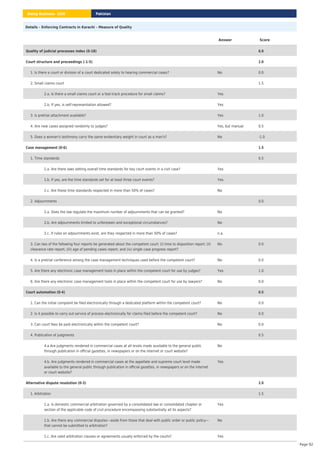
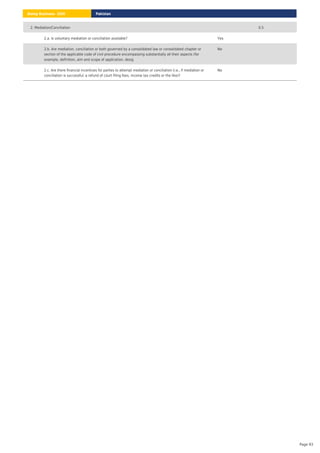
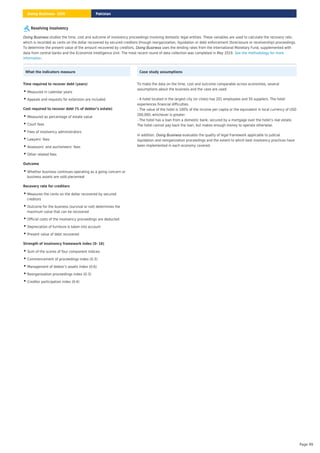
What the indicators measure
Procedures to legally start and formally operate a company
(number)
Preregistration (for example, name verification or reservation,
notarization)
•
Registration in the economy’s largest business city
•
Postregistration (for example, social security registration,
company seal)
•
Obtaining approval from spouse to start a business or to leave
the home to register the company
•
Obtaining any gender specific document for company
registration and operation or national identification card
•
Time required to complete each procedure (calendar days)
Does not include time spent gathering information
•
Each procedure starts on a separate day (2 procedures cannot
start on the same day)
•
Procedures fully completed online are recorded as ½ day
•
Procedure is considered completed once final document is
received
•
No prior contact with officials
•
Cost required to complete each procedure (% of income per
capita)
Official costs only, no bribes
•
No professional fees unless services required by law or
commonly used in practice
•
Paid-in minimum capital (% of income per capita)
• Funds deposited in a bank or with third party before registration
or up to 3 months after incorporation
Case study assumptions
To make the data comparable across economies, several assumptions about the business and the
procedures are used. It is assumed that any required information is readily available and that the
entrepreneur will pay no bribes.
The business:
-Is a limited liability company (or its legal equivalent). If there is more than one type of limited
liability company in the economy, the limited liability form most common among domestic firms is
chosen. Information on the most common form is obtained from incorporation lawyers or the
statistical office.
-Operates in the economy’s largest business city. For 11 economies the data are also collected for
the second largest business city.
-Performs general industrial or commercial activities such as the production or sale to the public of
goods or services. The business does not perform foreign trade activities and does not handle
products subject to a special tax regime, for example, liquor or tobacco. It is not using heavily
polluting production processes.
-Does not qualify for investment incentives or any special benefits.
-Is 100% domestically owned.
-Has five business owners, none of whom is a legal entity. One business owner holds 30% of the
company shares, two owners have 20% of shares each, and two owners have 15% of shares
each.
-Is managed by one local director.
-Has between 10 and 50 employees one month after the commencement of operations, all of them
domestic nationals.
-Has start-up capital of 10 times income per capita.
-Has an estimated turnover of at least 100 times income per capita.
-Leases the commercial plant or offices and is not a proprietor of real estate.
-Has an annual lease for the office space equivalent to one income per capita.
-Is in an office space of approximately 929 square meters (10,000 square feet).
-Has a company deed that is 10 pages long.
The owners:
-Have reached the legal age of majority and are capable of making decisions as an adult. If there
is no legal age of majority, they are assumed to be 30 years old.
-Are in good health and have no criminal record.
-Are married, the marriage is monogamous and registered with the authorities.
-Where the answer differs according to the legal system applicable to the woman or man in
question (as may be the case in economies where there is legal plurality), the answer used will be
the one that applies to the majority of the population.
Pakistan
Doing Business 2020
Page 5
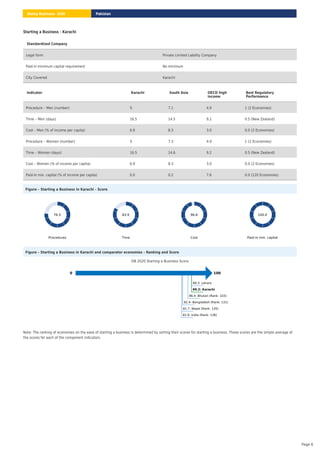
Starting a Business - Karachi
Figure – Starting a Business in Karachi – Score
Procedures
76.5
Time
83.9
Cost
96.6
Paid-in min. capital
100.0
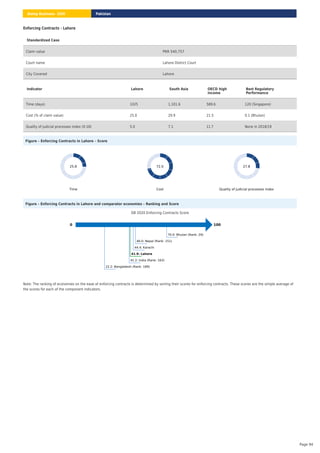
Figure – Starting a Business in Karachi and comparator economies – Ranking and Score
DB 2020 Starting a Business Score
0 100
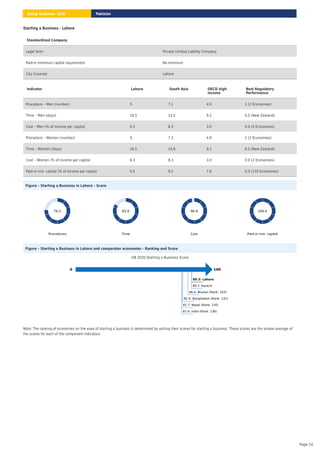
89.3: Lahore
89.2: Karachi
86.4: Bhutan (Rank: 103)
82.4: Bangladesh (Rank: 131)
81.7: Nepal (Rank: 135)
81.6: India (Rank: 136)
Note: The ranking of economies on the ease of starting a business is determined by sorting their scores for starting a business. These scores are the simple average of
the scores for each of the component indicators.
Standardized Company
Legal form Private Limited Liability Company
Paid-in minimum capital requirement No minimum
City Covered Karachi
Indicator Karachi South Asia OECD high
income
Best Regulatory
Performance
Procedure – Men (number) 5 7.1 4.9 1 (2 Economies)
Time – Men (days) 16.5 14.5 9.2 0.5 (New Zealand)
Cost – Men (% of income per capita) 6.9 8.3 3.0 0.0 (2 Economies)
Procedure – Women (number) 5 7.3 4.9 1 (2 Economies)
Time – Women (days) 16.5 14.6 9.2 0.5 (New Zealand)
Cost – Women (% of income per capita) 6.9 8.3 3.0 0.0 (2 Economies)
Paid-in min. capital (% of income per capita) 0.0 0.2 7.6 0.0 (120 Economies)
Pakistan
Doing Business 2020
Page 6
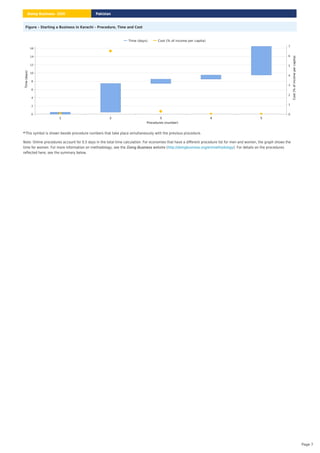
Figure – Starting a Business in Karachi – Procedure, Time and Cost
This symbol is shown beside procedure numbers that take place simultaneously with the previous procedure.
*
Note: Online procedures account for 0.5 days in the total time calculation. For economies that have a different procedure list for men and women, the graph shows the
time for women. For more information on methodology, see the website ( ). For details on the procedures
reflected here, see the summary below.
Doing Business http://doingbusiness.org/en/methodology
Procedures (number)
1 2 3 4 5
0
2
4
6
8
10
12
14
16
Time
(days)
0
1
2
3
4
5
6
7
Cost
(%
of
income
per
capita)
Time (days) Cost (% of income per capita)
Pakistan
Doing Business 2020
Page 7
Details – Starting a Business in Karachi – Procedure, Time and Cost
No. Procedures Time to Complete Associated Costs
1 Obtain PIN for company registration
: Securities and Exchange Commission of Pakistan (SECP)
Agency
As of April 2017, SEC has allowed for the registration for company incorporation to be submitted
through inputting the PIN number instead of the digital certificate. As such, companies now just
need to input the following information into the system his/her 13 digit CNIC Number /NICOP
/POC without dashes. The user will also enter his/her personal details i.e. Full Name,
Father’s/Spouse Name, Gender, Date of Birth, Current Address, Permanent Address, Mobile
Number, Email Address. The user will then enter his/her proposed password. In next section, the
user is required to select three security Questions and then provide answer to those questions.
The user will then click the Signup button to proceed further. After verification, the system will send
security code to User on his/her provided Mobile Number and also on his/her email address. Upon
submission, the system will send PIN to User on the provided Mobile No. through SMS and also
on the provided Email Address. This system generated PIN will be required for company
incorporation.
Less than one day
(online procedure)
PKR 100
2 Reserve the name, register company, pay incorporation fees, obtain a national tax number
(NTN) and register with Excise & Taxation Department of the District (Professional Tax), the
Sindh Employees Social Security Institution (SESSI), Employees Old-Age Benefits
Institution (EOBI) and Labor Department of Karachi on the Securities & Exchange
Commission of Pakistan (SECP) e-portal
: Securities and Exchange Commission of Pakistan (SECP)
Agency
Registration can either be completed online or in person at SECP.
On February 6, 2018, SECP launched a single online procedure for user registration, name
reservation, company incorporation, and notification of appointment of CEO. The new e-Services
are available at https://eservices.secp.gov.pk/eServices/ .
It is required to reserve a company name for the new registration. This can be done in two ways:
separately by submitting name reservation form, or together with submitting the incorporation
application. Most commonly, prior to reservation of name companies check the name availability
at https://www.secp.gov.pk/company-name-search/ (website also includes list of prohibited
names). Once the desired names were verified as available, founders go to
https://eservices.secp.gov.pk/eServices/ , login, and select combined application for name
reservation and company incorporation. During the incorporation application, companies notify of
the first CEOs, among other details.
Starting from 2019, entrepreneurs can also choose to register with Excise & Taxation Department
of the District for the Professional Tax, the Sindh Employees Social Security Institution (SESSI),
Employees Old-Age Benefits Institution (EOBI) and Labor Department within incorporation
application. Upon checking relevant options, the system generates pre-filled applications that
need to be reviewed by applicants and submitted through the same system in a step-by-step
process.
Once name reservation and incorporation application are prepared, the system prompts user to
the payment options. The name reservation fee, registration fee, filing fee and Labor Department
registration fee are all generated under one payment. Payment can be done online or at the bank.
It is most common that companies use e-payment.
The fees for incorporation of a company were updated on May 24, 2016 according to the S.R.O
448. The registration fees depend on the authorized capital.
A confirmation of the online or physical submission is received instantly, and the actual certificate
is emailed within a few hours. However, in practice, entrepreneurs also require to receive a
physical copy of incorporation certificate, which can be collected in person on the next day.
National tax number (NTN) is sent by e-mail with couple of hours. Confirmations of registration
with Excise & Taxation Department of the District for the Professional Tax, the Sindh Employees
Social Security Institution (SESSI), Employees Old-Age Benefits Institution (EOBI) and Labor
Department are received over e-mail within 1 week.
1 week Name reservation fee
(PKR 200) +
Filing fee (PKR 400) +
Registration fee (for online
submission: PKR 1,000 for
capital below PKR
100,000; additional PKR
500 for every PKR
100,000 of capital or part
thereof, above PKR
100,000 and up to PKR
10,000,000) +
Fee for registration with
the Labor Department
(PKR 1,000).
3 Make a company seal
: Seal maker
Agency
According to Article 23 of the Companies Act, 2017, every company shall have a common seal. A
company‘s common seal must be a seal having the company‘s name engraved on it in legible
form. If company issues share certificates in physical form, such certificates must also bear the
company seal.
Company seal is required in practice to open a bank account, and is also requested by
counterparts and public agencies.
1 day PKR 400-600
4 Open a bank account for tax registration
: Bank
Agency
A bank account number in the name of the company is needed in order to register for Sales Tax.
Typically, banks require a hard copy of the registration certificate in order to open an account.
1 day no charge
Pakistan
Doing Business 2020
Page 8
Takes place simultaneously with previous procedure.
5 Apply for a Sales Tax Registration Number (STRN) at the tax facilitation center of the
Regional Tax Office (RTO) of the Federal Board of Revenue (FBR) in Karachi
: Tax facilitation center of the Regional Tax Office (RTO) of the Federal Board of Revenue
(FBR) in Karachi
Agency
According to the Sections 14, 15 and 16 of the Sales Tax Act 1990 and Sales Tax Rules 2006, the
company must register for sales tax by submitting the application Form STR-1 at any tax
facilitation counter at the nearest Regional Tax Office (RTO). The local RTO forwards all
applications to the Central Registration Office. After verification, the CRO issues a Registration
Certificate bearing the registration number and mails the same to the registered company, on a
prescribed From STR-5.
To register, directors must visit the RTO in person and provide biometric data. Prior to issuing the
STRN, tax office conducts an inspection.
The Sales Tax General Order No. 4/2007 introduced electronic filing of the sales tax returns; and
as of July 1, 2008, electronic filing was made mandatory for all categories of taxpayers.
1 week no charge
Pakistan
Doing Business 2020
Page 9
Starting a Business - Lahore
Figure – Starting a Business in Lahore – Score
Procedures
76.5
Time
83.9
Cost
96.9
Paid-in min. capital
100.0
Figure – Starting a Business in Lahore and comparator economies – Ranking and Score
DB 2020 Starting a Business Score
0 100
89.3: Lahore
89.2: Karachi
86.4: Bhutan (Rank: 103)
82.4: Bangladesh (Rank: 131)
81.7: Nepal (Rank: 135)
81.6: India (Rank: 136)
Note: The ranking of economies on the ease of starting a business is determined by sorting their scores for starting a business. These scores are the simple average of
the scores for each of the component indicators.
Standardized Company
Legal form Private Limited Liability Company
Paid-in minimum capital requirement No minimum
City Covered Lahore
Indicator Lahore South Asia OECD high
income
Best Regulatory
Performance
Procedure – Men (number) 5 7.1 4.9 1 (2 Economies)
Time – Men (days) 16.5 14.5 9.2 0.5 (New Zealand)
Cost – Men (% of income per capita) 6.3 8.3 3.0 0.0 (2 Economies)
Procedure – Women (number) 5 7.3 4.9 1 (2 Economies)
Time – Women (days) 16.5 14.6 9.2 0.5 (New Zealand)
Cost – Women (% of income per capita) 6.3 8.3 3.0 0.0 (2 Economies)
Paid-in min. capital (% of income per capita) 0.0 0.2 7.6 0.0 (120 Economies)
Pakistan
Doing Business 2020
Page 10
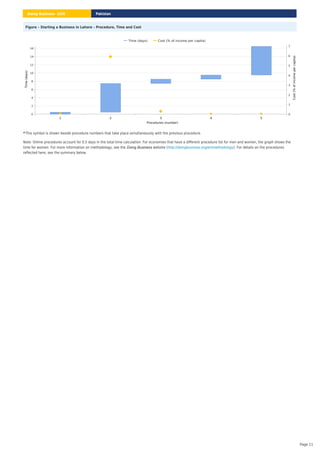
Figure – Starting a Business in Lahore – Procedure, Time and Cost
This symbol is shown beside procedure numbers that take place simultaneously with the previous procedure.
*
Note: Online procedures account for 0.5 days in the total time calculation. For economies that have a different procedure list for men and women, the graph shows the
time for women. For more information on methodology, see the website ( ). For details on the procedures
reflected here, see the summary below.
Doing Business http://doingbusiness.org/en/methodology
Procedures (number)
1 2 3 4 5
0
2
4
6
8
10
12
14
16
Time
(days)
0
1
2
3
4
5
6
7
Cost
(%
of
income
per
capita)
Time (days) Cost (% of income per capita)
Pakistan
Doing Business 2020
Page 11
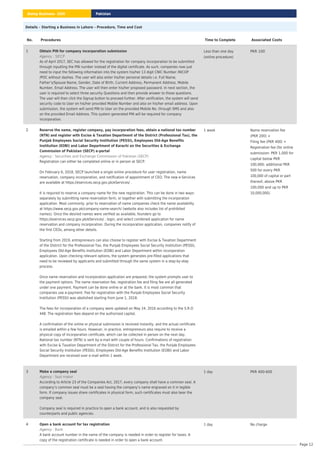
Details – Starting a Business in Lahore – Procedure, Time and Cost
No. Procedures Time to Complete Associated Costs
1 Obtain PIN for company incorporation submission
: SECP
Agency
As of April 2017, SEC has allowed for the registration for company incorporation to be submitted
through inputting the PIN number instead of the digital certificate. As such, companies now just
need to input the following information into the system his/her 13 digit CNIC Number /NICOP
/POC without dashes. The user will also enter his/her personal details i.e. Full Name,
Father’s/Spouse Name, Gender, Date of Birth, Current Address, Permanent Address, Mobile
Number, Email Address. The user will then enter his/her proposed password. In next section, the
user is required to select three security Questions and then provide answer to those questions.
The user will then click the Signup button to proceed further. After verification, the system will send
security code to User on his/her provided Mobile Number and also on his/her email address. Upon
submission, the system will send PIN to User on the provided Mobile No. through SMS and also
on the provided Email Address. This system generated PIN will be required for company
incorporation.
Less than one day
(online procedure)
PKR 100
2 Reserve the name, register company, pay incorporation fees, obtain a national tax number
(NTN) and register with Excise & Taxation Department of the District (Professional Tax), the
Punjab Employees Social Security Institution (PESSI), Employees Old-Age Benefits
Institution (EOBI) and Labor Department of Karachi on the Securities & Exchange
Commission of Pakistan (SECP) e-portal
: Securities and Exchange Commission of Pakistan (SECP)
Agency
Registration can either be completed online or in person at SECP.
On February 6, 2018, SECP launched a single online procedure for user registration, name
reservation, company incorporation, and notification of appointment of CEO. The new e-Services
are available at https://eservices.secp.gov.pk/eServices/ .
It is required to reserve a company name for the new registration. This can be done in two ways:
separately by submitting name reservation form, or together with submitting the incorporation
application. Most commonly, prior to reservation of name companies check the name availability
at https://www.secp.gov.pk/company-name-search/ (website also includes list of prohibited
names). Once the desired names were verified as available, founders go to
https://eservices.secp.gov.pk/eServices/ , login, and select combined application for name
reservation and company incorporation. During the incorporation application, companies notify of
the first CEOs, among other details.
Starting from 2019, entrepreneurs can also choose to register with Excise & Taxation Department
of the District for the Professional Tax, the Punjab Employees Social Security Institution (PESSI),
Employees Old-Age Benefits Institution (EOBI) and Labor Department within incorporation
application. Upon checking relevant options, the system generates pre-filled applications that
need to be reviewed by applicants and submitted through the same system in a step-by-step
process.
Once name reservation and incorporation application are prepared, the system prompts user to
the payment options. The name reservation fee, registration fee and filing fee are all generated
under one payment. Payment can be done online or at the bank. It is most common that
companies use e-payment. Fee for registration with the Punjab Employees Social Security
Institution (PESSI) was abolished starting from June 1, 2018.
The fees for incorporation of a company were updated on May 24, 2016 according to the S.R.O
448. The registration fees depend on the authorized capital.
A confirmation of the online or physical submission is received instantly, and the actual certificate
is emailed within a few hours. However, in practice, entrepreneurs also require to receive a
physical copy of incorporation certificate, which can be collected in person on the next day.
National tax number (NTN) is sent by e-mail with couple of hours. Confirmations of registration
with Excise & Taxation Department of the District for the Professional Tax, the Punjab Employees
Social Security Institution (PESSI), Employees Old-Age Benefits Institution (EOBI) and Labor
Department are received over e-mail within 1 week.
1 week Name reservation fee
(PKR 200) +
Filing fee (PKR 400) +
Registration fee (for online
submission: PKR 1,000 for
capital below PKR
100,000; additional PKR
500 for every PKR
100,000 of capital or part
thereof, above PKR
100,000 and up to PKR
10,000,000).
3 Make a company seal
: Seal maker
Agency
According to Article 23 of the Companies Act, 2017, every company shall have a common seal. A
company‘s common seal must be a seal having the company‘s name engraved on it in legible
form. If company issues share certificates in physical form, such certificates must also bear the
company seal.
Company seal is required in practice to open a bank account, and is also requested by
counterparts and public agencies.
1 day PKR 400-600
4 Open a bank account for tax registration
: Bank
Agency
A bank account number in the name of the company is needed in order to register for taxes. A
copy of the registration certificate is needed in order to open a bank account.
1 day No charge
Pakistan
Doing Business 2020
Page 12
Takes place simultaneously with previous procedure.
5 Apply for a Sales Tax Registration Number (STRN) at the tax facilitation center of the
Regional Tax Office (RTO) of the Federal Board of Revenue (FBR) in Lahore
: Tax facilitation center of the Regional Tax Office (RTO) of the Federal Board of Revenue
(FBR) in Lahore
Agency
According to the Sections 14, 15 and 16 of the Sales Tax Act 1990 and Sales Tax Rules 2006, the
company must register for sales tax by submitting the application Form STR-1 at any tax
facilitation counter at the nearest Regional Tax Office (RTO). The local RTO forwards all
applications to the Central Registration Office. After verification, the CRO issues a Registration
Certificate bearing the registration number and mails the same to the registered company, on a
prescribed From STR-5.
The Sales Tax General Order No. 4/2007 introduced electronic filing of the sales tax returns; and
as of July 1st 2008, electronic filing was made mandatory for all categories of taxpayers.
Prior to issuing the STRN, tax office conducts an inspection.
1 week no charge
Pakistan
Doing Business 2020
Page 13
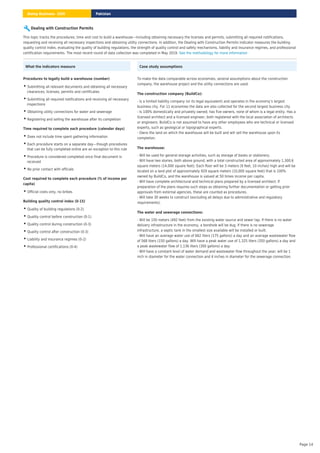
Dealing with Construction Permits
This topic tracks the procedures, time and cost to build a warehouse—including obtaining necessary the licenses and permits, submitting all required notifications,
requesting and receiving all necessary inspections and obtaining utility connections. In addition, the Dealing with Construction Permits indicator measures the building
quality control index, evaluating the quality of building regulations, the strength of quality control and safety mechanisms, liability and insurance regimes, and professional
certification requirements. The most recent round of data collection was completed in May 2019. See the methodology for more information
What the indicators measure
Procedures to legally build a warehouse (number)
Submitting all relevant documents and obtaining all necessary
clearances, licenses, permits and certificates
•
Submitting all required notifications and receiving all necessary
inspections
•
Obtaining utility connections for water and sewerage
•
Registering and selling the warehouse after its completion
•
Time required to complete each procedure (calendar days)
Does not include time spent gathering information
•
Each procedure starts on a separate day—though procedures
that can be fully completed online are an exception to this rule
•
Procedure is considered completed once final document is
received
•
No prior contact with officials
•
Cost required to complete each procedure (% of income per
capita)
Official costs only, no bribes
•
Building quality control index (0-15)
Quality of building regulations (0-2)
•
Quality control before construction (0-1)
•
Quality control during construction (0-3)
•
Quality control after construction (0-3)
•
Liability and insurance regimes (0-2)
•
Professional certifications (0-4)
•
Case study assumptions
To make the data comparable across economies, several assumptions about the construction
company, the warehouse project and the utility connections are used.
The construction company (BuildCo):
- Is a limited liability company (or its legal equivalent) and operates in the economy’s largest
business city. For 11 economies the data are also collected for the second largest business city.
- Is 100% domestically and privately owned; has five owners, none of whom is a legal entity. Has a
licensed architect and a licensed engineer, both registered with the local association of architects
or engineers. BuildCo is not assumed to have any other employees who are technical or licensed
experts, such as geological or topographical experts.
- Owns the land on which the warehouse will be built and will sell the warehouse upon its
completion.
The warehouse:
- Will be used for general storage activities, such as storage of books or stationery.
- Will have two stories, both above ground, with a total constructed area of approximately 1,300.6
square meters (14,000 square feet). Each floor will be 3 meters (9 feet, 10 inches) high and will be
located on a land plot of approximately 929 square meters (10,000 square feet) that is 100%
owned by BuildCo, and the warehouse is valued at 50 times income per capita.
- Will have complete architectural and technical plans prepared by a licensed architect. If
preparation of the plans requires such steps as obtaining further documentation or getting prior
approvals from external agencies, these are counted as procedures.
- Will take 30 weeks to construct (excluding all delays due to administrative and regulatory
requirements).
The water and sewerage connections:
- Will be 150 meters (492 feet) from the existing water source and sewer tap. If there is no water
delivery infrastructure in the economy, a borehole will be dug. If there is no sewerage
infrastructure, a septic tank in the smallest size available will be installed or built.
- Will have an average water use of 662 liters (175 gallons) a day and an average wastewater flow
of 568 liters (150 gallons) a day. Will have a peak water use of 1,325 liters (350 gallons) a day and
a peak wastewater flow of 1,136 liters (300 gallons) a day.
- Will have a constant level of water demand and wastewater flow throughout the year; will be 1
inch in diameter for the water connection and 4 inches in diameter for the sewerage connection.
Pakistan
Doing Business 2020
Page 14
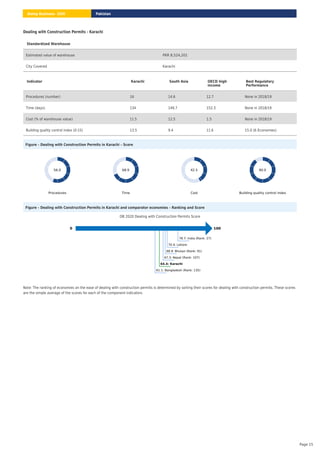
Dealing with Construction Permits - Karachi
Figure – Dealing with Construction Permits in Karachi – Score
Procedures
56.0
Time
68.9
Cost
42.5
Building quality control index
90.0
Figure – Dealing with Construction Permits in Karachi and comparator economies – Ranking and Score
DB 2020 Dealing with Construction Permits Score
0 100
78.7: India (Rank: 27)
70.4: Lahore
68.9: Bhutan (Rank: 91)
67.3: Nepal (Rank: 107)
64.4: Karachi
61.1: Bangladesh (Rank: 135)
Note: The ranking of economies on the ease of dealing with construction permits is determined by sorting their scores for dealing with construction permits. These scores
are the simple average of the scores for each of the component indicators.
Standardized Warehouse
Estimated value of warehouse PKR 8,524,201
City Covered Karachi
Indicator Karachi South Asia OECD high
income
Best Regulatory
Performance
Procedures (number) 16 14.6 12.7 None in 2018/19
Time (days) 134 149.7 152.3 None in 2018/19
Cost (% of warehouse value) 11.5 12.5 1.5 None in 2018/19
Building quality control index (0-15) 13.5 9.4 11.6 15.0 (6 Economies)
Pakistan
Doing Business 2020
Page 15
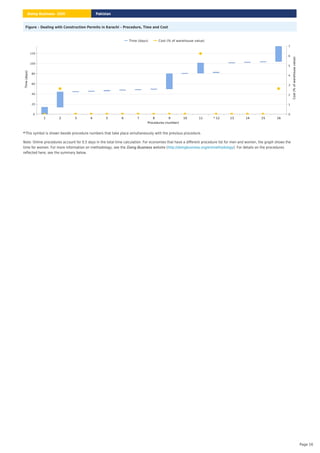
Figure – Dealing with Construction Permits in Karachi – Procedure, Time and Cost
This symbol is shown beside procedure numbers that take place simultaneously with the previous procedure.
*
Note: Online procedures account for 0.5 days in the total time calculation. For economies that have a different procedure list for men and women, the graph shows the
time for women. For more information on methodology, see the website ( ). For details on the procedures
reflected here, see the summary below.
Doing Business http://doingbusiness.org/en/methodology
Procedures (number)
1 2 3 4 5 6 7 8 9 10 11 * 12 13 14 15 16
0
20
40
60
80
100
120
Time
(days)
0
1
2
3
4
5
6
7
Cost
(%
of
warehouse
value)
Time (days) Cost (% of warehouse value)
Pakistan
Doing Business 2020
Page 16
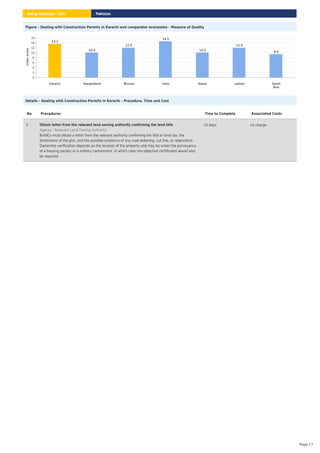
Figure – Dealing with Construction Permits in Karachi and comparator economies – Measure of Quality
Karachi Bangladesh Bhutan India Nepal Lahore South
Asia
0
2
4
6
8
10
12
14
16
Index
score
13.5
10.0
12.0
14.5
10.0
12.0
9.4
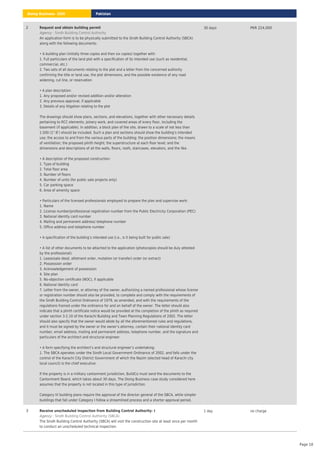
Details – Dealing with Construction Permits in Karachi – Procedure, Time and Cost
No. Procedures Time to Complete Associated Costs
1 Obtain letter from the relevant land owning authority confirming the land title
: Relevant Land Owning Authority
Agency
BuildCo must obtain a letter from the relevant authority confirming the title or land use, the
dimensions of the plot, and the possible existence of any road widening, cut line, or reservation.
Ownership verification depends on the location of the property and may be under the purveyance
of a housing society or a military cantonment, in which case non-objection certificates would also
be required.
14 days no charge
Pakistan
Doing Business 2020
Page 17
2 Request and obtain building permit
: Sindh Building Control Authority
Agency
An application form is to be physically submitted to the Sindh Building Control Authority (SBCA)
along with the following documents:
• A building plan (initially three copies and then six copies) together with:
1. Full particulars of the land plot with a specification of its intended use (such as residential,
commercial, etc.)
2. Two sets of all documents relating to the plot and a letter from the concerned authority
confirming the title or land use, the plot dimensions, and the possible existence of any road
widening, cut line, or reservation
• A plan description:
1. Any proposed and/or revised addition and/or alteration
2. Any previous approval, if applicable
3. Details of any litigation relating to the plot
The drawings should show plans, sections, and elevations, together with other necessary details
pertaining to RCC elements, joinery work, and covered areas of every floor, including the
basement (if applicable). In addition, a block plan of the site, drawn to a scale of not less than
1:500 (1”:8’) should be included. Such a plan and sections should show the building’s intended
use; the access to and from the various parts of the building; the position dimensions; the means
of ventilation; the proposed plinth height; the superstructure at each floor level; and the
dimensions and descriptions of all the walls, floors, roofs, staircases, elevators, and the like.
• A description of the proposed construction:
1. Type of building
2. Total floor area
3. Number of floors
4. Number of units (for public sale projects only)
5. Car parking space
6. Area of amenity space
• Particulars of the licensed professionals employed to prepare the plan and supervise work:
1. Name
2. License number/professional registration number from the Public Electricity Corporation (PEC)
3. National identity card number
4. Mailing and permanent address/ telephone number
5. Office address and telephone number
• A specification of the building’s intended use (i.e., is it being built for public sale)
• A list of other documents to be attached to the application (photocopies should be duly attested
by the professional):
1. Lease/sale deed, allotment order, mutation (or transfer) order (or extract)
2. Possession order
3. Acknowledgement of possession
4. Site plan
5. No-objection certificate (NOC), if applicable
6. National identity card
7. Letter from the owner, or attorney of the owner, authorizing a named professional whose license
or registration number should also be provided, to complete and comply with the requirements of
the Sindh Building Control Ordinance of 1979, as amended, and with the requirements of the
regulations framed under the ordinance for and on behalf of the owner. The letter should also
indicate that a plinth certificate notice would be provided at the completion of the plinth as required
under section 3-2.10 of the Karachi Building and Town Planning Regulations of 2002. The letter
should also specify that the owner would abide by all the aforementioned rules and regulations,
and it must be signed by the owner or the owner’s attorney, contain their national identity card
number, email address, mailing and permanent address, telephone number, and the signature and
particulars of the architect and structural engineer.
• A form specifying the architect’s and structural engineer’s undertaking:
1. The SBCA operates under the Sindh Local Government Ordinance of 2002, and falls under the
control of the Karachi City District Government of which the Nazim (elected head of Karachi city
local council) is the chief executive.
If the property is in a military cantonment jurisdiction, BuildCo must send the documents to the
Cantonment Board, which takes about 30 days. The Doing Business case study considered here
assumes that the property is not located in this type of jurisdiction.
Category IV building plans require the approval of the director general of the SBCA, while simpler
buildings that fall under Category I follow a streamlined process and a shorter approval period.
30 days PKR 224,000
3 Receive unscheduled inspection from Building Control Authority- I
: Sindh Building Control Authority (SBCA)
Agency
The Sindh Building Control Authority (SBCA) will visit the construction site at least once per month
to conduct an unscheduled technical inspection.
1 day no charge
Pakistan
Doing Business 2020
Page 18
4 Receive unscheduled inspection from Building Control Authority-II
: Sindh Building Control Authority (SBCA)
Agency
The Sindh Building Control Authority (SBCA) will visit the construction site at least once per month
to conduct an unscheduled technical inspection.
1 day no charge
5 Receive unscheduled inspection from Building Control Authority- III
: Sindh Building Control Authority
Agency
The Sindh Building Control Authority (SBCA) will visit the construction site at least once per month
to conduct an unscheduled technical inspection.
1 day no charge
6 Receive unscheduled inspection from Building Control Authority-IV
: Sindh Building Control Authority
Agency
The Sindh Building Control Authority (SBCA) will visit the construction site at least once per month
to conduct an unscheduled technical inspection.
1 day no charge
7 Receive unscheduled inspection from Building Control Authority- V
: Sindh Building Control Authority
Agency
The Sindh Building Control Authority (SBCA) will visit the construction site at least once per month
to conduct an unscheduled technical inspection.
1 day no charge
8 Receive unscheduled inspection from Building Control Authority-VI
: Sindh Building Control Authority
Agency
The Sindh Building Control Authority (SBCA) will visit the construction site at least once per month
to conduct an unscheduled technical inspection.
1 day no charge
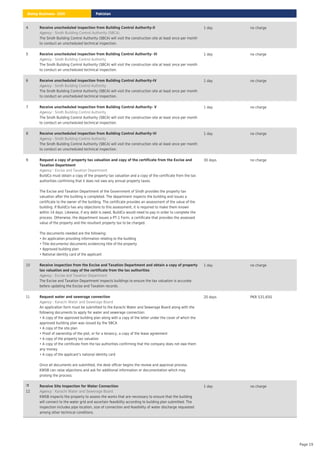
9 Request a copy of property tax valuation and copy of the certificate from the Excise and
Taxation Department
: Excise and Taxation Department
Agency
BuildCo must obtain a copy of the property tax valuation and a copy of the certificate from the tax
authorities confirming that it does not owe any annual property taxes.
The Excise and Taxation Department of the Government of Sindh provides the property tax
valuation after the building is completed. The department inspects the building and issues a
certificate to the owner of the building. The certificate provides an assessment of the value of the
building. If BuildCo has any objections to this assessment, it is required to make them known
within 14 days. Likewise, if any debt is owed, BuildCo would need to pay in order to complete the
process. Otherwise, the department issues a PT-1 Form, a certificate that provides the assessed
value of the property and the resultant property tax to be charged.
The documents needed are the following:
• An application providing information relating to the building
• Title documents/ documents evidencing title of the property
• Approved building plan
• National identity card of the applicant
30 days no charge
10 Receive inspection from the Excise and Taxation Department and obtain a copy of property
tax valuation and copy of the certificate from the tax authorities
: Excise and Taxation Department
Agency
The Excise and Taxation Department inspects buildings to ensure the tax valuation is accurate
before updating the Excise and Taxation records.
1 day no charge
11 Request water and sewerage connection
: Karachi Water and Sewerage Board
Agency
An application form must be submitted to the Karachi Water and Sewerage Board along with the
following documents to apply for water and sewerage connection:
• A copy of the approved building plan along with a copy of the letter under the cover of which the
approved building plan was issued by the SBCA
• A copy of the site plan
• Proof of ownership of the plot, or for a tenancy, a copy of the lease agreement
• A copy of the property tax valuation
• A copy of the certificate from the tax authorities confirming that the company does not owe them
any money
• A copy of the applicant’s national identity card
Once all documents are submitted, the desk officer begins the review and approval process.
KWSB can raise objections and ask for additional information or documentation which may
prolong the process.
20 days PKR 531,650
12
Receive Site Inspection for Water Connection
: Karachi Water and Sewerage Board
Agency
KWSB inspects the property to assess the works that are necessary to ensure that the building
will connect to the water grid and ascertain feasibility according to building plan submitted. The
inspection includes pipe location, size of connection and feasibility of water discharge requested
among other technical conditions.
1 day no charge
Pakistan
Doing Business 2020
Page 19
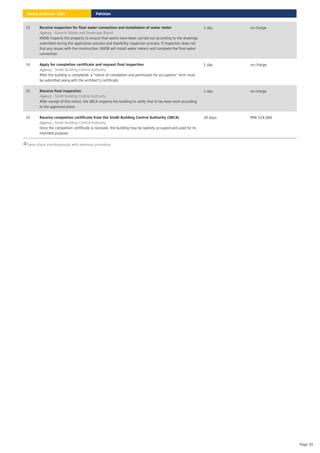
Takes place simultaneously with previous procedure.
13 Receive inspection for final water connection and installation of water meter
: Karachi Water and Sewerage Board
Agency
KWSB inspects the property to ensure that works have been carried out according to the drawings
submitted during the application process and feasibility inspection process. If inspection does not
find any issues with the construction, KWSB will install water meters and complete the final water
connection.
1 day no charge
14 Apply for completion certificate and request final inspection
: Sindh Building Control Authority
Agency
After the building is completed, a “notice of completion and permission for occupation” form must
be submitted along with the architect’s certificate.
1 day no charge
15 Receive final inspection
: Sindh Building Control Authority
Agency
After receipt of this notice, the SBCA inspects the building to verify that it has been built according
to the approved plans.
1 day no charge
16 Receive completion certificate from the Sindh Building Control Authority (SBCA)
: Sindh Building Control Authority
Agency
Once the completion certificate is received, the building may be lawfully occupied and used for its
intended purpose.
30 days PKR 224,000
Pakistan
Doing Business 2020
Page 20
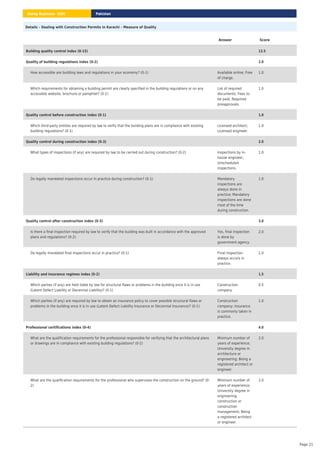
Details – Dealing with Construction Permits in Karachi – Measure of Quality
Answer Score
Building quality control index (0-15) 13.5
Quality of building regulations index (0-2) 2.0
How accessible are building laws and regulations in your economy? (0-1) Available online; Free
of charge.
1.0
Which requirements for obtaining a building permit are clearly specified in the building regulations or on any
accessible website, brochure or pamphlet? (0-1)
List of required
documents; Fees to
be paid; Required
preapprovals.
1.0
Quality control before construction index (0-1) 1.0
Which third-party entities are required by law to verify that the building plans are in compliance with existing
building regulations? (0-1)
Licensed architect;
Licensed engineer.
1.0
Quality control during construction index (0-3) 2.0
What types of inspections (if any) are required by law to be carried out during construction? (0-2) Inspections by in-
house engineer;
Unscheduled
inspections.
1.0
Do legally mandated inspections occur in practice during construction? (0-1) Mandatory
inspections are
always done in
practice; Mandatory
inspections are done
most of the time
during construction.
1.0
Quality control after construction index (0-3) 3.0
Is there a final inspection required by law to verify that the building was built in accordance with the approved
plans and regulations? (0-2)
Yes, final inspection
is done by
government agency.
2.0
Do legally mandated final inspections occur in practice? (0-1) Final inspection
always occurs in
practice.
1.0
Liability and insurance regimes index (0-2) 1.5
Which parties (if any) are held liable by law for structural flaws or problems in the building once it is in use
(Latent Defect Liability or Decennial Liability)? (0-1)
Construction
company.
0.5
Which parties (if any) are required by law to obtain an insurance policy to cover possible structural flaws or
problems in the building once it is in use (Latent Defect Liability Insurance or Decennial Insurance)? (0-1)
Construction
company; Insurance
is commonly taken in
practice.
1.0
Professional certifications index (0-4) 4.0
What are the qualification requirements for the professional responsible for verifying that the architectural plans
or drawings are in compliance with existing building regulations? (0-2)
Minimum number of
years of experience;
University degree in
architecture or
engineering; Being a
registered architect or
engineer.
2.0
What are the qualification requirements for the professional who supervises the construction on the ground? (0-
2)
Minimum number of
years of experience;
University degree in
engineering,
construction or
construction
management; Being
a registered architect
or engineer.
2.0
Pakistan
Doing Business 2020
Page 21
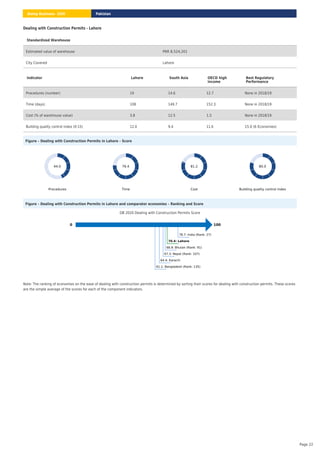
Dealing with Construction Permits - Lahore
Figure – Dealing with Construction Permits in Lahore – Score
Procedures
44.0
Time
76.4
Cost
81.2
Building quality control index
80.0
Figure – Dealing with Construction Permits in Lahore and comparator economies – Ranking and Score
DB 2020 Dealing with Construction Permits Score
0 100
78.7: India (Rank: 27)
70.4: Lahore
68.9: Bhutan (Rank: 91)
67.3: Nepal (Rank: 107)
64.4: Karachi
61.1: Bangladesh (Rank: 135)
Note: The ranking of economies on the ease of dealing with construction permits is determined by sorting their scores for dealing with construction permits. These scores
are the simple average of the scores for each of the component indicators.
Standardized Warehouse
Estimated value of warehouse PKR 8,524,201
City Covered Lahore
Indicator Lahore South Asia OECD high
income
Best Regulatory
Performance
Procedures (number) 19 14.6 12.7 None in 2018/19
Time (days) 108 149.7 152.3 None in 2018/19
Cost (% of warehouse value) 3.8 12.5 1.5 None in 2018/19
Building quality control index (0-15) 12.0 9.4 11.6 15.0 (6 Economies)
Pakistan
Doing Business 2020
Page 22
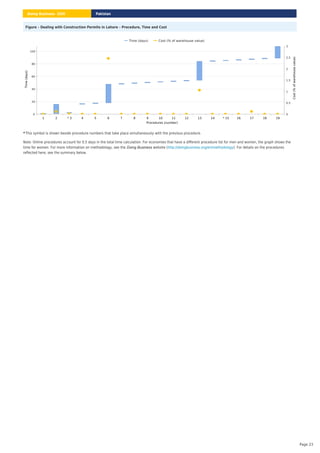
Figure – Dealing with Construction Permits in Lahore – Procedure, Time and Cost
This symbol is shown beside procedure numbers that take place simultaneously with the previous procedure.
*
Note: Online procedures account for 0.5 days in the total time calculation. For economies that have a different procedure list for men and women, the graph shows the
time for women. For more information on methodology, see the website ( ). For details on the procedures
reflected here, see the summary below.
Doing Business http://doingbusiness.org/en/methodology
Procedures (number)
1 2 * 3 4 5 6 7 8 9 10 11 12 13 14 * 15 16 17 18 19
0
20
40
60
80
100
Time
(days)
0
0.5
1
1.5
2
2.5
3
Cost
(%
of
warehouse
value)
Time (days) Cost (% of warehouse value)
Pakistan
Doing Business 2020
Page 23
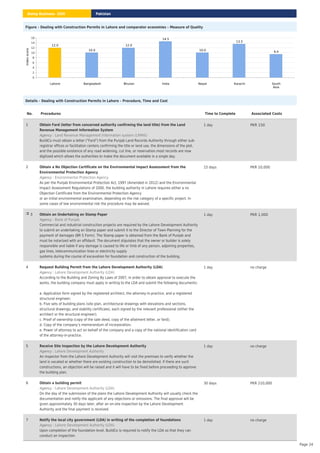
Figure – Dealing with Construction Permits in Lahore and comparator economies – Measure of Quality
Lahore Bangladesh Bhutan India Nepal Karachi South
Asia
0
2
4
6
8
10
12
14
16
Index
score
12.0
10.0
12.0
14.5
10.0
13.5
9.4
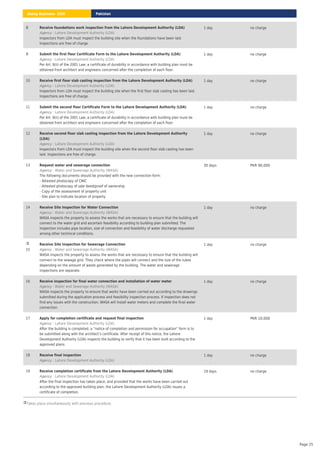
Details – Dealing with Construction Permits in Lahore – Procedure, Time and Cost
No. Procedures Time to Complete Associated Costs
1 Obtain Fard (letter from concerned authority confirming the land title) from the Land
Revenue Management Information System
: Land Revenue Management Information system (LRMIS)
Agency
BuildCo must obtain a letter ("Fard") from the Punjab Land Records Authority through either sub-
registrar offices or facilitation centers confirming the title or land use, the dimensions of the plot,
and the possible existence of any road widening, cut line, or reservation.most records are now
digitized which allows the authorities to make the document available in a single day.
1 day PKR 150
2 Obtain a No Objection Certificate on the Environmental Impact Assessment from the
Environmental Protection Agency
: Environmental Protection Agency
Agency
As per the Punjab Environmental Protection Act, 1997 (Amended in 2012) and the Environmental
Impact Assessment Regulations of 2000, the building authority in Lahore requires either a no
Objection Certificate from the Environmental Protection Agency
or an initial environmental examination, depending on the risk category of a specific project. In
some cases of low environmental risk the procedure may be waived.
15 days PKR 10,000
3 Obtain an Undertaking on Stamp Paper
: Bank of Punjab
Agency
Commercial and industrial construction projects are required by the Lahore Development Authority
to submit an undertaking on Stamp paper and submit it to the Director of Town Planning for the
payment of damages (BR 5 Form). The Stamp paper is obtained from the Bank of Punjab and
must be notarized with an affidavit. The document stipulates that the owner or builder is solely
responsible and liable if any damage is caused to life or limb of any person, adjoining properties,
gas lines, telecommunication lines or electricity supply
systems during the course of excavation for foundation and construction of the building.
1 day PKR 1,000
4 Request Building Permit from the Lahore Development Authority (LDA)
: Lahore Development Authority (LDA)
Agency
According to the Building and Zoning By Laws of 2007, in order to obtain approval to execute the
works, the building company must apply in writing to the LDA and submit the following documents:
a. Application form signed by the registered architect, the attorney-in-practice, and a registered
structural engineer;
b. Five sets of building plans (site plan, architectural drawings with elevations and sections,
structural drawings, and stability certificate), each signed by the relevant professional (either the
architect or the structural engineer);
c. Proof of ownership (copy of the sale deed, copy of the allotment letter, or fard);
d. Copy of the company’s memorandum of incorporation;
e. Power of attorney to act on behalf of the company and a copy of the national identification card
of the attorney-in-practice.
1 day no charge
5 Receive Site Inspection by the Lahore Development Authority
: Lahore Development Authority
Agency
An inspector from the Lahore Development Authority will visit the premises to verify whether the
land is vacated or whether there are existing construction to be demolished. If there are such
constructions, an objection will be raised and it will have to be fixed before proceeding to approve
the building plan.
1 day no charge
6 Obtain a building permit
: Lahore Development Authority (LDA)
Agency
On the day of the submission of the plans the Lahore Development Authority will usually check the
documentation and notify the applicant of any objections or omissions. The final approval will be
given approximately 30 days later, after an on-site inspection by the Lahore Development
Authority and the final payment is received.
30 days PKR 210,000
7 Notify the local city government (LDA) in writing of the completion of foundations
: Lahore Development Authority (LDA)
Agency
Upon completion of the foundation level, BuildCo is required to notify the LDA so that they can
conduct an inspection.
1 day no charge
Pakistan
Doing Business 2020
Page 24
Takes place simultaneously with previous procedure.
8 Receive foundations work inspection from the Lahore Development Authority (LDA)
: Lahore Development Authority (LDA)
Agency
Inspectors from LDA must inspect the building site when the foundations have been laid.
Inspections are free of charge.
1 day no charge
9 Submit the first floor Certificate Form to the Lahore Development Authority (LDA)
: Lahore Development Authority (LDA)
Agency
Per Art. 8(ii) of the 2001 Law, a certificate of durability in accordance with building plan must be
obtained from architect and engineers concerned after the completion of each floor.
1 day no charge
10 Receive first floor slab casting inspection from the Lahore Development Authority (LDA)
: Lahore Development Authority (LDA)
Agency
Inspectors from LDA must inspect the building site when the first floor slab casting has been laid.
Inspections are free of charge.
1 day no charge
11 Submit the second floor Certificate Form to the Lahore Development Authority (LDA)
: Lahore Development Authority (LDA)
Agency
Per Art. 8(ii) of the 2001 Law, a certificate of durability in accordance with building plan must be
obtained from architect and engineers concerned after the completion of each floor.
1 day no charge
12 Receive second floor slab casting inspection from the Lahore Development Authority
(LDA)
: Lahore Development Authority (LDA)
Agency
Inspectors from LDA must inspect the building site when the second floor slab casting has been
laid. Inspections are free of charge.
1 day no charge
13 Request water and sewerage connection
: Water and Sewerage Authority (WASA)
Agency
The following documents should be provided with the new connection form:
- Attested photocopy of CNIC
- Attested photocopy of sale deed/proof of ownership
- Copy of the assessment of property unit
- Site plan to indicate location of property
30 days PKR 90,000
14 Receive Site Inspection for Water Connection
: Water and Sewerage Authority (WASA)
Agency
WASA inspects the property to assess the works that are necessary to ensure that the building will
connect to the water grid and ascertain feasibility according to building plan submitted. The
inspection includes pipe location, size of connection and feasibility of water discharge requested
among other technical conditions.
1 day no charge
15
Receive Site Inspection for Sewerage Connection
: Water and Sewerage Authority (WASA)
Agency
WASA inspects the property to assess the works that are necessary to ensure that the building will
connect to the sewage grid. They check where the pipes will connect and the size of the tubes
depending on the amount of waste generated by the building. The water and sewerage
inspections are separate.
1 day no charge
16 Receive inspection for final water connection and installation of water meter
: Water and Sewerage Authority (WASA)
Agency
WASA inspects the property to ensure that works have been carried out according to the drawings
submitted during the application process and feasibility inspection process. If inspection does not
find any issues with the construction, WASA will install water meters and complete the final water
connection.
1 day no charge
17 Apply for completion certificate and request final inspection
: Lahore Development Authority (LDA)
Agency
After the building is completed, a “notice of completion and permission for occupation” form is to
be submitted along with the architect’s certificate. After receipt of this notice, the Lahore
Development Authority (LDA) inspects the building to verify that it has been built according to the
approved plans.
1 day PKR 10,000
18 Receive final inspection
: Lahore Development Authority (LDA)
Agency
1 day no charge
19 Receive completion certificate from the Lahore Development Authority (LDA)
: Lahore Development Authority (LDA)
Agency
After the final inspection has taken place, and provided that the works have been carried out
according to the approved building plan, the Lahore Development Authority (LDA) issues a
certificate of completion.
19 days no charge
Pakistan
Doing Business 2020
Page 25
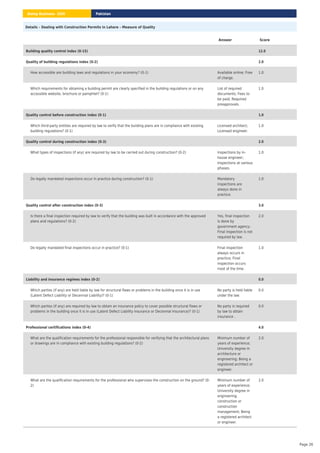
Details – Dealing with Construction Permits in Lahore – Measure of Quality
Answer Score
Building quality control index (0-15) 12.0
Quality of building regulations index (0-2) 2.0
How accessible are building laws and regulations in your economy? (0-1) Available online; Free
of charge.
1.0
Which requirements for obtaining a building permit are clearly specified in the building regulations or on any
accessible website, brochure or pamphlet? (0-1)
List of required
documents; Fees to
be paid; Required
preapprovals.
1.0
Quality control before construction index (0-1) 1.0
Which third-party entities are required by law to verify that the building plans are in compliance with existing
building regulations? (0-1)
Licensed architect;
Licensed engineer.
1.0
Quality control during construction index (0-3) 2.0
What types of inspections (if any) are required by law to be carried out during construction? (0-2) Inspections by in-
house engineer;
Inspections at various
phases.
1.0
Do legally mandated inspections occur in practice during construction? (0-1) Mandatory
inspections are
always done in
practice.
1.0
Quality control after construction index (0-3) 3.0
Is there a final inspection required by law to verify that the building was built in accordance with the approved
plans and regulations? (0-2)
Yes, final inspection
is done by
government agency;
Final inspection is not
required by law.
2.0
Do legally mandated final inspections occur in practice? (0-1) Final inspection
always occurs in
practice; Final
inspection occurs
most of the time.
1.0
Liability and insurance regimes index (0-2) 0.0
Which parties (if any) are held liable by law for structural flaws or problems in the building once it is in use
(Latent Defect Liability or Decennial Liability)? (0-1)
No party is held liable
under the law.
0.0
Which parties (if any) are required by law to obtain an insurance policy to cover possible structural flaws or
problems in the building once it is in use (Latent Defect Liability Insurance or Decennial Insurance)? (0-1)
No party is required
by law to obtain
insurance .
0.0
Professional certifications index (0-4) 4.0
What are the qualification requirements for the professional responsible for verifying that the architectural plans
or drawings are in compliance with existing building regulations? (0-2)
Minimum number of
years of experience;
University degree in
architecture or
engineering; Being a
registered architect or
engineer.
2.0
What are the qualification requirements for the professional who supervises the construction on the ground? (0-
2)
Minimum number of
years of experience;
University degree in
engineering,
construction or
construction
management; Being
a registered architect
or engineer.
2.0
Pakistan
Doing Business 2020
Page 26
Getting Electricity
This topic measures the procedures, time and cost required for a business to obtain a permanent electricity connection for a newly constructed warehouse. Additionally,
the reliability of supply and transparency of tariffs index measures reliability of supply, transparency of tariffs and the price of electricity. The most recent round of data
collection for the project was completed in May 2019. .
See the methodology for more information
What the indicators measure
Procedures to obtain an electricity connection (number)
Submitting all relevant documents and obtaining all necessary
clearances and permits
•
Completing all required notifications and receiving all necessary
inspections
•
Obtaining external installation works and possibly purchasing
material for these works
•
Concluding any necessary supply contract and obtaining final
supply
•
Time required to complete each procedure (calendar days)
Is at least 1 calendar day
•
Each procedure starts on a separate day
•
Does not include time spent gathering information
•
Reflects the time spent in practice, with little follow-up and no
prior contact with officials
•
Cost required to complete each procedure (% of income per
capita)
Official costs only, no bribes
•
Value added tax excluded
•
The reliability of supply and transparency of tariffs index (0-8)
Duration and frequency of power outages (0–3)
•
Tools to monitor power outages (0–1)
•
Tools to restore power supply (0–1)
•
Regulatory monitoring of utilities’ performance (0–1)
•
Financial deterrents limiting outages (0–1)
•
Transparency and accessibility of tariffs (0–1)
•
Price of electricity (cents per kilowatt-hour)*
Price based on monthly bill for commercial warehouse in case
study
•
*Note: measures the price of electricity, but it is
not included in the ease of doing business score nor in the ranking
on the ease of getting electricity.
Doing Business
Case study assumptions
To make the data comparable across economies, several assumptions about the warehouse, the
electricity connection and the monthly consumption are used.
The warehouse:
- Is owned by a local entrepreneur and is used for storage of goods.
- Is located in the economy’s largest business city. For 11 economies the data are also collected for
the second largest business city.
- Is located in an area where similar warehouses are typically located and is in an area with no
physical constraints. For example, the property is not near a railway.
- Is a new construction and is being connected to electricity for the first time.
- Has two stories with a total surface area of approximately 1,300.6 square meters (14,000 square
feet). The plot of land on which it is built is 929 square meters (10,000 square feet).
The electricity connection:
- Is a permanent one with a three-phase, four-wire Y connection with a subscribed capacity of 140-
kilo-volt-ampere (kVA) with a power factor of 1, when 1 kVA = 1 kilowatt (kW).
- Has a length of 150 meters. The connection is to either the low- or medium-voltage distribution
network and is either overhead or underground, whichever is more common in the area where the
warehouse is located and requires works that involve the crossing of a 10-meter road (such as by
excavation or overhead lines) but are all carried out on public land. There is no crossing of other
owners’ private property because the warehouse has access to a road.
- Does not require work to install the internal wiring of the warehouse. This has already been
completed up to and including the customer’s service panel or switchboard and the meter base.
The monthly consumption:
- It is assumed that the warehouse operates 30 days a month from 9:00 a.m. to 5:00 p.m. (8 hours
a day), with equipment utilized at 80% of capacity on average and that there are no electricity cuts
(assumed for simplicity reasons) and the monthly energy consumption is 26,880 kilowatt-hours
(kWh); hourly consumption is 112 kWh.
- If multiple electricity suppliers exist, the warehouse is served by the cheapest supplier.
- Tariffs effective in January of the current year are used for calculation of the price of electricity for
the warehouse. Although January has 31 days, for calculation purposes only 30 days are used.
Pakistan
Doing Business 2020
Page 27
Getting Electricity - Karachi
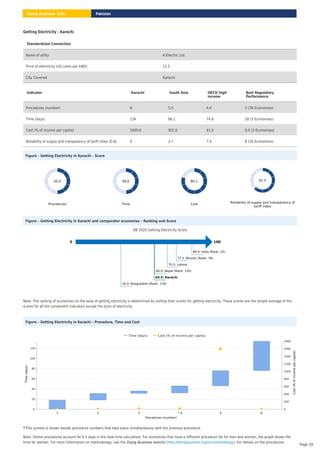
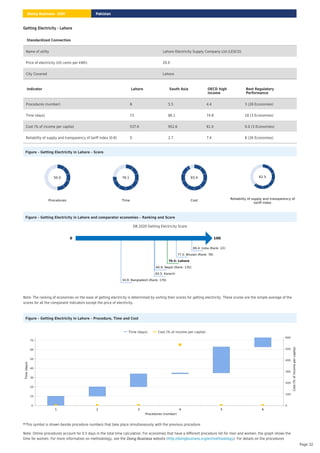
Figure – Getting Electricity in Karachi – Score
Procedures
50.0
Time
49.6
Cost
80.1
Reliability of supply and transparency of
tariff index
62.5
Figure – Getting Electricity in Karachi and comparator economies – Ranking and Score
DB 2020 Getting Electricity Score
0 100
89.4: India (Rank: 22)
77.5: Bhutan (Rank: 78)
70.5: Lahore
60.9: Nepal (Rank: 135)
60.5: Karachi
34.9: Bangladesh (Rank: 176)
Note: The ranking of economies on the ease of getting electricity is determined by sorting their scores for getting electricity. These scores are the simple average of the
scores for all the component indicators except the price of electricity.
Figure – Getting Electricity in Karachi – Procedure, Time and Cost
This symbol is shown beside procedure numbers that take place simultaneously with the previous procedure.
*
Note: Online procedures account for 0.5 days in the total time calculation. For economies that have a different procedure list for men and women, the graph shows the
time for women. For more information on methodology, see the website ( ). For details on the procedures
Doing Business http://doingbusiness.org/en/methodology
Procedures (number)
1 2 3 * 4 5 6
0
20
40
60
80
100
120
Time
(days)
0
200
400
600
800
1000
1200
1400
1600
1800
Cost
(%
of
income
per
capita)
Time (days) Cost (% of income per capita)
Standardized Connection
Name of utility K-Electric Ltd.
Price of electricity (US cents per kWh) 22.2
City Covered Karachi
Indicator Karachi South Asia OECD high
income
Best Regulatory
Performance
Procedures (number) 6 5.5 4.4 3 (28 Economies)
Time (days) 134 86.1 74.8 18 (3 Economies)
Cost (% of income per capita) 1609.8 952.6 61.0 0.0 (3 Economies)
Reliability of supply and transparency of tariff index (0-8) 5 2.7 7.4 8 (26 Economies)
Pakistan
Doing Business 2020
Page 28
reflected here, see the summary below.
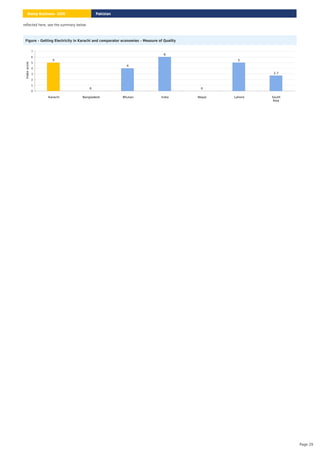
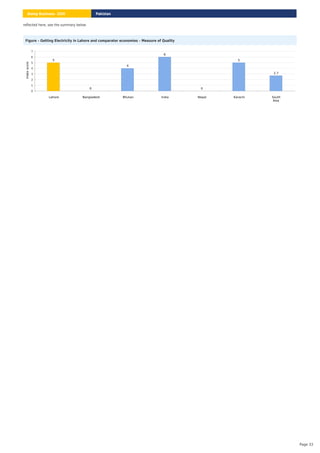
Figure – Getting Electricity in Karachi and comparator economies – Measure of Quality
Karachi Bangladesh Bhutan India Nepal Lahore South
Asia
0
1
2
3
4
5
6
7
Index
score
5
0
4
6
0
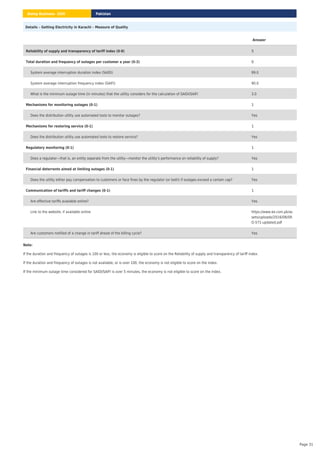
5
2.7
Pakistan
Doing Business 2020
Page 29
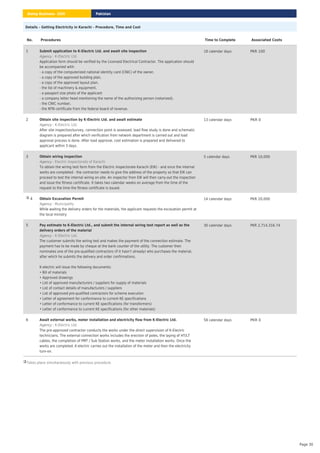
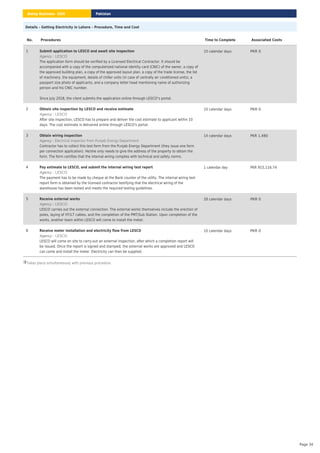
Details – Getting Electricity in Karachi – Procedure, Time and Cost
Takes place simultaneously with previous procedure.
No. Procedures Time to Complete Associated Costs
1 Submit application to K-Electric Ltd. and await site inspection
: K-Electric Ltd.
Agency
Application form should be verified by the Licensed Electrical Contractor. The application should
be accompanied with:
- a copy of the computerized national identity card (CNIC) of the owner,
- a copy of the approved building plan,
- a copy of the approved layout plan,
- the list of machinery & equipment,
- a passport size photo of the applicant
- a company letter head mentioning the name of the authorizing person (notarized),
- the CNIC number,
- the NTN certificate from the federal board of revenue.
18 calendar days PKR 100
2 Obtain site inspection by K-Electric Ltd. and await estimate
: K-Electric Ltd.
Agency
After site inspection/survey, connection point is assessed, load flow study is done and schematic
diagram is prepared after which verification from network department is carried out and load
approval process is done. After load approval, cost estimation is prepared and delivered to
applicant within 3 days.
13 calendar days PKR 0
3 Obtain wiring inspection
: Electric Inspectorate of Karachi
Agency
To obtain the wiring test form from the Electric Inspectorate Karachi (EIK) - and once the internal
works are completed - the contractor needs to give the address of the property so that EIK can
proceed to test the internal wiring on-site. An inspector from EIK will then carry-out the inspection
and issue the fitness certificate. It takes two calendar weeks on average from the time of the
request to the time the fitness certificate is issued.
5 calendar days PKR 10,000
4 Obtain Excavation Permit
: Municipality
Agency
While waiting the delivery orders for the materials, the applicant requests the excavation permit at
the local ministry
14 calendar days PKR 20,000
5 Pay estimate to K-Electric Ltd., and submit the internal wiring test report as well as the
delivery orders of the material
: K-Electric Ltd.
Agency
The customer submits the wiring test and makes the payment of the connection estimate. The
payment has to be made by cheque at the bank counter of the utility. The customer then
nominates one of the pre-qualified contractors (if it hasn’t already) who purchases the material,
after which he submits the delivery and order confirmations.
K-electric will issue the following documents:
• Bill of materials
• Approved drawings
• List of approved manufacturers / suppliers for supply of materials
• List of contact details of manufacturers / suppliers
• List of approved pre-qualified contractors for scheme execution
• Letter of agreement for conformance to current KE specifications
• Letter of conformance to current KE specifications (for transformers)
• Letter of conformance to current KE specifications (for other materials)
30 calendar days PKR 2,714,316.74
6 Await external works, meter installation and electricity flow from K-Electric Ltd.
: K-Electric Ltd.
Agency
The pre-approved contractor conducts the works under the direct supervision of K-Electric
technicians. The external connection works includes the erection of poles, the laying of HT/LT
cables, the completion of PMT / Sub Station works, and the meter installation works. Once the
works are completed, K-electric carries out the installation of the meter and then the electricity
turn-on.
58 calendar days PKR 0
Pakistan
Doing Business 2020
Page 30
Details – Getting Electricity in Karachi – Measure of Quality
Note:
If the duration and frequency of outages is 100 or less, the economy is eligible to score on the Reliability of supply and transparency of tariff index.
If the duration and frequency of outages is not available, or is over 100, the economy is not eligible to score on the index.
If the minimum outage time considered for SAIDI/SAIFI is over 5 minutes, the economy is not eligible to score on the index.
Answer
Reliability of supply and transparency of tariff index (0-8) 5
Total duration and frequency of outages per customer a year (0-3) 0
System average interruption duration index (SAIDI) 99.0
System average interruption frequency index (SAIFI) 90.0
What is the minimum outage time (in minutes) that the utility considers for the calculation of SAIDI/SAIFI 3.0
Mechanisms for monitoring outages (0-1) 1
Does the distribution utility use automated tools to monitor outages? Yes
Mechanisms for restoring service (0-1) 1
Does the distribution utility use automated tools to restore service? Yes
Regulatory monitoring (0-1) 1
Does a regulator—that is, an entity separate from the utility—monitor the utility’s performance on reliability of supply? Yes
Financial deterrents aimed at limiting outages (0-1) 1
Does the utility either pay compensation to customers or face fines by the regulator (or both) if outages exceed a certain cap? Yes
Communication of tariffs and tariff changes (0-1) 1
Are effective tariffs available online? Yes
Link to the website, if available online https://www.ke.com.pk/as
sets/uploads/2016/08/SR
O-571-updated.pdf
Are customers notified of a change in tariff ahead of the billing cycle? Yes
Pakistan
Doing Business 2020
Page 31
Getting Electricity - Lahore
Figure – Getting Electricity in Lahore – Score
Procedures
50.0
Time
76.1
Cost
93.4
Reliability of supply and transparency of
tariff index
62.5
Figure – Getting Electricity in Lahore and comparator economies – Ranking and Score
DB 2020 Getting Electricity Score
0 100
89.4: India (Rank: 22)
77.5: Bhutan (Rank: 78)
70.5: Lahore
60.9: Nepal (Rank: 135)
60.5: Karachi
34.9: Bangladesh (Rank: 176)
Note: The ranking of economies on the ease of getting electricity is determined by sorting their scores for getting electricity. These scores are the simple average of the
scores for all the component indicators except the price of electricity.
Figure – Getting Electricity in Lahore – Procedure, Time and Cost
This symbol is shown beside procedure numbers that take place simultaneously with the previous procedure.
*
Note: Online procedures account for 0.5 days in the total time calculation. For economies that have a different procedure list for men and women, the graph shows the
time for women. For more information on methodology, see the website ( ). For details on the procedures
Doing Business http://doingbusiness.org/en/methodology
Procedures (number)
1 2 3 4 5 6
0
10
20
30
40
50
60
70
Time
(days)
0
100
200
300
400
500
600
Cost
(%
of
income
per
capita)
Time (days) Cost (% of income per capita)
Standardized Connection
Name of utility Lahore Electricity Supply Company Ltd (LESCO)
Price of electricity (US cents per kWh) 20.9
City Covered Lahore
Indicator Lahore South Asia OECD high
income
Best Regulatory
Performance
Procedures (number) 6 5.5 4.4 3 (28 Economies)
Time (days) 73 86.1 74.8 18 (3 Economies)
Cost (% of income per capita) 537.6 952.6 61.0 0.0 (3 Economies)
Reliability of supply and transparency of tariff index (0-8) 5 2.7 7.4 8 (26 Economies)
Pakistan
Doing Business 2020
Page 32
reflected here, see the summary below.
Figure – Getting Electricity in Lahore and comparator economies – Measure of Quality
Lahore Bangladesh Bhutan India Nepal Karachi South
Asia
0
1
2
3
4
5
6
7
Index
score
5
0
4
6
0
5
2.7
Pakistan
Doing Business 2020
Page 33
Details – Getting Electricity in Lahore – Procedure, Time and Cost
Takes place simultaneously with previous procedure.
No. Procedures Time to Complete Associated Costs
1 Submit application to LESCO and await site inspection
: LESCO
Agency
The application form should be verified by a Licensed Electrical Contractor. It should be
accompanied with a copy of the computerized national identity card (CNIC) of the owner, a copy of
the approved building plan, a copy of the approved layout plan, a copy of the trade license, the list
of machinery, the equipment, details of chiller units (in case of centrally air conditioned units), a
passport size photo of applicants, and a company letter head mentioning name of authorizing
person and his CNIC number.
Since July 2018, the client submits the application online through LESCO"s portal.
10 calendar days PKR 0
2 Obtain site inspection by LESCO and receive estimate
: LESCO
Agency
After site inspection, LESCO has to prepare and deliver the cost estimate to applicant within 10
days. The cost estimate is delivered online through LESCO's portal.
10 calendar days PKR 0
3 Obtain wiring inspection
: Electrical Inspector from Punjab Energy Department
Agency
Contractor has to collect this test form from the Punjab Energy Department (they issue one form
per connection application). He/she only needs to give the address of the property to obtain the
form. The form certifies that the internal wiring complies with technical and safety norms.
14 calendar days PKR 1,480
4 Pay estimate to LESCO, and submit the internal wiring test report
: LESCO
Agency
The payment has to be made by cheque at the Bank counter of the utility. The internal wiring test
report form is obtained by the licensed contractor testifying that the electrical wiring of the
warehouse has been tested and meets the required testing guidelines.
1 calendar day PKR 915,116.74
5 Receive external works
: LESCO
Agency
LESCO carries out the external connection. The external works themselves include the erection of
poles, laying of HT/LT cables, and the completion of the PMT/Sub Station. Upon completion of the
works, another team within LESCO will come to install the meter.
28 calendar days PKR 0
6 Receive meter installation and electricity flow from LESCO
: LESCO
Agency
LESCO will come on site to carry-out an external inspection, after which a completion report will
be issued. Once the report is signed and stamped, the external works are approved and LESCO
can come and install the meter. Electricity can then be supplied.
10 calendar days PKR 0
Pakistan
Doing Business 2020
Page 34
Details – Getting Electricity in Lahore – Measure of Quality
Note:
If the duration and frequency of outages is 100 or less, the economy is eligible to score on the Reliability of supply and transparency of tariff index.
If the duration and frequency of outages is not available, or is over 100, the economy is not eligible to score on the index.
If the minimum outage time considered for SAIDI/SAIFI is over 5 minutes, the economy is not eligible to score on the index.
Answer
Reliability of supply and transparency of tariff index (0-8) 5
Total duration and frequency of outages per customer a year (0-3) 0
System average interruption duration index (SAIDI) 72.1
System average interruption frequency index (SAIFI) 66.1
What is the minimum outage time (in minutes) that the utility considers for the calculation of SAIDI/SAIFI 3.0
Mechanisms for monitoring outages (0-1) 1
Does the distribution utility use automated tools to monitor outages? Yes
Mechanisms for restoring service (0-1) 1
Does the distribution utility use automated tools to restore service? Yes
Regulatory monitoring (0-1) 1
Does a regulator—that is, an entity separate from the utility—monitor the utility’s performance on reliability of supply? Yes
Financial deterrents aimed at limiting outages (0-1) 1
Does the utility either pay compensation to customers or face fines by the regulator (or both) if outages exceed a certain cap? Yes
Communication of tariffs and tariff changes (0-1) 1
Are effective tariffs available online? Yes
Link to the website, if available online http://www.lesco.gov.pk/3
000063
Are customers notified of a change in tariff ahead of the billing cycle? Yes
Pakistan
Doing Business 2020
Page 35
Registering Property
This topic examines the steps, time and cost involved in registering property, assuming a standardized case of an entrepreneur who wants to purchase land and a
building that is already registered and free of title dispute. In addition, the topic also measures the quality of the land administration system in each economy. The quality
of land administration index has five dimensions: reliability of infrastructure, transparency of information, geographic coverage, land dispute resolution, and equal access
to property rights. The most recent round of data collection for the project was completed in May 2019. .
See the methodology for more information
What the indicators measure
Procedures to legally transfer title on immovable property
(number)
Preregistration procedures (for example, checking for liens,
notarizing sales agreement, paying property transfer taxes)
•
Registration procedures in the economy's largest business city.
•
Postregistration procedures (for example, filling title with
municipality)
•
Time required to complete each procedure (calendar days)
Does not include time spent gathering information
•
Each procedure starts on a separate day - though procedures
that can be fully completed online are an exception to this rule
•
Procedure is considered completed once final document is
received
•
No prior contact with officials
•
Cost required to complete each procedure (% of property
value)
Official costs only (such as administrative fees, duties and
taxes).
•
Value Added Tax, Capital Gains Tax and illicit payments are
excluded
•
Quality of land administration index (0-30)
Reliability of infrastructure index (0-8)
•
Transparency of information index (0–6)
•
Geographic coverage index (0–8)
•
Land dispute resolution index (0–8)
•
Equal access to property rights index (-2–0)
•
Case study assumptions
To make the data comparable across economies, several assumptions about the parties to the
transaction, the property and the procedures are used.
The parties (buyer and seller):
- Are limited liability companies (or the legal equivalent).
- Are located in the periurban (that is, on the outskirts of the city but still within its official limits)
area of the economy’s largest business city. For 11 economies the data are also collected for the
second largest business city.
- Are 100% domestically and privately owned.
- Perform general commercial activities.
The property (fully owned by the seller):
- Has a value of 50 times income per capita, which equals the sale price.
- Is fully owned by the seller.
- Has no mortgages attached and has been under the same ownership for the past 10 years.
- Is registered in the land registry or cadastre, or both, and is free of title disputes.
- Is located in a periurban commercial zone (that is, on the outskirts of the city but still within its
official limits), and no rezoning is required.
- Consists of land and a building. The land area is 557.4 square meters (6,000 square feet). A two-
story warehouse of 929 square meters (10,000 square feet) is located on the land. The warehouse
is 10 years old, is in good condition, has no heating system and complies with all safety standards,
building codes and legal requirements. The property, consisting of land and building, will be
transferred in its entirety.
- Will not be subject to renovations or additional construction following the purchase.
- Has no trees, natural water sources, natural reserves or historical monuments of any kind.
- Will not be used for special purposes, and no special permits, such as for residential use,
industrial plants, waste storage or certain types of agricultural activities, are required.
- Has no occupants, and no other party holds a legal interest in it.
Pakistan
Doing Business 2020
Page 36
Registering Property - Karachi
Figure – Registering Property in Karachi – Score
Procedures
33.3
Time
29.2
Cost
71.9
Quality of the land administration index
23.3
Figure – Registering Property in Karachi and comparator economies – Ranking and Score
DB 2020 Registering Property Score
0 100
72.6: Bhutan (Rank: 53)
65.5: Lahore
63.6: Nepal (Rank: 97)
47.6: India (Rank: 154)
39.4: Karachi
29.0: Bangladesh (Rank: 184)
Note: The ranking of economies on the ease of registering property is determined by sorting their scores for registering property. These scores are the simple average of
the scores for each of the component indicators.
Indicator Karachi South Asia OECD high
income
Best Regulatory
Performance
Procedures (number) 9 6.9 4.7 1 (5 Economies)
Time (days) 149 107.8 23.6 1 (2 Economies)
Cost (% of property value) 4.2 7.0 4.2 0.0 (Saudi Arabia)
Quality of the land administration index (0-30) 7.0 9.1 23.2 None in 2018/19
Pakistan
Doing Business 2020
Page 37
Figure – Registering Property in Karachi – Procedure, Time and Cost
This symbol is shown beside procedure numbers that take place simultaneously with the previous procedure.
*
Note: Online procedures account for 0.5 days in the total time calculation. For economies that have a different procedure list for men and women, the graph shows the
time for women. For more information on methodology, see the website ( ). For details on the procedures
reflected here, see the summary below.
Doing Business http://doingbusiness.org/en/methodology
Procedures (number)
1 * 2 * 3 4 5 6 7 8 9
0
20
40
60
80
100
120
140
Time
(days)
0
0.5
1
1.5
2
2.5
3
3.5
4
4.5
Cost
(%
of
property
value)
Time (days) Cost (% of property value)
Pakistan
Doing Business 2020
Page 38
Figure – Registering Property in Karachi and comparator economies – Measure of Quality
Karachi Bangladesh Bhutan India Nepal Lahore South
Asia
0
5
10
15
20
25
Index
score
7.0 6.5
23.0
10.8
6.0
15.0
9.1
Details – Registering Property in Karachi – Procedure, Time and Cost
No. Procedures Time to Complete Associated Costs
1 Obtaining a Sales Certificate (or Non Objection Certificate)
: District Officer Board of Revenue (Mukhtiarkar and Assistant Commissioner)
Agency
The Deputy District Officer of the Board of Revenue or the District Officer Board of Revenue
(Mukhtiarkar), issue a "Sales Certificate" (No Objection Certificate) in favor of the Seller permitting
the sale of the property, provided that the entire amount due and payable in respect of the
property has been satisfied. Since 2016, the Board of Revenue implemented standardized sales
certificate which is printed on a secure, QR code encoded, verifiable paper. The veracity of the
Sales Certificate can be checked online at
https://sindhzameen.gos.pk/demo_Registries/prcCNIC.aspx
Please note that other Land Registration Authorities in Karachi might have a different procedure to
issue their Non-Objection Certificates when applicable.
14 days PKR 300
2 Advertisement of transaction in newspapers inviting objections
: Local Newspaper
Agency
A Public notice is placed in two different newspapers having circulation of 100,000 copies, (usually
in English and in Urdu newspaper), inviting objections/claims. After publication, there is commonly
a seven-day waiting time for arrival of objections, if any. Advertisement is published in local
newspapers (dailies) having a large circulation. Simultaneously, the buyer will verify the
authenticity of the documents presented by the seller as well his authority to act on behalf of the
company to sell this property. At the same time, there is a checking for any encumbrances.
There is no specific legal requirement to advertise the property transfer, but it is a common
practice to reduce the risk of disputes.
8 days PKR 10,000
3 Conduct title search
: Sub-Registrar's office
Agency
As a part of the due diligence procedure, it is a common practice to search the books and verify
whether the counterpart actually owns the property. Lawyers also look into the previous owners.
The process is completely manual and does not have cost.
7 days no charge
4 Hire deed writer or lawyer to draft sale purchase agreement
: Deed writer or lawyer
Agency
It is common practice in Pakistan to hire a lawyer to draft the sale purchase agreement.
There is a checklist now available online with list of documents required for registration, although
practices might change depending on the sub-registrar office.
Additionally, the Board of Revenue has uploaded standardized deeds in
https://sindhzameen.gos.pk/demo_Registries/templates.aspx on February 2017.
5 days PKR 7,500; (PKR 5,000-
10,000)
5 Challan is issued at a relevant agency
: Sub-Registers Office
Agency
Challan is issued in the office of Sub-Registrar, Board of Revenue or any other relevant agency
such as Defense Housing Authority, Karachi Municipal Corporation, Karachi Development
Authority, and others.
1 day No cost
Pakistan
Doing Business 2020
Page 39
Takes place simultaneously with previous procedure.
6 Payment of stamp duty, capital value tax, Town tax and registration fee
: Government Treasury or National Bank of Pakistan
Agency
The following payments must be made: (i) Conveyance stamp duty 2% of property value; (ii) The
capital value tax (CVT) of 2.5% of the property value. After the 18th constitutional amendment
(April, 2010), the CVT on property was transferred to the provincial governments. CVT is
applicable in urban areas for residential property exceeding an area of one kanal and in case of
commercial properties without any threshold of land area or size of the property. However, where
the value of such property is not recorded, the CVT is payable at Rs. 100 per square yard of land
area; (iii) 1% of property value for the registration fee; and (iv) 1% of the property value for the
Town Tax Fees are paid at the Government Treasury or National Bank of Pakistan, an
autonomous bank jointly owned by Government of Pakistan and public, who issue receipt of
money which is taken to the Stamp office of the Government. The receipt of payment is taken to
the Stamp Office of the Government. The Stamp office will, upon production of receipt, issue a
stamp paper of the value (money deposited) on the Sale Deed. Such typed stamp paper will be
presented later before the Registrar, who registers the change of ownership.
Board of Revenue has introduced Property Tax Calculator online which can be used to calculate
the applicable taxes easily and same can be paid at any Government Treasury/National Bank of
Pakistan.
Upon presentation of paid challan, Office of Stamps issue a stamp paper with calculated amount
of stamps on it. The Stamp paper is then used to print the deed which was prepared in procedure
No.4.
1 day PKR 340,968.04; (2% of
property price (stamp duty)
+ 1% of property price
(registration fee)+ 1%
Town Tax + 2.5 % of the
property price (Capital
value tax)
Capital value tax is not
included into cost
estimates.)
7 Receipt of payment is taken to Stamp Office
: Stamp Office of the Government
Agency
The receipt of payment obtained in Procedure 5 is taken to the Stamp Office of the Government.
The Stamp office will, upon production of receipt, issue a stamp paper of the value (money
deposited) on the Sale Deed. Such typed stamp paper will be presented later before the Registrar,
who registers the change of ownership.
1 day no charge
8 Execution and registration of the deed before the registration authority
: Sub-Registrar of Conveyance/Assurances
Agency
The conveyance deed must be executed before the registering authority. Execution of the deed is
done before the Sub-Registrar of Conveyance/Assurances of the area, official responsible under
the Registration Act. Registration of the deed automatically follows the execution of sale deed. A
receipt is issued immediately, but the deed is delivered a few months later. The name of the buyer
is recorded in the new deed, showing the change in ownership. The documentation shall include:
(i) Conveyance/Sale Deed (stamped after payment in Procedure 5); (ii) ID of parties; (iii) Original
title deed of seller; (iv) Sales Certificate (obtained in Procedure 1); and (v) If the parties have
authorized someone else through a power of attorney, the power of attorney in original with
copies.
After submitting the required documents, the parties will arrange an appointment to sign and
execute the sales deed in front of the sub-registrar. After executing the deed, the registrar sends
the transfer instrument to the scanning unit (there are two in Karachi). The scanning unit scans the
deed and inputs essential information in the electronic database for indexation of the sales deed,
publishing this information online in the Board of Revenue´s website. The sales deed is then sent
back to the sub-registrar office to be delivered to the buyer.
120 days no charge
9 Mutation
: Board of Revenue (or any Relevant land authority)
Agency
Once the registration process is completed, and the sale deed has been collected from the
registrar office, the mutation processes is carried out at the relevant land owning authority for
transfer of ownership.
The mutation is the process of obtaining the new title document. A property mutation is simply the
change of title ownership under certain conditions such as sale/purchase or death of an owner
and even if the property is bought through a power of attorney (PoA). Through mutation, while the
new owner gets the property in his name, the government is able to charge property tax from the
right owner.
7 days PKR 500
Pakistan
Doing Business 2020
Page 40
Details – Registering Property in Karachi – Measure of Quality
Answer Score
Quality of the land administration index (0-30) 7.0
Reliability of infrastructure index (0-8) 0.0
Type of land registration system in the economy: Dual system (Title &
Deed)
What is the institution in charge of immovable property registration? Office of Sub-
Registrar
In what format are past and newly issued land records kept at the immovable property registry of the largest
business city of the economy —in a paper format or in a computerized format (scanned or fully digital)?
Paper 0.0
Is there a comprehensive and functional electronic database for checking for encumbrances (liens, mortgages,
restrictions and the like)?
No 0.0
Institution in charge of the plans showing legal boundaries in the largest business city: Land Revenue
Department, Board of
Revenue
In what format are past and newly issued cadastral plans kept at the mapping agency of the largest business
city of the economy—in a paper format or in a computerized format (scanned or fully digital)?
Paper 0.0
Is there an electronic database for recording boundaries, checking plans and providing cadastral information
(geographic information system)?
No 0.0
Is the information recorded by the immovable property registration agency and the cadastral or mapping agency
kept in a single database, in different but linked databases or in separate databases?
Separate databases 0.0
Do the immovable property registration agency and cadastral or mapping agency use the same identification
number for properties?
No 0.0
Transparency of information index (0–6) 3.5
Who is able to obtain information on land ownership at the agency in charge of immovable property registration
in the largest business city?
Anyone who pays the
official fee
1.0
Is the list of documents that are required to complete any type of property transaction made publicly available–
and if so, how?
Yes, online 0.5
Link for online access: https://sindhzameen.
gos.pk/pdf/doc_Regis
trationofProperty.pdf
Is the applicable fee schedule for any type of property transaction at the agency in charge of immovable property
registration in the largest business city made publicly available–and if so, how?
Yes, online 0.5
Link for online access: https://sindhzameen.
gos.pk/asrkhi/khi_das
hboard.aspx
Does the agency in charge of immovable property registration agency formally commit to deliver a legally
binding document that proves property ownership within a specific timeframe –and if so, how does it
communicate the service standard?
No 0.0
Link for online access:
Is there a specific and independent mechanism for filing complaints about a problem that occurred at the agency
in charge of immovable property registration?
No 0.0
Contact information:
Are there publicly available official statistics tracking the number of transactions at the immovable property
registration agency?
Yes 0.5
Number of property transfers in the largest business city in 2018: 89727.0
Who is able to consult maps of land plots in the largest business city? Anyone who pays the
official fee
0.5
Is the applicable fee schedule for accessing maps of land plots made publicly available—and if so, how? Yes, online 0.5
Pakistan
Doing Business 2020
Page 41
Link for online access: https://sindhzameen.
gos.pk/pdf/Fee_Notifi
cation.pdf
Does the cadastral/mapping agency formally specifies the timeframe to deliver an updated cadastral plan—and
if so, how does it communicate the service standard?
No 0.0
Link for online access:
Is there a specific and independent mechanism for filing complaints about a problem that occurred at the
cadastral or mapping agency?
No 0.0
Contact information:
Geographic coverage index (0–8) 0.0
Are all privately held land plots in the largest business city formally registered at the immovable property
registry?
No 0.0
Are all privately held land plots in the economy formally registered at the immovable property registry? No 0.0
Are all privately held land plots in the largest business city mapped? No 0.0
Are all privately held land plots in the economy mapped? No 0.0
Land dispute resolution index (0–8) 3.5
Does the law require that all property sale transactions be registered at the immovable property registry to make
them opposable to third parties?
Yes 1.5
Legal basis: Land Acquisition Act
1894, Registration
Act, 1908 and
Transfer of Property
Act 1882
Is the system of immovable property registration subject to a state or private guarantee? No 0.0
Type of guarantee:
Legal basis:
Is there a is a specific, out-of-court compensation mechanism to cover for losses incurred by parties who
engaged in good faith in a property transaction based on erroneous information certified by the immovable
property registry?
No 0.0
Legal basis:
Does the legal system require a control of legality of the documents necessary for a property transaction (e.g.,
checking the compliance of contracts with requirements of the law)?
Yes 0.5
If yes, who is responsible for checking the legality of the documents? Registrar;
Does the legal system require verification of the identity of the parties to a property transaction? Yes 0.5
If yes, who is responsible for verifying the identity of the parties? Registrar;
Is there a national database to verify the accuracy of government issued identity documents? Yes 1.0
What is the Court of first instance in charge of a case involving a standard land dispute between two local
businesses over tenure rights for a property worth 50 times gross national income (GNI) per capita and located
in the largest business city?
District Courts
How long does it take on average to obtain a decision from the first-instance court for such a case (without
appeal)?
More than 3 years 0.0
Are there publicly available statistics on the number of land disputes at the economy level in the first instance
court?
No 0.0
Number of land disputes in the economy in 2018:
Equal access to property rights index (-2–0) 0.0
Do unmarried men and unmarried women have equal ownership rights to property? Yes
Do married men and married women have equal ownership rights to property? Yes 0.0
Pakistan
Doing Business 2020
Page 42
Registering Property - Lahore
Figure – Registering Property in Lahore – Score
Procedures
50.0
Time
89.7
Cost
72.2
Quality of the land administration index
50.0
Figure – Registering Property in Lahore and comparator economies – Ranking and Score
DB 2020 Registering Property Score
0 100
72.6: Bhutan (Rank: 53)
65.5: Lahore
63.6: Nepal (Rank: 97)
47.6: India (Rank: 154)
39.4: Karachi
29.0: Bangladesh (Rank: 184)
Note: The ranking of economies on the ease of registering property is determined by sorting their scores for registering property. These scores are the simple average of
the scores for each of the component indicators.
Indicator Lahore South Asia OECD high
income
Best Regulatory
Performance
Procedures (number) 7 6.9 4.7 1 (5 Economies)
Time (days) 22.5 107.8 23.6 1 (2 Economies)
Cost (% of property value) 4.2 7.0 4.2 0.0 (Saudi Arabia)
Quality of the land administration index (0-30) 15.0 9.1 23.2 None in 2018/19
Pakistan
Doing Business 2020
Page 43
Figure – Registering Property in Lahore – Procedure, Time and Cost
This symbol is shown beside procedure numbers that take place simultaneously with the previous procedure.
*
Note: Online procedures account for 0.5 days in the total time calculation. For economies that have a different procedure list for men and women, the graph shows the
time for women. For more information on methodology, see the website ( ). For details on the procedures
reflected here, see the summary below.
Doing Business http://doingbusiness.org/en/methodology
Procedures (number)
1 * 2 * 3 4 5 6 7
0
5
10
15
20
Time
(days)
0
0.5
1
1.5
2
2.5
3
3.5
4
4.5
Cost
(%
of
property
value)
Time (days) Cost (% of property value)
Pakistan
Doing Business 2020
Page 44
Figure – Registering Property in Lahore and comparator economies – Measure of Quality
Lahore Bangladesh Bhutan India Nepal Karachi South
Asia
0
5
10
15
20
25
Index
score
15.0
6.5
23.0
10.8
6.0
7.0
9.1
Details – Registering Property in Lahore – Procedure, Time and Cost
No. Procedures Time to Complete Associated Costs
1 Obtain a PT1 form at the Excise and Taxation Department to verify whether the property
has outstanding debts related to the property tax
: Excise and Taxation Department
Agency
This procedure is not required by law, but as a part of the common due diligence, is carried out by
lawyers to verify whether the property is free of charges and liabilities.
As of 2019, a PT1 form is requested online and later picked up at the Excise and Taxation
Department of the Government of Punjab in 2-4 days. There is no charge to obtain the form. The
PT1 form is prescribed under the Property Tax Act of 1958.
The PT1 register is the basic documents in property tax record. The PT1 form is an extract of the
records that tracks the physical characteristics of a given immovable property in order to evaluate
the applicable property tax. More importantly, it shows the property tax levied on the property, and
whether this property has any outstanding debts related to that tax. Since this information is not
recorded in the Record of Rights (Intiqal), lawyers need to verify property tax information with the
Taxation and Excise Department.
This document is not required by the PLRA to register the sales deed or to proceed with the
Mutation of the Record of Rights. However, it is commonly done in practice for due diligence
purposes. The PT1 certificate can be requested online at: http://rodportal.punjab-
zameen.gov.pk/nocpropertytax/
3 days no charge
2 Obtain the Fard (ownership and non-encumbrance certificate)
: Punjab Land Records Authority or any Facilitation Center
Agency
To start the property transfer and registration process, the seller must obtain a Fard for sale at the
Punjab Land Records Authority or in the Facilitation Centers. The Fard for sale is an ownership
certificate with the details of the property, the owner, the boundaries and any liens on the property
as registered in the Records of Rights.
The seller must attend in person with their CNIC (Identification document) and will provide the
Khatauni number (ownership holding record) of the property or the name of the owner.
Note that if the property would be located in an area owned by another Land Authority, such as
Lahore Development Authority or Defense Housing Authority, a FARD might not be available, and
the seller will have to request a transfer/allotment letter proving ownership in these authorities.
1 day PKR 500
3 Obtain a No Objection Certificate (NOC)
: Relevant Land Authority
Agency
The No Objection Certificate (NOC) is obtained from the relevant land authority where the
property is located. The certificate attests that as per the land records maintained there are no
mortgages/charges/liens or any security interest in the land created by a third party. Although not
required by law the NOC is obtained in practice as part of the due diligence process and used to
protect the interests of the buyer.
1 day No Cost
4 Hire the deed writer or the lawyer to draft the sale purchase agreement
: Lawyer
Agency
It is common practice in Pakistan to hire a lawyer to draft the sale purchase agreement. People
who cannot afford lawyers hire a deed writer costing around PKP 1,000.
The Punjab Land Records Authority has uploaded standardized deeds to the public at large, both
in English and Urdu in: https://rodportal.punjab-zameen.gov.pk/specimen/
3 days PKR 12,500
5 E-Challan is obtained
: Excise and Taxation Department Website
Agency
An E-Challan is generated online, listing the stamp duty that need to be paid. The name of the
MOZA (zone) where the property exists is entered into the system, along with the details of the
transaction.
Less than one day,
online
no charge
Pakistan
Doing Business 2020
Page 45
Takes place simultaneously with previous procedure.
6 Payment of the stamp duty, capital value tax, town tax and registration fee
: Bank of Punjab
Agency
The E-Challan generated in previous procedure is brought to the Bank of Punjab. The payment is
made in person and the receipt for payment is printed on stamp paper at the Bank of Punjab.
Following payments must be made: 5% combined tax (However according to indicator
methodology 2% CVT is not taken into account):
(i) Conveyance stamp duty 3% of property value.
(ii) The capital value tax (CVT) is set at 2% of the property value (Punjab Finance Act, 2010). (This
tax is not included in cost calculations.)
(iii) PKR 1000 Registration Fee.
(iv) 1% of the property value for the Town Tax
1 day PKR 341,968.04; (2% of
the property price (Capital
value tax) (not included in
calculations)
+ 3% of property price
(stamp duty)
+ PKR 500 (Registration
fee)
+ 1% Town Tax)
7 Execution and registration of a deed before the registration authority
: Sub-Registrar of Conveyance/Assurances
Agency
The conveyance deed must be executed before the registering authority. Execution of the deed is
done before the Sub-Registrar of Conveyance/Assurances of the Tehsil (9 in Lahore), official
responsible under the Registration Act. Registration of the deed automatically follows the
execution of sale deed. A receipt is issued immediately, but the deed is delivered within a week. A
computerized system has been put in place at the sub-registrar offices which is linked with the
Arazi Record Center's system. Now, the sales deed is presented at the computer section where all
the data entry of the deeds is being uploaded in the system. The clerk captures thumb
impressions, digital pictures of the parties and scans the sales deed. On the same day it is sent as
a hard and soft formats to the Sub-Registrar. The Sub- Registrar verifies all the information in the
software system, without the parties needing to see him to proceed to execute the deed. Once he
approves the registration of the sales deed, the deed is ready to be picked up by the parties and
at the same time the information of the deed is sent to the Arazi Record Center to proceed for the
mutation.
The name of the buyer is recorded in the new deed, showing the change in ownership. The
documentation shall include: Conveyance/Sale Deed ID of parties Original title deed of seller If
parties have authorized someone else through a power of attorney, the power of attorney in
original with copies.
At the Arazi Record Center, officials authorized to change the records receive the sales deed
information. They would review the information and proceed to change the Records of Rights if
there are no objections. The result of the mutation (Intiqal) is then communicated to the buyer
within a week. A property mutation is the change of the title ownership under certain conditions
such as sale/purchase or death of an owner and even if the property is bought through a power of
attorney (PoA). Through mutation, while the new owner gets the property in his name, the
government is able to charge property tax from the right owner.
The buyer will conduct post registration procedures, such as changing the name at the utility
companies, property taxation and municipal services.
15 days no charge
Pakistan
Doing Business 2020
Page 46
Details – Registering Property in Lahore – Measure of Quality
Answer Score
Quality of the land administration index (0-30) 15.0
Reliability of infrastructure index (0-8) 6.0
Type of land registration system in the economy: Deed Registration
System
What is the institution in charge of immovable property registration? Punjab Land Records
Authority (PLRA)
In what format are past and newly issued land records kept at the immovable property registry of the largest
business city of the economy —in a paper format or in a computerized format (scanned or fully digital)?
Computer/Fully digital 2.0
Is there a comprehensive and functional electronic database for checking for encumbrances (liens, mortgages,
restrictions and the like)?
Yes 1.0
Institution in charge of the plans showing legal boundaries in the largest business city: Punjab Land Records
Authority (PLRA)
In what format are past and newly issued cadastral plans kept at the mapping agency of the largest business
city of the economy—in a paper format or in a computerized format (scanned or fully digital)?
Computer/Scanned 1.0
Is there an electronic database for recording boundaries, checking plans and providing cadastral information
(geographic information system)?
Yes 1.0
Is the information recorded by the immovable property registration agency and the cadastral or mapping agency
kept in a single database, in different but linked databases or in separate databases?
Different databases
but linked
1.0
Do the immovable property registration agency and cadastral or mapping agency use the same identification
number for properties?
No 0.0
Transparency of information index (0–6) 5.5
Who is able to obtain information on land ownership at the agency in charge of immovable property registration
in the largest business city?
Anyone who pays the
official fee
1.0
Is the list of documents that are required to complete any type of property transaction made publicly available–
and if so, how?
Yes, online 0.5
Link for online access: http://rodportal.punjab
-
zameen.gov.pk/requir
ements/
Is the applicable fee schedule for any type of property transaction at the agency in charge of immovable property
registration in the largest business city made publicly available–and if so, how?
Yes, online 0.5
Link for online access: https://rodportal.punja
b-zameen.gov.pk/fee-
schedule
Does the agency in charge of immovable property registration agency formally commit to deliver a legally
binding document that proves property ownership within a specific timeframe –and if so, how does it
communicate the service standard?
Yes, online 0.5
Link for online access: https://rodportal.punja
b-
zameen.gov.pk/proce
ss
Is there a specific and independent mechanism for filing complaints about a problem that occurred at the agency
in charge of immovable property registration?
Yes 1.0
Contact information: https://rodportal.punja
b-
zameen.gov.pk/compl
aint-management-cell
Are there publicly available official statistics tracking the number of transactions at the immovable property
registration agency?
No 0.0
Number of property transfers in the largest business city in 2018:
Pakistan
Doing Business 2020
Page 47
Who is able to consult maps of land plots in the largest business city? Anyone who pays the
official fee
0.5
Is the applicable fee schedule for accessing maps of land plots made publicly available—and if so, how? Yes, online 0.5
Link for online access: http://rod.punjab-
zameen.gov.pk/fee-
schedule/map-fee-
schedule/
https://rodportal.punja
b-zameen.gov.pk/fee-
schedule/urban
Does the cadastral/mapping agency formally specifies the timeframe to deliver an updated cadastral plan—and
if so, how does it communicate the service standard?
Yes, online 0.5
Link for online access: http://rod.punjab-
zameen.gov.pk/proce
ss
Is there a specific and independent mechanism for filing complaints about a problem that occurred at the
cadastral or mapping agency?
Yes 0.5
Contact information: https://rodportal.punja
b-
zameen.gov.pk/compl
aint-management-cell
Geographic coverage index (0–8) 0.0
Are all privately held land plots in the largest business city formally registered at the immovable property
registry?
No 0.0
Are all privately held land plots in the economy formally registered at the immovable property registry? No 0.0
Are all privately held land plots in the largest business city mapped? No 0.0
Are all privately held land plots in the economy mapped? No 0.0
Land dispute resolution index (0–8) 3.5
Does the law require that all property sale transactions be registered at the immovable property registry to make
them opposable to third parties?
Yes 1.5
Legal basis: Land Acquisition Act,
Registration Act 1908
and Transfer of
Property Act 1882
Is the system of immovable property registration subject to a state or private guarantee? No 0.0
Type of guarantee:
Legal basis: Land Acquisition Act,
Registration Act 1908
and Transfer of
Property Act 1882
Is there a is a specific, out-of-court compensation mechanism to cover for losses incurred by parties who
engaged in good faith in a property transaction based on erroneous information certified by the immovable
property registry?
No 0.0
Legal basis:
Does the legal system require a control of legality of the documents necessary for a property transaction (e.g.,
checking the compliance of contracts with requirements of the law)?
Yes 0.5
If yes, who is responsible for checking the legality of the documents? Registrar;
Does the legal system require verification of the identity of the parties to a property transaction? Yes 0.5
If yes, who is responsible for verifying the identity of the parties? Registrar;
Is there a national database to verify the accuracy of government issued identity documents? Yes 1.0
What is the Court of first instance in charge of a case involving a standard land dispute between two local
businesses over tenure rights for a property worth 50 times gross national income (GNI) per capita and located
in the largest business city?
District Court
Pakistan
Doing Business 2020
Page 48
How long does it take on average to obtain a decision from the first-instance court for such a case (without
appeal)?
More than 3 years 0.0
Are there publicly available statistics on the number of land disputes at the economy level in the first instance
court?
No 0.0
Number of land disputes in the economy in 2018:
Equal access to property rights index (-2–0) 0.0
Do unmarried men and unmarried women have equal ownership rights to property? Yes
Do married men and married women have equal ownership rights to property? Yes 0.0
Pakistan
Doing Business 2020
Page 49
Getting Credit
This topic explores two sets of issues—the strength of credit reporting systems and the effectiveness of collateral and bankruptcy laws in facilitating lending. The most
recent round of data collection for the project was completed in May 2019. .
See the methodology for more information
What the indicators measure
Strength of legal rights index (0–12)
Rights of borrowers and lenders through collateral laws (0-10)
•
Protection of secured creditors’ rights through bankruptcy laws
(0-2)
•
Depth of credit information index (0–8)
Scope and accessibility of credit information distributed by
credit bureaus and credit registries (0-8)
•
Credit bureau coverage (% of adults)
Number of individuals and firms listed in largest credit bureau
as a percentage of adult population
•
Credit registry coverage (% of adults)
Number of individuals and firms listed in credit registry as a
percentage of adult population
•
Case study assumptions
assesses the sharing of credit information and the legal rights of borrowers and
lenders with respect to secured transactions through 2 sets of indicators. The depth of credit
information index measures rules and practices affecting the coverage, scope and accessibility of
credit information available through a credit registry or a credit bureau. The strength of legal rights
index measures the degree to which collateral and bankruptcy laws protect the rights of borrowers
and lenders and thus facilitate lending. For each economy it is first determined whether a unitary
secured transactions system exists. Then two case scenarios, case A and case B, are used to
determine how a nonpossessory security interest is created, publicized and enforced according to
the law. Special emphasis is given to how the collateral registry operates (if registration of security
interests is possible). The case scenarios involve a secured borrower, company ABC, and a
secured lender, BizBank.
Doing Business
In some economies the legal framework for secured transactions will allow only case A or case B
(not both) to apply. Both cases examine the same set of legal provisions relating to the use of
movable collateral.
Several assumptions about the secured borrower (ABC) and lender (BizBank) are used:
- ABC is a domestic limited liability company (or its legal equivalent).
- ABC has up to 50 employees.
- ABC has its headquarters and only base of operations in the economy’s largest business city. For
11 economies the data are also collected for the second largest business city.
- Both ABC and BizBank are 100% domestically owned.
The case scenarios also involve assumptions. In case A, as collateral for the loan, ABC grants
BizBank a nonpossessory security interest in one category of movable assets, for example, its
machinery or its inventory. ABC wants to keep both possession and ownership of the collateral. In
economies where the law does not allow nonpossessory security interests in movable property,
ABC and BizBank use a fiduciary transfer-of-title arrangement (or a similar substitute for
nonpossessory security interests).
In case B, ABC grants BizBank a business charge, enterprise charge, floating charge or any
charge that gives BizBank a security interest over ABC’s combined movable assets (or as much of
ABC’s movable assets as possible). ABC keeps ownership and possession of the assets.
Pakistan
Doing Business 2020
Page 50
Getting Credit - Karachi
Figure – Getting Credit in Karachi – Score
Score - Getting Credit
45.0
Figure – Getting Credit in Karachi and comparator economies – Ranking and Score
DB 2020 Getting Credit Score
0 100
80.0: India (Rank: 25)
75.0: Nepal (Rank: 37)
55.0: Bhutan (Rank: 94)
45.0: Bangladesh (Rank: 119)
45.0: Karachi
45.0: Lahore
Note: The ranking of economies on the ease of getting credit is determined by sorting their scores for getting credit. These scores are the sum of the scores for the
strength of legal rights index and the depth of credit information index.
Indicator Karachi South Asia OECD high
income
Best Regulatory
Performance
Strength of legal rights index (0-12) 2 5.5 6.1 12 (5 Economies)
Depth of credit information index (0-8) 7 5.1 6.8 8 (53 Economies)
Credit registry coverage (% of adults) 11.7 5.1 24.4 100.0 (2 Economies)
Credit bureau coverage (% of adults) 6.7 21.0 66.7 100.0 (14 Economies)
Pakistan
Doing Business 2020
Page 51
Figure – Legal Rights in Karachi and comparator economies
Karachi Bangladesh Bhutan India Nepal Lahore South
Asia
0
2
4
6
8
10
12
Index
Score
2
5
4
9
10
2
5.5
Pakistan
Doing Business 2020
Page 52
Details – Legal Rights in Karachi
Strength of legal rights index (0-12) 2
Does an integrated or unified legal framework for secured transactions that extends to the creation, publicity and enforcement of functional equivalents
to security interests in movable assets exist in the economy?
No
Does the law allow businesses to grant a non possessory security right in a single category of movable assets, without requiring a specific description
of collateral?
Yes
Does the law allow businesses to grant a non possessory security right in substantially all of its assets, without requiring a specific description of
collateral?
Yes
May a security right extend to future or after-acquired assets, and does it extend automatically to the products, proceeds and replacements of the
original assets?
No
Is a general description of debts and obligations permitted in collateral agreements; can all types of debts and obligations be secured between parties;
and can the collateral agreement include a maximum amount for which the assets are encumbered?
No
Is a collateral registry in operation for both incorporated and non-incorporated entities, that is unified geographically and by asset type, with an
electronic database indexed by debtor's name?
No
Does a notice-based collateral registry exist in which all functional equivalents can be registered? No
Does a modern collateral registry exist in which registrations, amendments, cancellations and searches can be performed online by any interested third
party?
No
Are secured creditors paid first (i.e. before tax claims and employee claims) when a debtor defaults outside an insolvency procedure? No
Are secured creditors paid first (i.e. before tax claims and employee claims) when a business is liquidated? No
Are secured creditors subject to an automatic stay on enforcement when a debtor enters a court-supervised reorganization procedure? Does the law
protect secured creditors’ rights by providing clear grounds for relief from the stay and sets a time limit for it?
No
Does the law allow parties to agree on out of court enforcement at the time a security interest is created? Does the law allow the secured creditor to sell
the collateral through public auction or private tender, as well as, for the secured creditor to keep the asset in satisfaction of the debt?
No
Figure – Credit Information in Karachi and comparator economies
Karachi Bangladesh Bhutan India Nepal Lahore South
Asia
0
1
2
3
4
5
6
7
8
Index
Score
7
4
7 7
5
7
5.1
Pakistan
Doing Business 2020
Page 53
Details – Credit Information in Karachi
Note: An economy receives a score of 1 if there is a "yes" to either bureau or registry. If the credit bureau or registry is not operational or covers less than 5% of the adult
population, the total score on the depth of credit information index is 0.
Depth of credit information index (0-8) Credit bureau Credit registry Score
Are data on both firms and individuals distributed? No Yes 1
Are both positive and negative credit data distributed? Yes No 1
Are data from retailers or utility companies - in addition to data from banks and
financial institutions - distributed?
No No 0
Are at least 2 years of historical data distributed? (Credit bureaus and registries
that distribute more than 10 years of negative data or erase data on defaults as
soon as they are repaid obtain a score of 0 for this component.)
Yes No 1
Are data on loan amounts below 1% of income per capita distributed? Yes Yes 1
By law, do borrowers have the right to access their data in the credit bureau or
credit registry?
Yes No 1
Can banks and financial institutions access borrowers’ credit information online
(for example, through an online platform, a system-to-system connection or
both)?
Yes Yes 1
Are bureau or registry credit scores offered as a value-added service to help
banks and financial institutions assess the creditworthiness of borrowers?
Yes No 1
Coverage Credit bureau Credit registry
Number of individuals 8,619,261 14,894,364
Number of firms 0 148,277
Total 8,619,261 15,042,641
Percentage of adult population 6.7 11.7
Pakistan
Doing Business 2020
Page 54
Getting Credit - Lahore
Figure – Getting Credit in Lahore – Score
Score - Getting Credit
45.0
Figure – Getting Credit in Lahore and comparator economies – Ranking and Score
DB 2020 Getting Credit Score
0 100
80.0: India (Rank: 25)
75.0: Nepal (Rank: 37)
55.0: Bhutan (Rank: 94)
45.0: Bangladesh (Rank: 119)
45.0: Karachi
45.0: Lahore
Note: The ranking of economies on the ease of getting credit is determined by sorting their scores for getting credit. These scores are the sum of the scores for the
strength of legal rights index and the depth of credit information index.
Indicator Lahore South Asia OECD high
income
Best Regulatory
Performance
Strength of legal rights index (0-12) 2 5.5 6.1 12 (5 Economies)
Depth of credit information index (0-8) 7 5.1 6.8 8 (53 Economies)
Credit registry coverage (% of adults) 11.7 5.1 24.4 100.0 (2 Economies)
Credit bureau coverage (% of adults) 6.7 21.0 66.7 100.0 (14 Economies)
Pakistan
Doing Business 2020
Page 55
Figure – Legal Rights in Lahore and comparator economies
Lahore Bangladesh Bhutan India Nepal Karachi South
Asia
0
2
4
6
8
10
12
Index
Score
2
5
4
9
10
2
5.5
Pakistan
Doing Business 2020
Page 56
Details – Legal Rights in Lahore
Strength of legal rights index (0-12) 2
Does an integrated or unified legal framework for secured transactions that extends to the creation, publicity and enforcement of functional equivalents
to security interests in movable assets exist in the economy?
No
Does the law allow businesses to grant a non possessory security right in a single category of movable assets, without requiring a specific description
of collateral?
Yes
Does the law allow businesses to grant a non possessory security right in substantially all of its assets, without requiring a specific description of
collateral?
Yes
May a security right extend to future or after-acquired assets, and does it extend automatically to the products, proceeds and replacements of the
original assets?
No
Is a general description of debts and obligations permitted in collateral agreements; can all types of debts and obligations be secured between parties;
and can the collateral agreement include a maximum amount for which the assets are encumbered?
No
Is a collateral registry in operation for both incorporated and non-incorporated entities, that is unified geographically and by asset type, with an
electronic database indexed by debtor's name?
No
Does a notice-based collateral registry exist in which all functional equivalents can be registered? No
Does a modern collateral registry exist in which registrations, amendments, cancellations and searches can be performed online by any interested third
party?
No
Are secured creditors paid first (i.e. before tax claims and employee claims) when a debtor defaults outside an insolvency procedure? No
Are secured creditors paid first (i.e. before tax claims and employee claims) when a business is liquidated? No
Are secured creditors subject to an automatic stay on enforcement when a debtor enters a court-supervised reorganization procedure? Does the law
protect secured creditors’ rights by providing clear grounds for relief from the stay and sets a time limit for it?
No
Does the law allow parties to agree on out of court enforcement at the time a security interest is created? Does the law allow the secured creditor to sell
the collateral through public auction or private tender, as well as, for the secured creditor to keep the asset in satisfaction of the debt?
No
Figure – Credit Information in Lahore and comparator economies
Lahore Bangladesh Bhutan India Nepal Karachi South
Asia
0
1
2
3
4
5
6
7
8
Index
Score
7
4
7 7
5
7
5.1
Pakistan
Doing Business 2020
Page 57
Details – Credit Information in Lahore
Note: An economy receives a score of 1 if there is a "yes" to either bureau or registry. If the credit bureau or registry is not operational or covers less than 5% of the adult
population, the total score on the depth of credit information index is 0.
Depth of credit information index (0-8) Credit bureau Credit registry Score
Are data on both firms and individuals distributed? No Yes 1
Are both positive and negative credit data distributed? Yes No 1
Are data from retailers or utility companies - in addition to data from banks and
financial institutions - distributed?
No No 0
Are at least 2 years of historical data distributed? (Credit bureaus and registries
that distribute more than 10 years of negative data or erase data on defaults as
soon as they are repaid obtain a score of 0 for this component.)
Yes No 1
Are data on loan amounts below 1% of income per capita distributed? Yes Yes 1
By law, do borrowers have the right to access their data in the credit bureau or
credit registry?
Yes No 1
Can banks and financial institutions access borrowers’ credit information online
(for example, through an online platform, a system-to-system connection or
both)?
Yes Yes 1
Are bureau or registry credit scores offered as a value-added service to help
banks and financial institutions assess the creditworthiness of borrowers?
Yes No 1
Coverage Credit bureau Credit registry
Number of individuals 8,619,261 14,894,364
Number of firms 0 148,277
Total 8,619,261 15,042,641
Percentage of adult population 6.7 11.7
Pakistan
Doing Business 2020
Page 58
Protecting Minority Investors
This topic measures the strength of minority shareholder protections against misuse of corporate assets by directors for their personal gain as well as shareholder rights,
governance safeguards and corporate transparency requirements that reduce the risk of abuse. The most recent round of data collection for the project was completed
in May 2019. .
See the methodology for more information
What the indicators measure
: Disclosure, review, and
approval requirements for related-party transactions
• Extent of disclosure index (0–10)
: Ability of minority
shareholders to sue and hold interested directors liable for
prejudicial related-party transactions; Available legal
remedies (damages, disgorgement of profits, disqualification
from managerial position(s) for one year or more, rescission of
the transaction)
• Extent of director liability index (0–10)
: Access to internal
corporate documents; Evidence obtainable during trial and
allocation of legal expenses
• Ease of shareholder suits index (0–10)
Sum of
the extent of disclosure, extent of director liability and ease of
shareholder suits indices
• Extent of conflict of interest regulation index (0-30):
: Shareholders’ rights
and role in major corporate decisions
• Extent of shareholder rights index (0-6)
: Governance
safeguards protecting shareholders from undue board control
and entrenchment
• Extent of ownership and control index (0-7)
: Corporate
transparency on ownership stakes, compensation, audits and
financial prospects
• Extent of corporate transparency index (0-7)
: Sum of the
extent of shareholders rights, extent of ownership and control
and extent of corporate transparency indices
• Extent of shareholder governance index (0–20)
: Sum
of the extent of conflict of interest regulation and extent of
shareholder governance indices
• Strength of minority investor protection index (0–50)
Case study assumptions
To make the data comparable across economies, a case study uses several assumptions about
the business and the transaction.
- Is a publicly traded corporation listed on the economy’s most important stock exchange.
- Has a board of directors and a chief executive officer (CEO) who may legally act on behalf of
Buyer where permitted, even if this is not specifically required by law.
- Has a supervisory board in economies with a two-tier board system on which Mr. James
appointed 60% of the shareholder-elected members.
- Has not adopted bylaws or articles of association that go beyond the minimum requirements.
Does not follow codes, principles, recommendations or guidelines that are not mandatory.
- Is a manufacturing company with its own distribution network.
The business (Buyer):
- Mr. James owns 60% of Buyer, sits on Buyer’s board of directors and elected two directors to
Buyer’s five-member board.
- Mr. James also owns 90% of Seller, a company that operates a chain of retail hardware stores.
Seller recently closed a large number of its stores.
- Mr. James proposes that Buyer purchase Seller’s unused fleet of trucks to expand Buyer’s
distribution of its food products, a proposal to which Buyer agrees. The price is equal to 10% of
Buyer’s assets and is higher than the market value.
- The proposed transaction is part of the company’s principal activity and is not outside the
authority of the company.
- Buyer enters into the transaction. All required approvals are obtained, and all required disclosures
made—that is, the transaction was not entered into fraudulently.
- The transaction causes damages to Buyer. Shareholders sue Mr. James and the executives and
directors that approved the transaction.
The transaction involves the following details:
Pakistan
Doing Business 2020
Page 59
Protecting Minority Investors - Karachi
Figure – Protecting Minority in Karachi – Score
Score - Protecting Minority Investors
72.0
Figure – Protecting Minority Investors in Karachi and comparator economies – Ranking and Score
DB 2020 Protecting Minority Investors Score
0 100
80.0: India (Rank: 13)
72.0: Karachi
72.0: Lahore
60.0: Bangladesh (Rank: 72)
58.0: Nepal (Rank: 79)
46.0: Bhutan (Rank: 111)
Note: The ranking of economies on the strength of minority investor protections is determined by sorting their scores for protecting minority investors. These scores are
the simple average of the scores for the extent of conflict of interest regulation index and the extent of shareholder governance index.
Stock exchange information
Stock exchange Karachi Stock Exchange
Stock exchange URL http://www.kse.com.pk
Listed firms with equity securities 651
City Covered Karachi
Indicator Karachi South Asia OECD high
income
Best Regulatory
Performance
Extent of disclosure index (0-10) 6.0 5.8 6.5 10 (13 Economies)
Extent of director liability index (0-10) 7.0 5.0 5.3 10 (3 Economies)
Ease of shareholder suits index (0-10) 6.0 7.4 7.3 10 (Djibouti)
Extent of shareholder rights index (0-6) 5.0 3.5 4.7 6 (19 Economies)
Extent of ownership and control index (0-7) 7.0 3.6 4.5 7 (9 Economies)
Extent of corporate transparency index (0-7) 5.0 3.3 5.7 7 (13 Economies)
Pakistan
Doing Business 2020
Page 60
Figure – Protecting Minority Investors in Karachi and comparator economies – Measure of Quality
Karachi
Bangladesh
Bhutan
India
Lahore
Nepal
OECD high income
South Asia
0 5 10 15 20 25 30 35 40 45
Sub-Indicator Score
5 7 6 7 5 6
3 7 6 3 4 7
3 4 4 3 3 6
6 7 8 6 6 7
5 7 6 7 5 6
4 1 6 4 5 9
5.6 5.6 6.6 4.3 4.5 7.4
3.9 5.9 6.1 4.4 4.1 7.1
Extent of corporate transparency index (0-7) Extent of director liability index (0-10) Extent of disclosure index (0-10) Extent of ownership and control index (0-7)
Extent of shareholder rights index (0-6) Ease of shareholder suits index (0-10)
Pakistan
Doing Business 2020
Page 61
Details – Protecting Minority Investors in Karachi – Measure of Quality
Answer Score
Extent of conflict of interest regulation index (0-30)
Extent of disclosure index (0-10) 6.0
Whose decision is sufficient to approve the Buyer-Seller transaction? (0-3) Board of directors
excluding interested
members
2.0
Must an external body review the terms of the transaction before it takes place? (0-1) No 0.0
Must Mr. James disclose his conflict of interest to the board of directors? (0-2) Full disclosure of all
material facts
2.0
Must Buyer disclose the transaction in periodic filings (e.g. annual reports)? (0-2) Disclosure on the
transaction and on
the conflict of interest
2.0
Must Buyer immediately disclose the transaction to the public? (0-2) No disclosure
obligation
0.0
Extent of director liability index (0-10) 7.0
Can shareholders representing 10% of Buyer's share capital sue for the damage the transaction caused to
Buyer? (0-1)
Yes 1.0
Can shareholders hold Mr. James liable for the damage the transaction caused to Buyer? (0-2) Liable if negligent 1.0
Can shareholders hold the other directors liable for the damage the transaction caused to Buyer? (0-2) Liable if negligent 1.0
Must Mr. James pay damages for the harm caused to Buyer upon a successful claim by shareholders? (0-1) Yes 1.0
Must Mr. James repay profits made from the transaction upon a successful claim by shareholders? (0-1) Yes 1.0
Is Mr. James disqualified upon a successful claim by shareholders? (0-1) Yes 1.0
Can a court void the transaction upon a successful claim by shareholders? (0-2) Voidable if negligently
concluded
1.0
Ease of shareholder suits index (0-10) 6.0
Before suing, can shareholders representing 10% of Buyer's share capital inspect the transaction documents?
(0-1)
Yes 1.0
Can the plaintiff obtain any documents from the defendant and witnesses at trial? (0-3) Any relevant
document
3.0
Can the plaintiff request categories of documents from the defendant without identifying specific ones? (0-1) No 0.0
Can the plaintiff directly question the defendant and witnesses at trial? (0-2) Preapproved
questions only
1.0
Is the level of proof required for civil suits lower than that of criminal cases? (0-1) Yes 1.0
Can shareholder plaintiffs recover their legal expenses from the company? (0-2) At the discretion of
the court
0.0
Extent of shareholder governance index (0-20)
Extent of shareholder rights index (0-6) 5.0
Does the sale of 51% of Buyer's assets require shareholder approval? Yes 1.0
Can shareholders representing 10% of Buyer's share capital call for a meeting of shareholders? Yes 1.0
Must Buyer obtain its shareholders’ approval every time it issues new shares? No 0.0
Do shareholders automatically receive preemption rights every time Buyer issues new shares? Yes 1.0
Do shareholders elect and dismiss the external auditor? Yes 1.0
Are changes to the rights of a class of shares only possible if the holders of the affected shares approve? Yes 1.0
Extent of ownership and control index (0-7) 7.0
Pakistan
Doing Business 2020
Page 62
Is it forbidden to appoint the same individual as CEO and chairperson of the board of directors? Yes 1.0
Must the board of directors include independent and nonexecutive board members? Yes 1.0
Can shareholders remove members of the board of directors without cause before the end of their term? Yes 1.0
Must the board of directors include a separate audit committee exclusively comprising board members? Yes 1.0
Must a potential acquirer make a tender offer to all shareholders upon acquiring 50% of Buyer? Yes 1.0
Must Buyer pay declared dividends within a maximum period set by law? Yes 1.0
Is a subsidiary prohibited from acquiring shares issued by its parent company? Yes 1.0
Extent of corporate transparency index (0-7) 5.0
Must Buyer disclose direct and indirect beneficial ownership stakes representing 5%? Yes 1.0
Must Buyer disclose information about board members’ primary employment and directorships in other
companies?
Yes 1.0
Must Buyer disclose the compensation of individual managers? No 0.0
Must a detailed notice of general meeting be sent 21 days before the meeting? Yes 1.0
Can shareholders representing 5% of Buyer’s share capital put items on the general meeting agenda? No 0.0
Must Buyer's annual financial statements be audited by an external auditor? Yes 1.0
Must Buyer disclose its audit reports to the public? Yes 1.0
Pakistan
Doing Business 2020
Page 63
Protecting Minority Investors - Lahore
Figure – Protecting Minority in Lahore – Score
Score - Protecting Minority Investors
72.0
Figure – Protecting Minority Investors in Lahore and comparator economies – Ranking and Score
DB 2020 Protecting Minority Investors Score
0 100
80.0: India (Rank: 13)
72.0: Karachi
72.0: Lahore
60.0: Bangladesh (Rank: 72)
58.0: Nepal (Rank: 79)
46.0: Bhutan (Rank: 111)
Note: The ranking of economies on the strength of minority investor protections is determined by sorting their scores for protecting minority investors. These scores are
the simple average of the scores for the extent of conflict of interest regulation index and the extent of shareholder governance index.
Stock exchange information
Stock exchange Karachi Stock Exchange
Stock exchange URL http://www.kse.com.pk
Listed firms with equity securities 651
City Covered Lahore
Indicator Lahore South Asia OECD high
income
Best Regulatory
Performance
Extent of disclosure index (0-10) 6.0 5.8 6.5 10 (13 Economies)
Extent of director liability index (0-10) 7.0 5.0 5.3 10 (3 Economies)
Ease of shareholder suits index (0-10) 6.0 7.4 7.3 10 (Djibouti)
Extent of shareholder rights index (0-6) 5.0 3.5 4.7 6 (19 Economies)
Extent of ownership and control index (0-7) 7.0 3.6 4.5 7 (9 Economies)
Extent of corporate transparency index (0-7) 5.0 3.3 5.7 7 (13 Economies)
Pakistan
Doing Business 2020
Page 64
Figure – Protecting Minority Investors in Lahore and comparator economies – Measure of Quality
Lahore
Bangladesh
Bhutan
India
Karachi
Nepal
OECD high income
South Asia
0 5 10 15 20 25 30 35 40 45
Sub-Indicator Score
5 7 6 7 5 6
3 7 6 3 4 7
3 4 4 3 3 6
6 7 8 6 6 7
5 7 6 7 5 6
4 1 6 4 5 9
5.6 5.6 6.6 4.3 4.5 7.4
3.9 5.9 6.1 4.4 4.1 7.1
Extent of corporate transparency index (0-7) Extent of director liability index (0-10) Extent of disclosure index (0-10) Extent of ownership and control index (0-7)
Extent of shareholder rights index (0-6) Ease of shareholder suits index (0-10)
Pakistan
Doing Business 2020
Page 65
Details – Protecting Minority Investors in Lahore – Measure of Quality
Answer Score
Extent of conflict of interest regulation index (0-30)
Extent of disclosure index (0-10) 6.0
Whose decision is sufficient to approve the Buyer-Seller transaction? (0-3) Board of directors
excluding interested
members
2.0
Must an external body review the terms of the transaction before it takes place? (0-1) No 0.0
Must Mr. James disclose his conflict of interest to the board of directors? (0-2) Full disclosure of all
material facts
2.0
Must Buyer disclose the transaction in periodic filings (e.g. annual reports)? (0-2) Disclosure on the
transaction and on
the conflict of interest
2.0
Must Buyer immediately disclose the transaction to the public? (0-2) No disclosure
obligation
0.0
Extent of director liability index (0-10) 7.0
Can shareholders representing 10% of Buyer's share capital sue for the damage the transaction caused to
Buyer? (0-1)
Yes 1.0
Can shareholders hold Mr. James liable for the damage the transaction caused to Buyer? (0-2) Liable if negligent 1.0
Can shareholders hold the other directors liable for the damage the transaction caused to Buyer? (0-2) Liable if negligent 1.0
Must Mr. James pay damages for the harm caused to Buyer upon a successful claim by shareholders? (0-1) Yes 1.0
Must Mr. James repay profits made from the transaction upon a successful claim by shareholders? (0-1) Yes 1.0
Is Mr. James disqualified upon a successful claim by shareholders? (0-1) Yes 1.0
Can a court void the transaction upon a successful claim by shareholders? (0-2) Voidable if negligently
concluded
1.0
Ease of shareholder suits index (0-10) 6.0
Before suing, can shareholders representing 10% of Buyer's share capital inspect the transaction documents?
(0-1)
Yes 1.0
Can the plaintiff obtain any documents from the defendant and witnesses at trial? (0-3) Any relevant
document
3.0
Can the plaintiff request categories of documents from the defendant without identifying specific ones? (0-1) No 0.0
Can the plaintiff directly question the defendant and witnesses at trial? (0-2) Preapproved
questions only
1.0
Is the level of proof required for civil suits lower than that of criminal cases? (0-1) Yes 1.0
Can shareholder plaintiffs recover their legal expenses from the company? (0-2) At the discretion of
the court
0.0
Extent of shareholder governance index (0-20)
Extent of shareholder rights index (0-6) 5.0
Does the sale of 51% of Buyer's assets require shareholder approval? Yes 1.0
Can shareholders representing 10% of Buyer's share capital call for a meeting of shareholders? Yes 1.0
Must Buyer obtain its shareholders’ approval every time it issues new shares? No 0.0
Do shareholders automatically receive preemption rights every time Buyer issues new shares? Yes 1.0
Do shareholders elect and dismiss the external auditor? Yes 1.0
Are changes to the rights of a class of shares only possible if the holders of the affected shares approve? Yes 1.0
Extent of ownership and control index (0-7) 7.0
Pakistan
Doing Business 2020
Page 66
Is it forbidden to appoint the same individual as CEO and chairperson of the board of directors? Yes 1.0
Must the board of directors include independent and nonexecutive board members? Yes 1.0
Can shareholders remove members of the board of directors without cause before the end of their term? Yes 1.0
Must the board of directors include a separate audit committee exclusively comprising board members? Yes 1.0
Must a potential acquirer make a tender offer to all shareholders upon acquiring 50% of Buyer? Yes 1.0
Must Buyer pay declared dividends within a maximum period set by law? Yes 1.0
Is a subsidiary prohibited from acquiring shares issued by its parent company? Yes 1.0
Extent of corporate transparency index (0-7) 5.0
Must Buyer disclose direct and indirect beneficial ownership stakes representing 5%? Yes 1.0
Must Buyer disclose information about board members’ primary employment and directorships in other
companies?
Yes 1.0
Must Buyer disclose the compensation of individual managers? No 0.0
Must a detailed notice of general meeting be sent 21 days before the meeting? Yes 1.0
Can shareholders representing 5% of Buyer’s share capital put items on the general meeting agenda? No 0.0
Must Buyer's annual financial statements be audited by an external auditor? Yes 1.0
Must Buyer disclose its audit reports to the public? Yes 1.0
Pakistan
Doing Business 2020
Page 67
Paying Taxes
This topic records the taxes and mandatory contributions that a medium-size company must pay or withhold in a given year, as well as the administrative burden of
paying taxes and contributions and complying with postfiling procedures (VAT refund and tax audit). The most recent round of data collection for the project was
completed in May 2019 covering for the Paying Taxes indicator calendar year 2018 (January 1, 2018 – December 31, 2018). See the methodology for more information.
What the indicators measure
Tax payments for a manufacturing company in 2018 (number
per year adjusted for electronic and joint filing and payment)
Total number of taxes and contributions paid or withheld,
including consumption taxes (value added tax, sales tax or
goods and service tax)
•
Method and frequency of filing and payment
•
Time required to comply with 3 major taxes (hours per year)
Collecting information, computing tax payable
•
Preparing separate tax accounting books, if required
•
Completing tax return, filing with agencies
•
Arranging payment or withholding
•
Total tax and contribution rate (% of commercial profits)
Profit or corporate income tax
•
Social contributions, labor taxes paid by employer
•
Property and property transfer taxes
•
Dividend, capital gains, financial transactions taxes
•
Waste collection, vehicle, road and other taxes
•
Postfiling Index
Time to comply with VAT refund (hours)
•
Time to obtain VAT refund (weeks)
•
Time to comply with a corporate income tax correction (hours)
•
Time to complete a corporate income tax correction (weeks)
•
Case study assumptions
Using a case scenario, records taxes and mandatory contributions a medium size
company must pay in a year, and measures the administrative burden of paying taxes,
contributions and dealing with postfiling processes. Information is also compiled on frequency of
filing and payments, time taken to comply with tax laws, time taken to comply with the
requirements of postfiling processes and time waiting.
Doing Business
To make data comparable across economies, several assumptions are used:
- TaxpayerCo is a medium-size business that started operations on January 1, 2017. It produces
ceramic flowerpots and sells them at retail.
Taxes and mandatory contributions are measured
at all levels of government.
- In June 2018, TaxpayerCo. makes a large capital purchase: the value of the machine is 65 times
income per capita of the economy. Sales are equally spread per month (1,050 times income per
capita divided by 12) and cost of goods sold are equally expensed per month (875 times income
per capita divided by 12). The machinery seller is registered for VAT and excess input VAT incurred
in June will be fully recovered after four consecutive months if the VAT rate is the same for inputs,
sales and the machine and the tax reporting period is every month. Input VAT will exceed Output
VAT in June 2018.
All taxes and contributions recorded are paid in the
second year of operation (calendar year 2018).
The VAT refund process:
- An error in calculation of income tax liability (for example, use of incorrect tax depreciation rates,
or incorrectly treating an expense as tax deductible) leads to an incorrect income tax return and a
corporate income tax underpayment. TaxpayerCo. discovered the error and voluntarily notified the
tax authority. The value of the underpaid income tax liability is 5% of the corporate income tax
liability due. TaxpayerCo. submits corrected information after the deadline for submitting the annual
tax return, but within the tax assessment period.
The corporate income tax audit process:
Pakistan
Doing Business 2020
Page 68
Paying Taxes - Karachi
Figure – Paying Taxes in Karachi – Score
Payments
48.3
Time
63.8
Total tax and contribution rate
89.2
Postfiling index
10.5
Figure – Paying Taxes in Karachi and comparator economies – Ranking and Score
DB 2020 Paying Taxes Score
0 100
89.2: Bhutan (Rank: 15)
67.6: India (Rank: 115)
56.1: Bangladesh (Rank: 151)
53.0: Karachi
52.9: Lahore
47.1: Nepal (Rank: 175)
Note: The ranking of economies on the ease of paying taxes is determined by sorting their scores for paying taxes. These scores are the simple average of the scores for
each of the component indicators, with a threshold and a nonlinear transformation applied to one of the component indicators, the total tax and contribution rate. The
threshold is defined as the total tax and contribution rate at the 15th percentile of the overall distribution for all years included in the analysis up to and including Doing
Business 2015, which is 26.1%. All economies with a total tax and contribution rate below this threshold receive the same score as the economy at the threshold.
Indicator Karachi South Asia OECD high
income
Best Regulatory
Performance
Payments (number per year) 34 26.7 10.3 3 (2 Economies)
Time (hours per year) 283 273.5 158.8 49 (3 Economies)
Total tax and contribution rate (% of profit) 33.8 43.9 39.9 26.1 (33 Economies)
Postfiling index (0-100) 10.5 41.2 86.7 None in 2018/19
Pakistan
Doing Business 2020
Page 69
Figure – Paying Taxes in Karachi and comparator economies – Measure of Quality
Karachi Bangladesh Bhutan India Nepal Lahore South
Asia
0
10
20
30
40
50
60
70
80
90
100
Index
score
10.5
44.4
95.0
49.3
33.3
10.5
41.2
Pakistan
Doing Business 2020
Page 70
Details – Paying Taxes in Karachi
Tax or
mandatory
contribution
Payments
(number)
Notes on
Payments
Time (hours) Statutory tax
rate
Tax base Total tax and
contribution
rate (% of
profit)
Notes on TTCR
Corporate
income tax
1.0 online as of
March 1, 2018
38.0 24% as of July 1,
2018
taxable profit 17.83
Employer paid -
Pension
contributions
12.0 5% or PKR 750
per employee per
month
minimum wage 7.50
Social security
contributions
12.0 40.0 6% up to PKR
15,000 wage
ceiling
gross salaries 6.46
Education cess 1.0 PKR 100 per
month
per worker 0.93
Property tax 1.0 18% (including
10% discount)
annual rental
value of property
0.89
Tax on interest 0.0 10% interest 0.26 included in other
taxes
Professional tax 1.0 PKR 10,000 fixed fee 0.14
Vehicle tax 1.0 varies fixed fee
depending on
type of vehicle
0.07
Stamp duty 1.0 rate based on
contract value
0.00
Employee paid -
Pension
contributions
0.0 jointly 1% or PKR 140
per employee per
month
gross salaries 0.00 withheld
Fuel tax 1.0 25% included into fuel
price
0.00 small amount
Goods and sales
tax (VAT)
3.0 online as of
March 1, 2018
205.0 17% value added 0.00 not included
Totals 34 283 33.8
Pakistan
Doing Business 2020
Page 71
Details – Paying Taxes in Karachi – Tax by Type
Taxes by type Answer
Profit tax (% of profit) 17.8
Labor tax and contributions (% of profit) 14.9
Other taxes (% of profit) 1.1
Pakistan
Doing Business 2020
Page 72
Details – Paying Taxes in Karachi – Measure of Quality
Names of taxes have been standardized. For instance income tax, profit tax, tax on company's income are all named corporate income tax in this table.
The hours for VAT include all the VAT and sales taxes applicable.
The hours for Social Security include all the hours for labor taxes and mandatory contributions in general.
The postfiling index is the average of the scores on time to comply with VAT refund, time to obtain a VAT refund, time to comply with a corporate income tax correction
and time to complete a corporate income tax correction.
N/A = Not applicable.
Notes:
Answer Score
Postfiling index (0-100) 10.5
VAT refunds
Does VAT exist? Yes
Does a VAT refund process exist per the case study? Yes
Restrictions on VAT refund process none
Percentage of cases exposed to a VAT audit (%) 50% - 74%
Is there a mandatory carry forward period? Yes
Time to comply with VAT refund (hours) 84.0 0.0
Time to obtain VAT refund (weeks) 79.0 0.0
Corporate income tax audits
Does corporate income tax exist? Yes
Percentage of cases exposed to a corporate income tax audit (%) 25% - 49%
Time to comply with a corporate income tax correction (hours) 67.5 0.0
Time to complete a corporate income tax correction (weeks) 18.6 42.0
Pakistan
Doing Business 2020
Page 73
Paying Taxes - Lahore
Figure – Paying Taxes in Lahore – Score
Payments
48.3
Time
63.8
Total tax and contribution rate
88.9
Postfiling index
10.5
Figure – Paying Taxes in Lahore and comparator economies – Ranking and Score
DB 2020 Paying Taxes Score
0 100
89.2: Bhutan (Rank: 15)
67.6: India (Rank: 115)
56.1: Bangladesh (Rank: 151)
53.0: Karachi
52.9: Lahore
47.1: Nepal (Rank: 175)
Note: The ranking of economies on the ease of paying taxes is determined by sorting their scores for paying taxes. These scores are the simple average of the scores for
each of the component indicators, with a threshold and a nonlinear transformation applied to one of the component indicators, the total tax and contribution rate. The
threshold is defined as the total tax and contribution rate at the 15th percentile of the overall distribution for all years included in the analysis up to and including Doing
Business 2015, which is 26.1%. All economies with a total tax and contribution rate below this threshold receive the same score as the economy at the threshold.
Indicator Lahore South Asia OECD high
income
Best Regulatory
Performance
Payments (number per year) 34 26.7 10.3 3 (2 Economies)
Time (hours per year) 283 273.5 158.8 49 (3 Economies)
Total tax and contribution rate (% of profit) 34.0 43.9 39.9 26.1 (33 Economies)
Postfiling index (0-100) 10.5 41.2 86.7 None in 2018/19
Pakistan
Doing Business 2020
Page 74
Figure – Paying Taxes in Lahore and comparator economies – Measure of Quality
Lahore Bangladesh Bhutan India Nepal Karachi South
Asia
0
10
20
30
40
50
60
70
80
90
100
Index
score
10.5
44.4
95.0
49.3
33.3
10.5
41.2
Pakistan
Doing Business 2020
Page 75
Details – Paying Taxes in Lahore
Tax or
mandatory
contribution
Payments
(number)
Notes on
Payments
Time (hours) Statutory tax
rate
Tax base Total tax and
contribution
rate (% of
profit)
Notes on TTCR
Corporate
income tax
1.0 online as of
March 1, 2018
38.0 24% as of July 1,
2018
taxable profit 17.76
Employer paid -
Pension
contributions
12.0 5% or PKR 750
per employee per
month
minimum wage 7.50
Social security
contributions
12.0 40.0 6% up to PKR
22,000 wage
ceiling
gross salaries 6.74
Education cess 1.0 PKR 100 per
month
per worker 0.93
Property tax 1.0 18% (including
10% discount)
annual rental
value of property
0.89
Tax on interest 0.0 10% interest 0.26 included in other
taxes
Professional tax 1.0 PKR 10,000 fixed fee 0.14
Vehicle tax 1.0 varies fixed fee
depending on
type of vehicle
0.07
Stamp duty 1.0 rate based on
contract value
0.00
Employee paid -
Pension
contributions
0.0 jointly 1% or PKR 140
per employee per
month
gross salaries 0.00 withheld
Fuel tax 1.0 25% included into fuel
price
0.00 small amount
Goods and sales
tax (VAT)
3.0 online as of
March 1, 2018
205.0 17% value added 0.00 not included
Totals 34 283 34.0
Pakistan
Doing Business 2020
Page 76
Details – Paying Taxes in Lahore – Tax by Type
Taxes by type Answer
Profit tax (% of profit) 17.8
Labor tax and contributions (% of profit) 15.2
Other taxes (% of profit) 1.1
Pakistan
Doing Business 2020
Page 77
Details – Paying Taxes in Lahore – Measure of Quality
Names of taxes have been standardized. For instance income tax, profit tax, tax on company's income are all named corporate income tax in this table.
The hours for VAT include all the VAT and sales taxes applicable.
The hours for Social Security include all the hours for labor taxes and mandatory contributions in general.
The postfiling index is the average of the scores on time to comply with VAT refund, time to obtain a VAT refund, time to comply with a corporate income tax correction
and time to complete a corporate income tax correction.
N/A = Not applicable.
Notes:
Answer Score
Postfiling index (0-100) 10.5
VAT refunds
Does VAT exist? Yes
Does a VAT refund process exist per the case study? Yes
Restrictions on VAT refund process none
Percentage of cases exposed to a VAT audit (%) 50% - 74%
Is there a mandatory carry forward period? Yes
Time to comply with VAT refund (hours) 84.0 0.0
Time to obtain VAT refund (weeks) 79.0 0.0
Corporate income tax audits
Does corporate income tax exist? Yes
Percentage of cases exposed to a corporate income tax audit (%) 25% - 49%
Time to comply with a corporate income tax correction (hours) 67.5 0.0
Time to complete a corporate income tax correction (weeks) 18.6 42.0
Pakistan
Doing Business 2020
Page 78
Trading across Borders
records the time and cost associated with the logistical process of exporting and importing goods. measures the time and cost (excluding
tariffs) associated with three sets of procedures—documentary compliance, border compliance and domestic transport—within the overall process of exporting or
importing a shipment of goods. The most recent round of data collection for the project was completed in May 2019. .
Doing Business Doing Business
See the methodology for more information
What the indicators measure
Documentary compliance
Obtaining, preparing and submitting documents during
transport, clearance, inspections and port or border handling in
origin economy
•
Obtaining, preparing and submitting documents required by
destination economy and any transit economies
•
Covers all documents required by law and in practice, including
electronic submissions of information
•
Border compliance
Customs clearance and inspections
•
Inspections by other agencies (if applied to more than 20% of
shipments)
•
Handling and inspections that take place at the economy’s port
or border
•
Domestic transport
Loading or unloading of the shipment at the warehouse or
port/border
•
Transport between warehouse and port/border
•
Traffic delays and road police checks while shipment is en
route
•
Case study assumptions
To make the data comparable across economies, a few assumptions are made about the traded
goods and the transactions:
Time is measured in hours, and 1 day is 24 hours (for example, 22 days are recorded as
22×24=528 hours). If customs clearance takes 7.5 hours, the data are recorded as is. Alternatively,
suppose documents are submitted to a customs agency at 8:00a.m., are processed overnight and
can be picked up at 8:00a.m. the next day. The time for customs clearance would be recorded as
24 hours because the actual procedure took 24 hours.
Time:
Insurance cost and informal payments for which no receipt is issued are excluded from the
costs recorded. Costs are reported in U.S. dollars. Contributors are asked to convert local currency
into U.S. dollars based on the exchange rate prevailing on the day they answer the questionnaire.
Contributors are private sector experts in international trade logistics and are informed about
exchange rates.
Cost:
- For all 190 economies covered by , it is assumed a shipment is in a warehouse in
the largest business city of the exporting economy and travels to a warehouse in the largest
business city of the importing economy.
- It is assumed each economy imports 15 metric tons of containerized auto parts (HS 8708) from
its natural import partner—the economy from which it imports the largest value (price times
quantity) of auto parts. It is assumed each economy exports the product of its comparative
advantage (defined by the largest export value) to its natural export partner—the economy that is
the largest purchaser of this product. Shipment value is assumed to be $50,000.
- The mode of transport is the one most widely used for the chosen export or import product and
the trading partner, as is the seaport or land border crossing.
- All electronic information submissions requested by any government agency in connection with
the shipment are considered to be documents obtained, prepared and submitted during the export
or import process.
- A port or border is a place (seaport or land border crossing) where merchandise can enter or
leave an economy.
- Relevant government agencies include customs, port authorities, road police, border guards,
standardization agencies, ministries or departments of agriculture or industry, national security
agencies and any other government authorities.
Assumptions of the case study:
Doing Business
Pakistan
Doing Business 2020
Page 79
Trading across Borders - Karachi
Figure – Trading across Borders in Karachi – Score
Time
to
export:
Border
compliance
64.2
Cost
to
export:
Border
compliance
72.8
Time
to
export:
Documentary
compliance
68.0
Cost
to
export:
Documentary
compliance
70.5
Time
to
import:
Border
compliance
57.3
Cost
to
import:
Border
compliance
76.1
Time
to
import:
Documentary
compliance
60.3
Cost
to
import:
Documentary
compliance
81.4
Figure – Trading across Borders in Karachi and comparator economies – Ranking and Score
DB 2020 Trading Across Borders Score
0 100
94.2: Bhutan (Rank: 30)
85.1: Nepal (Rank: 60)
82.5: India (Rank: 68)
68.8: Karachi
68.8: Lahore
31.8: Bangladesh (Rank: 176)
Note: The ranking of economies on the ease of trading across borders is determined by sorting their scores for trading across borders. These scores are the simple
average of the scores for the time and cost for documentary compliance and border compliance to export and import.
Indicator Karachi South Asia OECD high
income
Best Regulatory
Performance
Time to export: Border compliance (hours) 58 53.4 12.7 1 (19 Economies)
Cost to export: Border compliance (USD) 288 310.6 136.8 0 (19 Economies)
Time to export: Documentary compliance (hours) 55 73.7 2.3 1 (26 Economies)
Cost to export: Documentary compliance (USD) 118 157.9 33.4 0 (20 Economies)
Time to import: Border compliance (hours) 120 85.7 8.5 1 (25 Economies)
Cost to import: Border compliance (USD) 287 472.9 98.1 0 (28 Economies)
Time to import: Documentary compliance (hours) 96 93.7 3.4 1 (30 Economies)
Cost to import: Documentary compliance (USD) 130 261.7 23.5 0 (30 Economies)
Pakistan
Doing Business 2020
Page 80
Figure – Trading across Borders in Karachi – Time and Cost
Export
-
Border
Compliance
Export
-
Documentary
Compliance
Import
-
Border
Compliance
Import
-
Documentary
Compliance
0
20
40
60
80
100
120
140
Time
(hours)
0
50
100
150
200
250
300
350
Cost
(USD)
58
288
55
118
120 287
96
130
Time (hours) Cost (USD)
Pakistan
Doing Business 2020
Page 81
Details – Trading across Borders in Karachi
Characteristics Export Import
Product HS 52 : Cotton HS 8708: Parts and accessories of motor vehicles
Trade partner China Thailand
Border Qasim port Qasim port
Distance (km) 54 54
Domestic transport time (hours) 5 4
Domestic transport cost (USD) 200 200
Details – Trading across Borders in Karachi – Components of Border Compliance
Time to Complete (hours) Associated Costs (USD)
Export: Clearance and inspections required by
customs authorities
24.0 82.0
Export: Clearance and inspections required by
agencies other than customs
8.0 50.0
Export: Port or border handling 58.0 156.0
Import: Clearance and inspections required by
customs authorities
34.0 97.0
Import: Clearance and inspections required by
agencies other than customs
0.0 0.0
Import: Port or border handling 120.0 190.0
Pakistan
Doing Business 2020
Page 82
Details – Trading across Borders in Karachi – Trade Documents
Export Import
Commercial Invoice Commercial invoice
Packing list Packing list
Certificate of Origin Bill of lading
Bill of lading Import general manifest
Inspection report Import declaration
Export General Manifest (EGM) Electronic I Form
Electronic E Form Terminal handling receipts
Customs Export Declaration Delivery Order
Price certificate Gate Pass
Phytosanitary certificate SOLAS certificate
e-CRO
Terminal handling receipts
SOLAS certificate
Pakistan
Doing Business 2020
Page 83
Trading across Borders - Lahore
Figure – Trading across Borders in Lahore – Score
Time
to
export:
Border
compliance
64.2
Cost
to
export:
Border
compliance
72.8
Time
to
export:
Documentary
compliance
68.0
Cost
to
export:
Documentary
compliance
70.5
Time
to
import:
Border
compliance
57.3
Cost
to
import:
Border
compliance
76.1
Time
to
import:
Documentary
compliance
60.3
Cost
to
import:
Documentary
compliance
81.4
Figure – Trading across Borders in Lahore and comparator economies – Ranking and Score
DB 2020 Trading Across Borders Score
0 100
94.2: Bhutan (Rank: 30)
85.1: Nepal (Rank: 60)
82.5: India (Rank: 68)
68.8: Karachi
68.8: Lahore
31.8: Bangladesh (Rank: 176)
Note: The ranking of economies on the ease of trading across borders is determined by sorting their scores for trading across borders. These scores are the simple
average of the scores for the time and cost for documentary compliance and border compliance to export and import.
Indicator Lahore South Asia OECD high
income
Best Regulatory
Performance
Time to export: Border compliance (hours) 58 53.4 12.7 1 (19 Economies)
Cost to export: Border compliance (USD) 288 310.6 136.8 0 (19 Economies)
Time to export: Documentary compliance (hours) 55 73.7 2.3 1 (26 Economies)
Cost to export: Documentary compliance (USD) 118 157.9 33.4 0 (20 Economies)
Time to import: Border compliance (hours) 120 85.7 8.5 1 (25 Economies)
Cost to import: Border compliance (USD) 287 472.9 98.1 0 (28 Economies)
Time to import: Documentary compliance (hours) 96 93.7 3.4 1 (30 Economies)
Cost to import: Documentary compliance (USD) 130 261.7 23.5 0 (30 Economies)
Pakistan
Doing Business 2020
Page 84
Figure – Trading across Borders in Lahore – Time and Cost
Export
-
Border
Compliance
Export
-
Documentary
Compliance
Import
-
Border
Compliance
Import
-
Documentary
Compliance
0
20
40
60
80
100
120
140
Time
(hours)
0
50
100
150
200
250
300
350
Cost
(USD)
58
288
55
118
120 287
96
130
Time (hours) Cost (USD)
Pakistan
Doing Business 2020
Page 85
Details – Trading across Borders in Lahore
Characteristics Export Import
Product HS 52 : Cotton HS 8708: Parts and accessories of motor vehicles
Trade partner China Thailand
Border Qasim port Qasim port
Distance (km) 1296 1296
Domestic transport time (hours) 48 48
Domestic transport cost (USD) 500 500
Details – Trading across Borders in Lahore – Components of Border Compliance
Time to Complete (hours) Associated Costs (USD)
Export: Clearance and inspections required by
customs authorities
24.0 82.0
Export: Clearance and inspections required by
agencies other than customs
8.0 50.0
Export: Port or border handling 58.0 156.0
Import: Clearance and inspections required by
customs authorities
34.0 97.0
Import: Clearance and inspections required by
agencies other than customs
0.0 0.0
Import: Port or border handling 120.0 190.0
Pakistan
Doing Business 2020
Page 86
Details – Trading across Borders in Lahore – Trade Documents
Export Import
Commercial Invoice Commercial Invoice
Packing list Packing list
Certificate of origin Bill of lading
Bill of lading Import General Manifest
Inspection report Import declaration
Export General Manifest (EGM) Electronic I Form
Electronic E Form Terminal handling receipts
Customs Export Declaration Delivery Order
Price certificate issued by the All Pakistan Textile Mills Association Gate Pass
Phytosanitary certificate SOLAS certificate
CRO
Terminal handling receipts
SOLAS certificate
Pakistan
Doing Business 2020
Page 87
Enforcing Contracts
.
The enforcing contracts indicator measures the time and cost for resolving a commercial dispute through a local first-instance court, and the quality of judicial processes
index, evaluating whether each economy has adopted a series of good practices that promote quality and efficiency in the court system. The most recent round of data
collection was completed in May 2019. See the methodology for more information
What the indicators measure
Time required to enforce a contract through the courts
(calendar days)
Time to file and serve the case
•
Time for trial and to obtain the judgment
•
Time to enforce the judgment
•
Cost required to enforce a contract through the courts (% of
claim value)
Average attorney fees
•
Court costs
•
Enforcement costs
•
Quality of judicial processes index (0-18)
Court structure and proceedings (-1-5)
•
Case management (0-6)
•
Court automation (0-4)
•
Alternative dispute resolution (0-3)
•
Case study assumptions
The dispute in the case study involves the breach of a sales contract between two domestic
businesses. The case study assumes that the court hears an expert on the quality of the goods in
dispute. This distinguishes the case from simple debt enforcement.
To make the data on the time and comparable across economies, several assumptions about the
case are used:
- The dispute concerns a lawful transaction between two businesses (Seller and Buyer), both
located in the economy’s largest business city. For 11 economies the data are also collected for the
second largest business city.
- The Buyer orders custom-made furniture, then fails to pay alleging that the goods are not of
adequate quality.
- The value of the dispute is 200% of the income per capita or the equivalent in local currency of
USD 5,000, whichever is greater.
- The Seller sues the Buyer before the court with jurisdiction over commercial cases worth 200% of
income per capita or $5,000 whichever is greater.
- The Seller requests the pretrial attachment of the defendant’s movable assets to secure the
claim.
- The claim is disputed on the merits because of Buyer’s allegation that the quality of the goods
was not adequate.
- The judge decides in favor of the seller; there is no appeal.
- The Seller enforces the judgment through a public sale of the Buyer’s movable assets.
Pakistan
Doing Business 2020
Page 88
Enforcing Contracts - Karachi
Figure – Enforcing Contracts in Karachi – Score
Time
20.0
Cost
79.8
Quality of judicial processes index
33.3
Figure – Enforcing Contracts in Karachi and comparator economies – Ranking and Score
DB 2020 Enforcing Contracts Score
0 100
70.0: Bhutan (Rank: 29)
46.0: Nepal (Rank: 151)
44.4: Karachi
41.9: Lahore
41.2: India (Rank: 163)
22.2: Bangladesh (Rank: 189)
Note: The ranking of economies on the ease of enforcing contracts is determined by sorting their scores for enforcing contracts. These scores are the simple average of
the scores for each of the component indicators.
Standardized Case
Claim value PKR 540,757
Court name Karachi District Court
City Covered Karachi
Indicator Karachi South Asia OECD high
income
Best Regulatory
Performance
Time (days) 1096 1,101.6 589.6 120 (Singapore)
Cost (% of claim value) 18.1 29.9 21.5 0.1 (Bhutan)
Quality of judicial processes index (0-18) 6.0 7.1 11.7 None in 2018/19
Pakistan
Doing Business 2020
Page 89
Figure – Enforcing Contracts in Karachi – Time and Cost
Bangladesh Bhutan India Karachi Lahore Nepal OECD
high
income
South
Asia
0
200
400
600
800
1000
1200
1400
1600
Time
(days)
0
10
20
30
40
50
60
70
80
Cost
(%
of
claim
value)
1442
66.8
225
23.1
1445
31.0
1096
18.1
1025
25.0
910
27.3 589.6
21.5
1,101.6
29.9
Time (days) Cost (% of claim value)
Pakistan
Doing Business 2020
Page 90
Figure – Enforcing Contracts in Karachi and comparator economies – Measure of Quality
Karachi
Bangladesh
Bhutan
India
Lahore
Nepal
OECD high income
South Asia
0 2 4 6 8 10 12 14
Sub-Indicator Score
2 1.5 0.5 2
3 1 0.5 3
2.5 3 0 2.5
2.5 1.5 2 4.5
2 0.5 0.5 2
2.5 0.5 0 3
2.5 3.2 2.4 3.6
2.4 1.2 0.8 3.1
Alternative dispute resolution (0-3) Case management (0-6) Court automation (0-4) Court structure and proceedings (-1-5)
Details – Enforcing Contracts in Karachi
Indicator
Time (days) 1096
Filing and service 96
Trial and judgment 700
Enforcement of judgment 300
Cost (% of claim value) 18.1
Attorney fees 11
Court fees 5.9
Enforcement fees 1.2
Quality of judicial processes index (0-18) 6.0
Court structure and proceedings (-1-5) 2.0
Case management (0-6) 1.5
Court automation (0-4) 0.5
Alternative dispute resolution (0-3) 2.0
Pakistan
Doing Business 2020
Page 91
Details – Enforcing Contracts in Karachi – Measure of Quality
Answer Score
Quality of judicial processes index (0-18) 6.0
Court structure and proceedings (-1-5) 2.0
1. Is there a court or division of a court dedicated solely to hearing commercial cases? No 0.0
2. Small claims court 1.5
2.a. Is there a small claims court or a fast-track procedure for small claims? Yes
2.b. If yes, is self-representation allowed? Yes
3. Is pretrial attachment available? Yes 1.0
4. Are new cases assigned randomly to judges? Yes, but manual 0.5
5. Does a woman's testimony carry the same evidentiary weight in court as a man's? No -1.0
Case management (0-6) 1.5
1. Time standards 0.5
1.a. Are there laws setting overall time standards for key court events in a civil case? Yes
1.b. If yes, are the time standards set for at least three court events? Yes
1.c. Are these time standards respected in more than 50% of cases? No
2. Adjournments 0.0
2.a. Does the law regulate the maximum number of adjournments that can be granted? No
2.b. Are adjournments limited to unforeseen and exceptional circumstances? No
2.c. If rules on adjournments exist, are they respected in more than 50% of cases? n.a.
3. Can two of the following four reports be generated about the competent court: (i) time to disposition report; (ii)
clearance rate report; (iii) age of pending cases report; and (iv) single case progress report?
No 0.0
4. Is a pretrial conference among the case management techniques used before the competent court? No 0.0
5. Are there any electronic case management tools in place within the competent court for use by judges? Yes 1.0
6. Are there any electronic case management tools in place within the competent court for use by lawyers? No 0.0
Court automation (0-4) 0.5
1. Can the initial complaint be filed electronically through a dedicated platform within the competent court? No 0.0
2. Is it possible to carry out service of process electronically for claims filed before the competent court? No 0.0
3. Can court fees be paid electronically within the competent court? No 0.0
4. Publication of judgments 0.5
4.a Are judgments rendered in commercial cases at all levels made available to the general public
through publication in official gazettes, in newspapers or on the internet or court website?
No
4.b. Are judgments rendered in commercial cases at the appellate and supreme court level made
available to the general public through publication in official gazettes, in newspapers or on the internet
or court website?
Yes
Alternative dispute resolution (0-3) 2.0
1. Arbitration 1.5
1.a. Is domestic commercial arbitration governed by a consolidated law or consolidated chapter or
section of the applicable code of civil procedure encompassing substantially all its aspects?
Yes
1.b. Are there any commercial disputes—aside from those that deal with public order or public policy—
that cannot be submitted to arbitration?
No
1.c. Are valid arbitration clauses or agreements usually enforced by the courts? Yes
Pakistan
Doing Business 2020
Page 92
2. Mediation/Conciliation 0.5
2.a. Is voluntary mediation or conciliation available? Yes
2.b. Are mediation, conciliation or both governed by a consolidated law or consolidated chapter or
section of the applicable code of civil procedure encompassing substantially all their aspects (for
example, definition, aim and scope of application, desig
No
2.c. Are there financial incentives for parties to attempt mediation or conciliation (i.e., if mediation or
conciliation is successful, a refund of court filing fees, income tax credits or the like)?
No
Pakistan
Doing Business 2020
Page 93
Enforcing Contracts - Lahore
Figure – Enforcing Contracts in Lahore – Score
Time
25.8
Cost
72.0
Quality of judicial processes index
27.8
Figure – Enforcing Contracts in Lahore and comparator economies – Ranking and Score
DB 2020 Enforcing Contracts Score
0 100
70.0: Bhutan (Rank: 29)
46.0: Nepal (Rank: 151)
44.4: Karachi
41.9: Lahore
41.2: India (Rank: 163)
22.2: Bangladesh (Rank: 189)
Note: The ranking of economies on the ease of enforcing contracts is determined by sorting their scores for enforcing contracts. These scores are the simple average of
the scores for each of the component indicators.
Standardized Case
Claim value PKR 540,757
Court name Lahore District Court
City Covered Lahore
Indicator Lahore South Asia OECD high
income
Best Regulatory
Performance
Time (days) 1025 1,101.6 589.6 120 (Singapore)
Cost (% of claim value) 25.0 29.9 21.5 0.1 (Bhutan)
Quality of judicial processes index (0-18) 5.0 7.1 11.7 None in 2018/19
Pakistan
Doing Business 2020
Page 94
Figure – Enforcing Contracts in Lahore – Time and Cost
Bangladesh Bhutan India Karachi Lahore Nepal OECD
high
income
South
Asia
0
200
400
600
800
1000
1200
1400
1600
Time
(days)
0
10
20
30
40
50
60
70
80
Cost
(%
of
claim
value)
1442
66.8
225
23.1
1445
31.0
1096
18.1
1025
25.0
910
27.3 589.6
21.5
1,101.6
29.9
Time (days) Cost (% of claim value)
Pakistan
Doing Business 2020
Page 95
Figure – Enforcing Contracts in Lahore and comparator economies – Measure of Quality
Lahore
Bangladesh
Bhutan
India
Karachi
Nepal
OECD high income
South Asia
0 2 4 6 8 10 12 14
Sub-Indicator Score
2 0.5 0.5 2
3 1 0.5 3
2.5 3 0 2.5
2.5 1.5 2 4.5
2 1.5 0.5 2
2.5 0.5 0 3
2.5 3.2 2.4 3.6
2.4 1.2 0.8 3.1
Alternative dispute resolution (0-3) Case management (0-6) Court automation (0-4) Court structure and proceedings (-1-5)
Details – Enforcing Contracts in Lahore
Indicator
Time (days) 1025
Filing and service 60
Trial and judgment 600
Enforcement of judgment 365
Cost (% of claim value) 25.0
Attorney fees 15
Court fees 7
Enforcement fees 3
Quality of judicial processes index (0-18) 5.0
Court structure and proceedings (-1-5) 2.0
Case management (0-6) 0.5
Court automation (0-4) 0.5
Alternative dispute resolution (0-3) 2.0
Pakistan
Doing Business 2020
Page 96
Details – Enforcing Contracts in Lahore – Measure of Quality
Answer Score
Quality of judicial processes index (0-18) 5.0
Court structure and proceedings (-1-5) 2.0
1. Is there a court or division of a court dedicated solely to hearing commercial cases? No 0.0
2. Small claims court 1.5
2.a. Is there a small claims court or a fast-track procedure for small claims? Yes
2.b. If yes, is self-representation allowed? Yes
3. Is pretrial attachment available? Yes 1.0
4. Are new cases assigned randomly to judges? Yes, but manual 0.5
5. Does a woman's testimony carry the same evidentiary weight in court as a man's? No -1.0
Case management (0-6) 0.5
1. Time standards 0.5
1.a. Are there laws setting overall time standards for key court events in a civil case? Yes
1.b. If yes, are the time standards set for at least three court events? Yes
1.c. Are these time standards respected in more than 50% of cases? No
2. Adjournments 0.0
2.a. Does the law regulate the maximum number of adjournments that can be granted? No
2.b. Are adjournments limited to unforeseen and exceptional circumstances? No
2.c. If rules on adjournments exist, are they respected in more than 50% of cases? n.a.
3. Can two of the following four reports be generated about the competent court: (i) time to disposition report; (ii)
clearance rate report; (iii) age of pending cases report; and (iv) single case progress report?
No 0.0
4. Is a pretrial conference among the case management techniques used before the competent court? No 0.0
5. Are there any electronic case management tools in place within the competent court for use by judges? No 0.0
6. Are there any electronic case management tools in place within the competent court for use by lawyers? No 0.0
Court automation (0-4) 0.5
1. Can the initial complaint be filed electronically through a dedicated platform within the competent court? No 0.0
2. Is it possible to carry out service of process electronically for claims filed before the competent court? No 0.0
3. Can court fees be paid electronically within the competent court? No 0.0
4. Publication of judgments 0.5
4.a Are judgments rendered in commercial cases at all levels made available to the general public
through publication in official gazettes, in newspapers or on the internet or court website?
No
4.b. Are judgments rendered in commercial cases at the appellate and supreme court level made
available to the general public through publication in official gazettes, in newspapers or on the internet
or court website?
Yes
Alternative dispute resolution (0-3) 2.0
1. Arbitration 1.5
1.a. Is domestic commercial arbitration governed by a consolidated law or consolidated chapter or
section of the applicable code of civil procedure encompassing substantially all its aspects?
Yes
1.b. Are there any commercial disputes—aside from those that deal with public order or public policy—
that cannot be submitted to arbitration?
No
1.c. Are valid arbitration clauses or agreements usually enforced by the courts? Yes
Pakistan
Doing Business 2020
Page 97
2. Mediation/Conciliation 0.5
2.a. Is voluntary mediation or conciliation available? Yes
2.b. Are mediation, conciliation or both governed by a consolidated law or consolidated chapter or
section of the applicable code of civil procedure encompassing substantially all their aspects (for
example, definition, aim and scope of application, desig
No
2.c. Are there financial incentives for parties to attempt mediation or conciliation (i.e., if mediation or
conciliation is successful, a refund of court filing fees, income tax credits or the like)?
No
Pakistan
Doing Business 2020
Page 98
Resolving Insolvency
studies the time, cost and outcome of insolvency proceedings involving domestic legal entities. These variables are used to calculate the recovery rate,
which is recorded as cents on the dollar recovered by secured creditors through reorganization, liquidation or debt enforcement (foreclosure or receivership) proceedings.
To determine the present value of the amount recovered by creditors, uses the lending rates from the International Monetary Fund, supplemented with
data from central banks and the Economist Intelligence Unit. The most recent round of data collection was completed in May 2019.
.
Doing Business
Doing Business
See the methodology for more
information
What the indicators measure
Time required to recover debt (years)
Measured in calendar years
•
Appeals and requests for extension are included
•
Cost required to recover debt (% of debtor’s estate)
Measured as percentage of estate value
•
Court fees
•
Fees of insolvency administrators
•
Lawyers’ fees
•
Assessors’ and auctioneers’ fees
•
Other related fees
•
Outcome
Whether business continues operating as a going concern or
business assets are sold piecemeal
•
Recovery rate for creditors
Measures the cents on the dollar recovered by secured
creditors
•
Outcome for the business (survival or not) determines the
maximum value that can be recovered
•
Official costs of the insolvency proceedings are deducted
•
Depreciation of furniture is taken into account
•
Present value of debt recovered
•
Strength of insolvency framework index (0- 16)
Sum of the scores of four component indices:
•
Commencement of proceedings index (0-3)
•
Management of debtor’s assets index (0-6)
•
Reorganization proceedings index (0-3)
•
Creditor participation index (0-4)
•
Case study assumptions
To make the data on the time, cost and outcome comparable across economies, several
assumptions about the business and the case are used:
- A hotel located in the largest city (or cities) has 201 employees and 50 suppliers. The hotel
experiences financial difficulties.
- The value of the hotel is 100% of the income per capita or the equivalent in local currency of USD
200,000, whichever is greater.
- The hotel has a loan from a domestic bank, secured by a mortgage over the hotel’s real estate.
The hotel cannot pay back the loan, but makes enough money to operate otherwise.
In addition, evaluates the quality of legal framework applicable to judicial
liquidation and reorganization proceedings and the extent to which best insolvency practices have
been implemented in each economy covered.
Doing Business
Pakistan
Doing Business 2020
Page 99
Resolving Insolvency - Karachi
Figure – Resolving Insolvency in Karachi – Score
Recovery rate
44.9
Strength of insolvency framework index
71.9
Figure – Resolving Insolvency in Karachi and comparator economies – Ranking and Score
DB 2020 Resolving Insolvency Score
0 100
62.0: India (Rank: 52)
60.1: Lahore
58.4: Karachi
47.2: Nepal (Rank: 87)
28.1: Bangladesh (Rank: 154)
0.0: Bhutan (Rank: 168)
Note: The ranking of economies on the ease of resolving insolvency is determined by sorting their scores for resolving insolvency. These scores are the simple average
of the scores for the recovery rate and the strength of insolvency framework index.
Indicator Karachi South Asia OECD high
income
Best Regulatory
Performance
Recovery rate (cents on the dollar) 41.7 38.1 70.2 92.9 (Norway)
Time (years) 2.8 2.2 1.7 0.4 (Ireland)
Cost (% of estate) 4.0 9.9 9.3 1.0 (Norway)
Outcome (0 as piecemeal sale and 1 as going concern) 0 .. .. ..
Strength of insolvency framework index (0-16) 11.5 6.5 11.9 None in 2018/19
Pakistan
Doing Business 2020
Page 100
Figure – Resolving Insolvency in Karachi – Time and Cost
Bangladesh No
Practice
Bhutan
India Karachi Lahore Nepal OECD
high
income
South
Asia
0
0.5
1
1.5
2
2.5
3
3.5
4
4.5
Time
(years)
0
2
4
6
8
10
12
Cost
(%
of
estate)
4.0
8.0
1.6
9.0
2.8
4.0
2.3
4.0
2.0
9.0
1.7
9.3
2.2
9.9
Time (years) Cost (% of estate)
Pakistan
Doing Business 2020
Page 101
Figure – Resolving Insolvency in Karachi and comparator economies – Measure of Quality
Note: Even if the economy’s legal framework includes provisions related to insolvency proceedings (liquidation or reorganization), the economy receives 0 points for the
strength of insolvency framework index, if time, cost and outcome indicators are recorded as “no practice.”
Karachi
Bangladesh
Bhutan
India
Lahore
Nepal
OECD high income
South Asia
0 2 4 6 8 10 12 14
Sub-Indicator Score
5.5 2.5 2 1.5
2 2 0
0
1 2 1 0
4.5 2 1 0
5.5 2.5 2 1.5
4 2 0 2
5.3 2.8 2.1 1.9
3.6 2.1 0.9 0.6
Management of debtor's assets index (0-6) Commencement of proceedings index (0-3) Creditor participation index (0-4) Reorganization proceedings index (0-3)
Figure – Resolving Insolvency in Karachi and comparator economies – Recovery Rate
Karachi Bangladesh Bhutan India Nepal Lahore South Asia
0
10
20
30
40
50
60
70
80
Recovery
rate(cents
on
the
dollar)
41.7
29.1
No Practice
71.6
41.2
44.9
38.1
Pakistan
Doing Business 2020
Page 102
Details – Resolving Insolvency in Karachi
Indicator Answer Score
Proceeding foreclosure After Mirage's default on payment, the BizBank will bring a recovery action (foreclosure proceedings) under Section 9
of the Financial Institutions (Recovery of Finances) Ordinance 2001, against the Mirage at the Banking Court. This is
the most effective way for BizBank to recoup its investment with the security interest over Mirage's assets.
Outcome piecemeal sale After Court's decision on Mirage's case, BizBank would gain possession of Mirage's assets and sell them piecemeal in
a public auction by the court appointed auctioneer. The hotel will stop operating.
Time (in years) 2.8 The foreclosure procedure until BizBank is repaid some or all of the money owed to it takes approximate 2.8 years.
BizBank would initiate foreclosure 3 months after Mirage's default. The Court will then review the case, notify all
relevant parties, hold a hearing and appoint an official receiver. This period usually takes about 4 months. Then it takes
approximate half a year for the court appointed official receiver to finalize creditors' claims and an additional 4 months
to have the court's final decision made. The court would then appoint an auctioneer to conduct the sale of Mirage's
assets. Execution of the auction sale until BizBank is repaid takes around 1 year.
Cost (% of estate) 4.0 The costs associated with the case would amount to approximately 4% of the value of the debtor's estate. Cost
incurred during the entire insolvency process mainly include court or government agency fees (0.1%), attorneys’ fees
(2%), costs of notification and publication (<1%), fees of accountants, assessors, inspectors and other professionals
(1%), and fees of auctioneers (1%).
Recovery rate
(cents on the dollar)
41.7
Pakistan
Doing Business 2020
Page 103
Details – Resolving Insolvency in Karachi – Measure of Quality
Even if the economy’s legal framework includes provisions related to insolvency proceedings (liquidation or reorganization), the economy receives 0 points for the
strength of insolvency framework index, if time, cost and outcome indicators are recorded as “no practice.”
Note:
Answer Score
Strength of insolvency framework index (0-16) 11.5
Commencement of proceedings index (0-3) 2.5
What procedures are available to a DEBTOR when commencing insolvency proceedings? (a) Debtor may file for
both liquidation and
reorganization
1.0
Does the insolvency framework allow a CREDITOR to file for insolvency of the debtor? (b) Yes, but a creditor
may file for liquidation
only
0.5
What basis for commencement of the insolvency proceedings is allowed under the insolvency framework? (a)
Debtor is generally unable to pay its debts as they mature (b) The value of debtor's liabilities exceeds the value
of its assets
(a) Debtor is
generally unable to
pay its debts as they
mature
1.0
Management of debtor's assets index (0-6) 5.5
Does the insolvency framework allow the continuation of contracts supplying essential goods and services to the
debtor?
Yes 1.0
Does the insolvency framework allow the rejection by the debtor of overly burdensome contracts? Yes 1.0
Does the insolvency framework allow avoidance of preferential transactions? Yes 1.0
Does the insolvency framework allow avoidance of undervalued transactions? Yes 1.0
Does the insolvency framework provide for the possibility of the debtor obtaining credit after commencement of
insolvency proceedings?
Yes 1.0
Does the insolvency framework assign priority to post-commencement credit? (a) Yes over all pre-
commencement
creditors, secured or
unsecured
0.5
Reorganization proceedings index (0-3) 1.5
Which creditors vote on the proposed reorganization plan? (a) All creditors 0.5
Does the insolvency framework require that dissenting creditors in reorganization receive at least as much as
what they would obtain in a liquidation?
Yes 1.0
Are the creditors divided into classes for the purposes of voting on the reorganization plan, does each class vote
separately and are creditors in the same class treated equally?
No 0.0
Creditor participation index (0-4) 2.0
Does the insolvency framework require approval by the creditors for selection or appointment of the insolvency
representative?
No 0.0
Does the insolvency framework require approval by the creditors for sale of substantial assets of the debtor? Yes 1.0
Does the insolvency framework provide that a creditor has the right to request information from the insolvency
representative?
No 0.0
Does the insolvency framework provide that a creditor has the right to object to decisions accepting or rejecting
creditors' claims?
Yes 1.0
Pakistan
Doing Business 2020
Page 104
Resolving Insolvency - Lahore
Figure – Resolving Insolvency in Lahore – Score
Recovery rate
48.3
Strength of insolvency framework index
71.9
Figure – Resolving Insolvency in Lahore and comparator economies – Ranking and Score
DB 2020 Resolving Insolvency Score
0 100
62.0: India (Rank: 52)
60.1: Lahore
58.4: Karachi
47.2: Nepal (Rank: 87)
28.1: Bangladesh (Rank: 154)
0.0: Bhutan (Rank: 168)
Note: The ranking of economies on the ease of resolving insolvency is determined by sorting their scores for resolving insolvency. These scores are the simple average
of the scores for the recovery rate and the strength of insolvency framework index.
Indicator Lahore South Asia OECD high
income
Best Regulatory
Performance
Recovery rate (cents on the dollar) 44.9 38.1 70.2 92.9 (Norway)
Time (years) 2.3 2.2 1.7 0.4 (Ireland)
Cost (% of estate) 4.0 9.9 9.3 1.0 (Norway)
Outcome (0 as piecemeal sale and 1 as going concern) 0 .. .. ..
Strength of insolvency framework index (0-16) 11.5 6.5 11.9 None in 2018/19
Pakistan
Doing Business 2020
Page 105
Figure – Resolving Insolvency in Lahore – Time and Cost
Bangladesh No
Practice
Bhutan
India Karachi Lahore Nepal OECD
high
income
South
Asia
0
0.5
1
1.5
2
2.5
3
3.5
4
4.5
Time
(years)
0
2
4
6
8
10
12
Cost
(%
of
estate)
4.0
8.0
1.6
9.0
2.8
4.0
2.3
4.0
2.0
9.0
1.7
9.3
2.2
9.9
Time (years) Cost (% of estate)
Pakistan
Doing Business 2020
Page 106
Figure – Resolving Insolvency in Lahore and comparator economies – Measure of Quality
Note: Even if the economy’s legal framework includes provisions related to insolvency proceedings (liquidation or reorganization), the economy receives 0 points for the
strength of insolvency framework index, if time, cost and outcome indicators are recorded as “no practice.”
Lahore
Bangladesh
Bhutan
India
Karachi
Nepal
OECD high income
South Asia
0 2 4 6 8 10 12 14
Sub-Indicator Score
5.5 2.5 2 1.5
2 2 0
0
1 2 1 0
4.5 2 1 0
5.5 2.5 2 1.5
4 2 0 2
5.3 2.8 2.1 1.9
3.6 2.1 0.9 0.6
Management of debtor's assets index (0-6) Commencement of proceedings index (0-3) Creditor participation index (0-4) Reorganization proceedings index (0-3)
Figure – Resolving Insolvency in Lahore and comparator economies – Recovery Rate
Lahore Bangladesh Bhutan India Nepal Karachi South Asia
0
10
20
30
40
50
60
70
80
Recovery
rate(cents
on
the
dollar)
44.9
29.1
No Practice
71.6
41.2 41.7
38.1
Pakistan
Doing Business 2020
Page 107
Details – Resolving Insolvency in Lahore
Indicator Answer Score
Proceeding foreclosure After Mirage's default on payment, the BizBank will bring a recovery action (foreclosure proceedings) under Section 9
of the Financial Institutions (Recovery of Finances) Ordinance 2001, against the Mirage at the Banking Court. This is
the most effective way for BizBank to recoup its investment with the security interest over Mirage's assets.
Outcome piecemeal sale After Court's decision on Mirage's case, BizBank would gain possession of Mirage's assets and sell them piecemeal in
a public auction by the court appointed auctioneer. The hotel will stop operating.
Time (in years) 2.3 Recovery law is a specialized law and provides a restricted time frame of ninety days to conclude the foreclosure
procedure. However, in practice, it may extend to about 28 months. The time consumed in obtaining a judgement
before the Banking Court is year and some additional months. The time for the successful execution and enforcement
of decree also takes approximately an additional a year
Cost (% of estate) 4.0 The costs associated with the case would amount to approximately 4% of the value of the debtor's estate. Cost
incurred during the entire insolvency process mainly include court or government agency fees (0.1%), attorneys’ fees
(2%), costs of notification and publication (<1%), fees of accountants, assessors, inspectors and other professionals
(1%), and fees of auctioneers (1%).
Recovery rate
(cents on the dollar)
44.9
Pakistan
Doing Business 2020
Page 108
Details – Resolving Insolvency in Lahore – Measure of Quality
Even if the economy’s legal framework includes provisions related to insolvency proceedings (liquidation or reorganization), the economy receives 0 points for the
strength of insolvency framework index, if time, cost and outcome indicators are recorded as “no practice.”
Note:
Answer Score
Strength of insolvency framework index (0-16) 11.5
Commencement of proceedings index (0-3) 2.5
What procedures are available to a DEBTOR when commencing insolvency proceedings? (a) Debtor may file for
both liquidation and
reorganization
1.0
Does the insolvency framework allow a CREDITOR to file for insolvency of the debtor? (b) Yes, but a creditor
may file for liquidation
only
0.5
What basis for commencement of the insolvency proceedings is allowed under the insolvency framework? (a)
Debtor is generally unable to pay its debts as they mature (b) The value of debtor's liabilities exceeds the value
of its assets
(a) Debtor is
generally unable to
pay its debts as they
mature
1.0
Management of debtor's assets index (0-6) 5.5
Does the insolvency framework allow the continuation of contracts supplying essential goods and services to the
debtor?
Yes 1.0
Does the insolvency framework allow the rejection by the debtor of overly burdensome contracts? Yes 1.0
Does the insolvency framework allow avoidance of preferential transactions? Yes 1.0
Does the insolvency framework allow avoidance of undervalued transactions? Yes 1.0
Does the insolvency framework provide for the possibility of the debtor obtaining credit after commencement of
insolvency proceedings?
Yes 1.0
Does the insolvency framework assign priority to post-commencement credit? (a) Yes over all pre-
commencement
creditors, secured or
unsecured
0.5
Reorganization proceedings index (0-3) 1.5
Which creditors vote on the proposed reorganization plan? (a) All creditors 0.5
Does the insolvency framework require that dissenting creditors in reorganization receive at least as much as
what they would obtain in a liquidation?
Yes 1.0
Are the creditors divided into classes for the purposes of voting on the reorganization plan, does each class vote
separately and are creditors in the same class treated equally?
No 0.0
Creditor participation index (0-4) 2.0
Does the insolvency framework require approval by the creditors for selection or appointment of the insolvency
representative?
No 0.0
Does the insolvency framework require approval by the creditors for sale of substantial assets of the debtor? Yes 1.0
Does the insolvency framework provide that a creditor has the right to request information from the insolvency
representative?
No 0.0
Does the insolvency framework provide that a creditor has the right to object to decisions accepting or rejecting
creditors' claims?
Yes 1.0
Pakistan
Doing Business 2020
Page 109
Employing Workers
presents detailed data for the employing workers indicators on the website ( ). The study does not present
rankings of economies on these indicators or include the topic in the aggregate ease of doing business score or ranking on the ease of doing business.
Doing Business Doing Business http://www.doingbusiness.org
The most recent round of data collection was completed in May 2019. .
See the methodology for more information
What the indicators measure
(i) whether fixed-term contracts are prohibited for permanent
tasks; (ii) maximum cumulative duration of fixed-term contracts;
(iii) length of the maximum probationary period; (iv) minimum
wage;(v) ratio of minimum wage to the average value added per
worker.
Hiring
(i) maximum number of working days allowed per week; (ii)
premiums for work: at night, on a weekly rest day and overtime;
(iii) whether there are restrictions on work at night, work on a
weekly rest day and for overtime work; (iv) length of paid annual
leave.
Working hours
(i) whether redundancy can be basis for terminating workers; (ii)
whether employer needs to notify and/or get approval from third
party to terminate 1 redundant worker and a group of 9 redundant
workers; (iii) whether the law requires employer to reassign or
retrain a worker before making worker redundant; (iv) whether
priority rules apply for redundancies and reemployment.
Redundancy rules
(i) notice period for redundancy dismissal; (ii) severance
payments, and (iii) penalties due when terminating a redundant
worker. Data on the availability of unemployment protection for a
worker with one year of employment is also collected.
Redundancy cost
Case study assumptions
To make the data comparable across economies, several assumptions about the worker and the
business are used.
- Is a cashier in a supermarket or grocery store, age 19, with one year of work experience.
- Is a full-time employee.
- Is not a member of the labor union, unless membership is mandatory.
The worker:
- Is a limited liability company (or the equivalent in the economy).
- Operates a supermarket or grocery store in the economy’s largest business city. For 11
economies the data are also collected for the second largest business city.
- Has 60 employees.
- Is subject to collective bargaining agreements if such agreements cover more than 50% of the
food retail sector and they apply even to firms that are not party to them.
- Abides by every law and regulation but does not grant workers more benefits than those
mandated by law, regulation or (if applicable) collective bargaining agreements.
The business:
Pakistan
Doing Business 2020
Page 110
Employing Workers - Karachi
Details – Employing Workers in Karachi
Answer
Hiring
Fixed-term contracts prohibited for permanent tasks? Yes
Maximum length of a single fixed-term contract (months) 9.0
Maximum length of fixed-term contracts, including renewals (months) 9.0
Minimum wage applicable to the worker assumed in the case study (US$/month) 150.1
Ratio of minimum wage to value added per worker 0.7
Maximum length of probationary period (months) 3.0
Working hours
Standard workday 9.0
Maximum number of working days per week 6.0
Premium for night work (% of hourly pay) 0.0
Premium for work on weekly rest day (% of hourly pay) 100.0
Premium for overtime work (% of hourly pay) 100.0
Restrictions on night work? Yes
Restrictions on weekly holiday? Yes
Restrictions on overtime work? No
Paid annual leave for a worker with 1 year of tenure (working days) 14.0
Paid annual leave for a worker with 5 years of tenure (working days) 14.0
Paid annual leave for a worker with 10 years of tenure (working days) 14.0
Paid annual leave (average for workers with 1, 5 and 10 years of tenure, in working days) 14.0
Redundancy rules
Dismissal due to redundancy allowed by law? Yes
Third-party notification if one worker is dismissed? No
Third-party approval if one worker is dismissed? No
Third-party notification if nine workers are dismissed? No
Third-party approval if nine workers are dismissed? No
Retraining or reassignment obligation before redundancy? No
Priority rules for redundancies? Yes
Priority rules for reemployment? Yes
Redundancy cost
Notice period for redundancy dismissal for a worker with 1 year of tenure (weeks of salary) 4.3
Notice period for redundancy dismissal for a worker with 5 years of tenure (weeks of salary) 4.3
Notice period for redundancy dismissal for a worker with 10 years of tenure (weeks of salary) 4.3
Notice period for redundancy dismissal (average for workers with 1, 5 and 10 years of tenure, in weeks of salary) 4.3
Severance pay for redundancy dismissal for a worker with 1 year of tenure (weeks of salary) 4.3
Severance pay for redundancy dismissal for a worker with 5 years of tenure (weeks of salary) 21.4
Pakistan
Doing Business 2020
Page 111
Severance pay for redundancy dismissal for a worker with 10 years of tenure (weeks of salary) 42.9
Severance pay for redundancy dismissal (average for workers with 1, 5 and 10 years of tenure, in weeks of salary) 22.9
Unemployment protection after one year of employment? No
Pakistan
Doing Business 2020
Page 112
Employing Workers - Lahore
Details – Employing Workers in Lahore
Answer
Hiring
Fixed-term contracts prohibited for permanent tasks? Yes
Maximum length of a single fixed-term contract (months) 9.0
Maximum length of fixed-term contracts, including renewals (months) 9.0
Minimum wage applicable to the worker assumed in the case study (US$/month) 152.9
Ratio of minimum wage to value added per worker 0.7
Maximum length of probationary period (months) 3.0
Working hours
Standard workday 9.0
Maximum number of working days per week 6.0
Premium for night work (% of hourly pay) 0.0
Premium for work on weekly rest day (% of hourly pay) 100.0
Premium for overtime work (% of hourly pay) 100.0
Restrictions on night work? Yes
Restrictions on weekly holiday? Yes
Restrictions on overtime work? No
Paid annual leave for a worker with 1 year of tenure (working days) 14.0
Paid annual leave for a worker with 5 years of tenure (working days) 14.0
Paid annual leave for a worker with 10 years of tenure (working days) 14.0
Paid annual leave (average for workers with 1, 5 and 10 years of tenure, in working days) 14.0
Redundancy rules
Dismissal due to redundancy allowed by law? Yes
Third-party notification if one worker is dismissed? No
Third-party approval if one worker is dismissed? No
Third-party notification if nine workers are dismissed? No
Third-party approval if nine workers are dismissed? No
Retraining or reassignment obligation before redundancy? No
Priority rules for redundancies? Yes
Priority rules for reemployment? Yes
Redundancy cost
Notice period for redundancy dismissal for a worker with 1 year of tenure (weeks of salary) 4.3
Notice period for redundancy dismissal for a worker with 5 years of tenure (weeks of salary) 4.3
Notice period for redundancy dismissal for a worker with 10 years of tenure (weeks of salary) 4.3
Notice period for redundancy dismissal (average for workers with 1, 5 and 10 years of tenure, in weeks of salary) 4.3
Severance pay for redundancy dismissal for a worker with 1 year of tenure (weeks of salary) 4.3
Severance pay for redundancy dismissal for a worker with 5 years of tenure (weeks of salary) 21.4
Pakistan
Doing Business 2020
Page 113
Severance pay for redundancy dismissal for a worker with 10 years of tenure (weeks of salary) 42.9
Severance pay for redundancy dismissal (average for workers with 1, 5 and 10 years of tenure, in weeks of salary) 22.9
Unemployment protection after one year of employment? No
Pakistan
Doing Business 2020
Page 114
Business Reforms in Pakistan
From May 2, 2018 to May 1, 2019, 115 economies implemented 294 business regulatory reforms across the 10 areas measured by Doing Business. Reforms inspired by
have been implemented by economies in all regions. The following are reforms implemented since 2008.
Doing Business Doing Business
DB2020
Starting a Business: Pakistan made starting a business easier by expanding procedures available through the online one-stop shop. This reform applies to both Karachi
and Lahore. Furthermore, Pakistan (Lahore) abolished the Labor Department registration fee.
Dealing with Construction Permits: Pakistan (Karachi) made obtaining a construction permit easier and faster by streamlining the approval process and also made
construction safer by ensuring that building quality inspections take place regularly. Pakistan (Lahore) also made obtaining a construction permit easier and faster by
streamlining the approval process and by improving the operational efficiency of its one-stop shop for construction permitting.
Getting Electricity: Pakistan made getting electricity easier by enforcing service delivery time frames and by launching an online portal for new applications. Pakistan
also increased the transparency of electricity tariff changes. This reform applies to both Karachi and Lahore.
Registering Property: Pakistan (Karachi) made property registration faster by making it easier to execute and register a deed at the Office of the Sub-Registrar.
Pakistan (Lahore) made registering property easier by increasing the transparency of the land administration system.
Paying Taxes: Pakistan made paying taxes easier by introducing online payment modules for value added tax and corporate income tax, and less costly by reducing the
corporate income tax rate. This reform applies to both Karachi and Lahore.
Trading across Borders: Pakistan made trading across borders easier by enhancing the integration of various agencies in the Web-Based One Customs (WEBOC)
electronic system and coordinating joint physical inspections at the port. This reform applies to both Karachi and Lahore.
DB2019
Starting a Business: Pakistan made starting a business easier by enhancing the online one-stop registration system, replacing several forms for incorporation with a
single application and establishing information exchange between the registry and the tax authority. This change applies to both Karachi and Lahore.
Registering Property: Pakistan (Lahore) made registering property easier by streamlining and automating administrative procedures, and by increasing the
transparency of its land administration system. Pakistan (Karachi) made registering property easier by increasing the transparency of the land registry.
Resolving Insolvency: Pakistan made resolving insolvency easier by introducing the reorganization procedure and improving the continuation of the debtor’s business
during insolvency proceedings. This change applies to both Karachi and Lahore.
DB2018
Starting a Business: Pakistan made starting a business easier by replacing the need to obtain a digital signature for company incorporation with a less costly personal
identification number. This change applies to both Karachi and Lahore.
Registering Property: Pakistan, Karachi improved the transparency of the land registration process by publishing online the fee schedule and the list of documents
necessary to complete any property registration.
Protecting Minority Investors: Pakistan increased minority investor protections by making it easier to sue directors in case of prejudicial transactions with interested
parties. This reform applies to both Karachi and Lahore.
Trading across Borders: Pakistan made importing and exporting easier by developing a new container terminal and enhancing its customs platform for electronic
document submission. These changes apply to both Karachi and Lahore.
DB2017
Registering Property: Pakistan improved the quality of land administration by digitizing ownership and land records. This reform applies to Lahore.
Getting Credit: Pakistan improved access to credit information guaranteeing by law borrowers’ rights to inspect their own data. The credit bureau also expanded its
borrower coverage. This reform applies to both Lahore and Karachi.
Trading across Borders: Pakistan made exporting and importing easier by enhancing its electronic "Web Based One Customs Platform".
DB2016
Getting Electricity: Pakistan (Karachi), made the process for getting an electricity connection faster as the distribution utility improved the stock of material for the
external connection works.
DB2015
Trading across Borders: Pakistan made trading across borders easier by introducing a fully automated, computerized system (the Web-Based One Customs system)
for the submission and processing of export and import documents. This reform applies to both Lahore and Karachi.
= reform making it easier to do business. = Change making it more difficult to do business.
Doing Business
Pakistan
Doing Business 2020
Page 115
DB2012
Paying Taxes: Pakistan increased the profit tax rate for small firms.
DB2011
Registering Property: Pakistan made property transfer more affordable by reducing the stamp duty rate.
Trading across Borders: Pakistan reduced the time to export by improving electronic communication between the Karachi Port authorities and the private terminals,
which have also boosted efficiency by introducing new equipment.
DB2010
Starting a Business: Pakistan made starting a business easier by introducing an electronic registration system, allowing online registration for sales tax and
eliminating the requirement to make the declaration of compliance on a stamped paper.
DB2008
Registering Property: Pakistan made registering property more expensive by increasing the capital value tax.
Getting Credit: Pakistan’s private credit bureau began distributing positive as well as negative credit information, and its public credit registry eliminated the minimum
threshold for loans included in its database.
Pakistan
Doing Business 2020
Page 116
Pakistan
Doing Business 2020
Page 117

Pak ease of doing business

  • 1.
  • 2.
    Economy Profile ofPakistan Doing Business 2020 Indicators (in order of appearance in the document) Starting a business Procedures, time, cost and paid-in minimum capital to start a limited liability company Dealing with construction permits Procedures, time and cost to complete all formalities to build a warehouse and the quality control and safety mechanisms in the construction permitting system Getting electricity Procedures, time and cost to get connected to the electrical grid, and the reliability of the electricity supply and the transparency of tariffs Registering property Procedures, time and cost to transfer a property and the quality of the land administration system Getting credit Movable collateral laws and credit information systems Protecting minority investors Minority shareholders’ rights in related-party transactions and in corporate governance Paying taxes Payments, time, total tax and contribution rate for a firm to comply with all tax regulations as well as postfiling processes Trading across borders Time and cost to export the product of comparative advantage and import auto parts Enforcing contracts Time and cost to resolve a commercial dispute and the quality of judicial processes Resolving insolvency Time, cost, outcome and recovery rate for a commercial insolvency and the strength of the legal framework for insolvency Employing workers Flexibility in employment regulation and redundancy cost Pakistan Doing Business 2020 Page 2
  • 3.
    About Doing Business Theproject provides objective measures of business regulations and their enforcement across 190 economies and selected cities at the subnational and regional level. Doing Business The project, launched in 2002, looks at domestic small and medium-size companies and measures the regulations applying to them through their life cycle. Doing Business captures several important dimensions of the regulatory environment as it applies to local firms. It provides quantitative indicators on regulation for starting a business, dealing with construction permits, getting electricity, registering property, getting credit, protecting minority investors, paying taxes, trading across borders, enforcing contracts and resolving insolvency. also measures features of employing workers. Although does not present rankings of economies on the employing workers indicators or include the topic in the aggregate ease of doing business score or ranking on the ease of doing business, it does present the data for these indicators. Doing Business Doing Business Doing Business By gathering and analyzing comprehensive quantitative data to compare business regulation environments across economies and over time, encourages economies to compete towards more efficient regulation; offers measurable benchmarks for reform; and serves as a resource for academics, journalists, private sector researchers and others interested in the business climate of each economy. Doing Business In addition, offers detailed , which exhaustively cover business regulation and reform in different cities and regions within a nation. These studies provide data on the ease of doing business, rank each location, and recommend reforms to improve performance in each of the indicator areas. Selected cities can compare their business regulations with other cities in the economy or region and with the 190 economies that has ranked. Doing Business subnational studies Doing Business The first study, published in 2003, covered 5 indicator sets and 133 economies. This year’s study covers 11 indicator sets and 190 economies. Most indicator sets refer to a case scenario in the largest business city of each economy, except for 11 economies that have a population of more than 100 million as of 2013 (Bangladesh, Brazil, China, India, Indonesia, Japan, Mexico, Nigeria, Pakistan, the Russian Federation and the United States) where also collected data for the second largest business city. The data for these 11 economies are a population-weighted average for the 2 largest business cities. The project has benefited from feedback from governments, academics, practitioners and reviewers. The initial goal remains: to provide an objective basis for understanding and improving the regulatory environment for business around the world. Doing Business Doing Business To learn more about please visit Doing Business doingbusiness.org Pakistan Doing Business 2020 Page 3
  • 4.
    Ease of DoingBusiness in Pakistan Region South Asia Income Category Lower middle income Population 212,215,030 City Covered Karachi, Lahore 108 DB RANK DB SCORE 61.0 Rankings on Doing Business topics - Pakistan 72 112 123 151 119 28 161 111 156 58 Starting a Business Dealing with Construction Permits Getting Electricity Registering Property Getting Credit Protecting Minority Investors Paying Taxes Trading across Borders Enforcing Contracts Resolving Insolvency Topic Scores 89.3 66.5 64.0 48.6 45.0 72.0 52.9 68.8 43.5 59.0 (rank) Starting a Business 72 Score of starting a business (0-100) 89.3 Procedures (number) 5 Time (days) 16.5 Cost (number) 6.7 Paid-in min. capital (% of income per capita) 0.0 (rank) Dealing with Construction Permits 112 Score of dealing with construction permits (0-100) 66.5 Procedures (number) 17 Time (days) 125 Cost (% of warehouse value) 8.8 Building quality control index (0-15) 13.0 (rank) Getting Electricity 123 Score of getting electricity (0-100) 64.0 Procedures (number) 6 Time (days) 113 Cost (% of income per capita) 1,234.5 Reliability of supply and transparency of tariff index (0-8) 5 (rank) Registering Property 151 Score of registering property (0-100) 48.6 Procedures (number) 8 Time (days) 105 Cost (% of property value) 4.2 Quality of the land administration index (0-30) 9.8 (rank) Getting Credit 119 Score of getting credit (0-100) 45.0 Strength of legal rights index (0-12) 2 Depth of credit information index (0-8) 7 Credit registry coverage (% of adults) 11.7 Credit bureau coverage (% of adults) 6.7 (rank) Protecting Minority Investors 28 Score of protecting minority investors (0-100) 72.0 Extent of disclosure index (0-10) 6.0 Extent of director liability index (0-10) 7.0 Ease of shareholder suits index (0-10) 6.0 Extent of shareholder rights index (0-6) 5.0 Extent of ownership and control index (0-7) 7.0 Extent of corporate transparency index (0-7) 5.0 (rank) Paying Taxes 161 Score of paying taxes (0-100) 52.9 Payments (number per year) 34 Time (hours per year) 283 Total tax and contribution rate (% of profit) 33.9 Postfiling index (0-100) 10.5 (rank) Trading across Borders 111 Score of trading across borders (0-100) 68.8 Time to export Documentary compliance (hours) 55 Border compliance (hours) 58 Cost to export Documentary compliance (USD) 118 Border compliance (USD) 288 Time to export Documentary compliance (hours) 96 Border compliance (hours) 120 Cost to export Documentary compliance (USD) 130 Border compliance (USD) 287 (rank) Enforcing Contracts 156 Score of enforcing contracts (0-100) 43.5 Time (days) 1,071 Cost (% of claim value) 20.5 Quality of judicial processes index (0-18) 5.7 (rank) Resolving Insolvency 58 Score of resolving insolvency (0-100) 59.0 Recovery rate (cents on the dollar) 42.8 Time (years) 2.6 Cost (% of estate) 4.0 Outcome (0 as piecemeal sale and 1 as going concern) 0 Strength of insolvency framework index (0-16) 11.5 Pakistan Doing Business 2020 Page 4
  • 5.
    Starting a Business Thistopic measures the number of procedures, time, cost and paid-in minimum capital requirement for a small- to medium-sized limited liability company to start up and formally operate in each economy’s largest business city. To make the data comparable across 190 economies, uses a standardized business that is 100% domestically owned, has start-up capital equivalent to 10 times the income per capita, engages in general industrial or commercial activities and employs between 10 and 50 people one month after the commencement of operations, all of whom are domestic nationals. Starting a Business considers two types of local limited liability companies that are identical in all aspects, except that one company is owned by 5 married women and the other by 5 married men. The ranking of economies on the ease of starting a business is determined by sorting their scores for starting a business. These scores are the simple average of the scores for each of the component indicators. Doing Business The most recent round of data collection for the project was completed in May 2019. . See the methodology for more information What the indicators measure Procedures to legally start and formally operate a company (number) Preregistration (for example, name verification or reservation, notarization) • Registration in the economy’s largest business city • Postregistration (for example, social security registration, company seal) • Obtaining approval from spouse to start a business or to leave the home to register the company • Obtaining any gender specific document for company registration and operation or national identification card • Time required to complete each procedure (calendar days) Does not include time spent gathering information • Each procedure starts on a separate day (2 procedures cannot start on the same day) • Procedures fully completed online are recorded as ½ day • Procedure is considered completed once final document is received • No prior contact with officials • Cost required to complete each procedure (% of income per capita) Official costs only, no bribes • No professional fees unless services required by law or commonly used in practice • Paid-in minimum capital (% of income per capita) • Funds deposited in a bank or with third party before registration or up to 3 months after incorporation Case study assumptions To make the data comparable across economies, several assumptions about the business and the procedures are used. It is assumed that any required information is readily available and that the entrepreneur will pay no bribes. The business: -Is a limited liability company (or its legal equivalent). If there is more than one type of limited liability company in the economy, the limited liability form most common among domestic firms is chosen. Information on the most common form is obtained from incorporation lawyers or the statistical office. -Operates in the economy’s largest business city. For 11 economies the data are also collected for the second largest business city. -Performs general industrial or commercial activities such as the production or sale to the public of goods or services. The business does not perform foreign trade activities and does not handle products subject to a special tax regime, for example, liquor or tobacco. It is not using heavily polluting production processes. -Does not qualify for investment incentives or any special benefits. -Is 100% domestically owned. -Has five business owners, none of whom is a legal entity. One business owner holds 30% of the company shares, two owners have 20% of shares each, and two owners have 15% of shares each. -Is managed by one local director. -Has between 10 and 50 employees one month after the commencement of operations, all of them domestic nationals. -Has start-up capital of 10 times income per capita. -Has an estimated turnover of at least 100 times income per capita. -Leases the commercial plant or offices and is not a proprietor of real estate. -Has an annual lease for the office space equivalent to one income per capita. -Is in an office space of approximately 929 square meters (10,000 square feet). -Has a company deed that is 10 pages long. The owners: -Have reached the legal age of majority and are capable of making decisions as an adult. If there is no legal age of majority, they are assumed to be 30 years old. -Are in good health and have no criminal record. -Are married, the marriage is monogamous and registered with the authorities. -Where the answer differs according to the legal system applicable to the woman or man in question (as may be the case in economies where there is legal plurality), the answer used will be the one that applies to the majority of the population. Pakistan Doing Business 2020 Page 5
  • 6.
    Starting a Business- Karachi Figure – Starting a Business in Karachi – Score Procedures 76.5 Time 83.9 Cost 96.6 Paid-in min. capital 100.0 Figure – Starting a Business in Karachi and comparator economies – Ranking and Score DB 2020 Starting a Business Score 0 100 89.3: Lahore 89.2: Karachi 86.4: Bhutan (Rank: 103) 82.4: Bangladesh (Rank: 131) 81.7: Nepal (Rank: 135) 81.6: India (Rank: 136) Note: The ranking of economies on the ease of starting a business is determined by sorting their scores for starting a business. These scores are the simple average of the scores for each of the component indicators. Standardized Company Legal form Private Limited Liability Company Paid-in minimum capital requirement No minimum City Covered Karachi Indicator Karachi South Asia OECD high income Best Regulatory Performance Procedure – Men (number) 5 7.1 4.9 1 (2 Economies) Time – Men (days) 16.5 14.5 9.2 0.5 (New Zealand) Cost – Men (% of income per capita) 6.9 8.3 3.0 0.0 (2 Economies) Procedure – Women (number) 5 7.3 4.9 1 (2 Economies) Time – Women (days) 16.5 14.6 9.2 0.5 (New Zealand) Cost – Women (% of income per capita) 6.9 8.3 3.0 0.0 (2 Economies) Paid-in min. capital (% of income per capita) 0.0 0.2 7.6 0.0 (120 Economies) Pakistan Doing Business 2020 Page 6
  • 7.
    Figure – Startinga Business in Karachi – Procedure, Time and Cost This symbol is shown beside procedure numbers that take place simultaneously with the previous procedure. * Note: Online procedures account for 0.5 days in the total time calculation. For economies that have a different procedure list for men and women, the graph shows the time for women. For more information on methodology, see the website ( ). For details on the procedures reflected here, see the summary below. Doing Business http://doingbusiness.org/en/methodology Procedures (number) 1 2 3 4 5 0 2 4 6 8 10 12 14 16 Time (days) 0 1 2 3 4 5 6 7 Cost (% of income per capita) Time (days) Cost (% of income per capita) Pakistan Doing Business 2020 Page 7
  • 8.
    Details – Startinga Business in Karachi – Procedure, Time and Cost No. Procedures Time to Complete Associated Costs 1 Obtain PIN for company registration : Securities and Exchange Commission of Pakistan (SECP) Agency As of April 2017, SEC has allowed for the registration for company incorporation to be submitted through inputting the PIN number instead of the digital certificate. As such, companies now just need to input the following information into the system his/her 13 digit CNIC Number /NICOP /POC without dashes. The user will also enter his/her personal details i.e. Full Name, Father’s/Spouse Name, Gender, Date of Birth, Current Address, Permanent Address, Mobile Number, Email Address. The user will then enter his/her proposed password. In next section, the user is required to select three security Questions and then provide answer to those questions. The user will then click the Signup button to proceed further. After verification, the system will send security code to User on his/her provided Mobile Number and also on his/her email address. Upon submission, the system will send PIN to User on the provided Mobile No. through SMS and also on the provided Email Address. This system generated PIN will be required for company incorporation. Less than one day (online procedure) PKR 100 2 Reserve the name, register company, pay incorporation fees, obtain a national tax number (NTN) and register with Excise & Taxation Department of the District (Professional Tax), the Sindh Employees Social Security Institution (SESSI), Employees Old-Age Benefits Institution (EOBI) and Labor Department of Karachi on the Securities & Exchange Commission of Pakistan (SECP) e-portal : Securities and Exchange Commission of Pakistan (SECP) Agency Registration can either be completed online or in person at SECP. On February 6, 2018, SECP launched a single online procedure for user registration, name reservation, company incorporation, and notification of appointment of CEO. The new e-Services are available at https://eservices.secp.gov.pk/eServices/ . It is required to reserve a company name for the new registration. This can be done in two ways: separately by submitting name reservation form, or together with submitting the incorporation application. Most commonly, prior to reservation of name companies check the name availability at https://www.secp.gov.pk/company-name-search/ (website also includes list of prohibited names). Once the desired names were verified as available, founders go to https://eservices.secp.gov.pk/eServices/ , login, and select combined application for name reservation and company incorporation. During the incorporation application, companies notify of the first CEOs, among other details. Starting from 2019, entrepreneurs can also choose to register with Excise & Taxation Department of the District for the Professional Tax, the Sindh Employees Social Security Institution (SESSI), Employees Old-Age Benefits Institution (EOBI) and Labor Department within incorporation application. Upon checking relevant options, the system generates pre-filled applications that need to be reviewed by applicants and submitted through the same system in a step-by-step process. Once name reservation and incorporation application are prepared, the system prompts user to the payment options. The name reservation fee, registration fee, filing fee and Labor Department registration fee are all generated under one payment. Payment can be done online or at the bank. It is most common that companies use e-payment. The fees for incorporation of a company were updated on May 24, 2016 according to the S.R.O 448. The registration fees depend on the authorized capital. A confirmation of the online or physical submission is received instantly, and the actual certificate is emailed within a few hours. However, in practice, entrepreneurs also require to receive a physical copy of incorporation certificate, which can be collected in person on the next day. National tax number (NTN) is sent by e-mail with couple of hours. Confirmations of registration with Excise & Taxation Department of the District for the Professional Tax, the Sindh Employees Social Security Institution (SESSI), Employees Old-Age Benefits Institution (EOBI) and Labor Department are received over e-mail within 1 week. 1 week Name reservation fee (PKR 200) + Filing fee (PKR 400) + Registration fee (for online submission: PKR 1,000 for capital below PKR 100,000; additional PKR 500 for every PKR 100,000 of capital or part thereof, above PKR 100,000 and up to PKR 10,000,000) + Fee for registration with the Labor Department (PKR 1,000). 3 Make a company seal : Seal maker Agency According to Article 23 of the Companies Act, 2017, every company shall have a common seal. A company‘s common seal must be a seal having the company‘s name engraved on it in legible form. If company issues share certificates in physical form, such certificates must also bear the company seal. Company seal is required in practice to open a bank account, and is also requested by counterparts and public agencies. 1 day PKR 400-600 4 Open a bank account for tax registration : Bank Agency A bank account number in the name of the company is needed in order to register for Sales Tax. Typically, banks require a hard copy of the registration certificate in order to open an account. 1 day no charge Pakistan Doing Business 2020 Page 8
  • 9.
    Takes place simultaneouslywith previous procedure. 5 Apply for a Sales Tax Registration Number (STRN) at the tax facilitation center of the Regional Tax Office (RTO) of the Federal Board of Revenue (FBR) in Karachi : Tax facilitation center of the Regional Tax Office (RTO) of the Federal Board of Revenue (FBR) in Karachi Agency According to the Sections 14, 15 and 16 of the Sales Tax Act 1990 and Sales Tax Rules 2006, the company must register for sales tax by submitting the application Form STR-1 at any tax facilitation counter at the nearest Regional Tax Office (RTO). The local RTO forwards all applications to the Central Registration Office. After verification, the CRO issues a Registration Certificate bearing the registration number and mails the same to the registered company, on a prescribed From STR-5. To register, directors must visit the RTO in person and provide biometric data. Prior to issuing the STRN, tax office conducts an inspection. The Sales Tax General Order No. 4/2007 introduced electronic filing of the sales tax returns; and as of July 1, 2008, electronic filing was made mandatory for all categories of taxpayers. 1 week no charge Pakistan Doing Business 2020 Page 9
  • 10.
    Starting a Business- Lahore Figure – Starting a Business in Lahore – Score Procedures 76.5 Time 83.9 Cost 96.9 Paid-in min. capital 100.0 Figure – Starting a Business in Lahore and comparator economies – Ranking and Score DB 2020 Starting a Business Score 0 100 89.3: Lahore 89.2: Karachi 86.4: Bhutan (Rank: 103) 82.4: Bangladesh (Rank: 131) 81.7: Nepal (Rank: 135) 81.6: India (Rank: 136) Note: The ranking of economies on the ease of starting a business is determined by sorting their scores for starting a business. These scores are the simple average of the scores for each of the component indicators. Standardized Company Legal form Private Limited Liability Company Paid-in minimum capital requirement No minimum City Covered Lahore Indicator Lahore South Asia OECD high income Best Regulatory Performance Procedure – Men (number) 5 7.1 4.9 1 (2 Economies) Time – Men (days) 16.5 14.5 9.2 0.5 (New Zealand) Cost – Men (% of income per capita) 6.3 8.3 3.0 0.0 (2 Economies) Procedure – Women (number) 5 7.3 4.9 1 (2 Economies) Time – Women (days) 16.5 14.6 9.2 0.5 (New Zealand) Cost – Women (% of income per capita) 6.3 8.3 3.0 0.0 (2 Economies) Paid-in min. capital (% of income per capita) 0.0 0.2 7.6 0.0 (120 Economies) Pakistan Doing Business 2020 Page 10
  • 11.
    Figure – Startinga Business in Lahore – Procedure, Time and Cost This symbol is shown beside procedure numbers that take place simultaneously with the previous procedure. * Note: Online procedures account for 0.5 days in the total time calculation. For economies that have a different procedure list for men and women, the graph shows the time for women. For more information on methodology, see the website ( ). For details on the procedures reflected here, see the summary below. Doing Business http://doingbusiness.org/en/methodology Procedures (number) 1 2 3 4 5 0 2 4 6 8 10 12 14 16 Time (days) 0 1 2 3 4 5 6 7 Cost (% of income per capita) Time (days) Cost (% of income per capita) Pakistan Doing Business 2020 Page 11
  • 12.
    Details – Startinga Business in Lahore – Procedure, Time and Cost No. Procedures Time to Complete Associated Costs 1 Obtain PIN for company incorporation submission : SECP Agency As of April 2017, SEC has allowed for the registration for company incorporation to be submitted through inputting the PIN number instead of the digital certificate. As such, companies now just need to input the following information into the system his/her 13 digit CNIC Number /NICOP /POC without dashes. The user will also enter his/her personal details i.e. Full Name, Father’s/Spouse Name, Gender, Date of Birth, Current Address, Permanent Address, Mobile Number, Email Address. The user will then enter his/her proposed password. In next section, the user is required to select three security Questions and then provide answer to those questions. The user will then click the Signup button to proceed further. After verification, the system will send security code to User on his/her provided Mobile Number and also on his/her email address. Upon submission, the system will send PIN to User on the provided Mobile No. through SMS and also on the provided Email Address. This system generated PIN will be required for company incorporation. Less than one day (online procedure) PKR 100 2 Reserve the name, register company, pay incorporation fees, obtain a national tax number (NTN) and register with Excise & Taxation Department of the District (Professional Tax), the Punjab Employees Social Security Institution (PESSI), Employees Old-Age Benefits Institution (EOBI) and Labor Department of Karachi on the Securities & Exchange Commission of Pakistan (SECP) e-portal : Securities and Exchange Commission of Pakistan (SECP) Agency Registration can either be completed online or in person at SECP. On February 6, 2018, SECP launched a single online procedure for user registration, name reservation, company incorporation, and notification of appointment of CEO. The new e-Services are available at https://eservices.secp.gov.pk/eServices/ . It is required to reserve a company name for the new registration. This can be done in two ways: separately by submitting name reservation form, or together with submitting the incorporation application. Most commonly, prior to reservation of name companies check the name availability at https://www.secp.gov.pk/company-name-search/ (website also includes list of prohibited names). Once the desired names were verified as available, founders go to https://eservices.secp.gov.pk/eServices/ , login, and select combined application for name reservation and company incorporation. During the incorporation application, companies notify of the first CEOs, among other details. Starting from 2019, entrepreneurs can also choose to register with Excise & Taxation Department of the District for the Professional Tax, the Punjab Employees Social Security Institution (PESSI), Employees Old-Age Benefits Institution (EOBI) and Labor Department within incorporation application. Upon checking relevant options, the system generates pre-filled applications that need to be reviewed by applicants and submitted through the same system in a step-by-step process. Once name reservation and incorporation application are prepared, the system prompts user to the payment options. The name reservation fee, registration fee and filing fee are all generated under one payment. Payment can be done online or at the bank. It is most common that companies use e-payment. Fee for registration with the Punjab Employees Social Security Institution (PESSI) was abolished starting from June 1, 2018. The fees for incorporation of a company were updated on May 24, 2016 according to the S.R.O 448. The registration fees depend on the authorized capital. A confirmation of the online or physical submission is received instantly, and the actual certificate is emailed within a few hours. However, in practice, entrepreneurs also require to receive a physical copy of incorporation certificate, which can be collected in person on the next day. National tax number (NTN) is sent by e-mail with couple of hours. Confirmations of registration with Excise & Taxation Department of the District for the Professional Tax, the Punjab Employees Social Security Institution (PESSI), Employees Old-Age Benefits Institution (EOBI) and Labor Department are received over e-mail within 1 week. 1 week Name reservation fee (PKR 200) + Filing fee (PKR 400) + Registration fee (for online submission: PKR 1,000 for capital below PKR 100,000; additional PKR 500 for every PKR 100,000 of capital or part thereof, above PKR 100,000 and up to PKR 10,000,000). 3 Make a company seal : Seal maker Agency According to Article 23 of the Companies Act, 2017, every company shall have a common seal. A company‘s common seal must be a seal having the company‘s name engraved on it in legible form. If company issues share certificates in physical form, such certificates must also bear the company seal. Company seal is required in practice to open a bank account, and is also requested by counterparts and public agencies. 1 day PKR 400-600 4 Open a bank account for tax registration : Bank Agency A bank account number in the name of the company is needed in order to register for taxes. A copy of the registration certificate is needed in order to open a bank account. 1 day No charge Pakistan Doing Business 2020 Page 12
  • 13.
    Takes place simultaneouslywith previous procedure. 5 Apply for a Sales Tax Registration Number (STRN) at the tax facilitation center of the Regional Tax Office (RTO) of the Federal Board of Revenue (FBR) in Lahore : Tax facilitation center of the Regional Tax Office (RTO) of the Federal Board of Revenue (FBR) in Lahore Agency According to the Sections 14, 15 and 16 of the Sales Tax Act 1990 and Sales Tax Rules 2006, the company must register for sales tax by submitting the application Form STR-1 at any tax facilitation counter at the nearest Regional Tax Office (RTO). The local RTO forwards all applications to the Central Registration Office. After verification, the CRO issues a Registration Certificate bearing the registration number and mails the same to the registered company, on a prescribed From STR-5. The Sales Tax General Order No. 4/2007 introduced electronic filing of the sales tax returns; and as of July 1st 2008, electronic filing was made mandatory for all categories of taxpayers. Prior to issuing the STRN, tax office conducts an inspection. 1 week no charge Pakistan Doing Business 2020 Page 13
  • 14.
    Dealing with ConstructionPermits This topic tracks the procedures, time and cost to build a warehouse—including obtaining necessary the licenses and permits, submitting all required notifications, requesting and receiving all necessary inspections and obtaining utility connections. In addition, the Dealing with Construction Permits indicator measures the building quality control index, evaluating the quality of building regulations, the strength of quality control and safety mechanisms, liability and insurance regimes, and professional certification requirements. The most recent round of data collection was completed in May 2019. See the methodology for more information What the indicators measure Procedures to legally build a warehouse (number) Submitting all relevant documents and obtaining all necessary clearances, licenses, permits and certificates • Submitting all required notifications and receiving all necessary inspections • Obtaining utility connections for water and sewerage • Registering and selling the warehouse after its completion • Time required to complete each procedure (calendar days) Does not include time spent gathering information • Each procedure starts on a separate day—though procedures that can be fully completed online are an exception to this rule • Procedure is considered completed once final document is received • No prior contact with officials • Cost required to complete each procedure (% of income per capita) Official costs only, no bribes • Building quality control index (0-15) Quality of building regulations (0-2) • Quality control before construction (0-1) • Quality control during construction (0-3) • Quality control after construction (0-3) • Liability and insurance regimes (0-2) • Professional certifications (0-4) • Case study assumptions To make the data comparable across economies, several assumptions about the construction company, the warehouse project and the utility connections are used. The construction company (BuildCo): - Is a limited liability company (or its legal equivalent) and operates in the economy’s largest business city. For 11 economies the data are also collected for the second largest business city. - Is 100% domestically and privately owned; has five owners, none of whom is a legal entity. Has a licensed architect and a licensed engineer, both registered with the local association of architects or engineers. BuildCo is not assumed to have any other employees who are technical or licensed experts, such as geological or topographical experts. - Owns the land on which the warehouse will be built and will sell the warehouse upon its completion. The warehouse: - Will be used for general storage activities, such as storage of books or stationery. - Will have two stories, both above ground, with a total constructed area of approximately 1,300.6 square meters (14,000 square feet). Each floor will be 3 meters (9 feet, 10 inches) high and will be located on a land plot of approximately 929 square meters (10,000 square feet) that is 100% owned by BuildCo, and the warehouse is valued at 50 times income per capita. - Will have complete architectural and technical plans prepared by a licensed architect. If preparation of the plans requires such steps as obtaining further documentation or getting prior approvals from external agencies, these are counted as procedures. - Will take 30 weeks to construct (excluding all delays due to administrative and regulatory requirements). The water and sewerage connections: - Will be 150 meters (492 feet) from the existing water source and sewer tap. If there is no water delivery infrastructure in the economy, a borehole will be dug. If there is no sewerage infrastructure, a septic tank in the smallest size available will be installed or built. - Will have an average water use of 662 liters (175 gallons) a day and an average wastewater flow of 568 liters (150 gallons) a day. Will have a peak water use of 1,325 liters (350 gallons) a day and a peak wastewater flow of 1,136 liters (300 gallons) a day. - Will have a constant level of water demand and wastewater flow throughout the year; will be 1 inch in diameter for the water connection and 4 inches in diameter for the sewerage connection. Pakistan Doing Business 2020 Page 14
  • 15.
    Dealing with ConstructionPermits - Karachi Figure – Dealing with Construction Permits in Karachi – Score Procedures 56.0 Time 68.9 Cost 42.5 Building quality control index 90.0 Figure – Dealing with Construction Permits in Karachi and comparator economies – Ranking and Score DB 2020 Dealing with Construction Permits Score 0 100 78.7: India (Rank: 27) 70.4: Lahore 68.9: Bhutan (Rank: 91) 67.3: Nepal (Rank: 107) 64.4: Karachi 61.1: Bangladesh (Rank: 135) Note: The ranking of economies on the ease of dealing with construction permits is determined by sorting their scores for dealing with construction permits. These scores are the simple average of the scores for each of the component indicators. Standardized Warehouse Estimated value of warehouse PKR 8,524,201 City Covered Karachi Indicator Karachi South Asia OECD high income Best Regulatory Performance Procedures (number) 16 14.6 12.7 None in 2018/19 Time (days) 134 149.7 152.3 None in 2018/19 Cost (% of warehouse value) 11.5 12.5 1.5 None in 2018/19 Building quality control index (0-15) 13.5 9.4 11.6 15.0 (6 Economies) Pakistan Doing Business 2020 Page 15
  • 16.
    Figure – Dealingwith Construction Permits in Karachi – Procedure, Time and Cost This symbol is shown beside procedure numbers that take place simultaneously with the previous procedure. * Note: Online procedures account for 0.5 days in the total time calculation. For economies that have a different procedure list for men and women, the graph shows the time for women. For more information on methodology, see the website ( ). For details on the procedures reflected here, see the summary below. Doing Business http://doingbusiness.org/en/methodology Procedures (number) 1 2 3 4 5 6 7 8 9 10 11 * 12 13 14 15 16 0 20 40 60 80 100 120 Time (days) 0 1 2 3 4 5 6 7 Cost (% of warehouse value) Time (days) Cost (% of warehouse value) Pakistan Doing Business 2020 Page 16
  • 17.
    Figure – Dealingwith Construction Permits in Karachi and comparator economies – Measure of Quality Karachi Bangladesh Bhutan India Nepal Lahore South Asia 0 2 4 6 8 10 12 14 16 Index score 13.5 10.0 12.0 14.5 10.0 12.0 9.4 Details – Dealing with Construction Permits in Karachi – Procedure, Time and Cost No. Procedures Time to Complete Associated Costs 1 Obtain letter from the relevant land owning authority confirming the land title : Relevant Land Owning Authority Agency BuildCo must obtain a letter from the relevant authority confirming the title or land use, the dimensions of the plot, and the possible existence of any road widening, cut line, or reservation. Ownership verification depends on the location of the property and may be under the purveyance of a housing society or a military cantonment, in which case non-objection certificates would also be required. 14 days no charge Pakistan Doing Business 2020 Page 17
  • 18.
    2 Request andobtain building permit : Sindh Building Control Authority Agency An application form is to be physically submitted to the Sindh Building Control Authority (SBCA) along with the following documents: • A building plan (initially three copies and then six copies) together with: 1. Full particulars of the land plot with a specification of its intended use (such as residential, commercial, etc.) 2. Two sets of all documents relating to the plot and a letter from the concerned authority confirming the title or land use, the plot dimensions, and the possible existence of any road widening, cut line, or reservation • A plan description: 1. Any proposed and/or revised addition and/or alteration 2. Any previous approval, if applicable 3. Details of any litigation relating to the plot The drawings should show plans, sections, and elevations, together with other necessary details pertaining to RCC elements, joinery work, and covered areas of every floor, including the basement (if applicable). In addition, a block plan of the site, drawn to a scale of not less than 1:500 (1”:8’) should be included. Such a plan and sections should show the building’s intended use; the access to and from the various parts of the building; the position dimensions; the means of ventilation; the proposed plinth height; the superstructure at each floor level; and the dimensions and descriptions of all the walls, floors, roofs, staircases, elevators, and the like. • A description of the proposed construction: 1. Type of building 2. Total floor area 3. Number of floors 4. Number of units (for public sale projects only) 5. Car parking space 6. Area of amenity space • Particulars of the licensed professionals employed to prepare the plan and supervise work: 1. Name 2. License number/professional registration number from the Public Electricity Corporation (PEC) 3. National identity card number 4. Mailing and permanent address/ telephone number 5. Office address and telephone number • A specification of the building’s intended use (i.e., is it being built for public sale) • A list of other documents to be attached to the application (photocopies should be duly attested by the professional): 1. Lease/sale deed, allotment order, mutation (or transfer) order (or extract) 2. Possession order 3. Acknowledgement of possession 4. Site plan 5. No-objection certificate (NOC), if applicable 6. National identity card 7. Letter from the owner, or attorney of the owner, authorizing a named professional whose license or registration number should also be provided, to complete and comply with the requirements of the Sindh Building Control Ordinance of 1979, as amended, and with the requirements of the regulations framed under the ordinance for and on behalf of the owner. The letter should also indicate that a plinth certificate notice would be provided at the completion of the plinth as required under section 3-2.10 of the Karachi Building and Town Planning Regulations of 2002. The letter should also specify that the owner would abide by all the aforementioned rules and regulations, and it must be signed by the owner or the owner’s attorney, contain their national identity card number, email address, mailing and permanent address, telephone number, and the signature and particulars of the architect and structural engineer. • A form specifying the architect’s and structural engineer’s undertaking: 1. The SBCA operates under the Sindh Local Government Ordinance of 2002, and falls under the control of the Karachi City District Government of which the Nazim (elected head of Karachi city local council) is the chief executive. If the property is in a military cantonment jurisdiction, BuildCo must send the documents to the Cantonment Board, which takes about 30 days. The Doing Business case study considered here assumes that the property is not located in this type of jurisdiction. Category IV building plans require the approval of the director general of the SBCA, while simpler buildings that fall under Category I follow a streamlined process and a shorter approval period. 30 days PKR 224,000 3 Receive unscheduled inspection from Building Control Authority- I : Sindh Building Control Authority (SBCA) Agency The Sindh Building Control Authority (SBCA) will visit the construction site at least once per month to conduct an unscheduled technical inspection. 1 day no charge Pakistan Doing Business 2020 Page 18
  • 19.
    4 Receive unscheduledinspection from Building Control Authority-II : Sindh Building Control Authority (SBCA) Agency The Sindh Building Control Authority (SBCA) will visit the construction site at least once per month to conduct an unscheduled technical inspection. 1 day no charge 5 Receive unscheduled inspection from Building Control Authority- III : Sindh Building Control Authority Agency The Sindh Building Control Authority (SBCA) will visit the construction site at least once per month to conduct an unscheduled technical inspection. 1 day no charge 6 Receive unscheduled inspection from Building Control Authority-IV : Sindh Building Control Authority Agency The Sindh Building Control Authority (SBCA) will visit the construction site at least once per month to conduct an unscheduled technical inspection. 1 day no charge 7 Receive unscheduled inspection from Building Control Authority- V : Sindh Building Control Authority Agency The Sindh Building Control Authority (SBCA) will visit the construction site at least once per month to conduct an unscheduled technical inspection. 1 day no charge 8 Receive unscheduled inspection from Building Control Authority-VI : Sindh Building Control Authority Agency The Sindh Building Control Authority (SBCA) will visit the construction site at least once per month to conduct an unscheduled technical inspection. 1 day no charge 9 Request a copy of property tax valuation and copy of the certificate from the Excise and Taxation Department : Excise and Taxation Department Agency BuildCo must obtain a copy of the property tax valuation and a copy of the certificate from the tax authorities confirming that it does not owe any annual property taxes. The Excise and Taxation Department of the Government of Sindh provides the property tax valuation after the building is completed. The department inspects the building and issues a certificate to the owner of the building. The certificate provides an assessment of the value of the building. If BuildCo has any objections to this assessment, it is required to make them known within 14 days. Likewise, if any debt is owed, BuildCo would need to pay in order to complete the process. Otherwise, the department issues a PT-1 Form, a certificate that provides the assessed value of the property and the resultant property tax to be charged. The documents needed are the following: • An application providing information relating to the building • Title documents/ documents evidencing title of the property • Approved building plan • National identity card of the applicant 30 days no charge 10 Receive inspection from the Excise and Taxation Department and obtain a copy of property tax valuation and copy of the certificate from the tax authorities : Excise and Taxation Department Agency The Excise and Taxation Department inspects buildings to ensure the tax valuation is accurate before updating the Excise and Taxation records. 1 day no charge 11 Request water and sewerage connection : Karachi Water and Sewerage Board Agency An application form must be submitted to the Karachi Water and Sewerage Board along with the following documents to apply for water and sewerage connection: • A copy of the approved building plan along with a copy of the letter under the cover of which the approved building plan was issued by the SBCA • A copy of the site plan • Proof of ownership of the plot, or for a tenancy, a copy of the lease agreement • A copy of the property tax valuation • A copy of the certificate from the tax authorities confirming that the company does not owe them any money • A copy of the applicant’s national identity card Once all documents are submitted, the desk officer begins the review and approval process. KWSB can raise objections and ask for additional information or documentation which may prolong the process. 20 days PKR 531,650 12 Receive Site Inspection for Water Connection : Karachi Water and Sewerage Board Agency KWSB inspects the property to assess the works that are necessary to ensure that the building will connect to the water grid and ascertain feasibility according to building plan submitted. The inspection includes pipe location, size of connection and feasibility of water discharge requested among other technical conditions. 1 day no charge Pakistan Doing Business 2020 Page 19
  • 20.
    Takes place simultaneouslywith previous procedure. 13 Receive inspection for final water connection and installation of water meter : Karachi Water and Sewerage Board Agency KWSB inspects the property to ensure that works have been carried out according to the drawings submitted during the application process and feasibility inspection process. If inspection does not find any issues with the construction, KWSB will install water meters and complete the final water connection. 1 day no charge 14 Apply for completion certificate and request final inspection : Sindh Building Control Authority Agency After the building is completed, a “notice of completion and permission for occupation” form must be submitted along with the architect’s certificate. 1 day no charge 15 Receive final inspection : Sindh Building Control Authority Agency After receipt of this notice, the SBCA inspects the building to verify that it has been built according to the approved plans. 1 day no charge 16 Receive completion certificate from the Sindh Building Control Authority (SBCA) : Sindh Building Control Authority Agency Once the completion certificate is received, the building may be lawfully occupied and used for its intended purpose. 30 days PKR 224,000 Pakistan Doing Business 2020 Page 20
  • 21.
    Details – Dealingwith Construction Permits in Karachi – Measure of Quality Answer Score Building quality control index (0-15) 13.5 Quality of building regulations index (0-2) 2.0 How accessible are building laws and regulations in your economy? (0-1) Available online; Free of charge. 1.0 Which requirements for obtaining a building permit are clearly specified in the building regulations or on any accessible website, brochure or pamphlet? (0-1) List of required documents; Fees to be paid; Required preapprovals. 1.0 Quality control before construction index (0-1) 1.0 Which third-party entities are required by law to verify that the building plans are in compliance with existing building regulations? (0-1) Licensed architect; Licensed engineer. 1.0 Quality control during construction index (0-3) 2.0 What types of inspections (if any) are required by law to be carried out during construction? (0-2) Inspections by in- house engineer; Unscheduled inspections. 1.0 Do legally mandated inspections occur in practice during construction? (0-1) Mandatory inspections are always done in practice; Mandatory inspections are done most of the time during construction. 1.0 Quality control after construction index (0-3) 3.0 Is there a final inspection required by law to verify that the building was built in accordance with the approved plans and regulations? (0-2) Yes, final inspection is done by government agency. 2.0 Do legally mandated final inspections occur in practice? (0-1) Final inspection always occurs in practice. 1.0 Liability and insurance regimes index (0-2) 1.5 Which parties (if any) are held liable by law for structural flaws or problems in the building once it is in use (Latent Defect Liability or Decennial Liability)? (0-1) Construction company. 0.5 Which parties (if any) are required by law to obtain an insurance policy to cover possible structural flaws or problems in the building once it is in use (Latent Defect Liability Insurance or Decennial Insurance)? (0-1) Construction company; Insurance is commonly taken in practice. 1.0 Professional certifications index (0-4) 4.0 What are the qualification requirements for the professional responsible for verifying that the architectural plans or drawings are in compliance with existing building regulations? (0-2) Minimum number of years of experience; University degree in architecture or engineering; Being a registered architect or engineer. 2.0 What are the qualification requirements for the professional who supervises the construction on the ground? (0- 2) Minimum number of years of experience; University degree in engineering, construction or construction management; Being a registered architect or engineer. 2.0 Pakistan Doing Business 2020 Page 21
  • 22.
    Dealing with ConstructionPermits - Lahore Figure – Dealing with Construction Permits in Lahore – Score Procedures 44.0 Time 76.4 Cost 81.2 Building quality control index 80.0 Figure – Dealing with Construction Permits in Lahore and comparator economies – Ranking and Score DB 2020 Dealing with Construction Permits Score 0 100 78.7: India (Rank: 27) 70.4: Lahore 68.9: Bhutan (Rank: 91) 67.3: Nepal (Rank: 107) 64.4: Karachi 61.1: Bangladesh (Rank: 135) Note: The ranking of economies on the ease of dealing with construction permits is determined by sorting their scores for dealing with construction permits. These scores are the simple average of the scores for each of the component indicators. Standardized Warehouse Estimated value of warehouse PKR 8,524,201 City Covered Lahore Indicator Lahore South Asia OECD high income Best Regulatory Performance Procedures (number) 19 14.6 12.7 None in 2018/19 Time (days) 108 149.7 152.3 None in 2018/19 Cost (% of warehouse value) 3.8 12.5 1.5 None in 2018/19 Building quality control index (0-15) 12.0 9.4 11.6 15.0 (6 Economies) Pakistan Doing Business 2020 Page 22
  • 23.
    Figure – Dealingwith Construction Permits in Lahore – Procedure, Time and Cost This symbol is shown beside procedure numbers that take place simultaneously with the previous procedure. * Note: Online procedures account for 0.5 days in the total time calculation. For economies that have a different procedure list for men and women, the graph shows the time for women. For more information on methodology, see the website ( ). For details on the procedures reflected here, see the summary below. Doing Business http://doingbusiness.org/en/methodology Procedures (number) 1 2 * 3 4 5 6 7 8 9 10 11 12 13 14 * 15 16 17 18 19 0 20 40 60 80 100 Time (days) 0 0.5 1 1.5 2 2.5 3 Cost (% of warehouse value) Time (days) Cost (% of warehouse value) Pakistan Doing Business 2020 Page 23
  • 24.
    Figure – Dealingwith Construction Permits in Lahore and comparator economies – Measure of Quality Lahore Bangladesh Bhutan India Nepal Karachi South Asia 0 2 4 6 8 10 12 14 16 Index score 12.0 10.0 12.0 14.5 10.0 13.5 9.4 Details – Dealing with Construction Permits in Lahore – Procedure, Time and Cost No. Procedures Time to Complete Associated Costs 1 Obtain Fard (letter from concerned authority confirming the land title) from the Land Revenue Management Information System : Land Revenue Management Information system (LRMIS) Agency BuildCo must obtain a letter ("Fard") from the Punjab Land Records Authority through either sub- registrar offices or facilitation centers confirming the title or land use, the dimensions of the plot, and the possible existence of any road widening, cut line, or reservation.most records are now digitized which allows the authorities to make the document available in a single day. 1 day PKR 150 2 Obtain a No Objection Certificate on the Environmental Impact Assessment from the Environmental Protection Agency : Environmental Protection Agency Agency As per the Punjab Environmental Protection Act, 1997 (Amended in 2012) and the Environmental Impact Assessment Regulations of 2000, the building authority in Lahore requires either a no Objection Certificate from the Environmental Protection Agency or an initial environmental examination, depending on the risk category of a specific project. In some cases of low environmental risk the procedure may be waived. 15 days PKR 10,000 3 Obtain an Undertaking on Stamp Paper : Bank of Punjab Agency Commercial and industrial construction projects are required by the Lahore Development Authority to submit an undertaking on Stamp paper and submit it to the Director of Town Planning for the payment of damages (BR 5 Form). The Stamp paper is obtained from the Bank of Punjab and must be notarized with an affidavit. The document stipulates that the owner or builder is solely responsible and liable if any damage is caused to life or limb of any person, adjoining properties, gas lines, telecommunication lines or electricity supply systems during the course of excavation for foundation and construction of the building. 1 day PKR 1,000 4 Request Building Permit from the Lahore Development Authority (LDA) : Lahore Development Authority (LDA) Agency According to the Building and Zoning By Laws of 2007, in order to obtain approval to execute the works, the building company must apply in writing to the LDA and submit the following documents: a. Application form signed by the registered architect, the attorney-in-practice, and a registered structural engineer; b. Five sets of building plans (site plan, architectural drawings with elevations and sections, structural drawings, and stability certificate), each signed by the relevant professional (either the architect or the structural engineer); c. Proof of ownership (copy of the sale deed, copy of the allotment letter, or fard); d. Copy of the company’s memorandum of incorporation; e. Power of attorney to act on behalf of the company and a copy of the national identification card of the attorney-in-practice. 1 day no charge 5 Receive Site Inspection by the Lahore Development Authority : Lahore Development Authority Agency An inspector from the Lahore Development Authority will visit the premises to verify whether the land is vacated or whether there are existing construction to be demolished. If there are such constructions, an objection will be raised and it will have to be fixed before proceeding to approve the building plan. 1 day no charge 6 Obtain a building permit : Lahore Development Authority (LDA) Agency On the day of the submission of the plans the Lahore Development Authority will usually check the documentation and notify the applicant of any objections or omissions. The final approval will be given approximately 30 days later, after an on-site inspection by the Lahore Development Authority and the final payment is received. 30 days PKR 210,000 7 Notify the local city government (LDA) in writing of the completion of foundations : Lahore Development Authority (LDA) Agency Upon completion of the foundation level, BuildCo is required to notify the LDA so that they can conduct an inspection. 1 day no charge Pakistan Doing Business 2020 Page 24
  • 25.
    Takes place simultaneouslywith previous procedure. 8 Receive foundations work inspection from the Lahore Development Authority (LDA) : Lahore Development Authority (LDA) Agency Inspectors from LDA must inspect the building site when the foundations have been laid. Inspections are free of charge. 1 day no charge 9 Submit the first floor Certificate Form to the Lahore Development Authority (LDA) : Lahore Development Authority (LDA) Agency Per Art. 8(ii) of the 2001 Law, a certificate of durability in accordance with building plan must be obtained from architect and engineers concerned after the completion of each floor. 1 day no charge 10 Receive first floor slab casting inspection from the Lahore Development Authority (LDA) : Lahore Development Authority (LDA) Agency Inspectors from LDA must inspect the building site when the first floor slab casting has been laid. Inspections are free of charge. 1 day no charge 11 Submit the second floor Certificate Form to the Lahore Development Authority (LDA) : Lahore Development Authority (LDA) Agency Per Art. 8(ii) of the 2001 Law, a certificate of durability in accordance with building plan must be obtained from architect and engineers concerned after the completion of each floor. 1 day no charge 12 Receive second floor slab casting inspection from the Lahore Development Authority (LDA) : Lahore Development Authority (LDA) Agency Inspectors from LDA must inspect the building site when the second floor slab casting has been laid. Inspections are free of charge. 1 day no charge 13 Request water and sewerage connection : Water and Sewerage Authority (WASA) Agency The following documents should be provided with the new connection form: - Attested photocopy of CNIC - Attested photocopy of sale deed/proof of ownership - Copy of the assessment of property unit - Site plan to indicate location of property 30 days PKR 90,000 14 Receive Site Inspection for Water Connection : Water and Sewerage Authority (WASA) Agency WASA inspects the property to assess the works that are necessary to ensure that the building will connect to the water grid and ascertain feasibility according to building plan submitted. The inspection includes pipe location, size of connection and feasibility of water discharge requested among other technical conditions. 1 day no charge 15 Receive Site Inspection for Sewerage Connection : Water and Sewerage Authority (WASA) Agency WASA inspects the property to assess the works that are necessary to ensure that the building will connect to the sewage grid. They check where the pipes will connect and the size of the tubes depending on the amount of waste generated by the building. The water and sewerage inspections are separate. 1 day no charge 16 Receive inspection for final water connection and installation of water meter : Water and Sewerage Authority (WASA) Agency WASA inspects the property to ensure that works have been carried out according to the drawings submitted during the application process and feasibility inspection process. If inspection does not find any issues with the construction, WASA will install water meters and complete the final water connection. 1 day no charge 17 Apply for completion certificate and request final inspection : Lahore Development Authority (LDA) Agency After the building is completed, a “notice of completion and permission for occupation” form is to be submitted along with the architect’s certificate. After receipt of this notice, the Lahore Development Authority (LDA) inspects the building to verify that it has been built according to the approved plans. 1 day PKR 10,000 18 Receive final inspection : Lahore Development Authority (LDA) Agency 1 day no charge 19 Receive completion certificate from the Lahore Development Authority (LDA) : Lahore Development Authority (LDA) Agency After the final inspection has taken place, and provided that the works have been carried out according to the approved building plan, the Lahore Development Authority (LDA) issues a certificate of completion. 19 days no charge Pakistan Doing Business 2020 Page 25
  • 26.
    Details – Dealingwith Construction Permits in Lahore – Measure of Quality Answer Score Building quality control index (0-15) 12.0 Quality of building regulations index (0-2) 2.0 How accessible are building laws and regulations in your economy? (0-1) Available online; Free of charge. 1.0 Which requirements for obtaining a building permit are clearly specified in the building regulations or on any accessible website, brochure or pamphlet? (0-1) List of required documents; Fees to be paid; Required preapprovals. 1.0 Quality control before construction index (0-1) 1.0 Which third-party entities are required by law to verify that the building plans are in compliance with existing building regulations? (0-1) Licensed architect; Licensed engineer. 1.0 Quality control during construction index (0-3) 2.0 What types of inspections (if any) are required by law to be carried out during construction? (0-2) Inspections by in- house engineer; Inspections at various phases. 1.0 Do legally mandated inspections occur in practice during construction? (0-1) Mandatory inspections are always done in practice. 1.0 Quality control after construction index (0-3) 3.0 Is there a final inspection required by law to verify that the building was built in accordance with the approved plans and regulations? (0-2) Yes, final inspection is done by government agency; Final inspection is not required by law. 2.0 Do legally mandated final inspections occur in practice? (0-1) Final inspection always occurs in practice; Final inspection occurs most of the time. 1.0 Liability and insurance regimes index (0-2) 0.0 Which parties (if any) are held liable by law for structural flaws or problems in the building once it is in use (Latent Defect Liability or Decennial Liability)? (0-1) No party is held liable under the law. 0.0 Which parties (if any) are required by law to obtain an insurance policy to cover possible structural flaws or problems in the building once it is in use (Latent Defect Liability Insurance or Decennial Insurance)? (0-1) No party is required by law to obtain insurance . 0.0 Professional certifications index (0-4) 4.0 What are the qualification requirements for the professional responsible for verifying that the architectural plans or drawings are in compliance with existing building regulations? (0-2) Minimum number of years of experience; University degree in architecture or engineering; Being a registered architect or engineer. 2.0 What are the qualification requirements for the professional who supervises the construction on the ground? (0- 2) Minimum number of years of experience; University degree in engineering, construction or construction management; Being a registered architect or engineer. 2.0 Pakistan Doing Business 2020 Page 26
  • 27.
    Getting Electricity This topicmeasures the procedures, time and cost required for a business to obtain a permanent electricity connection for a newly constructed warehouse. Additionally, the reliability of supply and transparency of tariffs index measures reliability of supply, transparency of tariffs and the price of electricity. The most recent round of data collection for the project was completed in May 2019. . See the methodology for more information What the indicators measure Procedures to obtain an electricity connection (number) Submitting all relevant documents and obtaining all necessary clearances and permits • Completing all required notifications and receiving all necessary inspections • Obtaining external installation works and possibly purchasing material for these works • Concluding any necessary supply contract and obtaining final supply • Time required to complete each procedure (calendar days) Is at least 1 calendar day • Each procedure starts on a separate day • Does not include time spent gathering information • Reflects the time spent in practice, with little follow-up and no prior contact with officials • Cost required to complete each procedure (% of income per capita) Official costs only, no bribes • Value added tax excluded • The reliability of supply and transparency of tariffs index (0-8) Duration and frequency of power outages (0–3) • Tools to monitor power outages (0–1) • Tools to restore power supply (0–1) • Regulatory monitoring of utilities’ performance (0–1) • Financial deterrents limiting outages (0–1) • Transparency and accessibility of tariffs (0–1) • Price of electricity (cents per kilowatt-hour)* Price based on monthly bill for commercial warehouse in case study • *Note: measures the price of electricity, but it is not included in the ease of doing business score nor in the ranking on the ease of getting electricity. Doing Business Case study assumptions To make the data comparable across economies, several assumptions about the warehouse, the electricity connection and the monthly consumption are used. The warehouse: - Is owned by a local entrepreneur and is used for storage of goods. - Is located in the economy’s largest business city. For 11 economies the data are also collected for the second largest business city. - Is located in an area where similar warehouses are typically located and is in an area with no physical constraints. For example, the property is not near a railway. - Is a new construction and is being connected to electricity for the first time. - Has two stories with a total surface area of approximately 1,300.6 square meters (14,000 square feet). The plot of land on which it is built is 929 square meters (10,000 square feet). The electricity connection: - Is a permanent one with a three-phase, four-wire Y connection with a subscribed capacity of 140- kilo-volt-ampere (kVA) with a power factor of 1, when 1 kVA = 1 kilowatt (kW). - Has a length of 150 meters. The connection is to either the low- or medium-voltage distribution network and is either overhead or underground, whichever is more common in the area where the warehouse is located and requires works that involve the crossing of a 10-meter road (such as by excavation or overhead lines) but are all carried out on public land. There is no crossing of other owners’ private property because the warehouse has access to a road. - Does not require work to install the internal wiring of the warehouse. This has already been completed up to and including the customer’s service panel or switchboard and the meter base. The monthly consumption: - It is assumed that the warehouse operates 30 days a month from 9:00 a.m. to 5:00 p.m. (8 hours a day), with equipment utilized at 80% of capacity on average and that there are no electricity cuts (assumed for simplicity reasons) and the monthly energy consumption is 26,880 kilowatt-hours (kWh); hourly consumption is 112 kWh. - If multiple electricity suppliers exist, the warehouse is served by the cheapest supplier. - Tariffs effective in January of the current year are used for calculation of the price of electricity for the warehouse. Although January has 31 days, for calculation purposes only 30 days are used. Pakistan Doing Business 2020 Page 27
  • 28.
    Getting Electricity -Karachi Figure – Getting Electricity in Karachi – Score Procedures 50.0 Time 49.6 Cost 80.1 Reliability of supply and transparency of tariff index 62.5 Figure – Getting Electricity in Karachi and comparator economies – Ranking and Score DB 2020 Getting Electricity Score 0 100 89.4: India (Rank: 22) 77.5: Bhutan (Rank: 78) 70.5: Lahore 60.9: Nepal (Rank: 135) 60.5: Karachi 34.9: Bangladesh (Rank: 176) Note: The ranking of economies on the ease of getting electricity is determined by sorting their scores for getting electricity. These scores are the simple average of the scores for all the component indicators except the price of electricity. Figure – Getting Electricity in Karachi – Procedure, Time and Cost This symbol is shown beside procedure numbers that take place simultaneously with the previous procedure. * Note: Online procedures account for 0.5 days in the total time calculation. For economies that have a different procedure list for men and women, the graph shows the time for women. For more information on methodology, see the website ( ). For details on the procedures Doing Business http://doingbusiness.org/en/methodology Procedures (number) 1 2 3 * 4 5 6 0 20 40 60 80 100 120 Time (days) 0 200 400 600 800 1000 1200 1400 1600 1800 Cost (% of income per capita) Time (days) Cost (% of income per capita) Standardized Connection Name of utility K-Electric Ltd. Price of electricity (US cents per kWh) 22.2 City Covered Karachi Indicator Karachi South Asia OECD high income Best Regulatory Performance Procedures (number) 6 5.5 4.4 3 (28 Economies) Time (days) 134 86.1 74.8 18 (3 Economies) Cost (% of income per capita) 1609.8 952.6 61.0 0.0 (3 Economies) Reliability of supply and transparency of tariff index (0-8) 5 2.7 7.4 8 (26 Economies) Pakistan Doing Business 2020 Page 28
  • 29.
    reflected here, seethe summary below. Figure – Getting Electricity in Karachi and comparator economies – Measure of Quality Karachi Bangladesh Bhutan India Nepal Lahore South Asia 0 1 2 3 4 5 6 7 Index score 5 0 4 6 0 5 2.7 Pakistan Doing Business 2020 Page 29
  • 30.
    Details – GettingElectricity in Karachi – Procedure, Time and Cost Takes place simultaneously with previous procedure. No. Procedures Time to Complete Associated Costs 1 Submit application to K-Electric Ltd. and await site inspection : K-Electric Ltd. Agency Application form should be verified by the Licensed Electrical Contractor. The application should be accompanied with: - a copy of the computerized national identity card (CNIC) of the owner, - a copy of the approved building plan, - a copy of the approved layout plan, - the list of machinery & equipment, - a passport size photo of the applicant - a company letter head mentioning the name of the authorizing person (notarized), - the CNIC number, - the NTN certificate from the federal board of revenue. 18 calendar days PKR 100 2 Obtain site inspection by K-Electric Ltd. and await estimate : K-Electric Ltd. Agency After site inspection/survey, connection point is assessed, load flow study is done and schematic diagram is prepared after which verification from network department is carried out and load approval process is done. After load approval, cost estimation is prepared and delivered to applicant within 3 days. 13 calendar days PKR 0 3 Obtain wiring inspection : Electric Inspectorate of Karachi Agency To obtain the wiring test form from the Electric Inspectorate Karachi (EIK) - and once the internal works are completed - the contractor needs to give the address of the property so that EIK can proceed to test the internal wiring on-site. An inspector from EIK will then carry-out the inspection and issue the fitness certificate. It takes two calendar weeks on average from the time of the request to the time the fitness certificate is issued. 5 calendar days PKR 10,000 4 Obtain Excavation Permit : Municipality Agency While waiting the delivery orders for the materials, the applicant requests the excavation permit at the local ministry 14 calendar days PKR 20,000 5 Pay estimate to K-Electric Ltd., and submit the internal wiring test report as well as the delivery orders of the material : K-Electric Ltd. Agency The customer submits the wiring test and makes the payment of the connection estimate. The payment has to be made by cheque at the bank counter of the utility. The customer then nominates one of the pre-qualified contractors (if it hasn’t already) who purchases the material, after which he submits the delivery and order confirmations. K-electric will issue the following documents: • Bill of materials • Approved drawings • List of approved manufacturers / suppliers for supply of materials • List of contact details of manufacturers / suppliers • List of approved pre-qualified contractors for scheme execution • Letter of agreement for conformance to current KE specifications • Letter of conformance to current KE specifications (for transformers) • Letter of conformance to current KE specifications (for other materials) 30 calendar days PKR 2,714,316.74 6 Await external works, meter installation and electricity flow from K-Electric Ltd. : K-Electric Ltd. Agency The pre-approved contractor conducts the works under the direct supervision of K-Electric technicians. The external connection works includes the erection of poles, the laying of HT/LT cables, the completion of PMT / Sub Station works, and the meter installation works. Once the works are completed, K-electric carries out the installation of the meter and then the electricity turn-on. 58 calendar days PKR 0 Pakistan Doing Business 2020 Page 30
  • 31.
    Details – GettingElectricity in Karachi – Measure of Quality Note: If the duration and frequency of outages is 100 or less, the economy is eligible to score on the Reliability of supply and transparency of tariff index. If the duration and frequency of outages is not available, or is over 100, the economy is not eligible to score on the index. If the minimum outage time considered for SAIDI/SAIFI is over 5 minutes, the economy is not eligible to score on the index. Answer Reliability of supply and transparency of tariff index (0-8) 5 Total duration and frequency of outages per customer a year (0-3) 0 System average interruption duration index (SAIDI) 99.0 System average interruption frequency index (SAIFI) 90.0 What is the minimum outage time (in minutes) that the utility considers for the calculation of SAIDI/SAIFI 3.0 Mechanisms for monitoring outages (0-1) 1 Does the distribution utility use automated tools to monitor outages? Yes Mechanisms for restoring service (0-1) 1 Does the distribution utility use automated tools to restore service? Yes Regulatory monitoring (0-1) 1 Does a regulator—that is, an entity separate from the utility—monitor the utility’s performance on reliability of supply? Yes Financial deterrents aimed at limiting outages (0-1) 1 Does the utility either pay compensation to customers or face fines by the regulator (or both) if outages exceed a certain cap? Yes Communication of tariffs and tariff changes (0-1) 1 Are effective tariffs available online? Yes Link to the website, if available online https://www.ke.com.pk/as sets/uploads/2016/08/SR O-571-updated.pdf Are customers notified of a change in tariff ahead of the billing cycle? Yes Pakistan Doing Business 2020 Page 31
  • 32.
    Getting Electricity -Lahore Figure – Getting Electricity in Lahore – Score Procedures 50.0 Time 76.1 Cost 93.4 Reliability of supply and transparency of tariff index 62.5 Figure – Getting Electricity in Lahore and comparator economies – Ranking and Score DB 2020 Getting Electricity Score 0 100 89.4: India (Rank: 22) 77.5: Bhutan (Rank: 78) 70.5: Lahore 60.9: Nepal (Rank: 135) 60.5: Karachi 34.9: Bangladesh (Rank: 176) Note: The ranking of economies on the ease of getting electricity is determined by sorting their scores for getting electricity. These scores are the simple average of the scores for all the component indicators except the price of electricity. Figure – Getting Electricity in Lahore – Procedure, Time and Cost This symbol is shown beside procedure numbers that take place simultaneously with the previous procedure. * Note: Online procedures account for 0.5 days in the total time calculation. For economies that have a different procedure list for men and women, the graph shows the time for women. For more information on methodology, see the website ( ). For details on the procedures Doing Business http://doingbusiness.org/en/methodology Procedures (number) 1 2 3 4 5 6 0 10 20 30 40 50 60 70 Time (days) 0 100 200 300 400 500 600 Cost (% of income per capita) Time (days) Cost (% of income per capita) Standardized Connection Name of utility Lahore Electricity Supply Company Ltd (LESCO) Price of electricity (US cents per kWh) 20.9 City Covered Lahore Indicator Lahore South Asia OECD high income Best Regulatory Performance Procedures (number) 6 5.5 4.4 3 (28 Economies) Time (days) 73 86.1 74.8 18 (3 Economies) Cost (% of income per capita) 537.6 952.6 61.0 0.0 (3 Economies) Reliability of supply and transparency of tariff index (0-8) 5 2.7 7.4 8 (26 Economies) Pakistan Doing Business 2020 Page 32
  • 33.
    reflected here, seethe summary below. Figure – Getting Electricity in Lahore and comparator economies – Measure of Quality Lahore Bangladesh Bhutan India Nepal Karachi South Asia 0 1 2 3 4 5 6 7 Index score 5 0 4 6 0 5 2.7 Pakistan Doing Business 2020 Page 33
  • 34.
    Details – GettingElectricity in Lahore – Procedure, Time and Cost Takes place simultaneously with previous procedure. No. Procedures Time to Complete Associated Costs 1 Submit application to LESCO and await site inspection : LESCO Agency The application form should be verified by a Licensed Electrical Contractor. It should be accompanied with a copy of the computerized national identity card (CNIC) of the owner, a copy of the approved building plan, a copy of the approved layout plan, a copy of the trade license, the list of machinery, the equipment, details of chiller units (in case of centrally air conditioned units), a passport size photo of applicants, and a company letter head mentioning name of authorizing person and his CNIC number. Since July 2018, the client submits the application online through LESCO"s portal. 10 calendar days PKR 0 2 Obtain site inspection by LESCO and receive estimate : LESCO Agency After site inspection, LESCO has to prepare and deliver the cost estimate to applicant within 10 days. The cost estimate is delivered online through LESCO's portal. 10 calendar days PKR 0 3 Obtain wiring inspection : Electrical Inspector from Punjab Energy Department Agency Contractor has to collect this test form from the Punjab Energy Department (they issue one form per connection application). He/she only needs to give the address of the property to obtain the form. The form certifies that the internal wiring complies with technical and safety norms. 14 calendar days PKR 1,480 4 Pay estimate to LESCO, and submit the internal wiring test report : LESCO Agency The payment has to be made by cheque at the Bank counter of the utility. The internal wiring test report form is obtained by the licensed contractor testifying that the electrical wiring of the warehouse has been tested and meets the required testing guidelines. 1 calendar day PKR 915,116.74 5 Receive external works : LESCO Agency LESCO carries out the external connection. The external works themselves include the erection of poles, laying of HT/LT cables, and the completion of the PMT/Sub Station. Upon completion of the works, another team within LESCO will come to install the meter. 28 calendar days PKR 0 6 Receive meter installation and electricity flow from LESCO : LESCO Agency LESCO will come on site to carry-out an external inspection, after which a completion report will be issued. Once the report is signed and stamped, the external works are approved and LESCO can come and install the meter. Electricity can then be supplied. 10 calendar days PKR 0 Pakistan Doing Business 2020 Page 34
  • 35.
    Details – GettingElectricity in Lahore – Measure of Quality Note: If the duration and frequency of outages is 100 or less, the economy is eligible to score on the Reliability of supply and transparency of tariff index. If the duration and frequency of outages is not available, or is over 100, the economy is not eligible to score on the index. If the minimum outage time considered for SAIDI/SAIFI is over 5 minutes, the economy is not eligible to score on the index. Answer Reliability of supply and transparency of tariff index (0-8) 5 Total duration and frequency of outages per customer a year (0-3) 0 System average interruption duration index (SAIDI) 72.1 System average interruption frequency index (SAIFI) 66.1 What is the minimum outage time (in minutes) that the utility considers for the calculation of SAIDI/SAIFI 3.0 Mechanisms for monitoring outages (0-1) 1 Does the distribution utility use automated tools to monitor outages? Yes Mechanisms for restoring service (0-1) 1 Does the distribution utility use automated tools to restore service? Yes Regulatory monitoring (0-1) 1 Does a regulator—that is, an entity separate from the utility—monitor the utility’s performance on reliability of supply? Yes Financial deterrents aimed at limiting outages (0-1) 1 Does the utility either pay compensation to customers or face fines by the regulator (or both) if outages exceed a certain cap? Yes Communication of tariffs and tariff changes (0-1) 1 Are effective tariffs available online? Yes Link to the website, if available online http://www.lesco.gov.pk/3 000063 Are customers notified of a change in tariff ahead of the billing cycle? Yes Pakistan Doing Business 2020 Page 35
  • 36.
    Registering Property This topicexamines the steps, time and cost involved in registering property, assuming a standardized case of an entrepreneur who wants to purchase land and a building that is already registered and free of title dispute. In addition, the topic also measures the quality of the land administration system in each economy. The quality of land administration index has five dimensions: reliability of infrastructure, transparency of information, geographic coverage, land dispute resolution, and equal access to property rights. The most recent round of data collection for the project was completed in May 2019. . See the methodology for more information What the indicators measure Procedures to legally transfer title on immovable property (number) Preregistration procedures (for example, checking for liens, notarizing sales agreement, paying property transfer taxes) • Registration procedures in the economy's largest business city. • Postregistration procedures (for example, filling title with municipality) • Time required to complete each procedure (calendar days) Does not include time spent gathering information • Each procedure starts on a separate day - though procedures that can be fully completed online are an exception to this rule • Procedure is considered completed once final document is received • No prior contact with officials • Cost required to complete each procedure (% of property value) Official costs only (such as administrative fees, duties and taxes). • Value Added Tax, Capital Gains Tax and illicit payments are excluded • Quality of land administration index (0-30) Reliability of infrastructure index (0-8) • Transparency of information index (0–6) • Geographic coverage index (0–8) • Land dispute resolution index (0–8) • Equal access to property rights index (-2–0) • Case study assumptions To make the data comparable across economies, several assumptions about the parties to the transaction, the property and the procedures are used. The parties (buyer and seller): - Are limited liability companies (or the legal equivalent). - Are located in the periurban (that is, on the outskirts of the city but still within its official limits) area of the economy’s largest business city. For 11 economies the data are also collected for the second largest business city. - Are 100% domestically and privately owned. - Perform general commercial activities. The property (fully owned by the seller): - Has a value of 50 times income per capita, which equals the sale price. - Is fully owned by the seller. - Has no mortgages attached and has been under the same ownership for the past 10 years. - Is registered in the land registry or cadastre, or both, and is free of title disputes. - Is located in a periurban commercial zone (that is, on the outskirts of the city but still within its official limits), and no rezoning is required. - Consists of land and a building. The land area is 557.4 square meters (6,000 square feet). A two- story warehouse of 929 square meters (10,000 square feet) is located on the land. The warehouse is 10 years old, is in good condition, has no heating system and complies with all safety standards, building codes and legal requirements. The property, consisting of land and building, will be transferred in its entirety. - Will not be subject to renovations or additional construction following the purchase. - Has no trees, natural water sources, natural reserves or historical monuments of any kind. - Will not be used for special purposes, and no special permits, such as for residential use, industrial plants, waste storage or certain types of agricultural activities, are required. - Has no occupants, and no other party holds a legal interest in it. Pakistan Doing Business 2020 Page 36
  • 37.
    Registering Property -Karachi Figure – Registering Property in Karachi – Score Procedures 33.3 Time 29.2 Cost 71.9 Quality of the land administration index 23.3 Figure – Registering Property in Karachi and comparator economies – Ranking and Score DB 2020 Registering Property Score 0 100 72.6: Bhutan (Rank: 53) 65.5: Lahore 63.6: Nepal (Rank: 97) 47.6: India (Rank: 154) 39.4: Karachi 29.0: Bangladesh (Rank: 184) Note: The ranking of economies on the ease of registering property is determined by sorting their scores for registering property. These scores are the simple average of the scores for each of the component indicators. Indicator Karachi South Asia OECD high income Best Regulatory Performance Procedures (number) 9 6.9 4.7 1 (5 Economies) Time (days) 149 107.8 23.6 1 (2 Economies) Cost (% of property value) 4.2 7.0 4.2 0.0 (Saudi Arabia) Quality of the land administration index (0-30) 7.0 9.1 23.2 None in 2018/19 Pakistan Doing Business 2020 Page 37
  • 38.
    Figure – RegisteringProperty in Karachi – Procedure, Time and Cost This symbol is shown beside procedure numbers that take place simultaneously with the previous procedure. * Note: Online procedures account for 0.5 days in the total time calculation. For economies that have a different procedure list for men and women, the graph shows the time for women. For more information on methodology, see the website ( ). For details on the procedures reflected here, see the summary below. Doing Business http://doingbusiness.org/en/methodology Procedures (number) 1 * 2 * 3 4 5 6 7 8 9 0 20 40 60 80 100 120 140 Time (days) 0 0.5 1 1.5 2 2.5 3 3.5 4 4.5 Cost (% of property value) Time (days) Cost (% of property value) Pakistan Doing Business 2020 Page 38
  • 39.
    Figure – RegisteringProperty in Karachi and comparator economies – Measure of Quality Karachi Bangladesh Bhutan India Nepal Lahore South Asia 0 5 10 15 20 25 Index score 7.0 6.5 23.0 10.8 6.0 15.0 9.1 Details – Registering Property in Karachi – Procedure, Time and Cost No. Procedures Time to Complete Associated Costs 1 Obtaining a Sales Certificate (or Non Objection Certificate) : District Officer Board of Revenue (Mukhtiarkar and Assistant Commissioner) Agency The Deputy District Officer of the Board of Revenue or the District Officer Board of Revenue (Mukhtiarkar), issue a "Sales Certificate" (No Objection Certificate) in favor of the Seller permitting the sale of the property, provided that the entire amount due and payable in respect of the property has been satisfied. Since 2016, the Board of Revenue implemented standardized sales certificate which is printed on a secure, QR code encoded, verifiable paper. The veracity of the Sales Certificate can be checked online at https://sindhzameen.gos.pk/demo_Registries/prcCNIC.aspx Please note that other Land Registration Authorities in Karachi might have a different procedure to issue their Non-Objection Certificates when applicable. 14 days PKR 300 2 Advertisement of transaction in newspapers inviting objections : Local Newspaper Agency A Public notice is placed in two different newspapers having circulation of 100,000 copies, (usually in English and in Urdu newspaper), inviting objections/claims. After publication, there is commonly a seven-day waiting time for arrival of objections, if any. Advertisement is published in local newspapers (dailies) having a large circulation. Simultaneously, the buyer will verify the authenticity of the documents presented by the seller as well his authority to act on behalf of the company to sell this property. At the same time, there is a checking for any encumbrances. There is no specific legal requirement to advertise the property transfer, but it is a common practice to reduce the risk of disputes. 8 days PKR 10,000 3 Conduct title search : Sub-Registrar's office Agency As a part of the due diligence procedure, it is a common practice to search the books and verify whether the counterpart actually owns the property. Lawyers also look into the previous owners. The process is completely manual and does not have cost. 7 days no charge 4 Hire deed writer or lawyer to draft sale purchase agreement : Deed writer or lawyer Agency It is common practice in Pakistan to hire a lawyer to draft the sale purchase agreement. There is a checklist now available online with list of documents required for registration, although practices might change depending on the sub-registrar office. Additionally, the Board of Revenue has uploaded standardized deeds in https://sindhzameen.gos.pk/demo_Registries/templates.aspx on February 2017. 5 days PKR 7,500; (PKR 5,000- 10,000) 5 Challan is issued at a relevant agency : Sub-Registers Office Agency Challan is issued in the office of Sub-Registrar, Board of Revenue or any other relevant agency such as Defense Housing Authority, Karachi Municipal Corporation, Karachi Development Authority, and others. 1 day No cost Pakistan Doing Business 2020 Page 39
  • 40.
    Takes place simultaneouslywith previous procedure. 6 Payment of stamp duty, capital value tax, Town tax and registration fee : Government Treasury or National Bank of Pakistan Agency The following payments must be made: (i) Conveyance stamp duty 2% of property value; (ii) The capital value tax (CVT) of 2.5% of the property value. After the 18th constitutional amendment (April, 2010), the CVT on property was transferred to the provincial governments. CVT is applicable in urban areas for residential property exceeding an area of one kanal and in case of commercial properties without any threshold of land area or size of the property. However, where the value of such property is not recorded, the CVT is payable at Rs. 100 per square yard of land area; (iii) 1% of property value for the registration fee; and (iv) 1% of the property value for the Town Tax Fees are paid at the Government Treasury or National Bank of Pakistan, an autonomous bank jointly owned by Government of Pakistan and public, who issue receipt of money which is taken to the Stamp office of the Government. The receipt of payment is taken to the Stamp Office of the Government. The Stamp office will, upon production of receipt, issue a stamp paper of the value (money deposited) on the Sale Deed. Such typed stamp paper will be presented later before the Registrar, who registers the change of ownership. Board of Revenue has introduced Property Tax Calculator online which can be used to calculate the applicable taxes easily and same can be paid at any Government Treasury/National Bank of Pakistan. Upon presentation of paid challan, Office of Stamps issue a stamp paper with calculated amount of stamps on it. The Stamp paper is then used to print the deed which was prepared in procedure No.4. 1 day PKR 340,968.04; (2% of property price (stamp duty) + 1% of property price (registration fee)+ 1% Town Tax + 2.5 % of the property price (Capital value tax) Capital value tax is not included into cost estimates.) 7 Receipt of payment is taken to Stamp Office : Stamp Office of the Government Agency The receipt of payment obtained in Procedure 5 is taken to the Stamp Office of the Government. The Stamp office will, upon production of receipt, issue a stamp paper of the value (money deposited) on the Sale Deed. Such typed stamp paper will be presented later before the Registrar, who registers the change of ownership. 1 day no charge 8 Execution and registration of the deed before the registration authority : Sub-Registrar of Conveyance/Assurances Agency The conveyance deed must be executed before the registering authority. Execution of the deed is done before the Sub-Registrar of Conveyance/Assurances of the area, official responsible under the Registration Act. Registration of the deed automatically follows the execution of sale deed. A receipt is issued immediately, but the deed is delivered a few months later. The name of the buyer is recorded in the new deed, showing the change in ownership. The documentation shall include: (i) Conveyance/Sale Deed (stamped after payment in Procedure 5); (ii) ID of parties; (iii) Original title deed of seller; (iv) Sales Certificate (obtained in Procedure 1); and (v) If the parties have authorized someone else through a power of attorney, the power of attorney in original with copies. After submitting the required documents, the parties will arrange an appointment to sign and execute the sales deed in front of the sub-registrar. After executing the deed, the registrar sends the transfer instrument to the scanning unit (there are two in Karachi). The scanning unit scans the deed and inputs essential information in the electronic database for indexation of the sales deed, publishing this information online in the Board of Revenue´s website. The sales deed is then sent back to the sub-registrar office to be delivered to the buyer. 120 days no charge 9 Mutation : Board of Revenue (or any Relevant land authority) Agency Once the registration process is completed, and the sale deed has been collected from the registrar office, the mutation processes is carried out at the relevant land owning authority for transfer of ownership. The mutation is the process of obtaining the new title document. A property mutation is simply the change of title ownership under certain conditions such as sale/purchase or death of an owner and even if the property is bought through a power of attorney (PoA). Through mutation, while the new owner gets the property in his name, the government is able to charge property tax from the right owner. 7 days PKR 500 Pakistan Doing Business 2020 Page 40
  • 41.
    Details – RegisteringProperty in Karachi – Measure of Quality Answer Score Quality of the land administration index (0-30) 7.0 Reliability of infrastructure index (0-8) 0.0 Type of land registration system in the economy: Dual system (Title & Deed) What is the institution in charge of immovable property registration? Office of Sub- Registrar In what format are past and newly issued land records kept at the immovable property registry of the largest business city of the economy —in a paper format or in a computerized format (scanned or fully digital)? Paper 0.0 Is there a comprehensive and functional electronic database for checking for encumbrances (liens, mortgages, restrictions and the like)? No 0.0 Institution in charge of the plans showing legal boundaries in the largest business city: Land Revenue Department, Board of Revenue In what format are past and newly issued cadastral plans kept at the mapping agency of the largest business city of the economy—in a paper format or in a computerized format (scanned or fully digital)? Paper 0.0 Is there an electronic database for recording boundaries, checking plans and providing cadastral information (geographic information system)? No 0.0 Is the information recorded by the immovable property registration agency and the cadastral or mapping agency kept in a single database, in different but linked databases or in separate databases? Separate databases 0.0 Do the immovable property registration agency and cadastral or mapping agency use the same identification number for properties? No 0.0 Transparency of information index (0–6) 3.5 Who is able to obtain information on land ownership at the agency in charge of immovable property registration in the largest business city? Anyone who pays the official fee 1.0 Is the list of documents that are required to complete any type of property transaction made publicly available– and if so, how? Yes, online 0.5 Link for online access: https://sindhzameen. gos.pk/pdf/doc_Regis trationofProperty.pdf Is the applicable fee schedule for any type of property transaction at the agency in charge of immovable property registration in the largest business city made publicly available–and if so, how? Yes, online 0.5 Link for online access: https://sindhzameen. gos.pk/asrkhi/khi_das hboard.aspx Does the agency in charge of immovable property registration agency formally commit to deliver a legally binding document that proves property ownership within a specific timeframe –and if so, how does it communicate the service standard? No 0.0 Link for online access: Is there a specific and independent mechanism for filing complaints about a problem that occurred at the agency in charge of immovable property registration? No 0.0 Contact information: Are there publicly available official statistics tracking the number of transactions at the immovable property registration agency? Yes 0.5 Number of property transfers in the largest business city in 2018: 89727.0 Who is able to consult maps of land plots in the largest business city? Anyone who pays the official fee 0.5 Is the applicable fee schedule for accessing maps of land plots made publicly available—and if so, how? Yes, online 0.5 Pakistan Doing Business 2020 Page 41
  • 42.
    Link for onlineaccess: https://sindhzameen. gos.pk/pdf/Fee_Notifi cation.pdf Does the cadastral/mapping agency formally specifies the timeframe to deliver an updated cadastral plan—and if so, how does it communicate the service standard? No 0.0 Link for online access: Is there a specific and independent mechanism for filing complaints about a problem that occurred at the cadastral or mapping agency? No 0.0 Contact information: Geographic coverage index (0–8) 0.0 Are all privately held land plots in the largest business city formally registered at the immovable property registry? No 0.0 Are all privately held land plots in the economy formally registered at the immovable property registry? No 0.0 Are all privately held land plots in the largest business city mapped? No 0.0 Are all privately held land plots in the economy mapped? No 0.0 Land dispute resolution index (0–8) 3.5 Does the law require that all property sale transactions be registered at the immovable property registry to make them opposable to third parties? Yes 1.5 Legal basis: Land Acquisition Act 1894, Registration Act, 1908 and Transfer of Property Act 1882 Is the system of immovable property registration subject to a state or private guarantee? No 0.0 Type of guarantee: Legal basis: Is there a is a specific, out-of-court compensation mechanism to cover for losses incurred by parties who engaged in good faith in a property transaction based on erroneous information certified by the immovable property registry? No 0.0 Legal basis: Does the legal system require a control of legality of the documents necessary for a property transaction (e.g., checking the compliance of contracts with requirements of the law)? Yes 0.5 If yes, who is responsible for checking the legality of the documents? Registrar; Does the legal system require verification of the identity of the parties to a property transaction? Yes 0.5 If yes, who is responsible for verifying the identity of the parties? Registrar; Is there a national database to verify the accuracy of government issued identity documents? Yes 1.0 What is the Court of first instance in charge of a case involving a standard land dispute between two local businesses over tenure rights for a property worth 50 times gross national income (GNI) per capita and located in the largest business city? District Courts How long does it take on average to obtain a decision from the first-instance court for such a case (without appeal)? More than 3 years 0.0 Are there publicly available statistics on the number of land disputes at the economy level in the first instance court? No 0.0 Number of land disputes in the economy in 2018: Equal access to property rights index (-2–0) 0.0 Do unmarried men and unmarried women have equal ownership rights to property? Yes Do married men and married women have equal ownership rights to property? Yes 0.0 Pakistan Doing Business 2020 Page 42
  • 43.
    Registering Property -Lahore Figure – Registering Property in Lahore – Score Procedures 50.0 Time 89.7 Cost 72.2 Quality of the land administration index 50.0 Figure – Registering Property in Lahore and comparator economies – Ranking and Score DB 2020 Registering Property Score 0 100 72.6: Bhutan (Rank: 53) 65.5: Lahore 63.6: Nepal (Rank: 97) 47.6: India (Rank: 154) 39.4: Karachi 29.0: Bangladesh (Rank: 184) Note: The ranking of economies on the ease of registering property is determined by sorting their scores for registering property. These scores are the simple average of the scores for each of the component indicators. Indicator Lahore South Asia OECD high income Best Regulatory Performance Procedures (number) 7 6.9 4.7 1 (5 Economies) Time (days) 22.5 107.8 23.6 1 (2 Economies) Cost (% of property value) 4.2 7.0 4.2 0.0 (Saudi Arabia) Quality of the land administration index (0-30) 15.0 9.1 23.2 None in 2018/19 Pakistan Doing Business 2020 Page 43
  • 44.
    Figure – RegisteringProperty in Lahore – Procedure, Time and Cost This symbol is shown beside procedure numbers that take place simultaneously with the previous procedure. * Note: Online procedures account for 0.5 days in the total time calculation. For economies that have a different procedure list for men and women, the graph shows the time for women. For more information on methodology, see the website ( ). For details on the procedures reflected here, see the summary below. Doing Business http://doingbusiness.org/en/methodology Procedures (number) 1 * 2 * 3 4 5 6 7 0 5 10 15 20 Time (days) 0 0.5 1 1.5 2 2.5 3 3.5 4 4.5 Cost (% of property value) Time (days) Cost (% of property value) Pakistan Doing Business 2020 Page 44
  • 45.
    Figure – RegisteringProperty in Lahore and comparator economies – Measure of Quality Lahore Bangladesh Bhutan India Nepal Karachi South Asia 0 5 10 15 20 25 Index score 15.0 6.5 23.0 10.8 6.0 7.0 9.1 Details – Registering Property in Lahore – Procedure, Time and Cost No. Procedures Time to Complete Associated Costs 1 Obtain a PT1 form at the Excise and Taxation Department to verify whether the property has outstanding debts related to the property tax : Excise and Taxation Department Agency This procedure is not required by law, but as a part of the common due diligence, is carried out by lawyers to verify whether the property is free of charges and liabilities. As of 2019, a PT1 form is requested online and later picked up at the Excise and Taxation Department of the Government of Punjab in 2-4 days. There is no charge to obtain the form. The PT1 form is prescribed under the Property Tax Act of 1958. The PT1 register is the basic documents in property tax record. The PT1 form is an extract of the records that tracks the physical characteristics of a given immovable property in order to evaluate the applicable property tax. More importantly, it shows the property tax levied on the property, and whether this property has any outstanding debts related to that tax. Since this information is not recorded in the Record of Rights (Intiqal), lawyers need to verify property tax information with the Taxation and Excise Department. This document is not required by the PLRA to register the sales deed or to proceed with the Mutation of the Record of Rights. However, it is commonly done in practice for due diligence purposes. The PT1 certificate can be requested online at: http://rodportal.punjab- zameen.gov.pk/nocpropertytax/ 3 days no charge 2 Obtain the Fard (ownership and non-encumbrance certificate) : Punjab Land Records Authority or any Facilitation Center Agency To start the property transfer and registration process, the seller must obtain a Fard for sale at the Punjab Land Records Authority or in the Facilitation Centers. The Fard for sale is an ownership certificate with the details of the property, the owner, the boundaries and any liens on the property as registered in the Records of Rights. The seller must attend in person with their CNIC (Identification document) and will provide the Khatauni number (ownership holding record) of the property or the name of the owner. Note that if the property would be located in an area owned by another Land Authority, such as Lahore Development Authority or Defense Housing Authority, a FARD might not be available, and the seller will have to request a transfer/allotment letter proving ownership in these authorities. 1 day PKR 500 3 Obtain a No Objection Certificate (NOC) : Relevant Land Authority Agency The No Objection Certificate (NOC) is obtained from the relevant land authority where the property is located. The certificate attests that as per the land records maintained there are no mortgages/charges/liens or any security interest in the land created by a third party. Although not required by law the NOC is obtained in practice as part of the due diligence process and used to protect the interests of the buyer. 1 day No Cost 4 Hire the deed writer or the lawyer to draft the sale purchase agreement : Lawyer Agency It is common practice in Pakistan to hire a lawyer to draft the sale purchase agreement. People who cannot afford lawyers hire a deed writer costing around PKP 1,000. The Punjab Land Records Authority has uploaded standardized deeds to the public at large, both in English and Urdu in: https://rodportal.punjab-zameen.gov.pk/specimen/ 3 days PKR 12,500 5 E-Challan is obtained : Excise and Taxation Department Website Agency An E-Challan is generated online, listing the stamp duty that need to be paid. The name of the MOZA (zone) where the property exists is entered into the system, along with the details of the transaction. Less than one day, online no charge Pakistan Doing Business 2020 Page 45
  • 46.
    Takes place simultaneouslywith previous procedure. 6 Payment of the stamp duty, capital value tax, town tax and registration fee : Bank of Punjab Agency The E-Challan generated in previous procedure is brought to the Bank of Punjab. The payment is made in person and the receipt for payment is printed on stamp paper at the Bank of Punjab. Following payments must be made: 5% combined tax (However according to indicator methodology 2% CVT is not taken into account): (i) Conveyance stamp duty 3% of property value. (ii) The capital value tax (CVT) is set at 2% of the property value (Punjab Finance Act, 2010). (This tax is not included in cost calculations.) (iii) PKR 1000 Registration Fee. (iv) 1% of the property value for the Town Tax 1 day PKR 341,968.04; (2% of the property price (Capital value tax) (not included in calculations) + 3% of property price (stamp duty) + PKR 500 (Registration fee) + 1% Town Tax) 7 Execution and registration of a deed before the registration authority : Sub-Registrar of Conveyance/Assurances Agency The conveyance deed must be executed before the registering authority. Execution of the deed is done before the Sub-Registrar of Conveyance/Assurances of the Tehsil (9 in Lahore), official responsible under the Registration Act. Registration of the deed automatically follows the execution of sale deed. A receipt is issued immediately, but the deed is delivered within a week. A computerized system has been put in place at the sub-registrar offices which is linked with the Arazi Record Center's system. Now, the sales deed is presented at the computer section where all the data entry of the deeds is being uploaded in the system. The clerk captures thumb impressions, digital pictures of the parties and scans the sales deed. On the same day it is sent as a hard and soft formats to the Sub-Registrar. The Sub- Registrar verifies all the information in the software system, without the parties needing to see him to proceed to execute the deed. Once he approves the registration of the sales deed, the deed is ready to be picked up by the parties and at the same time the information of the deed is sent to the Arazi Record Center to proceed for the mutation. The name of the buyer is recorded in the new deed, showing the change in ownership. The documentation shall include: Conveyance/Sale Deed ID of parties Original title deed of seller If parties have authorized someone else through a power of attorney, the power of attorney in original with copies. At the Arazi Record Center, officials authorized to change the records receive the sales deed information. They would review the information and proceed to change the Records of Rights if there are no objections. The result of the mutation (Intiqal) is then communicated to the buyer within a week. A property mutation is the change of the title ownership under certain conditions such as sale/purchase or death of an owner and even if the property is bought through a power of attorney (PoA). Through mutation, while the new owner gets the property in his name, the government is able to charge property tax from the right owner. The buyer will conduct post registration procedures, such as changing the name at the utility companies, property taxation and municipal services. 15 days no charge Pakistan Doing Business 2020 Page 46
  • 47.
    Details – RegisteringProperty in Lahore – Measure of Quality Answer Score Quality of the land administration index (0-30) 15.0 Reliability of infrastructure index (0-8) 6.0 Type of land registration system in the economy: Deed Registration System What is the institution in charge of immovable property registration? Punjab Land Records Authority (PLRA) In what format are past and newly issued land records kept at the immovable property registry of the largest business city of the economy —in a paper format or in a computerized format (scanned or fully digital)? Computer/Fully digital 2.0 Is there a comprehensive and functional electronic database for checking for encumbrances (liens, mortgages, restrictions and the like)? Yes 1.0 Institution in charge of the plans showing legal boundaries in the largest business city: Punjab Land Records Authority (PLRA) In what format are past and newly issued cadastral plans kept at the mapping agency of the largest business city of the economy—in a paper format or in a computerized format (scanned or fully digital)? Computer/Scanned 1.0 Is there an electronic database for recording boundaries, checking plans and providing cadastral information (geographic information system)? Yes 1.0 Is the information recorded by the immovable property registration agency and the cadastral or mapping agency kept in a single database, in different but linked databases or in separate databases? Different databases but linked 1.0 Do the immovable property registration agency and cadastral or mapping agency use the same identification number for properties? No 0.0 Transparency of information index (0–6) 5.5 Who is able to obtain information on land ownership at the agency in charge of immovable property registration in the largest business city? Anyone who pays the official fee 1.0 Is the list of documents that are required to complete any type of property transaction made publicly available– and if so, how? Yes, online 0.5 Link for online access: http://rodportal.punjab - zameen.gov.pk/requir ements/ Is the applicable fee schedule for any type of property transaction at the agency in charge of immovable property registration in the largest business city made publicly available–and if so, how? Yes, online 0.5 Link for online access: https://rodportal.punja b-zameen.gov.pk/fee- schedule Does the agency in charge of immovable property registration agency formally commit to deliver a legally binding document that proves property ownership within a specific timeframe –and if so, how does it communicate the service standard? Yes, online 0.5 Link for online access: https://rodportal.punja b- zameen.gov.pk/proce ss Is there a specific and independent mechanism for filing complaints about a problem that occurred at the agency in charge of immovable property registration? Yes 1.0 Contact information: https://rodportal.punja b- zameen.gov.pk/compl aint-management-cell Are there publicly available official statistics tracking the number of transactions at the immovable property registration agency? No 0.0 Number of property transfers in the largest business city in 2018: Pakistan Doing Business 2020 Page 47
  • 48.
    Who is ableto consult maps of land plots in the largest business city? Anyone who pays the official fee 0.5 Is the applicable fee schedule for accessing maps of land plots made publicly available—and if so, how? Yes, online 0.5 Link for online access: http://rod.punjab- zameen.gov.pk/fee- schedule/map-fee- schedule/ https://rodportal.punja b-zameen.gov.pk/fee- schedule/urban Does the cadastral/mapping agency formally specifies the timeframe to deliver an updated cadastral plan—and if so, how does it communicate the service standard? Yes, online 0.5 Link for online access: http://rod.punjab- zameen.gov.pk/proce ss Is there a specific and independent mechanism for filing complaints about a problem that occurred at the cadastral or mapping agency? Yes 0.5 Contact information: https://rodportal.punja b- zameen.gov.pk/compl aint-management-cell Geographic coverage index (0–8) 0.0 Are all privately held land plots in the largest business city formally registered at the immovable property registry? No 0.0 Are all privately held land plots in the economy formally registered at the immovable property registry? No 0.0 Are all privately held land plots in the largest business city mapped? No 0.0 Are all privately held land plots in the economy mapped? No 0.0 Land dispute resolution index (0–8) 3.5 Does the law require that all property sale transactions be registered at the immovable property registry to make them opposable to third parties? Yes 1.5 Legal basis: Land Acquisition Act, Registration Act 1908 and Transfer of Property Act 1882 Is the system of immovable property registration subject to a state or private guarantee? No 0.0 Type of guarantee: Legal basis: Land Acquisition Act, Registration Act 1908 and Transfer of Property Act 1882 Is there a is a specific, out-of-court compensation mechanism to cover for losses incurred by parties who engaged in good faith in a property transaction based on erroneous information certified by the immovable property registry? No 0.0 Legal basis: Does the legal system require a control of legality of the documents necessary for a property transaction (e.g., checking the compliance of contracts with requirements of the law)? Yes 0.5 If yes, who is responsible for checking the legality of the documents? Registrar; Does the legal system require verification of the identity of the parties to a property transaction? Yes 0.5 If yes, who is responsible for verifying the identity of the parties? Registrar; Is there a national database to verify the accuracy of government issued identity documents? Yes 1.0 What is the Court of first instance in charge of a case involving a standard land dispute between two local businesses over tenure rights for a property worth 50 times gross national income (GNI) per capita and located in the largest business city? District Court Pakistan Doing Business 2020 Page 48
  • 49.
    How long doesit take on average to obtain a decision from the first-instance court for such a case (without appeal)? More than 3 years 0.0 Are there publicly available statistics on the number of land disputes at the economy level in the first instance court? No 0.0 Number of land disputes in the economy in 2018: Equal access to property rights index (-2–0) 0.0 Do unmarried men and unmarried women have equal ownership rights to property? Yes Do married men and married women have equal ownership rights to property? Yes 0.0 Pakistan Doing Business 2020 Page 49
  • 50.
    Getting Credit This topicexplores two sets of issues—the strength of credit reporting systems and the effectiveness of collateral and bankruptcy laws in facilitating lending. The most recent round of data collection for the project was completed in May 2019. . See the methodology for more information What the indicators measure Strength of legal rights index (0–12) Rights of borrowers and lenders through collateral laws (0-10) • Protection of secured creditors’ rights through bankruptcy laws (0-2) • Depth of credit information index (0–8) Scope and accessibility of credit information distributed by credit bureaus and credit registries (0-8) • Credit bureau coverage (% of adults) Number of individuals and firms listed in largest credit bureau as a percentage of adult population • Credit registry coverage (% of adults) Number of individuals and firms listed in credit registry as a percentage of adult population • Case study assumptions assesses the sharing of credit information and the legal rights of borrowers and lenders with respect to secured transactions through 2 sets of indicators. The depth of credit information index measures rules and practices affecting the coverage, scope and accessibility of credit information available through a credit registry or a credit bureau. The strength of legal rights index measures the degree to which collateral and bankruptcy laws protect the rights of borrowers and lenders and thus facilitate lending. For each economy it is first determined whether a unitary secured transactions system exists. Then two case scenarios, case A and case B, are used to determine how a nonpossessory security interest is created, publicized and enforced according to the law. Special emphasis is given to how the collateral registry operates (if registration of security interests is possible). The case scenarios involve a secured borrower, company ABC, and a secured lender, BizBank. Doing Business In some economies the legal framework for secured transactions will allow only case A or case B (not both) to apply. Both cases examine the same set of legal provisions relating to the use of movable collateral. Several assumptions about the secured borrower (ABC) and lender (BizBank) are used: - ABC is a domestic limited liability company (or its legal equivalent). - ABC has up to 50 employees. - ABC has its headquarters and only base of operations in the economy’s largest business city. For 11 economies the data are also collected for the second largest business city. - Both ABC and BizBank are 100% domestically owned. The case scenarios also involve assumptions. In case A, as collateral for the loan, ABC grants BizBank a nonpossessory security interest in one category of movable assets, for example, its machinery or its inventory. ABC wants to keep both possession and ownership of the collateral. In economies where the law does not allow nonpossessory security interests in movable property, ABC and BizBank use a fiduciary transfer-of-title arrangement (or a similar substitute for nonpossessory security interests). In case B, ABC grants BizBank a business charge, enterprise charge, floating charge or any charge that gives BizBank a security interest over ABC’s combined movable assets (or as much of ABC’s movable assets as possible). ABC keeps ownership and possession of the assets. Pakistan Doing Business 2020 Page 50
  • 51.
    Getting Credit -Karachi Figure – Getting Credit in Karachi – Score Score - Getting Credit 45.0 Figure – Getting Credit in Karachi and comparator economies – Ranking and Score DB 2020 Getting Credit Score 0 100 80.0: India (Rank: 25) 75.0: Nepal (Rank: 37) 55.0: Bhutan (Rank: 94) 45.0: Bangladesh (Rank: 119) 45.0: Karachi 45.0: Lahore Note: The ranking of economies on the ease of getting credit is determined by sorting their scores for getting credit. These scores are the sum of the scores for the strength of legal rights index and the depth of credit information index. Indicator Karachi South Asia OECD high income Best Regulatory Performance Strength of legal rights index (0-12) 2 5.5 6.1 12 (5 Economies) Depth of credit information index (0-8) 7 5.1 6.8 8 (53 Economies) Credit registry coverage (% of adults) 11.7 5.1 24.4 100.0 (2 Economies) Credit bureau coverage (% of adults) 6.7 21.0 66.7 100.0 (14 Economies) Pakistan Doing Business 2020 Page 51
  • 52.
    Figure – LegalRights in Karachi and comparator economies Karachi Bangladesh Bhutan India Nepal Lahore South Asia 0 2 4 6 8 10 12 Index Score 2 5 4 9 10 2 5.5 Pakistan Doing Business 2020 Page 52
  • 53.
    Details – LegalRights in Karachi Strength of legal rights index (0-12) 2 Does an integrated or unified legal framework for secured transactions that extends to the creation, publicity and enforcement of functional equivalents to security interests in movable assets exist in the economy? No Does the law allow businesses to grant a non possessory security right in a single category of movable assets, without requiring a specific description of collateral? Yes Does the law allow businesses to grant a non possessory security right in substantially all of its assets, without requiring a specific description of collateral? Yes May a security right extend to future or after-acquired assets, and does it extend automatically to the products, proceeds and replacements of the original assets? No Is a general description of debts and obligations permitted in collateral agreements; can all types of debts and obligations be secured between parties; and can the collateral agreement include a maximum amount for which the assets are encumbered? No Is a collateral registry in operation for both incorporated and non-incorporated entities, that is unified geographically and by asset type, with an electronic database indexed by debtor's name? No Does a notice-based collateral registry exist in which all functional equivalents can be registered? No Does a modern collateral registry exist in which registrations, amendments, cancellations and searches can be performed online by any interested third party? No Are secured creditors paid first (i.e. before tax claims and employee claims) when a debtor defaults outside an insolvency procedure? No Are secured creditors paid first (i.e. before tax claims and employee claims) when a business is liquidated? No Are secured creditors subject to an automatic stay on enforcement when a debtor enters a court-supervised reorganization procedure? Does the law protect secured creditors’ rights by providing clear grounds for relief from the stay and sets a time limit for it? No Does the law allow parties to agree on out of court enforcement at the time a security interest is created? Does the law allow the secured creditor to sell the collateral through public auction or private tender, as well as, for the secured creditor to keep the asset in satisfaction of the debt? No Figure – Credit Information in Karachi and comparator economies Karachi Bangladesh Bhutan India Nepal Lahore South Asia 0 1 2 3 4 5 6 7 8 Index Score 7 4 7 7 5 7 5.1 Pakistan Doing Business 2020 Page 53
  • 54.
    Details – CreditInformation in Karachi Note: An economy receives a score of 1 if there is a "yes" to either bureau or registry. If the credit bureau or registry is not operational or covers less than 5% of the adult population, the total score on the depth of credit information index is 0. Depth of credit information index (0-8) Credit bureau Credit registry Score Are data on both firms and individuals distributed? No Yes 1 Are both positive and negative credit data distributed? Yes No 1 Are data from retailers or utility companies - in addition to data from banks and financial institutions - distributed? No No 0 Are at least 2 years of historical data distributed? (Credit bureaus and registries that distribute more than 10 years of negative data or erase data on defaults as soon as they are repaid obtain a score of 0 for this component.) Yes No 1 Are data on loan amounts below 1% of income per capita distributed? Yes Yes 1 By law, do borrowers have the right to access their data in the credit bureau or credit registry? Yes No 1 Can banks and financial institutions access borrowers’ credit information online (for example, through an online platform, a system-to-system connection or both)? Yes Yes 1 Are bureau or registry credit scores offered as a value-added service to help banks and financial institutions assess the creditworthiness of borrowers? Yes No 1 Coverage Credit bureau Credit registry Number of individuals 8,619,261 14,894,364 Number of firms 0 148,277 Total 8,619,261 15,042,641 Percentage of adult population 6.7 11.7 Pakistan Doing Business 2020 Page 54
  • 55.
    Getting Credit -Lahore Figure – Getting Credit in Lahore – Score Score - Getting Credit 45.0 Figure – Getting Credit in Lahore and comparator economies – Ranking and Score DB 2020 Getting Credit Score 0 100 80.0: India (Rank: 25) 75.0: Nepal (Rank: 37) 55.0: Bhutan (Rank: 94) 45.0: Bangladesh (Rank: 119) 45.0: Karachi 45.0: Lahore Note: The ranking of economies on the ease of getting credit is determined by sorting their scores for getting credit. These scores are the sum of the scores for the strength of legal rights index and the depth of credit information index. Indicator Lahore South Asia OECD high income Best Regulatory Performance Strength of legal rights index (0-12) 2 5.5 6.1 12 (5 Economies) Depth of credit information index (0-8) 7 5.1 6.8 8 (53 Economies) Credit registry coverage (% of adults) 11.7 5.1 24.4 100.0 (2 Economies) Credit bureau coverage (% of adults) 6.7 21.0 66.7 100.0 (14 Economies) Pakistan Doing Business 2020 Page 55
  • 56.
    Figure – LegalRights in Lahore and comparator economies Lahore Bangladesh Bhutan India Nepal Karachi South Asia 0 2 4 6 8 10 12 Index Score 2 5 4 9 10 2 5.5 Pakistan Doing Business 2020 Page 56
  • 57.
    Details – LegalRights in Lahore Strength of legal rights index (0-12) 2 Does an integrated or unified legal framework for secured transactions that extends to the creation, publicity and enforcement of functional equivalents to security interests in movable assets exist in the economy? No Does the law allow businesses to grant a non possessory security right in a single category of movable assets, without requiring a specific description of collateral? Yes Does the law allow businesses to grant a non possessory security right in substantially all of its assets, without requiring a specific description of collateral? Yes May a security right extend to future or after-acquired assets, and does it extend automatically to the products, proceeds and replacements of the original assets? No Is a general description of debts and obligations permitted in collateral agreements; can all types of debts and obligations be secured between parties; and can the collateral agreement include a maximum amount for which the assets are encumbered? No Is a collateral registry in operation for both incorporated and non-incorporated entities, that is unified geographically and by asset type, with an electronic database indexed by debtor's name? No Does a notice-based collateral registry exist in which all functional equivalents can be registered? No Does a modern collateral registry exist in which registrations, amendments, cancellations and searches can be performed online by any interested third party? No Are secured creditors paid first (i.e. before tax claims and employee claims) when a debtor defaults outside an insolvency procedure? No Are secured creditors paid first (i.e. before tax claims and employee claims) when a business is liquidated? No Are secured creditors subject to an automatic stay on enforcement when a debtor enters a court-supervised reorganization procedure? Does the law protect secured creditors’ rights by providing clear grounds for relief from the stay and sets a time limit for it? No Does the law allow parties to agree on out of court enforcement at the time a security interest is created? Does the law allow the secured creditor to sell the collateral through public auction or private tender, as well as, for the secured creditor to keep the asset in satisfaction of the debt? No Figure – Credit Information in Lahore and comparator economies Lahore Bangladesh Bhutan India Nepal Karachi South Asia 0 1 2 3 4 5 6 7 8 Index Score 7 4 7 7 5 7 5.1 Pakistan Doing Business 2020 Page 57
  • 58.
    Details – CreditInformation in Lahore Note: An economy receives a score of 1 if there is a "yes" to either bureau or registry. If the credit bureau or registry is not operational or covers less than 5% of the adult population, the total score on the depth of credit information index is 0. Depth of credit information index (0-8) Credit bureau Credit registry Score Are data on both firms and individuals distributed? No Yes 1 Are both positive and negative credit data distributed? Yes No 1 Are data from retailers or utility companies - in addition to data from banks and financial institutions - distributed? No No 0 Are at least 2 years of historical data distributed? (Credit bureaus and registries that distribute more than 10 years of negative data or erase data on defaults as soon as they are repaid obtain a score of 0 for this component.) Yes No 1 Are data on loan amounts below 1% of income per capita distributed? Yes Yes 1 By law, do borrowers have the right to access their data in the credit bureau or credit registry? Yes No 1 Can banks and financial institutions access borrowers’ credit information online (for example, through an online platform, a system-to-system connection or both)? Yes Yes 1 Are bureau or registry credit scores offered as a value-added service to help banks and financial institutions assess the creditworthiness of borrowers? Yes No 1 Coverage Credit bureau Credit registry Number of individuals 8,619,261 14,894,364 Number of firms 0 148,277 Total 8,619,261 15,042,641 Percentage of adult population 6.7 11.7 Pakistan Doing Business 2020 Page 58
  • 59.
    Protecting Minority Investors Thistopic measures the strength of minority shareholder protections against misuse of corporate assets by directors for their personal gain as well as shareholder rights, governance safeguards and corporate transparency requirements that reduce the risk of abuse. The most recent round of data collection for the project was completed in May 2019. . See the methodology for more information What the indicators measure : Disclosure, review, and approval requirements for related-party transactions • Extent of disclosure index (0–10) : Ability of minority shareholders to sue and hold interested directors liable for prejudicial related-party transactions; Available legal remedies (damages, disgorgement of profits, disqualification from managerial position(s) for one year or more, rescission of the transaction) • Extent of director liability index (0–10) : Access to internal corporate documents; Evidence obtainable during trial and allocation of legal expenses • Ease of shareholder suits index (0–10) Sum of the extent of disclosure, extent of director liability and ease of shareholder suits indices • Extent of conflict of interest regulation index (0-30): : Shareholders’ rights and role in major corporate decisions • Extent of shareholder rights index (0-6) : Governance safeguards protecting shareholders from undue board control and entrenchment • Extent of ownership and control index (0-7) : Corporate transparency on ownership stakes, compensation, audits and financial prospects • Extent of corporate transparency index (0-7) : Sum of the extent of shareholders rights, extent of ownership and control and extent of corporate transparency indices • Extent of shareholder governance index (0–20) : Sum of the extent of conflict of interest regulation and extent of shareholder governance indices • Strength of minority investor protection index (0–50) Case study assumptions To make the data comparable across economies, a case study uses several assumptions about the business and the transaction. - Is a publicly traded corporation listed on the economy’s most important stock exchange. - Has a board of directors and a chief executive officer (CEO) who may legally act on behalf of Buyer where permitted, even if this is not specifically required by law. - Has a supervisory board in economies with a two-tier board system on which Mr. James appointed 60% of the shareholder-elected members. - Has not adopted bylaws or articles of association that go beyond the minimum requirements. Does not follow codes, principles, recommendations or guidelines that are not mandatory. - Is a manufacturing company with its own distribution network. The business (Buyer): - Mr. James owns 60% of Buyer, sits on Buyer’s board of directors and elected two directors to Buyer’s five-member board. - Mr. James also owns 90% of Seller, a company that operates a chain of retail hardware stores. Seller recently closed a large number of its stores. - Mr. James proposes that Buyer purchase Seller’s unused fleet of trucks to expand Buyer’s distribution of its food products, a proposal to which Buyer agrees. The price is equal to 10% of Buyer’s assets and is higher than the market value. - The proposed transaction is part of the company’s principal activity and is not outside the authority of the company. - Buyer enters into the transaction. All required approvals are obtained, and all required disclosures made—that is, the transaction was not entered into fraudulently. - The transaction causes damages to Buyer. Shareholders sue Mr. James and the executives and directors that approved the transaction. The transaction involves the following details: Pakistan Doing Business 2020 Page 59
  • 60.
    Protecting Minority Investors- Karachi Figure – Protecting Minority in Karachi – Score Score - Protecting Minority Investors 72.0 Figure – Protecting Minority Investors in Karachi and comparator economies – Ranking and Score DB 2020 Protecting Minority Investors Score 0 100 80.0: India (Rank: 13) 72.0: Karachi 72.0: Lahore 60.0: Bangladesh (Rank: 72) 58.0: Nepal (Rank: 79) 46.0: Bhutan (Rank: 111) Note: The ranking of economies on the strength of minority investor protections is determined by sorting their scores for protecting minority investors. These scores are the simple average of the scores for the extent of conflict of interest regulation index and the extent of shareholder governance index. Stock exchange information Stock exchange Karachi Stock Exchange Stock exchange URL http://www.kse.com.pk Listed firms with equity securities 651 City Covered Karachi Indicator Karachi South Asia OECD high income Best Regulatory Performance Extent of disclosure index (0-10) 6.0 5.8 6.5 10 (13 Economies) Extent of director liability index (0-10) 7.0 5.0 5.3 10 (3 Economies) Ease of shareholder suits index (0-10) 6.0 7.4 7.3 10 (Djibouti) Extent of shareholder rights index (0-6) 5.0 3.5 4.7 6 (19 Economies) Extent of ownership and control index (0-7) 7.0 3.6 4.5 7 (9 Economies) Extent of corporate transparency index (0-7) 5.0 3.3 5.7 7 (13 Economies) Pakistan Doing Business 2020 Page 60
  • 61.
    Figure – ProtectingMinority Investors in Karachi and comparator economies – Measure of Quality Karachi Bangladesh Bhutan India Lahore Nepal OECD high income South Asia 0 5 10 15 20 25 30 35 40 45 Sub-Indicator Score 5 7 6 7 5 6 3 7 6 3 4 7 3 4 4 3 3 6 6 7 8 6 6 7 5 7 6 7 5 6 4 1 6 4 5 9 5.6 5.6 6.6 4.3 4.5 7.4 3.9 5.9 6.1 4.4 4.1 7.1 Extent of corporate transparency index (0-7) Extent of director liability index (0-10) Extent of disclosure index (0-10) Extent of ownership and control index (0-7) Extent of shareholder rights index (0-6) Ease of shareholder suits index (0-10) Pakistan Doing Business 2020 Page 61
  • 62.
    Details – ProtectingMinority Investors in Karachi – Measure of Quality Answer Score Extent of conflict of interest regulation index (0-30) Extent of disclosure index (0-10) 6.0 Whose decision is sufficient to approve the Buyer-Seller transaction? (0-3) Board of directors excluding interested members 2.0 Must an external body review the terms of the transaction before it takes place? (0-1) No 0.0 Must Mr. James disclose his conflict of interest to the board of directors? (0-2) Full disclosure of all material facts 2.0 Must Buyer disclose the transaction in periodic filings (e.g. annual reports)? (0-2) Disclosure on the transaction and on the conflict of interest 2.0 Must Buyer immediately disclose the transaction to the public? (0-2) No disclosure obligation 0.0 Extent of director liability index (0-10) 7.0 Can shareholders representing 10% of Buyer's share capital sue for the damage the transaction caused to Buyer? (0-1) Yes 1.0 Can shareholders hold Mr. James liable for the damage the transaction caused to Buyer? (0-2) Liable if negligent 1.0 Can shareholders hold the other directors liable for the damage the transaction caused to Buyer? (0-2) Liable if negligent 1.0 Must Mr. James pay damages for the harm caused to Buyer upon a successful claim by shareholders? (0-1) Yes 1.0 Must Mr. James repay profits made from the transaction upon a successful claim by shareholders? (0-1) Yes 1.0 Is Mr. James disqualified upon a successful claim by shareholders? (0-1) Yes 1.0 Can a court void the transaction upon a successful claim by shareholders? (0-2) Voidable if negligently concluded 1.0 Ease of shareholder suits index (0-10) 6.0 Before suing, can shareholders representing 10% of Buyer's share capital inspect the transaction documents? (0-1) Yes 1.0 Can the plaintiff obtain any documents from the defendant and witnesses at trial? (0-3) Any relevant document 3.0 Can the plaintiff request categories of documents from the defendant without identifying specific ones? (0-1) No 0.0 Can the plaintiff directly question the defendant and witnesses at trial? (0-2) Preapproved questions only 1.0 Is the level of proof required for civil suits lower than that of criminal cases? (0-1) Yes 1.0 Can shareholder plaintiffs recover their legal expenses from the company? (0-2) At the discretion of the court 0.0 Extent of shareholder governance index (0-20) Extent of shareholder rights index (0-6) 5.0 Does the sale of 51% of Buyer's assets require shareholder approval? Yes 1.0 Can shareholders representing 10% of Buyer's share capital call for a meeting of shareholders? Yes 1.0 Must Buyer obtain its shareholders’ approval every time it issues new shares? No 0.0 Do shareholders automatically receive preemption rights every time Buyer issues new shares? Yes 1.0 Do shareholders elect and dismiss the external auditor? Yes 1.0 Are changes to the rights of a class of shares only possible if the holders of the affected shares approve? Yes 1.0 Extent of ownership and control index (0-7) 7.0 Pakistan Doing Business 2020 Page 62
  • 63.
    Is it forbiddento appoint the same individual as CEO and chairperson of the board of directors? Yes 1.0 Must the board of directors include independent and nonexecutive board members? Yes 1.0 Can shareholders remove members of the board of directors without cause before the end of their term? Yes 1.0 Must the board of directors include a separate audit committee exclusively comprising board members? Yes 1.0 Must a potential acquirer make a tender offer to all shareholders upon acquiring 50% of Buyer? Yes 1.0 Must Buyer pay declared dividends within a maximum period set by law? Yes 1.0 Is a subsidiary prohibited from acquiring shares issued by its parent company? Yes 1.0 Extent of corporate transparency index (0-7) 5.0 Must Buyer disclose direct and indirect beneficial ownership stakes representing 5%? Yes 1.0 Must Buyer disclose information about board members’ primary employment and directorships in other companies? Yes 1.0 Must Buyer disclose the compensation of individual managers? No 0.0 Must a detailed notice of general meeting be sent 21 days before the meeting? Yes 1.0 Can shareholders representing 5% of Buyer’s share capital put items on the general meeting agenda? No 0.0 Must Buyer's annual financial statements be audited by an external auditor? Yes 1.0 Must Buyer disclose its audit reports to the public? Yes 1.0 Pakistan Doing Business 2020 Page 63
  • 64.
    Protecting Minority Investors- Lahore Figure – Protecting Minority in Lahore – Score Score - Protecting Minority Investors 72.0 Figure – Protecting Minority Investors in Lahore and comparator economies – Ranking and Score DB 2020 Protecting Minority Investors Score 0 100 80.0: India (Rank: 13) 72.0: Karachi 72.0: Lahore 60.0: Bangladesh (Rank: 72) 58.0: Nepal (Rank: 79) 46.0: Bhutan (Rank: 111) Note: The ranking of economies on the strength of minority investor protections is determined by sorting their scores for protecting minority investors. These scores are the simple average of the scores for the extent of conflict of interest regulation index and the extent of shareholder governance index. Stock exchange information Stock exchange Karachi Stock Exchange Stock exchange URL http://www.kse.com.pk Listed firms with equity securities 651 City Covered Lahore Indicator Lahore South Asia OECD high income Best Regulatory Performance Extent of disclosure index (0-10) 6.0 5.8 6.5 10 (13 Economies) Extent of director liability index (0-10) 7.0 5.0 5.3 10 (3 Economies) Ease of shareholder suits index (0-10) 6.0 7.4 7.3 10 (Djibouti) Extent of shareholder rights index (0-6) 5.0 3.5 4.7 6 (19 Economies) Extent of ownership and control index (0-7) 7.0 3.6 4.5 7 (9 Economies) Extent of corporate transparency index (0-7) 5.0 3.3 5.7 7 (13 Economies) Pakistan Doing Business 2020 Page 64
  • 65.
    Figure – ProtectingMinority Investors in Lahore and comparator economies – Measure of Quality Lahore Bangladesh Bhutan India Karachi Nepal OECD high income South Asia 0 5 10 15 20 25 30 35 40 45 Sub-Indicator Score 5 7 6 7 5 6 3 7 6 3 4 7 3 4 4 3 3 6 6 7 8 6 6 7 5 7 6 7 5 6 4 1 6 4 5 9 5.6 5.6 6.6 4.3 4.5 7.4 3.9 5.9 6.1 4.4 4.1 7.1 Extent of corporate transparency index (0-7) Extent of director liability index (0-10) Extent of disclosure index (0-10) Extent of ownership and control index (0-7) Extent of shareholder rights index (0-6) Ease of shareholder suits index (0-10) Pakistan Doing Business 2020 Page 65
  • 66.
    Details – ProtectingMinority Investors in Lahore – Measure of Quality Answer Score Extent of conflict of interest regulation index (0-30) Extent of disclosure index (0-10) 6.0 Whose decision is sufficient to approve the Buyer-Seller transaction? (0-3) Board of directors excluding interested members 2.0 Must an external body review the terms of the transaction before it takes place? (0-1) No 0.0 Must Mr. James disclose his conflict of interest to the board of directors? (0-2) Full disclosure of all material facts 2.0 Must Buyer disclose the transaction in periodic filings (e.g. annual reports)? (0-2) Disclosure on the transaction and on the conflict of interest 2.0 Must Buyer immediately disclose the transaction to the public? (0-2) No disclosure obligation 0.0 Extent of director liability index (0-10) 7.0 Can shareholders representing 10% of Buyer's share capital sue for the damage the transaction caused to Buyer? (0-1) Yes 1.0 Can shareholders hold Mr. James liable for the damage the transaction caused to Buyer? (0-2) Liable if negligent 1.0 Can shareholders hold the other directors liable for the damage the transaction caused to Buyer? (0-2) Liable if negligent 1.0 Must Mr. James pay damages for the harm caused to Buyer upon a successful claim by shareholders? (0-1) Yes 1.0 Must Mr. James repay profits made from the transaction upon a successful claim by shareholders? (0-1) Yes 1.0 Is Mr. James disqualified upon a successful claim by shareholders? (0-1) Yes 1.0 Can a court void the transaction upon a successful claim by shareholders? (0-2) Voidable if negligently concluded 1.0 Ease of shareholder suits index (0-10) 6.0 Before suing, can shareholders representing 10% of Buyer's share capital inspect the transaction documents? (0-1) Yes 1.0 Can the plaintiff obtain any documents from the defendant and witnesses at trial? (0-3) Any relevant document 3.0 Can the plaintiff request categories of documents from the defendant without identifying specific ones? (0-1) No 0.0 Can the plaintiff directly question the defendant and witnesses at trial? (0-2) Preapproved questions only 1.0 Is the level of proof required for civil suits lower than that of criminal cases? (0-1) Yes 1.0 Can shareholder plaintiffs recover their legal expenses from the company? (0-2) At the discretion of the court 0.0 Extent of shareholder governance index (0-20) Extent of shareholder rights index (0-6) 5.0 Does the sale of 51% of Buyer's assets require shareholder approval? Yes 1.0 Can shareholders representing 10% of Buyer's share capital call for a meeting of shareholders? Yes 1.0 Must Buyer obtain its shareholders’ approval every time it issues new shares? No 0.0 Do shareholders automatically receive preemption rights every time Buyer issues new shares? Yes 1.0 Do shareholders elect and dismiss the external auditor? Yes 1.0 Are changes to the rights of a class of shares only possible if the holders of the affected shares approve? Yes 1.0 Extent of ownership and control index (0-7) 7.0 Pakistan Doing Business 2020 Page 66
  • 67.
    Is it forbiddento appoint the same individual as CEO and chairperson of the board of directors? Yes 1.0 Must the board of directors include independent and nonexecutive board members? Yes 1.0 Can shareholders remove members of the board of directors without cause before the end of their term? Yes 1.0 Must the board of directors include a separate audit committee exclusively comprising board members? Yes 1.0 Must a potential acquirer make a tender offer to all shareholders upon acquiring 50% of Buyer? Yes 1.0 Must Buyer pay declared dividends within a maximum period set by law? Yes 1.0 Is a subsidiary prohibited from acquiring shares issued by its parent company? Yes 1.0 Extent of corporate transparency index (0-7) 5.0 Must Buyer disclose direct and indirect beneficial ownership stakes representing 5%? Yes 1.0 Must Buyer disclose information about board members’ primary employment and directorships in other companies? Yes 1.0 Must Buyer disclose the compensation of individual managers? No 0.0 Must a detailed notice of general meeting be sent 21 days before the meeting? Yes 1.0 Can shareholders representing 5% of Buyer’s share capital put items on the general meeting agenda? No 0.0 Must Buyer's annual financial statements be audited by an external auditor? Yes 1.0 Must Buyer disclose its audit reports to the public? Yes 1.0 Pakistan Doing Business 2020 Page 67
  • 68.
    Paying Taxes This topicrecords the taxes and mandatory contributions that a medium-size company must pay or withhold in a given year, as well as the administrative burden of paying taxes and contributions and complying with postfiling procedures (VAT refund and tax audit). The most recent round of data collection for the project was completed in May 2019 covering for the Paying Taxes indicator calendar year 2018 (January 1, 2018 – December 31, 2018). See the methodology for more information. What the indicators measure Tax payments for a manufacturing company in 2018 (number per year adjusted for electronic and joint filing and payment) Total number of taxes and contributions paid or withheld, including consumption taxes (value added tax, sales tax or goods and service tax) • Method and frequency of filing and payment • Time required to comply with 3 major taxes (hours per year) Collecting information, computing tax payable • Preparing separate tax accounting books, if required • Completing tax return, filing with agencies • Arranging payment or withholding • Total tax and contribution rate (% of commercial profits) Profit or corporate income tax • Social contributions, labor taxes paid by employer • Property and property transfer taxes • Dividend, capital gains, financial transactions taxes • Waste collection, vehicle, road and other taxes • Postfiling Index Time to comply with VAT refund (hours) • Time to obtain VAT refund (weeks) • Time to comply with a corporate income tax correction (hours) • Time to complete a corporate income tax correction (weeks) • Case study assumptions Using a case scenario, records taxes and mandatory contributions a medium size company must pay in a year, and measures the administrative burden of paying taxes, contributions and dealing with postfiling processes. Information is also compiled on frequency of filing and payments, time taken to comply with tax laws, time taken to comply with the requirements of postfiling processes and time waiting. Doing Business To make data comparable across economies, several assumptions are used: - TaxpayerCo is a medium-size business that started operations on January 1, 2017. It produces ceramic flowerpots and sells them at retail. Taxes and mandatory contributions are measured at all levels of government. - In June 2018, TaxpayerCo. makes a large capital purchase: the value of the machine is 65 times income per capita of the economy. Sales are equally spread per month (1,050 times income per capita divided by 12) and cost of goods sold are equally expensed per month (875 times income per capita divided by 12). The machinery seller is registered for VAT and excess input VAT incurred in June will be fully recovered after four consecutive months if the VAT rate is the same for inputs, sales and the machine and the tax reporting period is every month. Input VAT will exceed Output VAT in June 2018. All taxes and contributions recorded are paid in the second year of operation (calendar year 2018). The VAT refund process: - An error in calculation of income tax liability (for example, use of incorrect tax depreciation rates, or incorrectly treating an expense as tax deductible) leads to an incorrect income tax return and a corporate income tax underpayment. TaxpayerCo. discovered the error and voluntarily notified the tax authority. The value of the underpaid income tax liability is 5% of the corporate income tax liability due. TaxpayerCo. submits corrected information after the deadline for submitting the annual tax return, but within the tax assessment period. The corporate income tax audit process: Pakistan Doing Business 2020 Page 68
  • 69.
    Paying Taxes -Karachi Figure – Paying Taxes in Karachi – Score Payments 48.3 Time 63.8 Total tax and contribution rate 89.2 Postfiling index 10.5 Figure – Paying Taxes in Karachi and comparator economies – Ranking and Score DB 2020 Paying Taxes Score 0 100 89.2: Bhutan (Rank: 15) 67.6: India (Rank: 115) 56.1: Bangladesh (Rank: 151) 53.0: Karachi 52.9: Lahore 47.1: Nepal (Rank: 175) Note: The ranking of economies on the ease of paying taxes is determined by sorting their scores for paying taxes. These scores are the simple average of the scores for each of the component indicators, with a threshold and a nonlinear transformation applied to one of the component indicators, the total tax and contribution rate. The threshold is defined as the total tax and contribution rate at the 15th percentile of the overall distribution for all years included in the analysis up to and including Doing Business 2015, which is 26.1%. All economies with a total tax and contribution rate below this threshold receive the same score as the economy at the threshold. Indicator Karachi South Asia OECD high income Best Regulatory Performance Payments (number per year) 34 26.7 10.3 3 (2 Economies) Time (hours per year) 283 273.5 158.8 49 (3 Economies) Total tax and contribution rate (% of profit) 33.8 43.9 39.9 26.1 (33 Economies) Postfiling index (0-100) 10.5 41.2 86.7 None in 2018/19 Pakistan Doing Business 2020 Page 69
  • 70.
    Figure – PayingTaxes in Karachi and comparator economies – Measure of Quality Karachi Bangladesh Bhutan India Nepal Lahore South Asia 0 10 20 30 40 50 60 70 80 90 100 Index score 10.5 44.4 95.0 49.3 33.3 10.5 41.2 Pakistan Doing Business 2020 Page 70
  • 71.
    Details – PayingTaxes in Karachi Tax or mandatory contribution Payments (number) Notes on Payments Time (hours) Statutory tax rate Tax base Total tax and contribution rate (% of profit) Notes on TTCR Corporate income tax 1.0 online as of March 1, 2018 38.0 24% as of July 1, 2018 taxable profit 17.83 Employer paid - Pension contributions 12.0 5% or PKR 750 per employee per month minimum wage 7.50 Social security contributions 12.0 40.0 6% up to PKR 15,000 wage ceiling gross salaries 6.46 Education cess 1.0 PKR 100 per month per worker 0.93 Property tax 1.0 18% (including 10% discount) annual rental value of property 0.89 Tax on interest 0.0 10% interest 0.26 included in other taxes Professional tax 1.0 PKR 10,000 fixed fee 0.14 Vehicle tax 1.0 varies fixed fee depending on type of vehicle 0.07 Stamp duty 1.0 rate based on contract value 0.00 Employee paid - Pension contributions 0.0 jointly 1% or PKR 140 per employee per month gross salaries 0.00 withheld Fuel tax 1.0 25% included into fuel price 0.00 small amount Goods and sales tax (VAT) 3.0 online as of March 1, 2018 205.0 17% value added 0.00 not included Totals 34 283 33.8 Pakistan Doing Business 2020 Page 71
  • 72.
    Details – PayingTaxes in Karachi – Tax by Type Taxes by type Answer Profit tax (% of profit) 17.8 Labor tax and contributions (% of profit) 14.9 Other taxes (% of profit) 1.1 Pakistan Doing Business 2020 Page 72
  • 73.
    Details – PayingTaxes in Karachi – Measure of Quality Names of taxes have been standardized. For instance income tax, profit tax, tax on company's income are all named corporate income tax in this table. The hours for VAT include all the VAT and sales taxes applicable. The hours for Social Security include all the hours for labor taxes and mandatory contributions in general. The postfiling index is the average of the scores on time to comply with VAT refund, time to obtain a VAT refund, time to comply with a corporate income tax correction and time to complete a corporate income tax correction. N/A = Not applicable. Notes: Answer Score Postfiling index (0-100) 10.5 VAT refunds Does VAT exist? Yes Does a VAT refund process exist per the case study? Yes Restrictions on VAT refund process none Percentage of cases exposed to a VAT audit (%) 50% - 74% Is there a mandatory carry forward period? Yes Time to comply with VAT refund (hours) 84.0 0.0 Time to obtain VAT refund (weeks) 79.0 0.0 Corporate income tax audits Does corporate income tax exist? Yes Percentage of cases exposed to a corporate income tax audit (%) 25% - 49% Time to comply with a corporate income tax correction (hours) 67.5 0.0 Time to complete a corporate income tax correction (weeks) 18.6 42.0 Pakistan Doing Business 2020 Page 73
  • 74.
    Paying Taxes -Lahore Figure – Paying Taxes in Lahore – Score Payments 48.3 Time 63.8 Total tax and contribution rate 88.9 Postfiling index 10.5 Figure – Paying Taxes in Lahore and comparator economies – Ranking and Score DB 2020 Paying Taxes Score 0 100 89.2: Bhutan (Rank: 15) 67.6: India (Rank: 115) 56.1: Bangladesh (Rank: 151) 53.0: Karachi 52.9: Lahore 47.1: Nepal (Rank: 175) Note: The ranking of economies on the ease of paying taxes is determined by sorting their scores for paying taxes. These scores are the simple average of the scores for each of the component indicators, with a threshold and a nonlinear transformation applied to one of the component indicators, the total tax and contribution rate. The threshold is defined as the total tax and contribution rate at the 15th percentile of the overall distribution for all years included in the analysis up to and including Doing Business 2015, which is 26.1%. All economies with a total tax and contribution rate below this threshold receive the same score as the economy at the threshold. Indicator Lahore South Asia OECD high income Best Regulatory Performance Payments (number per year) 34 26.7 10.3 3 (2 Economies) Time (hours per year) 283 273.5 158.8 49 (3 Economies) Total tax and contribution rate (% of profit) 34.0 43.9 39.9 26.1 (33 Economies) Postfiling index (0-100) 10.5 41.2 86.7 None in 2018/19 Pakistan Doing Business 2020 Page 74
  • 75.
    Figure – PayingTaxes in Lahore and comparator economies – Measure of Quality Lahore Bangladesh Bhutan India Nepal Karachi South Asia 0 10 20 30 40 50 60 70 80 90 100 Index score 10.5 44.4 95.0 49.3 33.3 10.5 41.2 Pakistan Doing Business 2020 Page 75
  • 76.
    Details – PayingTaxes in Lahore Tax or mandatory contribution Payments (number) Notes on Payments Time (hours) Statutory tax rate Tax base Total tax and contribution rate (% of profit) Notes on TTCR Corporate income tax 1.0 online as of March 1, 2018 38.0 24% as of July 1, 2018 taxable profit 17.76 Employer paid - Pension contributions 12.0 5% or PKR 750 per employee per month minimum wage 7.50 Social security contributions 12.0 40.0 6% up to PKR 22,000 wage ceiling gross salaries 6.74 Education cess 1.0 PKR 100 per month per worker 0.93 Property tax 1.0 18% (including 10% discount) annual rental value of property 0.89 Tax on interest 0.0 10% interest 0.26 included in other taxes Professional tax 1.0 PKR 10,000 fixed fee 0.14 Vehicle tax 1.0 varies fixed fee depending on type of vehicle 0.07 Stamp duty 1.0 rate based on contract value 0.00 Employee paid - Pension contributions 0.0 jointly 1% or PKR 140 per employee per month gross salaries 0.00 withheld Fuel tax 1.0 25% included into fuel price 0.00 small amount Goods and sales tax (VAT) 3.0 online as of March 1, 2018 205.0 17% value added 0.00 not included Totals 34 283 34.0 Pakistan Doing Business 2020 Page 76
  • 77.
    Details – PayingTaxes in Lahore – Tax by Type Taxes by type Answer Profit tax (% of profit) 17.8 Labor tax and contributions (% of profit) 15.2 Other taxes (% of profit) 1.1 Pakistan Doing Business 2020 Page 77
  • 78.
    Details – PayingTaxes in Lahore – Measure of Quality Names of taxes have been standardized. For instance income tax, profit tax, tax on company's income are all named corporate income tax in this table. The hours for VAT include all the VAT and sales taxes applicable. The hours for Social Security include all the hours for labor taxes and mandatory contributions in general. The postfiling index is the average of the scores on time to comply with VAT refund, time to obtain a VAT refund, time to comply with a corporate income tax correction and time to complete a corporate income tax correction. N/A = Not applicable. Notes: Answer Score Postfiling index (0-100) 10.5 VAT refunds Does VAT exist? Yes Does a VAT refund process exist per the case study? Yes Restrictions on VAT refund process none Percentage of cases exposed to a VAT audit (%) 50% - 74% Is there a mandatory carry forward period? Yes Time to comply with VAT refund (hours) 84.0 0.0 Time to obtain VAT refund (weeks) 79.0 0.0 Corporate income tax audits Does corporate income tax exist? Yes Percentage of cases exposed to a corporate income tax audit (%) 25% - 49% Time to comply with a corporate income tax correction (hours) 67.5 0.0 Time to complete a corporate income tax correction (weeks) 18.6 42.0 Pakistan Doing Business 2020 Page 78
  • 79.
    Trading across Borders recordsthe time and cost associated with the logistical process of exporting and importing goods. measures the time and cost (excluding tariffs) associated with three sets of procedures—documentary compliance, border compliance and domestic transport—within the overall process of exporting or importing a shipment of goods. The most recent round of data collection for the project was completed in May 2019. . Doing Business Doing Business See the methodology for more information What the indicators measure Documentary compliance Obtaining, preparing and submitting documents during transport, clearance, inspections and port or border handling in origin economy • Obtaining, preparing and submitting documents required by destination economy and any transit economies • Covers all documents required by law and in practice, including electronic submissions of information • Border compliance Customs clearance and inspections • Inspections by other agencies (if applied to more than 20% of shipments) • Handling and inspections that take place at the economy’s port or border • Domestic transport Loading or unloading of the shipment at the warehouse or port/border • Transport between warehouse and port/border • Traffic delays and road police checks while shipment is en route • Case study assumptions To make the data comparable across economies, a few assumptions are made about the traded goods and the transactions: Time is measured in hours, and 1 day is 24 hours (for example, 22 days are recorded as 22×24=528 hours). If customs clearance takes 7.5 hours, the data are recorded as is. Alternatively, suppose documents are submitted to a customs agency at 8:00a.m., are processed overnight and can be picked up at 8:00a.m. the next day. The time for customs clearance would be recorded as 24 hours because the actual procedure took 24 hours. Time: Insurance cost and informal payments for which no receipt is issued are excluded from the costs recorded. Costs are reported in U.S. dollars. Contributors are asked to convert local currency into U.S. dollars based on the exchange rate prevailing on the day they answer the questionnaire. Contributors are private sector experts in international trade logistics and are informed about exchange rates. Cost: - For all 190 economies covered by , it is assumed a shipment is in a warehouse in the largest business city of the exporting economy and travels to a warehouse in the largest business city of the importing economy. - It is assumed each economy imports 15 metric tons of containerized auto parts (HS 8708) from its natural import partner—the economy from which it imports the largest value (price times quantity) of auto parts. It is assumed each economy exports the product of its comparative advantage (defined by the largest export value) to its natural export partner—the economy that is the largest purchaser of this product. Shipment value is assumed to be $50,000. - The mode of transport is the one most widely used for the chosen export or import product and the trading partner, as is the seaport or land border crossing. - All electronic information submissions requested by any government agency in connection with the shipment are considered to be documents obtained, prepared and submitted during the export or import process. - A port or border is a place (seaport or land border crossing) where merchandise can enter or leave an economy. - Relevant government agencies include customs, port authorities, road police, border guards, standardization agencies, ministries or departments of agriculture or industry, national security agencies and any other government authorities. Assumptions of the case study: Doing Business Pakistan Doing Business 2020 Page 79
  • 80.
    Trading across Borders- Karachi Figure – Trading across Borders in Karachi – Score Time to export: Border compliance 64.2 Cost to export: Border compliance 72.8 Time to export: Documentary compliance 68.0 Cost to export: Documentary compliance 70.5 Time to import: Border compliance 57.3 Cost to import: Border compliance 76.1 Time to import: Documentary compliance 60.3 Cost to import: Documentary compliance 81.4 Figure – Trading across Borders in Karachi and comparator economies – Ranking and Score DB 2020 Trading Across Borders Score 0 100 94.2: Bhutan (Rank: 30) 85.1: Nepal (Rank: 60) 82.5: India (Rank: 68) 68.8: Karachi 68.8: Lahore 31.8: Bangladesh (Rank: 176) Note: The ranking of economies on the ease of trading across borders is determined by sorting their scores for trading across borders. These scores are the simple average of the scores for the time and cost for documentary compliance and border compliance to export and import. Indicator Karachi South Asia OECD high income Best Regulatory Performance Time to export: Border compliance (hours) 58 53.4 12.7 1 (19 Economies) Cost to export: Border compliance (USD) 288 310.6 136.8 0 (19 Economies) Time to export: Documentary compliance (hours) 55 73.7 2.3 1 (26 Economies) Cost to export: Documentary compliance (USD) 118 157.9 33.4 0 (20 Economies) Time to import: Border compliance (hours) 120 85.7 8.5 1 (25 Economies) Cost to import: Border compliance (USD) 287 472.9 98.1 0 (28 Economies) Time to import: Documentary compliance (hours) 96 93.7 3.4 1 (30 Economies) Cost to import: Documentary compliance (USD) 130 261.7 23.5 0 (30 Economies) Pakistan Doing Business 2020 Page 80
  • 81.
    Figure – Tradingacross Borders in Karachi – Time and Cost Export - Border Compliance Export - Documentary Compliance Import - Border Compliance Import - Documentary Compliance 0 20 40 60 80 100 120 140 Time (hours) 0 50 100 150 200 250 300 350 Cost (USD) 58 288 55 118 120 287 96 130 Time (hours) Cost (USD) Pakistan Doing Business 2020 Page 81
  • 82.
    Details – Tradingacross Borders in Karachi Characteristics Export Import Product HS 52 : Cotton HS 8708: Parts and accessories of motor vehicles Trade partner China Thailand Border Qasim port Qasim port Distance (km) 54 54 Domestic transport time (hours) 5 4 Domestic transport cost (USD) 200 200 Details – Trading across Borders in Karachi – Components of Border Compliance Time to Complete (hours) Associated Costs (USD) Export: Clearance and inspections required by customs authorities 24.0 82.0 Export: Clearance and inspections required by agencies other than customs 8.0 50.0 Export: Port or border handling 58.0 156.0 Import: Clearance and inspections required by customs authorities 34.0 97.0 Import: Clearance and inspections required by agencies other than customs 0.0 0.0 Import: Port or border handling 120.0 190.0 Pakistan Doing Business 2020 Page 82
  • 83.
    Details – Tradingacross Borders in Karachi – Trade Documents Export Import Commercial Invoice Commercial invoice Packing list Packing list Certificate of Origin Bill of lading Bill of lading Import general manifest Inspection report Import declaration Export General Manifest (EGM) Electronic I Form Electronic E Form Terminal handling receipts Customs Export Declaration Delivery Order Price certificate Gate Pass Phytosanitary certificate SOLAS certificate e-CRO Terminal handling receipts SOLAS certificate Pakistan Doing Business 2020 Page 83
  • 84.
    Trading across Borders- Lahore Figure – Trading across Borders in Lahore – Score Time to export: Border compliance 64.2 Cost to export: Border compliance 72.8 Time to export: Documentary compliance 68.0 Cost to export: Documentary compliance 70.5 Time to import: Border compliance 57.3 Cost to import: Border compliance 76.1 Time to import: Documentary compliance 60.3 Cost to import: Documentary compliance 81.4 Figure – Trading across Borders in Lahore and comparator economies – Ranking and Score DB 2020 Trading Across Borders Score 0 100 94.2: Bhutan (Rank: 30) 85.1: Nepal (Rank: 60) 82.5: India (Rank: 68) 68.8: Karachi 68.8: Lahore 31.8: Bangladesh (Rank: 176) Note: The ranking of economies on the ease of trading across borders is determined by sorting their scores for trading across borders. These scores are the simple average of the scores for the time and cost for documentary compliance and border compliance to export and import. Indicator Lahore South Asia OECD high income Best Regulatory Performance Time to export: Border compliance (hours) 58 53.4 12.7 1 (19 Economies) Cost to export: Border compliance (USD) 288 310.6 136.8 0 (19 Economies) Time to export: Documentary compliance (hours) 55 73.7 2.3 1 (26 Economies) Cost to export: Documentary compliance (USD) 118 157.9 33.4 0 (20 Economies) Time to import: Border compliance (hours) 120 85.7 8.5 1 (25 Economies) Cost to import: Border compliance (USD) 287 472.9 98.1 0 (28 Economies) Time to import: Documentary compliance (hours) 96 93.7 3.4 1 (30 Economies) Cost to import: Documentary compliance (USD) 130 261.7 23.5 0 (30 Economies) Pakistan Doing Business 2020 Page 84
  • 85.
    Figure – Tradingacross Borders in Lahore – Time and Cost Export - Border Compliance Export - Documentary Compliance Import - Border Compliance Import - Documentary Compliance 0 20 40 60 80 100 120 140 Time (hours) 0 50 100 150 200 250 300 350 Cost (USD) 58 288 55 118 120 287 96 130 Time (hours) Cost (USD) Pakistan Doing Business 2020 Page 85
  • 86.
    Details – Tradingacross Borders in Lahore Characteristics Export Import Product HS 52 : Cotton HS 8708: Parts and accessories of motor vehicles Trade partner China Thailand Border Qasim port Qasim port Distance (km) 1296 1296 Domestic transport time (hours) 48 48 Domestic transport cost (USD) 500 500 Details – Trading across Borders in Lahore – Components of Border Compliance Time to Complete (hours) Associated Costs (USD) Export: Clearance and inspections required by customs authorities 24.0 82.0 Export: Clearance and inspections required by agencies other than customs 8.0 50.0 Export: Port or border handling 58.0 156.0 Import: Clearance and inspections required by customs authorities 34.0 97.0 Import: Clearance and inspections required by agencies other than customs 0.0 0.0 Import: Port or border handling 120.0 190.0 Pakistan Doing Business 2020 Page 86
  • 87.
    Details – Tradingacross Borders in Lahore – Trade Documents Export Import Commercial Invoice Commercial Invoice Packing list Packing list Certificate of origin Bill of lading Bill of lading Import General Manifest Inspection report Import declaration Export General Manifest (EGM) Electronic I Form Electronic E Form Terminal handling receipts Customs Export Declaration Delivery Order Price certificate issued by the All Pakistan Textile Mills Association Gate Pass Phytosanitary certificate SOLAS certificate CRO Terminal handling receipts SOLAS certificate Pakistan Doing Business 2020 Page 87
  • 88.
    Enforcing Contracts . The enforcingcontracts indicator measures the time and cost for resolving a commercial dispute through a local first-instance court, and the quality of judicial processes index, evaluating whether each economy has adopted a series of good practices that promote quality and efficiency in the court system. The most recent round of data collection was completed in May 2019. See the methodology for more information What the indicators measure Time required to enforce a contract through the courts (calendar days) Time to file and serve the case • Time for trial and to obtain the judgment • Time to enforce the judgment • Cost required to enforce a contract through the courts (% of claim value) Average attorney fees • Court costs • Enforcement costs • Quality of judicial processes index (0-18) Court structure and proceedings (-1-5) • Case management (0-6) • Court automation (0-4) • Alternative dispute resolution (0-3) • Case study assumptions The dispute in the case study involves the breach of a sales contract between two domestic businesses. The case study assumes that the court hears an expert on the quality of the goods in dispute. This distinguishes the case from simple debt enforcement. To make the data on the time and comparable across economies, several assumptions about the case are used: - The dispute concerns a lawful transaction between two businesses (Seller and Buyer), both located in the economy’s largest business city. For 11 economies the data are also collected for the second largest business city. - The Buyer orders custom-made furniture, then fails to pay alleging that the goods are not of adequate quality. - The value of the dispute is 200% of the income per capita or the equivalent in local currency of USD 5,000, whichever is greater. - The Seller sues the Buyer before the court with jurisdiction over commercial cases worth 200% of income per capita or $5,000 whichever is greater. - The Seller requests the pretrial attachment of the defendant’s movable assets to secure the claim. - The claim is disputed on the merits because of Buyer’s allegation that the quality of the goods was not adequate. - The judge decides in favor of the seller; there is no appeal. - The Seller enforces the judgment through a public sale of the Buyer’s movable assets. Pakistan Doing Business 2020 Page 88
  • 89.
    Enforcing Contracts -Karachi Figure – Enforcing Contracts in Karachi – Score Time 20.0 Cost 79.8 Quality of judicial processes index 33.3 Figure – Enforcing Contracts in Karachi and comparator economies – Ranking and Score DB 2020 Enforcing Contracts Score 0 100 70.0: Bhutan (Rank: 29) 46.0: Nepal (Rank: 151) 44.4: Karachi 41.9: Lahore 41.2: India (Rank: 163) 22.2: Bangladesh (Rank: 189) Note: The ranking of economies on the ease of enforcing contracts is determined by sorting their scores for enforcing contracts. These scores are the simple average of the scores for each of the component indicators. Standardized Case Claim value PKR 540,757 Court name Karachi District Court City Covered Karachi Indicator Karachi South Asia OECD high income Best Regulatory Performance Time (days) 1096 1,101.6 589.6 120 (Singapore) Cost (% of claim value) 18.1 29.9 21.5 0.1 (Bhutan) Quality of judicial processes index (0-18) 6.0 7.1 11.7 None in 2018/19 Pakistan Doing Business 2020 Page 89
  • 90.
    Figure – EnforcingContracts in Karachi – Time and Cost Bangladesh Bhutan India Karachi Lahore Nepal OECD high income South Asia 0 200 400 600 800 1000 1200 1400 1600 Time (days) 0 10 20 30 40 50 60 70 80 Cost (% of claim value) 1442 66.8 225 23.1 1445 31.0 1096 18.1 1025 25.0 910 27.3 589.6 21.5 1,101.6 29.9 Time (days) Cost (% of claim value) Pakistan Doing Business 2020 Page 90
  • 91.
    Figure – EnforcingContracts in Karachi and comparator economies – Measure of Quality Karachi Bangladesh Bhutan India Lahore Nepal OECD high income South Asia 0 2 4 6 8 10 12 14 Sub-Indicator Score 2 1.5 0.5 2 3 1 0.5 3 2.5 3 0 2.5 2.5 1.5 2 4.5 2 0.5 0.5 2 2.5 0.5 0 3 2.5 3.2 2.4 3.6 2.4 1.2 0.8 3.1 Alternative dispute resolution (0-3) Case management (0-6) Court automation (0-4) Court structure and proceedings (-1-5) Details – Enforcing Contracts in Karachi Indicator Time (days) 1096 Filing and service 96 Trial and judgment 700 Enforcement of judgment 300 Cost (% of claim value) 18.1 Attorney fees 11 Court fees 5.9 Enforcement fees 1.2 Quality of judicial processes index (0-18) 6.0 Court structure and proceedings (-1-5) 2.0 Case management (0-6) 1.5 Court automation (0-4) 0.5 Alternative dispute resolution (0-3) 2.0 Pakistan Doing Business 2020 Page 91
  • 92.
    Details – EnforcingContracts in Karachi – Measure of Quality Answer Score Quality of judicial processes index (0-18) 6.0 Court structure and proceedings (-1-5) 2.0 1. Is there a court or division of a court dedicated solely to hearing commercial cases? No 0.0 2. Small claims court 1.5 2.a. Is there a small claims court or a fast-track procedure for small claims? Yes 2.b. If yes, is self-representation allowed? Yes 3. Is pretrial attachment available? Yes 1.0 4. Are new cases assigned randomly to judges? Yes, but manual 0.5 5. Does a woman's testimony carry the same evidentiary weight in court as a man's? No -1.0 Case management (0-6) 1.5 1. Time standards 0.5 1.a. Are there laws setting overall time standards for key court events in a civil case? Yes 1.b. If yes, are the time standards set for at least three court events? Yes 1.c. Are these time standards respected in more than 50% of cases? No 2. Adjournments 0.0 2.a. Does the law regulate the maximum number of adjournments that can be granted? No 2.b. Are adjournments limited to unforeseen and exceptional circumstances? No 2.c. If rules on adjournments exist, are they respected in more than 50% of cases? n.a. 3. Can two of the following four reports be generated about the competent court: (i) time to disposition report; (ii) clearance rate report; (iii) age of pending cases report; and (iv) single case progress report? No 0.0 4. Is a pretrial conference among the case management techniques used before the competent court? No 0.0 5. Are there any electronic case management tools in place within the competent court for use by judges? Yes 1.0 6. Are there any electronic case management tools in place within the competent court for use by lawyers? No 0.0 Court automation (0-4) 0.5 1. Can the initial complaint be filed electronically through a dedicated platform within the competent court? No 0.0 2. Is it possible to carry out service of process electronically for claims filed before the competent court? No 0.0 3. Can court fees be paid electronically within the competent court? No 0.0 4. Publication of judgments 0.5 4.a Are judgments rendered in commercial cases at all levels made available to the general public through publication in official gazettes, in newspapers or on the internet or court website? No 4.b. Are judgments rendered in commercial cases at the appellate and supreme court level made available to the general public through publication in official gazettes, in newspapers or on the internet or court website? Yes Alternative dispute resolution (0-3) 2.0 1. Arbitration 1.5 1.a. Is domestic commercial arbitration governed by a consolidated law or consolidated chapter or section of the applicable code of civil procedure encompassing substantially all its aspects? Yes 1.b. Are there any commercial disputes—aside from those that deal with public order or public policy— that cannot be submitted to arbitration? No 1.c. Are valid arbitration clauses or agreements usually enforced by the courts? Yes Pakistan Doing Business 2020 Page 92
  • 93.
    2. Mediation/Conciliation 0.5 2.a.Is voluntary mediation or conciliation available? Yes 2.b. Are mediation, conciliation or both governed by a consolidated law or consolidated chapter or section of the applicable code of civil procedure encompassing substantially all their aspects (for example, definition, aim and scope of application, desig No 2.c. Are there financial incentives for parties to attempt mediation or conciliation (i.e., if mediation or conciliation is successful, a refund of court filing fees, income tax credits or the like)? No Pakistan Doing Business 2020 Page 93
  • 94.
    Enforcing Contracts -Lahore Figure – Enforcing Contracts in Lahore – Score Time 25.8 Cost 72.0 Quality of judicial processes index 27.8 Figure – Enforcing Contracts in Lahore and comparator economies – Ranking and Score DB 2020 Enforcing Contracts Score 0 100 70.0: Bhutan (Rank: 29) 46.0: Nepal (Rank: 151) 44.4: Karachi 41.9: Lahore 41.2: India (Rank: 163) 22.2: Bangladesh (Rank: 189) Note: The ranking of economies on the ease of enforcing contracts is determined by sorting their scores for enforcing contracts. These scores are the simple average of the scores for each of the component indicators. Standardized Case Claim value PKR 540,757 Court name Lahore District Court City Covered Lahore Indicator Lahore South Asia OECD high income Best Regulatory Performance Time (days) 1025 1,101.6 589.6 120 (Singapore) Cost (% of claim value) 25.0 29.9 21.5 0.1 (Bhutan) Quality of judicial processes index (0-18) 5.0 7.1 11.7 None in 2018/19 Pakistan Doing Business 2020 Page 94
  • 95.
    Figure – EnforcingContracts in Lahore – Time and Cost Bangladesh Bhutan India Karachi Lahore Nepal OECD high income South Asia 0 200 400 600 800 1000 1200 1400 1600 Time (days) 0 10 20 30 40 50 60 70 80 Cost (% of claim value) 1442 66.8 225 23.1 1445 31.0 1096 18.1 1025 25.0 910 27.3 589.6 21.5 1,101.6 29.9 Time (days) Cost (% of claim value) Pakistan Doing Business 2020 Page 95
  • 96.
    Figure – EnforcingContracts in Lahore and comparator economies – Measure of Quality Lahore Bangladesh Bhutan India Karachi Nepal OECD high income South Asia 0 2 4 6 8 10 12 14 Sub-Indicator Score 2 0.5 0.5 2 3 1 0.5 3 2.5 3 0 2.5 2.5 1.5 2 4.5 2 1.5 0.5 2 2.5 0.5 0 3 2.5 3.2 2.4 3.6 2.4 1.2 0.8 3.1 Alternative dispute resolution (0-3) Case management (0-6) Court automation (0-4) Court structure and proceedings (-1-5) Details – Enforcing Contracts in Lahore Indicator Time (days) 1025 Filing and service 60 Trial and judgment 600 Enforcement of judgment 365 Cost (% of claim value) 25.0 Attorney fees 15 Court fees 7 Enforcement fees 3 Quality of judicial processes index (0-18) 5.0 Court structure and proceedings (-1-5) 2.0 Case management (0-6) 0.5 Court automation (0-4) 0.5 Alternative dispute resolution (0-3) 2.0 Pakistan Doing Business 2020 Page 96
  • 97.
    Details – EnforcingContracts in Lahore – Measure of Quality Answer Score Quality of judicial processes index (0-18) 5.0 Court structure and proceedings (-1-5) 2.0 1. Is there a court or division of a court dedicated solely to hearing commercial cases? No 0.0 2. Small claims court 1.5 2.a. Is there a small claims court or a fast-track procedure for small claims? Yes 2.b. If yes, is self-representation allowed? Yes 3. Is pretrial attachment available? Yes 1.0 4. Are new cases assigned randomly to judges? Yes, but manual 0.5 5. Does a woman's testimony carry the same evidentiary weight in court as a man's? No -1.0 Case management (0-6) 0.5 1. Time standards 0.5 1.a. Are there laws setting overall time standards for key court events in a civil case? Yes 1.b. If yes, are the time standards set for at least three court events? Yes 1.c. Are these time standards respected in more than 50% of cases? No 2. Adjournments 0.0 2.a. Does the law regulate the maximum number of adjournments that can be granted? No 2.b. Are adjournments limited to unforeseen and exceptional circumstances? No 2.c. If rules on adjournments exist, are they respected in more than 50% of cases? n.a. 3. Can two of the following four reports be generated about the competent court: (i) time to disposition report; (ii) clearance rate report; (iii) age of pending cases report; and (iv) single case progress report? No 0.0 4. Is a pretrial conference among the case management techniques used before the competent court? No 0.0 5. Are there any electronic case management tools in place within the competent court for use by judges? No 0.0 6. Are there any electronic case management tools in place within the competent court for use by lawyers? No 0.0 Court automation (0-4) 0.5 1. Can the initial complaint be filed electronically through a dedicated platform within the competent court? No 0.0 2. Is it possible to carry out service of process electronically for claims filed before the competent court? No 0.0 3. Can court fees be paid electronically within the competent court? No 0.0 4. Publication of judgments 0.5 4.a Are judgments rendered in commercial cases at all levels made available to the general public through publication in official gazettes, in newspapers or on the internet or court website? No 4.b. Are judgments rendered in commercial cases at the appellate and supreme court level made available to the general public through publication in official gazettes, in newspapers or on the internet or court website? Yes Alternative dispute resolution (0-3) 2.0 1. Arbitration 1.5 1.a. Is domestic commercial arbitration governed by a consolidated law or consolidated chapter or section of the applicable code of civil procedure encompassing substantially all its aspects? Yes 1.b. Are there any commercial disputes—aside from those that deal with public order or public policy— that cannot be submitted to arbitration? No 1.c. Are valid arbitration clauses or agreements usually enforced by the courts? Yes Pakistan Doing Business 2020 Page 97
  • 98.
    2. Mediation/Conciliation 0.5 2.a.Is voluntary mediation or conciliation available? Yes 2.b. Are mediation, conciliation or both governed by a consolidated law or consolidated chapter or section of the applicable code of civil procedure encompassing substantially all their aspects (for example, definition, aim and scope of application, desig No 2.c. Are there financial incentives for parties to attempt mediation or conciliation (i.e., if mediation or conciliation is successful, a refund of court filing fees, income tax credits or the like)? No Pakistan Doing Business 2020 Page 98
  • 99.
    Resolving Insolvency studies thetime, cost and outcome of insolvency proceedings involving domestic legal entities. These variables are used to calculate the recovery rate, which is recorded as cents on the dollar recovered by secured creditors through reorganization, liquidation or debt enforcement (foreclosure or receivership) proceedings. To determine the present value of the amount recovered by creditors, uses the lending rates from the International Monetary Fund, supplemented with data from central banks and the Economist Intelligence Unit. The most recent round of data collection was completed in May 2019. . Doing Business Doing Business See the methodology for more information What the indicators measure Time required to recover debt (years) Measured in calendar years • Appeals and requests for extension are included • Cost required to recover debt (% of debtor’s estate) Measured as percentage of estate value • Court fees • Fees of insolvency administrators • Lawyers’ fees • Assessors’ and auctioneers’ fees • Other related fees • Outcome Whether business continues operating as a going concern or business assets are sold piecemeal • Recovery rate for creditors Measures the cents on the dollar recovered by secured creditors • Outcome for the business (survival or not) determines the maximum value that can be recovered • Official costs of the insolvency proceedings are deducted • Depreciation of furniture is taken into account • Present value of debt recovered • Strength of insolvency framework index (0- 16) Sum of the scores of four component indices: • Commencement of proceedings index (0-3) • Management of debtor’s assets index (0-6) • Reorganization proceedings index (0-3) • Creditor participation index (0-4) • Case study assumptions To make the data on the time, cost and outcome comparable across economies, several assumptions about the business and the case are used: - A hotel located in the largest city (or cities) has 201 employees and 50 suppliers. The hotel experiences financial difficulties. - The value of the hotel is 100% of the income per capita or the equivalent in local currency of USD 200,000, whichever is greater. - The hotel has a loan from a domestic bank, secured by a mortgage over the hotel’s real estate. The hotel cannot pay back the loan, but makes enough money to operate otherwise. In addition, evaluates the quality of legal framework applicable to judicial liquidation and reorganization proceedings and the extent to which best insolvency practices have been implemented in each economy covered. Doing Business Pakistan Doing Business 2020 Page 99
  • 100.
    Resolving Insolvency -Karachi Figure – Resolving Insolvency in Karachi – Score Recovery rate 44.9 Strength of insolvency framework index 71.9 Figure – Resolving Insolvency in Karachi and comparator economies – Ranking and Score DB 2020 Resolving Insolvency Score 0 100 62.0: India (Rank: 52) 60.1: Lahore 58.4: Karachi 47.2: Nepal (Rank: 87) 28.1: Bangladesh (Rank: 154) 0.0: Bhutan (Rank: 168) Note: The ranking of economies on the ease of resolving insolvency is determined by sorting their scores for resolving insolvency. These scores are the simple average of the scores for the recovery rate and the strength of insolvency framework index. Indicator Karachi South Asia OECD high income Best Regulatory Performance Recovery rate (cents on the dollar) 41.7 38.1 70.2 92.9 (Norway) Time (years) 2.8 2.2 1.7 0.4 (Ireland) Cost (% of estate) 4.0 9.9 9.3 1.0 (Norway) Outcome (0 as piecemeal sale and 1 as going concern) 0 .. .. .. Strength of insolvency framework index (0-16) 11.5 6.5 11.9 None in 2018/19 Pakistan Doing Business 2020 Page 100
  • 101.
    Figure – ResolvingInsolvency in Karachi – Time and Cost Bangladesh No Practice Bhutan India Karachi Lahore Nepal OECD high income South Asia 0 0.5 1 1.5 2 2.5 3 3.5 4 4.5 Time (years) 0 2 4 6 8 10 12 Cost (% of estate) 4.0 8.0 1.6 9.0 2.8 4.0 2.3 4.0 2.0 9.0 1.7 9.3 2.2 9.9 Time (years) Cost (% of estate) Pakistan Doing Business 2020 Page 101
  • 102.
    Figure – ResolvingInsolvency in Karachi and comparator economies – Measure of Quality Note: Even if the economy’s legal framework includes provisions related to insolvency proceedings (liquidation or reorganization), the economy receives 0 points for the strength of insolvency framework index, if time, cost and outcome indicators are recorded as “no practice.” Karachi Bangladesh Bhutan India Lahore Nepal OECD high income South Asia 0 2 4 6 8 10 12 14 Sub-Indicator Score 5.5 2.5 2 1.5 2 2 0 0 1 2 1 0 4.5 2 1 0 5.5 2.5 2 1.5 4 2 0 2 5.3 2.8 2.1 1.9 3.6 2.1 0.9 0.6 Management of debtor's assets index (0-6) Commencement of proceedings index (0-3) Creditor participation index (0-4) Reorganization proceedings index (0-3) Figure – Resolving Insolvency in Karachi and comparator economies – Recovery Rate Karachi Bangladesh Bhutan India Nepal Lahore South Asia 0 10 20 30 40 50 60 70 80 Recovery rate(cents on the dollar) 41.7 29.1 No Practice 71.6 41.2 44.9 38.1 Pakistan Doing Business 2020 Page 102
  • 103.
    Details – ResolvingInsolvency in Karachi Indicator Answer Score Proceeding foreclosure After Mirage's default on payment, the BizBank will bring a recovery action (foreclosure proceedings) under Section 9 of the Financial Institutions (Recovery of Finances) Ordinance 2001, against the Mirage at the Banking Court. This is the most effective way for BizBank to recoup its investment with the security interest over Mirage's assets. Outcome piecemeal sale After Court's decision on Mirage's case, BizBank would gain possession of Mirage's assets and sell them piecemeal in a public auction by the court appointed auctioneer. The hotel will stop operating. Time (in years) 2.8 The foreclosure procedure until BizBank is repaid some or all of the money owed to it takes approximate 2.8 years. BizBank would initiate foreclosure 3 months after Mirage's default. The Court will then review the case, notify all relevant parties, hold a hearing and appoint an official receiver. This period usually takes about 4 months. Then it takes approximate half a year for the court appointed official receiver to finalize creditors' claims and an additional 4 months to have the court's final decision made. The court would then appoint an auctioneer to conduct the sale of Mirage's assets. Execution of the auction sale until BizBank is repaid takes around 1 year. Cost (% of estate) 4.0 The costs associated with the case would amount to approximately 4% of the value of the debtor's estate. Cost incurred during the entire insolvency process mainly include court or government agency fees (0.1%), attorneys’ fees (2%), costs of notification and publication (<1%), fees of accountants, assessors, inspectors and other professionals (1%), and fees of auctioneers (1%). Recovery rate (cents on the dollar) 41.7 Pakistan Doing Business 2020 Page 103
  • 104.
    Details – ResolvingInsolvency in Karachi – Measure of Quality Even if the economy’s legal framework includes provisions related to insolvency proceedings (liquidation or reorganization), the economy receives 0 points for the strength of insolvency framework index, if time, cost and outcome indicators are recorded as “no practice.” Note: Answer Score Strength of insolvency framework index (0-16) 11.5 Commencement of proceedings index (0-3) 2.5 What procedures are available to a DEBTOR when commencing insolvency proceedings? (a) Debtor may file for both liquidation and reorganization 1.0 Does the insolvency framework allow a CREDITOR to file for insolvency of the debtor? (b) Yes, but a creditor may file for liquidation only 0.5 What basis for commencement of the insolvency proceedings is allowed under the insolvency framework? (a) Debtor is generally unable to pay its debts as they mature (b) The value of debtor's liabilities exceeds the value of its assets (a) Debtor is generally unable to pay its debts as they mature 1.0 Management of debtor's assets index (0-6) 5.5 Does the insolvency framework allow the continuation of contracts supplying essential goods and services to the debtor? Yes 1.0 Does the insolvency framework allow the rejection by the debtor of overly burdensome contracts? Yes 1.0 Does the insolvency framework allow avoidance of preferential transactions? Yes 1.0 Does the insolvency framework allow avoidance of undervalued transactions? Yes 1.0 Does the insolvency framework provide for the possibility of the debtor obtaining credit after commencement of insolvency proceedings? Yes 1.0 Does the insolvency framework assign priority to post-commencement credit? (a) Yes over all pre- commencement creditors, secured or unsecured 0.5 Reorganization proceedings index (0-3) 1.5 Which creditors vote on the proposed reorganization plan? (a) All creditors 0.5 Does the insolvency framework require that dissenting creditors in reorganization receive at least as much as what they would obtain in a liquidation? Yes 1.0 Are the creditors divided into classes for the purposes of voting on the reorganization plan, does each class vote separately and are creditors in the same class treated equally? No 0.0 Creditor participation index (0-4) 2.0 Does the insolvency framework require approval by the creditors for selection or appointment of the insolvency representative? No 0.0 Does the insolvency framework require approval by the creditors for sale of substantial assets of the debtor? Yes 1.0 Does the insolvency framework provide that a creditor has the right to request information from the insolvency representative? No 0.0 Does the insolvency framework provide that a creditor has the right to object to decisions accepting or rejecting creditors' claims? Yes 1.0 Pakistan Doing Business 2020 Page 104
  • 105.
    Resolving Insolvency -Lahore Figure – Resolving Insolvency in Lahore – Score Recovery rate 48.3 Strength of insolvency framework index 71.9 Figure – Resolving Insolvency in Lahore and comparator economies – Ranking and Score DB 2020 Resolving Insolvency Score 0 100 62.0: India (Rank: 52) 60.1: Lahore 58.4: Karachi 47.2: Nepal (Rank: 87) 28.1: Bangladesh (Rank: 154) 0.0: Bhutan (Rank: 168) Note: The ranking of economies on the ease of resolving insolvency is determined by sorting their scores for resolving insolvency. These scores are the simple average of the scores for the recovery rate and the strength of insolvency framework index. Indicator Lahore South Asia OECD high income Best Regulatory Performance Recovery rate (cents on the dollar) 44.9 38.1 70.2 92.9 (Norway) Time (years) 2.3 2.2 1.7 0.4 (Ireland) Cost (% of estate) 4.0 9.9 9.3 1.0 (Norway) Outcome (0 as piecemeal sale and 1 as going concern) 0 .. .. .. Strength of insolvency framework index (0-16) 11.5 6.5 11.9 None in 2018/19 Pakistan Doing Business 2020 Page 105
  • 106.
    Figure – ResolvingInsolvency in Lahore – Time and Cost Bangladesh No Practice Bhutan India Karachi Lahore Nepal OECD high income South Asia 0 0.5 1 1.5 2 2.5 3 3.5 4 4.5 Time (years) 0 2 4 6 8 10 12 Cost (% of estate) 4.0 8.0 1.6 9.0 2.8 4.0 2.3 4.0 2.0 9.0 1.7 9.3 2.2 9.9 Time (years) Cost (% of estate) Pakistan Doing Business 2020 Page 106
  • 107.
    Figure – ResolvingInsolvency in Lahore and comparator economies – Measure of Quality Note: Even if the economy’s legal framework includes provisions related to insolvency proceedings (liquidation or reorganization), the economy receives 0 points for the strength of insolvency framework index, if time, cost and outcome indicators are recorded as “no practice.” Lahore Bangladesh Bhutan India Karachi Nepal OECD high income South Asia 0 2 4 6 8 10 12 14 Sub-Indicator Score 5.5 2.5 2 1.5 2 2 0 0 1 2 1 0 4.5 2 1 0 5.5 2.5 2 1.5 4 2 0 2 5.3 2.8 2.1 1.9 3.6 2.1 0.9 0.6 Management of debtor's assets index (0-6) Commencement of proceedings index (0-3) Creditor participation index (0-4) Reorganization proceedings index (0-3) Figure – Resolving Insolvency in Lahore and comparator economies – Recovery Rate Lahore Bangladesh Bhutan India Nepal Karachi South Asia 0 10 20 30 40 50 60 70 80 Recovery rate(cents on the dollar) 44.9 29.1 No Practice 71.6 41.2 41.7 38.1 Pakistan Doing Business 2020 Page 107
  • 108.
    Details – ResolvingInsolvency in Lahore Indicator Answer Score Proceeding foreclosure After Mirage's default on payment, the BizBank will bring a recovery action (foreclosure proceedings) under Section 9 of the Financial Institutions (Recovery of Finances) Ordinance 2001, against the Mirage at the Banking Court. This is the most effective way for BizBank to recoup its investment with the security interest over Mirage's assets. Outcome piecemeal sale After Court's decision on Mirage's case, BizBank would gain possession of Mirage's assets and sell them piecemeal in a public auction by the court appointed auctioneer. The hotel will stop operating. Time (in years) 2.3 Recovery law is a specialized law and provides a restricted time frame of ninety days to conclude the foreclosure procedure. However, in practice, it may extend to about 28 months. The time consumed in obtaining a judgement before the Banking Court is year and some additional months. The time for the successful execution and enforcement of decree also takes approximately an additional a year Cost (% of estate) 4.0 The costs associated with the case would amount to approximately 4% of the value of the debtor's estate. Cost incurred during the entire insolvency process mainly include court or government agency fees (0.1%), attorneys’ fees (2%), costs of notification and publication (<1%), fees of accountants, assessors, inspectors and other professionals (1%), and fees of auctioneers (1%). Recovery rate (cents on the dollar) 44.9 Pakistan Doing Business 2020 Page 108
  • 109.
    Details – ResolvingInsolvency in Lahore – Measure of Quality Even if the economy’s legal framework includes provisions related to insolvency proceedings (liquidation or reorganization), the economy receives 0 points for the strength of insolvency framework index, if time, cost and outcome indicators are recorded as “no practice.” Note: Answer Score Strength of insolvency framework index (0-16) 11.5 Commencement of proceedings index (0-3) 2.5 What procedures are available to a DEBTOR when commencing insolvency proceedings? (a) Debtor may file for both liquidation and reorganization 1.0 Does the insolvency framework allow a CREDITOR to file for insolvency of the debtor? (b) Yes, but a creditor may file for liquidation only 0.5 What basis for commencement of the insolvency proceedings is allowed under the insolvency framework? (a) Debtor is generally unable to pay its debts as they mature (b) The value of debtor's liabilities exceeds the value of its assets (a) Debtor is generally unable to pay its debts as they mature 1.0 Management of debtor's assets index (0-6) 5.5 Does the insolvency framework allow the continuation of contracts supplying essential goods and services to the debtor? Yes 1.0 Does the insolvency framework allow the rejection by the debtor of overly burdensome contracts? Yes 1.0 Does the insolvency framework allow avoidance of preferential transactions? Yes 1.0 Does the insolvency framework allow avoidance of undervalued transactions? Yes 1.0 Does the insolvency framework provide for the possibility of the debtor obtaining credit after commencement of insolvency proceedings? Yes 1.0 Does the insolvency framework assign priority to post-commencement credit? (a) Yes over all pre- commencement creditors, secured or unsecured 0.5 Reorganization proceedings index (0-3) 1.5 Which creditors vote on the proposed reorganization plan? (a) All creditors 0.5 Does the insolvency framework require that dissenting creditors in reorganization receive at least as much as what they would obtain in a liquidation? Yes 1.0 Are the creditors divided into classes for the purposes of voting on the reorganization plan, does each class vote separately and are creditors in the same class treated equally? No 0.0 Creditor participation index (0-4) 2.0 Does the insolvency framework require approval by the creditors for selection or appointment of the insolvency representative? No 0.0 Does the insolvency framework require approval by the creditors for sale of substantial assets of the debtor? Yes 1.0 Does the insolvency framework provide that a creditor has the right to request information from the insolvency representative? No 0.0 Does the insolvency framework provide that a creditor has the right to object to decisions accepting or rejecting creditors' claims? Yes 1.0 Pakistan Doing Business 2020 Page 109
  • 110.
    Employing Workers presents detaileddata for the employing workers indicators on the website ( ). The study does not present rankings of economies on these indicators or include the topic in the aggregate ease of doing business score or ranking on the ease of doing business. Doing Business Doing Business http://www.doingbusiness.org The most recent round of data collection was completed in May 2019. . See the methodology for more information What the indicators measure (i) whether fixed-term contracts are prohibited for permanent tasks; (ii) maximum cumulative duration of fixed-term contracts; (iii) length of the maximum probationary period; (iv) minimum wage;(v) ratio of minimum wage to the average value added per worker. Hiring (i) maximum number of working days allowed per week; (ii) premiums for work: at night, on a weekly rest day and overtime; (iii) whether there are restrictions on work at night, work on a weekly rest day and for overtime work; (iv) length of paid annual leave. Working hours (i) whether redundancy can be basis for terminating workers; (ii) whether employer needs to notify and/or get approval from third party to terminate 1 redundant worker and a group of 9 redundant workers; (iii) whether the law requires employer to reassign or retrain a worker before making worker redundant; (iv) whether priority rules apply for redundancies and reemployment. Redundancy rules (i) notice period for redundancy dismissal; (ii) severance payments, and (iii) penalties due when terminating a redundant worker. Data on the availability of unemployment protection for a worker with one year of employment is also collected. Redundancy cost Case study assumptions To make the data comparable across economies, several assumptions about the worker and the business are used. - Is a cashier in a supermarket or grocery store, age 19, with one year of work experience. - Is a full-time employee. - Is not a member of the labor union, unless membership is mandatory. The worker: - Is a limited liability company (or the equivalent in the economy). - Operates a supermarket or grocery store in the economy’s largest business city. For 11 economies the data are also collected for the second largest business city. - Has 60 employees. - Is subject to collective bargaining agreements if such agreements cover more than 50% of the food retail sector and they apply even to firms that are not party to them. - Abides by every law and regulation but does not grant workers more benefits than those mandated by law, regulation or (if applicable) collective bargaining agreements. The business: Pakistan Doing Business 2020 Page 110
  • 111.
    Employing Workers -Karachi Details – Employing Workers in Karachi Answer Hiring Fixed-term contracts prohibited for permanent tasks? Yes Maximum length of a single fixed-term contract (months) 9.0 Maximum length of fixed-term contracts, including renewals (months) 9.0 Minimum wage applicable to the worker assumed in the case study (US$/month) 150.1 Ratio of minimum wage to value added per worker 0.7 Maximum length of probationary period (months) 3.0 Working hours Standard workday 9.0 Maximum number of working days per week 6.0 Premium for night work (% of hourly pay) 0.0 Premium for work on weekly rest day (% of hourly pay) 100.0 Premium for overtime work (% of hourly pay) 100.0 Restrictions on night work? Yes Restrictions on weekly holiday? Yes Restrictions on overtime work? No Paid annual leave for a worker with 1 year of tenure (working days) 14.0 Paid annual leave for a worker with 5 years of tenure (working days) 14.0 Paid annual leave for a worker with 10 years of tenure (working days) 14.0 Paid annual leave (average for workers with 1, 5 and 10 years of tenure, in working days) 14.0 Redundancy rules Dismissal due to redundancy allowed by law? Yes Third-party notification if one worker is dismissed? No Third-party approval if one worker is dismissed? No Third-party notification if nine workers are dismissed? No Third-party approval if nine workers are dismissed? No Retraining or reassignment obligation before redundancy? No Priority rules for redundancies? Yes Priority rules for reemployment? Yes Redundancy cost Notice period for redundancy dismissal for a worker with 1 year of tenure (weeks of salary) 4.3 Notice period for redundancy dismissal for a worker with 5 years of tenure (weeks of salary) 4.3 Notice period for redundancy dismissal for a worker with 10 years of tenure (weeks of salary) 4.3 Notice period for redundancy dismissal (average for workers with 1, 5 and 10 years of tenure, in weeks of salary) 4.3 Severance pay for redundancy dismissal for a worker with 1 year of tenure (weeks of salary) 4.3 Severance pay for redundancy dismissal for a worker with 5 years of tenure (weeks of salary) 21.4 Pakistan Doing Business 2020 Page 111
  • 112.
    Severance pay forredundancy dismissal for a worker with 10 years of tenure (weeks of salary) 42.9 Severance pay for redundancy dismissal (average for workers with 1, 5 and 10 years of tenure, in weeks of salary) 22.9 Unemployment protection after one year of employment? No Pakistan Doing Business 2020 Page 112
  • 113.
    Employing Workers -Lahore Details – Employing Workers in Lahore Answer Hiring Fixed-term contracts prohibited for permanent tasks? Yes Maximum length of a single fixed-term contract (months) 9.0 Maximum length of fixed-term contracts, including renewals (months) 9.0 Minimum wage applicable to the worker assumed in the case study (US$/month) 152.9 Ratio of minimum wage to value added per worker 0.7 Maximum length of probationary period (months) 3.0 Working hours Standard workday 9.0 Maximum number of working days per week 6.0 Premium for night work (% of hourly pay) 0.0 Premium for work on weekly rest day (% of hourly pay) 100.0 Premium for overtime work (% of hourly pay) 100.0 Restrictions on night work? Yes Restrictions on weekly holiday? Yes Restrictions on overtime work? No Paid annual leave for a worker with 1 year of tenure (working days) 14.0 Paid annual leave for a worker with 5 years of tenure (working days) 14.0 Paid annual leave for a worker with 10 years of tenure (working days) 14.0 Paid annual leave (average for workers with 1, 5 and 10 years of tenure, in working days) 14.0 Redundancy rules Dismissal due to redundancy allowed by law? Yes Third-party notification if one worker is dismissed? No Third-party approval if one worker is dismissed? No Third-party notification if nine workers are dismissed? No Third-party approval if nine workers are dismissed? No Retraining or reassignment obligation before redundancy? No Priority rules for redundancies? Yes Priority rules for reemployment? Yes Redundancy cost Notice period for redundancy dismissal for a worker with 1 year of tenure (weeks of salary) 4.3 Notice period for redundancy dismissal for a worker with 5 years of tenure (weeks of salary) 4.3 Notice period for redundancy dismissal for a worker with 10 years of tenure (weeks of salary) 4.3 Notice period for redundancy dismissal (average for workers with 1, 5 and 10 years of tenure, in weeks of salary) 4.3 Severance pay for redundancy dismissal for a worker with 1 year of tenure (weeks of salary) 4.3 Severance pay for redundancy dismissal for a worker with 5 years of tenure (weeks of salary) 21.4 Pakistan Doing Business 2020 Page 113
  • 114.
    Severance pay forredundancy dismissal for a worker with 10 years of tenure (weeks of salary) 42.9 Severance pay for redundancy dismissal (average for workers with 1, 5 and 10 years of tenure, in weeks of salary) 22.9 Unemployment protection after one year of employment? No Pakistan Doing Business 2020 Page 114
  • 115.
    Business Reforms inPakistan From May 2, 2018 to May 1, 2019, 115 economies implemented 294 business regulatory reforms across the 10 areas measured by Doing Business. Reforms inspired by have been implemented by economies in all regions. The following are reforms implemented since 2008. Doing Business Doing Business DB2020 Starting a Business: Pakistan made starting a business easier by expanding procedures available through the online one-stop shop. This reform applies to both Karachi and Lahore. Furthermore, Pakistan (Lahore) abolished the Labor Department registration fee. Dealing with Construction Permits: Pakistan (Karachi) made obtaining a construction permit easier and faster by streamlining the approval process and also made construction safer by ensuring that building quality inspections take place regularly. Pakistan (Lahore) also made obtaining a construction permit easier and faster by streamlining the approval process and by improving the operational efficiency of its one-stop shop for construction permitting. Getting Electricity: Pakistan made getting electricity easier by enforcing service delivery time frames and by launching an online portal for new applications. Pakistan also increased the transparency of electricity tariff changes. This reform applies to both Karachi and Lahore. Registering Property: Pakistan (Karachi) made property registration faster by making it easier to execute and register a deed at the Office of the Sub-Registrar. Pakistan (Lahore) made registering property easier by increasing the transparency of the land administration system. Paying Taxes: Pakistan made paying taxes easier by introducing online payment modules for value added tax and corporate income tax, and less costly by reducing the corporate income tax rate. This reform applies to both Karachi and Lahore. Trading across Borders: Pakistan made trading across borders easier by enhancing the integration of various agencies in the Web-Based One Customs (WEBOC) electronic system and coordinating joint physical inspections at the port. This reform applies to both Karachi and Lahore. DB2019 Starting a Business: Pakistan made starting a business easier by enhancing the online one-stop registration system, replacing several forms for incorporation with a single application and establishing information exchange between the registry and the tax authority. This change applies to both Karachi and Lahore. Registering Property: Pakistan (Lahore) made registering property easier by streamlining and automating administrative procedures, and by increasing the transparency of its land administration system. Pakistan (Karachi) made registering property easier by increasing the transparency of the land registry. Resolving Insolvency: Pakistan made resolving insolvency easier by introducing the reorganization procedure and improving the continuation of the debtor’s business during insolvency proceedings. This change applies to both Karachi and Lahore. DB2018 Starting a Business: Pakistan made starting a business easier by replacing the need to obtain a digital signature for company incorporation with a less costly personal identification number. This change applies to both Karachi and Lahore. Registering Property: Pakistan, Karachi improved the transparency of the land registration process by publishing online the fee schedule and the list of documents necessary to complete any property registration. Protecting Minority Investors: Pakistan increased minority investor protections by making it easier to sue directors in case of prejudicial transactions with interested parties. This reform applies to both Karachi and Lahore. Trading across Borders: Pakistan made importing and exporting easier by developing a new container terminal and enhancing its customs platform for electronic document submission. These changes apply to both Karachi and Lahore. DB2017 Registering Property: Pakistan improved the quality of land administration by digitizing ownership and land records. This reform applies to Lahore. Getting Credit: Pakistan improved access to credit information guaranteeing by law borrowers’ rights to inspect their own data. The credit bureau also expanded its borrower coverage. This reform applies to both Lahore and Karachi. Trading across Borders: Pakistan made exporting and importing easier by enhancing its electronic "Web Based One Customs Platform". DB2016 Getting Electricity: Pakistan (Karachi), made the process for getting an electricity connection faster as the distribution utility improved the stock of material for the external connection works. DB2015 Trading across Borders: Pakistan made trading across borders easier by introducing a fully automated, computerized system (the Web-Based One Customs system) for the submission and processing of export and import documents. This reform applies to both Lahore and Karachi. = reform making it easier to do business. = Change making it more difficult to do business. Doing Business Pakistan Doing Business 2020 Page 115
  • 116.
    DB2012 Paying Taxes: Pakistanincreased the profit tax rate for small firms. DB2011 Registering Property: Pakistan made property transfer more affordable by reducing the stamp duty rate. Trading across Borders: Pakistan reduced the time to export by improving electronic communication between the Karachi Port authorities and the private terminals, which have also boosted efficiency by introducing new equipment. DB2010 Starting a Business: Pakistan made starting a business easier by introducing an electronic registration system, allowing online registration for sales tax and eliminating the requirement to make the declaration of compliance on a stamped paper. DB2008 Registering Property: Pakistan made registering property more expensive by increasing the capital value tax. Getting Credit: Pakistan’s private credit bureau began distributing positive as well as negative credit information, and its public credit registry eliminated the minimum threshold for loans included in its database. Pakistan Doing Business 2020 Page 116
  • 117.