Paediatric HIV treatment
guidelines
By Dr.Girish R Bhagwat
Moderator – Dr . Thanveer
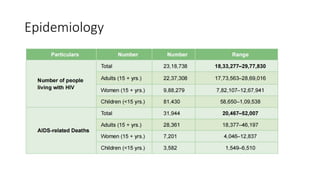
Epidemiology
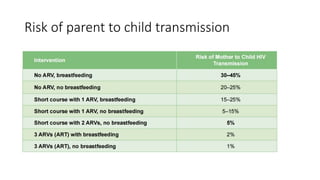
Risk of parent to child transmission
Diagnosis – Basic principles
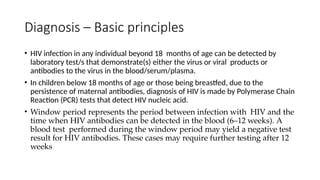
• HIV infection in any individual beyond 18 months of age can be detected by
laboratory test/s that demonstrate(s) either the virus or viral products or
antibodies to the virus in the blood/serum/plasma.
• In children below 18 months of age or those being breastfed, due to the
persistence of maternal antibodies, diagnosis of HIV is made by Polymerase Chain
Reaction (PCR) tests that detect HIV nucleic acid.
• Window period represents the period between infection with HIV and the
time when HIV antibodies can be detected in the blood (6–12 weeks). A
blood test performed during the window period may yield a negative test
result for HIV antibodies. These cases may require further testing after 12
weeks
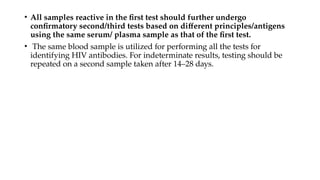
• All samples reactive in the first test should further undergo
confirmatory second/third tests based on different principles/antigens
using the same serum/ plasma sample as that of the first test.
• The same blood sample is utilized for performing all the tests for
identifying HIV antibodies. For indeterminate results, testing should be
repeated on a second sample taken after 14–28 days.
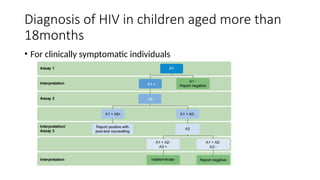
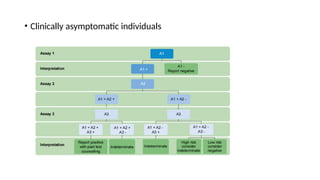
Diagnosis of HIV in children aged more than
18months
• For clinically symptomatic individuals
• Clinically asymptomatic individuals
Diagnosis of HIV infection in infants and
children less than 18 months of age
• Maternal antibodies to HIV, transferred passively to the infant during pregnancy,
usually persist for nearly 9–12 months in the infant. In some children, they may
persist for as long as 18 months.
• NACO recommends the use of Total Nucleic Acid (TNA) PCR test on a Dried Blood
Spot (DBS) sample of the infant to detect viral nucleic acids for diagnosis of HIV-1
infection during infancy. This test is performed at 6 weeks of age or at the earliest
opportunity when the infant and the mother come in contact with healthcare
system/workers.
Principles of management of Children living
with HIV
It not only includes use of pharmacotherapeutics but also
• Nutrition
• Developmental assessment
• Anthropometry
• Immunisation
• Follow up
Feeding guidelines for infants <6 months of age
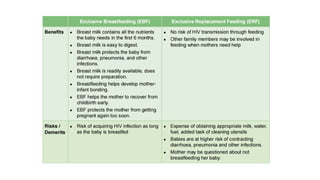
• Breastfeeding with concurrent ARV intervention offers HIV-exposed
infants the greatest chance of HIV-free survival.
• In concurrence with the current WHO guidelines, this is the
recommended feeding strategy for HIV-exposed infants in India.*
• However, given the fact that breastfeeding still carries some risk of
HIV transmission, however slight it may be, individual pregnant
women should also be informed about alternative infant-feeding
options and their advantages and disadvantages as compared to
breastfeeding
*WHO, UNICEF: Updates on HIV and infant feeding: the duration of
breastfeeding, and support from health services to
improve feeding practices among mothers living with HIV. Geneva: World
Health Organisation, 2016.
Mixed feeding
• It was earlier recommended that giving an infant a combination of breastfeeding and
replacement feeding is to be avoided since an artificially fed or breastfed child is at less
risk of acquiring HIV than the child who receives mixed feeding.
• Use of animal milk/formula feed increases the chance of causing inflammation of gut
mucosa due to allergy and infections, making it easier for the HIV in breast milk to gain
access and cause HIV infection in the infant.
• However, current evidence suggests that in continued presence of maternal ART, mixed
feeding is also rendered safe and may be preferred over no breastfeeding at all.
• Thus, although EBF is still recommended during first 6 months, practising mixed
feeding is not a reason to stop breast-feeding in the presence of ARV drugs. Thus, with
ongoing maternal ART during pregnancy and lactation, there remains no difference in
the feeding guidelines related to feeding of HIV-exposed versus unexposed infants.
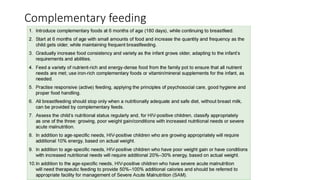
Complementary feeding
Initiating complementary feeding
• The WHO, in its 2016 guidelines on feeding HIV-exposed infants recommend that
“In settings where health services provide and support lifelong ART, including
adherence counselling, and promote and support breastfeeding among women
living with HIV, the duration of breastfeeding should not be restricted”.
• Mothers living with HIV should breastfeed for at least 12 months and may
continue breastfeeding for up to 24 months or longer (like the general
population) while being fully supported for ART adherence.
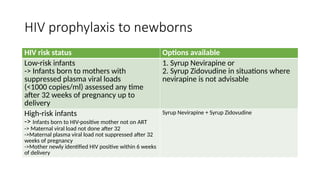
HIV prophylaxis to newborns
HIV risk status Options available
Low-risk infants
-> Infants born to mothers with
suppressed plasma viral loads
(<1000 copies/ml) assessed any time
after 32 weeks of pregnancy up to
delivery
1. Syrup Nevirapine or
2. Syrup Zidovudine in situations where
nevirapine is not advisable
High-risk infants
-> Infants born to HIV-positive mother not on ART
-> Maternal viral load not done after 32
->Maternal plasma viral load not suppressed after 32
weeks of pregnancy
->Mother newly identified HIV positive within 6 weeks
of delivery
Syrup Nevirapine + Syrup Zidovudine
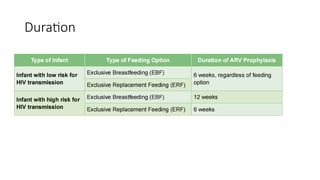
Duration
Immunization
• HIV-exposed infants, like all other infants, should be given BCG at birth. If BCG has
not been given at birth, or for neonates with HIV infection confirmed by early
virological testing, BCG vaccination should be delayed until ART has been started
and the infant confirmed to be immunologically stable (CD4 >25%). For Children
who are receiving ART, and have not received BCG earlier, it may be given once
they are clinically well and immunologically stable
• Severely immunocompromised HIV-infected infants, children, adolescents and
young adults should not receive measles virus-containing vaccine.
• A supplemental dose of measles containing vaccine may be considered in HIV-
exposed infants or soon after diagnosis of HIV infection in children older than 6
months who are not receiving ART and for whom the risk of measles is high, with
the aim to provide partial protection till they are revaccinated.
• Rotavirus vaccine, though a live vaccine, is recommended for use in HIV-exposed
infants due to their vulnerability to diarrhoea. Nevertheless, like all live vaccines,
it should not be given in children with known severe immunodeficiency.
• Inactive Japanese Encephalitis (JE) vaccine is safe for use in children with HIV
infection.

• It is desirable to check for seroconversion and give boosters as required especially
for hepatitis B. A 4-dose, double-quantity schedule for hepatitis B has been
recommended in view of poor seroconversion with routine immunization.
Red Flags in Developmental Screening
Positive indicators (the presence of any of the following):
• Loss of previously acquired developmental skills at any age
• Parental or professional concerns about vision, fixing or following an object or a
confirmed visual impairment at any age (simultaneous referral to paediatric
ophthalmology)
• Hearing loss at any age (simultaneous referral for expert audiologic or ear, nose and
throat assessment)
• Persistently low muscle tone or floppiness
• No speech by 18 months of age, especially if the child does not try to communicate by
other means such as gestures (simultaneous referral for urgent hearing test)
• Asymmetry of movements or hand preference before 18 months of age or other
features suggestive of cerebral palsy, such as increased muscle tone
• Persistent toe walking
• Complex disabilities
• Head circumference above +3 SD or below -3 SD. Also, if the
circumference has crossed 2 centiles (up or down) on the appropriate
chart or is disproportionate to the parental head circumference
• An assessing clinician who is uncertain about any aspect of the
assessment but thinks that development may be disordered
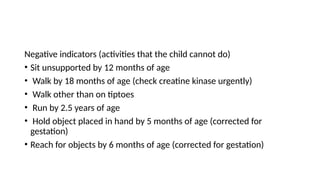
Negative indicators (activities that the child cannot do)
• Sit unsupported by 12 months of age
• Walk by 18 months of age (check creatine kinase urgently)
• Walk other than on tiptoes
• Run by 2.5 years of age
• Hold object placed in hand by 5 months of age (corrected for
gestation)
• Reach for objects by 6 months of age (corrected for gestation)
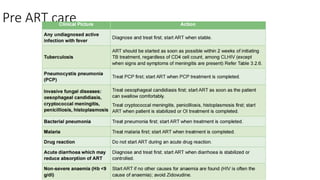
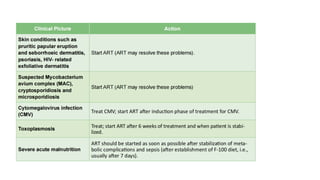
Pre ART care
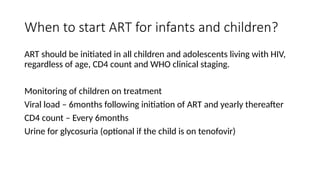
When to start ART for infants and children?
ART should be initiated in all children and adolescents living with HIV,
regardless of age, CD4 count and WHO clinical staging.
Monitoring of children on treatment
Viral load – 6months following initiation of ART and yearly thereafter
CD4 count – Every 6months
Urine for glycosuria (optional if the child is on tenofovir)
Drug classes and their mechanism of action
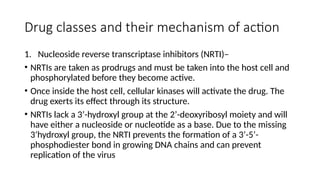
1. Nucleoside reverse transcriptase inhibitors (NRTI)–
• NRTIs are taken as prodrugs and must be taken into the host cell and
phosphorylated before they become active.
• Once inside the host cell, cellular kinases will activate the drug. The
drug exerts its effect through its structure.
• NRTIs lack a 3’-hydroxyl group at the 2’-deoxyribosyl moiety and will
have either a nucleoside or nucleotide as a base. Due to the missing
3’hydroxyl group, the NRTI prevents the formation of a 3’-5’-
phosphodiester bond in growing DNA chains and can prevent
replication of the virus
Examples – Zidovudine, lamivudine, abacavir, stavudine, tenofovir
ADR –
• Myopathy – Proximal > distal – more common with zidovudine
• Lipodystrophy – more common with stavudine (PI>NRTI)
• Peripheral neuropathy - more common with lamivudine
• Lactic acidosis – Hepatic steatosis often accompanies this
All the above are mainly due to mitochondrial toxicity.
2. Non nucleoside reverse transcriptase inhibitor (NNRTI)–
• The primary mechanism of action is through the binding of the NNRTI
to the reverse transcriptase and the creation of a hydrophobic pocket
proximal to the active site.
• This pocket creates a new spatial configuration of the substrate-
binding site to reduce the overall polymerase activity.
• HIV-2 is intrinsically resistant to NNRTIs
• Examples – Nevirapine, efavirenz, etavirine.
ADR –
• Increased risk of Steven-Johnson’s and toxic epidermal necrolysis.
• Transaminitis - more common with nevirapine
• Mood disturbances - more common with efivarenz.
3. Protease inhibitors –
• They bind to the active site of protease molecule, interfere with its
cleaving function, and are more effective viral inhibitors NRTIs.
• Because they act at a late step of viral cycle, they are effective in both
newly as well as chronically infected cells.
• Examples – Ritonavir, idinavir, lopinavir, Saquinavir
ADR –
• Lipodystrophy – Causes severe wasting of subcutaneous fat and the
patient appears emaciated.
• Gastro intestinal intolerance
• Nephrolithiasis – more common with idinavir
• Hyperbilirubunemia – secondary to UDP-glucuronyl transferase
inhibition – more common with atazanavir and idinavir.
• Increased risk of diabetes mellitus – type 2
4. Fusion Inhibitor –
Synthetic peptide which binds to gp41 .
Is not effective against HIV-2
Example – enfuviritide
ADR –
• Available only as subcutaneous formulation
• Local painful nodules and scarring
• Increased risk of Guillain-Barre Syndrome and glomerulonephritis
5. CCR5 inhibitor –
Inhibits binding of gp120 with CCR5 receptor.
Is not useful against strains which are CXCR4 or dual CXCR4/CCR5
tropic.
Example – Maraviroc.
ADR –
• Myositis, osteonecrosis, cholestatic jaundice
• Increased risk of malignancy as it interferes with immune surveillance.
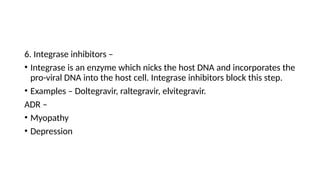
6. Integrase inhibitors –
• Integrase is an enzyme which nicks the host DNA and incorporates the
pro-viral DNA into the host cell. Integrase inhibitors block this step.
• Examples – Doltegravir, raltegravir, elvitegravir.
ADR –
• Myopathy
• Depression
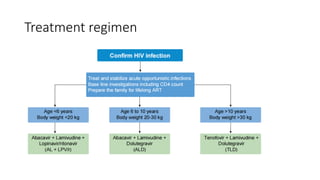
Treatment regimen
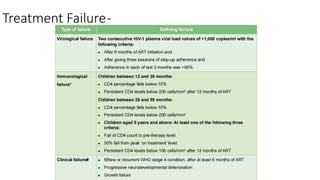
Treatment Failure-
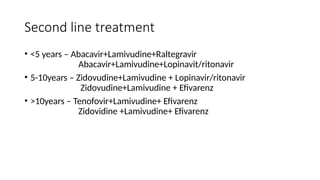
Second line treatment
• <5 years – Abacavir+Lamivudine+Raltegravir
Abacavir+Lamivudine+Lopinavit/ritonavir
• 5-10years – Zidovudine+Lamivudine + Lopinavir/ritonavir
Zidovudine+Lamivudine + Efivarenz
• >10years – Tenofovir+Lamivudine+ Efivarenz
Zidovidine +Lamivudine+ Efivarenz
Thank you.

Paediatric HIV treatment guidelines.pptx

  • 1.
    Paediatric HIV treatment guidelines ByDr.Girish R Bhagwat Moderator – Dr . Thanveer
  • 2.
  • 3.
    Risk of parentto child transmission
  • 4.
    Diagnosis – Basicprinciples • HIV infection in any individual beyond 18 months of age can be detected by laboratory test/s that demonstrate(s) either the virus or viral products or antibodies to the virus in the blood/serum/plasma. • In children below 18 months of age or those being breastfed, due to the persistence of maternal antibodies, diagnosis of HIV is made by Polymerase Chain Reaction (PCR) tests that detect HIV nucleic acid. • Window period represents the period between infection with HIV and the time when HIV antibodies can be detected in the blood (6–12 weeks). A blood test performed during the window period may yield a negative test result for HIV antibodies. These cases may require further testing after 12 weeks
  • 5.
    • All samplesreactive in the first test should further undergo confirmatory second/third tests based on different principles/antigens using the same serum/ plasma sample as that of the first test. • The same blood sample is utilized for performing all the tests for identifying HIV antibodies. For indeterminate results, testing should be repeated on a second sample taken after 14–28 days.
  • 6.
    Diagnosis of HIVin children aged more than 18months • For clinically symptomatic individuals
  • 7.
  • 8.
    Diagnosis of HIVinfection in infants and children less than 18 months of age • Maternal antibodies to HIV, transferred passively to the infant during pregnancy, usually persist for nearly 9–12 months in the infant. In some children, they may persist for as long as 18 months. • NACO recommends the use of Total Nucleic Acid (TNA) PCR test on a Dried Blood Spot (DBS) sample of the infant to detect viral nucleic acids for diagnosis of HIV-1 infection during infancy. This test is performed at 6 weeks of age or at the earliest opportunity when the infant and the mother come in contact with healthcare system/workers.
  • 9.
    Principles of managementof Children living with HIV It not only includes use of pharmacotherapeutics but also • Nutrition • Developmental assessment • Anthropometry • Immunisation • Follow up
  • 10.
    Feeding guidelines forinfants <6 months of age • Breastfeeding with concurrent ARV intervention offers HIV-exposed infants the greatest chance of HIV-free survival. • In concurrence with the current WHO guidelines, this is the recommended feeding strategy for HIV-exposed infants in India.* • However, given the fact that breastfeeding still carries some risk of HIV transmission, however slight it may be, individual pregnant women should also be informed about alternative infant-feeding options and their advantages and disadvantages as compared to breastfeeding *WHO, UNICEF: Updates on HIV and infant feeding: the duration of breastfeeding, and support from health services to improve feeding practices among mothers living with HIV. Geneva: World Health Organisation, 2016.
  • 12.
    Mixed feeding • Itwas earlier recommended that giving an infant a combination of breastfeeding and replacement feeding is to be avoided since an artificially fed or breastfed child is at less risk of acquiring HIV than the child who receives mixed feeding. • Use of animal milk/formula feed increases the chance of causing inflammation of gut mucosa due to allergy and infections, making it easier for the HIV in breast milk to gain access and cause HIV infection in the infant. • However, current evidence suggests that in continued presence of maternal ART, mixed feeding is also rendered safe and may be preferred over no breastfeeding at all. • Thus, although EBF is still recommended during first 6 months, practising mixed feeding is not a reason to stop breast-feeding in the presence of ARV drugs. Thus, with ongoing maternal ART during pregnancy and lactation, there remains no difference in the feeding guidelines related to feeding of HIV-exposed versus unexposed infants.
  • 13.
  • 14.
    Initiating complementary feeding •The WHO, in its 2016 guidelines on feeding HIV-exposed infants recommend that “In settings where health services provide and support lifelong ART, including adherence counselling, and promote and support breastfeeding among women living with HIV, the duration of breastfeeding should not be restricted”. • Mothers living with HIV should breastfeed for at least 12 months and may continue breastfeeding for up to 24 months or longer (like the general population) while being fully supported for ART adherence.
  • 15.
    HIV prophylaxis tonewborns HIV risk status Options available Low-risk infants -> Infants born to mothers with suppressed plasma viral loads (<1000 copies/ml) assessed any time after 32 weeks of pregnancy up to delivery 1. Syrup Nevirapine or 2. Syrup Zidovudine in situations where nevirapine is not advisable High-risk infants -> Infants born to HIV-positive mother not on ART -> Maternal viral load not done after 32 ->Maternal plasma viral load not suppressed after 32 weeks of pregnancy ->Mother newly identified HIV positive within 6 weeks of delivery Syrup Nevirapine + Syrup Zidovudine
  • 16.
  • 17.
    Immunization • HIV-exposed infants,like all other infants, should be given BCG at birth. If BCG has not been given at birth, or for neonates with HIV infection confirmed by early virological testing, BCG vaccination should be delayed until ART has been started and the infant confirmed to be immunologically stable (CD4 >25%). For Children who are receiving ART, and have not received BCG earlier, it may be given once they are clinically well and immunologically stable • Severely immunocompromised HIV-infected infants, children, adolescents and young adults should not receive measles virus-containing vaccine. • A supplemental dose of measles containing vaccine may be considered in HIV- exposed infants or soon after diagnosis of HIV infection in children older than 6 months who are not receiving ART and for whom the risk of measles is high, with the aim to provide partial protection till they are revaccinated.
  • 18.
    • Rotavirus vaccine,though a live vaccine, is recommended for use in HIV-exposed infants due to their vulnerability to diarrhoea. Nevertheless, like all live vaccines, it should not be given in children with known severe immunodeficiency. • Inactive Japanese Encephalitis (JE) vaccine is safe for use in children with HIV infection. • It is desirable to check for seroconversion and give boosters as required especially for hepatitis B. A 4-dose, double-quantity schedule for hepatitis B has been recommended in view of poor seroconversion with routine immunization.
  • 19.
    Red Flags inDevelopmental Screening Positive indicators (the presence of any of the following): • Loss of previously acquired developmental skills at any age • Parental or professional concerns about vision, fixing or following an object or a confirmed visual impairment at any age (simultaneous referral to paediatric ophthalmology) • Hearing loss at any age (simultaneous referral for expert audiologic or ear, nose and throat assessment) • Persistently low muscle tone or floppiness • No speech by 18 months of age, especially if the child does not try to communicate by other means such as gestures (simultaneous referral for urgent hearing test) • Asymmetry of movements or hand preference before 18 months of age or other features suggestive of cerebral palsy, such as increased muscle tone
  • 20.
    • Persistent toewalking • Complex disabilities • Head circumference above +3 SD or below -3 SD. Also, if the circumference has crossed 2 centiles (up or down) on the appropriate chart or is disproportionate to the parental head circumference • An assessing clinician who is uncertain about any aspect of the assessment but thinks that development may be disordered
  • 21.
    Negative indicators (activitiesthat the child cannot do) • Sit unsupported by 12 months of age • Walk by 18 months of age (check creatine kinase urgently) • Walk other than on tiptoes • Run by 2.5 years of age • Hold object placed in hand by 5 months of age (corrected for gestation) • Reach for objects by 6 months of age (corrected for gestation)
  • 22.
  • 24.
    When to startART for infants and children? ART should be initiated in all children and adolescents living with HIV, regardless of age, CD4 count and WHO clinical staging. Monitoring of children on treatment Viral load – 6months following initiation of ART and yearly thereafter CD4 count – Every 6months Urine for glycosuria (optional if the child is on tenofovir)
  • 25.
    Drug classes andtheir mechanism of action 1. Nucleoside reverse transcriptase inhibitors (NRTI)– • NRTIs are taken as prodrugs and must be taken into the host cell and phosphorylated before they become active. • Once inside the host cell, cellular kinases will activate the drug. The drug exerts its effect through its structure. • NRTIs lack a 3’-hydroxyl group at the 2’-deoxyribosyl moiety and will have either a nucleoside or nucleotide as a base. Due to the missing 3’hydroxyl group, the NRTI prevents the formation of a 3’-5’- phosphodiester bond in growing DNA chains and can prevent replication of the virus
  • 26.
    Examples – Zidovudine,lamivudine, abacavir, stavudine, tenofovir ADR – • Myopathy – Proximal > distal – more common with zidovudine • Lipodystrophy – more common with stavudine (PI>NRTI) • Peripheral neuropathy - more common with lamivudine • Lactic acidosis – Hepatic steatosis often accompanies this All the above are mainly due to mitochondrial toxicity.
  • 27.
    2. Non nucleosidereverse transcriptase inhibitor (NNRTI)– • The primary mechanism of action is through the binding of the NNRTI to the reverse transcriptase and the creation of a hydrophobic pocket proximal to the active site. • This pocket creates a new spatial configuration of the substrate- binding site to reduce the overall polymerase activity. • HIV-2 is intrinsically resistant to NNRTIs • Examples – Nevirapine, efavirenz, etavirine.
  • 28.
    ADR – • Increasedrisk of Steven-Johnson’s and toxic epidermal necrolysis. • Transaminitis - more common with nevirapine • Mood disturbances - more common with efivarenz.
  • 29.
    3. Protease inhibitors– • They bind to the active site of protease molecule, interfere with its cleaving function, and are more effective viral inhibitors NRTIs. • Because they act at a late step of viral cycle, they are effective in both newly as well as chronically infected cells. • Examples – Ritonavir, idinavir, lopinavir, Saquinavir
  • 30.
    ADR – • Lipodystrophy– Causes severe wasting of subcutaneous fat and the patient appears emaciated. • Gastro intestinal intolerance • Nephrolithiasis – more common with idinavir • Hyperbilirubunemia – secondary to UDP-glucuronyl transferase inhibition – more common with atazanavir and idinavir. • Increased risk of diabetes mellitus – type 2
  • 31.
    4. Fusion Inhibitor– Synthetic peptide which binds to gp41 . Is not effective against HIV-2 Example – enfuviritide ADR – • Available only as subcutaneous formulation • Local painful nodules and scarring • Increased risk of Guillain-Barre Syndrome and glomerulonephritis
  • 32.
    5. CCR5 inhibitor– Inhibits binding of gp120 with CCR5 receptor. Is not useful against strains which are CXCR4 or dual CXCR4/CCR5 tropic. Example – Maraviroc. ADR – • Myositis, osteonecrosis, cholestatic jaundice • Increased risk of malignancy as it interferes with immune surveillance.
  • 33.
    6. Integrase inhibitors– • Integrase is an enzyme which nicks the host DNA and incorporates the pro-viral DNA into the host cell. Integrase inhibitors block this step. • Examples – Doltegravir, raltegravir, elvitegravir. ADR – • Myopathy • Depression
  • 34.
  • 35.
  • 36.
    Second line treatment •<5 years – Abacavir+Lamivudine+Raltegravir Abacavir+Lamivudine+Lopinavit/ritonavir • 5-10years – Zidovudine+Lamivudine + Lopinavir/ritonavir Zidovudine+Lamivudine + Efivarenz • >10years – Tenofovir+Lamivudine+ Efivarenz Zidovidine +Lamivudine+ Efivarenz
  • 37.

Editor's Notes

  • #15 „ Infant born to a mother with confirmed HIV-2 or HIV-1 and HIV-2 combined infections „ Infant born to a mother who had received single dose of Nevirapine during earlier pregnancy or delivery „ Infant born to a mother who is on PI-based ART regimen due to treatment failure
  • #17 (CD4% >25% for children aged <5 years or CD4 count ≥200 cells/ mm3 if aged >5 years).