Predictive Modeling of Speech
Dr. Yogananda Isukapalli
PREDICTIVE MODELING OF SPEECH
Linear Predictive Coding (LPC):
is defined as a digital method for encoding an analog signal in
which a particular value is predicted by a linear function of
the past values of the signal
- First proposed method for encoding Human Speech US DoD
- Human speech is produced in the vocal tract which can be
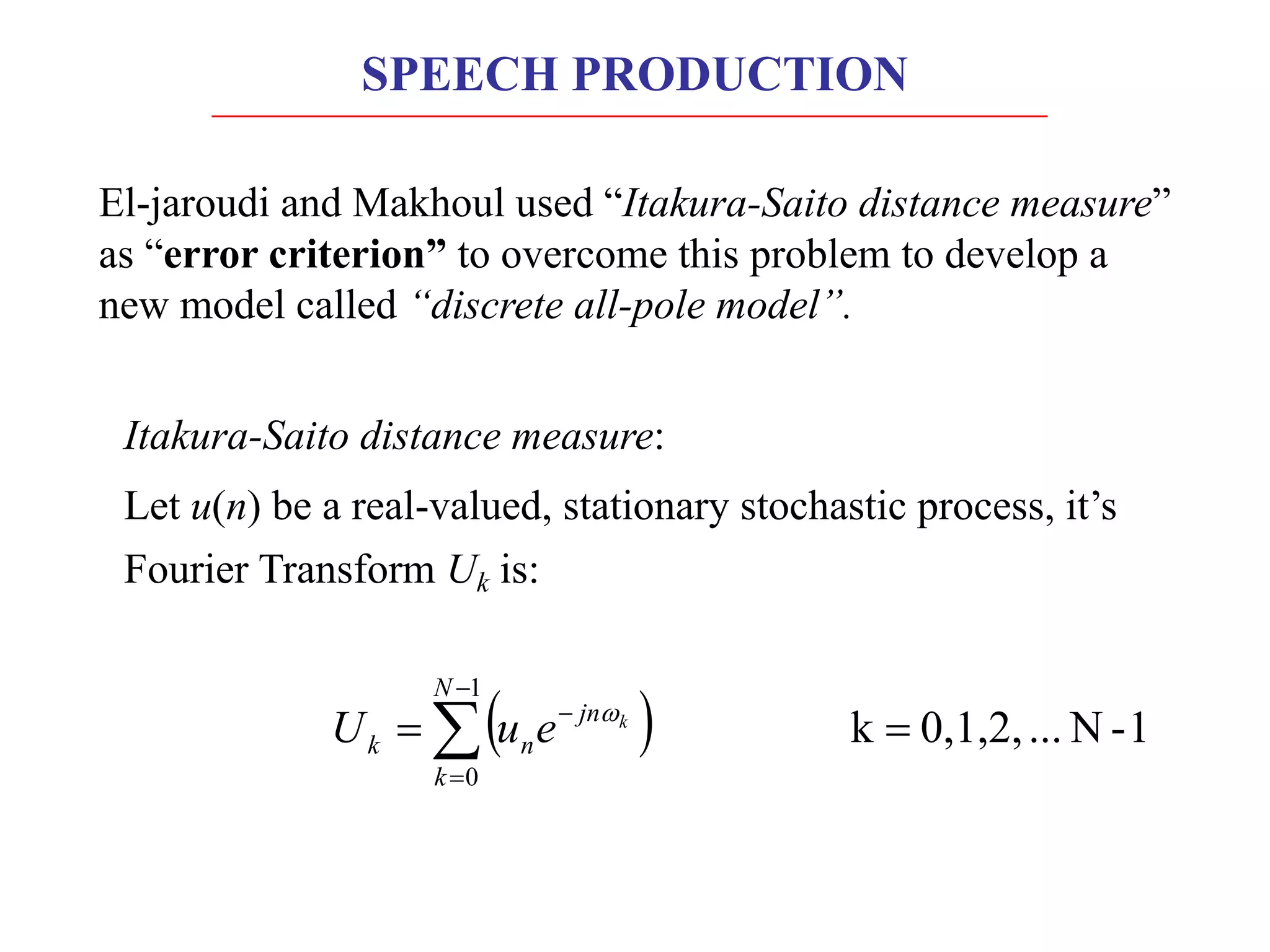
approximated as a variable diameter tube.
- The linear predictive coding (LPC) model is based on a
mathematical approximation of the vocal tract represented
by a tube of a varying diameter
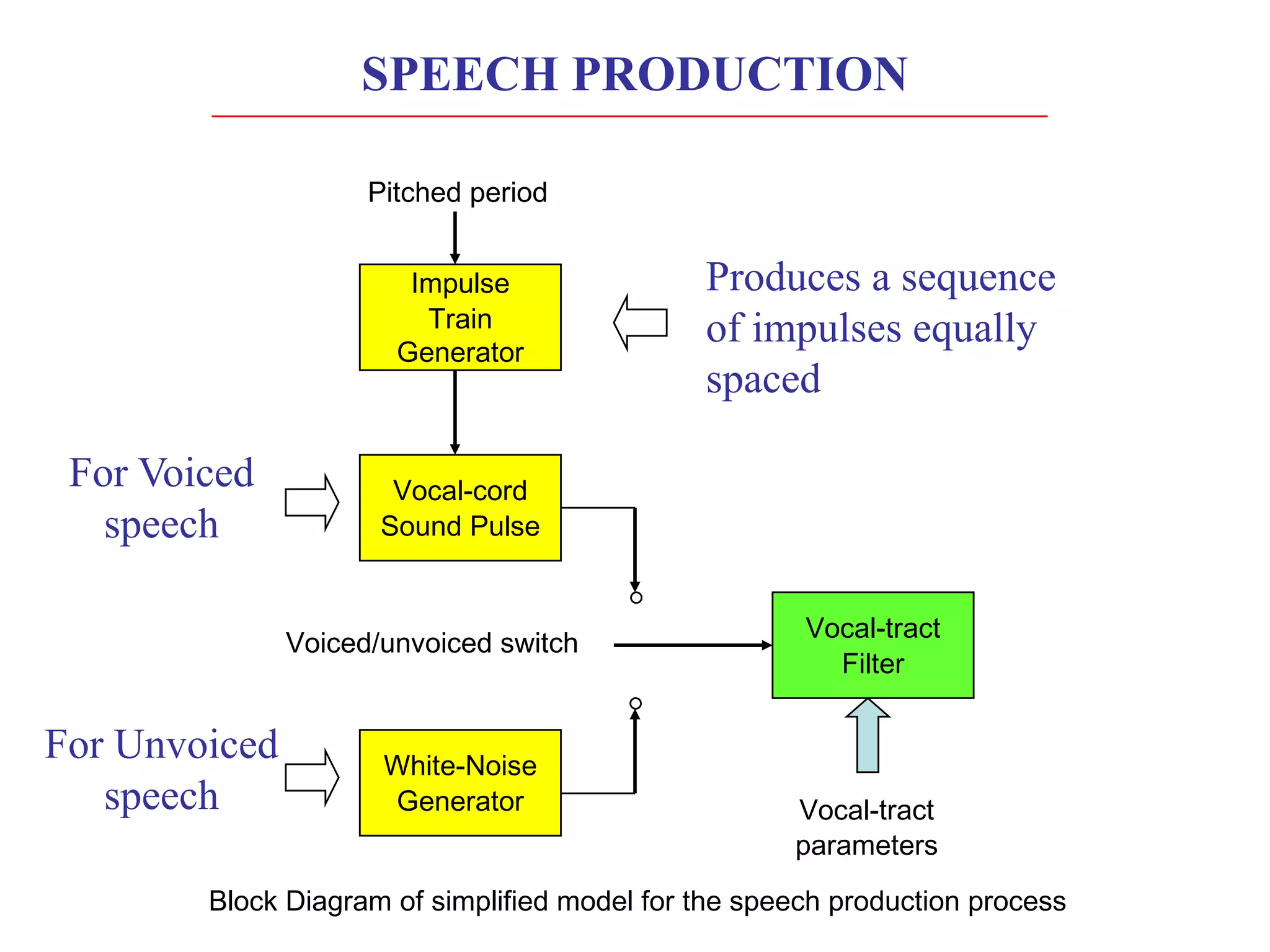
Impulse
Train
Generator
Vocal-cord
Sound Pulse
White-Noise
Generator
Vocal-tract
Filter
Vocal-tract
parameters
Pitched period
Voiced/unvoiced switch
Block Diagram of simplified model for the speech production process
For Voiced
speech
For Unvoiced
speech
Produces a sequence
of impulses equally
spaced
SPEECH PRODUCTION
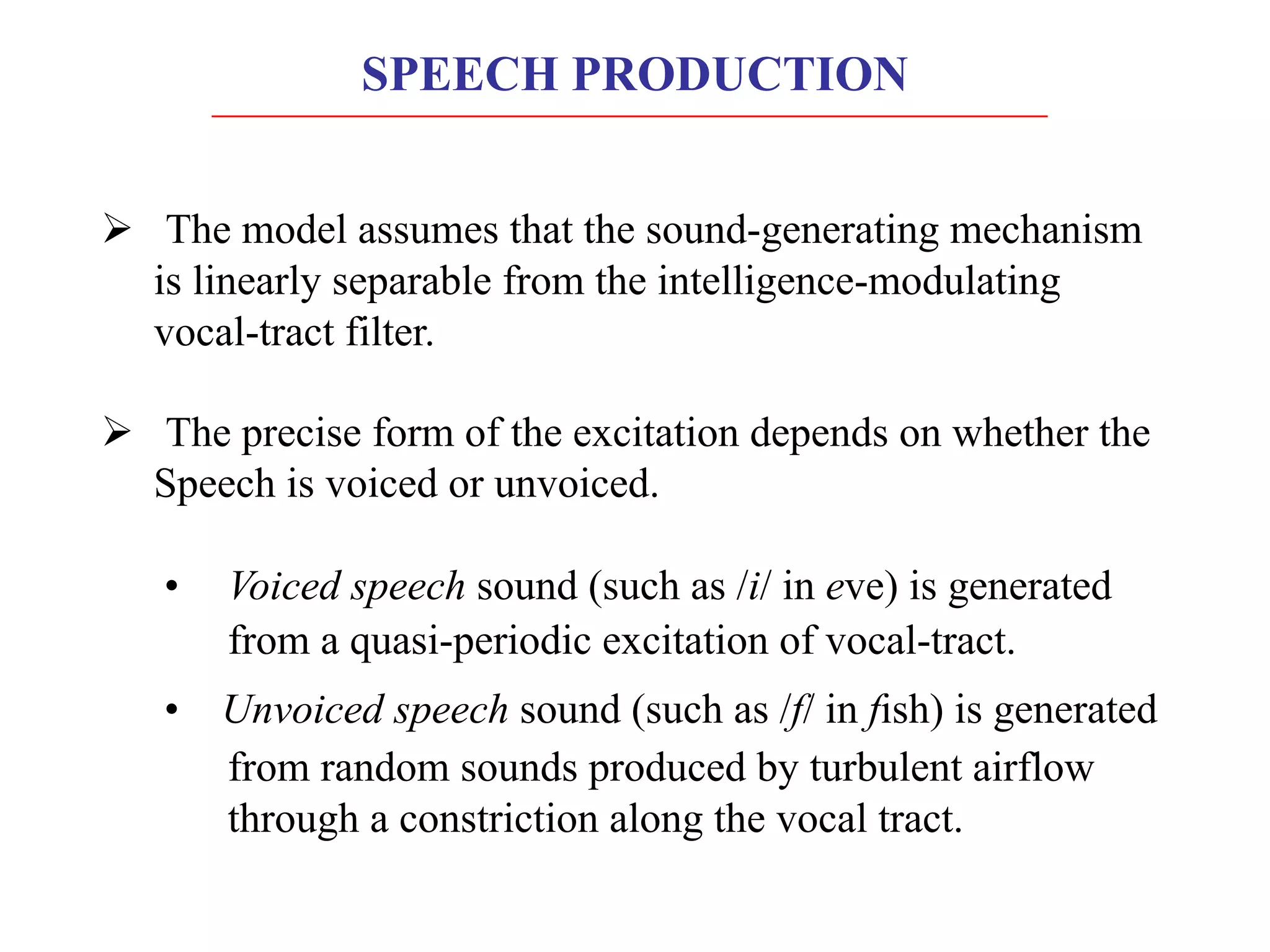
Ø The model assumes that the sound-generating mechanism
is linearly separable from the intelligence-modulating
vocal-tract filter.
Ø The precise form of the excitation depends on whether the
Speech is voiced or unvoiced.
• Voiced speech sound (such as /i/ in eve) is generated
from a quasi-periodic excitation of vocal-tract.
• Unvoiced speech sound (such as /f/ in fish) is generated
from random sounds produced by turbulent airflow
through a constriction along the vocal tract.
SPEECH PRODUCTION
SPEECH PRODUCTION
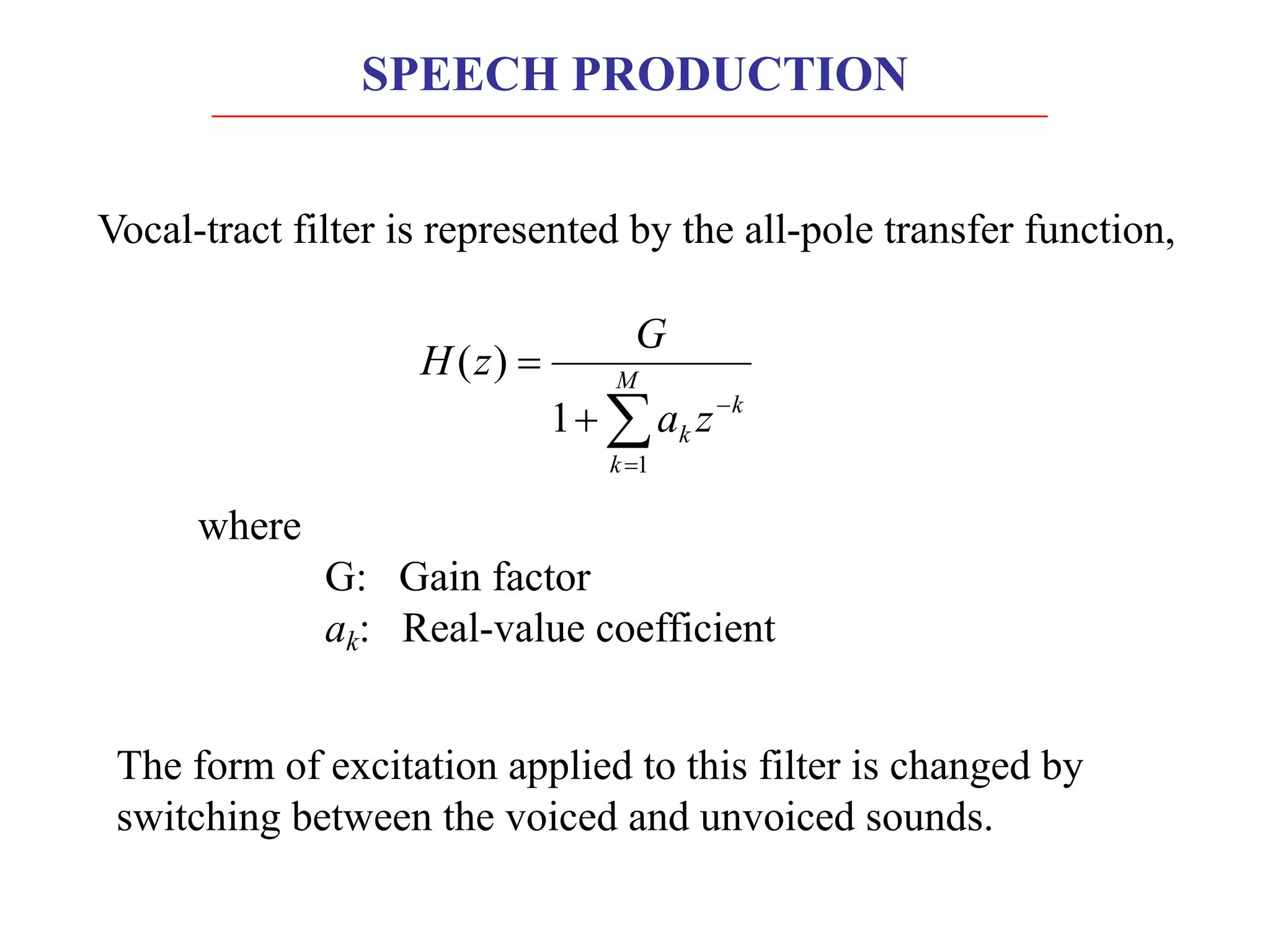
Vocal-tract filter is represented by the all-pole transfer function,
å
=
-
+
= M
k
k
k z
a
G
z
H
1
1
)
(
where
G: Gain factor
ak: Real-value coefficient
The form of excitation applied to this filter is changed by
switching between the voiced and unvoiced sounds.
SPEECH PRODUCTION
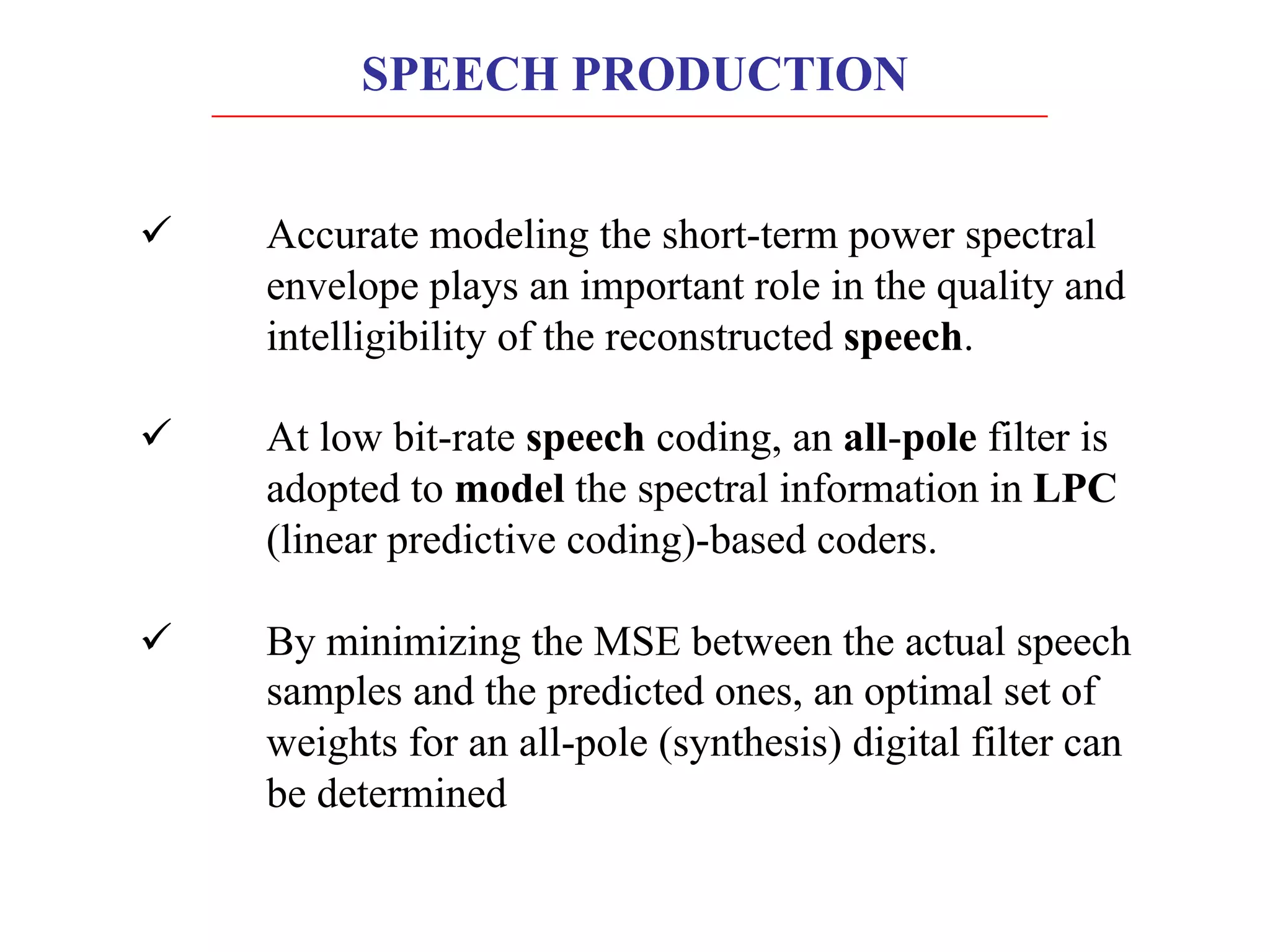
ü Accurate modeling the short-term power spectral
envelope plays an important role in the quality and
intelligibility of the reconstructed speech.
ü At low bit-rate speech coding, an all-pole filter is
adopted to model the spectral information in LPC
(linear predictive coding)-based coders.
ü By minimizing the MSE between the actual speech
samples and the predicted ones, an optimal set of
weights for an all-pole (synthesis) digital filter can
be determined
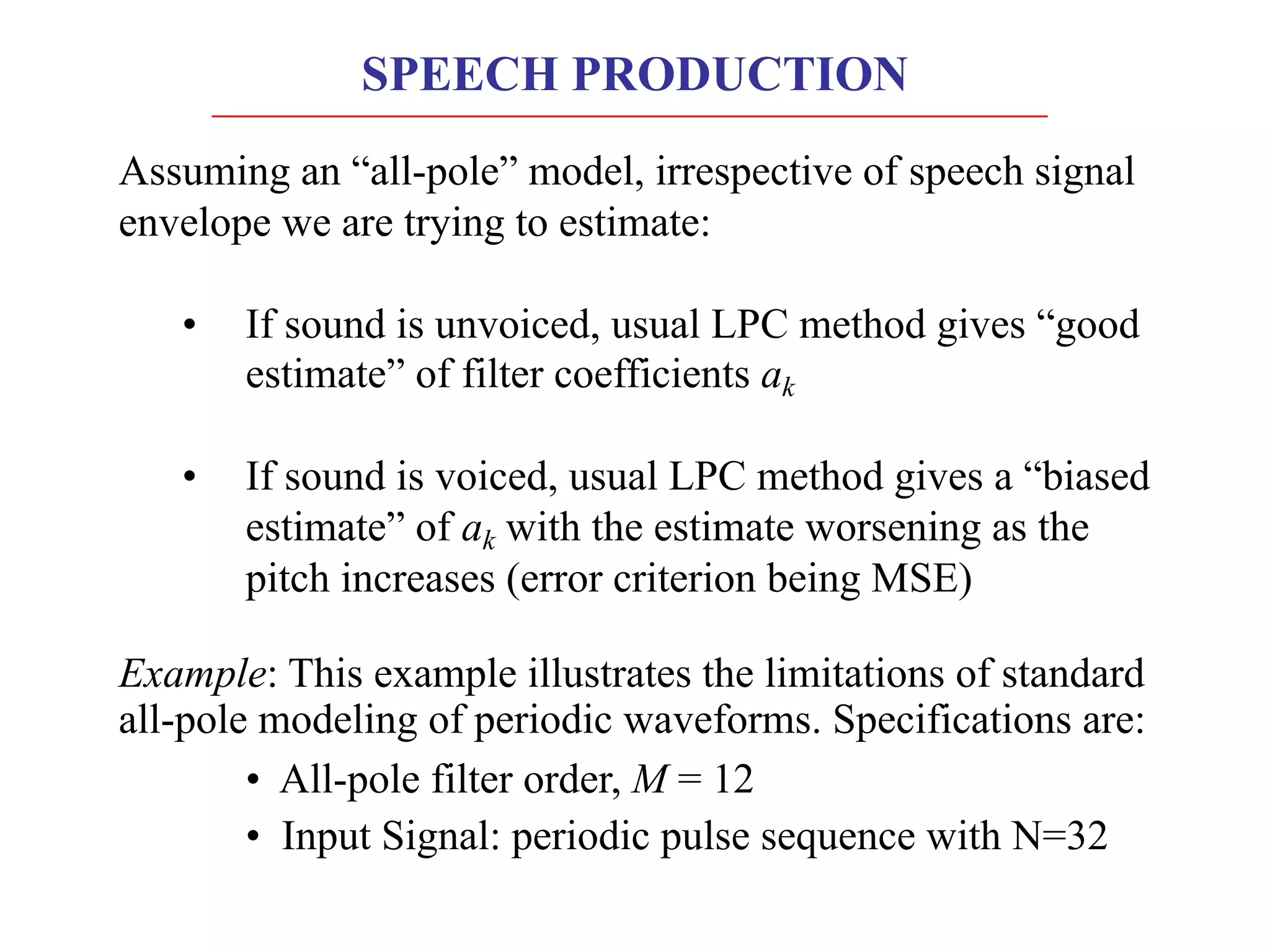
Assuming an “all-pole” model, irrespective of speech signal
envelope we are trying to estimate:
• If sound is unvoiced, usual LPC method gives “good
estimate” of filter coefficients ak
• If sound is voiced, usual LPC method gives a “biased
estimate” of ak with the estimate worsening as the
pitch increases (error criterion being MSE)
Example: This example illustrates the limitations of standard
all-pole modeling of periodic waveforms. Specifications are:
• All-pole filter order, M = 12
• Input Signal: periodic pulse sequence with N=32
SPEECH PRODUCTION
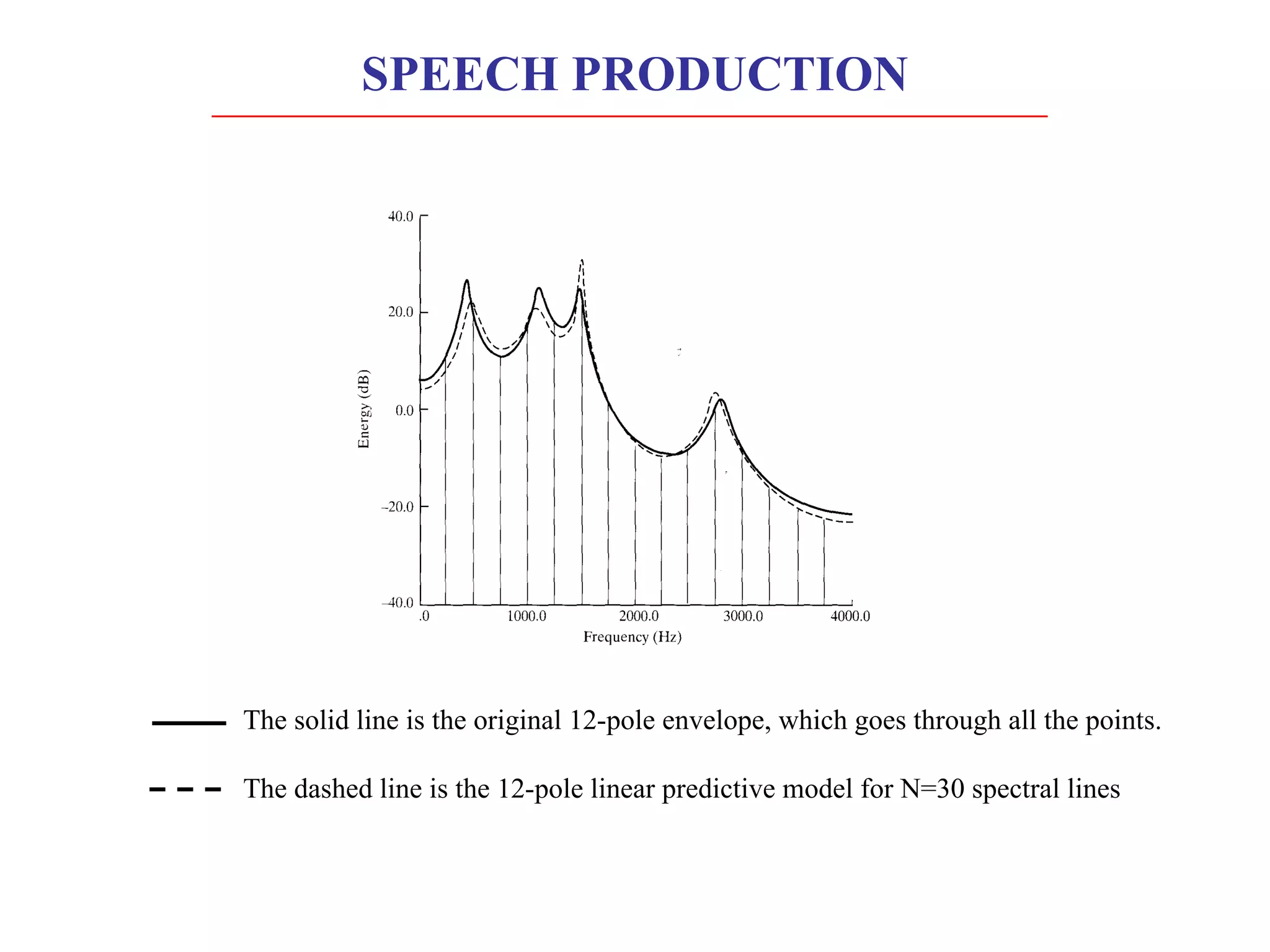
The solid line is the original 12-pole envelope, which goes through all the points.
The dashed line is the 12-pole linear predictive model for N=30 spectral lines
SPEECH PRODUCTION
Itakura-Saito distance measure:
Let u(n) be a real-valued, stationary stochastic process, it’s
Fourier Transform Uk is:
( ) 1
-
N
...
0,1,2,
k
1
0
=
= å
-
=
-
N
k
jn
n
k
k
e
u
U w
El-jaroudi and Makhoul used “Itakura-Saito distance measure”
as “error criterion” to overcome this problem to develop a
new model called “discrete all-pole model”.
SPEECH PRODUCTION
Let vector a denote a set of spectral parameters as:
T
M
a
a
a ]
,.....,
,
[
a 2
1
=
Note: See p.no.189-191 in textbook for proof
The auto-correlation function of u(n) for lag m is:
( )
( ) 1
-
N
...
0,1,2,
k
)
(
where
1
-
N
...
0,1,2,
k
1
)
(
1
0
1
0
=
=
=
=
å
å
-
=
-
-
=
N
k
jn
k
N
k
jn
k
k
k
e
m
r
S
e
S
N
m
r
w
w
SPEECH PRODUCTION
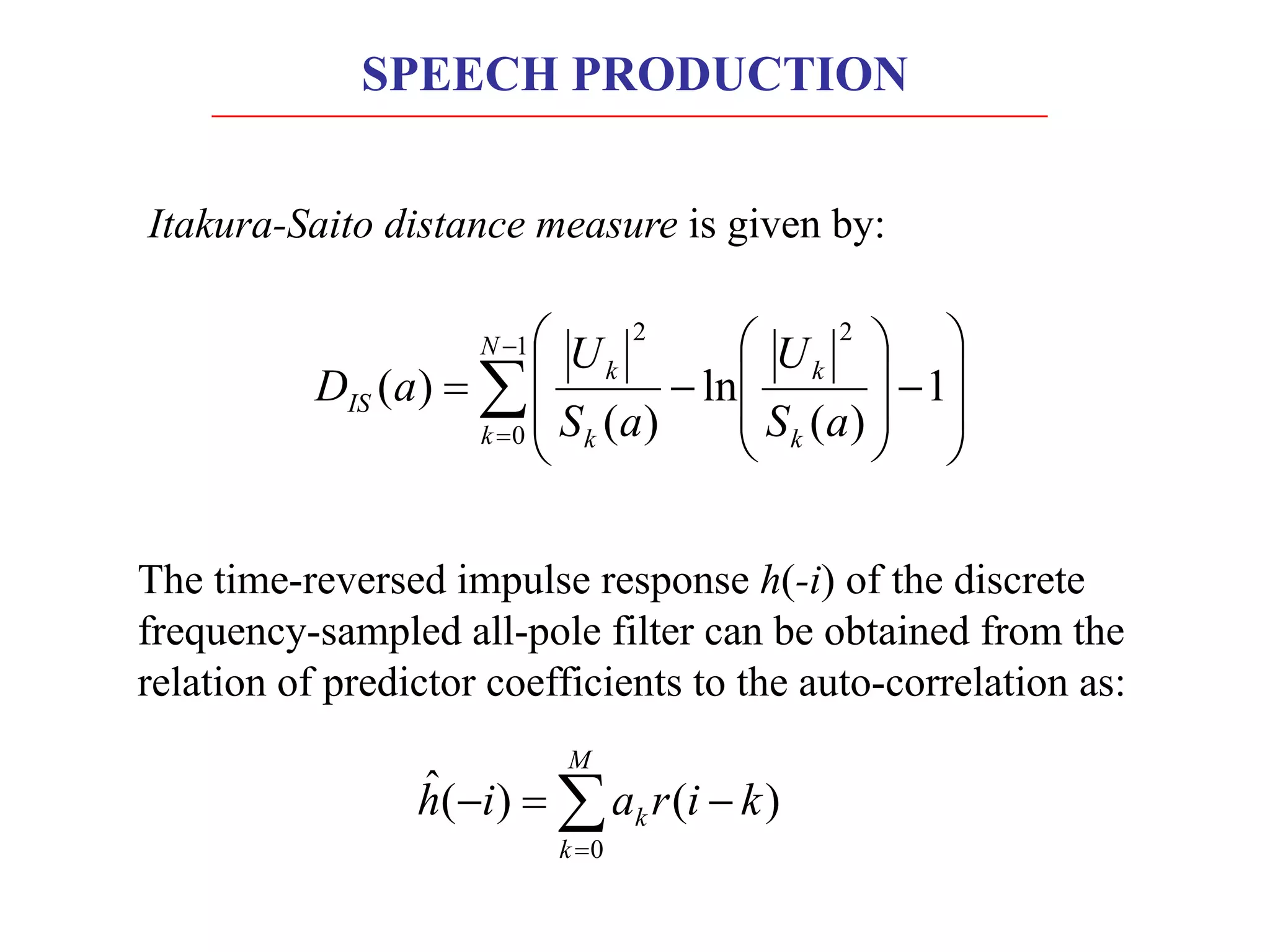
The time-reversed impulse response h(-i) of the discrete
frequency-sampled all-pole filter can be obtained from the
relation of predictor coefficients to the auto-correlation as:
å
=
-
=
-
M
k
k k
i
r
a
i
h
0
)
(
)
(
ˆ
å
-
=
÷
÷
ø
ö
ç
ç
è
æ
-
÷
÷
ø
ö
ç
ç
è
æ
-
=
1
0
2
2
1
)
(
ln
)
(
)
(
N
k k
k
k
k
IS
a
S
U
a
S
U
a
D
Itakura-Saito distance measure is given by:
SPEECH PRODUCTION
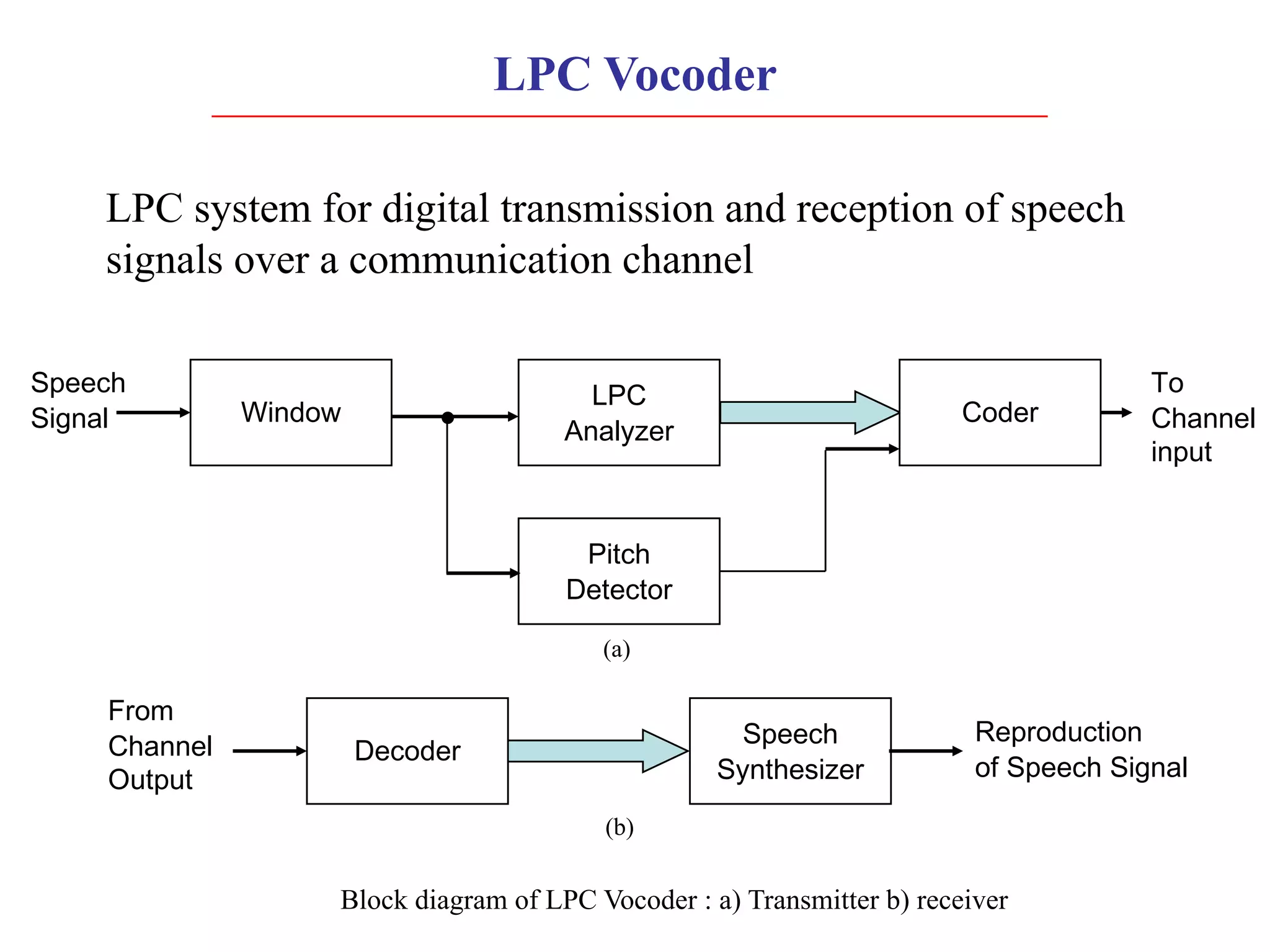
LPC Vocoder
LPC system for digital transmission and reception of speech
signals over a communication channel
Reproduction
of Speech Signal
From
Channel
Output
Speech
Signal
To
Channel
input
Window
LPC
Analyzer
Coder
Pitch
Detector
Block diagram of LPC Vocoder : a) Transmitter b) receiver
(b)
Decoder
Speech
Synthesizer
(a)
LPC Vocoder
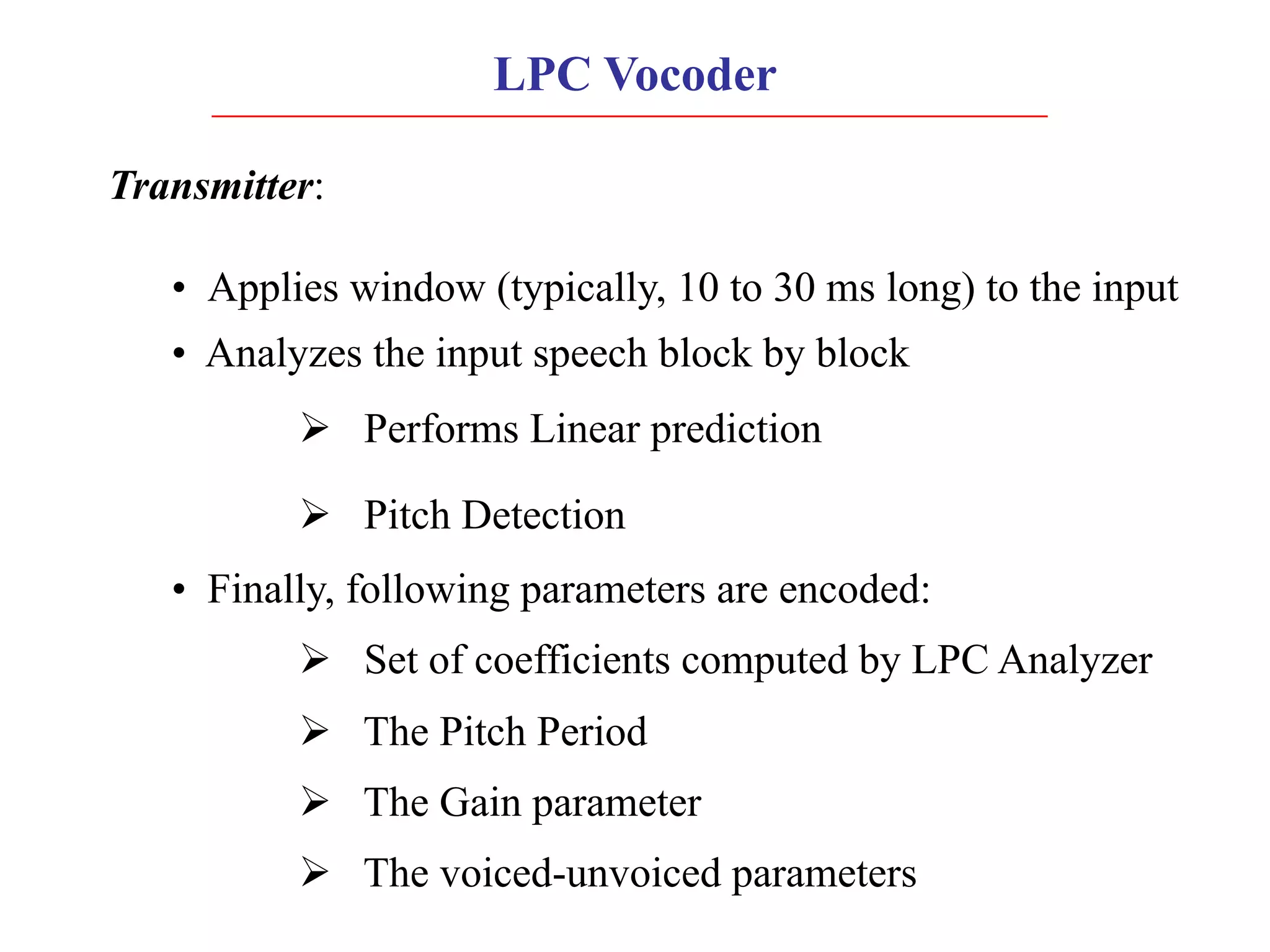
Transmitter:
• Applies window (typically, 10 to 30 ms long) to the input
• Analyzes the input speech block by block
Ø Performs Linear prediction
Ø Pitch Detection
• Finally, following parameters are encoded:
Ø Set of coefficients computed by LPC Analyzer
Ø The Pitch Period
Ø The Gain parameter
Ø The voiced-unvoiced parameters
LPC Vocoder
Receiver:
Performs the inverse operations on the channel output:
• Decode incoming parameters
• Synthesize a speech signal from the parameters

P4_Predictive_Modeling_Speech.pdf

  • 1.
    Predictive Modeling ofSpeech Dr. Yogananda Isukapalli
  • 2.
    PREDICTIVE MODELING OFSPEECH Linear Predictive Coding (LPC): is defined as a digital method for encoding an analog signal in which a particular value is predicted by a linear function of the past values of the signal - First proposed method for encoding Human Speech US DoD - Human speech is produced in the vocal tract which can be approximated as a variable diameter tube. - The linear predictive coding (LPC) model is based on a mathematical approximation of the vocal tract represented by a tube of a varying diameter
  • 3.
    Impulse Train Generator Vocal-cord Sound Pulse White-Noise Generator Vocal-tract Filter Vocal-tract parameters Pitched period Voiced/unvoicedswitch Block Diagram of simplified model for the speech production process For Voiced speech For Unvoiced speech Produces a sequence of impulses equally spaced SPEECH PRODUCTION
  • 4.
    Ø The modelassumes that the sound-generating mechanism is linearly separable from the intelligence-modulating vocal-tract filter. Ø The precise form of the excitation depends on whether the Speech is voiced or unvoiced. • Voiced speech sound (such as /i/ in eve) is generated from a quasi-periodic excitation of vocal-tract. • Unvoiced speech sound (such as /f/ in fish) is generated from random sounds produced by turbulent airflow through a constriction along the vocal tract. SPEECH PRODUCTION
  • 5.
    SPEECH PRODUCTION Vocal-tract filteris represented by the all-pole transfer function, å = - + = M k k k z a G z H 1 1 ) ( where G: Gain factor ak: Real-value coefficient The form of excitation applied to this filter is changed by switching between the voiced and unvoiced sounds.
  • 6.
    SPEECH PRODUCTION ü Accuratemodeling the short-term power spectral envelope plays an important role in the quality and intelligibility of the reconstructed speech. ü At low bit-rate speech coding, an all-pole filter is adopted to model the spectral information in LPC (linear predictive coding)-based coders. ü By minimizing the MSE between the actual speech samples and the predicted ones, an optimal set of weights for an all-pole (synthesis) digital filter can be determined
  • 7.
    Assuming an “all-pole”model, irrespective of speech signal envelope we are trying to estimate: • If sound is unvoiced, usual LPC method gives “good estimate” of filter coefficients ak • If sound is voiced, usual LPC method gives a “biased estimate” of ak with the estimate worsening as the pitch increases (error criterion being MSE) Example: This example illustrates the limitations of standard all-pole modeling of periodic waveforms. Specifications are: • All-pole filter order, M = 12 • Input Signal: periodic pulse sequence with N=32 SPEECH PRODUCTION
  • 8.
    The solid lineis the original 12-pole envelope, which goes through all the points. The dashed line is the 12-pole linear predictive model for N=30 spectral lines SPEECH PRODUCTION
  • 9.
    Itakura-Saito distance measure: Letu(n) be a real-valued, stationary stochastic process, it’s Fourier Transform Uk is: ( ) 1 - N ... 0,1,2, k 1 0 = = å - = - N k jn n k k e u U w El-jaroudi and Makhoul used “Itakura-Saito distance measure” as “error criterion” to overcome this problem to develop a new model called “discrete all-pole model”. SPEECH PRODUCTION
  • 10.
    Let vector adenote a set of spectral parameters as: T M a a a ] ,....., , [ a 2 1 = Note: See p.no.189-191 in textbook for proof The auto-correlation function of u(n) for lag m is: ( ) ( ) 1 - N ... 0,1,2, k ) ( where 1 - N ... 0,1,2, k 1 ) ( 1 0 1 0 = = = = å å - = - - = N k jn k N k jn k k k e m r S e S N m r w w SPEECH PRODUCTION
  • 11.
    The time-reversed impulseresponse h(-i) of the discrete frequency-sampled all-pole filter can be obtained from the relation of predictor coefficients to the auto-correlation as: å = - = - M k k k i r a i h 0 ) ( ) ( ˆ å - = ÷ ÷ ø ö ç ç è æ - ÷ ÷ ø ö ç ç è æ - = 1 0 2 2 1 ) ( ln ) ( ) ( N k k k k k IS a S U a S U a D Itakura-Saito distance measure is given by: SPEECH PRODUCTION
  • 12.
    LPC Vocoder LPC systemfor digital transmission and reception of speech signals over a communication channel Reproduction of Speech Signal From Channel Output Speech Signal To Channel input Window LPC Analyzer Coder Pitch Detector Block diagram of LPC Vocoder : a) Transmitter b) receiver (b) Decoder Speech Synthesizer (a)
  • 13.
    LPC Vocoder Transmitter: • Applieswindow (typically, 10 to 30 ms long) to the input • Analyzes the input speech block by block Ø Performs Linear prediction Ø Pitch Detection • Finally, following parameters are encoded: Ø Set of coefficients computed by LPC Analyzer Ø The Pitch Period Ø The Gain parameter Ø The voiced-unvoiced parameters
  • 14.
    LPC Vocoder Receiver: Performs theinverse operations on the channel output: • Decode incoming parameters • Synthesize a speech signal from the parameters