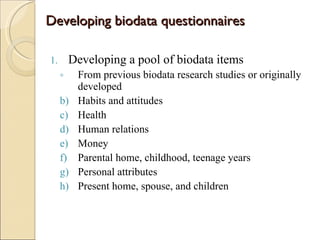
Developing biodata questionnaires  Developing a pool of biodata items From previous biodata research studies or originally developed Habits and attitudes Health Human relations Money Parental home, childhood, teenage years Personal attributes Present home, spouse, and children
Developing biodata questionnaires  Developing a pool of biodata items Recreation, hobbies, and interests School and education Self impressions Values, opinions, and preferences Work Journal of applied psychology Personnel psychology
Developing biodata questionnaires  Guidelines  Should principally deal with past behavior and experiences Family relationships are usually viewed as offensive Specificity and brevity Numbers should be used to define a biodata item’s options or alternatives All possible response options or an “escape” option (other) should given; response options that form a continuum should be used.
Developing biodata questionnaires  Guidelines  Neutral or pleasant connotation Past and present behaviors and with opinions, attitudes, and values are generally acceptable Reflect historical events that are important in shaping a person’s behavior and identity To lessens the effect of socially desirable
Developing biodata questionnaires  Prescreening and pilot-testing biodata items Reviewed by a panel of judges Large sample sizes ( >500) 刪題標準 Little response variance Skewed response distributions Items correlated with protected-group characteristics such as ethnicity Having no correlation with other items No correlation with the criterion
Scoring biodata questionnaires Computing a single biodata score As empirical keying Methods:  (a)  vertical percentage (b) horizontal percentage  (c)  correlation  (d)  differential regression (e) deviant response (f) rare response vertical percentage  - item is analyzed  related to job success  weight  sum weight  Limited to predictions for a specific pool of applicants and for a specific job success Uncertainty about what the scores really means.
Scoring biodata questionnaires Computing a multiple biodata score 用主成份分析或因素分析  (  通常為 10~15 因素  ) 每個因素包含至少 10 題以上 Figure 10.4 p455 有學者分析  75 biodata items 和三個效標的關係 Different biodata factors were associated with different types of performance on the job.
信度 因為個別差異, internal consistency reliability 0.6 ~ 0.8 Test-retest reliability  0.6 ~ 0.9 Objective, verifiable biodata factors had higher test – retest reliabilities than subjective , less verifiable ones.
效度 Edwin Ghiselli  認為是最有效的預測工具 James Asher reported that 90 percent of biodata validity coefficient were above 0.3 Meta-analyses  Different biodata validity coefficients for different criteria can be expected  Table10.3 p458 The predictive validity of biodata measures was 0.35 for overall job performance and 0.30 for overall performance in training programs
效度 效度類化,有學者使用  supervisory profile record  在 79 個公司,效度為  0.33 應同一公司經理人較恰當, true validity 0.53 Guidelines 效度類化合理嗎 ? 效標的測量穩定及準確有效嗎 ? 每一題的效度 ? 樣本數夠大嗎 ?
效度 以上的研究都是指在職經理人,可以類化到應徵者嗎 ? Biodata measure  和  general mental ability measure correlation 0.5 , biodata  並無顯著增加預測力 但工作表現廣泛定義包含組織公民行為,這是 biodata  可以預測到的
Accuracy of biodata Self – report Attitudes, interests, belief – not verifiable 但也有學者支持有正確性 Greater accuracy was found for scores on groups of common biodata items – biodata factor – than for single item
Accuracy of biodata 應徵者會基於  impression management strategies fake answer 避免策略 Score specific biodata item response 告訴應徵者會在面試時驗證 Use of factual items – more verification  p461
Why is biodata a good predictor BIB  反應人的  life history, interview  容易扭曲 Item is validity Measure aspects of the criterion directly Composed of a wide variety of items.
Use of biodata 0.4% of 248 HR Table 10.4 p465
Criticism of biodata Fake 計分方式都 specific, biodata form  未統一 只有大公司才有大樣本 有些人才會被排除
Summy recommendation for WABs Plan on developing your own WAB Consider carefully the measure of job performance or criterion to be used in developing a WAB Develop and select WAB items with the content of the job and criterion to be predicted in mind.
Summy recommendation for WABs Develop a WAB on as large as sample possible ( a minimum of 300 application forms from persons hired and on whom criterion data are available ) Avoid using the same sample of persons for whom a WAB was developed to cross-validity a WAB scoring key.
Summy recommendation for WABs If your organization is using expensive selection measures – for example, assessment centers – consider using a WAB as a preliminary screening tool. Use WABs in conjunction with other selection measures. Conduct a validity check of WAB scoring keys every three to five years.
Summy recommendation for biodata Conduct a job analysis; consider carefully the criterion or job success measure to be predicted. Consider using an exiting biodata questionnaire. However, because few well-developed, commercially available biodata questionnaires are currently available, biodata questionnaires will probably have to be developed, Development of biodata questionnaires is more suited to larger organizaions.
Summy recommendation for biodata Items or constructs developed for a biodata questionnaire must be related empirically to the criterion. An important problem facing small organizations is how best to examine of the validity. Like a WAB, all biodata items should be reviewed for discriminatory impact.
Summy recommendation for biodata In conducting a validation study, base the study on job applicants, use predictive validity designs, and cross-validate the questionnaire on applicants Consider using biodata questionnaire in addition to other measures; biodata questionnaire may explain unique criterion information unexplained by other measures, such as interviews and certain ability tests.

甄選P451

  • 1.
    Developing biodata questionnaires Developing a pool of biodata items From previous biodata research studies or originally developed Habits and attitudes Health Human relations Money Parental home, childhood, teenage years Personal attributes Present home, spouse, and children
  • 2.
    Developing biodata questionnaires Developing a pool of biodata items Recreation, hobbies, and interests School and education Self impressions Values, opinions, and preferences Work Journal of applied psychology Personnel psychology
  • 3.
    Developing biodata questionnaires Guidelines Should principally deal with past behavior and experiences Family relationships are usually viewed as offensive Specificity and brevity Numbers should be used to define a biodata item’s options or alternatives All possible response options or an “escape” option (other) should given; response options that form a continuum should be used.
  • 4.
    Developing biodata questionnaires Guidelines Neutral or pleasant connotation Past and present behaviors and with opinions, attitudes, and values are generally acceptable Reflect historical events that are important in shaping a person’s behavior and identity To lessens the effect of socially desirable
  • 5.
    Developing biodata questionnaires Prescreening and pilot-testing biodata items Reviewed by a panel of judges Large sample sizes ( >500) 刪題標準 Little response variance Skewed response distributions Items correlated with protected-group characteristics such as ethnicity Having no correlation with other items No correlation with the criterion
  • 6.
    Scoring biodata questionnairesComputing a single biodata score As empirical keying Methods: (a) vertical percentage (b) horizontal percentage (c) correlation (d) differential regression (e) deviant response (f) rare response vertical percentage - item is analyzed related to job success weight sum weight Limited to predictions for a specific pool of applicants and for a specific job success Uncertainty about what the scores really means.
  • 7.
    Scoring biodata questionnairesComputing a multiple biodata score 用主成份分析或因素分析 ( 通常為 10~15 因素 ) 每個因素包含至少 10 題以上 Figure 10.4 p455 有學者分析 75 biodata items 和三個效標的關係 Different biodata factors were associated with different types of performance on the job.
  • 8.
    信度 因為個別差異, internalconsistency reliability 0.6 ~ 0.8 Test-retest reliability 0.6 ~ 0.9 Objective, verifiable biodata factors had higher test – retest reliabilities than subjective , less verifiable ones.
  • 9.
    效度 Edwin Ghiselli 認為是最有效的預測工具 James Asher reported that 90 percent of biodata validity coefficient were above 0.3 Meta-analyses Different biodata validity coefficients for different criteria can be expected Table10.3 p458 The predictive validity of biodata measures was 0.35 for overall job performance and 0.30 for overall performance in training programs
  • 10.
    效度 效度類化,有學者使用 supervisory profile record 在 79 個公司,效度為 0.33 應同一公司經理人較恰當, true validity 0.53 Guidelines 效度類化合理嗎 ? 效標的測量穩定及準確有效嗎 ? 每一題的效度 ? 樣本數夠大嗎 ?
  • 11.
    效度 以上的研究都是指在職經理人,可以類化到應徵者嗎 ?Biodata measure 和 general mental ability measure correlation 0.5 , biodata 並無顯著增加預測力 但工作表現廣泛定義包含組織公民行為,這是 biodata 可以預測到的
  • 12.
    Accuracy of biodataSelf – report Attitudes, interests, belief – not verifiable 但也有學者支持有正確性 Greater accuracy was found for scores on groups of common biodata items – biodata factor – than for single item
  • 13.
    Accuracy of biodata應徵者會基於 impression management strategies fake answer 避免策略 Score specific biodata item response 告訴應徵者會在面試時驗證 Use of factual items – more verification p461
  • 14.
    Why is biodataa good predictor BIB 反應人的 life history, interview 容易扭曲 Item is validity Measure aspects of the criterion directly Composed of a wide variety of items.
  • 15.
    Use of biodata0.4% of 248 HR Table 10.4 p465
  • 16.
    Criticism of biodataFake 計分方式都 specific, biodata form 未統一 只有大公司才有大樣本 有些人才會被排除
  • 17.
    Summy recommendation forWABs Plan on developing your own WAB Consider carefully the measure of job performance or criterion to be used in developing a WAB Develop and select WAB items with the content of the job and criterion to be predicted in mind.
  • 18.
    Summy recommendation forWABs Develop a WAB on as large as sample possible ( a minimum of 300 application forms from persons hired and on whom criterion data are available ) Avoid using the same sample of persons for whom a WAB was developed to cross-validity a WAB scoring key.
  • 19.
    Summy recommendation forWABs If your organization is using expensive selection measures – for example, assessment centers – consider using a WAB as a preliminary screening tool. Use WABs in conjunction with other selection measures. Conduct a validity check of WAB scoring keys every three to five years.
  • 20.
    Summy recommendation forbiodata Conduct a job analysis; consider carefully the criterion or job success measure to be predicted. Consider using an exiting biodata questionnaire. However, because few well-developed, commercially available biodata questionnaires are currently available, biodata questionnaires will probably have to be developed, Development of biodata questionnaires is more suited to larger organizaions.
  • 21.
    Summy recommendation forbiodata Items or constructs developed for a biodata questionnaire must be related empirically to the criterion. An important problem facing small organizations is how best to examine of the validity. Like a WAB, all biodata items should be reviewed for discriminatory impact.
  • 22.
    Summy recommendation forbiodata In conducting a validation study, base the study on job applicants, use predictive validity designs, and cross-validate the questionnaire on applicants Consider using biodata questionnaire in addition to other measures; biodata questionnaire may explain unique criterion information unexplained by other measures, such as interviews and certain ability tests.