Pipeline Abandonments and ConversionsPipeline Abandonments and Conversions
2014 FEPA Summer Symposium2014 FEPA Summer Symposium
July 24, 2014July 24, 2014
Berne L. Mosley, Energy Projects Consulting, LLCBerne L. Mosley, Energy Projects Consulting, LLC
Complete Partial
•Remove facilities
•Isolate and abandon in place
•Capacity lease
•Sell
•Downrate (pipeline MAOP or
turbine hp for example)
•Downsize (smaller diameter)
•Limit service schedule
2
Personal Rule of Thumb:
Action taken to temporarily inactivate a facility which can be
reversed in a short period of time to restore service upon
demand and with little/no ground disturbed is not
abandonment.
Examples: closing and locking valves or removing EFM
equipment from meters
3
FERC
Regulatory approval
followed by
physical
disconnection
BSEE
90 days of no flow
if no SOP approved
DOT
Purge
hydrocarbons
STATE
PERMITS
(i.e., Louisiana )
Inactive
12 months
Unintended
Abandonment?
4
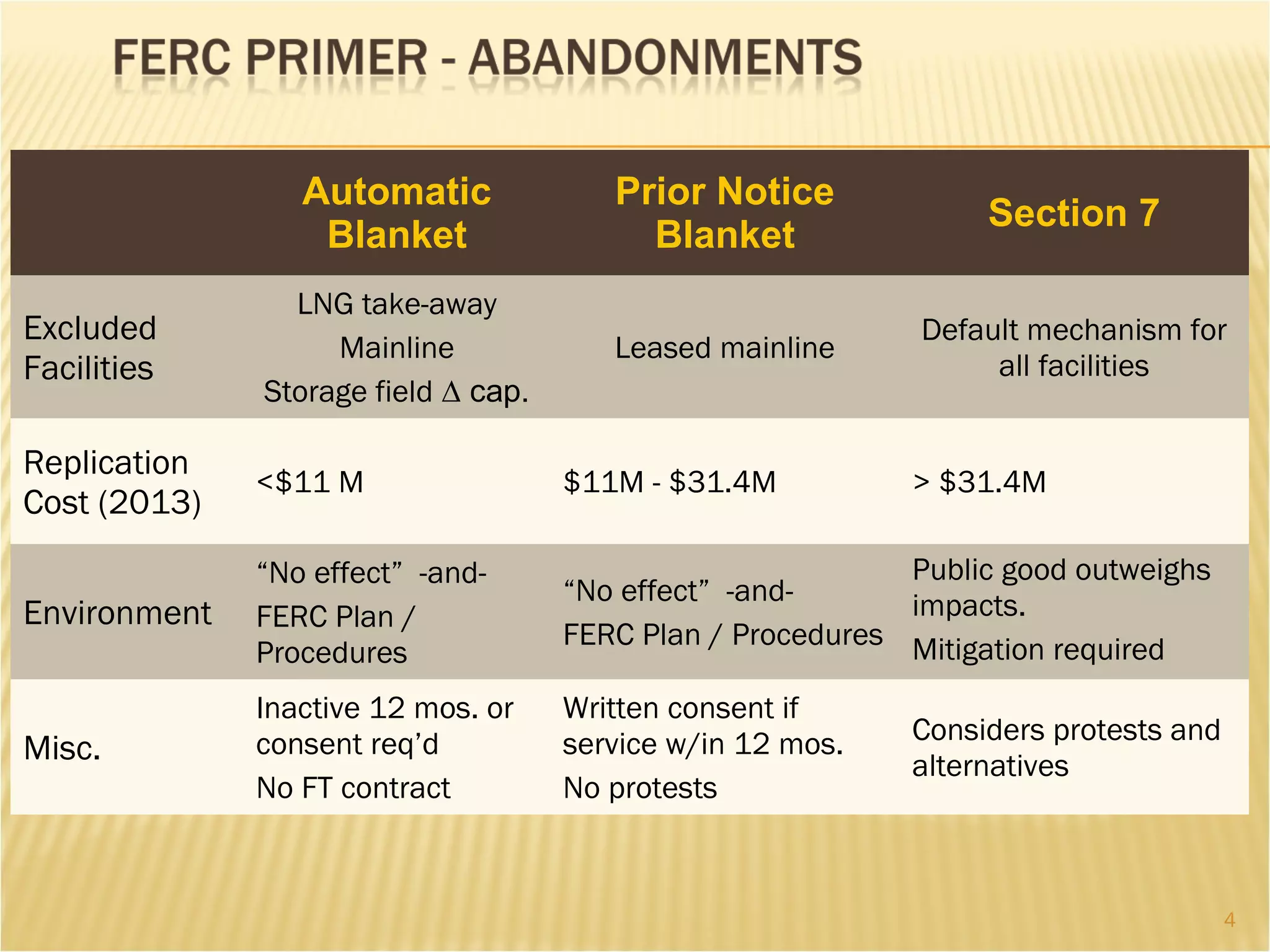
Automatic
Blanket
Prior Notice
Blanket
Section 7
Excluded
Facilities
LNG take-away
Mainline
Storage field ∆ cap.
Leased mainline
Default mechanism for
all facilities
Replication
Cost (2013)
<$11 M $11M - $31.4M > $31.4M
Environment
“No effect” -and-
FERC Plan /
Procedures
“No effect” -and-
FERC Plan / Procedures
Public good outweighs
impacts.
Mitigation required
Misc.
Inactive 12 mos. or
consent req’d
No FT contract
Written consent if
service w/in 12 mos.
No protests
Considers protests and
alternatives
Pipeline Issues Creative Responses
•“Death spiral” from rising O&M
costs and falling revenue
volumes
•Declining revenue throughput so
no incentive for FT. Majority of
volumes flow on IT at discount
•New supply sources strand pipe
segments and compression.
•Policies and regulations from
other agencies
•Spin-down / spin-off of assets to
form stand-alone regional
pipeline
•Conversion to transport liquids or
other energy forms
•Create gathering system for gas
supply from new basins (i.e.,
shale)
•Traditional sale to third party
with lower cost structure
5
6
7
Producers “free to the pool” or with deeply discounted rates
may have to negotiate contracts with new owner. If producers
not currently paying for transport of the affected gas, FERC
regulations do not give them much weight in the analysis.
When abandoning regional assets to new company, shippers
may now have multiple rates for single haul. If these are
IT/FT shippers, proposed new company needs to settle with
affected customers to avoid protests.
Offshore producers may argue that their production will be
stranded upon abandonment. Possible claim onshore as well,
but it is not as expensive to establish new outlet. FERC takes
this issue very seriously if the offshore platform is not dually
connected and no other pipelines are in the vicinity.
8
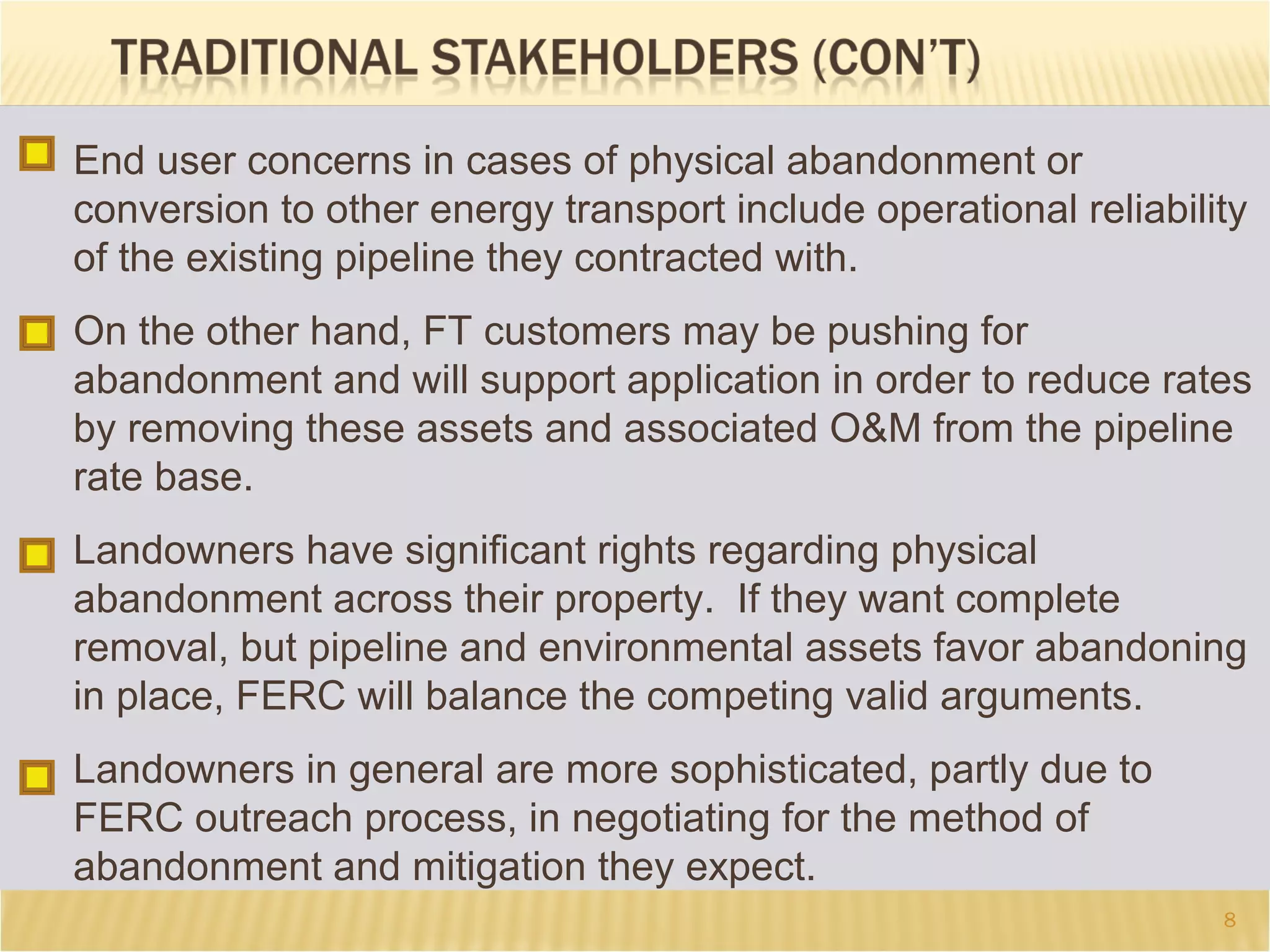
End user concerns in cases of physical abandonment or
conversion to other energy transport include operational reliability
of the existing pipeline they contracted with.
On the other hand, FT customers may be pushing for
abandonment and will support application in order to reduce rates
by removing these assets and associated O&M from the pipeline
rate base.
Landowners have significant rights regarding physical
abandonment across their property. If they want complete
removal, but pipeline and environmental assets favor abandoning
in place, FERC will balance the competing valid arguments.
Landowners in general are more sophisticated, partly due to
FERC outreach process, in negotiating for the method of
abandonment and mitigation they expect.
9
10
Environmental groups that were focused on E&P activities
now view the pipeline application process as a vehicle to
thwart further shale development, including protests against
gathering system designation.
State and federal agencies have become more involved in the
future obligations regarding disposal of pipeline assets.
The abandonment of pipelines in traditional producing basins
impact state and regional public policy, including issues such
as jobs, tax revenues, future site cleanup, and national energy
policy.
With aging infrastructure, and more stringent integrity and
testing requirements, there is increased pressure to
abandon interstate pipelines.
Pipeline companies will increase efforts to find creative
alternatives to traditional pipeline removal or abandonment
in place.
FERC regulations, and those of other agencies having over-
sight, will add to the complexity of the decision of when,
and how, to abandon pipeline assets.
11
INFRASTRUCTURE
HIGHWAY
Traditional Production
Flow
Shale Production Flow
N
S
12
 FERC Regulation of Natural Gas and Oil
 Converting Pipelines from Transporters of
Natural Gas to Transporters of Oil and
Petroleum Products…and Why Now?
 FERC’s Role in Such Conversions – Two Case
Studies (and info on a third)
 Challenges to Accomplishing Such Conversions
13
FERC Regulation of
Natural Gas and Oil
14
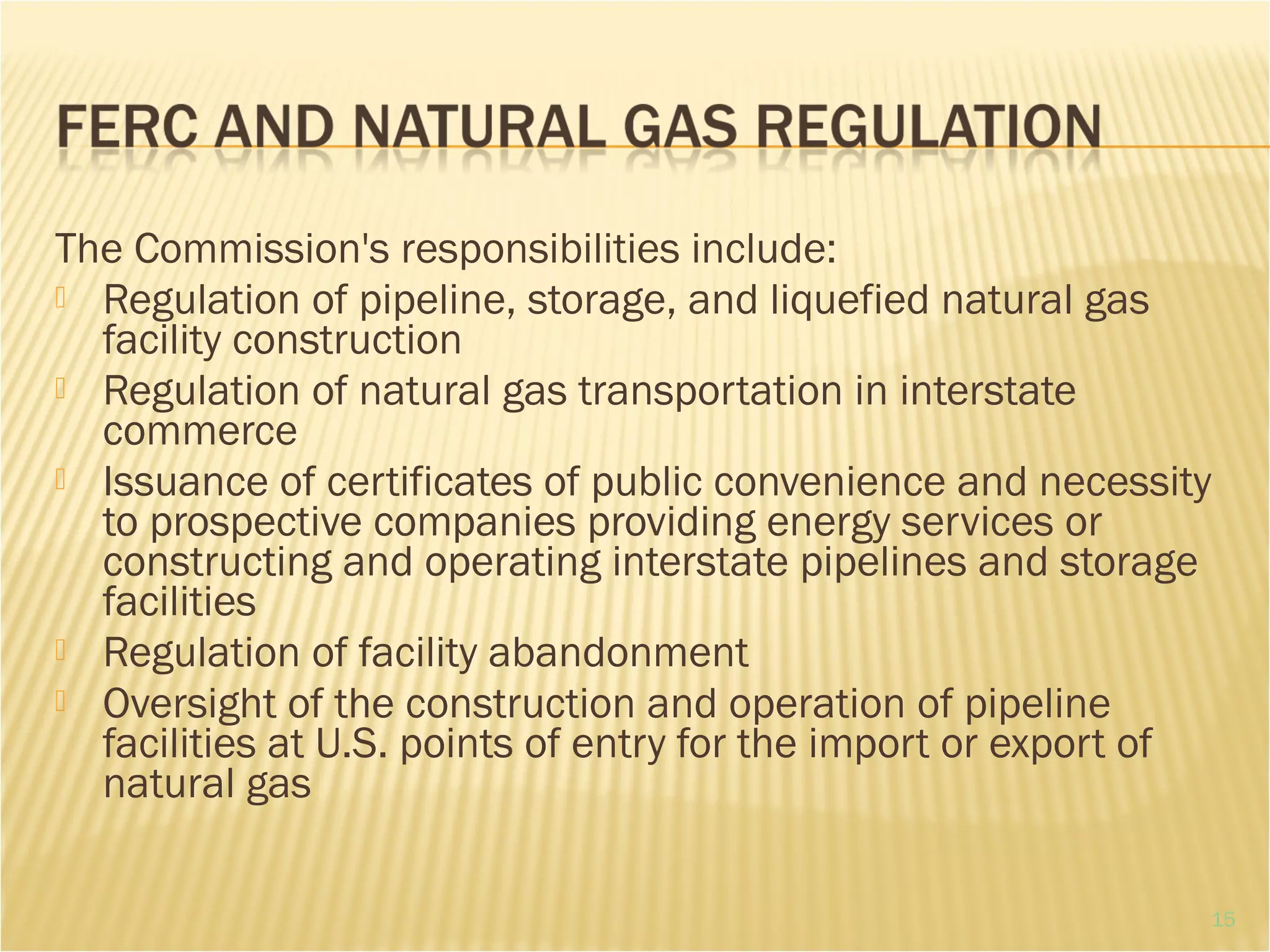
The Commission's responsibilities include:
 Regulation of pipeline, storage, and liquefied natural gas
facility construction
 Regulation of natural gas transportation in interstate
commerce
 Issuance of certificates of public convenience and necessity
to prospective companies providing energy services or
constructing and operating interstate pipelines and storage
facilities
 Regulation of facility abandonment
 Oversight of the construction and operation of pipeline
facilities at U.S. points of entry for the import or export of
natural gas
15
With respect to Natural Gas projects, FERC safeguards the environment
by: 
 Disclosing, analyzing and minimizing impacts where it is feasible and
reasonable to do so
 Encourage applicants to communicate with relevant federal and state
natural resources agencies, Indian tribes, and state water quality
agencies, prior to submitting an application
 Ensuring that all applicants perform the necessary studies to make an
informed decision on the project
 Issuing environmental assessments (EA) or draft and final
environmental impact statement (EIS) for comment on most projects
 Including requirements with any certificate issued to reduce
environmental impacts
 Visiting proposed project areas to determine the range of environmental
issues requiring analysis and holding scoping meetings as appropriate
16
The Commission's responsibilities include:
 Regulation of rates and practices of oil pipeline
companies engaged in interstate transportation;
 Establishment of equal service conditions to provide
shippers with equal access to pipeline transportation;
and
 Establishment of reasonable rates for transporting
petroleum and petroleum products by pipeline.*
FERC has no jurisdiction over construction or
maintenance of production wells, oil
pipelines, refineries, or storage facilities!!!
* See Declaratory Order (OR13-29) for jurisdictional discussion on Ethane
transportation. 17
Converting Pipelines from
Transporters of Natural Gas to
Transporters of Oil and Petroleum
Products…and Why Now?
18
Higher crude oil-to-natural gas ratio encourages drilling for oil in preference to
natural gas and makes natural gas liquids developments (e.g., ethane) relatively
more attractive than the development of dry natural gas resources.
19Source: http://www.eia.gov/todayinenergy/detail.cfm?id=5830
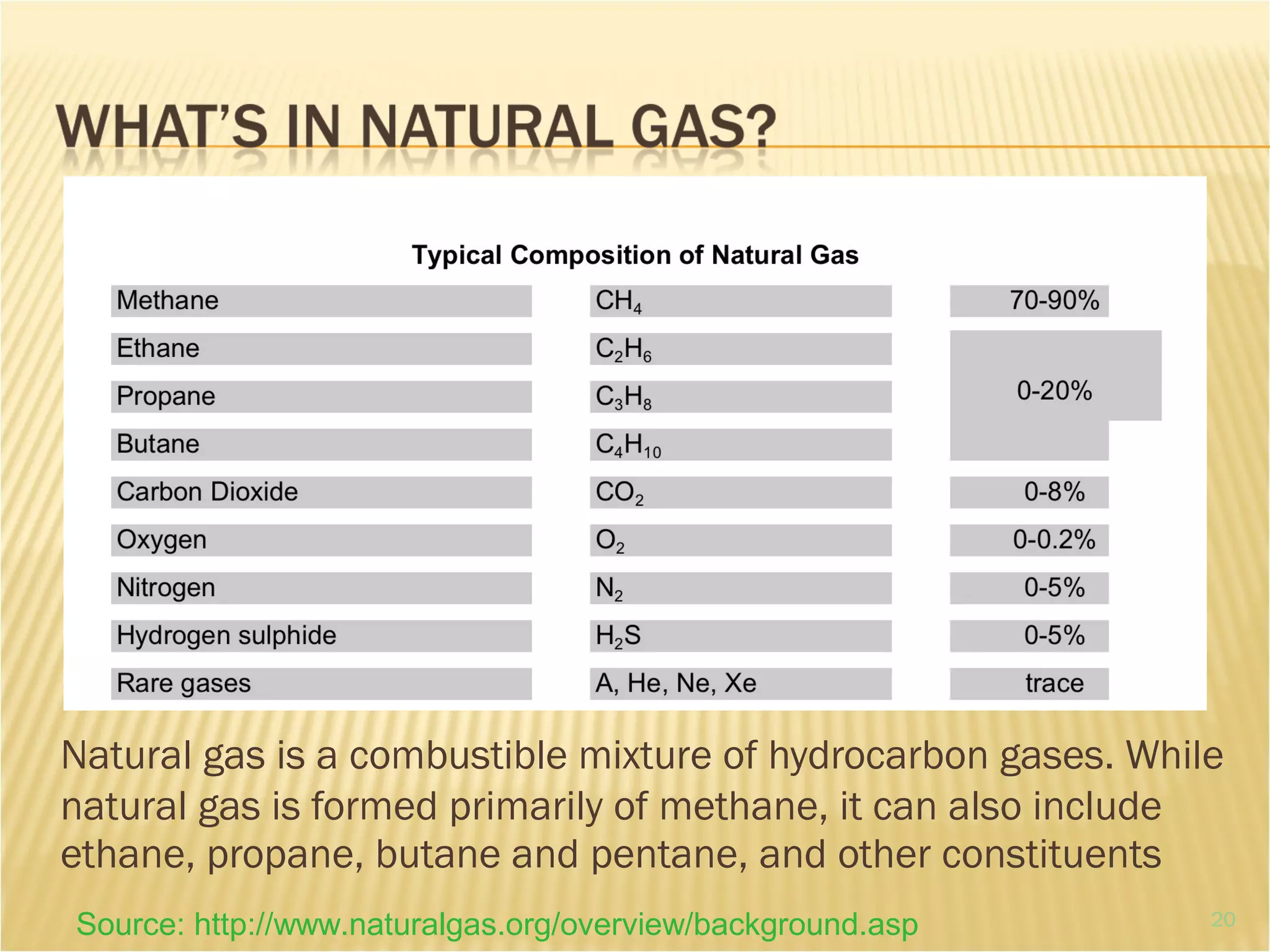
Natural gas is a combustible mixture of hydrocarbon gases. While
natural gas is formed primarily of methane, it can also include
ethane, propane, butane and pentane, and other constituents
Source: http://www.naturalgas.org/overview/background.asp 20
21
 Nearly half of the world’s ethylene will be
produced from ethane and liquefied petroleum
gas (LPG) by 2023, mostly at the expense of
naphtha.
 The feedstock shift is most dramatic in North
America, where prolific shale gas
production yields cheap ethane in the US and
is driving a petrochemical resurgence.
Source: http://www.hydrocarbonprocessing.com/Article/3257517/Ethane-LPG-
to-trump-naphtha-as-preferred-ethylene-feedstocks.html 22
The ethane can be removed from natural gas,
but for petrochemical uses it must first be
“cracked”, typically using steam…
 There are few crackers in and around the
Marcellus and Utica Shale Plays…
 There are many crackers in the Gulf Coast…
 There is unused / spare capacity on
traditional South-to-North long haul
pipelines…
Hence the gas-to-liquids pipeline conversions!
23
FERC’s Role in Such Conversions
24
25
Tallgrass was authorized to abandon approximately 432.4 miles of
mainline pipeline facilities for the purpose of re-converting the facilities
into crude oil pipeline facilities, and to construct and operate certain
replacement facilities in order to continue natural gas transportation
service to its existing firm customers.
To satisfy NEPA, FERC issued an EA (not an EIS) that addressed
geology, soils, water resources, wetlands, vegetation, fisheries, wildlife,
threatened and endangered species, land use, recreation, visual
resources, cultural resources, air quality, noise, safety, cumulative
impacts, and alternatives. In addition, section B.9 of the EA discussed
the cumulative impacts of the conversion to oil -- the construction of:
 260 miles of 24-inch-diameter pipeline (Cushing Lateral) from KS to OK
that would connect to Tallgrass (Pony Express) Pipeline from Lincoln
County, Kansas to Cushing, Oklahoma;
 16 span replacements and eight electric oil pump stations along the
existing Pony Express Pipeline segment;
 2 electric oil pump stations along the Cushing Lateral.
26
27
The abandonment by transfer of the 432.4 miles of PXP would have no
ground disturbance and is not addressed further. The abandonment
and/or modification of aboveground facilities would cause minimal
disturbance entirely within existing work areas or existing right-of-way.
Regarding the cumulative impacts of the Cushing Lateral…“[s]ince the
FERC does not regulate the sitting of oil pipelines, we do not have
detailed information concerning the environmental impacts of the
planned Cushing Lateral, other than what TIGT has provided, as
discussed above. The environmental review would be subject to the
regulations of the USACE and other applicable Kansas and Oklahoma
state permitting agencies. We conclude that the Project would represent
a negligible contribution to the overall cumulative impacts of the
combined oil transportation project discussed above."
Relevant Language from the EA:
28
Trunkline was authorized to abandon by sale to an affiliate
approximately 770 miles of mainline transmission pipeline and
appurtenant facilities for conversion to oil pipeline
transmission service, and to abandon in place certain
mainline compression facilities that it would no longer need
after the pipeline facilities are abandoned, while still
maintaining natural gas service to its firm customers.
To satisfy NEPA, FERC issued an EA (again, NOT an EIS)
that addressed geology, soils, water resources, wetlands,
vegetation, fisheries, wildlife, threatened and endangered
species, land use, recreation, visual resources, cultural
resources, air quality, noise, safety, cumulative impacts, and
alternatives.
29
Relevant Language from the EA:
“After the abandonment, Trunkline would no longer be responsible for
the facilities and the Commission will have no remaining jurisdiction.
Thus, the EA did not include a detailed analysis of the impacts that could
occur after the abandonment. However, the EA did provide available
information about the anticipated conversion and about potential
cumulative impacts associated with the construction of facilities to
support the proposed future use.”
and
“In the event that the abandoned pipeline is converted for use in oil
transportation, the relevant authorizing and permitting state and federal
agencies, including the U.S. Department of Transportation, are
responsible for addressing environmental and safety matters.”
30
31
From the application:
• Texas Gas sought authority to abandon approximately 623 miles of
natural gas pipeline segments from Eunice, Louisiana to Hardinsburg,
Kentucky and associated facilities.
• All of Texas Gas’s installed facilities south of Eunice and north of
Hardinsburg would remain in interstate natural gas transportation service.
FERC issued an Environmental Assessment
[emphasis added] on February 14, 2014, but
project was withdrawn on June 3, 2014…
• Following abandonment, Texas Gas would
continue to provide natural gas transportation service
on its remaining pipeline facilities.
• After receipt of abandonment authority, the
pipeline segments will be taken out of natural gas
service and repurposed for use in natural gas liquids
(“NGL”) service.
Challenges to Accomplishing Such
Conversions
32
As Noted Above:
FERC has no jurisdiction over construction or maintenance of
production wells, oil pipelines, refineries, or storage facilities
This means:
Products pipelines are “sited” on a State-by-State basis (if a
pipeline crosses 10 states, then 10 different siting agencies may
be involved)
This doesn’t mean:
Products Pipelines are exempt from other Federal agency
requirements, or requirements of State agencies administering
Federal requirements (i. e., CZMA, CWA, CAA, etc.)
33
 Natural Gas is transported by being compressed by large
reciprocating or turbine motors at compressor stations
 Compressor stations are sited along the length of a
pipeline based on flow engineering analysis of
transportation distances, transportation volumes and
operating & delivery pressures
 Liquids are “pumped” and pumping stations are sited
along the liquids pipeline based on hydraulic analysis
The locations of historic compressor station
sites may not align with the required pumping
station sites, leading to new, and possibly
significant, construction for gas-to-liquid
conversion projects!
34
 The trend to convert unused natural gas
pipelines to oil- and products-pipelines will
continue, owing to higher oil-to-gas prices, and
the market for NGLs
 FERC will continue to assert economic
jurisdiction on such pipelines
 FERC’s NEPA role in conversion projects will be
limited
 Project proponents for conversion projects will
still be subject to certain Federal and State
oversight
35
Contact Information:
Berne L. Mosley, President
Energy Projects Consulting, LLC
bernemosley@yahoo.com
FERC – Federal Energy Regulatory Commission;
the agency responsible for interstate and some
offshore transportation of natural gas, oil and
“oil products”
NGA – Natural Gas Act; law that gives natural
gas companies authority to construct & operate
(Sec 7(c)) and abandon (Sec 7(b)) interstate
natural gas facilities
DOT – Department of Transportation; regulatory
agency with safety authority over interstate gas
and oil facilities
BSEE – Bureau of Safety and Environmental
Enforcement; regulatory agency responsible for
safety, environment and conservation of
offshore oil and natural gas resources
Blanket Certificate Program – a subprogram
of a Section 7(c) application, comprising
“automatic” and “prior notice”
Blanket Certificate Program – a subprogram
of a Section 7(c) application, comprising
“automatic” and “prior notice”
FT – Firm Transportation; transportation
guaranteed at full contract level of service
IT – Interruptible Transportation; transportation
provided on an “as available basis” with no
level-of-service guarantees
MAOP – Maximum Allowable Operating Pressure;
the pressure, in PSI, at which a pipeline is
allowed to operate, based on the yield strength
of the steel and DOT requirements
EFM – Electronic Flow Meters; meters that
measure the amount of gas flowing through a
pipe

New Developments in the Natural Gas Industry

  • 1.
    Pipeline Abandonments andConversionsPipeline Abandonments and Conversions 2014 FEPA Summer Symposium2014 FEPA Summer Symposium July 24, 2014July 24, 2014 Berne L. Mosley, Energy Projects Consulting, LLCBerne L. Mosley, Energy Projects Consulting, LLC
  • 2.
    Complete Partial •Remove facilities •Isolateand abandon in place •Capacity lease •Sell •Downrate (pipeline MAOP or turbine hp for example) •Downsize (smaller diameter) •Limit service schedule 2 Personal Rule of Thumb: Action taken to temporarily inactivate a facility which can be reversed in a short period of time to restore service upon demand and with little/no ground disturbed is not abandonment. Examples: closing and locking valves or removing EFM equipment from meters
  • 3.
    3 FERC Regulatory approval followed by physical disconnection BSEE 90days of no flow if no SOP approved DOT Purge hydrocarbons STATE PERMITS (i.e., Louisiana ) Inactive 12 months Unintended Abandonment?
  • 4.
    4 Automatic Blanket Prior Notice Blanket Section 7 Excluded Facilities LNGtake-away Mainline Storage field ∆ cap. Leased mainline Default mechanism for all facilities Replication Cost (2013) <$11 M $11M - $31.4M > $31.4M Environment “No effect” -and- FERC Plan / Procedures “No effect” -and- FERC Plan / Procedures Public good outweighs impacts. Mitigation required Misc. Inactive 12 mos. or consent req’d No FT contract Written consent if service w/in 12 mos. No protests Considers protests and alternatives
  • 5.
    Pipeline Issues CreativeResponses •“Death spiral” from rising O&M costs and falling revenue volumes •Declining revenue throughput so no incentive for FT. Majority of volumes flow on IT at discount •New supply sources strand pipe segments and compression. •Policies and regulations from other agencies •Spin-down / spin-off of assets to form stand-alone regional pipeline •Conversion to transport liquids or other energy forms •Create gathering system for gas supply from new basins (i.e., shale) •Traditional sale to third party with lower cost structure 5
  • 6.
  • 7.
    7 Producers “free tothe pool” or with deeply discounted rates may have to negotiate contracts with new owner. If producers not currently paying for transport of the affected gas, FERC regulations do not give them much weight in the analysis. When abandoning regional assets to new company, shippers may now have multiple rates for single haul. If these are IT/FT shippers, proposed new company needs to settle with affected customers to avoid protests. Offshore producers may argue that their production will be stranded upon abandonment. Possible claim onshore as well, but it is not as expensive to establish new outlet. FERC takes this issue very seriously if the offshore platform is not dually connected and no other pipelines are in the vicinity.
  • 8.
    8 End user concernsin cases of physical abandonment or conversion to other energy transport include operational reliability of the existing pipeline they contracted with. On the other hand, FT customers may be pushing for abandonment and will support application in order to reduce rates by removing these assets and associated O&M from the pipeline rate base. Landowners have significant rights regarding physical abandonment across their property. If they want complete removal, but pipeline and environmental assets favor abandoning in place, FERC will balance the competing valid arguments. Landowners in general are more sophisticated, partly due to FERC outreach process, in negotiating for the method of abandonment and mitigation they expect.
  • 9.
  • 10.
    10 Environmental groups thatwere focused on E&P activities now view the pipeline application process as a vehicle to thwart further shale development, including protests against gathering system designation. State and federal agencies have become more involved in the future obligations regarding disposal of pipeline assets. The abandonment of pipelines in traditional producing basins impact state and regional public policy, including issues such as jobs, tax revenues, future site cleanup, and national energy policy.
  • 11.
    With aging infrastructure,and more stringent integrity and testing requirements, there is increased pressure to abandon interstate pipelines. Pipeline companies will increase efforts to find creative alternatives to traditional pipeline removal or abandonment in place. FERC regulations, and those of other agencies having over- sight, will add to the complexity of the decision of when, and how, to abandon pipeline assets. 11
  • 12.
  • 13.
     FERC Regulationof Natural Gas and Oil  Converting Pipelines from Transporters of Natural Gas to Transporters of Oil and Petroleum Products…and Why Now?  FERC’s Role in Such Conversions – Two Case Studies (and info on a third)  Challenges to Accomplishing Such Conversions 13
  • 14.
  • 15.
    The Commission's responsibilitiesinclude:  Regulation of pipeline, storage, and liquefied natural gas facility construction  Regulation of natural gas transportation in interstate commerce  Issuance of certificates of public convenience and necessity to prospective companies providing energy services or constructing and operating interstate pipelines and storage facilities  Regulation of facility abandonment  Oversight of the construction and operation of pipeline facilities at U.S. points of entry for the import or export of natural gas 15
  • 16.
    With respect toNatural Gas projects, FERC safeguards the environment by:   Disclosing, analyzing and minimizing impacts where it is feasible and reasonable to do so  Encourage applicants to communicate with relevant federal and state natural resources agencies, Indian tribes, and state water quality agencies, prior to submitting an application  Ensuring that all applicants perform the necessary studies to make an informed decision on the project  Issuing environmental assessments (EA) or draft and final environmental impact statement (EIS) for comment on most projects  Including requirements with any certificate issued to reduce environmental impacts  Visiting proposed project areas to determine the range of environmental issues requiring analysis and holding scoping meetings as appropriate 16
  • 17.
    The Commission's responsibilitiesinclude:  Regulation of rates and practices of oil pipeline companies engaged in interstate transportation;  Establishment of equal service conditions to provide shippers with equal access to pipeline transportation; and  Establishment of reasonable rates for transporting petroleum and petroleum products by pipeline.* FERC has no jurisdiction over construction or maintenance of production wells, oil pipelines, refineries, or storage facilities!!! * See Declaratory Order (OR13-29) for jurisdictional discussion on Ethane transportation. 17
  • 18.
    Converting Pipelines from Transportersof Natural Gas to Transporters of Oil and Petroleum Products…and Why Now? 18
  • 19.
    Higher crude oil-to-naturalgas ratio encourages drilling for oil in preference to natural gas and makes natural gas liquids developments (e.g., ethane) relatively more attractive than the development of dry natural gas resources. 19Source: http://www.eia.gov/todayinenergy/detail.cfm?id=5830
  • 20.
    Natural gas isa combustible mixture of hydrocarbon gases. While natural gas is formed primarily of methane, it can also include ethane, propane, butane and pentane, and other constituents Source: http://www.naturalgas.org/overview/background.asp 20
  • 21.
  • 22.
     Nearly half ofthe world’s ethylene will be produced from ethane and liquefied petroleum gas (LPG) by 2023, mostly at the expense of naphtha.  The feedstock shift is most dramatic in North America, where prolific shale gas production yields cheap ethane in the US and is driving a petrochemical resurgence. Source: http://www.hydrocarbonprocessing.com/Article/3257517/Ethane-LPG- to-trump-naphtha-as-preferred-ethylene-feedstocks.html 22
  • 23.
    The ethane canbe removed from natural gas, but for petrochemical uses it must first be “cracked”, typically using steam…  There are few crackers in and around the Marcellus and Utica Shale Plays…  There are many crackers in the Gulf Coast…  There is unused / spare capacity on traditional South-to-North long haul pipelines… Hence the gas-to-liquids pipeline conversions! 23
  • 24.
    FERC’s Role inSuch Conversions 24
  • 25.
  • 26.
    Tallgrass was authorizedto abandon approximately 432.4 miles of mainline pipeline facilities for the purpose of re-converting the facilities into crude oil pipeline facilities, and to construct and operate certain replacement facilities in order to continue natural gas transportation service to its existing firm customers. To satisfy NEPA, FERC issued an EA (not an EIS) that addressed geology, soils, water resources, wetlands, vegetation, fisheries, wildlife, threatened and endangered species, land use, recreation, visual resources, cultural resources, air quality, noise, safety, cumulative impacts, and alternatives. In addition, section B.9 of the EA discussed the cumulative impacts of the conversion to oil -- the construction of:  260 miles of 24-inch-diameter pipeline (Cushing Lateral) from KS to OK that would connect to Tallgrass (Pony Express) Pipeline from Lincoln County, Kansas to Cushing, Oklahoma;  16 span replacements and eight electric oil pump stations along the existing Pony Express Pipeline segment;  2 electric oil pump stations along the Cushing Lateral. 26
  • 27.
    27 The abandonment bytransfer of the 432.4 miles of PXP would have no ground disturbance and is not addressed further. The abandonment and/or modification of aboveground facilities would cause minimal disturbance entirely within existing work areas or existing right-of-way. Regarding the cumulative impacts of the Cushing Lateral…“[s]ince the FERC does not regulate the sitting of oil pipelines, we do not have detailed information concerning the environmental impacts of the planned Cushing Lateral, other than what TIGT has provided, as discussed above. The environmental review would be subject to the regulations of the USACE and other applicable Kansas and Oklahoma state permitting agencies. We conclude that the Project would represent a negligible contribution to the overall cumulative impacts of the combined oil transportation project discussed above." Relevant Language from the EA:
  • 28.
  • 29.
    Trunkline was authorizedto abandon by sale to an affiliate approximately 770 miles of mainline transmission pipeline and appurtenant facilities for conversion to oil pipeline transmission service, and to abandon in place certain mainline compression facilities that it would no longer need after the pipeline facilities are abandoned, while still maintaining natural gas service to its firm customers. To satisfy NEPA, FERC issued an EA (again, NOT an EIS) that addressed geology, soils, water resources, wetlands, vegetation, fisheries, wildlife, threatened and endangered species, land use, recreation, visual resources, cultural resources, air quality, noise, safety, cumulative impacts, and alternatives. 29
  • 30.
    Relevant Language fromthe EA: “After the abandonment, Trunkline would no longer be responsible for the facilities and the Commission will have no remaining jurisdiction. Thus, the EA did not include a detailed analysis of the impacts that could occur after the abandonment. However, the EA did provide available information about the anticipated conversion and about potential cumulative impacts associated with the construction of facilities to support the proposed future use.” and “In the event that the abandoned pipeline is converted for use in oil transportation, the relevant authorizing and permitting state and federal agencies, including the U.S. Department of Transportation, are responsible for addressing environmental and safety matters.” 30
  • 31.
    31 From the application: •Texas Gas sought authority to abandon approximately 623 miles of natural gas pipeline segments from Eunice, Louisiana to Hardinsburg, Kentucky and associated facilities. • All of Texas Gas’s installed facilities south of Eunice and north of Hardinsburg would remain in interstate natural gas transportation service. FERC issued an Environmental Assessment [emphasis added] on February 14, 2014, but project was withdrawn on June 3, 2014… • Following abandonment, Texas Gas would continue to provide natural gas transportation service on its remaining pipeline facilities. • After receipt of abandonment authority, the pipeline segments will be taken out of natural gas service and repurposed for use in natural gas liquids (“NGL”) service.
  • 32.
    Challenges to AccomplishingSuch Conversions 32
  • 33.
    As Noted Above: FERChas no jurisdiction over construction or maintenance of production wells, oil pipelines, refineries, or storage facilities This means: Products pipelines are “sited” on a State-by-State basis (if a pipeline crosses 10 states, then 10 different siting agencies may be involved) This doesn’t mean: Products Pipelines are exempt from other Federal agency requirements, or requirements of State agencies administering Federal requirements (i. e., CZMA, CWA, CAA, etc.) 33
  • 34.
     Natural Gasis transported by being compressed by large reciprocating or turbine motors at compressor stations  Compressor stations are sited along the length of a pipeline based on flow engineering analysis of transportation distances, transportation volumes and operating & delivery pressures  Liquids are “pumped” and pumping stations are sited along the liquids pipeline based on hydraulic analysis The locations of historic compressor station sites may not align with the required pumping station sites, leading to new, and possibly significant, construction for gas-to-liquid conversion projects! 34
  • 35.
     The trendto convert unused natural gas pipelines to oil- and products-pipelines will continue, owing to higher oil-to-gas prices, and the market for NGLs  FERC will continue to assert economic jurisdiction on such pipelines  FERC’s NEPA role in conversion projects will be limited  Project proponents for conversion projects will still be subject to certain Federal and State oversight 35
  • 36.
    Contact Information: Berne L.Mosley, President Energy Projects Consulting, LLC bernemosley@yahoo.com
  • 37.
    FERC – FederalEnergy Regulatory Commission; the agency responsible for interstate and some offshore transportation of natural gas, oil and “oil products” NGA – Natural Gas Act; law that gives natural gas companies authority to construct & operate (Sec 7(c)) and abandon (Sec 7(b)) interstate natural gas facilities DOT – Department of Transportation; regulatory agency with safety authority over interstate gas and oil facilities
  • 38.
    BSEE – Bureauof Safety and Environmental Enforcement; regulatory agency responsible for safety, environment and conservation of offshore oil and natural gas resources Blanket Certificate Program – a subprogram of a Section 7(c) application, comprising “automatic” and “prior notice”
  • 39.
    Blanket Certificate Program– a subprogram of a Section 7(c) application, comprising “automatic” and “prior notice” FT – Firm Transportation; transportation guaranteed at full contract level of service IT – Interruptible Transportation; transportation provided on an “as available basis” with no level-of-service guarantees
  • 40.
    MAOP – MaximumAllowable Operating Pressure; the pressure, in PSI, at which a pipeline is allowed to operate, based on the yield strength of the steel and DOT requirements EFM – Electronic Flow Meters; meters that measure the amount of gas flowing through a pipe