ALCOHOLSahar mafi
Msc.clinical biochemistry
teacher: professor.HB sadeghi
yasuj university of medical science
Index
1. Introduction
2. Injuries
3. Effect of alcohol on others
4. Global Consumption Statistics
5. Beneficial effect
6. Biochemical effect of ethanol
7. Alcohol effect on :
• GIT
• CNT
• NT
• BLOOD
• IMMUNOSYSTEM
• CVS
• Reproduction
• SEX HORMONE
• DEPRESSION
• KIDNEY
Why is this issue important?
• For years, alcohol has been a part
of social gatherings, celebrations, and
rituals.
• Addiction to alcohol is more of a
problem today than it has ever been in
the Past.
People drink alcohol to…
Feel more relaxed
Look cool
Forget problems
Join the party
Become intoxicated
etc…
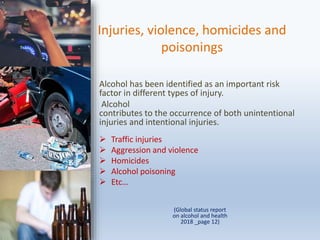
Injuries, violence, homicides and
poisonings
Alcohol has been identified as an important risk
factor in different types of injury.
Alcohol
contributes to the occurrence of both unintentional
injuries and intentional injuries.
 Traffic injuries
 Aggression and violence
 Homicides
 Alcohol poisoning
 Etc…
(Global status report
on alcohol and health
2018 _page 12)
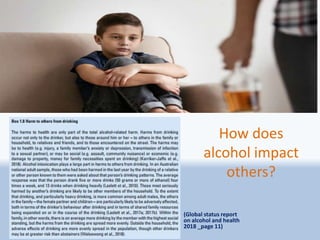
How does
alcohol impact
others?
(Global status report
on alcohol and health
2018 _page 11)
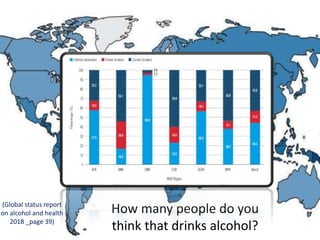
How many people do you
think that drinks alcohol?
(Global status report
on alcohol and health
2018 _page 39)
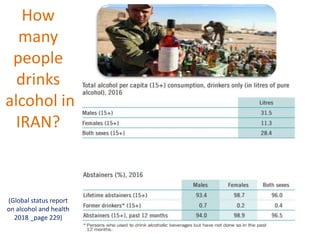
How
many
people
drinks
alcohol in
IRAN?
(Global status report
on alcohol and health
2018 _page 229)
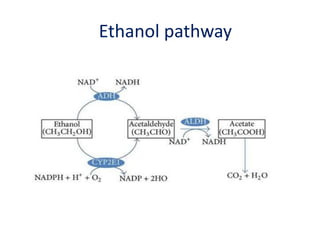
Ethanol pathway
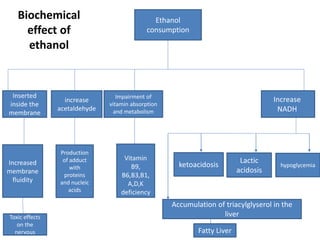
Ethanol
consumption
Increase
NADH
Impairment of
vitamin absorption
and metabolism
increase
acetaldehyde
Inserted
inside the
membrane
Vitamin
B9,
B6,B3,B1,
A,D,K
deficiency
Production
of adduct
with
proteins
and nucleic
acids
Increased
membrane
fluidity
hypoglycemia
Lactic
acidosis
ketoacidosis
Accumulation of triacylglyserol in the
liver
Fatty Liver
Toxic effects
on the
nervous
Biochemical
effect of
ethanol
Beneficial effect
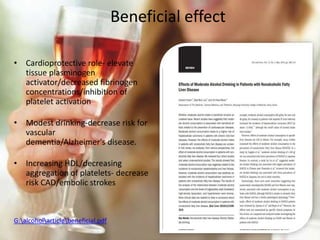
• Cardioprotective role- elevate
tissue plasminogen
activator/decreased fibrinogen
concentrations/inhibition of
platelet activation
• Modest drinking-decrease risk for
vascular
dementia/Alzheimer's disease.
• Increasing HDL/decreasing
aggregation of platelets- decrease
risk CAD/embolic strokes
G:alcoholarticlebeneficial.pdf
The Effects of Ethanol on GIT
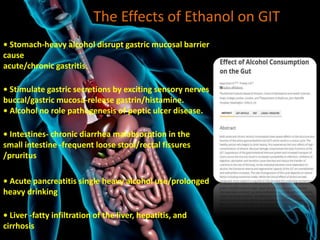
• Stomach-heavy alcohol disrupt gastric mucosal barrier
cause
acute/chronic gastritis.
• Stimulate gastric secretions by exciting sensory nerves
buccal/gastric mucosa-release gastrin/histamine.
• Alcohol no role pathogenesis of peptic ulcer disease.
• Intestines- chronic diarrhea malabsorption in the
small intestine -frequent loose stool/rectal fissures
/pruritus
• Acute pancreatitis single heavy alcohol use/prolonged
heavy drinking
• Liver -fatty infiltration of the liver, hepatitis, and
cirrhosis
The Effects of Ethanol on CNS
• Ethanol primarily CNS depressant-moderate amounts effect like
barbiturates/benzodiazepines,severe intoxication-general
anesthesia
• Chronic alcohol abuse-loss of both white/gray matter -
particularly frontal lobes, extent of damage- amount/duration/
older alcoholics
• Ethanol neurotoxic,loss of brain tissue,reduces brain metabolism/
increased metabolism during detoxification/malnutrition/ vitamin
deficiencies
G:alcoholarticlefl
amm1977.pdf
• Activity anticonvulsant/sleep-inducing/antianxiety/muscle relaxation
• tremors/seizures.
• hallucinations/delirium/ fever/tachycardia/can be fatal
• Acutely increases dopamine level /related brain regionscontinued alcohol
use/craving/relapse.
• During intoxication dopamine pathways changes-increases stress
• hormones feelings of reward / withdrawal –depression
• Changes opioid receptors release of beta endorphins.
• Also affect serotonin,nicotinic acetylcholine systems,cannabinol receptors
G:alcoholarticleneurotensinergic system.pdf
Hematological
• Microcytic anemia-chronic blood loss /iron deficiency.
• Macrocytic anemias may occur in the absence of vitamin
deficiencies.
• Normochromic anemias
• Morphological changes-development of burr cells,
schistocytes, and ringed sideroblasts.
Immunological
• Leukopenia/alteration of lymphocyte subsets/decreased
T-cell mitogenesis/changes in immunoglobulin production.
• Depressed leukocyte migration into inflamed areas may
account in part for the poor resistance to Klebsiella
pneumonia/listeriosis/tuberculosis.
• Alcohol consumption alter distribution/function of
lymphoid
cells by disrupting cytokine regulation
• Alcohol appears to play a role in the development of
infection HIV suppress CD4 T-lymphocyte
function/replication of HIV.
G:alcoholarticleimmunological.pdf
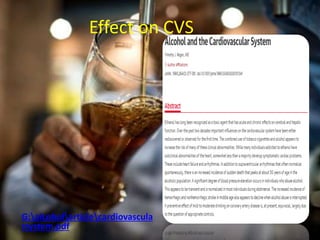
Effect on CVS
G:alcoholarticlecardiovascula
rsystem.pdf
Effect on CVS
• Hypertension-heavy alcohol use can raise diastolic/systolic blood pressure
• Hypotheses- direct pressor effect unknown
mechanism/increased intracellular Ca2+ levels
• Stroke-increased incidence of hemorrhagic
• Many stroke follow prolonged binge drinking in younger patients.
• Effects on hemostasis/fibrinolysis/blood clotting could
prevent-precipitate acute stroke
• The effects of alcohol on the formation of intracranial
aneurysms are controversial
• Skeletal Muscle -decreased muscle strength,increased
CK/decreased glycogen store
Reproduction
• Modest ethanol doses decrease erectile
capacity/testicular
atrophy with shrinkage of the seminiferous
tubules/decreases in ejaculate volume/lower sperm count
• Women can result in amenorrhea/decrease ovarian
size/absence of corpora lutea with associated
infertility/increased risk of spontaneous abortion
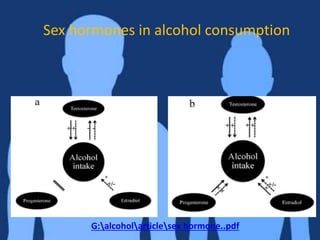
Sex hormones in alcohol consumption
G:alcoholarticlesex hormone..pdf
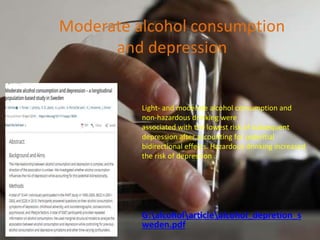
Moderate alcohol consumption
and depression
G:alcoholarticlealcohol_depretion_s
weden.pdf
Light- and moderate alcohol consumption and
non-hazardous drinking were
associated with the lowest risk of subsequent
depression after accounting for potential
bidirectional effects. Hazardous drinking increased
the risk of depression .
Alcohol and chronic kidney disease
G:alcoholarticlehu2019.pdf G:alcoholarticleoffspring
renal.pdf
‫ما‬ّ‫ن‬‫ا‬‫عمل‬ ‫من‬ ‫رجس‬ ‫االزالم‬ ‫و‬ ‫االنصاب‬ ‫و‬ ‫المیسر‬ ‫و‬ ‫الخمر‬
‫لعلکم‬ ‫فاجتنبوه‬ ‫الشیطان‬‫تفلحون‬
(‫مائده‬/‫آیه‬90)
«ً‫ا‬‫حقیقت‬‫سنگ‬ ‫یا‬ ‫و‬ ‫پرستى‬ ‫بت‬ ‫و‬ ‫قمار‬ ‫انواع‬ ‫و‬ ‫شراب‬
‫قرعه‬ ‫هاى‬ ‫چوبه‬ ‫و‬ ‫شده‬ ‫نصب‬ ‫قربانى‬ ‫براى‬ ‫که‬ ‫هایى‬
(‫غیبى‬ ‫امور‬ ‫کشف‬ ‫براى‬)‫شیطان‬ ‫کارهاى‬ ‫از‬ ‫پلیدى‬ ،
‫شوید‬ ‫رستگار‬ ‫شاید‬ ،‫گزینید‬ ‫دورى‬ ‫آن‬ ‫از‬ ،‫است‬.»
Thank you for your
attention

Alcohol

  • 1.
    ALCOHOLSahar mafi Msc.clinical biochemistry teacher:professor.HB sadeghi yasuj university of medical science
  • 2.
    Index 1. Introduction 2. Injuries 3.Effect of alcohol on others 4. Global Consumption Statistics 5. Beneficial effect 6. Biochemical effect of ethanol 7. Alcohol effect on : • GIT • CNT • NT • BLOOD • IMMUNOSYSTEM • CVS • Reproduction • SEX HORMONE • DEPRESSION • KIDNEY
  • 3.
    Why is thisissue important? • For years, alcohol has been a part of social gatherings, celebrations, and rituals. • Addiction to alcohol is more of a problem today than it has ever been in the Past.
  • 4.
    People drink alcoholto… Feel more relaxed Look cool Forget problems Join the party Become intoxicated etc…
  • 5.
    Injuries, violence, homicidesand poisonings Alcohol has been identified as an important risk factor in different types of injury. Alcohol contributes to the occurrence of both unintentional injuries and intentional injuries.  Traffic injuries  Aggression and violence  Homicides  Alcohol poisoning  Etc… (Global status report on alcohol and health 2018 _page 12)
  • 6.
    How does alcohol impact others? (Globalstatus report on alcohol and health 2018 _page 11)
  • 7.
    How many peopledo you think that drinks alcohol? (Global status report on alcohol and health 2018 _page 39)
  • 8.
    How many people drinks alcohol in IRAN? (Global statusreport on alcohol and health 2018 _page 229)
  • 9.
  • 10.
    Ethanol consumption Increase NADH Impairment of vitamin absorption andmetabolism increase acetaldehyde Inserted inside the membrane Vitamin B9, B6,B3,B1, A,D,K deficiency Production of adduct with proteins and nucleic acids Increased membrane fluidity hypoglycemia Lactic acidosis ketoacidosis Accumulation of triacylglyserol in the liver Fatty Liver Toxic effects on the nervous Biochemical effect of ethanol
  • 11.
    Beneficial effect • Cardioprotectiverole- elevate tissue plasminogen activator/decreased fibrinogen concentrations/inhibition of platelet activation • Modest drinking-decrease risk for vascular dementia/Alzheimer's disease. • Increasing HDL/decreasing aggregation of platelets- decrease risk CAD/embolic strokes G:alcoholarticlebeneficial.pdf
  • 12.
    The Effects ofEthanol on GIT • Stomach-heavy alcohol disrupt gastric mucosal barrier cause acute/chronic gastritis. • Stimulate gastric secretions by exciting sensory nerves buccal/gastric mucosa-release gastrin/histamine. • Alcohol no role pathogenesis of peptic ulcer disease. • Intestines- chronic diarrhea malabsorption in the small intestine -frequent loose stool/rectal fissures /pruritus • Acute pancreatitis single heavy alcohol use/prolonged heavy drinking • Liver -fatty infiltration of the liver, hepatitis, and cirrhosis
  • 13.
    The Effects ofEthanol on CNS • Ethanol primarily CNS depressant-moderate amounts effect like barbiturates/benzodiazepines,severe intoxication-general anesthesia • Chronic alcohol abuse-loss of both white/gray matter - particularly frontal lobes, extent of damage- amount/duration/ older alcoholics • Ethanol neurotoxic,loss of brain tissue,reduces brain metabolism/ increased metabolism during detoxification/malnutrition/ vitamin deficiencies G:alcoholarticlefl amm1977.pdf
  • 14.
    • Activity anticonvulsant/sleep-inducing/antianxiety/musclerelaxation • tremors/seizures. • hallucinations/delirium/ fever/tachycardia/can be fatal • Acutely increases dopamine level /related brain regionscontinued alcohol use/craving/relapse. • During intoxication dopamine pathways changes-increases stress • hormones feelings of reward / withdrawal –depression • Changes opioid receptors release of beta endorphins. • Also affect serotonin,nicotinic acetylcholine systems,cannabinol receptors G:alcoholarticleneurotensinergic system.pdf
  • 15.
    Hematological • Microcytic anemia-chronicblood loss /iron deficiency. • Macrocytic anemias may occur in the absence of vitamin deficiencies. • Normochromic anemias • Morphological changes-development of burr cells, schistocytes, and ringed sideroblasts.
  • 16.
    Immunological • Leukopenia/alteration oflymphocyte subsets/decreased T-cell mitogenesis/changes in immunoglobulin production. • Depressed leukocyte migration into inflamed areas may account in part for the poor resistance to Klebsiella pneumonia/listeriosis/tuberculosis. • Alcohol consumption alter distribution/function of lymphoid cells by disrupting cytokine regulation • Alcohol appears to play a role in the development of infection HIV suppress CD4 T-lymphocyte function/replication of HIV. G:alcoholarticleimmunological.pdf
  • 17.
  • 18.
    Effect on CVS •Hypertension-heavy alcohol use can raise diastolic/systolic blood pressure • Hypotheses- direct pressor effect unknown mechanism/increased intracellular Ca2+ levels • Stroke-increased incidence of hemorrhagic • Many stroke follow prolonged binge drinking in younger patients. • Effects on hemostasis/fibrinolysis/blood clotting could prevent-precipitate acute stroke • The effects of alcohol on the formation of intracranial aneurysms are controversial • Skeletal Muscle -decreased muscle strength,increased CK/decreased glycogen store
  • 19.
    Reproduction • Modest ethanoldoses decrease erectile capacity/testicular atrophy with shrinkage of the seminiferous tubules/decreases in ejaculate volume/lower sperm count • Women can result in amenorrhea/decrease ovarian size/absence of corpora lutea with associated infertility/increased risk of spontaneous abortion
  • 20.
    Sex hormones inalcohol consumption G:alcoholarticlesex hormone..pdf
  • 21.
    Moderate alcohol consumption anddepression G:alcoholarticlealcohol_depretion_s weden.pdf Light- and moderate alcohol consumption and non-hazardous drinking were associated with the lowest risk of subsequent depression after accounting for potential bidirectional effects. Hazardous drinking increased the risk of depression .
  • 22.
    Alcohol and chronickidney disease G:alcoholarticlehu2019.pdf G:alcoholarticleoffspring renal.pdf
  • 23.
    ‫ما‬ّ‫ن‬‫ا‬‫عمل‬ ‫من‬ ‫رجس‬‫االزالم‬ ‫و‬ ‫االنصاب‬ ‫و‬ ‫المیسر‬ ‫و‬ ‫الخمر‬ ‫لعلکم‬ ‫فاجتنبوه‬ ‫الشیطان‬‫تفلحون‬ (‫مائده‬/‫آیه‬90) «ً‫ا‬‫حقیقت‬‫سنگ‬ ‫یا‬ ‫و‬ ‫پرستى‬ ‫بت‬ ‫و‬ ‫قمار‬ ‫انواع‬ ‫و‬ ‫شراب‬ ‫قرعه‬ ‫هاى‬ ‫چوبه‬ ‫و‬ ‫شده‬ ‫نصب‬ ‫قربانى‬ ‫براى‬ ‫که‬ ‫هایى‬ (‫غیبى‬ ‫امور‬ ‫کشف‬ ‫براى‬)‫شیطان‬ ‫کارهاى‬ ‫از‬ ‫پلیدى‬ ، ‫شوید‬ ‫رستگار‬ ‫شاید‬ ،‫گزینید‬ ‫دورى‬ ‫آن‬ ‫از‬ ،‫است‬.»
  • 24.
    Thank you foryour attention