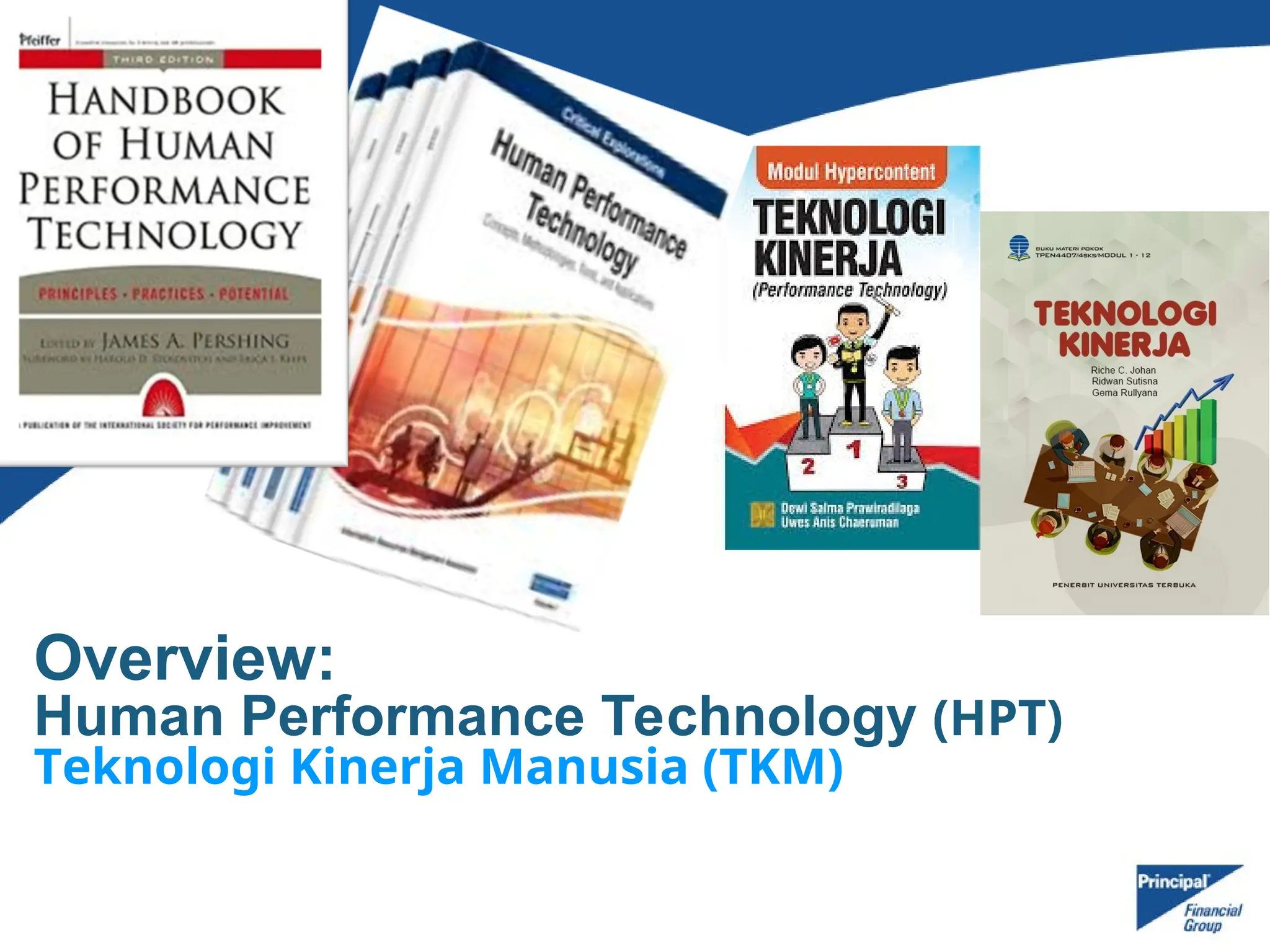
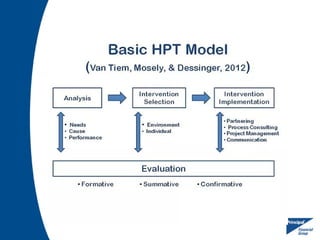
Overview:
Human Performance Technology (HPT)
Teknologi Kinerja Manusia (TKM)
Why we study of Human Performance
Technology…
The definition of Educational Technology
is the study and ethical practice of
facilitating learning and improving
performance by creating, using, and
managing appropriate technological
processes and resources.
(The AECT Standards 2012)
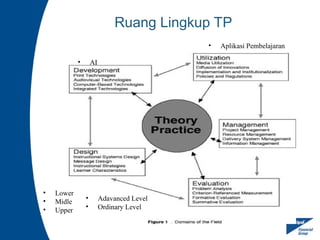
Ruang Lingkup TP
• Lower
• Midle
• Upper
• Adavanced Level
• Ordinary Level
• Aplikasi Pembelajaran
• AI
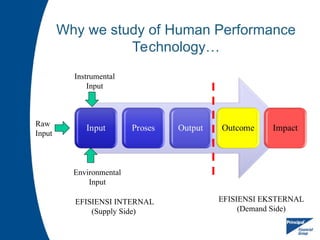
Why we study of Human Performance
Technology…
Instrumental
Input
Environmental
Input
Raw
Input
EFISIENSI INTERNAL
(Supply Side)
EFISIENSI EKSTERNAL
(Demand Side)
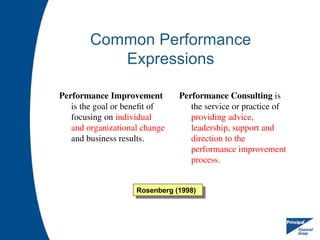
Common Performance
Expressions
Performance Improvement
is the goal or benefit of
focusing on individual
and organizational change
and business results.
Performance Consulting is
the service or practice of
providing advice,
leadership, support and
direction to the
performance improvement
process.
Rosenberg (1998)
Common Performance
Expressions, continued
• Performance Technology is the process and
tools used to solve human performance problems
or to realize performance improvement
opportunities.
Rosenberg: (1998)
What is
Human Performance Technology?
HPT is a systematic approach to improving
productivity and competence. It is a set
of methods, procedures, and strategies
for solving problems and seizing
opportunities related to the performance
of people.
ISPI: 2001
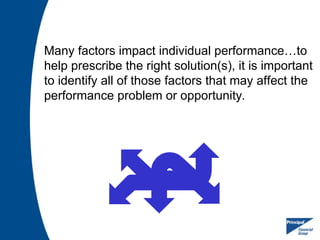
Many factors impact individual performance…to
help prescribe the right solution(s), it is important
to identify all of those factors that may affect the
performance problem or opportunity.
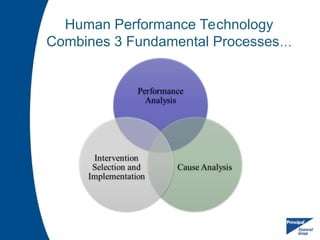
Human Performance Technology
Combines 3 Fundamental Processes…
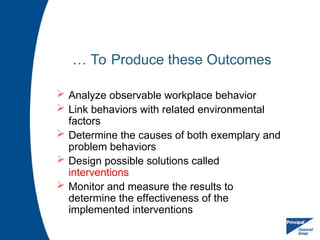
… To Produce these Outcomes
 Analyze observable workplace behavior
 Link behaviors with related environmental
factors
 Determine the causes of both exemplary and
problem behaviors
 Design possible solutions called
interventions
 Monitor and measure the results to
determine the effectiveness of the
implemented interventions
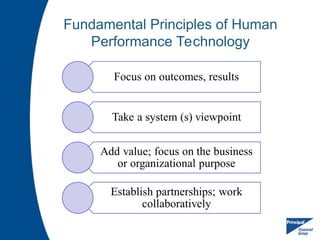
Fundamental Principles of Human
Performance Technology
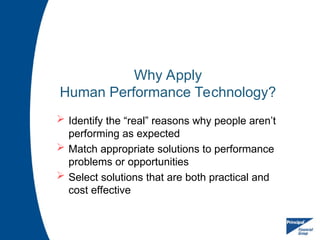
Why Apply
Human Performance Technology?
 Identify the “real” reasons why people aren’t
performing as expected
 Match appropriate solutions to performance
problems or opportunities
 Select solutions that are both practical and
cost effective
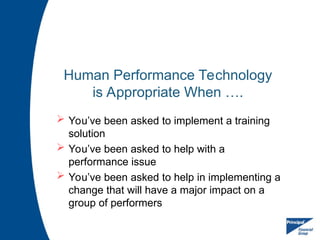
Human Performance Technology
is Appropriate When ….
 You’ve been asked to implement a training
solution
 You’ve been asked to help with a
performance issue
 You’ve been asked to help in implementing a
change that will have a major impact on a
group of performers
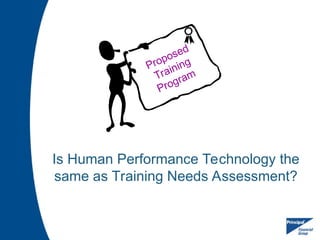
Is Human Performance Technology the
same as Training Needs Assessment?
Proposed
Training
Program
“The danger in leaping from apparent
problem to apparent solution is that
large amounts of time and money can
be spent in throwing training at a
problem that training cannot solve. You
need to dig a little deeper. That is why
a procedure (like Human Performance
Technology) is important to those who
actually want to solve problems – rather
than just talk about them.”
Robert F. Mager
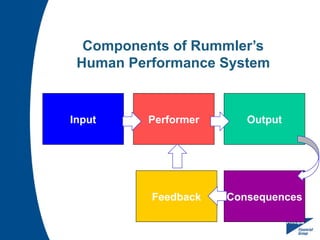
Components of Rummler’s
Human Performance System
Input Consequences
Feedback Performer
Output
Input Performer Output
Consequences
Feedback
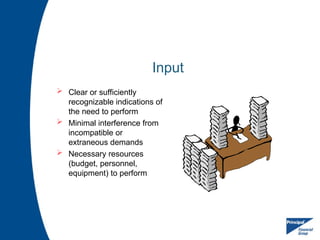
Input
 Clear or sufficiently
recognizable indications of
the need to perform
 Minimal interference from
incompatible or
extraneous demands
 Necessary resources
(budget, personnel,
equipment) to perform
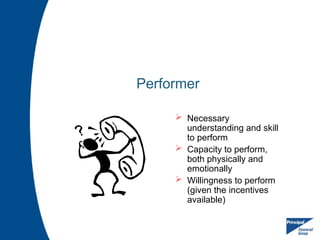
Performer
 Necessary
understanding and skill
to perform
 Capacity to perform,
both physically and
emotionally
 Willingness to perform
(given the incentives
available)
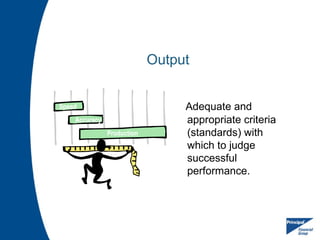
Output
Adequate and
appropriate criteria
(standards) with
which to judge
successful
performance.
Accuracy
Speed
Production
Consequences
 Sufficient positive
consequences
(incentives) to
perform
 Few, if any, negative
consequences
(disincentives) to
perform
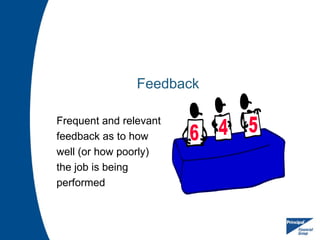
Feedback
Frequent and relevant
feedback as to how
well (or how poorly)
the job is being
performed
How Do You Apply
Human Performance Technology?
1. Conduct a Performance Analysis.
2. Conduct a Cause Analysis.
3. Select and implement the
appropriate intervention(s).
Conducting a Performance Analysis
 Understand the performance issue that is
being addressed and verify agreement
 Collect data on current performance
 Compare current performance to desired
performance
 Determine the performance gap
Conducting a Cause Analysis
 Identify causes for the performance gap
 Don’t jump to conclusions!
 If needed, gather more data
Areas for Cause Analysis
 Input
 Performer
 Output
 Consequences
 Feedback
Intervention
An intervention is an:
 activity
 process
 event or
 system
designed to correct the problem or change the
situation and improve performance.
Selecting and Implementing the
Appropriate Intervention(s)
 Identify criteria that the intervention(s) must fit such as:
Cost
Time
Quality
 Select the interventions(s) that best fit the criteria and
improve performance
 Propose the intervention(s) to the client and gain
commitment to implement
 Implement the intervention(s)
 Evaluate the effectiveness of the intervention(s)
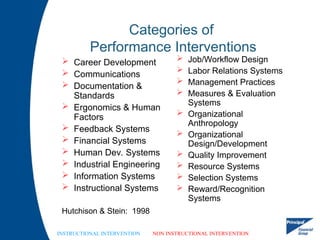
Categories of
Performance Interventions
 Career Development
 Communications
 Documentation &
Standards
 Ergonomics & Human
Factors
 Feedback Systems
 Financial Systems
 Human Dev. Systems
 Industrial Engineering
 Information Systems
 Instructional Systems
Hutchison & Stein: 1998
 Job/Workflow Design
 Labor Relations Systems
 Management Practices
 Measures & Evaluation
Systems
 Organizational
Anthropology
 Organizational
Design/Development
 Quality Improvement
 Resource Systems
 Selection Systems
 Reward/Recognition
Systems
INSTRUCTIONAL INTERVENTION NON INSTRUCTIONAL INTERVENTION
Let’s apply what we’ve learned
about HPT …
CPT Standards of Performance
Technology
 Focus on results
 Look at situations
systemically
 Add value
 Utilize partnerships &
collaborate
 Systematic:
 Assessment
 Analysis
 Design
 Development
 Implementation
 Evaluation
HPT Case Study
 Client: Customer Service Marketing Department
 Imperative: “Enhance the customer experience
while increasing service revenues by offering
additional services and products”
 Success Factors & Core Requirements
 Interventions: Workplace, Work, & Worker
P.S.
Closing Thoughts About
Human Performance Technology
 Brings a systems approach to diagnosing
performance
 Recognizes that organizational performance
factors have as much impact as individual
performance factors
 Promotes the brokering of effective solutions
KESIMPULAN
• Teknologi Kinerja adalah serangkaian
metode, prosedur dan strategi yang
sistematis untuk memecahkan masalah
atau menyadari peluang/kesempatan
yang berkaitan dengan kinerja orang-
orang dan organisasi.
• Kegiatan tersebut dapat diaplikasikan
baik untuk level individual, kelompok
kecil, tim, atau organisasi besar.
KESIMPULAN
• Bentuk-bentuk intervensi/solusinya dapat dilakukan
dalam bentuk informasi, komunikasi, pengembangan
organisasi, pelatihan, work/job design, manajemen
kinerja, rekayasa lingkungan, ergonomic, feedback
system, reward, coaching, perubahan budaya,
electronic support system, dan lain-lain.
• Teknolog kinerja sama seperti dokter. Mulai
melakukan diagnosa masalah secara sistematis dan
menyeluruh. Kemudian menyimpulkan inti penyebab
masalah (penyakit). Untuk kemudian membuat resep
pengobatannya seperti apa.
KESIMPULAN
• Bentuk-bentuk intervensi/solusinya dapat dilakukan dalam
bentuk informasi, komunikasi, pengembangan organisasi,
pelatihan, work/job design, manajemen kinerja, rekayasa
lingkungan, ergonomic, feedback system, reward, coaching,
perubahan budaya, electronic support system, dan lain-lain.
• Teknolog kinerja beperan dalam mendiagnosa
permasalahan kinerja dalam suatu organisasi, kemudian
menyimpulkan inti penyebab menurunnya kinerja secara
holistik, dan kemudian merekomendasikan, merancang,
melaksanakan, dan mengevaluasi serta memonitor
pelaksanaan intervensi atau solusi.
KESIMPULAN
• Bentuk-bentuk solusi dapat bermacam-macam
dan dapat bersifat instruksional seperti
pelatihan, distance learning, dan sejenisnya
maupun yang bersifat non-instruksional seperti
perubahan budaya, pemanfaatan electronic
support system, insentif, dan lain-lain.
THANKS

Overview of Human Performance Technology

  • 1.
    Overview: Human Performance Technology(HPT) Teknologi Kinerja Manusia (TKM)
  • 2.
    Why we studyof Human Performance Technology… The definition of Educational Technology is the study and ethical practice of facilitating learning and improving performance by creating, using, and managing appropriate technological processes and resources. (The AECT Standards 2012)
  • 4.
    Ruang Lingkup TP •Lower • Midle • Upper • Adavanced Level • Ordinary Level • Aplikasi Pembelajaran • AI
  • 5.
    Why we studyof Human Performance Technology… Instrumental Input Environmental Input Raw Input EFISIENSI INTERNAL (Supply Side) EFISIENSI EKSTERNAL (Demand Side)
  • 7.
    Common Performance Expressions Performance Improvement isthe goal or benefit of focusing on individual and organizational change and business results. Performance Consulting is the service or practice of providing advice, leadership, support and direction to the performance improvement process. Rosenberg (1998)
  • 8.
    Common Performance Expressions, continued •Performance Technology is the process and tools used to solve human performance problems or to realize performance improvement opportunities. Rosenberg: (1998)
  • 9.
    What is Human PerformanceTechnology? HPT is a systematic approach to improving productivity and competence. It is a set of methods, procedures, and strategies for solving problems and seizing opportunities related to the performance of people. ISPI: 2001
  • 10.
    Many factors impactindividual performance…to help prescribe the right solution(s), it is important to identify all of those factors that may affect the performance problem or opportunity.
  • 11.
    Human Performance Technology Combines3 Fundamental Processes…
  • 12.
    … To Producethese Outcomes  Analyze observable workplace behavior  Link behaviors with related environmental factors  Determine the causes of both exemplary and problem behaviors  Design possible solutions called interventions  Monitor and measure the results to determine the effectiveness of the implemented interventions
  • 13.
    Fundamental Principles ofHuman Performance Technology
  • 14.
    Why Apply Human PerformanceTechnology?  Identify the “real” reasons why people aren’t performing as expected  Match appropriate solutions to performance problems or opportunities  Select solutions that are both practical and cost effective
  • 15.
    Human Performance Technology isAppropriate When ….  You’ve been asked to implement a training solution  You’ve been asked to help with a performance issue  You’ve been asked to help in implementing a change that will have a major impact on a group of performers
  • 16.
    Is Human PerformanceTechnology the same as Training Needs Assessment? Proposed Training Program
  • 17.
    “The danger inleaping from apparent problem to apparent solution is that large amounts of time and money can be spent in throwing training at a problem that training cannot solve. You need to dig a little deeper. That is why a procedure (like Human Performance Technology) is important to those who actually want to solve problems – rather than just talk about them.” Robert F. Mager
  • 18.
    Components of Rummler’s HumanPerformance System Input Consequences Feedback Performer Output Input Performer Output Consequences Feedback
  • 19.
    Input  Clear orsufficiently recognizable indications of the need to perform  Minimal interference from incompatible or extraneous demands  Necessary resources (budget, personnel, equipment) to perform
  • 20.
    Performer  Necessary understanding andskill to perform  Capacity to perform, both physically and emotionally  Willingness to perform (given the incentives available)
  • 21.
    Output Adequate and appropriate criteria (standards)with which to judge successful performance. Accuracy Speed Production
  • 22.
    Consequences  Sufficient positive consequences (incentives)to perform  Few, if any, negative consequences (disincentives) to perform
  • 23.
    Feedback Frequent and relevant feedbackas to how well (or how poorly) the job is being performed
  • 24.
    How Do YouApply Human Performance Technology? 1. Conduct a Performance Analysis. 2. Conduct a Cause Analysis. 3. Select and implement the appropriate intervention(s).
  • 25.
    Conducting a PerformanceAnalysis  Understand the performance issue that is being addressed and verify agreement  Collect data on current performance  Compare current performance to desired performance  Determine the performance gap
  • 26.
    Conducting a CauseAnalysis  Identify causes for the performance gap  Don’t jump to conclusions!  If needed, gather more data
  • 27.
    Areas for CauseAnalysis  Input  Performer  Output  Consequences  Feedback
  • 28.
    Intervention An intervention isan:  activity  process  event or  system designed to correct the problem or change the situation and improve performance.
  • 29.
    Selecting and Implementingthe Appropriate Intervention(s)  Identify criteria that the intervention(s) must fit such as: Cost Time Quality  Select the interventions(s) that best fit the criteria and improve performance  Propose the intervention(s) to the client and gain commitment to implement  Implement the intervention(s)  Evaluate the effectiveness of the intervention(s)
  • 30.
    Categories of Performance Interventions Career Development  Communications  Documentation & Standards  Ergonomics & Human Factors  Feedback Systems  Financial Systems  Human Dev. Systems  Industrial Engineering  Information Systems  Instructional Systems Hutchison & Stein: 1998  Job/Workflow Design  Labor Relations Systems  Management Practices  Measures & Evaluation Systems  Organizational Anthropology  Organizational Design/Development  Quality Improvement  Resource Systems  Selection Systems  Reward/Recognition Systems INSTRUCTIONAL INTERVENTION NON INSTRUCTIONAL INTERVENTION
  • 31.
    Let’s apply whatwe’ve learned about HPT …
  • 32.
    CPT Standards ofPerformance Technology  Focus on results  Look at situations systemically  Add value  Utilize partnerships & collaborate  Systematic:  Assessment  Analysis  Design  Development  Implementation  Evaluation
  • 33.
    HPT Case Study Client: Customer Service Marketing Department  Imperative: “Enhance the customer experience while increasing service revenues by offering additional services and products”  Success Factors & Core Requirements  Interventions: Workplace, Work, & Worker
  • 34.
    P.S. Closing Thoughts About HumanPerformance Technology  Brings a systems approach to diagnosing performance  Recognizes that organizational performance factors have as much impact as individual performance factors  Promotes the brokering of effective solutions
  • 35.
    KESIMPULAN • Teknologi Kinerjaadalah serangkaian metode, prosedur dan strategi yang sistematis untuk memecahkan masalah atau menyadari peluang/kesempatan yang berkaitan dengan kinerja orang- orang dan organisasi. • Kegiatan tersebut dapat diaplikasikan baik untuk level individual, kelompok kecil, tim, atau organisasi besar.
  • 36.
    KESIMPULAN • Bentuk-bentuk intervensi/solusinyadapat dilakukan dalam bentuk informasi, komunikasi, pengembangan organisasi, pelatihan, work/job design, manajemen kinerja, rekayasa lingkungan, ergonomic, feedback system, reward, coaching, perubahan budaya, electronic support system, dan lain-lain. • Teknolog kinerja sama seperti dokter. Mulai melakukan diagnosa masalah secara sistematis dan menyeluruh. Kemudian menyimpulkan inti penyebab masalah (penyakit). Untuk kemudian membuat resep pengobatannya seperti apa.
  • 37.
    KESIMPULAN • Bentuk-bentuk intervensi/solusinyadapat dilakukan dalam bentuk informasi, komunikasi, pengembangan organisasi, pelatihan, work/job design, manajemen kinerja, rekayasa lingkungan, ergonomic, feedback system, reward, coaching, perubahan budaya, electronic support system, dan lain-lain. • Teknolog kinerja beperan dalam mendiagnosa permasalahan kinerja dalam suatu organisasi, kemudian menyimpulkan inti penyebab menurunnya kinerja secara holistik, dan kemudian merekomendasikan, merancang, melaksanakan, dan mengevaluasi serta memonitor pelaksanaan intervensi atau solusi.
  • 38.
    KESIMPULAN • Bentuk-bentuk solusidapat bermacam-macam dan dapat bersifat instruksional seperti pelatihan, distance learning, dan sejenisnya maupun yang bersifat non-instruksional seperti perubahan budaya, pemanfaatan electronic support system, insentif, dan lain-lain.
  • 39.