WEB DESIGN
 Web design is the process of creating websites.
 It encompasses several different aspects,including webpage layout,content
production, and graphic design.
 Web design is technically a subset of the broader category of web development.
Concept of web design
 A design concept is the idea behind a design.
 it’s how you plan on solving the design problem in front of you.
It’s the underlying logic, thinking, and reasoning for how you’ll design a
website.
Your concept will lead to your choices in colour and type.
TYPES OF LAYOUT
Static page layout
Dynamic page layout
Fixed design layout
Responsive design layout
Liquid or fluid layout
Single page design layout
PROCESS LAYOUT
In a process layout(also referred to as a job shop layout) similar machines
and services are located together.
 Therefore, in a process type of layout all drills are located in one area of
the layout and all milling machines are located in another area.
A manufacturing example of a process layout is a machine shop.
Example include hospitals, colleges, banks ,auto repair shop, and public
libraries.
THREE TYPES OF PRODUCT LAYOUT
 Product layout
 Process layout
 Fixed location layout
PRODUCT LAYOUT
 This type of layout is generally used in systems where a
product has to be manufactured or assembled in large
quantities.
 In product layout the machinery and auxiliary services are
located according to the processing sequence of the product
without any buffer storage within the line itself.
FIXED LOCATION LAYOUT
 In the type of layout, the product is kept at a fixed position and all other
materials; components, tools, machines, workers, etc... are brought and
arranged around it.
 Then assembly or fabrication is carried out.
 Example includes aircraft assembly,ship building, and most
constructions projects.
Adobe Photoshop
Adobe photoshop is a raster graphics editor developed and
published by adobe inc. for macOS and windows
 It was originally created in 1988 by Thomas and john knoll.
What is HTML?
 HTML stands for Hyper Text Markup Language
 HTML describes the structure of web pages using markup
 HTML are the building blocks of html pages
 HTML elements are represented by tags
 HTML tags label pieces of content such as “heading”, ”paragraph”, ”table”, and so on
 Browser do not display the HTML tags,but use them to render the content of the page
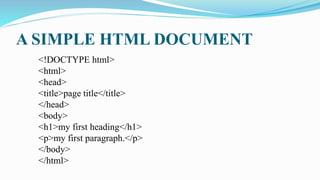
A SIMPLE HTML DOCUMENT
<!DOCTYPE html>
<html>
<head>
<title>page title</title>
</head>
<body>
<h1>my first heading</h1>
<p>my first paragraph.</p>
</body>
</html>
BASIC HTML TAGS
 XHTML is never than the old HTML
 XHTML has stricte r rules and does not allow some elements formerly used in HTML
 One benefit of using XHTML is that it helps make web pages look identical in
different browsers,such as internet explorer, firefox, safari, etc…
 XHTML is used to define and organize the page content but not to style it.
XHTML
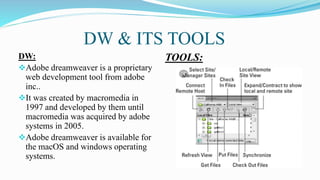
dreamweaver
DW & ITS TOOLS
DW:
Adobe dreamweaver is a proprietary
web development tool from adobe
inc..
It was created by macromedia in
1997 and developed by them until
macromedia was acquired by adobe
systems in 2005.
Adobe dreamweaver is available for
the macOS and windows operating
systems.
TOOLS:
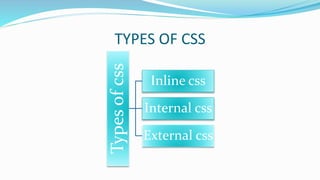
CSS full form is Cascading Style Sheets.
CSS is used to describe how html elements are to be displayed on
screen.
CSS save as lot of work.
It can control the layout of multiple web pages.
CSS
Typesofcss
Inline css
Internal css
External css
TYPES OF CSS
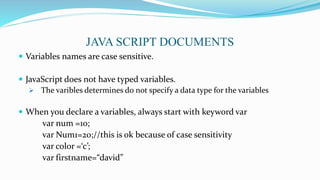
 Variables names are case sensitive.
 JavaScript does not have typed variables.
 The varibles determines do not specify a data type for the variables
 When you declare a variables, always start with keyword var
var num =10;
var Num1=20;//this is ok because of case sensitivity
var color =‘c’;
var firstname=“david”
JAVA SCRIPT DOCUMENTS
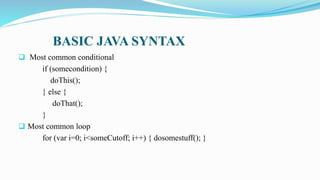
 Most common conditional
if (somecondition) {
doThis();
} else {
doThat();
}
 Most common loop
for (var i=0; i<someCutoff; i++) { dosomestuff(); }
BASIC JAVA SYNTAX
<HTML>
<script type=“text/javascript”>
/**
*this is amultiple-
*line comment
*/
Var index=0;
Var arr =[];
Function push(elem) {
// this comment may span only this line
arr [index++]=elem;
}
</script>
</HTML>
USING JAVASCRIPT SYNTAX COLORING
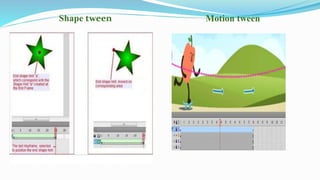
Shape tween Motion tween

OVER VIEW OF WEB DESIGNING

  • 2.
    WEB DESIGN  Webdesign is the process of creating websites.  It encompasses several different aspects,including webpage layout,content production, and graphic design.  Web design is technically a subset of the broader category of web development.
  • 3.
    Concept of webdesign  A design concept is the idea behind a design.  it’s how you plan on solving the design problem in front of you. It’s the underlying logic, thinking, and reasoning for how you’ll design a website. Your concept will lead to your choices in colour and type.
  • 4.
    TYPES OF LAYOUT Staticpage layout Dynamic page layout Fixed design layout Responsive design layout Liquid or fluid layout Single page design layout
  • 5.
    PROCESS LAYOUT In aprocess layout(also referred to as a job shop layout) similar machines and services are located together.  Therefore, in a process type of layout all drills are located in one area of the layout and all milling machines are located in another area. A manufacturing example of a process layout is a machine shop. Example include hospitals, colleges, banks ,auto repair shop, and public libraries.
  • 6.
    THREE TYPES OFPRODUCT LAYOUT  Product layout  Process layout  Fixed location layout
  • 7.
    PRODUCT LAYOUT  Thistype of layout is generally used in systems where a product has to be manufactured or assembled in large quantities.  In product layout the machinery and auxiliary services are located according to the processing sequence of the product without any buffer storage within the line itself.
  • 8.
    FIXED LOCATION LAYOUT In the type of layout, the product is kept at a fixed position and all other materials; components, tools, machines, workers, etc... are brought and arranged around it.  Then assembly or fabrication is carried out.  Example includes aircraft assembly,ship building, and most constructions projects.
  • 10.
    Adobe Photoshop Adobe photoshopis a raster graphics editor developed and published by adobe inc. for macOS and windows  It was originally created in 1988 by Thomas and john knoll.
  • 12.
    What is HTML? HTML stands for Hyper Text Markup Language  HTML describes the structure of web pages using markup  HTML are the building blocks of html pages  HTML elements are represented by tags  HTML tags label pieces of content such as “heading”, ”paragraph”, ”table”, and so on  Browser do not display the HTML tags,but use them to render the content of the page
  • 13.
    A SIMPLE HTMLDOCUMENT <!DOCTYPE html> <html> <head> <title>page title</title> </head> <body> <h1>my first heading</h1> <p>my first paragraph.</p> </body> </html>
  • 14.
  • 15.
     XHTML isnever than the old HTML  XHTML has stricte r rules and does not allow some elements formerly used in HTML  One benefit of using XHTML is that it helps make web pages look identical in different browsers,such as internet explorer, firefox, safari, etc…  XHTML is used to define and organize the page content but not to style it. XHTML
  • 16.
  • 17.
    DW & ITSTOOLS DW: Adobe dreamweaver is a proprietary web development tool from adobe inc.. It was created by macromedia in 1997 and developed by them until macromedia was acquired by adobe systems in 2005. Adobe dreamweaver is available for the macOS and windows operating systems. TOOLS:
  • 18.
    CSS full formis Cascading Style Sheets. CSS is used to describe how html elements are to be displayed on screen. CSS save as lot of work. It can control the layout of multiple web pages. CSS
  • 19.
  • 21.
     Variables namesare case sensitive.  JavaScript does not have typed variables.  The varibles determines do not specify a data type for the variables  When you declare a variables, always start with keyword var var num =10; var Num1=20;//this is ok because of case sensitivity var color =‘c’; var firstname=“david” JAVA SCRIPT DOCUMENTS
  • 22.
     Most commonconditional if (somecondition) { doThis(); } else { doThat(); }  Most common loop for (var i=0; i<someCutoff; i++) { dosomestuff(); } BASIC JAVA SYNTAX
  • 23.
    <HTML> <script type=“text/javascript”> /** *this isamultiple- *line comment */ Var index=0; Var arr =[]; Function push(elem) { // this comment may span only this line arr [index++]=elem; } </script> </HTML> USING JAVASCRIPT SYNTAX COLORING
  • 24.