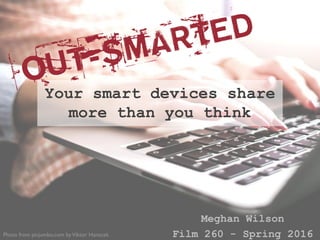
Meghan Wilson
Film 260 - Spring 2016
Your smart devices share
more than you think
Photo from picjumbo.com byViktor Hanacek
When was the last time
were without your phone?
you
Photo from picjumbo.com byViktor Hanacek
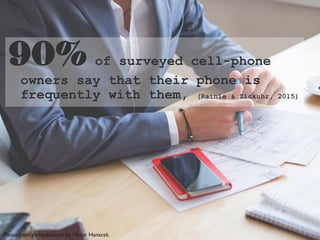
90% of surveyed cell-phone
owners say that their phone is
frequently with them, (Rainie & Zickuhr, 2015)
Photo from picjumbo.com byViktor Hanacek
Photo from Kaboompics.com
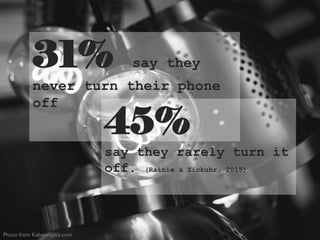
31% say they
never turn their phone
off
45%
say they rarely turn it
off. (Rainie & Zickuhr, 2015)
Photo from Kaboompics.com
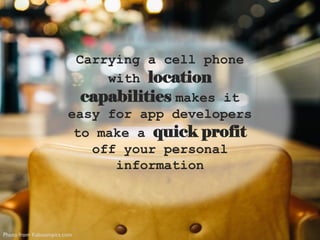
Carrying a cell phone
with location
capabilities makes it
easy for app developers
to make a quick profit
off your personal
information
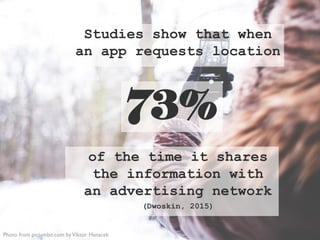
Studies show that when
an app requests location
Photo from picjumbo.com byViktor Hanacek
of the time it shares
the information with
an advertising network
(Dwoskin, 2015)
73%
Photo from picjumbo.com byViktor Hanacek
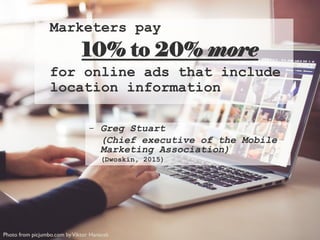
Marketers pay
10% to 20% more
for online ads that include
location information
- Greg Stuart
(Chief executive of the Mobile
Marketing Association)
(Dwoskin, 2015)
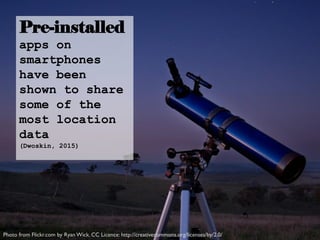
Pre-installed
apps on
smartphones
have been
shown to share
some of the
most location
data
(Dwoskin, 2015)
Photo from Flickr.com by Ryan Wick. CC Licence: http://creativecommons.org/licenses/by/2.0/
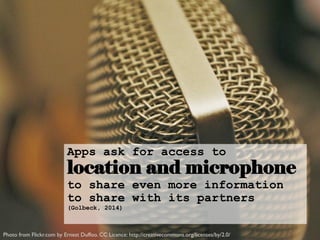
Apps ask for access to
location and microphone
to share even more information
to share with its partners
(Golbeck, 2014)
Photo from Flickr.com by Ernest Duffoo. CC Licence: http://creativecommons.org/licenses/by/2.0/
Photo from picjumbo.com byViktor Hanacek
More than 90%
of Americans feel
they’ve lost
control over their
personal data
(Dwoskin, 2015)
...yet few are
doing anything
to protect
themselves...
46% of smartphone users said that they
“couldn’t live without”
their devices (Smith, 2015)
Photo from picjumbo.com byViktor Hanacek
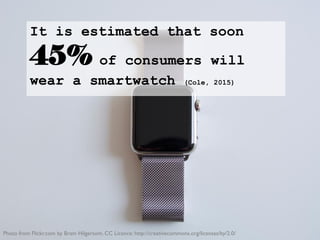
It is estimated that soon
45% of consumers will
wear a smartwatch (Cole, 2015)
Photo from Flickr.com by Bram Hilgersom. CC Licence: http://creativecommons.org/licenses/by/2.0/
developers are determined
to create devices that fit
seamlessly into our lives
and are easy to use for
children, adults and
seniors (Rhew, 2016)
Photo from Flickr.com by Chris Combe. CC Licence: http://creativecommons.org/licenses/by/2.0/
“Where we are with wearables
is about where we were with
the Internet in 1993”
-Amanda Parkes (chief of technology and
research at Manufacture New York)
(Postrel, 2016)
Photo from Flickr.com by Alvin Chow. CC Licence: http://creativecommons.org/licenses/by/2.0/
Photo from Flickr.com by Daniel Novta. CC Licence: http://creativecommons.org/licenses/by/2.0/
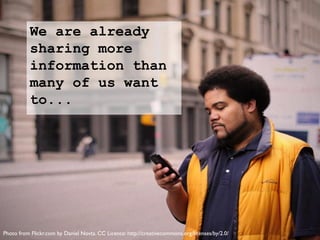
We are already
sharing more
information than
many of us want
to...
Photo from picjumbo.com byViktor Hanacek
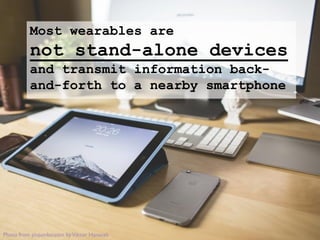
Most wearables are
not stand-alone devices
and transmit information back-
and-forth to a nearby smartphone
Transmitting information
can leave the user open
to risks of data
interception
(Mansfield, 2016)
Photo from Flickr.com by Robert Bejil. CC Licence: http://creativecommons.org/licenses/by/2.0/
There is a need for new security
policies surrounding smart wearables to
protect sensitive personal
and company information
Photo from Flickr.com by American Tobacco. CC Licence: http://creativecommons.org/licenses/by/2.0/
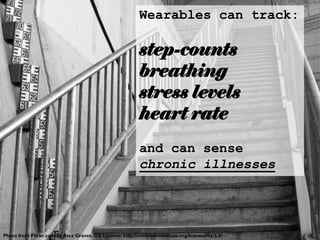
Wearables can track:
step-counts
breathing
stress levels
heart rate
and can sense
chronic illnesses
Photo from Flickr.com by Alex Graves. CC Licence: http://creativecommons.org/licenses/by/2.0/
Health insurance
companies are
researching ways that
they could use this
data in the future
when creating risk-
profiles (Olson, 2014)
Photo from Flickr.com by Imanka. CC Licence: http://creativecommons.org/licenses/by/2.0/
The sharing of personal
information is approaching a
grey area
Photo from Flickr.com by Arlanta. CC Licence: http://creativecommons.org/licenses/by/2.0/
In 2011 Fitbit made
all data collected public
by default and released
scores of personal data for
anyone to see (Sparkes, 2015)
Photo from Flickr.com by Overduebook. CC Licence: http://creativecommons.org/licenses/by/2.0/
Smart technology
is entering the
home at an
exponential
rate,
which only opens
the door to more
privacy breaches
Photo from Flickr.com by James Sann. CC Licence: http://creativecommons.org/licenses/by/2.0
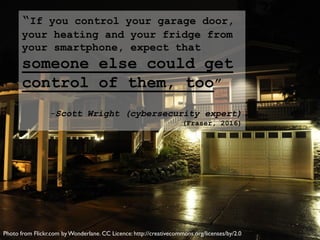
“If you control your garage door,
your heating and your fridge from
your smartphone, expect that
someone else could get
control of them, too”
-Scott Wright (cybersecurity expert)
(Fraser, 2016)
Photo from Flickr.com byWonderlane. CC Licence: http://creativecommons.org/licenses/by/2.0
Cole, S. (2015, March 12). How the AppleWatchWill Chnage Office Life. Retrieved from Fast Company:
http://www.fastcompany.com/3043533/the-future-of-work/how-the-apple-watch-will-change-office-life
Dwoskin, E. (2015, March 23). WhereWereYou 3 Minutes Ago?Your Apps Know. Retrieved fromThe Wall Street Journal:
http://blogs.wsj.com/digits/2015/03/23/where-were-you-3-minutes-ago-your-apps-know/?mod=LS1
Fraser, L. (2016, February 1). Connected devices quietly mine our data, privacy experts say. Retrieved from CBC News:
http://www.cbc.ca/news/technology/privacy-data-1.3426634
Golbeck, J. (2014, January 28). Track Star. Retrieved from Slate:
http://www.slate.com/articles/technology/future_tense/2014/01/ibeacon_shopkick_privacy_policies_for_location_tracking_apps_aren_t_cl
ear.single.html
Mansfield, M. (2016, February 18). CanWearableTechnologyThreaten the Cyber Seurity ofYour Business. Retrieved from Small Business Trends:
http://smallbiztrends.com/2016/02/wearable-technology-security-issues.html
Olson, P. (2014, June 19). WearableTech is Plugging Into Health Insurance. Retrieved from Forbes:
http://www.forbes.com/sites/parmyolson/2014/06/19/wearable-tech-health-insurance/#53668c105ba1
Postrel,V. (2016, March 3). Why Nobody'sWearingWearables. Retrieved from BloombergView:
http://www.bloomberg.com/view/articles/2016-03-03/why-nobody-s-wearing-wearables
Rainie, L., & Zickuhr, K. (2015,August 26). Americans'Views on Mobile Etiquette. Retrieved from Pew Research Center:
http://www.pewinternet.org/2015/08/26/americans-views-on-mobile-etiquette/
Rhew, D. D. (2016). Welcome Home:The Health Hub of the Future. Retrieved from Insights: https://insights.samsung.com/2016/03/24/welcome-
home-the-health-hub-of-the-future/
Smith,A. (2015,April 1). U.S. Smartphone Use in 2015. Retrieved from Pew Research Center: http://www.pewinternet.org/2015/04/01/us-
smartphone-use-in-2015/
Sparkes, M. (2015, February 10). Is smart technology really a threat to our privacy? Retrieved fromThe Telegraoh:
http://www.telegraph.co.uk/technology/news/11403494/Is-smart-technology-really-a-threat-to-our-privacy.html
Works Cited:
Photo from picjumbo.com byViktor Hanacek

Out-Smarted!

  • 1.
    Meghan Wilson Film 260- Spring 2016 Your smart devices share more than you think Photo from picjumbo.com byViktor Hanacek
  • 2.
    When was thelast time were without your phone? you Photo from picjumbo.com byViktor Hanacek
  • 3.
    90% of surveyedcell-phone owners say that their phone is frequently with them, (Rainie & Zickuhr, 2015) Photo from picjumbo.com byViktor Hanacek
  • 4.
    Photo from Kaboompics.com 31%say they never turn their phone off 45% say they rarely turn it off. (Rainie & Zickuhr, 2015)
  • 5.
    Photo from Kaboompics.com Carryinga cell phone with location capabilities makes it easy for app developers to make a quick profit off your personal information
  • 6.
    Studies show thatwhen an app requests location Photo from picjumbo.com byViktor Hanacek of the time it shares the information with an advertising network (Dwoskin, 2015) 73%
  • 7.
    Photo from picjumbo.combyViktor Hanacek Marketers pay 10% to 20% more for online ads that include location information - Greg Stuart (Chief executive of the Mobile Marketing Association) (Dwoskin, 2015)
  • 8.
    Pre-installed apps on smartphones have been shownto share some of the most location data (Dwoskin, 2015) Photo from Flickr.com by Ryan Wick. CC Licence: http://creativecommons.org/licenses/by/2.0/
  • 9.
    Apps ask foraccess to location and microphone to share even more information to share with its partners (Golbeck, 2014) Photo from Flickr.com by Ernest Duffoo. CC Licence: http://creativecommons.org/licenses/by/2.0/
  • 10.
    Photo from picjumbo.combyViktor Hanacek More than 90% of Americans feel they’ve lost control over their personal data (Dwoskin, 2015) ...yet few are doing anything to protect themselves...
  • 11.
    46% of smartphoneusers said that they “couldn’t live without” their devices (Smith, 2015) Photo from picjumbo.com byViktor Hanacek
  • 12.
    It is estimatedthat soon 45% of consumers will wear a smartwatch (Cole, 2015) Photo from Flickr.com by Bram Hilgersom. CC Licence: http://creativecommons.org/licenses/by/2.0/
  • 13.
    developers are determined tocreate devices that fit seamlessly into our lives and are easy to use for children, adults and seniors (Rhew, 2016) Photo from Flickr.com by Chris Combe. CC Licence: http://creativecommons.org/licenses/by/2.0/
  • 14.
    “Where we arewith wearables is about where we were with the Internet in 1993” -Amanda Parkes (chief of technology and research at Manufacture New York) (Postrel, 2016) Photo from Flickr.com by Alvin Chow. CC Licence: http://creativecommons.org/licenses/by/2.0/
  • 15.
    Photo from Flickr.comby Daniel Novta. CC Licence: http://creativecommons.org/licenses/by/2.0/ We are already sharing more information than many of us want to...
  • 16.
    Photo from picjumbo.combyViktor Hanacek Most wearables are not stand-alone devices and transmit information back- and-forth to a nearby smartphone
  • 17.
    Transmitting information can leavethe user open to risks of data interception (Mansfield, 2016) Photo from Flickr.com by Robert Bejil. CC Licence: http://creativecommons.org/licenses/by/2.0/
  • 18.
    There is aneed for new security policies surrounding smart wearables to protect sensitive personal and company information Photo from Flickr.com by American Tobacco. CC Licence: http://creativecommons.org/licenses/by/2.0/
  • 19.
    Wearables can track: step-counts breathing stresslevels heart rate and can sense chronic illnesses Photo from Flickr.com by Alex Graves. CC Licence: http://creativecommons.org/licenses/by/2.0/
  • 20.
    Health insurance companies are researchingways that they could use this data in the future when creating risk- profiles (Olson, 2014) Photo from Flickr.com by Imanka. CC Licence: http://creativecommons.org/licenses/by/2.0/
  • 21.
    The sharing ofpersonal information is approaching a grey area Photo from Flickr.com by Arlanta. CC Licence: http://creativecommons.org/licenses/by/2.0/
  • 22.
    In 2011 Fitbitmade all data collected public by default and released scores of personal data for anyone to see (Sparkes, 2015) Photo from Flickr.com by Overduebook. CC Licence: http://creativecommons.org/licenses/by/2.0/
  • 23.
    Smart technology is enteringthe home at an exponential rate, which only opens the door to more privacy breaches Photo from Flickr.com by James Sann. CC Licence: http://creativecommons.org/licenses/by/2.0
  • 24.
    “If you controlyour garage door, your heating and your fridge from your smartphone, expect that someone else could get control of them, too” -Scott Wright (cybersecurity expert) (Fraser, 2016) Photo from Flickr.com byWonderlane. CC Licence: http://creativecommons.org/licenses/by/2.0
  • 25.
    Cole, S. (2015,March 12). How the AppleWatchWill Chnage Office Life. Retrieved from Fast Company: http://www.fastcompany.com/3043533/the-future-of-work/how-the-apple-watch-will-change-office-life Dwoskin, E. (2015, March 23). WhereWereYou 3 Minutes Ago?Your Apps Know. Retrieved fromThe Wall Street Journal: http://blogs.wsj.com/digits/2015/03/23/where-were-you-3-minutes-ago-your-apps-know/?mod=LS1 Fraser, L. (2016, February 1). Connected devices quietly mine our data, privacy experts say. Retrieved from CBC News: http://www.cbc.ca/news/technology/privacy-data-1.3426634 Golbeck, J. (2014, January 28). Track Star. Retrieved from Slate: http://www.slate.com/articles/technology/future_tense/2014/01/ibeacon_shopkick_privacy_policies_for_location_tracking_apps_aren_t_cl ear.single.html Mansfield, M. (2016, February 18). CanWearableTechnologyThreaten the Cyber Seurity ofYour Business. Retrieved from Small Business Trends: http://smallbiztrends.com/2016/02/wearable-technology-security-issues.html Olson, P. (2014, June 19). WearableTech is Plugging Into Health Insurance. Retrieved from Forbes: http://www.forbes.com/sites/parmyolson/2014/06/19/wearable-tech-health-insurance/#53668c105ba1 Postrel,V. (2016, March 3). Why Nobody'sWearingWearables. Retrieved from BloombergView: http://www.bloomberg.com/view/articles/2016-03-03/why-nobody-s-wearing-wearables Rainie, L., & Zickuhr, K. (2015,August 26). Americans'Views on Mobile Etiquette. Retrieved from Pew Research Center: http://www.pewinternet.org/2015/08/26/americans-views-on-mobile-etiquette/ Rhew, D. D. (2016). Welcome Home:The Health Hub of the Future. Retrieved from Insights: https://insights.samsung.com/2016/03/24/welcome- home-the-health-hub-of-the-future/ Smith,A. (2015,April 1). U.S. Smartphone Use in 2015. Retrieved from Pew Research Center: http://www.pewinternet.org/2015/04/01/us- smartphone-use-in-2015/ Sparkes, M. (2015, February 10). Is smart technology really a threat to our privacy? Retrieved fromThe Telegraoh: http://www.telegraph.co.uk/technology/news/11403494/Is-smart-technology-really-a-threat-to-our-privacy.html Works Cited: Photo from picjumbo.com byViktor Hanacek