LPL Financial Member FINRA/SIPC
1
placeholder
Midyear Outlook 2020
LPL Research Outlook 2021
LPL Financial Member FINRA/SIPC
2
LPL Financial Member FINRA/SIPC
3
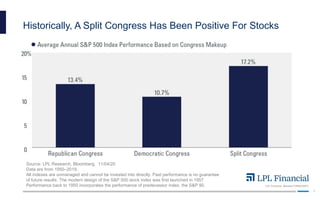
Historically, A Split Congress Has Been Positive For Stocks
Source: LPL Research, Bloomberg 11/04/20
Data are from 1950–2019.
All indexes are unmanaged and cannot be invested into directly. Past performance is no guarantee
of future results. The modern design of the S&P 500 stock index was first launched in 1957.
Performance back to 1950 incorporates the performance of predecessor index, the S&P 90.
LPL Financial Member FINRA/SIPC
4
LPL Financial Member FINRA/SIPC
5
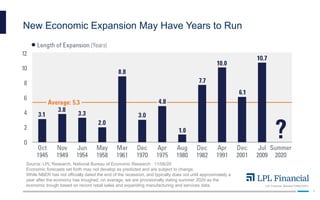
New Economic Expansion May Have Years to Run
Source: LPL Research, National Bureau of Economic Research 11/06/20
Economic forecasts set forth may not develop as predicted and are subject to change.
While NBER has not officially dated the end of the recession, and typically does not until approximately a
year after the economy has troughed, on average, we are provisionally dating summer 2020 as the
economic trough based on record retail sales and expanding manufacturing and services data.
LPL Financial Member FINRA/SIPC
6
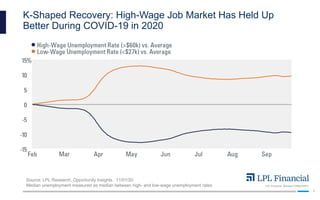
K-Shaped Recovery: High-Wage Job Market Has Held Up
Better During COVID-19 in 2020
Source: LPL Research, Opportunity Insights 11/01/20
Median unemployment measured as median between high- and low-wage unemployment rates
LPL Financial Member FINRA/SIPC
7
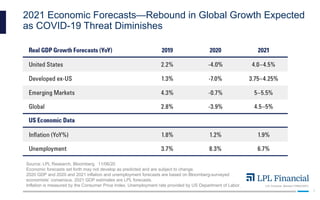
2021 Economic Forecasts—Rebound in Global Growth Expected
as COVID-19 Threat Diminishes
Source: LPL Research, Bloomberg 11/06/20
Economic forecasts set forth may not develop as predicted and are subject to change.
2020 GDP and 2020 and 2021 inflation and unemployment forecasts are based on Bloomberg-surveyed
economists’ consensus. 2021 GDP estimates are LPL forecasts.
Inflation is measured by the Consumer Price Index. Unemployment rate provided by US Department of Labor.
LPL Financial Member FINRA/SIPC
8
LPL Financial Member FINRA/SIPC
9
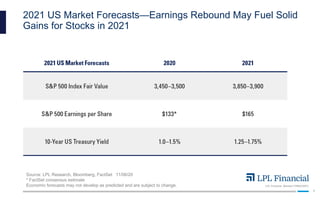
2021 US Market Forecasts—Earnings Rebound May Fuel Solid
Gains for Stocks in 2021
Source: LPL Research, Bloomberg, FactSet 11/06/20
* FactSet consensus estimate
Economic forecasts may not develop as predicted and are subject to change.
LPL Financial Member FINRA/SIPC
10
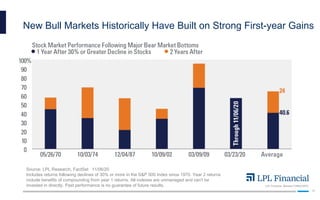
New Bull Markets Historically Have Built on Strong First-year Gains
Source: LPL Research, FactSet 11/06/20
Includes returns following declines of 30% or more in the S&P 500 Index since 1970. Year 2 returns
include benefits of compounding from year 1 returns. All indexes are unmanaged and can't be
invested in directly. Past performance is no guarantee of future results.
LPL Financial Member FINRA/SIPC
11
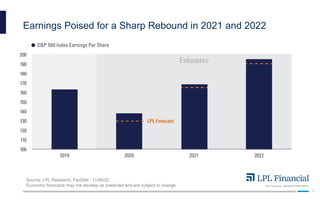
Earnings Poised for a Sharp Rebound in 2021 and 2022
Source: LPL Research, FactSet 11/06/20
Economic forecasts may not develop as predicted and are subject to change.
LPL Financial Member FINRA/SIPC
12
LPL Financial Member FINRA/SIPC
13
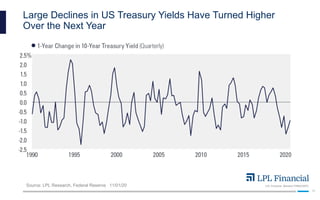
Large Declines in US Treasury Yields Have Turned Higher
Over the Next Year
Source: LPL Research, Federal Reserve 11/01/20
LPL Financial Member FINRA/SIPC
14
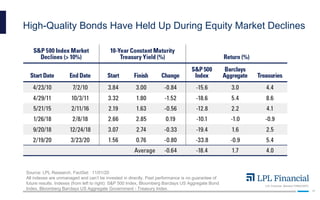
High-Quality Bonds Have Held Up During Equity Market Declines
Source: LPL Research, FactSet 11/01/20
All indexes are unmanaged and can’t be invested in directly. Past performance is no guarantee of
future results. Indexes (from left to right): S&P 500 Index, Bloomberg Barclays US Aggregate Bond
Index, Bloomberg Barclays US Aggregate Government - Treasury Index.
LPL Financial Member FINRA/SIPC
15
LPL Financial Member FINRA/SIPC
16
Important Disclosures
The opinions, statements and forecasts presented herein are general information only and are not intended to provide specific investment advice or recommendations for any
individual. It does not take into account the specific investment objectives, tax and financial condition, or particular needs of any specific person. There is no assurance that the
strategies or techniques discussed are suitable for all investors or will be successful. To determine which investment(s) may be appropriate for you, please consult your financial
professional prior to investing.
Any forward-looking statements including the economic forecasts herein may not develop as predicted and are subject to change based on future market and other conditions.
All performance referenced is historical and is no guarantee of
future results.
References to markets, asset classes, and sectors are generally regarding the corresponding market index. Indexes are unmanaged statistical composites and cannot be
invested into directly. Index performance is not indicative of the performance of any investment and does not reflect fees, expenses, or sales charges. All performance referenced
is historical and is no guarantee of future results.
Any company names noted herein are for educational purposes only and not an indication of trading intent or a solicitation of their products or services. LPL Financial doesn’t
provide research on individual equities.
All index data from FactSet.
All information is believed to be from reliable sources; however, LPL Financial makes no representation as to its completeness or accuracy.
General Risk disclosures:
Investing involves risks including possible loss of principal. No investment strategy or risk management technique can guarantee return or eliminate risk in all market
environments. There is no guarantee that a diversified portfolio will enhance overall returns or outperform a non-diversified portfolio. Diversification does not protect against
market risk. Investing in foreign and emerging markets debt or securities involves special additional risks. These risks include, but are not limited to, currency risk, geopolitical
risk, and risk associated with varying accounting standards. Investing in emerging markets may accentuate these risks.
General Definitions:
Gross Domestic Product (GDP) is the monetary value of all the finished goods and services produced within a country’s borders in a specific time period, though GDP is usually
calculated on an annual basis. It includes all of private and public consumption, government outlays, investments and exports less imports that occur within a defined territory.
LPL Financial Member FINRA/SIPC
17
Important Disclosures
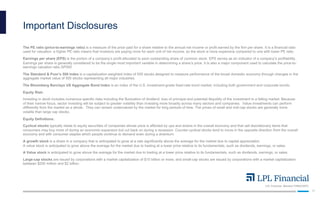
The PE ratio (price-to-earnings ratio) is a measure of the price paid for a share relative to the annual net income or profit earned by the firm per share. It is a financial ratio
used for valuation: a higher PE ratio means that investors are paying more for each unit of net income, so the stock is more expensive compared to one with lower PE ratio.
Earnings per share (EPS) is the portion of a company’s profit allocated to each outstanding share of common stock. EPS serves as an indicator of a company’s profitability.
Earnings per share is generally considered to be the single most important variable in determining a share’s price. It is also a major component used to calculate the price-to-
earnings valuation ratio.SP500
The Standard & Poor’s 500 Index is a capitalization-weighted index of 500 stocks designed to measure performance of the broad domestic economy through changes in the
aggregate market value of 500 stocks representing all major industries.
The Bloomberg Barclays US Aggregate Bond Index is an index of the U.S. investment-grade fixed-rate bond market, including both government and corporate bonds.
Equity Risk:
Investing in stock includes numerous specific risks including the fluctuation of dividend, loss of principal and potential illiquidity of the investment in a falling market. Because
of their narrow focus, sector investing will be subject to greater volatility than investing more broadly across many sectors and companies. Value investments can perform
differently from the market as a whole. They can remain undervalued by the market for long periods of time. The prices of small and mid-cap stocks are generally more
volatile than large cap stocks.
Equity Definitions:
Cyclical stocks typically relate to equity securities of companies whose price is affected by ups and downs in the overall economy and that sell discretionary items that
consumers may buy more of during an economic expansion but cut back on during a recession. Counter-cyclical stocks tend to move in the opposite direction from the overall
economy and with consumer staples which people continue to demand even during a downturn.
A growth stock is a share in a company that is anticipated to grow at a rate significantly above the average for the market due to capital appreciation.
A value stock is anticipated to grow above the average for the market due to trading at a lower price relative to its fundamentals, such as dividends, earnings, or sales.
A Value stock is anticipated to grow above the average for the market due to trading at a lower price relative to its fundamentals, such as dividends, earnings, or sales.
Large-cap stocks are issued by corporations with a market capitalization of $10 billion or more, and small-cap stocks are issued by corporations with a market capitalization
between $250 million and $2 billion.
LPL Financial Member FINRA/SIPC
18
Important Disclosures
Fixed Income Risks:
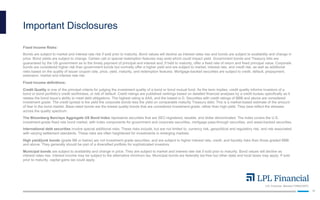
Bonds are subject to market and interest rate risk if sold prior to maturity. Bond values will decline as interest rates rise and bonds are subject to availability and change in
price. Bond yields are subject to change. Certain call or special redemption features may exist which could impact yield. Government bonds and Treasury bills are
guaranteed by the US government as to the timely payment of principal and interest and, if held to maturity, offer a fixed rate of return and fixed principal value. Corporate
bonds are considered higher risk than government bonds but normally offer a higher yield and are subject to market, interest rate, and credit risk, as well as additional
risks based on the quality of issuer coupon rate, price, yield, maturity, and redemption features. Mortgage-backed securities are subject to credit, default, prepayment,
extension, market and interest rate risk.
Fixed Income definitions:
Credit Quality is one of the principal criteria for judging the investment quality of a bond or bond mutual fund. As the term implies, credit quality informs investors of a
bond or bond portfolio’s credit worthiness, or risk of default. Credit ratings are published rankings based on detailed financial analyses by a credit bureau specifically as it
relates the bond issue’s ability to meet debt obligations. The highest rating is AAA, and the lowest is D. Securities with credit ratings of BBB and above are considered
investment grade. The credit spread is the yield the corporate bonds less the yield on comparable maturity Treasury debt. This is a market-based estimate of the amount
of fear in the bond market. Base-rated bonds are the lowest quality bonds that are considered investment-grade, rather than high-yield. They best reflect the stresses
across the quality spectrum.
The Bloomberg Barclays Aggregate US Bond Index represents securities that are SEC-registered, taxable, and dollar denominated. The index covers the U.S.
investment-grade fixed rate bond market, with index components for government and corporate securities, mortgage pass-through securities, and asset-backed securities.
International debt securities involve special additional risks. These risks include, but are not limited to, currency risk, geopolitical and regulatory risk, and risk associated
with varying settlement standards. These risks are often heightened for investments in emerging markets.
High yield/junk bonds (grade BB or below) are not investment grade securities, and are subject to higher interest rate, credit, and liquidity risks than those graded BBB
and above. They generally should be part of a diversified portfolio for sophisticated investors.
Municipal bonds are subject to availability and change in price. They are subject to market and interest rate risk if sold prior to maturity. Bond values will decline as
interest rates rise. Interest income may be subject to the alternative minimum tax. Municipal bonds are federally tax-free but other state and local taxes may apply. If sold
prior to maturity, capital gains tax could apply.
LPL Financial Member FINRA/SIPC
19
This research material has been prepared by LPL Financial LLC.
Securities and advisory services offered through LPL Financial (LPL), a registered investment advisor and broker-dealer (member FINRA/SIPC). Insurance products are
offered through LPL or its licensed affiliates. To the extent you are receiving investment advice from a separately registered independent investment advisor that is not
an LPL affiliate, please note LPL makes no representation with respect to such entity.
Not Insured by FDIC/NCUA or Any Other Government Agency | Not Bank/Credit Union Guaranteed | Not Bank/Credit Union Deposits or Obligations | May Lose Value
RES-19109-1020 | For Public Use | Tracking #1-05085982 (Exp. 12/21)

Outlook 2021

  • 1.
    LPL Financial MemberFINRA/SIPC 1 placeholder Midyear Outlook 2020 LPL Research Outlook 2021
  • 2.
  • 3.
    LPL Financial MemberFINRA/SIPC 3 Historically, A Split Congress Has Been Positive For Stocks Source: LPL Research, Bloomberg 11/04/20 Data are from 1950–2019. All indexes are unmanaged and cannot be invested into directly. Past performance is no guarantee of future results. The modern design of the S&P 500 stock index was first launched in 1957. Performance back to 1950 incorporates the performance of predecessor index, the S&P 90.
  • 4.
  • 5.
    LPL Financial MemberFINRA/SIPC 5 New Economic Expansion May Have Years to Run Source: LPL Research, National Bureau of Economic Research 11/06/20 Economic forecasts set forth may not develop as predicted and are subject to change. While NBER has not officially dated the end of the recession, and typically does not until approximately a year after the economy has troughed, on average, we are provisionally dating summer 2020 as the economic trough based on record retail sales and expanding manufacturing and services data.
  • 6.
    LPL Financial MemberFINRA/SIPC 6 K-Shaped Recovery: High-Wage Job Market Has Held Up Better During COVID-19 in 2020 Source: LPL Research, Opportunity Insights 11/01/20 Median unemployment measured as median between high- and low-wage unemployment rates
  • 7.
    LPL Financial MemberFINRA/SIPC 7 2021 Economic Forecasts—Rebound in Global Growth Expected as COVID-19 Threat Diminishes Source: LPL Research, Bloomberg 11/06/20 Economic forecasts set forth may not develop as predicted and are subject to change. 2020 GDP and 2020 and 2021 inflation and unemployment forecasts are based on Bloomberg-surveyed economists’ consensus. 2021 GDP estimates are LPL forecasts. Inflation is measured by the Consumer Price Index. Unemployment rate provided by US Department of Labor.
  • 8.
  • 9.
    LPL Financial MemberFINRA/SIPC 9 2021 US Market Forecasts—Earnings Rebound May Fuel Solid Gains for Stocks in 2021 Source: LPL Research, Bloomberg, FactSet 11/06/20 * FactSet consensus estimate Economic forecasts may not develop as predicted and are subject to change.
  • 10.
    LPL Financial MemberFINRA/SIPC 10 New Bull Markets Historically Have Built on Strong First-year Gains Source: LPL Research, FactSet 11/06/20 Includes returns following declines of 30% or more in the S&P 500 Index since 1970. Year 2 returns include benefits of compounding from year 1 returns. All indexes are unmanaged and can't be invested in directly. Past performance is no guarantee of future results.
  • 11.
    LPL Financial MemberFINRA/SIPC 11 Earnings Poised for a Sharp Rebound in 2021 and 2022 Source: LPL Research, FactSet 11/06/20 Economic forecasts may not develop as predicted and are subject to change.
  • 12.
    LPL Financial MemberFINRA/SIPC 12
  • 13.
    LPL Financial MemberFINRA/SIPC 13 Large Declines in US Treasury Yields Have Turned Higher Over the Next Year Source: LPL Research, Federal Reserve 11/01/20
  • 14.
    LPL Financial MemberFINRA/SIPC 14 High-Quality Bonds Have Held Up During Equity Market Declines Source: LPL Research, FactSet 11/01/20 All indexes are unmanaged and can’t be invested in directly. Past performance is no guarantee of future results. Indexes (from left to right): S&P 500 Index, Bloomberg Barclays US Aggregate Bond Index, Bloomberg Barclays US Aggregate Government - Treasury Index.
  • 15.
    LPL Financial MemberFINRA/SIPC 15
  • 16.
    LPL Financial MemberFINRA/SIPC 16 Important Disclosures The opinions, statements and forecasts presented herein are general information only and are not intended to provide specific investment advice or recommendations for any individual. It does not take into account the specific investment objectives, tax and financial condition, or particular needs of any specific person. There is no assurance that the strategies or techniques discussed are suitable for all investors or will be successful. To determine which investment(s) may be appropriate for you, please consult your financial professional prior to investing. Any forward-looking statements including the economic forecasts herein may not develop as predicted and are subject to change based on future market and other conditions. All performance referenced is historical and is no guarantee of future results. References to markets, asset classes, and sectors are generally regarding the corresponding market index. Indexes are unmanaged statistical composites and cannot be invested into directly. Index performance is not indicative of the performance of any investment and does not reflect fees, expenses, or sales charges. All performance referenced is historical and is no guarantee of future results. Any company names noted herein are for educational purposes only and not an indication of trading intent or a solicitation of their products or services. LPL Financial doesn’t provide research on individual equities. All index data from FactSet. All information is believed to be from reliable sources; however, LPL Financial makes no representation as to its completeness or accuracy. General Risk disclosures: Investing involves risks including possible loss of principal. No investment strategy or risk management technique can guarantee return or eliminate risk in all market environments. There is no guarantee that a diversified portfolio will enhance overall returns or outperform a non-diversified portfolio. Diversification does not protect against market risk. Investing in foreign and emerging markets debt or securities involves special additional risks. These risks include, but are not limited to, currency risk, geopolitical risk, and risk associated with varying accounting standards. Investing in emerging markets may accentuate these risks. General Definitions: Gross Domestic Product (GDP) is the monetary value of all the finished goods and services produced within a country’s borders in a specific time period, though GDP is usually calculated on an annual basis. It includes all of private and public consumption, government outlays, investments and exports less imports that occur within a defined territory.
  • 17.
    LPL Financial MemberFINRA/SIPC 17 Important Disclosures The PE ratio (price-to-earnings ratio) is a measure of the price paid for a share relative to the annual net income or profit earned by the firm per share. It is a financial ratio used for valuation: a higher PE ratio means that investors are paying more for each unit of net income, so the stock is more expensive compared to one with lower PE ratio. Earnings per share (EPS) is the portion of a company’s profit allocated to each outstanding share of common stock. EPS serves as an indicator of a company’s profitability. Earnings per share is generally considered to be the single most important variable in determining a share’s price. It is also a major component used to calculate the price-to- earnings valuation ratio.SP500 The Standard & Poor’s 500 Index is a capitalization-weighted index of 500 stocks designed to measure performance of the broad domestic economy through changes in the aggregate market value of 500 stocks representing all major industries. The Bloomberg Barclays US Aggregate Bond Index is an index of the U.S. investment-grade fixed-rate bond market, including both government and corporate bonds. Equity Risk: Investing in stock includes numerous specific risks including the fluctuation of dividend, loss of principal and potential illiquidity of the investment in a falling market. Because of their narrow focus, sector investing will be subject to greater volatility than investing more broadly across many sectors and companies. Value investments can perform differently from the market as a whole. They can remain undervalued by the market for long periods of time. The prices of small and mid-cap stocks are generally more volatile than large cap stocks. Equity Definitions: Cyclical stocks typically relate to equity securities of companies whose price is affected by ups and downs in the overall economy and that sell discretionary items that consumers may buy more of during an economic expansion but cut back on during a recession. Counter-cyclical stocks tend to move in the opposite direction from the overall economy and with consumer staples which people continue to demand even during a downturn. A growth stock is a share in a company that is anticipated to grow at a rate significantly above the average for the market due to capital appreciation. A value stock is anticipated to grow above the average for the market due to trading at a lower price relative to its fundamentals, such as dividends, earnings, or sales. A Value stock is anticipated to grow above the average for the market due to trading at a lower price relative to its fundamentals, such as dividends, earnings, or sales. Large-cap stocks are issued by corporations with a market capitalization of $10 billion or more, and small-cap stocks are issued by corporations with a market capitalization between $250 million and $2 billion.
  • 18.
    LPL Financial MemberFINRA/SIPC 18 Important Disclosures Fixed Income Risks: Bonds are subject to market and interest rate risk if sold prior to maturity. Bond values will decline as interest rates rise and bonds are subject to availability and change in price. Bond yields are subject to change. Certain call or special redemption features may exist which could impact yield. Government bonds and Treasury bills are guaranteed by the US government as to the timely payment of principal and interest and, if held to maturity, offer a fixed rate of return and fixed principal value. Corporate bonds are considered higher risk than government bonds but normally offer a higher yield and are subject to market, interest rate, and credit risk, as well as additional risks based on the quality of issuer coupon rate, price, yield, maturity, and redemption features. Mortgage-backed securities are subject to credit, default, prepayment, extension, market and interest rate risk. Fixed Income definitions: Credit Quality is one of the principal criteria for judging the investment quality of a bond or bond mutual fund. As the term implies, credit quality informs investors of a bond or bond portfolio’s credit worthiness, or risk of default. Credit ratings are published rankings based on detailed financial analyses by a credit bureau specifically as it relates the bond issue’s ability to meet debt obligations. The highest rating is AAA, and the lowest is D. Securities with credit ratings of BBB and above are considered investment grade. The credit spread is the yield the corporate bonds less the yield on comparable maturity Treasury debt. This is a market-based estimate of the amount of fear in the bond market. Base-rated bonds are the lowest quality bonds that are considered investment-grade, rather than high-yield. They best reflect the stresses across the quality spectrum. The Bloomberg Barclays Aggregate US Bond Index represents securities that are SEC-registered, taxable, and dollar denominated. The index covers the U.S. investment-grade fixed rate bond market, with index components for government and corporate securities, mortgage pass-through securities, and asset-backed securities. International debt securities involve special additional risks. These risks include, but are not limited to, currency risk, geopolitical and regulatory risk, and risk associated with varying settlement standards. These risks are often heightened for investments in emerging markets. High yield/junk bonds (grade BB or below) are not investment grade securities, and are subject to higher interest rate, credit, and liquidity risks than those graded BBB and above. They generally should be part of a diversified portfolio for sophisticated investors. Municipal bonds are subject to availability and change in price. They are subject to market and interest rate risk if sold prior to maturity. Bond values will decline as interest rates rise. Interest income may be subject to the alternative minimum tax. Municipal bonds are federally tax-free but other state and local taxes may apply. If sold prior to maturity, capital gains tax could apply.
  • 19.
    LPL Financial MemberFINRA/SIPC 19 This research material has been prepared by LPL Financial LLC. Securities and advisory services offered through LPL Financial (LPL), a registered investment advisor and broker-dealer (member FINRA/SIPC). Insurance products are offered through LPL or its licensed affiliates. To the extent you are receiving investment advice from a separately registered independent investment advisor that is not an LPL affiliate, please note LPL makes no representation with respect to such entity. Not Insured by FDIC/NCUA or Any Other Government Agency | Not Bank/Credit Union Guaranteed | Not Bank/Credit Union Deposits or Obligations | May Lose Value RES-19109-1020 | For Public Use | Tracking #1-05085982 (Exp. 12/21)