https://www.youtube.com/watch?v=H3De429jdIE
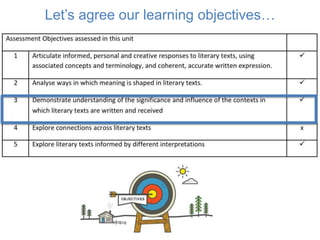
Let’s agree our learning objectives…
https://prezi.com/cfhhjlpdw6sa/marxism-in-act-5-
othello/
In Act One of Othello Brabantio, the father of Desdemona, confronts his new
son-in-law in the presence of the Duke. Furious over his daughter’s elopement,
he insists that Othello must have engaged in witchcraft to coerce her into this
interracial marriage. Othello reveals that, in fact, the courtship was based upon
words; more specifically, that Desdemona fell in love with him as she listened
to his stories. The Duke, clearly convinced that Othello is an honorable man,
attempts to console Brabantio, listing the reasons why anger should be forgot-
ten and peace embraced. Brabantio rebuts this argument, however, saying, “But
words are words. I never did hear/That the bruised heart was pierced through
the ear” (1.3.217–20). Brabantio dismisses language as impotent, rejecting the
possibility that Othello’s stories could have won the heart of Desdemona.
From Othello’s perspective, however, words are never just merely words. Othello
isthegreatstoryteller.Hisheroictalesofwar,slavery,andtravelcreatehisactuality
and his identity: that of army general, renowned warrior, respected citizen, and
adored husband. Stephen Greenblatt refers to Othello’s stories as “narrative self-
fashioning,” stating that “Othello characteristically responds to his
experience by shaping it as a story” (243). Lisa Hopkins writes
of “Othello’s absolute faith in the reliability of his own story
as a transparent mediator of his experiences” (164).
The Moor of Venice is not only a valiant warrior but also a man who knows the
power of words. It is not simply Othello’s prowess on the battlefield that wins him
his role in the Senate and the hand of Desdemona. Rather, it is his storytelling, his
ability to create and recreate his life’s narrative, that enables his success in civilian
life. This paper argues that Othello does not merely believe that individual, abstract words
signify actuality but also that words can create actuality when they are spoken.
From the time Othello bids Iago to “give thy worst of thoughts the worst of words,”
he gives over control of his own narrative and therefore, his future.
Othello ao4
Othello ao4

Othello ao4

  • 1.
  • 2.
    Let’s agree ourlearning objectives…
  • 3.
  • 7.
    In Act Oneof Othello Brabantio, the father of Desdemona, confronts his new son-in-law in the presence of the Duke. Furious over his daughter’s elopement, he insists that Othello must have engaged in witchcraft to coerce her into this interracial marriage. Othello reveals that, in fact, the courtship was based upon words; more specifically, that Desdemona fell in love with him as she listened to his stories. The Duke, clearly convinced that Othello is an honorable man, attempts to console Brabantio, listing the reasons why anger should be forgot- ten and peace embraced. Brabantio rebuts this argument, however, saying, “But words are words. I never did hear/That the bruised heart was pierced through the ear” (1.3.217–20). Brabantio dismisses language as impotent, rejecting the possibility that Othello’s stories could have won the heart of Desdemona. From Othello’s perspective, however, words are never just merely words. Othello isthegreatstoryteller.Hisheroictalesofwar,slavery,andtravelcreatehisactuality and his identity: that of army general, renowned warrior, respected citizen, and adored husband. Stephen Greenblatt refers to Othello’s stories as “narrative self- fashioning,” stating that “Othello characteristically responds to his experience by shaping it as a story” (243). Lisa Hopkins writes of “Othello’s absolute faith in the reliability of his own story as a transparent mediator of his experiences” (164).
  • 8.
    The Moor ofVenice is not only a valiant warrior but also a man who knows the power of words. It is not simply Othello’s prowess on the battlefield that wins him his role in the Senate and the hand of Desdemona. Rather, it is his storytelling, his ability to create and recreate his life’s narrative, that enables his success in civilian life. This paper argues that Othello does not merely believe that individual, abstract words signify actuality but also that words can create actuality when they are spoken. From the time Othello bids Iago to “give thy worst of thoughts the worst of words,” he gives over control of his own narrative and therefore, his future.

Editor's Notes

  • #2 p4l
  • #4 pni
  • #5 CM- plan an answer by applying ms to question
  • #6 A2D –modeled answer
  • #7 R- What else is there to say? Plan the rest of the answer in prep for next lesson
  • #11 R2- peer assessment and feedback from group