Old Testament Sunday School 
This Week 
Lesson 32: 
“I Know That My Redeemer Liveth” 
Next Week: Old Testament 
Lesson 33: 
“Sharing the Gospel with the World” 
Daniel Burgess 
daniel.burgess@gmail.com 
408-813-5671 voice/text
“I Know That My Redeemer Liveth” 
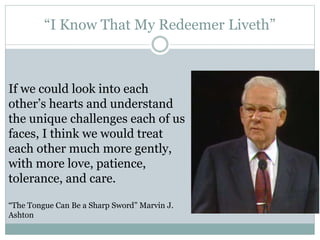
If we could look into each 
other’s hearts and understand 
the unique challenges each of us 
faces, I think we would treat 
each other much more gently, 
with more love, patience, 
tolerance, and care. 
“The Tongue Can Be a Sharp Sword” Marvin J. 
Ashton
“I Know That My Redeemer Liveth” 
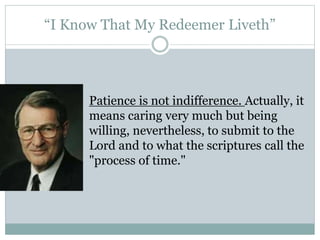
Patience is not indifference. Actually, it 
means caring very much but being 
willing, nevertheless, to submit to the 
Lord and to what the scriptures call the 
"process of time."
“I Know That My Redeemer Liveth” 
Patience is tied very closely to faith in our 
Heavenly Father. Actually, when we are 
unduly impatient we are suggesting that 
we know what is best—better than does 
God. Or, at least, we are asserting that 
our timetable is better than His.
“I Know That My Redeemer Liveth” 
Either way we are questioning the reality 
of God's omniscience as if, as some seem 
to believe, God were on some sort of 
postdoctoral fellowship and were not 
quite in charge of everything. 
…it is required of us, not only that we 
endure, but also that we endure well, that 
we exhibit “grace under pressure.”
Who is Job? 
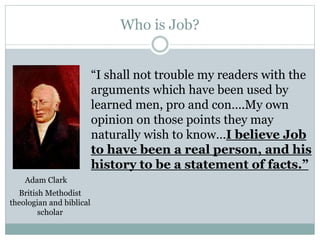
“I shall not trouble my readers with the 
arguments which have been used by 
learned men, pro and con….My own 
opinion on those points they may 
naturally wish to know…I believe Job 
to have been a real person, and his 
history to be a statement of facts.” 
Adam Clark 
British Methodist 
theologian and biblical 
scholar
Who is Job? 
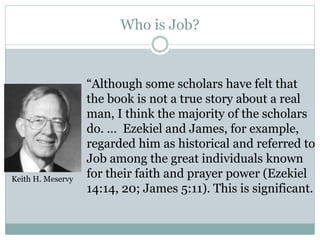
“Although some scholars have felt that 
the book is not a true story about a real 
man, I think the majority of the scholars 
do. … Ezekiel and James, for example, 
regarded him as historical and referred to 
Job among the great individuals known 
for their faith and prayer power (Ezekiel 
14:14, 20; James 5:11). This is significant. 
Keith H. Meservy
Who is Job? 
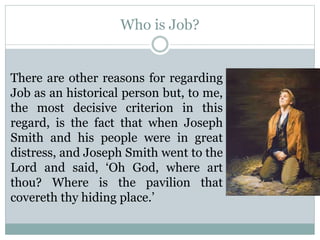
There are other reasons for regarding 
Job as an historical person but, to me, 
the most decisive criterion in this 
regard, is the fact that when Joseph 
Smith and his people were in great 
distress, and Joseph Smith went to the 
Lord and said, ‘Oh God, where art 
thou? Where is the pavilion that 
covereth thy hiding place.’
Who is Job? 
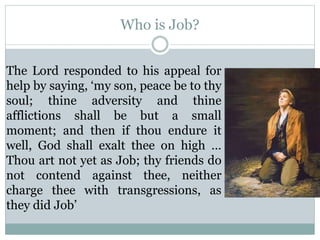
The Lord responded to his appeal for 
help by saying, ‘my son, peace be to thy 
soul; thine adversity and thine 
afflictions shall be but a small 
moment; and then if thou endure it 
well, God shall exalt thee on high … 
Thou art not yet as Job; thy friends do 
not contend against thee, neither 
charge thee with transgressions, as 
they did Job’
Who is Job? 
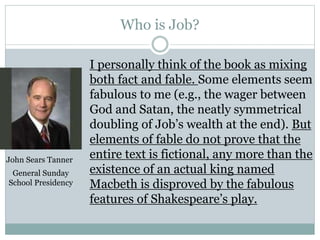
I personally think of the book as mixing 
both fact and fable. Some elements seem 
fabulous to me (e.g., the wager between 
God and Satan, the neatly symmetrical 
doubling of Job’s wealth at the end). But 
elements of fable do not prove that the 
entire text is fictional, any more than the 
existence of an actual king named 
Macbeth is disproved by the fabulous 
features of Shakespeare’s play. 
John Sears Tanner 
General Sunday 
School Presidency
Who is Job? 
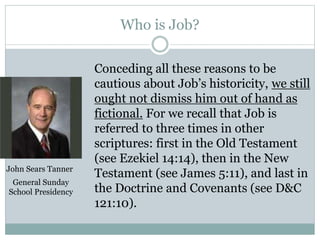
Conceding all these reasons to be 
cautious about Job’s historicity, we still 
ought not dismiss him out of hand as 
fictional. For we recall that Job is 
referred to three times in other 
scriptures: first in the Old Testament 
(see Ezekiel 14:14), then in the New 
Testament (see James 5:11), and last in 
the Doctrine and Covenants (see D&C 
121:10). 
John Sears Tanner 
General Sunday 
School Presidency
Who is Job? 
a. Feared God and shunned evil (Job 1:1). 
b. Humble and Wealthy (Job 1:3, 21). 
c. He had integrity (Job 2:3). 
d. He strengthened the weak (Job 4:3–4). 
e. He Followed the Lord (Job 23:10–12). 
f. A Compassionate Man (Job 29:12–16). 
g. Forgiving of his enemies (Job 31:29–30).
Who is Job? 
a. Loss of servants, property, and income (Job 1:13–17). 
b. Loss of children (Job 1:18–19). 
c. Physical illness and pain (Job 2:7; 7:5; 16:16). 
d. Restless sleep filled with nightmares (Job 7:4, 13–14). 
e. Cruel accusations, Betrayal of friends & Family 
(Job 2:9; 4:1, 7–8; 11:1–6; 19:13–22). 
f. Confusion about these trials (Job 10:15). 
g. Mockery/delighted in his downfall (Job 16:10–11; 30:1, 8–10). 
h. The feeling that God had forgotten him.
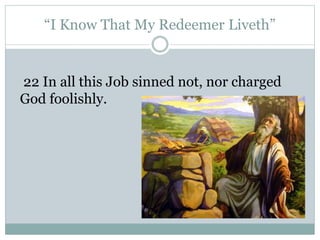
“I Know That My Redeemer Liveth” 
22 In all this Job sinned not, nor charged 
God foolishly.
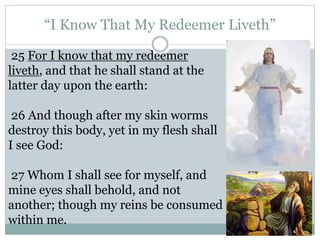
“I Know That My Redeemer Liveth” 
25 For I know that my redeemer 
liveth, and that he shall stand at the 
latter day upon the earth: 
26 And though after my skin worms 
destroy this body, yet in my flesh shall 
I see God: 
27 Whom I shall see for myself, and 
mine eyes shall behold, and not 
another; though my reins be consumed 
within me.
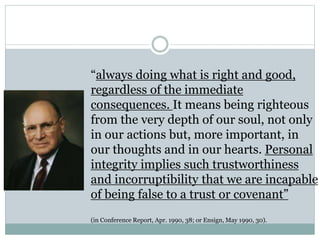
“always doing what is right and good, 
regardless of the immediate 
consequences. It means being righteous 
from the very depth of our soul, not only 
in our actions but, more important, in 
our thoughts and in our hearts. Personal 
integrity implies such trustworthiness 
and incorruptibility that we are incapable 
of being false to a trust or covenant” 
(in Conference Report, Apr. 1990, 38; or Ensign, May 1990, 30).
“I Know That My Redeemer Liveth”

Ot lesson32

  • 1.
    Old Testament SundaySchool This Week Lesson 32: “I Know That My Redeemer Liveth” Next Week: Old Testament Lesson 33: “Sharing the Gospel with the World” Daniel Burgess daniel.burgess@gmail.com 408-813-5671 voice/text
  • 2.
    “I Know ThatMy Redeemer Liveth” If we could look into each other’s hearts and understand the unique challenges each of us faces, I think we would treat each other much more gently, with more love, patience, tolerance, and care. “The Tongue Can Be a Sharp Sword” Marvin J. Ashton
  • 3.
    “I Know ThatMy Redeemer Liveth” Patience is not indifference. Actually, it means caring very much but being willing, nevertheless, to submit to the Lord and to what the scriptures call the "process of time."
  • 4.
    “I Know ThatMy Redeemer Liveth” Patience is tied very closely to faith in our Heavenly Father. Actually, when we are unduly impatient we are suggesting that we know what is best—better than does God. Or, at least, we are asserting that our timetable is better than His.
  • 5.
    “I Know ThatMy Redeemer Liveth” Either way we are questioning the reality of God's omniscience as if, as some seem to believe, God were on some sort of postdoctoral fellowship and were not quite in charge of everything. …it is required of us, not only that we endure, but also that we endure well, that we exhibit “grace under pressure.”
  • 7.
    Who is Job? “I shall not trouble my readers with the arguments which have been used by learned men, pro and con….My own opinion on those points they may naturally wish to know…I believe Job to have been a real person, and his history to be a statement of facts.” Adam Clark British Methodist theologian and biblical scholar
  • 8.
    Who is Job? “Although some scholars have felt that the book is not a true story about a real man, I think the majority of the scholars do. … Ezekiel and James, for example, regarded him as historical and referred to Job among the great individuals known for their faith and prayer power (Ezekiel 14:14, 20; James 5:11). This is significant. Keith H. Meservy
  • 9.
    Who is Job? There are other reasons for regarding Job as an historical person but, to me, the most decisive criterion in this regard, is the fact that when Joseph Smith and his people were in great distress, and Joseph Smith went to the Lord and said, ‘Oh God, where art thou? Where is the pavilion that covereth thy hiding place.’
  • 10.
    Who is Job? The Lord responded to his appeal for help by saying, ‘my son, peace be to thy soul; thine adversity and thine afflictions shall be but a small moment; and then if thou endure it well, God shall exalt thee on high … Thou art not yet as Job; thy friends do not contend against thee, neither charge thee with transgressions, as they did Job’
  • 11.
    Who is Job? I personally think of the book as mixing both fact and fable. Some elements seem fabulous to me (e.g., the wager between God and Satan, the neatly symmetrical doubling of Job’s wealth at the end). But elements of fable do not prove that the entire text is fictional, any more than the existence of an actual king named Macbeth is disproved by the fabulous features of Shakespeare’s play. John Sears Tanner General Sunday School Presidency
  • 12.
    Who is Job? Conceding all these reasons to be cautious about Job’s historicity, we still ought not dismiss him out of hand as fictional. For we recall that Job is referred to three times in other scriptures: first in the Old Testament (see Ezekiel 14:14), then in the New Testament (see James 5:11), and last in the Doctrine and Covenants (see D&C 121:10). John Sears Tanner General Sunday School Presidency
  • 13.
    Who is Job? a. Feared God and shunned evil (Job 1:1). b. Humble and Wealthy (Job 1:3, 21). c. He had integrity (Job 2:3). d. He strengthened the weak (Job 4:3–4). e. He Followed the Lord (Job 23:10–12). f. A Compassionate Man (Job 29:12–16). g. Forgiving of his enemies (Job 31:29–30).
  • 14.
    Who is Job? a. Loss of servants, property, and income (Job 1:13–17). b. Loss of children (Job 1:18–19). c. Physical illness and pain (Job 2:7; 7:5; 16:16). d. Restless sleep filled with nightmares (Job 7:4, 13–14). e. Cruel accusations, Betrayal of friends & Family (Job 2:9; 4:1, 7–8; 11:1–6; 19:13–22). f. Confusion about these trials (Job 10:15). g. Mockery/delighted in his downfall (Job 16:10–11; 30:1, 8–10). h. The feeling that God had forgotten him.
  • 15.
    “I Know ThatMy Redeemer Liveth” 22 In all this Job sinned not, nor charged God foolishly.
  • 16.
    “I Know ThatMy Redeemer Liveth” 25 For I know that my redeemer liveth, and that he shall stand at the latter day upon the earth: 26 And though after my skin worms destroy this body, yet in my flesh shall I see God: 27 Whom I shall see for myself, and mine eyes shall behold, and not another; though my reins be consumed within me.
  • 17.
    “always doing whatis right and good, regardless of the immediate consequences. It means being righteous from the very depth of our soul, not only in our actions but, more important, in our thoughts and in our hearts. Personal integrity implies such trustworthiness and incorruptibility that we are incapable of being false to a trust or covenant” (in Conference Report, Apr. 1990, 38; or Ensign, May 1990, 30).
  • 18.
    “I Know ThatMy Redeemer Liveth”