OSINT for Proactive Defense
Rootconf 2019
# whoami
● Shubham Mittal
○ Director at RedHunt Labs
○ CFP Review Board Member - BlackHat Asia & InSEC World HongKong
○ Co-Founder - Recon Village (DEFCON Hacking Conference)
○ Project Lead - DataSploit (OSINT Framework)
○ 8+ Years Experienced Security and OSINT Enthusiast
○ Expertise in Offensive Security, Perimeter Security, OSINT
○ Speaker/Trainer/Presenter - BlackHat, DEFCON, Nullcon, c0c0n, IETF
○ Bike Rider, Beat Boxer
○ Twitter: @upgoingstar
Agenda
● Overview of OSINT
● Why Security Teams should use OSINT
● Continuous Discovery and Monitoring of Assets
● Use OSINT Data for Periodic Attack Simulation
● Discovering Sensitive Information Leakage
● Monitoring Breached Passwords
● Proactively Identifying Security Incidents using SOCMint
● OSINT Countermeasures
What I mean when I use these..
- Brute Force
- Trial-and-error method used to obtain information such as a user password,
bucket names, subdomains, PIN, OTP Codes, etc.
- Black Box / White Box / Gray Box
- No access to the information / Complete access to the information / Hybrid mode.
- Patch
- Fixing security vulnerabilities and other bugs.
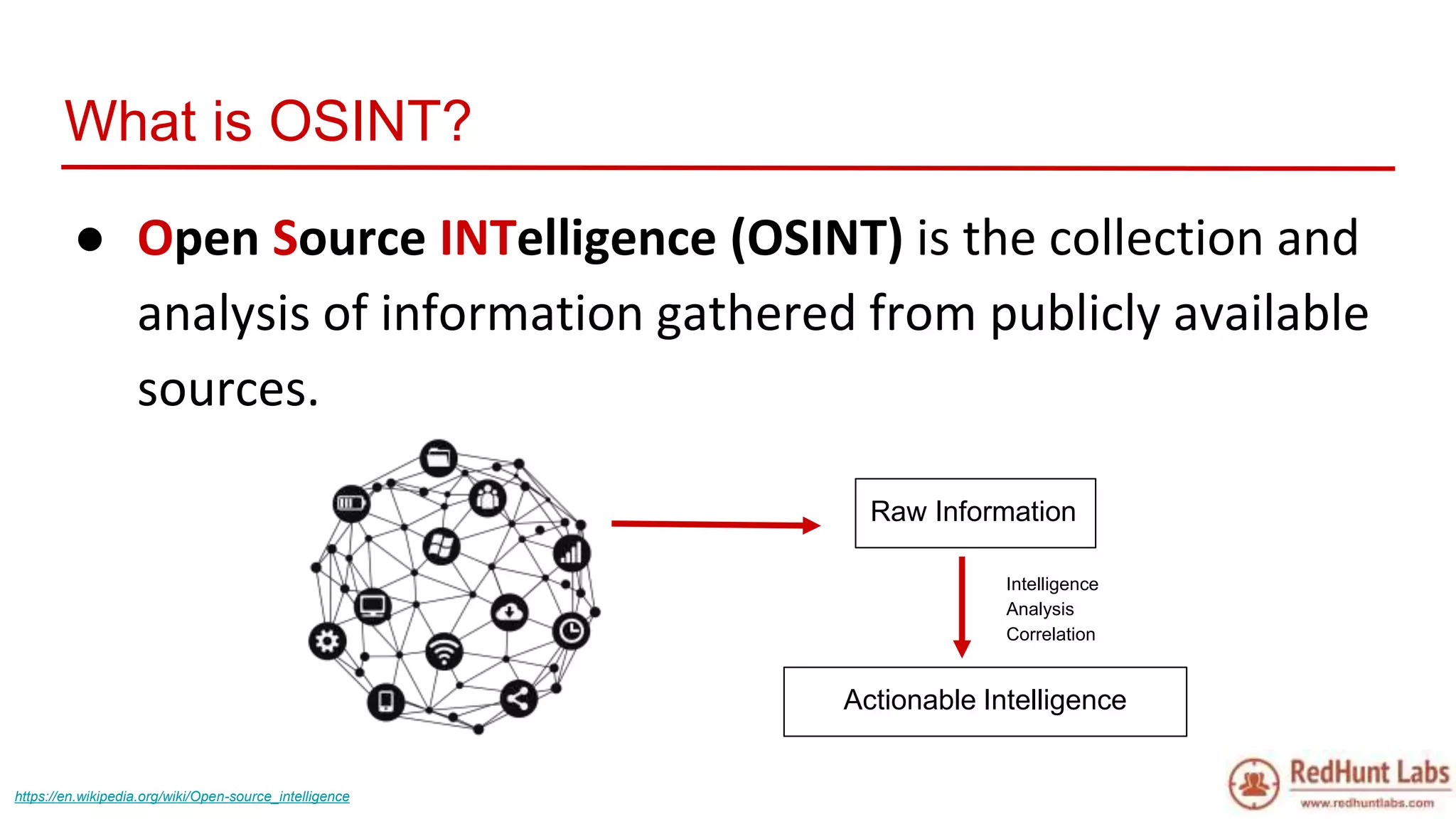
What is OSINT?
● Open Source INTelligence (OSINT) is the collection and
analysis of information gathered from publicly available
sources.
Intelligence
Analysis
Correlation
Raw Information
Actionable Intelligence
https://en.wikipedia.org/wiki/Open-source_intelligence
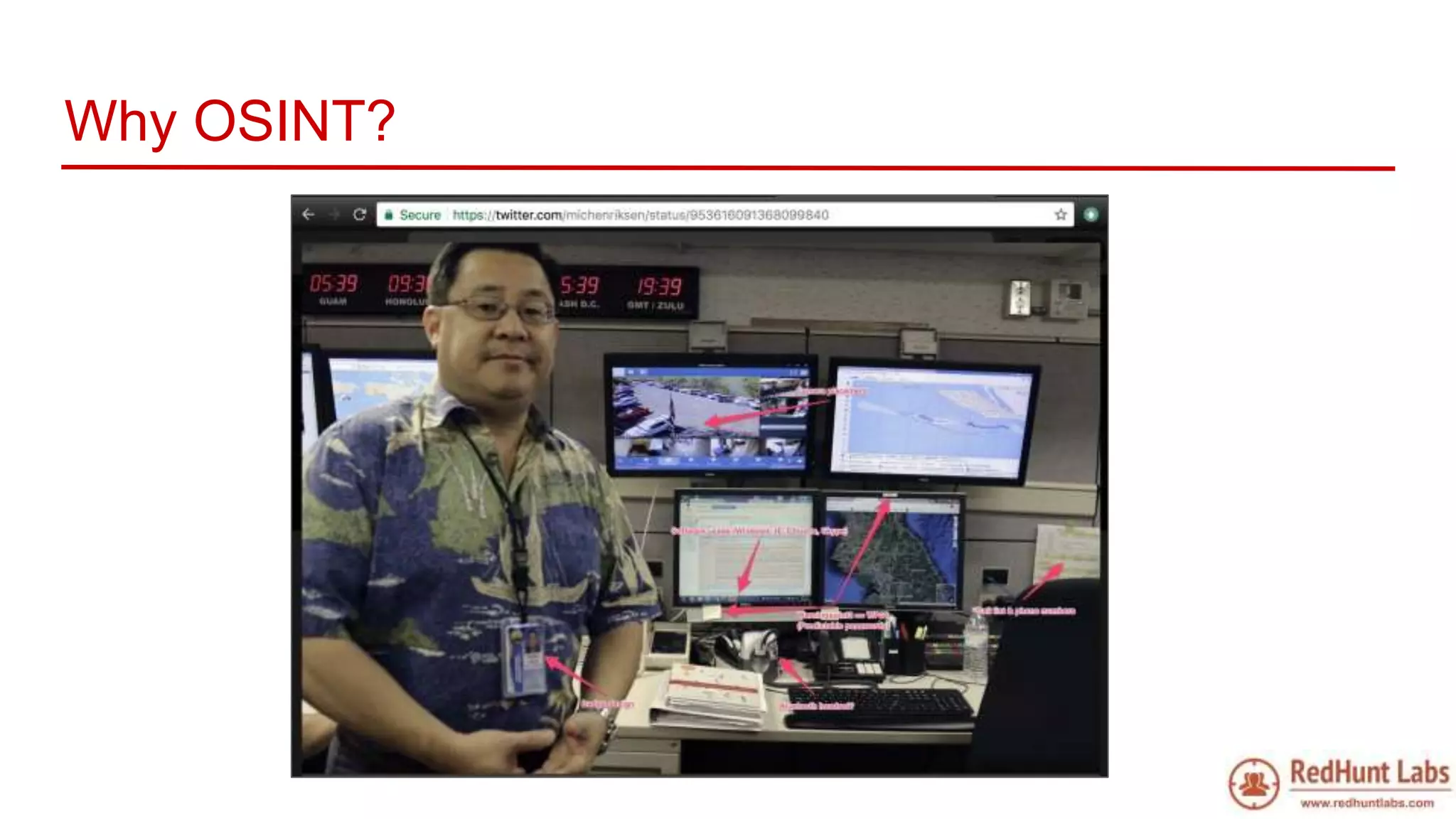
Why OSINT?
Why Security Teams should do OSINT?
Because, Hackers do.
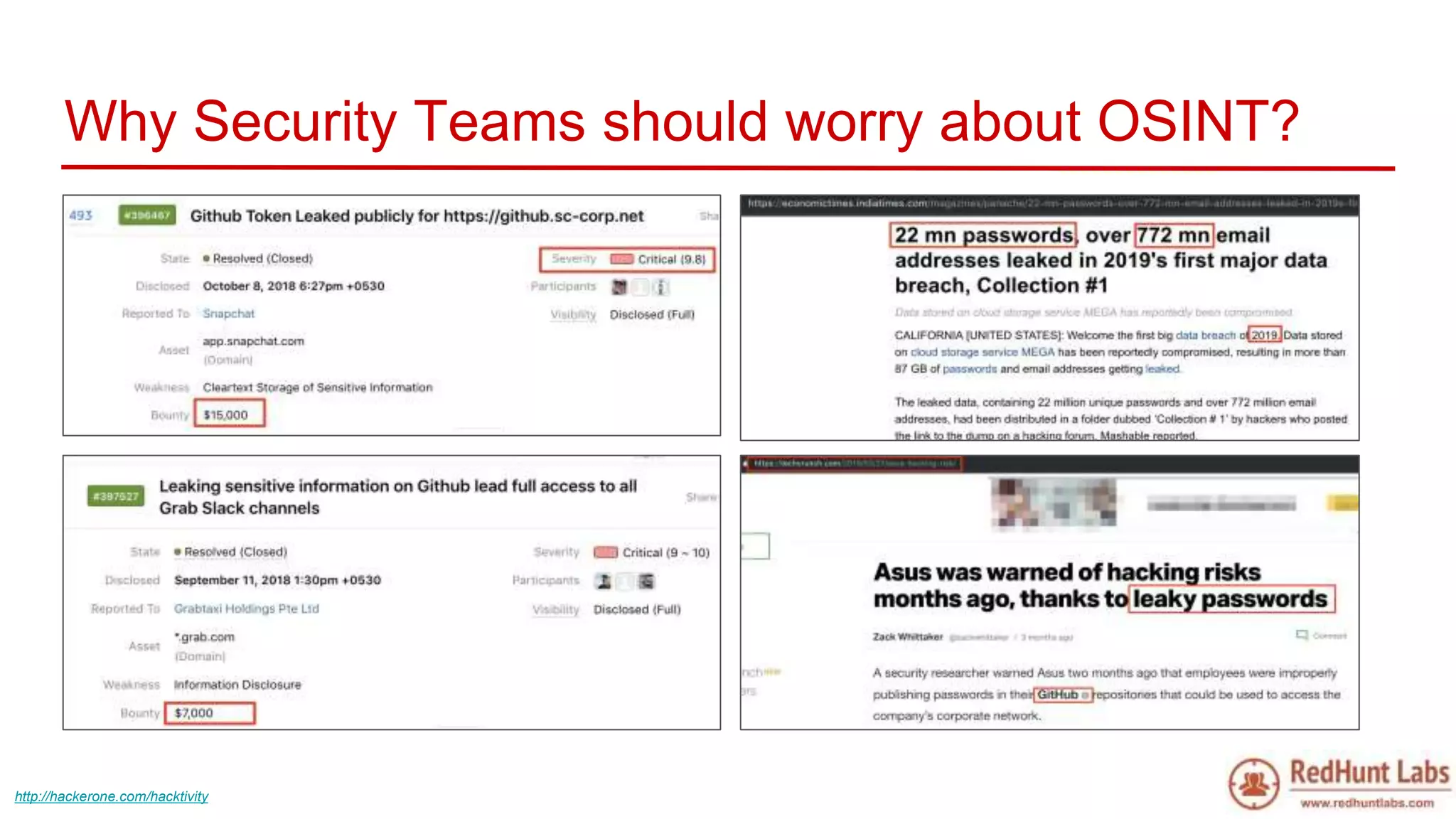
Why Security Teams should worry about OSINT?
● Sensitive Info Leakage on Code Aggregators
● Untracked Assets running Easy Targets
● Frequent Release Cycles, Dynamic Cloud Environments
● Targeted attacks, less noisy. Sometimes, can’t be caught.
● Employees use personal breached passwords in Corporate Accounts.
● Full Patched Systems? How about credentials leak?
Find it before Hackers do.
Why Security Teams should worry about OSINT?
http://hackerone.com/hacktivity
How?
● Continuous Discovery and Monitoring of Assets
● Periodic Attack Simulation
● Discovering Sensitive Information Leakage
● Monitoring Breached Passwords
● Proactively Identifying Security Incidents using SOCMint
What is an Asset?
● Any resource of monetary value.
● Owned by individuals, companies, or governments.
● Example?
○ Servers, HDD, Network Devices, Laptops, Domains, Patents, etc.
● How about..
○ Social Media Accounts, Source Code Repositories, Relevant Dumped Passwords,
Cloud Storage objects (Buckets, Blobs, Spaces, etc.), Elastic IP Addresses, API Keys
and Credentials and a lot more.
○ No monetary value, but can cause huge reputational and financial loss.
https://redhuntlabs.com/blog/redifining-assets-a-modern-perspective.html
Continuous Discovery and Monitoring of Assets
- IP Addresses (Dynamic and Elastic)
- Domains
- Subdomains
- Cloud Storage Objects
- Leaked Credentials / API Keys / etc.
- Social Media Accounts
- Third Party API Keys
- Analytics Tags
- Supply Chain (Vendors, Acquisitions, Mergers, etc.)
- IP Addresses
● Cloud API (WhiteBox)
● DC Administrators (WhiteBox)
● Internet Wide Scans (Project Sonar, Shodan, etc.)
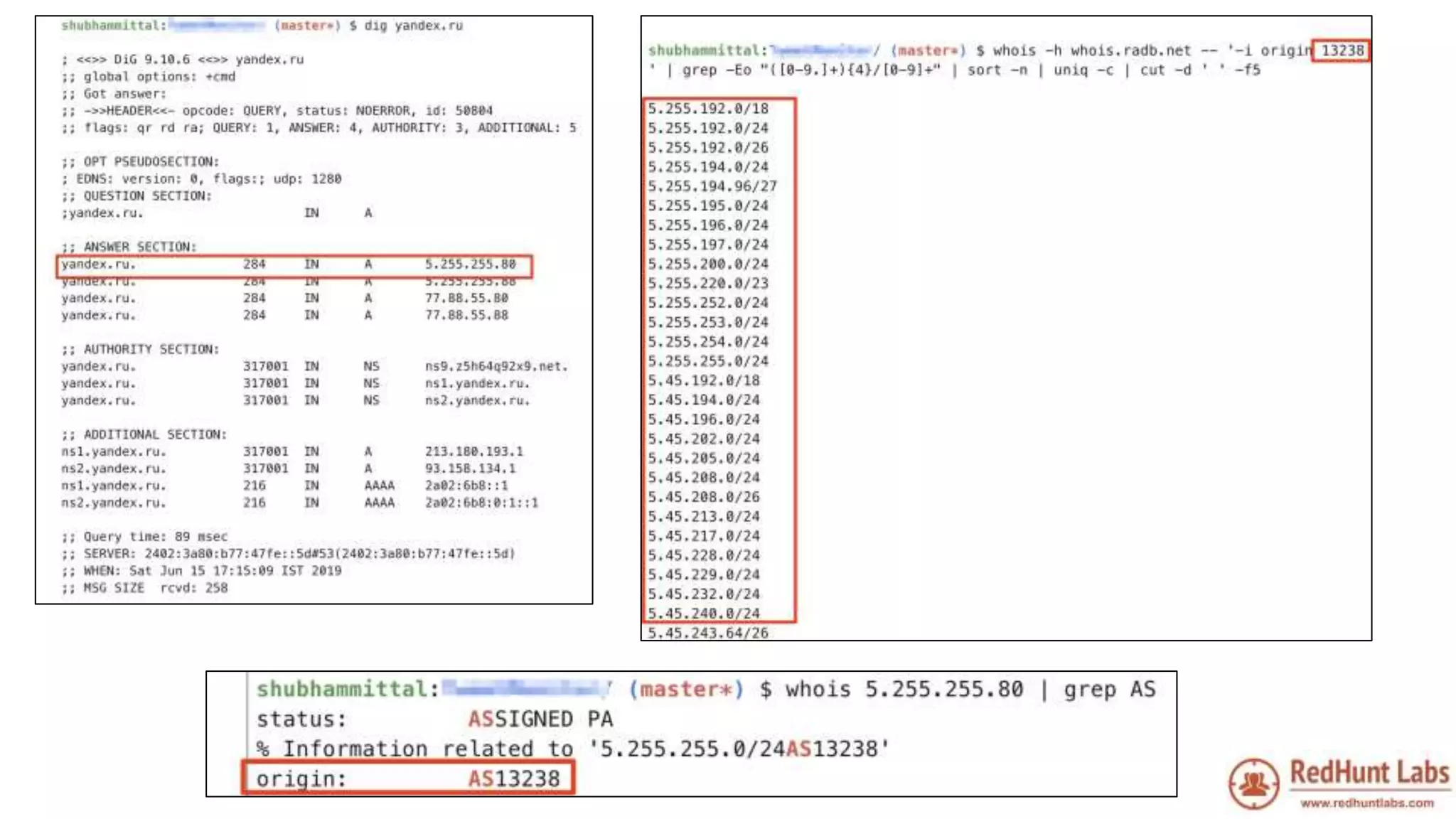
● Using ASN ID (Autonomous Synchronization Number)
● Whois Reverse Search
● Reverse PTR Records
DEMO - WhoIs / ASN ID
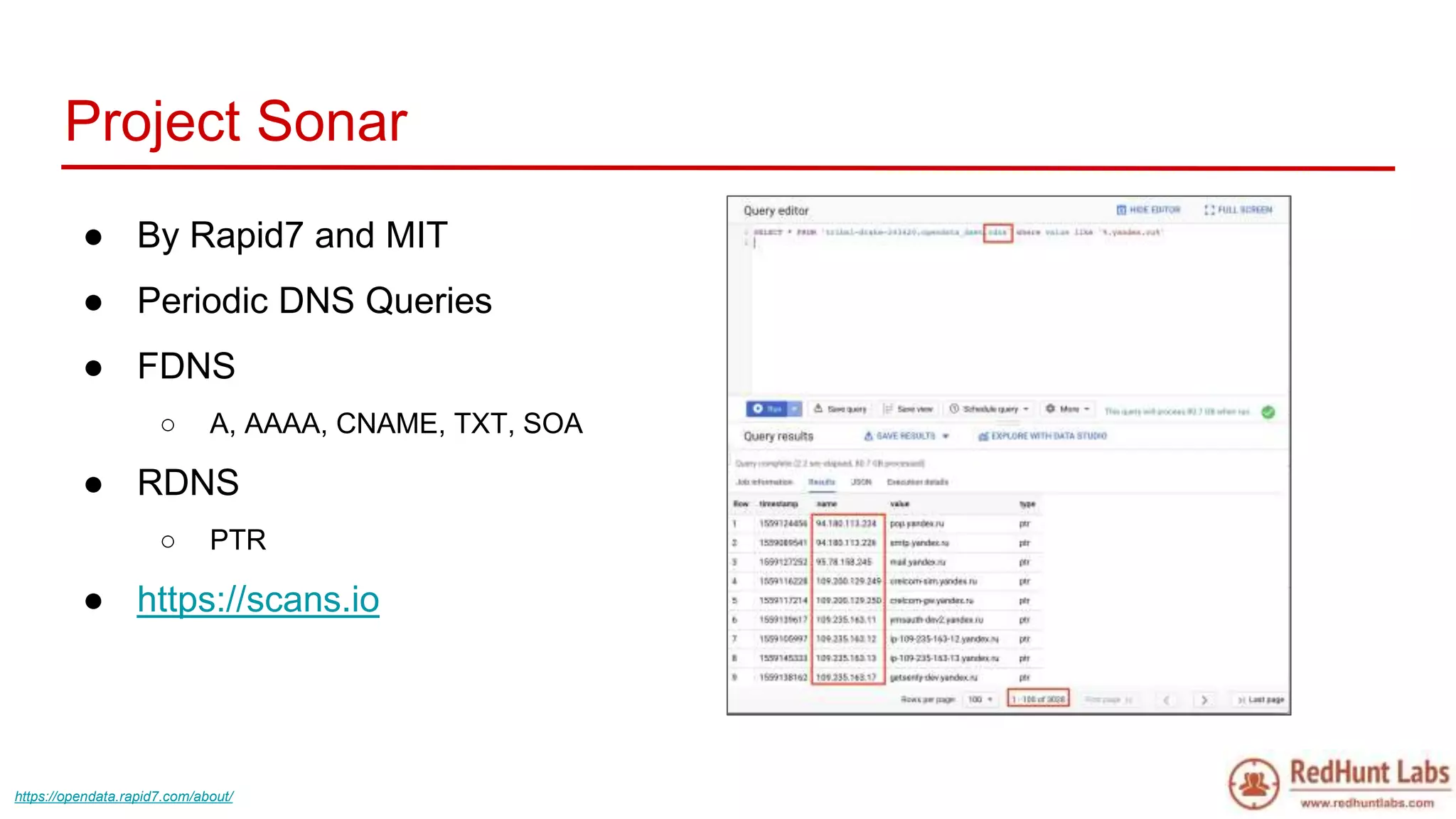
Project Sonar
● By Rapid7 and MIT
● Periodic DNS Queries
● FDNS
○ A, AAAA, CNAME, TXT, SOA
● RDNS
○ PTR
● https://scans.io
https://opendata.rapid7.com/about/
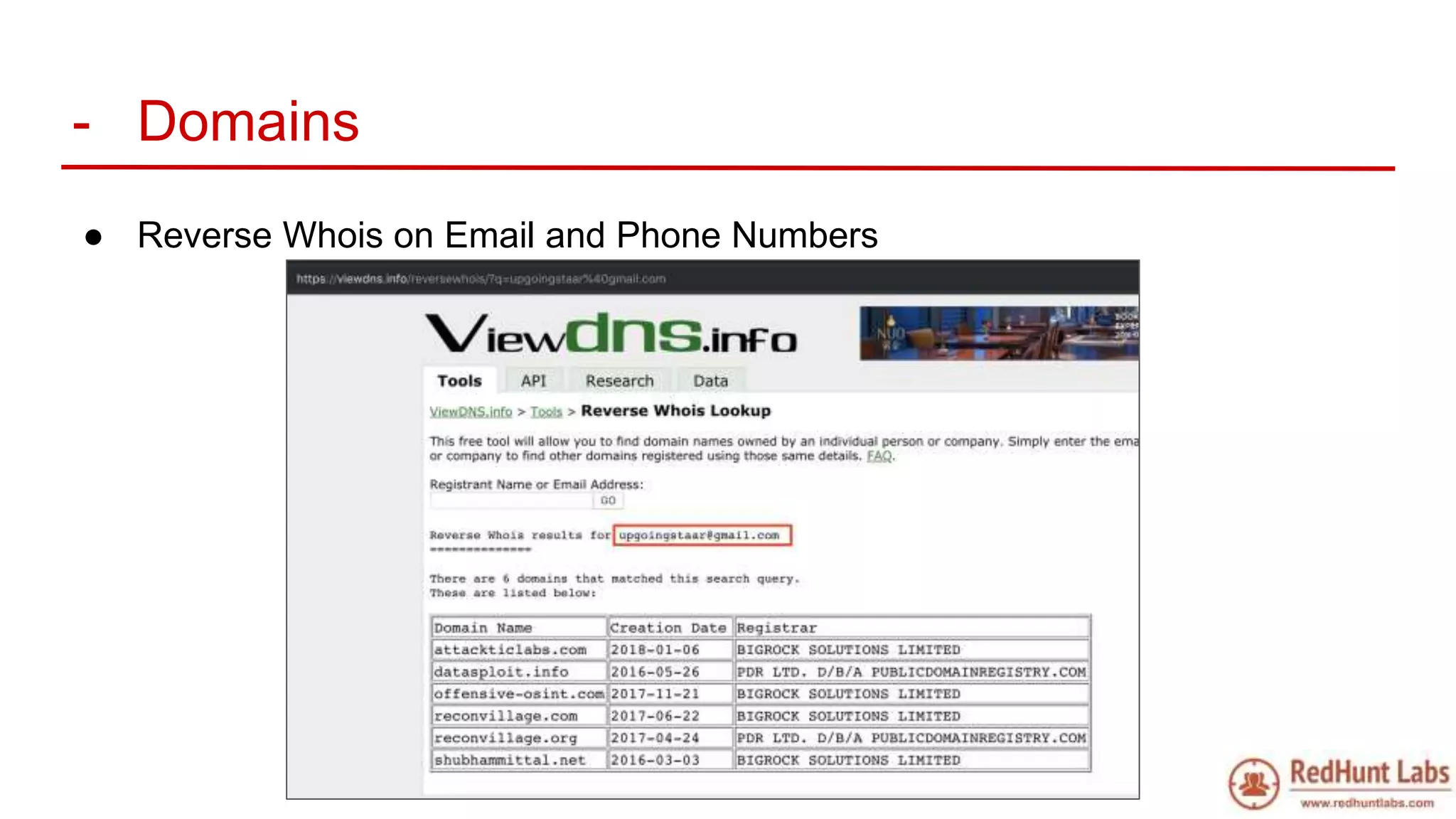
- Domains
● Reverse Whois on Email and Phone Numbers
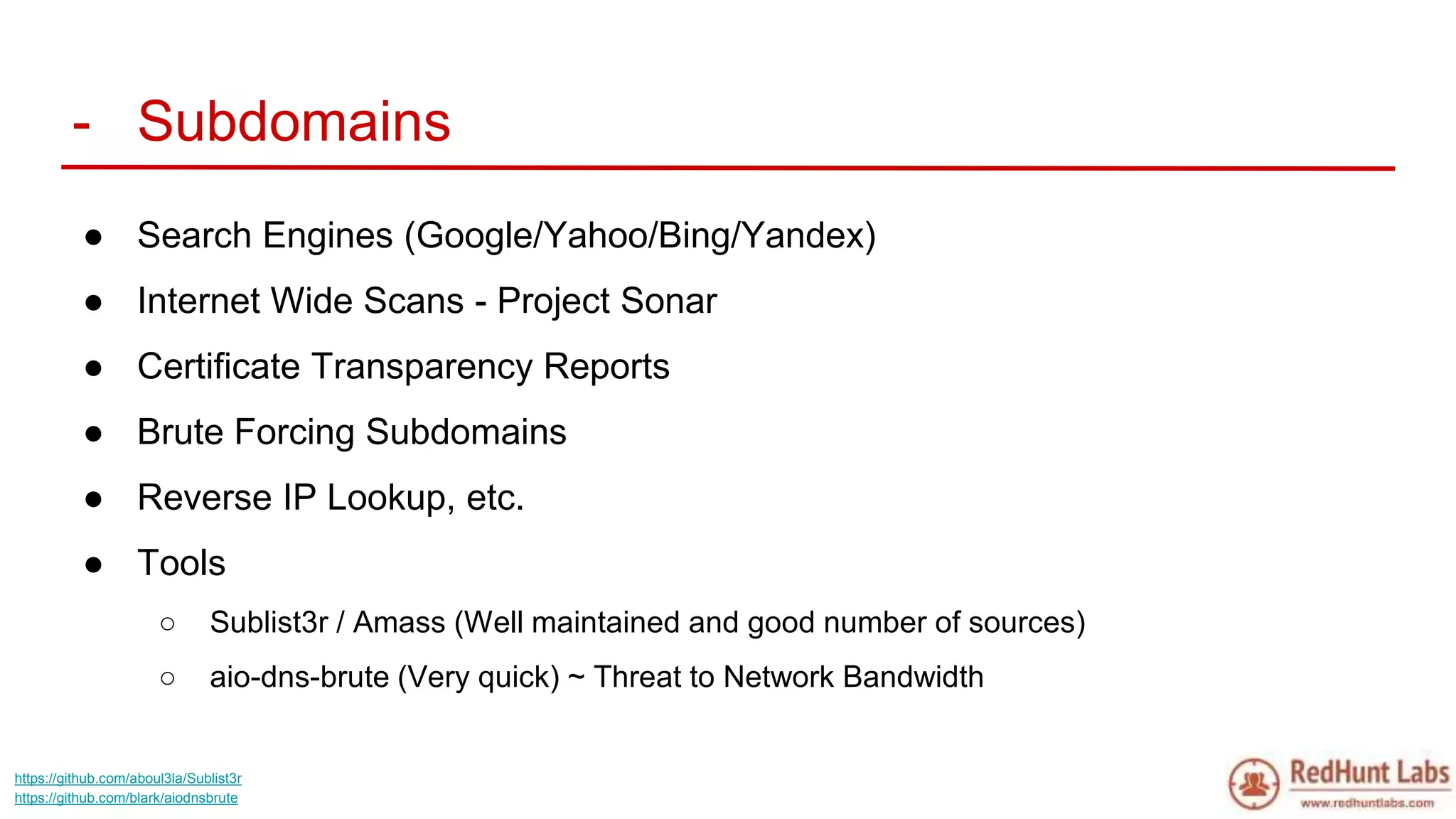
- Subdomains
● Search Engines (Google/Yahoo/Bing/Yandex)
● Internet Wide Scans - Project Sonar
● Certificate Transparency Reports
● Brute Forcing Subdomains
● Reverse IP Lookup, etc.
● Tools
○ Sublist3r / Amass (Well maintained and good number of sources)
○ aio-dns-brute (Very quick) ~ Threat to Network Bandwidth
https://github.com/aboul3la/Sublist3r
https://github.com/blark/aiodnsbrute
DEMO - Open Data Querying
(FDNS/RDNS DataSet)
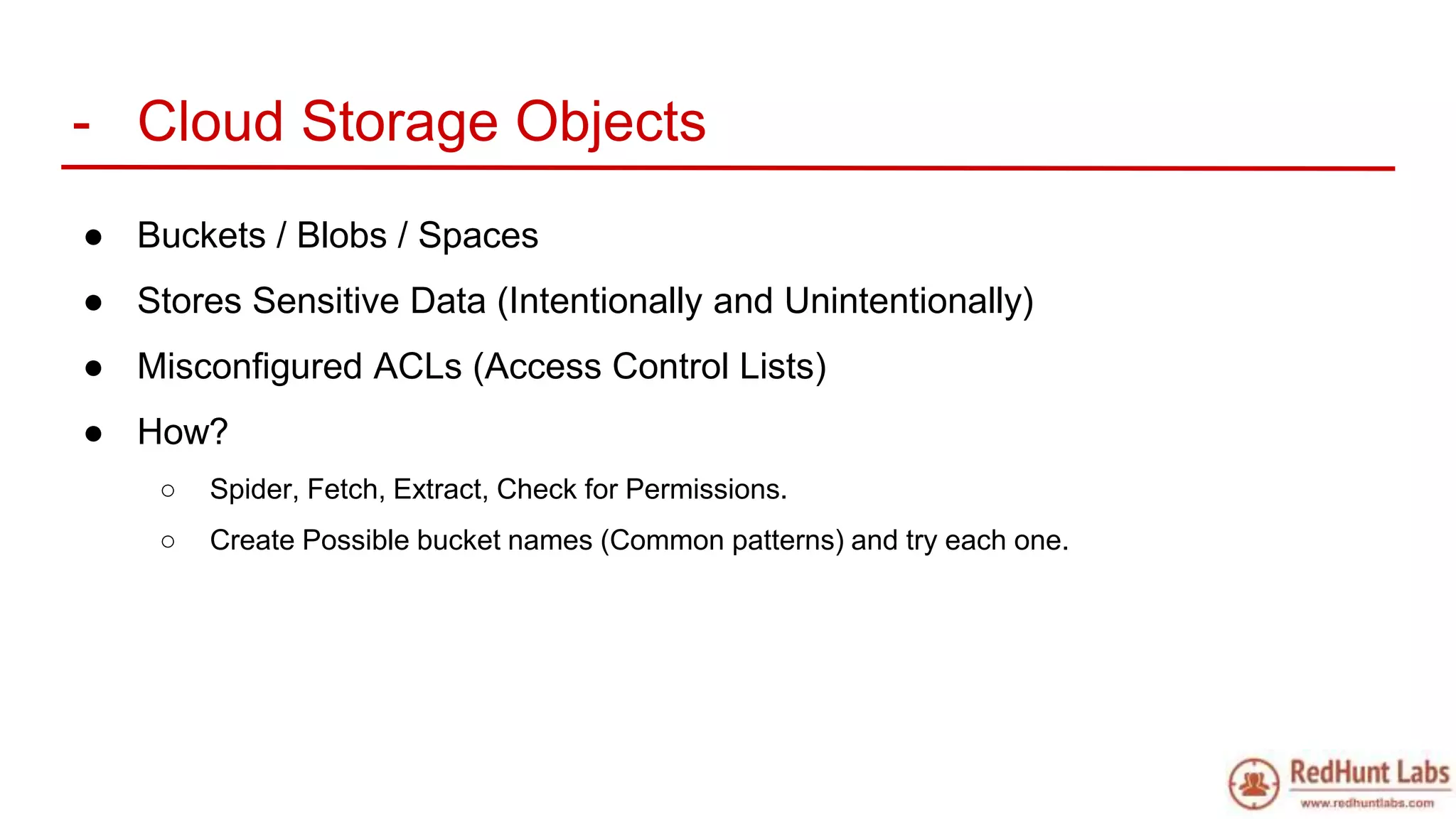
- Cloud Storage Objects
● Buckets / Blobs / Spaces
● Stores Sensitive Data (Intentionally and Unintentionally)
● Misconfigured ACLs (Access Control Lists)
● How?
○ Spider, Fetch, Extract, Check for Permissions.
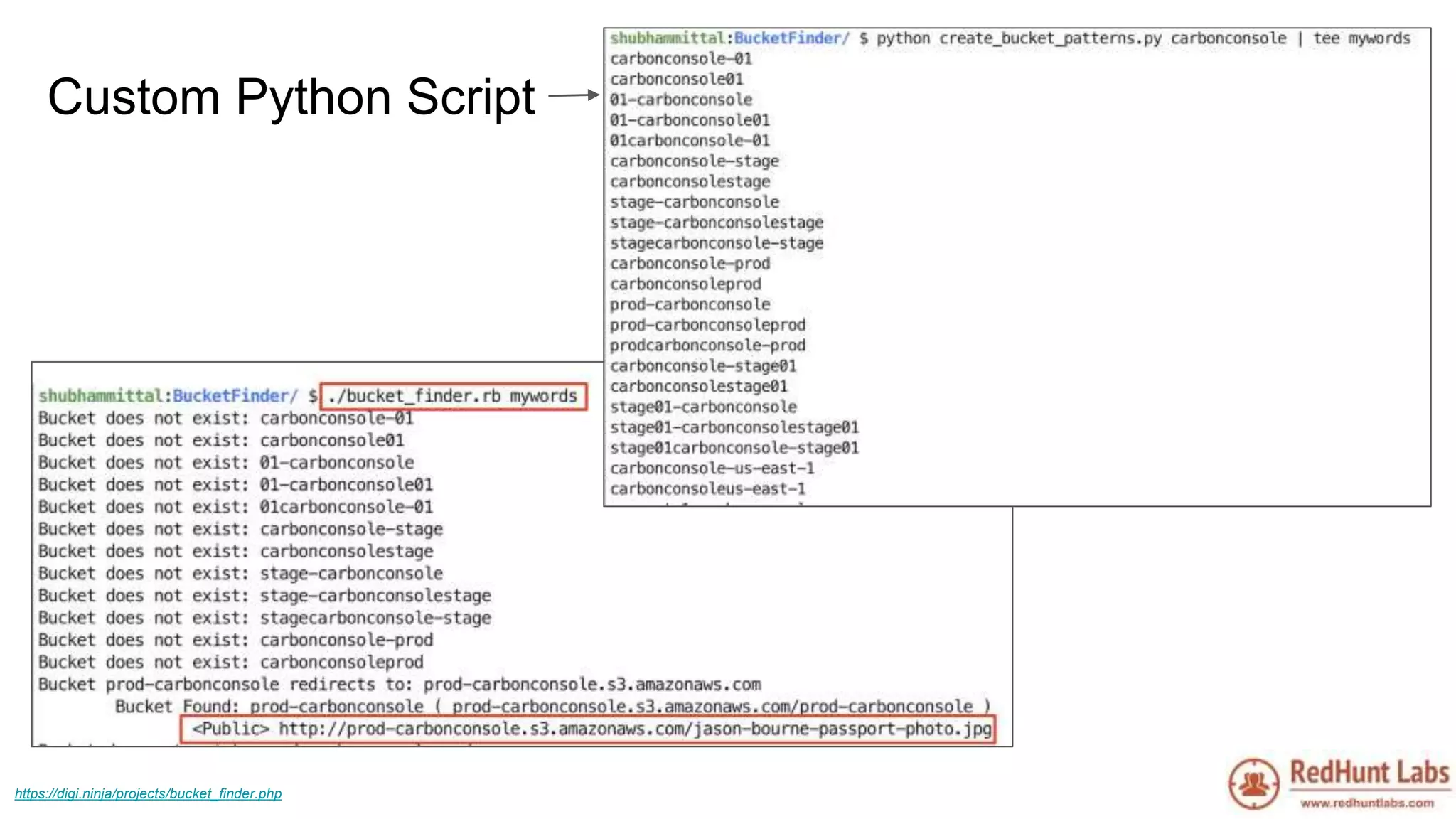
○ Create Possible bucket names (Common patterns) and try each one.
Custom Python Script
https://digi.ninja/projects/bucket_finder.php
- Leaked Creds
● Identify leaked sensitive information.
● Passwords, API Keys, Third Party Access Tokens, DB Creds, Internal domains, etc.
● GitHub, BitBucket, Pastebin, .Onion Websites, etc.
● Identify Organization Repos / Identify Employees and their personal Repos.
● Google CSE (Custom Search Engine)
● Manual Search
○ GitHub Advanced Search
● Automated tools
○ Gitrob, TruffleHog, etc.
https://github.com/search/advanced
https://github.com/michenriksen/gitrob
https://github.com/dxa4481/truffleHog
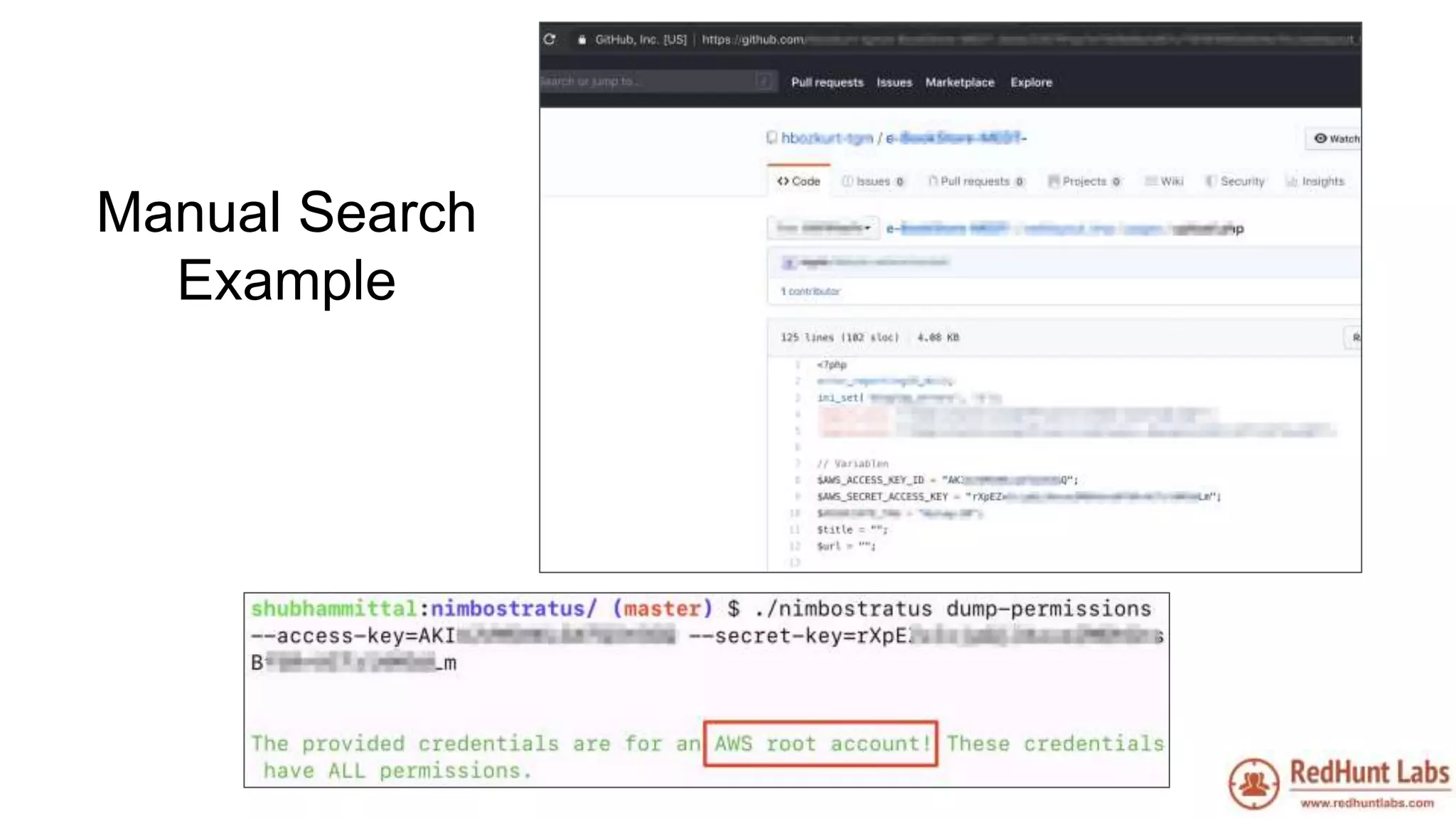
Manual Search
Example
DEMO - TruffleHog
- Social Media Monitoring
- Security Incidents
- Organization Reputation
- Keyword Based Monitoring
- Streaming APIs / Scrapers
- Google Alerts / Page Change Detection
- Tweet-Monitor
- Someone tweets, Alert on Email, Dump to ElasticSearch.
- Dashboards (Users, Frequency, Relationships, Geolocations, etc.)
- https://www.youtube.com/watch?v=OjLP5k5NIMY
https://github.com/upgoingstar/TweetMonitor
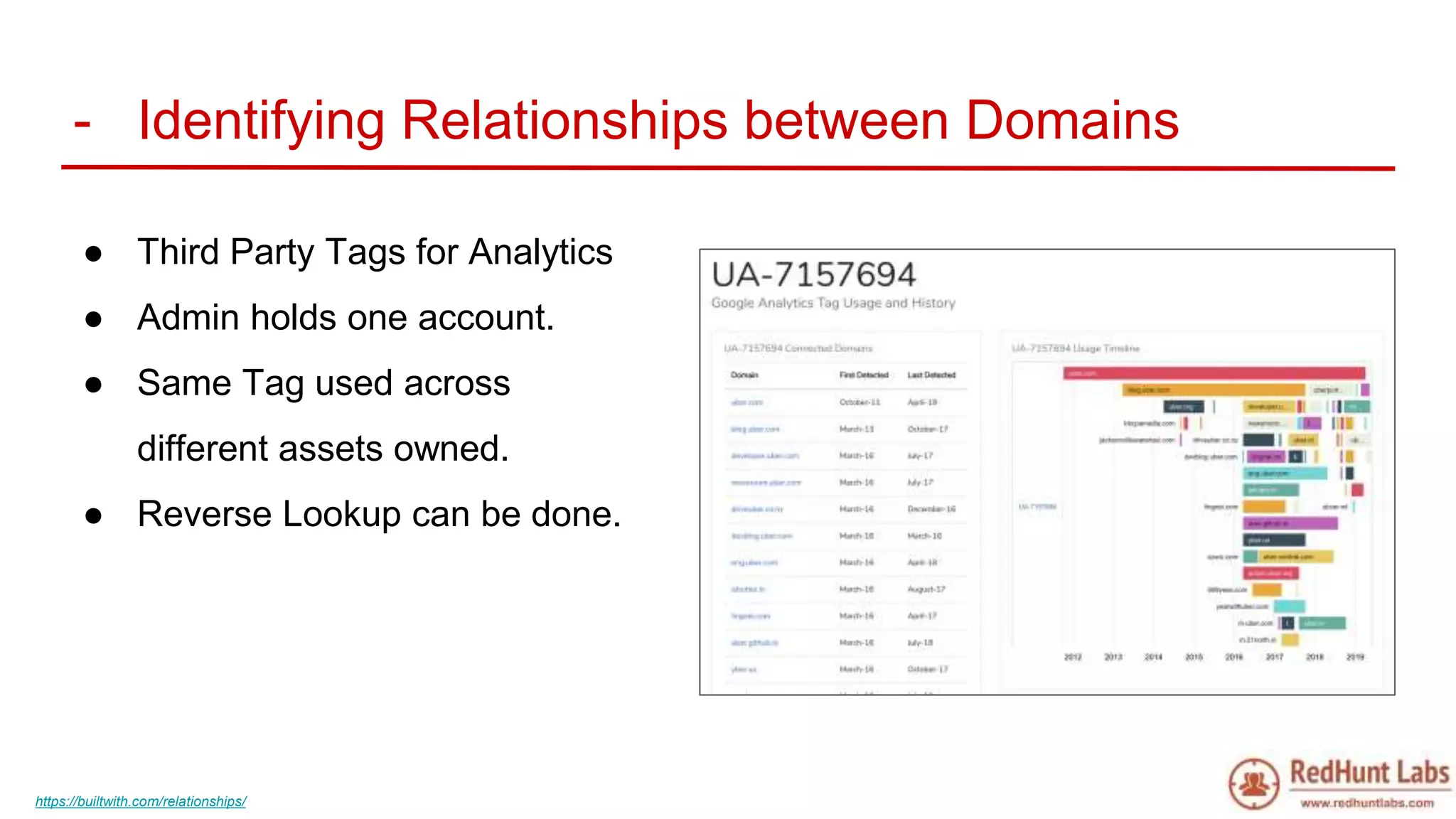
- Identifying Relationships between Domains
● Third Party Tags for Analytics
● Admin holds one account.
● Same Tag used across
different assets owned.
● Reverse Lookup can be done.
https://builtwith.com/relationships/
Periodic Attack Simulation
● Create a list of assets.
● Classify the assets (IPs, Subdomains, Domains, Buckets, etc.)
● Run custom scans.
● Pass these assets to Vulnerability Scanners, Review Reports.
● New Release? New Acquisition? New Merger?
○ Check for new assets.
○ Check for vulnerability resurfacing.
○ Run a complete cycle.
OSINT Countermeasures
- Do it yourself before someone else use it against you
- OSINT Awareness Campaigns
- MetaData Stripping
- Data Loss Prevention
- SIEM Integration with CIF
- HoneyCreds
- Identify the root cause, instead of fixing the issue.
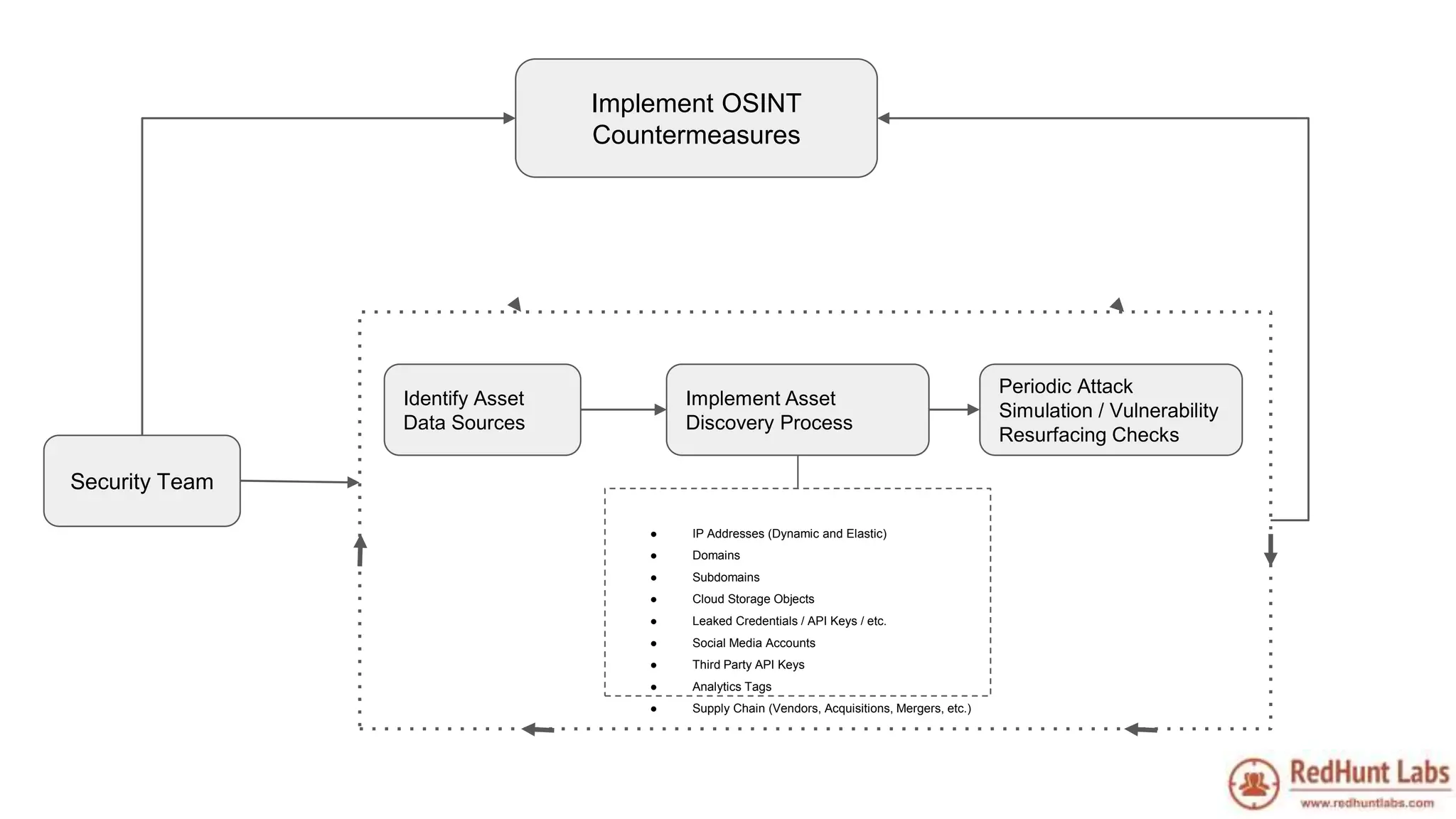
Implement OSINT
Countermeasures
Identify Asset
Data Sources
Implement Asset
Discovery Process
Periodic Attack
Simulation / Vulnerability
Resurfacing Checks
Security Team
● IP Addresses (Dynamic and Elastic)
● Domains
● Subdomains
● Cloud Storage Objects
● Leaked Credentials / API Keys / etc.
● Social Media Accounts
● Third Party API Keys
● Analytics Tags
● Supply Chain (Vendors, Acquisitions, Mergers, etc.)
What next?
● Awesome Asset Discovery List
○ https://github.com/redhuntlabs/Awesome-Asset-Discovery
● Awesome OSINT Resources
○ https://github.com/jivoi/awesome-osint
● DataSploit - OSINT Framework
○ https://github.com/DataSploit/datasploit
● Handpicked Weekly OSINT News
○ https://medium.com/week-in-osint
● Open Data - Internet Wide Scans
○ https://opendata.rapid7.com/about/
Q & A
- Email: shubham@redhuntlabs.com
- Twitter: @upgoingstar
- Website: www.redhuntlabs.com
- Would like to talk? Fix a meeting:
https://calendly.com/shubham_mittal/short_meeting

OSINT for Proactive Defense - RootConf 2019

  • 1.
    OSINT for ProactiveDefense Rootconf 2019
  • 2.
    # whoami ● ShubhamMittal ○ Director at RedHunt Labs ○ CFP Review Board Member - BlackHat Asia & InSEC World HongKong ○ Co-Founder - Recon Village (DEFCON Hacking Conference) ○ Project Lead - DataSploit (OSINT Framework) ○ 8+ Years Experienced Security and OSINT Enthusiast ○ Expertise in Offensive Security, Perimeter Security, OSINT ○ Speaker/Trainer/Presenter - BlackHat, DEFCON, Nullcon, c0c0n, IETF ○ Bike Rider, Beat Boxer ○ Twitter: @upgoingstar
  • 3.
    Agenda ● Overview ofOSINT ● Why Security Teams should use OSINT ● Continuous Discovery and Monitoring of Assets ● Use OSINT Data for Periodic Attack Simulation ● Discovering Sensitive Information Leakage ● Monitoring Breached Passwords ● Proactively Identifying Security Incidents using SOCMint ● OSINT Countermeasures
  • 4.
    What I meanwhen I use these.. - Brute Force - Trial-and-error method used to obtain information such as a user password, bucket names, subdomains, PIN, OTP Codes, etc. - Black Box / White Box / Gray Box - No access to the information / Complete access to the information / Hybrid mode. - Patch - Fixing security vulnerabilities and other bugs.
  • 5.
    What is OSINT? ●Open Source INTelligence (OSINT) is the collection and analysis of information gathered from publicly available sources. Intelligence Analysis Correlation Raw Information Actionable Intelligence https://en.wikipedia.org/wiki/Open-source_intelligence
  • 6.
  • 7.
    Why Security Teamsshould do OSINT? Because, Hackers do.
  • 8.
    Why Security Teamsshould worry about OSINT? ● Sensitive Info Leakage on Code Aggregators ● Untracked Assets running Easy Targets ● Frequent Release Cycles, Dynamic Cloud Environments ● Targeted attacks, less noisy. Sometimes, can’t be caught. ● Employees use personal breached passwords in Corporate Accounts. ● Full Patched Systems? How about credentials leak? Find it before Hackers do.
  • 9.
    Why Security Teamsshould worry about OSINT? http://hackerone.com/hacktivity
  • 10.
    How? ● Continuous Discoveryand Monitoring of Assets ● Periodic Attack Simulation ● Discovering Sensitive Information Leakage ● Monitoring Breached Passwords ● Proactively Identifying Security Incidents using SOCMint
  • 11.
    What is anAsset? ● Any resource of monetary value. ● Owned by individuals, companies, or governments. ● Example? ○ Servers, HDD, Network Devices, Laptops, Domains, Patents, etc. ● How about.. ○ Social Media Accounts, Source Code Repositories, Relevant Dumped Passwords, Cloud Storage objects (Buckets, Blobs, Spaces, etc.), Elastic IP Addresses, API Keys and Credentials and a lot more. ○ No monetary value, but can cause huge reputational and financial loss. https://redhuntlabs.com/blog/redifining-assets-a-modern-perspective.html
  • 12.
    Continuous Discovery andMonitoring of Assets - IP Addresses (Dynamic and Elastic) - Domains - Subdomains - Cloud Storage Objects - Leaked Credentials / API Keys / etc. - Social Media Accounts - Third Party API Keys - Analytics Tags - Supply Chain (Vendors, Acquisitions, Mergers, etc.)
  • 13.
    - IP Addresses ●Cloud API (WhiteBox) ● DC Administrators (WhiteBox) ● Internet Wide Scans (Project Sonar, Shodan, etc.) ● Using ASN ID (Autonomous Synchronization Number) ● Whois Reverse Search ● Reverse PTR Records
  • 15.
    DEMO - WhoIs/ ASN ID
  • 16.
    Project Sonar ● ByRapid7 and MIT ● Periodic DNS Queries ● FDNS ○ A, AAAA, CNAME, TXT, SOA ● RDNS ○ PTR ● https://scans.io https://opendata.rapid7.com/about/
  • 17.
    - Domains ● ReverseWhois on Email and Phone Numbers
  • 18.
    - Subdomains ● SearchEngines (Google/Yahoo/Bing/Yandex) ● Internet Wide Scans - Project Sonar ● Certificate Transparency Reports ● Brute Forcing Subdomains ● Reverse IP Lookup, etc. ● Tools ○ Sublist3r / Amass (Well maintained and good number of sources) ○ aio-dns-brute (Very quick) ~ Threat to Network Bandwidth https://github.com/aboul3la/Sublist3r https://github.com/blark/aiodnsbrute
  • 19.
    DEMO - OpenData Querying (FDNS/RDNS DataSet)
  • 20.
    - Cloud StorageObjects ● Buckets / Blobs / Spaces ● Stores Sensitive Data (Intentionally and Unintentionally) ● Misconfigured ACLs (Access Control Lists) ● How? ○ Spider, Fetch, Extract, Check for Permissions. ○ Create Possible bucket names (Common patterns) and try each one.
  • 21.
  • 22.
    - Leaked Creds ●Identify leaked sensitive information. ● Passwords, API Keys, Third Party Access Tokens, DB Creds, Internal domains, etc. ● GitHub, BitBucket, Pastebin, .Onion Websites, etc. ● Identify Organization Repos / Identify Employees and their personal Repos. ● Google CSE (Custom Search Engine) ● Manual Search ○ GitHub Advanced Search ● Automated tools ○ Gitrob, TruffleHog, etc. https://github.com/search/advanced https://github.com/michenriksen/gitrob https://github.com/dxa4481/truffleHog
  • 23.
  • 24.
  • 25.
    - Social MediaMonitoring - Security Incidents - Organization Reputation - Keyword Based Monitoring - Streaming APIs / Scrapers - Google Alerts / Page Change Detection - Tweet-Monitor - Someone tweets, Alert on Email, Dump to ElasticSearch. - Dashboards (Users, Frequency, Relationships, Geolocations, etc.) - https://www.youtube.com/watch?v=OjLP5k5NIMY https://github.com/upgoingstar/TweetMonitor
  • 26.
    - Identifying Relationshipsbetween Domains ● Third Party Tags for Analytics ● Admin holds one account. ● Same Tag used across different assets owned. ● Reverse Lookup can be done. https://builtwith.com/relationships/
  • 27.
    Periodic Attack Simulation ●Create a list of assets. ● Classify the assets (IPs, Subdomains, Domains, Buckets, etc.) ● Run custom scans. ● Pass these assets to Vulnerability Scanners, Review Reports. ● New Release? New Acquisition? New Merger? ○ Check for new assets. ○ Check for vulnerability resurfacing. ○ Run a complete cycle.
  • 28.
    OSINT Countermeasures - Doit yourself before someone else use it against you - OSINT Awareness Campaigns - MetaData Stripping - Data Loss Prevention - SIEM Integration with CIF - HoneyCreds - Identify the root cause, instead of fixing the issue.
  • 29.
    Implement OSINT Countermeasures Identify Asset DataSources Implement Asset Discovery Process Periodic Attack Simulation / Vulnerability Resurfacing Checks Security Team ● IP Addresses (Dynamic and Elastic) ● Domains ● Subdomains ● Cloud Storage Objects ● Leaked Credentials / API Keys / etc. ● Social Media Accounts ● Third Party API Keys ● Analytics Tags ● Supply Chain (Vendors, Acquisitions, Mergers, etc.)
  • 30.
    What next? ● AwesomeAsset Discovery List ○ https://github.com/redhuntlabs/Awesome-Asset-Discovery ● Awesome OSINT Resources ○ https://github.com/jivoi/awesome-osint ● DataSploit - OSINT Framework ○ https://github.com/DataSploit/datasploit ● Handpicked Weekly OSINT News ○ https://medium.com/week-in-osint ● Open Data - Internet Wide Scans ○ https://opendata.rapid7.com/about/
  • 31.
    Q & A -Email: shubham@redhuntlabs.com - Twitter: @upgoingstar - Website: www.redhuntlabs.com - Would like to talk? Fix a meeting: https://calendly.com/shubham_mittal/short_meeting

Editor's Notes

  • #9 Teams keep launching new instances, security misconfigurations public ip being assigned wrong security group being attached and hence sensitive port exposed These should be monitored
  • #30 Setup Security Team OSINT Countermeasures Identify Asset Data Sources Implement Asset Discovery Process Automated Vulnerability Scanning and Reporting Continuous Monitoring and Alerting