Prepared by:
De Castro, Gilbert E.
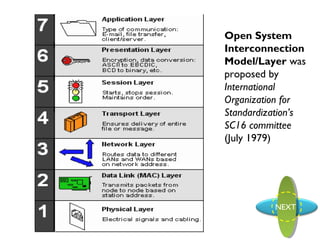
Open System
Interconnection
Model/Layer was
proposed by
International
Organization for
Standardization’s
SC16 committee
(July 1979)


          NEXT
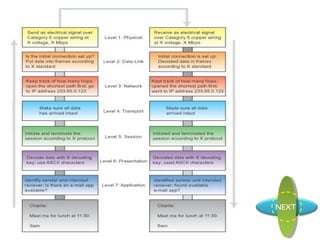
• handles the transfer of bits from
  one computer to another
• bits are actually converted into the
  electrical signals that travel across
  the physical circuit
• conveys the bit stream - electrical
  impulse, light or radio signal --
  through the network at the electrical
  and mechanical level
• data packets are encoded and
  decoded into bits
• getting data from one particular
  medium to another
• formats the message into data
  frames and adds a customized
  header containing the hardware
  destination and source address
• data packets are encoded and
  decoded into bits
• MAC sub layer controls how a
  computer on the network gains
  access to the data and permission
  to transmit it
• LLC layer controls frame
  synchronization, flow control and
  error checking
• responsible for transporting traffic
  between devices that are not
  locally attached
• provides switching and routing
  technologies, creating logical paths,
  known as virtual circuits, for
  transmitting data from node to
  node
• provides transparent transfer of
  data between end users
• providing reliable data transfer
  services to the upper layers
• controls the reliability of a given
  link through flow control,
  segmentation/desegmentation, and
  error control
• can keep track of the segments and
  retransmit those that fail.
• controls the dialogues
  (connections) between computers
• establishes, manages and terminates
  the connections between the local
  and remote application
• provides for full-duplex, half-duplex,
  or simplex operation, and establishes
  checkpointing, adjournment,
  termination, and restart procedures
• responsible for graceful close of
  sessions, session checkpointing
  and recovery
• establishes a context between
  Application Layer entities
• provides independence from
  differences in data representation
• transform data into the form that
  the application layer can accept
• formats and encrypts data to be
  sent across a network, providing
  freedom from compatibility
  problems
• interacts with software
  applications that implement a
  communicating component
• functions typically include
  identifying communication
  partners, determining resource
  availability, and synchronizing
  communication.
NEXT
Resources:

• http://www.webopedia.com/quick_ref/OSI_layers.asp
• http://en.wikipedia.org/wiki/OSI_model
• http://www.novell.com/info/primer/prim05.html
• http://technicals.wordpress.com/2007/10/04/osi-
  model/
• http://www.cisco.com/en/US/docs/internetworking/te
  chnology/handbook/Intro-to-
  Internet.html#wp1020580

OSI Layers

  • 1.
  • 2.
    Open System Interconnection Model/Layer was proposedby International Organization for Standardization’s SC16 committee (July 1979) NEXT
  • 3.
    • handles thetransfer of bits from one computer to another • bits are actually converted into the electrical signals that travel across the physical circuit • conveys the bit stream - electrical impulse, light or radio signal -- through the network at the electrical and mechanical level
  • 4.
    • data packetsare encoded and decoded into bits • getting data from one particular medium to another • formats the message into data frames and adds a customized header containing the hardware destination and source address
  • 5.
    • data packetsare encoded and decoded into bits • MAC sub layer controls how a computer on the network gains access to the data and permission to transmit it • LLC layer controls frame synchronization, flow control and error checking
  • 6.
    • responsible fortransporting traffic between devices that are not locally attached • provides switching and routing technologies, creating logical paths, known as virtual circuits, for transmitting data from node to node
  • 7.
    • provides transparenttransfer of data between end users • providing reliable data transfer services to the upper layers • controls the reliability of a given link through flow control, segmentation/desegmentation, and error control • can keep track of the segments and retransmit those that fail.
  • 8.
    • controls thedialogues (connections) between computers • establishes, manages and terminates the connections between the local and remote application • provides for full-duplex, half-duplex, or simplex operation, and establishes checkpointing, adjournment, termination, and restart procedures
  • 9.
    • responsible forgraceful close of sessions, session checkpointing and recovery
  • 10.
    • establishes acontext between Application Layer entities • provides independence from differences in data representation • transform data into the form that the application layer can accept • formats and encrypts data to be sent across a network, providing freedom from compatibility problems
  • 11.
    • interacts withsoftware applications that implement a communicating component • functions typically include identifying communication partners, determining resource availability, and synchronizing communication.
  • 13.
  • 14.
    Resources: • http://www.webopedia.com/quick_ref/OSI_layers.asp • http://en.wikipedia.org/wiki/OSI_model •http://www.novell.com/info/primer/prim05.html • http://technicals.wordpress.com/2007/10/04/osi- model/ • http://www.cisco.com/en/US/docs/internetworking/te chnology/handbook/Intro-to- Internet.html#wp1020580

Editor's Notes

  • #3 From Computer Desktop Encyclopedia ©2004 The Computer Language Co. Inc.
  • #4 Connectors, pins, electrical currents, encoding and light modulation are all part of different physical layer specifications
  • #5 Media Access Control (MAC) layer and the Logical Link Control (LLC) layer
  • #6 Media Access Control (MAC) layer and the Logical Link Control (LLC) layer
  • #8 The transport protocols used on the Internet are TCP and UDP.
  • #9 Some examples of session-layer implementations include Zone Information Protocol (ZIP), the AppleTalk protocol that coordinates the name binding process; and Session Control Protocol (SCP), the DECnet Phase IV session layer protocol.
  • #10 responsible for graceful close of sessions, which is a property of the Transmission Control Protocol Some examples of session-layer implementations include Zone Information Protocol (ZIP), the AppleTalk protocol that coordinates the name binding process; and Session Control Protocol (SCP), the DECnet Phase IV session layer protocol.
  • #11 Some examples of presentation layer coding and conversion schemes include common data representation formats, conversion of character representation formats, common data compression schemes, and common data encryption schemes.
  • #12 When identifying communication partners, the application layer determines the identity and availability of communication partners for an application with data to transmit. When determining resource availability, the application layer must decide whether sufficient network resources for the requested communication exist. In synchronizing communication, all communication between applications requires cooperation that is managed by the application layer.
  • #14 In this example, Sam will send an E-mail to Charlie. This illustration will show how Sam’s message will be delivered to Charlie.