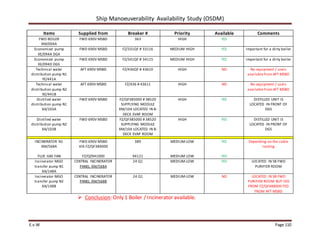
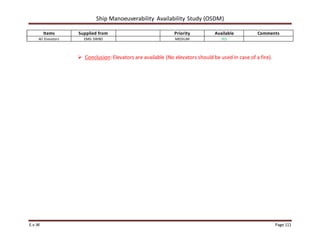
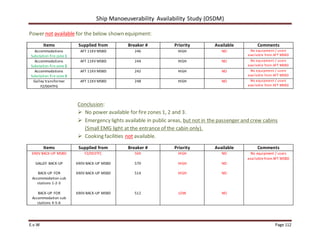
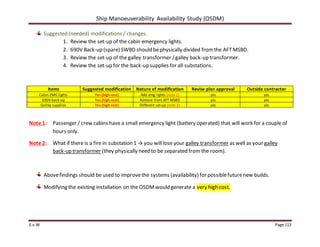
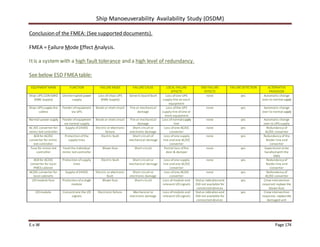
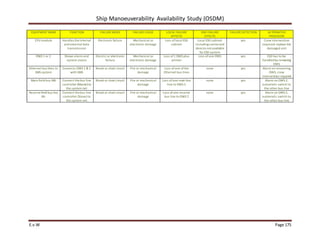
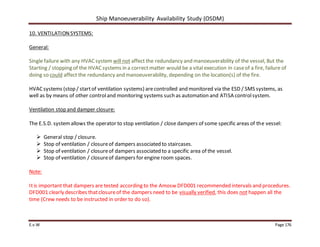
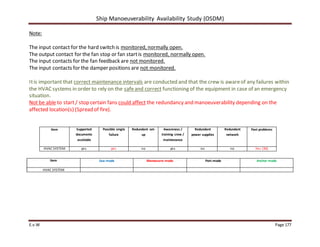
Ship Manoeuverability Availability Study (OSDM)
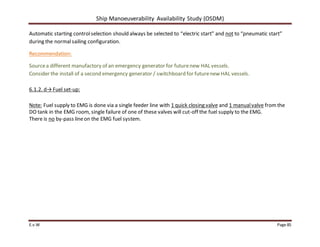
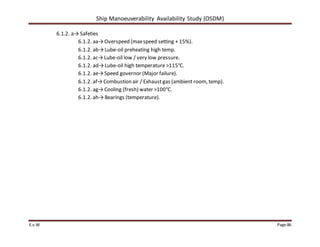
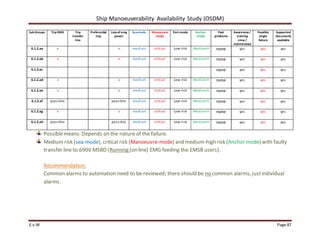
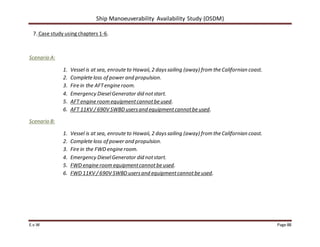
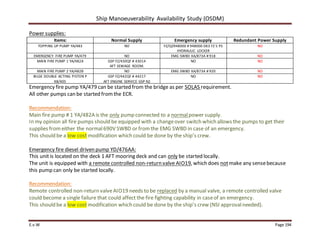
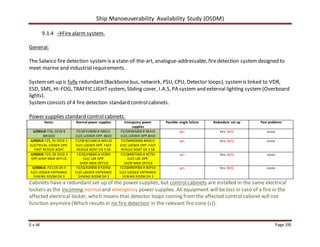
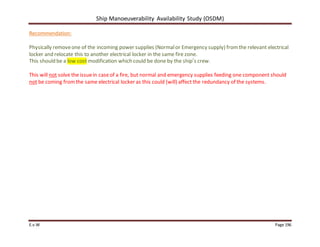
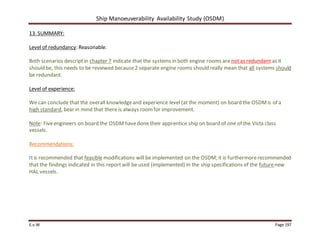
E.v.W Page 1
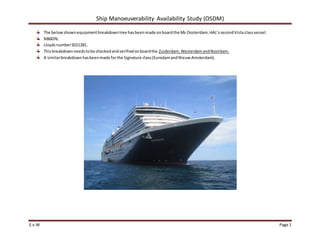
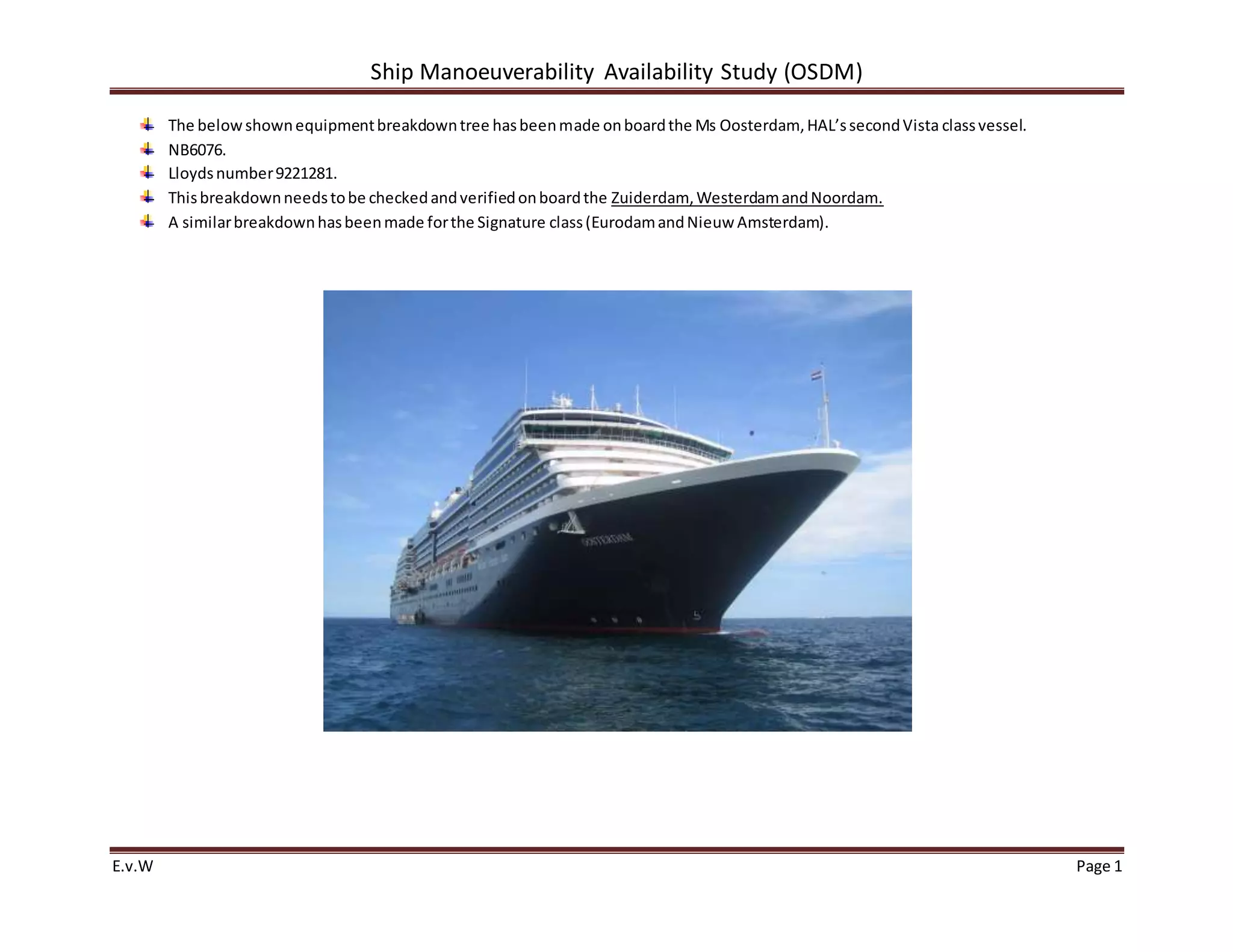
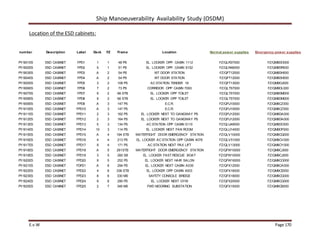
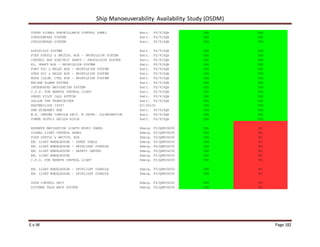
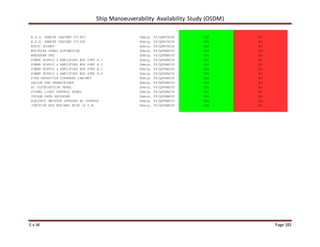
The belowshownequipmentbreakdowntree hasbeenmade onboardthe Ms Oosterdam,HAL’ssecondVista classvessel.
NB6076.
Lloydsnumber9221281.
Thisbreakdownneedstobe checkedandverifiedonboardthe Zuiderdam,WesterdamandNoordam.
A similarbreakdownhasbeenmade forthe Signature class(EurodamandNieuwAmsterdam).
Ship Manoeuverability Availability Study (OSDM)
E.v.W Page 2
The goals andobjectivesare to:
1. Identifythose aspectsof propulsionandsteeringrelatedsystemsthatare not redundant.
2. Identifythe failuresassociatedwith the essential shipcontrol andmanoeuvringsystemsandsubsystems.
3. Evaluate the effectivenessof the existingredundancies.
4. Identifyviathe belowshownequipmentbreakdownliststhe highrisk(critical) areasbymeansof usingthe investigationreportsaswell
as the knowledge of HAL’sshipsandoffice personnel.
All isaboutreliability,of whichthere are 3variances:
Structural reliability(dependingonatree of all kindsof subsystems,asper below) →shouldbe anewbuilddecision,AZIPODSare
maybe a goodexample…).
Usage reliability(dependingonsubsystemsbasedonrunningtime) –shouldbe implementedinourmaintenance management.
Reliabilityandknowledge of shipspersonnel –presentnecessarytraining/keepexperiencedpersonnel.
Nowadaysmaintenancemanagementisbasedon“situationdependent (risingcoolingwatertemperatures,vibrationincrease),corrective (oil
change,replace filters/bearingsaftercertainrunninghours),preventive (planningengine overall,switchboardmaintenance,orderparts) &time
based(basedonexperience (studiesfrommanufacturers),increase of incidentcasesandadjustedaccordingly”, whichisall basedonsafety&
reliability.
Operatorsneedtoknowwhatthe specificincidentbehaviorof certainequipmentisandwhichcomponentsare the causes.
Statisticsare the keyparameterstoidentifythese,thisprojectisbasedonmodificationstoavoidincidentsordelaythe incidents.
Ship Manoeuverability Availability Study (OSDM)
E.v.W Page 3
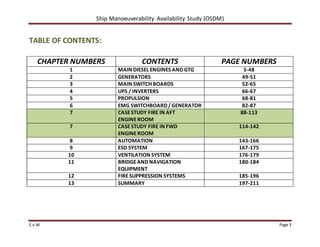
TABLE OF CONTENTS:
CHAPTER NUMBERS CONTENTS PAGE NUMBERS
1 MAIN DIESEL ENGINES AND GTG 5-48
2 GENERATORS 49-51
3 MAIN SWITCH BOARDS 52-65
4 UPS / INVERTERS 66-67
5 PROPULSION 68-81
6 EMG SWITCHBOARD /GENERATOR 82-87
7 CASESTUDY FIRE IN AFT
ENGINEROOM
88-113
7 CASESTUDY FIRE IN FWD
ENGINEROOM
114-142
8 AUTOMATION 143-166
9 ESD SYSTEM 167-175
10 VENTILATION SYSTEM 176-179
11 BRIDGEAND NAVIGATION
EQUIPMENT
180-184
12 FIRESUPPRESSION SYSTEMS 185-196
13 SUMMARY 197-211
Ship Manoeuverability Availability Study (OSDM)
E.v.W Page 4
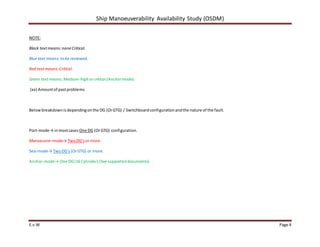
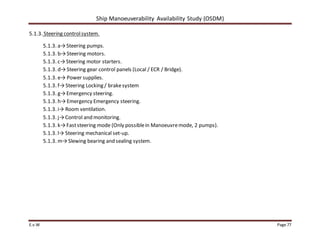
NOTE:
Black textmeans:noneCritical.
Blue text means:tobe reviewed.
Red textmeans:Critical.
Green text means:Medium-high orcritical (Anchormode).
(xx) Amountof pastproblems.
Belowbreakdownisdependingonthe DG (OrGTG) / Switchboardconfigurationandthe nature of the fault.
Port-mode→ inmostcasesOne DG (OrGTG) configuration.
Manoeuvre-mode→ TwoDG’sor more.
Sea-mode→ TwoDG’s(OrGTG) or more.
Anchor-mode→ One DG(16 Cylinder) (See supporteddocuments).
Ship Manoeuverability Availability Study (OSDM)
E.v.W Page 5
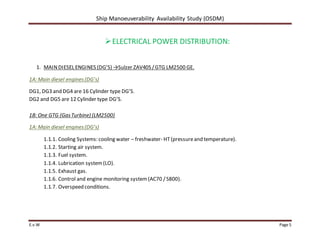
ELECTRICAL POWER DISTRIBUTION:
1. MAINDIESEL ENGINES (DG’S) →Sulzer ZAV40S /GTG LM2500 GE.
1A: Main diesel engines(DG’s)
DG1, DG3 and DG4 are 16 Cylinder type DG’S.
DG2 and DG5 are 12 Cylinder type DG’S.
1B: One GTG (GasTurbine) (LM2500)
1A: Main diesel engines(DG’s)
1.1.1. Cooling Systems: cooling water – freshwater- HT(pressureand temperature).
1.1.2. Starting air system.
1.1.3. Fuel system.
1.1.4. Lubrication system(LO).
1.1.5. Exhaust gas.
1.1.6. Control and engine monitoring system(AC70 /S800).
1.1.7. Overspeed conditions.
Ship Manoeuverability Availability Study (OSDM)
E.v.W Page 6
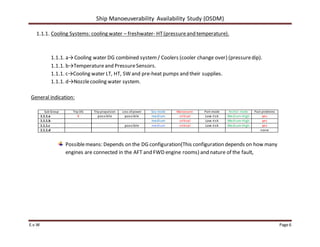
1.1.1. Cooling Systems: cooling water – freshwater- HT(pressureand temperature).
1.1.1. a→Cooling water DG combined system/ Coolers (cooler change over) (pressuredip).
1.1.1. b→Temperatureand PressureSensors.
1.1.1. c→Cooling water LT, HT, SW and pre-heat pumps and their supplies.
1.1.1. d→Nozzlecooling water system.
General indication:
Sub Group Trip DG Trip propulsion Loss ofpower Sea-mode Manoeuvre- Port-mode Anchor mode Past problems
1.1.1.a X possible possible medium critical Low risk Medium-High yes
1.1.1.b medium critical Low risk Medium-High yes
1.1.1.c possible medium critical Low risk Medium-High yes
1.1.1.d none
Possiblemeans: Depends on the DG configuration(This configuration depends on how many
engines are connected in the AFT and FWD engine rooms) and nature of the fault,
Ship Manoeuverability Availability Study (OSDM)
E.v.W Page 7
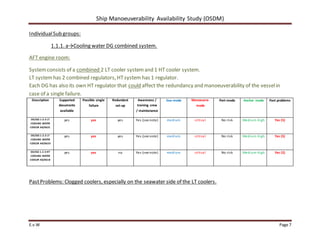
IndividualSub groups:
1.1.1. a→Cooling water DG combined system.
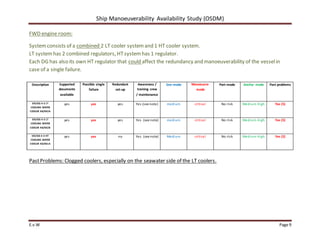
AFT engine room:
Systemconsists of a combined 2 LT cooler systemand 1 HT cooler system.
LT systemhas 2 combined regulators, HTsystem has 1 regulator.
Each DG has also its own HT regulator that could affect the redundancy and manoeuverability of the vesselin
case of a single failure.
Description Supported
documents
available
Possible single
failure
Redundant
set-up
Awareness /
training crew
/ maintenance
Sea-mode Manoeuvre-
mode
Port-mode Anchor mode Past problems
DD/GG 1-2-3 LT
COOLING WATER
COOLER XA/062C
yes yes yes Yes (see note) medium critical No risk Medium-high Yes (5)
DD/GG 1-2-3 LT
COOLING WATER
COOLER XA/062D
yes yes yes Yes (see note) medium critical No risk Medium-high Yes (5)
DD/GG 1-2-3 HT
COOLING WATER
COOLER XA/061B
yes yes no Yes (see note) medium critical No risk Medium-high Yes (2)
PastProblems: Clogged coolers, especially on the seawater side of the LT coolers.
Ship Manoeuverability Availability Study (OSDM)
E.v.W Page 8
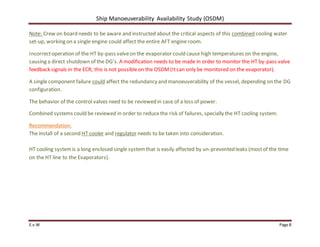
Note: Crew on board needs to be aware and instructed about the critical aspects of this combined cooling water
set-up, working on a single engine could affect the entire AFT engine room.
Incorrectoperation of the HT by-pass valveon the evaporator could cause high temperatures on the engine,
causing a direct shutdown of the DG’s. A modification needs to be made in order to monitor the HT by-pass valve
feedback signals in the ECR; this is not possibleon the OSDM (Itcan only be monitored on the evaporator).
A single component failure could affect the redundancy and manoeuverability of the vessel, depending on the DG
configuration.
The behavior of the control valves need to be reviewed in case of a loss of power.
Combined systems could be reviewed in order to reducethe risk of failures, specially the HT cooling system.
Recommendation:
The install of a second HT cooler and regulator needs to be taken into consideration.
HT cooling systemis a long enclosed single systemthat is easily affected by un-prevented leaks (mostof the time
on the HT line to the Evaporators).
Ship Manoeuverability Availability Study (OSDM)
E.v.W Page 9
FWD engine room:
Systemconsists of a combined 2 LT cooler systemand 1 HT cooler system.
LT systemhas 2 combined regulators, HTsystemhas 1 regulator.
Each DG has also its own HT regulator that could affect the redundancy and manoeuverability of the vesselin
case of a single failure.
Description Supported
documents
available
Possible single
failure
Redundant
set-up
Awareness /
training crew
/ maintenance
Sea-mode Manoeuvre-
mode
Port-mode Anchor mode Past problems
DD/GG 4-5 LT
COOLING WATER
COOLER XA/062A
yes yes yes Yes (see note) medium critical No risk Medium-high Yes (5)
DD/GG 4-5 LT
COOLING WATER
COOLER XA/062B
yes yes yes Yes (see note) medium critical No risk Medium-high Yes (5)
DD/GG 4-5 HT
COOLING WATER
COOLER XA/061A
yes yes no Yes (see note) Medium critical No risk Medium-high Yes (2)
PastProblems: Clogged coolers, especially on the seawater side of the LT coolers.
Ship Manoeuverability Availability Study (OSDM)
E.v.W Page 10
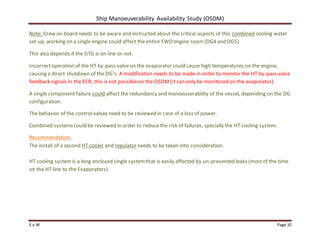
Note: Crew on board needs to be aware and instructed about the critical aspects of this combined cooling water
set-up, working on a single engine could affect the entire FWD engine room (DG4 and DG5)
This also depends if the GTG is on line or not.
Incorrectoperation of the HT by-pass valveon the evaporator could cause high temperatures on the engine,
causing a direct shutdown of the DG’s. A modification needs to be made in order to monitor the HT by-pass valve
feedback signals in the ECR; this is not possibleon the OSDM (Itcan only be monitored on the evaporator).
A single component failure could affect the redundancy and manoeuverability of the vessel, depending on the DG
configuration.
The behavior of the control valves need to be reviewed in case of a loss of power.
Combined systems could be reviewed in order to reducethe risk of failures, specially the HT cooling system.
Recommendation:
The install of a second HT cooler and regulator needs to be taken into consideration.
HT cooling systemis a long enclosed single systemthat is easily affected by un-prevented leaks (mostof the time
on the HT line to the Evaporators).
Ship Manoeuverability Availability Study (OSDM)
E.v.W Page 11
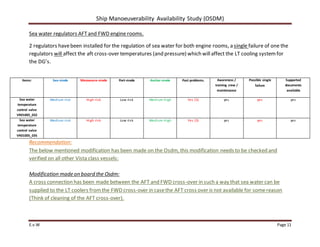
Sea water regulators AFT and FWD engine rooms.
2 regulators havebeen installed for the regulation of sea water for both engine rooms, a single failure of one the
regulators will affect the aft cross-over temperatures (and pressure) which willaffect the LT cooling systemfor
the DG’s.
Recommendation:
The below mentioned modification has been made on the Osdm, this modification needs to be checked and
verified on all other Vista class vessels:
Modification made on board the Osdm:
A cross connection has been made between the AFT and FWD cross-over in such a way that sea water can be
supplied to the LT coolers fromthe FWD cross-over in casethe AFT cross over is not available for somereason
(Think of cleaning of the AFT cross-over).
Items: Sea-mode Manoeuvre-mode Port-mode Anchor-mode Past problems. Awareness /
training crew /
maintenance
Possible single
failure
Supported
documents
available
Sea water
temperature
control valve
VR01005_032
Medium risk High risk Low risk Medium-high Yes (3) yes yes yes
Sea water
temperature
control valve
VR01005_035
Medium risk High risk Low risk Medium-high Yes (3) yes yes yes
Ship Manoeuverability Availability Study (OSDM)
E.v.W Page 12
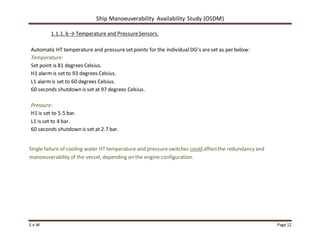
1.1.1. b → Temperature and PressureSensors.
Automatic HT temperature and pressuresetpoints for the individual DG’s areset as per below:
Temperature:
Set point is 81 degrees Celsius.
H1 alarm is set to 93 degrees Celsius.
L1 alarmis set to 60 degrees Celsius.
60 seconds shutdown is set at 97 degrees Celsius.
Pressure:
H1 is set to 5.5 bar.
L1 is set to 4 bar.
60 seconds shutdown is set at 2.7 bar.
Single failure of cooling water HT temperature and pressureswitches could affectthe redundancy and
manoeuverability of the vessel, depending on the engine configuration.
Ship Manoeuverability Availability Study (OSDM)
E.v.W Page 13
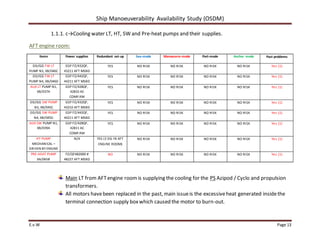
1.1.1. c→Cooling water LT, HT, SW and Pre-heat pumps and their supplies.
AFT engine room:
Items Power supplies Redundant set-up Sea-mode Manoeuvre-mode Port-mode Anchor mode Past problems
DD/GG FW LT
PUMP N3, XB/046C
GSP FZ/432QF,
43211 AFT MSBD
YES NO RISK NO RISK NO RISK NO RISK Yes (1)
DD/GG FW LT
PUMP N4, XB/046D
GSP FZ/442QF,
44211 AFT MSBD
YES NO RISK NO RISK NO RISK NO RISK Yes (1)
AUX LT PUMP N1,
XB/037A
GSP FZ/428QF,
42810 AC
COMP.RM
YES NO RISK NO RISK NO RISK NO RISK Yes (1)
DD/GG SW PUMP
N3, XB/045C
GSP FZ/432QF,
43210 AFT MSBD
YES NO RISK NO RISK NO RISK NO RISK Yes (1)
DD/GG SW PUMP
N4, XB/045D
GSP FZ/442QF,
44211 AFT MSBD
YES NO RISK NO RISK NO RISK NO RISK Yes (1)
AUX SW PUMP N1,
XB/039A
GSP FZ/428QF,
42811 AC
COMP.RM
YES NO RISK NO RISK NO RISK NO RISK Yes (1)
HT PUMP
MECHANICAL –
DRIVEN BY ENGINE
N/A YES (3 DG IN AFT
ENGINE ROOM)
NO RISK NO RISK NO RISK NO RISK Yes (1)
PRE-HEAT PUMP
XA/065B
FZ/QF482000 #
48227 AFT MSBD
NO NO RISK NO RISK NO RISK NO RISK Yes (1)
Main LT from AFTengine roomis supplying the cooling for the PS Azipod / Cyclo and propulsion
transformers.
All motors havebeen replaced in the past, main issueis the excessiveheat generated insidethe
terminal connection supply boxwhich caused the motor to burn-out.
Ship Manoeuverability Availability Study (OSDM)
E.v.W Page 14
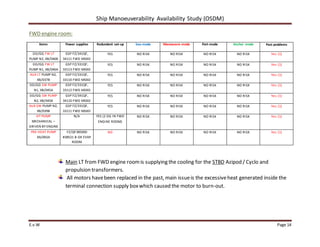
FWD engine room:
Items Power supplies Redundant set-up Sea-mode Manoeuvre-mode Port-mode Anchor mode Past problems
DD/GG FW LT
PUMP N2, XB/046B
GSP FZ/341QF,
34111 FWD MSBD
YES NO RISK NO RISK NO RISK NO RISK Yes (1)
DD/GG FW LT
PUMP N1, XB/046A
GSP FZ/331QF,
33113 FWD MSBD
YES NO RISK NO RISK NO RISK NO RISK Yes (1)
AUX LT PUMP N2,
XB/037B
GSP FZ/331QF,
33110 FWD MSBD
YES NO RISK NO RISK NO RISK NO RISK Yes (1)
DD/GG SW PUMP
N1, XB/045A
GSP FZ/331QF,
33112 FWD MSBD
YES NO RISK NO RISK NO RISK NO RISK Yes (1)
DD/GG SW PUMP
N2, XB/045B
GSP FZ/341QF,
34110 FWD MSBD
YES NO RISK NO RISK NO RISK NO RISK Yes (1)
AUX SW PUMP N2,
XB/039B
GSP FZ/331QF,
33111 FWD MSBD
YES NO RISK NO RISK NO RISK NO RISK Yes (1)
HT PUMP
MECHANICAL –
DRIVEN BY ENGINE
N/A YES (2 DG IN FWD
ENGINE ROOM)
NO RISK NO RISK NO RISK NO RISK Yes (1)
PRE-HEAT PUMP
XA/065A
FZ/QF385000
#38521 B-DK EVAP
ROOM
NO NO RISK NO RISK NO RISK NO RISK Yes (1)
Main LT from FWD engine roomis supplying the cooling for the STBD Azipod / Cyclo and
propulsion transformers.
All motors havebeen replaced in the past, main issueis the excessiveheat generated inside the
terminal connection supply boxwhich caused the motor to burn-out.
Ship Manoeuverability Availability Study (OSDM)
E.v.W Page 15
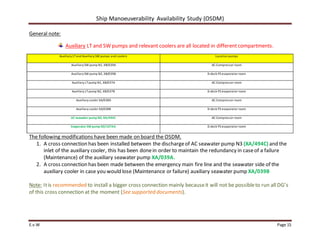
General note:
Auxiliary LT and SW pumps and relevant coolers are all located in different compartments.
Auxiliary LTand Auxiliary SW pumps and coolers Location pumps
Auxiliary SW pump N1, XB/039A AC-Compressor room
Auxiliary SW pump N2, XB/039B D-deck PS evaporator room
Auxiliary LTpump N1, XB/037A AC-Compressor room
Auxiliary LTpump N2, XB/037B D-deck PS evaporator room
Auxiliary cooler XA/038A AC-Compressor room
Auxiliary cooler XA/038B D-deck PS evaporator room
AC seawater pump N3, XA/494C AC-Compressor room
Evaporator SW pump XD/107AA D-deck PS evaporator room
The following modifications have been made on board the OSDM.
1. A cross connection has been installed between the dischargeof AC seawater pump N3 (XA/494C) and the
inlet of the auxiliary cooler, this has been donein order to maintain the redundancy in caseof a failure
(Maintenance) of the auxiliary seawater pump XA/039A.
2. A cross connection has been made between the emergency main fire line and the seawater side of the
auxiliary cooler in case you would lose (Maintenance or failure) auxiliary seawater pump XA/039B
Note: Itis recommended to install a bigger cross connection mainly becauseit will not be possibleto run all DG’s
of this cross connection at the moment (See supported documents).
Ship Manoeuverability Availability Study (OSDM)
E.v.W Page 16
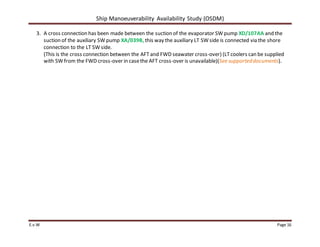
3. A cross connection has been made between the suction of the evaporator SW pump XD/107AA and the
suction of the auxiliary SW pump XA/039B, this way the auxiliary LT SW side is connected via the shore
connection to the LT SW side.
(This is the cross connection between the AFT and FWD seawater cross-over) (LTcoolers can be supplied
with SW from the FWD cross-over in casethe AFT cross-over is unavailable)(See supporteddocuments).
Ship Manoeuverability Availability Study (OSDM)
E.v.W Page 17
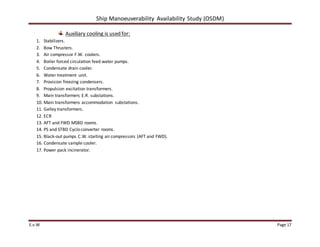
Auxiliary cooling is used for:
1. Stabilizers.
2. Bow Thrusters.
3. Air compressor F.W. coolers.
4. Boiler forced circulation feed water pumps.
5. Condensate drain cooler.
6. Water treatment unit.
7. Provision freezing condensers.
8. Propulsion excitation transformers.
9. Main transformers E.R. substations.
10. Main transformers accommodation substations.
11. Galley transformers.
12. ECR
13. AFT and FWD MSBD rooms.
14. PS and STBD Cyclo converter rooms.
15. Black-out pumps C.W. starting aircompressors (AFT and FWD).
16. Condensate sample cooler.
17. Power pack incinerator.
Ship Manoeuverability Availability Study (OSDM)
E.v.W Page 18
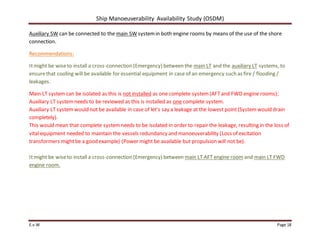
Auxiliary SW can be connected to the main SW systemin both engine rooms by means of the use of the shore
connection.
Recommendations:
Itmight be wiseto install a cross-connection (Emergency) between the main LT and the auxiliary LT systems, to
ensurethat cooling will be available for essential equipment in case of an emergency such as fire / flooding /
leakages.
Main LT systemcan be isolated as this is not installed as one complete system(AFTand FWD engine rooms);
Auxiliary LT systemneeds to be reviewed as this is installed as one complete system.
Auxiliary LT systemwould not be available in case of let’s say a leakage at the lowest point(Systemwould drain
completely).
This would mean that complete systemneeds to be isolated in order to repair the leakage, resulting in the loss of
vital equipment needed to maintain the vessels redundancy and manoeuverability (Loss of excitation
transformers mightbe a good example) (Power might be available but propulsion will not be).
Itmight be wiseto install a cross-connection (Emergency) between main LT AFT engine room and main LT FWD
engine room.
Ship Manoeuverability Availability Study (OSDM)
E.v.W Page 19
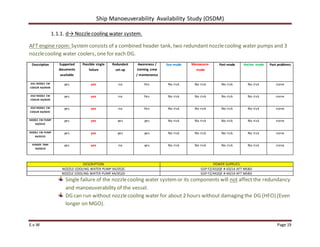
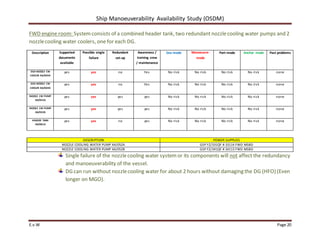
1.1.1. d→ Nozzlecooling water system.
AFT engine room: Systemconsists of a combined header tank, two redundantnozzlecooling water pumps and 3
nozzlecooling water coolers, one for each DG.
Description Supported
documents
available
Possible single
failure
Redundant
set-up
Awareness /
training crew
/ maintenance
Sea-mode Manoeuvre-
mode
Port-mode Anchor mode Past problems
DG1 NOZZLE CW
COOLER XA/069B
yes yes no Yes No risk No risk No risk No risk none
DG2 NOZZLE CW
COOLER XA/069E
yes yes no Yes No risk No risk No risk No risk none
DG3 NOZZLE CW
COOLER XA/069C
yes yes no Yes No risk No risk No risk No risk none
NOZZLE CW PUMP
XA/052C
yes yes yes yes No risk No risk No risk No risk none
NOZZLE CW PUMP
XA/052D
yes yes yes yes No risk No risk No risk No risk none
HEADER TANK
XA/081B
yes yes no yes No risk No risk No risk No risk none
DESCRIPTION POWER SUPPLIES
NOZZLE COOLING WATER PUMP XA/052C GSP FZ/432QF # 43214 AFT MSBD
NOZZLE COOLING WATER PUMP XA/052D GSP FZ/442QF # 44214 AFT MSBD
Single failure of the nozzlecooling water systemor its components will not affect the redundancy
and manoeuverability of the vessel.
DG can run without nozzlecooling water for about 2 hours without damaging the DG (HFO) (Even
longer on MGO).
Ship Manoeuverability Availability Study (OSDM)
E.v.W Page 20
FWD engine room: Systemconsists of a combined header tank, two redundant nozzlecooling water pumps and 2
nozzlecooling water coolers, one for each DG.
Description Supported
documents
available
Possible single
failure
Redundant
set-up
Awareness /
training crew
/ maintenance
Sea-mode Manoeuvre-
mode
Port-mode Anchor mode Past problems
DG4 NOZZLE CW
COOLER XA/069A
yes yes no Yes No risk No risk No risk No risk none
DG5 NOZZLE CW
COOLER XA/069D
yes yes no Yes No risk No risk No risk No risk none
NOZZLE CW PUMP
XA/052A
yes yes yes yes No risk No risk No risk No risk none
NOZZLE CW PUMP
XA/052B
yes yes yes yes No risk No risk No risk No risk none
HEADER TANK
XA/081A
yes yes no yes No risk No risk No risk No risk none
DESCRIPTION POWER SUPPLIES
NOZZLE COOLING WATER PUMP XA/052A GSP FZ/331QF # 33114 FWD MSBD
NOZZLE COOLING WATER PUMP XA/052B GSP FZ/341QF # 34113 FWD MSBD
Single failure of the nozzlecooling water systemor its components will not affect the redundancy
and manoeuverability of the vessel.
DG can run without nozzlecooling water for about 2 hours without damaging the DG (HFO) (Even
longer on MGO).
Ship Manoeuverability Availability Study (OSDM)
E.v.W Page 21
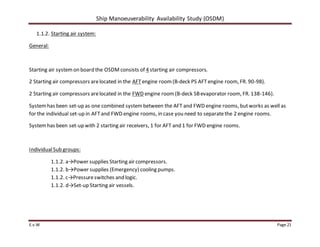
1.1.2. Starting air system:
General:
Starting air systemon board the OSDM consists of 4 starting air compressors.
2 Starting air compressors arelocated in the AFTengine room(B-deck PS AFTengine room, FR. 90-98).
2 Starting air compressors arelocated in the FWD engine room(B-deck SBevaporator room, FR. 138-146).
Systemhas been set-up as one combined systembetween the AFT and FWD engine rooms, butworks as well as
for the individual set-up in AFTand FWD engine rooms, in case you need to separatethe 2 engine rooms.
Systemhas been set-up with 2 starting air receivers, 1 for AFT and 1 for FWD engine rooms.
IndividualSub groups:
1.1.2. a→Power supplies Starting air compressors.
1.1.2. b→Power supplies (Emergency) cooling pumps.
1.1.2. c→Pressureswitches and logic.
1.1.2. d→Set-up Starting air vessels.
Ship Manoeuverability Availability Study (OSDM)
E.v.W Page 22
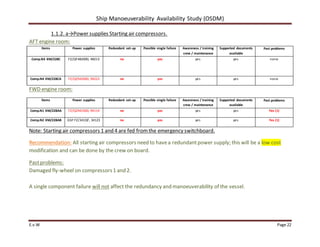
1.1.2. a→Power supplies Starting air compressors.
AFT engine room:
Items Power supplies Redundant set-up Possible single failure Awareness / training
crew / maintenance
Supported documents
available
Past problems
Comp.N3 XM/228C FZ/QF482000, 48213 no yes yes yes none
Comp.N4 XM/228CA FZ/QZ942000, 94223 no yes yes yes none
FWD engine room:
Items Power supplies Redundant set-up Possible single failure Awareness / training
crew / maintenance
Supported documents
available
Past problems
Comp.N1 XM/228AA FZ/QZ941000, 94114 no yes yes yes Yes (1)
Comp.N2 XM/228AB GSP FZ/341QF, 34123 no yes yes yes Yes (1)
Note: Starting air compressors 1 and 4 are fed fromthe emergency switchboard.
Recommendation: All starting air compressors need to havea redundantpower supply; this will be a low cost
modification and can be done by the crew on board.
Pastproblems:
Damaged fly-wheel on compressors1 and 2.
A single component failure will not affect the redundancy and manoeuverability of the vessel.
Ship Manoeuverability Availability Study (OSDM)
E.v.W Page 23
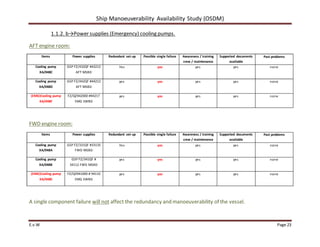
1.1.2. b→Power supplies (Emergency) cooling pumps.
AFT engine room:
Items Power supplies Redundant set-up Possible single failure Awareness / training
crew / maintenance
Supported documents
available
Past problems
Cooling pump
XA/048C
GSP FZ/432QF #43212
AFT MSBD
Yes yes yes yes none
Cooling pump
XA/048D
GSP FZ/442QF #44212
AFT MSBD
yes yes yes yes none
(EMG)Cooling pump
XA/048F
FZ/QZ942000 #94217
EMG SWBD
yes yes yes yes none
FWD engine room:
Items Power supplies Redundant set-up Possible single failure Awareness / training
crew / maintenance
Supported documents
available
Past problems
Cooling pump
XA/048A
GSP FZ/331QF #33135
FWD MSBD
Yes yes yes yes none
Cooling pump
XA/048B
GSP FZ/341QF #
34112 FWD MSBD
yes yes yes yes none
(EMG)Cooling pump
XA/048E
FZ/QZ941000 # 94110
EMG SWBD
yes yes yes yes none
A single component failure will not affect the redundancy and manoeuverability of the vessel.
Ship Manoeuverability Availability Study (OSDM)
E.v.W Page 24
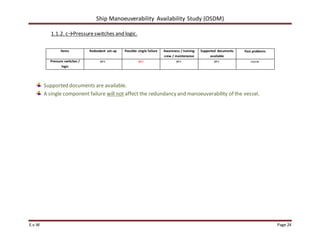
1.1.2. c→Pressureswitches and logic.
Supported documents are available.
A single component failure will not affect the redundancy and manoeuverability of the vessel.
Items Redundant set-up Possible single failure Awareness / training
crew / maintenance
Supported documents
available
Past problems
Pressure switches /
logic
yes yes yes yes none
Ship Manoeuverability Availability Study (OSDM)
E.v.W Page 25
1.1.2. d→Set-up Starting air vessels.
Systemhas been set-up with 2 starting air receivers, 1 for AFT and 1 for FWD engine rooms.
Systemhas been set-up in such a way that it can be used as a combined system(normalset-up) or as an
individual engine roomspecific (AFTor FWD) if needed in case of an emergency.
Starting air vesselfor the AFTengine roomis located in the PS B-deck AFTengine room, FR. 86-94.
Starting air vesselfor the FWD engine roomis located in the SB B-deck evaporator room, FR. 138-146.
The following systems areconnected to the DD/GG starting air system:
1. Air receiver for AFT whistle.
2. Starting air receiver for emergency diesel generator.
3. Emergency starting air compressor for emergency dieselgenerator (See recommendation).
4. Control air system→serviceair system.
5. Emergency diesel fire pump.
6. Engines DG1-2-3-4-5starting air.
Recommendation: Installa separate compressor /air vesselin a technical space between D-deck and deck 10 that
will mainly serveas a general back-up for engine roomstarting air systems as well as for the emergency
generator starting air system, fed fromthe emergency switchboard (Air feedback).
Ship Manoeuverability Availability Study (OSDM)
E.v.W Page 26
1.1.3. Fuel system:
General:
Fuel systems arein general an important factor and risk for the redundancy and manoeuverability of the vessel.
Fuel systems could generate many single failures, simple because it is a large and complicated system.
Fuel pressures and temperatures need to be monitored at all times.
IndividualSub groups:
1.1.3. a→H.F.O. /D.O. services, AFT and FWD engine rooms.
1.1.3. b→Logic and power supplies Booster pumps and feeder pumps, AFT and FWD engine rooms.
1.1.3. c→Blackoutgravity valves, AFTand FWD engine rooms.
1.1.3. d→H.F.O.Transfer system.
1.1.3. e→H.F.O.Separation system.
1.1.3. f→D.O.Transfer /Separation system.
1.1.3. h→L.O.Purifier system.
Ship Manoeuverability Availability Study (OSDM)
E.v.W Page 27
1.1.3. a→H.F.O. /D.O. services, AFT and FWD engine rooms.
Systemhas been designed to run on either H.F.O. or on DO (M.G.O.).
Systemhas a redundant set-up; it can be used as a combined systembetween the AFT and FWD engine
rooms as well as for the independent engine roomset-up.
H.F.O. systemhas a redundantset-up, but:
 Each fuel module has only 1 suction pipe fromthe H.F.O. servicetank with only 1 quick closing
valve, if this quick closing valve would accidentally shutyou will lose the complete module.
Recommendation: Install2 separatesuction valves with 2 quick closing valves.
D.O. (M.G.O.) systemhas no redundant set-up.
 When running on M.G.O. both engine rooms takesuction from1 suction line with only 1 quick
closing valve, if this valvewould shuta blackout will be the result (Single failure).
 Regulations in certain areas like the Californian coast require the ship to change-over fromH.F.O.
to M.G.O. 3 miles beforethe end of the sea voyage, meaning that often the ship sails on 2 or 3
engines running on M.G.O.
 Tank capacity is way too small, maximum quantity of the M.G.O. servicetank 2S is only 37.4m3.
Recommendation: Installa bigger M.G.O. servicetank or combine the GTG M.G.O. servicetank with the DG
M.G.O. servicetank by means of a permanent connection between the 2 tanks or by means of opening both
suction valves on the suction line (Communicating vessels)(See supported documents)
Install2 separatesuction valves with 2 quick closing valves.
Ship Manoeuverability Availability Study (OSDM)
E.v.W Page 28
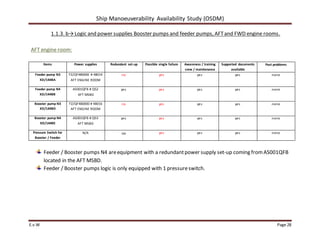
1.1.3. b→Logic and power supplies Booster pumps and feeder pumps, AFTand FWD engine rooms.
AFT engine room:
Items Power supplies Redundant set-up Possible single failure Awareness / training
crew / maintenance
Supported documents
available
Past problems
Feeder pump N3
XD/144BA
FZ/QF480000 # 48014
AFT ENGINE ROOM
no yes yes yes none
Feeder pump N4
XD/144BB
AS001QFB # Q52
AFT MSBD
yes yes yes yes none
Booster pump N3
XD/144BD
FZ/QF480000 # 48016
AFT ENGINE ROOM
no yes yes yes none
Booster pump N4
XD/144BE
AS001QFB # Q53
AFT MSBD
yes yes yes yes none
Pressure Switch for
Booster / Feeder
N/A no yes yes yes none
Feeder / Booster pumps N4 areequipment with a redundantpower supply set-up coming fromAS001QFB
located in the AFT MSBD.
Feeder / Booster pumps logic is only equipped with 1 pressureswitch.
Ship Manoeuverability Availability Study (OSDM)
E.v.W Page 29
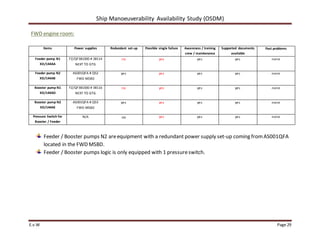
FWD engine room:
Items Power supplies Redundant set-up Possible single failure Awareness / training
crew / maintenance
Supported documents
available
Past problems
Feeder pump N1
XD/144AA
FZ/QF381000 # 38114
NEXT TO GTG
no yes yes yes none
Feeder pump N2
XD/144AB
AS001QFA # Q52
FWD MSBD
yes yes yes yes none
Booster pump N1
XD/144AD
FZ/QF381000 # 38116
NEXT TO GTG
no yes yes yes none
Booster pump N2
XD/144AE
AS001QFA # Q53
FWD MSBD
yes yes yes yes none
Pressure Switch for
Booster / Feeder
N/A no yes yes yes none
Feeder / Booster pumps N2 areequipment with a redundant power supply set-up coming fromAS001QFA
located in the FWD MSBD.
Feeder / Booster pumps logic is only equipped with 1 pressureswitch.
Ship Manoeuverability Availability Study (OSDM)
E.v.W Page 30
AFT and FWD engine rooms:
Items: Sea-mode Manoeuvre-mode Port-mode Anchor-mode Past problems.
Loss of Booster pumps Medium low-risk Medium-risk Low-risk Medium none
Loss of Feeder pumps Medium low-risk Medium-risk Low-risk Medium none
Loss of Pressure switch Medium low-risk Medium-risk Low-risk Medium none
Note:
There is no need to changethe logic of the booster / feeder pumps, nor is there a reason to combine the logic
with the logic for the D.O.black-outvalve.
A single failure could affect the redundancy and manoeuverability of the vessel.
Ship Manoeuverability Availability Study (OSDM)
E.v.W Page 31
1.1.3. c→Blackout gravity valves, AFTand FWD engine rooms.
 Each engine roomis equipped with a D.O. black-outvalvefor the D.O. supply by means of gravity to the
3 engines in the relevant engine room, coming fromthe D.O. tank GO06P.
 GO06P is located in the emergency generator room on Deck 10.
AFT engine room:
Item Power supplies Redundant set-up Possible single failure Awareness / training
crew / maintenance
Supported documents
available
Past problems
Black-out valve
NL/001DV
AU/821UE # Q7 YES (Valve by-pass
handle)
YES YES YES Yes (2)
A single component failure will not affect the redundancy and manoeuverability of the vessel.
Pastproblems due to leaking valve, this has been rectified (Valve installed incorrectly).
FWD engine room:
Item Power supplies Redundant set-up Possible single failure Awareness / training
crew / maintenance
Supported documents
available
Past problems
Black-out valve
NL/021DV
AU/836UE # Q7 YES (Valve by-pass
handle)
YES YES YES Yes (2)
A single component failure will not affect the redundancy and manoeuverability of the vessel.
Pastproblems due to leaking valve, this has been rectified (Valve installed incorrectly).
Ship Manoeuverability Availability Study (OSDM)
E.v.W Page 32
1.1.3. d→H.F.O.Transfer system.
Items Power supplies Redundant set-up Possible single failure Awareness / training
crew / maintenance
Supported documents
available
Past problems
H.F.O Transfer pump
N1 XA/501A
FZ/432QF # 43221
AFT MSBD
Yes yes yes yes Yes (1)
H.F.O Transfer pump
N2 XA/501B
FZ/442QF #44218
AFT MSBD
yes yes yes yes Yes (1)
A single component failure will not affect the redundancy and manoeuverability of the vessel.
Pastproblems were related to issues with the mechanical seal (Leaking).
Ship Manoeuverability Availability Study (OSDM)
E.v.W Page 33
1.1.3. e→ H.F.O.Separation system(Purifiers).
AFT engine room:
Items Power supplies Redundant set-up Possible single failure Awareness / training
crew / maintenance
Supported documents
available
Past problems
HFOElectric heater
XM/158BG
GSP FZ/442QF #44220
AFT 11KV MSBD
no yes yes yes Yes (1)
Purifier starter module
XM/158BC
FZ/QF480000 #48012
AFT ENGINEROOM
yes yes yes yes none
Purifier starter module
XM/158BD
FZ/QF484000 #48411
AFT ENGINEROOM
yes yes yes yes none
A single component failure will not affect the redundancy and manoeuverability of the vessel.
Pastproblems related to burned-outheating elements.
FWD engine room:
Items Power supplies Redundant set-up Possible single failure Awareness / training
crew / maintenance
Supported documents
available
Past problems
HFOElectric heater
XM/158AG
GSP FZ/341QF #34122
FWD 11KV MSBD
no yes yes yes Yes (7)
Purifier starter module
XM/158AC
FZ/QF381000 #38111
NEXTTO GTG
yes yes yes yes none
Purifier starter module
XM/158AD
FZ/QF383000 #38311
PS FWD PURF.ROOM
(Sludge purifier room)
yes yes yes yes none
A single component failure will not affect the redundancy and manoeuverability of the vessel.
Pastproblems related to burned-outheating elements.
Ship Manoeuverability Availability Study (OSDM)
E.v.W Page 34
1.1.3. f→D.O.Transfer /Separation system.
Items Power supplies Redundant set-up Possible single failure Awareness / training
crew / maintenance
Supported documents
available
Past problems
M.G.O. Transfer
pump XE/500
FZ/QZ942000 # 94213
EMG SWBD
yes yes yes yes none
M.G.O. Transfer
pump XB/502
FZ/341QF # 34117
FWD MSBD
yes yes yes yes none
Purifier starter
module XM/159C
FZ/QF381000 # 38113
NEXT TO GTG
no yes yes yes none
A single M.G.O. transfer pump failure will not affect the redundancy and manoeuverability of the vessel.
A single failure with the purifier components system could affect the redundancy and manoeuverability of
the vessel.
Recommendation:
The M.G.O. transfer pumps arethe only components that have a redundantset-up of the M.G.O. system.
Systemset-up needs to be reviewed and needs to be modified for any futurenew build HAL vessels.
Ship Manoeuverability Availability Study (OSDM)
E.v.W Page 35
1.1.4.→DG Lubeoil (L.O.) system.
Each DG is equipped with a single pre-lubepump; each pump is supplied fromthe emergency switchboard.
Each Pre-lube pump has a manually by-pass (DG can startwithout pre-lube pump).
Items Power supplies Redundant set-up Possible single failure Awareness / training
crew / maintenance
Supported documents
available
Past problems
Pre-lube pump DG1
XE/274BC
FZ/QZ942000 # 94210
AFT MSBD
no yes yes yes Yes (1) related to
electrical overload
Pre-lube pump DG2
XE/274EC
FZ/QZ942000 # 94212
AFT MSBD
no yes yes yes none
Pre-lube pump DG3
XE/274CC
FZ/QZ942000 # 94211
AFT MSBD
no yes yes yes Yes (1) related to
electrical overload
Pre-lube pump DG4
XE/274AC
FZ/QZ941000 # 94111
FWD MSBD
no yes yes yes none
Pre-lube pump DG5
XE/274DC
FZ/QZ941000 # 94112
FWD MSBD
no yes yes yes none
DG LO Transfer pump
XA/185A
GSP FZ/432QF #
43218 AFT MSBD
no yes yes yes none
Note: There is only one DG LO transfer pump, Located in the PS AFT purifier room, AFT engine room.
This pump is for the transfer of the LO from the storagetanks to the DG’s sump. Normally the sumps are full but
it could happen that LO needs to be transferred in case of an emergency, meaning that this cannot be done as
this pump does not have an emergency supply (Think of the Rotterdam scenario).
Recommendation: Installa change over switch and emergency supply for clean LO transfer pump XA/185A.
Installa cross connection between the clean and dirty LO pumps, this way you will create a redundantset-up in
case the clean LO pump breaks down mechanically (See supported documents).
Ship Manoeuverability Availability Study (OSDM)
E.v.W Page 36
Each DG is equipped with a single L.O. temperature regulator, L.O. cooler, self cleaning filter, duplex filter, L.O.
inlet / outlet temperature sensor and LO pressureswitch.
The temperature sensor for each DG has the following temperature set-limits:
H1→60°C
L1→45°C
Set point is set to 55°C
60 seconds shutdown (AC70) is set to 65°C
Filters are equipped with an automatic generated alarm in casethe filter is clogged (No delay).
L.O. outlet temperatures alarms are monitored with no delay in the alarm.
LO pressure:
Each running DG has the following pressuresetlimits:
H1→8 bar
L1→4 bar (Alarmsetting).
60 seconds shutdown (AC70) is set to 3 bar.
Note: Crew on board needs to be aware and instructed about the critical aspects of the DG L.O. system.
A single failure of one of the components could affect the redundancy and manoeuverability of the vessel,
depending on the DG configuration.
Ship Manoeuverability Availability Study (OSDM)
E.v.W Page 37
1.1.4.a →LO Purifier system.
AFT engine room L.O. purifier systemconsists of 3 purifier starter modules, 1 for each relevant DG.
FWD engine room L.O. purifier systemconsists of 2 purifier starter modules, 1 for each relevantDG.
AFT engine room:
Items Power supplies Redundant set-up Possible single failure Awareness / training
crew / maintenance
Supported documents
available
Past problems
Purifier starter
module XM/199BC
FZ/QF 480000 # 48010
AFT ENGINE ROOM
yes yes yes yes Yes (1)
Purifier starter
module XM/199BD
FZ/QF 480000 # 48011
AFT ENGINE ROOM
yes yes yes yes Yes (1)
Purifier starter
module XM/199BE
FZ/QF 484000 # 48410
AFT ENGINE ROOM
yes yes yes yes Yes (1)
FWD engine room:
Items Power supplies Redundant set-up Possible single failure Awareness / training
crew / maintenance
Supported documents
available
Past problems
Purifier starter
module XM/199AA
FZ/QF 381000 # 38111
NEXT TO GTG
yes yes yes yes Yes (2)
Purifier starter
module XM/199AB
FZ/QF 383000 # 38310
PS FWD SLUDGE
PURIFIER ROOM
yes yes yes yes Yes (1)
A possiblesingle component failure will not affect the redundancy and manoeuverability of the vessel.
Pastproblems were related to incorrect maintenance handlings (Human error).
Ship Manoeuverability Availability Study (OSDM)
E.v.W Page 38
1.1.5. Exhaust gas:
General:
Each DG is equipped with a cylinder exhaust gas temperature monitoring system.
The alarm set points for the cylinder exhaust gas temperatures are set as per below:
H1→500°C
L1→50°C
There is no alarm delay.
Exhaust gas is easily influenced by the following:
 Behavior of the turbo charger and its temperature.
 Injection valves.
 Set-up of the fuel pumps.
 Coolers.
Itis important that maintenance intervals are followed as per manufactures instructions (Turbo overhaul,
inspection / cleaning of the coolers, change of the fuel pumps at the correct interval.
Ship Manoeuverability Availability Study (OSDM)
E.v.W Page 39
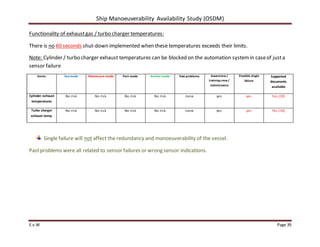
Functionality of exhaustgas / turbo charger temperatures:
There is no 60 seconds shut-down implemented when these temperatures exceeds their limits.
Note: Cylinder / turbo charger exhaust temperatures can be blocked on the automation systemin caseof justa
sensor failure
Items: Sea-mode Manoeuvre-mode Port-mode Anchor-mode Past problems. Awareness/
training crew /
maintenance
Possible single
failure
Supported
documents
available
Cylinder exhaust
temperatures
No risk No risk No risk No risk none yes yes Yes (10)
Turbo charger
exhaust temp.
No risk No risk No risk No risk none yes yes Yes (10)
Single failure will not affect the redundancy and manoeuverability of the vessel.
Pastproblems were all related to sensor failures or wrong sensor indications.
Ship Manoeuverability Availability Study (OSDM)
E.v.W Page 40
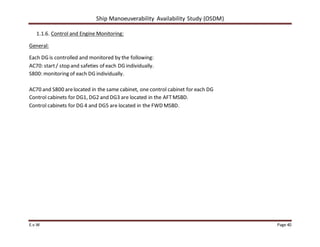
1.1.6. Control and Engine Monitoring:
General:
Each DG is controlled and monitored by the following:
AC70: start/ stop and safeties of each DG individually.
S800: monitoring of each DG individually.
AC70 and S800 arelocated in the same cabinet, one control cabinet for each DG
Control cabinets for DG1, DG2 and DG3 are located in the AFTMSBD.
Control cabinets for DG 4 and DG5 are located in the FWD MSBD.
Ship Manoeuverability Availability Study (OSDM)
E.v.W Page 41
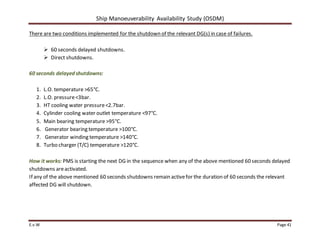
There are two conditions implemented for the shutdown of the relevant DG(s) in case of failures.
 60 seconds delayed shutdowns.
 Direct shutdowns.
60 seconds delayed shutdowns:
1. L.O. temperature >65°C.
2. L.O. pressure<3bar.
3. HT cooling water pressure<2.7bar.
4. Cylinder cooling water outlet temperature <97°C.
5. Main bearing temperature >95°C.
6. Generator bearing temperature >100°C.
7. Generator winding temperature >140°C.
8. Turbo charger (T/C) temperature >120°C.
How it works: PMS is starting the next DG in the sequence when any of the above mentioned 60 seconds delayed
shutdowns areactivated.
If any of the above mentioned 60 seconds shutdowns remain activefor the duration of 60 seconds the relevant
affected DG will shutdown.
Ship Manoeuverability Availability Study (OSDM)
E.v.W Page 42
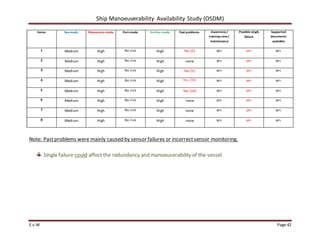
Items: Sea-mode Manoeuvre-mode Port-mode Anchor-mode Past problems. Awareness/
training crew /
maintenance
Possible single
failure
Supported
documents
available
1 Medium High No risk High Yes (5) yes yes yes
2 Medium High No risk High none yes yes yes
3 Medium High No risk High Yes (5) yes yes yes
4 Medium High No risk High Yes (15) yes yes yes
5 Medium High No risk High Yes (10) yes yes yes
6 Medium High No risk High none yes yes yes
7 Medium High No risk High none yes yes yes
8 Medium High No risk High none yes yes yes
Note: Pastproblems were mainly caused by sensor failures or incorrectsensor monitoring.
Single failure could affect the redundancy and manoeuverability of the vessel.
Ship Manoeuverability Availability Study (OSDM)
E.v.W Page 43
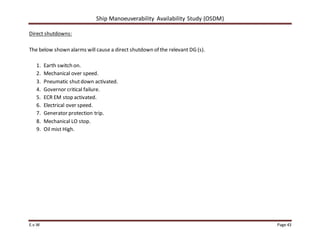
Direct shutdowns:
The below shown alarms will cause a direct shutdown of the relevant DG (s).
1. Earth switch on.
2. Mechanical over speed.
3. Pneumatic shutdown activated.
4. Governor critical failure.
5. ECR EM stop activated.
6. Electrical over speed.
7. Generator protection trip.
8. Mechanical LO stop.
9. Oil mist High.
Ship Manoeuverability Availability Study (OSDM)
E.v.W Page 44
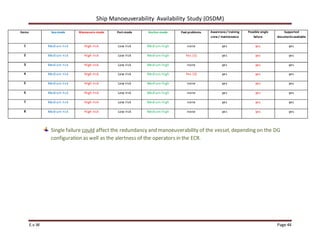
Items: Sea-mode Manoeuvre-mode Port-mode Anchor-mode Past problems. Awareness/ training
crew / maintenance
Possible single
failure
Supported
documentsavailable
1 Medium risk High risk Low risk Medium-high none yes yes yes
2 Medium risk High risk Low risk Medium-high Yes (1) yes yes yes
3 Medium risk High risk Low risk Medium-high none yes yes yes
4 Medium risk High risk Low risk Medium-high Yes (1) yes yes yes
5 Medium risk High risk Low risk Medium-high none yes yes yes
6 Medium risk High risk Low risk Medium-high none yes yes yes
7 Medium risk High risk Low risk Medium-high none yes yes yes
8 Medium risk High risk Low risk Medium-high none yes yes yes
Single failure could affect the redundancy and manoeuverability of the vessel, depending on the DG
configuration as well as the alertness of the operators in the ECR.
Ship Manoeuverability Availability Study (OSDM)
E.v.W Page 45
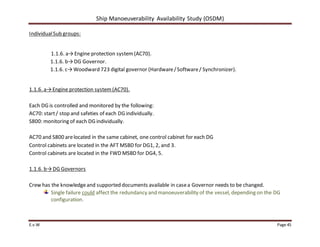
IndividualSub groups:
1.1.6. a→Engine protection system(AC70).
1.1.6. b→DG Governor.
1.1.6. c→Woodward 723 digital governor (Hardware/Software/ Synchronizer).
1.1.6. a→Engine protection system (AC70).
Each DG is controlled and monitored by the following:
AC70: start/ stop and safeties of each DG individually.
S800: monitoring of each DG individually.
AC70 and S800 arelocated in the same cabinet, one control cabinet for each DG
Control cabinets are located in the AFT MSBD for DG1, 2, and 3.
Control cabinets are located in the FWD MSBD for DG4, 5.
1.1.6. b→DG Governors
Crew has the knowledgeand supported documents available in casea Governor needs to be changed.
Single failure could affect the redundancy and manoeuverability of the vessel, depending on the DG
configuration.
Ship Manoeuverability Availability Study (OSDM)
E.v.W Page 46
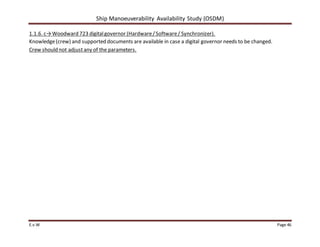
1.1.6. c→Woodward 723 digitalgovernor (Hardware/Software/ Synchronizer).
Knowledge(crew) and supported documents are available in case a digital governor needs to be changed.
Crew should not adjust any of the parameters.
Ship Manoeuverability Availability Study (OSDM)
E.v.W Page 47
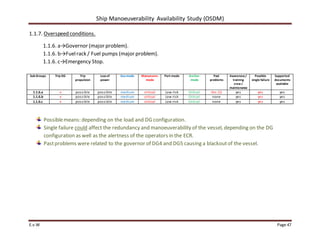
1.1.7. Overspeed conditions.
1.1.6. a→Governor (major problem).
1.1.6. b→Fuelrack / Fuel pumps (major problem).
1.1.6. c→Emergency Stop.
Sub Groups Trip DG Trip
propulsion
Lossof
power
Sea-mode Manoeuvre-
mode
Port-mode Anchor-
mode
Past
problems
Awareness/
training
crew /
maintenance
Possible
single failure
Supported
documents
available
1.1.6.a x possible possible medium critical Low risk Critical Yes (1) yes yes yes
1.1.6.b x possible possible medium critical Low risk Critical none yes yes yes
1.1.6.c x possible possible medium critical Low risk Critical none yes yes yes
Possiblemeans: depending on the load and DG configuration.
Single failure could affect the redundancy and manoeuverability of the vessel, depending on the DG
configuration as well as the alertness of the operators in the ECR.
Pastproblems were related to the governor of DG4 and DG5 causing a blackoutof the vessel.
Ship Manoeuverability Availability Study (OSDM)
E.v.W Page 48
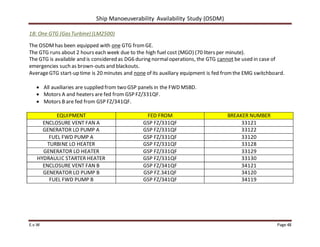
1B: One GTG (GasTurbine) (LM2500)
The OSDMhas been equipped with one GTG fromGE.
The GTG runs about 2 hours each week due to the high fuel cost (MGO) (70 liters per minute).
The GTG is available and is considered as DG6 during normaloperations, the GTG cannot be used in case of
emergencies such as brown-outs and blackouts.
AverageGTG start-up time is 20 minutes and none of its auxiliary equipment is fed fromthe EMG switchboard.
 All auxiliaries are supplied from two GSP panels in the FWD MSBD.
 Motors A and heaters are fed from GSP FZ/331QF.
 Motors B are fed from GSP FZ/341QF.
EQUIPMENT FED FROM BREAKER NUMBER
ENCLOSURE VENT FAN A GSP FZ/331QF 33121
GENERATOR LO PUMP A GSP FZ/331QF 33122
FUEL FWD PUMP A GSP FZ/331QF 33120
TURBINE LO HEATER GSP FZ/331QF 33128
GENERATOR LO HEATER GSP FZ/331QF 33129
HYDRAULIC STARTER HEATER GSP FZ/331QF 33130
ENCLOSURE VENT FAN B GSP FZ/341QF 34121
GENERATOR LO PUMP B GSP FZ.341QF 34120
FUEL FWD PUMP B GSP FZ/341QF 34119
Ship Manoeuverability Availability Study (OSDM)
E.v.W Page 49
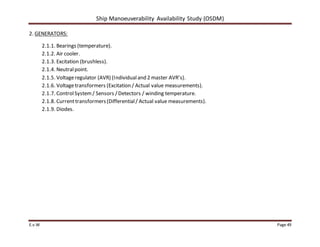
2. GENERATORS:
2.1.1. Bearings (temperature).
2.1.2. Air cooler.
2.1.3. Excitation (brushless).
2.1.4. Neutralpoint.
2.1.5. Voltageregulator (AVR) (Individualand 2 master AVR’s).
2.1.6. Voltagetransformers (Excitation / Actual value measurements).
2.1.7. ControlSystem/ Sensors /Detectors / winding temperature.
2.1.8. Current transformers(Differential/ Actual value measurements).
2.1.9. Diodes.
Ship Manoeuverability Availability Study (OSDM)
E.v.W Page 50
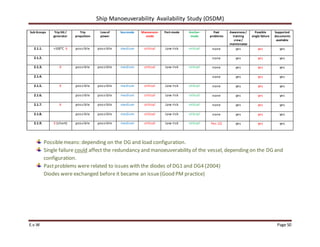
Sub Groups Trip DG /
generator
Trip
propulsion
Lossof
power
Sea-mode Manoeuvre-
mode
Port-mode Anchor-
mode
Past
problems
Awareness/
training
crew /
maintenance
Possible
single failure
Supported
documents
available
2.1.1. >100°C X possible possible medium critical Low risk critical none yes yes yes
2.1.2. none yes yes yes
2.1.3. X possible possible medium critical Low risk critical none yes yes yes
2.1.4. none yes yes yes
2.1.5. X possible possible medium critical Low risk critical none yes yes yes
2.1.6. possible possible medium critical Low risk critical none yes yes yes
2.1.7. X possible possible medium critical Low risk critical none yes yes yes
2.1.8. possible possible medium critical Low risk critical none yes yes yes
2.1.9. X (short) possible possible medium critical Low risk critical Yes (2) yes yes yes
Possiblemeans: depending on the DG and load configuration.
Single failure could affect the redundancy and manoeuverability of the vessel, depending on the DG and
configuration.
Pastproblems were related to issues with the diodes of DG1 and DG4 (2004)
Diodes were exchanged before it became an issue(Good PM practice)
Ship Manoeuverability Availability Study (OSDM)
E.v.W Page 51
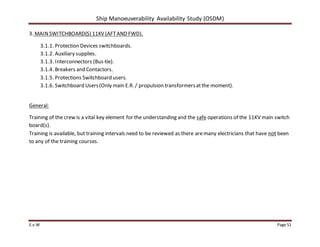
3. MAINSWITCHBOARD(S) 11KV (AFTAND FWD).
3.1.1. Protection Devices switchboards.
3.1.2. Auxiliary supplies.
3.1.3. Interconnectors (Bus-tie).
3.1.4. Breakers and Contactors.
3.1.5. Protections Switchboard users.
3.1.6. Switchboard Users(Only main E.R. / propulsion transformersatthe moment).
General:
Training of the crew is a vital key element for the understanding and the safe operations of the 11KV main switch
board(s).
Training is available, but training intervals need to be reviewed as there aremany electricians that have not been
to any of the training courses.
Ship Manoeuverability Availability Study (OSDM)
E.v.W Page 52
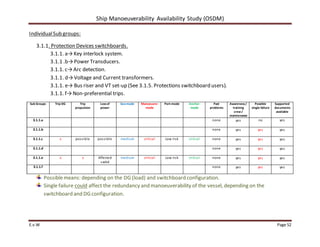
IndividualSub groups:
3.1.1. Protection Devices switchboards.
3.1.1. a→Key interlock system.
3.1.1 .b→Power Transducers.
3.1.1. c→Arc detection.
3.1.1. d→Voltage and Current transformers.
3.1.1. e→ Bus riser and VT set-up (See 3.1.5. Protections switchboard users).
3.1.1. f→Non-preferential trips.
Possiblemeans: depending on the DG (load) and switchboard configuration.
Single failure could affect the redundancy and manoeuverability of the vessel, depending on the
switchboard and DG configuration.
Sub Groups Trip DG Trip
propulsion
Lossof
power
Sea-mode Manoeuvre-
mode
Port-mode Anchor-
mode
Past
problems
Awareness/
training
crew /
maintenance
Possible
single failure
Supported
documents
available
3.1.1.a none yes no yes
3.1.1.b none yes yes yes
3.1.1.c x possible possible medium critical Low risk critical none yes yes yes
3.1.1.d none yes yes yes
3.1.1.e x x Affected
swbd
medium critical Low risk critical none yes yes yes
3.1.1.f none yes yes yes
Ship Manoeuverability Availability Study (OSDM)
E.v.W Page 53
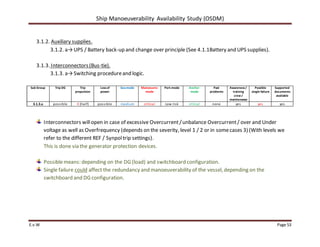
3.1.2. Auxiliary supplies.
3.1.2. a→UPS / Battery back-up and change over principle (See 4.1.1Battery and UPS supplies).
3.1.3. Interconnectors(Bus-tie).
3.1.3. a→Switching procedureand logic.
Sub Group Trip DG Trip
propulsion
Lossof
power
Sea-mode Manoeuvre-
mode
Port-mode Anchor-
mode
Past
problems
Awareness/
training
crew /
maintenance
Possible
single failure
Supported
documents
available
3.1.3.a possible X (half) possible medium critical Low risk critical none yes yes yes
Interconnectors willopen in case of excessive Overcurrent/unbalance Overcurrent/ over and Under
voltage as well as Overfrequency (depends on the severity, level 1 / 2 or in somecases 3) (With levels we
refer to the different REF / Synpoltrip settings).
This is done via the generator protection devices.
Possiblemeans: depending on the DG (load) and switchboard configuration.
Single failure could affect the redundancy and manoeuverability of the vessel, depending on the
switchboard and DG configuration.
Ship Manoeuverability Availability Study (OSDM)
E.v.W Page 54
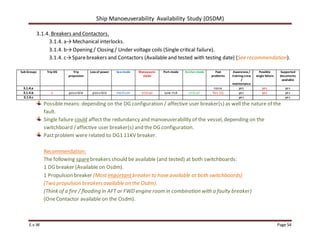
3.1.4. Breakers and Contactors.
3.1.4. a→Mechanical interlocks.
3.1.4. b→Opening / Closing / Under voltage coils (Single critical failure).
3.1.4. c→Sparebreakers and Contactors (Availableand tested with testing date) (See recommendation).
Sub Groups Trip DG Trip
propulsion
Lossof power Sea-mode Manoeuvre-
mode
Port-mode Anchor-mode Past
problems
Awareness/
training crew
/
maintenance
Possible
single failure
Supported
documents
available
3.1.4.a none yes yes yes
3.1.4.b x possible possible medium critical Low risk critical Yes (1) yes yes yes
3.1.4.c yes yes
Possiblemeans: depending on the DG configuration / affective user breaker(s) as well the nature of the
fault.
Single failure could affect the redundancy and manoeuverability of the vessel, depending on the
switchboard /affective user breaker(s) and the DG configuration.
Pastproblem were related to DG1 11KV breaker.
Recommendation:
The following sparebreakers should be available (and tested) at both switchboards:
1 DG breaker (Available on Osdm).
1 Propulsion breaker (Mostimportantbreaker to have available at both switchboards)
(Two propulsion breakersavailable on the Osdm).
(Think of a fire / flooding in AFT or FWD engine room in combination with a faulty breaker)
(OneContactor available on the Osdm).
Ship Manoeuverability Availability Study (OSDM)
E.v.W Page 55
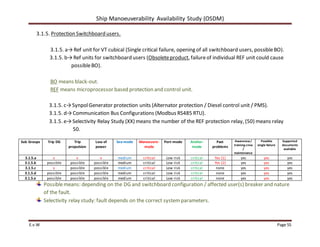
3.1.5. Protection Switchboard users.
3.1.5. a→Ref unit for VT cubical (Single critical failure, opening of all switchboard users, possibleBO).
3.1.5. b→Ref units for switchboard users (Obsoleteproduct, failureof individual REF unit could cause
possibleBO).
BO means black-out.
REF means microprocessor based protection and control unit.
3.1.5. c→SynpolGenerator protection units (Alternator protection / Diesel control unit / PMS).
3.1.5. d→Communication Bus Configurations (Modbus RS485 RTU).
3.1.5. e→Selectivity Relay Study (XX) means the number of the REF protection relay, (50) means relay
50.
Possiblemeans: depending on the DG and switchboard configuration / affected user(s) breaker and nature
of the fault.
Selectivity relay study: fault depends on the correct systemparameters.
Sub Groups Trip DG Trip
propulsion
Loss of
power
Sea-mode Manoeuvre-
mode
Port-mode Anchor-
mode
Past
problems
Awareness/
training crew
/
maintenance
Possible
single failure
Supported
documents
available
3.1.5.a x x x medium critical Low risk critical Yes (1) yes yes yes
3.1.5.b possible possible possible medium critical Low risk critical Yes (2) yes yes yes
3.1.5.c x possible possible medium critical Low risk critical none yes yes yes
3.1.5.d possible possible possible medium critical Low risk critical none yes yes yes
3.1.5.e possible possible possible medium critical Low risk critical none yes yes yes
Ship Manoeuverability Availability Study (OSDM)
E.v.W Page 56
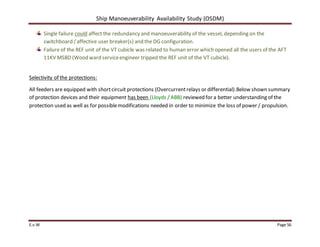
Single failure could affect the redundancy and manoeuverability of the vessel, depending on the
switchboard /affective user breaker(s) and the DG configuration.
Failure of the REF unit of the VT cubicle was related to human error which opened all the users of the AFT
11KV MSBD (Wood ward serviceengineer tripped the REF unit of the VT cubicle).
Selectivity of the protections:
All feeders are equipped with shortcircuit protections (Overcurrentrelays or differential).Below shown summary
of protection devices and their equipment has been (Lloyds / ABB) reviewed for a better understanding of the
protection used as well as for possiblemodifications needed in order to minimize the loss of power / propulsion.
Ship Manoeuverability Availability Study (OSDM)
E.v.W Page 57
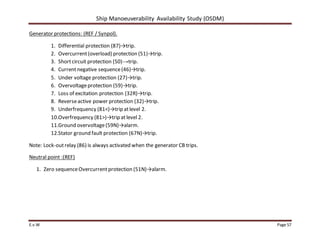
Generator protections: (REF / Synpol).
1. Differential protection (87)→trip.
2. Overcurrent(overload) protection (51)→trip.
3. Shortcircuit protection (50)→trip.
4. Currentnegative sequence(46)→trip.
5. Under voltage protection (27)→trip.
6. Overvoltageprotection (59)→trip.
7. Loss of excitation protection (32R)→trip.
8. Reverseactive power protection (32)→trip.
9. Underfrequency (81<)→trip atlevel 2.
10.Overfrequency (81>)→trip atlevel 2.
11.Ground overvoltage(59N)→alarm.
12.Stator ground fault protection (67N)→trip.
Note: Lock-outrelay (86) is always activated when the generator CB trips.
Neutral point :(REF)
1. Zero sequenceOvercurrentprotection (51N)→alarm.
Ship Manoeuverability Availability Study (OSDM)
E.v.W Page 58
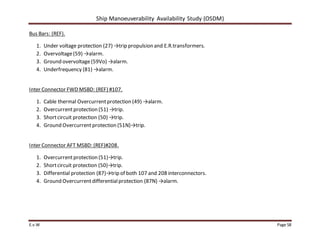
Bus Bars: (REF).
1. Under voltage protection (27) →trip propulsion and E.R.transformers.
2. Overvoltage(59) →alarm.
3. Ground overvoltage(59Vo) →alarm.
4. Underfrequency (81) →alarm.
Inter Connector FWD MSBD: (REF) #107.
1. Cable thermal Overcurrentprotection (49) →alarm.
2. Overcurrentprotection (51) →trip.
3. Shortcircuit protection (50) →trip.
4. Ground Overcurrentprotection (51N)→trip.
Inter Connector AFT MSBD: (REF)#208.
1. Overcurrentprotection (51)→trip.
2. Shortcircuit protection (50)→trip.
3. Differential protection (87)→trip of both 107 and 208 interconnectors.
4. Ground Overcurrentdifferentialprotection (87N) →alarm.
Ship Manoeuverability Availability Study (OSDM)
E.v.W Page 59
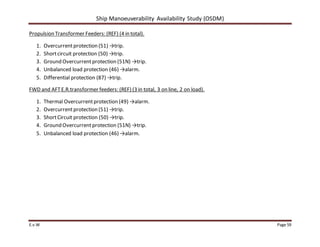
Propulsion Transformer Feeders: (REF) (4 in total).
1. Overcurrentprotection (51) →trip.
2. Shortcircuit protection (50) →trip.
3. Ground Overcurrentprotection (51N) →trip.
4. Unbalanced load protection (46) →alarm.
5. Differential protection (87) →trip.
FWD and AFTE.R.transformer feeders: (REF) (3 in total, 3 on line, 2 on load).
1. Thermal Overcurrentprotection (49) →alarm.
2. Overcurrentprotection (51) →trip.
3. ShortCircuit protection (50) →trip.
4. Ground Overcurrentprotection (51N) →trip.
5. Unbalanced load protection (46) →alarm.
Ship Manoeuverability Availability Study (OSDM)
E.v.W Page 60
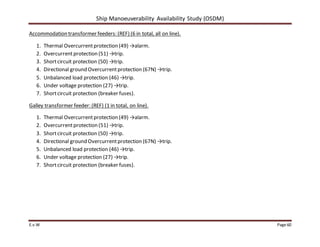
Accommodation transformer feeders: (REF) (6 in total, all on line).
1. Thermal Overcurrentprotection (49) →alarm.
2. Overcurrentprotection (51) →trip.
3. Shortcircuit protection (50) →trip.
4. Directional ground Overcurrentprotection (67N) →trip.
5. Unbalanced load protection (46) →trip.
6. Under voltage protection (27) →trip.
7. Shortcircuit protection (breaker fuses).
Galley transformer feeder: (REF) (1 in total, on line).
1. Thermal Overcurrentprotection (49) →alarm.
2. Overcurrentprotection (51) →trip.
3. Shortcircuit protection (50) →trip.
4. Directional ground Overcurrentprotection (67N) →trip.
5. Unbalanced load protection (46) →trip.
6. Under voltage protection (27) →trip.
7. Shortcircuit protection (breaker fuses).
Ship Manoeuverability Availability Study (OSDM)
E.v.W Page 61
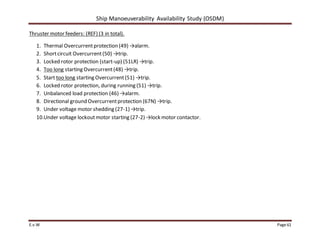
Thruster motor feeders: (REF) (3 in total).
1. Thermal Overcurrentprotection (49) →alarm.
2. Shortcircuit Overcurrent(50) →trip.
3. Locked rotor protection (start-up) (51LR) →trip.
4. Too long starting Overcurrent(48) →trip.
5. Start too long starting Overcurrent(51) →trip.
6. Locked rotor protection, during running (51) →trip.
7. Unbalanced load protection (46) →alarm.
8. Directional ground Overcurrentprotection (67N) →trip.
9. Under voltage motor shedding (27-1) →trip.
10.Under voltage lockoutmotor starting (27-2) →lock motor contactor.
Ship Manoeuverability Availability Study (OSDM)
E.v.W Page 62
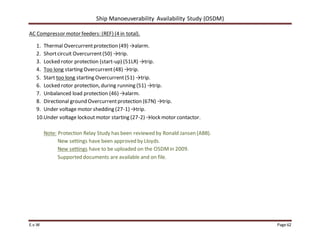
AC Compressor motor feeders: (REF) (4 in total).
1. Thermal Overcurrentprotection (49) →alarm.
2. Shortcircuit Overcurrent(50) →trip.
3. Locked rotor protection (start-up) (51LR) →trip.
4. Too long starting Overcurrent(48) →trip.
5. Start too long starting Overcurrent(51) →trip.
6. Locked rotor protection, during running (51) →trip.
7. Unbalanced load protection (46) →alarm.
8. Directional ground Overcurrentprotection (67N) →trip.
9. Under voltage motor shedding (27-1) →trip.
10.Under voltage lockoutmotor starting (27-2) →lock motor contactor.
Note: Protection Relay Study has been reviewed by Ronald Jansen (ABB).
New settings have been approved by Lloyds.
New settings have to be uploaded on the OSDMin 2009.
Supported documents are available and on file.
Ship Manoeuverability Availability Study (OSDM)
E.v.W Page 63
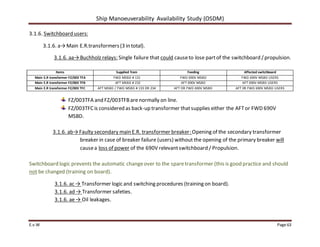
3.1.6. Switchboard users:
3.1.6. a→Main E.R.transformers(3 in total).
3.1.6. aa→Buchholz relays: Single failure that could causeto lose partof the switchboard /propulsion.
Items Supplied from Feeding Affected switchboard
Main E.R transformer FZ/003 TFA FWD MSBD # 131 FWD 690V MSBD FWD 690V MSBD USERS
Main E.R transformer FZ/003 TFB AFT MSBD # 232 AFT 690V MSBD AFT 690V MSBD USERS
Main E.R transformer FZ/003 TFC AFT MSBD / FWD MSBD # 133 OR 234 AFT OR FWD 690V MSBD AFT 0R FWD 690V MSBD USERS
FZ/003TFA and FZ/003TFBare normally on line.
FZ/003TFCis considered as back-up transformer thatsupplies either the AFTor FWD 690V
MSBD.
3.1.6. ab→Faulty secondary main E.R. transformer breaker: Opening of the secondary transformer
breaker in case of breaker failure (users) without the opening of the primary breaker will
causea loss of power of the 690V relevantswitchboard / Propulsion.
Switchboard logic prevents the automatic changeover to the sparetransformer (this is good practice and should
not be changed (training on board).
3.1.6. ac → Transformer logic and switching procedures (training on board).
3.1.6. ad → Transformer safeties.
3.1.6. ae→ Oil leakages.
Ship Manoeuverability Availability Study (OSDM)
E.v.W Page 64
Sub Groups Trip DG Trip
propulsion
Lossof power Sea-mode Manoeuvre-
mode
Port-mode Anchor-
mode
Past
problems
Awareness/
training
crew /
maintenance
Possible
single
failure
Supported
documents
available
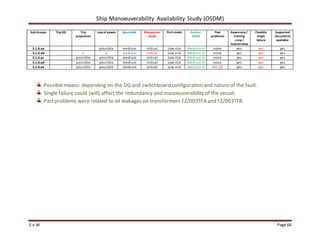
3.1.6.aa possible medium critical Low risk Medium-H none yes yes yes
3.1.6.ab x x medium critical Low risk Medium-H none yes yes yes
3.1.6.ac possible possible medium critical Low risk Medium-H none yes yes yes
3.1.6.ad possible possible medium critical Low risk Medium-H none yes yes yes
3.1.6.ae possible possible medium critical Low risk Medium-H Yes (2) yes yes yes
Possiblemeans: depending on the DG and switchboard configuration and nature of the fault.
Single failure could (will) affect the redundancy and manoeuverability of the vessel.
Pastproblems were related to oil leakages on transformers FZ/003TFA and FZ/003TFB.
Ship Manoeuverability Availability Study (OSDM)
E.v.W Page 65
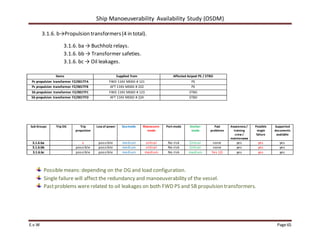
3.1.6. b→Propulsion transformers(4 in total).
3.1.6. ba → Buchholz relays.
3.1.6. bb → Transformer safeties.
3.1.6. bc → Oil leakages.
Items Supplied from Affected Azipod PS / STBD
Ps propulsion transformer FZ/001TFA FWD 11KV MSBD # 121 PS
Ps propulsion transformer FZ/001TFB AFT 11KV MSBD # 222 PS
Sb propulsion transformer FZ/001TFC FWD 11KV MSBD # 123 STBD
Sb propulsion transformer FZ/001TFD AFT 11KV MSBD # 224 STBD
Sub Groups Trip DG Trip
propulsion
Lossof power Sea-mode Manoeuvre-
mode
Port-mode Anchor-
mode
Past
problems
Awareness/
training
crew /
maintenance
Possible
single
failure
Supported
documents
available
3.1.6.ba x possible medium critical No risk Critical none yes yes yes
3.1.6.bb possible possible medium critical No risk Critical none yes yes yes
3.1.6.bc possible possible medium medium No risk medium Yes (2) yes yes yes
Possiblemeans: depending on the DG and load configuration.
Single failure will affect the redundancy and manoeuverability of the vessel.
Pastproblems were related to oil leakages on both FWD PS and SB propulsion transformers.
Ship Manoeuverability Availability Study (OSDM)
E.v.W Page 66
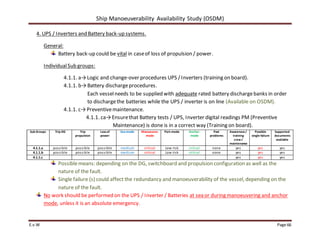
4. UPS / Inverters and Battery back-up systems.
General:
Battery back-up could be vital in caseof loss of propulsion / power.
IndividualSub groups:
4.1.1. a→Logic and change-over procedures UPS /Inverters (training on board).
4.1.1. b→Battery dischargeprocedures.
Each vesselneeds to be supplied with adequate rated battery dischargebanks in order
to dischargethe batteries while the UPS / inverter is on line (Available on OSDM).
4.1.1. c→Preventivemaintenance.
4.1.1. ca→Ensurethat Battery tests / UPS, Inverter digital readings PM (Preventive
Maintenance) is done is in a correct way (Training on board).
Sub Groups Trip DG Trip
propulsion
Lossof
power
Sea-mode Manoeuvre-
mode
Port-mode Anchor-
mode
Past
problems
Awareness/
training
crew /
maintenance
Possible
single failure
Supported
documents
available
4.1.1.a possible possible possible medium critical Low risk critical none yes yes yes
4.1.1.b possible possible possible medium critical Low risk critical none yes yes yes
4.1.1.c yes yes yes
Possiblemeans: depending on the DG, switchboard and propulsion configuration as well as the
nature of the fault.
Single failure (s) could affect the redundancy and manoeuverability of the vessel, depending on the
nature of the fault.
No work should be performed on the UPS / Inverter / Batteries at sea or during manoeuvering and anchor
mode, unless it is an absolute emergency.
Ship Manoeuverability Availability Study (OSDM)
E.v.W Page 67
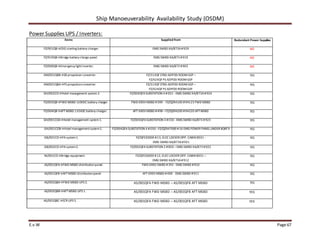
Power Supplies UPS / Inverters:
Items Supplied from Redundant Power Supplies
FZ/901QB→EDG starting battery charger. EMG SWBD XA/873A#929 NO
FZ/919QB→Bridge battery charge panel. EMG SWBD XA/873 #919 NO
FZ/009QB→Emergency lightinverter. EMG SWBD XA/873 #903 NO
XM/001QBB→SB propulsion converter. FZ/313QF STBD AZIPOD ROOMGSP –
FZ/424QF PS AZIPOD ROOMGSP
YES
XM/001QBA→PS propulsionconverter. FZ/313QF STBD AZIPOD ROOMGSP –
FZ/424QF PS AZIPOD ROOMGSP
YES
GH/002CO→Hotel management system 2. FZ/004QFASUBSTATION 4 #D51 -EMG SWBD XA/873A#924 YES
FZ/003QB→FWD MSBD 110VDC battery charger. FWD 690V MSBD #399 - FZ/QZ94100 #94123 FWD MSBD YES
FZ/004QB→AFTMSBD 110VDC battery charger. AFT 690V MSBD #498 –FZ/QZ94200 #94220 AFT MSBD YES
GH/001COA→Hotel management system1. FZ/003QFASUBSTATION 3 #C50 -EMG SWBD XA/873 #923 YES
GH/001COB→Hotelmanagementsystem1. FZ/004QFASUBSTATION 4 # D50 -FZ/QZ947000 #16 EMG POWER PANELUNDER BOAT9 YES
GB/001CO→PAsystem1. FZ/QFE30000 #13, ELEC LOCKER OPP. CABIN 8031 -
EMG SWBD XA/873A#921
YES
GB/002CO→PAsystem2. FZ/002QFASUBSTATION 2 #B50 –EMG SWBD XA/873 #922 YES
NI/001CO→Bridge equipment. FZ/QFE30000 #12, ELEC LOCKER OPP. CABIN 8031 –
EMG SWBD XA/873A#912
YES
AS/001QFA→FWD MSBD distributionpanel. FWD 690V SWBD #391 -EMG SWBD #910 YES
AS/001QFB→AFTMSBD distributionpanel. AFT 690V MSBD #490 - EMG SWBD #911 YES
AS/002QBA→FWD MSBD UPS 2. AS/001QFA FWD MSBD – AS/001QFB AFT MSBD YES
AS/002QBB→AFTMSBD UPS 1. AS/001QFA FWD MSBD – AS/001QFB AFT MSBD YES
AS/002QBC→ECR UPS 5. AS/001QFA FWD MSBD – AS/001QFB AFT MSBD YES
Ship Manoeuverability Availability Study (OSDM)
E.v.W Page 68
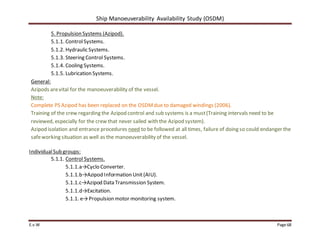
5. Propulsion Systems (Azipod).
5.1.1. ControlSystems.
5.1.2. Hydraulic Systems.
5.1.3. Steering Control Systems.
5.1.4. Cooling Systems.
5.1.5. Lubrication Systems.
General:
Azipods arevital for the manoeuverability of the vessel.
Note:
Complete PS Azipod has been replaced on the OSDMdue to damaged windings (2006).
Training of the crew regarding the Azipod control and sub systems is a must(Training intervals need to be
reviewed, especially for the crew that never sailed with the Azipod system).
Azipod isolation and entrance procedures need to be followed at all times, failure of doing so could endanger the
safeworking situation as well as the manoeuverability of the vessel.
IndividualSub groups:
5.1.1. Control Systems.
5.1.1.a→Cyclo Converter.
5.1.1.b→Azipod Information Unit(AIU).
5.1.1.c→Azipod Data Transmission System.
5.1.1.d→Excitation.
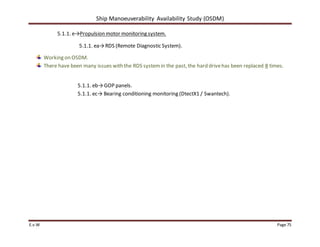
5.1.1. e→Propulsion motor monitoring system.
Ship Manoeuverability Availability Study (OSDM)
E.v.W Page 69
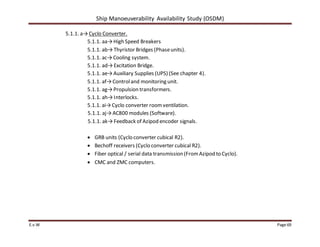
5.1.1. a→Cyclo Converter.
5.1.1. aa→High Speed Breakers
5.1.1. ab→Thyristor Bridges (Phaseunits).
5.1.1. ac→Cooling system.
5.1.1. ad→Excitation Bridge.
5.1.1. ae→Auxiliary Supplies (UPS) (See chapter 4).
5.1.1. af→Controland monitoring unit.
5.1.1. ag→ Propulsion transformers.
5.1.1. ah→Interlocks.
5.1.1. ai→Cyclo converter roomventilation.
5.1.1. aj→AC800 modules (Software).
5.1.1. ak→Feedback of Azipod encoder signals.
 GRB units (Cyclo converter cubical R2).
 Bechoff receivers (Cyclo converter cubical R2).
 Fiber optical / serial data transmission (FromAzipod to Cyclo).
 CMC and ZMC computers.
Ship Manoeuverability Availability Study (OSDM)
E.v.W Page 70
Sub Groups Trip DG Trip
propulsion
Lossof
power
Sea-mode Manoeuvre-
mode
Port-mode Anchor-
mode
Past
problems
Awareness/
training
crew /
maintenance
Possible
single failure
Supported
documents
available
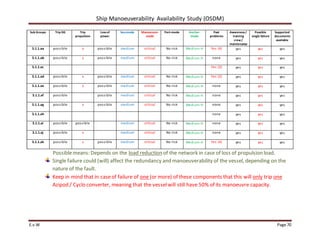
5.1.1.aa possible x possible medium critical No risk Medium-H Yes (4) yes yes yes
5.1.1.ab possible x possible medium critical No risk Medium-H none yes yes yes
5.1.1.ac Yes (2) yes yes yes
5.1.1.ad possible x possible medium critical No risk Medium-H Yes (2) yes yes yes
5.1.1.ae possible x possible medium critical No risk Medium-H none yes yes yes
5.1.1.af possible possible medium critical No risk Medium-H none yes yes yes
5.1.1.ag possible x possible medium critical No risk Medium-H none yes yes yes
5.1.1.ah none yes yes yes
5.1.1.ai possible possible medium critical No risk Medium-H none yes yes yes
5.1.1.aj possible x medium critical No risk Medium-H none yes yes yes
5.1.1.ak possible x possible medium critical No risk Medium-H Yes (4) yes yes yes
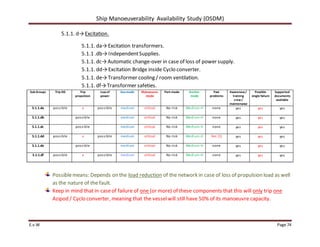
Possiblemeans: Depends on the load reduction of the network in case of loss of propulsion load.
Single failure could (will) affect the redundancy and manoeuverability of the vessel, depending on the
nature of the fault.
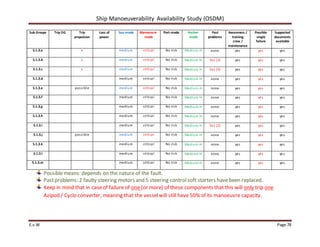
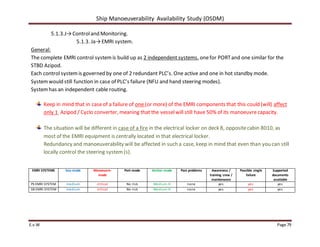
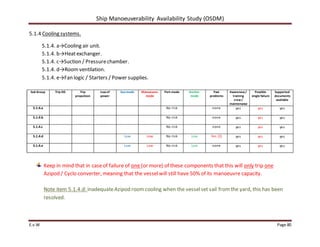
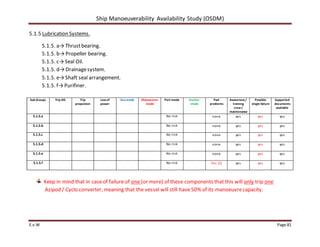
Keep in mind that in caseof failure of one (or more) of these components that this will only trip one
Azipod / Cyclo converter, meaning that the vesselwill still have 50% of its manoeuvre capacity.
Ship Manoeuverability Availability Study (OSDM)
E.v.W Page 71
Single failures:
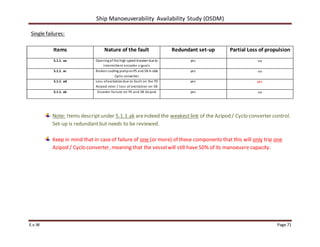
Items Nature of the fault Redundant set-up Partial Loss of propulsion
5.1.1. aa Openingof the high speed breaker due to
intermittent encoder signals
yes no
5.1.1. ac Broken cooling pumponPS and SB A-side
Cyclo converter
yes no
5.1.1. ad Loss ofexcitationdue to fault on the PS
Azipod rotor / loss of excitation on SB
yes yes
5.1.1. ak Encoder failure on PS and SB Azipod yes no
Note: Items descriptunder 5.1.1.ak areindeed the weakestlink of the Azipod / Cyclo converter control.
Set-up is redundantbut needs to be reviewed.
Keep in mind that in caseof failure of one (or more) of these components that this will only trip one
Azipod / Cyclo converter, meaning that the vesselwill still have 50% of its manoeuvre capacity.
Ship Manoeuverability Availability Study (OSDM)
E.v.W Page 72
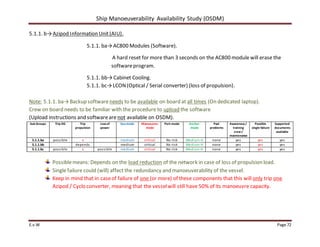
5.1.1. b→Azipod Information Unit(AIU).
5.1.1. ba→AC800 Modules (Software).
A hard reset for more than 3 seconds on the AC800 module will erase the
softwareprogram.
5.1.1. bb→Cabinet Cooling.
5.1.1. bc→LCON(Optical / Serial converter) (loss of propulsion).
Note: 5.1.1. ba→Backup softwareneeds to be available on board at all times (On dedicated laptop).
Crew on board needs to be familiar with the procedure to upload the software
(Upload instructions and softwareare not available on OSDM).
Sub Groups Trip DG Trip
propulsion
Lossof
power
Sea-mode Manoeuvre-
mode
Port-mode Anchor-
mode
Past
problems
Awareness/
training
crew /
maintenance
Possible
single failure
Supported
documents
available
5.1.1.ba possible x medium critical No risk Medium-H none yes yes yes
5.1.1.bb depends medium critical No risk Medium-H none yes yes yes
5.1.1.bc possible x possible medium critical No risk Medium-H none yes yes yes
Possiblemeans: Depends on the load reduction of the network in case of loss of propulsion load.
Single failure could (will) affect the redundancy and manoeuverability of the vessel.
Keep in mind that in caseof failure of one (or more) of these components that this will only trip one
Azipod / Cyclo converter, meaning that the vesselwill still have 50% of its manoeuvre capacity.
Ship Manoeuverability Availability Study (OSDM)
E.v.W Page 73
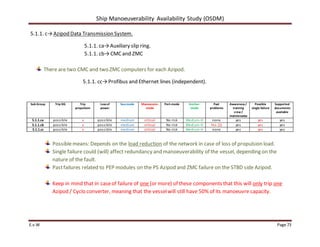
5.1.1. c→Azipod Data Transmission System.
5.1.1. ca→Auxiliary slip ring.
5.1.1. cb→CMCand ZMC
There are two CMC and two ZMC computers for each Azipod.
5.1.1. cc→Profibus and Ethernet lines (independent).
Sub Group Trip DG Trip
propulsion
Lossof
power
Sea-mode Manoeuvre-
mode
Port-mode Anchor-
mode
Past
problems
Awareness/
training
crew /
maintenance
Possible
single failure
Supported
documents
available
5.1.1.ca possible x possible medium critical No risk Medium-H none yes yes yes
5.1.1.cb possible x possible medium critical No risk Medium-H Yes (2) yes yes yes
5.1.1.cc possible x possible medium critical No risk Medium-H none yes yes yes
Possiblemeans: Depends on the load reduction of the network in case of loss of propulsion load.
Single failure could (will) affect redundancy and manoeuverability of the vessel, depending on the
nature of the fault.
Pastfailures related to PEP modules on the PS Azipod and ZMC failure on the STBD side Azipod.
Keep in mind that in caseof failure of one (or more) of these components that this will only trip one
Azipod / Cyclo converter, meaning that the vesselwill still have 50% of its manoeuvre capacity.
Ship Manoeuverability Availability Study (OSDM)
E.v.W Page 74
5.1.1. d→Excitation.
5.1.1. da→Excitation transformers.
5.1.1 .db→IndependentSupplies.
5.1.1. dc→Automatic change-over in case of loss of power supply.
5.1.1. dd→Excitation Bridge inside Cyclo converter.
5.1.1. de→Transformer cooling / room ventilation.
5.1.1. df→Transformer safeties.
Sub Groups Trip DG Trip
propulsion
Lossof
power
Sea-mode Manoeuvre-
mode
Port-mode Anchor-
mode
Past
problems
Awareness/
training
crew /
maintenance
Possible
single failure
Supported
documents
available
5.1.1.da possible x possible medium critical No risk Medium-H none yes yes yes
5.1.1.db possible medium critical No risk Medium-H none yes yes yes
5.1.1.dc possible medium critical No risk Medium-H none yes yes yes
5.1.1.dd possible x possible medium critical No risk Medium-H Yes (1) yes yes yes
5.1.1.de possible medium critical No risk Medium-H none yes yes yes
5.1.1.df possible x possible medium critical No risk Medium-H none yes yes yes
Possiblemeans: Depends on the load reduction of the network in case of loss of propulsion load as well
as the nature of the fault.
Keep in mind that in caseof failure of one (or more) of these components that this will only trip one
Azipod / Cyclo converter, meaning that the vesselwill still have 50% of its manoeuvre capacity.
Ship Manoeuverability Availability Study (OSDM)
E.v.W Page 75
5.1.1. e→Propulsion motor monitoring system.
5.1.1. ea→RDS (Remote Diagnostic System).
Working on OSDM.
There have been many issues with the RDS systemin the past, the hard drivehas been replaced 8 times.
5.1.1. eb→GOP panels.
5.1.1. ec→ Bearing conditioning monitoring (DtectX1 / Swantech).
Ship Manoeuverability Availability Study (OSDM)
E.v.W Page 76
5.1.2. Hydraulic Systems.
5.1.2. a→Hydraulic motors (4 in total)
5.1.2. b→In case of hydraulic leakage (Faultseparation block).
5.1.2. c→Flushing pump.
5.1.2. d→Hydraulic power pack.
Sub Groups Trip
propulsion
Lossof power Sea-mode Manoeuvre-
mode
Port-mode Anchor-mode Past problems Awareness/
training crew
/
maintenance
Possible single
failure
Supported
documents
available
5.1.2.a possible possible medium critical No risk Medium-H none yes yes yes
5.1.2.b Yes (1) yes yes yes
5.1.2.c none yes yes yes
5.1.2.d possible possible medium critical No risk Medium-H none yes yes yes
Possiblemeans: Depends on the nature of the fault as well as on the load reduction of the network in case
of a failure.
Fault separation block has been completely changed on the PS due to internal componentfailure.
Keep in mind that in caseof failure of one (or more) of these components that this will only trip one
Azipod / Cyclo converter, meaning that the vessel will still have50% of its manoeuvrecapacity.
Ship Manoeuverability Availability Study (OSDM)
E.v.W Page 77
5.1.3. Steering controlsystem.
5.1.3. a→Steering pumps.
5.1.3. b→Steering motors.
5.1.3. c→Steering motor starters.
5.1.3. d→Steering gear control panels (Local / ECR / Bridge).
5.1.3. e→ Power supplies.
5.1.3. f→Steering Locking / brakesystem
5.1.3. g→Emergency steering.
5.1.3. h→Emergency Emergency steering.
5.1.3. i→ Room ventilation.
5.1.3. j→Control and monitoring.
5.1.3. k→Faststeering mode (Only possiblein Manoeuvremode, 2 pumps).
5.1.3. l→ Steering mechanical set-up.
5.1.3. m→Slewing bearing and sealing system.
Ship Manoeuverability Availability Study (OSDM)
E.v.W Page 78
Sub Groups Trip DG Trip
propulsion
Loss of
power
Sea-mode Manoeuvre-
mode
Port-mode Anchor-
mode
Past
problems
Awareness /
training
crew /
maintenance
Possible
single
failure
Supported
documents
available
5.1.3.a x medium critical No risk Medium-H none yes yes yes
5.1.3.b x medium critical No risk Medium-H Yes (2) yes yes yes
5.1.3.c x medium critical No risk Medium-H Yes (5) yes yes yes
5.1.3.d medium critical No risk Medium-H none yes yes yes
5.1.3.e possible medium critical No risk Medium-H none yes yes yes
5.1.3.f medium critical No risk Medium-H none yes yes yes
5.1.3.g medium critical No risk Medium-H none yes yes yes
5.1.3.h medium critical No risk Medium-H none yes yes yes
5.1.3.i medium critical No risk Medium-H Yes (2) yes yes yes
5.1.3.j possible medium critical No risk Medium-H none yes yes yes
5.1.3.k medium critical No risk Medium-H none yes yes yes
5.1.3.l medium critical No risk Medium-H none yes yes yes
5.1.3.m medium critical No risk Medium-H none yes yes yes
Possiblemeans: depends on the nature of the fault.
Pastproblems: 2 faulty steering motors and 5 steering controlsoft starters havebeen replaced.
Keep in mind that in caseof failure of one (or more) of these components that this will only trip one
Azipod / Cyclo converter, meaning that the vesselwill still have 50% of its manoeuvre capacity.
Ship Manoeuverability Availability Study (OSDM)
E.v.W Page 79
5.1.3.J→Controland Monitoring.
5.1.3. Ja→EMRI system.
General:
The complete EMRI control systemis build up as 2 independent systems, onefor PORTand one similar for the
STBD Azipod.
Each control systemis governed by one of 2 redundant PLC’s. One active and one in hot standby mode.
Systemwould still function in case of PLC’s failure (NFU and hand steering modes).
Systemhas an independent cable routing.
Keep in mind that in caseof a failure of one (or more) of the EMRI components that this could (will) affect
only 1 Azipod / Cyclo converter, meaning that the vesselwill still have 50% of its manoeuvrecapacity.
The situation will be different in case of a fire in the electrical locker on deck 8, oppositecabin 8010, as
most of the EMRI equipment is centrally located in that electrical locker.
Redundancy and manoeuverability will be affected in such a case, keep in mind that even than you can still
locally control the steering system (s).
EMRI SYSTEMS Sea-mode Manoeuvre-
mode
Port-mode Anchor-mode Past problems Awareness /
training crew /
maintenance
Possible single
failure
Supported
documents
available
PS EMRI SYSTEM medium critical No risk Medium-H none yes yes yes
SB EMRI SYSTEM medium critical No risk Medium-H none yes yes yes
Ship Manoeuverability Availability Study (OSDM)
E.v.W Page 80
5.1.4 Cooling systems.
5.1.4. a→Cooling air unit.
5.1.4. b→Heatexchanger.
5.1.4. c→Suction / Pressurechamber.
5.1.4. d→Roomventilation.
5.1.4. e→Fan logic / Starters / Power supplies.
Sub Group Trip DG Trip
propulsion
Lossof
power
Sea-mode Manoeuvre-
mode
Port-mode Anchor-
mode
Past
problems
Awareness/
training
crew /
maintenance
Possible
single failure
Supported
documents
available
5.1.4.a No risk none yes yes yes
5.1.4.b No risk none yes yes yes
5.1.4.c No risk none yes yes yes
5.1.4.d Low Low No risk Low Yes (2) yes yes yes
5.1.4.e Low Low No risk Low none yes yes yes
Keep in mind that in caseof failure of one (or more) of these components that this will only trip one
Azipod / Cyclo converter, meaning that the vesselwill still have 50% of its manoeuvre capacity.
Note item 5.1.4.d: inadequateAzipod roomcooling when the vesselset sail fromthe yard, this has been
resolved.
Ship Manoeuverability Availability Study (OSDM)
E.v.W Page 81
5.1.5 Lubrication Systems.
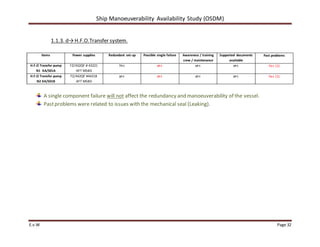
5.1.5. a→Thrustbearing.
5.1.5. b→Propeller bearing.
5.1.5. c→Seal Oil.
5.1.5. d→Drainagesystem.
5.1.5. e→Shaft seal arrangement.
5.1.5. f→Purifiner.
Sub Groups Trip DG Trip
propulsion
Lossof
power
Sea-mode Manoeuvre-
mode
Port-mode Anchor-
mode
Past
problems
Awareness/
training
crew /
maintenance
Possible
single failure
Supported
documents
available
5.1.5.a No risk none yes yes yes
5.1.5.b No risk none yes yes yes
5.1.5.c No risk none yes yes yes
5.1.5.d No risk none yes yes yes
5.1.5.e No risk none yes yes yes
5.1.5.f No risk Yes (2) yes yes yes
Keep in mind that in caseof failure of one (or more) of these components that this will only trip one
Azipod / Cyclo converter, meaning that the vessel will still have50% of its manoeuvrecapacity.
Ship Manoeuverability Availability Study (OSDM)
E.v.W Page 82
6. Emergency Switchboard / Emergency Generator.
6.1.1. Emergency switchboard.
6.1.2. Emergency generator.
General:
Emergency facilities such as emergency switchboard, its users and the emergency generator are vital for the
overall vessels safeand redundantoperation.
Failure of one of the components will affect the redundancy and could affect the manoeuverability of the vessel.
Note: The Complete EMG has been replaced on OSDM(March 2006)
IndividualSub groups:
6.1.1. Emergency switchboard.
6.1.1. a→Switchboard description / logic.
6.1.1. b→Inverter and Battery set-up.
6.1.1. c→Switchboard Safeties.
6.1.1. d→Transfer line and breakers.
6.1.1. e→ Switchboard users.
6.1.1. f→Room set-up / Ventilation.
6.1.1. g→Auxiliary transformers.
6.1.1. h→Masterpack breakers / sparebreakers.
Ship Manoeuverability Availability Study (OSDM)
E.v.W Page 83
Sub Groups Trip EMG Trip
transfer
line
Preferential
trip
Lossof emg
power
Sea-mode Manoeuvre-
mode
Port-mode Anchor-
mode
Past
problems
Awareness/
training
crew /
maintenance
Possible
single
failure
Supported
documents
available
6.1.1.a none yes yes yes
6.1.1.b Yes (20) yes yes yes
6.1.1.c possible possible medium critical Low risk Medium-H none yes yes yes
6.1.1.d medium critical Low risk Medium-H none yes yes yes
6.1.1.e none yes yes yes
6.1.1.f none yes yes yes
6.1.1.g medium critical Low risk Medium-H none yes yes yes
6.1.1.h possible possible possible medium critical Low risk Medium-H none yes yes yes
Possiblemeans: Depends on the nature of the failure.
Single failure will affect the redundancy and could affect the manoeuverability of the vessel.
Pastproblems were all related to internal component failures of the inverter (Fan sensors area good
example).
Ship Manoeuverability Availability Study (OSDM)
E.v.W Page 84
6.1.2. Emergency generator.
6.1.2. a→Safeties.
6.1.2. b→Radiator fan / Cooling (Modification made, in case of damper feedback failure).
6.1.2. c→Starting batteries / UPS (See chapter 4).
6.1.2. d→Fuel set-up.
6.1.2. e→ Starting air set-up / starting air receiver.
6.1.2. f→Control cabinet.
6.1.2. g→Mechanical set-up.
Sub Groups Trip EMG Trip
transfer
line
Preferential
trip
Lossof emg
power
Sea-mode Manoeuvre-
mode
Port-mode Anchor-
mode
Past
problems
Awareness/
training
crew /
maintenance
Possible
single
failure
Supported
documents
available
6.1.2.a possible possible medium critical Low risk Medium-H none yes yes yes
6.1.2.b x x medium critical Low risk Medium-H Yes (1) yes yes yes
6.1.2.c none yes yes yes
6.1.2.d possible possible medium critical Low risk Medium-H none yes yes yes
6.1.2.e Yes (1) yes yes yes
6.1.2.f possible possible medium critical Low risk Medium-H none yes yes yes
6.1.2.g medium critical Low risk Medium-H none yes yes yes
Possiblemeans: Depends on the nature of the failure.
Medium risk (sea-mode), critical risk (Manoeuvre-mode) and medium-high risk (Anchor mode) with faulty
transfer line to 690V MSBD (Running (on line) EMG feeding the EMSB users).
Pastproblems: air starter motor has been replaced / EMG cooler has been replaced (Leakage).
Ship Manoeuverability Availability Study (OSDM)
E.v.W Page 85
Automatic starting controlselection should always be selected to “electric start” and not to “pneumatic start”
during the normalsailing configuration.
Recommendation:
Sourcea different manufactory of an emergency generator for futurenew HAL vessels.
Consider the install of a second emergency generator / switchboard for futurenew HAL vessels.
6.1.2. d→ Fuel set-up:
Note: Fuel supply to EMG is done via a single feeder line with 1 quick closing valve and 1 manualvalve fromthe
DO tank in the EMG room, single failure of one of these valves will cut-off the fuel supply to the EMG.
There is no by-pass lineon the EMG fuel system.
Ship Manoeuverability Availability Study (OSDM)
E.v.W Page 86
6.1.2. a→ Safeties
6.1.2. aa→Overspeed (maxspeed setting + 15%).
6.1.2. ab→Lube-oil preheating high temp.
6.1.2. ac→Lube-oil low / very low pressure.
6.1.2. ad→Lube-oil high temperature >115°C.
6.1.2. ae→Speed governor (Major failure).
6.1.2. af→Combustion air / Exhaust gas (ambient room, temp).
6.1.2. ag→Cooling (fresh) water >100°C.
6.1.2. ah→Bearings (temperature).
Ship Manoeuverability Availability Study (OSDM)
E.v.W Page 87
Sub Groups Trip EMG Trip
transfer
line
Preferential
trip
Lossof emg
power
Sea-mode Manoeuvre-
mode
Port-mode Anchor-
mode
Past
problems
Awareness/
training
crew /
maintenance
Possible
single
failure
Supported
documents
available
6.1.2.aa x x medium critical Low risk Medium-H none yes yes yes
6.1.2.ab x x medium critical Low risk Medium-H none yes yes yes
6.1.2.ac none yes yes yes
6.1.2.ad x x medium critical Low risk Medium-H none yes yes yes
6.1.2.ae x x medium critical Low risk Medium-H none yes yes yes
6.1.2.af possible possible medium critical Low risk Medium-H none yes yes yes
6.1.2.ag x x medium critical Low risk Medium-H none yes yes yes
6.1.2.ah possible possible medium critical Low risk Medium-H none yes yes yes
Possiblemeans: Depends on the nature of the failure.
Medium risk (sea-mode), critical risk (Manoeuvre-mode) and medium-high risk (Anchor mode) with faulty
transfer line to 690V MSBD (Running (on line) EMG feeding the EMSB users).
Recommendation:
Common alarms to automation need to be reviewed; there should be no common alarms, justindividual
alarms.
Ship Manoeuverability Availability Study (OSDM)
E.v.W Page 88
7. Case study using chapters 1-6.
Scenario A:
1. Vessel is at sea, enroute to Hawaii, 2 dayssailing (away) from the Californian coast.
2. Complete loss of power and propulsion.
3. Fire in the AFTengine room.
4. Emergency DieselGenerator did notstart.
5. AFT engine room equipmentcannotbe used.
6. AFT 11KV / 690V SWBD usersand equipmentcannotbe used.
Scenario B:
1. Vessel is at sea, enroute to Hawaii, 2 dayssailing (away) from the Californian coast.
2. Complete loss of power and propulsion.
3. Fire in the FWD engine room.
4. Emergency DieselGenerator did notstart.
5. FWD engine room equipmentcannotbe used.
6. FWD 11KV / 690V SWBD usersand equipmentcannotbe used.
Ship Manoeuverability Availability Study (OSDM)
E.v.W Page 89
Goals for scenarios A and B:
1. Restore power / propulsion and Manoeuverability of the Vessel (Vital).
2. Restore vacuumsystems /galley and kitchen equipment / AC / drinking water (evaps) /potable
water / cabin power / Chiller and Freezer compressor /other passenger and crew facilities.
These scenarios will indicate the redundancy / non-redundancy of the ships systems in caseof an
emergency and the possiblechanges that need to be implemented in order to maintain the redundancy of
the ships systems.
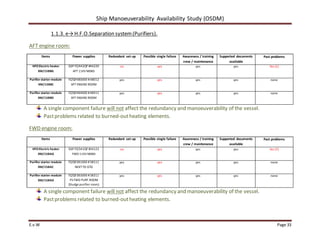
Scenario A:
1. Vessel is at sea, enroute to Hawaii, 2 dayssailing (away) from the Californian coast.
2. Complete loss of power and propulsion.
3. Fire in the AFTengine room.
4. Emergency DieselGenerator did notstart.
5. AFT engine room equipmentcannotbe used.
6. AFT 11KV / 690V SWBD usersand equipmentcannotbe used.
Below facts are based on one of the worstpossiblescenarios.
Ship Manoeuverability Availability Study (OSDM)
E.v.W Page 90
1. No access to the AFTengine room.
2. No access to the AFTMSBD (both entrance doorsto the AFTMSBD are located in the AFT engine room).
3. Emergency generatortransfer line wasselected to the AFT690V MSBD (410) before the fire / blackout.
4. No starting air available, air vessel only has a pressure of 8 bar (Not enough to start DG).
5. Essential equipmentto start the first DG on the FWD MSBD is available, but only via the normal690V
supplies and not via the 690V emergency supplies.
 Booster pump (pump overhaul).
 Starting air compressor (change bearingsof the motor).
 Combined set-up from AFTto FWD engine is not available due to the fire.
6. DO gravity valve FWD engine is notopening, no gravity feed to the DG.
7. DO gravity valve by-passline hasa broken handle, no gravity feed to the DG.
8. Only way to restore the power atthis point is by meansof the “ELECTRICAL FEEDBACK” procedure, pending
if EMG will start.
9. Soon you will find out that this will notwork because of the following reasons:
Important:
The release of CO² in the affected engine room could be of vital importance, it is importantthat the decision to
release CO² is made in a timely matter.
It is equally importantthatthe engineerswill isolate the combined systems between AFTand FWD engine rooms
as soon as possible in order to preventfurther damage (Think of combined starting air system as an example).
Ship Manoeuverability Availability Study (OSDM)
E.v.W Page 91
Emergency generator transfer line was selected to the AFT690V MSBD (410) beforethe fire / blackout.
This means that breaker 410 in the AFT MSBD is closed, breaker 410 does not have an under voltage coil,
meaning that this breaker can only be opened manually which is not possible (No access to AFT MSBD).
Note: EMG transfer line 410 (AFT) and 309 (FWD) are mechanically and electrically interlocked (See SWBD
description and explanation) (Sparebreaker keys arelocated in the Elec Workshop on theOSDM) (if needed).
We basically need to have 410 open and 309 closed beforewe can commence the “FEEDBACK” -
procedure.
Breaker number Under voltage coil MN Opening shunt MX Closing coil XF Modification needed
410 AFT MSBD X possible
309 FWD MSBD X possible
909 EMG SWBD X X X No
901 EMG SWBD X X X No
Conclusion: Not possible to restorepower and propulsion at this point with the abovementioned
conditions.
Modifications needed:
Item Needed modification Nature of modification Revise plan approval Outside contractor
Breaker 410 Possible solution** Install under voltage coil yes yes
Breaker 309 Possible solution** Install under voltage coil yes yes
AFT MSBD X Install a small manhole **
(SEE NOTE)
yes yes
FWD MSBD X Install a small manhole **
(SEE NOTE)
yes yes
Ship Manoeuverability Availability Study (OSDM)
E.v.W Page 92
Note: A small entrance / exit manhole needs to be installed for both AFT and FWD MSBD, in order to
access or escape fromthe MSBD’s in caseof an Engine room fire (Currentaccess doors areall
installed on the engine room side).
These access / exit manholes need to be installed at the back wall of the 690V SWBD’s.
This should be a relatively easy as well as a low cost modification.
AFT MSBD → manhole access via Engine workshop on B-deck.
FWD MSBD → manhole access via B-deck stairway behind the ECR.
** The implementation of under voltage coils could complicate the installation; this could be a high-cost
solution.
Other solution:
There is also the possibility to physicalremove(disconnect) the transfer line feeder cable (410) to the AFT
MSBD from the EMG SWBD, keep in mind that this would be a timely exercise.
Transfer feeder lines (410-309) areboth connected to the top bus bar of cubical 1A of the EMG SWBD
XA/873A (Cables are painted with fire resistantpaint and not marked).
Ship Manoeuverability Availability Study (OSDM)
E.v.W Page 93
Knowing the above, but in order to continue with the scenario A: We say that the machinistmade a hole in
order to access the AFT MSBD fromthe engine workshop on B-deck (At this point we are tampering with
the integrity of the areas).
Proceed with the “FEEDBACK” operation.
1. Go to the AFTMSBD (Protected with BA set, fire (CO² RELEASE) on the other side of the A60 bulkhead)
(MSBD should not be affected in case of release of CO² in the ENGINEroom as this is classified as a
different area of CO²release).
2. Performthe below necessary shown actions.
690V MSBD Open breaker / set to manual Rack-out breaker Take key (interlock with 309)
410 X X X
402 X
504 X
3. Open the following breakers ( time and safety permitted)
690V MSBD Open breaker / set to manual Rack-out breaker Comments
570 Already open X
512 Already open X
514 Already open X
454 Already open X
All other users 690V MSBD X
11KV MSBD
208 Already open X
234 Already open X If not racked out already
232 Already open X
248 Already open X
Ship Manoeuverability Availability Study (OSDM)
E.v.W Page 94
4. Go to FWD MSBD room.
5. Performthe below shown actions.
690V MSBD Close breaker Insert key Open breaker (set to manual) Rack-out breaker Comments
309 X X
301 Set to manual
All 690V users X
11KV MSBD
107 Already open X
133 Already open X If not racked out already
6. Go to ECR.
7. Performthe below shown actions (If notdone already).
Supply / Feeder / other Supply from AFT
11KV MSBD
Breaker # EMG stop ECR Fuel shut down Off position
EGP panel
Select rolling-
mode(autom.)
DG 1 XA/872B 202 X X
DG 2 XA/872B 204 X X
DG 3 XA/872B 206 X X
Substation 1 XA/872B 246 X
Substation 2 XA/872B 244 X
Substation 3 XA/872B 242 X
Galley Substation XA/872B 248 X
Transformer FZ/003TFB XA/872B 232 X
Transformer FZ/003TFC XA/872 A - B 133-234 X
All elevators X
8. Go to EMG room (or send somebody).
9. Open breaker 942 for the supply of FZ/QZ942000located in the AFT MSBD.
Ship Manoeuverability Availability Study (OSDM)
E.v.W Page 95
10.Select the selector switch in cabinet 1G located in XA/873A to “FEEDBACK”.
11. Start EMG, following the procedurefor “DEAD” - ship scenario.
12.Make sureEMG is running (stable condition, voltage and frequency).
13.Close breaker 901 by pushing “CLOSING” on cubicle1E, or directly on the breaker (on button).
14.Close breaker 909 by pushing “CLOSING” on cubicle1G, or directly on the breaker (on button).
15.EMG is now feeding the FWD 690V SWBD via breaker 309.
16. Go to FWD MSBD room.
17.Close the following essential (GSP’s) breakers in order to havethe auxiliary equipment available to startthe
firstDG (DG 4, 5).
Ship Manoeuverability Availability Study (OSDM)
E.v.W Page 96
Necessary Equipment: Supply from 690VMSBD CLOSE BREAKER # CHECK IF RUNNING / POWER
XD/144AD booster pump 1 FZ/QF381000#38116 381 X
XD/144AA feeder pump 1 FZ/QF381000#38114 381 X
Starting air compressor XM/228AB
(N2)
GSP FZ/341QF#34123 341 X
Coolingpump startingair compressor
XA/048A - XA/048B
GSP FZ/331QF#33135 for XA/048A
GSP FZ/341QF#34112 for XA/048B
331
341 (ALREADY CLOSED)
X
X
Secondary Equipment:
Seawater cooling pump N2 - XE/045B GSP FZ/341QF#34110 341 (ALREADY CLOSED)
LT FW cooling pump N1 - XE/046A GSP FZ/331QF#33113 331 (ALREADY CLOSED)
LT FW cooling pump N2 -XE/046B GSP FZ/341QF#34111 341 (ALREADY CLOSED)
Combustion air fan GSP FZ/325QF
#32516 DG5
#32517 DG4
325
Emergency power available
for the following users:
Supply from EMG SWBD/
AS/001QFA (FWD MSBD ROOM)
Breaker number remarks
Starting air compressor XM/228AA
(N1)
FZ/QZ941000 FWD E.R.EMG power panel 94114 Compressor cannot be used
(change bearings)
Emergency cooling pump for starting
air compressor (XE/048E)
FZ/QZ941000 FWD E.R.EMG power panel 94110 Can be used
XE/144AE Booster pump N2 AS/001QFA FWD MSBD Q52 Booster pump cannot be used (pump
overhaul)
XE/144AB Feeder pump N2 AS/001QFA FWD MSBD Q53 Can be used
DG4 AC70/S800 CABINET AU604 AS/001QFA FWD MSBD Q19 – Q20 Can be used
DG5 AC70/S800 CABINET AU605 AS/001QFA FWD MSBD Q21 – Q22 Can be used
GTG S800 CABINET AU606 AS/001QFA FWD MSBD Q23 Can be used
Ship Manoeuverability Availability Study (OSDM)
E.v.W Page 97
18. Start starting air compressor N2.
Start DG (on the DG) once required starting air pressureis available to start the DG. (Minimum 12 bars, nominal
27bar) (DG should always bestarted fromengine room, minimum useof air).
19. Go to the FWD MSBD room.
20. Connect (Manually) the DG to the 11KV MSBD (Oncethe DG is stabilized, voltage / frequency)(Following
available procedure).
21. Close manually the primary transformer breaker 131 for FZ/003TFA fromthe11KV MSBD. **
22.Go to the EMG roomor send somebody (somebody should bepresent already).
23.Select the selector switch in cabinet 1G located in XA/873A from“FEEDBACK” to “AUTO” position.
24.Go to the FWD 690V SWBD (somebody should bepresent) in order to select breaker 301 to auto.
25.Breaker 301 should close automatically, if not close manually.
26. At this point the logic of 301/909 and 901 willopen breaker 901.
27.EMG will not stop automatically, this needs to be stopped manually (it is advisable not to stop the EMG).
28. Close all 690V SWBD user breakers.
29. Power has been restored to the FWD MSBD.
30. EMG SWBD is powered via the FWD MSBD.
31.Go to ECR.
32. Start next DG and connect this to the FWD MSBD (this should be possibleby means of auto
synchronization or manualsynchronization fromFWD MSBD /ECR).
33. At this point wehave enough power to start the propulsion.
Ship Manoeuverability Availability Study (OSDM)
E.v.W Page 98
Equipment needed / things we need to do before we can startthe propulsion:
Necessary equipment Supply from Breaker number # Supply Available Blocking of high-
speed breakers on
Cyclo conv.
Remarks
PS propulsion transformer
FZ/001TFA
FWD MSBD 121 YES Depends on the cable
routing (FIRE AFT E.R.)
PS propulsion transformer
FZ/001TFB
AFT MSBD 222 NO YES (AQ2) No users AFT MSBD are
available
SB propulsion transformer
FZ/001TFC
FWD MSBD 123 YES Depends on the cable
routing (FIRE AFT E.R.)
SB propulsion transformer
FZ/001TFD
AFT MSBD 224 NO YES (BQ2) No users AFT MSBD are
available
PS Excitation transformer
FZ/002TFA
AFT MSBD 406 NO Select excit. transformer
to FWD MSBD
PS Excitation transformer
FZ/002TFA
FWD MSBD 305 YES Select excit. transformer
to FWD MSBD
SB Excitation transformer
FZ/002TFB
AFT MSBD 408 NO Select excit. transformer
to FWD MSBD
SB Excitation transformer
FZ/002TFB
FWD MSBD 307 YES Select excit. transformer
to FWD MSBD
GSP FZ/424QF auxiliary
equipment for SB propulsion
AFT MSBD 424 NO GSP 424 can be fed from
GSP 313
GSP FZ/313QF auxiliary
equipment for PS propulsion
FWD MSBD 313 YES Depends on the cable
routing (FIRE AFT E.R.)
PS Steering pumps
Via FZ/001CTA
GSP FZ/313QF -
EMG SWBD
31310
913
YES (fed via 424)
YES
Depends on the cable
routing (FIRE AFT E.R.)
SB steering pumps
Via FZ/001CTB
GSP FZ/424QF -
EMG SWBD
42410
914
YES
YES
Ship Manoeuverability Availability Study (OSDM)
E.v.W Page 99
Equipment needed / things we need to do before we can startthe propulsion:
1. See above shown table.
2. Go to both Cyclo converter rooms.
3. Open the permission switches on the high-speed breakers as indicated in the table.
4. Supply GSP FZ/424QF (SB) fromGSP FZ/313QF (PS) (INTERLOCK VIA PADLOCK).
5. Padlock key located on breaker 42401 on GSP FZ/424QF.
6. Open breaker 42401 on GSP FZ/424QF (SBCyclo-converter room).
7. Remove padlock and close breaker 42402 on GSP FZ/424QF (SBCyclo-converter room).
8. Remove padlock and close breaker 31302 on GSP FZ/313QF (PS Cyclo-converter room).
9. Clear alarms on Cyclo-converter GOP screens.
10.Go to B-deck transformer room.
11. Select both excitation transformers supply to the FWD MSBD by means of switching the selector
switch on the transformer (1 excitation transformer is already selected to the FWD MSBD).
12.Go to the ECR.
13. Clear alarms on the ECR GOP screens.
14.The “PM READY START”light starts flashing (on GOP).
15. Start the propulsion.
16.Transfer propulsion controlto the bridge, once stable and running.
You will only have half a winding available on each Azipod.
Ship Manoeuverability Availability Study (OSDM)
E.v.W Page 100
17.The below shown bow thrusters areavailable if needed.
Bow thruster number Supply from breaker # Available
BT1 YA/764A 161 YES
BT2 YA/764B 262 NO
BT3 YA/764C 163 YES
At this point the ships manoeuverability has been restored (Depending on the routing of the cables!!!).
Suggested (needed) modifications / changes.
Items Suggested modification Nature of modification Revise plan approval Outside contractor
Starting air compressors Yes (low-cost) Normal and EMG supply X X (ships crew)
Cable runs yes Re-routing / reviewing of
vital supply cables from
switchboard.
X X
Electricians / engineers need to be trained for emergency scenarios becauseit could happen 1 day.
2nd
/3rd
electricians should all be BA trained, although they may not be assigned to a fire team.
Ship Manoeuverability Availability Study (OSDM)
E.v.W Page 101
IMPORTANT FACTS FOR SCENARIO“A”:
At this point the ships manoeuverability has been restored (Depending on the routing of the cables!!!).
But:
Both HFOtransfer pumpsare located in the AFT PS purifier room; these pumpswill not be available due to fire in
the AFT engine room.
Running DG’sin the FWD engine room have therefore a limited HFO supply in service and settling tanks.
Approximate 1 or 2 daysdepending on the engine configurationsand load.
System could be changed over to M.G.O. after the HFO FWD tanksare emptied, M.G.O. tanksare located fwd of
the fwd engine room on the OSDM
M.G.O. service tank hasa limited capacity of 37.4m3 (high level at 30m3), butthere is a way to combine the GTG
M.G.O. service tank by meansof communicating vessels which will increase the total amountof M.G.O.
availability as descripton page 23
Knowing thatone 16 cylinder DG is using 48m3 per day and thatone 12 cylinder DG is using 36m3 per day it is
safe to assumethat vessel will have the capability to sail with this configuration pending if the M.G.O transfer
pump located in the FWD STBD purifier room is available.
Note: One M.G.O. transfer pump is located in the AFTPS purifier room (Notavailable due to fire).
One M.G.O. transfer pump islocated in the FWD STBD purifier room (Should be available).
Ship Manoeuverability Availability Study (OSDM)
E.v.W Page 102
Recommendation:
HFO transfer pumps need to be relocated; set-up should have one HFO transfer pump in AFT and one in the FWD
engine rooms!!!
M.G.O. set up needs to be reviewed and recommended modifications should be implemented in order to reduce
the risk of losing the M.G.O. systemas well.
Ship Manoeuverability Availability Study (OSDM)
E.v.W Page 103
Scenario A, Part 2:
2. Restore vacuumsystems / galley and kitchen equipment / AC / drinking water (evaps) /potable water / cabin
power / Chiller and Freezer compressor /other passenger and crew facilities.
Power is available for the below shown equipment (Depending on the routing of the cables!!!).
Items Supplied from Breaker # Priority Available Comments
Vacuum collecting
system N1
GSP FZ/945QZ
Potable water room
94516 HIGH yes
Vacuum collecting
system N2
GSP FZ/945QZ
Potable water room
94517 HIGH yes
Vacuum collecting
system N3
GSP FZ/945QZ
Potable water room
94518 HIGH yes
Vacuum collecting
system N4
FZ/QZ942000
AFT MSBD
94214 HIGH NO No equipment / users
available from AFT MSBD
Vacuum collecting
system N5
FZ/QZ942000
AFT MSBD
94215 HIGH NO No equipment / users
available from AFT MSBD
 Vacuumsystems 1, 2 and 3 are available (FWD zones of the vessel).
 Power for systems 4 and 5 is available, but power panel FZ/QZ942000 is located in the AFT
MSBD room (This panel has already been isolated (step 9) fromthe EMSB via breaker 942).
 There is a way to combine these vacuumsystems, butwe can safely assumethat this is not
possibledue to the fire in the AFT E.R. (Piping is routed via AFTE.R.).
Note 1: No technical water (See page 106) means no flushing of the toilets, systemwill work butyou will have a
lot of flushing and vacuumproblems.
Note 2:
Sewagewill directly be pumped over board (Emergency scenario).
Ship Manoeuverability Availability Study (OSDM)
E.v.W Page 104
Items Supplied from Breaker # Priority Available Comments
Fresh water generator
XA/107A
FWD 690V SWBD 365 MEDIUM HIGH YES
Fresh water generator
XA/107B
AFT 690V SWBD 466 MEDIUM HIGH NO No equipment / users
available from AFT MSBD
Fresh water generator
XA/107C
FWD 690V SWBD 367 MEDIUM HIGH YES
Items Supplied from Breaker # Priority Available Comments
Cold potable water pump
EP1 / YE440A
GSP FZ/945QZ 94510 MEDIUM HIGH YES
Cold potable water pump
EP2 / YE440B
GSP FZ/945QZ 94511 MEDUIM HIGH YES
Cold potable water pump
EP3 / YE440C
GSP FZ/327QF 32726 MEDIUM HIGH YES
Potable water transfer
pump EP1 / YE/442A
GSP FZ/327QF 32711 LOW YES
Potable water transfer
pump EP2 / YE/442B
GSP FZ/327QF 32712 LOW YES
Galley hot water circ.pump
1 / YE/445A
GSP FZ/945QZ 94514 MEDIUM YES
Galley hot water circ.pump
2 / YE/445B
GSP FZ/327QF 32714 MEDIUM YES
Accommodation hot water
pump EP1 - YE/444A
GSP FZ/945QZ 94513 MEDIUM YES
Accommodation hot water
pump EP2 - YE/444B
GSP FZ/327QF 32713 MEDIUM YES
 Conclusion: water is available.
Ship Manoeuverability Availability Study (OSDM)
E.v.W Page 105
Itis important that we have the availability of the grey water pumps in the FWD engine room as per below:
Items Supplied from Breaker # Priority Available Comments
Grey water tank MS01P
GREY WATER PUMP 3
YE/514 E
GREY WATER PUMP 4
YE/514 F
GSP FZ/333QF
GSP FZ/333QF
FWD VACUUMCOL.ROOM
33314
33315
MEDIUM
MEDIUM
YES
YES
Grey water tank MS04C
GREY WATER PUMP 5
YE/514 G
GREY WATER PUMP 6
YE/514 H
GSP FZ/333QF
GSP FZ/333QF
FWD VACUUMCOL.ROOM
33316
33317
MEDIUM
MEDIUM
YES
YES
Grey water tank MS06P
GREY WATER PUMP 8
YE/514 L
GREY WATER PUMP 9
YE/514 M
GSP FZ/428QF AC ROOM
GSP FZ/327QF POT.W.RM
42814
32717
MEDIUM
MEDIUM
NO
YES
SUPPLIED FROMAFTMSBD
Grey water tank MS06C
GREY WATER PUMP 14
YE/514 R
GREY WATER PUMP 10
YE/514 T
GSP FZ/428QF AC ROOM
GSP FZ/331QF FWD MSBD
42815
33125
MEDIUM
MEDIUM
NO
YES
SUPPLIED FROMAFTMSBD
 Conclusion: Grey water pumps are available.
But:
Grey water pumps are not available in all zones, meaning that shower facilities etc in zones without the grey
water pumps areonly available for a limited time (Until tanks are full).
Ship Manoeuverability Availability Study (OSDM)
E.v.W Page 106
Items Supplied from Breaker # Priority Available Comments
Laundry Substation
feeder FZ/008TFA
FWD 690V MSBD 315 LOW YES
Laundry Substation
feeder FZ/008TFB
AFT 690V MSBD 416 LOW NO No equipment / users
available from AFT MSBD
Laundry grey water
pump 1 YE/514C
GSP FZ/333QF 33312 LOW YES
Laundry grey water
pump 2 YE/514D
GSP FZ/333QF 33313 LOW YES
Laundry hot technical
water circ.pump YE/446
GSP FZ/333QF 33311 LOW YES
Technical water
distribution pump 1
YE/441A
GSP FZ/436QF 43610 LOW NO No equipment / users
available from AFT MSBD
Technical water
distribution pump 2
YE/441B
GSP FZ/436QF 43611 LOW NO No equipment / users
available from AFT MSBD
Conclusion: Laundry is not available (Normally no technical water means no washing)
(See notes).
Note 1:
Potable water-technical water transfer line connection is available on OSDM, meaning that you could use
this connection to utilize the laundry facilities by using potable water instead of technical water.
Note 2:
Potable water is used to utilize the laundry facilities on the OSDMfor somereason.
Ship Manoeuverability Availability Study (OSDM)
E.v.W Page 107
Items Supplied from Breaker # Priority Available Comments
Accommodations
Substation fire zone 1
AFT MSBD 11KV 246 HIGH NO No equipment / users
available from AFT MSBD
Accommodations
Substation fire zone 2
AFT MSBD 11KV 244 HIGH NO No equipment / users
available from AFT MSBD
Accommodations
Substation fire zone 3
AFT MSBD 11KV 242 HIGH NO No equipment / users
available from AFT MSBD
Accommodations
Substation fire zone 4
FWD MSBD 11KV 145 HIGH YES Back-up not available
Accommodations
Substation fire zone 5
FWD MSBD 11KV 143 HIGH YES Back-up not available
Accommodations
Substation fire zone 6
FWD MSBD 11KV 141 HIGH YES Back-up not available
AC compressor 1 /
YB/685A
FWD MSBD 11KV 151 HIGH YES
AC compressor 2 /
YB/685B
AFT MSBD 11KV 252 HIGH NO No equipment / users
available from AFT MSBD
AC compressor 3 /
YB/685C
FWD MSBD 11KV 153 HIGH YES
AC compressor 4 /
YB/685D
AFT MSBD 11KV 254 HIGH NO No equipment / users
available from AFT MSBD
AC Hot water pump 1
YA/683A
GSP FZ/329QF
AC ROOM
32914 HIGH YES
AC Hot water pump 2
YA/683B
GSP FZ/428QF
AC ROOM
42817 HIGH NO No equipment / users
available from AFT MSBD
AC Chilled water
pump 1 YA/682A
GSP FZ/329QF
AC ROOM
32912 HIGH YES
AC Chilled water
pump 2 YA/682B
GSP FZ/428QF
AC ROOM
42816 HIGH NO No equipment / users
available from AFT MSBD
AC Chilled water
pump 3 YA/682C
GSP FZ/329QF
AC ROOM
32913 HIGH YES
 Conclusion: AC is available / Accommodation Substations 4, 5 and 6 are available.
Ship Manoeuverability Availability Study (OSDM)
E.v.W Page 108
Items Supplied from Breaker # Priority Available Comments
PS Stabilizer
YA/770A
FZ/QZ941000 EMG
SWBD
FWD 690V SWBD
94118
373
LOW YES
YES
SB Stabilizer
YA/770B
FZ/QZ941000 EMG
SWBD
AFT 690V SWBD
94119
472
LOW YES
NO No equipment / users
available from AFT MSBD
 Conclusion: Stabilizers are available.
Items Supplied from Breaker # Priority Available Comments
AFT Mooring winch
substation FZ/010QF
FWD 690 MSBD 321 LOW YES Depending on the cable
routing
AFT Mooring winch
substation FZ/010QF
AFT 690V MSBD 420 LOW NO No equipment / users
available from AFT MSBD
FWD Mooring winch
substation FZ/011QF
FWD 690 MSBD 319 LOW YES
FWD Mooring winch
substation FZ/011QF
AFT 690V MSBD 418 LOW NO No equipment / users
available from AFT MSBD
Note: Breakers 42001 (1A) and 42002 (1B) need to be swapped in order to supply the AFTmooring winches
(Breakers arelocated in the AFT mooring winch substation).
 Conclusion: AFT and FWD mooring winch substations areavailable.
Ship Manoeuverability Availability Study (OSDM)
E.v.W Page 109
Items Supplied from Breaker # Priority Available Comments
Provision store SWBD
XM/695A
AFT 690V MSBD 422 HIGH NO No equipment / users
available from AFT MSBD
Freezer compressor
XE/695A
XM/695A HIGH NO
Chiller compressor
XE/695D
XM/695A HIGH NO
Provision store
SWBD XM/695B
FWD 690 MSBD 323 HIGH YES Depending on the cable
routing
Freezer compressor
XE/695B
XM/695B HIGH YES
Chiller compressor
XE/695C
XM/695B HIGH YES
Freezer circulation
pump N1 XS/695AA
XM/695A HIGH NO No equipment / users
available from AFT MSBD
Freezer circulation
pump N2 XS/695CA
XM/695B HIGH YES
Chiller circulation pump
N1 XS/695DA
XM/695A HIGH NO No equipment / users
available from AFT MSBD
Chiller circulation pump
N2 XS/695BA
XM/695B HIGH YES
 Conclusion: Only 1 Freezer / Chiller compressor available.
Ship Manoeuverability Availability Study (OSDM)
E.v.W Page 110
Items Supplied from Breaker # Priority Available Comments
FWD BOILER
XM/004A
FWD 690V MSBD 363 HIGH YES
Economizer pump
XE/094A DG4
FWD 690V MSBD FZ/331QF # 33116 MEDIUM HIGH YES Important for a dirty boiler
Economizer pump
XE/094D DG5
FWD 690V MSBD FZ/341QF # 34115 MEDIUM HIGH YES Important for a dirty boiler
Technical water
distribution pump N1
YE/441A
AFT 690V MSBD FZ/436QF # 43610 HIGH NO No equipment / users
available from AFT MSBD
Technical water
distribution pump N2
XE/441B
AFT 690V MSBD FZ/436 # 43611 HIGH NO No equipment / users
available from AFT MSBD
Distilled water
distribution pump N1
XA/103A
FWD 690V MSBD FZ/QF385000 # 38520
SUPPLYING MODULE
XM/104 LOCATED IN B-
DECK EVAP ROOM
HIGH YES DISTILLED UNIT IS
LOCATED IN FRONT OF
DG5
Distilled water
distribution pump N2
XA/103B
FWD 690V MSBD FZ/QF385000 # 38520
SUPPLYING MODULE
XM/104 LOCATED IN B-
DECK EVAP ROOM
HIGH YES DISTILLED UNIT IS
LOCATED IN FRONT OF
DG5
INCINERATOR N1
XM/568A
FLUE GAS FAN
FWD 690V MSBD
VIA FZ/QF389000
FZ/QZ941000
389
94121
MEDIUM-LOW
MEDIUM LOW
YES
YES
Depending on the cable
routing
Incinerator MGO
transfer pump N1
XA/148A
CENTRAL INCINERATOR
PANEL XM/568A
24 Q1 MEDIUM-LOW YES LOCATED IN SB FWD
PURIFIER ROOM
Incinerator MGO
transfer pump N2
XA/148B
CENTRAL INCINERATOR
PANEL XM/568B
24 Q1 MEDIUM-LOW NO LOCATED IN SB FWD
PURIFIER ROOM BUT FED
FROM FZ/QF488000 FED
FROM AFT MSBD
 Conclusion: Only 1 Boiler / Incinerator available.
Ship Manoeuverability Availability Study (OSDM)
E.v.W Page 111
Items Supplied from Priority Available Comments
All Elevators EMG SWBD MEDIUM YES
 Conclusion: Elevators are available (No elevators should be used in case of a fire).
Ship Manoeuverability Availability Study (OSDM)
E.v.W Page 112
Power not available for the below shown equipment:
Items Supplied from Breaker # Priority Available Comments
Accommodations
Substation fire zone 1
AFT 11KV MSBD 246 HIGH NO No equipment / users
available from AFT MSBD
Accommodations
Substation fire zone 2
AFT 11KV MSBD 244 HIGH NO No equipment / users
available from AFT MSBD
Accommodations
Substation fire zone 3
AFT 11KV MSBD 242 HIGH NO No equipment / users
available from AFT MSBD
Galley transformer
FZ/004TFG
AFT 11KV MSBD 248 HIGH NO No equipment / users
available from AFT MSBD
Conclusion:
 No power available for fire zones 1, 2 and 3.
 Emergency lights available in public areas, but not in the passenger and crew cabins
(Small EMG light at the entrance of the cabin only).
 Cooking facilities not available.
Items Supplied from Breaker # Priority Available Comments
690V BACK-UP MSBD
GALLEY BACK-UP
BACK-UP FOR
Accommodation sub
stations 1-2-3
BACK-UP FOR
Accommodation sub
stations 4-5-6
FZ/003TFC
690V BACK-UP MSBD
690V BACK-UP MSBD
690V BACK-UP MSBD
504
570
514
512
HIGH
HIGH
HIGH
LOW
NO
NO
NO
NO
No equipment / users
available from AFT MSBD
Ship Manoeuverability Availability Study (OSDM)
E.v.W Page 113
Suggested (needed) modifications / changes.
1. Review the set-up of the cabin emergency lights.
2. 690V Back-up (spare) SWBD should bephysically divided fromthe AFTMSBD.
3. Review the set-up of the galley transformer /galley back-up transformer.
4. Review the set-up for the back-up supplies for all substations.
Items Suggested modification Nature of modification Revise plan approval Outside contractor
Cabin EMG lights Yes (high-cost) Add emg lights (note 1) yes yes
690V back-up Yes (high-cost) Remove from AFT MSBD yes yes
Galley supplies Yes (high-cost) Different set-up (note 2) yes yes
Note 1: Passenger / crew cabins have a small emergency light (battery operated) that will work for a couple of
hours only.
Note 2: What if there is a fire in substation 1 → you will lose your galley transformer as well as your galley
back-up transformer (they physically need to be separated from the room).
Abovefindings should be used to improvethe systems (availability) for possiblefuturenew builds.
Modifying the existing installation on the OSDM would generate a very high cost.
Ship Manoeuverability Availability Study (OSDM)
E.v.W Page 114
Scenario B:
1. Vessel is at sea, enroute to Hawaii, 2 dayssailing (away) from the Californian coast.
2. Complete loss of power and propulsion.
3. Fire in the FWD engine room.
4. Emergency DieselGenerator did notstart.
5. FWD engine room equipmentcannotbe used.
6. FWD 11KV / 690V SWBD usersand equipmentcannotbe used.
Below facts are based on one of the worstpossiblescenarios.
Ship Manoeuverability Availability Study (OSDM)
E.v.W Page 115
1.No access to the FWD engine room.
2.No access to the FWD MSBD (both entrance doorsto the FWD MSBD are located in the FWD engine room).
3.Emergency generatortransfer line wasselected to the FWD 690V MSBD (309) before the fire / blackout.
4.No starting air available, air vessel only has a pressure of 8 bar (Notenough to start DG).
5.Essential equipmentto start the first DG on the AFT MSBD is available, but only via the normal690V supplies
and not via the 690V emergency supplies.
 Booster pump (pump overhaul).
 Starting air compressor (change bearingsof the motor).
 Combined set-up from AFTto FWD engine is not available due to the fire.
6. DO gravity valve AFT engine is notopening, no gravity feed to the DG.
7. DO gravity valve by-passline has a broken handle, no gravity feed to the DG.
8.Only way to restore the power at this point is by meansof the “ELECTRICAL FEEDBACK” procedure, pendingif
EMG will start.
9.Soon you willfind out that this will not work because of the following reasons:
Important:
The release of CO² in the affected engine room could be of vital importance, it is important that the decision to
release CO² is made in a timely matter.
It is equally importantthatthe engineerswill isolate the combined systems between AFTand FWD engine rooms
as soon as possible in order to preventfurther damage (Think of combined starting air system as an example).
Ship Manoeuverability Availability Study (OSDM)
E.v.W Page 116
Emergency generator transfer line was selected to the FWD 690V MSBD (309) beforethe fire/ blackout.
This means that breaker 309 in the FWD MSBD is closed, breaker 309 does not have an under voltage coil,
meaning that this breaker can only be opened manually which is not possible (No access to FWD MSBD).
Note: EMG transfer line 410 (AFT) and 309 (FWD) aremechanically and electrically interlocked (See SWBD
description and explanation) (Sparebreaker keys arelocated in the Elec Workshop on theOSDM) (if needed).
We basically need to have 309 open and 410 closed beforewe can commence the “FEEDBACK”-procedure.
Breaker number Under voltage coil MN Opening shunt MX Closing coil XF Modification needed
410 AFT MSBD X possible
309 FWD MSBD X possible
909 EMG SWBD X X X No
901 EMG SWBD X X X No
Conclusion: Not possible to restorepower and propulsion at this point with the abovementioned
conditions.
Modifications needed:
Item Needed modification Nature of modification Revise plan approval Outside contractor
Breaker 410 Possible solution** Install under voltage coil yes yes
Breaker 309 Possible solution** Install under voltage coil yes yes
AFT MSBD X Install a small manhole **
(SEE NOTE)
yes yes
FWD MSBD X Install a small manhole **
(SEE NOTE)
yes yes
Ship Manoeuverability Availability Study (OSDM)
E.v.W Page 117
Note: A small entrance / exit manhole needs to be installed for both AFT and FWD MSBD, in order to
access or escape fromthe MSBD’s in caseof an Engine room fire (Currentaccess doors areall
installed on the engine room side).
These access / exit manholes need to be installed at the back wall of the 690V SWBD’s.
This should be a relatively easy as well as a low cost modification.
AFT MSBD → manhole access via Engine workshop on B-deck.
FWD MSBD → manhole access via B-deck stairway behind the ECR.
** The implementation of under voltage coils could complicate the installation; this could be a high-cost
solution.
Other solution:
There is also the possibility to physicalremove(disconnect) the transfer line feeder cable (309) to the FWD
MSBD from the EMG SWBD, keep in mind that this would be a timely exercise.
Transfer feeder lines (410-309) areboth connected to the top bus bar of cubical 1A of the EMG SWBD
XA/873A (Cables are painted with fire resistantpaint and not marked).
Ship Manoeuverability Availability Study (OSDM)
E.v.W Page 118
Knowing the above but in order to continue with the scenario B: We say that the machinist made a hole in
order to access the FWD MSBD fromB-deck stairway behind the ECR (At this point we are tampering with
the integrity of the areas).
Proceed with the “FEEDBACK” operation.
1. Go to the FWD MSBD (Protected with BA set, fire (CO²RELEASE) on the other side of the A60 bulkhead)
(MSBD should not be affected in case of release of CO² in the ENGINEroom as this is classified as a
different area of CO²release).
2. Performthe below necessary shown actions.
690V MSBD Open breaker / set to manual Rack-out breaker Take key (interlock with 410)
309 X X X
301 X
3. Open the following breakers ( time and safety permitted)
690V MSBD Open breaker / (set to manual) Rack-out breaker Comments
353 Already open X
All other users 690V MSBD X
11KV MSBD
107 Already open X
133 Already open X (If not racked out already) X
131 Already open X
Ship Manoeuverability Availability Study (OSDM)
E.v.W Page 119
4. Go to AFT MSBD room.
5. Performthe below shown actions.
690V MSBD Close breaker Insert key Open breaker (set to manual) Rack-out breaker Comments
410 X X
402 Set to manual
All 690V users X
11KV MSBD
208 Already open X
234 Already open X (If not racked out already)
6. Go to ECR.
7. Performthe below shown actions (If notdone already).
Supply / Feeder / other Supply from FWD
11KV MSBD
Breaker #
EMG stop
ECR
Fuel shut
down
Off position
EGP
Select rolling-
mode
DG 4 XA/872A 101 X X
DG 5 XA/872A 103 X X
GTG XA/872A 105 X Not available
Substation 4 XA/872A 145 X
Substation 5 XA/872A 143 X
Substation 6 XA/872A 141 X
Transformer FZ/003TFA XA/872A 131 X
Transformer FZ/003TFC XA/872 A - B 133-234 X
All elevators X
Ship Manoeuverability Availability Study (OSDM)
E.v.W Page 120
8. Go to EMG room (or send somebody).
9. Open breaker 941 for the supply of FZ/QZ941000located in the FWD MSBD.
10.Select the selector switch in cabinet 1G located in XA/873A to “FEEDBACK”.
11. Start EMG, following the procedurefor “DEAD” - ship scenario. **
12.Make sureEMG is running (stable condition, voltage and frequency).
13.Close breaker 901 by pushing “CLOSING” on cubicle1E, or directly on the breaker (on button).
14.Close breaker 909 by pushing “CLOSING” on cubicle1G, or directly on the breaker (on button).
15.EMG is now feeding the AFT 690V SWBD via breaker 410.
16. Go to AFT MSBD room.
17.Close the following essential (GSP’s) breakers in order to havethe auxiliary equipment available to startthe
firstDG (DG 1, 2 or 3).
Ship Manoeuverability Availability Study (OSDM)
E.v.W Page 121
Necessary Equipment Supply from 690VMSBD CLOSE BREAKER # CHECK IF RUNNING / POWER
XD/144BD booster pump 3 FZ/QF480000#48016 480 X
XD/144BA feeder pump 3 FZ/QF480000#48014 480 X
Starting air compressor XM/228B-1
(N3)
FZ/QF482000#48213 482 X
Cooling pump starting air compressor
XA/048C - XA/048D
GSP FZ/432QF#43212 for XA/048C
GSP FZ/442QF#44212 for XA/048D
432
442
X
X
Secondary Equipment
Seawater cooling pump N3 - XE/045C GSP FZ/432QF#43210 432 (ALREADY CLOSED)
LT FW cooling pump N3 - XE/046C GSP FZ/432QF#43211 432 (ALREADY CLOSED)
LT FW cooling pump N4 - XE/046D GSP FZ/442QF#44211 442 (ALREADY CLOSED)
Combustion air fan GSP FZ/426QF
#42617 DG1
#42616 DG2
#42618 DG3
426
Emergency power available for
the following users:
Supply from EMG SWBD /
AS/001QFB (AFT MSBD ROOM)
Breaker number remarks
Starting air compressor XM/228CA
(N4)
FZ/QZ942000 AFT E.R. EMG power panel 94223 Compressor cannot be used
(change bearings)
Emergency cooling pump for starting
air compressor XA/048F
FZ/QZ942000 AFT E.R. EMG power panel 94229 Can be used
XD/144AE Booster pump N4 AS/001QFB AFT MSBD Q53 Booster pump cannot be used
(pump overhaul)
XD/144AB Feeder pump N4 AS/001QFB AFT MSBD Q52 Can be used
DG1 AC70/S800 CABINET AU601 AS/001QFB AFT MSBD Q13 – Q14 Can be used
DG2 AC70/S800 CABINET AU602 AS/001QFB AFT MSBD Q15 – Q16 Can be used
DG3 AC70/S800 CABINET AU603 AS/001QFB AFT MSBD Q17 – Q18 Can be used
Ship Manoeuverability Availability Study (OSDM)
E.v.W Page 122
18.Start starting air compressor N3.
19. Start DG (on the DG) once required starting air pressureis available to start the DG (minimum 12 bar,
nominal 27bar) (DG should always bestarted fromengine room, minimum useof air).
20. Go to the AFT MSBD room.
21. Connect (Manually) the DG to the 11KV MSBD (Oncethe DG is stabilized, voltage / frequency)(Following
available procedure).
22. Close manually the primary transformer breaker 232 for FZ/003TFB fromthe11KV MSBD.
23.Go to the EMG roomor send somebody (somebody should bepresent already).
24.Select the selector switch in cabinet 1G located in XA/873A from“FEEDBACK” to “AUTO” position.
25.Go to the AFT690V SWBD (somebody should bepresent) in order to select breaker 402 to “AUTO”.
26.Breaker 402 should close automatically, if not close manually.
27. At this point the logic of 402/909 and 901 willopen breaker 901.
28.EMG will not stop automatically, this needs to be stopped manually (it is advisableto not stop the EMG).
29. Close all 690V SWBD user breakers.
30. Power has been restored to the AFT MSBD.
31. EMG SWBD is powered via the AFT MSBD.
32.Go to ECR.
33. Start next DG and connect this to the AFTMSBD (This should be possibleby means of auto synchronization
or manual synchronization fromAFTMSBD / ECR).
34. At this point wehave enough power to start the propulsion.
Ship Manoeuverability Availability Study (OSDM)
E.v.W Page 123
Equipment needed / things we need to do before we can startthe propulsion:
Necessary equipment Supply from Breaker number
#
Supply Available Blocking of high-
speed breakers on
Cyclo conv.
Remarks
PS propulsion transformer
FZ/001TFA
FWD MSBD 121 NO YES (AQ1) No users FWD MSBD are
available
PS propulsion transformer
FZ/001TFB
AFT MSBD 222 YES
SB propulsion transformer
FZ/001TFC
FWD MSBD 123 NO YES (BQ1) No users FWD MSBD are
available
SB propulsion transformer
FZ/001TFD
AFT MSBD 224 YES
PS Excitation transformer
FZ/002TFA
AFT MSBD 406 YES Select excit. transformer
to AFT MSBD
PS Excitation transformer
FZ/002TFA
FWD MSBD 305 NO Select excit. transformer
to AFT MSBD
SB Excitation transformer
FZ/002TFB
AFT MSBD 408 YES Select excit. transformer
to AFT MSBD
SB Excitation transformer
FZ/002TFB
FWD MSBD 307 NO Select excit. transformer
to AFT MSBD
GSP FZ/424QF auxiliary
equipment for SB propulsion
AFT MSBD 424 YES
GSP FZ/313QF auxiliary
equipment for PS propulsion
FWD MSBD 313 NO GSP 313 can be fed from
GSP 424
PS Steering pumps
Via FZ/001CTA
GSP FZ/313QF -
EMG SWBD
31310
913
YES(fed via 424)
YES
SB steering pumps
Via FZ/001CTB
GSP FZ/424QF -
EMG SWBD
42410
914
YES
YES
Ship Manoeuverability Availability Study (OSDM)
E.v.W Page 124
Equipment needed / things we need to do before we can start the propulsion:
1. See above shown table.
2. Go to both Cyclo converter rooms.
3. Open the permission switches on the high-speed breakers as indicated in the table.
4. Supply GSP FZ/313QF (PS) fromGSP FZ/424QF(SB) (INTERLOCK VIA PADLOCK).
5. Padlock key located on breaker 31301 on GSP FZ/313QF.
6. Open breaker 31301 on GSP FZ/313QF (PS Cyclo Converter Room).
7. Remove padlock and close breaker 31302 on GSP FZ/313QF (PS Cyclo Converter Room).
8. Remove padlock and close breaker 42402 on GSP FZ/424QF (SBCyclo Converter Room).
9. Clear alarms on Cyclo Converter GOP screens.
10.Go to B-deck transformer room.
11. Select both excitation transformers supply to the AFT MSBD by means of switching the selector
switch on the transformer (1 excitation transformer is already selected to the AFTMSBD).
12.Go to the ECR.
13. Clear alarms on the ECR GOP screens.
14.The “PM READY START” light starts flashing (on GOP).
15. Start the propulsion.
16.Transfer propulsion controlto the bridge, once stable and running.
You will only have half a winding available on each Azipod.
Ship Manoeuverability Availability Study (OSDM)
E.v.W Page 125
17.The below shown bow thrusters areavailable if needed.
Bow thruster number Supply from breaker # Available
BT1 YA/764A 161 NO
BT2 YA/764B 262 YES
BT3 YA/764C 163 NO
At this point the ships manoeuverability has been restored (Depending on the routing of the cables!!!).
Suggested (needed) modifications / changes.
Items Suggested modification Nature of modification Revise plan approval Outside contractor
Starting air compressors Yes (low-cost) Normal and EMG supply X X (ships crew)
Cable runs yes Re-routing / reviewing of
vital supply cables from
switchboard.
X X
Electricians / engineers need to be trained for emergency scenarios becauseit could happen 1 day.
2nd
/3rd
electricians should all be BA trained, although they may not be assigned to a fire team.
Ship Manoeuverability Availability Study (OSDM)
E.v.W Page 126
IMPORTANT FACTFOR SCENARIO“B”:
At this point the ships manoeuverability has been restored (Depending on the routing of the cables!!!).
However:
The distilled water unit is located in the FWD engine room (Frontof DG5), which isnot available.
The AFT boiler can only run for a little while until the hot well has reached low level, technicalwater pumpsare
available as they are supplied from the AFT MSBD GSP, which meansthat this is nota problem because a
permanenttechnicalwater emergencyconnection islocated at the hotwell (AFT E.R.).
Note 1: Operator needs to be awarethat action needs to be taken in case the hot well reaches a low level,
operator needs to go down and open the technical water emergency filling valve.(This should be a pro-active
handling).
Note 2: Purifier HFOelectric heater and the module HFO electric heater are located in the AFT PS purifier room
(Both heaters can be used in case steam is not available).
Items Power supplies Redundant set-up Possible single failure Awareness / training
crew / maintenance
Supported documents
available
Past problems
HFO Purifier Electric
heater XM/158BG
GSP FZ/442QF #44220
AFT MSBD
no yes yes yes Yes (5)
HFO Module Electric
heater XD/114AH
FZ/QF381000 # 38115
NEXT TO GTG
no yes yes yes Yes (2)
(There have been a few incidents were both heaterswere only partialavailable on the OSDMdue to burned-out
heating elements).
Ship Manoeuverability Availability Study (OSDM)
E.v.W Page 127
BUT:
No purifierswill be available due to no distilled water; there is also no HFO transfer connection to the service tanks
Explanation:
When purifiers arenot available the relevant DG’s will only be on-line for as long as fuel is available in the service
tank.
There is another possibility by means of opening both suction valves of the serviceand settling tanks in order to
get moreHFO, but this is not advisablebecause the HFO fuel transfer line is a common line between the AFTand
FWD serviceand settling tanks (We want to contain the fire and not spread the fire to the AFT engine room).
Could try to by-pass thepurifiers, butthis could be a risky exercise(Un-purified HFO will be supplied to the DG).
“Worst” case:
AFT engine room DG’s willrun for as long as you have HFO available in the servicetank.
Running the AFT engine room DG’s on M.G.O. is not an option becauseof the below mentioned reason:
Fuel module hasto be switched to M.G.O., which is not available as the pipesfrom the service tank 2SBrun
through the FWD engine room, it is also notpossible to transfer M.G.O. to the emergency dieseltank (GO06P has
a small capacity of 11.2M3).
Ship Manoeuverability Availability Study (OSDM)
E.v.W Page 128
Result:
Knowing thatone 16 cylinder DG is using 48m3 per day (12 cylinder DG =36m3 per day) it is safe to assume that
vessel will lose its redundancyand manoeuverability depending on the amountof HFOavailable in the service
tank (Worstcase = 70m3) within 1 day, resulting in the final loss of power /propulsion.
Emergency generatorwillbe available until the MGO emergency tank isempty (Emergency generator usesabout
12 liter per minute running on 1800RPM’s, thisis 700 liters per hour, so it is safe to assume that emergency
generator willrun for about15 hoursonly withoutthe availability of the MGO transfer pumps).
Recommendations:
A: Review the set-up of the distilled water unit.
Installa separate distilled water unit in the AFT engine room
B: Review the MGO tank set-up.
MGO systemshould be completely separated between AFT and FWD engine rooms.
C: Install technical water connection on the distilled line to the purifiers(Emergency use only).
Ship Manoeuverability Availability Study (OSDM)
E.v.W Page 129
Scenario B, Part 2:
2. Restore vacuum systems / galley and kitchen equipment / AC / drinking water (evaps) /potable water / cabin
power / Chiller and Freezer compressor /other passenger and crew facilities.
Power is available for the below shown equipment (Depending on the routing of the cables!!!).
Items Supplied from Breaker # Priority Available Comments
Vacuum collecting
system N1
GSP FZ/945QF
Potable water room
94516 HIGH yes
Vacuum collecting
system N2
GSP FZ/945QF
Potable water room
94517 HIGH yes
Vacuum collecting
system N3
GSP FZ/945QF
Potable water room
94518 HIGH yes
Vacuum collecting
system N4
FZ/QZ942000
AFT MSBD
94214 HIGH yes
Vacuum collecting
system N5
FZ/QZ942000
AFT MSBD
94215 HIGH yes
 Toilet facilities are available in all zones of the vessel.
Note 1:
Sewagewill directly be pumped over board, if necessary (Emergency scenario).
Note 2:
No technical water (Page 132) means no flushing of the toilets, systemwould still work butyou will have an
increase of vacuumand flushing problems.
Ship Manoeuverability Availability Study (OSDM)
E.v.W Page 130
Items Supplied from Breaker # Priority Available Comments
Fresh water generator
XA/107A
FWD 690V SWBD 365 MEDIUM HIGH NO No equipment / users
available from FWD MSBD
Fresh water generator
XA/107B
AFT 690V SWBD 466 MEDIUM HIGH YES
Fresh water generator
XA/107C
FWD 690V SWBD 367 MEDIUM HIGH NO No equipment / users
available from FWD MSBD
Items Supplied from Breaker # Priority Available Comments
Cold potable water pump
EP1 / YE440A
GSP FZ/945QZ 94510 MEDIUM HIGH YES
Cold potable water pump
EP2 / YE440B
GSP FZ/945QZ 94511 MEDIUM HIGH YES
Cold potable water pump
EP3 / YE440C
GSP FZ/327QF 32726 MEDIUM HIGH NO No equipment / users
available from FWD MSBD
Potable water transfer
pump EP1 / YE/442A
GSP FZ/327QF 32711 LOW NO No equipment / users
available from FWD MSBD
Potable water transfer
pump EP2 / YE/442B
GSP FZ/327QF 32712 LOW NO No equipment / users
available from FWD MSBD
Galley hot water circ.pump
1 / YE/445A
GSP FZ/945QZ 94514 MEDIUM YES
Galley hot water circ.pump
2 / YE/445B
GSP FZ/327QF 32714 MEDIUM NO No equipment / users
available from FWD MSBD
Accommodation hot water
pump EP1 - YE/444A
GSP FZ/945QZ 94513 MEDIUM YES
Accommodation hot water
pump EP2 - YE/444B
GSP FZ/327QF 32713 MEDIUM NO No equipment / users
available from FWD MSBD
 Conclusion: Water is available, but the capacity for the making and distribution of fresh
water is limited.
Ship Manoeuverability Availability Study (OSDM)
E.v.W Page 131
Itis furthermoreimportant that we have the availability of the grey water pumps AFTengine room as per below:
Items Supplied from Breaker # Priority Available Comments
Grey water tank MS17S
GREY WATER PUMP 1
YA/514 A.
GREY WATER PUMP 2
YA/514 B
GSP FZ/436QF
PROVISION COMP.ROOM
GSP FZ/436QF
PROVISION COMP.ROOM
43617
43618
MEDIUM
MEDIUM
YES
YES
 Conclusion: Grey water pumps are available.
But:
Grey water pumps are not available in all zones, meaning that shower facilities etc in zones withoutthe grey
water pumps areonly available for a limited time (Until tanks are full).
Ship Manoeuverability Availability Study (OSDM)
E.v.W Page 132
Items Supplied from Breaker # Priority Available Comments
Laundry Substation
feeder FZ/008TFA
FWD 690V MSBD 315 LOW NO No equipment / users
available from FWD MSBD
Laundry Substation
feeder FZ/008TFB
AFT 690V MSBD 416 LOW YES Depending on the cable
routing
Laundry grey water
pump 1
FZ/333QF 33312 LOW NO No equipment / users
available from FWD MSBD
Laundry grey water
pump 2
FZ/333QF 33313 LOW NO No equipment / users
available from FWD MSBD
Laundry hot technical
water circ.pump
FZ/333QF 33311 LOW NO No equipment / users
available from FWD MSBD
Technical water
distribution pump 1
YE/441A
FZ/436QF 43610 LOW YES Depending on the routing
of the pipes
Technical water
distribution pump 2
YE/441B
FZ/436QF 43611 LOW YES Depending on the routing
of the pipes
 Conclusion: Laundry is not available for washing.
 Grey Water Pumps and Hot Technical Water Circulation Pump are not available.
 Technical Water Distribution Pumps (power) areavailable, but it is safe to assumethat no
technical water is available due to the fact that piping is routed through the fwd engine
room.(Thereis a cross connection between Potable water and Technical water).
But: Laundry facilities could become available by following the below recommendation in
case of a fire in the engine roomspaces:
Change technical water supply to potable water supply in order to usethe laundry
facilities (Laundry on OSDMis utilized via Potable water for somereason).
Ship Manoeuverability Availability Study (OSDM)
E.v.W Page 133
Recommendation:
A: Review the set up of the technical water pumps as these pumps are located in the far most aft partof the
engine room, while the main consumer (Laundry) is located in the far mostfwd part of the vessel.
B: Installa technical water emergency pump in the FWD sewageroom(Two technical water tanks are available
on the OSDM.
AFT engine room: Technical water tank N18 STBD, frames 40-50.
FWD engine room: Technical water tank N3 STBD, frames 254-270.
C: Installisolations valves for the technical water systembetween the AFT and FWD engine roomspaces in such a
Way that you can still supply technical water to the users in the AFT engine roomin caseFWD engine is not
available.
Ship Manoeuverability Availability Study (OSDM)
E.v.W Page 134
Items Supplied from Breaker # Priority Available Comments
Accommodations
Substation fire zone 1
AFT MSBD 11KV 246 HIGH YES
Accommodations
Substation fire zone 2
AFT MSBD 11KV 244 HIGH YES
Accommodations
Substation fire zone 3
AFT MSBD 11KV 242 HIGH YES Back-upis available, depending
on the cable routing
Accommodations
Substation fire zone 4
FWD MSBD 11KV 145 HIGH NO Back-upis available. depending
on the cable routing
Accommodations
Substation fire zone 5
FWD MSBD 11KV 143 HIGH NO Back-upis available, depending
on the cable routing
Accommodations
Substation fire zone 6
FWD MSBD 11KV 141 HIGH NO Back-upis available, depending
on the cable routing
AC compressor 1
YB/685A
FWD MSBD 11KV 151 HIGH NO No equipment / users available
from FWD MSBD
AC compressor 2
YB/685B
AFT MSBD 11KV 252 HIGH YES
AC compressor 3
YB/685C
FWD MSBD 11KV 153 HIGH NO No equipment / users available
from FWD MSBD
AC compressor 4
YB/685D
AFT MSBD 11KV 254 HIGH YES
AC Hot water pump 1
YA/683A
GSP FZ/329QF
AC ROOM
32914 HIGH NO No equipment / users available
from FWD MSBD
AC Hot water pump 2
YA/683B
GSP FZ/428QF
AC ROOM
42817 HIGH YES
AC Chilled water
pump 1 YA/682A
GSP FZ/329QF
AC ROOM
32912 HIGH NO No equipment / users available
from FWD MSBD
AC Chilled water
pump 2 YA/682B
GSP FZ/428QF
AC ROOM
42816 HIGH YES
AC Chilled water
pump 3 YA/682C
GSP FZ/329QF
AC ROOM
32913 HIGH NO No equipment / users available
from FWD MSBD
Ship Manoeuverability Availability Study (OSDM)
E.v.W Page 135
Conclusion:
AC is available / Accommodation Substations 1 and 2 are available. Substation 3 is available depending on the
cable routing of the main supply and / or back-up power supply.
Substation 4, 5 and 6 are available pending on the cable routing of the back-up supply.
Ship Manoeuverability Availability Study (OSDM)
E.v.W Page 136
Items Supplied from Breaker # Priority Available Comments
PS Stabilizer
YA/770A
FZ/QZ941000 EMG
SWBD
FWD 690V SWBD
94118
373
LOW NO
NO
No equipment / users
available from FWD MSBD
SB Stabilizer
YA/770B
FZ/QZ941000 EMG
SWBD
AFT 690V SWBD
94119
472
LOW NO
YES
No equipment / users
available from FWD MSBD
 Conclusion: Only SB stabilizer is available.
Items Supplied from Breaker # Priority Available Comments
AFT Mooring winch
substation FZ/010QF
FWD 690 MSBD 321 LOW NO No equipment / users
available from FWD MSBD
AFT Mooring winch
substation FZ/010QF
AFT 690V MSBD 420 LOW YES
FWD Mooring winch
substation FZ/011QF
FWD 690 MSBD 319 LOW NO No equipment / users
available from FWD MSBD
FWD Mooring winch
substation FZ/011QF
AFT 690V MSBD 418 LOW YES Depending on the cable
routing
Note: Breakers 31901 (1A) and 31902 (1B) need to be swapped in order to supply the FWD mooring
winches (Breakers arelocated in the FWD mooring winch substation).
 Conclusion: AFT and FWD mooring winch substations areavailable.
Ship Manoeuverability Availability Study (OSDM)
E.v.W Page 137
Items Supplied from Breaker # Priority Available Comments
Provision store SWBD
XM/695
AFT 690V MSBD 422 HIGH YES
Freezer compressor
XE/695A
XM/695A HIGH YES
Chiller compressor
XE/695D
XM/695A HIGH YES
Provision store
SWBD XM/695B
FWD 690 MSBD 323 HIGH NO No equipment / users
available from FWD MSBD
Freezer compressor
XE/695B
XM/695B HIGH NO
Chiller compressor
XE/695C
XM/695B HIGH NO
Freezer circulation
pump N1 XS/695AA
XM/695A HIGH YES
Freezer circulation
pump N2 XS/695CA
XM/695B HIGH NO No equipment / users
available from FWD MSBD
Chiller circulation pump
N1 XS/695DA
XM/695A HIGH YES
Chiller circulation pump
N2 XS/695BA
XM/695B HIGH NO No equipment / users
available from FWD MSBD
 Conclusion: Only 1 Freezer / Chiller compressor available.
Ship Manoeuverability Availability Study (OSDM)
E.v.W Page 138
Items Supplied from Breaker # Priority Available Comments
FWD BOILER XM/004A FWD 690V MSBD 363 MEDIUM HIGH NO No equipment / users
available from FWD MSBD
INCINERATOR N1 FWD 690V MSBD
VIA FZ/QF389000
389 MEDIUM NO No equipment / users
available from FWD MSBD
AFT BOILER XM/004B AFT 690V MSBD 464 MEDIUM HIGH YES BOILER is available.
ECONOMIZER PUMP
XE/094B DG1
AFT 690V MSBD FZ/432QF # 43216 MEDIUM HIGH YES Important for a dirty boiler
ECONOMIZER PUMP
XE/094E DG2
AFT 690V MSBD FZ/432QF # 43217 MEDIUM HIGH YES Important for a dirty boiler
ECONOMIZER PUMP
XE/094C DG3
AFT 690V MSBD FZ/442QF # 44215 MEDIUM HIGH YES Important for a dirty boiler
Technical water
distribution pump N1
YE/441A
AFT 690V MSBD FZ/436QF # 43610 HIGH YES
Technical water
distribution pump N2
XE/441B
AFT 690V MSBD FZ/436 # 43611 HIGH YES
Distilledwater distribution
pump N1 XA/103A
FWD 690V MSBD FZ/QF385000 # 38520
SUPPLYING MODULE
XM/104 (B-deck evap rm).
HIGH NO DISTILLED UNIT LOCATED IN
FRONT OF DG5
Distilledwater distribution
pump N2 XA/103B
FWD 690V MSBD FZ/QF385000 # 38520
SUPPLYING MODULE
XM/104 (B-deck evap rm)
HIGH NO DISTILLED UNIT LOCATED IN
FRONT OF DG5
INCINERATOR N2
XM/568B
FLUE GAS FAN
AFT 690V MSBD
VIA FZ/QF488000
FZ/QZ942000
488
94219
MEDIUM-LOW
MEDIUM-LOW
YES
YES
INCINERATOR IS NOT
AVAILABLE
Incinerator MGO
transfer pump N1
XA/148A
CENTRAL INCINERATOR
PANEL XM/568A
24 Q1 MEDIUM-LOW NO LOCATED IN SB FWD
PURIFIER ROOM
Incinerator MGO
transfer pump N2
XA/148B
CENTRAL INCINERATOR
PANEL XM/568B
24 Q1 MEDIUM-LOW NO LOCATED IN SB FWD
PURIFIER ROOM
 Conclusion: AFT Boiler available / Incinerator not available.
Ship Manoeuverability Availability Study (OSDM)
E.v.W Page 139
Items Supplied from Priority Available Comments
All Elevators EMG SWBD MEDIUM YES
 Conclusion: Elevators are available (Do not use the elevators in case of a fire).
Ship Manoeuverability Availability Study (OSDM)
E.v.W Page 140
Power not available for the below shown equipment:
Items Supplied from Breaker # Priority Available Comments
Accommodations
Substation fire zone 1
AFT 11KV MSBD 246 HIGH YES
Accommodations
Substation fire zone 2
AFT 11KV MSBD 244 HIGH YES
Accommodations
Substation fire zone 3
AFT 11KV MSBD 242 HIGH YES Depending on the cable
routing
Accommodations
Substation fire zone 4
FWD 11KV MSBD 145 HIGH NO No equipment / users
available from FWD MSBD
Accommodations
Substation fire zone 5
FWD 11KV MSBD 143 HIGH NO No equipment / users
available from FWD MSBD
Accommodations
Substation fire zone 6
FWD 11KV MSBD 141 HIGH NO No equipment / users
available from FWD MSBD
Galley transformer
FZ/004TFG
AFT 11KV MSBD 248 HIGH YES
 Conclusion:
 Accommodation Substations 1 and 2 are available.
 Substation 3 is available depending on the cable routing of the main supply and / or back-
up power supply.
 Substation 4, 5 and 6 are available pending on the cable routing of the back-up supply.
 Emergency lights available in public areas, but not in the passenger and crew cabins
(Small EMG light at the entrance of the cabin only).
 Cooking facilities are available.
Ship Manoeuverability Availability Study (OSDM)
E.v.W Page 141
Items Supplied from Breaker # Priority Available Comments
690V BACK-UP MSBD
GALLEY BACK-UP
BACK-UP FOR
Accommodation sub
stations 1-2-3
BACK-UP FOR
Accommodation sub
stations 4-5-6
FZ/003TFC
690V BACK-UP MSBD
690V BACK-UP MSBD
690V BACK-UP MSBD
504
570
514
512
HIGH
HIGH
HIGH
LOW
YES
YES
YES
YES
Depending on the cable
routing for substation 3
Depending on the cable
routing
Suggested (needed) modifications / changes.
1. Review the set-up of the cabin emergency lights.
2. 690V Back-up (spare) SWBD should bephysically divided fromthe AFTMSBD.
3. Review the set-up of the galley transformer /galley back-up transformer.
4. Review the set-up for the back-up supplies for all substations.
Items Suggested modification Nature of modification Revise plan approval Outside contractor
Cabin EMG lights Yes (high-cost) Add emg lights (note 1) yes yes
690V back-up Yes (high-cost) Remove from AFT MSBD yes yes
Galley supplies Yes (high-cost) Different set-up (note 2) yes yes
Ship Manoeuverability Availability Study (OSDM)
E.v.W Page 142
Note 1: Passenger / crew cabins have a small emergency light (battery operated) that will work for a couple
of hours only.
Note 2: What if there is a fire in substation 1 → you will lose your galley transformer as well as your galley
back-up transformer (they need to be physically separated from the room).
Abovefindings should be used to improvethe systems (availability) for possiblefuturenew builds.
Modifying the existing installation on the OSDMwould generate a very high cost.
Note:
ECR could become unavailable in case of a spread of the fire in the FWD engine room to the adjacent engine
roomareas (Settling tank area).
Ship Manoeuverability Availability Study (OSDM)
E.v.W Page 143
8. AUTOMATIONSYSTEMS (I.A.S).
I.A.S. =Integrated Automation System.
8.1.1. Power distribution panels and UPS for alarm columns (See chapter 4).
8.1.2. Main UPS for automation plant.
8.1.3. I.A.S. configuration overview.
8.1.4. Distribution of Main controllers.
8.1.5. Distribution of controller functions.
8.1.6. Operator stations (OS).
8.1.7. Master bus 300 (MB300) and LANmain controlnetwork configurations and cable routing.
8.1.8. Power ManagementSystem(PMS) configuration.
Ship Manoeuverability Availability Study (OSDM)
E.v.W Page 144
General:
The behavior of the Automation plant in caseof an Engine room fire such as descript in the above chapter 7
depends on a lot of factors, in general it is safe to assumethat most of the wiring (Automation plant I/O)
routed in the affected engine room spaces will burn (out) which results in shortcircuits and ground failures
of the designated circuits (I/O).
The I/O units installed in the affected engine roomspaces will not be available anymorefor the designated
installed equipment, this will result in an accumulation of fault messages in the direction of the AC450, it is
difficult to speculate how this AC450 willreact, but in the worstcasethe AC450 willshutdown completely.
The Automation network would in general function as designed (redundantdesign) regardless the
shutdown of the affected AC450.
There could be a possibility that the Automation network (functions) willrespond with a delay, meaning
that the information flow towards and fromthe ECR (operators) willbe delayed as well!!
AC450 =Redundant Controller, type AC450 (Thefunction and set-up of the AC450 willbe explained in chapter
8.1.5).
I/O = Input/ Output modules.
Ship Manoeuverability Availability Study (OSDM)
E.v.W Page 145
8.1.1. Power distribution panels and UPS for alarm columns.
8.1.1. a→Power Distribution Panels.
AS/001QFA→FWD11KV MSBD.
AS/001QFB→AFT11KV MSBD.
8.1.1. b→Changeover circuits (Normaland Emergency Supply).
8.1.1. c →24V UPS and batteries.
8.1.1. d→Internalcomponents.
8.1.1. e→Users 690V/220V / 24V.
8.1.1. f→220V UPS and batteries.
8.1.1. g→Users 220V UPS→E.R. alarmmonitoring systems.
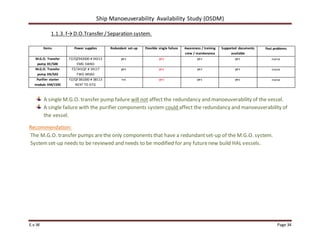
8.1.1. h→Static switch 220V UPS.
Ship Manoeuverability Availability Study (OSDM)
E.v.W Page 146
Sub group Supported
documents
available
Possible single
failure
Redundant
set-up
Awareness /
training crew
/ maintenance
Sea-mode Manoeuvre-
mode
Port-mode Anchor-mode Past problems
8.1.1.a yes yes yes yes No risk No risk No risk No risk none
Sub group Supported
documents
available
Possible single
failure
Redundant
set-up
Awareness /
training crew
/ maintenance
Sea-mode Manoeuvre-
mode
Port-mode Anchor-mode Past problems
8.1.1.b yes yes yes yes No risk No risk No risk No risk none
Sub group Supported
documents
available
Possible single
failure
Redundant
set-up
Awareness /
training crew
/ maintenance
Sea-mode Manoeuvre-
mode
Port-mode Anchor-mode Past problems
8.1.1.c yes yes yes yes No risk No risk No risk No risk none
Sub group Supported
documents
available
Possible single
failure
Redundant
set-up
Awareness /
training crew
/ maintenance
Sea-mode Manoeuvre-
mode
Port-mode Anchor-mode Past problems
8.1.1.d yes yes yes yes No risk No risk No risk No risk none
Ship Manoeuverability Availability Study (OSDM)
E.v.W Page 147
Sub group Supported
documents
available
Possible single
failure
Redundant
set-up
Awareness /
training crew
/ maintenance
Sea-mode Manoeuvre-
mode
Port-mode Anchor-mode Past problems
8.1.1.e yes yes yes yes No risk No risk No risk No risk none
Sub group Supported
documents
available
Possible single
failure
Redundant
set-up
Awareness /
training crew
/ maintenance
Sea-mode Manoeuvre-
mode
Port-mode Anchor-mode Past problems
8.1.1.f yes yes yes yes No risk No risk No risk No risk none
Sub group Supported
documents
available
Possible single
failure
Redundant
set-up
Awareness /
training crew
/ maintenance
Sea-mode Manoeuvre-
mode
Port-mode Anchor-mode Past problems
8.1.1.g yes yes no yes No risk No risk No risk No risk none
Sub group Supported
documents
available
Possible single
failure
Redundant
set-up
Awareness /
training crew
/ maintenance
Sea-mode Manoeuvre-
mode
Port-mode Anchor-mode Past problems
8.1.1.h yes yes no yes No risk No risk No risk No risk none
Note: Power distribution panels are set-up in a redundantway, a single componentfailure will not affect the
redundancy and manoeuverability of the vessel. E.R. alarm columns are not set-up in a redundantway, a single
internal / external componentfailure will not affect the redundancy and manoeuverability of the vessel.
Ship Manoeuverability Availability Study (OSDM)
E.v.W Page 148
8.1.2. Main UPS for automation plant.
8.1.2.a→Power distribution panels.
8.1.2.b→Inverter /Batteries.
8.1.2.c→Static switch.
8.1.2.d→Users.
Sub group Supported
documents
available
Possible single
failure
Redundant set-
up
Awareness/
training crew /
maintenance
Sea-mode Manoeuvre-
mode
Port-mode Anchor-mode Past problems
8.1.2.a yes yes yes yes No risk No risk No risk No risk none
Sub group Supported
documents
available
Possible single
failure
Redundant set-
up
Awareness/
training crew /
maintenance
Sea-mode Manoeuvre-
mode
Port-mode Anchor-mode Past problems
8.1.2.b yes yes yes yes No risk No risk No risk No risk none
Sub group Supported
documents
available
Possible single
failure
Redundant set-
up
Awareness/
training crew /
maintenance
Sea-mode Manoeuvre-
mode
Port-mode Anchor-mode Past problems
8.1.2.c yes yes yes yes No risk No risk No risk No risk none
Ship Manoeuverability Availability Study (OSDM)
E.v.W Page 149
Sub group Supported
documents
available
Possible single
failure
Redundant set-
up
Awareness/
training crew /
maintenance
Sea-mode Manoeuvre-
mode
Port-mode Anchor-mode Past problems
8.1.2.d yes yes yes yes No risk No risk No risk No risk none
Note:
The controllers, I/O’s and D/G safeties are fed fromboth UPS units, systemis therefore fully redundant and will
not affect the redundancy and manoeuverability of the vesselin case of a single componentfailure.
Ship Manoeuverability Availability Study (OSDM)
E.v.W Page 150
8.1.3. I.A.S configuration overview.
8.1.3.a→Redundantcontrollers for AFTand FWD engine rooms.
8.1.3.b→Dedicated singleCPU controllers.
8.1.3.c→Routing of the main control network.
8.1.4.d→High degreeof I/O distribution.
Sub group Supported
documents
available
Possible single
failure
Redundant
set-up
Awareness /
training crew
/ maintenance
Sea-mode Manoeuvre-
mode
Port-mode Anchor-mode Past problems
8.1.3.a yes yes yes yes No risk No risk No risk No risk none
Sub group Supported
documents
available
Possible single
failure
Redundant
set-up
Awareness /
training crew
/ maintenance
Sea-mode Manoeuvre-
mode
Port-mode Anchor-mode Past problems
8.1.3.b yes yes yes yes No risk No risk No risk No risk none
Ship Manoeuverability Availability Study (OSDM)
E.v.W Page 151
Sub group Supported
documents
available
Possible single
failure
Redundant
set-up
Awareness /
training crew
/ maintenance
Sea-mode Manoeuvre-
mode
Port-mode Anchor-mode Past problems
8.1.3.c yes yes yes yes No risk No risk No risk No risk none
Note: Routing of the main control network has been done in a redundantring configuration with the point to
point connections of the nodes and is in place abovethe watertight bulkhead level.
Sub group Supported
documents
available
Possible single
failure
Redundant
set-up
Awareness /
training crew
/ maintenance
Sea-mode Manoeuvre-
mode
Port-mode Anchor-mode Past problems
8.1.3.d yes yes yes yes No risk No risk No risk No risk Yes (4)
(Redundancy and) Manoeuverability of the vesselwill not be affected due to a possiblesingle failure of the
I.A.S. configuration.
Pastproblems were related to faulty S800 controland monitoring units.
Ship Manoeuverability Availability Study (OSDM)
E.v.W Page 152
8.1.4. Distribution of main controllers.
8.1.4.a→Singlecontrollers typeAC410.
8.1.4.b→Redundantcontrollers typeAC450.
Sub group Supported
documents
available
Possible single
failure
Redundant
set-up
Awareness /
training crew
/ maintenance
Sea-mode Manoeuvre-
mode
Port-mode Anchor-mode Past problems
8.1.4.a yes yes no yes No risk No risk No risk No risk none
Note: Single controllers dedicated to PORTand STBD users within the fire zone.
On the OSDM wehave 2 single dedicated controllers for the PORT and STBD propulsion systems (AC410-1P and
AC410-1S).
Items Supported
documents
available
Possible single
failure
Redundant set-
up
Awareness /
training crew /
maintenance
Loss of
propulsion
Redundant
power supplies
Redundant
network
Past problems
AC410-1P yes yes no yes no yes yes none
AC410-1S yes yes no yes no yes yes none
(Redundancy and) Manoeuverability of the vesselwill not be affected due to a possiblesingle failure of a
single controller.
Ship Manoeuverability Availability Study (OSDM)
E.v.W Page 153
Single controller is set as an independent system, propulsion auxiliaries remain running.
Auxiliaries would have to be started locally if a failure of the AC410 persists, butpropulsion itself would not be
affected.
The install of a redundant(instead of a single) controller for the propulsion systems should betaken into
consideration (Futurevessels).
Sub group Supported
documents
available
Possible single
failure
Redundant
set-up
Awareness /
training crew
/ maintenance
Sea-mode Manoeuvre-
mode
Port-mode Anchor-mode Past problems
8.1.4.b yes yes yes yes No risk No risk No risk No risk none
Note: There are 3 redundant controllers, AC450-2 /AC450-3 /AC450-4.
Items Supported
documents
available
Possible single
failure
Redundant set-
up
Awareness /
training crew /
maintenance
Loss of
propulsion
Redundant
power supplies
Redundant
network
Past problems
AC450-2 yes yes yes yes no yes yes none
AC450-3 yes yes yes yes no yes yes none
AC450-4 yes yes yes yes no yes yes none
Redundant controllers dedicated to all users within the fire zone.
(Redundancy and) Manoeuverability of the vesselwill not be affected due to a possiblesingle failure of the
redundantcontrollers.
Ship Manoeuverability Availability Study (OSDM)
E.v.W Page 154
8.1.5. Distribution of controller functions.
8.1.5.a→Foresection (main fire zone 4).
8.1.5.b→Forward engineroom(main fire zone 3).
8.1.5.c→Aftengineroom(main fire zone2).
8.1.5.d→Aftsection (main fire zone1).
8.1.5.a→Foresection (main fire zone4)
 Redundant AC450-4 control/ monitoring functions related to fire zones 4-5-6-7 including data links to:
 Valve controlsystem.
 HVACsystem.
 Napa loading computer.
Sub group Supported
documents
available
Possible single
failure
Redundant set-
up
Awareness /
training crew /
maintenance
Loss of
propulsion
Redundant
power supplies
Redundant
network
Past problems
8.1.5.a yes yes yes yes no yes yes none
Note: (Redundancy and) Manoeuverability of the vesselwill not be affected due to a possiblesingle failure of the
redundantcontroller.
Ship Manoeuverability Availability Study (OSDM)
E.v.W Page 155
8.1.5.b→Forward engineroom(main fire zone3).
 Redundant AC450-3 control/ monitoring functions related to fire zone 3 including the following:
 Control / monitoring related to DG 4-5 and GTG, forward MSBD and other equipment related in this fire
zone.
 Power Management System(PMS) functions related to DG 4-5 and GTG
 DG 4-5 and GTG start / stop control systemvia separated S800 I/O (One I/O cabinet per generator / GTG).
 Data link to separated switchboard monitoring system(Any I/O’s related to PMS including breaker control
are hardwired).
Sub group Supported
documents
available
Possible single
failure
Redundant set-
up
Awareness /
training crew /
maintenance
Loss of
propulsion
Redundant
power supplies
Redundant
network
Past problems
8.1.5.b yes yes yes yes no yes yes none
Note: (Redundancy and) Manoeuverability of the vesselwill not be affected due to a possiblesingle failure
of the redundant controller.
Ship Manoeuverability Availability Study (OSDM)
E.v.W Page 156
8.1.5. c→Aft engine room (firezone 2).
 Redundant AC450-2 control/ monitoring functions related to fire zone 2 including the following:
 Control / monitoring related to DG 1-2-3, aftMSBD and other equipment related in this firezone.
 Power Management System(PMS) functions related to DG 1-2-3.
 DG 1-2-3 start/ stop control systemvia separated S800 I/O (OneI/O cabinet per generator).
 Data link to separated switchboard monitoring system(Any I/O’s related to PMS including breaker control
are hardwired).
Sub group Supported
documents
available
Possible single
failure
Redundant set-
up
Awareness /
training crew /
maintenance
Loss of
propulsion
Redundant
power supplies
Redundant
network
Past problems
8.1.5.c yes yes yes yes no yes yes none
Note: (Redundancy and) Manoeuverability of the vesselwill not be affected due to a possiblesingle failure
of the redundant controller.
Ship Manoeuverability Availability Study (OSDM)
E.v.W Page 157
8.1.5.d→Aftsection (main fire zone 1).
 Single AC410-1P control/ monitoring functions related to fire zone 1 including the following:
 Control and monitoring for the PORTpropulsion system.
 Data link for the PORTCyclo Converter.
 Single AC410-1S control/ monitoring functions related to fire zone 1 including the following:
 Control and monitoring for the STBD propulsion system.
 Data link for the STBD Cyclo Converter.
Sub group Supported
documents
available
Possible single
failure
Redundant set-
up
Awareness /
training crew /
maintenance
Loss of
propulsion
Redundant
power supplies
Redundant
network
Past problems
8.1.5.d yes yes no yes no yes yes none
Note: (Redundancy and) Manoeuverability of the vessel will not be affected due to a possiblesingle failure
of the single controller (PORTor STBD).
Ship Manoeuverability Availability Study (OSDM)
E.v.W Page 158
8.1.6.Operator Stations (OS).
The operator stations are used for the operator’s communication.
The printers connected to the operator stations are used for alarm, event and data log printouts.
Sub group Supported
documents
available
Possible single
failure
Redundant set-
up
Awareness /
training crew /
maintenance
Loss of
propulsion
Redundant
power supplies
Redundant
network
Past problems
8.1.6 yes yes yes yes no yes yes Yes (6)
Note: Operator station(s) in the engine room spaces fail due to excessive heat and vibrations.
Ship Manoeuverability Availability Study (OSDM)
E.v.W Page 159
8.1.7. Master bus 300 (MB300) main controlnetwork configuration and cable routing.
The master bus 300 (MB300) is a high performance network based on IEEE 802.3 with an ISO class 4
connection-oriented transportprotocol, ensuring flow controland reliability with multiple priorities.
The MB300 consists of two networks in order to providea fully redundantconfiguration: network 11 and
network 12
 Wire break(s) willnot affect the functionality of the network.
 Shortcircuit (s) on the connection between the individual node and the switch will not affectthe
functionality of the network.
 Complete loss of connections to the controllers in the FWD (or AFT) engine roomdue to flooding / fire will
not affect the remaining controllers in the other areas (including the operator stations).
 Main bus network is routed outside the engine spaces.
Sub group Supported
documents
available
Possible single
failure
Redundant set-
up
Awareness /
training crew /
maintenance
Loss of
propulsion
Redundant
power supplies
Redundant
network
Past problems
8.1.7. yes yes yes yes no yes yes none
Note: (Redundancy and) Manoeuverability of the vesselwill not be affected due to a possiblesingle failure
of the redundant network (s).
Ship Manoeuverability Availability Study (OSDM)
E.v.W Page 160
8.1.8. Power ManagementSystem(PMS) configuration.
Note: The PMS functions arelocated in the main process controllers typeAC450.
 PMS functions for DG 1-2-3 arelocated in the main process controller AC450-2 (firezone2).
 PMS functions for DG 4-5-GTG arelocated in the main process controller AC450-3 (firezone3).
The PMS for DG 1-2-3 and DG 4-5-GTG will function independently should (for somereason) the bus-tie breaker
be open.
The PMS configuration will continue the automatic operation of DG 1-2-3 in case of a mayor failure(fault) in fire
zone 3 (fire / flooding) and vice versa for DG 4-5-GTG in caseof a major failure (fault) in fire zone2 (fire /
flooding).
Ship Manoeuverability Availability Study (OSDM)
E.v.W Page 161
The following PMS functions are included for a generator configuration consisting of the amountof 5 DG’s and
one GTG:
1. Start / Stop control of DG.
2. DG standby programincluding automatic control of the DG auxiliaries.
3. DG Slow turning.
4. Synchronization /connection of the generator to the bus bar.
5. Automatic connection of the DG after a blackout.
6. Load dependent DG start/ stop program.
7. Heavy load program.
8. Start sequence program.
9. Process alarms and systemsupervision.
10.DG load controlset point controlto the electronic governor.
11.Interfaceto the electronic governor.
12.Blackout recovery program.
13.Control of various breakers for transformers, substationsetc.
14.Interfaceto propulsion motor(s) controlsystem(s).
Ship Manoeuverability Availability Study (OSDM)
E.v.W Page 162
General:
 Power management systemoperating modes:
Portmode:
The load dependant start/ stop programis available for all DG’s (as mentioned above).
Minimum one generator will be connected and required additional generator sets will be started / stopped if
required due to an increase in load / fault on the already connected set (The GTG will be considered as the last in
sequence should it be selected into standby mode).
An automatic transfer from port mode to manoeuvremode will be made when the Azipod auxiliaries are started.
Manoeuvremode:
The load dependant startfunction is in operation but the load dependant stop function is blocked.
Minimum two generators will be connected and required additional generator sets will be started if required due
to an increase in load / fault of the already connected set (The GTG will be considered as the last in sequence
should it be selected into standby mode).
Manoeuvremode will be automatically activated when:
1. Any propulsion breaker transformer breaker is closed.
2. Propulsion auxiliary run startis activated.
3. Any thruster breaker is closed.
Ship Manoeuverability Availability Study (OSDM)
E.v.W Page 163
Sea mode:
The load dependant startfunction is in operation but the load dependant stop function is blocked if only two DG-
sets are connected.
Minimum two generators will be connected and required additional generator sets will be started if required due
to an increase in load / fault of the already connected set (The GTG will be considered as the last in sequence
should it be selected into standby mode).
Sub group Supported
documents
available
Possible single
failure
Redundant set-
up
Awareness /
training crew /
maintenance
Loss of
propulsion
Redundant
power supplies
Redundant
network
Past problems
8.1.8. yes yes yes yes no yes yes none
Note: (Redundancy and) Manoeuverability of the vesselwill not be affected due to a possiblesingle failure
of the redundant PMS network (s).
Ship Manoeuverability Availability Study (OSDM)
E.v.W Page 164
Alaska port mode: (Not used).
The Alaska port mode can only be selected with the GTG available in standby and ready position.
The GTG will be connected and the DG sets will remain in standby.
The next DG in sequence will be started and connected at fault on the GTG.
The Alaska port mode is blocked when:
 Any propulsion transformer breaker is closed.
 Propulsion auxiliary run startis activated.
 Any thruster breaker is closed.
Alaska sailing mode: (Not used).
The Alaska sailing mode can only be selected with the GTG available in standby and ready position.
The GTG will be connected together with two 12 cylinder DG’s in order to have the DG load above50%.
The next DG in sequence will be started and connected at fault on the connected sets.
Ship Manoeuverability Availability Study (OSDM)
E.v.W Page 165
Anchor mode:
Anchor mode has been implemented in 2011 as part of the fuel saving scope.
Criteria for activating anchor mode:
1. Vesselarriving at the tendering position and lowering the anchor (Keep in mind that the lowering of
the anchor is not an interlock with the anchor mode, basically anchor mode can be enabled without
the useof the anchor) (Should thisbe changed into an interlock mode function?).
2. Switch-off all bow thrusters.
3. Switch-off either the PS or STBD side Azipod.
4. Select Zero RPM on the Azipod that will be used for anchor mode operations (Either PS or STBD).
5. Ensurethat the main breakers of the selected Azipod remain closed!!
Note:
The normalstart-up logic of the Azipod requirestwo DG’sconnected to the network, howeveroperation with one
DG connected to the network ispossible when the main breakersare notopened, while reducing the amountof
connected DG’s.
6. Select Anchor mode on the VDU (IAS) (Mode6), this will automatically disconnectthe remaining DG’s
on line, excluding the first DG in the sequence (DG1 or DG3 or DG4) (16 Cylinder DG’s).
Note:
 Maximum two AC sets can stay on line (Anchor mode does not recognize the local start-up of 3rd
AC-set).
Ship Manoeuverability Availability Study (OSDM)
E.v.W Page 166
Criteria for de-activating anchor mode:
1. Select Maneuver mode (Manually) on the VDU(IAS) (Mode2) or select any other operating mode).
Notes:
A: the activation of any other operating mode will result in a DG start request.
B: if you choose to select portmode (Single DG on line) you have to make sure that the Azipod is switched off
before the activation of the portmode (Main breakersopen and auxiliariesoff). Failure of doing so will result in
the start requestof a 2nd
DG
The following conditions will de-activate the anchor mode configuration:
A. Load of the running DG reaches 88% (Startrequestof 2ND
DG within 2 seconds, pre-warning at
85% DG load).
B. Start requestof the auxiliaries of the not running Azipod / Cyclo.
C. Start requestof a bow thruster.
D. Start requestof a 3rd
AC set (Anchor mode does not recognizethe start-up of a 3rd
AC set
locally) (Should this be changed?).
E. Any shutdown condition of the running DG.
F. Azipod trip: Port mode will be activated.
Note: Activating of the anchor mode will be a ships staff decision as it could (will) affect the redundancy
and manoeuverability of the vessel.
Anchor mode operating mode is generating a high reactive power, this is limiting the active power in a huge
way, plus that a high reactive power is bad for the efficiency of the apparatus, Azipod is this instance.
Ship Manoeuverability Availability Study (OSDM)
E.v.W Page 167
9. EMERGENCY SHUT DOWNSYSTEM(E.S.D.).
General:
The E.S.D. systemconsists of 25 control cabinets, located in various areas of the vessel.
Each cabinet monitors and controls different elements of the E.S.D. system, firedoors, dampers, fans, etc.
Each cabinet is equipped with a set of input / output circuit boards, used by the E.S.D. systemto monitor (inputs)
the status of safety related elements, and to control(outputs) such elements.
Simple example:
For instance a fire door is monitored by an input, linked to the limit switch associated to the door (which indicates
that the door is closed) and it is controlled by an output, connected to a relay (which cut the power of the magnet
associated to the door).
Each cabinet is connected to the E.S.D. network with a redundantlink, to ensurereliability of the system.
Both networks aremade by a horizontalbackbone, with vertical sections for each fire zone.
One network runs in the upper decks, the other one in the lower decks of the vessel.
Cable breaks will not affect the functionality of the system.
Each cabinet is supplied via a redundantpower supply, normaland emergency supply.
Each cabinet has its own CPU, able to performmonitoring and controlof safety elements, and also able to
execute sequences.
Ship Manoeuverability Availability Study (OSDM)
E.v.W Page 168
The redundant network and the communication softwarehavebeen designed in order to allow each node of the
network to have a complete view of all the information acquired by the other nodes.
One of the main functions in charge to the E.S.D. systemis the execution of the shut-down sequences related to
the CO²release in the dedicated areas.
 The physicalrelease of CO² is a manual action.
 E.S.D. is requested to perform, beforethe physicalgas release, a shutdown procedurethat isolates the area
and, in somecases, stop the machinery in those areas.
Philosophy:
As mentioned before, the E.S.D. systemis controlled by means of inputs / outputs (I/O’s),allrelevant equipment
that is required to be partof the E.S.D. systemhas been reviewed in the so called I/O matrix, cause and effect
matrix.
E.S.D. systemsoftwarehas been programmed according this causeand effect matrix.
Itis of vital importance that this matrix is correct, incorrectprogramming of the E.S.D. softwarecould causefor
instance the vessel to blackoutwhen e.g. wrong machinery is stopped in e.g. the wrong engine room.
Activation of the E.S.D. hard wired switches for the AFT engine roomshould not stop the equipment in the FWD
engine roomand vice versa.
Single failure like the above could (will) affect the redundancy and manoeuverability of the vessel, depending on
the natureof the fault.
Ship Manoeuverability Availability Study (OSDM)
E.v.W Page 169
Safety monitoring and control system(SMS):
The SMS is a monitoring system, interfacing the mandatory safety sub-systems foreseen on the vessel.
The SMS shall:
 Interfacethe main ship safety sub-systems, acquiring data fromthem.
 Presentto the SMS operators the status of all the elements monitored, by means of graphic Man Machine
Interface(MMI) and vector drawings.
 Detect all the safety alarms generated by safety sub-systems, and automatically reporting them to the SMS
operators.
The SMS (OWS) is a distributed system, with one workstation in the wheelhouseand one in the ECR. (Hard drives
are sensitiveto failures, one of the weakestlinks of the system).
Recommendation: InstallPC with a redundant hard drive, or install a solid state drive in order to minimize the
failures of the workstations.
The safety systems interfaced are:
1. Fire detection system(Serialline RS 232).
2. High fog system(Serial line RS 422).
3. Watertight door system(Serial line RS 422).
4. E.S.D. (RJ 45 to Ethernet HUB).
The network is not redundant, as the SMS for this class of vessels is puremonitoring system, which doesn’t
replace any statutory systemor function.
Single failure will not affect the redundancy and manoeuverability of the vessel.
Ship Manoeuverability Availability Study (OSDM)
E.v.W Page 170
Location of the ESD cabinets:
number Description Label Deck FZ Frame Location Normal power supplies Emergency power supplies
PY/901ES ESD CABINET FPD1 1 1 48 PS EL. LOCKER OPP. CABIN 1112 FZ/QLR37000 FZ/QM9DO000
PY/902ES ESD CABINET FPD2 5 1 51 PS EL. LOCKER OPP. CABIN 5152 FZ/QLR46000 FZ/QM9DR000
PY/903ES ESD CABINET FPD3 A 2 54 PS WT DOOR STATION FZ/QFT12000 FZ/QM9DH000
PY/904ES ESD CABINET FPD4 A 2 54 PS WT DOOR STATION FZ/QFT12000 FZ/QM9DH000
PY/905ES ESD CABINET FPD5 3 2 108 PS AC STATION TENDER 16 FZ/QFT13000 FZ/QM9DJ000
PY/906ES ESD CABINET FPD6 7 2 73 PS CORRIDOR OPP CABIN 7093 FZ/QLT57000 FZ/QM9DL000
PY/907ES ESD CABINET FPD7 9 2 66 STB EL. LOCKER OPP TOILET FZ/QLT57000 FZ/QM9DM000
PY/908ES ESD CABINET FPD8 9 2 66 STB EL. LOCKER OPP TOILET FZ/QLT57000 FZ/QM9DM000
PY/909ES ESD CABINET FPD9 A 3 147 PS E.C.R. FZ/QFU10000 FZ/QM9CZ000
PY/910ES ESD CABINET FPD10 A 3 147 PS E.C.R. FZ/QFU10000 FZ/QM9CZ000
PY/911ES ESD CABINET FPD11 2 3 162 PS EL. LOCKER NEXT TO GANGWAY PS FZ/QFU12000 FZ/QM9DA000
PY/912ES ESD CABINET FPD12 2 3 164 PS EL. LOCKER NEXT TO GANGWAY PS FZ/QFU12000 FZ/QM9DA000
PY/913ES ESD CABINET FPD13 5 3 134 PS AC STATION OPP CABIN 5110 FZ/QLU49000 FZ/QM9DC000
PY/914ES ESD CABINET FPD14 10 3 114 PS EL. LOCKER NEXT FAN ROOM FZ/QLU14000 FZ/QM9DF000
PY/915ES ESD CABINET FPD15 A 4 194 STB WATERTIGHT DOOR EMERGENCY STATION FZ/QLV10000 FZ/QM9CQ000
PY/916ES ESD CABINET FPD16 4 4 213 PS EL. LOCKER AC STATION OPP CABIN 4078 FZ/QLV51000 FZ/QM9CV000
PY/917ES ESD CABINET FPD17 9 4 171 PS AC STATION NEXT PAX LIFT FZ/QLV13000 FZ/QM9CY000
PY/918ES ESD CABINET FPD18 A 5 261STB WATERTIGHT DOOR EMERGENCY STATION FZ/QFW10000 FZ/QM9CJ000
PY/919ES ESD CABINET FPD19 3 5 260 SB EL. LOCKER FAST RESCUE BOAT FZ/QFW10000 FZ/QM9CJ000
PY/920ES ESD CABINET FPD20 9 5 252 PS EL. LOCKER NEXT HAIR SALON FZ/QFW16000 FZ/QM9CO000
PY/921ES ESD CABINET FDP21 A 6 294 PS EL. LOCKER NEXT CABIN A030 FZ/QFX12000 FZ/QM9CA000
PY/922ES ESD CABINET FPD22 4 6 338 STB EL. LOCKER OPP CABIN 4003 FZ/QFX16000 FZ/QM9CE000
PY/923ES ESD CABINET FPD23 8 6 330 MS SAFETY CONSOLE BRIDGE FZ/QFX18000 FZ/QM9CG000
PY/924ES ESD CABINET FPD24 9 6 290 PS EL. LOCKER NEXT GYM FZ/QFX20000 FZ/QM9CG000
PY/925ES ESD CANINET FPD25 2 7 346 MS FWD MOORING SUBSTATION FZ/QFX15000 FZ/QM9CB000
Ship Manoeuverability Availability Study (OSDM)
E.v.W Page 171
Item Supported
documents
available
Possible single
failure
Redundant set-
up
Awareness /
training crew /
maintenance
Redundant
power supplies
Redundant
network
Past problems
ESD SYSTEM yes yes yes yes yes yes Yes (2)
Pastproblems were related to faulty computers (OWS) in ECR and on the bridge.
Item Sea-mode Manoeuvre-mode Port-mode Anchor-mode
ESD SYSTEM Medium Critical Low risk Medium-high
In general we can conclude that a correct set-up of the E.S.D. systemis vital for the overallsafe operations of the
vessel.
Observation:
The set-up of the E.S.D. system and its equipment has not been installed according to the fail safe mode
philosophy (Which is the correct way of installation).
Fail safe mode means that equipment will stop in caseof wire break, or burned-outsignalcables to the local
E.S.D. cut-off relay (s).
(Fail safemode means in general that the (DC) relays are always energized, which in-creases the chanceof
component failures).
E.S.D. monitors the equipment with a so called, Monitored, Normally open contact.
Ship Manoeuverability Availability Study (OSDM)
E.v.W Page 172
Explanation:
Circuit boards IOM402, DEM401 and REM 402 (See supported documentation) are monitoring the inputs and
outputs.
Inputs areusually employed in:
-Emergency stops.
-Hard switch selectors.
The monitoring of a channel is implemented by an 8.2KΩ resistor placed at the end of the cable. Even when the
contact is open, there is a small currentgoing through the resistor, which is monitored by the board.
In caseof a cable break, the board detects the absence of currentand signals a fault on the channel.
-Fans and pumps (Accommodation and machinery).
In this casethe monitoring of a channel is implemented using the coil of the relay placed at the end of the line.
In caseof cable break, the board detects the absence of currentand signals a fault on the channel.
Manual action is required when such a channel alarm is triggered; equipment can only be switched off by means
physically isolation of the relevant equipment.
Ship Manoeuverability Availability Study (OSDM)
E.v.W Page 173
The E.S.D. systemconsists of 23 hard wired switching stations (local panels).
Panel ID / Tag
number
Services Location
PY/101QI FIRE DAMPERS & VENTILATION – SMOKE EXTRACTION – OVERBOARDDISCHARGECONTROL – MACHINERY AND
OIL PUMPS
ECR MIMIC CONSOLE
PY/102QI FIRE DOORS – FIRE DAMPERS & VENTILATION – SMOKE EXTRACTION – OVERBOARDDISCHARGE CONTROL –
SIDE DOORS MIMIC
WHEELHOUSE SAFETY
CONSOLE
PY/103QI – PY/104QI AFT PURIFIERROOM(LOCAL SAFETY PANELS – HARD SWITCHES) D-DECK FR.96 – FR102
PY/105QI AFT PURIFIERROOM(LOCAL SAFETY PANELS – HARD SWITCHES) B-DECK FR.92
PY/106QI – PY/107QI PS FWD PURIFIERROOM(LOCAL SAFETY PANELS – HARD SWITCHES) D-DECK FR.114 – FR.122
PY/108QI – PY/109QI SB FWD PURIFIERROOM(LOCAL SAFETY PANELS – HARD SWITCHES) D-DECK FR.114 – FR.122
PY/110QI – PY/112QI INCINERATOR ROOM(LOCAL SAFET PANELS – HARDSWITCHES) D-DECK FR.86 – FR.106
PY/111QI INCINERATOR ROOM(LOCAL SAFET PANELS – HARDSWITCHES) B-DECK FR.86
PY/116QI PS LIFEBOAT AREA (LOCAL SAFET PANELS – HARDSWITCHES) DECK 3 FR.78
PY/117QI PS LIFEBOAT AREA (LOCAL SAFET PANELS – HARDSWITCHES) DECK 3 FR.280
PY/118QI SB LIFEBOAT AREA (LOCAL SAFET PANELS – HARDSWITCHES) DECK 3 FR. 78
PY/119QI SB LIFEBOAT AREA (LOCAL SAFET PANELS – HARDSWITCHES) DECK 3 FR.280
PY/120QI – PY/121QI BUNKER STATION (LOCAL SAFET PANELS – HARDSWITCHES) A-DECK FR.82 – FR. 86
PY/122QI – PY/123QI BUNKER WATER STATION (LOCAL SAFET PANELS – HARDSWITCHES) A-DECK FR.82 – FR. 86
These hard wired stations are important in case equipment needs to be isolated / stopped locally; activation of
the wrong switches could affect the redundancy and manoeuverability of the vessel.
Local stations (yellow high-lighted) arelocated on an open deck (deck 3), it is a recommendation to remove them
fromthe open decks and relocate them inside the electrical lockers on deck 3(Lloyds /NSI approvalneeded).
This should be a low-costmodification.
Itis a fact that these local stations and its components suffer fromthe influence of Mother Nature, which could
causea shutdown /stop of the relevant equipment.
Ship Manoeuverability Availability Study (OSDM)
E.v.W Page 174
Conclusion of the FMEA: (See supported documents).
FMEA = Failure Mode Effect Analysis.
Itis a systemwith a high fault tolerance and a high level of redundancy.
See below ESD FMEA table:
EQUIPMENT NAME FUNCTION FAILURE MODE FAILURE CAUSE LOCAL FAILURE
EFFECTS
END FAILURE
EFFECTS
FAILURE DETECTION ALTERNATIVE
PROVISION
Ships UPS 220V 60HZ
(EMG Supply)
Uninterrupted power
supply
Loss ofships UPS
(EMG Supply)
Generic board fault Loss ofone UPS
supply line on each
equipment
none yes Automatic change
over to normal supply
Ships UPS supply line
cables
Feeder ofequipment
via UPS
Break or short circuit Fire or mechanical
damage
Loss ofthe UPS
supply line ofone or
more equipment
none yes Automatic change
over to normal supply
Normal power supply Feeder ofequipment
via normal supply
Break or short circuit Fire or mechanical
damage
Loss ofnormalsupply
line
none yes Automatic change
over to UPS supply
AC /DC converter for
mimic led controller
Supply of24VDC Electric or electronic
failure
Short circuit or
electronic damage
Loss ofone AC/DC
converter
none yes Redundancy of
AC/DC converter
ACB for AC/DC
converter for mimic
led controller
Protection ofthe
supply lines
Electric fault Short circuit of
mechanical damage
Loss ofone supply
line and one AC/DC
converter
none yes Redundancy ofthe
feeder line and
converter
Fuse for mimic led
controller
Feed the individual
mimic led controller
Blown fuse Short circuit Partial loss offire
door & damper
none yes Supervision to be
handled with the
OWS
ACB for AC/DC
converter for local
PMCS cabinet
Protection ofsupply
lines
Electric fault Short circuit or
mechanical damage
Loss ofone supply
line and one AC/DC
converter
none yes Redundancy of
feeder line and
converter
AC/DC converter for
local cabinets
Supply of24VDC Electric or electronic
fault
Short circuit or
electronic damage
Loss ofone AC/DC
converter
none yes Redundancy of
AC/DC converter
I/O module fuse Protection ofa single
module
Blown fuse Short circuit Loss ofmodule and
relevant I/O signals
Status indicationand
ESD not available for
connected devices
yes Crew intervention
required: replace the
blown fuse
I/O module Concentrate the I/O
signals
Electronic failure Mechanical or
electronic damage
Loss ofmodule and
relevant I/O signals
Status indicationand
ESD not available for
connected devices
yes Crew intervention
required,: replacethe
damaged unit
Ship Manoeuverability Availability Study (OSDM)
E.v.W Page 175
EQUIPMENT NAME FUNCTION FAILURE MODE FAILURE CAUSE LOCAL FAILURE
EFFECTS
END FAILURE
EFFECTS
FAILURE DETECTION ALTERNATIVE
PROVISION
CPU module Handles theinternal
and external data
transmission
Electronic failure Mechanical or
electronic damage
Loss oflocal ESD
cabinet
Local ESD cabinet
including connected
devices notavailable
for ESD system
yes Crew intervention
required: replace the
damaged unit
OWS 1 or 2 Shows alarm and
system status
Electric or electronic
failure
Mechanical or
electronic damage
Loss of1 OWS plus
printer
Loss ofone OWS yes ESD has to be
handledby remaining
OWS
Ethernet bus lines to
SMS system
Connects OWS 1 & 2
with SMS
Break or short circuit Fire or mechanical
damage
Loss of one ofthe
Ethernet bus lines
none yes Alarm on remaining
OWS, crew
intervention required
Main field bus M6 Connect thebus line
controller (Master) to
the system net
Break or short circuit Fire or mechanical
damage
Loss ofone main bus
line to OWS 2
none yes Alarm on OWS 2,
automatic switch to
the other bus line
Reservefield bus line
R6
Connect thebus line
controller (Slave) to
the system net
Break or short circuit Fire or mechanical
damage
Loss ofone reserve
bus line to OWS 2
none yes Alarm on OWS 2,
automatic switch to
the other bus line
Ship Manoeuverability Availability Study (OSDM)
E.v.W Page 176
10. VENTILATIONSYSTEMS:
General:
Single failure with any HVACsystem will not affect the redundancy and manoeuverability of the vessel, But the
Starting / stopping of the HVACsystems in a correct matter would be a vital execution in caseof a fire, failure of
doing so could affect the redundancy and manoeuverability, depending on the location(s) of the fire.
HVACsystems (stop / startof ventilation systems) arecontrolled and monitored via the ESD / SMS systems, as
well as by means of other controland monitoring systems such as automation and ATISA controlsystem.
Ventilation stop and damper closure:
The E.S.D. systemallows the operator to stop ventilation / close dampers of some specific areas of the vessel:
 General stop / closure.
 Stop of ventilation / closureof dampers associated to staircases.
 Stop of ventilation / closureof dampers associated to a specific area of the vessel.
 Stop of ventilation / closureof dampers for engine room spaces.
Note:
Itis important that dampers are tested according to the Amosw DFD001 recommended intervals and procedures.
DFD001 clearly describes thatclosureof the dampers need to be visually verified, this does not happen all the
time (Crew needs to be instructed in order to do so).
Ship Manoeuverability Availability Study (OSDM)
E.v.W Page 177
Note:
The input contact for the hard switch is monitored, normally open.
The output contact for the fan stop or fan startis monitored, normally open.
The input contacts for the fan feedback are not monitored.
The input contacts for the damper positions are not monitored.
Itis important that correct maintenance intervals are conducted and that the crew is awareof any failures within
the HVACsystems in order to rely on the safeand correct functioning of the equipment in case of an emergency
situation.
Not be able to start/ stop certain fans could affect the redundancy and manoeuverability depending on the
affected location(s) (Spread of fire).
Item Supported
documents
available
Possible single
failure
Redundant set-
up
Awareness /
training crew /
maintenance
Redundant
power supplies
Redundant
network
Past problems
HVAC SYSTEM yes yes no yes no no Yes (30)
Item Sea-mode Manoeuvre-mode Port-mode Anchor-mode
HVAC SYSTEM
Ship Manoeuverability Availability Study (OSDM)
E.v.W Page 178
Conclusion:
1. No redundantpower supply for fan starters.
2. No redundantbus communication from the ATISA supervision system.
3. No redundantpower supply for the ATISA controlcabinet (1 UPS supply).
4. In mostcases just one power supply for multiple fan units fromthe main sub stations for supply and
exhaust fans.
Power supplies are looped fromone HVAC unit to the next HVACunit in the same fire zone, with only 1 feeder
line.
Failure of the feeder line will affect multiple HVACunits.
Ship Manoeuverability Availability Study (OSDM)
E.v.W Page 179
SmokeExtraction:
Smokeextraction systemis an important function for the safeoperation of the vesselin caseof an emergency
(Fire).
The E.S.D. systemallows the operator to start / stop the smokeextraction in the area where this function is
foreseen by regulations (Areas which spans three or moredecks).
The actions to be performed are the following:
1. Closureof the fire doors surrounding theareas.
2. Stop the ventilation in the area.
3. Activation of proper ventilation to evacuate smokefromthe area. Typically the exhaust fans in the upper
decks are activated, as well as some supply fans in the lower decks.
Note:
The input contacts for the hard switch and FDS contact is monitored, normally open.
The output contact for the fan start or fan stop is monitored, normally open.
The input contacts for the fan running status are not monitored.
The input contacts for the damper positions are not monitored.
Itis important that correct maintenance intervals are conducted and that the crew is awareof any failures within
the smokeextraction system in order to rely on the safeand correct functioning of the system in case of an
emergency situation.
Not be able to start/ stop certain fans (smokeextraction) could affect the redundancy and manoeuverability
depending on the affected area (s) (Spread of fire).
Ship Manoeuverability Availability Study (OSDM)
E.v.W Page 180
11. BRIDGEAND NAVIGATIONEQUIPMENT:
General:
Itis of vital importance that the navigation officers arewell instructed and trained in caseof a sudden black-out,
loss of propulsion and loss of navigation equipment which will (could) directly influence the manoeuverability of
the vessel.
Navigation officers need to know what the specific incident behavior of certain equipment is and which
components are the causes.
Itis a must that they are able to identify the failures associated with the essential ship control and manoeuvring
systems and sub systems.
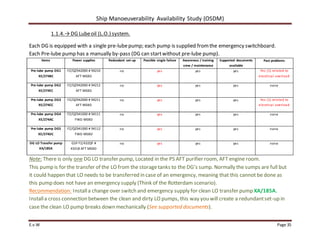
Navigation officers need to have the knowledgeof the following essential criteria’s:
1. What navigation equipment is available during a black-out?
2. The easiest way to performa crash stop.
3. How to use the back-up controls.
4. What will happen in case of a steering gear failure, or accidentally stopping of the wrong steering
pump?
5. What to do when one Azipod won’tturn anymore?
6. What happened when the RPM order fails during joystick sailing mode?
7. What to do in case of a steering gear hydraulic locking alarm?
Ship Manoeuverability Availability Study (OSDM)
E.v.W Page 181
1. What navigation equipment is available during a black-out?
The below shown list specifies which navigation equipment will be (will not be) available during a normal black-
out (with emergency generator) or during a black-out withoutthe availability of the emergency generator.
ITEMS TYPE OF BACKUP TYPE OF BLACK-OUT
NORMAL BLACK-OUT
WITH EMERGENCY GENERATOR
EMERGENCY GENERATOR
FAILURE
JUNCTION BOX FOR ECHOSOUNDER UPS NI/001CO YES YES
VHF AERONAUTIC UPS NI/001CO YES YES
W.H. STBD CONSOLE SECT. A UPS NI/001CO YES YES
W.T. DOORS CONTROL STATION UPS NI/001CO YES YES
JUNCTION BOX FOR WIND SPEED UPS NI/001CO YES YES
S-BAND ANTENNA RADAR 1 UPS NI/001CO YES YES
S-BAND ANTENNA RADAR 2 UPS NI/001CO YES YES
X-BAND ANTENNA RADAR UPS NI/001CO YES YES
X-BAND BOW ANTENNA RADAR UPS NI/001CO YES YES
RADAR JUNCTION BOX UPS NI/001CO YES YES
S-BAND TRANSCEIVER UNIT FOR RADAR SYSTEM UPS NI/001CO YES YES
X-BAND TRANSCEIVER UNIT FOR RADAR SYSTEM UPS NI/001CO YES YES
MULTIPILOT INTERCONNECTION BOX SYSTEM 1 UPS NI/001CO YES YES
JUNCTION BOX FOR AUTOPILOT SYSTEM GB/001AM UPS NI/001CO YES YES
JUNCTION BOX FOR INTEGRATED NAVIGATION SYSTEM UPS NI/001CO YES YES
CONSOLE TERM. BOARD FOR CONNINGPILOT (INTEG.NAV.) UPS NI/001CO YES YES
THRUSTER SYSTEM – MAIN PLC UNIT IN W.H. UPS NI/001CO YES YES
JUNCTION BOX FOR ECHOSOUNDER UPS NI/001CO YES YES
FIRE DETECTION VDU UPS NI/001CO YES YES
WHISTLES PANEL AUTOMATION. Batt. FZ/919QB YES YES
SOUND SIGNAL SURVEILLANCE CONTROL PANEL. Batt. FZ/919QB YES YES
SIGNAL LIGHT SYSTEM Batt. FZ/919QB YES YES
DGPS RECEIVER Batt. FZ/919QB YES YES
Ship Manoeuverability Availability Study (OSDM)
E.v.W Page 182
SOUND SIGNAL SURVEILLANCE CONTROL PANEL Batt. FZ/919QB YES YES
GYROCOMPASS SYSTEM Batt. FZ/919QB YES YES
AUTOPILOT SYSTEM Batt. FZ/919QB YES YES
FUSE SUPPLY & SWITCH. BOX – PROPULSION SYSTEM Batt. FZ/919QB YES YES
CONTROL BOX ELECTRIC SHAFT – PROPULSION SYSTEM Batt. FZ/919QB YES YES
EL. SHAFT BOX – PROPULSION SYSTEM Batt. FZ/919QB YES YES
PORT PLC & RELAY BOX – PROPULSION SYSTEM Batt. FZ/919QB YES YES
STBD PLC & RELAY BOX – PROPULSION SYSTEM Batt. FZ/919QB YES YES
MODE ILLUM. CTRL BOX – PROPULSION SYSTEM Batt. FZ/919QB YES YES
BRIDGE ALARM SYSTEM Batt. FZ/919QB YES YES
INTEGRATED NAVIGATION SYSTEM Batt. FZ/919QB YES YES
C.U.P. FOR REMOTE CONTROL LIGHT Batt. FZ/919QB YES YES
SPEED PILOT CALL BUTTON Batt. FZ/919QB YES YES
SAILOR VHF TRANSCEIVER Batt. FZ/919QB YES YES
MASTERCLOCK 20097 NI/001CO YES YES
SMS ETHERNET HUB Batt. FZ/919QB YES YES
W.H. CENTER CONSOLE SECT. B INSTR. ILLUMINATION Batt. FZ/919QB YES YES
POWER SUPPLY SAILOR N163S Batt. FZ/919QB YES YES
RESERVE NAVIGATION LIGHTS MIMIC PANEL Emerg. FZ/QM9CG000 YES NO
SIGNAL LIGHT CONTROL PANEL Emerg. FZ/QM9CG000 YES NO
FUSE SUPPLY & SWITCH. BOX Emerg. FZ/QM9CG000 YES NO
EM. LIGHT WHEELHOUSE – CHART TABLE Emerg. FZ/QM9CG000 YES NO
EM. LIGHT WHEELHOUSE – SPOTLIGHT CONSOLE Emerg. FZ/QM9CG000 YES NO
EM. LIGHT WHEELHOUSE – SAFETY CENTER Emerg. FZ/QM9CG000 YES NO
EM. LIGHT WHEELHOUSE Emerg. FZ/QM9CG000 YES NO
C.P.U. FOR REMOTE CONTROL LIGHT Emerg. FZ/QM9CG000 YES NO
EM. LIGHT WHEELHOUSE – SPOTLIGHT CONSOLE Emerg. FZ/QM9CG000 YES NO
DOOR CONTROL UNIT Emerg. FZ/QM9CG000 YES NO
SISTEMA TALK BACK SYSTEM Emerg. FZ/QM9CG000 YES NO
Ship Manoeuverability Availability Study (OSDM)
E.v.W Page 183
E.S.D. REMOTE CABINET PY/923 Emerg. FZ/QM9CG000 YES NO
E.S.D. REMOTE CABINET PY/924 Emerg. FZ/QM9CG000 YES NO
MULTI SOCKET Emerg. FZ/QM9CG000 YES NO
WHISTLES PANEL AUTOMATION Emerg. FZ/QR9BA000 YES NO
WHEATHER FAX Emerg. FZ/QR9BA000 YES NO
POWER SUPPLY & AMPLIFIER BOX PORT N.1 Emerg. FZ/QR9BA000 YES NO
POWER SUPPLY & AMPLIFIER BOX PORT N.2 Emerg. FZ/QR9BA000 YES NO
POWER SUPPLY & AMPLIFIER BOX STBD N.1 Emerg. FZ/QR9BA000 YES NO
POWER SUPPLY & AMPLIFIER BOX STBD N.2 Emerg. FZ/QR9BA000 YES NO
FIRE DETECTION STANDARD CABINET Emerg. FZ/QR9BA000 YES NO
SAILOR VHF TRANSCEIVER Emerg. FZ/QR9BA000 YES NO
AC DISTRIBUTION PANEL Emerg. FZ/QR9BA000 YES NO
SIGNAL LIGHT CONTROL PANEL Emerg. FZ/QR9BA000 YES NO
VOYAGE DATA RECORDER Emerg. FZ/QR9BB000 YES NO
ELECTRIC WHISTLE ZETHORN AC CONTROL Emerg. FZ/QR9BB000 YES NO
JUNCTION BOX MIN/MAX WITH 14 T.B. Emerg. FZ/QR9BB000 YES NO
Ship Manoeuverability Availability Study (OSDM)
E.v.W Page 184
Items 2-7:
Items Sea-mode Manoeuvre-mode Port-mode Anchor-mode
Item 2
Item 3 Medium Critical No risk Medium high
Item 4 Medium Critical No risk Medium high
Item 5 Critical No risk
Item 6 Critical No risk
Item 7 Critical No risk
Single failure of relevant equipment and / or an incorrect correctiveaction will (can) affect the
manoeuverability of the vessel.
Items Supported
documents
available
Possible single
failure
Redundant set-up Awareness /
training crew /
maintenance
Past problems
Item 2 yes yes
Item 3 yes yes yes yes none
Item 4 yes yes yes yes Yes (2)
Item 5 yes yes yes yes none
Item 6 yes yes yes yes none
Item 7 yes yes yes yes none
Ship Manoeuverability Availability Study (OSDM)
E.v.W Page 185
12. FIRESUPPRESSION SYSTEMS.
General:
The correct functioning of the fire suppression systems is a must; in-correcthandling and / or not functioning of
those systems will(could) affect the redundancy and Manoeuverability of the vessel, depending on the affected
area(s) (Spread of fires).
Main Systems are:
12.1.1 → Hi-Fog System.
12.1.2 → C0² System.
12.1.3 → Fire fighting System.
12.1.4 → Fire alarm system.
IndividualSub groups:
9.1.1 → Hi-Fog System.
8.1.1. a → General.
12.1.1. b → Hi-Fog Units.
12.1.1. c → Protected areas.
Ship Manoeuverability Availability Study (OSDM)
E.v.W Page 186
12.1.1.a → General.
The Marioff Hi-Fog Systemuses water under high pressure, and is based on established hydraulic principles and
technology. The special designed spray nozzles causethe water to enter the spaceas fine fog (mist) at high
speed.
The small droplets yield a very large total water surfacearea, providing efficient cooling of the fire and
surrounding gases. Thehigh speed of the small droplets enables the fog to penetrate hot flue gases and reach the
combustion source, even in large, hidden fires.
Ship Manoeuverability Availability Study (OSDM)
E.v.W Page 187
12.1.1. b →Hi-Fog Units.
General:
For the guarantee of the maximum reliability, the Hi-Fog Systemis equipped with two identical pump units
SPAU5+1, located in separate compartments (Both on the PS on OSDM).
Both pump units are dimensioned to maintain the full water pressure and volumefor SOLAS required 280m²
Accommodation area(s).
In caseof a failure of the active (Master) pump unit, the other (Slave) pump unit can be selected for useby the
selection switch, located in the ECR panel and wheelhouse panel (Nitrogen banks will always beavailable in case of
dual pump failures; maintaining of the HI-fog pressure).
Recommendation (Futurenew builds).
One Hi-Fog Unit needs to be installed on the PS and one on SB, at the moment they are located in separate
compartments, but both on the PS hull side (C-D deck). Possiblecollision could damage both units.
Recommendation: (OSDM).
Hi-fog pump unit(s) consists of several MANUAL valves without any feedback indication (Valveopen / close
indications).
Itcould happen that valves are closed during maintenance or inspections of the unit(s) and accidentally not be opened
after the maintenance or inspections are completed.
Itis recommended that all valves of the Hi-fog pump units will be sealed and that a valve opening / closing log is kept
in the ECR in order to prevent accidentally mistakes which could affect the redundancy (and manoeuverability) of the
vesselin case of a fire.
Ship Manoeuverability Availability Study (OSDM)
E.v.W Page 188
IndividualSub groups:
12.1.1. b →Hi-Fog Units.
12.1.1. ba →Power Supplies.
12.1.1. bb →Controlpanels.
12.1.1. bc →Flow control.
12.1.1. ba →Power Supplies.
Both Hi-Fog Units have redundantpower supplies, one supply fromthe 690V main SWBD and one fromthe 690V EMG
SWBD.
Sub group Supported
documents
available
Possible single
failure
Redundant set-
up
Awareness/
training crew /
maintenance
Sea-mode Manoeuvre-
mode
Port-mode Anchor-mode Past problems
Hi-fog units yes yes yes yes none
Hi-Fog Units Normal Power Supply Emergency Power Supply Redundant Set-up
YA/485A FWD 690V MSBD # 369 EMG SWBD XA/873 # 925 YES
YA/485B AFT 690V MSBD # 474 EMG SWBD XA/873 # 926 YES
YA/485A, system1 is located on D-deck, FR.200-206.
YA/485B, system2 is located on C-deck, FR.226-230.
Ship Manoeuverability Availability Study (OSDM)
E.v.W Page 189
12.1.1. bb →Controlpanels.
The Hi-Fog Systemincludes the following control and indication panels:
Control panel in wheelhouse, Hi-Fog release panel in ECR, Hi-fog PLC cabinet and the Hi-fog pump unit control
panels. The primary indication systemfor the Hi-fog alarms is the SMS system, werealarms aregiven fromthe
Hi-fog PLC cabinet.
The Hi-fog PLC cabinet is used to handle the systemsignals and is connected to the HI-fog pump units, Mimic
panel, VDRsystemand the release panel in the ECR.
VDR= Voice Data Recorder.
ECR PLC cabinet is the only cabinet that has a redundantpower supply.
Recommendation: Installa normalpower supply in order to improvethe redundancy in case of power failures.
PLC cabinet has a 24VDCbattery back-up which should last for 12 hours.
PLC softwareis saved to flash type memory.
PLC cabinet is equipped with two PLC-units working identically; PLC failure in one does not affect the
performanceof another one.
Items Normal Supply Emergency Supply Past Problems
Hi-fog PLC Cabinet YM/485 ECR FZ/QFU10000 IN ECR ON
DECK A # UB028
FZ/QM9CZ000 OPP.COM OFFICE ON
DECK 1 # 9CZ28
none
Hi fog PLC Cabinet YM/485C deck 7 NO FZ/QM9CF000 OPP. CABIN 7034
DECK 7 # 9CF50
none
Ship Manoeuverability Availability Study (OSDM)
E.v.W Page 190
12.1.1. bc →Flow control.
If the flow monitor malfunctions, and the systempressurewill drop the pump unit will receive a startsignal from
the low pressureswitch, when the pressuredrops below 17bar.
Ship Manoeuverability Availability Study (OSDM)
E.v.W Page 191
12.1.1. c →Protected areas.
Hi-fog systemprotects the following areas:
-Public, service and storage areas as per IMO Res. A800 (19).
-Machinery spaces (Total protection) as per IMO MSC/ Circ. 913.
-Deep fat fryers as per ISO 15371:2000.
Modifications:
Safety upgrades for Hi-fog, fire detectors and CO²system have been implemented for the engine roomspaces.
OSDMmodifications have been completed in May 2011.
2 extra loops have been installed in respectively MVZ 2 and 3 while the existing systems remained untouched.
The new loops have been provided with extra new type IRflame detectors and smoke detectors which have been
programmed in such way that they will work together with the existing ones as one systemwith improved
coverage.
Release of Hi-fog is triggered by either 2 smoke/ heat detectors or 1 flame detector (UV or IR) withoutany delay.
With the exception of the emergency generator room, were Hi-fog is triggered by a combination of 1 smoke/
heat detector and 1 flame detector (UV or IR) without any delay.
Ship Manoeuverability Availability Study (OSDM)
E.v.W Page 192
9.1.2 → C0² System.
Power supplies main C0² control cabinet:
CO² CONTROL CABINET YM/536AA NORMAL POWER SUPPLY EMERGENCY POWER SUPPLY REDUNDANT
POWER SUPPLIES FZ/QLT57000 ELECTRICAL LOCKER DECK 9
AFT LIDO, FRAME 66 STBD FIRE ZONE 2
FZ/QM9DM000 ELECTRICAL LOCKER DECK
9 AFT LIDO, FRAME 66 STBD FIRE ZONE 2
YES (NOT)
Note: the power supplies for the master CO² controlcabinet (YM/536AA) located in the CO² roomare redundant,
but both power supplies, normaland emergency, are coming fromthe same electrical locker, meaning that this is
not a fully redundantset-up (Think of a fire in the relevant locker).
CO² control and monitoring cabinet will be affected in caseof a fire in the electrical locker, deck 9 aft lido, frame
66 STBD, fire zone 2.
No alarms and monitoring of the CO² system will be available in case both power supplies would be lost.
CO² can still be released (Withoutalarms and warnings).
Recommendation:
Physically removeone of the incoming power supplies (Normalor Emergency supply) fromthe relevant electrical
locker and relocate this to another electrical locker in the same fire zone (Firezone 2).
This should be a low cost modification which could be done by the ship’s crew.
Ship Manoeuverability Availability Study (OSDM)
E.v.W Page 193
9.1.3 → Fire fighting System.
General:
OSDMfire fighting systemconsists of a Hydroforetank, topping-up pump, two fire pumps and two emergency
fire pumps.
1. Hydroforetank YA/478.
2. Topping-up pump YA/483.
3. Fire pump 1 YA/482A.
4. Fire pump 2 YA/482B.
5. Emergency fire pump YA/479.
6. Emergency diesel driven fire pump YD/476AA.
7. Bilge double acting piston pump XB/405 (This bilge pump can be used as a fire pump if needed).
Hydroforetank, topping-up pump, emergency fire pump and fire pump 1 are all located in one area, close to the
STBD hull side, Frames 170-182.
Topping-up pump, emergency fire pump, fire pump 1 are all connected to the FWD cross-over.
Fire pump 2 is connected to the AFT cross-over.
Recommendation:
Set-up needs to be reviewed; fire fighting capacity will significantly decrease in case of a flooding / fire in the
compartment (Frames 170-182).
Should there be a cross connection between the AFT and FWD cross-over? (Suction of the emergency fire pump).
Ship Manoeuverability Availability Study (OSDM)
E.v.W Page 194
Power supplies:
Items: Normal Supply Emergency supply Redundant Power Supply
TOPPING UP PUMP YA/483 NO FZ/QZ948000 # 948000 DK3 FZ 5 PS
HYDRAULIC LOCKER
NO
EMERGENCY FIRE PUMP YA/479 NO EMG SWBD XA/873A # 918 NO
MAIN FIRE PUMP 1 YA/482A GSP FZ/430QF # 43014
AFT SEWAGE ROOM.
NO NO
MAIN FIRE PUMP 2 YA/482B NO EMG SWBD XA/873A # 920 NO
BILGE DOUBLE ACTING PISTON P
XB/405
GSP FZ/442QF # 44217
AFT ENGINE SERVICE GSP N2
NO NO
Emergency fire pump YA/479 can be started from the bridge as per SOLAS requirement.
All other pumps can be started fromthe ECR.
Recommendation:
Main fire pump # 1 YA/482A is the only pump connected to a normalpower supply.
In my opinion all fire pumps should be equipped with a changeover switch which allows the pumps to get their
supplies fromeither the normal690V SWBD or fromthe EMG SWBD in case of an emergency.
This should be a low cost modification which could be done by the ship’s crew.
Emergency fire diesel driven pump YD/476AA:
This unit is located on the deck 1 AFT mooring deck and can only be started locally.
The unit is equipped with a remote controlled non-return valve AIO19, which does notmake any sensebecause
this pump can only be started locally.
Recommendation:
Remote controlled non-return valveAIO19 needs to be replaced by a manual valve, a remote controlled valve
could become a single failure that could affect the fire fighting capability in caseof an emergency.
This should be a low cost modification which could be done by the ship’s crew (NSI approvalneeded).
Ship Manoeuverability Availability Study (OSDM)
E.v.W Page 195
9.1.4 →Fire alarm system.
General:
The Salwico fire detection systemis a state-of-the-art, analogue-addressable, firedetection systemdesigned to
meet marine and industrialrequirements.
Systemset-up is fully redundant(Backbonebus, network, PSU, CPU, Detector loops), systemis linked to VDR,
ESD, SMS, HI-FOG, TRAFFICLIGHTsystem, Sliding cover, I.A.S, PA system and external lighting system(Overboard
lights).
Systemconsists of 4 fire detection standard controlcabinets.
Power supplies standard controlcabinets:
Items: Normal power supplies Emergency power
supplies
Possible single failure Redundant set-up Past problems
IJ/001UE FZ6, DECK 8
BRIDGE
FZ/QFX18000 # XB814,
ELEC LOCKER OPP. 8010
FZ/QR9BA000 # 9BA16
ELEC LOCKER OPP.8010
yes Yes (NO) none
IJ/002UE FZ5, PS DECK 3
ELECTRICAL LOCKER OPP.
FAST RESCUE BOAT
FZ/QFW11000 # WB110
ELEC LOCKER OPP. FAST
RESCUE BOAT DK 3 SB
FZ/QM9CK000 #9CK15
ELEC LOCKER OPP. FAST
RESCUE BOAT DK 3 SB
yes Yes (NO) none
IJ/003UE FZ4, SB DECK 3
OPP.SHOP MGR OFFICE
FZ/QLV48000 # VE850
ELEC LKR OPP.
SHOP MGR OFFICE
FZ/QM9CT000 # 9CT50
ELEC LKR OPP.
SHOP MGR OFFICE
yes Yes (NO) none
IJ/004UE, FZ1,SB DK 3
ELEC LOCKER ENTRANCE
DINING ROOM DK 3
FZ/QLR39000 # RD950
ELEC LOCKER ENTRANCE
DINING ROOM DK 3
FZ/QM9DP000 # 9DP10
ELEC LOCKER ENTRANCE
DINING ROOM DK 3
yes Yes (NO) none
Cabinets have a redundantset-up of the power supplies, but controlcabinets are installed in the same electrical
lockers as the incoming normaland emergency power supplies. All equipment will be lost in case of a fire in the
affected electrical locker, which means that detector loops coming from the affected control cabinet will not
function anymore(Which results in no fire detection in the relevant fire zone (s)).
Ship Manoeuverability Availability Study (OSDM)
E.v.W Page 196
Recommendation:
Physically removeone of the incoming power supplies (Normalor Emergency supply) fromthe relevant electrical
locker and relocate this to another electrical locker in the same fire zone.
This should be a low cost modification which could be done by the ship’s crew.
This will not solve the issuein caseof a fire, but normal and emergency supplies feeding one component should
not be coming fromthe same electrical locker as this could (will) affect the redundancy of the systems.
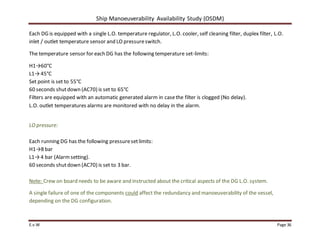
Ship Manoeuverability Availability Study (OSDM)
E.v.W Page 197
13. SUMMARY:
Level of redundancy: Reasonable.
Both scenarios descriptin chapter 7 indicate that the systems in both engine rooms are not as redundant as it
should be, this needs to be reviewed because2 separate engine rooms should really mean that all systems should
be redundant.
Level of experience:
We can conclude that the overall knowledgeand experience level (at the moment) on board the OSDMis of a
high standard, bear in mind that there is always roomfor improvement.
Note: Fiveengineers on board the OSDMhavedone their apprentice ship on board of one of the Vista class
vessels.
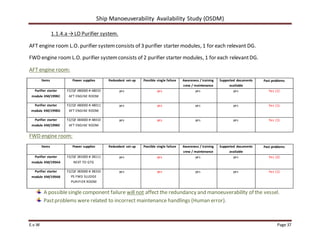
Recommendations:
Itis recommended that feasible modifications will be implemented on the OSDM; it is furthermorerecommended
that the findings indicated in this reportwill be used (implemented) in the ship specifications of the futurenew
HAL vessels.
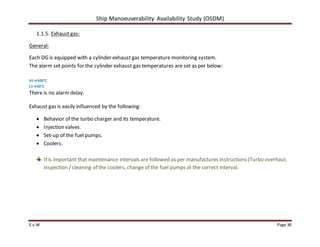
Ship Manoeuverability Availability Study (OSDM)
E.v.W Page 198
List with suggested recommendations:
Item numbers: Descriptions: Document Page numbers:
1 HT COOLERAND REGULATOR 8-10
2 CROSS CONNECTIONAFT/ FWD CROSS-OVER 11
3 BIGGERCROSS CONNECTIONSW AUX COOLERAND MAIN
FIRELINE
15
4 CONNECTIONMAINLT – AUXILIARYLT 18
5 CONNECTIONMAINLTAFT-FWD ENGINEROOMS 18
6 REDUNDANTPOWER SUPPLIES STARTING AIRCOMPRESSORS 22
7 ADD STARTING AIRCOMPRESSOR/AIRVESSEL 25
8 SUCTIONVALVES /QUICK CLOSING VALVES HFO/MGO 27
9 MGO TANK 27
10 MGO SET-UP 34
11 LO TRANSFER PUMP XA/185A 35
12 TRAINING INTERVALS 11KV MSBD 51
13 CYCLO SOFTWARE 72
Ship Manoeuverability Availability Study (OSDM)
E.v.W Page 199
List with suggested recommendations:
Item numbers: Descriptions: Document Page numbers:
14 COMMONALARMS EMG 87
15 INSTALL MANHOLE AFT-FWD MSBD ROOMS 91 / 116
16 HFO TRANSFER PUMP 102
17 DISTILLED WATER UNIT/ CONNECTIONTO PURIFIER 128
18 TECHNICAL WATERPUMPS 133
19 ESD HARDWIRED CONTROL CABINETS /COMPUTER 169 / 173
20 HI-FOG PUMP UNITS 187
21 POWERSUPPLYHI-FOG PLC CABINET 189
22 CO² CONTROL CABINET 192
23 FIREFIGHTING SYSTEM 193
24 FIREALARM SYSTEM 196
25 OVERALL TRAINING 1-211
26 OVERALL MAINTENANCEINTERVALS 1-211
Please review the block diagrams (Componentfailures) indicated on the below shown pages (200-211).
Ship Manoeuverability Availability Study (OSDM)
E.v.W Page 200
3 3
1 1
2
6
4
1
2
5
1
0
1
2
3
4
5
6
7
Engine related component failures on board the OSDM
Osdm
Ship Manoeuverability Availability Study (OSDM)
E.v.W Page 201
Summary Engine related component failures:
1. Governor related items: DG2 synchronizer, DG4/DG5 governor failure(Blackout).
2. Engine speed pickup failures: DG1 – DG3 and DG5.
3. Oil mist detector: Failureon DG4 caused a complete blackoutin 2004.
4. Engine HT regulator: DG3, regulator card error.
5. Engine LT regulator: Burned motors on DG4 and DG5.
6. Engine SW regulator: regulator controlcards, all DG’s.
7. Engine coolers: Dirty LT coolers AFT and FWD engine rooms.
8. Engine control systemAC70: Complete AC70 has been replaced on DG4.
9. Engine monitoring systemS800: S800 modules have been replaced on DG1 and DG5.
10.HT temperature sensors: Thefigure mustbe around 200 times, due to vibrations and faulty sensors, HT
sensor 60 second shutdown havebeen modified in 2011.
11.Fuel electric module heater: severalissues due to faulty heating elements.
Ship Manoeuverability Availability Study (OSDM)
E.v.W Page 202
Aboveshown figures are based on information from AMOSW, investigation reports and knowledgeof the crew
on board.
There will always bea % of failures that is not recorded in AMOSW and that is not mentioned in the investigation
reports (OSDM has been sailing since 2003).
Governor
10% Engine speed pickups
10%
Oil mistdetector
4%
Engine HT regulator
4%
Engine LT regulators
7%
Engine SW regulators
21%
Engine coolers
14%
AC70
3%
S800
7%
HT sensors
17%
Electric module heater
3%
OSDM ENGINE RELATED COMPONENT FAILURES
Governor
Engine speed pickups
Oil mist detector
Engine HT regulator
Engine LT regulators
Engine SW regulators
Engine coolers
AC70
S800
HT sensors
Electric module heater
Ship Manoeuverability Availability Study (OSDM)
E.v.W Page 203
4
2 2
4
1 1 1
9
2
8
3
1
0
1
2
3
4
5
6
7
8
9
10
Propulsion related component failures on board the OSDM
Osdm
Ship Manoeuverability Availability Study (OSDM)
E.v.W Page 204
Summary Propulsion related component failures:
1. High speed breakers: All related to Azipod encoder failures.
2. Azipod room cooling: Issuesexisting when the vesselset sail has been resolved.
3. Azipod excitation: Related to PS Azipod rotor and SBcontrol circuit.
4. Encoders: Encoder failures on both Azipods.
5. PEP module: PS Azipod.
6. CMC and ZMC computers: OneZMC failure on STBD Azipod.
7. Hydraulic power pack: Fault separation block has been replaced on the PS.
8. Steering gear: Five issues related to broken steering gear softstarters, 2 issues related to human error
(Stopping of a running steering gear pump) and 2 issues related to the steering gear motor failure
(Motors havebeen replaced, one on PS and one on STBD).
9. Cyclo controlboards: Issues on PS and STBD Cyclo due to reprogramming of the CCB cards.
10.RDS: Hard drivehas been replaced 8 times since 2003.
11.Cyclo converter cooling pumps: 2 pumps have been replaced on the PS and one on the STBD side.
12.Complete Azipod: PS Azipod hasbeen replaced in 2006.
Ship Manoeuverability Availability Study (OSDM)
E.v.W Page 205
Aboveshown figures are based on information from AMOSW, investigation reports and knowledgeof the crew
on board.
There will always bea % of failures that is not recorded in AMOSW and that is not mentioned in the investigation
reports (OSDMhas been sailing since 2003).
High speed
breakers
10%
Azipod room cooling
5%
Excitation
5%
Encoders
10%
PEP module
3%
CMC and ZMC computers
3%
Hydraulic power pack
3%
Steering gear
24%
Cyclo control boards
5%
RDS
21%
Cyclo converter
coolingpumps
8%
Complete Azipod failure
3%
OSDM PROPULSION RELATED COMPONENT FAILURES
High speed breakers
Azipod room cooling
Excitation
Encoders
PEP module
CMC and ZMC computers
Hydraulic power pack
Steering gear
Cyclo control boards
RDS
Cyclo converter cooling pumps
Complete Azipod failure
Ship Manoeuverability Availability Study (OSDM)
E.v.W Page 206
Osdmhas been sailing since 2003.
Loss of propulsion: Excitation failure (1), Encoder failures (4) and power failure (1).
Blackouts: Governor Failures (2), Shoreconnection (3) and oil mist detector (1).
Brown-outs: Under voltage coils (2), REF unit (1) and unbalanced net work (1).
6 6
4
0
1
2
3
4
5
6
7
Loss of power / propulsiontrip(partial loss of) propulsiononboard the OSDM
Brown-out
Blackout
trip of propulsion
Ship Manoeuverability Availability Study (OSDM)
E.v.W Page 207
4 6
3
30
2 1
20
1
4 6
0
20
0
5
10
15
20
25
30
35
General component failures(Important systems) onboardthe OSDM
Ship Manoeuverability Availability Study (OSDM)
E.v.W Page 208
Summary of general component failures (Importantsystems):
1. Automation system: 4 faulty S800 modules.
2. OS: 6 failures related to heat and vibrations.
3. ESD computers: Computer on the bridge has been replaced twice; ECR computer has been replaced one
time.
4. HVACsystems: All main motors have been replaced on all AC-sets; other problems wereall related to the
HVACdistribution systems.
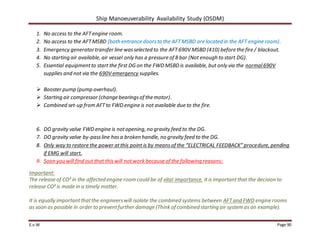
5. 11KV MSBD: Issues related to REF units, DG breaker and tripping of the aft VT cubicle REF unit.
6. Starting air compressors: Issuesrelated to damaged fly-wheels (Human error).
7. 690V MSBD and distribution: Main issueis the ground failures.
8. EMG starting: Issues related to faulty starter motor as well as incorrect settings of starting relay.
9. EMG: EMG has been replaced in 2006.
10.Cooler EMG: Cooler has been replaced in 2010.
Ship Manoeuverability Availability Study (OSDM)
E.v.W Page 209
Aboveshown figures are based on information from AMOSW, investigation reports and knowledgeof the crew
on board.
There will always bea % of failures that is not recorded in AMOSW and that is not mentioned in the investigation
reports (OSDMhas been sailing since 2003).
AUTOMATION
5%
OS
8%
ESD
4%
HVAC
39%
11KV MSBD
5%
STARTING AIR
COMPRESSORS
3%
690V DISTRIBUTION
8%
EMG COMPLETE
REPLACEMENT
1%
EMG STARTING ISSUES
26%
EMG COOLER
1%
OSDM GENERAL COMPONENT FAILURES
AUTOMATION
OS
ESD
HVAC
11KV MSBD
STARTING AIR COMPRESSORS
690V DISTRIBUTION
EMG COMPLETE REPLACEMENT
EMG STARTING ISSUES
Ship Manoeuverability Availability Study (OSDM)
E.v.W Page 210
Conclusion:
Aboveshown figures are based on information from AMOSW, investigation reports and knowledgeof the crew
on board.
There will always bea % of failures that is not recorded in AMOSW and that is not mentioned in the investigation
reports (OSDMhas been sailing since 2003).
129
5
29
0
20
40
60
80
100
120
140
Summary component failures / human errors on board the
OSDM
MECHANICAL COMPONENT
FAILURES
HUMAN ERRORS
ELECTRICAL
Ship Manoeuverability Availability Study (OSDM)
E.v.W Page 211
Recommendations:
1. Ongoing training for new crew, there are still crew members that have not done their required trainings.
2. Seattle HR department needs to make surethat the experience levels remain of a high standards by means of
implementing the correctplanning intervals (Crew needs to stay a minimum of 4 contracts on the same vessel
as this is beneficial for crew and vessel).
3. Implement a scheduled interval for a controlled black-outas this is the only way to fully provethat systems,
back-up systems arereliable.
Scheduled black-outs are beneficial for ship crew (Firsthand learning curve).
Controlled black-outs will possibleimprove the understanding of the redundancy and manoeuverability of the vesselin
case of real black-outs, loss of propulsion, this should really be part of the preventive maintenance plan as operators
need to know whatthe specific incident behavior of certain equipment is and which components arethe causes, in fact
it is a big part of the so called usagereliability which is based on running time (usage) of the systems (reliability of back-
up batteries is mostlikely the best example).
4. Review training schedules and training facilities, more so called “training on board schedules” needs to be
implemented (Firsthand learning curve) (Cabin availability is key to success).
Re-instate the shorebased advanced life fire fighting training as done in the past.
Review the availability of the training courses for non-Asian officers in Subic Bay as many courses areonly
available for Asian crew and officers.
5. Keep experienced crew; review the contract duration set-up, many experienced crew members thinking of
leaving due to the change in their 3-2 to 4-2 contractduration set-up.

OSDM Ships Manoeuverability Availabilty Study

  • 1.
    Ship Manoeuverability AvailabilityStudy (OSDM) E.v.W Page 1 The belowshownequipmentbreakdowntree hasbeenmade onboardthe Ms Oosterdam,HAL’ssecondVista classvessel. NB6076. Lloydsnumber9221281. Thisbreakdownneedstobe checkedandverifiedonboardthe Zuiderdam,WesterdamandNoordam. A similarbreakdownhasbeenmade forthe Signature class(EurodamandNieuwAmsterdam).
  • 2.
    Ship Manoeuverability AvailabilityStudy (OSDM) E.v.W Page 2 The goals andobjectivesare to: 1. Identifythose aspectsof propulsionandsteeringrelatedsystemsthatare not redundant. 2. Identifythe failuresassociatedwith the essential shipcontrol andmanoeuvringsystemsandsubsystems. 3. Evaluate the effectivenessof the existingredundancies. 4. Identifyviathe belowshownequipmentbreakdownliststhe highrisk(critical) areasbymeansof usingthe investigationreportsaswell as the knowledge of HAL’sshipsandoffice personnel. All isaboutreliability,of whichthere are 3variances: Structural reliability(dependingonatree of all kindsof subsystems,asper below) →shouldbe anewbuilddecision,AZIPODSare maybe a goodexample…). Usage reliability(dependingonsubsystemsbasedonrunningtime) –shouldbe implementedinourmaintenance management. Reliabilityandknowledge of shipspersonnel –presentnecessarytraining/keepexperiencedpersonnel. Nowadaysmaintenancemanagementisbasedon“situationdependent (risingcoolingwatertemperatures,vibrationincrease),corrective (oil change,replace filters/bearingsaftercertainrunninghours),preventive (planningengine overall,switchboardmaintenance,orderparts) &time based(basedonexperience (studiesfrommanufacturers),increase of incidentcasesandadjustedaccordingly”, whichisall basedonsafety& reliability. Operatorsneedtoknowwhatthe specificincidentbehaviorof certainequipmentisandwhichcomponentsare the causes. Statisticsare the keyparameterstoidentifythese,thisprojectisbasedonmodificationstoavoidincidentsordelaythe incidents.
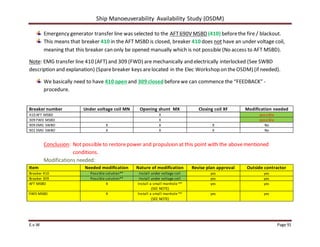
  • 3.
    Ship Manoeuverability AvailabilityStudy (OSDM) E.v.W Page 3 TABLE OF CONTENTS: CHAPTER NUMBERS CONTENTS PAGE NUMBERS 1 MAIN DIESEL ENGINES AND GTG 5-48 2 GENERATORS 49-51 3 MAIN SWITCH BOARDS 52-65 4 UPS / INVERTERS 66-67 5 PROPULSION 68-81 6 EMG SWITCHBOARD /GENERATOR 82-87 7 CASESTUDY FIRE IN AFT ENGINEROOM 88-113 7 CASESTUDY FIRE IN FWD ENGINEROOM 114-142 8 AUTOMATION 143-166 9 ESD SYSTEM 167-175 10 VENTILATION SYSTEM 176-179 11 BRIDGEAND NAVIGATION EQUIPMENT 180-184 12 FIRESUPPRESSION SYSTEMS 185-196 13 SUMMARY 197-211
  • 4.
    Ship Manoeuverability AvailabilityStudy (OSDM) E.v.W Page 4 NOTE: Black textmeans:noneCritical. Blue text means:tobe reviewed. Red textmeans:Critical. Green text means:Medium-high orcritical (Anchormode). (xx) Amountof pastproblems. Belowbreakdownisdependingonthe DG (OrGTG) / Switchboardconfigurationandthe nature of the fault. Port-mode→ inmostcasesOne DG (OrGTG) configuration. Manoeuvre-mode→ TwoDG’sor more. Sea-mode→ TwoDG’s(OrGTG) or more. Anchor-mode→ One DG(16 Cylinder) (See supporteddocuments).
  • 5.
    Ship Manoeuverability AvailabilityStudy (OSDM) E.v.W Page 5 ELECTRICAL POWER DISTRIBUTION: 1. MAINDIESEL ENGINES (DG’S) →Sulzer ZAV40S /GTG LM2500 GE. 1A: Main diesel engines(DG’s) DG1, DG3 and DG4 are 16 Cylinder type DG’S. DG2 and DG5 are 12 Cylinder type DG’S. 1B: One GTG (GasTurbine) (LM2500) 1A: Main diesel engines(DG’s) 1.1.1. Cooling Systems: cooling water – freshwater- HT(pressureand temperature). 1.1.2. Starting air system. 1.1.3. Fuel system. 1.1.4. Lubrication system(LO). 1.1.5. Exhaust gas. 1.1.6. Control and engine monitoring system(AC70 /S800). 1.1.7. Overspeed conditions.
  • 6.
    Ship Manoeuverability AvailabilityStudy (OSDM) E.v.W Page 6 1.1.1. Cooling Systems: cooling water – freshwater- HT(pressureand temperature). 1.1.1. a→Cooling water DG combined system/ Coolers (cooler change over) (pressuredip). 1.1.1. b→Temperatureand PressureSensors. 1.1.1. c→Cooling water LT, HT, SW and pre-heat pumps and their supplies. 1.1.1. d→Nozzlecooling water system. General indication: Sub Group Trip DG Trip propulsion Loss ofpower Sea-mode Manoeuvre- Port-mode Anchor mode Past problems 1.1.1.a X possible possible medium critical Low risk Medium-High yes 1.1.1.b medium critical Low risk Medium-High yes 1.1.1.c possible medium critical Low risk Medium-High yes 1.1.1.d none Possiblemeans: Depends on the DG configuration(This configuration depends on how many engines are connected in the AFT and FWD engine rooms) and nature of the fault,
  • 7.
    Ship Manoeuverability AvailabilityStudy (OSDM) E.v.W Page 7 IndividualSub groups: 1.1.1. a→Cooling water DG combined system. AFT engine room: Systemconsists of a combined 2 LT cooler systemand 1 HT cooler system. LT systemhas 2 combined regulators, HTsystem has 1 regulator. Each DG has also its own HT regulator that could affect the redundancy and manoeuverability of the vesselin case of a single failure. Description Supported documents available Possible single failure Redundant set-up Awareness / training crew / maintenance Sea-mode Manoeuvre- mode Port-mode Anchor mode Past problems DD/GG 1-2-3 LT COOLING WATER COOLER XA/062C yes yes yes Yes (see note) medium critical No risk Medium-high Yes (5) DD/GG 1-2-3 LT COOLING WATER COOLER XA/062D yes yes yes Yes (see note) medium critical No risk Medium-high Yes (5) DD/GG 1-2-3 HT COOLING WATER COOLER XA/061B yes yes no Yes (see note) medium critical No risk Medium-high Yes (2) PastProblems: Clogged coolers, especially on the seawater side of the LT coolers.
  • 8.
    Ship Manoeuverability AvailabilityStudy (OSDM) E.v.W Page 8 Note: Crew on board needs to be aware and instructed about the critical aspects of this combined cooling water set-up, working on a single engine could affect the entire AFT engine room. Incorrectoperation of the HT by-pass valveon the evaporator could cause high temperatures on the engine, causing a direct shutdown of the DG’s. A modification needs to be made in order to monitor the HT by-pass valve feedback signals in the ECR; this is not possibleon the OSDM (Itcan only be monitored on the evaporator). A single component failure could affect the redundancy and manoeuverability of the vessel, depending on the DG configuration. The behavior of the control valves need to be reviewed in case of a loss of power. Combined systems could be reviewed in order to reducethe risk of failures, specially the HT cooling system. Recommendation: The install of a second HT cooler and regulator needs to be taken into consideration. HT cooling systemis a long enclosed single systemthat is easily affected by un-prevented leaks (mostof the time on the HT line to the Evaporators).
  • 9.
    Ship Manoeuverability AvailabilityStudy (OSDM) E.v.W Page 9 FWD engine room: Systemconsists of a combined 2 LT cooler systemand 1 HT cooler system. LT systemhas 2 combined regulators, HTsystemhas 1 regulator. Each DG has also its own HT regulator that could affect the redundancy and manoeuverability of the vesselin case of a single failure. Description Supported documents available Possible single failure Redundant set-up Awareness / training crew / maintenance Sea-mode Manoeuvre- mode Port-mode Anchor mode Past problems DD/GG 4-5 LT COOLING WATER COOLER XA/062A yes yes yes Yes (see note) medium critical No risk Medium-high Yes (5) DD/GG 4-5 LT COOLING WATER COOLER XA/062B yes yes yes Yes (see note) medium critical No risk Medium-high Yes (5) DD/GG 4-5 HT COOLING WATER COOLER XA/061A yes yes no Yes (see note) Medium critical No risk Medium-high Yes (2) PastProblems: Clogged coolers, especially on the seawater side of the LT coolers.
  • 10.
    Ship Manoeuverability AvailabilityStudy (OSDM) E.v.W Page 10 Note: Crew on board needs to be aware and instructed about the critical aspects of this combined cooling water set-up, working on a single engine could affect the entire FWD engine room (DG4 and DG5) This also depends if the GTG is on line or not. Incorrectoperation of the HT by-pass valveon the evaporator could cause high temperatures on the engine, causing a direct shutdown of the DG’s. A modification needs to be made in order to monitor the HT by-pass valve feedback signals in the ECR; this is not possibleon the OSDM (Itcan only be monitored on the evaporator). A single component failure could affect the redundancy and manoeuverability of the vessel, depending on the DG configuration. The behavior of the control valves need to be reviewed in case of a loss of power. Combined systems could be reviewed in order to reducethe risk of failures, specially the HT cooling system. Recommendation: The install of a second HT cooler and regulator needs to be taken into consideration. HT cooling systemis a long enclosed single systemthat is easily affected by un-prevented leaks (mostof the time on the HT line to the Evaporators).
  • 11.
    Ship Manoeuverability AvailabilityStudy (OSDM) E.v.W Page 11 Sea water regulators AFT and FWD engine rooms. 2 regulators havebeen installed for the regulation of sea water for both engine rooms, a single failure of one the regulators will affect the aft cross-over temperatures (and pressure) which willaffect the LT cooling systemfor the DG’s. Recommendation: The below mentioned modification has been made on the Osdm, this modification needs to be checked and verified on all other Vista class vessels: Modification made on board the Osdm: A cross connection has been made between the AFT and FWD cross-over in such a way that sea water can be supplied to the LT coolers fromthe FWD cross-over in casethe AFT cross over is not available for somereason (Think of cleaning of the AFT cross-over). Items: Sea-mode Manoeuvre-mode Port-mode Anchor-mode Past problems. Awareness / training crew / maintenance Possible single failure Supported documents available Sea water temperature control valve VR01005_032 Medium risk High risk Low risk Medium-high Yes (3) yes yes yes Sea water temperature control valve VR01005_035 Medium risk High risk Low risk Medium-high Yes (3) yes yes yes
  • 12.
    Ship Manoeuverability AvailabilityStudy (OSDM) E.v.W Page 12 1.1.1. b → Temperature and PressureSensors. Automatic HT temperature and pressuresetpoints for the individual DG’s areset as per below: Temperature: Set point is 81 degrees Celsius. H1 alarm is set to 93 degrees Celsius. L1 alarmis set to 60 degrees Celsius. 60 seconds shutdown is set at 97 degrees Celsius. Pressure: H1 is set to 5.5 bar. L1 is set to 4 bar. 60 seconds shutdown is set at 2.7 bar. Single failure of cooling water HT temperature and pressureswitches could affectthe redundancy and manoeuverability of the vessel, depending on the engine configuration.
  • 13.
    Ship Manoeuverability AvailabilityStudy (OSDM) E.v.W Page 13 1.1.1. c→Cooling water LT, HT, SW and Pre-heat pumps and their supplies. AFT engine room: Items Power supplies Redundant set-up Sea-mode Manoeuvre-mode Port-mode Anchor mode Past problems DD/GG FW LT PUMP N3, XB/046C GSP FZ/432QF, 43211 AFT MSBD YES NO RISK NO RISK NO RISK NO RISK Yes (1) DD/GG FW LT PUMP N4, XB/046D GSP FZ/442QF, 44211 AFT MSBD YES NO RISK NO RISK NO RISK NO RISK Yes (1) AUX LT PUMP N1, XB/037A GSP FZ/428QF, 42810 AC COMP.RM YES NO RISK NO RISK NO RISK NO RISK Yes (1) DD/GG SW PUMP N3, XB/045C GSP FZ/432QF, 43210 AFT MSBD YES NO RISK NO RISK NO RISK NO RISK Yes (1) DD/GG SW PUMP N4, XB/045D GSP FZ/442QF, 44211 AFT MSBD YES NO RISK NO RISK NO RISK NO RISK Yes (1) AUX SW PUMP N1, XB/039A GSP FZ/428QF, 42811 AC COMP.RM YES NO RISK NO RISK NO RISK NO RISK Yes (1) HT PUMP MECHANICAL – DRIVEN BY ENGINE N/A YES (3 DG IN AFT ENGINE ROOM) NO RISK NO RISK NO RISK NO RISK Yes (1) PRE-HEAT PUMP XA/065B FZ/QF482000 # 48227 AFT MSBD NO NO RISK NO RISK NO RISK NO RISK Yes (1) Main LT from AFTengine roomis supplying the cooling for the PS Azipod / Cyclo and propulsion transformers. All motors havebeen replaced in the past, main issueis the excessiveheat generated insidethe terminal connection supply boxwhich caused the motor to burn-out.
  • 14.
    Ship Manoeuverability AvailabilityStudy (OSDM) E.v.W Page 14 FWD engine room: Items Power supplies Redundant set-up Sea-mode Manoeuvre-mode Port-mode Anchor mode Past problems DD/GG FW LT PUMP N2, XB/046B GSP FZ/341QF, 34111 FWD MSBD YES NO RISK NO RISK NO RISK NO RISK Yes (1) DD/GG FW LT PUMP N1, XB/046A GSP FZ/331QF, 33113 FWD MSBD YES NO RISK NO RISK NO RISK NO RISK Yes (1) AUX LT PUMP N2, XB/037B GSP FZ/331QF, 33110 FWD MSBD YES NO RISK NO RISK NO RISK NO RISK Yes (1) DD/GG SW PUMP N1, XB/045A GSP FZ/331QF, 33112 FWD MSBD YES NO RISK NO RISK NO RISK NO RISK Yes (1) DD/GG SW PUMP N2, XB/045B GSP FZ/341QF, 34110 FWD MSBD YES NO RISK NO RISK NO RISK NO RISK Yes (1) AUX SW PUMP N2, XB/039B GSP FZ/331QF, 33111 FWD MSBD YES NO RISK NO RISK NO RISK NO RISK Yes (1) HT PUMP MECHANICAL – DRIVEN BY ENGINE N/A YES (2 DG IN FWD ENGINE ROOM) NO RISK NO RISK NO RISK NO RISK Yes (1) PRE-HEAT PUMP XA/065A FZ/QF385000 #38521 B-DK EVAP ROOM NO NO RISK NO RISK NO RISK NO RISK Yes (1) Main LT from FWD engine roomis supplying the cooling for the STBD Azipod / Cyclo and propulsion transformers. All motors havebeen replaced in the past, main issueis the excessiveheat generated inside the terminal connection supply boxwhich caused the motor to burn-out.
  • 15.
    Ship Manoeuverability AvailabilityStudy (OSDM) E.v.W Page 15 General note: Auxiliary LT and SW pumps and relevant coolers are all located in different compartments. Auxiliary LTand Auxiliary SW pumps and coolers Location pumps Auxiliary SW pump N1, XB/039A AC-Compressor room Auxiliary SW pump N2, XB/039B D-deck PS evaporator room Auxiliary LTpump N1, XB/037A AC-Compressor room Auxiliary LTpump N2, XB/037B D-deck PS evaporator room Auxiliary cooler XA/038A AC-Compressor room Auxiliary cooler XA/038B D-deck PS evaporator room AC seawater pump N3, XA/494C AC-Compressor room Evaporator SW pump XD/107AA D-deck PS evaporator room The following modifications have been made on board the OSDM. 1. A cross connection has been installed between the dischargeof AC seawater pump N3 (XA/494C) and the inlet of the auxiliary cooler, this has been donein order to maintain the redundancy in caseof a failure (Maintenance) of the auxiliary seawater pump XA/039A. 2. A cross connection has been made between the emergency main fire line and the seawater side of the auxiliary cooler in case you would lose (Maintenance or failure) auxiliary seawater pump XA/039B Note: Itis recommended to install a bigger cross connection mainly becauseit will not be possibleto run all DG’s of this cross connection at the moment (See supported documents).
  • 16.
    Ship Manoeuverability AvailabilityStudy (OSDM) E.v.W Page 16 3. A cross connection has been made between the suction of the evaporator SW pump XD/107AA and the suction of the auxiliary SW pump XA/039B, this way the auxiliary LT SW side is connected via the shore connection to the LT SW side. (This is the cross connection between the AFT and FWD seawater cross-over) (LTcoolers can be supplied with SW from the FWD cross-over in casethe AFT cross-over is unavailable)(See supporteddocuments).
  • 17.
    Ship Manoeuverability AvailabilityStudy (OSDM) E.v.W Page 17 Auxiliary cooling is used for: 1. Stabilizers. 2. Bow Thrusters. 3. Air compressor F.W. coolers. 4. Boiler forced circulation feed water pumps. 5. Condensate drain cooler. 6. Water treatment unit. 7. Provision freezing condensers. 8. Propulsion excitation transformers. 9. Main transformers E.R. substations. 10. Main transformers accommodation substations. 11. Galley transformers. 12. ECR 13. AFT and FWD MSBD rooms. 14. PS and STBD Cyclo converter rooms. 15. Black-out pumps C.W. starting aircompressors (AFT and FWD). 16. Condensate sample cooler. 17. Power pack incinerator.
  • 18.
    Ship Manoeuverability AvailabilityStudy (OSDM) E.v.W Page 18 Auxiliary SW can be connected to the main SW systemin both engine rooms by means of the use of the shore connection. Recommendations: Itmight be wiseto install a cross-connection (Emergency) between the main LT and the auxiliary LT systems, to ensurethat cooling will be available for essential equipment in case of an emergency such as fire / flooding / leakages. Main LT systemcan be isolated as this is not installed as one complete system(AFTand FWD engine rooms); Auxiliary LT systemneeds to be reviewed as this is installed as one complete system. Auxiliary LT systemwould not be available in case of let’s say a leakage at the lowest point(Systemwould drain completely). This would mean that complete systemneeds to be isolated in order to repair the leakage, resulting in the loss of vital equipment needed to maintain the vessels redundancy and manoeuverability (Loss of excitation transformers mightbe a good example) (Power might be available but propulsion will not be). Itmight be wiseto install a cross-connection (Emergency) between main LT AFT engine room and main LT FWD engine room.
  • 19.
    Ship Manoeuverability AvailabilityStudy (OSDM) E.v.W Page 19 1.1.1. d→ Nozzlecooling water system. AFT engine room: Systemconsists of a combined header tank, two redundantnozzlecooling water pumps and 3 nozzlecooling water coolers, one for each DG. Description Supported documents available Possible single failure Redundant set-up Awareness / training crew / maintenance Sea-mode Manoeuvre- mode Port-mode Anchor mode Past problems DG1 NOZZLE CW COOLER XA/069B yes yes no Yes No risk No risk No risk No risk none DG2 NOZZLE CW COOLER XA/069E yes yes no Yes No risk No risk No risk No risk none DG3 NOZZLE CW COOLER XA/069C yes yes no Yes No risk No risk No risk No risk none NOZZLE CW PUMP XA/052C yes yes yes yes No risk No risk No risk No risk none NOZZLE CW PUMP XA/052D yes yes yes yes No risk No risk No risk No risk none HEADER TANK XA/081B yes yes no yes No risk No risk No risk No risk none DESCRIPTION POWER SUPPLIES NOZZLE COOLING WATER PUMP XA/052C GSP FZ/432QF # 43214 AFT MSBD NOZZLE COOLING WATER PUMP XA/052D GSP FZ/442QF # 44214 AFT MSBD Single failure of the nozzlecooling water systemor its components will not affect the redundancy and manoeuverability of the vessel. DG can run without nozzlecooling water for about 2 hours without damaging the DG (HFO) (Even longer on MGO).
  • 20.
    Ship Manoeuverability AvailabilityStudy (OSDM) E.v.W Page 20 FWD engine room: Systemconsists of a combined header tank, two redundant nozzlecooling water pumps and 2 nozzlecooling water coolers, one for each DG. Description Supported documents available Possible single failure Redundant set-up Awareness / training crew / maintenance Sea-mode Manoeuvre- mode Port-mode Anchor mode Past problems DG4 NOZZLE CW COOLER XA/069A yes yes no Yes No risk No risk No risk No risk none DG5 NOZZLE CW COOLER XA/069D yes yes no Yes No risk No risk No risk No risk none NOZZLE CW PUMP XA/052A yes yes yes yes No risk No risk No risk No risk none NOZZLE CW PUMP XA/052B yes yes yes yes No risk No risk No risk No risk none HEADER TANK XA/081A yes yes no yes No risk No risk No risk No risk none DESCRIPTION POWER SUPPLIES NOZZLE COOLING WATER PUMP XA/052A GSP FZ/331QF # 33114 FWD MSBD NOZZLE COOLING WATER PUMP XA/052B GSP FZ/341QF # 34113 FWD MSBD Single failure of the nozzlecooling water systemor its components will not affect the redundancy and manoeuverability of the vessel. DG can run without nozzlecooling water for about 2 hours without damaging the DG (HFO) (Even longer on MGO).
  • 21.
    Ship Manoeuverability AvailabilityStudy (OSDM) E.v.W Page 21 1.1.2. Starting air system: General: Starting air systemon board the OSDM consists of 4 starting air compressors. 2 Starting air compressors arelocated in the AFTengine room(B-deck PS AFTengine room, FR. 90-98). 2 Starting air compressors arelocated in the FWD engine room(B-deck SBevaporator room, FR. 138-146). Systemhas been set-up as one combined systembetween the AFT and FWD engine rooms, butworks as well as for the individual set-up in AFTand FWD engine rooms, in case you need to separatethe 2 engine rooms. Systemhas been set-up with 2 starting air receivers, 1 for AFT and 1 for FWD engine rooms. IndividualSub groups: 1.1.2. a→Power supplies Starting air compressors. 1.1.2. b→Power supplies (Emergency) cooling pumps. 1.1.2. c→Pressureswitches and logic. 1.1.2. d→Set-up Starting air vessels.
  • 22.
    Ship Manoeuverability AvailabilityStudy (OSDM) E.v.W Page 22 1.1.2. a→Power supplies Starting air compressors. AFT engine room: Items Power supplies Redundant set-up Possible single failure Awareness / training crew / maintenance Supported documents available Past problems Comp.N3 XM/228C FZ/QF482000, 48213 no yes yes yes none Comp.N4 XM/228CA FZ/QZ942000, 94223 no yes yes yes none FWD engine room: Items Power supplies Redundant set-up Possible single failure Awareness / training crew / maintenance Supported documents available Past problems Comp.N1 XM/228AA FZ/QZ941000, 94114 no yes yes yes Yes (1) Comp.N2 XM/228AB GSP FZ/341QF, 34123 no yes yes yes Yes (1) Note: Starting air compressors 1 and 4 are fed fromthe emergency switchboard. Recommendation: All starting air compressors need to havea redundantpower supply; this will be a low cost modification and can be done by the crew on board. Pastproblems: Damaged fly-wheel on compressors1 and 2. A single component failure will not affect the redundancy and manoeuverability of the vessel.
  • 23.
    Ship Manoeuverability AvailabilityStudy (OSDM) E.v.W Page 23 1.1.2. b→Power supplies (Emergency) cooling pumps. AFT engine room: Items Power supplies Redundant set-up Possible single failure Awareness / training crew / maintenance Supported documents available Past problems Cooling pump XA/048C GSP FZ/432QF #43212 AFT MSBD Yes yes yes yes none Cooling pump XA/048D GSP FZ/442QF #44212 AFT MSBD yes yes yes yes none (EMG)Cooling pump XA/048F FZ/QZ942000 #94217 EMG SWBD yes yes yes yes none FWD engine room: Items Power supplies Redundant set-up Possible single failure Awareness / training crew / maintenance Supported documents available Past problems Cooling pump XA/048A GSP FZ/331QF #33135 FWD MSBD Yes yes yes yes none Cooling pump XA/048B GSP FZ/341QF # 34112 FWD MSBD yes yes yes yes none (EMG)Cooling pump XA/048E FZ/QZ941000 # 94110 EMG SWBD yes yes yes yes none A single component failure will not affect the redundancy and manoeuverability of the vessel.
  • 24.
    Ship Manoeuverability AvailabilityStudy (OSDM) E.v.W Page 24 1.1.2. c→Pressureswitches and logic. Supported documents are available. A single component failure will not affect the redundancy and manoeuverability of the vessel. Items Redundant set-up Possible single failure Awareness / training crew / maintenance Supported documents available Past problems Pressure switches / logic yes yes yes yes none
  • 25.
    Ship Manoeuverability AvailabilityStudy (OSDM) E.v.W Page 25 1.1.2. d→Set-up Starting air vessels. Systemhas been set-up with 2 starting air receivers, 1 for AFT and 1 for FWD engine rooms. Systemhas been set-up in such a way that it can be used as a combined system(normalset-up) or as an individual engine roomspecific (AFTor FWD) if needed in case of an emergency. Starting air vesselfor the AFTengine roomis located in the PS B-deck AFTengine room, FR. 86-94. Starting air vesselfor the FWD engine roomis located in the SB B-deck evaporator room, FR. 138-146. The following systems areconnected to the DD/GG starting air system: 1. Air receiver for AFT whistle. 2. Starting air receiver for emergency diesel generator. 3. Emergency starting air compressor for emergency dieselgenerator (See recommendation). 4. Control air system→serviceair system. 5. Emergency diesel fire pump. 6. Engines DG1-2-3-4-5starting air. Recommendation: Installa separate compressor /air vesselin a technical space between D-deck and deck 10 that will mainly serveas a general back-up for engine roomstarting air systems as well as for the emergency generator starting air system, fed fromthe emergency switchboard (Air feedback).
  • 26.
    Ship Manoeuverability AvailabilityStudy (OSDM) E.v.W Page 26 1.1.3. Fuel system: General: Fuel systems arein general an important factor and risk for the redundancy and manoeuverability of the vessel. Fuel systems could generate many single failures, simple because it is a large and complicated system. Fuel pressures and temperatures need to be monitored at all times. IndividualSub groups: 1.1.3. a→H.F.O. /D.O. services, AFT and FWD engine rooms. 1.1.3. b→Logic and power supplies Booster pumps and feeder pumps, AFT and FWD engine rooms. 1.1.3. c→Blackoutgravity valves, AFTand FWD engine rooms. 1.1.3. d→H.F.O.Transfer system. 1.1.3. e→H.F.O.Separation system. 1.1.3. f→D.O.Transfer /Separation system. 1.1.3. h→L.O.Purifier system.
  • 27.
    Ship Manoeuverability AvailabilityStudy (OSDM) E.v.W Page 27 1.1.3. a→H.F.O. /D.O. services, AFT and FWD engine rooms. Systemhas been designed to run on either H.F.O. or on DO (M.G.O.). Systemhas a redundant set-up; it can be used as a combined systembetween the AFT and FWD engine rooms as well as for the independent engine roomset-up. H.F.O. systemhas a redundantset-up, but:  Each fuel module has only 1 suction pipe fromthe H.F.O. servicetank with only 1 quick closing valve, if this quick closing valve would accidentally shutyou will lose the complete module. Recommendation: Install2 separatesuction valves with 2 quick closing valves. D.O. (M.G.O.) systemhas no redundant set-up.  When running on M.G.O. both engine rooms takesuction from1 suction line with only 1 quick closing valve, if this valvewould shuta blackout will be the result (Single failure).  Regulations in certain areas like the Californian coast require the ship to change-over fromH.F.O. to M.G.O. 3 miles beforethe end of the sea voyage, meaning that often the ship sails on 2 or 3 engines running on M.G.O.  Tank capacity is way too small, maximum quantity of the M.G.O. servicetank 2S is only 37.4m3. Recommendation: Installa bigger M.G.O. servicetank or combine the GTG M.G.O. servicetank with the DG M.G.O. servicetank by means of a permanent connection between the 2 tanks or by means of opening both suction valves on the suction line (Communicating vessels)(See supported documents) Install2 separatesuction valves with 2 quick closing valves.
  • 28.
    Ship Manoeuverability AvailabilityStudy (OSDM) E.v.W Page 28 1.1.3. b→Logic and power supplies Booster pumps and feeder pumps, AFTand FWD engine rooms. AFT engine room: Items Power supplies Redundant set-up Possible single failure Awareness / training crew / maintenance Supported documents available Past problems Feeder pump N3 XD/144BA FZ/QF480000 # 48014 AFT ENGINE ROOM no yes yes yes none Feeder pump N4 XD/144BB AS001QFB # Q52 AFT MSBD yes yes yes yes none Booster pump N3 XD/144BD FZ/QF480000 # 48016 AFT ENGINE ROOM no yes yes yes none Booster pump N4 XD/144BE AS001QFB # Q53 AFT MSBD yes yes yes yes none Pressure Switch for Booster / Feeder N/A no yes yes yes none Feeder / Booster pumps N4 areequipment with a redundantpower supply set-up coming fromAS001QFB located in the AFT MSBD. Feeder / Booster pumps logic is only equipped with 1 pressureswitch.
  • 29.
    Ship Manoeuverability AvailabilityStudy (OSDM) E.v.W Page 29 FWD engine room: Items Power supplies Redundant set-up Possible single failure Awareness / training crew / maintenance Supported documents available Past problems Feeder pump N1 XD/144AA FZ/QF381000 # 38114 NEXT TO GTG no yes yes yes none Feeder pump N2 XD/144AB AS001QFA # Q52 FWD MSBD yes yes yes yes none Booster pump N1 XD/144AD FZ/QF381000 # 38116 NEXT TO GTG no yes yes yes none Booster pump N2 XD/144AE AS001QFA # Q53 FWD MSBD yes yes yes yes none Pressure Switch for Booster / Feeder N/A no yes yes yes none Feeder / Booster pumps N2 areequipment with a redundant power supply set-up coming fromAS001QFA located in the FWD MSBD. Feeder / Booster pumps logic is only equipped with 1 pressureswitch.
  • 30.
    Ship Manoeuverability AvailabilityStudy (OSDM) E.v.W Page 30 AFT and FWD engine rooms: Items: Sea-mode Manoeuvre-mode Port-mode Anchor-mode Past problems. Loss of Booster pumps Medium low-risk Medium-risk Low-risk Medium none Loss of Feeder pumps Medium low-risk Medium-risk Low-risk Medium none Loss of Pressure switch Medium low-risk Medium-risk Low-risk Medium none Note: There is no need to changethe logic of the booster / feeder pumps, nor is there a reason to combine the logic with the logic for the D.O.black-outvalve. A single failure could affect the redundancy and manoeuverability of the vessel.
  • 31.
    Ship Manoeuverability AvailabilityStudy (OSDM) E.v.W Page 31 1.1.3. c→Blackout gravity valves, AFTand FWD engine rooms.  Each engine roomis equipped with a D.O. black-outvalvefor the D.O. supply by means of gravity to the 3 engines in the relevant engine room, coming fromthe D.O. tank GO06P.  GO06P is located in the emergency generator room on Deck 10. AFT engine room: Item Power supplies Redundant set-up Possible single failure Awareness / training crew / maintenance Supported documents available Past problems Black-out valve NL/001DV AU/821UE # Q7 YES (Valve by-pass handle) YES YES YES Yes (2) A single component failure will not affect the redundancy and manoeuverability of the vessel. Pastproblems due to leaking valve, this has been rectified (Valve installed incorrectly). FWD engine room: Item Power supplies Redundant set-up Possible single failure Awareness / training crew / maintenance Supported documents available Past problems Black-out valve NL/021DV AU/836UE # Q7 YES (Valve by-pass handle) YES YES YES Yes (2) A single component failure will not affect the redundancy and manoeuverability of the vessel. Pastproblems due to leaking valve, this has been rectified (Valve installed incorrectly).
  • 32.
    Ship Manoeuverability AvailabilityStudy (OSDM) E.v.W Page 32 1.1.3. d→H.F.O.Transfer system. Items Power supplies Redundant set-up Possible single failure Awareness / training crew / maintenance Supported documents available Past problems H.F.O Transfer pump N1 XA/501A FZ/432QF # 43221 AFT MSBD Yes yes yes yes Yes (1) H.F.O Transfer pump N2 XA/501B FZ/442QF #44218 AFT MSBD yes yes yes yes Yes (1) A single component failure will not affect the redundancy and manoeuverability of the vessel. Pastproblems were related to issues with the mechanical seal (Leaking).
  • 33.
    Ship Manoeuverability AvailabilityStudy (OSDM) E.v.W Page 33 1.1.3. e→ H.F.O.Separation system(Purifiers). AFT engine room: Items Power supplies Redundant set-up Possible single failure Awareness / training crew / maintenance Supported documents available Past problems HFOElectric heater XM/158BG GSP FZ/442QF #44220 AFT 11KV MSBD no yes yes yes Yes (1) Purifier starter module XM/158BC FZ/QF480000 #48012 AFT ENGINEROOM yes yes yes yes none Purifier starter module XM/158BD FZ/QF484000 #48411 AFT ENGINEROOM yes yes yes yes none A single component failure will not affect the redundancy and manoeuverability of the vessel. Pastproblems related to burned-outheating elements. FWD engine room: Items Power supplies Redundant set-up Possible single failure Awareness / training crew / maintenance Supported documents available Past problems HFOElectric heater XM/158AG GSP FZ/341QF #34122 FWD 11KV MSBD no yes yes yes Yes (7) Purifier starter module XM/158AC FZ/QF381000 #38111 NEXTTO GTG yes yes yes yes none Purifier starter module XM/158AD FZ/QF383000 #38311 PS FWD PURF.ROOM (Sludge purifier room) yes yes yes yes none A single component failure will not affect the redundancy and manoeuverability of the vessel. Pastproblems related to burned-outheating elements.
  • 34.
    Ship Manoeuverability AvailabilityStudy (OSDM) E.v.W Page 34 1.1.3. f→D.O.Transfer /Separation system. Items Power supplies Redundant set-up Possible single failure Awareness / training crew / maintenance Supported documents available Past problems M.G.O. Transfer pump XE/500 FZ/QZ942000 # 94213 EMG SWBD yes yes yes yes none M.G.O. Transfer pump XB/502 FZ/341QF # 34117 FWD MSBD yes yes yes yes none Purifier starter module XM/159C FZ/QF381000 # 38113 NEXT TO GTG no yes yes yes none A single M.G.O. transfer pump failure will not affect the redundancy and manoeuverability of the vessel. A single failure with the purifier components system could affect the redundancy and manoeuverability of the vessel. Recommendation: The M.G.O. transfer pumps arethe only components that have a redundantset-up of the M.G.O. system. Systemset-up needs to be reviewed and needs to be modified for any futurenew build HAL vessels.
  • 35.
    Ship Manoeuverability AvailabilityStudy (OSDM) E.v.W Page 35 1.1.4.→DG Lubeoil (L.O.) system. Each DG is equipped with a single pre-lubepump; each pump is supplied fromthe emergency switchboard. Each Pre-lube pump has a manually by-pass (DG can startwithout pre-lube pump). Items Power supplies Redundant set-up Possible single failure Awareness / training crew / maintenance Supported documents available Past problems Pre-lube pump DG1 XE/274BC FZ/QZ942000 # 94210 AFT MSBD no yes yes yes Yes (1) related to electrical overload Pre-lube pump DG2 XE/274EC FZ/QZ942000 # 94212 AFT MSBD no yes yes yes none Pre-lube pump DG3 XE/274CC FZ/QZ942000 # 94211 AFT MSBD no yes yes yes Yes (1) related to electrical overload Pre-lube pump DG4 XE/274AC FZ/QZ941000 # 94111 FWD MSBD no yes yes yes none Pre-lube pump DG5 XE/274DC FZ/QZ941000 # 94112 FWD MSBD no yes yes yes none DG LO Transfer pump XA/185A GSP FZ/432QF # 43218 AFT MSBD no yes yes yes none Note: There is only one DG LO transfer pump, Located in the PS AFT purifier room, AFT engine room. This pump is for the transfer of the LO from the storagetanks to the DG’s sump. Normally the sumps are full but it could happen that LO needs to be transferred in case of an emergency, meaning that this cannot be done as this pump does not have an emergency supply (Think of the Rotterdam scenario). Recommendation: Installa change over switch and emergency supply for clean LO transfer pump XA/185A. Installa cross connection between the clean and dirty LO pumps, this way you will create a redundantset-up in case the clean LO pump breaks down mechanically (See supported documents).
  • 36.
    Ship Manoeuverability AvailabilityStudy (OSDM) E.v.W Page 36 Each DG is equipped with a single L.O. temperature regulator, L.O. cooler, self cleaning filter, duplex filter, L.O. inlet / outlet temperature sensor and LO pressureswitch. The temperature sensor for each DG has the following temperature set-limits: H1→60°C L1→45°C Set point is set to 55°C 60 seconds shutdown (AC70) is set to 65°C Filters are equipped with an automatic generated alarm in casethe filter is clogged (No delay). L.O. outlet temperatures alarms are monitored with no delay in the alarm. LO pressure: Each running DG has the following pressuresetlimits: H1→8 bar L1→4 bar (Alarmsetting). 60 seconds shutdown (AC70) is set to 3 bar. Note: Crew on board needs to be aware and instructed about the critical aspects of the DG L.O. system. A single failure of one of the components could affect the redundancy and manoeuverability of the vessel, depending on the DG configuration.
  • 37.
    Ship Manoeuverability AvailabilityStudy (OSDM) E.v.W Page 37 1.1.4.a →LO Purifier system. AFT engine room L.O. purifier systemconsists of 3 purifier starter modules, 1 for each relevant DG. FWD engine room L.O. purifier systemconsists of 2 purifier starter modules, 1 for each relevantDG. AFT engine room: Items Power supplies Redundant set-up Possible single failure Awareness / training crew / maintenance Supported documents available Past problems Purifier starter module XM/199BC FZ/QF 480000 # 48010 AFT ENGINE ROOM yes yes yes yes Yes (1) Purifier starter module XM/199BD FZ/QF 480000 # 48011 AFT ENGINE ROOM yes yes yes yes Yes (1) Purifier starter module XM/199BE FZ/QF 484000 # 48410 AFT ENGINE ROOM yes yes yes yes Yes (1) FWD engine room: Items Power supplies Redundant set-up Possible single failure Awareness / training crew / maintenance Supported documents available Past problems Purifier starter module XM/199AA FZ/QF 381000 # 38111 NEXT TO GTG yes yes yes yes Yes (2) Purifier starter module XM/199AB FZ/QF 383000 # 38310 PS FWD SLUDGE PURIFIER ROOM yes yes yes yes Yes (1) A possiblesingle component failure will not affect the redundancy and manoeuverability of the vessel. Pastproblems were related to incorrect maintenance handlings (Human error).
  • 38.
    Ship Manoeuverability AvailabilityStudy (OSDM) E.v.W Page 38 1.1.5. Exhaust gas: General: Each DG is equipped with a cylinder exhaust gas temperature monitoring system. The alarm set points for the cylinder exhaust gas temperatures are set as per below: H1→500°C L1→50°C There is no alarm delay. Exhaust gas is easily influenced by the following:  Behavior of the turbo charger and its temperature.  Injection valves.  Set-up of the fuel pumps.  Coolers. Itis important that maintenance intervals are followed as per manufactures instructions (Turbo overhaul, inspection / cleaning of the coolers, change of the fuel pumps at the correct interval.
  • 39.
    Ship Manoeuverability AvailabilityStudy (OSDM) E.v.W Page 39 Functionality of exhaustgas / turbo charger temperatures: There is no 60 seconds shut-down implemented when these temperatures exceeds their limits. Note: Cylinder / turbo charger exhaust temperatures can be blocked on the automation systemin caseof justa sensor failure Items: Sea-mode Manoeuvre-mode Port-mode Anchor-mode Past problems. Awareness/ training crew / maintenance Possible single failure Supported documents available Cylinder exhaust temperatures No risk No risk No risk No risk none yes yes Yes (10) Turbo charger exhaust temp. No risk No risk No risk No risk none yes yes Yes (10) Single failure will not affect the redundancy and manoeuverability of the vessel. Pastproblems were all related to sensor failures or wrong sensor indications.
  • 40.
    Ship Manoeuverability AvailabilityStudy (OSDM) E.v.W Page 40 1.1.6. Control and Engine Monitoring: General: Each DG is controlled and monitored by the following: AC70: start/ stop and safeties of each DG individually. S800: monitoring of each DG individually. AC70 and S800 arelocated in the same cabinet, one control cabinet for each DG Control cabinets for DG1, DG2 and DG3 are located in the AFTMSBD. Control cabinets for DG 4 and DG5 are located in the FWD MSBD.
  • 41.
    Ship Manoeuverability AvailabilityStudy (OSDM) E.v.W Page 41 There are two conditions implemented for the shutdown of the relevant DG(s) in case of failures.  60 seconds delayed shutdowns.  Direct shutdowns. 60 seconds delayed shutdowns: 1. L.O. temperature >65°C. 2. L.O. pressure<3bar. 3. HT cooling water pressure<2.7bar. 4. Cylinder cooling water outlet temperature <97°C. 5. Main bearing temperature >95°C. 6. Generator bearing temperature >100°C. 7. Generator winding temperature >140°C. 8. Turbo charger (T/C) temperature >120°C. How it works: PMS is starting the next DG in the sequence when any of the above mentioned 60 seconds delayed shutdowns areactivated. If any of the above mentioned 60 seconds shutdowns remain activefor the duration of 60 seconds the relevant affected DG will shutdown.
  • 42.
    Ship Manoeuverability AvailabilityStudy (OSDM) E.v.W Page 42 Items: Sea-mode Manoeuvre-mode Port-mode Anchor-mode Past problems. Awareness/ training crew / maintenance Possible single failure Supported documents available 1 Medium High No risk High Yes (5) yes yes yes 2 Medium High No risk High none yes yes yes 3 Medium High No risk High Yes (5) yes yes yes 4 Medium High No risk High Yes (15) yes yes yes 5 Medium High No risk High Yes (10) yes yes yes 6 Medium High No risk High none yes yes yes 7 Medium High No risk High none yes yes yes 8 Medium High No risk High none yes yes yes Note: Pastproblems were mainly caused by sensor failures or incorrectsensor monitoring. Single failure could affect the redundancy and manoeuverability of the vessel.
  • 43.
    Ship Manoeuverability AvailabilityStudy (OSDM) E.v.W Page 43 Direct shutdowns: The below shown alarms will cause a direct shutdown of the relevant DG (s). 1. Earth switch on. 2. Mechanical over speed. 3. Pneumatic shutdown activated. 4. Governor critical failure. 5. ECR EM stop activated. 6. Electrical over speed. 7. Generator protection trip. 8. Mechanical LO stop. 9. Oil mist High.
  • 44.
    Ship Manoeuverability AvailabilityStudy (OSDM) E.v.W Page 44 Items: Sea-mode Manoeuvre-mode Port-mode Anchor-mode Past problems. Awareness/ training crew / maintenance Possible single failure Supported documentsavailable 1 Medium risk High risk Low risk Medium-high none yes yes yes 2 Medium risk High risk Low risk Medium-high Yes (1) yes yes yes 3 Medium risk High risk Low risk Medium-high none yes yes yes 4 Medium risk High risk Low risk Medium-high Yes (1) yes yes yes 5 Medium risk High risk Low risk Medium-high none yes yes yes 6 Medium risk High risk Low risk Medium-high none yes yes yes 7 Medium risk High risk Low risk Medium-high none yes yes yes 8 Medium risk High risk Low risk Medium-high none yes yes yes Single failure could affect the redundancy and manoeuverability of the vessel, depending on the DG configuration as well as the alertness of the operators in the ECR.
  • 45.
    Ship Manoeuverability AvailabilityStudy (OSDM) E.v.W Page 45 IndividualSub groups: 1.1.6. a→Engine protection system(AC70). 1.1.6. b→DG Governor. 1.1.6. c→Woodward 723 digital governor (Hardware/Software/ Synchronizer). 1.1.6. a→Engine protection system (AC70). Each DG is controlled and monitored by the following: AC70: start/ stop and safeties of each DG individually. S800: monitoring of each DG individually. AC70 and S800 arelocated in the same cabinet, one control cabinet for each DG Control cabinets are located in the AFT MSBD for DG1, 2, and 3. Control cabinets are located in the FWD MSBD for DG4, 5. 1.1.6. b→DG Governors Crew has the knowledgeand supported documents available in casea Governor needs to be changed. Single failure could affect the redundancy and manoeuverability of the vessel, depending on the DG configuration.
  • 46.
    Ship Manoeuverability AvailabilityStudy (OSDM) E.v.W Page 46 1.1.6. c→Woodward 723 digitalgovernor (Hardware/Software/ Synchronizer). Knowledge(crew) and supported documents are available in case a digital governor needs to be changed. Crew should not adjust any of the parameters.
  • 47.
    Ship Manoeuverability AvailabilityStudy (OSDM) E.v.W Page 47 1.1.7. Overspeed conditions. 1.1.6. a→Governor (major problem). 1.1.6. b→Fuelrack / Fuel pumps (major problem). 1.1.6. c→Emergency Stop. Sub Groups Trip DG Trip propulsion Lossof power Sea-mode Manoeuvre- mode Port-mode Anchor- mode Past problems Awareness/ training crew / maintenance Possible single failure Supported documents available 1.1.6.a x possible possible medium critical Low risk Critical Yes (1) yes yes yes 1.1.6.b x possible possible medium critical Low risk Critical none yes yes yes 1.1.6.c x possible possible medium critical Low risk Critical none yes yes yes Possiblemeans: depending on the load and DG configuration. Single failure could affect the redundancy and manoeuverability of the vessel, depending on the DG configuration as well as the alertness of the operators in the ECR. Pastproblems were related to the governor of DG4 and DG5 causing a blackoutof the vessel.
  • 48.
    Ship Manoeuverability AvailabilityStudy (OSDM) E.v.W Page 48 1B: One GTG (GasTurbine) (LM2500) The OSDMhas been equipped with one GTG fromGE. The GTG runs about 2 hours each week due to the high fuel cost (MGO) (70 liters per minute). The GTG is available and is considered as DG6 during normaloperations, the GTG cannot be used in case of emergencies such as brown-outs and blackouts. AverageGTG start-up time is 20 minutes and none of its auxiliary equipment is fed fromthe EMG switchboard.  All auxiliaries are supplied from two GSP panels in the FWD MSBD.  Motors A and heaters are fed from GSP FZ/331QF.  Motors B are fed from GSP FZ/341QF. EQUIPMENT FED FROM BREAKER NUMBER ENCLOSURE VENT FAN A GSP FZ/331QF 33121 GENERATOR LO PUMP A GSP FZ/331QF 33122 FUEL FWD PUMP A GSP FZ/331QF 33120 TURBINE LO HEATER GSP FZ/331QF 33128 GENERATOR LO HEATER GSP FZ/331QF 33129 HYDRAULIC STARTER HEATER GSP FZ/331QF 33130 ENCLOSURE VENT FAN B GSP FZ/341QF 34121 GENERATOR LO PUMP B GSP FZ.341QF 34120 FUEL FWD PUMP B GSP FZ/341QF 34119
  • 49.
    Ship Manoeuverability AvailabilityStudy (OSDM) E.v.W Page 49 2. GENERATORS: 2.1.1. Bearings (temperature). 2.1.2. Air cooler. 2.1.3. Excitation (brushless). 2.1.4. Neutralpoint. 2.1.5. Voltageregulator (AVR) (Individualand 2 master AVR’s). 2.1.6. Voltagetransformers (Excitation / Actual value measurements). 2.1.7. ControlSystem/ Sensors /Detectors / winding temperature. 2.1.8. Current transformers(Differential/ Actual value measurements). 2.1.9. Diodes.
  • 50.
    Ship Manoeuverability AvailabilityStudy (OSDM) E.v.W Page 50 Sub Groups Trip DG / generator Trip propulsion Lossof power Sea-mode Manoeuvre- mode Port-mode Anchor- mode Past problems Awareness/ training crew / maintenance Possible single failure Supported documents available 2.1.1. >100°C X possible possible medium critical Low risk critical none yes yes yes 2.1.2. none yes yes yes 2.1.3. X possible possible medium critical Low risk critical none yes yes yes 2.1.4. none yes yes yes 2.1.5. X possible possible medium critical Low risk critical none yes yes yes 2.1.6. possible possible medium critical Low risk critical none yes yes yes 2.1.7. X possible possible medium critical Low risk critical none yes yes yes 2.1.8. possible possible medium critical Low risk critical none yes yes yes 2.1.9. X (short) possible possible medium critical Low risk critical Yes (2) yes yes yes Possiblemeans: depending on the DG and load configuration. Single failure could affect the redundancy and manoeuverability of the vessel, depending on the DG and configuration. Pastproblems were related to issues with the diodes of DG1 and DG4 (2004) Diodes were exchanged before it became an issue(Good PM practice)
  • 51.
    Ship Manoeuverability AvailabilityStudy (OSDM) E.v.W Page 51 3. MAINSWITCHBOARD(S) 11KV (AFTAND FWD). 3.1.1. Protection Devices switchboards. 3.1.2. Auxiliary supplies. 3.1.3. Interconnectors (Bus-tie). 3.1.4. Breakers and Contactors. 3.1.5. Protections Switchboard users. 3.1.6. Switchboard Users(Only main E.R. / propulsion transformersatthe moment). General: Training of the crew is a vital key element for the understanding and the safe operations of the 11KV main switch board(s). Training is available, but training intervals need to be reviewed as there aremany electricians that have not been to any of the training courses.
  • 52.
    Ship Manoeuverability AvailabilityStudy (OSDM) E.v.W Page 52 IndividualSub groups: 3.1.1. Protection Devices switchboards. 3.1.1. a→Key interlock system. 3.1.1 .b→Power Transducers. 3.1.1. c→Arc detection. 3.1.1. d→Voltage and Current transformers. 3.1.1. e→ Bus riser and VT set-up (See 3.1.5. Protections switchboard users). 3.1.1. f→Non-preferential trips. Possiblemeans: depending on the DG (load) and switchboard configuration. Single failure could affect the redundancy and manoeuverability of the vessel, depending on the switchboard and DG configuration. Sub Groups Trip DG Trip propulsion Lossof power Sea-mode Manoeuvre- mode Port-mode Anchor- mode Past problems Awareness/ training crew / maintenance Possible single failure Supported documents available 3.1.1.a none yes no yes 3.1.1.b none yes yes yes 3.1.1.c x possible possible medium critical Low risk critical none yes yes yes 3.1.1.d none yes yes yes 3.1.1.e x x Affected swbd medium critical Low risk critical none yes yes yes 3.1.1.f none yes yes yes
  • 53.
    Ship Manoeuverability AvailabilityStudy (OSDM) E.v.W Page 53 3.1.2. Auxiliary supplies. 3.1.2. a→UPS / Battery back-up and change over principle (See 4.1.1Battery and UPS supplies). 3.1.3. Interconnectors(Bus-tie). 3.1.3. a→Switching procedureand logic. Sub Group Trip DG Trip propulsion Lossof power Sea-mode Manoeuvre- mode Port-mode Anchor- mode Past problems Awareness/ training crew / maintenance Possible single failure Supported documents available 3.1.3.a possible X (half) possible medium critical Low risk critical none yes yes yes Interconnectors willopen in case of excessive Overcurrent/unbalance Overcurrent/ over and Under voltage as well as Overfrequency (depends on the severity, level 1 / 2 or in somecases 3) (With levels we refer to the different REF / Synpoltrip settings). This is done via the generator protection devices. Possiblemeans: depending on the DG (load) and switchboard configuration. Single failure could affect the redundancy and manoeuverability of the vessel, depending on the switchboard and DG configuration.
  • 54.
    Ship Manoeuverability AvailabilityStudy (OSDM) E.v.W Page 54 3.1.4. Breakers and Contactors. 3.1.4. a→Mechanical interlocks. 3.1.4. b→Opening / Closing / Under voltage coils (Single critical failure). 3.1.4. c→Sparebreakers and Contactors (Availableand tested with testing date) (See recommendation). Sub Groups Trip DG Trip propulsion Lossof power Sea-mode Manoeuvre- mode Port-mode Anchor-mode Past problems Awareness/ training crew / maintenance Possible single failure Supported documents available 3.1.4.a none yes yes yes 3.1.4.b x possible possible medium critical Low risk critical Yes (1) yes yes yes 3.1.4.c yes yes Possiblemeans: depending on the DG configuration / affective user breaker(s) as well the nature of the fault. Single failure could affect the redundancy and manoeuverability of the vessel, depending on the switchboard /affective user breaker(s) and the DG configuration. Pastproblem were related to DG1 11KV breaker. Recommendation: The following sparebreakers should be available (and tested) at both switchboards: 1 DG breaker (Available on Osdm). 1 Propulsion breaker (Mostimportantbreaker to have available at both switchboards) (Two propulsion breakersavailable on the Osdm). (Think of a fire / flooding in AFT or FWD engine room in combination with a faulty breaker) (OneContactor available on the Osdm).
  • 55.
    Ship Manoeuverability AvailabilityStudy (OSDM) E.v.W Page 55 3.1.5. Protection Switchboard users. 3.1.5. a→Ref unit for VT cubical (Single critical failure, opening of all switchboard users, possibleBO). 3.1.5. b→Ref units for switchboard users (Obsoleteproduct, failureof individual REF unit could cause possibleBO). BO means black-out. REF means microprocessor based protection and control unit. 3.1.5. c→SynpolGenerator protection units (Alternator protection / Diesel control unit / PMS). 3.1.5. d→Communication Bus Configurations (Modbus RS485 RTU). 3.1.5. e→Selectivity Relay Study (XX) means the number of the REF protection relay, (50) means relay 50. Possiblemeans: depending on the DG and switchboard configuration / affected user(s) breaker and nature of the fault. Selectivity relay study: fault depends on the correct systemparameters. Sub Groups Trip DG Trip propulsion Loss of power Sea-mode Manoeuvre- mode Port-mode Anchor- mode Past problems Awareness/ training crew / maintenance Possible single failure Supported documents available 3.1.5.a x x x medium critical Low risk critical Yes (1) yes yes yes 3.1.5.b possible possible possible medium critical Low risk critical Yes (2) yes yes yes 3.1.5.c x possible possible medium critical Low risk critical none yes yes yes 3.1.5.d possible possible possible medium critical Low risk critical none yes yes yes 3.1.5.e possible possible possible medium critical Low risk critical none yes yes yes
  • 56.
    Ship Manoeuverability AvailabilityStudy (OSDM) E.v.W Page 56 Single failure could affect the redundancy and manoeuverability of the vessel, depending on the switchboard /affective user breaker(s) and the DG configuration. Failure of the REF unit of the VT cubicle was related to human error which opened all the users of the AFT 11KV MSBD (Wood ward serviceengineer tripped the REF unit of the VT cubicle). Selectivity of the protections: All feeders are equipped with shortcircuit protections (Overcurrentrelays or differential).Below shown summary of protection devices and their equipment has been (Lloyds / ABB) reviewed for a better understanding of the protection used as well as for possiblemodifications needed in order to minimize the loss of power / propulsion.
  • 57.
    Ship Manoeuverability AvailabilityStudy (OSDM) E.v.W Page 57 Generator protections: (REF / Synpol). 1. Differential protection (87)→trip. 2. Overcurrent(overload) protection (51)→trip. 3. Shortcircuit protection (50)→trip. 4. Currentnegative sequence(46)→trip. 5. Under voltage protection (27)→trip. 6. Overvoltageprotection (59)→trip. 7. Loss of excitation protection (32R)→trip. 8. Reverseactive power protection (32)→trip. 9. Underfrequency (81<)→trip atlevel 2. 10.Overfrequency (81>)→trip atlevel 2. 11.Ground overvoltage(59N)→alarm. 12.Stator ground fault protection (67N)→trip. Note: Lock-outrelay (86) is always activated when the generator CB trips. Neutral point :(REF) 1. Zero sequenceOvercurrentprotection (51N)→alarm.
  • 58.
    Ship Manoeuverability AvailabilityStudy (OSDM) E.v.W Page 58 Bus Bars: (REF). 1. Under voltage protection (27) →trip propulsion and E.R.transformers. 2. Overvoltage(59) →alarm. 3. Ground overvoltage(59Vo) →alarm. 4. Underfrequency (81) →alarm. Inter Connector FWD MSBD: (REF) #107. 1. Cable thermal Overcurrentprotection (49) →alarm. 2. Overcurrentprotection (51) →trip. 3. Shortcircuit protection (50) →trip. 4. Ground Overcurrentprotection (51N)→trip. Inter Connector AFT MSBD: (REF)#208. 1. Overcurrentprotection (51)→trip. 2. Shortcircuit protection (50)→trip. 3. Differential protection (87)→trip of both 107 and 208 interconnectors. 4. Ground Overcurrentdifferentialprotection (87N) →alarm.
  • 59.
    Ship Manoeuverability AvailabilityStudy (OSDM) E.v.W Page 59 Propulsion Transformer Feeders: (REF) (4 in total). 1. Overcurrentprotection (51) →trip. 2. Shortcircuit protection (50) →trip. 3. Ground Overcurrentprotection (51N) →trip. 4. Unbalanced load protection (46) →alarm. 5. Differential protection (87) →trip. FWD and AFTE.R.transformer feeders: (REF) (3 in total, 3 on line, 2 on load). 1. Thermal Overcurrentprotection (49) →alarm. 2. Overcurrentprotection (51) →trip. 3. ShortCircuit protection (50) →trip. 4. Ground Overcurrentprotection (51N) →trip. 5. Unbalanced load protection (46) →alarm.
  • 60.
    Ship Manoeuverability AvailabilityStudy (OSDM) E.v.W Page 60 Accommodation transformer feeders: (REF) (6 in total, all on line). 1. Thermal Overcurrentprotection (49) →alarm. 2. Overcurrentprotection (51) →trip. 3. Shortcircuit protection (50) →trip. 4. Directional ground Overcurrentprotection (67N) →trip. 5. Unbalanced load protection (46) →trip. 6. Under voltage protection (27) →trip. 7. Shortcircuit protection (breaker fuses). Galley transformer feeder: (REF) (1 in total, on line). 1. Thermal Overcurrentprotection (49) →alarm. 2. Overcurrentprotection (51) →trip. 3. Shortcircuit protection (50) →trip. 4. Directional ground Overcurrentprotection (67N) →trip. 5. Unbalanced load protection (46) →trip. 6. Under voltage protection (27) →trip. 7. Shortcircuit protection (breaker fuses).
  • 61.
    Ship Manoeuverability AvailabilityStudy (OSDM) E.v.W Page 61 Thruster motor feeders: (REF) (3 in total). 1. Thermal Overcurrentprotection (49) →alarm. 2. Shortcircuit Overcurrent(50) →trip. 3. Locked rotor protection (start-up) (51LR) →trip. 4. Too long starting Overcurrent(48) →trip. 5. Start too long starting Overcurrent(51) →trip. 6. Locked rotor protection, during running (51) →trip. 7. Unbalanced load protection (46) →alarm. 8. Directional ground Overcurrentprotection (67N) →trip. 9. Under voltage motor shedding (27-1) →trip. 10.Under voltage lockoutmotor starting (27-2) →lock motor contactor.
  • 62.
    Ship Manoeuverability AvailabilityStudy (OSDM) E.v.W Page 62 AC Compressor motor feeders: (REF) (4 in total). 1. Thermal Overcurrentprotection (49) →alarm. 2. Shortcircuit Overcurrent(50) →trip. 3. Locked rotor protection (start-up) (51LR) →trip. 4. Too long starting Overcurrent(48) →trip. 5. Start too long starting Overcurrent(51) →trip. 6. Locked rotor protection, during running (51) →trip. 7. Unbalanced load protection (46) →alarm. 8. Directional ground Overcurrentprotection (67N) →trip. 9. Under voltage motor shedding (27-1) →trip. 10.Under voltage lockoutmotor starting (27-2) →lock motor contactor. Note: Protection Relay Study has been reviewed by Ronald Jansen (ABB). New settings have been approved by Lloyds. New settings have to be uploaded on the OSDMin 2009. Supported documents are available and on file.
  • 63.
    Ship Manoeuverability AvailabilityStudy (OSDM) E.v.W Page 63 3.1.6. Switchboard users: 3.1.6. a→Main E.R.transformers(3 in total). 3.1.6. aa→Buchholz relays: Single failure that could causeto lose partof the switchboard /propulsion. Items Supplied from Feeding Affected switchboard Main E.R transformer FZ/003 TFA FWD MSBD # 131 FWD 690V MSBD FWD 690V MSBD USERS Main E.R transformer FZ/003 TFB AFT MSBD # 232 AFT 690V MSBD AFT 690V MSBD USERS Main E.R transformer FZ/003 TFC AFT MSBD / FWD MSBD # 133 OR 234 AFT OR FWD 690V MSBD AFT 0R FWD 690V MSBD USERS FZ/003TFA and FZ/003TFBare normally on line. FZ/003TFCis considered as back-up transformer thatsupplies either the AFTor FWD 690V MSBD. 3.1.6. ab→Faulty secondary main E.R. transformer breaker: Opening of the secondary transformer breaker in case of breaker failure (users) without the opening of the primary breaker will causea loss of power of the 690V relevantswitchboard / Propulsion. Switchboard logic prevents the automatic changeover to the sparetransformer (this is good practice and should not be changed (training on board). 3.1.6. ac → Transformer logic and switching procedures (training on board). 3.1.6. ad → Transformer safeties. 3.1.6. ae→ Oil leakages.
  • 64.
    Ship Manoeuverability AvailabilityStudy (OSDM) E.v.W Page 64 Sub Groups Trip DG Trip propulsion Lossof power Sea-mode Manoeuvre- mode Port-mode Anchor- mode Past problems Awareness/ training crew / maintenance Possible single failure Supported documents available 3.1.6.aa possible medium critical Low risk Medium-H none yes yes yes 3.1.6.ab x x medium critical Low risk Medium-H none yes yes yes 3.1.6.ac possible possible medium critical Low risk Medium-H none yes yes yes 3.1.6.ad possible possible medium critical Low risk Medium-H none yes yes yes 3.1.6.ae possible possible medium critical Low risk Medium-H Yes (2) yes yes yes Possiblemeans: depending on the DG and switchboard configuration and nature of the fault. Single failure could (will) affect the redundancy and manoeuverability of the vessel. Pastproblems were related to oil leakages on transformers FZ/003TFA and FZ/003TFB.
  • 65.
    Ship Manoeuverability AvailabilityStudy (OSDM) E.v.W Page 65 3.1.6. b→Propulsion transformers(4 in total). 3.1.6. ba → Buchholz relays. 3.1.6. bb → Transformer safeties. 3.1.6. bc → Oil leakages. Items Supplied from Affected Azipod PS / STBD Ps propulsion transformer FZ/001TFA FWD 11KV MSBD # 121 PS Ps propulsion transformer FZ/001TFB AFT 11KV MSBD # 222 PS Sb propulsion transformer FZ/001TFC FWD 11KV MSBD # 123 STBD Sb propulsion transformer FZ/001TFD AFT 11KV MSBD # 224 STBD Sub Groups Trip DG Trip propulsion Lossof power Sea-mode Manoeuvre- mode Port-mode Anchor- mode Past problems Awareness/ training crew / maintenance Possible single failure Supported documents available 3.1.6.ba x possible medium critical No risk Critical none yes yes yes 3.1.6.bb possible possible medium critical No risk Critical none yes yes yes 3.1.6.bc possible possible medium medium No risk medium Yes (2) yes yes yes Possiblemeans: depending on the DG and load configuration. Single failure will affect the redundancy and manoeuverability of the vessel. Pastproblems were related to oil leakages on both FWD PS and SB propulsion transformers.
  • 66.
    Ship Manoeuverability AvailabilityStudy (OSDM) E.v.W Page 66 4. UPS / Inverters and Battery back-up systems. General: Battery back-up could be vital in caseof loss of propulsion / power. IndividualSub groups: 4.1.1. a→Logic and change-over procedures UPS /Inverters (training on board). 4.1.1. b→Battery dischargeprocedures. Each vesselneeds to be supplied with adequate rated battery dischargebanks in order to dischargethe batteries while the UPS / inverter is on line (Available on OSDM). 4.1.1. c→Preventivemaintenance. 4.1.1. ca→Ensurethat Battery tests / UPS, Inverter digital readings PM (Preventive Maintenance) is done is in a correct way (Training on board). Sub Groups Trip DG Trip propulsion Lossof power Sea-mode Manoeuvre- mode Port-mode Anchor- mode Past problems Awareness/ training crew / maintenance Possible single failure Supported documents available 4.1.1.a possible possible possible medium critical Low risk critical none yes yes yes 4.1.1.b possible possible possible medium critical Low risk critical none yes yes yes 4.1.1.c yes yes yes Possiblemeans: depending on the DG, switchboard and propulsion configuration as well as the nature of the fault. Single failure (s) could affect the redundancy and manoeuverability of the vessel, depending on the nature of the fault. No work should be performed on the UPS / Inverter / Batteries at sea or during manoeuvering and anchor mode, unless it is an absolute emergency.
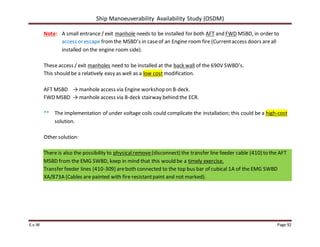
  • 67.
    Ship Manoeuverability AvailabilityStudy (OSDM) E.v.W Page 67 Power Supplies UPS / Inverters: Items Supplied from Redundant Power Supplies FZ/901QB→EDG starting battery charger. EMG SWBD XA/873A#929 NO FZ/919QB→Bridge battery charge panel. EMG SWBD XA/873 #919 NO FZ/009QB→Emergency lightinverter. EMG SWBD XA/873 #903 NO XM/001QBB→SB propulsion converter. FZ/313QF STBD AZIPOD ROOMGSP – FZ/424QF PS AZIPOD ROOMGSP YES XM/001QBA→PS propulsionconverter. FZ/313QF STBD AZIPOD ROOMGSP – FZ/424QF PS AZIPOD ROOMGSP YES GH/002CO→Hotel management system 2. FZ/004QFASUBSTATION 4 #D51 -EMG SWBD XA/873A#924 YES FZ/003QB→FWD MSBD 110VDC battery charger. FWD 690V MSBD #399 - FZ/QZ94100 #94123 FWD MSBD YES FZ/004QB→AFTMSBD 110VDC battery charger. AFT 690V MSBD #498 –FZ/QZ94200 #94220 AFT MSBD YES GH/001COA→Hotel management system1. FZ/003QFASUBSTATION 3 #C50 -EMG SWBD XA/873 #923 YES GH/001COB→Hotelmanagementsystem1. FZ/004QFASUBSTATION 4 # D50 -FZ/QZ947000 #16 EMG POWER PANELUNDER BOAT9 YES GB/001CO→PAsystem1. FZ/QFE30000 #13, ELEC LOCKER OPP. CABIN 8031 - EMG SWBD XA/873A#921 YES GB/002CO→PAsystem2. FZ/002QFASUBSTATION 2 #B50 –EMG SWBD XA/873 #922 YES NI/001CO→Bridge equipment. FZ/QFE30000 #12, ELEC LOCKER OPP. CABIN 8031 – EMG SWBD XA/873A#912 YES AS/001QFA→FWD MSBD distributionpanel. FWD 690V SWBD #391 -EMG SWBD #910 YES AS/001QFB→AFTMSBD distributionpanel. AFT 690V MSBD #490 - EMG SWBD #911 YES AS/002QBA→FWD MSBD UPS 2. AS/001QFA FWD MSBD – AS/001QFB AFT MSBD YES AS/002QBB→AFTMSBD UPS 1. AS/001QFA FWD MSBD – AS/001QFB AFT MSBD YES AS/002QBC→ECR UPS 5. AS/001QFA FWD MSBD – AS/001QFB AFT MSBD YES
  • 68.
    Ship Manoeuverability AvailabilityStudy (OSDM) E.v.W Page 68 5. Propulsion Systems (Azipod). 5.1.1. ControlSystems. 5.1.2. Hydraulic Systems. 5.1.3. Steering Control Systems. 5.1.4. Cooling Systems. 5.1.5. Lubrication Systems. General: Azipods arevital for the manoeuverability of the vessel. Note: Complete PS Azipod has been replaced on the OSDMdue to damaged windings (2006). Training of the crew regarding the Azipod control and sub systems is a must(Training intervals need to be reviewed, especially for the crew that never sailed with the Azipod system). Azipod isolation and entrance procedures need to be followed at all times, failure of doing so could endanger the safeworking situation as well as the manoeuverability of the vessel. IndividualSub groups: 5.1.1. Control Systems. 5.1.1.a→Cyclo Converter. 5.1.1.b→Azipod Information Unit(AIU). 5.1.1.c→Azipod Data Transmission System. 5.1.1.d→Excitation. 5.1.1. e→Propulsion motor monitoring system.
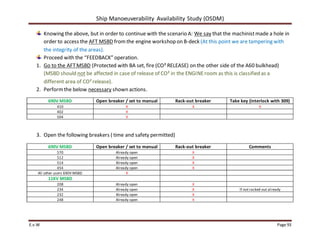
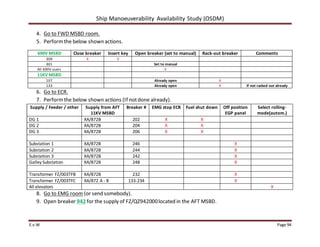
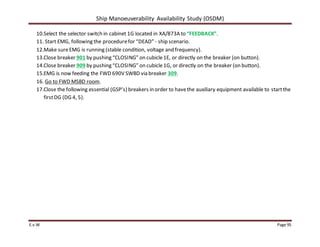
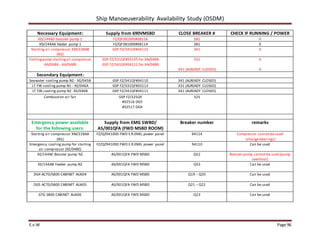
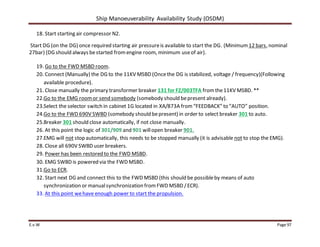
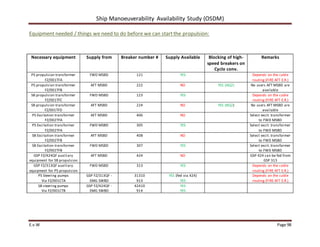
  • 69.
    Ship Manoeuverability AvailabilityStudy (OSDM) E.v.W Page 69 5.1.1. a→Cyclo Converter. 5.1.1. aa→High Speed Breakers 5.1.1. ab→Thyristor Bridges (Phaseunits). 5.1.1. ac→Cooling system. 5.1.1. ad→Excitation Bridge. 5.1.1. ae→Auxiliary Supplies (UPS) (See chapter 4). 5.1.1. af→Controland monitoring unit. 5.1.1. ag→ Propulsion transformers. 5.1.1. ah→Interlocks. 5.1.1. ai→Cyclo converter roomventilation. 5.1.1. aj→AC800 modules (Software). 5.1.1. ak→Feedback of Azipod encoder signals.  GRB units (Cyclo converter cubical R2).  Bechoff receivers (Cyclo converter cubical R2).  Fiber optical / serial data transmission (FromAzipod to Cyclo).  CMC and ZMC computers.
  • 70.
    Ship Manoeuverability AvailabilityStudy (OSDM) E.v.W Page 70 Sub Groups Trip DG Trip propulsion Lossof power Sea-mode Manoeuvre- mode Port-mode Anchor- mode Past problems Awareness/ training crew / maintenance Possible single failure Supported documents available 5.1.1.aa possible x possible medium critical No risk Medium-H Yes (4) yes yes yes 5.1.1.ab possible x possible medium critical No risk Medium-H none yes yes yes 5.1.1.ac Yes (2) yes yes yes 5.1.1.ad possible x possible medium critical No risk Medium-H Yes (2) yes yes yes 5.1.1.ae possible x possible medium critical No risk Medium-H none yes yes yes 5.1.1.af possible possible medium critical No risk Medium-H none yes yes yes 5.1.1.ag possible x possible medium critical No risk Medium-H none yes yes yes 5.1.1.ah none yes yes yes 5.1.1.ai possible possible medium critical No risk Medium-H none yes yes yes 5.1.1.aj possible x medium critical No risk Medium-H none yes yes yes 5.1.1.ak possible x possible medium critical No risk Medium-H Yes (4) yes yes yes Possiblemeans: Depends on the load reduction of the network in case of loss of propulsion load. Single failure could (will) affect the redundancy and manoeuverability of the vessel, depending on the nature of the fault. Keep in mind that in caseof failure of one (or more) of these components that this will only trip one Azipod / Cyclo converter, meaning that the vesselwill still have 50% of its manoeuvre capacity.
  • 71.
    Ship Manoeuverability AvailabilityStudy (OSDM) E.v.W Page 71 Single failures: Items Nature of the fault Redundant set-up Partial Loss of propulsion 5.1.1. aa Openingof the high speed breaker due to intermittent encoder signals yes no 5.1.1. ac Broken cooling pumponPS and SB A-side Cyclo converter yes no 5.1.1. ad Loss ofexcitationdue to fault on the PS Azipod rotor / loss of excitation on SB yes yes 5.1.1. ak Encoder failure on PS and SB Azipod yes no Note: Items descriptunder 5.1.1.ak areindeed the weakestlink of the Azipod / Cyclo converter control. Set-up is redundantbut needs to be reviewed. Keep in mind that in caseof failure of one (or more) of these components that this will only trip one Azipod / Cyclo converter, meaning that the vesselwill still have 50% of its manoeuvre capacity.
  • 72.
    Ship Manoeuverability AvailabilityStudy (OSDM) E.v.W Page 72 5.1.1. b→Azipod Information Unit(AIU). 5.1.1. ba→AC800 Modules (Software). A hard reset for more than 3 seconds on the AC800 module will erase the softwareprogram. 5.1.1. bb→Cabinet Cooling. 5.1.1. bc→LCON(Optical / Serial converter) (loss of propulsion). Note: 5.1.1. ba→Backup softwareneeds to be available on board at all times (On dedicated laptop). Crew on board needs to be familiar with the procedure to upload the software (Upload instructions and softwareare not available on OSDM). Sub Groups Trip DG Trip propulsion Lossof power Sea-mode Manoeuvre- mode Port-mode Anchor- mode Past problems Awareness/ training crew / maintenance Possible single failure Supported documents available 5.1.1.ba possible x medium critical No risk Medium-H none yes yes yes 5.1.1.bb depends medium critical No risk Medium-H none yes yes yes 5.1.1.bc possible x possible medium critical No risk Medium-H none yes yes yes Possiblemeans: Depends on the load reduction of the network in case of loss of propulsion load. Single failure could (will) affect the redundancy and manoeuverability of the vessel. Keep in mind that in caseof failure of one (or more) of these components that this will only trip one Azipod / Cyclo converter, meaning that the vesselwill still have 50% of its manoeuvre capacity.
  • 73.
    Ship Manoeuverability AvailabilityStudy (OSDM) E.v.W Page 73 5.1.1. c→Azipod Data Transmission System. 5.1.1. ca→Auxiliary slip ring. 5.1.1. cb→CMCand ZMC There are two CMC and two ZMC computers for each Azipod. 5.1.1. cc→Profibus and Ethernet lines (independent). Sub Group Trip DG Trip propulsion Lossof power Sea-mode Manoeuvre- mode Port-mode Anchor- mode Past problems Awareness/ training crew / maintenance Possible single failure Supported documents available 5.1.1.ca possible x possible medium critical No risk Medium-H none yes yes yes 5.1.1.cb possible x possible medium critical No risk Medium-H Yes (2) yes yes yes 5.1.1.cc possible x possible medium critical No risk Medium-H none yes yes yes Possiblemeans: Depends on the load reduction of the network in case of loss of propulsion load. Single failure could (will) affect redundancy and manoeuverability of the vessel, depending on the nature of the fault. Pastfailures related to PEP modules on the PS Azipod and ZMC failure on the STBD side Azipod. Keep in mind that in caseof failure of one (or more) of these components that this will only trip one Azipod / Cyclo converter, meaning that the vesselwill still have 50% of its manoeuvre capacity.
  • 74.
    Ship Manoeuverability AvailabilityStudy (OSDM) E.v.W Page 74 5.1.1. d→Excitation. 5.1.1. da→Excitation transformers. 5.1.1 .db→IndependentSupplies. 5.1.1. dc→Automatic change-over in case of loss of power supply. 5.1.1. dd→Excitation Bridge inside Cyclo converter. 5.1.1. de→Transformer cooling / room ventilation. 5.1.1. df→Transformer safeties. Sub Groups Trip DG Trip propulsion Lossof power Sea-mode Manoeuvre- mode Port-mode Anchor- mode Past problems Awareness/ training crew / maintenance Possible single failure Supported documents available 5.1.1.da possible x possible medium critical No risk Medium-H none yes yes yes 5.1.1.db possible medium critical No risk Medium-H none yes yes yes 5.1.1.dc possible medium critical No risk Medium-H none yes yes yes 5.1.1.dd possible x possible medium critical No risk Medium-H Yes (1) yes yes yes 5.1.1.de possible medium critical No risk Medium-H none yes yes yes 5.1.1.df possible x possible medium critical No risk Medium-H none yes yes yes Possiblemeans: Depends on the load reduction of the network in case of loss of propulsion load as well as the nature of the fault. Keep in mind that in caseof failure of one (or more) of these components that this will only trip one Azipod / Cyclo converter, meaning that the vesselwill still have 50% of its manoeuvre capacity.
  • 75.
    Ship Manoeuverability AvailabilityStudy (OSDM) E.v.W Page 75 5.1.1. e→Propulsion motor monitoring system. 5.1.1. ea→RDS (Remote Diagnostic System). Working on OSDM. There have been many issues with the RDS systemin the past, the hard drivehas been replaced 8 times. 5.1.1. eb→GOP panels. 5.1.1. ec→ Bearing conditioning monitoring (DtectX1 / Swantech).
  • 76.
    Ship Manoeuverability AvailabilityStudy (OSDM) E.v.W Page 76 5.1.2. Hydraulic Systems. 5.1.2. a→Hydraulic motors (4 in total) 5.1.2. b→In case of hydraulic leakage (Faultseparation block). 5.1.2. c→Flushing pump. 5.1.2. d→Hydraulic power pack. Sub Groups Trip propulsion Lossof power Sea-mode Manoeuvre- mode Port-mode Anchor-mode Past problems Awareness/ training crew / maintenance Possible single failure Supported documents available 5.1.2.a possible possible medium critical No risk Medium-H none yes yes yes 5.1.2.b Yes (1) yes yes yes 5.1.2.c none yes yes yes 5.1.2.d possible possible medium critical No risk Medium-H none yes yes yes Possiblemeans: Depends on the nature of the fault as well as on the load reduction of the network in case of a failure. Fault separation block has been completely changed on the PS due to internal componentfailure. Keep in mind that in caseof failure of one (or more) of these components that this will only trip one Azipod / Cyclo converter, meaning that the vessel will still have50% of its manoeuvrecapacity.
  • 77.
    Ship Manoeuverability AvailabilityStudy (OSDM) E.v.W Page 77 5.1.3. Steering controlsystem. 5.1.3. a→Steering pumps. 5.1.3. b→Steering motors. 5.1.3. c→Steering motor starters. 5.1.3. d→Steering gear control panels (Local / ECR / Bridge). 5.1.3. e→ Power supplies. 5.1.3. f→Steering Locking / brakesystem 5.1.3. g→Emergency steering. 5.1.3. h→Emergency Emergency steering. 5.1.3. i→ Room ventilation. 5.1.3. j→Control and monitoring. 5.1.3. k→Faststeering mode (Only possiblein Manoeuvremode, 2 pumps). 5.1.3. l→ Steering mechanical set-up. 5.1.3. m→Slewing bearing and sealing system.
  • 78.
    Ship Manoeuverability AvailabilityStudy (OSDM) E.v.W Page 78 Sub Groups Trip DG Trip propulsion Loss of power Sea-mode Manoeuvre- mode Port-mode Anchor- mode Past problems Awareness / training crew / maintenance Possible single failure Supported documents available 5.1.3.a x medium critical No risk Medium-H none yes yes yes 5.1.3.b x medium critical No risk Medium-H Yes (2) yes yes yes 5.1.3.c x medium critical No risk Medium-H Yes (5) yes yes yes 5.1.3.d medium critical No risk Medium-H none yes yes yes 5.1.3.e possible medium critical No risk Medium-H none yes yes yes 5.1.3.f medium critical No risk Medium-H none yes yes yes 5.1.3.g medium critical No risk Medium-H none yes yes yes 5.1.3.h medium critical No risk Medium-H none yes yes yes 5.1.3.i medium critical No risk Medium-H Yes (2) yes yes yes 5.1.3.j possible medium critical No risk Medium-H none yes yes yes 5.1.3.k medium critical No risk Medium-H none yes yes yes 5.1.3.l medium critical No risk Medium-H none yes yes yes 5.1.3.m medium critical No risk Medium-H none yes yes yes Possiblemeans: depends on the nature of the fault. Pastproblems: 2 faulty steering motors and 5 steering controlsoft starters havebeen replaced. Keep in mind that in caseof failure of one (or more) of these components that this will only trip one Azipod / Cyclo converter, meaning that the vesselwill still have 50% of its manoeuvre capacity.
  • 79.
    Ship Manoeuverability AvailabilityStudy (OSDM) E.v.W Page 79 5.1.3.J→Controland Monitoring. 5.1.3. Ja→EMRI system. General: The complete EMRI control systemis build up as 2 independent systems, onefor PORTand one similar for the STBD Azipod. Each control systemis governed by one of 2 redundant PLC’s. One active and one in hot standby mode. Systemwould still function in case of PLC’s failure (NFU and hand steering modes). Systemhas an independent cable routing. Keep in mind that in caseof a failure of one (or more) of the EMRI components that this could (will) affect only 1 Azipod / Cyclo converter, meaning that the vesselwill still have 50% of its manoeuvrecapacity. The situation will be different in case of a fire in the electrical locker on deck 8, oppositecabin 8010, as most of the EMRI equipment is centrally located in that electrical locker. Redundancy and manoeuverability will be affected in such a case, keep in mind that even than you can still locally control the steering system (s). EMRI SYSTEMS Sea-mode Manoeuvre- mode Port-mode Anchor-mode Past problems Awareness / training crew / maintenance Possible single failure Supported documents available PS EMRI SYSTEM medium critical No risk Medium-H none yes yes yes SB EMRI SYSTEM medium critical No risk Medium-H none yes yes yes
  • 80.
    Ship Manoeuverability AvailabilityStudy (OSDM) E.v.W Page 80 5.1.4 Cooling systems. 5.1.4. a→Cooling air unit. 5.1.4. b→Heatexchanger. 5.1.4. c→Suction / Pressurechamber. 5.1.4. d→Roomventilation. 5.1.4. e→Fan logic / Starters / Power supplies. Sub Group Trip DG Trip propulsion Lossof power Sea-mode Manoeuvre- mode Port-mode Anchor- mode Past problems Awareness/ training crew / maintenance Possible single failure Supported documents available 5.1.4.a No risk none yes yes yes 5.1.4.b No risk none yes yes yes 5.1.4.c No risk none yes yes yes 5.1.4.d Low Low No risk Low Yes (2) yes yes yes 5.1.4.e Low Low No risk Low none yes yes yes Keep in mind that in caseof failure of one (or more) of these components that this will only trip one Azipod / Cyclo converter, meaning that the vesselwill still have 50% of its manoeuvre capacity. Note item 5.1.4.d: inadequateAzipod roomcooling when the vesselset sail fromthe yard, this has been resolved.
  • 81.
    Ship Manoeuverability AvailabilityStudy (OSDM) E.v.W Page 81 5.1.5 Lubrication Systems. 5.1.5. a→Thrustbearing. 5.1.5. b→Propeller bearing. 5.1.5. c→Seal Oil. 5.1.5. d→Drainagesystem. 5.1.5. e→Shaft seal arrangement. 5.1.5. f→Purifiner. Sub Groups Trip DG Trip propulsion Lossof power Sea-mode Manoeuvre- mode Port-mode Anchor- mode Past problems Awareness/ training crew / maintenance Possible single failure Supported documents available 5.1.5.a No risk none yes yes yes 5.1.5.b No risk none yes yes yes 5.1.5.c No risk none yes yes yes 5.1.5.d No risk none yes yes yes 5.1.5.e No risk none yes yes yes 5.1.5.f No risk Yes (2) yes yes yes Keep in mind that in caseof failure of one (or more) of these components that this will only trip one Azipod / Cyclo converter, meaning that the vessel will still have50% of its manoeuvrecapacity.
  • 82.
    Ship Manoeuverability AvailabilityStudy (OSDM) E.v.W Page 82 6. Emergency Switchboard / Emergency Generator. 6.1.1. Emergency switchboard. 6.1.2. Emergency generator. General: Emergency facilities such as emergency switchboard, its users and the emergency generator are vital for the overall vessels safeand redundantoperation. Failure of one of the components will affect the redundancy and could affect the manoeuverability of the vessel. Note: The Complete EMG has been replaced on OSDM(March 2006) IndividualSub groups: 6.1.1. Emergency switchboard. 6.1.1. a→Switchboard description / logic. 6.1.1. b→Inverter and Battery set-up. 6.1.1. c→Switchboard Safeties. 6.1.1. d→Transfer line and breakers. 6.1.1. e→ Switchboard users. 6.1.1. f→Room set-up / Ventilation. 6.1.1. g→Auxiliary transformers. 6.1.1. h→Masterpack breakers / sparebreakers.
  • 83.
    Ship Manoeuverability AvailabilityStudy (OSDM) E.v.W Page 83 Sub Groups Trip EMG Trip transfer line Preferential trip Lossof emg power Sea-mode Manoeuvre- mode Port-mode Anchor- mode Past problems Awareness/ training crew / maintenance Possible single failure Supported documents available 6.1.1.a none yes yes yes 6.1.1.b Yes (20) yes yes yes 6.1.1.c possible possible medium critical Low risk Medium-H none yes yes yes 6.1.1.d medium critical Low risk Medium-H none yes yes yes 6.1.1.e none yes yes yes 6.1.1.f none yes yes yes 6.1.1.g medium critical Low risk Medium-H none yes yes yes 6.1.1.h possible possible possible medium critical Low risk Medium-H none yes yes yes Possiblemeans: Depends on the nature of the failure. Single failure will affect the redundancy and could affect the manoeuverability of the vessel. Pastproblems were all related to internal component failures of the inverter (Fan sensors area good example).
  • 84.
    Ship Manoeuverability AvailabilityStudy (OSDM) E.v.W Page 84 6.1.2. Emergency generator. 6.1.2. a→Safeties. 6.1.2. b→Radiator fan / Cooling (Modification made, in case of damper feedback failure). 6.1.2. c→Starting batteries / UPS (See chapter 4). 6.1.2. d→Fuel set-up. 6.1.2. e→ Starting air set-up / starting air receiver. 6.1.2. f→Control cabinet. 6.1.2. g→Mechanical set-up. Sub Groups Trip EMG Trip transfer line Preferential trip Lossof emg power Sea-mode Manoeuvre- mode Port-mode Anchor- mode Past problems Awareness/ training crew / maintenance Possible single failure Supported documents available 6.1.2.a possible possible medium critical Low risk Medium-H none yes yes yes 6.1.2.b x x medium critical Low risk Medium-H Yes (1) yes yes yes 6.1.2.c none yes yes yes 6.1.2.d possible possible medium critical Low risk Medium-H none yes yes yes 6.1.2.e Yes (1) yes yes yes 6.1.2.f possible possible medium critical Low risk Medium-H none yes yes yes 6.1.2.g medium critical Low risk Medium-H none yes yes yes Possiblemeans: Depends on the nature of the failure. Medium risk (sea-mode), critical risk (Manoeuvre-mode) and medium-high risk (Anchor mode) with faulty transfer line to 690V MSBD (Running (on line) EMG feeding the EMSB users). Pastproblems: air starter motor has been replaced / EMG cooler has been replaced (Leakage).
  • 85.
    Ship Manoeuverability AvailabilityStudy (OSDM) E.v.W Page 85 Automatic starting controlselection should always be selected to “electric start” and not to “pneumatic start” during the normalsailing configuration. Recommendation: Sourcea different manufactory of an emergency generator for futurenew HAL vessels. Consider the install of a second emergency generator / switchboard for futurenew HAL vessels. 6.1.2. d→ Fuel set-up: Note: Fuel supply to EMG is done via a single feeder line with 1 quick closing valve and 1 manualvalve fromthe DO tank in the EMG room, single failure of one of these valves will cut-off the fuel supply to the EMG. There is no by-pass lineon the EMG fuel system.
  • 86.
    Ship Manoeuverability AvailabilityStudy (OSDM) E.v.W Page 86 6.1.2. a→ Safeties 6.1.2. aa→Overspeed (maxspeed setting + 15%). 6.1.2. ab→Lube-oil preheating high temp. 6.1.2. ac→Lube-oil low / very low pressure. 6.1.2. ad→Lube-oil high temperature >115°C. 6.1.2. ae→Speed governor (Major failure). 6.1.2. af→Combustion air / Exhaust gas (ambient room, temp). 6.1.2. ag→Cooling (fresh) water >100°C. 6.1.2. ah→Bearings (temperature).
  • 87.
    Ship Manoeuverability AvailabilityStudy (OSDM) E.v.W Page 87 Sub Groups Trip EMG Trip transfer line Preferential trip Lossof emg power Sea-mode Manoeuvre- mode Port-mode Anchor- mode Past problems Awareness/ training crew / maintenance Possible single failure Supported documents available 6.1.2.aa x x medium critical Low risk Medium-H none yes yes yes 6.1.2.ab x x medium critical Low risk Medium-H none yes yes yes 6.1.2.ac none yes yes yes 6.1.2.ad x x medium critical Low risk Medium-H none yes yes yes 6.1.2.ae x x medium critical Low risk Medium-H none yes yes yes 6.1.2.af possible possible medium critical Low risk Medium-H none yes yes yes 6.1.2.ag x x medium critical Low risk Medium-H none yes yes yes 6.1.2.ah possible possible medium critical Low risk Medium-H none yes yes yes Possiblemeans: Depends on the nature of the failure. Medium risk (sea-mode), critical risk (Manoeuvre-mode) and medium-high risk (Anchor mode) with faulty transfer line to 690V MSBD (Running (on line) EMG feeding the EMSB users). Recommendation: Common alarms to automation need to be reviewed; there should be no common alarms, justindividual alarms.
  • 88.
    Ship Manoeuverability AvailabilityStudy (OSDM) E.v.W Page 88 7. Case study using chapters 1-6. Scenario A: 1. Vessel is at sea, enroute to Hawaii, 2 dayssailing (away) from the Californian coast. 2. Complete loss of power and propulsion. 3. Fire in the AFTengine room. 4. Emergency DieselGenerator did notstart. 5. AFT engine room equipmentcannotbe used. 6. AFT 11KV / 690V SWBD usersand equipmentcannotbe used. Scenario B: 1. Vessel is at sea, enroute to Hawaii, 2 dayssailing (away) from the Californian coast. 2. Complete loss of power and propulsion. 3. Fire in the FWD engine room. 4. Emergency DieselGenerator did notstart. 5. FWD engine room equipmentcannotbe used. 6. FWD 11KV / 690V SWBD usersand equipmentcannotbe used.
  • 89.
    Ship Manoeuverability AvailabilityStudy (OSDM) E.v.W Page 89 Goals for scenarios A and B: 1. Restore power / propulsion and Manoeuverability of the Vessel (Vital). 2. Restore vacuumsystems /galley and kitchen equipment / AC / drinking water (evaps) /potable water / cabin power / Chiller and Freezer compressor /other passenger and crew facilities. These scenarios will indicate the redundancy / non-redundancy of the ships systems in caseof an emergency and the possiblechanges that need to be implemented in order to maintain the redundancy of the ships systems. Scenario A: 1. Vessel is at sea, enroute to Hawaii, 2 dayssailing (away) from the Californian coast. 2. Complete loss of power and propulsion. 3. Fire in the AFTengine room. 4. Emergency DieselGenerator did notstart. 5. AFT engine room equipmentcannotbe used. 6. AFT 11KV / 690V SWBD usersand equipmentcannotbe used. Below facts are based on one of the worstpossiblescenarios.
  • 90.
    Ship Manoeuverability AvailabilityStudy (OSDM) E.v.W Page 90 1. No access to the AFTengine room. 2. No access to the AFTMSBD (both entrance doorsto the AFTMSBD are located in the AFT engine room). 3. Emergency generatortransfer line wasselected to the AFT690V MSBD (410) before the fire / blackout. 4. No starting air available, air vessel only has a pressure of 8 bar (Not enough to start DG). 5. Essential equipmentto start the first DG on the FWD MSBD is available, but only via the normal690V supplies and not via the 690V emergency supplies.  Booster pump (pump overhaul).  Starting air compressor (change bearingsof the motor).  Combined set-up from AFTto FWD engine is not available due to the fire. 6. DO gravity valve FWD engine is notopening, no gravity feed to the DG. 7. DO gravity valve by-passline hasa broken handle, no gravity feed to the DG. 8. Only way to restore the power atthis point is by meansof the “ELECTRICAL FEEDBACK” procedure, pending if EMG will start. 9. Soon you will find out that this will notwork because of the following reasons: Important: The release of CO² in the affected engine room could be of vital importance, it is importantthat the decision to release CO² is made in a timely matter. It is equally importantthatthe engineerswill isolate the combined systems between AFTand FWD engine rooms as soon as possible in order to preventfurther damage (Think of combined starting air system as an example).
  • 91.
    Ship Manoeuverability AvailabilityStudy (OSDM) E.v.W Page 91 Emergency generator transfer line was selected to the AFT690V MSBD (410) beforethe fire / blackout. This means that breaker 410 in the AFT MSBD is closed, breaker 410 does not have an under voltage coil, meaning that this breaker can only be opened manually which is not possible (No access to AFT MSBD). Note: EMG transfer line 410 (AFT) and 309 (FWD) are mechanically and electrically interlocked (See SWBD description and explanation) (Sparebreaker keys arelocated in the Elec Workshop on theOSDM) (if needed). We basically need to have 410 open and 309 closed beforewe can commence the “FEEDBACK” - procedure. Breaker number Under voltage coil MN Opening shunt MX Closing coil XF Modification needed 410 AFT MSBD X possible 309 FWD MSBD X possible 909 EMG SWBD X X X No 901 EMG SWBD X X X No Conclusion: Not possible to restorepower and propulsion at this point with the abovementioned conditions. Modifications needed: Item Needed modification Nature of modification Revise plan approval Outside contractor Breaker 410 Possible solution** Install under voltage coil yes yes Breaker 309 Possible solution** Install under voltage coil yes yes AFT MSBD X Install a small manhole ** (SEE NOTE) yes yes FWD MSBD X Install a small manhole ** (SEE NOTE) yes yes
  • 92.
    Ship Manoeuverability AvailabilityStudy (OSDM) E.v.W Page 92 Note: A small entrance / exit manhole needs to be installed for both AFT and FWD MSBD, in order to access or escape fromthe MSBD’s in caseof an Engine room fire (Currentaccess doors areall installed on the engine room side). These access / exit manholes need to be installed at the back wall of the 690V SWBD’s. This should be a relatively easy as well as a low cost modification. AFT MSBD → manhole access via Engine workshop on B-deck. FWD MSBD → manhole access via B-deck stairway behind the ECR. ** The implementation of under voltage coils could complicate the installation; this could be a high-cost solution. Other solution: There is also the possibility to physicalremove(disconnect) the transfer line feeder cable (410) to the AFT MSBD from the EMG SWBD, keep in mind that this would be a timely exercise. Transfer feeder lines (410-309) areboth connected to the top bus bar of cubical 1A of the EMG SWBD XA/873A (Cables are painted with fire resistantpaint and not marked).
  • 93.
    Ship Manoeuverability AvailabilityStudy (OSDM) E.v.W Page 93 Knowing the above, but in order to continue with the scenario A: We say that the machinistmade a hole in order to access the AFT MSBD fromthe engine workshop on B-deck (At this point we are tampering with the integrity of the areas). Proceed with the “FEEDBACK” operation. 1. Go to the AFTMSBD (Protected with BA set, fire (CO² RELEASE) on the other side of the A60 bulkhead) (MSBD should not be affected in case of release of CO² in the ENGINEroom as this is classified as a different area of CO²release). 2. Performthe below necessary shown actions. 690V MSBD Open breaker / set to manual Rack-out breaker Take key (interlock with 309) 410 X X X 402 X 504 X 3. Open the following breakers ( time and safety permitted) 690V MSBD Open breaker / set to manual Rack-out breaker Comments 570 Already open X 512 Already open X 514 Already open X 454 Already open X All other users 690V MSBD X 11KV MSBD 208 Already open X 234 Already open X If not racked out already 232 Already open X 248 Already open X
  • 94.
    Ship Manoeuverability AvailabilityStudy (OSDM) E.v.W Page 94 4. Go to FWD MSBD room. 5. Performthe below shown actions. 690V MSBD Close breaker Insert key Open breaker (set to manual) Rack-out breaker Comments 309 X X 301 Set to manual All 690V users X 11KV MSBD 107 Already open X 133 Already open X If not racked out already 6. Go to ECR. 7. Performthe below shown actions (If notdone already). Supply / Feeder / other Supply from AFT 11KV MSBD Breaker # EMG stop ECR Fuel shut down Off position EGP panel Select rolling- mode(autom.) DG 1 XA/872B 202 X X DG 2 XA/872B 204 X X DG 3 XA/872B 206 X X Substation 1 XA/872B 246 X Substation 2 XA/872B 244 X Substation 3 XA/872B 242 X Galley Substation XA/872B 248 X Transformer FZ/003TFB XA/872B 232 X Transformer FZ/003TFC XA/872 A - B 133-234 X All elevators X 8. Go to EMG room (or send somebody). 9. Open breaker 942 for the supply of FZ/QZ942000located in the AFT MSBD.
  • 95.
    Ship Manoeuverability AvailabilityStudy (OSDM) E.v.W Page 95 10.Select the selector switch in cabinet 1G located in XA/873A to “FEEDBACK”. 11. Start EMG, following the procedurefor “DEAD” - ship scenario. 12.Make sureEMG is running (stable condition, voltage and frequency). 13.Close breaker 901 by pushing “CLOSING” on cubicle1E, or directly on the breaker (on button). 14.Close breaker 909 by pushing “CLOSING” on cubicle1G, or directly on the breaker (on button). 15.EMG is now feeding the FWD 690V SWBD via breaker 309. 16. Go to FWD MSBD room. 17.Close the following essential (GSP’s) breakers in order to havethe auxiliary equipment available to startthe firstDG (DG 4, 5).
  • 96.
    Ship Manoeuverability AvailabilityStudy (OSDM) E.v.W Page 96 Necessary Equipment: Supply from 690VMSBD CLOSE BREAKER # CHECK IF RUNNING / POWER XD/144AD booster pump 1 FZ/QF381000#38116 381 X XD/144AA feeder pump 1 FZ/QF381000#38114 381 X Starting air compressor XM/228AB (N2) GSP FZ/341QF#34123 341 X Coolingpump startingair compressor XA/048A - XA/048B GSP FZ/331QF#33135 for XA/048A GSP FZ/341QF#34112 for XA/048B 331 341 (ALREADY CLOSED) X X Secondary Equipment: Seawater cooling pump N2 - XE/045B GSP FZ/341QF#34110 341 (ALREADY CLOSED) LT FW cooling pump N1 - XE/046A GSP FZ/331QF#33113 331 (ALREADY CLOSED) LT FW cooling pump N2 -XE/046B GSP FZ/341QF#34111 341 (ALREADY CLOSED) Combustion air fan GSP FZ/325QF #32516 DG5 #32517 DG4 325 Emergency power available for the following users: Supply from EMG SWBD/ AS/001QFA (FWD MSBD ROOM) Breaker number remarks Starting air compressor XM/228AA (N1) FZ/QZ941000 FWD E.R.EMG power panel 94114 Compressor cannot be used (change bearings) Emergency cooling pump for starting air compressor (XE/048E) FZ/QZ941000 FWD E.R.EMG power panel 94110 Can be used XE/144AE Booster pump N2 AS/001QFA FWD MSBD Q52 Booster pump cannot be used (pump overhaul) XE/144AB Feeder pump N2 AS/001QFA FWD MSBD Q53 Can be used DG4 AC70/S800 CABINET AU604 AS/001QFA FWD MSBD Q19 – Q20 Can be used DG5 AC70/S800 CABINET AU605 AS/001QFA FWD MSBD Q21 – Q22 Can be used GTG S800 CABINET AU606 AS/001QFA FWD MSBD Q23 Can be used
  • 97.
    Ship Manoeuverability AvailabilityStudy (OSDM) E.v.W Page 97 18. Start starting air compressor N2. Start DG (on the DG) once required starting air pressureis available to start the DG. (Minimum 12 bars, nominal 27bar) (DG should always bestarted fromengine room, minimum useof air). 19. Go to the FWD MSBD room. 20. Connect (Manually) the DG to the 11KV MSBD (Oncethe DG is stabilized, voltage / frequency)(Following available procedure). 21. Close manually the primary transformer breaker 131 for FZ/003TFA fromthe11KV MSBD. ** 22.Go to the EMG roomor send somebody (somebody should bepresent already). 23.Select the selector switch in cabinet 1G located in XA/873A from“FEEDBACK” to “AUTO” position. 24.Go to the FWD 690V SWBD (somebody should bepresent) in order to select breaker 301 to auto. 25.Breaker 301 should close automatically, if not close manually. 26. At this point the logic of 301/909 and 901 willopen breaker 901. 27.EMG will not stop automatically, this needs to be stopped manually (it is advisable not to stop the EMG). 28. Close all 690V SWBD user breakers. 29. Power has been restored to the FWD MSBD. 30. EMG SWBD is powered via the FWD MSBD. 31.Go to ECR. 32. Start next DG and connect this to the FWD MSBD (this should be possibleby means of auto synchronization or manualsynchronization fromFWD MSBD /ECR). 33. At this point wehave enough power to start the propulsion.
  • 98.
    Ship Manoeuverability AvailabilityStudy (OSDM) E.v.W Page 98 Equipment needed / things we need to do before we can startthe propulsion: Necessary equipment Supply from Breaker number # Supply Available Blocking of high- speed breakers on Cyclo conv. Remarks PS propulsion transformer FZ/001TFA FWD MSBD 121 YES Depends on the cable routing (FIRE AFT E.R.) PS propulsion transformer FZ/001TFB AFT MSBD 222 NO YES (AQ2) No users AFT MSBD are available SB propulsion transformer FZ/001TFC FWD MSBD 123 YES Depends on the cable routing (FIRE AFT E.R.) SB propulsion transformer FZ/001TFD AFT MSBD 224 NO YES (BQ2) No users AFT MSBD are available PS Excitation transformer FZ/002TFA AFT MSBD 406 NO Select excit. transformer to FWD MSBD PS Excitation transformer FZ/002TFA FWD MSBD 305 YES Select excit. transformer to FWD MSBD SB Excitation transformer FZ/002TFB AFT MSBD 408 NO Select excit. transformer to FWD MSBD SB Excitation transformer FZ/002TFB FWD MSBD 307 YES Select excit. transformer to FWD MSBD GSP FZ/424QF auxiliary equipment for SB propulsion AFT MSBD 424 NO GSP 424 can be fed from GSP 313 GSP FZ/313QF auxiliary equipment for PS propulsion FWD MSBD 313 YES Depends on the cable routing (FIRE AFT E.R.) PS Steering pumps Via FZ/001CTA GSP FZ/313QF - EMG SWBD 31310 913 YES (fed via 424) YES Depends on the cable routing (FIRE AFT E.R.) SB steering pumps Via FZ/001CTB GSP FZ/424QF - EMG SWBD 42410 914 YES YES
  • 99.
    Ship Manoeuverability AvailabilityStudy (OSDM) E.v.W Page 99 Equipment needed / things we need to do before we can startthe propulsion: 1. See above shown table. 2. Go to both Cyclo converter rooms. 3. Open the permission switches on the high-speed breakers as indicated in the table. 4. Supply GSP FZ/424QF (SB) fromGSP FZ/313QF (PS) (INTERLOCK VIA PADLOCK). 5. Padlock key located on breaker 42401 on GSP FZ/424QF. 6. Open breaker 42401 on GSP FZ/424QF (SBCyclo-converter room). 7. Remove padlock and close breaker 42402 on GSP FZ/424QF (SBCyclo-converter room). 8. Remove padlock and close breaker 31302 on GSP FZ/313QF (PS Cyclo-converter room). 9. Clear alarms on Cyclo-converter GOP screens. 10.Go to B-deck transformer room. 11. Select both excitation transformers supply to the FWD MSBD by means of switching the selector switch on the transformer (1 excitation transformer is already selected to the FWD MSBD). 12.Go to the ECR. 13. Clear alarms on the ECR GOP screens. 14.The “PM READY START”light starts flashing (on GOP). 15. Start the propulsion. 16.Transfer propulsion controlto the bridge, once stable and running. You will only have half a winding available on each Azipod.
  • 100.
    Ship Manoeuverability AvailabilityStudy (OSDM) E.v.W Page 100 17.The below shown bow thrusters areavailable if needed. Bow thruster number Supply from breaker # Available BT1 YA/764A 161 YES BT2 YA/764B 262 NO BT3 YA/764C 163 YES At this point the ships manoeuverability has been restored (Depending on the routing of the cables!!!). Suggested (needed) modifications / changes. Items Suggested modification Nature of modification Revise plan approval Outside contractor Starting air compressors Yes (low-cost) Normal and EMG supply X X (ships crew) Cable runs yes Re-routing / reviewing of vital supply cables from switchboard. X X Electricians / engineers need to be trained for emergency scenarios becauseit could happen 1 day. 2nd /3rd electricians should all be BA trained, although they may not be assigned to a fire team.
  • 101.
    Ship Manoeuverability AvailabilityStudy (OSDM) E.v.W Page 101 IMPORTANT FACTS FOR SCENARIO“A”: At this point the ships manoeuverability has been restored (Depending on the routing of the cables!!!). But: Both HFOtransfer pumpsare located in the AFT PS purifier room; these pumpswill not be available due to fire in the AFT engine room. Running DG’sin the FWD engine room have therefore a limited HFO supply in service and settling tanks. Approximate 1 or 2 daysdepending on the engine configurationsand load. System could be changed over to M.G.O. after the HFO FWD tanksare emptied, M.G.O. tanksare located fwd of the fwd engine room on the OSDM M.G.O. service tank hasa limited capacity of 37.4m3 (high level at 30m3), butthere is a way to combine the GTG M.G.O. service tank by meansof communicating vessels which will increase the total amountof M.G.O. availability as descripton page 23 Knowing thatone 16 cylinder DG is using 48m3 per day and thatone 12 cylinder DG is using 36m3 per day it is safe to assumethat vessel will have the capability to sail with this configuration pending if the M.G.O transfer pump located in the FWD STBD purifier room is available. Note: One M.G.O. transfer pump is located in the AFTPS purifier room (Notavailable due to fire). One M.G.O. transfer pump islocated in the FWD STBD purifier room (Should be available).
  • 102.
    Ship Manoeuverability AvailabilityStudy (OSDM) E.v.W Page 102 Recommendation: HFO transfer pumps need to be relocated; set-up should have one HFO transfer pump in AFT and one in the FWD engine rooms!!! M.G.O. set up needs to be reviewed and recommended modifications should be implemented in order to reduce the risk of losing the M.G.O. systemas well.
  • 103.
    Ship Manoeuverability AvailabilityStudy (OSDM) E.v.W Page 103 Scenario A, Part 2: 2. Restore vacuumsystems / galley and kitchen equipment / AC / drinking water (evaps) /potable water / cabin power / Chiller and Freezer compressor /other passenger and crew facilities. Power is available for the below shown equipment (Depending on the routing of the cables!!!). Items Supplied from Breaker # Priority Available Comments Vacuum collecting system N1 GSP FZ/945QZ Potable water room 94516 HIGH yes Vacuum collecting system N2 GSP FZ/945QZ Potable water room 94517 HIGH yes Vacuum collecting system N3 GSP FZ/945QZ Potable water room 94518 HIGH yes Vacuum collecting system N4 FZ/QZ942000 AFT MSBD 94214 HIGH NO No equipment / users available from AFT MSBD Vacuum collecting system N5 FZ/QZ942000 AFT MSBD 94215 HIGH NO No equipment / users available from AFT MSBD  Vacuumsystems 1, 2 and 3 are available (FWD zones of the vessel).  Power for systems 4 and 5 is available, but power panel FZ/QZ942000 is located in the AFT MSBD room (This panel has already been isolated (step 9) fromthe EMSB via breaker 942).  There is a way to combine these vacuumsystems, butwe can safely assumethat this is not possibledue to the fire in the AFT E.R. (Piping is routed via AFTE.R.). Note 1: No technical water (See page 106) means no flushing of the toilets, systemwill work butyou will have a lot of flushing and vacuumproblems. Note 2: Sewagewill directly be pumped over board (Emergency scenario).
  • 104.
    Ship Manoeuverability AvailabilityStudy (OSDM) E.v.W Page 104 Items Supplied from Breaker # Priority Available Comments Fresh water generator XA/107A FWD 690V SWBD 365 MEDIUM HIGH YES Fresh water generator XA/107B AFT 690V SWBD 466 MEDIUM HIGH NO No equipment / users available from AFT MSBD Fresh water generator XA/107C FWD 690V SWBD 367 MEDIUM HIGH YES Items Supplied from Breaker # Priority Available Comments Cold potable water pump EP1 / YE440A GSP FZ/945QZ 94510 MEDIUM HIGH YES Cold potable water pump EP2 / YE440B GSP FZ/945QZ 94511 MEDUIM HIGH YES Cold potable water pump EP3 / YE440C GSP FZ/327QF 32726 MEDIUM HIGH YES Potable water transfer pump EP1 / YE/442A GSP FZ/327QF 32711 LOW YES Potable water transfer pump EP2 / YE/442B GSP FZ/327QF 32712 LOW YES Galley hot water circ.pump 1 / YE/445A GSP FZ/945QZ 94514 MEDIUM YES Galley hot water circ.pump 2 / YE/445B GSP FZ/327QF 32714 MEDIUM YES Accommodation hot water pump EP1 - YE/444A GSP FZ/945QZ 94513 MEDIUM YES Accommodation hot water pump EP2 - YE/444B GSP FZ/327QF 32713 MEDIUM YES  Conclusion: water is available.
  • 105.
    Ship Manoeuverability AvailabilityStudy (OSDM) E.v.W Page 105 Itis important that we have the availability of the grey water pumps in the FWD engine room as per below: Items Supplied from Breaker # Priority Available Comments Grey water tank MS01P GREY WATER PUMP 3 YE/514 E GREY WATER PUMP 4 YE/514 F GSP FZ/333QF GSP FZ/333QF FWD VACUUMCOL.ROOM 33314 33315 MEDIUM MEDIUM YES YES Grey water tank MS04C GREY WATER PUMP 5 YE/514 G GREY WATER PUMP 6 YE/514 H GSP FZ/333QF GSP FZ/333QF FWD VACUUMCOL.ROOM 33316 33317 MEDIUM MEDIUM YES YES Grey water tank MS06P GREY WATER PUMP 8 YE/514 L GREY WATER PUMP 9 YE/514 M GSP FZ/428QF AC ROOM GSP FZ/327QF POT.W.RM 42814 32717 MEDIUM MEDIUM NO YES SUPPLIED FROMAFTMSBD Grey water tank MS06C GREY WATER PUMP 14 YE/514 R GREY WATER PUMP 10 YE/514 T GSP FZ/428QF AC ROOM GSP FZ/331QF FWD MSBD 42815 33125 MEDIUM MEDIUM NO YES SUPPLIED FROMAFTMSBD  Conclusion: Grey water pumps are available. But: Grey water pumps are not available in all zones, meaning that shower facilities etc in zones without the grey water pumps areonly available for a limited time (Until tanks are full).
  • 106.
    Ship Manoeuverability AvailabilityStudy (OSDM) E.v.W Page 106 Items Supplied from Breaker # Priority Available Comments Laundry Substation feeder FZ/008TFA FWD 690V MSBD 315 LOW YES Laundry Substation feeder FZ/008TFB AFT 690V MSBD 416 LOW NO No equipment / users available from AFT MSBD Laundry grey water pump 1 YE/514C GSP FZ/333QF 33312 LOW YES Laundry grey water pump 2 YE/514D GSP FZ/333QF 33313 LOW YES Laundry hot technical water circ.pump YE/446 GSP FZ/333QF 33311 LOW YES Technical water distribution pump 1 YE/441A GSP FZ/436QF 43610 LOW NO No equipment / users available from AFT MSBD Technical water distribution pump 2 YE/441B GSP FZ/436QF 43611 LOW NO No equipment / users available from AFT MSBD Conclusion: Laundry is not available (Normally no technical water means no washing) (See notes). Note 1: Potable water-technical water transfer line connection is available on OSDM, meaning that you could use this connection to utilize the laundry facilities by using potable water instead of technical water. Note 2: Potable water is used to utilize the laundry facilities on the OSDMfor somereason.
  • 107.
    Ship Manoeuverability AvailabilityStudy (OSDM) E.v.W Page 107 Items Supplied from Breaker # Priority Available Comments Accommodations Substation fire zone 1 AFT MSBD 11KV 246 HIGH NO No equipment / users available from AFT MSBD Accommodations Substation fire zone 2 AFT MSBD 11KV 244 HIGH NO No equipment / users available from AFT MSBD Accommodations Substation fire zone 3 AFT MSBD 11KV 242 HIGH NO No equipment / users available from AFT MSBD Accommodations Substation fire zone 4 FWD MSBD 11KV 145 HIGH YES Back-up not available Accommodations Substation fire zone 5 FWD MSBD 11KV 143 HIGH YES Back-up not available Accommodations Substation fire zone 6 FWD MSBD 11KV 141 HIGH YES Back-up not available AC compressor 1 / YB/685A FWD MSBD 11KV 151 HIGH YES AC compressor 2 / YB/685B AFT MSBD 11KV 252 HIGH NO No equipment / users available from AFT MSBD AC compressor 3 / YB/685C FWD MSBD 11KV 153 HIGH YES AC compressor 4 / YB/685D AFT MSBD 11KV 254 HIGH NO No equipment / users available from AFT MSBD AC Hot water pump 1 YA/683A GSP FZ/329QF AC ROOM 32914 HIGH YES AC Hot water pump 2 YA/683B GSP FZ/428QF AC ROOM 42817 HIGH NO No equipment / users available from AFT MSBD AC Chilled water pump 1 YA/682A GSP FZ/329QF AC ROOM 32912 HIGH YES AC Chilled water pump 2 YA/682B GSP FZ/428QF AC ROOM 42816 HIGH NO No equipment / users available from AFT MSBD AC Chilled water pump 3 YA/682C GSP FZ/329QF AC ROOM 32913 HIGH YES  Conclusion: AC is available / Accommodation Substations 4, 5 and 6 are available.
  • 108.
    Ship Manoeuverability AvailabilityStudy (OSDM) E.v.W Page 108 Items Supplied from Breaker # Priority Available Comments PS Stabilizer YA/770A FZ/QZ941000 EMG SWBD FWD 690V SWBD 94118 373 LOW YES YES SB Stabilizer YA/770B FZ/QZ941000 EMG SWBD AFT 690V SWBD 94119 472 LOW YES NO No equipment / users available from AFT MSBD  Conclusion: Stabilizers are available. Items Supplied from Breaker # Priority Available Comments AFT Mooring winch substation FZ/010QF FWD 690 MSBD 321 LOW YES Depending on the cable routing AFT Mooring winch substation FZ/010QF AFT 690V MSBD 420 LOW NO No equipment / users available from AFT MSBD FWD Mooring winch substation FZ/011QF FWD 690 MSBD 319 LOW YES FWD Mooring winch substation FZ/011QF AFT 690V MSBD 418 LOW NO No equipment / users available from AFT MSBD Note: Breakers 42001 (1A) and 42002 (1B) need to be swapped in order to supply the AFTmooring winches (Breakers arelocated in the AFT mooring winch substation).  Conclusion: AFT and FWD mooring winch substations areavailable.
  • 109.
    Ship Manoeuverability AvailabilityStudy (OSDM) E.v.W Page 109 Items Supplied from Breaker # Priority Available Comments Provision store SWBD XM/695A AFT 690V MSBD 422 HIGH NO No equipment / users available from AFT MSBD Freezer compressor XE/695A XM/695A HIGH NO Chiller compressor XE/695D XM/695A HIGH NO Provision store SWBD XM/695B FWD 690 MSBD 323 HIGH YES Depending on the cable routing Freezer compressor XE/695B XM/695B HIGH YES Chiller compressor XE/695C XM/695B HIGH YES Freezer circulation pump N1 XS/695AA XM/695A HIGH NO No equipment / users available from AFT MSBD Freezer circulation pump N2 XS/695CA XM/695B HIGH YES Chiller circulation pump N1 XS/695DA XM/695A HIGH NO No equipment / users available from AFT MSBD Chiller circulation pump N2 XS/695BA XM/695B HIGH YES  Conclusion: Only 1 Freezer / Chiller compressor available.
  • 110.
    Ship Manoeuverability AvailabilityStudy (OSDM) E.v.W Page 110 Items Supplied from Breaker # Priority Available Comments FWD BOILER XM/004A FWD 690V MSBD 363 HIGH YES Economizer pump XE/094A DG4 FWD 690V MSBD FZ/331QF # 33116 MEDIUM HIGH YES Important for a dirty boiler Economizer pump XE/094D DG5 FWD 690V MSBD FZ/341QF # 34115 MEDIUM HIGH YES Important for a dirty boiler Technical water distribution pump N1 YE/441A AFT 690V MSBD FZ/436QF # 43610 HIGH NO No equipment / users available from AFT MSBD Technical water distribution pump N2 XE/441B AFT 690V MSBD FZ/436 # 43611 HIGH NO No equipment / users available from AFT MSBD Distilled water distribution pump N1 XA/103A FWD 690V MSBD FZ/QF385000 # 38520 SUPPLYING MODULE XM/104 LOCATED IN B- DECK EVAP ROOM HIGH YES DISTILLED UNIT IS LOCATED IN FRONT OF DG5 Distilled water distribution pump N2 XA/103B FWD 690V MSBD FZ/QF385000 # 38520 SUPPLYING MODULE XM/104 LOCATED IN B- DECK EVAP ROOM HIGH YES DISTILLED UNIT IS LOCATED IN FRONT OF DG5 INCINERATOR N1 XM/568A FLUE GAS FAN FWD 690V MSBD VIA FZ/QF389000 FZ/QZ941000 389 94121 MEDIUM-LOW MEDIUM LOW YES YES Depending on the cable routing Incinerator MGO transfer pump N1 XA/148A CENTRAL INCINERATOR PANEL XM/568A 24 Q1 MEDIUM-LOW YES LOCATED IN SB FWD PURIFIER ROOM Incinerator MGO transfer pump N2 XA/148B CENTRAL INCINERATOR PANEL XM/568B 24 Q1 MEDIUM-LOW NO LOCATED IN SB FWD PURIFIER ROOM BUT FED FROM FZ/QF488000 FED FROM AFT MSBD  Conclusion: Only 1 Boiler / Incinerator available.
  • 111.
    Ship Manoeuverability AvailabilityStudy (OSDM) E.v.W Page 111 Items Supplied from Priority Available Comments All Elevators EMG SWBD MEDIUM YES  Conclusion: Elevators are available (No elevators should be used in case of a fire).
  • 112.
    Ship Manoeuverability AvailabilityStudy (OSDM) E.v.W Page 112 Power not available for the below shown equipment: Items Supplied from Breaker # Priority Available Comments Accommodations Substation fire zone 1 AFT 11KV MSBD 246 HIGH NO No equipment / users available from AFT MSBD Accommodations Substation fire zone 2 AFT 11KV MSBD 244 HIGH NO No equipment / users available from AFT MSBD Accommodations Substation fire zone 3 AFT 11KV MSBD 242 HIGH NO No equipment / users available from AFT MSBD Galley transformer FZ/004TFG AFT 11KV MSBD 248 HIGH NO No equipment / users available from AFT MSBD Conclusion:  No power available for fire zones 1, 2 and 3.  Emergency lights available in public areas, but not in the passenger and crew cabins (Small EMG light at the entrance of the cabin only).  Cooking facilities not available. Items Supplied from Breaker # Priority Available Comments 690V BACK-UP MSBD GALLEY BACK-UP BACK-UP FOR Accommodation sub stations 1-2-3 BACK-UP FOR Accommodation sub stations 4-5-6 FZ/003TFC 690V BACK-UP MSBD 690V BACK-UP MSBD 690V BACK-UP MSBD 504 570 514 512 HIGH HIGH HIGH LOW NO NO NO NO No equipment / users available from AFT MSBD
  • 113.
    Ship Manoeuverability AvailabilityStudy (OSDM) E.v.W Page 113 Suggested (needed) modifications / changes. 1. Review the set-up of the cabin emergency lights. 2. 690V Back-up (spare) SWBD should bephysically divided fromthe AFTMSBD. 3. Review the set-up of the galley transformer /galley back-up transformer. 4. Review the set-up for the back-up supplies for all substations. Items Suggested modification Nature of modification Revise plan approval Outside contractor Cabin EMG lights Yes (high-cost) Add emg lights (note 1) yes yes 690V back-up Yes (high-cost) Remove from AFT MSBD yes yes Galley supplies Yes (high-cost) Different set-up (note 2) yes yes Note 1: Passenger / crew cabins have a small emergency light (battery operated) that will work for a couple of hours only. Note 2: What if there is a fire in substation 1 → you will lose your galley transformer as well as your galley back-up transformer (they physically need to be separated from the room). Abovefindings should be used to improvethe systems (availability) for possiblefuturenew builds. Modifying the existing installation on the OSDM would generate a very high cost.
  • 114.
    Ship Manoeuverability AvailabilityStudy (OSDM) E.v.W Page 114 Scenario B: 1. Vessel is at sea, enroute to Hawaii, 2 dayssailing (away) from the Californian coast. 2. Complete loss of power and propulsion. 3. Fire in the FWD engine room. 4. Emergency DieselGenerator did notstart. 5. FWD engine room equipmentcannotbe used. 6. FWD 11KV / 690V SWBD usersand equipmentcannotbe used. Below facts are based on one of the worstpossiblescenarios.
  • 115.
    Ship Manoeuverability AvailabilityStudy (OSDM) E.v.W Page 115 1.No access to the FWD engine room. 2.No access to the FWD MSBD (both entrance doorsto the FWD MSBD are located in the FWD engine room). 3.Emergency generatortransfer line wasselected to the FWD 690V MSBD (309) before the fire / blackout. 4.No starting air available, air vessel only has a pressure of 8 bar (Notenough to start DG). 5.Essential equipmentto start the first DG on the AFT MSBD is available, but only via the normal690V supplies and not via the 690V emergency supplies.  Booster pump (pump overhaul).  Starting air compressor (change bearingsof the motor).  Combined set-up from AFTto FWD engine is not available due to the fire. 6. DO gravity valve AFT engine is notopening, no gravity feed to the DG. 7. DO gravity valve by-passline has a broken handle, no gravity feed to the DG. 8.Only way to restore the power at this point is by meansof the “ELECTRICAL FEEDBACK” procedure, pendingif EMG will start. 9.Soon you willfind out that this will not work because of the following reasons: Important: The release of CO² in the affected engine room could be of vital importance, it is important that the decision to release CO² is made in a timely matter. It is equally importantthatthe engineerswill isolate the combined systems between AFTand FWD engine rooms as soon as possible in order to preventfurther damage (Think of combined starting air system as an example).
  • 116.
    Ship Manoeuverability AvailabilityStudy (OSDM) E.v.W Page 116 Emergency generator transfer line was selected to the FWD 690V MSBD (309) beforethe fire/ blackout. This means that breaker 309 in the FWD MSBD is closed, breaker 309 does not have an under voltage coil, meaning that this breaker can only be opened manually which is not possible (No access to FWD MSBD). Note: EMG transfer line 410 (AFT) and 309 (FWD) aremechanically and electrically interlocked (See SWBD description and explanation) (Sparebreaker keys arelocated in the Elec Workshop on theOSDM) (if needed). We basically need to have 309 open and 410 closed beforewe can commence the “FEEDBACK”-procedure. Breaker number Under voltage coil MN Opening shunt MX Closing coil XF Modification needed 410 AFT MSBD X possible 309 FWD MSBD X possible 909 EMG SWBD X X X No 901 EMG SWBD X X X No Conclusion: Not possible to restorepower and propulsion at this point with the abovementioned conditions. Modifications needed: Item Needed modification Nature of modification Revise plan approval Outside contractor Breaker 410 Possible solution** Install under voltage coil yes yes Breaker 309 Possible solution** Install under voltage coil yes yes AFT MSBD X Install a small manhole ** (SEE NOTE) yes yes FWD MSBD X Install a small manhole ** (SEE NOTE) yes yes
  • 117.
    Ship Manoeuverability AvailabilityStudy (OSDM) E.v.W Page 117 Note: A small entrance / exit manhole needs to be installed for both AFT and FWD MSBD, in order to access or escape fromthe MSBD’s in caseof an Engine room fire (Currentaccess doors areall installed on the engine room side). These access / exit manholes need to be installed at the back wall of the 690V SWBD’s. This should be a relatively easy as well as a low cost modification. AFT MSBD → manhole access via Engine workshop on B-deck. FWD MSBD → manhole access via B-deck stairway behind the ECR. ** The implementation of under voltage coils could complicate the installation; this could be a high-cost solution. Other solution: There is also the possibility to physicalremove(disconnect) the transfer line feeder cable (309) to the FWD MSBD from the EMG SWBD, keep in mind that this would be a timely exercise. Transfer feeder lines (410-309) areboth connected to the top bus bar of cubical 1A of the EMG SWBD XA/873A (Cables are painted with fire resistantpaint and not marked).
  • 118.
    Ship Manoeuverability AvailabilityStudy (OSDM) E.v.W Page 118 Knowing the above but in order to continue with the scenario B: We say that the machinist made a hole in order to access the FWD MSBD fromB-deck stairway behind the ECR (At this point we are tampering with the integrity of the areas). Proceed with the “FEEDBACK” operation. 1. Go to the FWD MSBD (Protected with BA set, fire (CO²RELEASE) on the other side of the A60 bulkhead) (MSBD should not be affected in case of release of CO² in the ENGINEroom as this is classified as a different area of CO²release). 2. Performthe below necessary shown actions. 690V MSBD Open breaker / set to manual Rack-out breaker Take key (interlock with 410) 309 X X X 301 X 3. Open the following breakers ( time and safety permitted) 690V MSBD Open breaker / (set to manual) Rack-out breaker Comments 353 Already open X All other users 690V MSBD X 11KV MSBD 107 Already open X 133 Already open X (If not racked out already) X 131 Already open X
  • 119.
    Ship Manoeuverability AvailabilityStudy (OSDM) E.v.W Page 119 4. Go to AFT MSBD room. 5. Performthe below shown actions. 690V MSBD Close breaker Insert key Open breaker (set to manual) Rack-out breaker Comments 410 X X 402 Set to manual All 690V users X 11KV MSBD 208 Already open X 234 Already open X (If not racked out already) 6. Go to ECR. 7. Performthe below shown actions (If notdone already). Supply / Feeder / other Supply from FWD 11KV MSBD Breaker # EMG stop ECR Fuel shut down Off position EGP Select rolling- mode DG 4 XA/872A 101 X X DG 5 XA/872A 103 X X GTG XA/872A 105 X Not available Substation 4 XA/872A 145 X Substation 5 XA/872A 143 X Substation 6 XA/872A 141 X Transformer FZ/003TFA XA/872A 131 X Transformer FZ/003TFC XA/872 A - B 133-234 X All elevators X
  • 120.
    Ship Manoeuverability AvailabilityStudy (OSDM) E.v.W Page 120 8. Go to EMG room (or send somebody). 9. Open breaker 941 for the supply of FZ/QZ941000located in the FWD MSBD. 10.Select the selector switch in cabinet 1G located in XA/873A to “FEEDBACK”. 11. Start EMG, following the procedurefor “DEAD” - ship scenario. ** 12.Make sureEMG is running (stable condition, voltage and frequency). 13.Close breaker 901 by pushing “CLOSING” on cubicle1E, or directly on the breaker (on button). 14.Close breaker 909 by pushing “CLOSING” on cubicle1G, or directly on the breaker (on button). 15.EMG is now feeding the AFT 690V SWBD via breaker 410. 16. Go to AFT MSBD room. 17.Close the following essential (GSP’s) breakers in order to havethe auxiliary equipment available to startthe firstDG (DG 1, 2 or 3).
  • 121.
    Ship Manoeuverability AvailabilityStudy (OSDM) E.v.W Page 121 Necessary Equipment Supply from 690VMSBD CLOSE BREAKER # CHECK IF RUNNING / POWER XD/144BD booster pump 3 FZ/QF480000#48016 480 X XD/144BA feeder pump 3 FZ/QF480000#48014 480 X Starting air compressor XM/228B-1 (N3) FZ/QF482000#48213 482 X Cooling pump starting air compressor XA/048C - XA/048D GSP FZ/432QF#43212 for XA/048C GSP FZ/442QF#44212 for XA/048D 432 442 X X Secondary Equipment Seawater cooling pump N3 - XE/045C GSP FZ/432QF#43210 432 (ALREADY CLOSED) LT FW cooling pump N3 - XE/046C GSP FZ/432QF#43211 432 (ALREADY CLOSED) LT FW cooling pump N4 - XE/046D GSP FZ/442QF#44211 442 (ALREADY CLOSED) Combustion air fan GSP FZ/426QF #42617 DG1 #42616 DG2 #42618 DG3 426 Emergency power available for the following users: Supply from EMG SWBD / AS/001QFB (AFT MSBD ROOM) Breaker number remarks Starting air compressor XM/228CA (N4) FZ/QZ942000 AFT E.R. EMG power panel 94223 Compressor cannot be used (change bearings) Emergency cooling pump for starting air compressor XA/048F FZ/QZ942000 AFT E.R. EMG power panel 94229 Can be used XD/144AE Booster pump N4 AS/001QFB AFT MSBD Q53 Booster pump cannot be used (pump overhaul) XD/144AB Feeder pump N4 AS/001QFB AFT MSBD Q52 Can be used DG1 AC70/S800 CABINET AU601 AS/001QFB AFT MSBD Q13 – Q14 Can be used DG2 AC70/S800 CABINET AU602 AS/001QFB AFT MSBD Q15 – Q16 Can be used DG3 AC70/S800 CABINET AU603 AS/001QFB AFT MSBD Q17 – Q18 Can be used
  • 122.
    Ship Manoeuverability AvailabilityStudy (OSDM) E.v.W Page 122 18.Start starting air compressor N3. 19. Start DG (on the DG) once required starting air pressureis available to start the DG (minimum 12 bar, nominal 27bar) (DG should always bestarted fromengine room, minimum useof air). 20. Go to the AFT MSBD room. 21. Connect (Manually) the DG to the 11KV MSBD (Oncethe DG is stabilized, voltage / frequency)(Following available procedure). 22. Close manually the primary transformer breaker 232 for FZ/003TFB fromthe11KV MSBD. 23.Go to the EMG roomor send somebody (somebody should bepresent already). 24.Select the selector switch in cabinet 1G located in XA/873A from“FEEDBACK” to “AUTO” position. 25.Go to the AFT690V SWBD (somebody should bepresent) in order to select breaker 402 to “AUTO”. 26.Breaker 402 should close automatically, if not close manually. 27. At this point the logic of 402/909 and 901 willopen breaker 901. 28.EMG will not stop automatically, this needs to be stopped manually (it is advisableto not stop the EMG). 29. Close all 690V SWBD user breakers. 30. Power has been restored to the AFT MSBD. 31. EMG SWBD is powered via the AFT MSBD. 32.Go to ECR. 33. Start next DG and connect this to the AFTMSBD (This should be possibleby means of auto synchronization or manual synchronization fromAFTMSBD / ECR). 34. At this point wehave enough power to start the propulsion.
  • 123.
    Ship Manoeuverability AvailabilityStudy (OSDM) E.v.W Page 123 Equipment needed / things we need to do before we can startthe propulsion: Necessary equipment Supply from Breaker number # Supply Available Blocking of high- speed breakers on Cyclo conv. Remarks PS propulsion transformer FZ/001TFA FWD MSBD 121 NO YES (AQ1) No users FWD MSBD are available PS propulsion transformer FZ/001TFB AFT MSBD 222 YES SB propulsion transformer FZ/001TFC FWD MSBD 123 NO YES (BQ1) No users FWD MSBD are available SB propulsion transformer FZ/001TFD AFT MSBD 224 YES PS Excitation transformer FZ/002TFA AFT MSBD 406 YES Select excit. transformer to AFT MSBD PS Excitation transformer FZ/002TFA FWD MSBD 305 NO Select excit. transformer to AFT MSBD SB Excitation transformer FZ/002TFB AFT MSBD 408 YES Select excit. transformer to AFT MSBD SB Excitation transformer FZ/002TFB FWD MSBD 307 NO Select excit. transformer to AFT MSBD GSP FZ/424QF auxiliary equipment for SB propulsion AFT MSBD 424 YES GSP FZ/313QF auxiliary equipment for PS propulsion FWD MSBD 313 NO GSP 313 can be fed from GSP 424 PS Steering pumps Via FZ/001CTA GSP FZ/313QF - EMG SWBD 31310 913 YES(fed via 424) YES SB steering pumps Via FZ/001CTB GSP FZ/424QF - EMG SWBD 42410 914 YES YES
  • 124.
    Ship Manoeuverability AvailabilityStudy (OSDM) E.v.W Page 124 Equipment needed / things we need to do before we can start the propulsion: 1. See above shown table. 2. Go to both Cyclo converter rooms. 3. Open the permission switches on the high-speed breakers as indicated in the table. 4. Supply GSP FZ/313QF (PS) fromGSP FZ/424QF(SB) (INTERLOCK VIA PADLOCK). 5. Padlock key located on breaker 31301 on GSP FZ/313QF. 6. Open breaker 31301 on GSP FZ/313QF (PS Cyclo Converter Room). 7. Remove padlock and close breaker 31302 on GSP FZ/313QF (PS Cyclo Converter Room). 8. Remove padlock and close breaker 42402 on GSP FZ/424QF (SBCyclo Converter Room). 9. Clear alarms on Cyclo Converter GOP screens. 10.Go to B-deck transformer room. 11. Select both excitation transformers supply to the AFT MSBD by means of switching the selector switch on the transformer (1 excitation transformer is already selected to the AFTMSBD). 12.Go to the ECR. 13. Clear alarms on the ECR GOP screens. 14.The “PM READY START” light starts flashing (on GOP). 15. Start the propulsion. 16.Transfer propulsion controlto the bridge, once stable and running. You will only have half a winding available on each Azipod.
  • 125.
    Ship Manoeuverability AvailabilityStudy (OSDM) E.v.W Page 125 17.The below shown bow thrusters areavailable if needed. Bow thruster number Supply from breaker # Available BT1 YA/764A 161 NO BT2 YA/764B 262 YES BT3 YA/764C 163 NO At this point the ships manoeuverability has been restored (Depending on the routing of the cables!!!). Suggested (needed) modifications / changes. Items Suggested modification Nature of modification Revise plan approval Outside contractor Starting air compressors Yes (low-cost) Normal and EMG supply X X (ships crew) Cable runs yes Re-routing / reviewing of vital supply cables from switchboard. X X Electricians / engineers need to be trained for emergency scenarios becauseit could happen 1 day. 2nd /3rd electricians should all be BA trained, although they may not be assigned to a fire team.
  • 126.
    Ship Manoeuverability AvailabilityStudy (OSDM) E.v.W Page 126 IMPORTANT FACTFOR SCENARIO“B”: At this point the ships manoeuverability has been restored (Depending on the routing of the cables!!!). However: The distilled water unit is located in the FWD engine room (Frontof DG5), which isnot available. The AFT boiler can only run for a little while until the hot well has reached low level, technicalwater pumpsare available as they are supplied from the AFT MSBD GSP, which meansthat this is nota problem because a permanenttechnicalwater emergencyconnection islocated at the hotwell (AFT E.R.). Note 1: Operator needs to be awarethat action needs to be taken in case the hot well reaches a low level, operator needs to go down and open the technical water emergency filling valve.(This should be a pro-active handling). Note 2: Purifier HFOelectric heater and the module HFO electric heater are located in the AFT PS purifier room (Both heaters can be used in case steam is not available). Items Power supplies Redundant set-up Possible single failure Awareness / training crew / maintenance Supported documents available Past problems HFO Purifier Electric heater XM/158BG GSP FZ/442QF #44220 AFT MSBD no yes yes yes Yes (5) HFO Module Electric heater XD/114AH FZ/QF381000 # 38115 NEXT TO GTG no yes yes yes Yes (2) (There have been a few incidents were both heaterswere only partialavailable on the OSDMdue to burned-out heating elements).
  • 127.
    Ship Manoeuverability AvailabilityStudy (OSDM) E.v.W Page 127 BUT: No purifierswill be available due to no distilled water; there is also no HFO transfer connection to the service tanks Explanation: When purifiers arenot available the relevant DG’s will only be on-line for as long as fuel is available in the service tank. There is another possibility by means of opening both suction valves of the serviceand settling tanks in order to get moreHFO, but this is not advisablebecause the HFO fuel transfer line is a common line between the AFTand FWD serviceand settling tanks (We want to contain the fire and not spread the fire to the AFT engine room). Could try to by-pass thepurifiers, butthis could be a risky exercise(Un-purified HFO will be supplied to the DG). “Worst” case: AFT engine room DG’s willrun for as long as you have HFO available in the servicetank. Running the AFT engine room DG’s on M.G.O. is not an option becauseof the below mentioned reason: Fuel module hasto be switched to M.G.O., which is not available as the pipesfrom the service tank 2SBrun through the FWD engine room, it is also notpossible to transfer M.G.O. to the emergency dieseltank (GO06P has a small capacity of 11.2M3).
  • 128.
    Ship Manoeuverability AvailabilityStudy (OSDM) E.v.W Page 128 Result: Knowing thatone 16 cylinder DG is using 48m3 per day (12 cylinder DG =36m3 per day) it is safe to assume that vessel will lose its redundancyand manoeuverability depending on the amountof HFOavailable in the service tank (Worstcase = 70m3) within 1 day, resulting in the final loss of power /propulsion. Emergency generatorwillbe available until the MGO emergency tank isempty (Emergency generator usesabout 12 liter per minute running on 1800RPM’s, thisis 700 liters per hour, so it is safe to assume that emergency generator willrun for about15 hoursonly withoutthe availability of the MGO transfer pumps). Recommendations: A: Review the set-up of the distilled water unit. Installa separate distilled water unit in the AFT engine room B: Review the MGO tank set-up. MGO systemshould be completely separated between AFT and FWD engine rooms. C: Install technical water connection on the distilled line to the purifiers(Emergency use only).
  • 129.
    Ship Manoeuverability AvailabilityStudy (OSDM) E.v.W Page 129 Scenario B, Part 2: 2. Restore vacuum systems / galley and kitchen equipment / AC / drinking water (evaps) /potable water / cabin power / Chiller and Freezer compressor /other passenger and crew facilities. Power is available for the below shown equipment (Depending on the routing of the cables!!!). Items Supplied from Breaker # Priority Available Comments Vacuum collecting system N1 GSP FZ/945QF Potable water room 94516 HIGH yes Vacuum collecting system N2 GSP FZ/945QF Potable water room 94517 HIGH yes Vacuum collecting system N3 GSP FZ/945QF Potable water room 94518 HIGH yes Vacuum collecting system N4 FZ/QZ942000 AFT MSBD 94214 HIGH yes Vacuum collecting system N5 FZ/QZ942000 AFT MSBD 94215 HIGH yes  Toilet facilities are available in all zones of the vessel. Note 1: Sewagewill directly be pumped over board, if necessary (Emergency scenario). Note 2: No technical water (Page 132) means no flushing of the toilets, systemwould still work butyou will have an increase of vacuumand flushing problems.
  • 130.
    Ship Manoeuverability AvailabilityStudy (OSDM) E.v.W Page 130 Items Supplied from Breaker # Priority Available Comments Fresh water generator XA/107A FWD 690V SWBD 365 MEDIUM HIGH NO No equipment / users available from FWD MSBD Fresh water generator XA/107B AFT 690V SWBD 466 MEDIUM HIGH YES Fresh water generator XA/107C FWD 690V SWBD 367 MEDIUM HIGH NO No equipment / users available from FWD MSBD Items Supplied from Breaker # Priority Available Comments Cold potable water pump EP1 / YE440A GSP FZ/945QZ 94510 MEDIUM HIGH YES Cold potable water pump EP2 / YE440B GSP FZ/945QZ 94511 MEDIUM HIGH YES Cold potable water pump EP3 / YE440C GSP FZ/327QF 32726 MEDIUM HIGH NO No equipment / users available from FWD MSBD Potable water transfer pump EP1 / YE/442A GSP FZ/327QF 32711 LOW NO No equipment / users available from FWD MSBD Potable water transfer pump EP2 / YE/442B GSP FZ/327QF 32712 LOW NO No equipment / users available from FWD MSBD Galley hot water circ.pump 1 / YE/445A GSP FZ/945QZ 94514 MEDIUM YES Galley hot water circ.pump 2 / YE/445B GSP FZ/327QF 32714 MEDIUM NO No equipment / users available from FWD MSBD Accommodation hot water pump EP1 - YE/444A GSP FZ/945QZ 94513 MEDIUM YES Accommodation hot water pump EP2 - YE/444B GSP FZ/327QF 32713 MEDIUM NO No equipment / users available from FWD MSBD  Conclusion: Water is available, but the capacity for the making and distribution of fresh water is limited.
  • 131.
    Ship Manoeuverability AvailabilityStudy (OSDM) E.v.W Page 131 Itis furthermoreimportant that we have the availability of the grey water pumps AFTengine room as per below: Items Supplied from Breaker # Priority Available Comments Grey water tank MS17S GREY WATER PUMP 1 YA/514 A. GREY WATER PUMP 2 YA/514 B GSP FZ/436QF PROVISION COMP.ROOM GSP FZ/436QF PROVISION COMP.ROOM 43617 43618 MEDIUM MEDIUM YES YES  Conclusion: Grey water pumps are available. But: Grey water pumps are not available in all zones, meaning that shower facilities etc in zones withoutthe grey water pumps areonly available for a limited time (Until tanks are full).
  • 132.
    Ship Manoeuverability AvailabilityStudy (OSDM) E.v.W Page 132 Items Supplied from Breaker # Priority Available Comments Laundry Substation feeder FZ/008TFA FWD 690V MSBD 315 LOW NO No equipment / users available from FWD MSBD Laundry Substation feeder FZ/008TFB AFT 690V MSBD 416 LOW YES Depending on the cable routing Laundry grey water pump 1 FZ/333QF 33312 LOW NO No equipment / users available from FWD MSBD Laundry grey water pump 2 FZ/333QF 33313 LOW NO No equipment / users available from FWD MSBD Laundry hot technical water circ.pump FZ/333QF 33311 LOW NO No equipment / users available from FWD MSBD Technical water distribution pump 1 YE/441A FZ/436QF 43610 LOW YES Depending on the routing of the pipes Technical water distribution pump 2 YE/441B FZ/436QF 43611 LOW YES Depending on the routing of the pipes  Conclusion: Laundry is not available for washing.  Grey Water Pumps and Hot Technical Water Circulation Pump are not available.  Technical Water Distribution Pumps (power) areavailable, but it is safe to assumethat no technical water is available due to the fact that piping is routed through the fwd engine room.(Thereis a cross connection between Potable water and Technical water). But: Laundry facilities could become available by following the below recommendation in case of a fire in the engine roomspaces: Change technical water supply to potable water supply in order to usethe laundry facilities (Laundry on OSDMis utilized via Potable water for somereason).
  • 133.
    Ship Manoeuverability AvailabilityStudy (OSDM) E.v.W Page 133 Recommendation: A: Review the set up of the technical water pumps as these pumps are located in the far most aft partof the engine room, while the main consumer (Laundry) is located in the far mostfwd part of the vessel. B: Installa technical water emergency pump in the FWD sewageroom(Two technical water tanks are available on the OSDM. AFT engine room: Technical water tank N18 STBD, frames 40-50. FWD engine room: Technical water tank N3 STBD, frames 254-270. C: Installisolations valves for the technical water systembetween the AFT and FWD engine roomspaces in such a Way that you can still supply technical water to the users in the AFT engine roomin caseFWD engine is not available.
  • 134.
    Ship Manoeuverability AvailabilityStudy (OSDM) E.v.W Page 134 Items Supplied from Breaker # Priority Available Comments Accommodations Substation fire zone 1 AFT MSBD 11KV 246 HIGH YES Accommodations Substation fire zone 2 AFT MSBD 11KV 244 HIGH YES Accommodations Substation fire zone 3 AFT MSBD 11KV 242 HIGH YES Back-upis available, depending on the cable routing Accommodations Substation fire zone 4 FWD MSBD 11KV 145 HIGH NO Back-upis available. depending on the cable routing Accommodations Substation fire zone 5 FWD MSBD 11KV 143 HIGH NO Back-upis available, depending on the cable routing Accommodations Substation fire zone 6 FWD MSBD 11KV 141 HIGH NO Back-upis available, depending on the cable routing AC compressor 1 YB/685A FWD MSBD 11KV 151 HIGH NO No equipment / users available from FWD MSBD AC compressor 2 YB/685B AFT MSBD 11KV 252 HIGH YES AC compressor 3 YB/685C FWD MSBD 11KV 153 HIGH NO No equipment / users available from FWD MSBD AC compressor 4 YB/685D AFT MSBD 11KV 254 HIGH YES AC Hot water pump 1 YA/683A GSP FZ/329QF AC ROOM 32914 HIGH NO No equipment / users available from FWD MSBD AC Hot water pump 2 YA/683B GSP FZ/428QF AC ROOM 42817 HIGH YES AC Chilled water pump 1 YA/682A GSP FZ/329QF AC ROOM 32912 HIGH NO No equipment / users available from FWD MSBD AC Chilled water pump 2 YA/682B GSP FZ/428QF AC ROOM 42816 HIGH YES AC Chilled water pump 3 YA/682C GSP FZ/329QF AC ROOM 32913 HIGH NO No equipment / users available from FWD MSBD
  • 135.
    Ship Manoeuverability AvailabilityStudy (OSDM) E.v.W Page 135 Conclusion: AC is available / Accommodation Substations 1 and 2 are available. Substation 3 is available depending on the cable routing of the main supply and / or back-up power supply. Substation 4, 5 and 6 are available pending on the cable routing of the back-up supply.
  • 136.
    Ship Manoeuverability AvailabilityStudy (OSDM) E.v.W Page 136 Items Supplied from Breaker # Priority Available Comments PS Stabilizer YA/770A FZ/QZ941000 EMG SWBD FWD 690V SWBD 94118 373 LOW NO NO No equipment / users available from FWD MSBD SB Stabilizer YA/770B FZ/QZ941000 EMG SWBD AFT 690V SWBD 94119 472 LOW NO YES No equipment / users available from FWD MSBD  Conclusion: Only SB stabilizer is available. Items Supplied from Breaker # Priority Available Comments AFT Mooring winch substation FZ/010QF FWD 690 MSBD 321 LOW NO No equipment / users available from FWD MSBD AFT Mooring winch substation FZ/010QF AFT 690V MSBD 420 LOW YES FWD Mooring winch substation FZ/011QF FWD 690 MSBD 319 LOW NO No equipment / users available from FWD MSBD FWD Mooring winch substation FZ/011QF AFT 690V MSBD 418 LOW YES Depending on the cable routing Note: Breakers 31901 (1A) and 31902 (1B) need to be swapped in order to supply the FWD mooring winches (Breakers arelocated in the FWD mooring winch substation).  Conclusion: AFT and FWD mooring winch substations areavailable.
  • 137.
    Ship Manoeuverability AvailabilityStudy (OSDM) E.v.W Page 137 Items Supplied from Breaker # Priority Available Comments Provision store SWBD XM/695 AFT 690V MSBD 422 HIGH YES Freezer compressor XE/695A XM/695A HIGH YES Chiller compressor XE/695D XM/695A HIGH YES Provision store SWBD XM/695B FWD 690 MSBD 323 HIGH NO No equipment / users available from FWD MSBD Freezer compressor XE/695B XM/695B HIGH NO Chiller compressor XE/695C XM/695B HIGH NO Freezer circulation pump N1 XS/695AA XM/695A HIGH YES Freezer circulation pump N2 XS/695CA XM/695B HIGH NO No equipment / users available from FWD MSBD Chiller circulation pump N1 XS/695DA XM/695A HIGH YES Chiller circulation pump N2 XS/695BA XM/695B HIGH NO No equipment / users available from FWD MSBD  Conclusion: Only 1 Freezer / Chiller compressor available.
  • 138.
    Ship Manoeuverability AvailabilityStudy (OSDM) E.v.W Page 138 Items Supplied from Breaker # Priority Available Comments FWD BOILER XM/004A FWD 690V MSBD 363 MEDIUM HIGH NO No equipment / users available from FWD MSBD INCINERATOR N1 FWD 690V MSBD VIA FZ/QF389000 389 MEDIUM NO No equipment / users available from FWD MSBD AFT BOILER XM/004B AFT 690V MSBD 464 MEDIUM HIGH YES BOILER is available. ECONOMIZER PUMP XE/094B DG1 AFT 690V MSBD FZ/432QF # 43216 MEDIUM HIGH YES Important for a dirty boiler ECONOMIZER PUMP XE/094E DG2 AFT 690V MSBD FZ/432QF # 43217 MEDIUM HIGH YES Important for a dirty boiler ECONOMIZER PUMP XE/094C DG3 AFT 690V MSBD FZ/442QF # 44215 MEDIUM HIGH YES Important for a dirty boiler Technical water distribution pump N1 YE/441A AFT 690V MSBD FZ/436QF # 43610 HIGH YES Technical water distribution pump N2 XE/441B AFT 690V MSBD FZ/436 # 43611 HIGH YES Distilledwater distribution pump N1 XA/103A FWD 690V MSBD FZ/QF385000 # 38520 SUPPLYING MODULE XM/104 (B-deck evap rm). HIGH NO DISTILLED UNIT LOCATED IN FRONT OF DG5 Distilledwater distribution pump N2 XA/103B FWD 690V MSBD FZ/QF385000 # 38520 SUPPLYING MODULE XM/104 (B-deck evap rm) HIGH NO DISTILLED UNIT LOCATED IN FRONT OF DG5 INCINERATOR N2 XM/568B FLUE GAS FAN AFT 690V MSBD VIA FZ/QF488000 FZ/QZ942000 488 94219 MEDIUM-LOW MEDIUM-LOW YES YES INCINERATOR IS NOT AVAILABLE Incinerator MGO transfer pump N1 XA/148A CENTRAL INCINERATOR PANEL XM/568A 24 Q1 MEDIUM-LOW NO LOCATED IN SB FWD PURIFIER ROOM Incinerator MGO transfer pump N2 XA/148B CENTRAL INCINERATOR PANEL XM/568B 24 Q1 MEDIUM-LOW NO LOCATED IN SB FWD PURIFIER ROOM  Conclusion: AFT Boiler available / Incinerator not available.
  • 139.
    Ship Manoeuverability AvailabilityStudy (OSDM) E.v.W Page 139 Items Supplied from Priority Available Comments All Elevators EMG SWBD MEDIUM YES  Conclusion: Elevators are available (Do not use the elevators in case of a fire).
  • 140.
    Ship Manoeuverability AvailabilityStudy (OSDM) E.v.W Page 140 Power not available for the below shown equipment: Items Supplied from Breaker # Priority Available Comments Accommodations Substation fire zone 1 AFT 11KV MSBD 246 HIGH YES Accommodations Substation fire zone 2 AFT 11KV MSBD 244 HIGH YES Accommodations Substation fire zone 3 AFT 11KV MSBD 242 HIGH YES Depending on the cable routing Accommodations Substation fire zone 4 FWD 11KV MSBD 145 HIGH NO No equipment / users available from FWD MSBD Accommodations Substation fire zone 5 FWD 11KV MSBD 143 HIGH NO No equipment / users available from FWD MSBD Accommodations Substation fire zone 6 FWD 11KV MSBD 141 HIGH NO No equipment / users available from FWD MSBD Galley transformer FZ/004TFG AFT 11KV MSBD 248 HIGH YES  Conclusion:  Accommodation Substations 1 and 2 are available.  Substation 3 is available depending on the cable routing of the main supply and / or back- up power supply.  Substation 4, 5 and 6 are available pending on the cable routing of the back-up supply.  Emergency lights available in public areas, but not in the passenger and crew cabins (Small EMG light at the entrance of the cabin only).  Cooking facilities are available.
  • 141.
    Ship Manoeuverability AvailabilityStudy (OSDM) E.v.W Page 141 Items Supplied from Breaker # Priority Available Comments 690V BACK-UP MSBD GALLEY BACK-UP BACK-UP FOR Accommodation sub stations 1-2-3 BACK-UP FOR Accommodation sub stations 4-5-6 FZ/003TFC 690V BACK-UP MSBD 690V BACK-UP MSBD 690V BACK-UP MSBD 504 570 514 512 HIGH HIGH HIGH LOW YES YES YES YES Depending on the cable routing for substation 3 Depending on the cable routing Suggested (needed) modifications / changes. 1. Review the set-up of the cabin emergency lights. 2. 690V Back-up (spare) SWBD should bephysically divided fromthe AFTMSBD. 3. Review the set-up of the galley transformer /galley back-up transformer. 4. Review the set-up for the back-up supplies for all substations. Items Suggested modification Nature of modification Revise plan approval Outside contractor Cabin EMG lights Yes (high-cost) Add emg lights (note 1) yes yes 690V back-up Yes (high-cost) Remove from AFT MSBD yes yes Galley supplies Yes (high-cost) Different set-up (note 2) yes yes
  • 142.
    Ship Manoeuverability AvailabilityStudy (OSDM) E.v.W Page 142 Note 1: Passenger / crew cabins have a small emergency light (battery operated) that will work for a couple of hours only. Note 2: What if there is a fire in substation 1 → you will lose your galley transformer as well as your galley back-up transformer (they need to be physically separated from the room). Abovefindings should be used to improvethe systems (availability) for possiblefuturenew builds. Modifying the existing installation on the OSDMwould generate a very high cost. Note: ECR could become unavailable in case of a spread of the fire in the FWD engine room to the adjacent engine roomareas (Settling tank area).
  • 143.
    Ship Manoeuverability AvailabilityStudy (OSDM) E.v.W Page 143 8. AUTOMATIONSYSTEMS (I.A.S). I.A.S. =Integrated Automation System. 8.1.1. Power distribution panels and UPS for alarm columns (See chapter 4). 8.1.2. Main UPS for automation plant. 8.1.3. I.A.S. configuration overview. 8.1.4. Distribution of Main controllers. 8.1.5. Distribution of controller functions. 8.1.6. Operator stations (OS). 8.1.7. Master bus 300 (MB300) and LANmain controlnetwork configurations and cable routing. 8.1.8. Power ManagementSystem(PMS) configuration.
  • 144.
    Ship Manoeuverability AvailabilityStudy (OSDM) E.v.W Page 144 General: The behavior of the Automation plant in caseof an Engine room fire such as descript in the above chapter 7 depends on a lot of factors, in general it is safe to assumethat most of the wiring (Automation plant I/O) routed in the affected engine room spaces will burn (out) which results in shortcircuits and ground failures of the designated circuits (I/O). The I/O units installed in the affected engine roomspaces will not be available anymorefor the designated installed equipment, this will result in an accumulation of fault messages in the direction of the AC450, it is difficult to speculate how this AC450 willreact, but in the worstcasethe AC450 willshutdown completely. The Automation network would in general function as designed (redundantdesign) regardless the shutdown of the affected AC450. There could be a possibility that the Automation network (functions) willrespond with a delay, meaning that the information flow towards and fromthe ECR (operators) willbe delayed as well!! AC450 =Redundant Controller, type AC450 (Thefunction and set-up of the AC450 willbe explained in chapter 8.1.5). I/O = Input/ Output modules.
  • 145.
    Ship Manoeuverability AvailabilityStudy (OSDM) E.v.W Page 145 8.1.1. Power distribution panels and UPS for alarm columns. 8.1.1. a→Power Distribution Panels. AS/001QFA→FWD11KV MSBD. AS/001QFB→AFT11KV MSBD. 8.1.1. b→Changeover circuits (Normaland Emergency Supply). 8.1.1. c →24V UPS and batteries. 8.1.1. d→Internalcomponents. 8.1.1. e→Users 690V/220V / 24V. 8.1.1. f→220V UPS and batteries. 8.1.1. g→Users 220V UPS→E.R. alarmmonitoring systems. 8.1.1. h→Static switch 220V UPS.
  • 146.
    Ship Manoeuverability AvailabilityStudy (OSDM) E.v.W Page 146 Sub group Supported documents available Possible single failure Redundant set-up Awareness / training crew / maintenance Sea-mode Manoeuvre- mode Port-mode Anchor-mode Past problems 8.1.1.a yes yes yes yes No risk No risk No risk No risk none Sub group Supported documents available Possible single failure Redundant set-up Awareness / training crew / maintenance Sea-mode Manoeuvre- mode Port-mode Anchor-mode Past problems 8.1.1.b yes yes yes yes No risk No risk No risk No risk none Sub group Supported documents available Possible single failure Redundant set-up Awareness / training crew / maintenance Sea-mode Manoeuvre- mode Port-mode Anchor-mode Past problems 8.1.1.c yes yes yes yes No risk No risk No risk No risk none Sub group Supported documents available Possible single failure Redundant set-up Awareness / training crew / maintenance Sea-mode Manoeuvre- mode Port-mode Anchor-mode Past problems 8.1.1.d yes yes yes yes No risk No risk No risk No risk none
  • 147.
    Ship Manoeuverability AvailabilityStudy (OSDM) E.v.W Page 147 Sub group Supported documents available Possible single failure Redundant set-up Awareness / training crew / maintenance Sea-mode Manoeuvre- mode Port-mode Anchor-mode Past problems 8.1.1.e yes yes yes yes No risk No risk No risk No risk none Sub group Supported documents available Possible single failure Redundant set-up Awareness / training crew / maintenance Sea-mode Manoeuvre- mode Port-mode Anchor-mode Past problems 8.1.1.f yes yes yes yes No risk No risk No risk No risk none Sub group Supported documents available Possible single failure Redundant set-up Awareness / training crew / maintenance Sea-mode Manoeuvre- mode Port-mode Anchor-mode Past problems 8.1.1.g yes yes no yes No risk No risk No risk No risk none Sub group Supported documents available Possible single failure Redundant set-up Awareness / training crew / maintenance Sea-mode Manoeuvre- mode Port-mode Anchor-mode Past problems 8.1.1.h yes yes no yes No risk No risk No risk No risk none Note: Power distribution panels are set-up in a redundantway, a single componentfailure will not affect the redundancy and manoeuverability of the vessel. E.R. alarm columns are not set-up in a redundantway, a single internal / external componentfailure will not affect the redundancy and manoeuverability of the vessel.
  • 148.
    Ship Manoeuverability AvailabilityStudy (OSDM) E.v.W Page 148 8.1.2. Main UPS for automation plant. 8.1.2.a→Power distribution panels. 8.1.2.b→Inverter /Batteries. 8.1.2.c→Static switch. 8.1.2.d→Users. Sub group Supported documents available Possible single failure Redundant set- up Awareness/ training crew / maintenance Sea-mode Manoeuvre- mode Port-mode Anchor-mode Past problems 8.1.2.a yes yes yes yes No risk No risk No risk No risk none Sub group Supported documents available Possible single failure Redundant set- up Awareness/ training crew / maintenance Sea-mode Manoeuvre- mode Port-mode Anchor-mode Past problems 8.1.2.b yes yes yes yes No risk No risk No risk No risk none Sub group Supported documents available Possible single failure Redundant set- up Awareness/ training crew / maintenance Sea-mode Manoeuvre- mode Port-mode Anchor-mode Past problems 8.1.2.c yes yes yes yes No risk No risk No risk No risk none
  • 149.
    Ship Manoeuverability AvailabilityStudy (OSDM) E.v.W Page 149 Sub group Supported documents available Possible single failure Redundant set- up Awareness/ training crew / maintenance Sea-mode Manoeuvre- mode Port-mode Anchor-mode Past problems 8.1.2.d yes yes yes yes No risk No risk No risk No risk none Note: The controllers, I/O’s and D/G safeties are fed fromboth UPS units, systemis therefore fully redundant and will not affect the redundancy and manoeuverability of the vesselin case of a single componentfailure.
  • 150.
    Ship Manoeuverability AvailabilityStudy (OSDM) E.v.W Page 150 8.1.3. I.A.S configuration overview. 8.1.3.a→Redundantcontrollers for AFTand FWD engine rooms. 8.1.3.b→Dedicated singleCPU controllers. 8.1.3.c→Routing of the main control network. 8.1.4.d→High degreeof I/O distribution. Sub group Supported documents available Possible single failure Redundant set-up Awareness / training crew / maintenance Sea-mode Manoeuvre- mode Port-mode Anchor-mode Past problems 8.1.3.a yes yes yes yes No risk No risk No risk No risk none Sub group Supported documents available Possible single failure Redundant set-up Awareness / training crew / maintenance Sea-mode Manoeuvre- mode Port-mode Anchor-mode Past problems 8.1.3.b yes yes yes yes No risk No risk No risk No risk none
  • 151.
    Ship Manoeuverability AvailabilityStudy (OSDM) E.v.W Page 151 Sub group Supported documents available Possible single failure Redundant set-up Awareness / training crew / maintenance Sea-mode Manoeuvre- mode Port-mode Anchor-mode Past problems 8.1.3.c yes yes yes yes No risk No risk No risk No risk none Note: Routing of the main control network has been done in a redundantring configuration with the point to point connections of the nodes and is in place abovethe watertight bulkhead level. Sub group Supported documents available Possible single failure Redundant set-up Awareness / training crew / maintenance Sea-mode Manoeuvre- mode Port-mode Anchor-mode Past problems 8.1.3.d yes yes yes yes No risk No risk No risk No risk Yes (4) (Redundancy and) Manoeuverability of the vesselwill not be affected due to a possiblesingle failure of the I.A.S. configuration. Pastproblems were related to faulty S800 controland monitoring units.
  • 152.
    Ship Manoeuverability AvailabilityStudy (OSDM) E.v.W Page 152 8.1.4. Distribution of main controllers. 8.1.4.a→Singlecontrollers typeAC410. 8.1.4.b→Redundantcontrollers typeAC450. Sub group Supported documents available Possible single failure Redundant set-up Awareness / training crew / maintenance Sea-mode Manoeuvre- mode Port-mode Anchor-mode Past problems 8.1.4.a yes yes no yes No risk No risk No risk No risk none Note: Single controllers dedicated to PORTand STBD users within the fire zone. On the OSDM wehave 2 single dedicated controllers for the PORT and STBD propulsion systems (AC410-1P and AC410-1S). Items Supported documents available Possible single failure Redundant set- up Awareness / training crew / maintenance Loss of propulsion Redundant power supplies Redundant network Past problems AC410-1P yes yes no yes no yes yes none AC410-1S yes yes no yes no yes yes none (Redundancy and) Manoeuverability of the vesselwill not be affected due to a possiblesingle failure of a single controller.
  • 153.
    Ship Manoeuverability AvailabilityStudy (OSDM) E.v.W Page 153 Single controller is set as an independent system, propulsion auxiliaries remain running. Auxiliaries would have to be started locally if a failure of the AC410 persists, butpropulsion itself would not be affected. The install of a redundant(instead of a single) controller for the propulsion systems should betaken into consideration (Futurevessels). Sub group Supported documents available Possible single failure Redundant set-up Awareness / training crew / maintenance Sea-mode Manoeuvre- mode Port-mode Anchor-mode Past problems 8.1.4.b yes yes yes yes No risk No risk No risk No risk none Note: There are 3 redundant controllers, AC450-2 /AC450-3 /AC450-4. Items Supported documents available Possible single failure Redundant set- up Awareness / training crew / maintenance Loss of propulsion Redundant power supplies Redundant network Past problems AC450-2 yes yes yes yes no yes yes none AC450-3 yes yes yes yes no yes yes none AC450-4 yes yes yes yes no yes yes none Redundant controllers dedicated to all users within the fire zone. (Redundancy and) Manoeuverability of the vesselwill not be affected due to a possiblesingle failure of the redundantcontrollers.
  • 154.
    Ship Manoeuverability AvailabilityStudy (OSDM) E.v.W Page 154 8.1.5. Distribution of controller functions. 8.1.5.a→Foresection (main fire zone 4). 8.1.5.b→Forward engineroom(main fire zone 3). 8.1.5.c→Aftengineroom(main fire zone2). 8.1.5.d→Aftsection (main fire zone1). 8.1.5.a→Foresection (main fire zone4)  Redundant AC450-4 control/ monitoring functions related to fire zones 4-5-6-7 including data links to:  Valve controlsystem.  HVACsystem.  Napa loading computer. Sub group Supported documents available Possible single failure Redundant set- up Awareness / training crew / maintenance Loss of propulsion Redundant power supplies Redundant network Past problems 8.1.5.a yes yes yes yes no yes yes none Note: (Redundancy and) Manoeuverability of the vesselwill not be affected due to a possiblesingle failure of the redundantcontroller.
  • 155.
    Ship Manoeuverability AvailabilityStudy (OSDM) E.v.W Page 155 8.1.5.b→Forward engineroom(main fire zone3).  Redundant AC450-3 control/ monitoring functions related to fire zone 3 including the following:  Control / monitoring related to DG 4-5 and GTG, forward MSBD and other equipment related in this fire zone.  Power Management System(PMS) functions related to DG 4-5 and GTG  DG 4-5 and GTG start / stop control systemvia separated S800 I/O (One I/O cabinet per generator / GTG).  Data link to separated switchboard monitoring system(Any I/O’s related to PMS including breaker control are hardwired). Sub group Supported documents available Possible single failure Redundant set- up Awareness / training crew / maintenance Loss of propulsion Redundant power supplies Redundant network Past problems 8.1.5.b yes yes yes yes no yes yes none Note: (Redundancy and) Manoeuverability of the vesselwill not be affected due to a possiblesingle failure of the redundant controller.
  • 156.
    Ship Manoeuverability AvailabilityStudy (OSDM) E.v.W Page 156 8.1.5. c→Aft engine room (firezone 2).  Redundant AC450-2 control/ monitoring functions related to fire zone 2 including the following:  Control / monitoring related to DG 1-2-3, aftMSBD and other equipment related in this firezone.  Power Management System(PMS) functions related to DG 1-2-3.  DG 1-2-3 start/ stop control systemvia separated S800 I/O (OneI/O cabinet per generator).  Data link to separated switchboard monitoring system(Any I/O’s related to PMS including breaker control are hardwired). Sub group Supported documents available Possible single failure Redundant set- up Awareness / training crew / maintenance Loss of propulsion Redundant power supplies Redundant network Past problems 8.1.5.c yes yes yes yes no yes yes none Note: (Redundancy and) Manoeuverability of the vesselwill not be affected due to a possiblesingle failure of the redundant controller.
  • 157.
    Ship Manoeuverability AvailabilityStudy (OSDM) E.v.W Page 157 8.1.5.d→Aftsection (main fire zone 1).  Single AC410-1P control/ monitoring functions related to fire zone 1 including the following:  Control and monitoring for the PORTpropulsion system.  Data link for the PORTCyclo Converter.  Single AC410-1S control/ monitoring functions related to fire zone 1 including the following:  Control and monitoring for the STBD propulsion system.  Data link for the STBD Cyclo Converter. Sub group Supported documents available Possible single failure Redundant set- up Awareness / training crew / maintenance Loss of propulsion Redundant power supplies Redundant network Past problems 8.1.5.d yes yes no yes no yes yes none Note: (Redundancy and) Manoeuverability of the vessel will not be affected due to a possiblesingle failure of the single controller (PORTor STBD).
  • 158.
    Ship Manoeuverability AvailabilityStudy (OSDM) E.v.W Page 158 8.1.6.Operator Stations (OS). The operator stations are used for the operator’s communication. The printers connected to the operator stations are used for alarm, event and data log printouts. Sub group Supported documents available Possible single failure Redundant set- up Awareness / training crew / maintenance Loss of propulsion Redundant power supplies Redundant network Past problems 8.1.6 yes yes yes yes no yes yes Yes (6) Note: Operator station(s) in the engine room spaces fail due to excessive heat and vibrations.
  • 159.
    Ship Manoeuverability AvailabilityStudy (OSDM) E.v.W Page 159 8.1.7. Master bus 300 (MB300) main controlnetwork configuration and cable routing. The master bus 300 (MB300) is a high performance network based on IEEE 802.3 with an ISO class 4 connection-oriented transportprotocol, ensuring flow controland reliability with multiple priorities. The MB300 consists of two networks in order to providea fully redundantconfiguration: network 11 and network 12  Wire break(s) willnot affect the functionality of the network.  Shortcircuit (s) on the connection between the individual node and the switch will not affectthe functionality of the network.  Complete loss of connections to the controllers in the FWD (or AFT) engine roomdue to flooding / fire will not affect the remaining controllers in the other areas (including the operator stations).  Main bus network is routed outside the engine spaces. Sub group Supported documents available Possible single failure Redundant set- up Awareness / training crew / maintenance Loss of propulsion Redundant power supplies Redundant network Past problems 8.1.7. yes yes yes yes no yes yes none Note: (Redundancy and) Manoeuverability of the vesselwill not be affected due to a possiblesingle failure of the redundant network (s).
  • 160.
    Ship Manoeuverability AvailabilityStudy (OSDM) E.v.W Page 160 8.1.8. Power ManagementSystem(PMS) configuration. Note: The PMS functions arelocated in the main process controllers typeAC450.  PMS functions for DG 1-2-3 arelocated in the main process controller AC450-2 (firezone2).  PMS functions for DG 4-5-GTG arelocated in the main process controller AC450-3 (firezone3). The PMS for DG 1-2-3 and DG 4-5-GTG will function independently should (for somereason) the bus-tie breaker be open. The PMS configuration will continue the automatic operation of DG 1-2-3 in case of a mayor failure(fault) in fire zone 3 (fire / flooding) and vice versa for DG 4-5-GTG in caseof a major failure (fault) in fire zone2 (fire / flooding).
  • 161.
    Ship Manoeuverability AvailabilityStudy (OSDM) E.v.W Page 161 The following PMS functions are included for a generator configuration consisting of the amountof 5 DG’s and one GTG: 1. Start / Stop control of DG. 2. DG standby programincluding automatic control of the DG auxiliaries. 3. DG Slow turning. 4. Synchronization /connection of the generator to the bus bar. 5. Automatic connection of the DG after a blackout. 6. Load dependent DG start/ stop program. 7. Heavy load program. 8. Start sequence program. 9. Process alarms and systemsupervision. 10.DG load controlset point controlto the electronic governor. 11.Interfaceto the electronic governor. 12.Blackout recovery program. 13.Control of various breakers for transformers, substationsetc. 14.Interfaceto propulsion motor(s) controlsystem(s).
  • 162.
    Ship Manoeuverability AvailabilityStudy (OSDM) E.v.W Page 162 General:  Power management systemoperating modes: Portmode: The load dependant start/ stop programis available for all DG’s (as mentioned above). Minimum one generator will be connected and required additional generator sets will be started / stopped if required due to an increase in load / fault on the already connected set (The GTG will be considered as the last in sequence should it be selected into standby mode). An automatic transfer from port mode to manoeuvremode will be made when the Azipod auxiliaries are started. Manoeuvremode: The load dependant startfunction is in operation but the load dependant stop function is blocked. Minimum two generators will be connected and required additional generator sets will be started if required due to an increase in load / fault of the already connected set (The GTG will be considered as the last in sequence should it be selected into standby mode). Manoeuvremode will be automatically activated when: 1. Any propulsion breaker transformer breaker is closed. 2. Propulsion auxiliary run startis activated. 3. Any thruster breaker is closed.
  • 163.
    Ship Manoeuverability AvailabilityStudy (OSDM) E.v.W Page 163 Sea mode: The load dependant startfunction is in operation but the load dependant stop function is blocked if only two DG- sets are connected. Minimum two generators will be connected and required additional generator sets will be started if required due to an increase in load / fault of the already connected set (The GTG will be considered as the last in sequence should it be selected into standby mode). Sub group Supported documents available Possible single failure Redundant set- up Awareness / training crew / maintenance Loss of propulsion Redundant power supplies Redundant network Past problems 8.1.8. yes yes yes yes no yes yes none Note: (Redundancy and) Manoeuverability of the vesselwill not be affected due to a possiblesingle failure of the redundant PMS network (s).
  • 164.
    Ship Manoeuverability AvailabilityStudy (OSDM) E.v.W Page 164 Alaska port mode: (Not used). The Alaska port mode can only be selected with the GTG available in standby and ready position. The GTG will be connected and the DG sets will remain in standby. The next DG in sequence will be started and connected at fault on the GTG. The Alaska port mode is blocked when:  Any propulsion transformer breaker is closed.  Propulsion auxiliary run startis activated.  Any thruster breaker is closed. Alaska sailing mode: (Not used). The Alaska sailing mode can only be selected with the GTG available in standby and ready position. The GTG will be connected together with two 12 cylinder DG’s in order to have the DG load above50%. The next DG in sequence will be started and connected at fault on the connected sets.
  • 165.
    Ship Manoeuverability AvailabilityStudy (OSDM) E.v.W Page 165 Anchor mode: Anchor mode has been implemented in 2011 as part of the fuel saving scope. Criteria for activating anchor mode: 1. Vesselarriving at the tendering position and lowering the anchor (Keep in mind that the lowering of the anchor is not an interlock with the anchor mode, basically anchor mode can be enabled without the useof the anchor) (Should thisbe changed into an interlock mode function?). 2. Switch-off all bow thrusters. 3. Switch-off either the PS or STBD side Azipod. 4. Select Zero RPM on the Azipod that will be used for anchor mode operations (Either PS or STBD). 5. Ensurethat the main breakers of the selected Azipod remain closed!! Note: The normalstart-up logic of the Azipod requirestwo DG’sconnected to the network, howeveroperation with one DG connected to the network ispossible when the main breakersare notopened, while reducing the amountof connected DG’s. 6. Select Anchor mode on the VDU (IAS) (Mode6), this will automatically disconnectthe remaining DG’s on line, excluding the first DG in the sequence (DG1 or DG3 or DG4) (16 Cylinder DG’s). Note:  Maximum two AC sets can stay on line (Anchor mode does not recognize the local start-up of 3rd AC-set).
  • 166.
    Ship Manoeuverability AvailabilityStudy (OSDM) E.v.W Page 166 Criteria for de-activating anchor mode: 1. Select Maneuver mode (Manually) on the VDU(IAS) (Mode2) or select any other operating mode). Notes: A: the activation of any other operating mode will result in a DG start request. B: if you choose to select portmode (Single DG on line) you have to make sure that the Azipod is switched off before the activation of the portmode (Main breakersopen and auxiliariesoff). Failure of doing so will result in the start requestof a 2nd DG The following conditions will de-activate the anchor mode configuration: A. Load of the running DG reaches 88% (Startrequestof 2ND DG within 2 seconds, pre-warning at 85% DG load). B. Start requestof the auxiliaries of the not running Azipod / Cyclo. C. Start requestof a bow thruster. D. Start requestof a 3rd AC set (Anchor mode does not recognizethe start-up of a 3rd AC set locally) (Should this be changed?). E. Any shutdown condition of the running DG. F. Azipod trip: Port mode will be activated. Note: Activating of the anchor mode will be a ships staff decision as it could (will) affect the redundancy and manoeuverability of the vessel. Anchor mode operating mode is generating a high reactive power, this is limiting the active power in a huge way, plus that a high reactive power is bad for the efficiency of the apparatus, Azipod is this instance.
  • 167.
    Ship Manoeuverability AvailabilityStudy (OSDM) E.v.W Page 167 9. EMERGENCY SHUT DOWNSYSTEM(E.S.D.). General: The E.S.D. systemconsists of 25 control cabinets, located in various areas of the vessel. Each cabinet monitors and controls different elements of the E.S.D. system, firedoors, dampers, fans, etc. Each cabinet is equipped with a set of input / output circuit boards, used by the E.S.D. systemto monitor (inputs) the status of safety related elements, and to control(outputs) such elements. Simple example: For instance a fire door is monitored by an input, linked to the limit switch associated to the door (which indicates that the door is closed) and it is controlled by an output, connected to a relay (which cut the power of the magnet associated to the door). Each cabinet is connected to the E.S.D. network with a redundantlink, to ensurereliability of the system. Both networks aremade by a horizontalbackbone, with vertical sections for each fire zone. One network runs in the upper decks, the other one in the lower decks of the vessel. Cable breaks will not affect the functionality of the system. Each cabinet is supplied via a redundantpower supply, normaland emergency supply. Each cabinet has its own CPU, able to performmonitoring and controlof safety elements, and also able to execute sequences.
  • 168.
    Ship Manoeuverability AvailabilityStudy (OSDM) E.v.W Page 168 The redundant network and the communication softwarehavebeen designed in order to allow each node of the network to have a complete view of all the information acquired by the other nodes. One of the main functions in charge to the E.S.D. systemis the execution of the shut-down sequences related to the CO²release in the dedicated areas.  The physicalrelease of CO² is a manual action.  E.S.D. is requested to perform, beforethe physicalgas release, a shutdown procedurethat isolates the area and, in somecases, stop the machinery in those areas. Philosophy: As mentioned before, the E.S.D. systemis controlled by means of inputs / outputs (I/O’s),allrelevant equipment that is required to be partof the E.S.D. systemhas been reviewed in the so called I/O matrix, cause and effect matrix. E.S.D. systemsoftwarehas been programmed according this causeand effect matrix. Itis of vital importance that this matrix is correct, incorrectprogramming of the E.S.D. softwarecould causefor instance the vessel to blackoutwhen e.g. wrong machinery is stopped in e.g. the wrong engine room. Activation of the E.S.D. hard wired switches for the AFT engine roomshould not stop the equipment in the FWD engine roomand vice versa. Single failure like the above could (will) affect the redundancy and manoeuverability of the vessel, depending on the natureof the fault.
  • 169.
    Ship Manoeuverability AvailabilityStudy (OSDM) E.v.W Page 169 Safety monitoring and control system(SMS): The SMS is a monitoring system, interfacing the mandatory safety sub-systems foreseen on the vessel. The SMS shall:  Interfacethe main ship safety sub-systems, acquiring data fromthem.  Presentto the SMS operators the status of all the elements monitored, by means of graphic Man Machine Interface(MMI) and vector drawings.  Detect all the safety alarms generated by safety sub-systems, and automatically reporting them to the SMS operators. The SMS (OWS) is a distributed system, with one workstation in the wheelhouseand one in the ECR. (Hard drives are sensitiveto failures, one of the weakestlinks of the system). Recommendation: InstallPC with a redundant hard drive, or install a solid state drive in order to minimize the failures of the workstations. The safety systems interfaced are: 1. Fire detection system(Serialline RS 232). 2. High fog system(Serial line RS 422). 3. Watertight door system(Serial line RS 422). 4. E.S.D. (RJ 45 to Ethernet HUB). The network is not redundant, as the SMS for this class of vessels is puremonitoring system, which doesn’t replace any statutory systemor function. Single failure will not affect the redundancy and manoeuverability of the vessel.
  • 170.
    Ship Manoeuverability AvailabilityStudy (OSDM) E.v.W Page 170 Location of the ESD cabinets: number Description Label Deck FZ Frame Location Normal power supplies Emergency power supplies PY/901ES ESD CABINET FPD1 1 1 48 PS EL. LOCKER OPP. CABIN 1112 FZ/QLR37000 FZ/QM9DO000 PY/902ES ESD CABINET FPD2 5 1 51 PS EL. LOCKER OPP. CABIN 5152 FZ/QLR46000 FZ/QM9DR000 PY/903ES ESD CABINET FPD3 A 2 54 PS WT DOOR STATION FZ/QFT12000 FZ/QM9DH000 PY/904ES ESD CABINET FPD4 A 2 54 PS WT DOOR STATION FZ/QFT12000 FZ/QM9DH000 PY/905ES ESD CABINET FPD5 3 2 108 PS AC STATION TENDER 16 FZ/QFT13000 FZ/QM9DJ000 PY/906ES ESD CABINET FPD6 7 2 73 PS CORRIDOR OPP CABIN 7093 FZ/QLT57000 FZ/QM9DL000 PY/907ES ESD CABINET FPD7 9 2 66 STB EL. LOCKER OPP TOILET FZ/QLT57000 FZ/QM9DM000 PY/908ES ESD CABINET FPD8 9 2 66 STB EL. LOCKER OPP TOILET FZ/QLT57000 FZ/QM9DM000 PY/909ES ESD CABINET FPD9 A 3 147 PS E.C.R. FZ/QFU10000 FZ/QM9CZ000 PY/910ES ESD CABINET FPD10 A 3 147 PS E.C.R. FZ/QFU10000 FZ/QM9CZ000 PY/911ES ESD CABINET FPD11 2 3 162 PS EL. LOCKER NEXT TO GANGWAY PS FZ/QFU12000 FZ/QM9DA000 PY/912ES ESD CABINET FPD12 2 3 164 PS EL. LOCKER NEXT TO GANGWAY PS FZ/QFU12000 FZ/QM9DA000 PY/913ES ESD CABINET FPD13 5 3 134 PS AC STATION OPP CABIN 5110 FZ/QLU49000 FZ/QM9DC000 PY/914ES ESD CABINET FPD14 10 3 114 PS EL. LOCKER NEXT FAN ROOM FZ/QLU14000 FZ/QM9DF000 PY/915ES ESD CABINET FPD15 A 4 194 STB WATERTIGHT DOOR EMERGENCY STATION FZ/QLV10000 FZ/QM9CQ000 PY/916ES ESD CABINET FPD16 4 4 213 PS EL. LOCKER AC STATION OPP CABIN 4078 FZ/QLV51000 FZ/QM9CV000 PY/917ES ESD CABINET FPD17 9 4 171 PS AC STATION NEXT PAX LIFT FZ/QLV13000 FZ/QM9CY000 PY/918ES ESD CABINET FPD18 A 5 261STB WATERTIGHT DOOR EMERGENCY STATION FZ/QFW10000 FZ/QM9CJ000 PY/919ES ESD CABINET FPD19 3 5 260 SB EL. LOCKER FAST RESCUE BOAT FZ/QFW10000 FZ/QM9CJ000 PY/920ES ESD CABINET FPD20 9 5 252 PS EL. LOCKER NEXT HAIR SALON FZ/QFW16000 FZ/QM9CO000 PY/921ES ESD CABINET FDP21 A 6 294 PS EL. LOCKER NEXT CABIN A030 FZ/QFX12000 FZ/QM9CA000 PY/922ES ESD CABINET FPD22 4 6 338 STB EL. LOCKER OPP CABIN 4003 FZ/QFX16000 FZ/QM9CE000 PY/923ES ESD CABINET FPD23 8 6 330 MS SAFETY CONSOLE BRIDGE FZ/QFX18000 FZ/QM9CG000 PY/924ES ESD CABINET FPD24 9 6 290 PS EL. LOCKER NEXT GYM FZ/QFX20000 FZ/QM9CG000 PY/925ES ESD CANINET FPD25 2 7 346 MS FWD MOORING SUBSTATION FZ/QFX15000 FZ/QM9CB000
  • 171.
    Ship Manoeuverability AvailabilityStudy (OSDM) E.v.W Page 171 Item Supported documents available Possible single failure Redundant set- up Awareness / training crew / maintenance Redundant power supplies Redundant network Past problems ESD SYSTEM yes yes yes yes yes yes Yes (2) Pastproblems were related to faulty computers (OWS) in ECR and on the bridge. Item Sea-mode Manoeuvre-mode Port-mode Anchor-mode ESD SYSTEM Medium Critical Low risk Medium-high In general we can conclude that a correct set-up of the E.S.D. systemis vital for the overallsafe operations of the vessel. Observation: The set-up of the E.S.D. system and its equipment has not been installed according to the fail safe mode philosophy (Which is the correct way of installation). Fail safe mode means that equipment will stop in caseof wire break, or burned-outsignalcables to the local E.S.D. cut-off relay (s). (Fail safemode means in general that the (DC) relays are always energized, which in-creases the chanceof component failures). E.S.D. monitors the equipment with a so called, Monitored, Normally open contact.
  • 172.
    Ship Manoeuverability AvailabilityStudy (OSDM) E.v.W Page 172 Explanation: Circuit boards IOM402, DEM401 and REM 402 (See supported documentation) are monitoring the inputs and outputs. Inputs areusually employed in: -Emergency stops. -Hard switch selectors. The monitoring of a channel is implemented by an 8.2KΩ resistor placed at the end of the cable. Even when the contact is open, there is a small currentgoing through the resistor, which is monitored by the board. In caseof a cable break, the board detects the absence of currentand signals a fault on the channel. -Fans and pumps (Accommodation and machinery). In this casethe monitoring of a channel is implemented using the coil of the relay placed at the end of the line. In caseof cable break, the board detects the absence of currentand signals a fault on the channel. Manual action is required when such a channel alarm is triggered; equipment can only be switched off by means physically isolation of the relevant equipment.
  • 173.
    Ship Manoeuverability AvailabilityStudy (OSDM) E.v.W Page 173 The E.S.D. systemconsists of 23 hard wired switching stations (local panels). Panel ID / Tag number Services Location PY/101QI FIRE DAMPERS & VENTILATION – SMOKE EXTRACTION – OVERBOARDDISCHARGECONTROL – MACHINERY AND OIL PUMPS ECR MIMIC CONSOLE PY/102QI FIRE DOORS – FIRE DAMPERS & VENTILATION – SMOKE EXTRACTION – OVERBOARDDISCHARGE CONTROL – SIDE DOORS MIMIC WHEELHOUSE SAFETY CONSOLE PY/103QI – PY/104QI AFT PURIFIERROOM(LOCAL SAFETY PANELS – HARD SWITCHES) D-DECK FR.96 – FR102 PY/105QI AFT PURIFIERROOM(LOCAL SAFETY PANELS – HARD SWITCHES) B-DECK FR.92 PY/106QI – PY/107QI PS FWD PURIFIERROOM(LOCAL SAFETY PANELS – HARD SWITCHES) D-DECK FR.114 – FR.122 PY/108QI – PY/109QI SB FWD PURIFIERROOM(LOCAL SAFETY PANELS – HARD SWITCHES) D-DECK FR.114 – FR.122 PY/110QI – PY/112QI INCINERATOR ROOM(LOCAL SAFET PANELS – HARDSWITCHES) D-DECK FR.86 – FR.106 PY/111QI INCINERATOR ROOM(LOCAL SAFET PANELS – HARDSWITCHES) B-DECK FR.86 PY/116QI PS LIFEBOAT AREA (LOCAL SAFET PANELS – HARDSWITCHES) DECK 3 FR.78 PY/117QI PS LIFEBOAT AREA (LOCAL SAFET PANELS – HARDSWITCHES) DECK 3 FR.280 PY/118QI SB LIFEBOAT AREA (LOCAL SAFET PANELS – HARDSWITCHES) DECK 3 FR. 78 PY/119QI SB LIFEBOAT AREA (LOCAL SAFET PANELS – HARDSWITCHES) DECK 3 FR.280 PY/120QI – PY/121QI BUNKER STATION (LOCAL SAFET PANELS – HARDSWITCHES) A-DECK FR.82 – FR. 86 PY/122QI – PY/123QI BUNKER WATER STATION (LOCAL SAFET PANELS – HARDSWITCHES) A-DECK FR.82 – FR. 86 These hard wired stations are important in case equipment needs to be isolated / stopped locally; activation of the wrong switches could affect the redundancy and manoeuverability of the vessel. Local stations (yellow high-lighted) arelocated on an open deck (deck 3), it is a recommendation to remove them fromthe open decks and relocate them inside the electrical lockers on deck 3(Lloyds /NSI approvalneeded). This should be a low-costmodification. Itis a fact that these local stations and its components suffer fromthe influence of Mother Nature, which could causea shutdown /stop of the relevant equipment.
  • 174.
    Ship Manoeuverability AvailabilityStudy (OSDM) E.v.W Page 174 Conclusion of the FMEA: (See supported documents). FMEA = Failure Mode Effect Analysis. Itis a systemwith a high fault tolerance and a high level of redundancy. See below ESD FMEA table: EQUIPMENT NAME FUNCTION FAILURE MODE FAILURE CAUSE LOCAL FAILURE EFFECTS END FAILURE EFFECTS FAILURE DETECTION ALTERNATIVE PROVISION Ships UPS 220V 60HZ (EMG Supply) Uninterrupted power supply Loss ofships UPS (EMG Supply) Generic board fault Loss ofone UPS supply line on each equipment none yes Automatic change over to normal supply Ships UPS supply line cables Feeder ofequipment via UPS Break or short circuit Fire or mechanical damage Loss ofthe UPS supply line ofone or more equipment none yes Automatic change over to normal supply Normal power supply Feeder ofequipment via normal supply Break or short circuit Fire or mechanical damage Loss ofnormalsupply line none yes Automatic change over to UPS supply AC /DC converter for mimic led controller Supply of24VDC Electric or electronic failure Short circuit or electronic damage Loss ofone AC/DC converter none yes Redundancy of AC/DC converter ACB for AC/DC converter for mimic led controller Protection ofthe supply lines Electric fault Short circuit of mechanical damage Loss ofone supply line and one AC/DC converter none yes Redundancy ofthe feeder line and converter Fuse for mimic led controller Feed the individual mimic led controller Blown fuse Short circuit Partial loss offire door & damper none yes Supervision to be handled with the OWS ACB for AC/DC converter for local PMCS cabinet Protection ofsupply lines Electric fault Short circuit or mechanical damage Loss ofone supply line and one AC/DC converter none yes Redundancy of feeder line and converter AC/DC converter for local cabinets Supply of24VDC Electric or electronic fault Short circuit or electronic damage Loss ofone AC/DC converter none yes Redundancy of AC/DC converter I/O module fuse Protection ofa single module Blown fuse Short circuit Loss ofmodule and relevant I/O signals Status indicationand ESD not available for connected devices yes Crew intervention required: replace the blown fuse I/O module Concentrate the I/O signals Electronic failure Mechanical or electronic damage Loss ofmodule and relevant I/O signals Status indicationand ESD not available for connected devices yes Crew intervention required,: replacethe damaged unit
  • 175.
    Ship Manoeuverability AvailabilityStudy (OSDM) E.v.W Page 175 EQUIPMENT NAME FUNCTION FAILURE MODE FAILURE CAUSE LOCAL FAILURE EFFECTS END FAILURE EFFECTS FAILURE DETECTION ALTERNATIVE PROVISION CPU module Handles theinternal and external data transmission Electronic failure Mechanical or electronic damage Loss oflocal ESD cabinet Local ESD cabinet including connected devices notavailable for ESD system yes Crew intervention required: replace the damaged unit OWS 1 or 2 Shows alarm and system status Electric or electronic failure Mechanical or electronic damage Loss of1 OWS plus printer Loss ofone OWS yes ESD has to be handledby remaining OWS Ethernet bus lines to SMS system Connects OWS 1 & 2 with SMS Break or short circuit Fire or mechanical damage Loss of one ofthe Ethernet bus lines none yes Alarm on remaining OWS, crew intervention required Main field bus M6 Connect thebus line controller (Master) to the system net Break or short circuit Fire or mechanical damage Loss ofone main bus line to OWS 2 none yes Alarm on OWS 2, automatic switch to the other bus line Reservefield bus line R6 Connect thebus line controller (Slave) to the system net Break or short circuit Fire or mechanical damage Loss ofone reserve bus line to OWS 2 none yes Alarm on OWS 2, automatic switch to the other bus line
  • 176.
    Ship Manoeuverability AvailabilityStudy (OSDM) E.v.W Page 176 10. VENTILATIONSYSTEMS: General: Single failure with any HVACsystem will not affect the redundancy and manoeuverability of the vessel, But the Starting / stopping of the HVACsystems in a correct matter would be a vital execution in caseof a fire, failure of doing so could affect the redundancy and manoeuverability, depending on the location(s) of the fire. HVACsystems (stop / startof ventilation systems) arecontrolled and monitored via the ESD / SMS systems, as well as by means of other controland monitoring systems such as automation and ATISA controlsystem. Ventilation stop and damper closure: The E.S.D. systemallows the operator to stop ventilation / close dampers of some specific areas of the vessel:  General stop / closure.  Stop of ventilation / closureof dampers associated to staircases.  Stop of ventilation / closureof dampers associated to a specific area of the vessel.  Stop of ventilation / closureof dampers for engine room spaces. Note: Itis important that dampers are tested according to the Amosw DFD001 recommended intervals and procedures. DFD001 clearly describes thatclosureof the dampers need to be visually verified, this does not happen all the time (Crew needs to be instructed in order to do so).
  • 177.
    Ship Manoeuverability AvailabilityStudy (OSDM) E.v.W Page 177 Note: The input contact for the hard switch is monitored, normally open. The output contact for the fan stop or fan startis monitored, normally open. The input contacts for the fan feedback are not monitored. The input contacts for the damper positions are not monitored. Itis important that correct maintenance intervals are conducted and that the crew is awareof any failures within the HVACsystems in order to rely on the safeand correct functioning of the equipment in case of an emergency situation. Not be able to start/ stop certain fans could affect the redundancy and manoeuverability depending on the affected location(s) (Spread of fire). Item Supported documents available Possible single failure Redundant set- up Awareness / training crew / maintenance Redundant power supplies Redundant network Past problems HVAC SYSTEM yes yes no yes no no Yes (30) Item Sea-mode Manoeuvre-mode Port-mode Anchor-mode HVAC SYSTEM
  • 178.
    Ship Manoeuverability AvailabilityStudy (OSDM) E.v.W Page 178 Conclusion: 1. No redundantpower supply for fan starters. 2. No redundantbus communication from the ATISA supervision system. 3. No redundantpower supply for the ATISA controlcabinet (1 UPS supply). 4. In mostcases just one power supply for multiple fan units fromthe main sub stations for supply and exhaust fans. Power supplies are looped fromone HVAC unit to the next HVACunit in the same fire zone, with only 1 feeder line. Failure of the feeder line will affect multiple HVACunits.
  • 179.
    Ship Manoeuverability AvailabilityStudy (OSDM) E.v.W Page 179 SmokeExtraction: Smokeextraction systemis an important function for the safeoperation of the vesselin caseof an emergency (Fire). The E.S.D. systemallows the operator to start / stop the smokeextraction in the area where this function is foreseen by regulations (Areas which spans three or moredecks). The actions to be performed are the following: 1. Closureof the fire doors surrounding theareas. 2. Stop the ventilation in the area. 3. Activation of proper ventilation to evacuate smokefromthe area. Typically the exhaust fans in the upper decks are activated, as well as some supply fans in the lower decks. Note: The input contacts for the hard switch and FDS contact is monitored, normally open. The output contact for the fan start or fan stop is monitored, normally open. The input contacts for the fan running status are not monitored. The input contacts for the damper positions are not monitored. Itis important that correct maintenance intervals are conducted and that the crew is awareof any failures within the smokeextraction system in order to rely on the safeand correct functioning of the system in case of an emergency situation. Not be able to start/ stop certain fans (smokeextraction) could affect the redundancy and manoeuverability depending on the affected area (s) (Spread of fire).
  • 180.
    Ship Manoeuverability AvailabilityStudy (OSDM) E.v.W Page 180 11. BRIDGEAND NAVIGATIONEQUIPMENT: General: Itis of vital importance that the navigation officers arewell instructed and trained in caseof a sudden black-out, loss of propulsion and loss of navigation equipment which will (could) directly influence the manoeuverability of the vessel. Navigation officers need to know what the specific incident behavior of certain equipment is and which components are the causes. Itis a must that they are able to identify the failures associated with the essential ship control and manoeuvring systems and sub systems. Navigation officers need to have the knowledgeof the following essential criteria’s: 1. What navigation equipment is available during a black-out? 2. The easiest way to performa crash stop. 3. How to use the back-up controls. 4. What will happen in case of a steering gear failure, or accidentally stopping of the wrong steering pump? 5. What to do when one Azipod won’tturn anymore? 6. What happened when the RPM order fails during joystick sailing mode? 7. What to do in case of a steering gear hydraulic locking alarm?
  • 181.
    Ship Manoeuverability AvailabilityStudy (OSDM) E.v.W Page 181 1. What navigation equipment is available during a black-out? The below shown list specifies which navigation equipment will be (will not be) available during a normal black- out (with emergency generator) or during a black-out withoutthe availability of the emergency generator. ITEMS TYPE OF BACKUP TYPE OF BLACK-OUT NORMAL BLACK-OUT WITH EMERGENCY GENERATOR EMERGENCY GENERATOR FAILURE JUNCTION BOX FOR ECHOSOUNDER UPS NI/001CO YES YES VHF AERONAUTIC UPS NI/001CO YES YES W.H. STBD CONSOLE SECT. A UPS NI/001CO YES YES W.T. DOORS CONTROL STATION UPS NI/001CO YES YES JUNCTION BOX FOR WIND SPEED UPS NI/001CO YES YES S-BAND ANTENNA RADAR 1 UPS NI/001CO YES YES S-BAND ANTENNA RADAR 2 UPS NI/001CO YES YES X-BAND ANTENNA RADAR UPS NI/001CO YES YES X-BAND BOW ANTENNA RADAR UPS NI/001CO YES YES RADAR JUNCTION BOX UPS NI/001CO YES YES S-BAND TRANSCEIVER UNIT FOR RADAR SYSTEM UPS NI/001CO YES YES X-BAND TRANSCEIVER UNIT FOR RADAR SYSTEM UPS NI/001CO YES YES X-BAND TRANSCEIVER UNIT FOR RADAR SYSTEM UPS NI/001CO YES YES MULTIPILOT INTERCONNECTION BOX SYSTEM 1 UPS NI/001CO YES YES JUNCTION BOX FOR AUTOPILOT SYSTEM GB/001AM UPS NI/001CO YES YES JUNCTION BOX FOR INTEGRATED NAVIGATION SYSTEM UPS NI/001CO YES YES CONSOLE TERM. BOARD FOR CONNINGPILOT (INTEG.NAV.) UPS NI/001CO YES YES THRUSTER SYSTEM – MAIN PLC UNIT IN W.H. UPS NI/001CO YES YES JUNCTION BOX FOR ECHOSOUNDER UPS NI/001CO YES YES FIRE DETECTION VDU UPS NI/001CO YES YES WHISTLES PANEL AUTOMATION. Batt. FZ/919QB YES YES SOUND SIGNAL SURVEILLANCE CONTROL PANEL. Batt. FZ/919QB YES YES SIGNAL LIGHT SYSTEM Batt. FZ/919QB YES YES DGPS RECEIVER Batt. FZ/919QB YES YES
  • 182.
    Ship Manoeuverability AvailabilityStudy (OSDM) E.v.W Page 182 SOUND SIGNAL SURVEILLANCE CONTROL PANEL Batt. FZ/919QB YES YES GYROCOMPASS SYSTEM Batt. FZ/919QB YES YES GYROCOMPASS SYSTEM Batt. FZ/919QB YES YES AUTOPILOT SYSTEM Batt. FZ/919QB YES YES FUSE SUPPLY & SWITCH. BOX – PROPULSION SYSTEM Batt. FZ/919QB YES YES CONTROL BOX ELECTRIC SHAFT – PROPULSION SYSTEM Batt. FZ/919QB YES YES EL. SHAFT BOX – PROPULSION SYSTEM Batt. FZ/919QB YES YES PORT PLC & RELAY BOX – PROPULSION SYSTEM Batt. FZ/919QB YES YES STBD PLC & RELAY BOX – PROPULSION SYSTEM Batt. FZ/919QB YES YES MODE ILLUM. CTRL BOX – PROPULSION SYSTEM Batt. FZ/919QB YES YES BRIDGE ALARM SYSTEM Batt. FZ/919QB YES YES INTEGRATED NAVIGATION SYSTEM Batt. FZ/919QB YES YES C.U.P. FOR REMOTE CONTROL LIGHT Batt. FZ/919QB YES YES SPEED PILOT CALL BUTTON Batt. FZ/919QB YES YES SAILOR VHF TRANSCEIVER Batt. FZ/919QB YES YES MASTERCLOCK 20097 NI/001CO YES YES SMS ETHERNET HUB Batt. FZ/919QB YES YES W.H. CENTER CONSOLE SECT. B INSTR. ILLUMINATION Batt. FZ/919QB YES YES POWER SUPPLY SAILOR N163S Batt. FZ/919QB YES YES RESERVE NAVIGATION LIGHTS MIMIC PANEL Emerg. FZ/QM9CG000 YES NO SIGNAL LIGHT CONTROL PANEL Emerg. FZ/QM9CG000 YES NO FUSE SUPPLY & SWITCH. BOX Emerg. FZ/QM9CG000 YES NO EM. LIGHT WHEELHOUSE – CHART TABLE Emerg. FZ/QM9CG000 YES NO EM. LIGHT WHEELHOUSE – SPOTLIGHT CONSOLE Emerg. FZ/QM9CG000 YES NO EM. LIGHT WHEELHOUSE – SAFETY CENTER Emerg. FZ/QM9CG000 YES NO EM. LIGHT WHEELHOUSE Emerg. FZ/QM9CG000 YES NO C.P.U. FOR REMOTE CONTROL LIGHT Emerg. FZ/QM9CG000 YES NO EM. LIGHT WHEELHOUSE – SPOTLIGHT CONSOLE Emerg. FZ/QM9CG000 YES NO EM. LIGHT WHEELHOUSE – SPOTLIGHT CONSOLE Emerg. FZ/QM9CG000 YES NO DOOR CONTROL UNIT Emerg. FZ/QM9CG000 YES NO SISTEMA TALK BACK SYSTEM Emerg. FZ/QM9CG000 YES NO
  • 183.
    Ship Manoeuverability AvailabilityStudy (OSDM) E.v.W Page 183 E.S.D. REMOTE CABINET PY/923 Emerg. FZ/QM9CG000 YES NO E.S.D. REMOTE CABINET PY/924 Emerg. FZ/QM9CG000 YES NO MULTI SOCKET Emerg. FZ/QM9CG000 YES NO WHISTLES PANEL AUTOMATION Emerg. FZ/QR9BA000 YES NO WHEATHER FAX Emerg. FZ/QR9BA000 YES NO POWER SUPPLY & AMPLIFIER BOX PORT N.1 Emerg. FZ/QR9BA000 YES NO POWER SUPPLY & AMPLIFIER BOX PORT N.2 Emerg. FZ/QR9BA000 YES NO POWER SUPPLY & AMPLIFIER BOX STBD N.1 Emerg. FZ/QR9BA000 YES NO POWER SUPPLY & AMPLIFIER BOX STBD N.2 Emerg. FZ/QR9BA000 YES NO FIRE DETECTION STANDARD CABINET Emerg. FZ/QR9BA000 YES NO SAILOR VHF TRANSCEIVER Emerg. FZ/QR9BA000 YES NO AC DISTRIBUTION PANEL Emerg. FZ/QR9BA000 YES NO SIGNAL LIGHT CONTROL PANEL Emerg. FZ/QR9BA000 YES NO VOYAGE DATA RECORDER Emerg. FZ/QR9BB000 YES NO ELECTRIC WHISTLE ZETHORN AC CONTROL Emerg. FZ/QR9BB000 YES NO JUNCTION BOX MIN/MAX WITH 14 T.B. Emerg. FZ/QR9BB000 YES NO
  • 184.
    Ship Manoeuverability AvailabilityStudy (OSDM) E.v.W Page 184 Items 2-7: Items Sea-mode Manoeuvre-mode Port-mode Anchor-mode Item 2 Item 3 Medium Critical No risk Medium high Item 4 Medium Critical No risk Medium high Item 5 Critical No risk Item 6 Critical No risk Item 7 Critical No risk Single failure of relevant equipment and / or an incorrect correctiveaction will (can) affect the manoeuverability of the vessel. Items Supported documents available Possible single failure Redundant set-up Awareness / training crew / maintenance Past problems Item 2 yes yes Item 3 yes yes yes yes none Item 4 yes yes yes yes Yes (2) Item 5 yes yes yes yes none Item 6 yes yes yes yes none Item 7 yes yes yes yes none
  • 185.
    Ship Manoeuverability AvailabilityStudy (OSDM) E.v.W Page 185 12. FIRESUPPRESSION SYSTEMS. General: The correct functioning of the fire suppression systems is a must; in-correcthandling and / or not functioning of those systems will(could) affect the redundancy and Manoeuverability of the vessel, depending on the affected area(s) (Spread of fires). Main Systems are: 12.1.1 → Hi-Fog System. 12.1.2 → C0² System. 12.1.3 → Fire fighting System. 12.1.4 → Fire alarm system. IndividualSub groups: 9.1.1 → Hi-Fog System. 8.1.1. a → General. 12.1.1. b → Hi-Fog Units. 12.1.1. c → Protected areas.
  • 186.
    Ship Manoeuverability AvailabilityStudy (OSDM) E.v.W Page 186 12.1.1.a → General. The Marioff Hi-Fog Systemuses water under high pressure, and is based on established hydraulic principles and technology. The special designed spray nozzles causethe water to enter the spaceas fine fog (mist) at high speed. The small droplets yield a very large total water surfacearea, providing efficient cooling of the fire and surrounding gases. Thehigh speed of the small droplets enables the fog to penetrate hot flue gases and reach the combustion source, even in large, hidden fires.
  • 187.
    Ship Manoeuverability AvailabilityStudy (OSDM) E.v.W Page 187 12.1.1. b →Hi-Fog Units. General: For the guarantee of the maximum reliability, the Hi-Fog Systemis equipped with two identical pump units SPAU5+1, located in separate compartments (Both on the PS on OSDM). Both pump units are dimensioned to maintain the full water pressure and volumefor SOLAS required 280m² Accommodation area(s). In caseof a failure of the active (Master) pump unit, the other (Slave) pump unit can be selected for useby the selection switch, located in the ECR panel and wheelhouse panel (Nitrogen banks will always beavailable in case of dual pump failures; maintaining of the HI-fog pressure). Recommendation (Futurenew builds). One Hi-Fog Unit needs to be installed on the PS and one on SB, at the moment they are located in separate compartments, but both on the PS hull side (C-D deck). Possiblecollision could damage both units. Recommendation: (OSDM). Hi-fog pump unit(s) consists of several MANUAL valves without any feedback indication (Valveopen / close indications). Itcould happen that valves are closed during maintenance or inspections of the unit(s) and accidentally not be opened after the maintenance or inspections are completed. Itis recommended that all valves of the Hi-fog pump units will be sealed and that a valve opening / closing log is kept in the ECR in order to prevent accidentally mistakes which could affect the redundancy (and manoeuverability) of the vesselin case of a fire.
  • 188.
    Ship Manoeuverability AvailabilityStudy (OSDM) E.v.W Page 188 IndividualSub groups: 12.1.1. b →Hi-Fog Units. 12.1.1. ba →Power Supplies. 12.1.1. bb →Controlpanels. 12.1.1. bc →Flow control. 12.1.1. ba →Power Supplies. Both Hi-Fog Units have redundantpower supplies, one supply fromthe 690V main SWBD and one fromthe 690V EMG SWBD. Sub group Supported documents available Possible single failure Redundant set- up Awareness/ training crew / maintenance Sea-mode Manoeuvre- mode Port-mode Anchor-mode Past problems Hi-fog units yes yes yes yes none Hi-Fog Units Normal Power Supply Emergency Power Supply Redundant Set-up YA/485A FWD 690V MSBD # 369 EMG SWBD XA/873 # 925 YES YA/485B AFT 690V MSBD # 474 EMG SWBD XA/873 # 926 YES YA/485A, system1 is located on D-deck, FR.200-206. YA/485B, system2 is located on C-deck, FR.226-230.
  • 189.
    Ship Manoeuverability AvailabilityStudy (OSDM) E.v.W Page 189 12.1.1. bb →Controlpanels. The Hi-Fog Systemincludes the following control and indication panels: Control panel in wheelhouse, Hi-Fog release panel in ECR, Hi-fog PLC cabinet and the Hi-fog pump unit control panels. The primary indication systemfor the Hi-fog alarms is the SMS system, werealarms aregiven fromthe Hi-fog PLC cabinet. The Hi-fog PLC cabinet is used to handle the systemsignals and is connected to the HI-fog pump units, Mimic panel, VDRsystemand the release panel in the ECR. VDR= Voice Data Recorder. ECR PLC cabinet is the only cabinet that has a redundantpower supply. Recommendation: Installa normalpower supply in order to improvethe redundancy in case of power failures. PLC cabinet has a 24VDCbattery back-up which should last for 12 hours. PLC softwareis saved to flash type memory. PLC cabinet is equipped with two PLC-units working identically; PLC failure in one does not affect the performanceof another one. Items Normal Supply Emergency Supply Past Problems Hi-fog PLC Cabinet YM/485 ECR FZ/QFU10000 IN ECR ON DECK A # UB028 FZ/QM9CZ000 OPP.COM OFFICE ON DECK 1 # 9CZ28 none Hi fog PLC Cabinet YM/485C deck 7 NO FZ/QM9CF000 OPP. CABIN 7034 DECK 7 # 9CF50 none
  • 190.
    Ship Manoeuverability AvailabilityStudy (OSDM) E.v.W Page 190 12.1.1. bc →Flow control. If the flow monitor malfunctions, and the systempressurewill drop the pump unit will receive a startsignal from the low pressureswitch, when the pressuredrops below 17bar.
  • 191.
    Ship Manoeuverability AvailabilityStudy (OSDM) E.v.W Page 191 12.1.1. c →Protected areas. Hi-fog systemprotects the following areas: -Public, service and storage areas as per IMO Res. A800 (19). -Machinery spaces (Total protection) as per IMO MSC/ Circ. 913. -Deep fat fryers as per ISO 15371:2000. Modifications: Safety upgrades for Hi-fog, fire detectors and CO²system have been implemented for the engine roomspaces. OSDMmodifications have been completed in May 2011. 2 extra loops have been installed in respectively MVZ 2 and 3 while the existing systems remained untouched. The new loops have been provided with extra new type IRflame detectors and smoke detectors which have been programmed in such way that they will work together with the existing ones as one systemwith improved coverage. Release of Hi-fog is triggered by either 2 smoke/ heat detectors or 1 flame detector (UV or IR) withoutany delay. With the exception of the emergency generator room, were Hi-fog is triggered by a combination of 1 smoke/ heat detector and 1 flame detector (UV or IR) without any delay.
  • 192.
    Ship Manoeuverability AvailabilityStudy (OSDM) E.v.W Page 192 9.1.2 → C0² System. Power supplies main C0² control cabinet: CO² CONTROL CABINET YM/536AA NORMAL POWER SUPPLY EMERGENCY POWER SUPPLY REDUNDANT POWER SUPPLIES FZ/QLT57000 ELECTRICAL LOCKER DECK 9 AFT LIDO, FRAME 66 STBD FIRE ZONE 2 FZ/QM9DM000 ELECTRICAL LOCKER DECK 9 AFT LIDO, FRAME 66 STBD FIRE ZONE 2 YES (NOT) Note: the power supplies for the master CO² controlcabinet (YM/536AA) located in the CO² roomare redundant, but both power supplies, normaland emergency, are coming fromthe same electrical locker, meaning that this is not a fully redundantset-up (Think of a fire in the relevant locker). CO² control and monitoring cabinet will be affected in caseof a fire in the electrical locker, deck 9 aft lido, frame 66 STBD, fire zone 2. No alarms and monitoring of the CO² system will be available in case both power supplies would be lost. CO² can still be released (Withoutalarms and warnings). Recommendation: Physically removeone of the incoming power supplies (Normalor Emergency supply) fromthe relevant electrical locker and relocate this to another electrical locker in the same fire zone (Firezone 2). This should be a low cost modification which could be done by the ship’s crew.
  • 193.
    Ship Manoeuverability AvailabilityStudy (OSDM) E.v.W Page 193 9.1.3 → Fire fighting System. General: OSDMfire fighting systemconsists of a Hydroforetank, topping-up pump, two fire pumps and two emergency fire pumps. 1. Hydroforetank YA/478. 2. Topping-up pump YA/483. 3. Fire pump 1 YA/482A. 4. Fire pump 2 YA/482B. 5. Emergency fire pump YA/479. 6. Emergency diesel driven fire pump YD/476AA. 7. Bilge double acting piston pump XB/405 (This bilge pump can be used as a fire pump if needed). Hydroforetank, topping-up pump, emergency fire pump and fire pump 1 are all located in one area, close to the STBD hull side, Frames 170-182. Topping-up pump, emergency fire pump, fire pump 1 are all connected to the FWD cross-over. Fire pump 2 is connected to the AFT cross-over. Recommendation: Set-up needs to be reviewed; fire fighting capacity will significantly decrease in case of a flooding / fire in the compartment (Frames 170-182). Should there be a cross connection between the AFT and FWD cross-over? (Suction of the emergency fire pump).
  • 194.
    Ship Manoeuverability AvailabilityStudy (OSDM) E.v.W Page 194 Power supplies: Items: Normal Supply Emergency supply Redundant Power Supply TOPPING UP PUMP YA/483 NO FZ/QZ948000 # 948000 DK3 FZ 5 PS HYDRAULIC LOCKER NO EMERGENCY FIRE PUMP YA/479 NO EMG SWBD XA/873A # 918 NO MAIN FIRE PUMP 1 YA/482A GSP FZ/430QF # 43014 AFT SEWAGE ROOM. NO NO MAIN FIRE PUMP 2 YA/482B NO EMG SWBD XA/873A # 920 NO BILGE DOUBLE ACTING PISTON P XB/405 GSP FZ/442QF # 44217 AFT ENGINE SERVICE GSP N2 NO NO Emergency fire pump YA/479 can be started from the bridge as per SOLAS requirement. All other pumps can be started fromthe ECR. Recommendation: Main fire pump # 1 YA/482A is the only pump connected to a normalpower supply. In my opinion all fire pumps should be equipped with a changeover switch which allows the pumps to get their supplies fromeither the normal690V SWBD or fromthe EMG SWBD in case of an emergency. This should be a low cost modification which could be done by the ship’s crew. Emergency fire diesel driven pump YD/476AA: This unit is located on the deck 1 AFT mooring deck and can only be started locally. The unit is equipped with a remote controlled non-return valve AIO19, which does notmake any sensebecause this pump can only be started locally. Recommendation: Remote controlled non-return valveAIO19 needs to be replaced by a manual valve, a remote controlled valve could become a single failure that could affect the fire fighting capability in caseof an emergency. This should be a low cost modification which could be done by the ship’s crew (NSI approvalneeded).
  • 195.
    Ship Manoeuverability AvailabilityStudy (OSDM) E.v.W Page 195 9.1.4 →Fire alarm system. General: The Salwico fire detection systemis a state-of-the-art, analogue-addressable, firedetection systemdesigned to meet marine and industrialrequirements. Systemset-up is fully redundant(Backbonebus, network, PSU, CPU, Detector loops), systemis linked to VDR, ESD, SMS, HI-FOG, TRAFFICLIGHTsystem, Sliding cover, I.A.S, PA system and external lighting system(Overboard lights). Systemconsists of 4 fire detection standard controlcabinets. Power supplies standard controlcabinets: Items: Normal power supplies Emergency power supplies Possible single failure Redundant set-up Past problems IJ/001UE FZ6, DECK 8 BRIDGE FZ/QFX18000 # XB814, ELEC LOCKER OPP. 8010 FZ/QR9BA000 # 9BA16 ELEC LOCKER OPP.8010 yes Yes (NO) none IJ/002UE FZ5, PS DECK 3 ELECTRICAL LOCKER OPP. FAST RESCUE BOAT FZ/QFW11000 # WB110 ELEC LOCKER OPP. FAST RESCUE BOAT DK 3 SB FZ/QM9CK000 #9CK15 ELEC LOCKER OPP. FAST RESCUE BOAT DK 3 SB yes Yes (NO) none IJ/003UE FZ4, SB DECK 3 OPP.SHOP MGR OFFICE FZ/QLV48000 # VE850 ELEC LKR OPP. SHOP MGR OFFICE FZ/QM9CT000 # 9CT50 ELEC LKR OPP. SHOP MGR OFFICE yes Yes (NO) none IJ/004UE, FZ1,SB DK 3 ELEC LOCKER ENTRANCE DINING ROOM DK 3 FZ/QLR39000 # RD950 ELEC LOCKER ENTRANCE DINING ROOM DK 3 FZ/QM9DP000 # 9DP10 ELEC LOCKER ENTRANCE DINING ROOM DK 3 yes Yes (NO) none Cabinets have a redundantset-up of the power supplies, but controlcabinets are installed in the same electrical lockers as the incoming normaland emergency power supplies. All equipment will be lost in case of a fire in the affected electrical locker, which means that detector loops coming from the affected control cabinet will not function anymore(Which results in no fire detection in the relevant fire zone (s)).
  • 196.
    Ship Manoeuverability AvailabilityStudy (OSDM) E.v.W Page 196 Recommendation: Physically removeone of the incoming power supplies (Normalor Emergency supply) fromthe relevant electrical locker and relocate this to another electrical locker in the same fire zone. This should be a low cost modification which could be done by the ship’s crew. This will not solve the issuein caseof a fire, but normal and emergency supplies feeding one component should not be coming fromthe same electrical locker as this could (will) affect the redundancy of the systems.
  • 197.
    Ship Manoeuverability AvailabilityStudy (OSDM) E.v.W Page 197 13. SUMMARY: Level of redundancy: Reasonable. Both scenarios descriptin chapter 7 indicate that the systems in both engine rooms are not as redundant as it should be, this needs to be reviewed because2 separate engine rooms should really mean that all systems should be redundant. Level of experience: We can conclude that the overall knowledgeand experience level (at the moment) on board the OSDMis of a high standard, bear in mind that there is always roomfor improvement. Note: Fiveengineers on board the OSDMhavedone their apprentice ship on board of one of the Vista class vessels. Recommendations: Itis recommended that feasible modifications will be implemented on the OSDM; it is furthermorerecommended that the findings indicated in this reportwill be used (implemented) in the ship specifications of the futurenew HAL vessels.
  • 198.
    Ship Manoeuverability AvailabilityStudy (OSDM) E.v.W Page 198 List with suggested recommendations: Item numbers: Descriptions: Document Page numbers: 1 HT COOLERAND REGULATOR 8-10 2 CROSS CONNECTIONAFT/ FWD CROSS-OVER 11 3 BIGGERCROSS CONNECTIONSW AUX COOLERAND MAIN FIRELINE 15 4 CONNECTIONMAINLT – AUXILIARYLT 18 5 CONNECTIONMAINLTAFT-FWD ENGINEROOMS 18 6 REDUNDANTPOWER SUPPLIES STARTING AIRCOMPRESSORS 22 7 ADD STARTING AIRCOMPRESSOR/AIRVESSEL 25 8 SUCTIONVALVES /QUICK CLOSING VALVES HFO/MGO 27 9 MGO TANK 27 10 MGO SET-UP 34 11 LO TRANSFER PUMP XA/185A 35 12 TRAINING INTERVALS 11KV MSBD 51 13 CYCLO SOFTWARE 72
  • 199.
    Ship Manoeuverability AvailabilityStudy (OSDM) E.v.W Page 199 List with suggested recommendations: Item numbers: Descriptions: Document Page numbers: 14 COMMONALARMS EMG 87 15 INSTALL MANHOLE AFT-FWD MSBD ROOMS 91 / 116 16 HFO TRANSFER PUMP 102 17 DISTILLED WATER UNIT/ CONNECTIONTO PURIFIER 128 18 TECHNICAL WATERPUMPS 133 19 ESD HARDWIRED CONTROL CABINETS /COMPUTER 169 / 173 20 HI-FOG PUMP UNITS 187 21 POWERSUPPLYHI-FOG PLC CABINET 189 22 CO² CONTROL CABINET 192 23 FIREFIGHTING SYSTEM 193 24 FIREALARM SYSTEM 196 25 OVERALL TRAINING 1-211 26 OVERALL MAINTENANCEINTERVALS 1-211 Please review the block diagrams (Componentfailures) indicated on the below shown pages (200-211).
  • 200.
    Ship Manoeuverability AvailabilityStudy (OSDM) E.v.W Page 200 3 3 1 1 2 6 4 1 2 5 1 0 1 2 3 4 5 6 7 Engine related component failures on board the OSDM Osdm
  • 201.
    Ship Manoeuverability AvailabilityStudy (OSDM) E.v.W Page 201 Summary Engine related component failures: 1. Governor related items: DG2 synchronizer, DG4/DG5 governor failure(Blackout). 2. Engine speed pickup failures: DG1 – DG3 and DG5. 3. Oil mist detector: Failureon DG4 caused a complete blackoutin 2004. 4. Engine HT regulator: DG3, regulator card error. 5. Engine LT regulator: Burned motors on DG4 and DG5. 6. Engine SW regulator: regulator controlcards, all DG’s. 7. Engine coolers: Dirty LT coolers AFT and FWD engine rooms. 8. Engine control systemAC70: Complete AC70 has been replaced on DG4. 9. Engine monitoring systemS800: S800 modules have been replaced on DG1 and DG5. 10.HT temperature sensors: Thefigure mustbe around 200 times, due to vibrations and faulty sensors, HT sensor 60 second shutdown havebeen modified in 2011. 11.Fuel electric module heater: severalissues due to faulty heating elements.
  • 202.
    Ship Manoeuverability AvailabilityStudy (OSDM) E.v.W Page 202 Aboveshown figures are based on information from AMOSW, investigation reports and knowledgeof the crew on board. There will always bea % of failures that is not recorded in AMOSW and that is not mentioned in the investigation reports (OSDM has been sailing since 2003). Governor 10% Engine speed pickups 10% Oil mistdetector 4% Engine HT regulator 4% Engine LT regulators 7% Engine SW regulators 21% Engine coolers 14% AC70 3% S800 7% HT sensors 17% Electric module heater 3% OSDM ENGINE RELATED COMPONENT FAILURES Governor Engine speed pickups Oil mist detector Engine HT regulator Engine LT regulators Engine SW regulators Engine coolers AC70 S800 HT sensors Electric module heater
  • 203.
    Ship Manoeuverability AvailabilityStudy (OSDM) E.v.W Page 203 4 2 2 4 1 1 1 9 2 8 3 1 0 1 2 3 4 5 6 7 8 9 10 Propulsion related component failures on board the OSDM Osdm
  • 204.
    Ship Manoeuverability AvailabilityStudy (OSDM) E.v.W Page 204 Summary Propulsion related component failures: 1. High speed breakers: All related to Azipod encoder failures. 2. Azipod room cooling: Issuesexisting when the vesselset sail has been resolved. 3. Azipod excitation: Related to PS Azipod rotor and SBcontrol circuit. 4. Encoders: Encoder failures on both Azipods. 5. PEP module: PS Azipod. 6. CMC and ZMC computers: OneZMC failure on STBD Azipod. 7. Hydraulic power pack: Fault separation block has been replaced on the PS. 8. Steering gear: Five issues related to broken steering gear softstarters, 2 issues related to human error (Stopping of a running steering gear pump) and 2 issues related to the steering gear motor failure (Motors havebeen replaced, one on PS and one on STBD). 9. Cyclo controlboards: Issues on PS and STBD Cyclo due to reprogramming of the CCB cards. 10.RDS: Hard drivehas been replaced 8 times since 2003. 11.Cyclo converter cooling pumps: 2 pumps have been replaced on the PS and one on the STBD side. 12.Complete Azipod: PS Azipod hasbeen replaced in 2006.
  • 205.
    Ship Manoeuverability AvailabilityStudy (OSDM) E.v.W Page 205 Aboveshown figures are based on information from AMOSW, investigation reports and knowledgeof the crew on board. There will always bea % of failures that is not recorded in AMOSW and that is not mentioned in the investigation reports (OSDMhas been sailing since 2003). High speed breakers 10% Azipod room cooling 5% Excitation 5% Encoders 10% PEP module 3% CMC and ZMC computers 3% Hydraulic power pack 3% Steering gear 24% Cyclo control boards 5% RDS 21% Cyclo converter coolingpumps 8% Complete Azipod failure 3% OSDM PROPULSION RELATED COMPONENT FAILURES High speed breakers Azipod room cooling Excitation Encoders PEP module CMC and ZMC computers Hydraulic power pack Steering gear Cyclo control boards RDS Cyclo converter cooling pumps Complete Azipod failure
  • 206.
    Ship Manoeuverability AvailabilityStudy (OSDM) E.v.W Page 206 Osdmhas been sailing since 2003. Loss of propulsion: Excitation failure (1), Encoder failures (4) and power failure (1). Blackouts: Governor Failures (2), Shoreconnection (3) and oil mist detector (1). Brown-outs: Under voltage coils (2), REF unit (1) and unbalanced net work (1). 6 6 4 0 1 2 3 4 5 6 7 Loss of power / propulsiontrip(partial loss of) propulsiononboard the OSDM Brown-out Blackout trip of propulsion
  • 207.
    Ship Manoeuverability AvailabilityStudy (OSDM) E.v.W Page 207 4 6 3 30 2 1 20 1 4 6 0 20 0 5 10 15 20 25 30 35 General component failures(Important systems) onboardthe OSDM
  • 208.
    Ship Manoeuverability AvailabilityStudy (OSDM) E.v.W Page 208 Summary of general component failures (Importantsystems): 1. Automation system: 4 faulty S800 modules. 2. OS: 6 failures related to heat and vibrations. 3. ESD computers: Computer on the bridge has been replaced twice; ECR computer has been replaced one time. 4. HVACsystems: All main motors have been replaced on all AC-sets; other problems wereall related to the HVACdistribution systems. 5. 11KV MSBD: Issues related to REF units, DG breaker and tripping of the aft VT cubicle REF unit. 6. Starting air compressors: Issuesrelated to damaged fly-wheels (Human error). 7. 690V MSBD and distribution: Main issueis the ground failures. 8. EMG starting: Issues related to faulty starter motor as well as incorrect settings of starting relay. 9. EMG: EMG has been replaced in 2006. 10.Cooler EMG: Cooler has been replaced in 2010.
  • 209.
    Ship Manoeuverability AvailabilityStudy (OSDM) E.v.W Page 209 Aboveshown figures are based on information from AMOSW, investigation reports and knowledgeof the crew on board. There will always bea % of failures that is not recorded in AMOSW and that is not mentioned in the investigation reports (OSDMhas been sailing since 2003). AUTOMATION 5% OS 8% ESD 4% HVAC 39% 11KV MSBD 5% STARTING AIR COMPRESSORS 3% 690V DISTRIBUTION 8% EMG COMPLETE REPLACEMENT 1% EMG STARTING ISSUES 26% EMG COOLER 1% OSDM GENERAL COMPONENT FAILURES AUTOMATION OS ESD HVAC 11KV MSBD STARTING AIR COMPRESSORS 690V DISTRIBUTION EMG COMPLETE REPLACEMENT EMG STARTING ISSUES
  • 210.
    Ship Manoeuverability AvailabilityStudy (OSDM) E.v.W Page 210 Conclusion: Aboveshown figures are based on information from AMOSW, investigation reports and knowledgeof the crew on board. There will always bea % of failures that is not recorded in AMOSW and that is not mentioned in the investigation reports (OSDMhas been sailing since 2003). 129 5 29 0 20 40 60 80 100 120 140 Summary component failures / human errors on board the OSDM MECHANICAL COMPONENT FAILURES HUMAN ERRORS ELECTRICAL
  • 211.
    Ship Manoeuverability AvailabilityStudy (OSDM) E.v.W Page 211 Recommendations: 1. Ongoing training for new crew, there are still crew members that have not done their required trainings. 2. Seattle HR department needs to make surethat the experience levels remain of a high standards by means of implementing the correctplanning intervals (Crew needs to stay a minimum of 4 contracts on the same vessel as this is beneficial for crew and vessel). 3. Implement a scheduled interval for a controlled black-outas this is the only way to fully provethat systems, back-up systems arereliable. Scheduled black-outs are beneficial for ship crew (Firsthand learning curve). Controlled black-outs will possibleimprove the understanding of the redundancy and manoeuverability of the vesselin case of real black-outs, loss of propulsion, this should really be part of the preventive maintenance plan as operators need to know whatthe specific incident behavior of certain equipment is and which components arethe causes, in fact it is a big part of the so called usagereliability which is based on running time (usage) of the systems (reliability of back- up batteries is mostlikely the best example). 4. Review training schedules and training facilities, more so called “training on board schedules” needs to be implemented (Firsthand learning curve) (Cabin availability is key to success). Re-instate the shorebased advanced life fire fighting training as done in the past. Review the availability of the training courses for non-Asian officers in Subic Bay as many courses areonly available for Asian crew and officers. 5. Keep experienced crew; review the contract duration set-up, many experienced crew members thinking of leaving due to the change in their 3-2 to 4-2 contractduration set-up.