ORTHO INSTRUMENTS
Vedha vilasini.K
NAILS
• Nails are devices used for intra medullary
fixation of fractures of long bones.
• They have holes proximally and distally to lock
them with locking screws, to prevent rotation.
• The holes are usually perpendicular to the
long axis of the shaft.
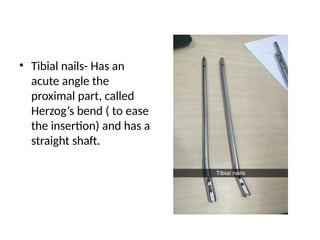
• Tibial nails- Has an
acute angle the
proximal part, called
Herzog’s bend ( to ease
the insertion) and has a
straight shaft.
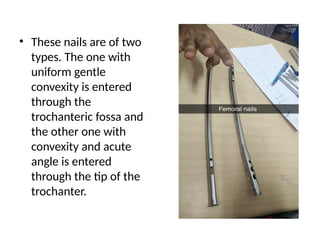
• These nails are of two
types. The one with
uniform gentle
convexity is entered
through the
trochanteric fossa and
the other one with
convexity and acute
angle is entered
through the tip of the
trochanter.
• Exceptional is the Proximal femoral Nail (PFN)
Which has Oblique holes
Used in the fixation of fracture at the proximal
part of the Femur
SCREWS
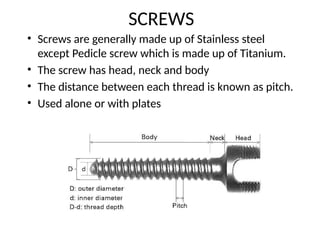
• Screws are generally made up of Stainless steel
except Pedicle screw which is made up of Titanium.
• The screw has head, neck and body
• The distance between each thread is known as pitch.
• Used alone or with plates
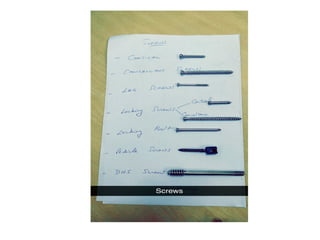
• CORTICAL SCREWS
They have closely spaced, shallow threads
and large core diameter. They are used to fix
fractures of the shaft.
• CANCELLOUS SCREWS
They have more deeply cut and widely
spaced threads compared to cortical screws.
They are used in the fixation of cancellous
bone (eg. Metaphyses of long bones) and
osteoporotic bones
• LAG SCREW
Partially threaded cancellous screw
Gives compression at the fracture site
• LOCKING SCREW
Types: cortical and cancellous
Screw with threads in the head
• LOCKING BOLT
Threads are least prominent in bolt
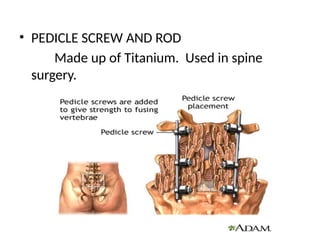
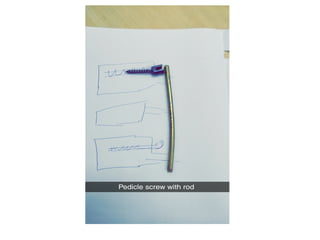
• PEDICLE SCREW AND ROD
Made up of Titanium. Used in spine
surgery.
• DYNAMIC HIP SCREW
Partially threaded at the tip. It has two
components: the lag screw and the barrel.
Used for internal fixation of Trochanteric
fractures. Eg. Proximal femoral fracture.
angle btw barrel and plate approximates the
angle btw neck and shaft of bone
PLATES
Used for fixation of bony fragments.
- Humerus, clavicle, forearm fractures,
Metaphysis and epiphysis of Tibia and femur
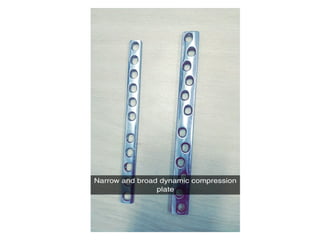
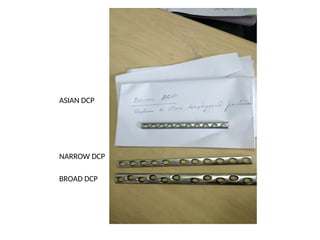
DYNAMIC COMPRESSION PLATE (DCP)
Used to cause compression at the fracture site
Broad- Humerus, Tibia, Femur
Narrow- Fibula, Clavicle
ASIAN DCP
NARROW DCP
BROAD DCP
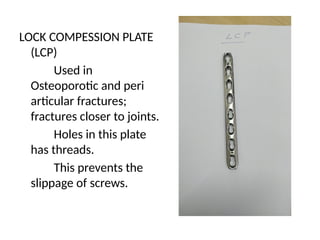
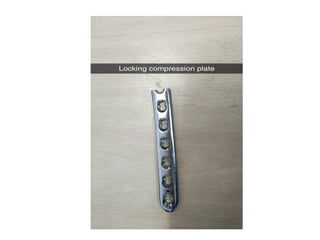
LOCK COMPESSION PLATE
(LCP)
Used in
Osteoporotic and peri
articular fractures;
fractures closer to joints.
Holes in this plate
has threads.
This prevents the
slippage of screws.
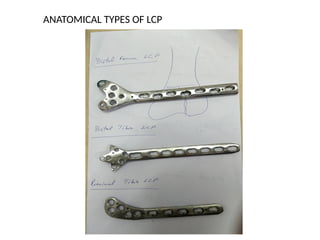
ANATOMICAL TYPES OF LCP
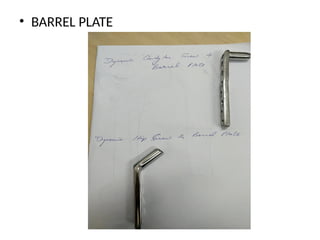
• BARREL PLATE
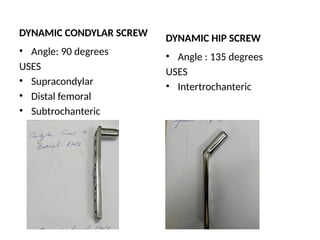
DYNAMIC CONDYLAR SCREW
• Angle: 90 degrees
USES
• Supracondylar
• Distal femoral
• Subtrochanteric
DYNAMIC HIP SCREW
• Angle : 135 degrees
USES
• Intertrochanteric
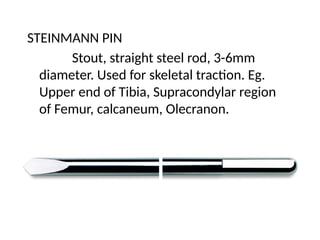
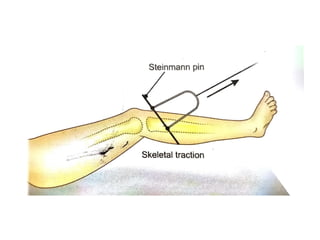
STEINMANN PIN
Stout, straight steel rod, 3-6mm
diameter. Used for skeletal traction. Eg.
Upper end of Tibia, Supracondylar region
of Femur, calcaneum, Olecranon.
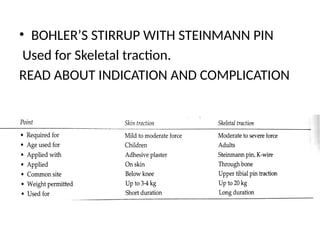
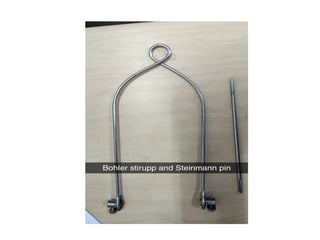
• BOHLER’S STIRRUP WITH STEINMANN PIN
Used for Skeletal traction.
READ ABOUT INDICATION AND COMPLICATION
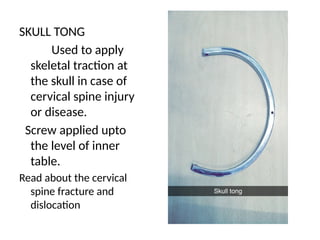
SKULL TONG
Used to apply
skeletal traction at
the skull in case of
cervical spine injury
or disease.
Screw applied upto
the level of inner
table.
Read about the cervical
spine fracture and
dislocation
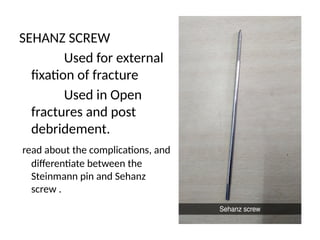
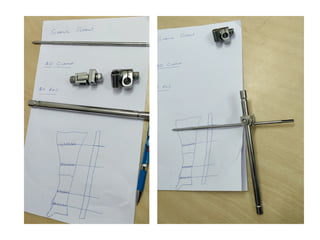
SEHANZ SCREW
Used for external
fixation of fracture
Used in Open
fractures and post
debridement.
read about the complications, and
differentiate between the
Steinmann pin and Sehanz
screw .
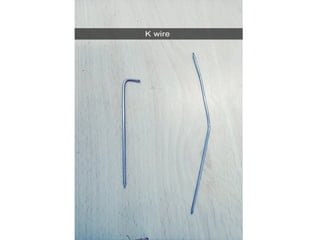
K WIRE
Kirschner wire or K wire is a thin, straight,
steel wire of 1-3 mm diameter.
Uses: 1. internal fixation of small bones
2. for giving traction, through
olecranon
3. in Ilizarov’s fixation
4. in fixing fractures in children
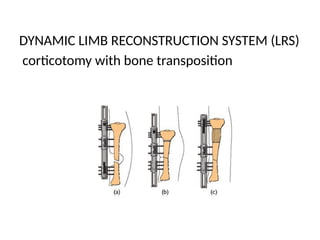
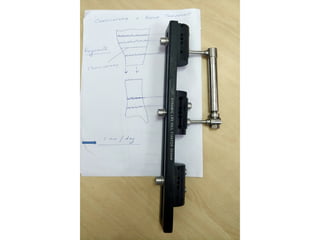
DYNAMIC LIMB RECONSTRUCTION SYSTEM (LRS)
corticotomy with bone transposition
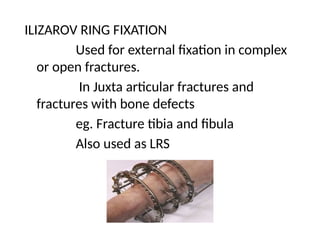
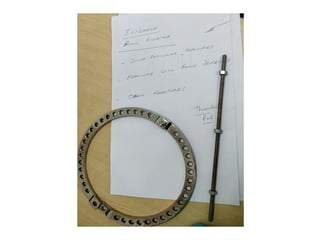
ILIZAROV RING FIXATION
Used for external fixation in complex
or open fractures.
In Juxta articular fractures and
fractures with bone defects
eg. Fracture tibia and fibula
Also used as LRS
All the best

ORTHOPAEDIC INSTRUMENTS LISTED IN THIS.pptx

  • 1.
  • 2.
    NAILS • Nails aredevices used for intra medullary fixation of fractures of long bones. • They have holes proximally and distally to lock them with locking screws, to prevent rotation. • The holes are usually perpendicular to the long axis of the shaft.
  • 3.
    • Tibial nails-Has an acute angle the proximal part, called Herzog’s bend ( to ease the insertion) and has a straight shaft.
  • 4.
    • These nailsare of two types. The one with uniform gentle convexity is entered through the trochanteric fossa and the other one with convexity and acute angle is entered through the tip of the trochanter.
  • 5.
    • Exceptional isthe Proximal femoral Nail (PFN) Which has Oblique holes Used in the fixation of fracture at the proximal part of the Femur
  • 6.
    SCREWS • Screws aregenerally made up of Stainless steel except Pedicle screw which is made up of Titanium. • The screw has head, neck and body • The distance between each thread is known as pitch. • Used alone or with plates
  • 8.
    • CORTICAL SCREWS Theyhave closely spaced, shallow threads and large core diameter. They are used to fix fractures of the shaft. • CANCELLOUS SCREWS They have more deeply cut and widely spaced threads compared to cortical screws. They are used in the fixation of cancellous bone (eg. Metaphyses of long bones) and osteoporotic bones
  • 9.
    • LAG SCREW Partiallythreaded cancellous screw Gives compression at the fracture site • LOCKING SCREW Types: cortical and cancellous Screw with threads in the head • LOCKING BOLT Threads are least prominent in bolt
  • 10.
    • PEDICLE SCREWAND ROD Made up of Titanium. Used in spine surgery.
  • 12.
    • DYNAMIC HIPSCREW Partially threaded at the tip. It has two components: the lag screw and the barrel. Used for internal fixation of Trochanteric fractures. Eg. Proximal femoral fracture. angle btw barrel and plate approximates the angle btw neck and shaft of bone
  • 13.
    PLATES Used for fixationof bony fragments. - Humerus, clavicle, forearm fractures, Metaphysis and epiphysis of Tibia and femur DYNAMIC COMPRESSION PLATE (DCP) Used to cause compression at the fracture site Broad- Humerus, Tibia, Femur Narrow- Fibula, Clavicle
  • 15.
  • 16.
    LOCK COMPESSION PLATE (LCP) Usedin Osteoporotic and peri articular fractures; fractures closer to joints. Holes in this plate has threads. This prevents the slippage of screws.
  • 18.
  • 19.
  • 20.
    DYNAMIC CONDYLAR SCREW •Angle: 90 degrees USES • Supracondylar • Distal femoral • Subtrochanteric DYNAMIC HIP SCREW • Angle : 135 degrees USES • Intertrochanteric
  • 21.
    STEINMANN PIN Stout, straightsteel rod, 3-6mm diameter. Used for skeletal traction. Eg. Upper end of Tibia, Supracondylar region of Femur, calcaneum, Olecranon.
  • 22.
    • BOHLER’S STIRRUPWITH STEINMANN PIN Used for Skeletal traction. READ ABOUT INDICATION AND COMPLICATION
  • 25.
    SKULL TONG Used toapply skeletal traction at the skull in case of cervical spine injury or disease. Screw applied upto the level of inner table. Read about the cervical spine fracture and dislocation
  • 26.
    SEHANZ SCREW Used forexternal fixation of fracture Used in Open fractures and post debridement. read about the complications, and differentiate between the Steinmann pin and Sehanz screw .
  • 28.
    K WIRE Kirschner wireor K wire is a thin, straight, steel wire of 1-3 mm diameter. Uses: 1. internal fixation of small bones 2. for giving traction, through olecranon 3. in Ilizarov’s fixation 4. in fixing fractures in children
  • 30.
    DYNAMIC LIMB RECONSTRUCTIONSYSTEM (LRS) corticotomy with bone transposition
  • 32.
    ILIZAROV RING FIXATION Usedfor external fixation in complex or open fractures. In Juxta articular fractures and fractures with bone defects eg. Fracture tibia and fibula Also used as LRS

  • 34.