
ORGANIZATIONAL BEHAVIOUR
             &
HUMAN RESOURCES DEVELOPMENT


         LEADERSHIP


                Presented By:
                          Amit Kumar
                          Anas.O.M
                          Krishnam Raju
                          Ridhi Vatsraj
                          Veerashekar.R
TOPICS
• Leader

• Leadership

• Good Leaders

• Bad Leaders

• How can leadership help an organization
WHO IS A LEADER?
“ The real leader has no need to lead he is the
    content to point the way”- Henry Miller.


“Innovation distinguishes between a leader and a
             follower” – Steve Jobs.
What is Leadership?
“Leadership is the desire and ability to inspire
   individual achievements” – Keith Miller.
Types of Leadership

     • Transformational

     • Transactional

     • Charismatic
WHO IS A GOOD LEADER?
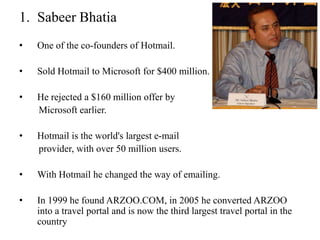
1. Sabeer Bhatia
•   One of the co-founders of Hotmail.

•   Sold Hotmail to Microsoft for $400 million.

•   He rejected a $160 million offer by
    Microsoft earlier.

•   Hotmail is the world's largest e-mail
    provider, with over 50 million users.

•   With Hotmail he changed the way of emailing.

•   In 1999 he found ARZOO.COM, in 2005 he converted ARZOO
    into a travel portal and is now the third largest travel portal in the
    country
Contd..,

• In 2008 he started SABSEBOLO.COM

• His future venture includes….
        Live office
       Nano city
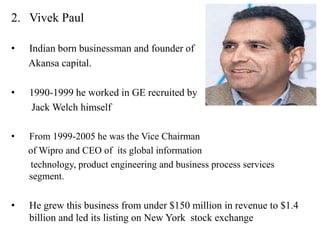
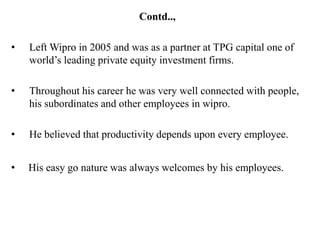
2. Vivek Paul

•   Indian born businessman and founder of
    Akansa capital.

•   1990-1999 he worked in GE recruited by
    Jack Welch himself

•   From 1999-2005 he was the Vice Chairman
    of Wipro and CEO of its global information
     technology, product engineering and business process services
    segment.


•   He grew this business from under $150 million in revenue to $1.4
    billion and led its listing on New York stock exchange
Contd..,

•   Left Wipro in 2005 and was as a partner at TPG capital one of
    world’s leading private equity investment firms.

•   Throughout his career he was very well connected with people,
    his subordinates and other employees in wipro.

•   He believed that productivity depends upon every employee.


•   His easy go nature was always welcomes by his employees.
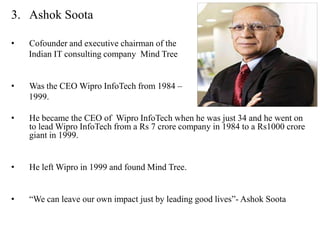
3. Ashok Soota

•   Cofounder and executive chairman of the
    Indian IT consulting company Mind Tree


•   Was the CEO Wipro InfoTech from 1984 –
    1999.

•   He became the CEO of Wipro InfoTech when he was just 34 and he went on
    to lead Wipro InfoTech from a Rs 7 crore company in 1984 to a Rs1000 crore
    giant in 1999.


•   He left Wipro in 1999 and found Mind Tree.


•   “We can leave our own impact just by leading good lives”- Ashok Soota
Contd..,

• With the dot com burst in 2000 it was like the end of the road for Mind
  Tree, but he steered through the difficult situation as a responsible captain
  to make the story of the company of success which could have been
  otherwise.

• On 5th April 2011 he announced the launch of Happiest Minds that offers
  a suite of IT services. Launched Happiest Minds on 29th August 2011.

• Within 2 months of its launch it raised $45 million as investment.
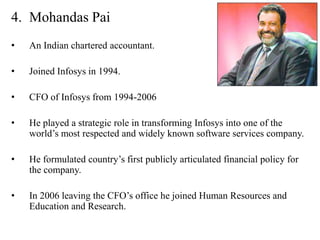
4. Mohandas Pai
•   An Indian chartered accountant.

•   Joined Infosys in 1994.

•   CFO of Infosys from 1994-2006

•   He played a strategic role in transforming Infosys into one of the
    world’s most respected and widely known software services company.

•   He formulated country’s first publicly articulated financial policy for
    the company.

•   In 2006 leaving the CFO’s office he joined Human Resources and
    Education and Research.
Contd..,

• He left Infosys in June 2011.

•    Mohandas Pai is one of those leaders in Infosys who took Infosys
    from a $10 million 500 people company to a $10 billion 1,30,000
    people globally with $40 billion of value.

• As an HR head he wanted his employees to take independent decisions
  and he believed in learning and training programs.

• The credit for the highly talented youngsters working in Infosys goes
  to Mohandas Pai .

“ The most important test for an MBA is the value that he adds to
   the organization and not the salary he earns.”- Mohandas Pai
WHO IS A BAD LEADER?
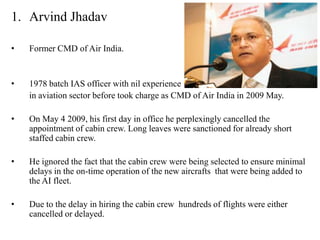
1. Arvind Jhadav

•   Former CMD of Air India.


•   1978 batch IAS officer with nil experience
    in aviation sector before took charge as CMD of Air India in 2009 May.

•   On May 4 2009, his first day in office he perplexingly cancelled the
    appointment of cabin crew. Long leaves were sanctioned for already short
    staffed cabin crew.

•   He ignored the fact that the cabin crew were being selected to ensure minimal
    delays in the on-time operation of the new aircrafts that were being added to
    the AI fleet.

•   Due to the delay in hiring the cabin crew hundreds of flights were either
    cancelled or delayed.
Contd..,
• This decision of his only costed Air India Rs 20 billion.

• AI bought 3 Boeing 777-300ER at a price of $852.30 million which
  wasn’t used for three months as AI did not take the delivery.

• Upon this AI engaged many consultants like Accenture, McKinsey,
  Booz Allen which costed them huge money.

• “There was a complete disconnect and trust deficit between CMD and
  the employees”- Capt. Mohan Ranganathan (member safety advisory
  committee of the Ministry of Civil Aviation.

• During his tenure only AI reported a loss of 11052 crores

• In August 2011 he was literally thrown out of AI..
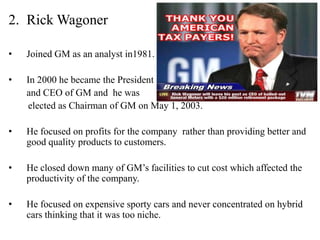
2. Rick Wagoner

•   Joined GM as an analyst in1981.

•   In 2000 he became the President
    and CEO of GM and he was
    elected as Chairman of GM on May 1, 2003.

•   He focused on profits for the company rather than providing better and
    good quality products to customers.

•   He closed down many of GM’s facilities to cut cost which affected the
    productivity of the company.

•   He focused on expensive sporty cars and never concentrated on hybrid
    cars thinking that it was too niche.
Contd..,

• All the time he was closing down facilities to cut down cost he was
  wasting money in other facilities of GM.

• Under his leadership GM suffered $ 85 billion in losses.

• In June 2009 the company became bankrupt , government fired Rick
  Wagoner and US government took over the company.
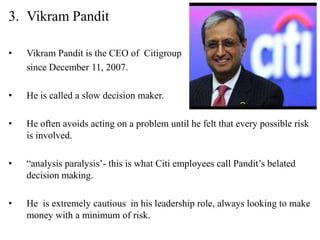
3. Vikram Pandit

•   Vikram Pandit is the CEO of Citigroup
    since December 11, 2007.

•   He is called a slow decision maker.

•   He often avoids acting on a problem until he felt that every possible risk
    is involved.

•   “analysis paralysis’- this is what Citi employees call Pandit’s belated
    decision making.

•   He is extremely cautious in his leadership role, always looking to make
    money with a minimum of risk.
Contd..,

• Even when Citi group was making losses he was claiming a huge
  salary.

• Vikram Pandit has been named one of the worst CEOs in America.
Now How will you decide whether a leader is good or bad?
SETTING UP A NEW COMPANY

• Every company stats with the intent that one day it will become a
  large company.

• One thing that we have to keep in mind while starting a company
  is that a startup company is not a small version of a large
  company

• A startup company requires different management principles and a
  leadership which is more participative.

• Every company that has grown from a small scratch to
  multibillion dollar giants shows that their management principles
  were different at startup
LEADERSHIP STYLE REQUIRED FOR A STARTUP COMPANY

• Startup stage for any business is filled with passion and excitement.

• Startup leadership requires passion for vision.

• The founder/leader should have direct hands on the day to day
  operations of the company.

• He should lead by examples

• Do not be a slave to management theorists.

• The leader should be good in networking, experimenting and
  facilitating
Contd..,

• Leaders should be flexible.

• The leader should take active participation in functions like forecasting,
  planning, organizing, commanding, coordinating and controlling.

• Employees are the strength and weakness of any company.

• Employees should be properly trained and educated. They should add
  value to the organization.

• A Democratic style of leadership will be appropriate for a startup
  company especially when it is a new kind of business.
HOW CAN LEADERSHIP HELP A COMPANY
     TO MEET INDUSTRIAL STANDARDS?

• Stringent quality control measures should cover every aspects of
  business – the leader should make this sure.

•    Real world examples has shown how quality of a product can
    affect the reputation of a company

• This is dependent on the vision of the leader.

• The success of any company depends on how well it serves the
  needs of its customers.
THANK YOU

ORGANIZATIONAL BEHAVIOUR & HUMAN RESOURCES DEVELOPMENT

  • 1.
    ORGANIZATIONAL BEHAVIOUR & HUMAN RESOURCES DEVELOPMENT LEADERSHIP Presented By: Amit Kumar Anas.O.M Krishnam Raju Ridhi Vatsraj Veerashekar.R
  • 2.
    TOPICS • Leader • Leadership •Good Leaders • Bad Leaders • How can leadership help an organization
  • 3.
    WHO IS ALEADER?
  • 4.
    “ The realleader has no need to lead he is the content to point the way”- Henry Miller. “Innovation distinguishes between a leader and a follower” – Steve Jobs.
  • 5.
  • 6.
    “Leadership is thedesire and ability to inspire individual achievements” – Keith Miller.
  • 7.
    Types of Leadership • Transformational • Transactional • Charismatic
  • 8.
    WHO IS AGOOD LEADER?
  • 9.
    1. Sabeer Bhatia • One of the co-founders of Hotmail. • Sold Hotmail to Microsoft for $400 million. • He rejected a $160 million offer by Microsoft earlier. • Hotmail is the world's largest e-mail provider, with over 50 million users. • With Hotmail he changed the way of emailing. • In 1999 he found ARZOO.COM, in 2005 he converted ARZOO into a travel portal and is now the third largest travel portal in the country
  • 10.
    Contd.., • In 2008he started SABSEBOLO.COM • His future venture includes….  Live office Nano city
  • 11.
    2. Vivek Paul • Indian born businessman and founder of Akansa capital. • 1990-1999 he worked in GE recruited by Jack Welch himself • From 1999-2005 he was the Vice Chairman of Wipro and CEO of its global information technology, product engineering and business process services segment. • He grew this business from under $150 million in revenue to $1.4 billion and led its listing on New York stock exchange
  • 12.
    Contd.., • Left Wipro in 2005 and was as a partner at TPG capital one of world’s leading private equity investment firms. • Throughout his career he was very well connected with people, his subordinates and other employees in wipro. • He believed that productivity depends upon every employee. • His easy go nature was always welcomes by his employees.
  • 13.
    3. Ashok Soota • Cofounder and executive chairman of the Indian IT consulting company Mind Tree • Was the CEO Wipro InfoTech from 1984 – 1999. • He became the CEO of Wipro InfoTech when he was just 34 and he went on to lead Wipro InfoTech from a Rs 7 crore company in 1984 to a Rs1000 crore giant in 1999. • He left Wipro in 1999 and found Mind Tree. • “We can leave our own impact just by leading good lives”- Ashok Soota
  • 14.
    Contd.., • With thedot com burst in 2000 it was like the end of the road for Mind Tree, but he steered through the difficult situation as a responsible captain to make the story of the company of success which could have been otherwise. • On 5th April 2011 he announced the launch of Happiest Minds that offers a suite of IT services. Launched Happiest Minds on 29th August 2011. • Within 2 months of its launch it raised $45 million as investment.
  • 15.
    4. Mohandas Pai • An Indian chartered accountant. • Joined Infosys in 1994. • CFO of Infosys from 1994-2006 • He played a strategic role in transforming Infosys into one of the world’s most respected and widely known software services company. • He formulated country’s first publicly articulated financial policy for the company. • In 2006 leaving the CFO’s office he joined Human Resources and Education and Research.
  • 16.
    Contd.., • He leftInfosys in June 2011. • Mohandas Pai is one of those leaders in Infosys who took Infosys from a $10 million 500 people company to a $10 billion 1,30,000 people globally with $40 billion of value. • As an HR head he wanted his employees to take independent decisions and he believed in learning and training programs. • The credit for the highly talented youngsters working in Infosys goes to Mohandas Pai . “ The most important test for an MBA is the value that he adds to the organization and not the salary he earns.”- Mohandas Pai
  • 17.
    WHO IS ABAD LEADER?
  • 18.
    1. Arvind Jhadav • Former CMD of Air India. • 1978 batch IAS officer with nil experience in aviation sector before took charge as CMD of Air India in 2009 May. • On May 4 2009, his first day in office he perplexingly cancelled the appointment of cabin crew. Long leaves were sanctioned for already short staffed cabin crew. • He ignored the fact that the cabin crew were being selected to ensure minimal delays in the on-time operation of the new aircrafts that were being added to the AI fleet. • Due to the delay in hiring the cabin crew hundreds of flights were either cancelled or delayed.
  • 19.
    Contd.., • This decisionof his only costed Air India Rs 20 billion. • AI bought 3 Boeing 777-300ER at a price of $852.30 million which wasn’t used for three months as AI did not take the delivery. • Upon this AI engaged many consultants like Accenture, McKinsey, Booz Allen which costed them huge money. • “There was a complete disconnect and trust deficit between CMD and the employees”- Capt. Mohan Ranganathan (member safety advisory committee of the Ministry of Civil Aviation. • During his tenure only AI reported a loss of 11052 crores • In August 2011 he was literally thrown out of AI..
  • 20.
    2. Rick Wagoner • Joined GM as an analyst in1981. • In 2000 he became the President and CEO of GM and he was elected as Chairman of GM on May 1, 2003. • He focused on profits for the company rather than providing better and good quality products to customers. • He closed down many of GM’s facilities to cut cost which affected the productivity of the company. • He focused on expensive sporty cars and never concentrated on hybrid cars thinking that it was too niche.
  • 21.
    Contd.., • All thetime he was closing down facilities to cut down cost he was wasting money in other facilities of GM. • Under his leadership GM suffered $ 85 billion in losses. • In June 2009 the company became bankrupt , government fired Rick Wagoner and US government took over the company.
  • 22.
    3. Vikram Pandit • Vikram Pandit is the CEO of Citigroup since December 11, 2007. • He is called a slow decision maker. • He often avoids acting on a problem until he felt that every possible risk is involved. • “analysis paralysis’- this is what Citi employees call Pandit’s belated decision making. • He is extremely cautious in his leadership role, always looking to make money with a minimum of risk.
  • 23.
    Contd.., • Even whenCiti group was making losses he was claiming a huge salary. • Vikram Pandit has been named one of the worst CEOs in America.
  • 24.
    Now How willyou decide whether a leader is good or bad?
  • 25.
    SETTING UP ANEW COMPANY • Every company stats with the intent that one day it will become a large company. • One thing that we have to keep in mind while starting a company is that a startup company is not a small version of a large company • A startup company requires different management principles and a leadership which is more participative. • Every company that has grown from a small scratch to multibillion dollar giants shows that their management principles were different at startup
  • 26.
    LEADERSHIP STYLE REQUIREDFOR A STARTUP COMPANY • Startup stage for any business is filled with passion and excitement. • Startup leadership requires passion for vision. • The founder/leader should have direct hands on the day to day operations of the company. • He should lead by examples • Do not be a slave to management theorists. • The leader should be good in networking, experimenting and facilitating
  • 27.
    Contd.., • Leaders shouldbe flexible. • The leader should take active participation in functions like forecasting, planning, organizing, commanding, coordinating and controlling. • Employees are the strength and weakness of any company. • Employees should be properly trained and educated. They should add value to the organization. • A Democratic style of leadership will be appropriate for a startup company especially when it is a new kind of business.
  • 28.
    HOW CAN LEADERSHIPHELP A COMPANY TO MEET INDUSTRIAL STANDARDS? • Stringent quality control measures should cover every aspects of business – the leader should make this sure. • Real world examples has shown how quality of a product can affect the reputation of a company • This is dependent on the vision of the leader. • The success of any company depends on how well it serves the needs of its customers.
  • 29.