Subject:
Human Resource Manamgement
Assignment:
Temporary Recruitment
Submitted to:
Mr. Umer Khan
Submitted by:
Syed Sajid Hussain
MINHAJ UNIVERSITY Gulberg Campus Lahore.
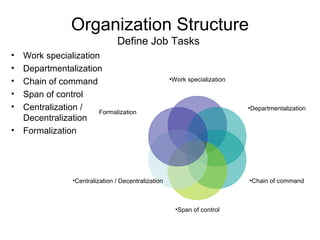
Organization Structure
Define Job Tasks
• Work specialization
• Departmentalization
• Chain of command
• Span of control
• Centralization /
Decentralization
• Formalization
•Work specialization
•Departmentalization
•Chain of command
•Span of control
•Centralization / Decentralization
Formalization
Temporary Worker
• Effective temporary recruitment is quick, efficient and provides a strong level of “fit”
between the requirements of clients and the skills, attitude and behaviors of
candidates. As a result, we follow a specific and rigorous process to ensure that the
“best fit” temporary staff can be quickly sourced and placed to meet the individual
needs of situation.
• A temporary worker is someone employed for a limited period whose job is usually
expected by both sides to last for only a short time. Temporary workers may be
employed directly by the employer or by private agencies. Agencies will recruit,
select and sometimes train temporary workers and hire them out to employers.
• Temporary workers are sometimes employed on fixed term contracts. A fixed term
contract is a contract of employment for a definite period, set in advance.
Employment ends when the contract expires and no notice need be given by the
employer. Employment contracts may also be agreed which end on the completion
of a particular task rather than on a specific date.
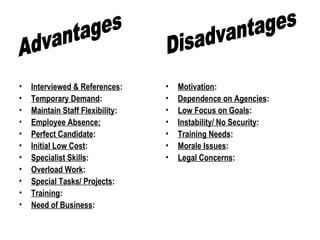
• Interviewed & References:
• Temporary Demand:
• Maintain Staff Flexibility:
• Employee Absence:
• Perfect Candidate:
• Initial Low Cost:
• Specialist Skills:
• Overload Work:
• Special Tasks/ Projects:
• Training:
• Need of Business:
• Motivation:
• Dependence on Agencies:
• Low Focus on Goals:
• Instability/ No Security:
• Training Needs:
• Morale Issues:
• Legal Concerns:
Employee’s Benefit
• Money
• Variety
• Flexibility
• Efficiency
• Productivity
• Opportunities
• Work location
• Relationship/ Reference
Employee’s Benefit
• Money
• Variety
• Flexibility
• Efficiency
• Productivity
• Opportunities
• Work location
• Relationship/ Reference

Organization structure & temporary recruitment

  • 1.
    Subject: Human Resource Manamgement Assignment: TemporaryRecruitment Submitted to: Mr. Umer Khan Submitted by: Syed Sajid Hussain MINHAJ UNIVERSITY Gulberg Campus Lahore.
  • 2.
    Organization Structure Define JobTasks • Work specialization • Departmentalization • Chain of command • Span of control • Centralization / Decentralization • Formalization •Work specialization •Departmentalization •Chain of command •Span of control •Centralization / Decentralization Formalization
  • 3.
    Temporary Worker • Effectivetemporary recruitment is quick, efficient and provides a strong level of “fit” between the requirements of clients and the skills, attitude and behaviors of candidates. As a result, we follow a specific and rigorous process to ensure that the “best fit” temporary staff can be quickly sourced and placed to meet the individual needs of situation. • A temporary worker is someone employed for a limited period whose job is usually expected by both sides to last for only a short time. Temporary workers may be employed directly by the employer or by private agencies. Agencies will recruit, select and sometimes train temporary workers and hire them out to employers. • Temporary workers are sometimes employed on fixed term contracts. A fixed term contract is a contract of employment for a definite period, set in advance. Employment ends when the contract expires and no notice need be given by the employer. Employment contracts may also be agreed which end on the completion of a particular task rather than on a specific date.
  • 4.
    • Interviewed &References: • Temporary Demand: • Maintain Staff Flexibility: • Employee Absence: • Perfect Candidate: • Initial Low Cost: • Specialist Skills: • Overload Work: • Special Tasks/ Projects: • Training: • Need of Business: • Motivation: • Dependence on Agencies: • Low Focus on Goals: • Instability/ No Security: • Training Needs: • Morale Issues: • Legal Concerns:
  • 5.
    Employee’s Benefit • Money •Variety • Flexibility • Efficiency • Productivity • Opportunities • Work location • Relationship/ Reference
  • 6.
    Employee’s Benefit • Money •Variety • Flexibility • Efficiency • Productivity • Opportunities • Work location • Relationship/ Reference