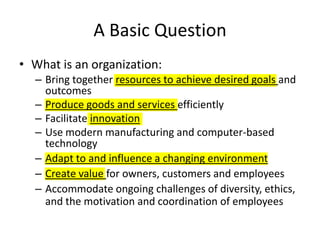
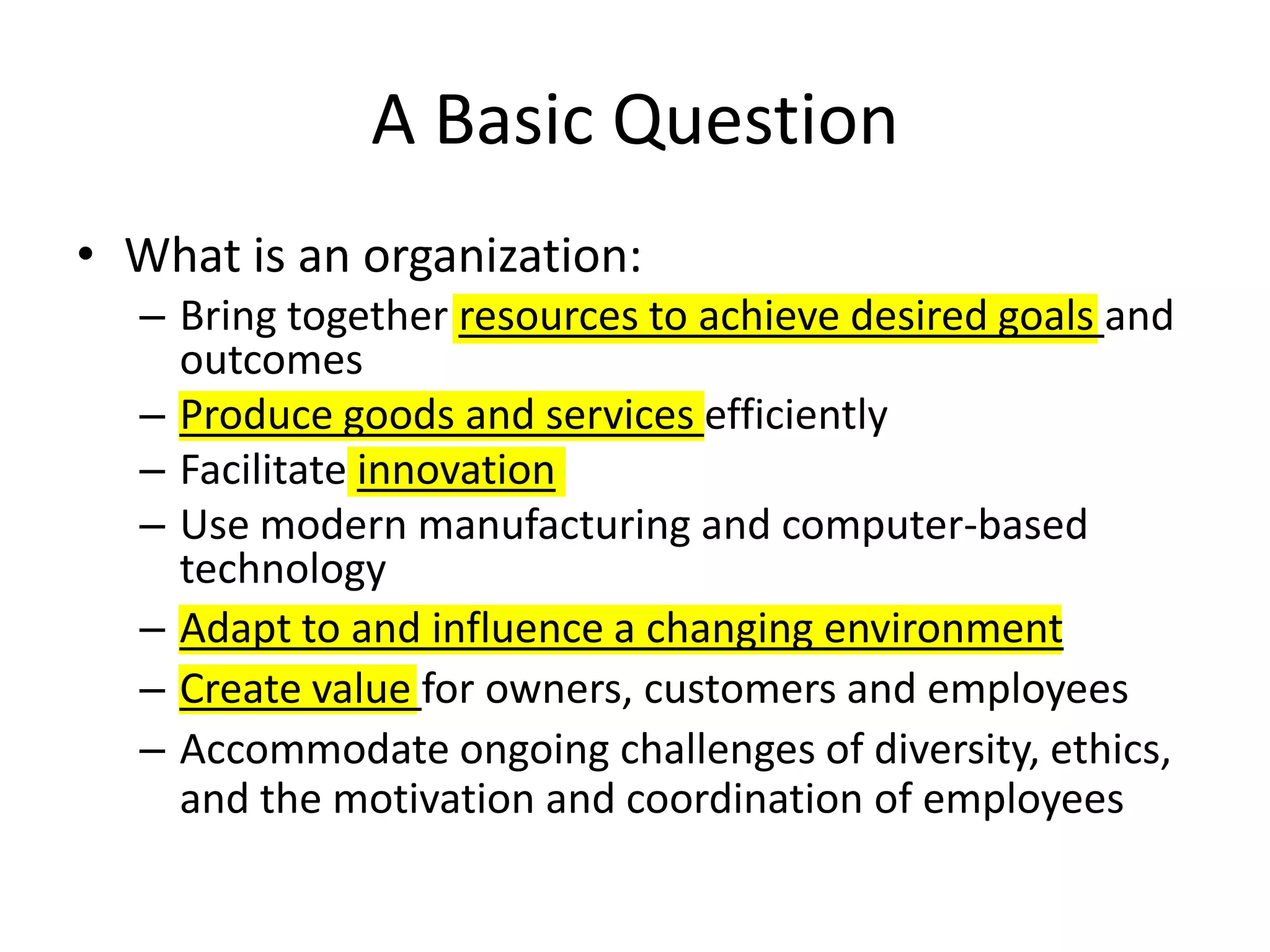
A Basic QuestionWhat is an organization:Bring together resources to achieve desired goals and outcomesProduce goods and services efficientlyFacilitate innovationUse modern manufacturing and computer-based technologyAdapt to and influence a changing environmentCreate value for owners, customers and employeesAccommodate ongoing challenges of diversity, ethics, and the motivation and coordination of employees
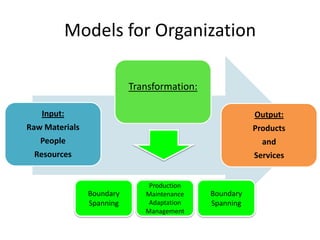
Models for OrganizationBoundarySpanningBoundary SpanningProductionMaintenanceAdaptationManagement
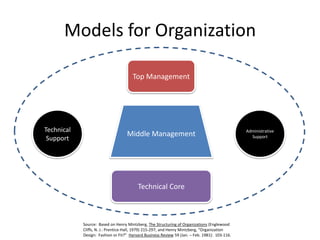
Models for OrganizationTop ManagementMiddle ManagementTechnical SupportAdministrative SupportTechnical CoreSource:  Based on Henry Mintzberg, The Structuring of Organizations (Englewood Cliffs, N. J.: Prentice-Hall, 1979) 215-297; and Henry Mintzberg, “Organization Design:  Fashion or Fit?”  Harvard Business Review 59 (Jan. – Feb. 1981):  103-116.
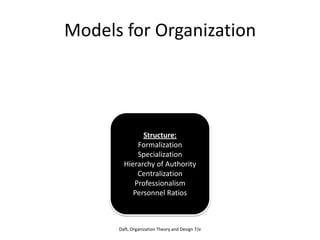
Models for OrganizationStructure:FormalizationSpecializationHierarchy of AuthorityCentralizationProfessionalismPersonnel RatiosDaft, Organization Theory and Design 7/e
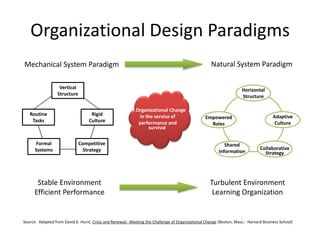
Organizational Design ParadigmsNatural System ParadigmMechanical System ParadigmVerticalStructureHorizontalStructureRoutineTasksRigidCultureAdaptiveCultureEmpoweredRolesCompetitiveStrategyFormalSystemsCollaborativeStrategySharedInformationStable EnvironmentEfficient PerformanceTurbulent EnvironmentLearning Organization     Organizational Changein the service ofperformance andsurvival Source:  Adapted from David K. Hurst, Crisis and Renewal:  Meeting the Challenge of Organizational Change (Boston, Mass.:  Harvard Business School)
Why Is It Important to Understand ?

Organization Design 1

  • 1.
    A Basic QuestionWhatis an organization:Bring together resources to achieve desired goals and outcomesProduce goods and services efficientlyFacilitate innovationUse modern manufacturing and computer-based technologyAdapt to and influence a changing environmentCreate value for owners, customers and employeesAccommodate ongoing challenges of diversity, ethics, and the motivation and coordination of employees
  • 2.
    Models for OrganizationBoundarySpanningBoundarySpanningProductionMaintenanceAdaptationManagement
  • 3.
    Models for OrganizationTopManagementMiddle ManagementTechnical SupportAdministrative SupportTechnical CoreSource: Based on Henry Mintzberg, The Structuring of Organizations (Englewood Cliffs, N. J.: Prentice-Hall, 1979) 215-297; and Henry Mintzberg, “Organization Design: Fashion or Fit?” Harvard Business Review 59 (Jan. – Feb. 1981): 103-116.
  • 4.
    Models for OrganizationStructure:FormalizationSpecializationHierarchyof AuthorityCentralizationProfessionalismPersonnel RatiosDaft, Organization Theory and Design 7/e
  • 5.
    Organizational Design ParadigmsNaturalSystem ParadigmMechanical System ParadigmVerticalStructureHorizontalStructureRoutineTasksRigidCultureAdaptiveCultureEmpoweredRolesCompetitiveStrategyFormalSystemsCollaborativeStrategySharedInformationStable EnvironmentEfficient PerformanceTurbulent EnvironmentLearning Organization Organizational Changein the service ofperformance andsurvival Source: Adapted from David K. Hurst, Crisis and Renewal: Meeting the Challenge of Organizational Change (Boston, Mass.: Harvard Business School)
  • 6.
    Why Is ItImportant to Understand ?