MBGM 103 (UNIT 4, Part 1)
Organisational Behaviour
FCM, Rama University
Stages of Group
Development
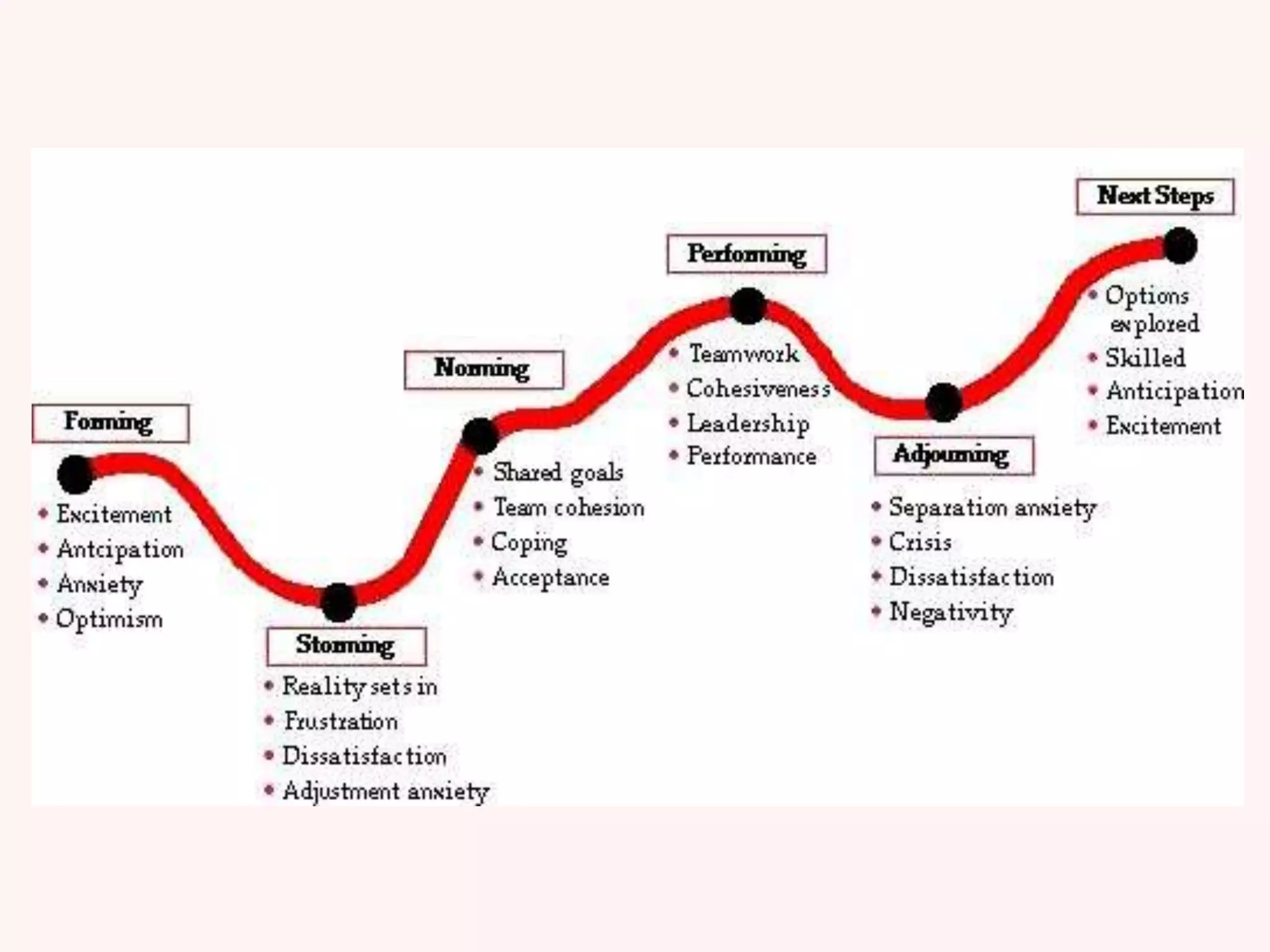
The model of group development
was first proposed by Bruce Tuckman
in 1965.
He maintained that these phases are
all necessary and inevitable in order
for:
the team to grow
to face up to challenges
to tackle problems
to find solutions
to plan work
and to deliver results.
The Five-Stage Model of Group
Development Consists of the following
stages:
1. Forming Stage
2. Storming Stage
3. Norming Stage
4. Performing Stage
5. Adjourning Stage
FORMING STAGE
The first stage in group development, characterized by much uncertainty.
In this, the team is formed and members meet. They learn what the team
opportunities and challenge will be.
Members will agree on goals and assign actions for work and ground rules or team
guidelines are established.
At the start, the team leader may be a member of the group, a supervisor, a
manager, or a consultant who will facilitate the team-building process. Leadership
will help the team to define their processes. At this stage, the leader needs to be
directive and understand the requirements for team training.
This stage is complete when the members have begun to think of themselves as a
part of a group.
STORMING STAGE
The second stage in group development, characterized by intragroup conflict.
During the second stage, individual expression of ideas occurs and there is open
conflict between members. Members tend to focus on details rather than the issues
and compete for influence.
Low trust among team members is an evident indicator of this stage.
The team needs to select their desired leadership style and decision methodology.
The team leader can help by stressing tolerance and patience between members.
The leader should guide the team process towards clear goals, defined roles,
acceptable team behavior, and a mutual feedback process for team communication.
When this stage is complete, there will be a relatively clear hierarchy of leadership
within the group.
NORMING STAGE
The third stage in group development, characterized by close relationships and
cohesiveness.
In the third stage, the team develops work habits that support group rules and
values. They use established tools and methods; exhibit good behaviors; mutual
trust, motivation, and open communication increase; positive teamwork and group
focus are apparent.
The team relationships grow and individual characteristics are understood and
appropriately utilized. The team leader continues to encourage participation and
professionalism among the team members.
This stage is complete when the group structure solidifies and the group has
assimilated a common set of expectations of what defines correct member behavior.
PERFORMING STAGE
The fourth stage in group development, when the group is fully functional.
The fourth stage shows high levels of loyalty, participation, motivation, and group
decision-making. Knowledge sharing, cross-training, and interdependence increases.
Team is self-directing in development of plans and strategy to meet their goals and
carry out work. Personal growth and sharing is encouraged throughout membership.
The leader becomes a facilitator aiding the team in communication processes and
helping if they revert to a prior stage.
Group energy has moved from getting to know and understand each other to
performing the task at hand.
Note: For permanent work groups, performing is the last stage in group
development.
ADJOURNING STAGE
The final stage in group development for temporary groups, characterized by
concern with wrapping up activities rather than performance.
For project teams, temporary committees, or task forces coming to an end, there will
be a finalizing stage as they celebrate and recognize group achievement. Then some
mourning over the dissolving of the team relationship and begin planning for the
change in individual work requirements.
During this stage, leadership needs to emphasize organization gratitude and both
team and individual recognition. For continuous work teams, there may be a higher
performance level as they develop and transform as individuals and reform into
revised teams. It is important to note that continuous work teams may revert to
prior stages when new people are added to the team.
Types
of
Groups
FORMAL GROUP INFORMAL GROUP
A designated work
group defined by
the organization’s
structure.
A group that is neither
formally structured
now organizationally
determined; appears
in response to the
need for social
contact.
FORMAL GROUPS
In formal groups, the behavior that team members should engage in
are stipulated by and directed toward organizational goals.
The major purpose of formal groups is to perform specific tasks and
achieve specific objectives defined by the organization. The most
common type of formal work group consists of individuals
cooperating under the direction of a leader.
Examples of formal groups are departments, divisions, taskforce,
project groups, quality circles, committees, and boards of directors.
FORMAL GROUPS
Characteristics of Formal Groups:
They are approved from some authority.
There is fixed division of labour
Individuals are assigned specific responsibilities.
There are personal interactions between the group members.
Group members are rewarded.
Formal groups can be further classified into:
Command Groups
Task Groups
Command Groups
A group composed of the individuals who report
directly to a given manager.
It is determined by the organization chart.
Membership in the group arises from each
employee’s position on the organizational chart.
Examples of a command group are: an academic
department chairman and the faculty members in
that department, or a director of postal audits and his
five inspectors.
Task Groups
Task groups consist of people who work together to achieve a
common task.
Members are brought together to accomplish a narrow range of
goals within a specified time period.
A task group’s boundaries are not limited to its immediate
hierarchical superior, it can cross command relationships.
Task groups are also commonly referred to as task forces. The
organization appoints members and assigns the goals and tasks
to be accomplished.
All command groups are also task groups, but reverse need not
be true.
Examples of assigned tasks are the development of a new
product, the improvement of a production process, or the
proposal of a motivational contest. Other common task groups
are ad hoc committees, project groups, and standing
committees.
INFORMAL GROUPS
These groups are natural formations in the work environment that
appear in response to the need of social contact.
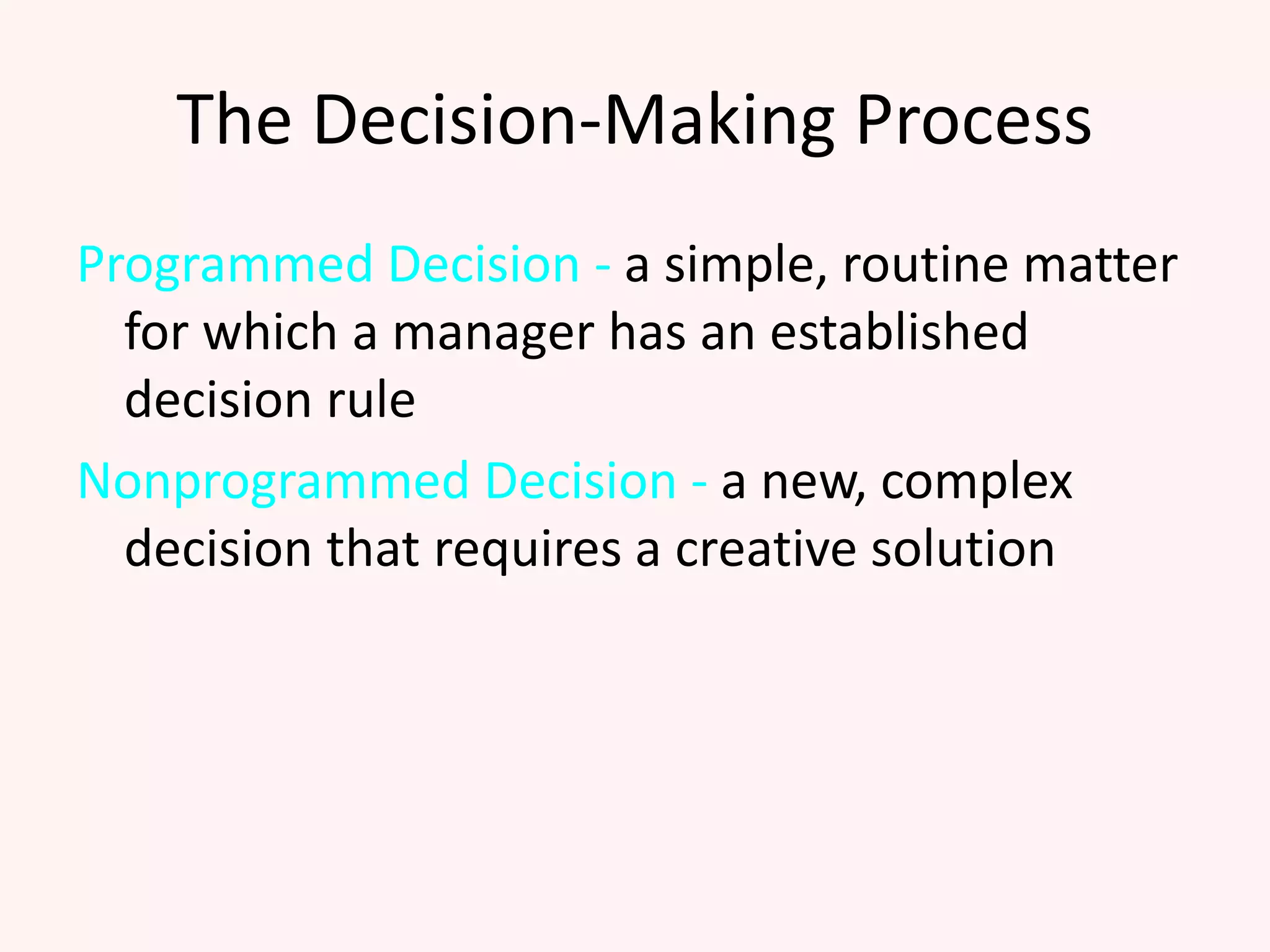
The Decision-Making Process
Programmed Decision - a simple, routine matter
for which a manager has an established
decision rule
Nonprogrammed Decision - a new, complex
decision that requires a creative solution
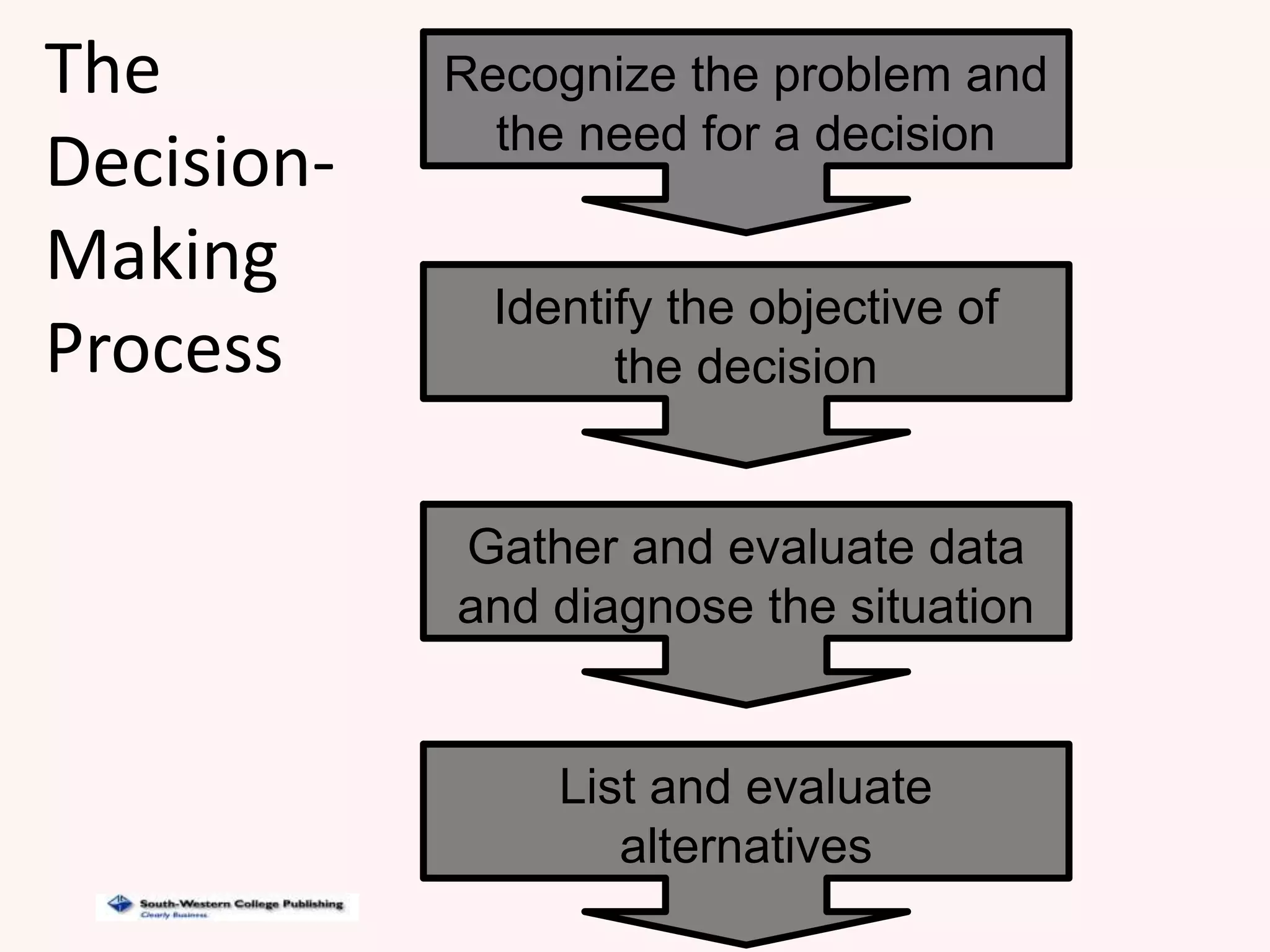
The
Decision-
Making
Process
Recognize the problem and
the need for a decision
Identify the objective of
the decision
Gather and evaluate data
and diagnose the situation
List and evaluate
alternatives
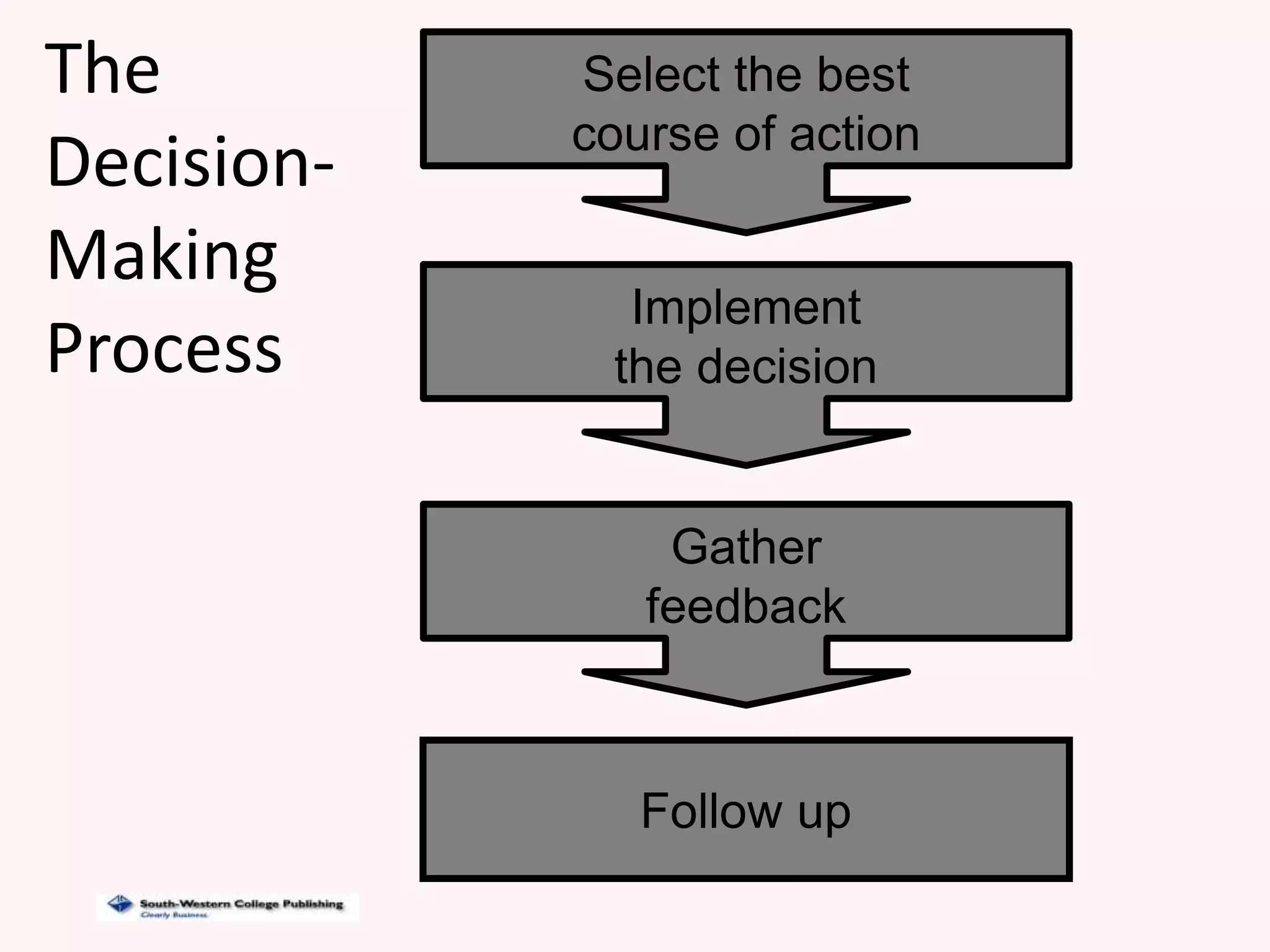
The
Decision-
Making
Process
Select the best
course of action
Implement
the decision
Gather
feedback
Follow up
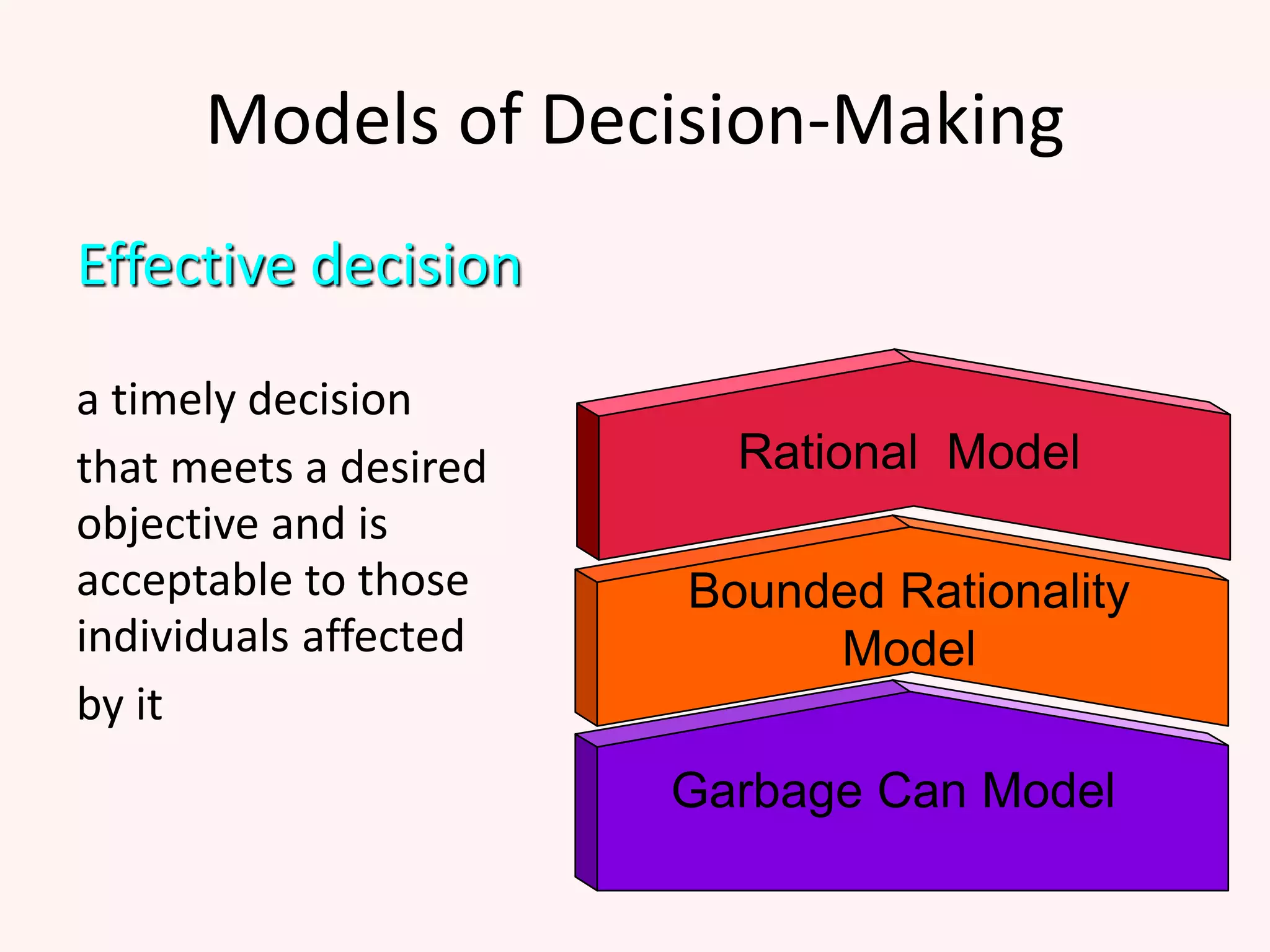
Models of Decision-Making
Effective decision
a timely decision
that meets a desired
objective and is
acceptable to those
individuals affected
by it
Garbage Can Model
Bounded Rationality
Model
Rational Model
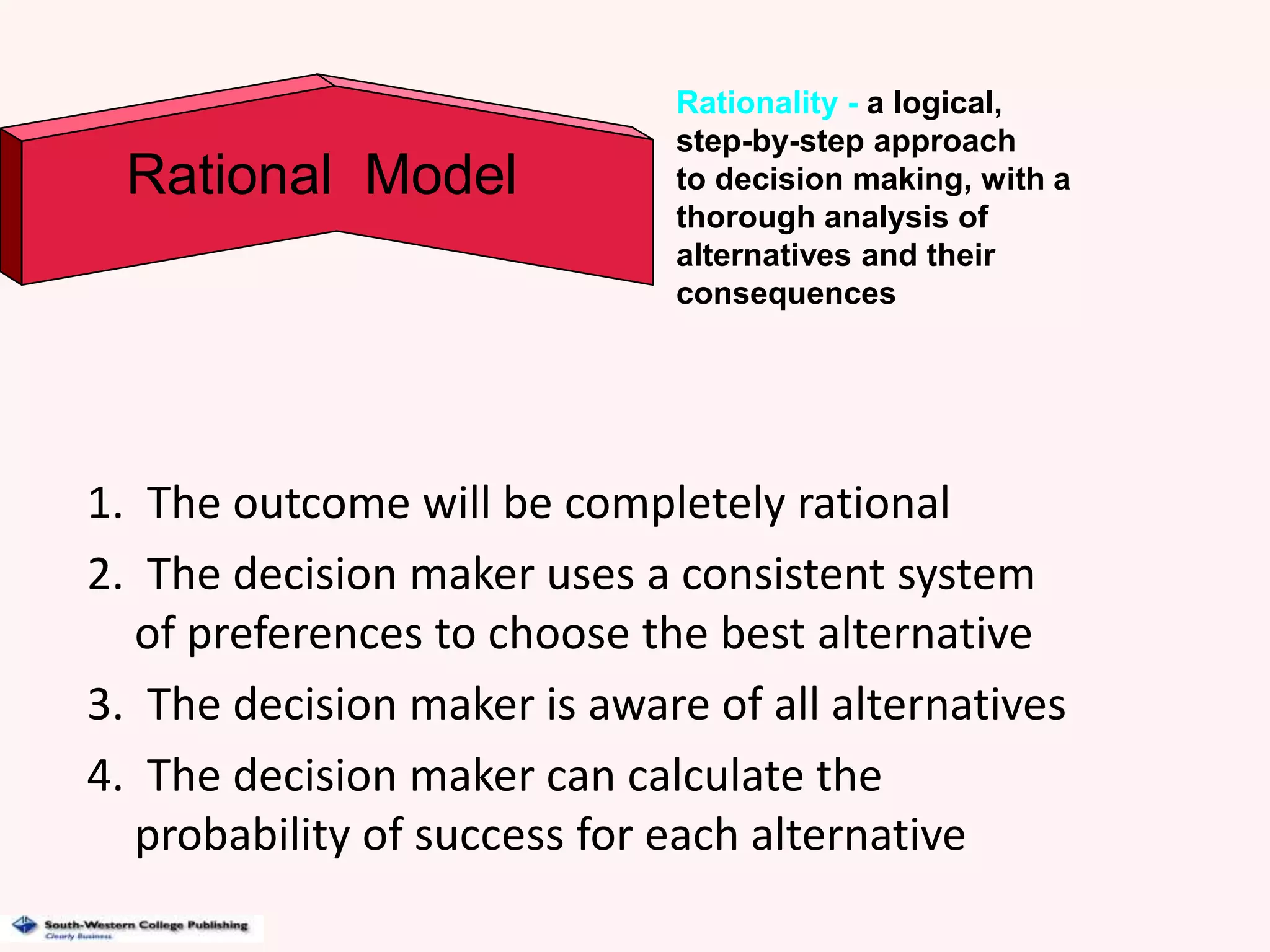
1. The outcome will be completely rational
2. The decision maker uses a consistent system
of preferences to choose the best alternative
3. The decision maker is aware of all alternatives
4. The decision maker can calculate the
probability of success for each alternative
Rational Model
Rationality - a logical,
step-by-step approach
to decision making, with a
thorough analysis of
alternatives and their
consequences
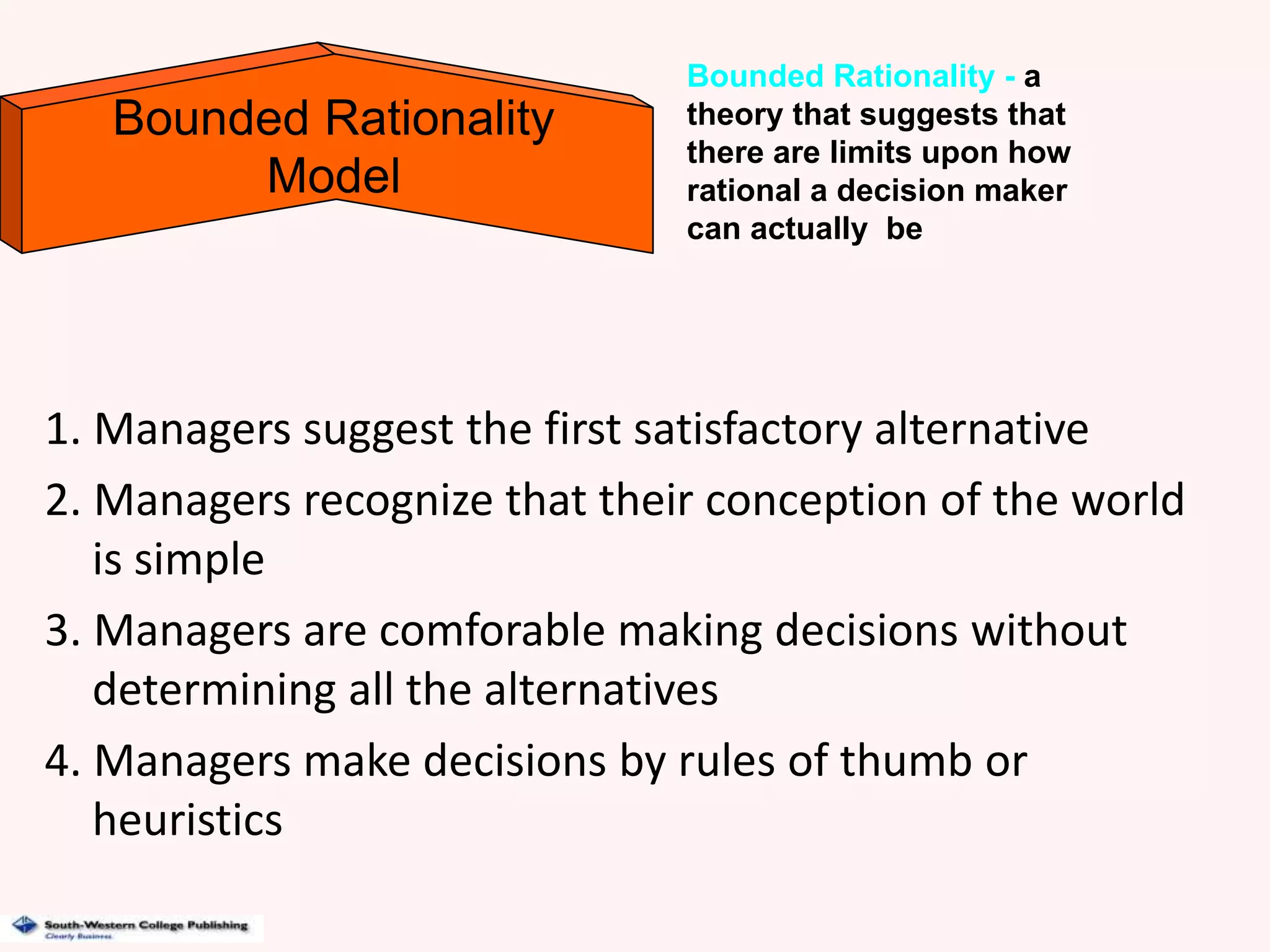
1. Managers suggest the first satisfactory alternative
2. Managers recognize that their conception of the world
is simple
3. Managers are comforable making decisions without
determining all the alternatives
4. Managers make decisions by rules of thumb or
heuristics
Bounded Rationality
Model
Bounded Rationality - a
theory that suggests that
there are limits upon how
rational a decision maker
can actually be
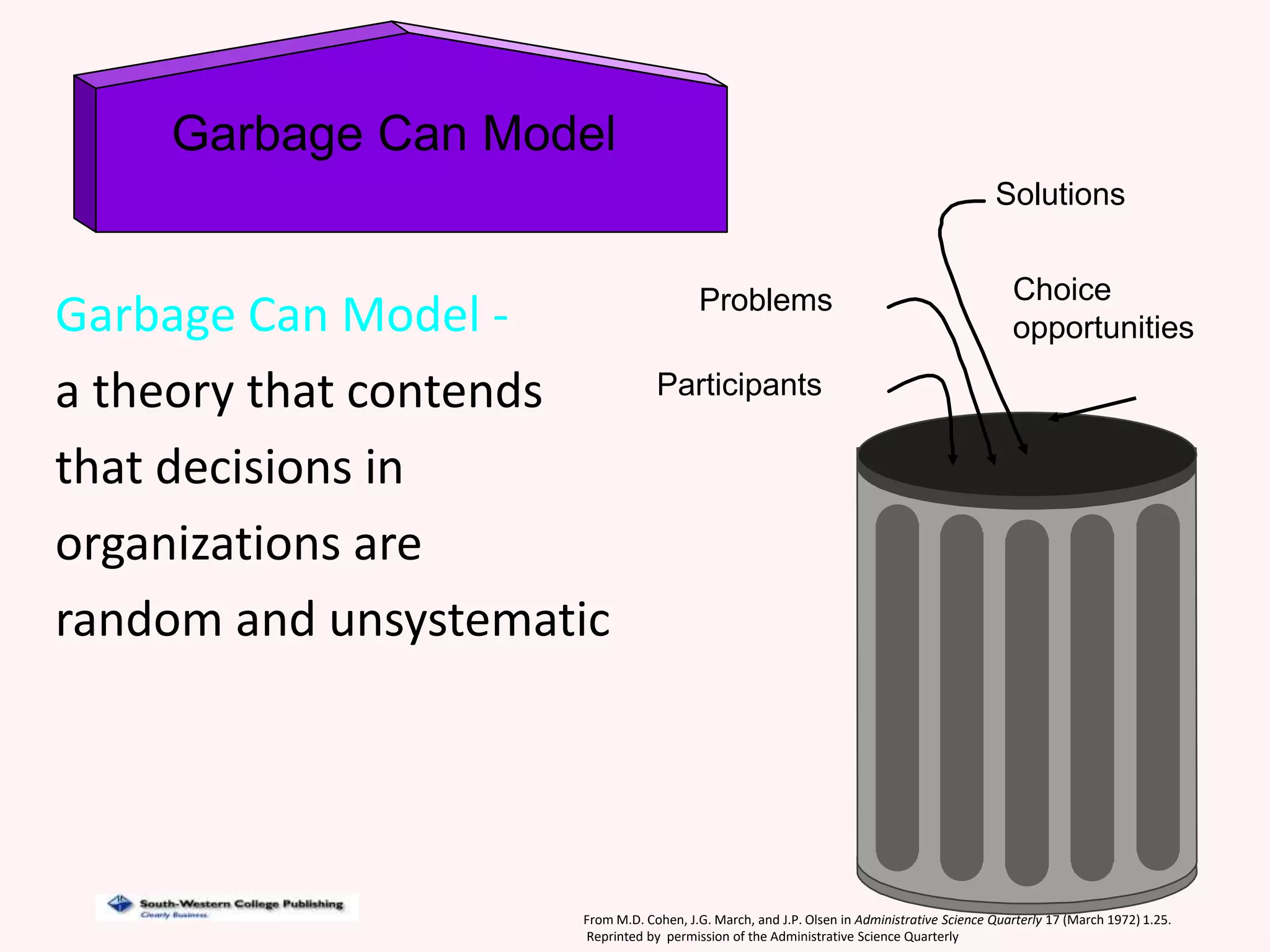
Garbage Can Model -
a theory that contends
that decisions in
organizations are
random and unsystematic
Garbage Can Model
Problems
Solutions
Choice
opportunities
Participants
From M.D. Cohen, J.G. March, and J.P. Olsen in Administrative Science Quarterly 17 (March 1972) 1.25.
Reprinted by permission of the Administrative Science Quarterly
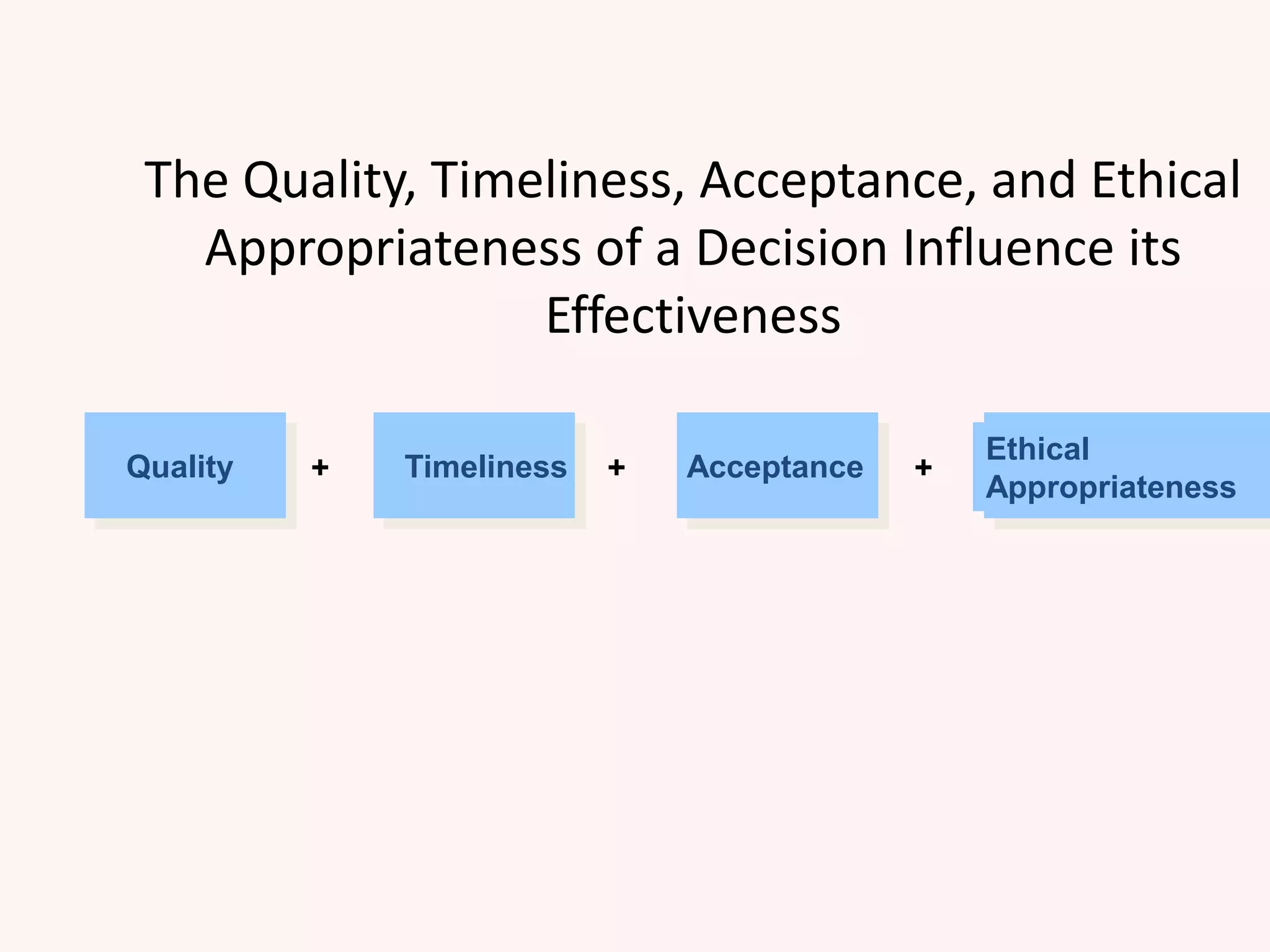
The Quality, Timeliness, Acceptance, and Ethical
Appropriateness of a Decision Influence its
Effectiveness
Quality
Ethical
Appropriateness
Acceptance
Timeliness
+ +
+
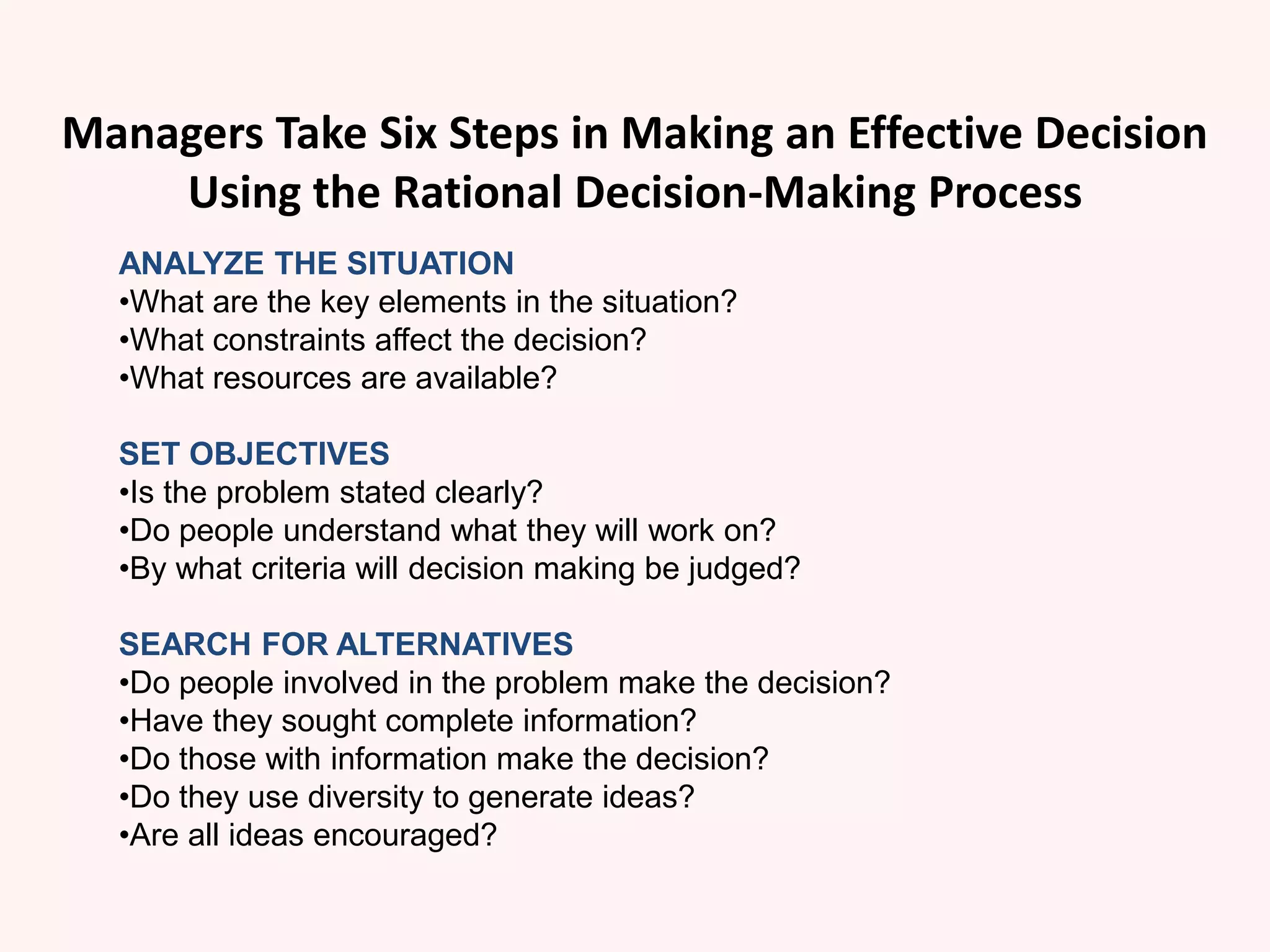
Managers Take Six Steps in Making an Effective Decision
Using the Rational Decision-Making Process
ANALYZE THE SITUATION
•What are the key elements in the situation?
•What constraints affect the decision?
•What resources are available?
SET OBJECTIVES
•Is the problem stated clearly?
•Do people understand what they will work on?
•By what criteria will decision making be judged?
SEARCH FOR ALTERNATIVES
•Do people involved in the problem make the decision?
•Have they sought complete information?
•Do those with information make the decision?
•Do they use diversity to generate ideas?
•Are all ideas encouraged?
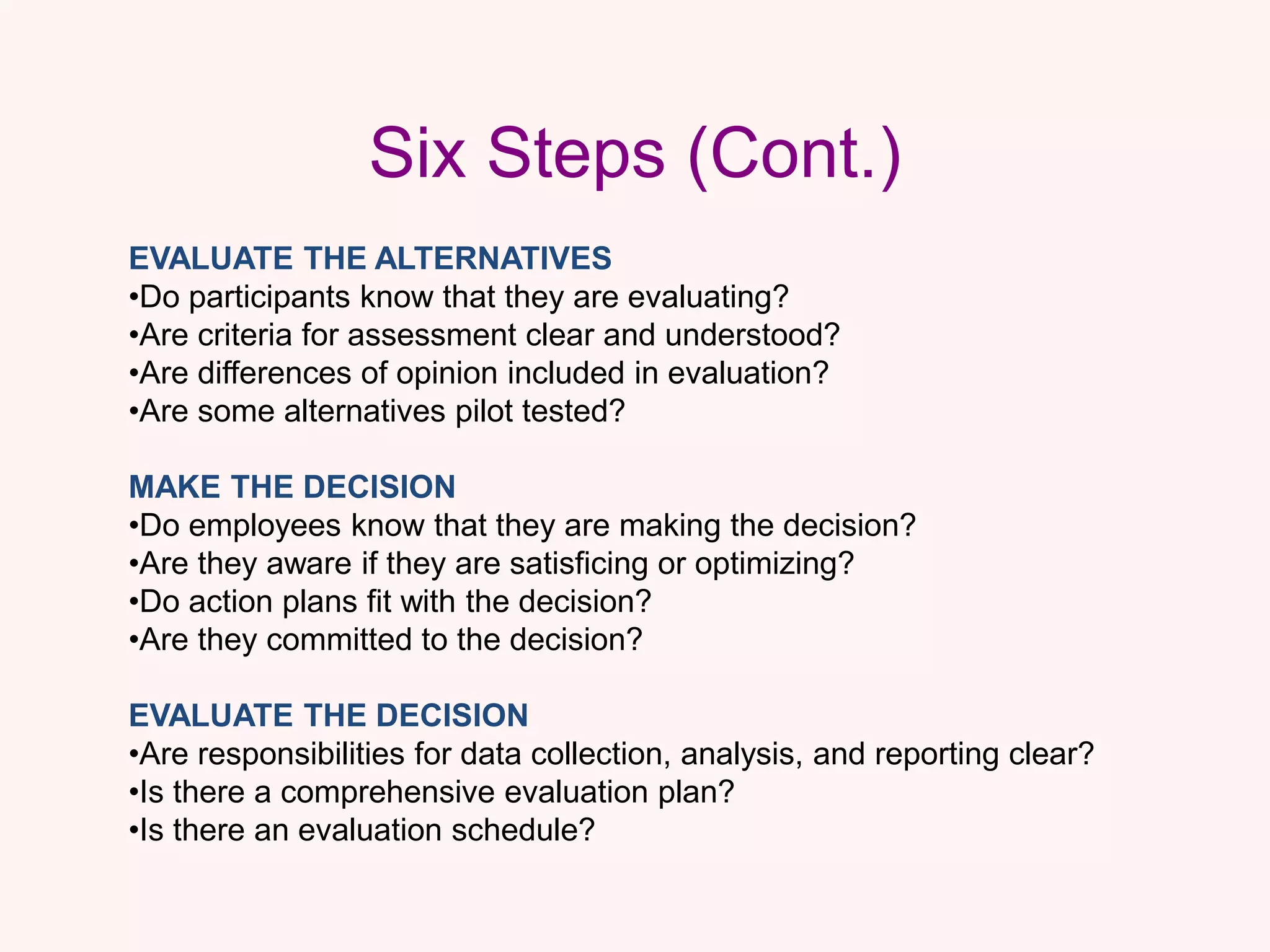
Six Steps (Cont.)
EVALUATE THE ALTERNATIVES
•Do participants know that they are evaluating?
•Are criteria for assessment clear and understood?
•Are differences of opinion included in evaluation?
•Are some alternatives pilot tested?
MAKE THE DECISION
•Do employees know that they are making the decision?
•Are they aware if they are satisficing or optimizing?
•Do action plans fit with the decision?
•Are they committed to the decision?
EVALUATE THE DECISION
•Are responsibilities for data collection, analysis, and reporting clear?
•Is there a comprehensive evaluation plan?
•Is there an evaluation schedule?

Organisational Behaviour Group Dynamics Unit 4.ppt

  • 1.
    MBGM 103 (UNIT4, Part 1) Organisational Behaviour FCM, Rama University
  • 2.
  • 3.
    The model ofgroup development was first proposed by Bruce Tuckman in 1965. He maintained that these phases are all necessary and inevitable in order for: the team to grow to face up to challenges to tackle problems to find solutions to plan work and to deliver results.
  • 4.
    The Five-Stage Modelof Group Development Consists of the following stages: 1. Forming Stage 2. Storming Stage 3. Norming Stage 4. Performing Stage 5. Adjourning Stage
  • 6.
    FORMING STAGE The firststage in group development, characterized by much uncertainty. In this, the team is formed and members meet. They learn what the team opportunities and challenge will be. Members will agree on goals and assign actions for work and ground rules or team guidelines are established. At the start, the team leader may be a member of the group, a supervisor, a manager, or a consultant who will facilitate the team-building process. Leadership will help the team to define their processes. At this stage, the leader needs to be directive and understand the requirements for team training. This stage is complete when the members have begun to think of themselves as a part of a group.
  • 7.
    STORMING STAGE The secondstage in group development, characterized by intragroup conflict. During the second stage, individual expression of ideas occurs and there is open conflict between members. Members tend to focus on details rather than the issues and compete for influence. Low trust among team members is an evident indicator of this stage. The team needs to select their desired leadership style and decision methodology. The team leader can help by stressing tolerance and patience between members. The leader should guide the team process towards clear goals, defined roles, acceptable team behavior, and a mutual feedback process for team communication. When this stage is complete, there will be a relatively clear hierarchy of leadership within the group.
  • 8.
    NORMING STAGE The thirdstage in group development, characterized by close relationships and cohesiveness. In the third stage, the team develops work habits that support group rules and values. They use established tools and methods; exhibit good behaviors; mutual trust, motivation, and open communication increase; positive teamwork and group focus are apparent. The team relationships grow and individual characteristics are understood and appropriately utilized. The team leader continues to encourage participation and professionalism among the team members. This stage is complete when the group structure solidifies and the group has assimilated a common set of expectations of what defines correct member behavior.
  • 9.
    PERFORMING STAGE The fourthstage in group development, when the group is fully functional. The fourth stage shows high levels of loyalty, participation, motivation, and group decision-making. Knowledge sharing, cross-training, and interdependence increases. Team is self-directing in development of plans and strategy to meet their goals and carry out work. Personal growth and sharing is encouraged throughout membership. The leader becomes a facilitator aiding the team in communication processes and helping if they revert to a prior stage. Group energy has moved from getting to know and understand each other to performing the task at hand. Note: For permanent work groups, performing is the last stage in group development.
  • 10.
    ADJOURNING STAGE The finalstage in group development for temporary groups, characterized by concern with wrapping up activities rather than performance. For project teams, temporary committees, or task forces coming to an end, there will be a finalizing stage as they celebrate and recognize group achievement. Then some mourning over the dissolving of the team relationship and begin planning for the change in individual work requirements. During this stage, leadership needs to emphasize organization gratitude and both team and individual recognition. For continuous work teams, there may be a higher performance level as they develop and transform as individuals and reform into revised teams. It is important to note that continuous work teams may revert to prior stages when new people are added to the team.
  • 11.
  • 12.
    FORMAL GROUP INFORMALGROUP A designated work group defined by the organization’s structure. A group that is neither formally structured now organizationally determined; appears in response to the need for social contact.
  • 13.
    FORMAL GROUPS In formalgroups, the behavior that team members should engage in are stipulated by and directed toward organizational goals. The major purpose of formal groups is to perform specific tasks and achieve specific objectives defined by the organization. The most common type of formal work group consists of individuals cooperating under the direction of a leader. Examples of formal groups are departments, divisions, taskforce, project groups, quality circles, committees, and boards of directors.
  • 14.
    FORMAL GROUPS Characteristics ofFormal Groups: They are approved from some authority. There is fixed division of labour Individuals are assigned specific responsibilities. There are personal interactions between the group members. Group members are rewarded. Formal groups can be further classified into: Command Groups Task Groups
  • 15.
    Command Groups A groupcomposed of the individuals who report directly to a given manager. It is determined by the organization chart. Membership in the group arises from each employee’s position on the organizational chart. Examples of a command group are: an academic department chairman and the faculty members in that department, or a director of postal audits and his five inspectors.
  • 16.
    Task Groups Task groupsconsist of people who work together to achieve a common task. Members are brought together to accomplish a narrow range of goals within a specified time period. A task group’s boundaries are not limited to its immediate hierarchical superior, it can cross command relationships. Task groups are also commonly referred to as task forces. The organization appoints members and assigns the goals and tasks to be accomplished. All command groups are also task groups, but reverse need not be true. Examples of assigned tasks are the development of a new product, the improvement of a production process, or the proposal of a motivational contest. Other common task groups are ad hoc committees, project groups, and standing committees.
  • 17.
    INFORMAL GROUPS These groupsare natural formations in the work environment that appear in response to the need of social contact.
  • 18.
    The Decision-Making Process ProgrammedDecision - a simple, routine matter for which a manager has an established decision rule Nonprogrammed Decision - a new, complex decision that requires a creative solution
  • 19.
    The Decision- Making Process Recognize the problemand the need for a decision Identify the objective of the decision Gather and evaluate data and diagnose the situation List and evaluate alternatives
  • 20.
    The Decision- Making Process Select the best courseof action Implement the decision Gather feedback Follow up
  • 21.
    Models of Decision-Making Effectivedecision a timely decision that meets a desired objective and is acceptable to those individuals affected by it Garbage Can Model Bounded Rationality Model Rational Model
  • 22.
    1. The outcomewill be completely rational 2. The decision maker uses a consistent system of preferences to choose the best alternative 3. The decision maker is aware of all alternatives 4. The decision maker can calculate the probability of success for each alternative Rational Model Rationality - a logical, step-by-step approach to decision making, with a thorough analysis of alternatives and their consequences
  • 23.
    1. Managers suggestthe first satisfactory alternative 2. Managers recognize that their conception of the world is simple 3. Managers are comforable making decisions without determining all the alternatives 4. Managers make decisions by rules of thumb or heuristics Bounded Rationality Model Bounded Rationality - a theory that suggests that there are limits upon how rational a decision maker can actually be
  • 24.
    Garbage Can Model- a theory that contends that decisions in organizations are random and unsystematic Garbage Can Model Problems Solutions Choice opportunities Participants From M.D. Cohen, J.G. March, and J.P. Olsen in Administrative Science Quarterly 17 (March 1972) 1.25. Reprinted by permission of the Administrative Science Quarterly
  • 25.
    The Quality, Timeliness,Acceptance, and Ethical Appropriateness of a Decision Influence its Effectiveness Quality Ethical Appropriateness Acceptance Timeliness + + +
  • 26.
    Managers Take SixSteps in Making an Effective Decision Using the Rational Decision-Making Process ANALYZE THE SITUATION •What are the key elements in the situation? •What constraints affect the decision? •What resources are available? SET OBJECTIVES •Is the problem stated clearly? •Do people understand what they will work on? •By what criteria will decision making be judged? SEARCH FOR ALTERNATIVES •Do people involved in the problem make the decision? •Have they sought complete information? •Do those with information make the decision? •Do they use diversity to generate ideas? •Are all ideas encouraged?
  • 27.
    Six Steps (Cont.) EVALUATETHE ALTERNATIVES •Do participants know that they are evaluating? •Are criteria for assessment clear and understood? •Are differences of opinion included in evaluation? •Are some alternatives pilot tested? MAKE THE DECISION •Do employees know that they are making the decision? •Are they aware if they are satisficing or optimizing? •Do action plans fit with the decision? •Are they committed to the decision? EVALUATE THE DECISION •Are responsibilities for data collection, analysis, and reporting clear? •Is there a comprehensive evaluation plan? •Is there an evaluation schedule?

Editor's Notes

  • #11 Responses of group members vary in this stage.
  • #17 Ad hoc committees are temporary groups created to resolve a specific complaint or develop a process. Project groups are similar to ad hoc committees and normally disband after the group completes the assigned task. Standing committees are more permanent than ad hoc committees and project groups. They maintain longer life spans by rotating members into the group.
  • #19 2
  • #20 3
  • #21 4
  • #22 5
  • #23 6
  • #24 7
  • #25 8