
Oracle
CONTROL STRUCTURE
PL/SQL IF/THEN/ELSE Statement
The IF/THEN statement checks a Boolean value or expression
and if true, executes the statements in the THEN clause. 
If the condition is false, the statements in the THEN
clause are skipped and execution jumps to the END IF, and
the expression that is checked must return a true or
false. It can be a simple Boolean variable or a compound 
expression joined with AND/OR clauses, and the expression
can even be a PL/SQL function that returns a Boolean
value. 
• IF...THEN
• IF...THEN...ELSE
• IF...THEN...ELSIF...ENDIF
• IF…THEN…ELSIF…THEN…ELSE…END IF
•
IF THEN statement
• IF THEN...END IF statement is a single-level 
conditional statement which executes a sequence of
statements based on a given condition. 
• Syntax:
IF condition THEN
executable statements
END IF;
• Condition
Expression evaluates to TRUE or FALSE
If TRUE commands execute
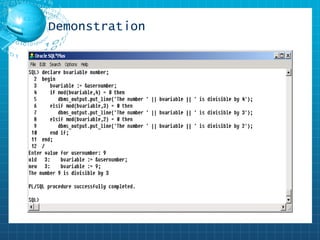
Demonstration
5
PL/SQL Comparison Operators
IF THEN ELSE statement
• The IF-THEN-ELSE statement is next level of extension 
of above the IF-THEN statement, as it provides the 
ability to give direction for FALSE or NULL also.
• Syntax: 
IF condition THEN
executable statements 1
ELSE
executable statements 2
END IF;
Demonstration
IF THEN ELSIF ENDIF statement 
 
• For multiple possible outcomes of a condition, we
use the IF THEN ELSIF ENDIF statement   
• Syntax:
  IF condition1 THEN
sequence_of_statements1
ELSIF condition2 THEN
sequence_of_statements2
ELSE
sequence_of_statements3
END IF;
Demonstration
Nested IF statement
• When using an ELSIF construct, it is not necessary
to specify what action should be taken if none of
the conditions evaluate to TRUE. In other words, an
ELSE clause is not required in the ELSIF construct.
Oracle pl/sql control statments

Oracle pl/sql control statments

  • 1.
  • 2.
    PL/SQL IF/THEN/ELSE Statement TheIF/THEN statement checks a Boolean value or expression and if true, executes the statements in the THEN clause.  If the condition is false, the statements in the THEN clause are skipped and execution jumps to the END IF, and the expression that is checked must return a true or false. It can be a simple Boolean variable or a compound  expression joined with AND/OR clauses, and the expression can even be a PL/SQL function that returns a Boolean value.  • IF...THEN • IF...THEN...ELSE • IF...THEN...ELSIF...ENDIF • IF…THEN…ELSIF…THEN…ELSE…END IF •
  • 3.
    IF THEN statement •IF THEN...END IF statement is a single-level  conditional statement which executes a sequence of statements based on a given condition.  • Syntax: IF condition THEN executable statements END IF; • Condition Expression evaluates to TRUE or FALSE If TRUE commands execute
  • 4.
  • 5.
  • 6.
    IF THEN ELSEstatement • The IF-THEN-ELSE statement is next level of extension  of above the IF-THEN statement, as it provides the  ability to give direction for FALSE or NULL also. • Syntax:  IF condition THEN executable statements 1 ELSE executable statements 2 END IF;
  • 7.
  • 8.
    IF THEN ELSIFENDIF statement    • For multiple possible outcomes of a condition, we use the IF THEN ELSIF ENDIF statement    • Syntax:   IF condition1 THEN sequence_of_statements1 ELSIF condition2 THEN sequence_of_statements2 ELSE sequence_of_statements3 END IF;
  • 9.
  • 10.
    Nested IF statement •When using an ELSIF construct, it is not necessary to specify what action should be taken if none of the conditions evaluate to TRUE. In other words, an ELSE clause is not required in the ELSIF construct.