DISCOVER . LEARN . EMPOWER
Conditional Control Structure
APEX INSTITUTE OF TECHNOLOGY
DEPARTMENT OF COMPUTER SCIENCE & ENGINEERING
Database Management System (21CSH-243)
Faculty: Mr. Saurabh Singhal(E12800)
1
DBMS: Course Objectives
2
COURSE OBJECTIVES
The Course aims to:
• Understand database system concepts and design databases for different
applications and to acquire the knowledge on DBMS and RDBMS.
• Implement and understand different types of DDL, DML and DCL statements.
• Understand transaction concepts related to databases and recovery/backup
techniques required for the proper storage of data.
COURSE OUTCOMES
3
On completion of this course, the students shall be able to:-
CO3
Apply relational algebra and relational calculus to query the database of
organization
Lecture Outline
• Control Structures of PL/SQL
• Loops
• Nested Loops
• For
• While
4
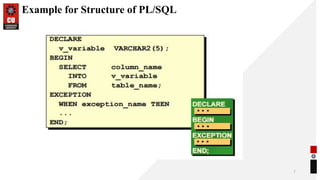
Structure of PL/SQL
5
Structure of PL/SQL
6
Example for Structure of PL/SQL
7
Example for Structure of PL/SQL
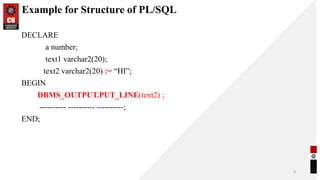
DECLARE
a number;
text1 varchar2(20);
text2 varchar2(20) := “HI”;
BEGIN
DBMS_OUTPUT.PUT_LINE(text2) ;
---------- ---------- ----------;
END;
8
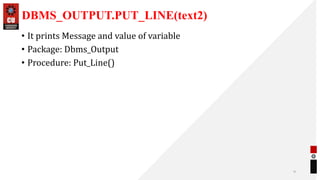
DBMS_OUTPUT.PUT_LINE(text2)
• It prints Message and value of variable
• Package: Dbms_Output
• Procedure: Put_Line()
9
PL/SQL Control Structure
PL/SQL has a number of control structures which includes:
• Conditional controls
• Iterative or loop controls.
It is these controls, used singly or together, that allow the PL/SQL
developer to direct the flow of execution through the program.
10
PL/SQL Control Structure: Conditional Controls
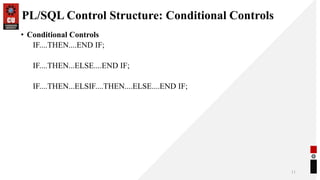
• Conditional Controls
IF....THEN....END IF;
IF....THEN...ELSE....END IF;
IF....THEN...ELSIF....THEN....ELSE....END IF;
11
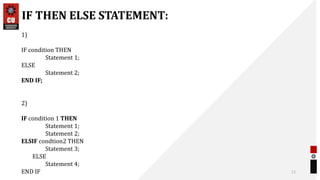
IF THEN ELSE STATEMENT:
12
1)
IF condition THEN
Statement 1;
ELSE
Statement 2;
END IF;
2)
IF condition 1 THEN
Statement 1;
Statement 2;
ELSIF condtion2 THEN
Statement 3;
ELSE
Statement 4;
END IF
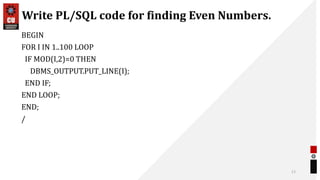
Write PL/SQL code for finding Even Numbers.
BEGIN
FOR I IN 1..100 LOOP
IF MOD(I,2)=0 THEN
DBMS_OUTPUT.PUT_LINE(I);
END IF;
END LOOP;
END;
/
13
//Write PL/SQL code to find Largest of three numbers.
DECLARE
A NUMBER;
B NUMBER;
C NUMBER;
BEGIN
A:=&A;
B:=&B;
C:=&C;
IF A=B AND B=C AND C=A THEN
DBMS_OUTPUT.PUT_LINE('ALL ARE EQUAL');
ELSE IF A>B AND A>C THEN
DBMS_OUTPUT.PUT_LINE('A IS GREATER');
ELSE IF B>C THEN
DBMS_OUTPUT.PUT_LINE('B IS GREATER');
ELSE
DBMS_OUTPUT.PUT_LINE('C IS GREATER');
END IF;
END IF;
END IF;
END;/ 14
References
• RamezElmasri and Shamkant B. Navathe, “Fundamentals of Database
System”, The Benjamin / Cummings Publishing Co.
• Korth and Silberschatz Abraham, “Database System Concepts”,
McGraw Hall.
• C.J.Date, “An Introduction to Database Systems”, Addison Wesley.
• Thomas M. Connolly, Carolyn & E. Begg, “Database Systems: A Practical
Approach to Design, Implementation and Management”, 5/E,
University of Paisley, Addison-Wesley.
15
THANK YOU
For queries
Email: saurabh.e12800@cumail.in
16

Lecture 2.3.26_Conditional Control Structure.pptx

  • 1.
    DISCOVER . LEARN. EMPOWER Conditional Control Structure APEX INSTITUTE OF TECHNOLOGY DEPARTMENT OF COMPUTER SCIENCE & ENGINEERING Database Management System (21CSH-243) Faculty: Mr. Saurabh Singhal(E12800) 1
  • 2.
    DBMS: Course Objectives 2 COURSEOBJECTIVES The Course aims to: • Understand database system concepts and design databases for different applications and to acquire the knowledge on DBMS and RDBMS. • Implement and understand different types of DDL, DML and DCL statements. • Understand transaction concepts related to databases and recovery/backup techniques required for the proper storage of data.
  • 3.
    COURSE OUTCOMES 3 On completionof this course, the students shall be able to:- CO3 Apply relational algebra and relational calculus to query the database of organization
  • 4.
    Lecture Outline • ControlStructures of PL/SQL • Loops • Nested Loops • For • While 4
  • 5.
  • 6.
  • 7.
  • 8.
    Example for Structureof PL/SQL DECLARE a number; text1 varchar2(20); text2 varchar2(20) := “HI”; BEGIN DBMS_OUTPUT.PUT_LINE(text2) ; ---------- ---------- ----------; END; 8
  • 9.
    DBMS_OUTPUT.PUT_LINE(text2) • It printsMessage and value of variable • Package: Dbms_Output • Procedure: Put_Line() 9
  • 10.
    PL/SQL Control Structure PL/SQLhas a number of control structures which includes: • Conditional controls • Iterative or loop controls. It is these controls, used singly or together, that allow the PL/SQL developer to direct the flow of execution through the program. 10
  • 11.
    PL/SQL Control Structure:Conditional Controls • Conditional Controls IF....THEN....END IF; IF....THEN...ELSE....END IF; IF....THEN...ELSIF....THEN....ELSE....END IF; 11
  • 12.
    IF THEN ELSESTATEMENT: 12 1) IF condition THEN Statement 1; ELSE Statement 2; END IF; 2) IF condition 1 THEN Statement 1; Statement 2; ELSIF condtion2 THEN Statement 3; ELSE Statement 4; END IF
  • 13.
    Write PL/SQL codefor finding Even Numbers. BEGIN FOR I IN 1..100 LOOP IF MOD(I,2)=0 THEN DBMS_OUTPUT.PUT_LINE(I); END IF; END LOOP; END; / 13
  • 14.
    //Write PL/SQL codeto find Largest of three numbers. DECLARE A NUMBER; B NUMBER; C NUMBER; BEGIN A:=&A; B:=&B; C:=&C; IF A=B AND B=C AND C=A THEN DBMS_OUTPUT.PUT_LINE('ALL ARE EQUAL'); ELSE IF A>B AND A>C THEN DBMS_OUTPUT.PUT_LINE('A IS GREATER'); ELSE IF B>C THEN DBMS_OUTPUT.PUT_LINE('B IS GREATER'); ELSE DBMS_OUTPUT.PUT_LINE('C IS GREATER'); END IF; END IF; END IF; END;/ 14

  • 15.
    References • RamezElmasri andShamkant B. Navathe, “Fundamentals of Database System”, The Benjamin / Cummings Publishing Co. • Korth and Silberschatz Abraham, “Database System Concepts”, McGraw Hall. • C.J.Date, “An Introduction to Database Systems”, Addison Wesley. • Thomas M. Connolly, Carolyn & E. Begg, “Database Systems: A Practical Approach to Design, Implementation and Management”, 5/E, University of Paisley, Addison-Wesley. 15
  • 16.
    THANK YOU For queries Email:saurabh.e12800@cumail.in 16