Seite 1Oracle ACM Implementation Best Practices
Andrejus Baranovskis
CEO & Architect | Oracle ACE Director
Red Samurai Consulting
Danilo Schmiedel
Solution Architect | Oracle ACE Director
OPITZ CONSULTING Deutschland GmbH
Oracle ACM Implementation Best Practices
March 04. 2015
Fusion Middleware Partner Community Forum XX
Seite 2Oracle ACM Implementation Best Practices
About OPITZ CONSULTING
 Founded in 1990, located in Germany and Poland
 Business IT Alignment, BPM, SOA and system integration, Application development,
IT Infrastructure Management
 Oracle Platinum Partner
 Two Oracle ACE Directors
 Recognized as one of the leading Oracle Fusion Middleware Partners
 Specialized in SOA, BPM, ADF & Application Grid, Exadata, Business Intelligence
Foundation, Oracle Database, Oracle Enterprise Linux, Real Application Cluster,
Oracle VM, Data Warehousing, DB11g Performance Tuning
 2014 ORACLE BPM Partner Community Award
 2010 Oracle Fusion Middleware Award
 2008 – 2010 EMEA SOA Community Award
Seite 3Oracle ACM Implementation Best Practices
About Red Samurai Consulting
 ADF, SOA , BPM, WebCenter and UCM
 Small Team of Experts, Focused on Technical Quality Results
 Customers – Global Corporations, Medium and Small Business
 Oracle Technical Blog – 8 Years (~700 posts)
 Oracle Fusion Middleware Innovation Award 2010
 SOA Partner Community Award for Outstanding Contribution
Across the World 2010
 2010 Enterprise 2.0 Blazer: Enterprise 2.0 Leader Award
Seite 4Oracle ACM Implementation Best Practices
Example | MedNet – Health Insurance
COMPANY OVERVIEW
 Specialists in Health Insurance since 1992, member of Munich Health
CHALLENGES/OPPORTUNITIES
 BPM processes are not flexible enough
 Modern Health Insurance requires agile integration
 ACM is a great candidate to close the gap
SOLUTION
 Invoice Processing, Enrolment Process, Claim Handling
 Integration with Oracle Mobile Suite
 Dynamic ADF UI with ACM Rule Engine
 ACM Rules Development with Process Composer
 Oracle BPM Workspace Usage
Seite 5Oracle ACM Implementation Best Practices
Structured / Unstructured Processes
Seite 6Oracle ACM Implementation Best Practices
Travel Request
A typical example of a structured process
Submitter
Submit Travel
Request
Manager
Review &
Approve
Final Approval
Rule Driven
Management Review
Notification
Approved?
Big Boss
Seite 7Oracle ACM Implementation Best Practices
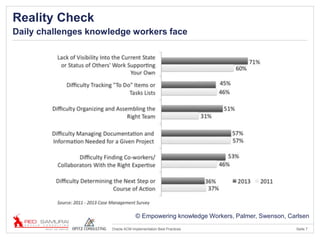
Reality Check
Daily challenges knowledge workers face
© Empowering knowledge Workers, Palmer, Swenson, Carlsen
Seite 8Oracle ACM Implementation Best Practices
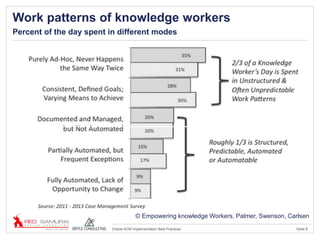
Work patterns of knowledge workers
Percent of the day spent in different modes
© Empowering knowledge Workers, Palmer, Swenson, Carlsen
Seite 9Oracle ACM Implementation Best Practices
Ad-Hoc, Unstructured and Unpredictable
What does that mean?
 Healthcare
 24.331 events
 627 patients
 376 different activities
Source: W. van der Aalst et al.,
“Process Mining Manifesto:
Toward Real Business Intelligence”
Seite 10Oracle ACM Implementation Best Practices
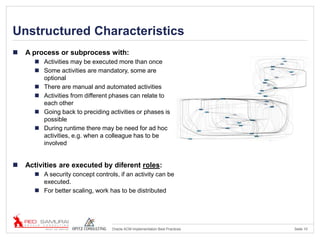
Unstructured Characteristics
 A process or subprocess with:
 Activities may be executed more than once
 Some activities are mandatory, some are
optional
 There are manual and automated activities
 Activities from different phases can relate to
each other
 Going back to preciding activities or phases is
possible
 During runtime there may be need for ad hoc
activities, e.g. when a colleague has to be
involved
 Activities are executed by diferent roles:
 A security concept controls, if an activity can be
executed.
 For better scaling, work has to be distributed
Seite 11Oracle ACM Implementation Best Practices
What is (sometimes) missed in pure BPMN?
Or: what we expect from an ACM solution
Doing by
Design Design by
Doing!
More flexibility Suggestions and
continuous decision
improvement – what
is the next best
action?
Integration of
different systems
Guidance - faster
enablement of
new colleagues
Situation-Driven
work
Seite 12Oracle ACM Implementation Best Practices
Anatomy of an ACM Solution (Example)
Seite 13Oracle ACM Implementation Best Practices
 Many different claim types
with specifics in regulation
 Missing user guidance
 Hidden knowledge from
experienced workers
 Many different systems and
independent solutions
 Telephone, Email, Correspondence
 Integration of different partners
 Task Management
 Many requests through different channels in case of a natural
disasters (in parallel)
 Limited tracability and lack of reporting
Challenges in Claims Management
Seite 14Oracle ACM Implementation Best Practices
Case Management UI Example (expanded)
Seite 15Oracle ACM Implementation Best Practices
Case UI – Navigation and Search
Seite 16Oracle ACM Implementation Best Practices
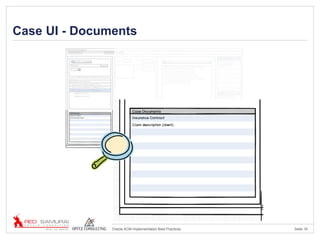
Case UI - Documents
Seite 17Oracle ACM Implementation Best Practices
Case UI – Data
Details about the claim and it‘s related entities
Seite 18Oracle ACM Implementation Best Practices
Case UI – Milestones & History
Where I am?
Seite 19Oracle ACM Implementation Best Practices
Case UI – Activities
What can I do next?
Seite 20Oracle ACM Implementation Best Practices
Case Management Solution Components
Task EngineDMS Case / Process Engine
System
Integration
Suggest Next Step
Central
entity
Related
entity
(1)
Related
entity
(2)
Related
entity
(3)
Knowledge Area
Quick Overview
Related Docs
Audittrail / Analytics
History
Navigation
Seite 21Oracle ACM Implementation Best Practices
Case Management in Oracle BPM
Claim
Seite 22Oracle ACM Implementation Best Practices
Adaptivity
Seite 23Oracle ACM Implementation Best Practices
What is meant with „adaptive“?
© Clemens Utschig-Utschig
Seite 24Oracle ACM Implementation Best Practices
Dynamic and „build to change“
What has to be defined during design-time?
© Clemens Utschig-Utschig
Defintition of: Activities, Milestones, Rules, Events, Data, Stakeholders
Seite 25Oracle ACM Implementation Best Practices
The value of Dynamic Case Management
 Change the „flow“ of the case without re-deployment
 Define and change which activities are available in the
different phases of a case without re-deployment (adjust
pre-/post-conditions)
 Define automatic triggering of e.g. case activities based on
milestones, outcomes and events
 Move milestones without re-deployment (e.g. milestone
„Assessment finished“ requires the execution of additional
activities)
 Add an additional activity call
 Without re-deployment: possible, if the activity already exists
 With re-deployment: if the activity didn‘t exist before (might require instance
migration)
Seite 26Oracle ACM Implementation Best Practices
Adaptivity in Oracle ACM
 Create Ad-Hoc Tasks
at anytime
 Create Ad-Hoc
Notifications
 Dynamic addition of
activities to the list of
available actions
Seite 27Oracle ACM Implementation Best Practices
Case Requirements / Getting Started
(before you start coding in JDev)
Seite 28Oracle ACM Implementation Best Practices
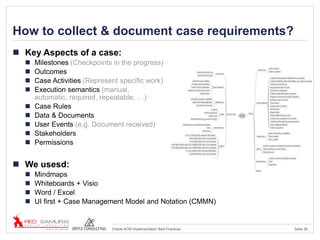
How to collect & document case requirements?
 Key Aspects of a case:
 Milestones (Checkpoints in the progress)
 Outcomes
 Case Activities (Represent specific work)
 Execution semantics (manual,
automatic, required, repeatable, …)
 Case Rules
 Data & Documents
 User Events (e.g. Document received)
 Stakeholders
 Permissions
 We usesd:
 Mindmaps
 Whiteboards + Visio
 Word / Excel
 UI first + Case Management Model and Notation (CMMN)
Seite 29Oracle ACM Implementation Best Practices
Case Requirements | Whiteboard
Seite 30Oracle ACM Implementation Best Practices
Case Requirements | Specification Sheet
Seite 31Oracle ACM Implementation Best Practices
Case Requirements | CMMN
 Defined by the OMG as a new standard for
Case Modeling
 Released in May 2014
 Is a notation for modeling and graphically expressing a case
 Is an interchange format for exchanging Case Models
among different tools
 Vendors like IBM, Oracle, SAP, Kofax, Cordys and Tibco
have contributed to this standard
 Download our CMMN / ACM Poster from
acmcommunity.com
Seite 32Oracle ACM Implementation Best Practices
CMMN | Case Plan Model
Case Name
 The complete behavior model of a Case is captured in a
CasePlanModel.
 It comprises both:
 all elements that represent the initial plan of the Case,
 and all elements that support the further evolution of the plan
through run-time planning by case workers.
Seite 33Oracle ACM Implementation Best Practices
CMMN | Plan Model Elements
Stages
Seite 34Oracle ACM Implementation Best Practices
CMMN | Plan Model Elements
Milestones & Event Listeners
Seite 35Oracle ACM Implementation Best Practices
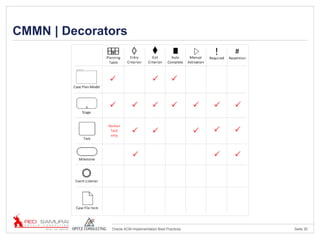
CMMN | Decorators
Seite 36Oracle ACM Implementation Best Practices
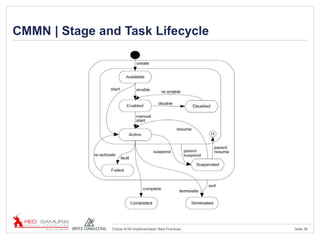
CMMN | Stage and Task Lifecycle
Seite 37Oracle ACM Implementation Best Practices
Case Requirements | CMMN + UI
We‘ve made our best experiences with CMMN + UI approach
CMMN Model
User Interface
Seite 38Oracle ACM Implementation Best Practices
[1] Situation after starting the case
What has been completed?
Seite 39Oracle ACM Implementation Best Practices
[1] Situation after starting the case
Which activity is has been activated?
Seite 40Oracle ACM Implementation Best Practices
[1] Situation after starting the case
Which activities are available in addition?
Seite 41Oracle ACM Implementation Best Practices
[2] Situation after completing „Create Claims N…“
What has been completed?
Seite 42Oracle ACM Implementation Best Practices
[2] Situation after completing „Create Claims N…“
What has been activated? (no automatic activation in that stage)
Seite 43Oracle ACM Implementation Best Practices
[2] Situation after completing „Create Claims N…“
Which activities are available in addition?
Seite 44Oracle ACM Implementation Best Practices
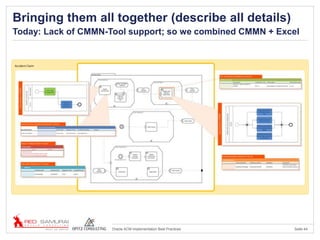
Bringing them all together (describe all details)
Today: Lack of CMMN-Tool support; so we combined CMMN + Excel
Seite 45Oracle ACM Implementation Best Practices
OK, we know that we have to identify the relevant
activities, milestones, rules and so on…
How do we know which artifacts
are really needed?
Seite 46Oracle ACM Implementation Best Practices
Modeling Exercise „Underwriting“
Text-to-Model
„Sometimes the applicant receives a callback by phone to
answer additional questions within a medical questionnaire.
The clerk decides whether this is possible or not – based on
his experience and his skills.
If the clerk called the applicant the resulting protocoll has to be
reviewed by one of his colleagues.
In case of any abnormalities the doctors of the applicant can
be consulted. This always happens by fax. The doctor is
answering back by Fax as well. A clerk evaluates the
examination. This can affect the underwriting result.“
Seite 47Oracle ACM Implementation Best Practices
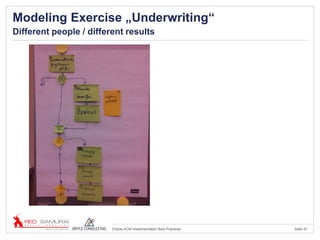
Modeling Exercise „Underwriting“
Different people / different results
Seite 48Oracle ACM Implementation Best Practices
Modeling Exercise „Underwriting“
Different people / different results
Seite 49Oracle ACM Implementation Best Practices
Modeling Exercise „Underwriting“
Different people / different results
Seite 50Oracle ACM Implementation Best Practices
Modeling Exercise „Underwriting“
Different people / different results
Seite 51Oracle ACM Implementation Best Practices
Emerging paths (The Oregon Experiment)
http://www.nature.com/nature/journal/v388/n6637/fig_tab/388047a0_F1.html
Seite 52Oracle ACM Implementation Best Practices
Demo: Process Mining
Seite 53Oracle ACM Implementation Best Practices
Case Implementation
Seite 54Oracle ACM Implementation Best Practices
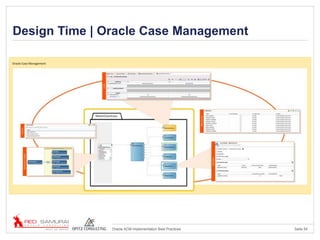
Design Time | Oracle Case Management
Seite 55Oracle ACM Implementation Best Practices
Demo: Case Implementation
Seite 56Oracle ACM Implementation Best Practices
Design Time | Case Rules
Seite 57Oracle ACM Implementation Best Practices
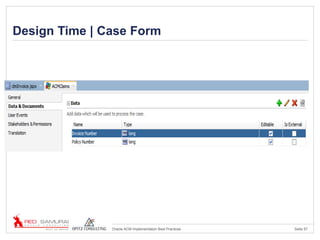
Design Time | Case Form
Seite 58Oracle ACM Implementation Best Practices
Design Time | Activity Form
Seite 59Oracle ACM Implementation Best Practices
Design Time | Human Task Form
Seite 60Oracle ACM Implementation Best Practices
Human Task Form – Frame Busting
Use – “never”, default “differentDomain” doesn’t work in BPM Workspace
Seite 61Oracle ACM Implementation Best Practices
ADF Library Reuse
ADF Shared Library usage is recommended
Seite 62Oracle ACM Implementation Best Practices
ADF Security
No Web Authentication is recommended
Seite 63Oracle ACM Implementation Best Practices
Existing ADF Form Integration
Seite 64Oracle ACM Implementation Best Practices
Simplified ADF Form Integration
Seite 65Oracle ACM Implementation Best Practices
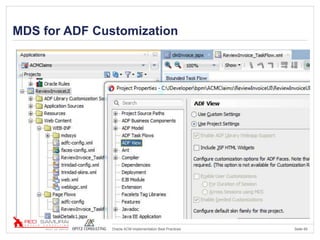
MDS for ADF Customization
Seite 66Oracle ACM Implementation Best Practices
MDS for ADF Customization
Seite 67Oracle ACM Implementation Best Practices
A few more recommendations…
 Avoid to put all the case data into the case (just take the
data attributes which are needed to control the flow)
 Use BPMN activities as a wrapper (to call services, to call
human tasks)
 Use „Java Custom Case Activity“ for prototyping
 Structure your rules (Maintenance!)
 One Decision Table per: Case Lifecycle Event Rules, Case Milestone Event
Rules, Case Activity Event Rules, User Defined Event Rules, Case Data
Event Rule, Case Document Event Rule
 One ruleset per CMMN-Stage
 Use the „identificationkey“ attribute for mapping business
related identifiers to case instance
Seite 68Oracle ACM Implementation Best Practices
Download: www.thecattlecrew.com
Seite 69Oracle ACM Implementation Best Practices
Questions?
www.thecattlecrew.com
Seite 70Oracle ACM Implementation Best Practices
Contact
Andrejus Baranovskis
CEO & Archtitect | Oracle ACE Director
Red Samurai Consulting
Phone: +49 173 54 79 302
Mail: andrejus.baranovskis@redsamurai.com
Twitter: @andrejusb
Blog: http://andrejusb.blogspot.de
Danilo Schmiedel
Solution Architect
OPITZ CONSULTING Deutschland GmbH
Kirchstr. 6, 51647 Gummersbach, Germany
Phone: +49 173 7279001
Mail: danilo.schmiedel@opitz-consulting.com
Twitter: @dschmied
Blog: http://inside-bpm-and-soa.blogspot.com
www.thecattlecrew.com
Seite 71Oracle ACM Implementation Best Practices
Additional Content
Seite 72Oracle ACM Implementation Best Practices
Why we didn‘t choose a process (here)?
Differences and Limitations
 More modeling and implementation effort necessary to
implement processes with
 Activities, which are always available
 Activities with certain preconditions
 GoTo‘s and Returns
 Milestones
 Ad-Hoc tasks not supported in BPMN during runtime
 No change of the control flow without redeployment
Seite 73Oracle ACM Implementation Best Practices
Always executable and optional Actions
 BPMN: Implemented as Event-based Subprocess
 CMMN: Discretionary Task with „Repetition“ Decorator
Seite 74Oracle ACM Implementation Best Practices
Activities with certain preconditions
 BPMN: Implemented as Event-based subprocess with
gateway to check if all requirements are fulfilled
 CMMN: Task with Sentry and appropriate Rule / Expression
Seite 75Oracle ACM Implementation Best Practices
Mark a certain process state
 BPMN: Tracking via state variable within the process
 CMMN: Definition of Milestones
Option 1
Option 2
Option 3
Seite 76Oracle ACM Implementation Best Practices
Master-Detail: Creation of Child-Processes
 BPMN: Dynamic call of new detail processes via return loops
 CMMN: Case-Task with „Repetition“ Decorator
Seite 77Oracle ACM Implementation Best Practices
Why we didn‘t choose a process (here)?
Differences and Limitations
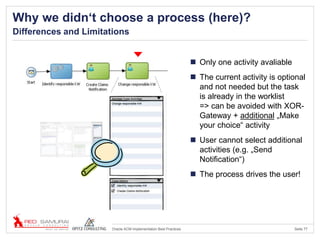
 Only one activity avaliable
 The current activity is optional
and not needed but the task
is already in the worklist
=> can be avoided with XOR-
Gateway + additional „Make
your choice“ activity
 User cannot select additional
activities (e.g. „Send
Notification“)
 The process drives the user!
Seite 78Oracle ACM Implementation Best Practices
Why we didn‘t choose a process (here)?
Differences and Limitations (2)
 No activity available
 Process instance has to wait
for the requested documents
 User cannot select additional
activities during that time
(e.g. „Send Notification“)

Oracle ACM Implementation - Best Practices

  • 1.
    Seite 1Oracle ACMImplementation Best Practices Andrejus Baranovskis CEO & Architect | Oracle ACE Director Red Samurai Consulting Danilo Schmiedel Solution Architect | Oracle ACE Director OPITZ CONSULTING Deutschland GmbH Oracle ACM Implementation Best Practices March 04. 2015 Fusion Middleware Partner Community Forum XX
  • 2.
    Seite 2Oracle ACMImplementation Best Practices About OPITZ CONSULTING  Founded in 1990, located in Germany and Poland  Business IT Alignment, BPM, SOA and system integration, Application development, IT Infrastructure Management  Oracle Platinum Partner  Two Oracle ACE Directors  Recognized as one of the leading Oracle Fusion Middleware Partners  Specialized in SOA, BPM, ADF & Application Grid, Exadata, Business Intelligence Foundation, Oracle Database, Oracle Enterprise Linux, Real Application Cluster, Oracle VM, Data Warehousing, DB11g Performance Tuning  2014 ORACLE BPM Partner Community Award  2010 Oracle Fusion Middleware Award  2008 – 2010 EMEA SOA Community Award
  • 3.
    Seite 3Oracle ACMImplementation Best Practices About Red Samurai Consulting  ADF, SOA , BPM, WebCenter and UCM  Small Team of Experts, Focused on Technical Quality Results  Customers – Global Corporations, Medium and Small Business  Oracle Technical Blog – 8 Years (~700 posts)  Oracle Fusion Middleware Innovation Award 2010  SOA Partner Community Award for Outstanding Contribution Across the World 2010  2010 Enterprise 2.0 Blazer: Enterprise 2.0 Leader Award
  • 4.
    Seite 4Oracle ACMImplementation Best Practices Example | MedNet – Health Insurance COMPANY OVERVIEW  Specialists in Health Insurance since 1992, member of Munich Health CHALLENGES/OPPORTUNITIES  BPM processes are not flexible enough  Modern Health Insurance requires agile integration  ACM is a great candidate to close the gap SOLUTION  Invoice Processing, Enrolment Process, Claim Handling  Integration with Oracle Mobile Suite  Dynamic ADF UI with ACM Rule Engine  ACM Rules Development with Process Composer  Oracle BPM Workspace Usage
  • 5.
    Seite 5Oracle ACMImplementation Best Practices Structured / Unstructured Processes
  • 6.
    Seite 6Oracle ACMImplementation Best Practices Travel Request A typical example of a structured process Submitter Submit Travel Request Manager Review & Approve Final Approval Rule Driven Management Review Notification Approved? Big Boss
  • 7.
    Seite 7Oracle ACMImplementation Best Practices Reality Check Daily challenges knowledge workers face © Empowering knowledge Workers, Palmer, Swenson, Carlsen
  • 8.
    Seite 8Oracle ACMImplementation Best Practices Work patterns of knowledge workers Percent of the day spent in different modes © Empowering knowledge Workers, Palmer, Swenson, Carlsen
  • 9.
    Seite 9Oracle ACMImplementation Best Practices Ad-Hoc, Unstructured and Unpredictable What does that mean?  Healthcare  24.331 events  627 patients  376 different activities Source: W. van der Aalst et al., “Process Mining Manifesto: Toward Real Business Intelligence”
  • 10.
    Seite 10Oracle ACMImplementation Best Practices Unstructured Characteristics  A process or subprocess with:  Activities may be executed more than once  Some activities are mandatory, some are optional  There are manual and automated activities  Activities from different phases can relate to each other  Going back to preciding activities or phases is possible  During runtime there may be need for ad hoc activities, e.g. when a colleague has to be involved  Activities are executed by diferent roles:  A security concept controls, if an activity can be executed.  For better scaling, work has to be distributed
  • 11.
    Seite 11Oracle ACMImplementation Best Practices What is (sometimes) missed in pure BPMN? Or: what we expect from an ACM solution Doing by Design Design by Doing! More flexibility Suggestions and continuous decision improvement – what is the next best action? Integration of different systems Guidance - faster enablement of new colleagues Situation-Driven work
  • 12.
    Seite 12Oracle ACMImplementation Best Practices Anatomy of an ACM Solution (Example)
  • 13.
    Seite 13Oracle ACMImplementation Best Practices  Many different claim types with specifics in regulation  Missing user guidance  Hidden knowledge from experienced workers  Many different systems and independent solutions  Telephone, Email, Correspondence  Integration of different partners  Task Management  Many requests through different channels in case of a natural disasters (in parallel)  Limited tracability and lack of reporting Challenges in Claims Management
  • 14.
    Seite 14Oracle ACMImplementation Best Practices Case Management UI Example (expanded)
  • 15.
    Seite 15Oracle ACMImplementation Best Practices Case UI – Navigation and Search
  • 16.
    Seite 16Oracle ACMImplementation Best Practices Case UI - Documents
  • 17.
    Seite 17Oracle ACMImplementation Best Practices Case UI – Data Details about the claim and it‘s related entities
  • 18.
    Seite 18Oracle ACMImplementation Best Practices Case UI – Milestones & History Where I am?
  • 19.
    Seite 19Oracle ACMImplementation Best Practices Case UI – Activities What can I do next?
  • 20.
    Seite 20Oracle ACMImplementation Best Practices Case Management Solution Components Task EngineDMS Case / Process Engine System Integration Suggest Next Step Central entity Related entity (1) Related entity (2) Related entity (3) Knowledge Area Quick Overview Related Docs Audittrail / Analytics History Navigation
  • 21.
    Seite 21Oracle ACMImplementation Best Practices Case Management in Oracle BPM Claim
  • 22.
    Seite 22Oracle ACMImplementation Best Practices Adaptivity
  • 23.
    Seite 23Oracle ACMImplementation Best Practices What is meant with „adaptive“? © Clemens Utschig-Utschig
  • 24.
    Seite 24Oracle ACMImplementation Best Practices Dynamic and „build to change“ What has to be defined during design-time? © Clemens Utschig-Utschig Defintition of: Activities, Milestones, Rules, Events, Data, Stakeholders
  • 25.
    Seite 25Oracle ACMImplementation Best Practices The value of Dynamic Case Management  Change the „flow“ of the case without re-deployment  Define and change which activities are available in the different phases of a case without re-deployment (adjust pre-/post-conditions)  Define automatic triggering of e.g. case activities based on milestones, outcomes and events  Move milestones without re-deployment (e.g. milestone „Assessment finished“ requires the execution of additional activities)  Add an additional activity call  Without re-deployment: possible, if the activity already exists  With re-deployment: if the activity didn‘t exist before (might require instance migration)
  • 26.
    Seite 26Oracle ACMImplementation Best Practices Adaptivity in Oracle ACM  Create Ad-Hoc Tasks at anytime  Create Ad-Hoc Notifications  Dynamic addition of activities to the list of available actions
  • 27.
    Seite 27Oracle ACMImplementation Best Practices Case Requirements / Getting Started (before you start coding in JDev)
  • 28.
    Seite 28Oracle ACMImplementation Best Practices How to collect & document case requirements?  Key Aspects of a case:  Milestones (Checkpoints in the progress)  Outcomes  Case Activities (Represent specific work)  Execution semantics (manual, automatic, required, repeatable, …)  Case Rules  Data & Documents  User Events (e.g. Document received)  Stakeholders  Permissions  We usesd:  Mindmaps  Whiteboards + Visio  Word / Excel  UI first + Case Management Model and Notation (CMMN)
  • 29.
    Seite 29Oracle ACMImplementation Best Practices Case Requirements | Whiteboard
  • 30.
    Seite 30Oracle ACMImplementation Best Practices Case Requirements | Specification Sheet
  • 31.
    Seite 31Oracle ACMImplementation Best Practices Case Requirements | CMMN  Defined by the OMG as a new standard for Case Modeling  Released in May 2014  Is a notation for modeling and graphically expressing a case  Is an interchange format for exchanging Case Models among different tools  Vendors like IBM, Oracle, SAP, Kofax, Cordys and Tibco have contributed to this standard  Download our CMMN / ACM Poster from acmcommunity.com
  • 32.
    Seite 32Oracle ACMImplementation Best Practices CMMN | Case Plan Model Case Name  The complete behavior model of a Case is captured in a CasePlanModel.  It comprises both:  all elements that represent the initial plan of the Case,  and all elements that support the further evolution of the plan through run-time planning by case workers.
  • 33.
    Seite 33Oracle ACMImplementation Best Practices CMMN | Plan Model Elements Stages
  • 34.
    Seite 34Oracle ACMImplementation Best Practices CMMN | Plan Model Elements Milestones & Event Listeners
  • 35.
    Seite 35Oracle ACMImplementation Best Practices CMMN | Decorators
  • 36.
    Seite 36Oracle ACMImplementation Best Practices CMMN | Stage and Task Lifecycle
  • 37.
    Seite 37Oracle ACMImplementation Best Practices Case Requirements | CMMN + UI We‘ve made our best experiences with CMMN + UI approach CMMN Model User Interface
  • 38.
    Seite 38Oracle ACMImplementation Best Practices [1] Situation after starting the case What has been completed?
  • 39.
    Seite 39Oracle ACMImplementation Best Practices [1] Situation after starting the case Which activity is has been activated?
  • 40.
    Seite 40Oracle ACMImplementation Best Practices [1] Situation after starting the case Which activities are available in addition?
  • 41.
    Seite 41Oracle ACMImplementation Best Practices [2] Situation after completing „Create Claims N…“ What has been completed?
  • 42.
    Seite 42Oracle ACMImplementation Best Practices [2] Situation after completing „Create Claims N…“ What has been activated? (no automatic activation in that stage)
  • 43.
    Seite 43Oracle ACMImplementation Best Practices [2] Situation after completing „Create Claims N…“ Which activities are available in addition?
  • 44.
    Seite 44Oracle ACMImplementation Best Practices Bringing them all together (describe all details) Today: Lack of CMMN-Tool support; so we combined CMMN + Excel
  • 45.
    Seite 45Oracle ACMImplementation Best Practices OK, we know that we have to identify the relevant activities, milestones, rules and so on… How do we know which artifacts are really needed?
  • 46.
    Seite 46Oracle ACMImplementation Best Practices Modeling Exercise „Underwriting“ Text-to-Model „Sometimes the applicant receives a callback by phone to answer additional questions within a medical questionnaire. The clerk decides whether this is possible or not – based on his experience and his skills. If the clerk called the applicant the resulting protocoll has to be reviewed by one of his colleagues. In case of any abnormalities the doctors of the applicant can be consulted. This always happens by fax. The doctor is answering back by Fax as well. A clerk evaluates the examination. This can affect the underwriting result.“
  • 47.
    Seite 47Oracle ACMImplementation Best Practices Modeling Exercise „Underwriting“ Different people / different results
  • 48.
    Seite 48Oracle ACMImplementation Best Practices Modeling Exercise „Underwriting“ Different people / different results
  • 49.
    Seite 49Oracle ACMImplementation Best Practices Modeling Exercise „Underwriting“ Different people / different results
  • 50.
    Seite 50Oracle ACMImplementation Best Practices Modeling Exercise „Underwriting“ Different people / different results
  • 51.
    Seite 51Oracle ACMImplementation Best Practices Emerging paths (The Oregon Experiment) http://www.nature.com/nature/journal/v388/n6637/fig_tab/388047a0_F1.html
  • 52.
    Seite 52Oracle ACMImplementation Best Practices Demo: Process Mining
  • 53.
    Seite 53Oracle ACMImplementation Best Practices Case Implementation
  • 54.
    Seite 54Oracle ACMImplementation Best Practices Design Time | Oracle Case Management
  • 55.
    Seite 55Oracle ACMImplementation Best Practices Demo: Case Implementation
  • 56.
    Seite 56Oracle ACMImplementation Best Practices Design Time | Case Rules
  • 57.
    Seite 57Oracle ACMImplementation Best Practices Design Time | Case Form
  • 58.
    Seite 58Oracle ACMImplementation Best Practices Design Time | Activity Form
  • 59.
    Seite 59Oracle ACMImplementation Best Practices Design Time | Human Task Form
  • 60.
    Seite 60Oracle ACMImplementation Best Practices Human Task Form – Frame Busting Use – “never”, default “differentDomain” doesn’t work in BPM Workspace
  • 61.
    Seite 61Oracle ACMImplementation Best Practices ADF Library Reuse ADF Shared Library usage is recommended
  • 62.
    Seite 62Oracle ACMImplementation Best Practices ADF Security No Web Authentication is recommended
  • 63.
    Seite 63Oracle ACMImplementation Best Practices Existing ADF Form Integration
  • 64.
    Seite 64Oracle ACMImplementation Best Practices Simplified ADF Form Integration
  • 65.
    Seite 65Oracle ACMImplementation Best Practices MDS for ADF Customization
  • 66.
    Seite 66Oracle ACMImplementation Best Practices MDS for ADF Customization
  • 67.
    Seite 67Oracle ACMImplementation Best Practices A few more recommendations…  Avoid to put all the case data into the case (just take the data attributes which are needed to control the flow)  Use BPMN activities as a wrapper (to call services, to call human tasks)  Use „Java Custom Case Activity“ for prototyping  Structure your rules (Maintenance!)  One Decision Table per: Case Lifecycle Event Rules, Case Milestone Event Rules, Case Activity Event Rules, User Defined Event Rules, Case Data Event Rule, Case Document Event Rule  One ruleset per CMMN-Stage  Use the „identificationkey“ attribute for mapping business related identifiers to case instance
  • 68.
    Seite 68Oracle ACMImplementation Best Practices Download: www.thecattlecrew.com
  • 69.
    Seite 69Oracle ACMImplementation Best Practices Questions? www.thecattlecrew.com
  • 70.
    Seite 70Oracle ACMImplementation Best Practices Contact Andrejus Baranovskis CEO & Archtitect | Oracle ACE Director Red Samurai Consulting Phone: +49 173 54 79 302 Mail: andrejus.baranovskis@redsamurai.com Twitter: @andrejusb Blog: http://andrejusb.blogspot.de Danilo Schmiedel Solution Architect OPITZ CONSULTING Deutschland GmbH Kirchstr. 6, 51647 Gummersbach, Germany Phone: +49 173 7279001 Mail: danilo.schmiedel@opitz-consulting.com Twitter: @dschmied Blog: http://inside-bpm-and-soa.blogspot.com www.thecattlecrew.com
  • 71.
    Seite 71Oracle ACMImplementation Best Practices Additional Content
  • 72.
    Seite 72Oracle ACMImplementation Best Practices Why we didn‘t choose a process (here)? Differences and Limitations  More modeling and implementation effort necessary to implement processes with  Activities, which are always available  Activities with certain preconditions  GoTo‘s and Returns  Milestones  Ad-Hoc tasks not supported in BPMN during runtime  No change of the control flow without redeployment
  • 73.
    Seite 73Oracle ACMImplementation Best Practices Always executable and optional Actions  BPMN: Implemented as Event-based Subprocess  CMMN: Discretionary Task with „Repetition“ Decorator
  • 74.
    Seite 74Oracle ACMImplementation Best Practices Activities with certain preconditions  BPMN: Implemented as Event-based subprocess with gateway to check if all requirements are fulfilled  CMMN: Task with Sentry and appropriate Rule / Expression
  • 75.
    Seite 75Oracle ACMImplementation Best Practices Mark a certain process state  BPMN: Tracking via state variable within the process  CMMN: Definition of Milestones Option 1 Option 2 Option 3
  • 76.
    Seite 76Oracle ACMImplementation Best Practices Master-Detail: Creation of Child-Processes  BPMN: Dynamic call of new detail processes via return loops  CMMN: Case-Task with „Repetition“ Decorator
  • 77.
    Seite 77Oracle ACMImplementation Best Practices Why we didn‘t choose a process (here)? Differences and Limitations  Only one activity avaliable  The current activity is optional and not needed but the task is already in the worklist => can be avoided with XOR- Gateway + additional „Make your choice“ activity  User cannot select additional activities (e.g. „Send Notification“)  The process drives the user!
  • 78.
    Seite 78Oracle ACMImplementation Best Practices Why we didn‘t choose a process (here)? Differences and Limitations (2)  No activity available  Process instance has to wait for the requested documents  User cannot select additional activities during that time (e.g. „Send Notification“)

Editor's Notes

  • #2 With Oracle BPM Suite the modeling, simulation, implementation and execution of business processes in a multi-user environment is straightforward. But how about unstructured, ad-hoc processes which are too complex and too flexible to put them into a rigid BPMN model? Think about a claim notification after a car accident - it is very difficult to model each potential option of it and a lot of effort and time is necessary to bring all varieties into the process. Think about the user interface – it has to be very dynamic in order to make optimal business decisions. If you have similar challenges this session is made for you! The speakers will provide an excellent view on implementing knowledge-intensive processes from multiple ADF & BPM projects around globe.
  • #6 When we talk about ACM, we first have to talk about structured and unstructured processes.
  • #28 Ddesign time considerations. Lets say we have: an unstructured problem to solve the need to define the design time artifacts
  • #29 Outlining the independent aspects of the case For this particular use case => mind map
  • #38 It is a new notation and there are not so many examples out there. We noticed that people have some challenges in understanding it – so we‘ve made recommend is to follow a UI-first
  • #52 A similar example is described in the book the „Oregon Experiment“. What you see here is an University campus. It was built without any roads or lanes. They wanted to let the people at the campus decide which way to go. After a while it was quite clear which way the people follow. How about our insurance / case example. In the long term we wanted to replace a huge closed claims management solution with a case management solution. But how to design the case? Which elements are needed?
  • #74 Fragen: BPMN: Muss man sowas modellieren?
  • #75 Fragen: BPMN: Muss man sowas modellieren?
  • #76 BPMN: Mitführen des Status im Prozesskontext ist die simpelste Implementierung; In der Realität hätte man hier wahrscheinlich einen Service-Call, der den Zustand in einer DB persistiert, sodass man diesen von der UI aus abfragen kann