1
Part 1: Tools
2
3
-Rpass
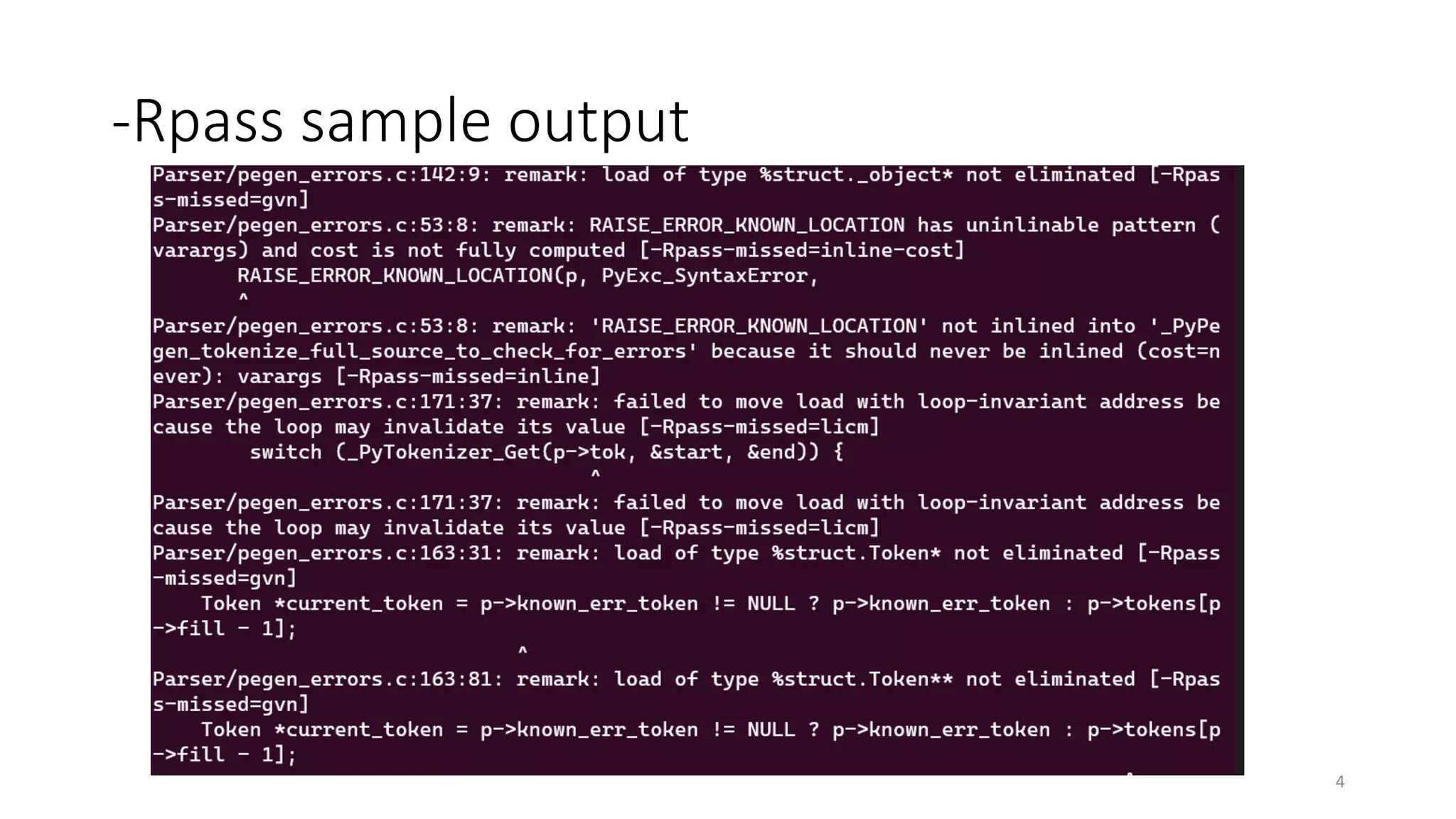
-Rpass sample output
4
5
-Rpass
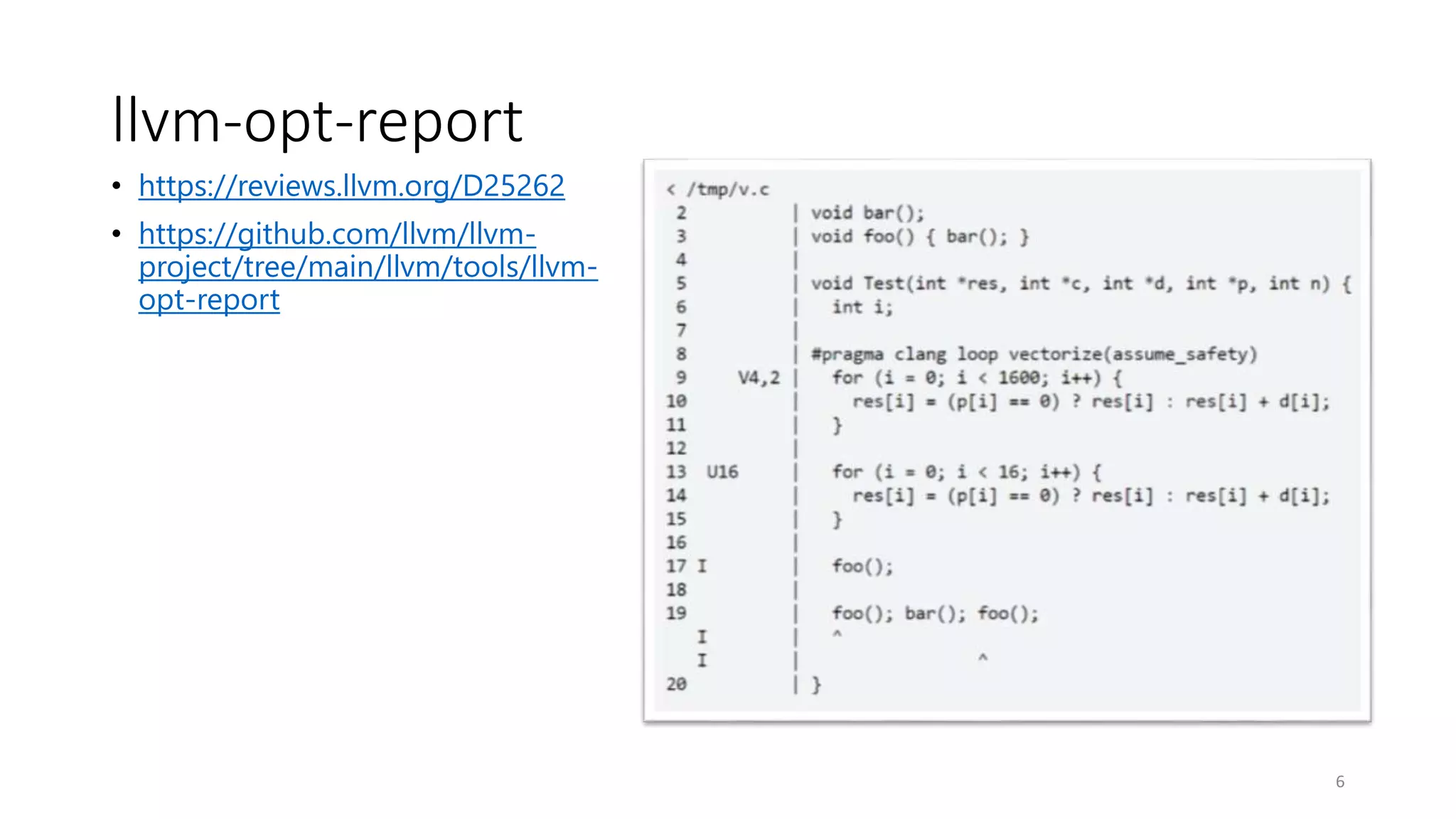
llvm-opt-report
llvm-opt-report
• https://reviews.llvm.org/D25262
• https://github.com/llvm/llvm-
project/tree/main/llvm/tools/llvm-
opt-report
6
7
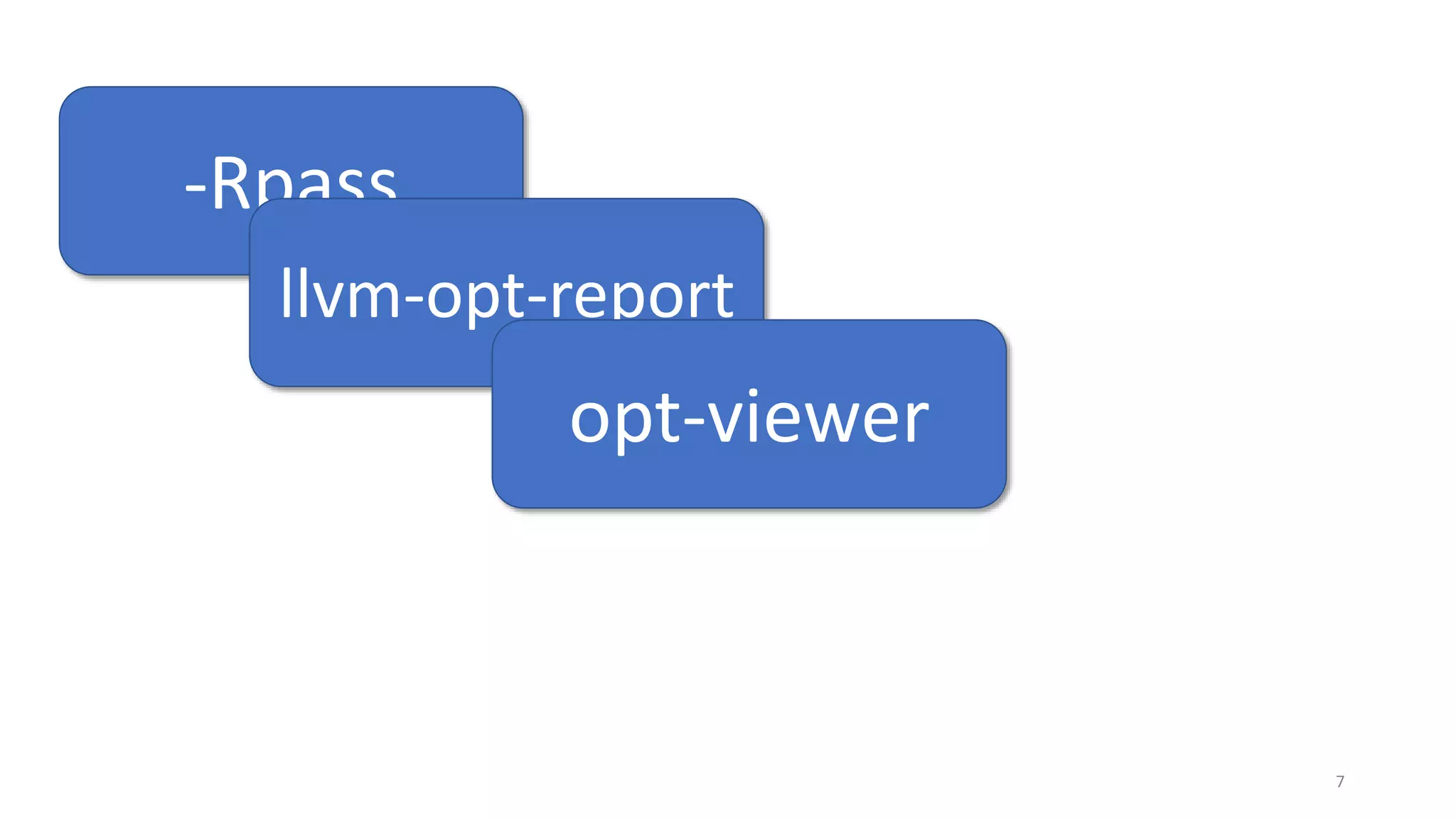
-Rpass
llvm-opt-report
opt-viewer
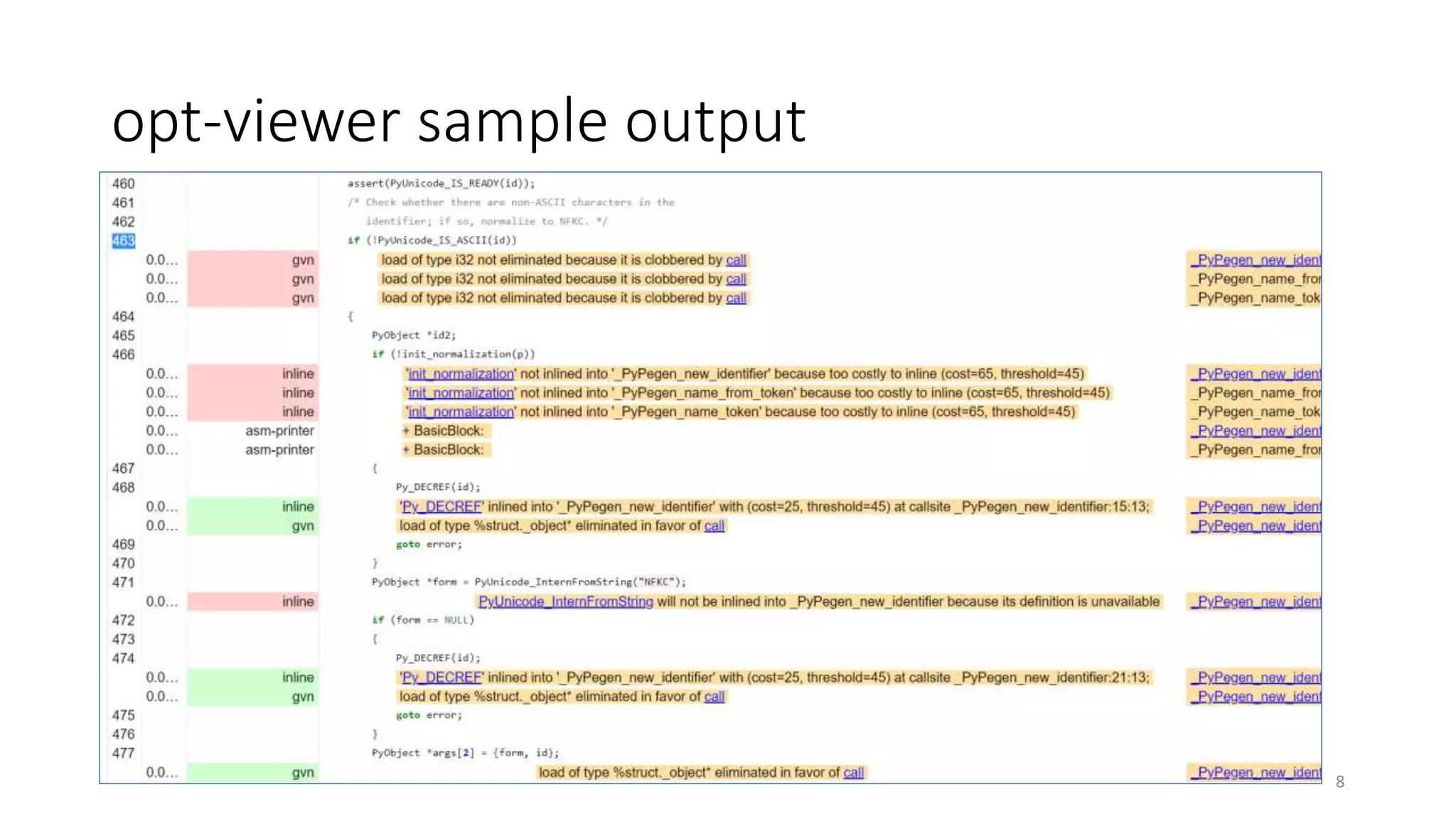
opt-viewer sample output
8
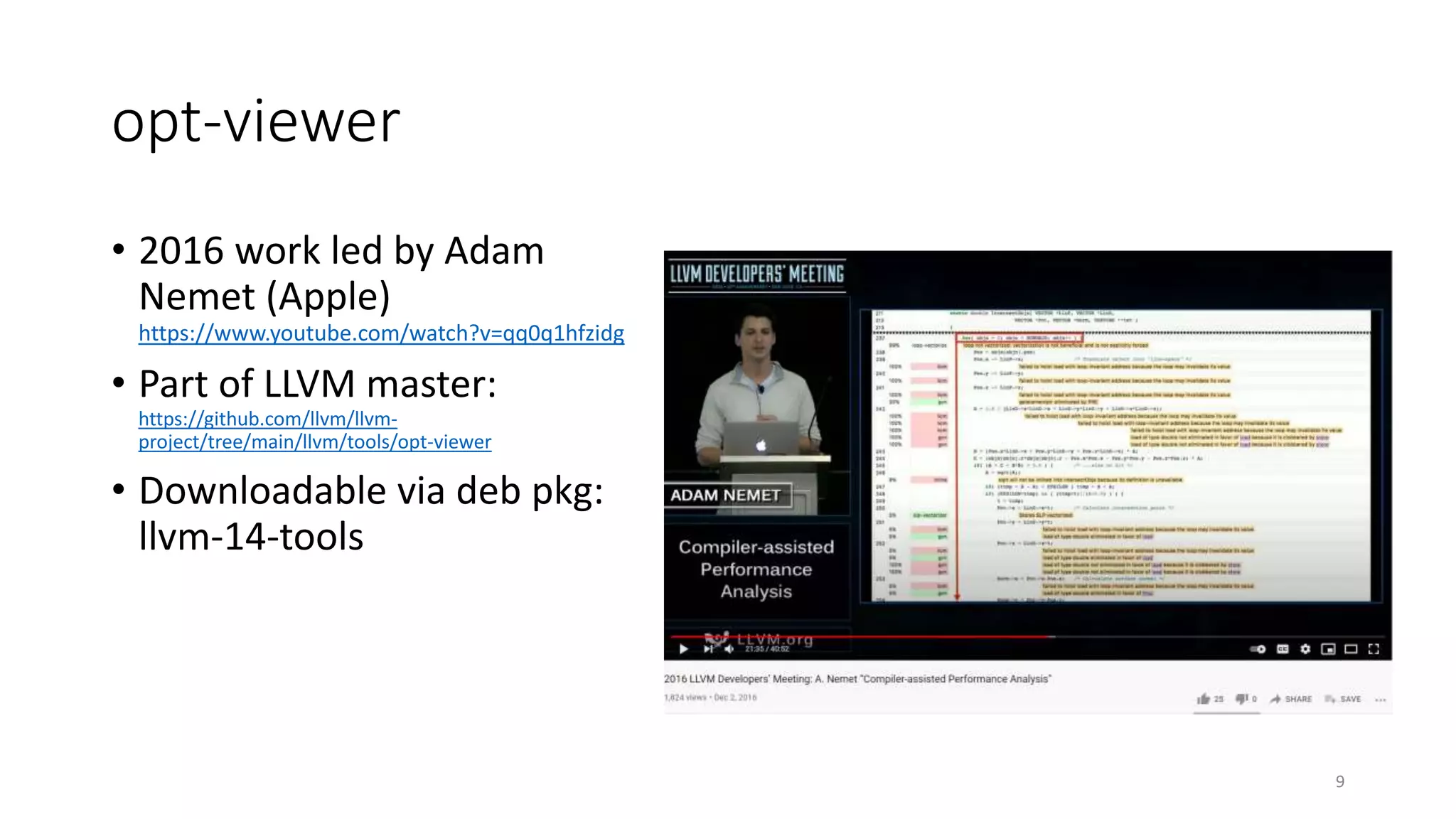
opt-viewer
• 2016 work led by Adam
Nemet (Apple)
https://www.youtube.com/watch?v=qq0q1hfzidg
• Part of LLVM master:
https://github.com/llvm/llvm-
project/tree/main/llvm/tools/opt-viewer
• Downloadable via deb pkg:
llvm-14-tools
9
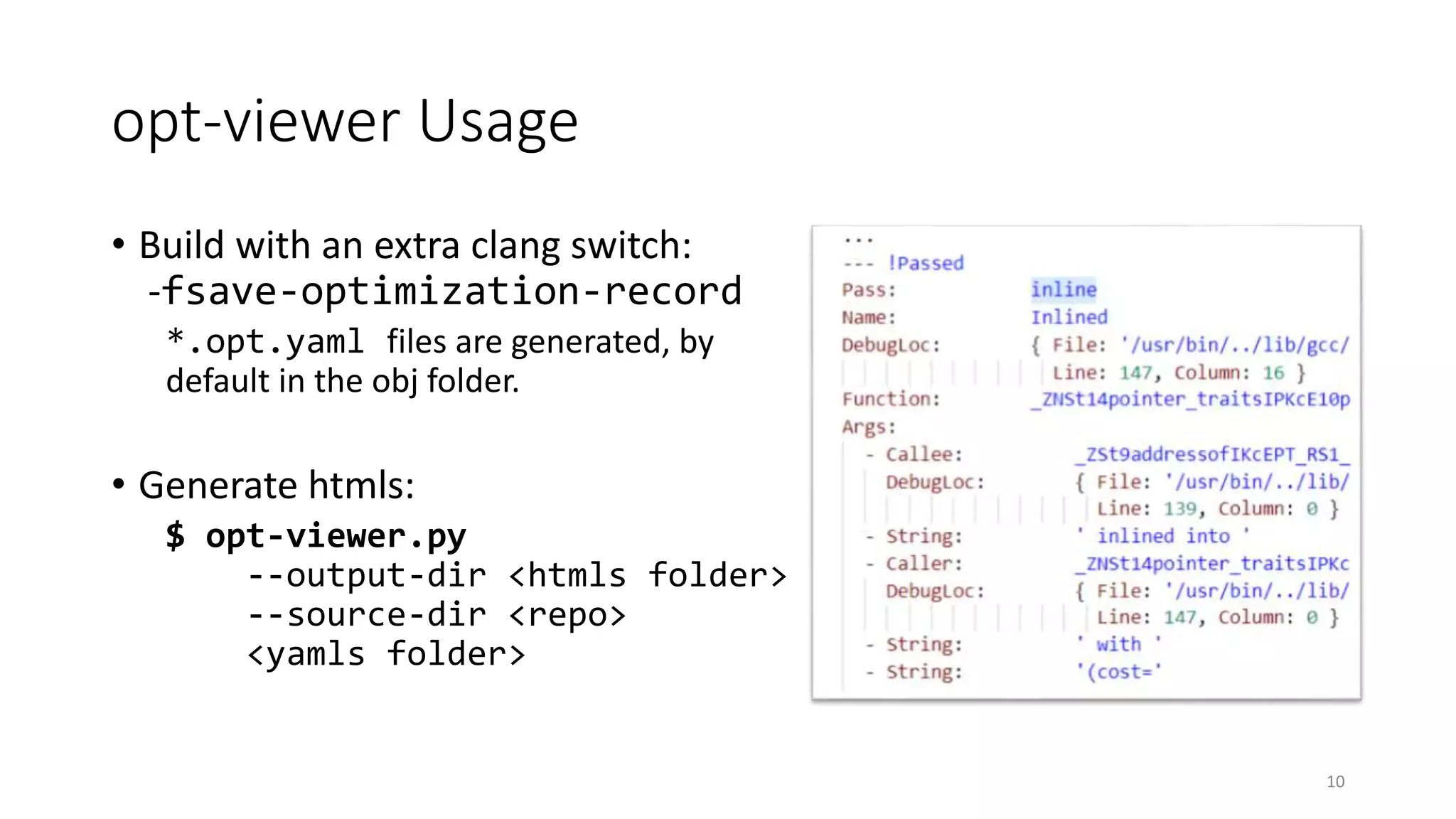
opt-viewer Usage
• Build with an extra clang switch:
-fsave-optimization-record
*.opt.yaml files are generated, by
default in the obj folder.
• Generate htmls:
$ opt-viewer.py
--output-dir <htmls folder>
--source-dir <repo>
<yamls folder>
10
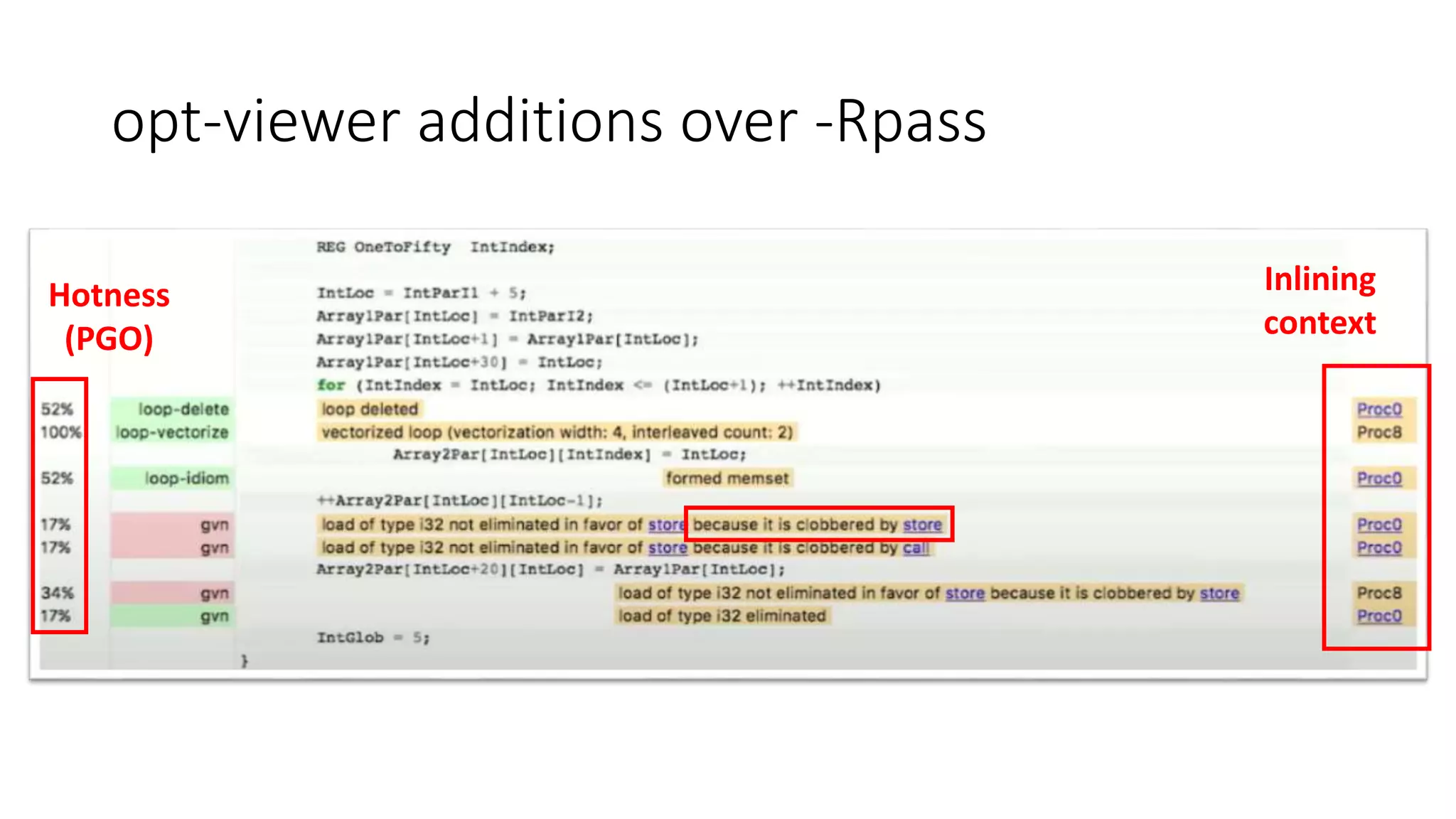
opt-viewer additions over -Rpass
Inlining
context
Hotness
(PGO)
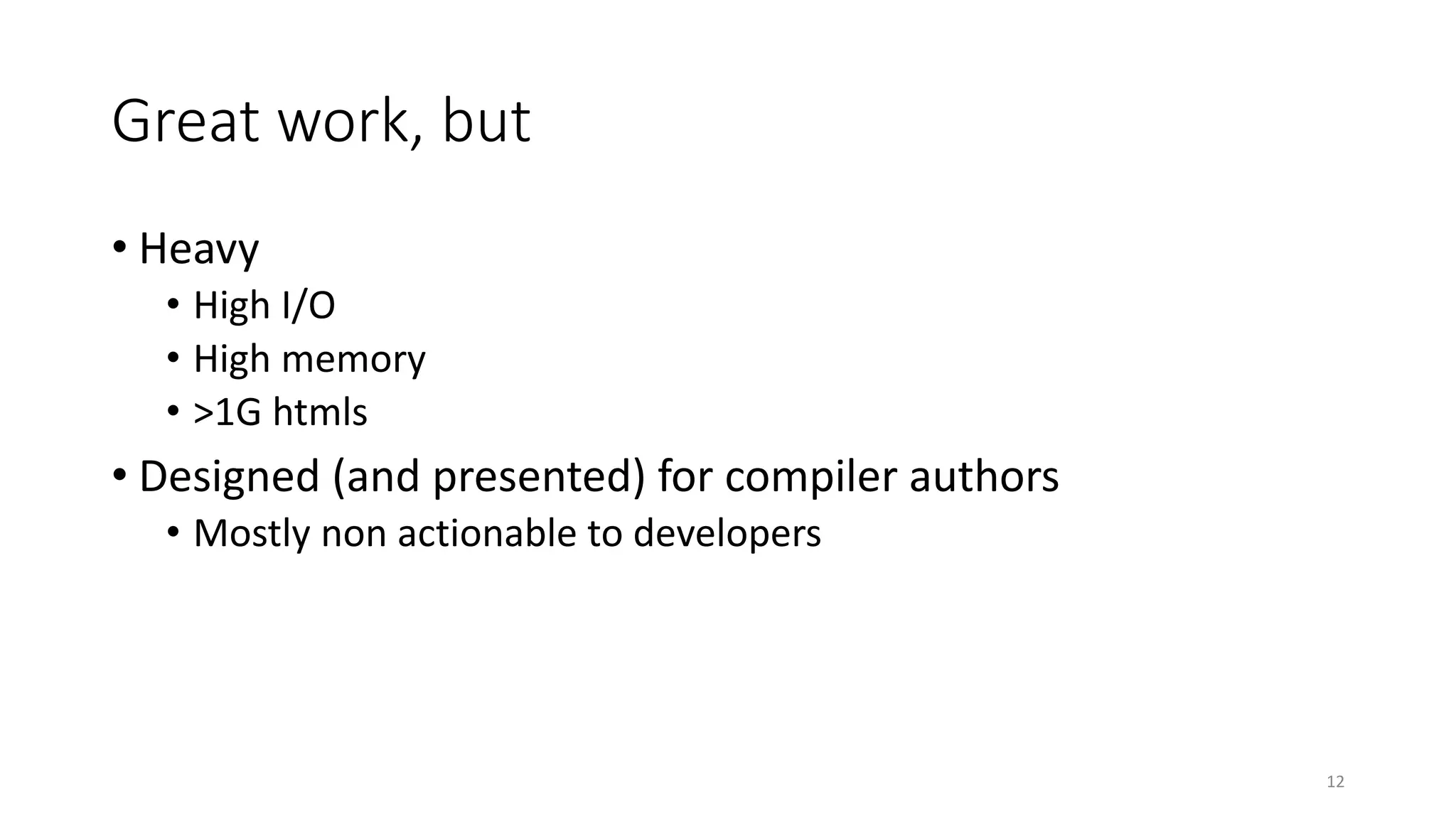
Great work, but
• Heavy
• High I/O
• High memory
• >1G htmls
• Designed (and presented) for compiler authors
• Mostly non actionable to developers
12
13
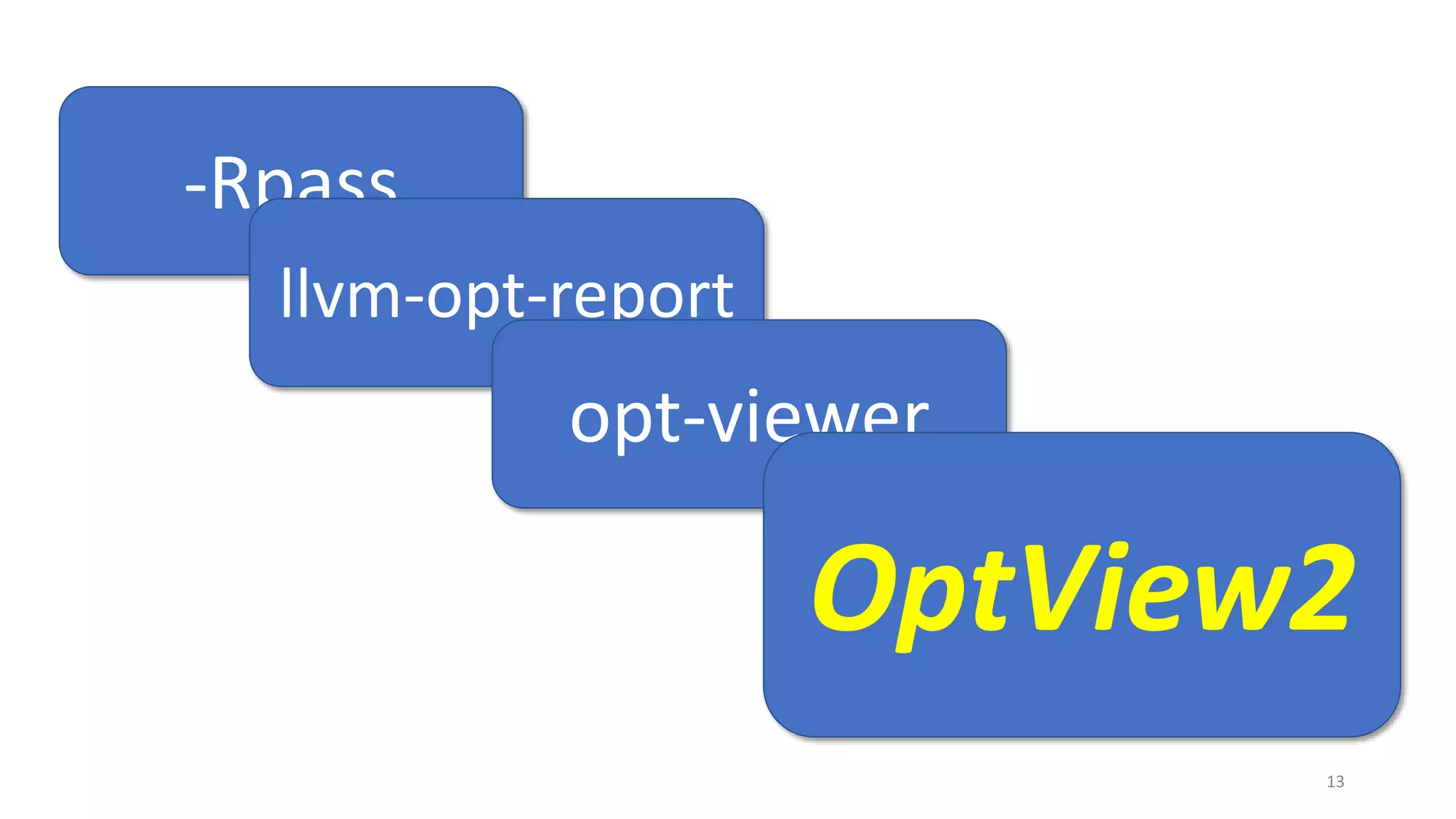
-Rpass
llvm-opt-report
opt-viewer
OptView2
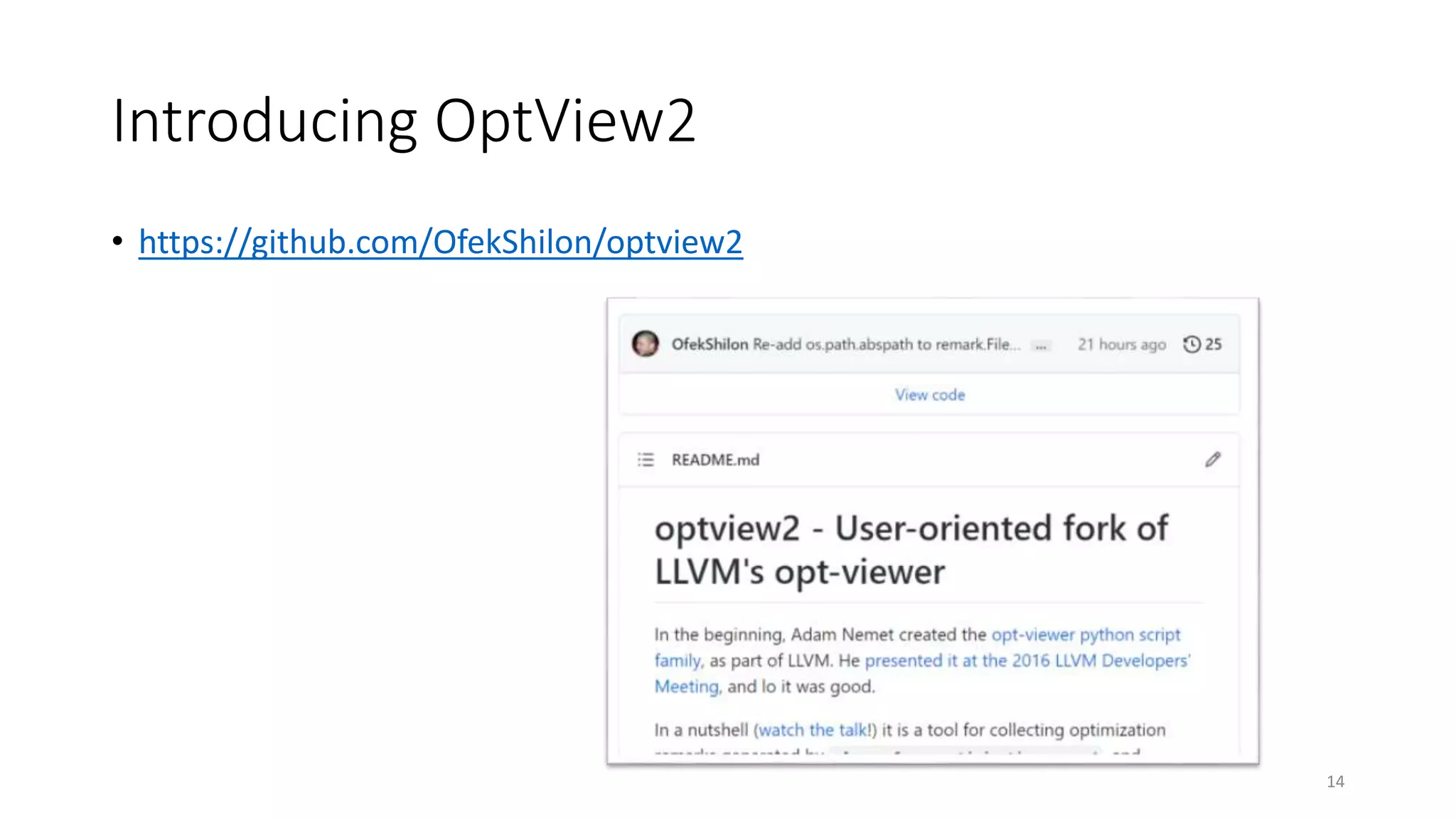
Introducing OptView2
• https://github.com/OfekShilon/optview2
14
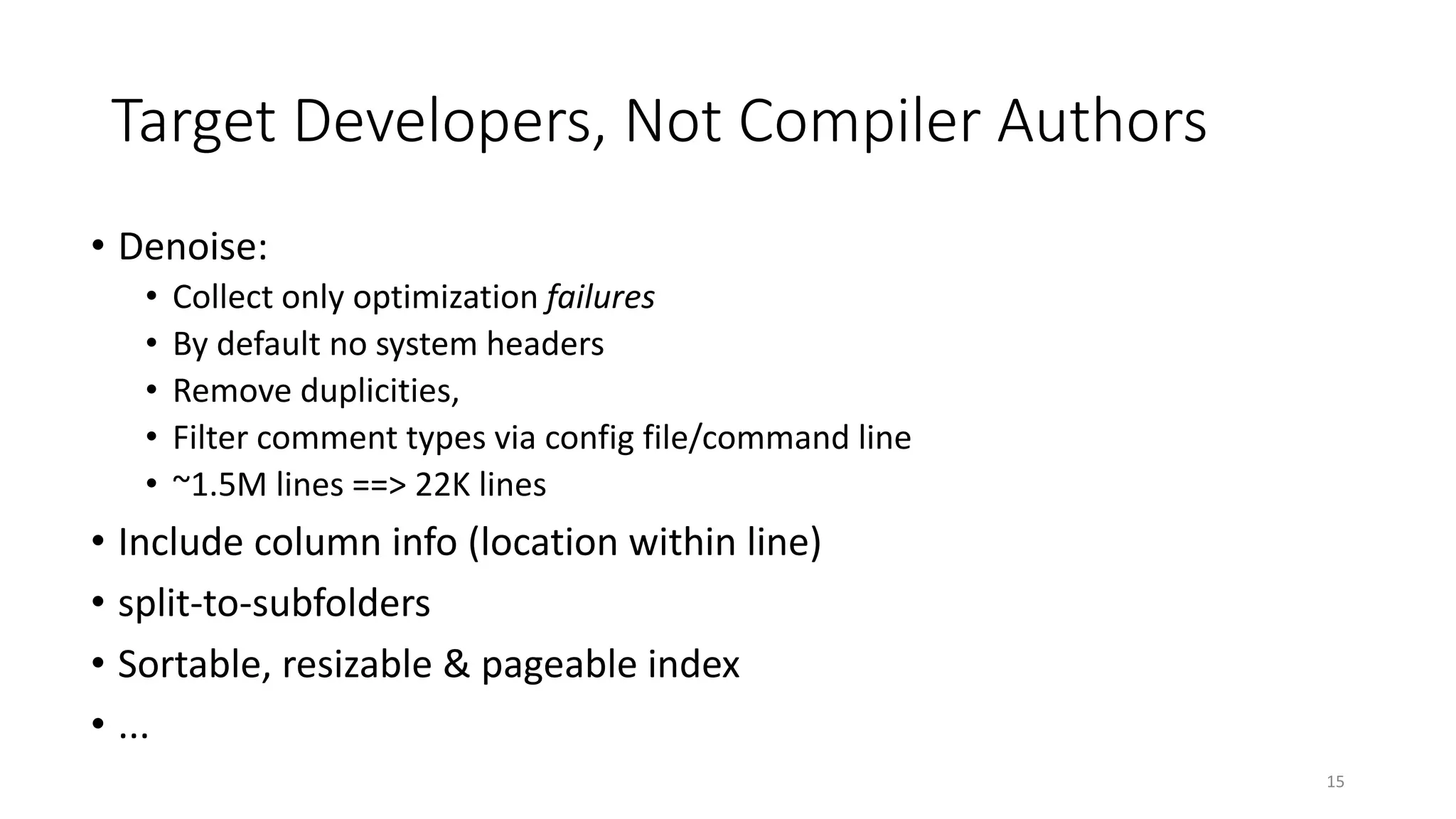
Target Developers, Not Compiler Authors
• Denoise:
• Collect only optimization failures
• By default no system headers
• Remove duplicities,
• Filter comment types via config file/command line
• ~1.5M lines ==> 22K lines
• Include column info (location within line)
• split-to-subfolders
• Sortable, resizable & pageable index
• ...
15
Example OptView2 outputs
• https://ofekshilon.github.io/optview2-opencv/
• https://ofekshilon.github.io/optview2-cpython/
• https://ofekshilon.github.io/optview2_mujoco/
16
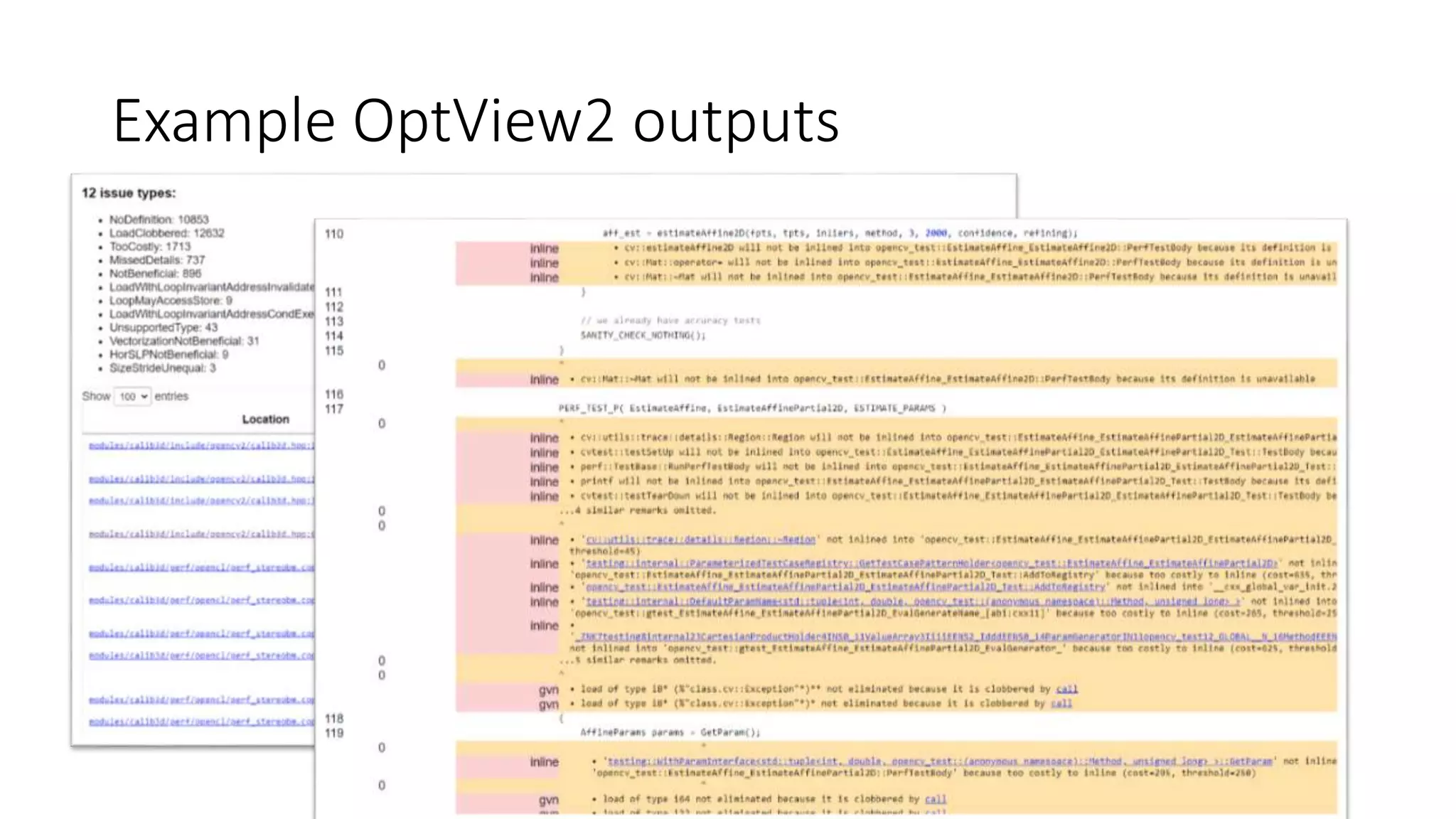
Example OptView2 outputs
17
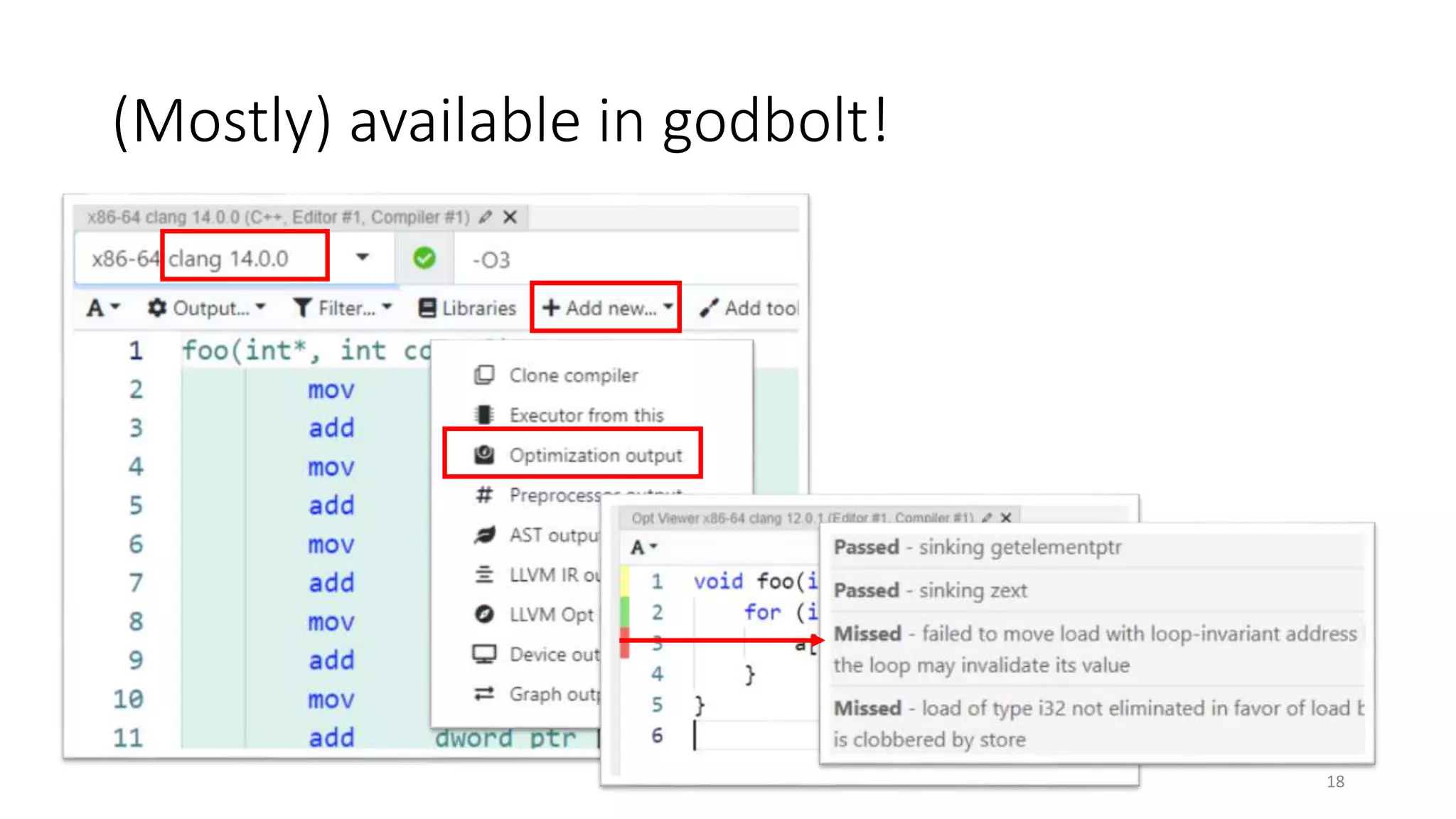
(Mostly) available in godbolt!
18
Part 2: Usage
19
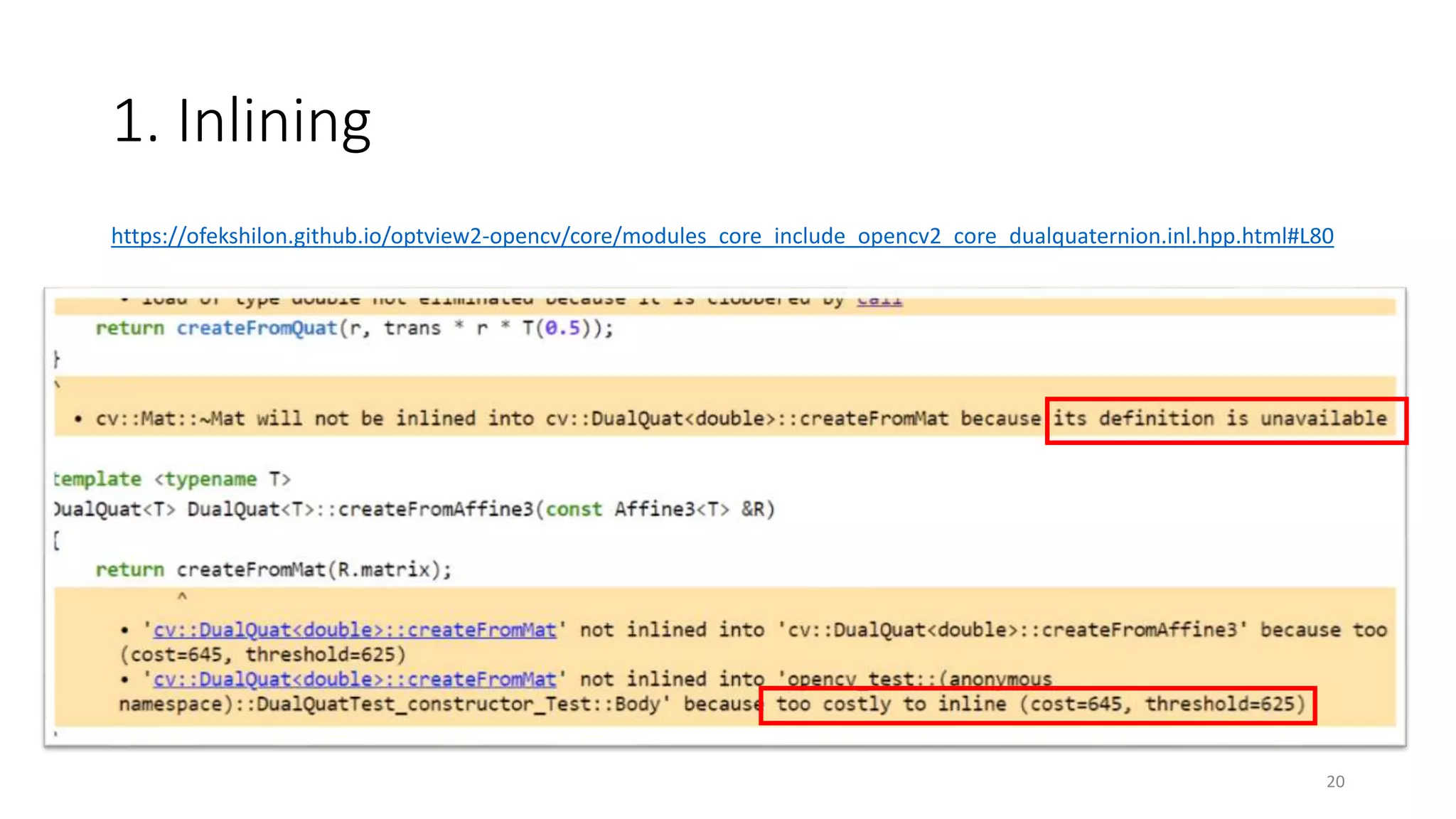
1. Inlining
https://ofekshilon.github.io/optview2-opencv/core/modules_core_include_opencv2_core_dualquaternion.inl.hpp.html#L80
20
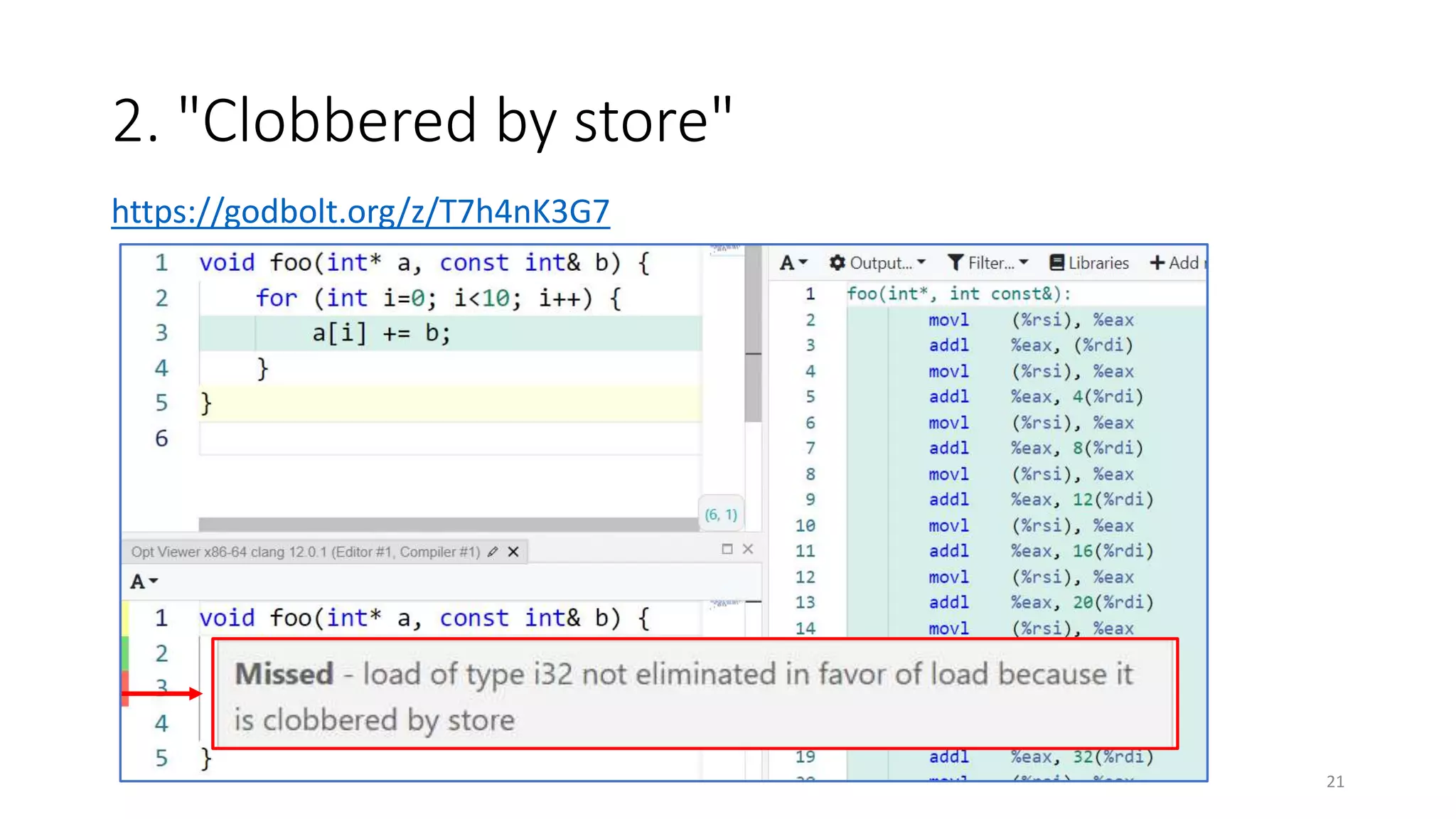
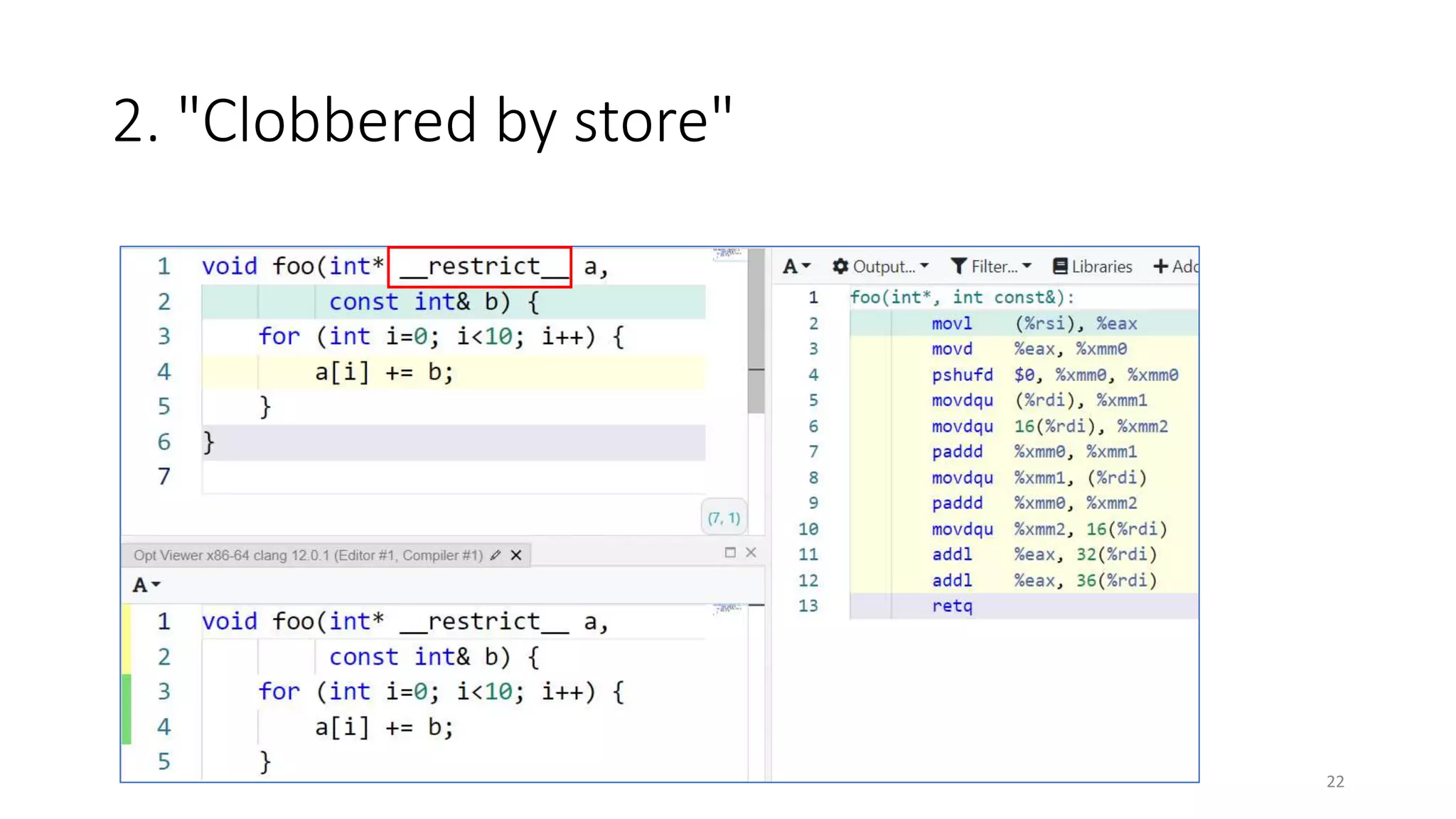
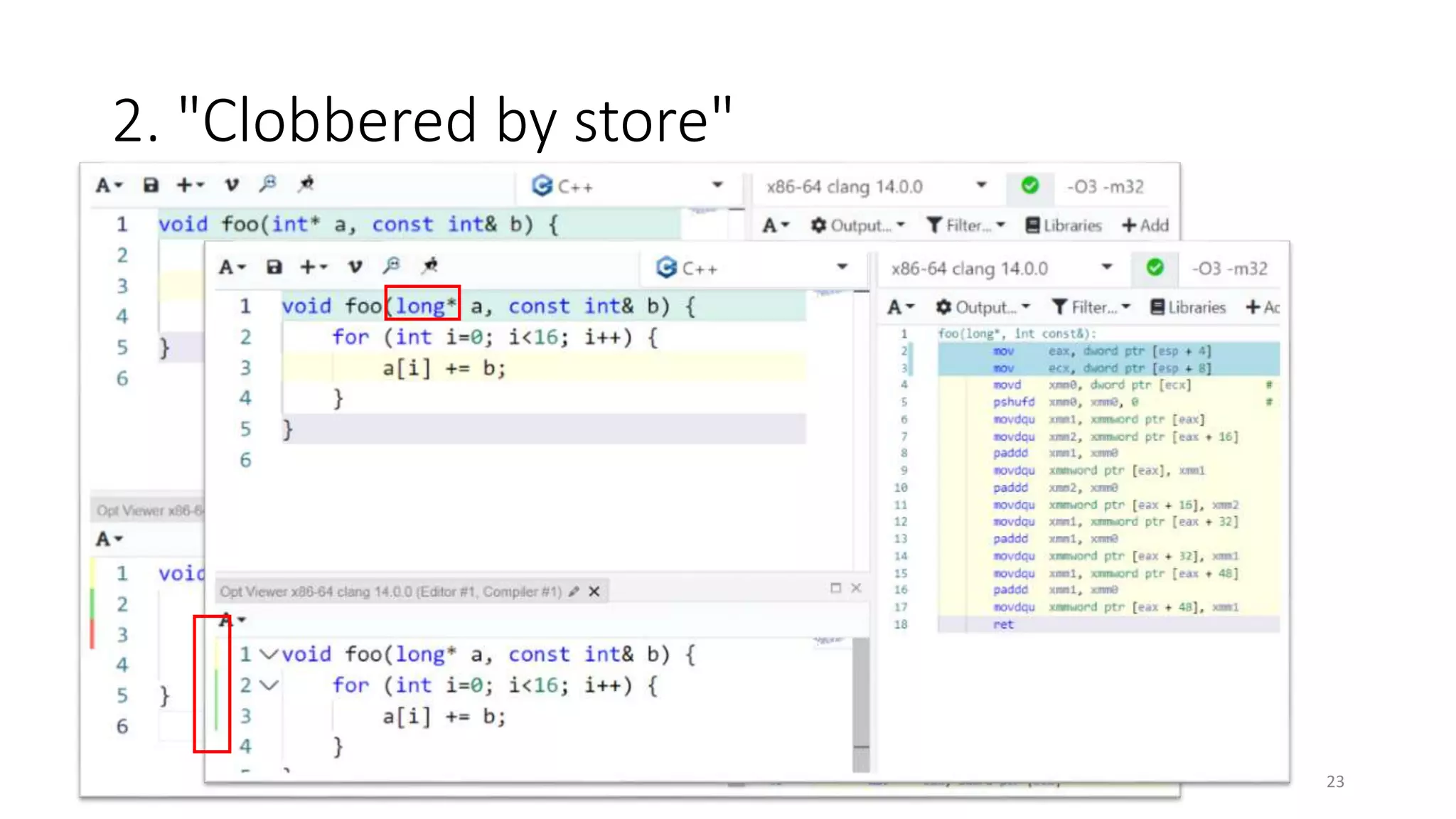
2. "Clobbered by store"
https://godbolt.org/z/T7h4nK3G7
21
2. "Clobbered by store"
22
2. "Clobbered by store"
23
2. "Clobbered by store"
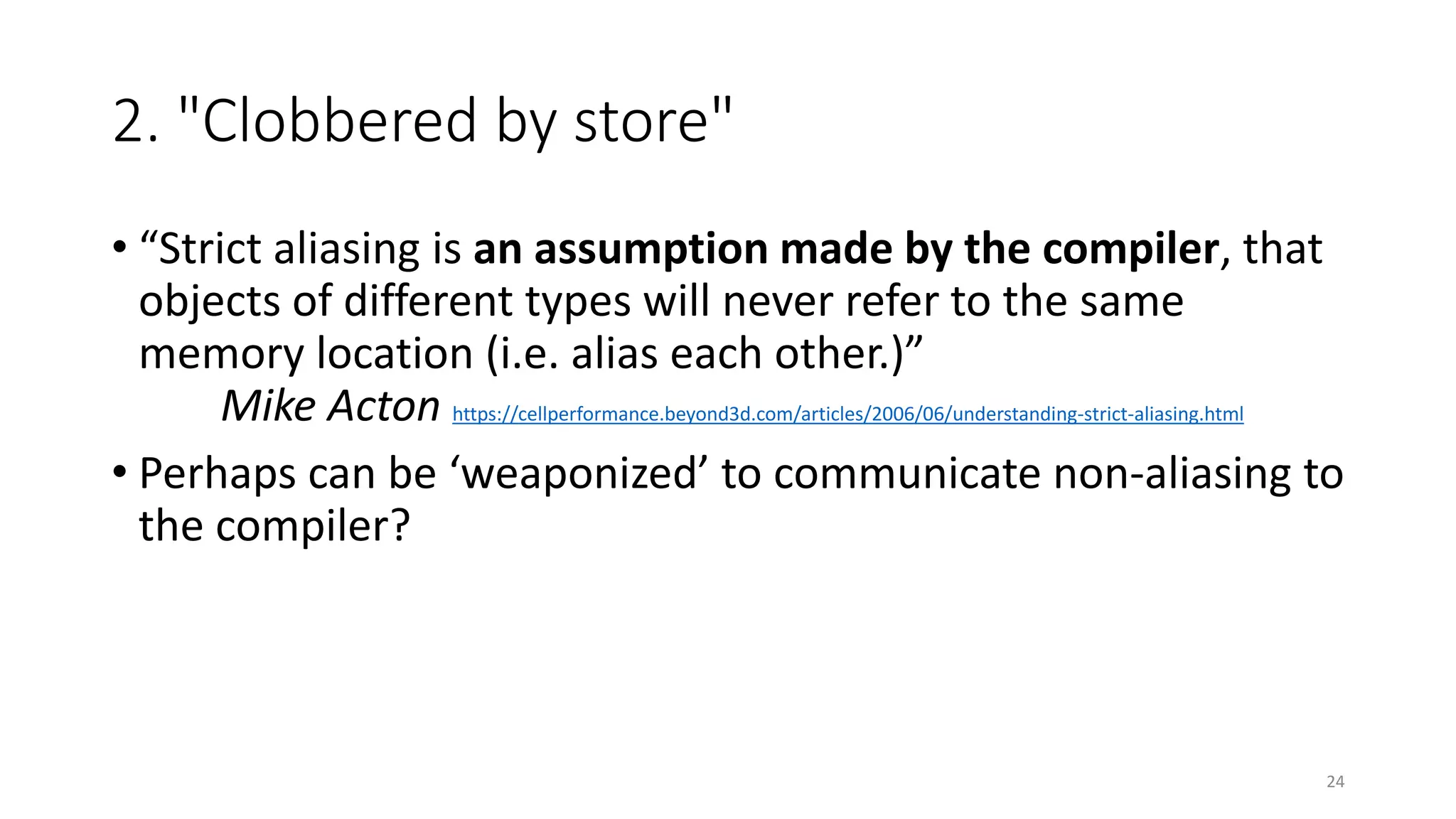
• “Strict aliasing is an assumption made by the compiler, that
objects of different types will never refer to the same
memory location (i.e. alias each other.)”
Mike Acton https://cellperformance.beyond3d.com/articles/2006/06/understanding-strict-aliasing.html
• Perhaps can be ‘weaponized’ to communicate non-aliasing to
the compiler?
24
2. "Clobbered by store"
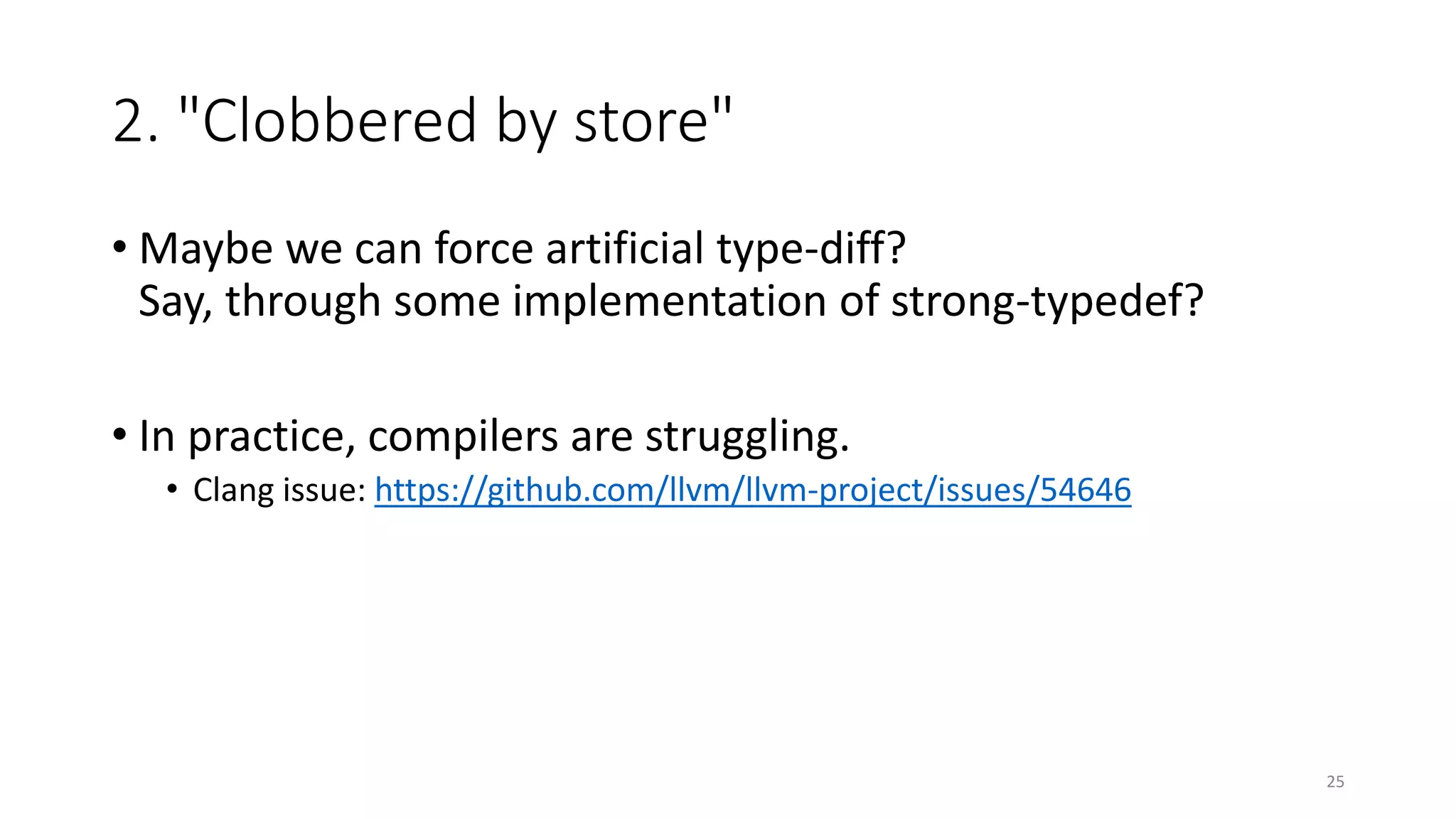
• Maybe we can force artificial type-diff?
Say, through some implementation of strong-typedef?
• In practice, compilers are struggling.
• Clang issue: https://github.com/llvm/llvm-project/issues/54646
25
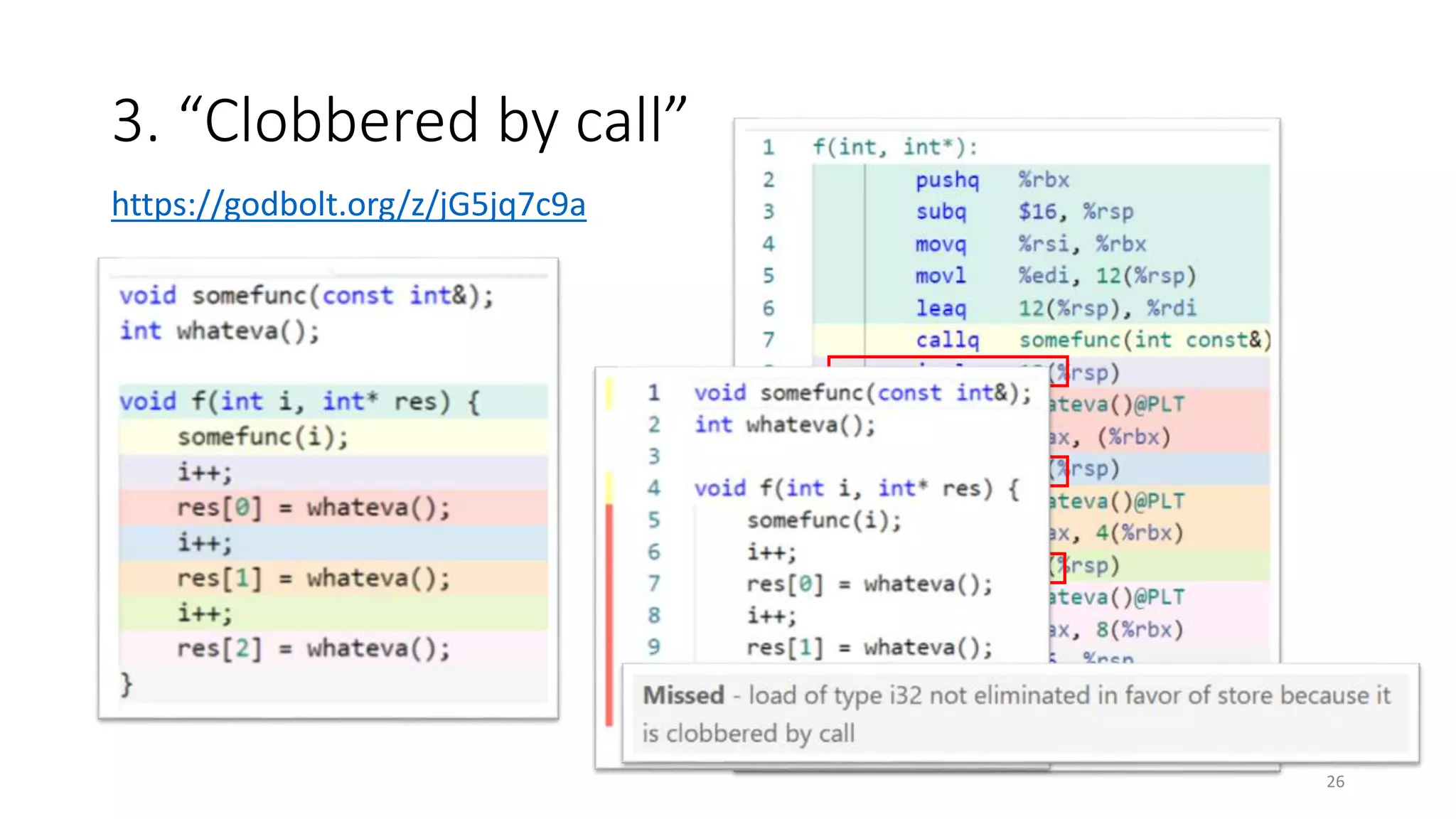
3. “Clobbered by call”
https://godbolt.org/z/jG5jq7c9a
26
3. “Clobbered by call”
27
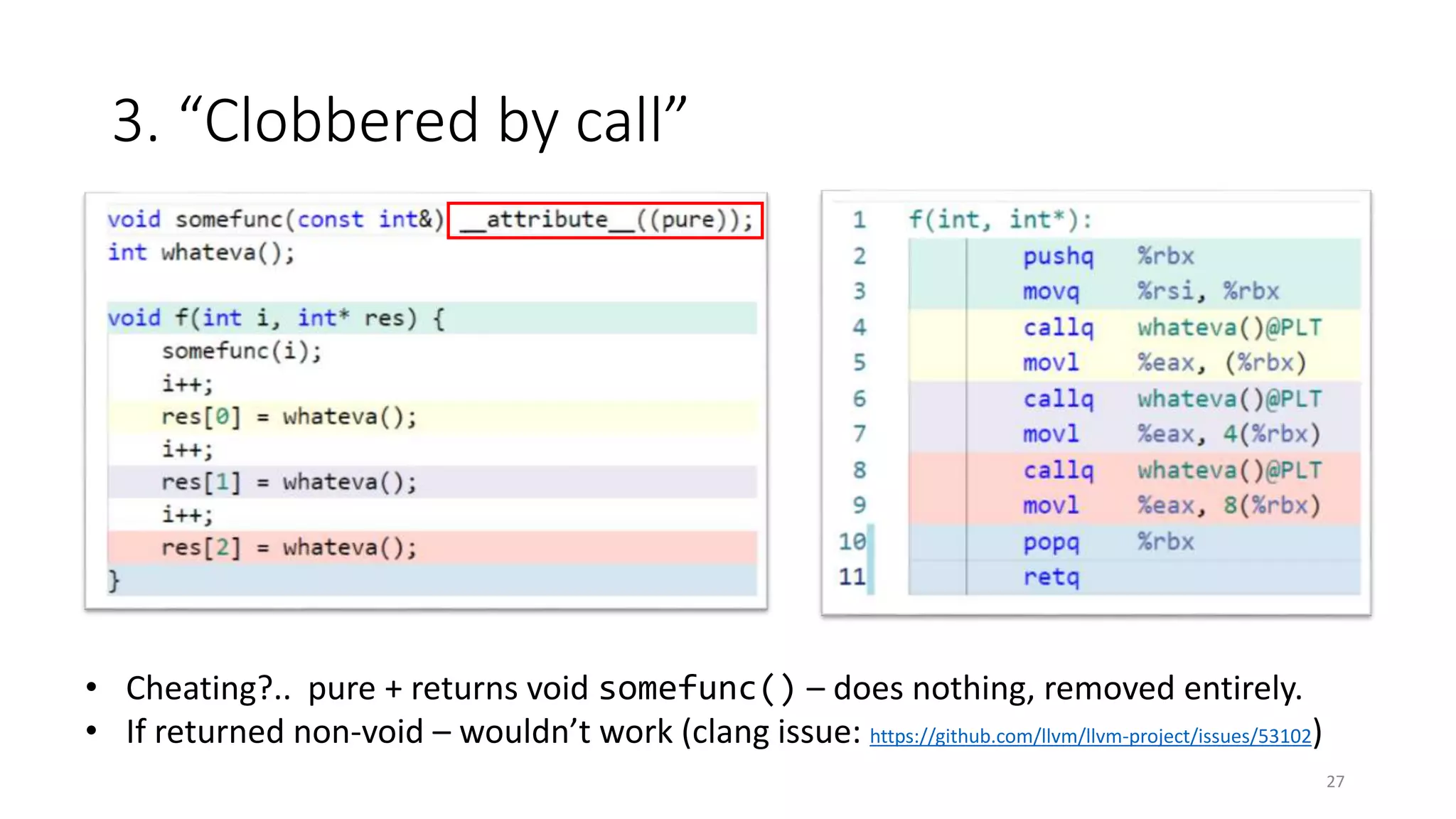
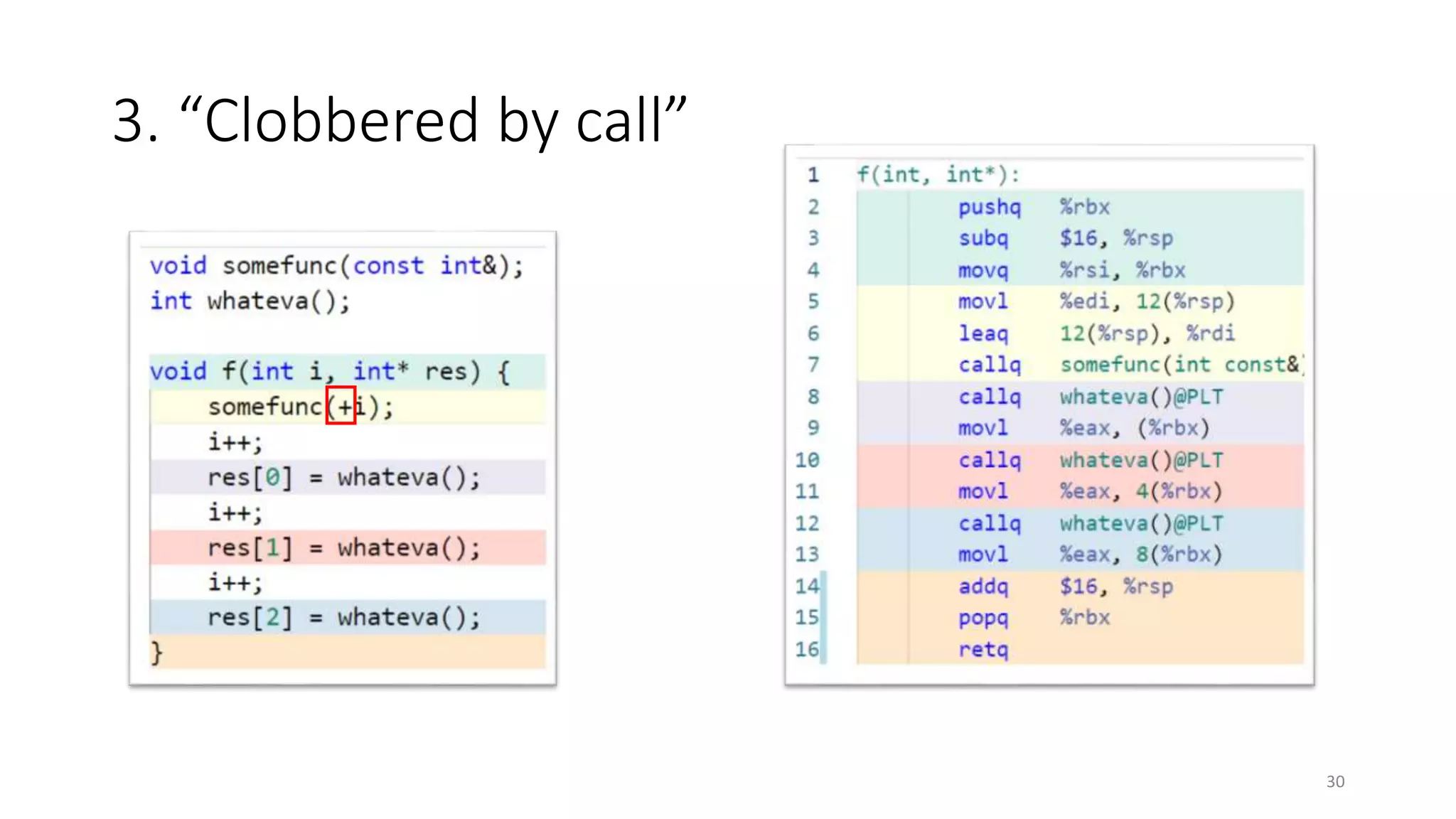
• Cheating?.. pure + returns void somefunc() – does nothing, removed entirely.
• If returned non-void – wouldn’t work (clang issue: https://github.com/llvm/llvm-project/issues/53102)
3. “Clobbered by call”
28
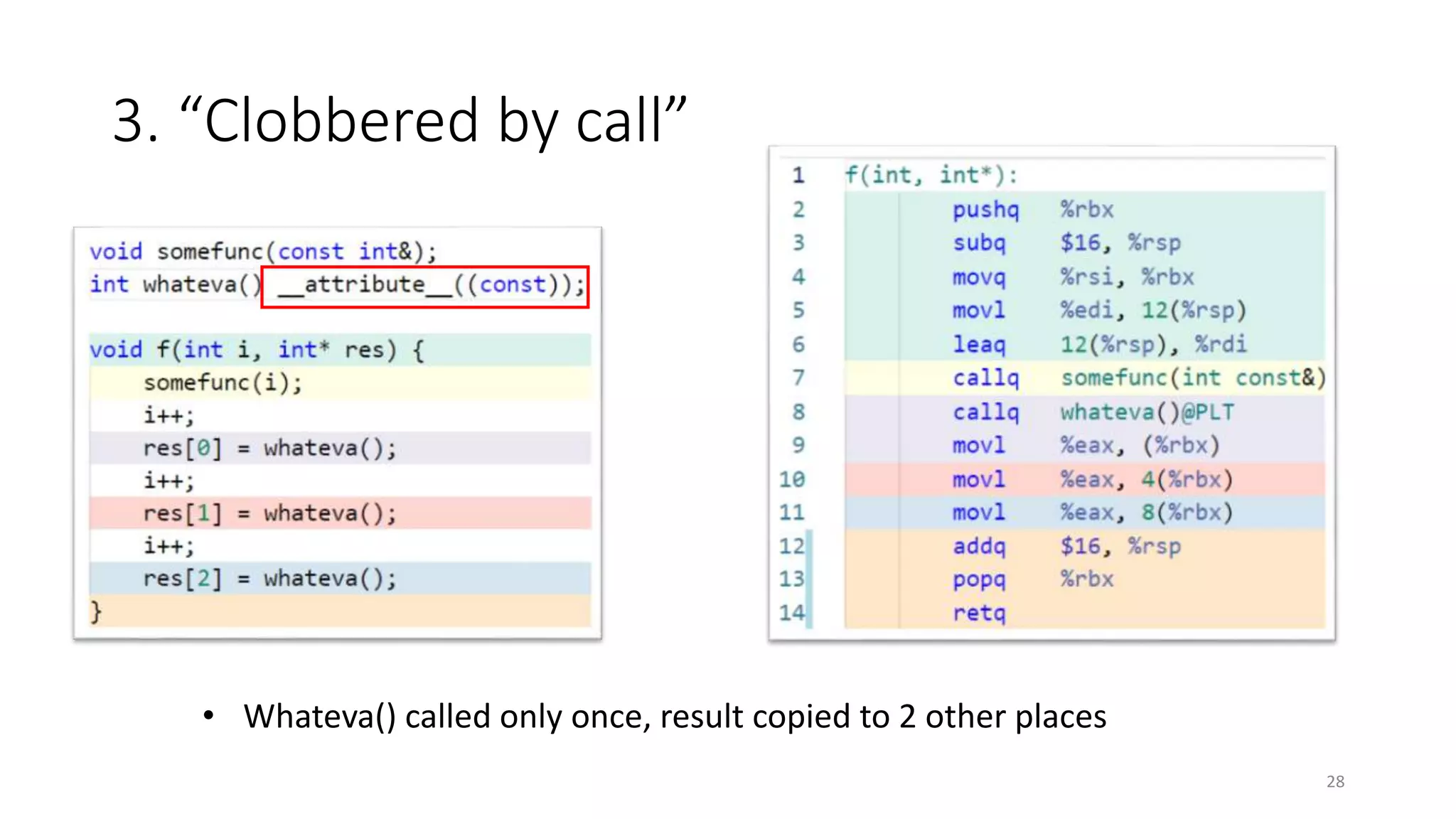
• Whateva() called only once, result copied to 2 other places
3. “Clobbered by call”
29
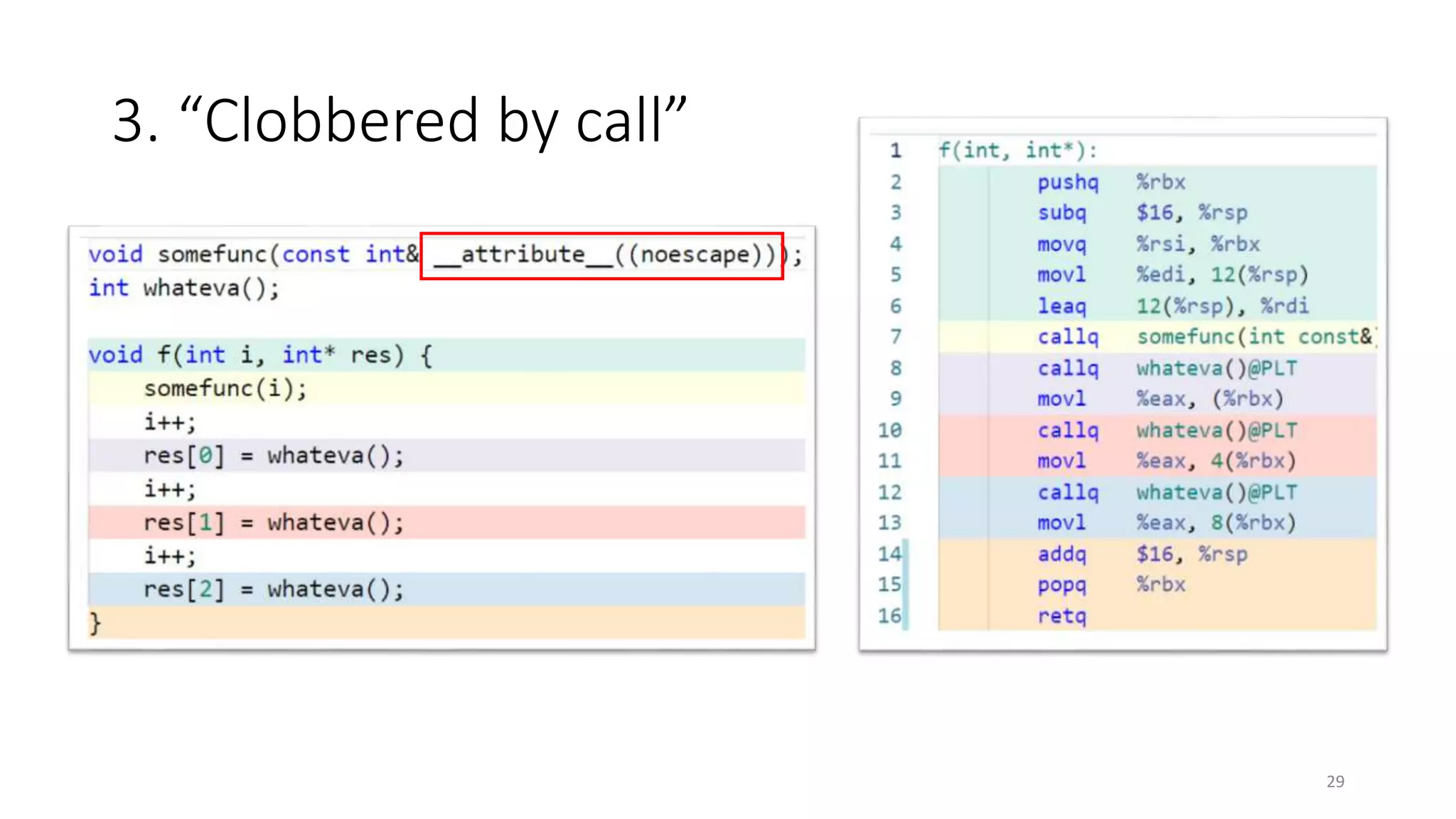
3. “Clobbered by call”
30
3. “Clobbered by call”
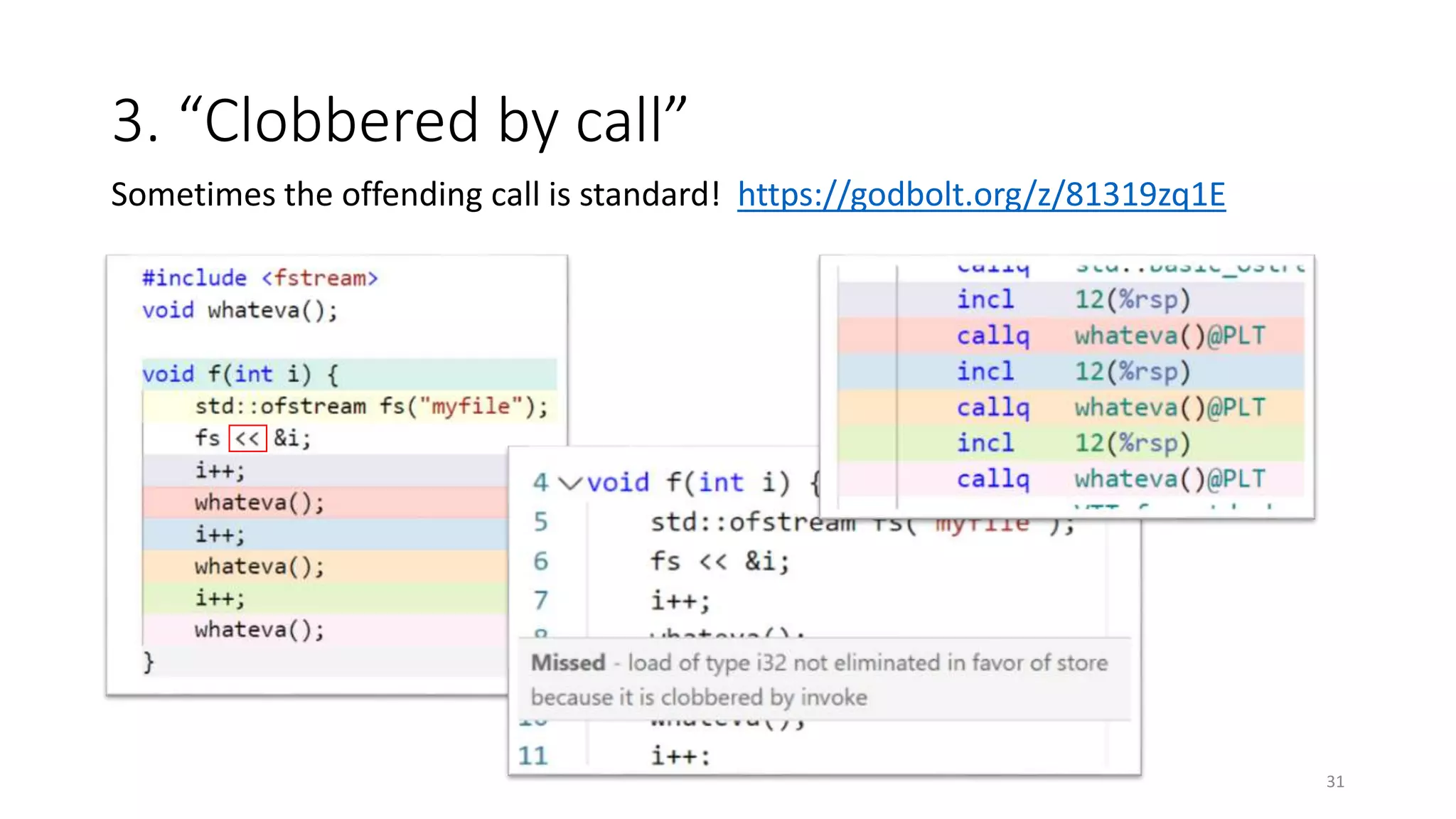
Sometimes the offending call is standard! https://godbolt.org/z/81319zq1E
31
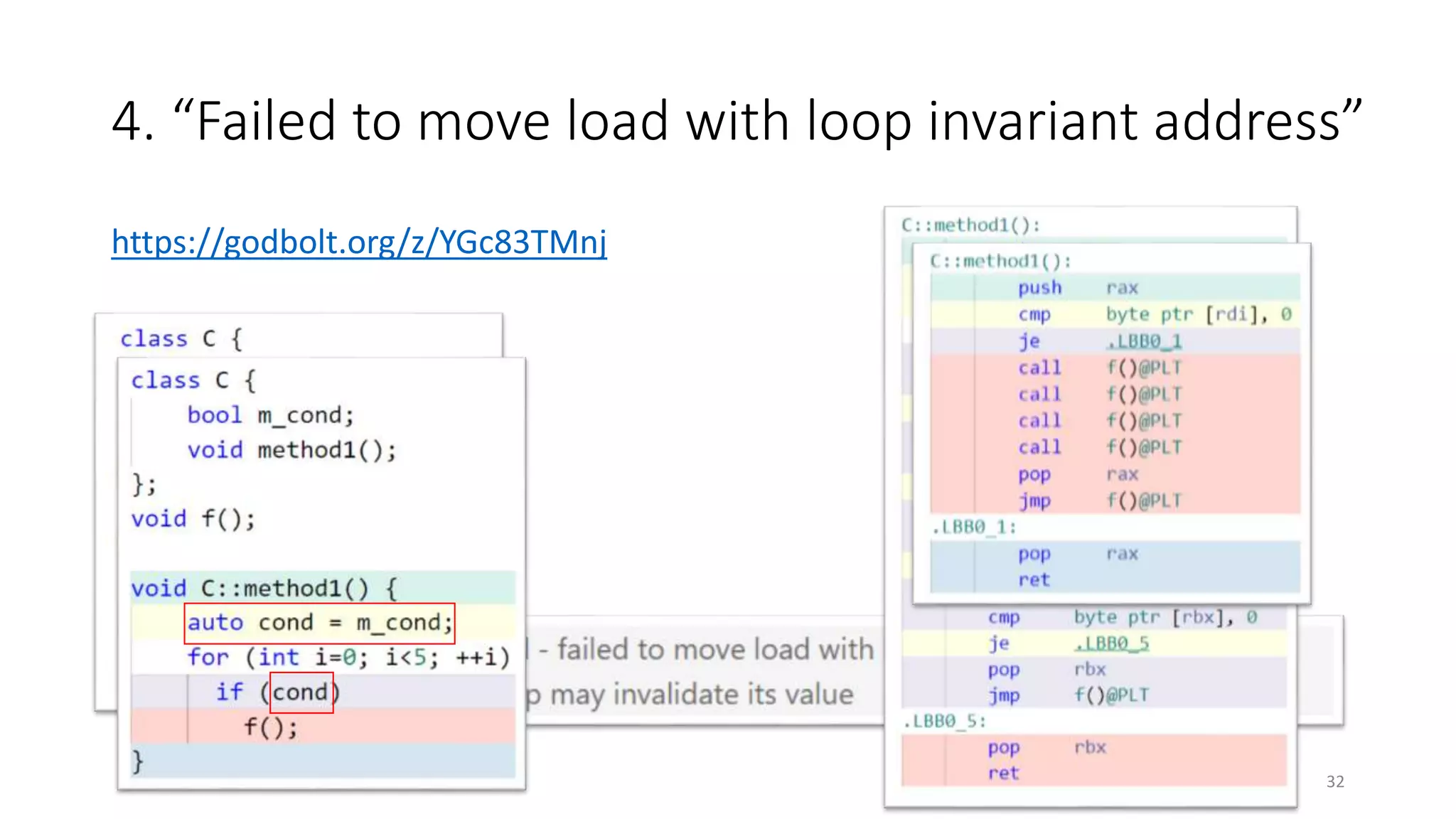
4. “Failed to move load with loop invariant address”
https://godbolt.org/z/YGc83TMnj
32
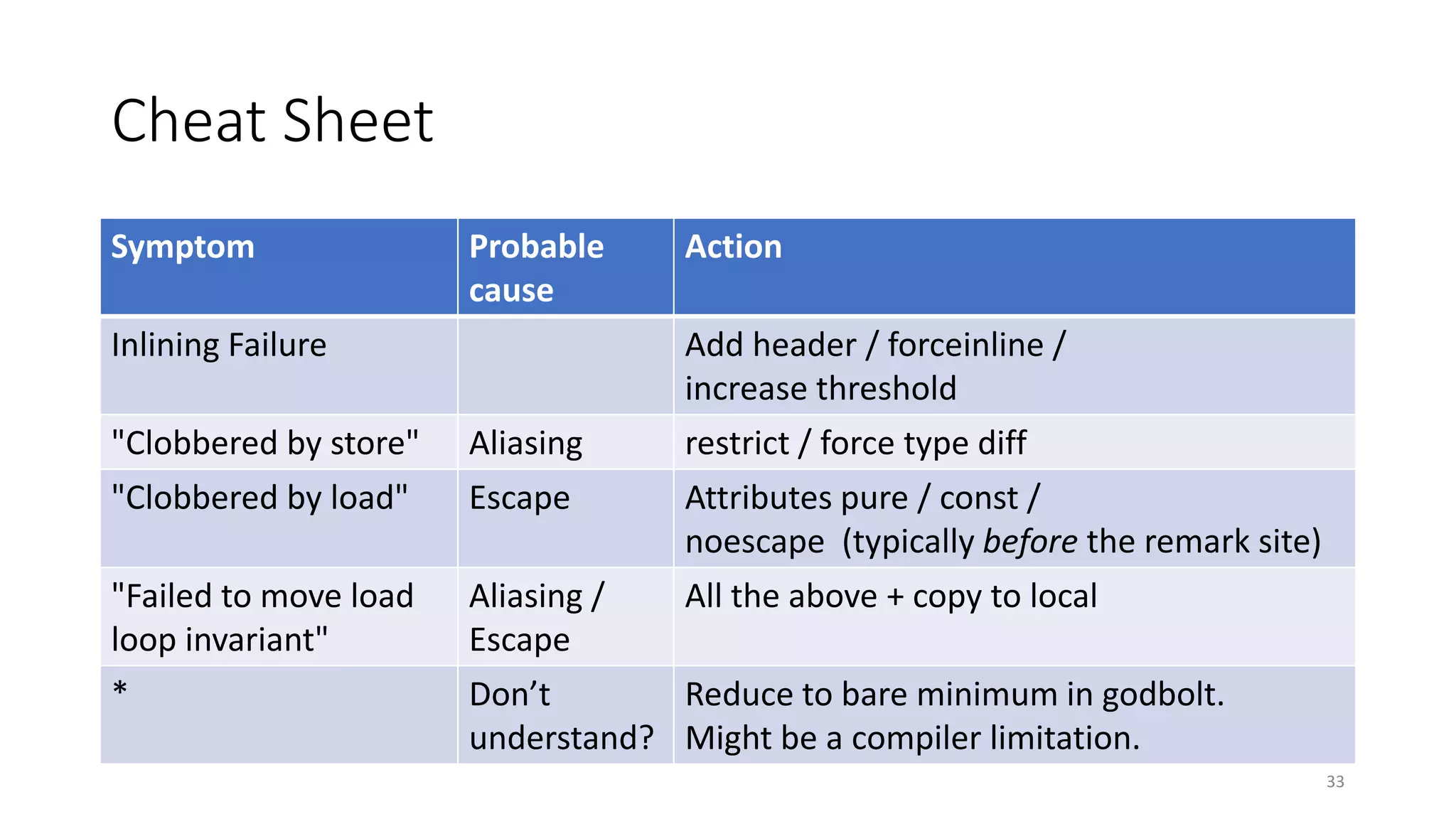
Cheat Sheet
Symptom Probable
cause
Action
Inlining Failure Add header / forceinline /
increase threshold
"Clobbered by store" Aliasing restrict / force type diff
"Clobbered by load" Escape Attributes pure / const /
noescape (typically before the remark site)
"Failed to move load
loop invariant"
Aliasing /
Escape
All the above + copy to local
* Don’t
understand?
Reduce to bare minimum in godbolt.
Might be a compiler limitation.
33
Part 3: Other Compilers
34
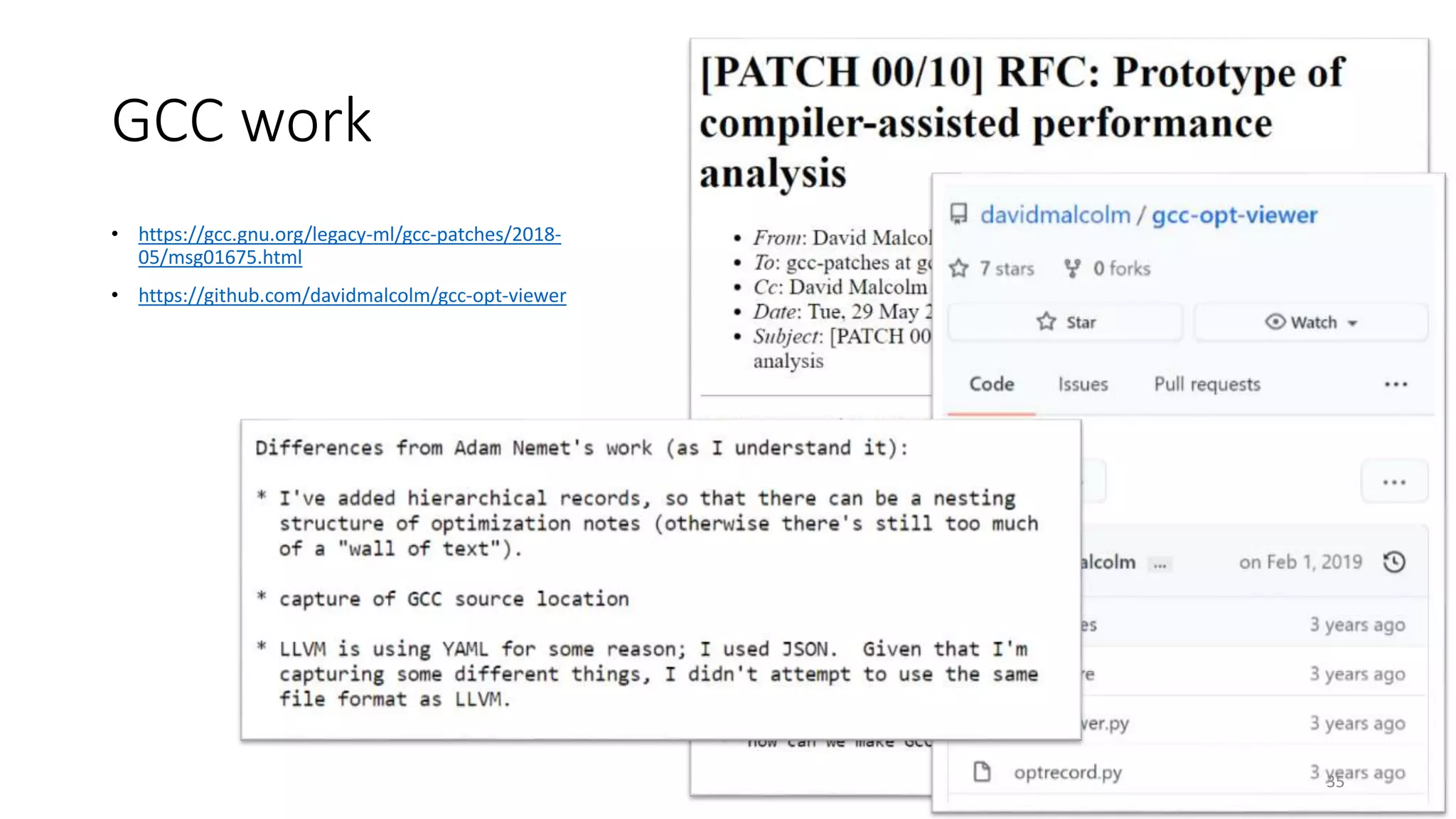
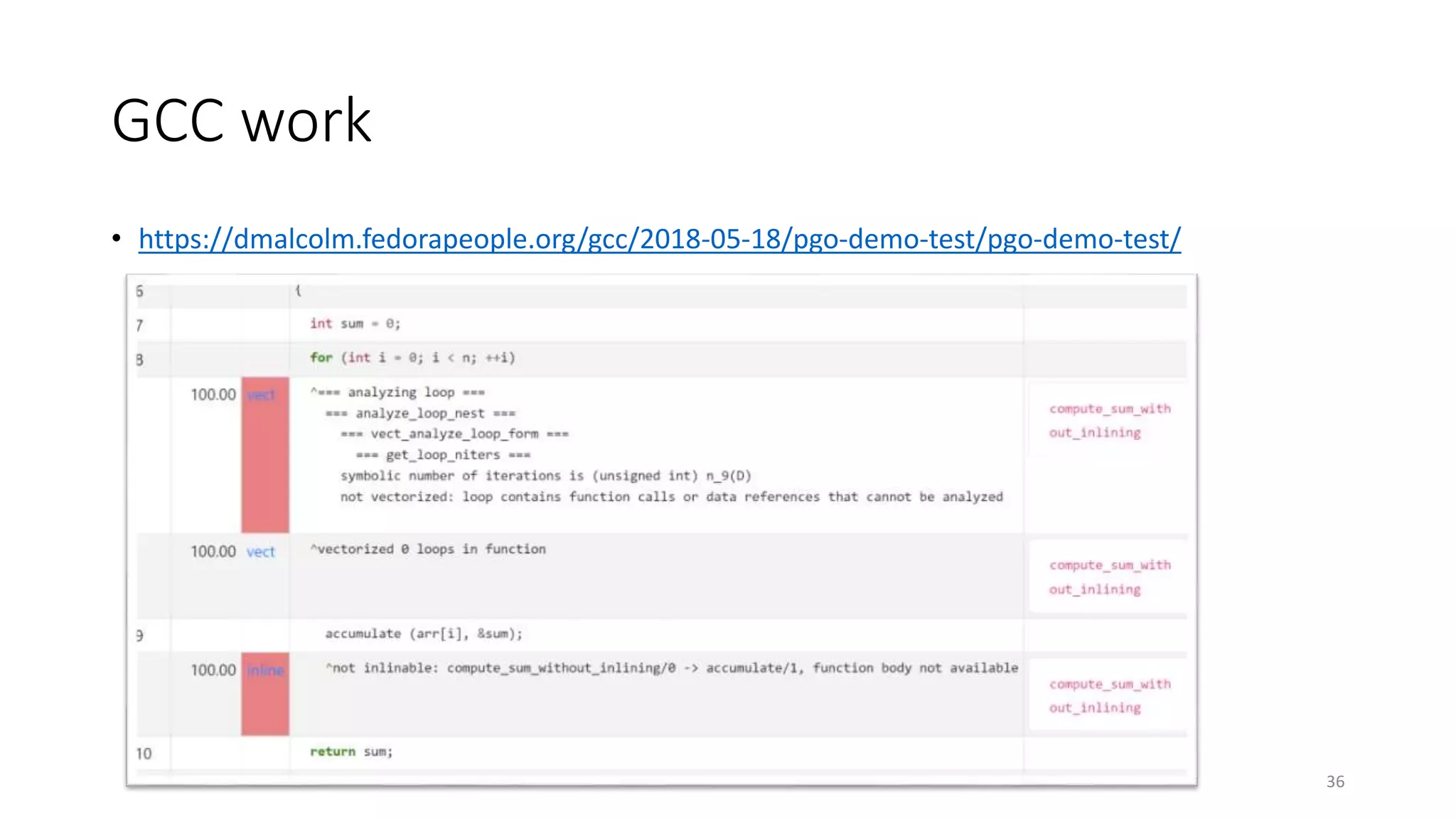
GCC work
• https://gcc.gnu.org/legacy-ml/gcc-patches/2018-
05/msg01675.html
• https://github.com/davidmalcolm/gcc-opt-viewer
35
GCC work
• https://dmalcolm.fedorapeople.org/gcc/2018-05-18/pgo-demo-test/pgo-demo-test/
36
GCC work
• Active only during 2018
• Still at prototype quality
• Compilation might consume 10G+ RAM per single file
• Python scripts often break
• Opened two bugs, one solved in my fork
37
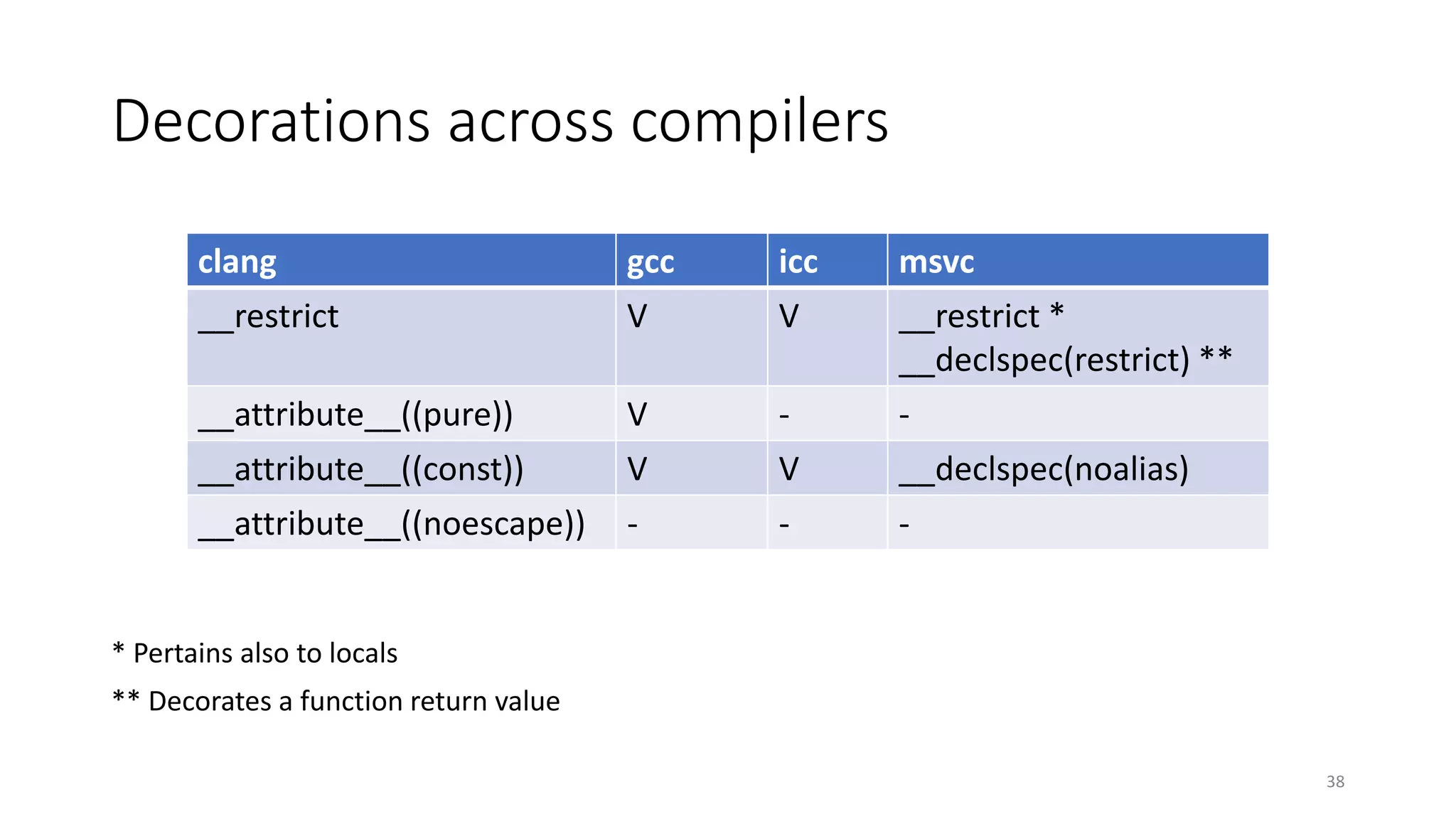
Decorations across compilers
* Pertains also to locals
** Decorates a function return value
38
clang gcc icc msvc
__restrict V V __restrict *
__declspec(restrict) **
__attribute__((pure)) V - -
__attribute__((const)) V V __declspec(noalias)
__attribute__((noescape)) - - -
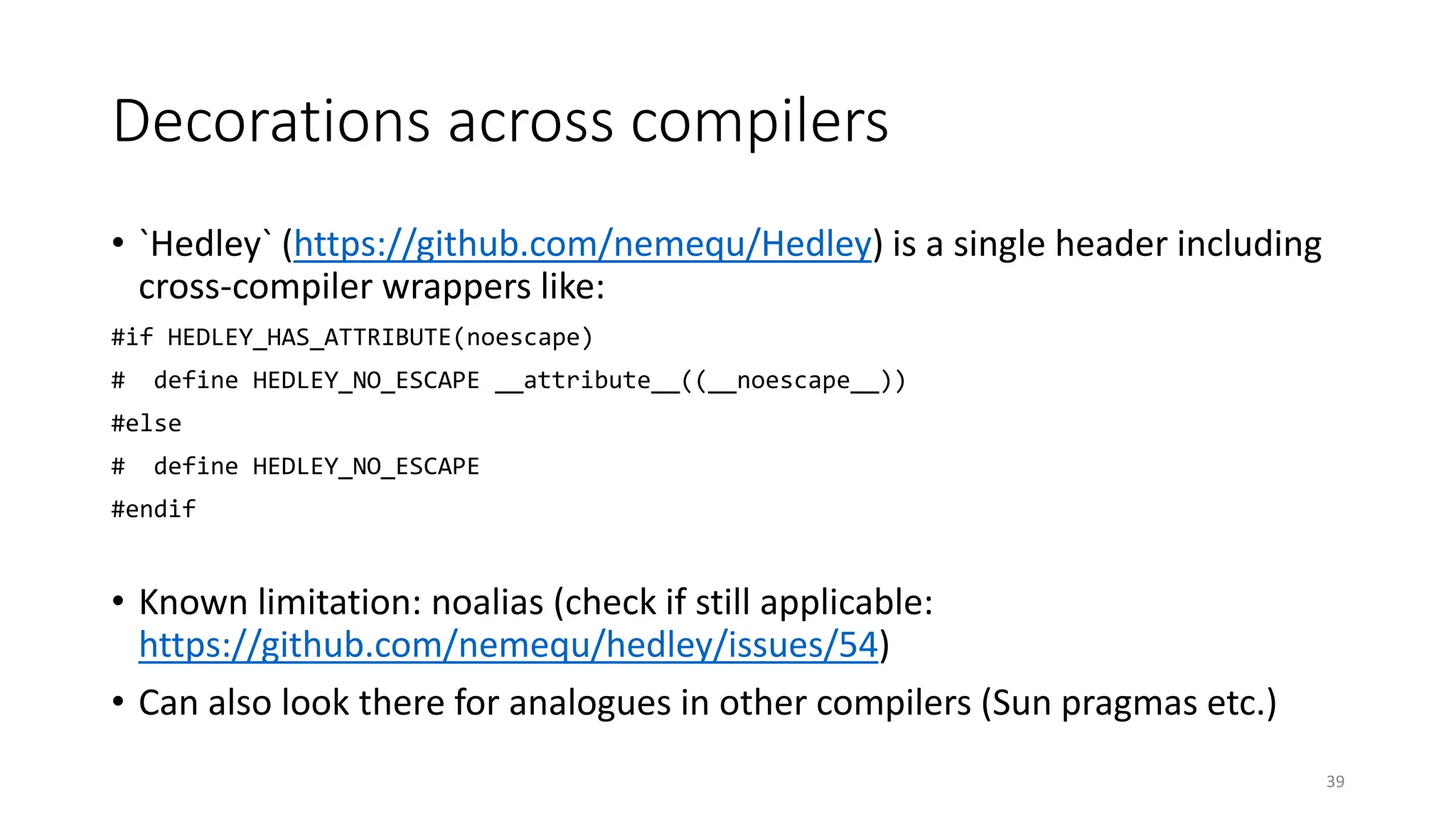
Decorations across compilers
• `Hedley` (https://github.com/nemequ/Hedley) is a single header including
cross-compiler wrappers like:
#if HEDLEY_HAS_ATTRIBUTE(noescape)
# define HEDLEY_NO_ESCAPE __attribute__((__noescape__))
#else
# define HEDLEY_NO_ESCAPE
#endif
• Known limitation: noalias (check if still applicable:
https://github.com/nemequ/hedley/issues/54)
• Can also look there for analogues in other compilers (Sun pragmas etc.)
39
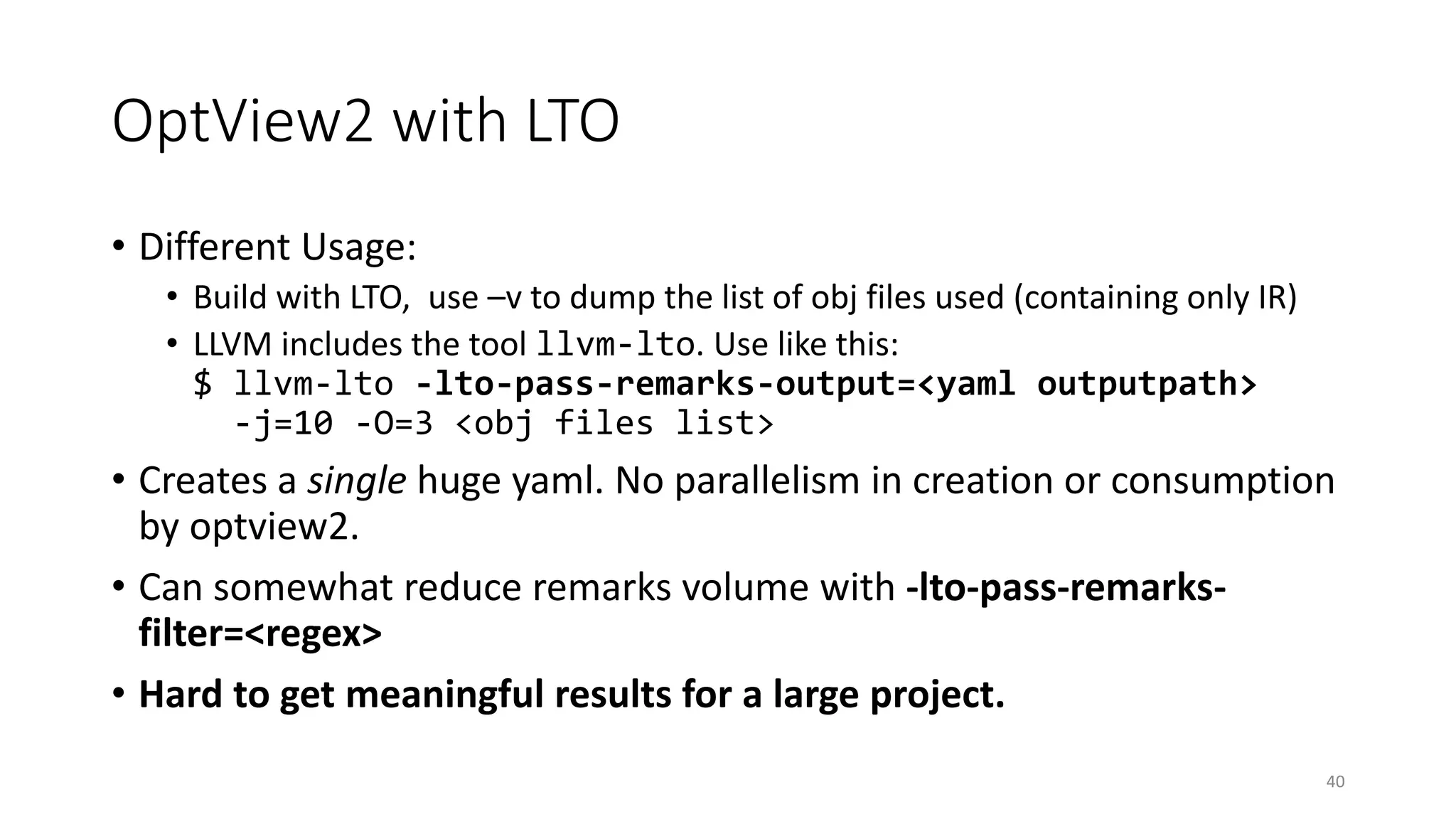
OptView2 with LTO
• Different Usage:
• Build with LTO, use –v to dump the list of obj files used (containing only IR)
• LLVM includes the tool llvm-lto. Use like this:
$ llvm-lto -lto-pass-remarks-output=<yaml outputpath>
-j=10 -O=3 <obj files list>
• Creates a single huge yaml. No parallelism in creation or consumption
by optview2.
• Can somewhat reduce remarks volume with -lto-pass-remarks-
filter=<regex>
• Hard to get meaningful results for a large project.
40
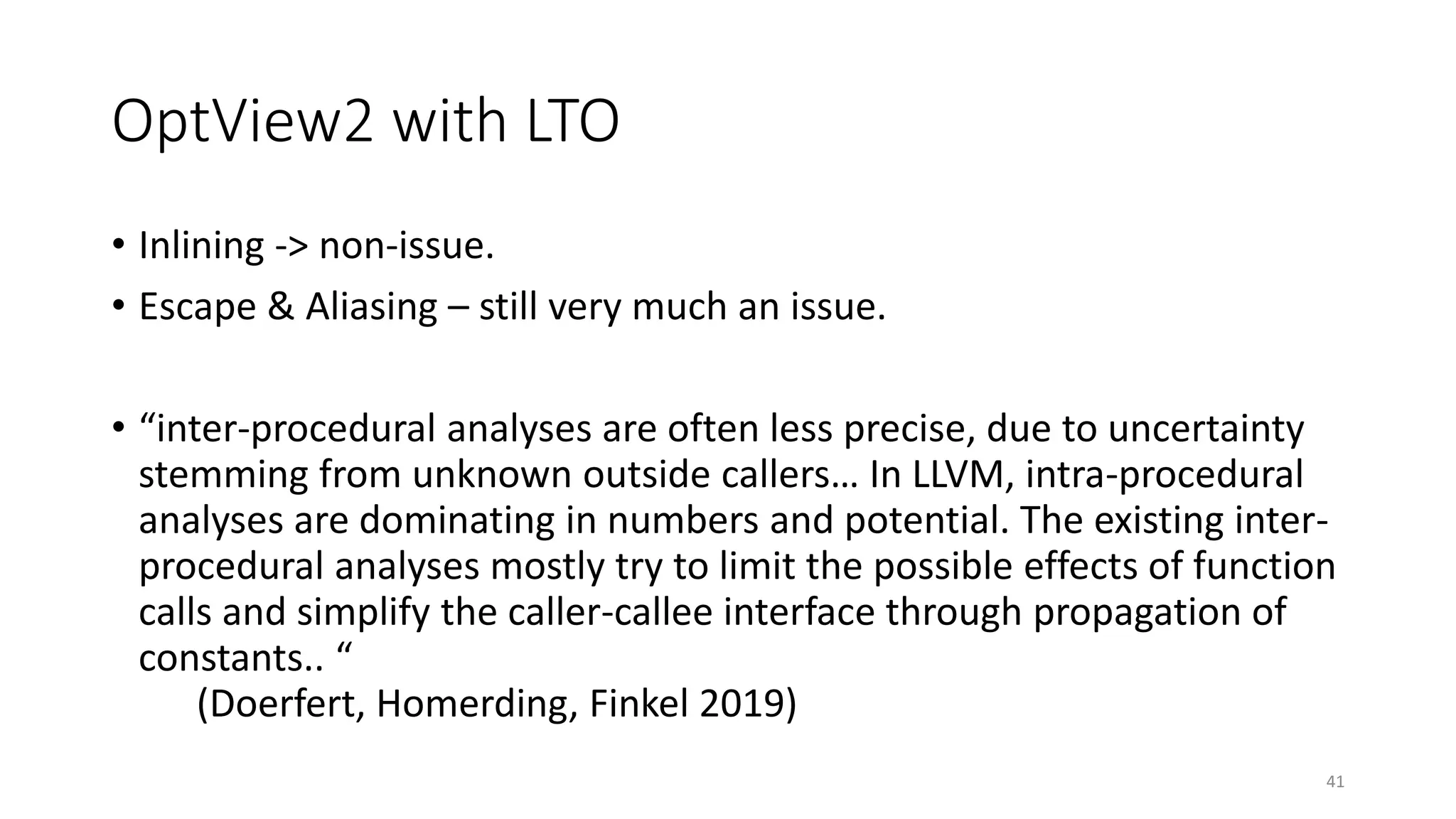
OptView2 with LTO
• Inlining -> non-issue.
• Escape & Aliasing – still very much an issue.
• “inter-procedural analyses are often less precise, due to uncertainty
stemming from unknown outside callers… In LLVM, intra-procedural
analyses are dominating in numbers and potential. The existing inter-
procedural analyses mostly try to limit the possible effects of function
calls and simplify the caller-callee interface through propagation of
constants.. “
(Doerfert, Homerding, Finkel 2019)
41
Impact?
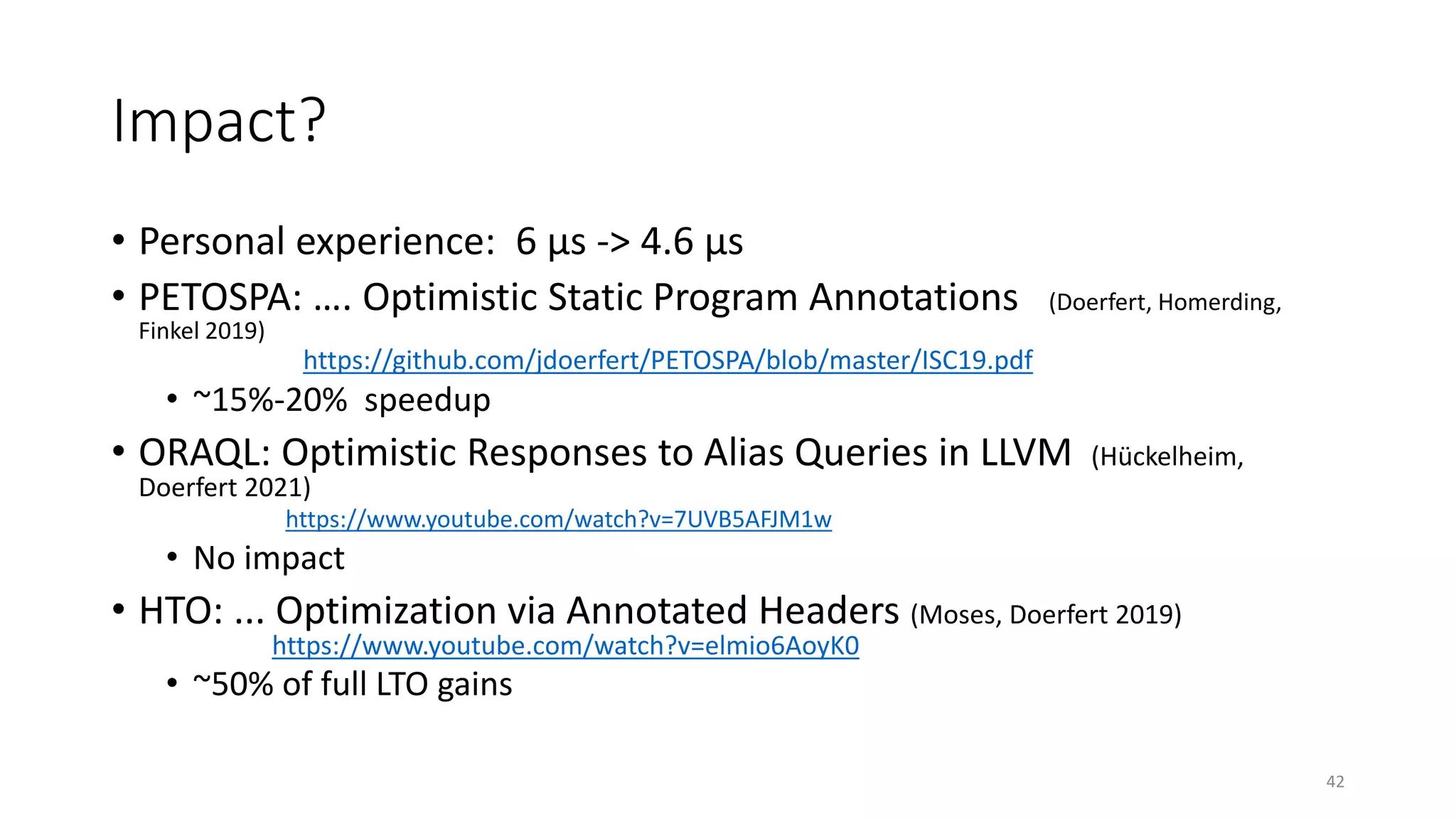
• Personal experience: 6 µs -> 4.6 µs
• PETOSPA: …. Optimistic Static Program Annotations (Doerfert, Homerding,
Finkel 2019)
https://github.com/jdoerfert/PETOSPA/blob/master/ISC19.pdf
• ~15%-20% speedup
• ORAQL: Optimistic Responses to Alias Queries in LLVM (Hückelheim,
Doerfert 2021)
https://www.youtube.com/watch?v=7UVB5AFJM1w
• No impact
• HTO: ... Optimization via Annotated Headers (Moses, Doerfert 2019)
https://www.youtube.com/watch?v=elmio6AoyK0
• ~50% of full LTO gains
42
Recommendations
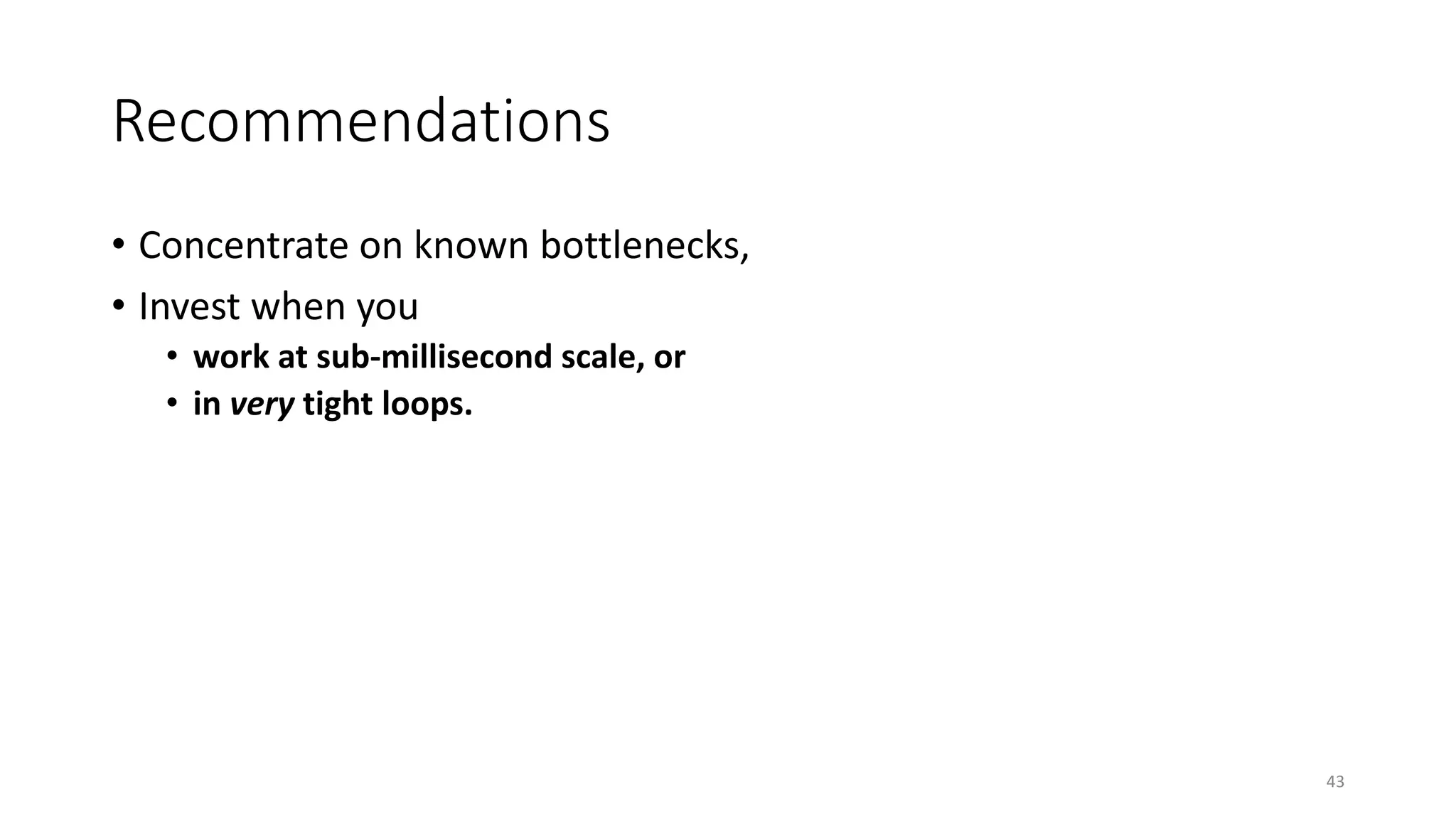
• Concentrate on known bottlenecks,
• Invest when you
• work at sub-millisecond scale, or
• in very tight loops.
43
Bottom line
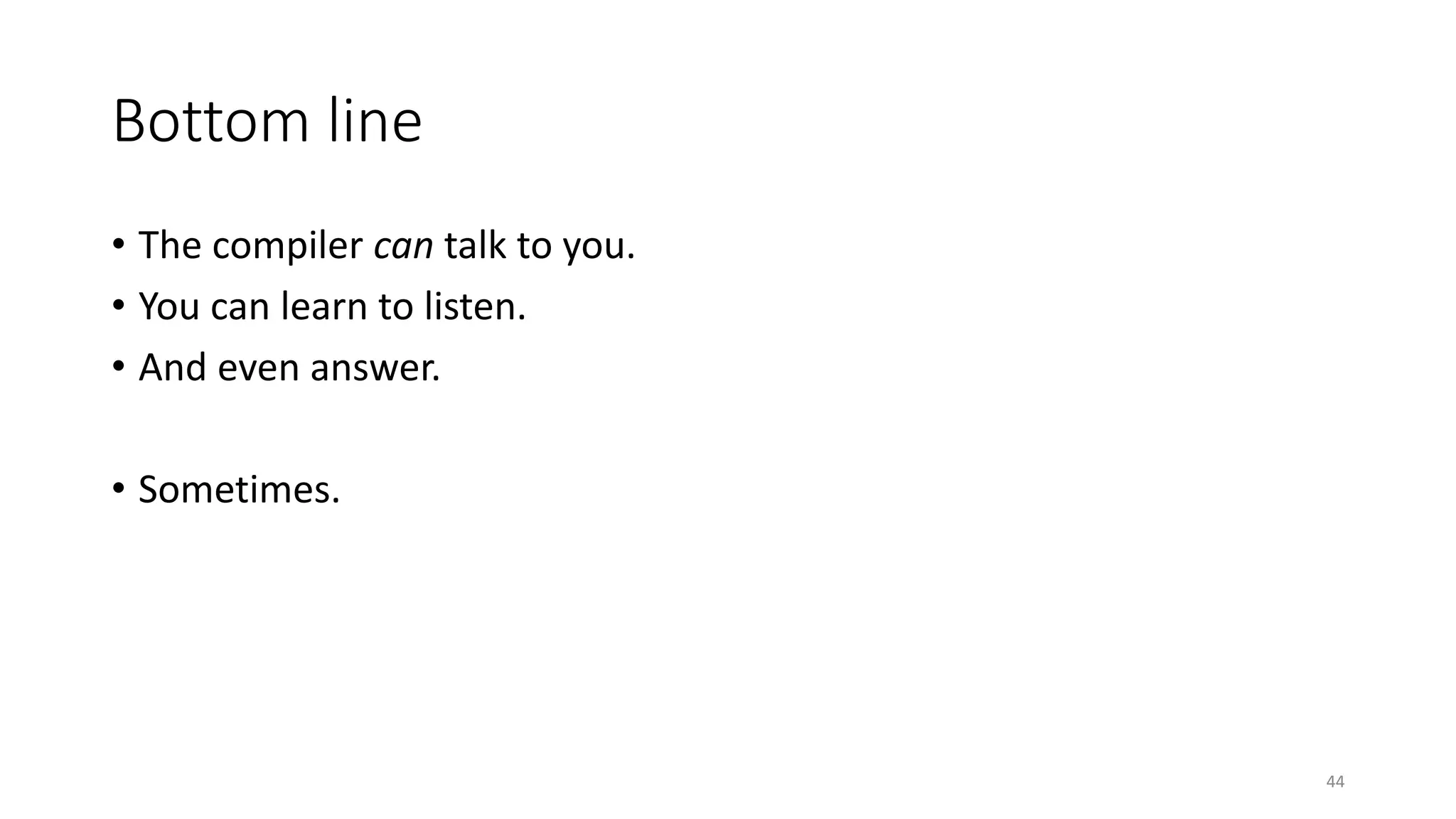
• The compiler can talk to you.
• You can learn to listen.
• And even answer.
• Sometimes.
44
Come join the party!
• https://github.com/OfekShilon/optview2
ofekshilon@gmail.com
45
@OfekShilon
46
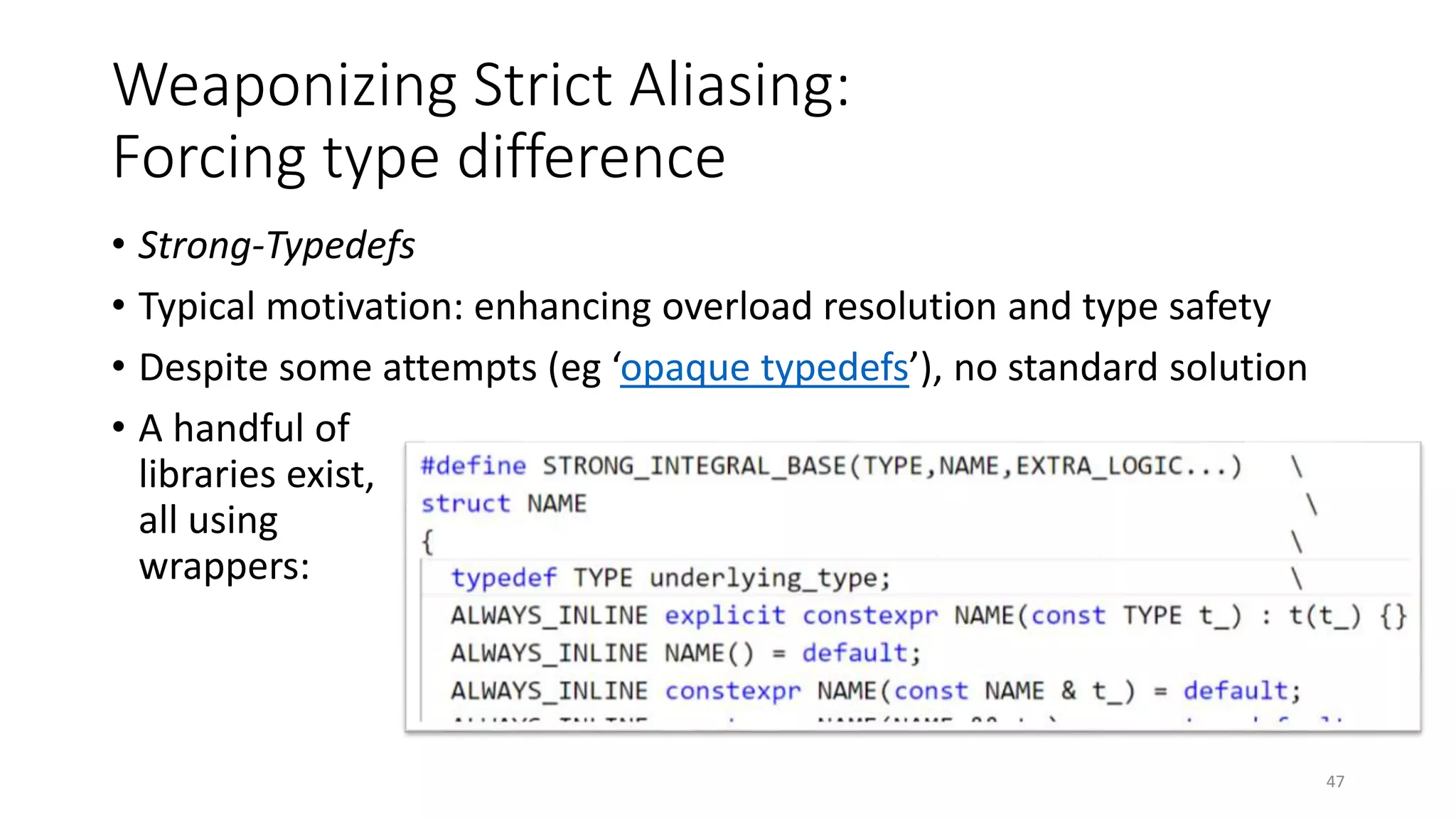
Weaponizing Strict Aliasing:
Forcing type difference
• Strong-Typedefs
• Typical motivation: enhancing overload resolution and type safety
• Despite some attempts (eg ‘opaque typedefs’), no standard solution
• A handful of
libraries exist,
all using
wrappers:
47
Strong-typedefs impact
• Improves optimization:
• https://godbolt.org/z/r8aWfMGfx
• Degrades optimization:
• https://godbolt.org/z/fe95sdrnx
• Clang issue: https://github.com/llvm/llvm-project/issues/54646
• Improves again: (enum classes hack, for integer-likes only)
• https://godbolt.org/z/4nejY3dKs
48
4. “Failed to move load with loop invariant
address”
• Foreach or other <algorithm>s?
• In this toy example – identical code.
• https://godbolt.org/z/jYWhG6zWc
• Occasionally different, not always better.
49
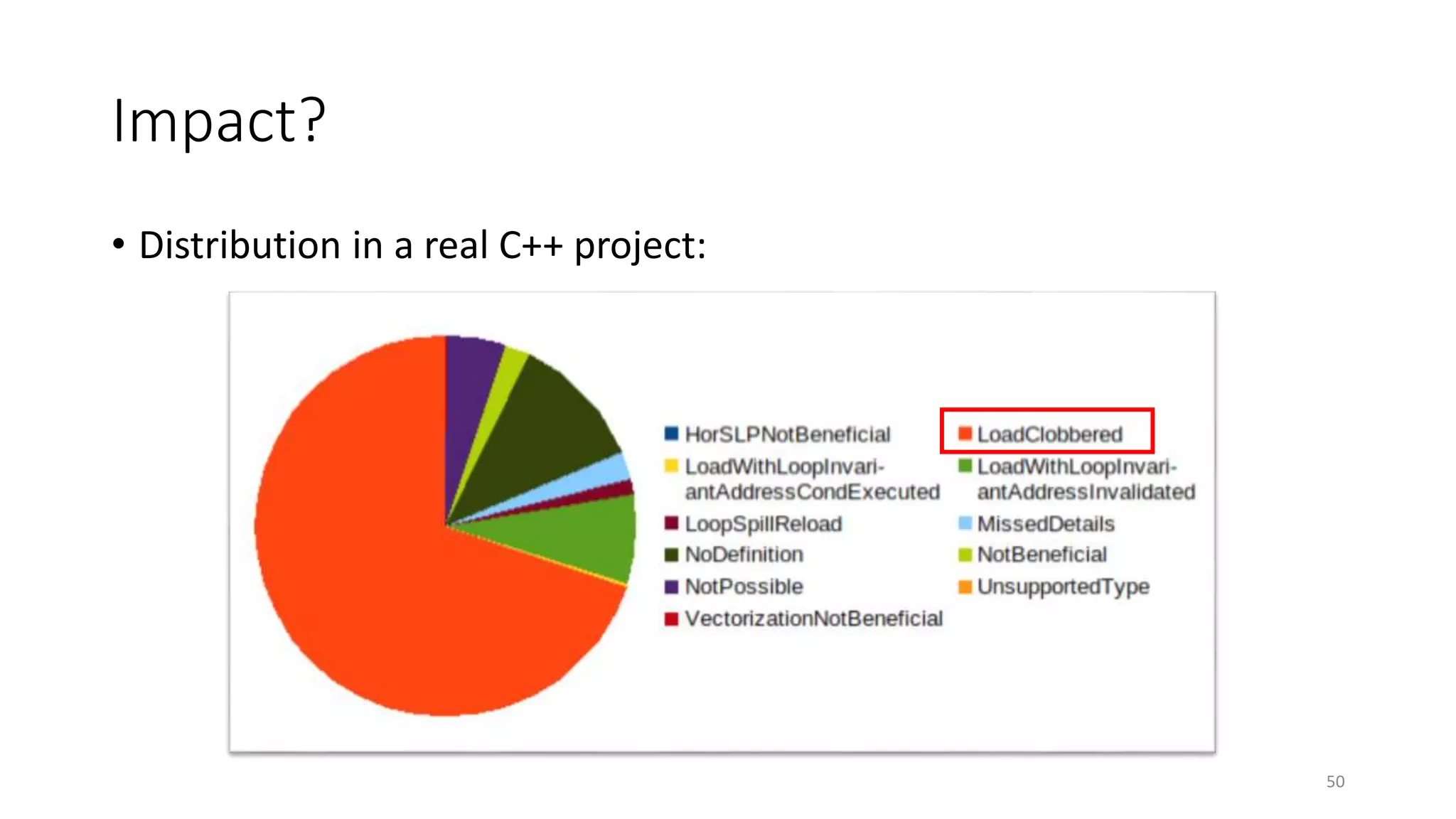
Impact?
• Distribution in a real C++ project:
50
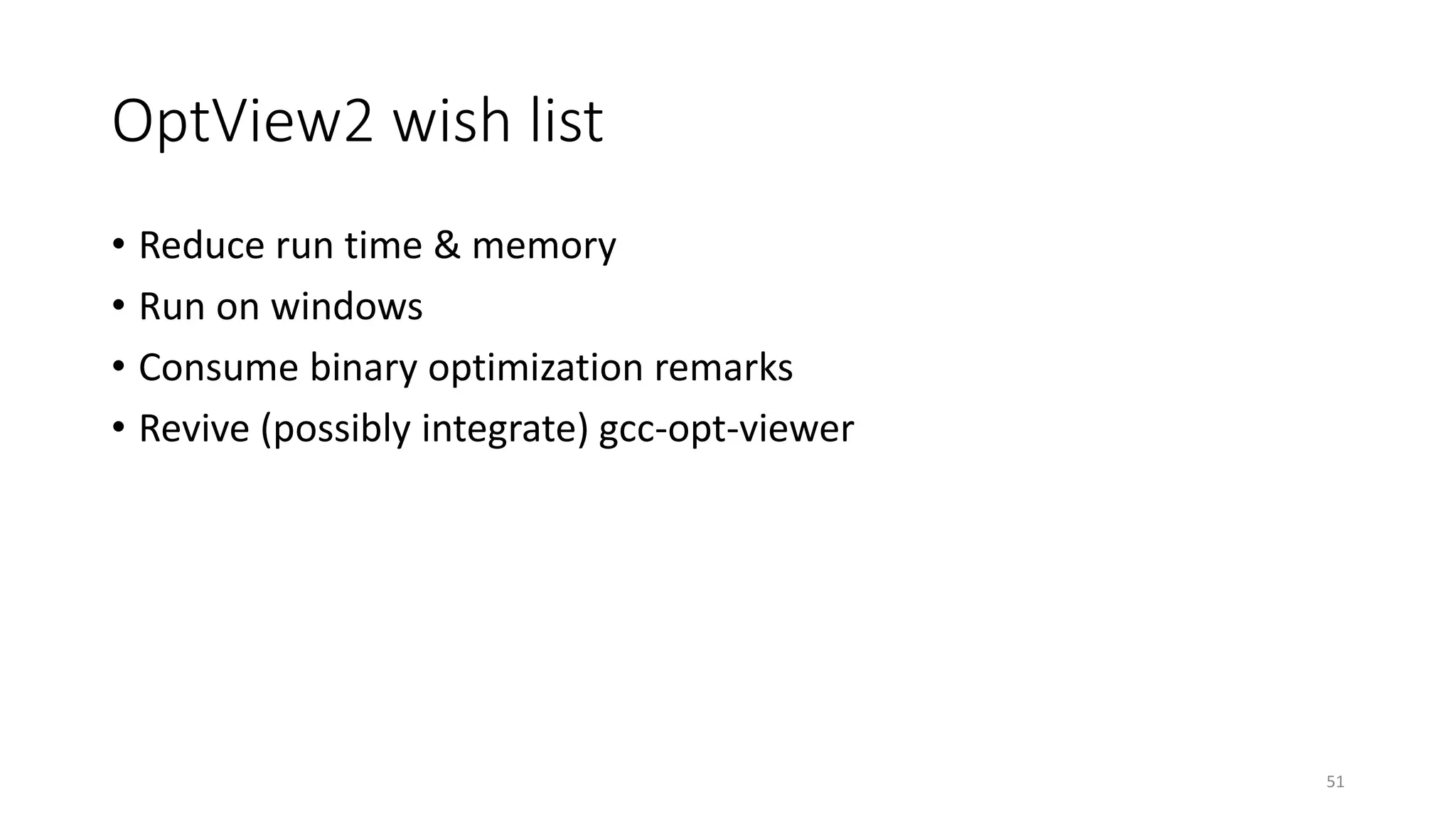
OptView2 wish list
• Reduce run time & memory
• Run on windows
• Consume binary optimization remarks
• Revive (possibly integrate) gcc-opt-viewer
51
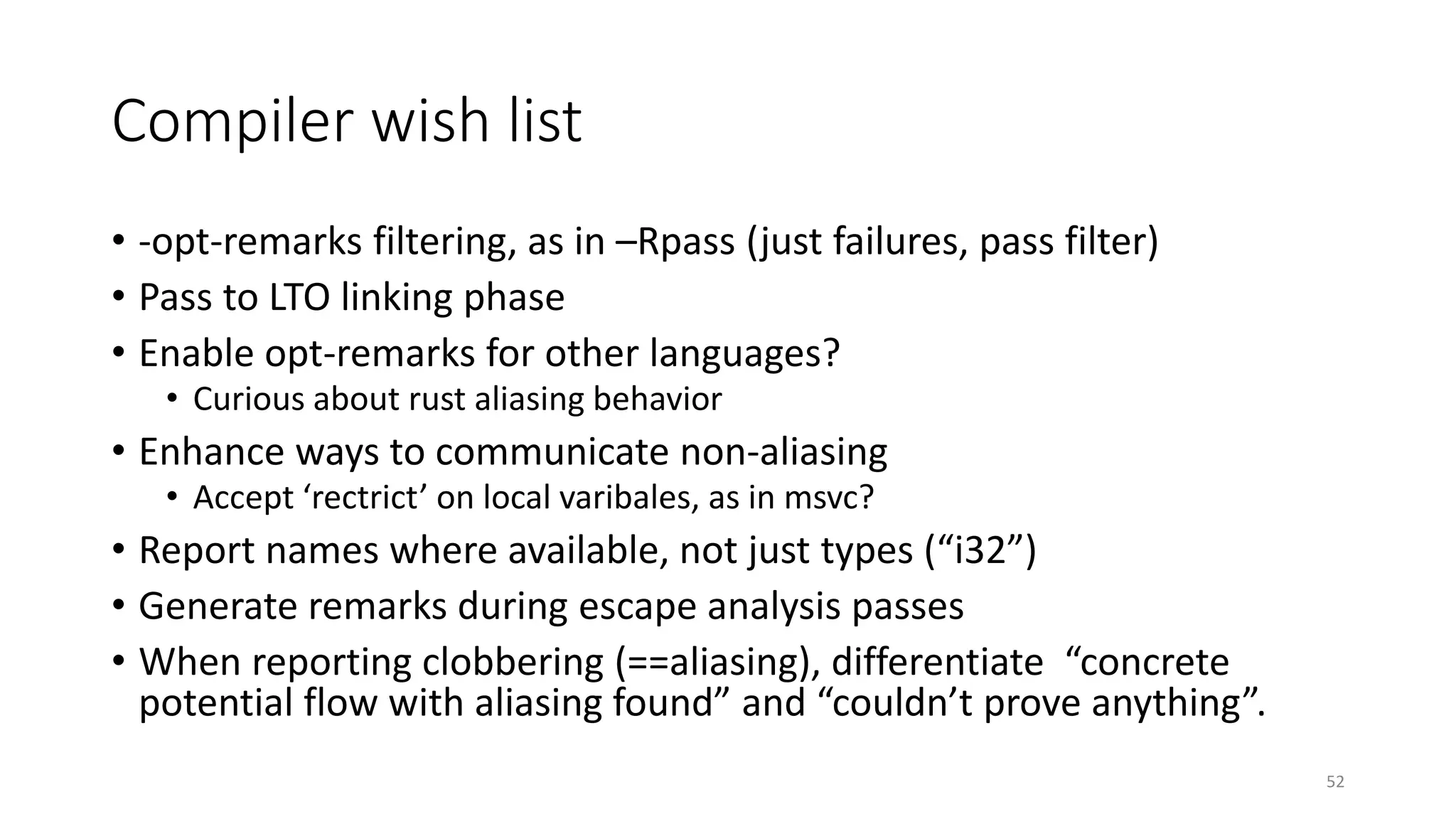
Compiler wish list
• -opt-remarks filtering, as in –Rpass (just failures, pass filter)
• Pass to LTO linking phase
• Enable opt-remarks for other languages?
• Curious about rust aliasing behavior
• Enhance ways to communicate non-aliasing
• Accept ‘rectrict’ on local varibales, as in msvc?
• Report names where available, not just types (“i32”)
• Generate remarks during escape analysis passes
• When reporting clobbering (==aliasing), differentiate “concrete
potential flow with aliasing found” and “couldn’t prove anything”.
52

OptView2 - C++ on Sea 2022

  • 1.
  • 2.
  • 3.
  • 4.
  • 5.
  • 6.
  • 7.
  • 8.
  • 9.
    opt-viewer • 2016 workled by Adam Nemet (Apple) https://www.youtube.com/watch?v=qq0q1hfzidg • Part of LLVM master: https://github.com/llvm/llvm- project/tree/main/llvm/tools/opt-viewer • Downloadable via deb pkg: llvm-14-tools 9
  • 10.
    opt-viewer Usage • Buildwith an extra clang switch: -fsave-optimization-record *.opt.yaml files are generated, by default in the obj folder. • Generate htmls: $ opt-viewer.py --output-dir <htmls folder> --source-dir <repo> <yamls folder> 10
  • 11.
    opt-viewer additions over-Rpass Inlining context Hotness (PGO)
  • 12.
    Great work, but •Heavy • High I/O • High memory • >1G htmls • Designed (and presented) for compiler authors • Mostly non actionable to developers 12
  • 13.
  • 14.
  • 15.
    Target Developers, NotCompiler Authors • Denoise: • Collect only optimization failures • By default no system headers • Remove duplicities, • Filter comment types via config file/command line • ~1.5M lines ==> 22K lines • Include column info (location within line) • split-to-subfolders • Sortable, resizable & pageable index • ... 15
  • 16.
    Example OptView2 outputs •https://ofekshilon.github.io/optview2-opencv/ • https://ofekshilon.github.io/optview2-cpython/ • https://ofekshilon.github.io/optview2_mujoco/ 16
  • 17.
  • 18.
  • 19.
  • 20.
  • 21.
    2. "Clobbered bystore" https://godbolt.org/z/T7h4nK3G7 21
  • 22.
  • 23.
  • 24.
    2. "Clobbered bystore" • “Strict aliasing is an assumption made by the compiler, that objects of different types will never refer to the same memory location (i.e. alias each other.)” Mike Acton https://cellperformance.beyond3d.com/articles/2006/06/understanding-strict-aliasing.html • Perhaps can be ‘weaponized’ to communicate non-aliasing to the compiler? 24
  • 25.
    2. "Clobbered bystore" • Maybe we can force artificial type-diff? Say, through some implementation of strong-typedef? • In practice, compilers are struggling. • Clang issue: https://github.com/llvm/llvm-project/issues/54646 25
  • 26.
    3. “Clobbered bycall” https://godbolt.org/z/jG5jq7c9a 26
  • 27.
    3. “Clobbered bycall” 27 • Cheating?.. pure + returns void somefunc() – does nothing, removed entirely. • If returned non-void – wouldn’t work (clang issue: https://github.com/llvm/llvm-project/issues/53102)
  • 28.
    3. “Clobbered bycall” 28 • Whateva() called only once, result copied to 2 other places
  • 29.
  • 30.
  • 31.
    3. “Clobbered bycall” Sometimes the offending call is standard! https://godbolt.org/z/81319zq1E 31
  • 32.
    4. “Failed tomove load with loop invariant address” https://godbolt.org/z/YGc83TMnj 32
  • 33.
    Cheat Sheet Symptom Probable cause Action InliningFailure Add header / forceinline / increase threshold "Clobbered by store" Aliasing restrict / force type diff "Clobbered by load" Escape Attributes pure / const / noescape (typically before the remark site) "Failed to move load loop invariant" Aliasing / Escape All the above + copy to local * Don’t understand? Reduce to bare minimum in godbolt. Might be a compiler limitation. 33
  • 34.
    Part 3: OtherCompilers 34
  • 35.
  • 36.
  • 37.
    GCC work • Activeonly during 2018 • Still at prototype quality • Compilation might consume 10G+ RAM per single file • Python scripts often break • Opened two bugs, one solved in my fork 37
  • 38.
    Decorations across compilers *Pertains also to locals ** Decorates a function return value 38 clang gcc icc msvc __restrict V V __restrict * __declspec(restrict) ** __attribute__((pure)) V - - __attribute__((const)) V V __declspec(noalias) __attribute__((noescape)) - - -
  • 39.
    Decorations across compilers •`Hedley` (https://github.com/nemequ/Hedley) is a single header including cross-compiler wrappers like: #if HEDLEY_HAS_ATTRIBUTE(noescape) # define HEDLEY_NO_ESCAPE __attribute__((__noescape__)) #else # define HEDLEY_NO_ESCAPE #endif • Known limitation: noalias (check if still applicable: https://github.com/nemequ/hedley/issues/54) • Can also look there for analogues in other compilers (Sun pragmas etc.) 39
  • 40.
    OptView2 with LTO •Different Usage: • Build with LTO, use –v to dump the list of obj files used (containing only IR) • LLVM includes the tool llvm-lto. Use like this: $ llvm-lto -lto-pass-remarks-output=<yaml outputpath> -j=10 -O=3 <obj files list> • Creates a single huge yaml. No parallelism in creation or consumption by optview2. • Can somewhat reduce remarks volume with -lto-pass-remarks- filter=<regex> • Hard to get meaningful results for a large project. 40
  • 41.
    OptView2 with LTO •Inlining -> non-issue. • Escape & Aliasing – still very much an issue. • “inter-procedural analyses are often less precise, due to uncertainty stemming from unknown outside callers… In LLVM, intra-procedural analyses are dominating in numbers and potential. The existing inter- procedural analyses mostly try to limit the possible effects of function calls and simplify the caller-callee interface through propagation of constants.. “ (Doerfert, Homerding, Finkel 2019) 41
  • 42.
    Impact? • Personal experience:6 µs -> 4.6 µs • PETOSPA: …. Optimistic Static Program Annotations (Doerfert, Homerding, Finkel 2019) https://github.com/jdoerfert/PETOSPA/blob/master/ISC19.pdf • ~15%-20% speedup • ORAQL: Optimistic Responses to Alias Queries in LLVM (Hückelheim, Doerfert 2021) https://www.youtube.com/watch?v=7UVB5AFJM1w • No impact • HTO: ... Optimization via Annotated Headers (Moses, Doerfert 2019) https://www.youtube.com/watch?v=elmio6AoyK0 • ~50% of full LTO gains 42
  • 43.
    Recommendations • Concentrate onknown bottlenecks, • Invest when you • work at sub-millisecond scale, or • in very tight loops. 43
  • 44.
    Bottom line • Thecompiler can talk to you. • You can learn to listen. • And even answer. • Sometimes. 44
  • 45.
    Come join theparty! • https://github.com/OfekShilon/optview2 ofekshilon@gmail.com 45 @OfekShilon
  • 46.
  • 47.
    Weaponizing Strict Aliasing: Forcingtype difference • Strong-Typedefs • Typical motivation: enhancing overload resolution and type safety • Despite some attempts (eg ‘opaque typedefs’), no standard solution • A handful of libraries exist, all using wrappers: 47
  • 48.
    Strong-typedefs impact • Improvesoptimization: • https://godbolt.org/z/r8aWfMGfx • Degrades optimization: • https://godbolt.org/z/fe95sdrnx • Clang issue: https://github.com/llvm/llvm-project/issues/54646 • Improves again: (enum classes hack, for integer-likes only) • https://godbolt.org/z/4nejY3dKs 48
  • 49.
    4. “Failed tomove load with loop invariant address” • Foreach or other <algorithm>s? • In this toy example – identical code. • https://godbolt.org/z/jYWhG6zWc • Occasionally different, not always better. 49
  • 50.
    Impact? • Distribution ina real C++ project: 50
  • 51.
    OptView2 wish list •Reduce run time & memory • Run on windows • Consume binary optimization remarks • Revive (possibly integrate) gcc-opt-viewer 51
  • 52.
    Compiler wish list •-opt-remarks filtering, as in –Rpass (just failures, pass filter) • Pass to LTO linking phase • Enable opt-remarks for other languages? • Curious about rust aliasing behavior • Enhance ways to communicate non-aliasing • Accept ‘rectrict’ on local varibales, as in msvc? • Report names where available, not just types (“i32”) • Generate remarks during escape analysis passes • When reporting clobbering (==aliasing), differentiate “concrete potential flow with aliasing found” and “couldn’t prove anything”. 52

Editor's Notes

  • #10 Clang-only 
  • #33 Replace members with locals NOT good c++ code!
  • #38 Definitely needs some lovin, Hopefully can still be resurrected.
  • #52 Report LLVM bugs: alias analysis bugs had no observable symptoms until now. There are no diagnostics emitted on them and they don’t result in bad codegen So, I suspect there are plenty of them.
  • #53 At least 4 committee papers try to engage with aliasing in the language. Alias-set, provenance