Optimization Using Evolutionary Algorithms And
Metaheuristics Applications In Engineering 1st
Edition Kaushik Kumar download
https://ebookbell.com/product/optimization-using-evolutionary-
algorithms-and-metaheuristics-applications-in-engineering-1st-
edition-kaushik-kumar-11221236
Explore and download more ebooks at ebookbell.com
Here are some recommended products that we believe you will be
interested in. You can click the link to download.
Multiobjective Optimization Using Evolutionary Algorithms 1st Edition
Kalyanmoy Deb
https://ebookbell.com/product/multiobjective-optimization-using-
evolutionary-algorithms-1st-edition-kalyanmoy-deb-2480600
Structural Optimization Using Shuffled Shepherd Metaheuristic
Algorithm Extensions And Applications Ali Kaveh
https://ebookbell.com/product/structural-optimization-using-shuffled-
shepherd-metaheuristic-algorithm-extensions-and-applications-ali-
kaveh-49177056
Project Optimization Using Matlab And Solver Reyolando Mlrf Brasil
Marcelo Araujo Da Silva
https://ebookbell.com/product/project-optimization-using-matlab-and-
solver-reyolando-mlrf-brasil-marcelo-araujo-da-silva-50338804
Design Optimization Using Matlab And Solidworks 1st Edition Suresh
https://ebookbell.com/product/design-optimization-using-matlab-and-
solidworks-1st-edition-suresh-54462520
Erp Optimization Using Your Existing System To Support Profitable
Ebusiness Initiatives 1st Edition Cindy Jutras
https://ebookbell.com/product/erp-optimization-using-your-existing-
system-to-support-profitable-ebusiness-initiatives-1st-edition-cindy-
jutras-2613326
Business Optimization Using Mathematical Programming An Introduction
With Case Studies And Solutions In Various Algebraic Modeling
Languages Research Management Science 307 2nd Ed 2021 Josef Kallrath
https://ebookbell.com/product/business-optimization-using-
mathematical-programming-an-introduction-with-case-studies-and-
solutions-in-various-algebraic-modeling-languages-research-management-
science-307-2nd-ed-2021-josef-kallrath-34418854
Project Optimization Using Matlab And Solver De Gruyter Textbook
Reyolando Mlrf Brasil
https://ebookbell.com/product/project-optimization-using-matlab-and-
solver-de-gruyter-textbook-reyolando-mlrf-brasil-34809644
Production Optimization Using Nodal Analysis 2nd Ed H Dale Beggs
https://ebookbell.com/product/production-optimization-using-nodal-
analysis-2nd-ed-h-dale-beggs-4125836
Portfolio Optimization Using Fundamental Indicators Based On
Multiobjective Ea 1st Edition Antonio Daniel Silva
https://ebookbell.com/product/portfolio-optimization-using-
fundamental-indicators-based-on-multiobjective-ea-1st-edition-antonio-
daniel-silva-5355826
Optimization Using
Evolutionary Algorithms
and Metaheuristics
Science, Technology, and Management Series
Series Editor, J. Paulo Davim, Professor, Department of Mechanical Engineering,
University of Aveiro, Portugal
This book series focuses on special volumes from conferences, workshops, and
symposiums, as well as volumes on topics of current interested in all aspects
of science, technology, and management. The series will discuss topics such as
mathematics, chemistry, physics, materials science, nanosciences, sustainability
science, computational sciences, mechanical engineering, industrial engineering,
manufacturing engineering, mechatronics engineering, electrical engineering,
systems engineering, biomedical engineering, management sciences, economical
science, human resource management, social sciences, engineering education, etc. The
books will present principles, models techniques, methodologies, and applications of
science, technology and management.
Advanced Mathematical Techniques in Engineering Sciences
Edited by Mangey Ram and J. Paulo Davim
Soft Computing Techniques for Engineering Optimization
Authored by Kaushik Kumar, Supriyo Roy, J. Paulo Davim
Handbook of IOT and Big Data
Edited by Vijender Kumar Solanki, Vicente García Díaz, J. Paulo Davim
For more information on this series, please visit: www.crcpress.com/Science-
Technology-and-Management/book-series/CRCSCITECMAN
Optimization Using
Evolutionary Algorithms
and Metaheuristics
Applications in Engineering
Edited by
Kaushik Kumar
Associate Professor, Department of Mechanical Engineering
Birla Institute of Technology
J. Paulo Davim
Professor, Department of Mechanical Engineering
University of Aveiro
CRC Press
Taylor & Francis Group
6000 Broken Sound Parkway NW, Suite 300
Boca Raton, FL 33487–2742
© 2020 by Taylor & Francis Group, LLC
CRC Press is an imprint of Taylor & Francis Group, an Informa business
No claim to original U.S. Government works
Printed on acid-free paper
International Standard Book Number-13978-0-367-26044-6(Hardback)
This book contains information obtained from authentic and highly regarded sources.
Reasonable efforts have been made to publish reliable data and information, but the
author and publisher cannot assume responsibility for the validity of all materials or the
consequences of their use. The authors and publishers have attempted to trace the copyright
holders of all material reproduced in this publication and apologize to copyright holders if
permission to publish in this form has not been obtained. If any copyright material has not
been acknowledged, please write and let us know so we may rectify in any future reprint.
Except as permitted under U.S. Copyright Law, no part of this book may be reprinted,
reproduced, transmitted, or utilized in any form by any electronic, mechanical, or other
means, now known or hereafter invented, including photocopying, microfilming, and
recording, or in any information storage or retrieval system, without written permission
from the publishers.
For permission to photocopy or use material electronically from this work, please access www.
copyright.com (www.copyright.com/) or contact the Copyright Clearance Center, Inc. (CCC),
222 Rosewood Drive, Danvers, MA01923, 978–750–8400. CCC is a not-for-profit organization
that provides licenses and registration for a variety of users. For organizations that have been
granted a photocopy license by the CCC, a separate system of payment has been arranged.
Trademark Notice: Product or corporate names may be trademarks or registered trademarks,
and are used only for identification and explanation without intent to infringe.
Library of Congress Cataloging‑in‑Publication Data
Names: Kumar, K. (Kaushik), 1968– editor. | Davim, J. Paulo, editor.
Title: Optimization using evolutionary algorithms and metaheuristics :
applications in engineering / edited by Kaushik Kumar and J. Paulo Davim.
Description: Boca Raton : Taylor & Francis, a CRC title, part of the Taylor &
Francis imprint, a member of the Taylor & Francis Group, the academic division of
T&F Informa, plc, 2019. | Series: Science, technology, and management series |
Includes bibliographical references.
Identifiers: LCCN 2019019067 | ISBN 9780367260446 (hardback : alk. paper) |
ISBN 9780429293030 (e-book)
Subjects: LCSH: Engineering economy. | Mathematical optimization. |
Genetic algorithms. | metaheuristics.
Classification: LCC TA177.4 .O68 2019 | DDC 620.001/5196—dc23
LC record available at https://lccn.loc.gov/2019019067
Visit the Taylor & Francis Web site at
www.taylorandfrancis.com
and the CRC Press Web site at
www.crcpress.com
v
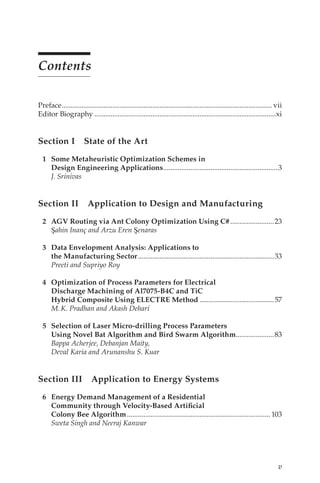
Contents
Preface�������������������������������������������������������������������������������������������������������������������� vii
Editor Biography����������������������������������������������������������������������������������������������������xi
Section I State of the Art
1 Some Metaheuristic Optimization Schemes in
Design Engineering Applications���������������������������������������������������������������3
J. Srinivas
Section II Application to Design and Manufacturing
2 AGV Routing via Ant Colony Optimization Using C#������������������������23
Şahin Inanç and Arzu Eren Şenaras
3 Data Envelopment Analysis: Applications to
the Manufacturing Sector���������������������������������������������������������������������������33
Preeti and Supriyo Roy
4 Optimization of Process Parameters for Electrical
Discharge Machining of Al7075-B4C and TiC
Hybrid Composite Using ELECTRE Method�����������������������������������������57
M.K. Pradhan and Akash Dehari
5 Selection of Laser Micro-drilling Process Parameters
Using Novel Bat Algorithm and Bird Swarm Algorithm���������������������83
Bappa Acherjee, Debanjan Maity,
Deval Karia and Arunanshu S. Kuar
Section III Application to Energy Systems
6 Energy Demand Management of a Residential
Community through Velocity-Based Artificial
Colony Bee Algorithm������������������������������������������������������������������������������� 103
Sweta Singh and Neeraj Kanwar
viContents
7 Adaptive Neuro-fuzzy Inference System (ANFIS)
Modelling in Energy System and Water Resources���������������������������� 117
P.A. Adedeji, S.O. Masebinu, S.A. Akinlabi and N. Madushele
Index���������������������������������������������������������������������������������������������������������������������135
vii
Preface
The ever-increasing demand on engineers to lower production costs to with-
stand competition has prompted engineers to look for rigorous methods
of decision-making, such as optimization methods, to design and produce
products both economically and efficiently. The term optimize is defined as
“to make perfect.” The word optimus—the best—was derived from Opis, a
Roman goddess of abundance and fertility, who is said to have been the wife
of Saturn. By her the gods designed the earth, because the earth distributes
all goods (riches, goods, abundance, gifts, munificence, plenty, etc.).
Let us consider the design of a steel structure where some of the mem-
bers are described by ten design variables. Each design variable represents a
number of a Universal Beams (UB) section from a catalogue of ten available
sections. Assuming one full structural analysis of each design takes 1 second
on a computer, how much time would it take to check all the combinations
of cross-sections in order to guarantee the optimum solution? The result is
317 years (1010 seconds). So optimization is required.
Optimization can be used in any field, as it involves formulating a pro-
cess or products in various forms. It is the process of finding the best way
of using the existing resources while taking into account all the factors that
influence decisions in any experiment. The final product not only meets the
requirements from the availability but also from the practical mass produc-
tion criteria.
In computer science and mathematical optimization, a metaheuristic is a
higher-level procedure or heuristic designed to find, generate or select a heu-
ristic (partial search algorithm) that may provide a sufficiently good solu-
tion to an optimization problem, especially with incomplete or imperfect
information or a limited computation capacity. Metaheuristics sample a set
of solutions which is too large to be completely sampled. Metaheuristics may
make few assumptions about the optimization problem being solved, and so
they may be usable for a variety of problems.
Compared to optimization algorithms and iterative methods, metaheuris-
tics do not guarantee that a globally optimal solution can be found on some
class of problems. Many metaheuristics implement some form of stochastic
optimization, so that the solution found is dependent on the set of random
variables generated. In combinatorial optimization, by searching across a
large set of feasible solutions, metaheuristics can often find good solutions
with less computational effort than optimization algorithms, iterative meth-
ods or simple heuristics. As such, they are useful approaches for optimiza-
tion problems.
The requirement of this book is mainly aimed at two major objectives. First,
it has chapters by eminent researchers in the field providing readers about
viiiPreface
the current status of the subject. Second, algorithm-based optimization or
advanced optimization techniques are mostly applied to non-engineering
problems. This would serve as an excellent guideline for people in this field.
The chapters in the book have been provided by researchers and acade-
micians who have gained considerable success in the field. The chapters of
the book are segregated in three parts, namely Part I: State of the Art; Part II:
Application to Design and Manufacturing; and Part III: Application to Energy
Systems.
Part I contains Chapter 1; Part II contains Chapters 2 to 5; and Part III con-
tains Chapters 6 and 7.
Part I of the book begins with Chapter 1, describing new metaheuristic
optimization schemes for design engineering. It starts with the assumption
that multi-constraint and multi-objective optimal problems are cumbersome
to handle with available solution techniques, and metaheuristic methods
provide help in such situations as they obtain an approximate solution from
polynomial time algorithms. The chapter then concentrates on three such
techniques applied to some engineering design problems.
Part II is dedicated to “Application to Design and Manufacturing” and
contains four chapters. Chapter 2 explains Ant Colony Optimization. The
technique has been used for Automated Guided Vehicle (AGV) routing. The
algorithm has been utilized using C#. The work is commendable, as the black
box of any software has not been used, rather the codes were generated using
C#, which makes the work more versatile and robust.
Chapter 3 utilizes Data Envelopment Analysis (DEA), a mathematical
optimization technique towards the manufacturing sector. The technique is
being applied for selecting the best plant layout, evaluating the most effec-
tive Flexible Manufacturing System (FMS) and Advanced Manufacturing
Techniques (AMT), identifying the most sustainable manufacturing system,
finding the energy efficient manufacturing unit, investigating the profitabil-
ity and marketability of manufacturing organizations. Hence, the chapter
reviews the diverse application of DEA in the manufacturing sector and
thoroughly scrutinized to state the future directions of research.
In Chapter 4, Response Surface Methodology coupled with the ELECTRE
method has been proposed for optimization of the input process parameters
of Electrical Discharge Machining, a non-traditional machining technique,
for machining of AL7075, B4C and TiC Hybrid Composite. The significant
input parameters such as pulse current (Ip), pulse duration (Ton), duty cycle
(Tau) and the discharge voltage (V) are considered, and MRR, surface rough-
ness, radial over-cut and TWR have been considered as responses for in this
chapter.
In Chapter 5, the last chapter of the section, two novel bio-inspired meta-
heuristic algorithms are employed to investigate the laser micro-drilling
process. The techniques used are very new and are the novel bat algorithm
and the bird swarm algorithm. The novel bat algorithm is inspired by habi-
tat selection behaviours of bats and their self-adaptive compensation for the
Preface ix
Doppler effect in echoes. The bird swarm algorithm is inspired by the social
behaviours and social interactions in bird swarms. In this chapter the objec-
tive functions are developed using the response surface method (RSM). Both
the algorithms are compared for their accuracy, repeatability, convergence
rate and computational time and were found to be capable of predicting
accurate trends of the parametric effects.
From here the book continues with Part III, grouping contributions
for energy systems. Chapter 6 illustrates the application of Demand Side
Management (DSM) for improvement in energy efficiency of the power grid
and maintain its reliability. The load curve has been reshaped with DSM
techniques and also the total cost of electricity consumption was reduced.
The chapter presents a proposal for minimization of electrical cost of a resi-
dential community. Three cases have been reported for the purpose of com-
parison: normal load without DSM strategy in place, with DSM strategy and
DSM strategy with solar PV generation. The observations reveal that it not
possible to reduce the power consumption, however it is always feasible to
shift the loads to cheaper pricing hours. The DSM strategy has been imple-
mented using Velocity-based Artificial Bee Colony (VABC) algorithm and
effectiveness of the load management strategy is truly reflected in the results.
The last chapter of the section and the book, Chapter 7, provides the reader
with another metaheuristic technique known as the Adaptive Neuro-fuzzy
Inference System (ANFIS). Its incredible ability to generalize complex non-
linear systems has been instrumental in its popularity in last two decades.
The chapter dedicates for lesser-known facts about the technique (i.e. its
strengths and weakness). The strengths and weaknesses of ANFIS were dis-
cussed with applications of ANFIS modelling in energy system and water
resources optimization. The chapter elaborates on the black box nature of
the Artificial Neural Network (ANN) with its associated pitfalls, a com-
ponent of ANFIS and basic principles of the Fuzzy Inference System (FIS).
Recommendations in terms of ANFIS architecture and model parameter
selection were made for energy and water resources engineers on the use of
ANFIS modelling technique.
First and foremost, we would like to thank God. In the process of put-
ting this book together, the true gift of writing was very much realized and
appreciated. You have given the power to believe in passion, hard work
and pursue dreams. This could never have been done without faith in You,
the Almighty. We would like to thank all the contributing authors without
whom this would have been impossible. We would also like to thank them
for believing in us. We would like to thank all of our colleagues and friends
in different parts of the world for sharing ideas in shaping our thoughts. Our
efforts will come to a level of satisfaction if the professionals concerned with
all the fields related to optimization are benefitted. We owe a huge thanks to
all our technical reviewers, editorial advisory board members, book devel-
opment editor, and the team of CRC Press (A Taylor  Francis Company) for
their availability to work on this huge project. All of their efforts helped to
xPreface
make this book complete, and we would have failed if all of them hadn’t have
actively supported and cooperated. Thanks to one and all.
Throughout the process of editing this book, many individuals, from dif-
ferent walks of life, have taken time out to help us out. Last, but definitely
not least, we would like to thank them all, our well-wishers, for providing
us encouragement. We would have probably given up without their support.
Kaushik Kumar
J. Paulo Davim
xi
Editor Biography
Kaushik Kumar, 
B.Tech (Mechanical Engineering, REC (Now NIT),
Warangal), MBA (Marketing, IGNOU) and Ph.D. (Engineering, Jadavpur
University), is presently an Associate Professor in the Department of
Mechanical Engineering, Birla Institute of Technology, Mesra, Ranchi, India.
He has 16 years of teaching and research and over 11 years of industrial
experience in a manufacturing unit of global repute. His areas of teaching
and research interest are optimization, conventional and non-conventional
manufacturing, CAD/CAM, rapid prototyping, quality management sys-
tems and composites. He has nine patents, 28 books, 15 edited books, 43
book chapters, 136 international journal publications, and 21 international
and eight national conference publications to his credit. He is guest editor
for many peer-reviewed journals and editorial boards and is a review panel
member of many international and national journals of global repute. He has
been felicitated with many awards and honours.
J. Paulo Davim 
received his Ph.D. degree in Mechanical Engineering in
1997, M.Sc. degree in Mechanical Engineering (materials and manufacturing
processes) in 1991, Mechanical Engineering degree (5 years) in 1986, from
the University of Porto (FEUP), the Aggregate title (Full Habilitation) from
the University of Coimbra in 2005 and the D.Sc. from London Metropolitan
University in 2013. He is Senior Chartered Engineer by the Portuguese
Institution of Engineers with an MBA and Specialist title in Engineering
and Industrial Management. He is also Eur Ing by FEANI-Brussels and
Fellow (FIET) by IET-London. Currently, he is Professor at the Department
of Mechanical Engineering of the University of Aveiro, Portugal. He has
more than 30 years of teaching and research experience in Manufacturing,
Materials, Mechanical and Industrial Engineering, with special emphasis in
Machining  Tribology. He also has interest in Management, Engineering
Education and Higher Education for Sustainability. He has guided large
numbers of postdoc, Ph.D. and master’s students as well as has coordinated
and participated in several financed research projects. He has received
several scientific awards. He has worked as evaluator of projects for ERC
European Research Council and other international research agencies as
well as examiner of Ph.D. thesis for many universities in different countries.
He is the Editor in Chief of several international journals, Guest Editor of
journals, books Editor, book Series Editor and Scientific Advisory for many
international journals and conferences. Presently, he is an Editorial Board
member of 30 international journals and acts as reviewer for more than 100
xii Editor Biography
prestigious Web of Science journals. In addition, he has also published as
editor (and co-editor) more than 100 books and as author (and co-author)
more than 10 books, 80 book chapters and 400 articles in journals and con-
ferences (more than 250 articles in journals indexed in Web of Science core
collection/h-index 50 + /7500 + citations, SCOPUS/h-index 56 + /10500 +
citations, Google Scholar/h-index 71 + /16500 + ).
Section I
State of the Art
Other documents randomly have
different content
Mr. Jenner. Did you have any conversation with him in addition to
the letter, apart from the letter?
Mr. Oswald. I believe I did along that line because as I stated our
interests in hunting and fishing was mutual and he did state that he
was able to——
Mr. Jenner. In response to Mr. Dulles' question, would you give
the conversation? We will take care of the letter in the morning.
Mr. Oswald. No, sir; I am trying to give the conversation.
Mr. Jenner. Thank you. Proceed.
Mr. Oswald. That we talked about hunting over there, and he said
that he had only been hunting a half dozen times, and so forth, and
that he had only used a shotgun, and a couple of times he did shoot
a duck.
Mr. Jenner. It was all shotgun shooting, no rifle shooting?
Mr. Oswald. No rifle shooting, no sir. That is all they were allowed
to have, the shotgun.
Mr. Jenner. This conversation took place, as I understand it, on
his return from Russia when he was living with you for that month,
that would be June-July of 1962?
Mr. Oswald. Yes, sir; that is correct.
Mr. Jenner. And that is the extent of the conversation?
Mr. Oswald. Yes, sir; that is.
Mr. Jenner. As you now recall it—there have been some reports,
and they are only reports as far as we of the staff are concerned, of
speculation about a television set, whether your brother purchased
or owned a television set and whether he purchased it outright or on
time with a guarantee from you.
What information or knowledge do you have in that connection?
Mr. Oswald. I am not aware that he purchased a television set,
sir. I did at his request, when he and Marina and the baby were
living in Fort Worth.
Mr. Jenner. Where in Fort Worth?
Mr. Oswald. Mercedes Street in Fort Worth, in a small duplex
which was——
Mr. Jenner. Can you fix even more definitely the time of this
event?
Mr. Oswald. This was approximately the latter part of September,
1962. And at his request——
Mr. Jenner. He came to you, excuse me.
Mr. Oswald. He called me, sir.
Mr. Jenner. He called you by telephone?
Mr. Oswald. Yes, sir; he called me at my office from his place of
employment in Fort Worth at that time.
Mr. Jenner. Give us the substance of what he said.
Mr. Oswald. We talked briefly about how each family was doing,
and so forth, and he said that he would like to establish credit and
he had tried to charge something at Montgomery Ward's at Fort
Worth, the West 7th Street store, and they had stated that he
needed to have somebody cosign or vouch for him, and this was his
request to me, and I said gladly I would do so, and late that
afternoon after work, this was approximately 5:30 by the time I
arrived at Montgomery Ward, I did sign for Lee's charge account.
However, I was not aware of what he was charging.
Mr. Jenner. There was no discussion, I take it, at that time of
what—the use to which he intended to put his credit?
Mr. Oswald. No, sir; I believe perhaps he did mention something
about a baby chair and a baby bed.
Mr. Jenner. Was there ever any discussion between you about his
purchase or acquisition of a television set?
Mr. Oswald. No, sir; there was not.
Mr. Jenner. Were you ever in his home or apartment?
Mr. Oswald. Yes, sir; I was.
Mr. Jenner. Did you see a television set there?
Mr. Oswald. Pardon me, you are referring to the apartment on
Mercedes Street, is that correct?
Mr. Jenner. Yes.
Mr. Oswald. Yes, I was in his home quite a few times and there
was not a television set that I remember.
Mr. Jenner. On any occasion that you were there?
Mr. Oswald. No, sir.
Mr. Jenner. On any occasion when you were in any place of
residence of your brother after his return to the United States, did
you see in those premises a television set?
Mr. Oswald. Yes, sir.
Mr. Jenner. Where was that?
Mr. Oswald. At my house and at my mother's house.
Mr. Jenner. I should have been more specific and identified a
residence as one of his own rather than living with you or living with
your mother.
Mr. Oswald. At no residence that he lived in that I was aware of
at any time did I see him with a television set that I would take to
be his own.
Mr. Jenner. Did you ever have any discussions—did any
discussion ever occur between the two of you with respect to his
acquisition of a television set?
Mr. Oswald. None that I recall, sir.
Mr. Jenner. This is, as far as you are concerned, a total blank, this
television set matter?
Mr. Oswald. That is correct, sir.
Mr. Dulles. I think we had better adjourn pretty soon. This man
has had quite an ordeal for the day.
Mr. Jenner. It is acceptable.
Mr. Dulles. Is it acceptable to you?
The Chairman. Yes.
Mr. Oswald. I have no objection to continuing.
Mr. McKenzie. If you would prefer to reconvene tomorrow
morning we can reconvene then.
Mr. Rankin. I think 9 o'clock is better. I think we can finish up in
the morning.
Mr. Dulles. Thank you. At 9 o'clock in the morning.
(Whereupon, at 5:15 p.m., the President's Commission
recessed.)
Friday, February 21, 1964
TESTIMONY OF ROBERT EDWARD
LEE OSWALD RESUMED
The President's Commission met at 9 a.m. on February 21, 1964,
at 200 Maryland Avenue NE., Washington, D.C.
Present were Chief Justice Earl Warren, Chairman; and Allen W.
Dulles, member.
Also present were J. Lee Rankin, general counsel; Albert E.
Jenner, Jr., assistant counsel; Wesley J. Liebeler, assistant counsel;
and William McKenzie, attorney for Robert Edward Lee Oswald.
The Chairman. Gentlemen, the Commission will be in order.
As yesterday, I will only be able to be here for a comparatively
short time, because we have our weekly conference of the Supreme
Court today. And when I leave, Mr. Allen Dulles will conduct the
hearing. We will now proceed with the testimony.
Mr. Jenner. Thank you, Mr. Chief Justice.
I would like to return, Mr. Oswald, to the time that your brother
Lee was discharged from military service and spent approximately 3
days at home. You recall that period?
Mr. Oswald. Yes, sir; I do.
Mr. Jenner. Now, would you please describe his physical
appearance the last time you saw him during that 3-day period?
Mr. Oswald. His hair was brown and curly, a full set of hair. His
physical appearance—he was trim, weighed approximately 140
pounds, he was approximately 5 foot 9½, he seemed to be in fine
physical shape at that time.
Mr. Jenner. I mentioned 3 days. Was I wrong about the 3 days,
or was it a little longer period?
Mr. Oswald. No, sir; my recollection on that period was 2 or 3
days, and only during one of these day do I remember seeing him.
He spent the day at our house.
Mr. Jenner. It was your impression, sir, that he was in good
health, bright and alert mentally at that time?
Mr. Oswald. Yes, sir; he most certainly was.
Mr. Jenner. Did you describe his physical appearance as far as his
head of hair was concerned?
Mr. Oswald. Yes, sir.
Mr. Jenner. A full head of hair?
Mr. Oswald. Yes, sir.
Mr. Jenner. Did he appear strained in any respect?
Mr. Oswald. No, sir; he did not.
Mr. Jenner. His mental condition, as far as you can tell, is what
you would regard or had regarded as normal during your
acquaintance with him as his brother?
Mr. Oswald. That is correct.
Mr. Jenner. Now, will you then jump to the first time you saw him
subsequently thereto, which I understand was in June 1962. State
the date, please, as closely as you can.
Mr. Oswald. This was June 14, 1962.
Mr. Jenner. And where did you see him?
Mr. Oswald. At Dallas, Love Field.
Mr. Jenner. Now, on that occasion—and take in also the period of
time that he lived with you in your home during June and part of
July 1962—what did you observe, and if in contrast by way of
contrast, in his physical appearance and demeanor as against the
last time you had seen him, in 1959.
Mr. Oswald. His appearance had changed to the extent that he
had lost a considerable amount of hair; his hair had become very
kinky in comparison with his naturally curly hair prior to his
departure to Russia.
Mr. Jenner. Had his hair been in any respect kinky, as you put it,
in November of 1959 immediately prior to his leaving for Russia?
Mr. Oswald. That would have been in September.
Mr. Jenner. September—I am sorry.
Mr. Oswald. No, sir; it was not. It was curly.
Mr. Jenner. Did that arrest your attention, the difference in the
texture of his head of hair?
Mr. Oswald. Yes, sir; it certainly did.
Mr. Jenner. You, though 5 years old at the time of your father's
death—do you recall his physical appearance insofar as his head of
hair?
Mr. Oswald. My father's head of hair?
Mr. Jenner. Yes.
Mr. Oswald. He had a full set of hair.
Mr. Jenner. Do you have any baldness or tendency towards
baldness in your family?
Mr. Oswald. None that I am aware of.
Mr. Jenner. Now, I include both your mother and father and
relatives on either side, to the extent that you have met those
people.
Mr. Oswald. No, sir; no one that I recall that I met, relatives on
either my father's or mother's side, had any tendency towards
baldness.
Mr. Jenner. And you have none?
Mr. Oswald. No, sir; I do not.
Mr. Jenner. And your brother John?
Mr. Oswald. No, sir.
Mr. Jenner. He still has a full head of hair?
Mr. Oswald. Yes, sir.
Mr. Jenner. Even now?
Mr. Oswald. Yes, sir.
Mr. Jenner. What else did you observe by way of his facial
appearance—whether he was drawn, or bouncy and healthy, as he
had been when you had seen him in September of 1959?
Mr. Oswald. He appeared the first couple of days upon his return,
June 14, 1962, to be rather tense and anxious. I also noted that his
complexion had changed somewhat to the extent that he had always
been very fair complected—his complexion was rather ruddy at this
time—you might say it appeared like an artificial suntan that you get
out of a bottle, but very slight—in other words, a tint of brown to a
tint of yellow.
Mr. Jenner. What else did you notice by contrast, so far as his
physical appearance is concerned? And then, next, I want to go to
his demeanor.
Mr. Oswald. I believe his weight perhaps was a little bit less at
that time. I would say probably 5 pounds—approximately 5 pounds
less than what he was in 1959, before he went to Russia.
Mr. Jenner. Did you say he appeared drawn as compared with his
appearance in 1959—facially?
Mr. Oswald. I would say to some extent; yes, sir.
Mr. Jenner. Now, would you please relate to the Commission any
other differences, if there were any, in demeanor?
Mr. Oswald. To me, he acted the same as he did in 1959 prior to
going to Russia. Our conversations at the time he returned from
Russia in June of 1962—he appeared to be the same boy I had
known before, with the exception of what I noted on his physical
appearance.
As far as his conversations were concerned at this particular
time, June of 1962, I noticed no difference.
He appeared to have picked up something of an accent. But I
took this to mean that because he had been speaking the Russian
language and living in Russia during a period of approximately two
and a half years, that this was the reason for the accent.
Mr. Jenner. Did these differences in physical appearance,
especially his hair, his skin tone, his overall facial and physical
appearance, lead you at that moment, in the light of what had
occurred in the meantime, your exchange of correspondence, lead
you to form an opinion, at least tentative, as to what might have
occurred or happened to your brother while he was in Russia?
Mr. Oswald. In reference to that, sir; his hair—I did, either on the
first or second night, when he was there at the house—I pointed it
out to him and actually had him bend his head down to where I
could look at the top of it, and it was very thin on the top—you could
see just right down to his scalp.
And his comment on that was that he thought the weather had
affected his hair, the cold weather.
Mr. Jenner. Did he make any comments when you met him at
Love Field, and did you ride in with him from Love Field to your
home?
Mr. Oswald. Yes, sir. We were in my personal car, and my wife
and my children were with me. We met him and his wife and his
baby. He seemed, perhaps the word is disappointed, when there
were no newspaper reporters around. He did comment on this.
Mr. Jenner. Tell us what he said.
Mr. Oswald. I believe his comment was something, What, no
photographers or anything?
I said, No, I have been able to keep it quiet.
Mr. Jenner. And where was that remark made?
Mr. Oswald. At Love Field, as they came through the gate.
Mr. Jenner. Did he make any remarks on that subject as you
drove into town?
Mr. Oswald. No, sir; he did not.
Mr. Jenner. Did he make any other comments that arrested your
attention when he arrived at Love Field or while you were driving
into town?
Mr. Oswald. Yes, sir; he did. In reference to newspaper reporters
again, or photographers, he asked me if I had been receiving calls
and so forth, and I told him I had received two or three calls, but I
said nothing, and they were not aware of his schedule of arrival in
the United States, and they were not aware at that time, to my
knowledge, that he had arrived at Love Field, and that he was going
to be at my home.
Mr. Jenner. Having in mind the changes in physical appearance,
and also the course of events since the day of his arrival at Love
Field to the present time, have you formed an opinion, Mr. Oswald,
as to whether your brother may have undergone some treatment of
some kind in Russia that affected his mind?
Mr. Oswald. Yes, sir. Since Lee's death on November 24th, I have
formed an opinion in that respect.
Mr. Jenner. What is that opinion?
Mr. Oswald. That, perhaps in sheer speculation on my part—that
due to the nature of the change in his hair, in the baldness that
appeared, I reached the opinion that perhaps something in the
nature of shock treatments or something along that line had been
given him in Russia.
Mr. Jenner. You base this opinion on any factors other than or in
addition to this change of physical appearance that you noted on his
return from Russia?
Mr. Oswald. No, sir; I do not.
Mr. Jenner. Has the course of events affected the opinion you
have now expressed?
Mr. Oswald. Yes, sir; since the course of events, since Friday,
November 22, 1963, his death following on the 24th of November
1963, I have searched my own mind for possible reasons of why or
how this all came about. That has been one of my opinions—in
reference to his hair structure and so forth, and his baldness—
pardon me just a minute, please.
Mr. Jenner. Have you concluded your answer?
Mr. Oswald. Yes, thank you.
Mr. Jenner. Has this course of events and your brother's physical
appearance and any other factors you had in mind led you to form
an opinion as to whether he was or had been an agent of the
government of the USSR?
Mr. McKenzie. You are asking him, Mr. Jenner, to speculate.
Mr. Jenner. I am.
Mr. Oswald. May I have that again, please?
Mr. McKenzie. His question was—this is off the record.
(Discussion off the record.)
Mr. Oswald. No, sir.
Mr. McKenzie. Mr. Jenner, may I ask a question at this time?
Robert, at any time after your brother returned from Russia, or
at any time after he went to Russia, did he ever remark to you as to
whether or not he had been ill while in Russia?
Mr. Oswald. No, sir; he did not.
Mr. McKenzie. Has his wife, Marina Oswald, ever said anything to
you about whether or not he was ill while he resided in Russia?
Mr. Oswald. Yes, sir; she has.
Mr. McKenzie. And what did she say?
Mr. Jenner. Could you fix the time, please?
Mr. Oswald. My conversation with Marina Oswald?
Mr. Jenner. Yes.
Mr. Oswald. Approximately 4 weeks ago, in one of our
conversations.
Mr. Jenner. And where did that take place?
Mr. Oswald. I believe in my car on the way to the cemetery, or
returning from the cemetery, to Mr. Martin's house, in Dallas, Tex.
Mr. Jenner. Anyone other than Marina and yourself present?
Mr. Oswald. No, sir.
Mr. Jenner. All right. State the conversation.
Mr. Oswald. If I may fix the date more accurately here, sir; if I
could possibly refer to my diary.
I recall this conversation on January 13, 1964, between Marina
Oswald and myself in my car, at which time she stated to me——
Mr. Jenner. Excuse me, sir, to what are you now referring to
refresh your recollection?
Mr. Oswald. This would be to a followup of the conversation we
had in reference to——
Mr. Jenner. Excuse me—the document.
Mr. Oswald. I am referring to my notebook that I have been
keeping in various events that have occurred since November 22,
1963.
Mr. Jenner. For the purpose of the record, would you read the
first three words and the last three words of the page to which you
are making reference?
Mr. Oswald. Sunday, January 13, 1964. Jim advised that——
Mr. Jenner. That is on the first line?
Mr. Oswald. Yes, sir. The last line is told her this story.
Mr. Jenner. All right. Proceed, sir.
Mr. Oswald. We had a discussion——
Mr. McKenzie. Pardon me just a second.
For the sake of the record, let me state this. A copy of this diary
has been furnished to the Commission, photostated by the
Commission, and Mr. Jenner has it in front of him.
Mr. Jenner. I will qualify it, Mr. Chief Justice. But I didn't want to
take Your Honor's time at the moment, because I do want to cover
another subject while you are still here.
Proceed, sir.
Mr. Oswald. What prompted my question as to whether or not
Lee was ill while he was in Russia was the followup of a conversation
that we had in relation to an incident that occurred some time in the
year of 1963. I am not able to place the date of that purported
incident. I was advised at that time in reference to this incident that
on one day, that Lee was going to shoot at or shoot Mr. Richard M.
Nixon, that Marina N. Oswald locked Lee Harvey Oswald in the
bathroom for the entire day.
At the end of this brief remark in relation to Mr. Nixon, I asked
her at that time had Lee been ill or been in the hospital while he was
in Russia. And, at this time, she told me yes, that he had, on two
occasions, been in the hospital in Russia.
I asked her what was the nature of the illness. My best
recollection of that, sir, was that he was having difficulty with his
sinus, and that the cold was bothering him somewhat. And I do not
recall anything more specific than that in relation to the illness.
Mr. Dulles. Could I ask one question there?
Did Marina say whether this was while they were in Minsk, or
she didn't indicate where he was at the time?
Mr. Oswald. No, sir, she did not.
Mr. Dulles. She did not?
Mr. Oswald. No, sir; she did not.
Mr. Jenner. Have you now stated and exhausted your recollection
of everything she said on that subject of his illness on that particular
occasion?
Mr. Oswald. Yes, sir; I have.
Mr. Jenner. And you did not pursue the matter any further than
you have indicated with her?
Mr. Oswald. Sir, I believe I attempted to, and with her limited
knowledge of the English language, we were encountering some
difficulties. And I told her perhaps at a later date, or something of
that nature, that we could discuss it more fully.
Mr. Jenner. Did you ever pursue it with her on any subsequent
occasion?
Mr. Oswald. No, sir; I have not.
Mr. Jenner. If I may, Mr. Chief Justice, I will return to that illness
feature at a later point.
You have an entry in your diary under the date of January 13,
1964——
Mr. Oswald. Yes, sir, in reference to Mr. Nixon?
Mr. Jenner. Yes.
Now, you have alluded to Mr. Nixon in testifying with respect to
your conversation on the subject of illness with Marina.
Mr. Chief Justice, if I may, I will read the entry on that particular
date, and will wish to question the witness about it.
Sunday, January 13, 1964. Jim advised that Marina told him
that Lee wanted to—and there are a series of five dashes, followed
by the letters, NMR, also, but Marina locked Lee in the bathroom all
day. This was confirmed later this day by Marina. On the way to the
cemetery.
Is that in your handwriting?
Mr. Oswald. Yes, sir; it is.
Mr. Jenner. Would you please supply, if suppliable, what is
indicated by the three dashes preceding the letters NMR and
identify what the letters NMR refer to?
Mr. Oswald. If I may, sir, correct you there. There are five dashes
there. And the word shoot was my intention to leave blank there.
And the initials NMR stands for Richard M. Nixon in reverse.
Mr. Jenner. I take it, then, that the five dashes were inserted
there as a substitute for the word shoot?
Mr. Oswald. That is correct, sir.
Mr. Jenner. And the initials are those of Richard M. Nixon
reversed?
Mr. Oswald. That is correct, sir.
Mr. Jenner. Now, would you please state fully when this matter or
this incident first came to your attention where and through and by
whom?
Mr. Oswald. The first time I was aware of this incident was at Mr.
Jim H. Martin's home in Dallas, Tex.
Mr. Jenner. On what day?
Mr. Oswald. On Sunday, January 13, 1964.
Mr. Jenner. What was the occasion for your being there?
Mr. Oswald. To visit with Marina, and to take her to the cemetery.
Mr. Jenner. You entered the home?
Mr. Oswald. Yes, sir.
Mr. Jenner. Was your wife, Mrs. Oswald, with you?
Mr. Oswald. Yes, sir; she was.
Mr. Jenner. Your children?
Mr. Oswald. Yes, sir; they were.
Mr. Jenner. You entered the home, and who was there?
Mr. Oswald. Mr. and Mrs. James H. Martin, I believe their children
were also present, and in the living room of their home there was
two Secret Service agents, or one Secret Service agent, and two
Dallas police officers.
Mr. Jenner. Are you able to identify any of those four men?
Do you recall any of them at the moment?
Mr. Oswald. I believe, sir, that one of the Secret Service agents, if
he was either the only one there, or two of them were there, the
one that I do recall, Mr. Bob Jameson or Jimson, of the Dallas office
—the U.S. Secret Service office in Dallas.
Mr. Jenner. Now, to what Richard M. Nixon did the initials NMR
as you have placed them in this note refer?
Mr. Oswald. To the past Vice President of the United States.
Mr. Jenner. Now, proceed to tell us about how the circumstance
arose, your first conversation of it, your first notice of it.
Mr. Oswald. I was talking with Mr. Jim Martin about various other
matters.
Mr. Jenner. Excuse me, sir. Where were you in talking to Mr. Jim
Martin?
Mr. Oswald. I was in the den of his home, sitting on a sofa.
Mr. Jenner. And who was present?
Mr. Oswald. Jim Martin and I were sitting on the sofa, and I
believe my wife and his wife were at the end of the den in the
kitchen part of it, standing by the sink.
Mr. Jenner. What is the distance between yourselves sitting on
the sofa and the others?
Mr. Oswald. I would say approximately 12 or 15 feet, sir.
Mr. Jenner. And was there a doorway, was it open?
Mr. Oswald. No, sir; it is an open room.
Mr. Jenner. So you were all in the same room—one section of it
you describe as a den?
Mr. Oswald. Yes, sir.
Mr. Jenner. And the other section consists of what?
Mr. Oswald. The kitchen, the sink, refrigerator, a washing
machine, built-in oven and range.
Mr. Jenner. All right. Proceed.
Mr. Oswald. We discussed other matters. I do not recall what
they were. Just talking to him about how Marina was doing and so
forth, and any other thing that we might be talking about in general,
small talk. And we finally—he finally brought up this question.
Mr. Jenner. What did he say and how did he approach it?
Reproduce it as best you can, sir.
Mr. Oswald. I believe he moved very close to me. I was turned
towards him. He was to my left. I might say at this time that the
women at the sink would be on my far right, behind me generally.
And he related to me——
Mr. Jenner. What did he say?
Mr. Oswald. This incident, that Marina had told him that on a day
still not identified to me, that he, Lee Harvey Oswald, had the
intention to shoot Mr. Richard M. Nixon, and that Marina N. Oswald
had locked Lee in the bathroom for the entire day. And that was the
text to my best remembrance—that was everything that was said
from him.
Mr. Jenner. Have you now exhausted your recollection?
Mr. Oswald. Of Mr. Martin's conversation to me?
Mr. Jenner. Yes.
Mr. Oswald. Yes, sir; I have.
Mr. Jenner. Did he say how he had come about this information?
Mr. Oswald. No, other than he had a conversation with Marina N.
Oswald.
Mr. Jenner. And he was relating to you a conversation he had had
with her?
Mr. Oswald. Yes, sir.
Mr. Jenner. Did he say that she had reported this to him?
Mr. Oswald. Yes, sir; he did.
Mr. Jenner. Did you inquire of him as to why this had not been
disclosed to you before?
Mr. Oswald. No, sir; I did not.
Mr. Jenner. Did you ask any questions of him in that connection?
Mr. Oswald. No, sir; I did not.
I might add that my reaction at that time was that I was rather
speechless. I believe I just shook my head in utter disbelief to what I
was hearing.
Mr. Jenner. Did Mr. Martin relate to you when Marina had told him
this story?
Mr. Oswald. No, sir; not to my recollection.
Mr. Jenner. Did you question him with respect to that?
Mr. Oswald. No, sir; I did not.
Mr. Jenner. Did you make any effort to fix the time when the
event in question had taken place?
Mr. Oswald. Yes, sir; in my own mind I did.
Mr. Jenner. You didn't question Mr. Martin about it, however?
Mr. Oswald. No, sir; I did not.
Mr. Dulles. At this time, did you know of the rumors with regard
to the attack on General Walker or not?
Mr. Oswald. Yes, sir; I did. And I refer, again, to the entry on
January 13, 1964, and the statement that Jim advised that Marina
told him that Lee wanted to blank NMR, also. And by that also I
was aware of the attempt on General Walker's life.
Mr. Jenner. Was anything said during the course of your
conversation with Mr. Martin in the den with respect to the
information you had that an attempt had been made by your brother
on the life of General Walker?
Mr. Oswald. No, sir, not at this conversation, it was not.
Mr. Jenner. Did you ever talk to Mr. Martin at any time
subsequent to this, with respect to this event?
Mr. Oswald. Yes, sir—preceding this day of January 13, 1964,
approximately 3 or 4 weeks prior to that——
Mr. Jenner. This particular event, I mean—Mr. Martin's relating to
you that Marina had advised him that your brother wanted to shoot
Richard M. Nixon, the Vice President of the United States. Did you
have a further conversation with Mr. Martin at any time subsequent
to that—that is, after January 13, 1964?
Mr. Oswald. No, sir; I did not.
Mr. Jenner. You have not up to this moment?
Mr. Oswald. No, sir; I have not.
Mr. Jenner. You did not at any time later that day? You had only
this one conversation with Mr. Martin, and none other?
Mr. Oswald. On this subject, yes, sir, that is correct.
Mr. Jenner. On this particular subject, you made no effort to
question him further about it?
Mr. Oswald. No, sir.
Mr. Jenner. And you have now exhausted your recollection as to
all of your conversation on this occasion with Mr. Martin?
Mr. Oswald. Yes, sir; I have.
Mr. Jenner. And you at no time ever pursued it further with him?
Mr. Oswald. No, sir; I did not.
Mr. Jenner. Did you report or relate this to the Secret Service or
the FBI or any other agency of the U.S. Government?
Mr. Oswald. No, sir; I did not.
Mr. McKenzie. Pardon me just a minute, Mr. Jenner. May I ask a
question?
You have, have you not, furnished the FBI a copy of this diary
that you have kept since November 22d?
Mr. Oswald. That is correct.
Mr. McKenzie. And likewise you furnished it to this Commission?
Mr. Oswald. That is correct.
Mr. Jenner. When was your diary furnished to the Commission for
the first time?
Mr. McKenzie. Yesterday morning.
Mr. Oswald. February 20, 1964.
Mr. Jenner. Yesterday morning when you and your counsel
tendered it to me?
Mr. Oswald. That is correct, sir.
Mr. Jenner. But between the 13th of January 1964 and yesterday
morning, when you tendered the diary to me, you made no tender
of any written materials nor did you relate orally to any agent or
agency of the U.S. Government this particular incident?
Mr. Oswald. Yes, sir; I had.
Mr. Jenner. You had?
Mr. Oswald. Yes, sir.
Mr. Jenner. Please state to whom and when?
Mr. Oswald. This was two FBI agents on the night of—may I have
a calendar, please?
On February 18, 1964, I turned over my notebook to two FBI
agents at my home in Denton, Tex., at which time they asked me
about this particular incident. I referred them to my diary, and
turned over the diary, with the advice of my counsel.
Mr. Jenner. Was that incident related by you to them at your
instance, or did they come to you with specific reference to it?
Mr. Oswald. They did have a specific reference to it on the night
of February 18, 1964.
Mr. Jenner. Who raised it—you or the agents?
Mr. Oswald. The agents did, sir.
Mr. Jenner. Did they state to you as to how they had come to
have that information?
Mr. Oswald. No, sir; they did not.
Mr. McKenzie. For the sake of the record, Mr. Jenner, I would like
to state what I told the agents.
Mr. Jenner. Now, returning to—when did you tell them, Mr.
McKenzie?
Mr. McKenzie. Mr. Jenner, the best I recall it was either Monday—
it was Monday, February 17th.
Mr. Jenner. Monday of this week?
Mr. McKenzie. Yes, this past Monday.
And I might add that I received the diary myself sometime
around 5:15 or 5 o'clock on Saturday, February 15th, and I read the
diary Sunday evening, February 16th, and gave the information to
the FBI agents on February 17th, at which time I suggested that if
they would like to talk to Robert about it they could be free to do so.
Mr. Oswald. May I say something here, Bill?
Mr. McKenzie did not know the exact meaning of this statement
on January 13, 1964. He asked me in his office on Monday
afternoon, February 17, 1964, to fill in the blanks, and to give the
man's name to the initials and what it meant, at which time I did.
Mr. Jenner. But from the 13th of January 1964 to Saturday
February 15, 1964, you had not drawn this matter to the attention of
any agency of the United States or any agent of the United States,
or any other person, is that correct?
Mr. Oswald. No, sir; that is not correct. I did not speak to any
agent of the U.S. Government.
My wife read my diary, and she asked me what that entry was.
Mr. Jenner. When did you prepare this diary?
Mr. Oswald. I prepared it on the dates noted in the diary. In this
particular instance, Sunday, January 13, 1964.
Mr. Jenner. That particular entry, I take it, then, from your
testimony, was made contemporaneously with the event itself—that
is, on January 13, 1964?
Mr. Oswald. That is correct, sir.
Mr. Jenner. This news from Mr. Martin startled and upset you, did
it not?
Mr. Oswald. Yes, sir; it did.
Mr. Jenner. You mentioned that you had gone to the Martin
home, one of the purposes being to take Marina to the cemetery.
Mr. Oswald. That is correct, sir.
Mr. Jenner. Did you do so?
Mr. Oswald. Yes, sir; I did.
Mr. Jenner. As soon as you were in her presence in the
automobile, or while you were driving there, did you raise this
subject with her?
Mr. Oswald. No, sir; I did not.
Mr. Jenner. You made no mention of what Mr. Martin had said to
you?
Mr. Oswald. No, sir; I did not.
Mr. Jenner. Did you ever speak to Marina about it?
Mr. Oswald. Yes, sir; she raised the question to me, or told me of
the incident.
Mr. Jenner. I see.
Was it on your way to the cemetery, while you were there, or
returning from the cemetery?
Mr. Oswald. On the way to the cemetery, sir.
Mr. Jenner. Please try to reconstruct the circumstances, and state
as clearly as you can how she raised the subject with you, and what
she said—first stating, however, who was in the automobile as you
were driving to the cemetery.
Mr. Oswald. It was Marina N. Oswald and myself, only.
Mr. Jenner. All right.
Now, try to—give us the scene just as it occurred—how she
brought it out.
Mr. Oswald. We had been talking about the children, her children
and my children, family affairs, and so forth, attempting to carry on
a reasonable facsimile of a complete conversation within her limited
knowledge of English. And at a pause in this conversation, she
started relating to me this incident.
Mr. Jenner. Please, Mr. Oswald—when you say she started
relating this incident, it doesn't help us any, it is not evidentiary. How
did she do it? What did she say, as best you are able to recall? How
did she bring it up?
Mr. McKenzie. In her own words, Robert, try to reconstruct
exactly what was said to you from the time you left Jim Martin's
house until you went—in Dallas, Tex., until you arrived in Fort Worth,
Tex., at the cemetery.
Mr. Oswald. On this subject, to the best of my knowledge, Marina
said to me, Robert, Lee also wanted to shoot Mr. Nixon. And, at
that time, I believe I gave her the statement that Yes, Jim told me
about this when we were sitting in the den that afternoon.
Mr. Jenner. You say you gave her the statement—you mean that
is what you said to her?
Welcome to our website – the perfect destination for book lovers and
knowledge seekers. We believe that every book holds a new world,
offering opportunities for learning, discovery, and personal growth.
That’s why we are dedicated to bringing you a diverse collection of
books, ranging from classic literature and specialized publications to
self-development guides and children's books.
More than just a book-buying platform, we strive to be a bridge
connecting you with timeless cultural and intellectual values. With an
elegant, user-friendly interface and a smart search system, you can
quickly find the books that best suit your interests. Additionally,
our special promotions and home delivery services help you save time
and fully enjoy the joy of reading.
Join us on a journey of knowledge exploration, passion nurturing, and
personal growth every day!
ebookbell.com

Optimization Using Evolutionary Algorithms And Metaheuristics Applications In Engineering 1st Edition Kaushik Kumar
  • 1.
    Optimization Using EvolutionaryAlgorithms And Metaheuristics Applications In Engineering 1st Edition Kaushik Kumar download https://ebookbell.com/product/optimization-using-evolutionary- algorithms-and-metaheuristics-applications-in-engineering-1st- edition-kaushik-kumar-11221236 Explore and download more ebooks at ebookbell.com
  • 2.
    Here are somerecommended products that we believe you will be interested in. You can click the link to download. Multiobjective Optimization Using Evolutionary Algorithms 1st Edition Kalyanmoy Deb https://ebookbell.com/product/multiobjective-optimization-using- evolutionary-algorithms-1st-edition-kalyanmoy-deb-2480600 Structural Optimization Using Shuffled Shepherd Metaheuristic Algorithm Extensions And Applications Ali Kaveh https://ebookbell.com/product/structural-optimization-using-shuffled- shepherd-metaheuristic-algorithm-extensions-and-applications-ali- kaveh-49177056 Project Optimization Using Matlab And Solver Reyolando Mlrf Brasil Marcelo Araujo Da Silva https://ebookbell.com/product/project-optimization-using-matlab-and- solver-reyolando-mlrf-brasil-marcelo-araujo-da-silva-50338804 Design Optimization Using Matlab And Solidworks 1st Edition Suresh https://ebookbell.com/product/design-optimization-using-matlab-and- solidworks-1st-edition-suresh-54462520
  • 3.
    Erp Optimization UsingYour Existing System To Support Profitable Ebusiness Initiatives 1st Edition Cindy Jutras https://ebookbell.com/product/erp-optimization-using-your-existing- system-to-support-profitable-ebusiness-initiatives-1st-edition-cindy- jutras-2613326 Business Optimization Using Mathematical Programming An Introduction With Case Studies And Solutions In Various Algebraic Modeling Languages Research Management Science 307 2nd Ed 2021 Josef Kallrath https://ebookbell.com/product/business-optimization-using- mathematical-programming-an-introduction-with-case-studies-and- solutions-in-various-algebraic-modeling-languages-research-management- science-307-2nd-ed-2021-josef-kallrath-34418854 Project Optimization Using Matlab And Solver De Gruyter Textbook Reyolando Mlrf Brasil https://ebookbell.com/product/project-optimization-using-matlab-and- solver-de-gruyter-textbook-reyolando-mlrf-brasil-34809644 Production Optimization Using Nodal Analysis 2nd Ed H Dale Beggs https://ebookbell.com/product/production-optimization-using-nodal- analysis-2nd-ed-h-dale-beggs-4125836 Portfolio Optimization Using Fundamental Indicators Based On Multiobjective Ea 1st Edition Antonio Daniel Silva https://ebookbell.com/product/portfolio-optimization-using- fundamental-indicators-based-on-multiobjective-ea-1st-edition-antonio- daniel-silva-5355826
  • 6.
  • 7.
    Science, Technology, andManagement Series Series Editor, J. Paulo Davim, Professor, Department of Mechanical Engineering, University of Aveiro, Portugal This book series focuses on special volumes from conferences, workshops, and symposiums, as well as volumes on topics of current interested in all aspects of science, technology, and management. The series will discuss topics such as mathematics, chemistry, physics, materials science, nanosciences, sustainability science, computational sciences, mechanical engineering, industrial engineering, manufacturing engineering, mechatronics engineering, electrical engineering, systems engineering, biomedical engineering, management sciences, economical science, human resource management, social sciences, engineering education, etc. The books will present principles, models techniques, methodologies, and applications of science, technology and management. Advanced Mathematical Techniques in Engineering Sciences Edited by Mangey Ram and J. Paulo Davim Soft Computing Techniques for Engineering Optimization Authored by Kaushik Kumar, Supriyo Roy, J. Paulo Davim Handbook of IOT and Big Data Edited by Vijender Kumar Solanki, Vicente García Díaz, J. Paulo Davim For more information on this series, please visit: www.crcpress.com/Science- Technology-and-Management/book-series/CRCSCITECMAN
  • 8.
    Optimization Using Evolutionary Algorithms andMetaheuristics Applications in Engineering Edited by Kaushik Kumar Associate Professor, Department of Mechanical Engineering Birla Institute of Technology J. Paulo Davim Professor, Department of Mechanical Engineering University of Aveiro
  • 9.
    CRC Press Taylor &Francis Group 6000 Broken Sound Parkway NW, Suite 300 Boca Raton, FL 33487–2742 © 2020 by Taylor & Francis Group, LLC CRC Press is an imprint of Taylor & Francis Group, an Informa business No claim to original U.S. Government works Printed on acid-free paper International Standard Book Number-13978-0-367-26044-6(Hardback) This book contains information obtained from authentic and highly regarded sources. Reasonable efforts have been made to publish reliable data and information, but the author and publisher cannot assume responsibility for the validity of all materials or the consequences of their use. The authors and publishers have attempted to trace the copyright holders of all material reproduced in this publication and apologize to copyright holders if permission to publish in this form has not been obtained. If any copyright material has not been acknowledged, please write and let us know so we may rectify in any future reprint. Except as permitted under U.S. Copyright Law, no part of this book may be reprinted, reproduced, transmitted, or utilized in any form by any electronic, mechanical, or other means, now known or hereafter invented, including photocopying, microfilming, and recording, or in any information storage or retrieval system, without written permission from the publishers. For permission to photocopy or use material electronically from this work, please access www. copyright.com (www.copyright.com/) or contact the Copyright Clearance Center, Inc. (CCC), 222 Rosewood Drive, Danvers, MA01923, 978–750–8400. CCC is a not-for-profit organization that provides licenses and registration for a variety of users. For organizations that have been granted a photocopy license by the CCC, a separate system of payment has been arranged. Trademark Notice: Product or corporate names may be trademarks or registered trademarks, and are used only for identification and explanation without intent to infringe. Library of Congress Cataloging‑in‑Publication Data Names: Kumar, K. (Kaushik), 1968– editor. | Davim, J. Paulo, editor. Title: Optimization using evolutionary algorithms and metaheuristics : applications in engineering / edited by Kaushik Kumar and J. Paulo Davim. Description: Boca Raton : Taylor & Francis, a CRC title, part of the Taylor & Francis imprint, a member of the Taylor & Francis Group, the academic division of T&F Informa, plc, 2019. | Series: Science, technology, and management series | Includes bibliographical references. Identifiers: LCCN 2019019067 | ISBN 9780367260446 (hardback : alk. paper) | ISBN 9780429293030 (e-book) Subjects: LCSH: Engineering economy. | Mathematical optimization. | Genetic algorithms. | metaheuristics. Classification: LCC TA177.4 .O68 2019 | DDC 620.001/5196—dc23 LC record available at https://lccn.loc.gov/2019019067 Visit the Taylor & Francis Web site at www.taylorandfrancis.com and the CRC Press Web site at www.crcpress.com
  • 10.
    v Contents Preface�������������������������������������������������������������������������������������������������������������������� vii Editor Biography����������������������������������������������������������������������������������������������������xi SectionI State of the Art 1 Some Metaheuristic Optimization Schemes in Design Engineering Applications���������������������������������������������������������������3 J. Srinivas Section II Application to Design and Manufacturing 2 AGV Routing via Ant Colony Optimization Using C#������������������������23 Şahin Inanç and Arzu Eren Şenaras 3 Data Envelopment Analysis: Applications to the Manufacturing Sector���������������������������������������������������������������������������33 Preeti and Supriyo Roy 4 Optimization of Process Parameters for Electrical Discharge Machining of Al7075-B4C and TiC Hybrid Composite Using ELECTRE Method�����������������������������������������57 M.K. Pradhan and Akash Dehari 5 Selection of Laser Micro-drilling Process Parameters Using Novel Bat Algorithm and Bird Swarm Algorithm���������������������83 Bappa Acherjee, Debanjan Maity, Deval Karia and Arunanshu S. Kuar Section III Application to Energy Systems 6 Energy Demand Management of a Residential Community through Velocity-Based Artificial Colony Bee Algorithm������������������������������������������������������������������������������� 103 Sweta Singh and Neeraj Kanwar
  • 11.
    viContents 7 Adaptive Neuro-fuzzyInference System (ANFIS) Modelling in Energy System and Water Resources���������������������������� 117 P.A. Adedeji, S.O. Masebinu, S.A. Akinlabi and N. Madushele Index���������������������������������������������������������������������������������������������������������������������135
  • 12.
    vii Preface The ever-increasing demandon engineers to lower production costs to with- stand competition has prompted engineers to look for rigorous methods of decision-making, such as optimization methods, to design and produce products both economically and efficiently. The term optimize is defined as “to make perfect.” The word optimus—the best—was derived from Opis, a Roman goddess of abundance and fertility, who is said to have been the wife of Saturn. By her the gods designed the earth, because the earth distributes all goods (riches, goods, abundance, gifts, munificence, plenty, etc.). Let us consider the design of a steel structure where some of the mem- bers are described by ten design variables. Each design variable represents a number of a Universal Beams (UB) section from a catalogue of ten available sections. Assuming one full structural analysis of each design takes 1 second on a computer, how much time would it take to check all the combinations of cross-sections in order to guarantee the optimum solution? The result is 317 years (1010 seconds). So optimization is required. Optimization can be used in any field, as it involves formulating a pro- cess or products in various forms. It is the process of finding the best way of using the existing resources while taking into account all the factors that influence decisions in any experiment. The final product not only meets the requirements from the availability but also from the practical mass produc- tion criteria. In computer science and mathematical optimization, a metaheuristic is a higher-level procedure or heuristic designed to find, generate or select a heu- ristic (partial search algorithm) that may provide a sufficiently good solu- tion to an optimization problem, especially with incomplete or imperfect information or a limited computation capacity. Metaheuristics sample a set of solutions which is too large to be completely sampled. Metaheuristics may make few assumptions about the optimization problem being solved, and so they may be usable for a variety of problems. Compared to optimization algorithms and iterative methods, metaheuris- tics do not guarantee that a globally optimal solution can be found on some class of problems. Many metaheuristics implement some form of stochastic optimization, so that the solution found is dependent on the set of random variables generated. In combinatorial optimization, by searching across a large set of feasible solutions, metaheuristics can often find good solutions with less computational effort than optimization algorithms, iterative meth- ods or simple heuristics. As such, they are useful approaches for optimiza- tion problems. The requirement of this book is mainly aimed at two major objectives. First, it has chapters by eminent researchers in the field providing readers about
  • 13.
    viiiPreface the current statusof the subject. Second, algorithm-based optimization or advanced optimization techniques are mostly applied to non-engineering problems. This would serve as an excellent guideline for people in this field. The chapters in the book have been provided by researchers and acade- micians who have gained considerable success in the field. The chapters of the book are segregated in three parts, namely Part I: State of the Art; Part II: Application to Design and Manufacturing; and Part III: Application to Energy Systems. Part I contains Chapter 1; Part II contains Chapters 2 to 5; and Part III con- tains Chapters 6 and 7. Part I of the book begins with Chapter 1, describing new metaheuristic optimization schemes for design engineering. It starts with the assumption that multi-constraint and multi-objective optimal problems are cumbersome to handle with available solution techniques, and metaheuristic methods provide help in such situations as they obtain an approximate solution from polynomial time algorithms. The chapter then concentrates on three such techniques applied to some engineering design problems. Part II is dedicated to “Application to Design and Manufacturing” and contains four chapters. Chapter 2 explains Ant Colony Optimization. The technique has been used for Automated Guided Vehicle (AGV) routing. The algorithm has been utilized using C#. The work is commendable, as the black box of any software has not been used, rather the codes were generated using C#, which makes the work more versatile and robust. Chapter 3 utilizes Data Envelopment Analysis (DEA), a mathematical optimization technique towards the manufacturing sector. The technique is being applied for selecting the best plant layout, evaluating the most effec- tive Flexible Manufacturing System (FMS) and Advanced Manufacturing Techniques (AMT), identifying the most sustainable manufacturing system, finding the energy efficient manufacturing unit, investigating the profitabil- ity and marketability of manufacturing organizations. Hence, the chapter reviews the diverse application of DEA in the manufacturing sector and thoroughly scrutinized to state the future directions of research. In Chapter 4, Response Surface Methodology coupled with the ELECTRE method has been proposed for optimization of the input process parameters of Electrical Discharge Machining, a non-traditional machining technique, for machining of AL7075, B4C and TiC Hybrid Composite. The significant input parameters such as pulse current (Ip), pulse duration (Ton), duty cycle (Tau) and the discharge voltage (V) are considered, and MRR, surface rough- ness, radial over-cut and TWR have been considered as responses for in this chapter. In Chapter 5, the last chapter of the section, two novel bio-inspired meta- heuristic algorithms are employed to investigate the laser micro-drilling process. The techniques used are very new and are the novel bat algorithm and the bird swarm algorithm. The novel bat algorithm is inspired by habi- tat selection behaviours of bats and their self-adaptive compensation for the
  • 14.
    Preface ix Doppler effectin echoes. The bird swarm algorithm is inspired by the social behaviours and social interactions in bird swarms. In this chapter the objec- tive functions are developed using the response surface method (RSM). Both the algorithms are compared for their accuracy, repeatability, convergence rate and computational time and were found to be capable of predicting accurate trends of the parametric effects. From here the book continues with Part III, grouping contributions for energy systems. Chapter 6 illustrates the application of Demand Side Management (DSM) for improvement in energy efficiency of the power grid and maintain its reliability. The load curve has been reshaped with DSM techniques and also the total cost of electricity consumption was reduced. The chapter presents a proposal for minimization of electrical cost of a resi- dential community. Three cases have been reported for the purpose of com- parison: normal load without DSM strategy in place, with DSM strategy and DSM strategy with solar PV generation. The observations reveal that it not possible to reduce the power consumption, however it is always feasible to shift the loads to cheaper pricing hours. The DSM strategy has been imple- mented using Velocity-based Artificial Bee Colony (VABC) algorithm and effectiveness of the load management strategy is truly reflected in the results. The last chapter of the section and the book, Chapter 7, provides the reader with another metaheuristic technique known as the Adaptive Neuro-fuzzy Inference System (ANFIS). Its incredible ability to generalize complex non- linear systems has been instrumental in its popularity in last two decades. The chapter dedicates for lesser-known facts about the technique (i.e. its strengths and weakness). The strengths and weaknesses of ANFIS were dis- cussed with applications of ANFIS modelling in energy system and water resources optimization. The chapter elaborates on the black box nature of the Artificial Neural Network (ANN) with its associated pitfalls, a com- ponent of ANFIS and basic principles of the Fuzzy Inference System (FIS). Recommendations in terms of ANFIS architecture and model parameter selection were made for energy and water resources engineers on the use of ANFIS modelling technique. First and foremost, we would like to thank God. In the process of put- ting this book together, the true gift of writing was very much realized and appreciated. You have given the power to believe in passion, hard work and pursue dreams. This could never have been done without faith in You, the Almighty. We would like to thank all the contributing authors without whom this would have been impossible. We would also like to thank them for believing in us. We would like to thank all of our colleagues and friends in different parts of the world for sharing ideas in shaping our thoughts. Our efforts will come to a level of satisfaction if the professionals concerned with all the fields related to optimization are benefitted. We owe a huge thanks to all our technical reviewers, editorial advisory board members, book devel- opment editor, and the team of CRC Press (A Taylor Francis Company) for their availability to work on this huge project. All of their efforts helped to
  • 15.
    xPreface make this bookcomplete, and we would have failed if all of them hadn’t have actively supported and cooperated. Thanks to one and all. Throughout the process of editing this book, many individuals, from dif- ferent walks of life, have taken time out to help us out. Last, but definitely not least, we would like to thank them all, our well-wishers, for providing us encouragement. We would have probably given up without their support. Kaushik Kumar J. Paulo Davim
  • 16.
    xi Editor Biography Kaushik Kumar, B.Tech (Mechanical Engineering, REC (Now NIT), Warangal), MBA (Marketing, IGNOU) and Ph.D. (Engineering, Jadavpur University), is presently an Associate Professor in the Department of Mechanical Engineering, Birla Institute of Technology, Mesra, Ranchi, India. He has 16 years of teaching and research and over 11 years of industrial experience in a manufacturing unit of global repute. His areas of teaching and research interest are optimization, conventional and non-conventional manufacturing, CAD/CAM, rapid prototyping, quality management sys- tems and composites. He has nine patents, 28 books, 15 edited books, 43 book chapters, 136 international journal publications, and 21 international and eight national conference publications to his credit. He is guest editor for many peer-reviewed journals and editorial boards and is a review panel member of many international and national journals of global repute. He has been felicitated with many awards and honours. J. Paulo Davim received his Ph.D. degree in Mechanical Engineering in 1997, M.Sc. degree in Mechanical Engineering (materials and manufacturing processes) in 1991, Mechanical Engineering degree (5 years) in 1986, from the University of Porto (FEUP), the Aggregate title (Full Habilitation) from the University of Coimbra in 2005 and the D.Sc. from London Metropolitan University in 2013. He is Senior Chartered Engineer by the Portuguese Institution of Engineers with an MBA and Specialist title in Engineering and Industrial Management. He is also Eur Ing by FEANI-Brussels and Fellow (FIET) by IET-London. Currently, he is Professor at the Department of Mechanical Engineering of the University of Aveiro, Portugal. He has more than 30 years of teaching and research experience in Manufacturing, Materials, Mechanical and Industrial Engineering, with special emphasis in Machining Tribology. He also has interest in Management, Engineering Education and Higher Education for Sustainability. He has guided large numbers of postdoc, Ph.D. and master’s students as well as has coordinated and participated in several financed research projects. He has received several scientific awards. He has worked as evaluator of projects for ERC European Research Council and other international research agencies as well as examiner of Ph.D. thesis for many universities in different countries. He is the Editor in Chief of several international journals, Guest Editor of journals, books Editor, book Series Editor and Scientific Advisory for many international journals and conferences. Presently, he is an Editorial Board member of 30 international journals and acts as reviewer for more than 100
  • 17.
    xii Editor Biography prestigiousWeb of Science journals. In addition, he has also published as editor (and co-editor) more than 100 books and as author (and co-author) more than 10 books, 80 book chapters and 400 articles in journals and con- ferences (more than 250 articles in journals indexed in Web of Science core collection/h-index 50 + /7500 + citations, SCOPUS/h-index 56 + /10500 + citations, Google Scholar/h-index 71 + /16500 + ).
  • 18.
  • 20.
    Other documents randomlyhave different content
  • 21.
    Mr. Jenner. Didyou have any conversation with him in addition to the letter, apart from the letter? Mr. Oswald. I believe I did along that line because as I stated our interests in hunting and fishing was mutual and he did state that he was able to—— Mr. Jenner. In response to Mr. Dulles' question, would you give the conversation? We will take care of the letter in the morning. Mr. Oswald. No, sir; I am trying to give the conversation. Mr. Jenner. Thank you. Proceed. Mr. Oswald. That we talked about hunting over there, and he said that he had only been hunting a half dozen times, and so forth, and that he had only used a shotgun, and a couple of times he did shoot a duck. Mr. Jenner. It was all shotgun shooting, no rifle shooting? Mr. Oswald. No rifle shooting, no sir. That is all they were allowed to have, the shotgun. Mr. Jenner. This conversation took place, as I understand it, on his return from Russia when he was living with you for that month, that would be June-July of 1962? Mr. Oswald. Yes, sir; that is correct. Mr. Jenner. And that is the extent of the conversation? Mr. Oswald. Yes, sir; that is. Mr. Jenner. As you now recall it—there have been some reports, and they are only reports as far as we of the staff are concerned, of speculation about a television set, whether your brother purchased or owned a television set and whether he purchased it outright or on time with a guarantee from you. What information or knowledge do you have in that connection? Mr. Oswald. I am not aware that he purchased a television set, sir. I did at his request, when he and Marina and the baby were
  • 22.
    living in FortWorth. Mr. Jenner. Where in Fort Worth? Mr. Oswald. Mercedes Street in Fort Worth, in a small duplex which was—— Mr. Jenner. Can you fix even more definitely the time of this event? Mr. Oswald. This was approximately the latter part of September, 1962. And at his request—— Mr. Jenner. He came to you, excuse me. Mr. Oswald. He called me, sir. Mr. Jenner. He called you by telephone? Mr. Oswald. Yes, sir; he called me at my office from his place of employment in Fort Worth at that time. Mr. Jenner. Give us the substance of what he said. Mr. Oswald. We talked briefly about how each family was doing, and so forth, and he said that he would like to establish credit and he had tried to charge something at Montgomery Ward's at Fort Worth, the West 7th Street store, and they had stated that he needed to have somebody cosign or vouch for him, and this was his request to me, and I said gladly I would do so, and late that afternoon after work, this was approximately 5:30 by the time I arrived at Montgomery Ward, I did sign for Lee's charge account. However, I was not aware of what he was charging. Mr. Jenner. There was no discussion, I take it, at that time of what—the use to which he intended to put his credit? Mr. Oswald. No, sir; I believe perhaps he did mention something about a baby chair and a baby bed. Mr. Jenner. Was there ever any discussion between you about his purchase or acquisition of a television set? Mr. Oswald. No, sir; there was not.
  • 23.
    Mr. Jenner. Wereyou ever in his home or apartment? Mr. Oswald. Yes, sir; I was. Mr. Jenner. Did you see a television set there? Mr. Oswald. Pardon me, you are referring to the apartment on Mercedes Street, is that correct? Mr. Jenner. Yes. Mr. Oswald. Yes, I was in his home quite a few times and there was not a television set that I remember. Mr. Jenner. On any occasion that you were there? Mr. Oswald. No, sir. Mr. Jenner. On any occasion when you were in any place of residence of your brother after his return to the United States, did you see in those premises a television set? Mr. Oswald. Yes, sir. Mr. Jenner. Where was that? Mr. Oswald. At my house and at my mother's house. Mr. Jenner. I should have been more specific and identified a residence as one of his own rather than living with you or living with your mother. Mr. Oswald. At no residence that he lived in that I was aware of at any time did I see him with a television set that I would take to be his own. Mr. Jenner. Did you ever have any discussions—did any discussion ever occur between the two of you with respect to his acquisition of a television set? Mr. Oswald. None that I recall, sir. Mr. Jenner. This is, as far as you are concerned, a total blank, this television set matter?
  • 24.
    Mr. Oswald. Thatis correct, sir. Mr. Dulles. I think we had better adjourn pretty soon. This man has had quite an ordeal for the day. Mr. Jenner. It is acceptable. Mr. Dulles. Is it acceptable to you? The Chairman. Yes. Mr. Oswald. I have no objection to continuing. Mr. McKenzie. If you would prefer to reconvene tomorrow morning we can reconvene then. Mr. Rankin. I think 9 o'clock is better. I think we can finish up in the morning. Mr. Dulles. Thank you. At 9 o'clock in the morning. (Whereupon, at 5:15 p.m., the President's Commission recessed.)
  • 25.
    Friday, February 21,1964 TESTIMONY OF ROBERT EDWARD LEE OSWALD RESUMED The President's Commission met at 9 a.m. on February 21, 1964, at 200 Maryland Avenue NE., Washington, D.C. Present were Chief Justice Earl Warren, Chairman; and Allen W. Dulles, member. Also present were J. Lee Rankin, general counsel; Albert E. Jenner, Jr., assistant counsel; Wesley J. Liebeler, assistant counsel; and William McKenzie, attorney for Robert Edward Lee Oswald. The Chairman. Gentlemen, the Commission will be in order. As yesterday, I will only be able to be here for a comparatively short time, because we have our weekly conference of the Supreme Court today. And when I leave, Mr. Allen Dulles will conduct the hearing. We will now proceed with the testimony. Mr. Jenner. Thank you, Mr. Chief Justice. I would like to return, Mr. Oswald, to the time that your brother Lee was discharged from military service and spent approximately 3 days at home. You recall that period? Mr. Oswald. Yes, sir; I do. Mr. Jenner. Now, would you please describe his physical appearance the last time you saw him during that 3-day period?
  • 26.
    Mr. Oswald. Hishair was brown and curly, a full set of hair. His physical appearance—he was trim, weighed approximately 140 pounds, he was approximately 5 foot 9½, he seemed to be in fine physical shape at that time. Mr. Jenner. I mentioned 3 days. Was I wrong about the 3 days, or was it a little longer period? Mr. Oswald. No, sir; my recollection on that period was 2 or 3 days, and only during one of these day do I remember seeing him. He spent the day at our house. Mr. Jenner. It was your impression, sir, that he was in good health, bright and alert mentally at that time? Mr. Oswald. Yes, sir; he most certainly was. Mr. Jenner. Did you describe his physical appearance as far as his head of hair was concerned? Mr. Oswald. Yes, sir. Mr. Jenner. A full head of hair? Mr. Oswald. Yes, sir. Mr. Jenner. Did he appear strained in any respect? Mr. Oswald. No, sir; he did not. Mr. Jenner. His mental condition, as far as you can tell, is what you would regard or had regarded as normal during your acquaintance with him as his brother? Mr. Oswald. That is correct. Mr. Jenner. Now, will you then jump to the first time you saw him subsequently thereto, which I understand was in June 1962. State the date, please, as closely as you can. Mr. Oswald. This was June 14, 1962. Mr. Jenner. And where did you see him? Mr. Oswald. At Dallas, Love Field.
  • 27.
    Mr. Jenner. Now,on that occasion—and take in also the period of time that he lived with you in your home during June and part of July 1962—what did you observe, and if in contrast by way of contrast, in his physical appearance and demeanor as against the last time you had seen him, in 1959. Mr. Oswald. His appearance had changed to the extent that he had lost a considerable amount of hair; his hair had become very kinky in comparison with his naturally curly hair prior to his departure to Russia. Mr. Jenner. Had his hair been in any respect kinky, as you put it, in November of 1959 immediately prior to his leaving for Russia? Mr. Oswald. That would have been in September. Mr. Jenner. September—I am sorry. Mr. Oswald. No, sir; it was not. It was curly. Mr. Jenner. Did that arrest your attention, the difference in the texture of his head of hair? Mr. Oswald. Yes, sir; it certainly did. Mr. Jenner. You, though 5 years old at the time of your father's death—do you recall his physical appearance insofar as his head of hair? Mr. Oswald. My father's head of hair? Mr. Jenner. Yes. Mr. Oswald. He had a full set of hair. Mr. Jenner. Do you have any baldness or tendency towards baldness in your family? Mr. Oswald. None that I am aware of. Mr. Jenner. Now, I include both your mother and father and relatives on either side, to the extent that you have met those people.
  • 28.
    Mr. Oswald. No,sir; no one that I recall that I met, relatives on either my father's or mother's side, had any tendency towards baldness. Mr. Jenner. And you have none? Mr. Oswald. No, sir; I do not. Mr. Jenner. And your brother John? Mr. Oswald. No, sir. Mr. Jenner. He still has a full head of hair? Mr. Oswald. Yes, sir. Mr. Jenner. Even now? Mr. Oswald. Yes, sir. Mr. Jenner. What else did you observe by way of his facial appearance—whether he was drawn, or bouncy and healthy, as he had been when you had seen him in September of 1959? Mr. Oswald. He appeared the first couple of days upon his return, June 14, 1962, to be rather tense and anxious. I also noted that his complexion had changed somewhat to the extent that he had always been very fair complected—his complexion was rather ruddy at this time—you might say it appeared like an artificial suntan that you get out of a bottle, but very slight—in other words, a tint of brown to a tint of yellow. Mr. Jenner. What else did you notice by contrast, so far as his physical appearance is concerned? And then, next, I want to go to his demeanor. Mr. Oswald. I believe his weight perhaps was a little bit less at that time. I would say probably 5 pounds—approximately 5 pounds less than what he was in 1959, before he went to Russia. Mr. Jenner. Did you say he appeared drawn as compared with his appearance in 1959—facially? Mr. Oswald. I would say to some extent; yes, sir.
  • 29.
    Mr. Jenner. Now,would you please relate to the Commission any other differences, if there were any, in demeanor? Mr. Oswald. To me, he acted the same as he did in 1959 prior to going to Russia. Our conversations at the time he returned from Russia in June of 1962—he appeared to be the same boy I had known before, with the exception of what I noted on his physical appearance. As far as his conversations were concerned at this particular time, June of 1962, I noticed no difference. He appeared to have picked up something of an accent. But I took this to mean that because he had been speaking the Russian language and living in Russia during a period of approximately two and a half years, that this was the reason for the accent. Mr. Jenner. Did these differences in physical appearance, especially his hair, his skin tone, his overall facial and physical appearance, lead you at that moment, in the light of what had occurred in the meantime, your exchange of correspondence, lead you to form an opinion, at least tentative, as to what might have occurred or happened to your brother while he was in Russia? Mr. Oswald. In reference to that, sir; his hair—I did, either on the first or second night, when he was there at the house—I pointed it out to him and actually had him bend his head down to where I could look at the top of it, and it was very thin on the top—you could see just right down to his scalp. And his comment on that was that he thought the weather had affected his hair, the cold weather. Mr. Jenner. Did he make any comments when you met him at Love Field, and did you ride in with him from Love Field to your home? Mr. Oswald. Yes, sir. We were in my personal car, and my wife and my children were with me. We met him and his wife and his
  • 30.
    baby. He seemed,perhaps the word is disappointed, when there were no newspaper reporters around. He did comment on this. Mr. Jenner. Tell us what he said. Mr. Oswald. I believe his comment was something, What, no photographers or anything? I said, No, I have been able to keep it quiet. Mr. Jenner. And where was that remark made? Mr. Oswald. At Love Field, as they came through the gate. Mr. Jenner. Did he make any remarks on that subject as you drove into town? Mr. Oswald. No, sir; he did not. Mr. Jenner. Did he make any other comments that arrested your attention when he arrived at Love Field or while you were driving into town? Mr. Oswald. Yes, sir; he did. In reference to newspaper reporters again, or photographers, he asked me if I had been receiving calls and so forth, and I told him I had received two or three calls, but I said nothing, and they were not aware of his schedule of arrival in the United States, and they were not aware at that time, to my knowledge, that he had arrived at Love Field, and that he was going to be at my home. Mr. Jenner. Having in mind the changes in physical appearance, and also the course of events since the day of his arrival at Love Field to the present time, have you formed an opinion, Mr. Oswald, as to whether your brother may have undergone some treatment of some kind in Russia that affected his mind? Mr. Oswald. Yes, sir. Since Lee's death on November 24th, I have formed an opinion in that respect. Mr. Jenner. What is that opinion?
  • 31.
    Mr. Oswald. That,perhaps in sheer speculation on my part—that due to the nature of the change in his hair, in the baldness that appeared, I reached the opinion that perhaps something in the nature of shock treatments or something along that line had been given him in Russia. Mr. Jenner. You base this opinion on any factors other than or in addition to this change of physical appearance that you noted on his return from Russia? Mr. Oswald. No, sir; I do not. Mr. Jenner. Has the course of events affected the opinion you have now expressed? Mr. Oswald. Yes, sir; since the course of events, since Friday, November 22, 1963, his death following on the 24th of November 1963, I have searched my own mind for possible reasons of why or how this all came about. That has been one of my opinions—in reference to his hair structure and so forth, and his baldness— pardon me just a minute, please. Mr. Jenner. Have you concluded your answer? Mr. Oswald. Yes, thank you. Mr. Jenner. Has this course of events and your brother's physical appearance and any other factors you had in mind led you to form an opinion as to whether he was or had been an agent of the government of the USSR? Mr. McKenzie. You are asking him, Mr. Jenner, to speculate. Mr. Jenner. I am. Mr. Oswald. May I have that again, please? Mr. McKenzie. His question was—this is off the record. (Discussion off the record.) Mr. Oswald. No, sir. Mr. McKenzie. Mr. Jenner, may I ask a question at this time?
  • 32.
    Robert, at anytime after your brother returned from Russia, or at any time after he went to Russia, did he ever remark to you as to whether or not he had been ill while in Russia? Mr. Oswald. No, sir; he did not. Mr. McKenzie. Has his wife, Marina Oswald, ever said anything to you about whether or not he was ill while he resided in Russia? Mr. Oswald. Yes, sir; she has. Mr. McKenzie. And what did she say? Mr. Jenner. Could you fix the time, please? Mr. Oswald. My conversation with Marina Oswald? Mr. Jenner. Yes. Mr. Oswald. Approximately 4 weeks ago, in one of our conversations. Mr. Jenner. And where did that take place? Mr. Oswald. I believe in my car on the way to the cemetery, or returning from the cemetery, to Mr. Martin's house, in Dallas, Tex. Mr. Jenner. Anyone other than Marina and yourself present? Mr. Oswald. No, sir. Mr. Jenner. All right. State the conversation. Mr. Oswald. If I may fix the date more accurately here, sir; if I could possibly refer to my diary. I recall this conversation on January 13, 1964, between Marina Oswald and myself in my car, at which time she stated to me—— Mr. Jenner. Excuse me, sir, to what are you now referring to refresh your recollection? Mr. Oswald. This would be to a followup of the conversation we had in reference to—— Mr. Jenner. Excuse me—the document.
  • 33.
    Mr. Oswald. Iam referring to my notebook that I have been keeping in various events that have occurred since November 22, 1963. Mr. Jenner. For the purpose of the record, would you read the first three words and the last three words of the page to which you are making reference? Mr. Oswald. Sunday, January 13, 1964. Jim advised that—— Mr. Jenner. That is on the first line? Mr. Oswald. Yes, sir. The last line is told her this story. Mr. Jenner. All right. Proceed, sir. Mr. Oswald. We had a discussion—— Mr. McKenzie. Pardon me just a second. For the sake of the record, let me state this. A copy of this diary has been furnished to the Commission, photostated by the Commission, and Mr. Jenner has it in front of him. Mr. Jenner. I will qualify it, Mr. Chief Justice. But I didn't want to take Your Honor's time at the moment, because I do want to cover another subject while you are still here. Proceed, sir. Mr. Oswald. What prompted my question as to whether or not Lee was ill while he was in Russia was the followup of a conversation that we had in relation to an incident that occurred some time in the year of 1963. I am not able to place the date of that purported incident. I was advised at that time in reference to this incident that on one day, that Lee was going to shoot at or shoot Mr. Richard M. Nixon, that Marina N. Oswald locked Lee Harvey Oswald in the bathroom for the entire day. At the end of this brief remark in relation to Mr. Nixon, I asked her at that time had Lee been ill or been in the hospital while he was
  • 34.
    in Russia. And,at this time, she told me yes, that he had, on two occasions, been in the hospital in Russia. I asked her what was the nature of the illness. My best recollection of that, sir, was that he was having difficulty with his sinus, and that the cold was bothering him somewhat. And I do not recall anything more specific than that in relation to the illness. Mr. Dulles. Could I ask one question there? Did Marina say whether this was while they were in Minsk, or she didn't indicate where he was at the time? Mr. Oswald. No, sir, she did not. Mr. Dulles. She did not? Mr. Oswald. No, sir; she did not. Mr. Jenner. Have you now stated and exhausted your recollection of everything she said on that subject of his illness on that particular occasion? Mr. Oswald. Yes, sir; I have. Mr. Jenner. And you did not pursue the matter any further than you have indicated with her? Mr. Oswald. Sir, I believe I attempted to, and with her limited knowledge of the English language, we were encountering some difficulties. And I told her perhaps at a later date, or something of that nature, that we could discuss it more fully. Mr. Jenner. Did you ever pursue it with her on any subsequent occasion? Mr. Oswald. No, sir; I have not. Mr. Jenner. If I may, Mr. Chief Justice, I will return to that illness feature at a later point. You have an entry in your diary under the date of January 13, 1964——
  • 35.
    Mr. Oswald. Yes,sir, in reference to Mr. Nixon? Mr. Jenner. Yes. Now, you have alluded to Mr. Nixon in testifying with respect to your conversation on the subject of illness with Marina. Mr. Chief Justice, if I may, I will read the entry on that particular date, and will wish to question the witness about it. Sunday, January 13, 1964. Jim advised that Marina told him that Lee wanted to—and there are a series of five dashes, followed by the letters, NMR, also, but Marina locked Lee in the bathroom all day. This was confirmed later this day by Marina. On the way to the cemetery. Is that in your handwriting? Mr. Oswald. Yes, sir; it is. Mr. Jenner. Would you please supply, if suppliable, what is indicated by the three dashes preceding the letters NMR and identify what the letters NMR refer to? Mr. Oswald. If I may, sir, correct you there. There are five dashes there. And the word shoot was my intention to leave blank there. And the initials NMR stands for Richard M. Nixon in reverse. Mr. Jenner. I take it, then, that the five dashes were inserted there as a substitute for the word shoot? Mr. Oswald. That is correct, sir. Mr. Jenner. And the initials are those of Richard M. Nixon reversed? Mr. Oswald. That is correct, sir. Mr. Jenner. Now, would you please state fully when this matter or this incident first came to your attention where and through and by whom? Mr. Oswald. The first time I was aware of this incident was at Mr. Jim H. Martin's home in Dallas, Tex.
  • 36.
    Mr. Jenner. Onwhat day? Mr. Oswald. On Sunday, January 13, 1964. Mr. Jenner. What was the occasion for your being there? Mr. Oswald. To visit with Marina, and to take her to the cemetery. Mr. Jenner. You entered the home? Mr. Oswald. Yes, sir. Mr. Jenner. Was your wife, Mrs. Oswald, with you? Mr. Oswald. Yes, sir; she was. Mr. Jenner. Your children? Mr. Oswald. Yes, sir; they were. Mr. Jenner. You entered the home, and who was there? Mr. Oswald. Mr. and Mrs. James H. Martin, I believe their children were also present, and in the living room of their home there was two Secret Service agents, or one Secret Service agent, and two Dallas police officers. Mr. Jenner. Are you able to identify any of those four men? Do you recall any of them at the moment? Mr. Oswald. I believe, sir, that one of the Secret Service agents, if he was either the only one there, or two of them were there, the one that I do recall, Mr. Bob Jameson or Jimson, of the Dallas office —the U.S. Secret Service office in Dallas. Mr. Jenner. Now, to what Richard M. Nixon did the initials NMR as you have placed them in this note refer? Mr. Oswald. To the past Vice President of the United States. Mr. Jenner. Now, proceed to tell us about how the circumstance arose, your first conversation of it, your first notice of it. Mr. Oswald. I was talking with Mr. Jim Martin about various other matters.
  • 37.
    Mr. Jenner. Excuseme, sir. Where were you in talking to Mr. Jim Martin? Mr. Oswald. I was in the den of his home, sitting on a sofa. Mr. Jenner. And who was present? Mr. Oswald. Jim Martin and I were sitting on the sofa, and I believe my wife and his wife were at the end of the den in the kitchen part of it, standing by the sink. Mr. Jenner. What is the distance between yourselves sitting on the sofa and the others? Mr. Oswald. I would say approximately 12 or 15 feet, sir. Mr. Jenner. And was there a doorway, was it open? Mr. Oswald. No, sir; it is an open room. Mr. Jenner. So you were all in the same room—one section of it you describe as a den? Mr. Oswald. Yes, sir. Mr. Jenner. And the other section consists of what? Mr. Oswald. The kitchen, the sink, refrigerator, a washing machine, built-in oven and range. Mr. Jenner. All right. Proceed. Mr. Oswald. We discussed other matters. I do not recall what they were. Just talking to him about how Marina was doing and so forth, and any other thing that we might be talking about in general, small talk. And we finally—he finally brought up this question. Mr. Jenner. What did he say and how did he approach it? Reproduce it as best you can, sir. Mr. Oswald. I believe he moved very close to me. I was turned towards him. He was to my left. I might say at this time that the women at the sink would be on my far right, behind me generally. And he related to me——
  • 38.
    Mr. Jenner. Whatdid he say? Mr. Oswald. This incident, that Marina had told him that on a day still not identified to me, that he, Lee Harvey Oswald, had the intention to shoot Mr. Richard M. Nixon, and that Marina N. Oswald had locked Lee in the bathroom for the entire day. And that was the text to my best remembrance—that was everything that was said from him. Mr. Jenner. Have you now exhausted your recollection? Mr. Oswald. Of Mr. Martin's conversation to me? Mr. Jenner. Yes. Mr. Oswald. Yes, sir; I have. Mr. Jenner. Did he say how he had come about this information? Mr. Oswald. No, other than he had a conversation with Marina N. Oswald. Mr. Jenner. And he was relating to you a conversation he had had with her? Mr. Oswald. Yes, sir. Mr. Jenner. Did he say that she had reported this to him? Mr. Oswald. Yes, sir; he did. Mr. Jenner. Did you inquire of him as to why this had not been disclosed to you before?
  • 39.
    Mr. Oswald. No,sir; I did not. Mr. Jenner. Did you ask any questions of him in that connection? Mr. Oswald. No, sir; I did not. I might add that my reaction at that time was that I was rather speechless. I believe I just shook my head in utter disbelief to what I was hearing. Mr. Jenner. Did Mr. Martin relate to you when Marina had told him this story? Mr. Oswald. No, sir; not to my recollection. Mr. Jenner. Did you question him with respect to that? Mr. Oswald. No, sir; I did not. Mr. Jenner. Did you make any effort to fix the time when the event in question had taken place? Mr. Oswald. Yes, sir; in my own mind I did. Mr. Jenner. You didn't question Mr. Martin about it, however? Mr. Oswald. No, sir; I did not. Mr. Dulles. At this time, did you know of the rumors with regard to the attack on General Walker or not? Mr. Oswald. Yes, sir; I did. And I refer, again, to the entry on January 13, 1964, and the statement that Jim advised that Marina told him that Lee wanted to blank NMR, also. And by that also I was aware of the attempt on General Walker's life. Mr. Jenner. Was anything said during the course of your conversation with Mr. Martin in the den with respect to the information you had that an attempt had been made by your brother on the life of General Walker? Mr. Oswald. No, sir, not at this conversation, it was not.
  • 40.
    Mr. Jenner. Didyou ever talk to Mr. Martin at any time subsequent to this, with respect to this event? Mr. Oswald. Yes, sir—preceding this day of January 13, 1964, approximately 3 or 4 weeks prior to that—— Mr. Jenner. This particular event, I mean—Mr. Martin's relating to you that Marina had advised him that your brother wanted to shoot Richard M. Nixon, the Vice President of the United States. Did you have a further conversation with Mr. Martin at any time subsequent to that—that is, after January 13, 1964? Mr. Oswald. No, sir; I did not. Mr. Jenner. You have not up to this moment? Mr. Oswald. No, sir; I have not. Mr. Jenner. You did not at any time later that day? You had only this one conversation with Mr. Martin, and none other? Mr. Oswald. On this subject, yes, sir, that is correct. Mr. Jenner. On this particular subject, you made no effort to question him further about it? Mr. Oswald. No, sir. Mr. Jenner. And you have now exhausted your recollection as to all of your conversation on this occasion with Mr. Martin? Mr. Oswald. Yes, sir; I have. Mr. Jenner. And you at no time ever pursued it further with him? Mr. Oswald. No, sir; I did not. Mr. Jenner. Did you report or relate this to the Secret Service or the FBI or any other agency of the U.S. Government? Mr. Oswald. No, sir; I did not. Mr. McKenzie. Pardon me just a minute, Mr. Jenner. May I ask a question?
  • 41.
    You have, haveyou not, furnished the FBI a copy of this diary that you have kept since November 22d? Mr. Oswald. That is correct. Mr. McKenzie. And likewise you furnished it to this Commission? Mr. Oswald. That is correct. Mr. Jenner. When was your diary furnished to the Commission for the first time? Mr. McKenzie. Yesterday morning. Mr. Oswald. February 20, 1964. Mr. Jenner. Yesterday morning when you and your counsel tendered it to me? Mr. Oswald. That is correct, sir. Mr. Jenner. But between the 13th of January 1964 and yesterday morning, when you tendered the diary to me, you made no tender of any written materials nor did you relate orally to any agent or agency of the U.S. Government this particular incident? Mr. Oswald. Yes, sir; I had. Mr. Jenner. You had? Mr. Oswald. Yes, sir. Mr. Jenner. Please state to whom and when? Mr. Oswald. This was two FBI agents on the night of—may I have a calendar, please? On February 18, 1964, I turned over my notebook to two FBI agents at my home in Denton, Tex., at which time they asked me about this particular incident. I referred them to my diary, and turned over the diary, with the advice of my counsel. Mr. Jenner. Was that incident related by you to them at your instance, or did they come to you with specific reference to it?
  • 42.
    Mr. Oswald. Theydid have a specific reference to it on the night of February 18, 1964. Mr. Jenner. Who raised it—you or the agents? Mr. Oswald. The agents did, sir. Mr. Jenner. Did they state to you as to how they had come to have that information? Mr. Oswald. No, sir; they did not. Mr. McKenzie. For the sake of the record, Mr. Jenner, I would like to state what I told the agents. Mr. Jenner. Now, returning to—when did you tell them, Mr. McKenzie? Mr. McKenzie. Mr. Jenner, the best I recall it was either Monday— it was Monday, February 17th. Mr. Jenner. Monday of this week? Mr. McKenzie. Yes, this past Monday. And I might add that I received the diary myself sometime around 5:15 or 5 o'clock on Saturday, February 15th, and I read the diary Sunday evening, February 16th, and gave the information to the FBI agents on February 17th, at which time I suggested that if they would like to talk to Robert about it they could be free to do so. Mr. Oswald. May I say something here, Bill? Mr. McKenzie did not know the exact meaning of this statement on January 13, 1964. He asked me in his office on Monday afternoon, February 17, 1964, to fill in the blanks, and to give the man's name to the initials and what it meant, at which time I did. Mr. Jenner. But from the 13th of January 1964 to Saturday February 15, 1964, you had not drawn this matter to the attention of any agency of the United States or any agent of the United States, or any other person, is that correct?
  • 43.
    Mr. Oswald. No,sir; that is not correct. I did not speak to any agent of the U.S. Government. My wife read my diary, and she asked me what that entry was. Mr. Jenner. When did you prepare this diary? Mr. Oswald. I prepared it on the dates noted in the diary. In this particular instance, Sunday, January 13, 1964. Mr. Jenner. That particular entry, I take it, then, from your testimony, was made contemporaneously with the event itself—that is, on January 13, 1964? Mr. Oswald. That is correct, sir. Mr. Jenner. This news from Mr. Martin startled and upset you, did it not? Mr. Oswald. Yes, sir; it did. Mr. Jenner. You mentioned that you had gone to the Martin home, one of the purposes being to take Marina to the cemetery. Mr. Oswald. That is correct, sir. Mr. Jenner. Did you do so? Mr. Oswald. Yes, sir; I did. Mr. Jenner. As soon as you were in her presence in the automobile, or while you were driving there, did you raise this subject with her? Mr. Oswald. No, sir; I did not. Mr. Jenner. You made no mention of what Mr. Martin had said to you? Mr. Oswald. No, sir; I did not. Mr. Jenner. Did you ever speak to Marina about it? Mr. Oswald. Yes, sir; she raised the question to me, or told me of the incident.
  • 44.
    Mr. Jenner. Isee. Was it on your way to the cemetery, while you were there, or returning from the cemetery? Mr. Oswald. On the way to the cemetery, sir. Mr. Jenner. Please try to reconstruct the circumstances, and state as clearly as you can how she raised the subject with you, and what she said—first stating, however, who was in the automobile as you were driving to the cemetery. Mr. Oswald. It was Marina N. Oswald and myself, only. Mr. Jenner. All right. Now, try to—give us the scene just as it occurred—how she brought it out. Mr. Oswald. We had been talking about the children, her children and my children, family affairs, and so forth, attempting to carry on a reasonable facsimile of a complete conversation within her limited knowledge of English. And at a pause in this conversation, she started relating to me this incident. Mr. Jenner. Please, Mr. Oswald—when you say she started relating this incident, it doesn't help us any, it is not evidentiary. How did she do it? What did she say, as best you are able to recall? How did she bring it up? Mr. McKenzie. In her own words, Robert, try to reconstruct exactly what was said to you from the time you left Jim Martin's house until you went—in Dallas, Tex., until you arrived in Fort Worth, Tex., at the cemetery. Mr. Oswald. On this subject, to the best of my knowledge, Marina said to me, Robert, Lee also wanted to shoot Mr. Nixon. And, at that time, I believe I gave her the statement that Yes, Jim told me about this when we were sitting in the den that afternoon. Mr. Jenner. You say you gave her the statement—you mean that is what you said to her?
  • 45.
    Welcome to ourwebsite – the perfect destination for book lovers and knowledge seekers. We believe that every book holds a new world, offering opportunities for learning, discovery, and personal growth. That’s why we are dedicated to bringing you a diverse collection of books, ranging from classic literature and specialized publications to self-development guides and children's books. More than just a book-buying platform, we strive to be a bridge connecting you with timeless cultural and intellectual values. With an elegant, user-friendly interface and a smart search system, you can quickly find the books that best suit your interests. Additionally, our special promotions and home delivery services help you save time and fully enjoy the joy of reading. Join us on a journey of knowledge exploration, passion nurturing, and personal growth every day! ebookbell.com