Soft Computing Techniques For Engineering Optimization Kaushik Kumar
1.
Soft Computing TechniquesFor Engineering
Optimization Kaushik Kumar download
https://ebookbell.com/product/soft-computing-techniques-for-
engineering-optimization-kaushik-kumar-10506968
Explore and download more ebooks at ebookbell.com
2.
Here are somerecommended products that we believe you will be
interested in. You can click the link to download.
Soft Computing Techniques For Type2 Diabetes Data Classification 1st
Edition Ramalingaswamy Cheruku Author Damodar Reddy Edla Author
Venkatanareshbabu Kuppili Author
https://ebookbell.com/product/soft-computing-techniques-for-
type2-diabetes-data-classification-1st-edition-ramalingaswamy-cheruku-
author-damodar-reddy-edla-author-venkatanareshbabu-kuppili-
author-11911172
New Soft Computing Techniques For System Modeling Pattern
Classification And Image Processing 1st Edition Prof Ph D
https://ebookbell.com/product/new-soft-computing-techniques-for-
system-modeling-pattern-classification-and-image-processing-1st-
edition-prof-ph-d-4190436
Cognitive And Soft Computing Techniques For The Analysis Of Healthcare
Data Akash Kumar Bhoi
https://ebookbell.com/product/cognitive-and-soft-computing-techniques-
for-the-analysis-of-healthcare-data-akash-kumar-bhoi-46110068
Soft Computing And Optimization Techniques For Sustainable Agriculture
Debesh Mishra Suchismita Satapathy Prasenjit Chatterjee
https://ebookbell.com/product/soft-computing-and-optimization-
techniques-for-sustainable-agriculture-debesh-mishra-suchismita-
satapathy-prasenjit-chatterjee-51134714
3.
Soft Computing AndOptimization Techniques For Sustainable Agriculture
Smart Computing Applications Satapathy
https://ebookbell.com/product/soft-computing-and-optimization-
techniques-for-sustainable-agriculture-smart-computing-applications-
satapathy-44145132
Soft Computing For Smart Environments Techniques And Applications
Mohamad Abdelbasset
https://ebookbell.com/product/soft-computing-for-smart-environments-
techniques-and-applications-mohamad-abdelbasset-49050192
Fuzzy Intelligent Systems Methodologies Techniques And Applications
Artificial Intelligence And Soft Computing For Industrial
Transformation 1st Edition R Anandan E Chandrasekaran G Suseendran S
Balamurugan Hanaa Hachimi
https://ebookbell.com/product/fuzzy-intelligent-systems-methodologies-
techniques-and-applications-artificial-intelligence-and-soft-
computing-for-industrial-transformation-1st-edition-r-anandan-e-
chandrasekaran-g-suseendran-s-balamurugan-hanaa-hachimi-34242672
Soft Computing Techniques And Applications Proceeding Of The
International Conference On Computing And Communication Ic3 2020 1st
Ed Samarjeet Borah
https://ebookbell.com/product/soft-computing-techniques-and-
applications-proceeding-of-the-international-conference-on-computing-
and-communication-ic3-2020-1st-ed-samarjeet-borah-22473622
Soft Computing Techniques In Engineering Health Mathematical And
Social Sciences Edge Ai In Future Computing 1st Edition Pradip Debnath
https://ebookbell.com/product/soft-computing-techniques-in-
engineering-health-mathematical-and-social-sciences-edge-ai-in-future-
computing-1st-edition-pradip-debnath-32807972
Science, Technology, and
ManagementSeries
Series Editor:
J. Paulo Davim
This book series focuses on special volumes from conferences, workshops,
and symposiums, as well as volumes on topics of current interest in all aspects
of science, technology and management. The series will discuss topics such
as mathematics, chemistry, physics, materials science, nanosciences, sustain-
ability science, computational sciences, mechanical
engineering,
industrial
engineering, manufacturing engineering, mechatronics
engineering,
electrical engineering, systems engineering, biomedical engineering, man-
agement sciences, economical science, human resource management, social
sciences and engineering education. This book series will present principles,
models techniques, methodologies, and applications of science, technology
and management.
Handbook of IOT and Big Data
Edited by Vijender Kumar Solanki, Vicente García Díaz, J. Paulo Davim
Advanced Mathematical Techniques in Engineering Sciences
Edited by Mangey Ram and J. Paulo Davim
v
Contents
Preface.......................................................................................................................ix
Authors.................................................................................................................. xiii
Section IIntroduction to Soft Computing Techniques
1. Introduction to Optimization and Relevance of Soft Computing
towards Optimal Solution.............................................................................3
1.1 Optimization..........................................................................................3
1.2
Single-Objective Mathematical Programming..................................4
1.3
Generalized Reduced Gradient Method.............................................6
1.4 Derivative-Based Optimization...........................................................9
1.4.1 Descent Methods......................................................................9
1.4.2 Gradient-Based Method......................................................... 10
1.4.3
Steepest Descent Method....................................................... 10
1.4.4
Newton’s Method (Classical Newton’s Method)................ 11
1.5 Soft Computing.................................................................................... 11
1.5.1
SC – How Is It Different from Hard Computing?..............13
1.6
Relevance of SC towards Optimal Solution..................................... 14
2. Various Soft Computing Techniques and Their Description..............17
2.1
History of Heuristics/Search Algorithms........................................17
2.2
Soft Computing Approaches – Derivative-Free Optimisation......18
2.2.1 Genetic Algorithms................................................................19
2.2.1.1 Encoding Schemes..................................................21
2.2.1.2 Fitness Evaluation...................................................21
2.2.1.3 Selection....................................................................21
2.2.1.4 Crossover..................................................................22
2.2.1.5 Mutation...................................................................23
2.2.1.6 Termination..............................................................24
2.2.1.7 Elitism.......................................................................24
2.2.2 Simulated Annealing.............................................................31
2.2.2.1
Terminologies of SA................................................31
2.2.2.2 Annealing Schedule................................................32
2.2.2.3
Stepwise Procedure of SA......................................32
2.2.3 Random Search.......................................................................34
2.2.4
Downhill Simplex Search......................................................35
2.3
Stochastic Optimization – Recent Advancement............................37
11.
vi Contents
2.3.1
ParticleSwarm Optimization...............................................37
2.3.1.1
Discussion of PSO over GA in Soft
Computing Platform����������������������������������������������38
2.3.2
Ant Colony Optimization......................................................39
2.3.2.1
ACO – How It Works in Any Optimization
Issue?������������������������������������������������������������������������41
2.3.2.2
ACO – Sequential Steps..........................................42
2.3.2.3
ACO – Meta-Heuristics Approach........................43
2.4 Hybridization.......................................................................................45
Section II
Various Case Studies Comprising
Industrial Problems and Their Optimal
Solutions Using Different Techniques
3. Single-Objective Optimization Using Response Surface
Methodology...................................................................................................49
3.1 Introduction..........................................................................................49
3.2
Experimentation, Result and Discussion.........................................49
4. Multi-Objective Optimization Using Weighted Principal
Component Analysis.....................................................................................59
4.1 Introduction..........................................................................................59
4.2
Experimentation, Result and Discussion.........................................59
4.3
Analysis of Variance ...........................................................................65
4.4 Confirmation Test................................................................................66
5. Single-Objective Optimization Using Taguchi Technique
(Maximization)..............................................................................................67
5.1 Introduction..........................................................................................67
5.2
Experimentation, Result and Discussion.........................................67
5.3
Analysis of Variance............................................................................69
5.4 Confirmation Test................................................................................70
6. Single-Objective Optimization Using Taguchi Technique
(Minimization)...............................................................................................73
6.1 Introduction..........................................................................................73
6.2 Experimentation...................................................................................73
6.3
Result and Discussion......................................................................... 74
6.4 Plots........................................................................................................ 74
6.5
Analysis of Variance............................................................................ 76
6.6
Development of Regression Model for OC......................................77
12.
vii
Contents
6.7 Confirmatory Experiment..................................................................77
6.8Three-Dimensional Plots....................................................................78
6.9 Conclusion.............................................................................................78
7. Multi-Objective Optimization Using Grey-Taguchi Technique.........79
7.1 Introduction..........................................................................................79
7.2
Experimentation, Result and Discussion.........................................79
7.3
Grey Relational Analysis....................................................................80
7.4
Grey Relational Grade Analysis.........................................................80
7.5
Taguchi Analysis for Grades..............................................................81
7.6
Analysis of Variance for Grades........................................................82
7.7 Confirmation Test................................................................................85
8. Multi-Objective Optimization Using Taguchi-Coupled
Fuzzy Logic������������������������������������������������������������������������������������������������� 87
8.1 Introduction..........................................................................................87
8.2 Experimental Design...........................................................................87
8.3 Experimental Parameters....................................................................88
8.4
Planning the Experiments..................................................................88
8.5 S/N Ratio...............................................................................................88
8.6
Fuzzy Logic Unit..................................................................................90
8.7
MRPI and ANOVA for Analysis........................................................92
8.8 Confirmation Test................................................................................95
8.9 Conclusions...........................................................................................96
9. Multi-Objective Optimization Using Non-Dominated Sorting
Genetic Algorithm.........................................................................................97
9.1 Introduction..........................................................................................97
9.2 Experimental Procedure.....................................................................98
9.3 Experimentation...................................................................................98
9.4
Mathematical Model for MRR and SR..............................................98
9.5 Problem Formulation......................................................................... 101
9.6
Result and Discussion....................................................................... 101
9.7 Conclusion........................................................................................... 103
10. Single-Objective Optimization Using Artificial Bee Colony
Algorithm...................................................................................................... 105
10.1 Introduction........................................................................................ 105
10.2
Setup for Experimentation............................................................... 106
10.3
Result and Discussion....................................................................... 106
10.4
Surface Morphology Analysis.......................................................... 109
10.5 Conclusion........................................................................................... 110
13.
viii Contents
Section III
Hands-OnTraining on Various Software
Dedicated for the Usage of Techniques
11. Working with Minitab for Optimization Using Taguchi
Technique...................................................................................................... 113
11.1 Introduction........................................................................................ 113
11.2 Problem Definition............................................................................. 113
11.3 Software Operation............................................................................ 113
12. Working with MATLAB® for Optimization Using Artificial
Neural Network...........................................................................................127
12.1 Introduction........................................................................................127
12.2 Problem Definition.............................................................................127
12.3 Software Operation............................................................................128
12.4
Details of the Operations..................................................................129
13. Working with MATLAB® for Optimization Using Genetic
Algorithm...................................................................................................... 137
13.1 Introduction........................................................................................ 137
13.2 Problem Definition............................................................................. 137
13.3 Script Coding......................................................................................138
13.4
Performing Optimization in MATLAB..........................................138
References............................................................................................................ 143
Index��������������������������������������������������������������������������������������������������������������������� 151
14.
ix
Preface
The term ‘optimize’is basically a way of journey ‘to make perfect’. The word
‘optimus’– ‘the best’–was actually derived from Opis, a Roman goddess of
abundance and fertility, and is said to be the wife of Saturn. By her, the Gods
designated the earth, because the earth distributes all goods, i.e., riches,
goods, abundance, gifts, munificence, plenty, etc.
Let us consider the design of a steel structure, where some of the
members
are described by ten design variables. Each design variable represents
a
number of universal beam sections from a catalogue of ten available
sections. Assuming that one full structural analysis of each design takes 1s
on a
computer, how much time would it take to check all the combinations of
cross sections to guarantee an optimum solution? The result is 317 years
(1010 s), and hence is the requirement of ‘optimization’.
Optimization can be used in any field as it involves formulating process or
products in various forms. It is the ‘process of finding the best way of using
the existing resources while taking into account all the factors that influ-
ence decisions in any experiment’. The final product meets the requirements
not only from the availability but also from the practical mass production
criteria.
This book is mainly aimed at two major objectives. First, it explains the
basic concept of soft computing and its application towards optimization.
Second, it provides hand-in-hand exposure by guiding the readers on the
journey towards optimization via an implicational area of concern.
The main objective of this book is bidirectional: to develop soft comput-
ing and to explore its efficacy and application towards optimization. Its
main emphasis is directed towards industrial engineering outlook. The tar-
get audience is academic students, researchers and industry practitioners,
engineers, research scientists and academicians working in interdisciplinary
fields.
The chapters are categorized into three sections: Section 1 – Introduction to
Soft Computing Techniques, Section 2 – Various case studies comprising of
industrial problems and their optimal solutions using different techniques
and Section 3 – Hands-on training on various software packages dedicated
for the usage of techniques.
Section 1 contains Chapters 1 and 2, Section 2 has Chapters 3–10 and
Section 3 enlists Chapters 11–13.
Section 1 starts with Chapter 1 introducingthe reader to the concept of
optimisation and single objective mathematical programming technique.
It continues with generalized reduced gradient and derivative-based opti-
mization. Emphasis has been given on various traditional methods such as
Descent Method, Gradient-Based Method, Steepest Descent Method and
15.
x Preface
Newton’s Method.The chapter starts discussing about Soft Computing and
its difference from Hard Computing. It ends with an elaboration of the rel-
evance of soft computing towards optimal solution.
Chapter 2 is a description of various soft computing techniques with an
elaboration on the history of heuristics or search algorithms. Various soft
computing approaches under derivative-free optimization such as Genetic
Algorithms, Simulated Annealing, Random Search Method and Downhill
Simplex Method have been discussed elaborately. Techniques under sto-
chastic optimization such as Particle Swarm Optimization and Ant Colony
Optimization have also been covered in this chapter. The chapter ends with
an elaborative discussion on the latest development of heuristics named
after hybridization.
Section 2 contains seven chapters in which different industrial-oriented
problems have been optimized using different techniques. Chapter 3 takes
up the optimization of input process parameters of Electrical Discharge
Machining using Response Surface Methodology. The chapter deals with
the impact of machining parameters and machining characteristics of EN
19 tool steel workpiece in electrical discharge machining. Input variables in
machining taken are pulse off time, voltage and pulse current, whereas the
material removal rate is the response that needs to be maximized. To develop
empirical models and relate them with process variables along with its inter-
actions with concerned response function, response surface methodology is
incorporated. A confirmatory test was performed at the end to validate the
chosen input parameters.
Chapter 4 aims to determine the effect of machining parameters in elec-
trical discharge machining on the machining characteristics of EN 19 tool
steel work sample. Material removal rate and five surface roughness param-
eters are considered as responses, while the machining variables are pulse
current, pulse off time, voltage and pulse on time. Solving multi-variable
and multi-objective functions is quite complex, and hence in such cases, it
becomes necessary to change multi-objectives to a single performance index,
which represents the overall quality index for multiple quality characteris-
tics. Considering complexities, a Weighted Principal Component Analysis
has been chosen for the same. Similar to an earlier problem, confirmatory
test was performed at the end to evaluate the extent of optimization.
Chapter 5 utilizes the Taguchi Technique towards optimization of a single
objective situation. Here, Turning Operation in computer numerical
control
(CNC) Lathe has been chosen with an aim to maximize the material removal
rate. From different parameters that can be thought of as manufacturing
objectives, material removal rate is examined as a factor which specifically
influences machining hour rate and cost of machining. Machining param-
eters, in particular, depth of cut, feed rate and cutting rate, were taken into
consideration. To evaluate the improvement increments in the signal-to-
noise ratio from initial process parameters, optimal process parameters were
evaluated, indicating authenticity of the technique and also its validation.
16.
xi
Preface
As the TaguchiTechnique has a different set of equations for maximiza-
tion and minimization, Chapter 6 is written on minimization problem. The
problem chosen here is minimization of overcut in Electrical Chemical
Machining. Feed rate, Inter-electrode gap, electrolyte concentration, and
voltage are taken as process parameters and overcut as an output response.
Since overcut is to be made minimum for better accuracy of the process, min-
imization has been used.
It usually happens in some of the machine components where more than
one output parameter, such as material removal rate and surface rough-
ness, are equally important. In this sequel, Chapter 7 considers Grey-Taguchi
Technique,amulti-objectiveoptimizationtooltowardsbetterwear
properties
for Kaolin-reinforced polymeric composite. Here, three
independent param-
eters, namely filler content, speed and normal load, were considered, and
two output parameters, such as wear and coefficient of friction, were opti-
mized simultaneously. A confirmatory test at the end of the chapter confirms
the validity of the technique.
Chapter 8 aims at utilizing Fuzzy Logic Technique in the optimization
of an industrial problem. Here, wear characteristics of silica gel-reinforced
aluminium metal matrix composites are studied. To minimize the number
of experiments, Taguchi strategy is used for deciding the design of experi-
ments. This chapter discusses how fuzzy reasoning could be used to change
multiple responses into a solitary response by utilizing multi-response
performance index. Wear characteristics have been evaluated at different
volume fractions of ceramic tested at dry sliding condition with different
normal load and sliding speed.
In Chapter 9, multi-objective optimization has been performed using
Non-Dominated Sorting Genetic Algorithm. The problem chosen is non-
conventional machining of an engineering material in electro-chemical
machine. Material removal rate and surface roughness, of opposing nature,
are an exceptional mix of machining parameters, which give better surface
finish, and also high material removal rate was identified at the same time
using the Non-Dominated Sorting Genetic Algorithm.
Chapter 10, the last chapter of Section 2, illustrates the usage of Artificial
Bee Colony algorithm for optimization of surface roughness in Wire
Electro-Discharge Machine. The aim of the chapter is to determine the
effects of chosen process parameters, i.e., current, pulse on time and pulse
off time and voltage, towards minimum surface roughness for EN 31 tool
steel. As a validation test, the surface morphology was studied with the aid
of scanning electron microscopy at optimal and average process paramet-
ric values.
Section 3, comprising three chapters, starts from this junction. Chapter 11
provides a hands-on training on Minitab software, the most sought out form
of optimization solution. Here, the performance of a chemical reaction under
various controlled factors, such as temperature, pressure, concentration and
surface area, is investigated by optimizing heat release.
17.
xii Preface
Chapter 12explores MATLAB® by taking the example used in Chapter 11
but performs multi-objective optimization using Artificial Neural Network.
Here, the performance of a chemical reaction under various controlled
factors, such as temperature, pressure, concentration and surface area, was
optimized considering heat and CO2 release as output. Readers are provided
with snapshots of the screen output after every command, providing them
with a user-friendly training programme.
Chapter 13, the last chapter of Section 3 and the book, is identical to the
earlier chapter as far as the software utilized is concerned, but uses Genetic
Algorithm for the process of optimization. Multi-objective optimization
with two objective functions were discussed and depicted.
First and foremost, we thank God. In the process of putting this book
together, we realized how true this gift of writing is for us. God has given us
the power to believe in our passion and pursue our dreams. We could never
have done this without the faith we have in God, ‘The Almighty’.
We also thank our colleagues, friends and students of different highest
level learning institutes and organizations. This book was not only inspired
by them but also directly improved by their active involvement in its
development. We look forward to discussing this book with them at future
gatherings, as we are sure they will all need and read this soon.
We owe a huge thanks to all of our technical reviewers, editorial
advisory
board members, book development editor and the team of CRC Press
personnel for their availability to work on this huge project. All their efforts
have helped to make this book complete, and we couldn’t have done it
without their constant coordination and support.
Throughout the process of writing this book, many individuals, from
different walks of life, have taken time to help us out. Last, but definitely not
least, we thank our well-wishers for providing us encouragement and kind-
hearted support. We would have probably given up without their support.
Kaushik Kumar
Supriyo Roy
J. Paulo Davim
MATLAB® is a registered trademark of The MathWorks, Inc. For product
information,
please contact:
The MathWorks, Inc.
3 Apple Hill Drive
Natick, MA 01760-2098 USA
Tel: 508-647-7000
Fax: 508-647-7001
E-mail: info@mathworks.com
Web: www.mathworks.com
18.
xiii
Authors
Dr. Kaushik Kumar,
BTech (mechanical engineering, REC (Now NIT),
Warangal), MBA (marketing, IGNOU) and PhD (engineering, Jadavpur
University), is presently an associate professor in the department of
mechanical engineering, Birla Institute of Technology, Mesra, Ranchi,
India. He has 15 years of teaching and research experience and more than
11 years of industrial experience in a manufacturing unit of global repute.
His areas of
teaching and research interests are quality management sys-
tems,
optimization, non-conventional machining, computer aided design/
computer aided
manufacturing (CAD/CAM), rapid prototyping and
composites. He has nine patents, 23 books, 12 edited books, 38 book chapters,
130 international journal publications, 18 international and eight national
conference publications to his credit. He is on the editorial board and review
panel of seven international and one national journal of repute. He has been
felicitated with many awards and honours.
Dr. Supriyo Roy,
MSc (statistics), MTech (ORIBM), PhD (business model
optimization), has been working as an associate professor at Birla Institute
of Technology, Mesra, Ranchi. A postdoctoral fellow from Airbus Group
Endowed (formerly EADS-SMI) Center for Sourcing and Management, IIM,
Bangalore, Roy has more than 5 years of industrial experience and 15 years
of experience in postgraduate teaching. His teaching interest comprises
interdisciplinary areas of management science, production and operations
management, decision science, supply chain management, soft computing
for manufacturing, etc. He has to his credit published one book, ten interna-
tional book chapters, 12 conference papers and more than 45 research papers
in leading international as well as national journals. Dr. Roy is associated
with many international and national journals of repute as an impanelled
reviewer. He has been felicitated with an award of ‘Outstanding Contribution
to Teaching’ in management science.
Prof. J. Paulo Davim
received his PhD in mechanical engineering in 1997,
MSc in mechanical engineering (materials and manufacturing processes)
in 1991, licentiate degree (5 years) in mechanical engineering in 1986 from
the University of Porto (FEUP); the aggregate title from the University of
Coimbra in 2005 and DSc from London Metropolitan University in 2013.
He is European Engineer FEANI (EUR ING) by fédération européenne
d’associations nationales d’ingénieurs (FEANI) and senior chartered engi-
neer at the Portuguese Institution of Engineers with MBA and specialist title
in engineering and industrial management. Currently, he is a professor in the
19.
xiv Authors
department ofmechanical engineering of the University of Aveiro. He has
more than 30 years of teaching and research experience in manufacturing,
materials and mechanical engineering, with special emphasis on machin-
ing and tribology. Recently, he also has interest in management/industrial
engineering and higher education for sustainability/engineering education.
He has received several scientific awards. He has worked as an evaluator of
projects for international research agencies as well as an examiner of PhD
thesis for many universities. He is the editor in chief of several international
journals, guest editor of journals, editor of books, series editor of books and
scientific advisor for many international journals and conferences. At pres-
ent, he is an editorial board member of 25 international journals and acts as
a reviewer for more than 80 prestigious Web of Science journals. In addition,
he has been an editor (and co-editor) of more than 100 books and an author
(and co-author) of more than ten books, 80 book chapters and 400 articles in
journals and conferences (more than 200 articles in journals indexed in Web
of Science/h-index 45+ and SCOPUS/h-index 52+).
Trout (speckled), Na-zhe-ma-
gwoos,
Carp,Nam-a-bin, Denotes the
red fin.
Catfish, Miz-zi, Silurus. C.
Bass, O-gau. The striped
species.
Tulibee, O-dön-a-bee
(wet-
mouth).
Eel, Pe-miz-zi (a
specific
term).
A specific term.
Snake, Ke-ná-bik (a
generic),
Ophidia. C.
Snake, A species
supposed
peculiar,
Turtle (lake), Mik-e-nok,
Chelonia. C.
Turtle (small land), Mis-qua-dais,
Philological Note.—Three of these fifty-seven terms of Indian
nomenclature are monosyllables, and twenty-four dissyllables.
The latter are compounds, as in muk-wah (black animal), and
wau-bose (white little animal); and it is inferable that all the
names over a single syllable are compounds. Thus, aisebun
(raccoon), is from ais, a shell, and the term past tense of verbs
in bun.
XIII.
Species of Bivalves collected in the Northwest, by Mr.
Schoolcraft and Captain Douglass, on the Expedition to the
Sources of the Mississippi, in 1820. By D. H. Barnes.
This paper, by which a new impulse was given to the study of
our freshwater conchology, and many species were added to
the list of discoveries, was published in two papers, to be
24.
found in thepages of Silliman's American Journal of Science,
vol. vi. pp. 120, 259.
XIV.
Freshwater Shells collected in the Valleys of the Fox and
Wisconsin, in 1820, by Mr. Schoolcraft. By Isaac Lea,
Member American Philosophical Society.
A description of these shells, in which several new species are
established, was published by the ingenious conchologist, Mr.
I. Lea, of Philadelphia, in the Transactions of the American
Philosophical Society, vol. v. p. 37, Plate III., c.
XV.
Summary Remarks respecting the Zoology of the
Northwest noticed by the Expedition to the Sources
of the Mississippi in 1820. By Dr. Samuel L. Mitchell.
The squirrel [from the vicinity of the Falls of St. Anthony], is a
species not heretofore described, and has been named sciurus
tredecem striatus, or the federation squirrel. (A.)
The pouched rat, or mus busarius, has been seen but once in
Europe. This was a specimen sent to the British Museum from
Canada, and described by Dr. Shaw. But its existence is rather
questioned by Chev. Cuvier. Both animals have been described,
and the descriptions published in the 21st vol. of the Medical
Repository, of New York, pp. 248, 249. The specimens [from
the West] are both preserved in my museum. Drawings have
been executed by the distinguished artist Milbert, and
forwarded by him, at my request, to the administrators of the
King's Museum, at Paris, of which he is a corresponding
member. My descriptions accompany them. The animals are
retained as too valuable to be sent out of the country. [B.]
25.
The paddle-fish isthe spatularia of Shaw, and polydon of
Lacepede. It lives in the Mississippi only, and the skeleton,
though incomplete, is better than any other person here
possesses. It is carefully preserved in my collection.
The serpent is a species of the ophalian genus anguis, the
oveto of the French, and the blind worm of the English. The
loss of the tail of this fragile creature renders an opinion a little
dubious; but it is supposed to be opthiosaureus of Dandrige,
corresponding to the anguis ventralis of Linnæus, figured by
Catesby.
The shells afford a rich amount of an undescribed species. The
whole of the univalves and bivalves received from Messrs.
Schoolcraft and Douglass have been assembled and examined,
with all I possessed before, and with Mr. Stacy Collins's
molluscas brought from the Ohio. Mr. Barnes is charged with
describing and delineating all the species not contained in Mr.
Say's Memoir of the Productions of the Land and Fresh Waters
of North America. The finished work will be laid before the
Lyceum, and finally be printed in Mr. Silliman's New Haven
Journal. The species by which geology will be enriched will
amount, probably, to nine or ten. (C.) We shall endeavor to be
just to our friends and benefactors.
S. L. MITCHELL.
For Gov. CASS.
Notes.
(A.)
An animal similar, in some respects, has been subsequently
found on the Straits of St. Mary's, Michigan, a specimen of the
dried skin of which I presented to the National Institute at
Washington; but, from the absence of the head bones and
teeth, it is not easy to determine whether it is a sciurus, or
arctomys.
(B.)
26.
The duplicature ofthe cheeks of this animal having been
extended outwardly in drying the skin, was left in its rigid
state, giving it an unnatural appearance, which doubtless led
to the incredulity of Cuvier when he saw the figure and
description of Dr. Shaw. Dr. Mitchell was led to a similar error
of opinion, at first, as to the natural position of these bags; but
afterwards, when the matter was explained to him, corrected
this mistaken notion.
(C.)
By reference to the descriptions of Mr. Barnes and Mr. Lea,
recited above, the number will be seen to have exceeded this
estimate.
XVI.
Mus Busarius. Vide Medical Repository, vol. xxi. p. 248.
XVII.
Sciurus Tredecem Striatus. Medical Repository, vol. xxi.
XVIII.
Proteus. American Journal of Science, vol. iv.
6. METEOROLOGY.
XIX.
Memoranda of Climatic Phenomena and the Distribution of
Solar Heat in 1820. By Henry R. Schoolcraft.
The influence of solar heat on the quantity of water which is
discharged from the great table lands which give origin to the
sources of the Mississippi was such, during the summer
27.
months of 1820,that, on reaching those altitudes in latitude
but a few minutes north of 47°, on the 21st of July, it was
found impracticable to proceed higher in tracing out its
sources. Attention had been directed to the phenomena of
temperatures, clouds, evaporations, and solar influences, from
the opening of the year, but they were not prosecuted with all
the advantages essential to generalization. Still, some of the
details noticed merit attention as meteorological memoranda
which may be interesting in future researches of this kind, and
it is with no higher view that these selections are made.
Observations made at Geneva, N. Y.
1820. 7 A.M. 1 P.M. 7 P.M. REMARKS.
April 20 64° 73° 60° Clear.
21 62 74 61 Clear.
22 65 78 66 Clear.
23 60 69 59 Clear.
24 59 70 61 Clear.
25 54 64 55 Clear.
26 55 67 54 Cloudy, with rain.
27 50 60 51 Rainy.
28 64 ... ... Clear.
Observations made at Buffalo, N. Y.
1820. 8 A.M. 2 P.M. REMARKS.
April 30 43° 60° Clear.
May 1 49 64 Clear.
2 45 63 Clear.
3 44 65 Clear.
4 46 79 Cloudy.
5 40 68 Cloudy, with rain.
28.
6 44 ...Cloudy.
These places are but ninety miles apart, yet such is the
influence of the lake winds on the temperature of the latter
position, that it denotes an atmospheric depression of
temperature of 5°. At the same time, the range between the
maximum and minimum was exactly the same.
Observations made at Detroit.
1820. 8 A.M. 12 M. 6 P.M. REMARKS. WIND.
May 15, 50° 61° 51° Fair. N. E.
16, 49 62 50 Fair. N. E.
17, 50 64 51 Fair. N. E.
18, 52 64 60 Fair. N. E.
19, 60 68 60 Fair. N. E.
20, 64 68 63 Fair. N. E.
21, 67 82 66 Fair. S. W.
22, 64 88 82 Fair. S. W.
23, 72 84 76 Cloudy, some rain W. N. W.
24, 53 64 ... Cloudy. N. W.
The average temperature of this place for May is denoted to be
some five or six degrees higher while the wind remained at
N.E., but on its changing to S.W. (on the 21st), the
temperature ran up four degrees at once. As soon as it
changed to N.W. (on the 24th), the thermometer fell from its
range on the 21st fourteen degrees.
The uncommon beauty and serenity of the Michigan autumns,
and the mildness of its winters, have often been the subject of
remark. By a diary of the weather kept by a gentleman in
Detroit, in the summer and fall of 1816, from the 24th of July
to the 22d of October, making eighty-nine days, it appears that
57 were fair,
12 cloudy, and
29.
20 showery andrainy.
By a diary kept at the garrison of Detroit (Fort Shelby),
agreeable to orders from the War Department, from the 15th
of Nov. 1818, to the 28th of Feb. 1819, making 105 days,
40 of them are marked clear,
40 cloudy,
13 clear and cloudy, and
12 cloudy, with rain or snow.
By Fahrenheit's thermometer, kept at the same place, and
under the same direction, it appears that the medium
temperature of the atmosphere was agreeable to the following
statement:—
7
A.M.
2
P.M.
9
P.M.
Average.
Lowest
deg.
Highest
deg.
Nov. 13 to
30,
41° 47° 41° 43° 31° 58°
December, 22 29 25 25 2 50
January, 30 31 30 30 10 58
February, 29 39 31 33 8 58
Prevailing winds, S. W. and N. W.
Observations on Lake and River St. Clair, Michigan.
1820.
6
A.M.
8
A.M.
12
M.
2
P.M.
6
P.M.
8
P.M. REMARKS.
May 24, ... ... ... ... ... 51°
25,
47° 56° 56° ... 46° ...
Clear. Wind N.
W.
27,
... 52 53 56° 45 ...
Clear. Wind N.
W.
27,
... 54 55 ... ... 44
Clear. Wind N.
W.
30.
Temperature of theWater of Lake and River
St. Clair.
May
25,
at 6 A. M., 49°
at 12 M.,
54°
26, at 8 A. M., 55 at 2 P. M., 55
27,
at 8 A. M., 54 at 12 M., 55
at 8 P. M.,
50°
Observations on Lake Huron.
5
A.
M.
°
6
A.
M.
°
8
A.
M.
°
9
A.
M.
°
11
A.
M.
°
12
M.
°
1
P.
M.
°
2
P.
M.
°
3
P.
M.
°
5
P.
M.
°
6
P.
M.
°
7
P.
M.
°
8
P.
M.
°
A
v
e
r t
a e
g m
e p.
REMARKS.
May 28 .. .. 54 .. .. 53 .. .. .. .. .. .. 41 51 Clear. Wind N. W.
29 .. .. 44 .. .. .. .. 70 .. .. 53 .. .. 55 Clear in the
morning; in the
afternoon high
wind from N. W.
with thunder and
lightning.
30 .. .. 46 .. .. 53 .. .. .. .. .. 48 .. 49 Clear. Wind high;
N. W.
31 .. .. .. 54 .. .. 55 .. 54 .. .. 48 .. 53
June 1 46 .. .. 57 61 .. .. .. .. .. .. 54 .. 54
2 .. .. .. .. .. 55 .. .. .. .. .. 50 .. 5½
3 .. 50 .. .. .. .. .. 61 .. .. .. 47 .. 52½
4 .. 52 .. 51 .. .. .. .. .. 49 .. 45 .. 49 Cloudy, with rain.
Wind strong; N.
W.
5 .. 48 .. .. .. 57 .. .. .. .. 44 .. .. 49½ Flying clouds.
Wind strong; N.
W.
6 .. .. 49 .. .. 57 .. .. .. .. 46 .. .. 50½ Clear. Wind
Strong; N. W.
516/10
Average
temperature
of the air.
31.
Water at LakeHuron.
Average.
May
28,
at 5 A.M.,
55°
at 12 A.M.,
58°
at 7 P.M.,
56°
56°
29,
at 7 A.M.,
54
at 12 A.M.,
60
at 7 P.M.,
63
59
June 1,
at 5
A.M., 42
at 11
A.M., 52
at 7
P.M., 44
40
3,
at 6
A.M., 46
at 2 P.M., 56
at 8
P.M., 46
47
6,
at 8
A.M., 50
at 12
A.M., 52
at 6
P.M., 49
50½
Observations at Michilimackinac and on the Straits of St.
Mary's.
1
8
2
0.
6
A.
M.
8
A.
M.
9
A.
M.
1
P.
M.
3
P.
M.
7
P.
M.
9
P.
M.
A
v
e
r
a
g
e.
W
E
A
T
H
E
R.
W
I
N
D.
June 7 ... ... 59° 61° ... ... 59° 59½ Clear. W. N. W.
8 ... ... 59 ... 64° ... 59 60 Clear. W. N. W.
9
... ... 53 ... ... 53° ...
52½ Cloudy
with
rain.
10
... 55° ... ... 60 ... 54
56 Cloudy
with
rain.
W.
11 ... 52 ... ... 54 ... 51 52 Clear. S. E.
12 ... 54 ... 55 ... ... 52 53 Clear. S. E.
13 53° ... ... 63 ... ... 58 58 Fair. S. W.
14 55 ... ... 73 ... ... 57 61 Cloudy. S. W.
32.
15 ... 66... ... 68 62 ... 65 Clear. S. W. St.
Mary's
16 ... 52 70 82 ... 66 ... 69 Clear. S. W.
17 ... 58 ... ... 82 ... 78 74 Clear. S. W.
18
56 ... ... 76 ... ... 68
66 Cloudy;
rain.
N. W.
The chief conclusion to be drawn, is the extreme fluctuations
of winds and temperatures, in these exposed positions on the
open lakes.
Observations on Lake Superior.
1
8
2
0.
4
A.
M.
5
A.
M.
6
A.
M.
7
A.
M.
8
A.
M.
9
A.
M.
10
A.
M.
11
A.
M.
12
P.
M.
1
P.
M.
2
P.
M.
3
P.
M.
4
P.
M.
5
P.
M.
6
P.
M.
7
P.
M.
8
P.
M.
9
P.
M.
10
P.
M.
A
v
e
r
a
g
e.
R
E
M
A
R
K
S.
June
19
.. .. 64 .. .. .. .. .. .. 78 .. .. .. .. 72 .. .. .. ..
70½ Stormy and
rain.
Wind N.
W.
20
.. 72 .. .. .. .. .. .. 75 .. .. .. .. 68 71 .. .. .. ..
71½ Stormy and
rain.
Wind N.
W.
Hurricane
at night.
21 .. .. .. .. .. .. 65 .. .. .. .. .. .. .. 70 .. .. 50 .. 62 Calm.
22
.. .. 55 .. .. .. .. .. .. .. .. 63 .. .. .. 49 .. .. ..
55½ Clear. Wind
light
from N.
W.
23
.. 65 .. .. .. .. .. .. 68 .. .. .. .. .. .. .. .. .. 70
67½ Clear. Wind
S. E.
24
.. .. .. .. 58 .. .. .. 74 .. .. .. .. .. 60 63 .. .. ..
63 Clear. High
wind, N.
W.
25
.. .. .. 60 .. .. .. 62 .. .. 76 .. .. .. .. .. .. 53 ..
62½ Clear. Wind
N. W.
33.
26
.. .. .... .. 69 .. .. .. .. 83 .. .. .. .. .. 68 .. ..
73 Rainy. Wind
W. N. W.
27
.. .. .. .. 68 .. .. .. .. .. 71 .. .. .. 69 .. .. .. ..
69 Clear. Wind
E. N. E.
(Fair!)
28
.. .. .. .. 74 .. .. .. .. 91 .. .. .. .. 74 .. .. .. ..
79½ Sky clear.
Wind N.
W.
29
.. .. .. .. 79 .. .. .. .. 94 .. .. .. .. .. 86 .. .. ..
88 Clear. Wind
N. W.
30
.. .. .. .. .. 76 .. .. 84 .. .. .. .. .. .. .. 60 .. ..
73 Clear. Wind
N. W.
July
1 54 .. .. .. 61 .. .. .. .. .. 75 .. 80 .. 68 .. .. .. ..
67½ Misty. Wind
light at
N. N. W.
2
70 .. .. .. .. .. 75 .. .. .. 76 .. .. .. 65 .. 65 .. ..
70 Clear. Wind
W. S. W.
3
.. .. 70 .. .. .. .. .. .. .. .. 66 .. .. 52 .. 61 .. ..
65 Cloudy,
mist, and
rain.
Wind
S. S. W.
4
.. .. .. 57 .. 61 .. .. .. .. .. .. .. .. .. .. .. .. ..
Wind S. S.
W.
Temperature of Lake Superior.
Lake
average.
June 20, at 6 P.M., 55°
21, at 10 A.M.,
60
at 6
P.M.,
56°
at 9
P.M.,
56°
57
22, at 6 A.M., 56
at 3 P.M.,
54
55
23, at 5 A.M., 52
at 12
A.M.,
56
at 10
P.M.,
64
57
24, at 6 P.M. 54
at 7
P.M.,
51
53
34.
25, at 7A.M., 67
at 11
A.M.
66,
at 9
P.M.,
68
60
26, at 9 A.M.,
56 at 8
P.M.,
57
56
27, at 8 A.M., 57
at 6
P.M.,
62
60
28, at 8 A.M.,
Superior 62°
at 6 P.M., Lake
72
Ontonagon 54 River
71
}67
29, at 8 A.M., 61
Lake 64
River 68
at 1 P.M., River
76
at 7 P.M.,
75°
30, at 8 P.M.,
River 74
July 1, at 8 A.M., 61
at 2
P.M.,
65
at 6
P.M.,
66
64
2, at 4 A.M., 63
at 11
A.M.,
64
at 2
P.M.,
68
at 9
P.M.,
62
64
3, at 6 A.M., 62
at 3
P.M.,
60
at 9
P.M.,
58
60
4, at 7 A.M., 58
It will be observed that the fluctuations of temperature noticed
at lower points on the lake chain, about the latitude of
Michilimackinac, have also characterized the entire length of
Lake Superior. The atmosphere observed at three separate
times, during twenty-four days, by Fahrenheit's thermometer,
35.
during the monthsof June and July, has varied from an
average temperature of 62° to 88°, agreeable to masses of
clouds interposed to the rays of the sun, and to shifting
currents of wind, which have often suddenly intervened. Its
waters, spreading for a length of five hundred miles from E. to
W., observed during the same time by as many immersions of
the instrument, has not varied more than two degrees below
or above the average temperature of 55° in mere surface
observations.
Observations on the Sources of the Mississippi River.
5
A.
M.
7
A.
M.
8
A.
M.
12
P.
M.
2
P.
M.
8
P.
M.
9
P.
M.
REMARKS.
July
17
... ... ... 76° 80° 79° 78° Morning rainy, then fair.
18 ... ... 51° 64 66 53 50 Fair.
19
... ... 46 63 70 55 ...
Night rainy, morning cloudy, then
fair.
;
20
... ... 60 80 84 75 ...
21 ... ... 68 86 88 85 74
22 ... ... 73 88 90 77 ... Cloudy, some thunder.
23
... ... 70 82 88 78 ...
Night and morning rain,
afternoon thunder.
24 ... ... 74 87 80 78 ... Fair.
25 ... ... ... ... 85 74 ... Fair.
26
61° ... ... ... 81 61 ...
Morning fair, evening cloudy and
rain, clear.
27 62 ... ... ... 80 75 ... Morning fair, evening fair.
28 62 ... ... ... 76 61 ... Morning fair, rain in afternoon.
29 50 ... ... ... 74 52 ... Clear.
30 ... 60° ... ... 76 ... 63 Wind N. W., weather clear.
31 ... 65 ... ... 81 ... 69 Wind W., weather clear.
Aug.
1
... 67 ... ... 83 70 ... Fair.
2 ... 72 ... ... [263] ... ... Fair.
36.
Observations at St.Peter's (now Minnesota).
1820. 7
A.
M.
2
P.
M.
9
A.
M.
WINDS. WEATHER.
July 15, 61° 79° 64° S. Clear; fair.
16, 62 82 76 S. Clear; rain towards morning.
17,
70 88 61
W. Cloudy; rain, thunder and
lightning.
18, 58 78 56 E. Clear.
19, 59 80 64 S. Cloudy; rain P.M.
20, 68 80 65 S. Clear.
21, 69 84 72 S. Clear.
22,
75 88 72
W. Clear; cloudy P.M., rain,
thunder and lightning
during the night.
23,
73 86 70
W. Clear, cloudy; rain and fair
weather alternately.
24, 70 89 72 W. Clear; calms.
25, 70 80 66 W. Clear; high winds at night.
26, 68 82 64 W. Clear; calm.
27, 72 78 62 W. Clear.
28, 67 75 58 S. E. Clear; fresh winds.
29, 60 71 54 N. E. Clear.
30, 60 76 63 N. W. Clear.
31, 65 81 69 W. Clear.
Meteorological Journal kept at Chicago by Dr. A. Wolcott.
1820. Daylight.9 A. M.2 P. M.9 P. M.WIND. WEATHER.
Jan. 1, 4° 11° 10° 0° W. N. W.Cloudy; light snow; first ice
in the river, 14 inches
thick; none in the lake.
2, 10 14 25 12 W. N. W.Clear.
3, 4 9 13 14 W. S. W. Clear.
4, 9 14 19 9 W. Clear.
5, 9 5 4 10 W. N. W.Clear.
37.
6, 11 415 28 S. S. W. Clear.
7, 36 36 39 36 S. W. Cloudy.
8, 32 32 34 33 N. N. E. Cloudy.
9, 32 33 36 34 N. E. Cloudy.
10, 32 31 31 25 N. E. Snow-storm.
11, 14 14 16 2 N. Clear.
12, 17 15 2 12 S. S. W. Clear.
13, 20 24 25 12 W. S. W. Clear.
14, 14 15 15 15 N. Snow-squalls.
15, 12 14 15 10 N. N. W. Clear; lake covered with
moving ice, as far as the
eye can see.
16, 20 20 21 21 E. N. E. Snow-storm.
17, 14 14 25 10 W. N. W.Clear.
18, 14 18 15 6 W. Cloudy.
19, 10 0 10 2 W. N. W.Clear.
20, 6 12 25 13 W. Clear.
21, 20 22 26 28 E. N. E. Snow-storm.
22, 7 11 12 5 N. W. Clear.
23, 20 4 0 3 W. Clear.
24, 2 6 18 16 W. Clear.
25, 4 3 9 7 W. Clear.
26, 16 19 26 28 E. S. E. Snow-storm.
27, 18 21 25 8 S. W. Cloudy.
28, 8 1 11 10 W. N. W.Clear.
29, 12 20 31 18 W. Cloudy; ice 18 inches on
river.
30, 6 6 4 5 W. Clear.
31, 6 5 3 17 W. N. W.Clear; snow 22 inches deep.
Feb. 1, 12 0 14 16 S. E. Cloudy.
2, 22 25 29 20 E. N. E. Snow-storm; ice 18¾ inches
on river.
3, 10 7 9 7 W. Clear.
4, 0 5 25 24 E. S. E. Clear.
5, 30 36 40 40 S. W. Clear.
6, 11 12 32 24 S. Clear.
7, 28 33 42 30 W. S. W. Clear.
8, 30 34 40 32 E. Cloudy and mist; snow
during the night fell six
inches.
9, 30 34 34 31 E. Clear.
38.
10, 31 3239 32 E. Cloudy.
11, 28 32 38 34 S. Clear.
12, 32 39 34 20 N. E. Cloudy.
13, 12 22 39 32 W. S. W. Clear.
14, 34 39 37 36 E. Cloudy; some rain with
thunder.
15, 36 38 39 36 E. Cloudy; some rain with
thunder.
16, 38 42 47 33 S. W. Clear.
17, 27 27 28 22 W. Light clouds.
18, 10 22 28 30 E. Cloudy.
19, 32 36 46 24 W. Clear.
20, 15 22 24 16 W. Clear.
21, 8 20 37 38 S. W. Clear.
22, 34 40 45 32 W. Clear.
23, 28 37 46 36 S. W. Cloudy; rain and hail with
thunder.
24, 30 33 40 39 E. Clear.
25, 44 50 59 54 S. W. Clear.
26, 50 49 38 36 S. W. Cloudy; tempest of wind
with flurries of rain and
hail.
27, 30 31 34 28 W. N. W.Clear.
28, 20 28 30 39 S. E. Clear.
29, 28 36 50 37 S. W. Clear.
Mar. 1, 32 35 36 18 N. N. W. Clear.
2, 8 15 25 20 N. N. W. Clear.
3, 26 30 36 22 W. N. W.Cloudy.
4, 19 28 42 36 S. W. Clear.
5, 30 32 36 23 N. E. Cloudy.
6, 13 19 25 14 N. N. W. Clear.
7, 16 17 24 18 E. N. E. Cloudy; light snow.
8, 17 24 23 21 N. E. Cloudy.
9, 22 24 26 23 N. N. E. Cloudy.
10, 24 26 31 24 N. N. E. Cloudy.
11, 22 24 29 31 E. N. E. Cloudy.
12, 28 32 33 32 E. S. E. Cloudy; light snow.
13, 32 37 39 34 E. N. E. Cloudy.
14, 32 36 36 33 E. N. E. Cloudy; light snow.
15, 26 32 ... ...
39.
Agreeable to aregister kept at Council Bluffs during the month
of January, 1820, the highest and lowest temperature at that
place were, respectively, 36° and 22°, the month giving a
mean of 17.89. Compared with the observed temperature, for
the same month, at the following positions in the United
States, both east and west of the Alleghanies, the Missouri
Valley reveals the fact of its being adapted to the purposes of
a profitable agriculture. [264]
Mean temperature
of the month.
Highest. Lowest.
Council Bluffs 17.89° 36° 22°
Wooster 16.69 36 zero
Zanesville 25.34 42 zero
Marietta 28.42 45 zero
Chillicothe 32.48 48 10
Cincinnati 28.76 46 11
Jeffersonville 23.05 50 6
Shawneetown 32.91 52 8
Huntsville 36.43 62 12
Tuscaloosa 46.63 74 17
Cahaba 65.87 73 54
Ouachita 34.16 68 10
New Orleans 52.16 78 25
Portsmouth, N. H. 19.31 40 4 [265]
Washington City 29.19 45 4
Council
Bluffs,
lat. 41°
45
´,
long. 19°
50
´
W. of the
capitol.
New
Orleans,
29 57 12 53 W.
Portsmouth, 43 05 6 10 E.
Difference
of lat.
13°
48
´.
Difference
of long.
26°.
Nor does it appear that the same quantity of snow falls in the
Missouri Valley which is common east of the Alleghany
Mountains. At the Council Bluffs, on the last of January, snow
was but twelve inches deep; at the same period, it was three
feet or more throughout the Eastern States.
40.
A snow-storm fellover the middle and eastern latitudes of the
United States, for the first time, during the autumn of the year
(1820), in the first half of November. As a precursor to this,
slight drifts and gusts of snow had showed themselves at
Albany on the 25th, 26th, and 28th of October. [266]
Montreal, Canada, October 28, 1820.—On Wednesday last we had
the first fall of snow this season. It commenced in the
forenoon, and continued slightly during the remainder of the
day. Although expected to disappear, the frosts in the nights
have been pretty severe, and a considerable quantity still
remains (Saturday) at the moment we are writing.
Salem, N. Y. October 31.—On Saturday last (27th), we had our
first snow for the season. It fell during most of the forenoon,
and for an hour or two the atmosphere was quite filled with it.
Some cool and shaded spots still remain whitened, though
yesterday was one of our pleasant autumnal days, with a mild
west wind.
Early Sleighing.—The Burlington (Vt.) Sentinel of the 27th ult.
says: On Tuesday night and Wednesday, the snow fell in this
place about eight inches deep on the level. It is said to be
twelve inches deep in some of the adjoining towns.—October,
1820.
At Philadelphia, it began on Saturday, 11th (morning), snow-
storm from the east, and continued all day. At night a
hurricane, accompanied by torrents of rain and snow, which
did not subside until the 12th in the morning. Weather
unsettled on the 13th.
At Worcester, a severe snow-storm, from northeast, on the
11th and 12th. On the 13th, snow was ten inches deep, the
weather cold, and sleighing good.
Snow in Poughkeepsie fell twelve inches deep, and produced
excellent sleighing.
At New Haven (Conn.), it began with snow, hail, and rain, on
Saturday evening, 11th. The day before was wintery cold. The
storm continued, without intermission, till Monday, 13th.
41.
At Boston, italso began on Saturday, 11th, from the northeast,
and fell six inches. On Sunday, rain and snow. Monday cold,
and indifferent sleighing in the streets.—Boston paper, Nov.
14th.
In Vernon, Oneida County, it began on the 11th, in the
evening, and continued, in all, till Monday, 13th, giving us
snow, rain, hail, and wind, alternately. On the 15th, the snow,
which lay six inches deep, began to thaw, and this was the
beginning of our Indian summer.
The Buffalo papers, of November 14th, say that several vessels
were lost in the gale and snow-storm, or driven ashore. The
storm closed up on the 13th, at New York City; the wind at
northwest, and very cold. The rain, snow, and hail which had
fallen gave good sleighing a part of that day. These notices
cover an area of about five hundred miles square, proving, the
universality of our autumnal phenomena.
Indian Summer.
This season appears to be produced by the settling of a thin
azure vapor. It is supposed to arise from the partial
decomposition of the foliage of the forest after the autumnal
rains are past. What is called the Indian summer, says an
observer at Albany, usually gives us fifteen or twenty days of
uncommonly pleasant fall weather, commencing in the early
part of October. The present season it set in as usual, and we
had a week or ten days of very fine weather, when a northeast
storm commenced, and continued for part of two days; within
which time more rain is supposed to have fallen than during
the whole of the preceding summer and fall. Most of the
streams and springs were filled, and the Hudson River, in many
places, overflowed its banks. It however again cleared off
pleasant, and remained so till Tuesday evening, when another
storm of rain commenced, which continued the whole night. In
the morning, there was some fall of hail accompanying the
rain, and about 8 o'clock a slight flurry of snow, and another
on Thursday evening; since which the weather has set in cold,
and has the appearance of the closing in of fall or the setting
in of winter. We however expect to put off winter and cold
42.
weather for sometime yet, and anticipate many pleasant days
in November.
Indian summer, in Oneida, commenced on the 15th November.
The weather had previously been cold, with snow and rain and
a murky atmosphere.
Wednesday, Nov. 15. The snow, which lay six inches deep,
began to thaw, and the sky was clear
and sunny.
Thursday, 16. Was a clear and pleasant day
throughout; snow continued to melt.
Friday, 17. The same, and smoky; warm sunshine;
not a cloud to be seen; snow melts.
Saturday, 18. The same.
Sunday, Nov. 19. The same; full moon; cloudy, with wind
in the evening; snow gone.
Monday, 20. The same; sky clear and warm.
Tuesday, 21. Weather cloudy; wind S. E.; prepares
for a change; a little snow during the
previous night, but melts from the
roofs this morning; no sun appears.
Wednesday, 22. Cloudy, dull morning; rain afternoon;
sun appeared a few moments about
4 P. M.
Thursday, 23. Cloudy, with alternate sunshine and
rain.
Friday, 24. Clear and pleasant.
Saturday, 25. Clear and pleasant.
Dr. Freeman, of Boston, in one of his occasional sermons,
employs the following poetic language in relation to this
American phenomenon:—
The southwest is the pleasantest wind which blows in New
England. In the month of October, in particular, after the frosts
which commonly take place at the end of September, it
frequently produces two or three weeks of fair weather, in
which the air is perfectly transparent, and clouds, which float
in a sky of the purest azure, are adorned with brilliant colors.
If at this season a man of an affectionate heart and ardent
imagination should visit the tombs of his friends, the
southwestern breezes, as they breathe through the glowing
43.
trees, would seemto him almost articulate. Though he might
not be so wrapped in enthusiasm as to fancy that the spirits of
his ancestors were whispering in his ear, yet he would at least
imagine that he heard 'the still small voice' of God. This
charming season is called the Indian Summer, a name which is
derived from the natives, who believe that it is caused by a
wind which comes immediately from the court of their great
and benevolent God Cantantowan, or the Southwestern God;
the God who is superior to all other beings, who sends them
every blessing which they enjoy, and to whom the souls of
their fathers go after their decease.
7. INDIAN HIEROGLYPHICS, OR PICTURE
WRITING, LANGUAGES, AND HISTORY.
XX.
Pictographic Mode of Communicating Ideas among the
Northwestern Indians, observed during the
Expedition to the Sources of the Mississippi in 1820,
in a Letter to the Secretary of War. By Hon. Lewis Cass.
Detroit, February 2, 1821.
Sir: An incident occurred upon my recent tour to the
Northwest, so rare in itself, and which so clearly shows the
facility with which communications may be opened between
savage nations, without the intervention of letters, that I have
thought it not improper to communicate it to you.
The Chippewas and Sioux are hereditary enemies, and
Charlevoix says they were at war when the French first
reached the Mississippi. I endeavored, when among them, to
learn the cause which first excited them to war, and the time
when it commenced. But they can give no rational account. An
44.
intelligent Chippewa chiefinformed me that the disputed
boundary between them was a subject of little importance,
and that the question respecting it could be easily adjusted. He
appeared to think that they fought because their fathers
fought before them. This war has been waged with various
success, and, in its prosecution, instances of courage and self-
devotion have occurred, within a few years, which would not
have disgraced the pages of Grecian or of Roman history.
Some years since, mutually weary of hostilities, the chiefs of
both nations met and agreed upon a truce. But the Sioux,
disregarding the solemn compact which they had formed, and
actuated by some sudden impulse, attacked the Chippewas,
and murdered a number of them. The old Chippewa chief who
descended the Mississippi with us was present upon this
occasion, and his life was saved by the intrepidity and
generous self-devotion of a Sioux chief. This man entreated,
remonstrated, and threatened. He urged his countrymen, by
every motive, to abstain from any violation of their faith, and,
when he found his remonstrances useless, he attached himself
to this Chippewa chief, and avowed his determination of saving
or perishing with him. Awed by his intrepidity, the Sioux finally
agreed that he should ransom the Chippewa, and he
accordingly applied to this object all the property he owned.
He then accompanied the Chippewa on his journey until he
considered him safe from any parties of the Sioux who might
be disposed to follow him.
I subjoin an extract from the journal of Mr. Doty, an intelligent
young gentleman who was with the expedition. This extract
has already been published, but it may have escaped your
observation, and the incident which it describes is so heroic in
itself, and so illustrative of the Indian character, that I cannot
resist the temptation of transmitting it to you.
Extract from Mr. Doty's Journal.—The Indians of the upper country
consider those of the Fond du Lac as very stupid and dull,
being but little given to war. They count the Sioux their
enemies, but have heretofore made few war excursions.
Having been frequently reprimanded by some of the more
vigilant Indians of the north, and charged with cowardice, and
45.
an utter disregardfor the event of the war, thirteen men of this
tribe, last season, determined to retrieve the character of their
nation by making an excursion against the Sioux. Accordingly,
without consulting the other Indians, they secretly departed,
and penetrated far into the Sioux country. Unexpectedly, at
night, they came upon a party of the Sioux, amounting to near
one hundred men, and immediately began to prepare for
battle. They encamped a short distance from the Sioux, and,
during the night, dug holes in the ground into which they
might retreat and fight to the last extremity. They appointed
one of their number (the youngest) to take a station at a
distance and witness the struggle, and instructed him, when
they were all slain, to make his escape to their own land, and
state the circumstances under which they had fallen.
Early in the morning, they attacked the Sioux in their camp,
who, immediately sallying out upon them, forced them back to
the last place of retreat they had resolved upon. They fought
desperately. More than twice their own number were killed
before they lost their lives. Eight of them were tomahawked in
the holes to which they had retreated; the other four fell on
the field! The THIRTEENTH returned home, according to the
directions be had received, and related the foregoing
circumstances to his tribe. They mourned their death; but,
delighted with the bravery of their friends, unexampled in
modern times, they were happy in their grief.
This account I received of the very Indian who was of the
party and had escaped.
The Sioux are much more numerous than the Chippewas, and
would have overpowered them long since had the operations
of the former been consentaneous. But they are divided into
so many different bands, and are scattered over such an
extensive country, that their efforts have no regular
combination.
Believing it equally consistent with humanity and sound policy
that these border contests should not be suffered to continue;
satisfied that you would approve of any plan of pacification
which might be adopted, and feeling that the Indians have a
46.
full portion ofmoral and physical evils, without adding to them
the calamities of a war which had no definite object, and no
probable termination; on our arrival at Sandy Lake, I proposed
to the Chippewa chiefs that a deputation should accompany us
to the mouth of the St. Peter's, with a view to establish a
permanent peace between them and the Sioux. The
Chippewas readily acceded to this proposition, and ten of their
principal men descended the Mississippi with us.
The computed distance from Sandy Lake to the St. Peter's is
six hundred miles, and, as I have already had the honor to
inform you, a considerable proportion of the country has been
the theatre of hostile enterprises. The Mississippi here
traverses the immense plains which extend to the Missouri,
and which present to the eye a spectacle at once interesting
and fatiguing. Scarcely the slightest variation in the surface
occurs, and they are entirely destitute of timber. In this
debatable land, the game is very abundant; buffaloes, elks,
and deer range unharmed, and unconscious of harm. The
mutual hostilities of the Chippewas and Sioux render it
dangerous for either, unless in strong parties, to visit this
portion of the country. The consequence has been a great
increase of all the animals whose flesh is used for food, or
whose fur is valuable for market. We found herds of buffaloes
quietly feeding upon the plains. There is little difficulty in
approaching sufficiently near to kill them. With an eagerness
which is natural to all hunters, and with an improvidence which
always attends these excursions, the animal is frequently killed
without any necessity, and no other part of them is preserved
but the tongue.
There is something extremely novel and interesting in this
pursuit. The immense plains, extending as far as the eye can
reach, are spotted here and there with droves of buffaloes.
The distance and the absence of known objects render it
difficult to estimate the size or the number of these animals.
The hunters approach cautiously, keeping to the leeward, lest
the buffaloes, whose scent is very acute, should observe them.
The moment a gun is fired, the buffaloes scatter and scour the
field in every direction. Unwieldy as they appear, they move
with considerable celerity. It is difficult to divert them from
47.
their course, andthe attempt is always hazardous. One of our
party barely escaped with his life from this act of temerity. The
hunters, who are stationed upon different parts of the plain,
fire as the animals pass them. The repeated discharge of guns
in every direction, the shouts of those who are engaged in the
pursuit, and the sight of the buffaloes at full speed on every
side, give an animation to the scene which is rarely equalled.
The droves which we saw were comparatively small. Some of
the party whom we found at St. Peter's, and who arrived at
that place by land from the Council Bluffs, estimated one of
the droves which they saw to contain two thousand buffaloes.
As we approached this part of the country, our Chippewa
friends became cautious and observing. The flag of the United
States was flying upon all our canoes, and, thanks to the
character which our country acquired by the events of the last
war, I found in our progress through the whole Indian country,
after we had once left the great line of communication, that
this flag was a passport which rendered our journey safe. We
consequently felt assured that no wandering party of the Sioux
would attack even their enemies, while under our protection.
But the Chippewas could not appreciate the influence which
the American flag would have upon other nations, nor is it
probable that they estimated with much accuracy the motives
which induced us to assume the character of an umpire.
The Chippewas landed occasionally to examine whether any of
the Sioux had recently visited that quarter. In one of these
excursions, a Chippewa found in a conspicuous place, a piece
of birch bark, made flat by being fastened between two sticks
at each end, and about eighteen inches long by fifteen broad.
This bark contained the answer of the Sioux nation to the
proposition which had been made by the Chippewas for the
termination of hostilities. So sanguinary has been the contest
between these tribes, that no personal communication could
take place. Neither the sanctity of the office, nor the
importance of the message, could protect the ambassadors of
either party from the vengeance of each other. Some time
preceding, the Chippewas, anxious for the restoration of
peace, had sent a number of their young men into these plains
48.
with a similarpiece of bark, upon which they had represented
their desire. The bark had been left hanging to a tree in an
exposed situation, and had been found and taken away by a
party of the Sioux.
The propositions had been examined and discussed in the
Sioux villages, and the bark which we found contained their
answer. The Chippewa who had prepared the bark for his tribe
was with us, and on our arrival at St. Peter's, finding it was
lost, I requested him to make another. He did so, and
produced what I have no doubt was a perfect fac-simile. We
brought with us both of these projets, and they are now in the
hands of Capt. Douglass. He will be able to give a more
intelligible description of them than I can from recollection,
and they could not be in the possession of one more
competent to the task.
The Chippewas explained to us with great facility the intention
of the Sioux, and apparently with as much readiness as if
some common character had been established between them.
The junction of the St. Peter's with the Mississippi, where a
principal part of the Sioux reside, was represented, and also
the American fort, with a sentinel on duty, and the flag flying.
The principal Sioux chief is named the Six, alluding, I believe,
to the bands or villages under his influence. To show that he
was not present at the deliberations upon the subject of
peace, he was represented upon a smaller piece of bark, which
was attached to the other. To identify him, he was drawn with
six heads and a large medal. Another Sioux chief stood in the
foreground, holding the pipe of peace in his right hand, and
his weapons in his left. Even we could not misunderstand that.
Like our own eagle with the olive-branch and arrows, he was
desirous of peace, but prepared for war.
The Sioux party contained fifty-nine warriors, and this number
was indicated by fifty-nine guns, which were drawn upon one
corner of the bark. The only subject which occasioned any
difficulty in the interpretation of the Chippewas, was owing to
an incident, of which they were ignorant. The encampment of
our troops had been removed from the low grounds upon the
49.
St. Peter's, toa high hill upon the Mississippi; two forts were
therefore drawn upon the bark, and the solution of this enigma
could not be discovered till our arrival at St. Peter's.
The effect of the discovery of this bark upon the minds of the
Chippewas was visible and immediate. Their doubts and
apprehensions appeared to be removed, and during the
residue of the journey, their conduct and feelings were
completely changed.
The Chippewa bark was drawn in the same general manner,
and Sandy Lake, the principal place of their residence, was
represented with much accuracy. To remove any doubt
respecting it, a view was given of the old northwest
establishment, situated upon its shore, and now in the
possession of the American Fur Company. No proportion was
preserved in their attempt at delineation. One mile of the
Mississippi, including the mouth of the St. Peter's, occupied as
much space as the whole distance to Sandy Lake; nor was
there anything to show that one part was nearer to the
spectator than another; yet the object of each party was
completely obtained. Speaking languages radically different
from each, for the Sioux constitute one of three grand divisions
into which the early French writers have arranged the
aborigines of our country, while the Chippewas are a branch of
what they call Algonquins, and without any conventional
character established between them, these tribes thus opened
a communication upon the most important subject which could
occupy their attention. Propositions leading to a peace were
made and accepted, and the simplicity of the mode could only
be equalled by the distinctness of the representations, and by
the ease with which they were understood.
An incident like this, of rare occurrence at this day, and
throwing some light upon the mode of communication before
the invention of letters, I thought it not improper to
communicate to you. It is only necessary to add, that on our
arrival at St. Peter's, we found Col. Leavenworth had been as
attentive and indefatigable upon this subject, as upon every
other which fell within the sphere of his command.
50.
During the precedingwinter, he had visited a tribe of the
Chippewas upon this pacific mission, and had, with the aid of
the agent, Mr. Talliafero, prepared the minds of both tribes for
a permanent peace. The Sioux and Chippewas met in council,
at which we all attended, and smoked the pipe of peace
together. They then, as they say in their figurative language,
buried the tomahawk so deep that it could never be dug up
again, and our Chippeway friends departed well satisfied with
the result of their mission.
I trust that Mr. Bolvin, the agent at Prairie du Chien, has been
able before this to communicate to you a successful account of
the negotiation which I instructed him to open between the
Sacs and Foxes, forming one party, and the Sioux. Hostilities
were carried on between these tribes, which, I presume, he
has been able to terminate.
We discovered a remarkable coincidence, as well in the sound
as in the application, between a word in the Sioux language
and one in our own. The circumstance is so singular that I
deem it worthy of notice. The Sioux call the Falls of St.
Anthony Ha ha, and the pronunciation is in every respect similar
to the same words in the English language. I could not learn
that this word was used for any other purpose, and I believe it
is confined in its application to that place alone. [267]
The
traveller in ascending the Mississippi turns a projecting point,
and these falls suddenly appear before him at a short distance.
Every man, savage or civilized, must be struck with the
magnificent spectacle which opens to his view. There is an
assemblage of objects which, added to the solitary grandeur of
the scene, to the height of the cataract, and to the eternal roar
of its waters, inspire the spectator with awe and admiration.
In his Anecdotes of Painting, it is stated by Horace Walpole,
that on the invention of fosses for boundaries, the common
people called them Ha Ha's! to express their surprise on
finding a sudden and unperceived check to their walk. I
believe the word is yet used in this manner in England. It is
certainly not a little remarkable that the same word should be
thus applied by one of the most civilized and by one of the
most barbarous people, to objects which, although not the
51.
same, were yetcalculated to excite the admiration of the
observer.
Nothing can show more clearly how fallacious are those
deductions of comparative etymology, which are founded upon
a few words carefully gleaned here and there from languages
having no common origin, and which are used by people who
have neither connection nor intercourse. The common descent
of two nations can never be traced by the accidental
consonance of a few syllables or words, and the attempt must
lead us into the regions of fancy.
The Sioux language is probably one of the most barren which
is spoken by any of our aboriginal tribes. Colonel Leavenworth,
who made considerable proficiency in it, calculated, I believe,
that the number of words did not exceed one thousand. They
use more gestures in their conversation than any Indians I
have seen, and this is a necessary result of the poverty of their
language.
I am well aware, that the subject of this letter is not within the
ordinary sphere of official communications. But I rely for your
indulgence upon the interest which you have shown to procure
and disseminate a full knowledge of every subject connected
with the internal condition of our country.
I am preparing a memoir upon the present state of the
Indians, agreeably to the intimation in my letter of September
last. I shall finish and transmit it to you as soon as my other
duties will permit.
Very respectfully, sir,
I have, c.,
LEWIS CASS.
Hon. John C. Calhoun,
Secretary of War.
XXI.
Inquiries respecting the History of the Indians of the United
States. By Lewis Cass.
52.
These queries werepublished at Detroit in separate
pamphlets, about the era of 1822, and communicated to
persons in the Indian country supposed to be capable of
furnishing the desired information. The results became the
topic of several critical disquisitions, which appeared in the
pages of the North American Review in 1825 and 1826;
disquisitions the spirit and tone of which created, as the reader
who is posted up on the topic will remember, a sensation
among philological and philosophical readers.
Whether we are most to admire the bold tone of inquiry
assumed by Gen. Cass, the acumen displayed in the
discussions, the eloquence of the language, or the general
soundness of the positions taken, is the only question left for
decision. Certainly, nobody can arise from the perusal of these
papers without becoming wiser or better informed on the
subjects discussed. The mere luxury of high-toned and
eloquent language is a gratification to the inquirer. But he
cannot close these investigations into a subject of deep
historical and philological interest without feeling established in
the principles of historic truth, or warmed in his literary ardor.
Prominent among the topics of the initial discussion, was the
work of John Dunn Hunter, a singular adventurer in the Indian
country, or, perhaps, an early captive, who, after wandering to
the Atlantic cities, where his harmless inefficiency of character
gained no favorable attention, found his way to London, where
the booksellers concocted a book of travels from him, in which
the United States is unscrupulously traduced for its treatment
of the Indians. The scathing which this person and his book
received arises from its having fallen in the way of the
business journeys of the critic to visit some of the principal
scenes referred to; and among others, the residence of John
Dunn, of Missouri, after whom he professed to be named, who
utterly denied all knowledge of the man or of his purported
adventures.
The question of the authenticity of the Indian traditions of Mr.
Heckewelder, derived from a single tribe, and that tribe telling
stories to salve up its own disastrous history, and the mere
literary capacities of the man to put his materials in order, is
53.
propounded and examinedin connection with the
contemporary traditions and languages of other tribes. These
traditions had been communicated to the Pennsylvania
Historical Society, in 1816, and were published under the
special auspices of Mr. Duponceau, in 1819. From the internal
evidence of the letters themselves, the critic pronounces them
to be reproductions of Mr. Duponceau himself; and it is an
evidence of the aptness of this deduction to be told that Mr.
Gallatin admitted (vide my Personal Memoirs, p. 623), that the
letters of Mr. Heckewelder had all been rewritten previous to
publication. It could no longer be a subject of admiration to
philologists, that from such imperfect sources of information,
that distinguished scholar should have pronounced the opinion
that the Delaware language rather exceeds than falls short of
the Greek and Latin in the affluence of syntactical forms and
capacities of expression. Trans. Hist. and Lit. Com., Am. Philo.
Soc., vol. i. p. 415.
XXII.
A Letter on the Origin of the Indian Race of America, and
the Principles of their Mode of uttering Ideas;
addressed to John Johnston, Esq., late of St. Mary's
Falls, Michigan. By Dr. J. McDonnell, of Belfast, Ireland.
Belfast, April 16, 1817.
My Dear J.: I feel always as if I am guilty of some great crime, in
not writing to you.
An account came to Sir Joseph Banks, of very curious rocks,
with odd stripes and colors, having been seen, this last war, by
sailors on the lakes, I think on Lake Superior. [268]
Pray keep up
your thoughts to the geography of rocks. I got some lately
from Bombay, exactly ditto with our Causeway. [269]
I shall ever regret the not having seen your daughter. I think it
likely that mingling the European blood and character with the
Indian might bring out some superior traits of character. Lest
54.
Welcome to ourwebsite – the perfect destination for book lovers and
knowledge seekers. We believe that every book holds a new world,
offering opportunities for learning, discovery, and personal growth.
That’s why we are dedicated to bringing you a diverse collection of
books, ranging from classic literature and specialized publications to
self-development guides and children's books.
More than just a book-buying platform, we strive to be a bridge
connecting you with timeless cultural and intellectual values. With an
elegant, user-friendly interface and a smart search system, you can
quickly find the books that best suit your interests. Additionally,
our special promotions and home delivery services help you save time
and fully enjoy the joy of reading.
Join us on a journey of knowledge exploration, passion nurturing, and
personal growth every day!
ebookbell.com









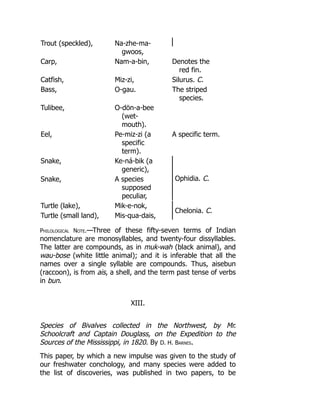
![found in the pages of Silliman's American Journal of Science,
vol. vi. pp. 120, 259.
XIV.
Freshwater Shells collected in the Valleys of the Fox and
Wisconsin, in 1820, by Mr. Schoolcraft. By Isaac Lea,
Member American Philosophical Society.
A description of these shells, in which several new species are
established, was published by the ingenious conchologist, Mr.
I. Lea, of Philadelphia, in the Transactions of the American
Philosophical Society, vol. v. p. 37, Plate III., c.
XV.
Summary Remarks respecting the Zoology of the
Northwest noticed by the Expedition to the Sources
of the Mississippi in 1820. By Dr. Samuel L. Mitchell.
The squirrel [from the vicinity of the Falls of St. Anthony], is a
species not heretofore described, and has been named sciurus
tredecem striatus, or the federation squirrel. (A.)
The pouched rat, or mus busarius, has been seen but once in
Europe. This was a specimen sent to the British Museum from
Canada, and described by Dr. Shaw. But its existence is rather
questioned by Chev. Cuvier. Both animals have been described,
and the descriptions published in the 21st vol. of the Medical
Repository, of New York, pp. 248, 249. The specimens [from
the West] are both preserved in my museum. Drawings have
been executed by the distinguished artist Milbert, and
forwarded by him, at my request, to the administrators of the
King's Museum, at Paris, of which he is a corresponding
member. My descriptions accompany them. The animals are
retained as too valuable to be sent out of the country. [B.]](https://image.slidesharecdn.com/5253484-250619014510-e70191c6/85/Soft-Computing-Techniques-For-Engineering-Optimization-Kaushik-Kumar-24-320.jpg)
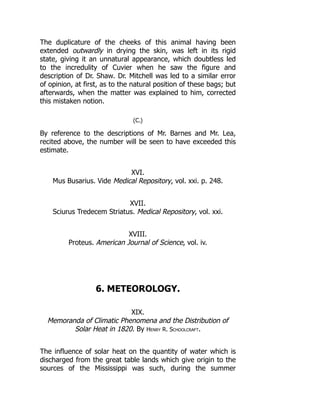
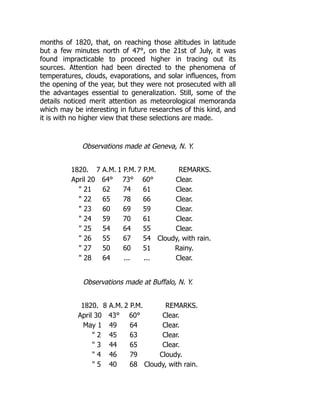
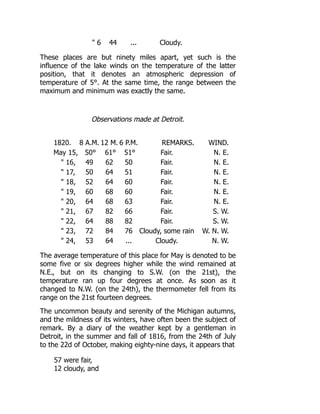
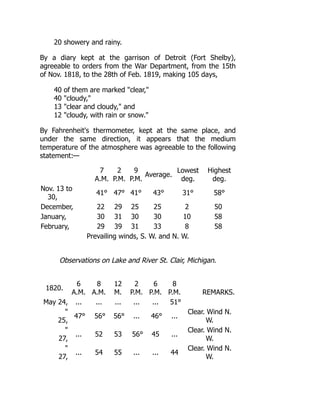
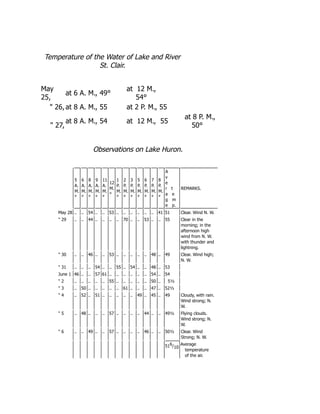
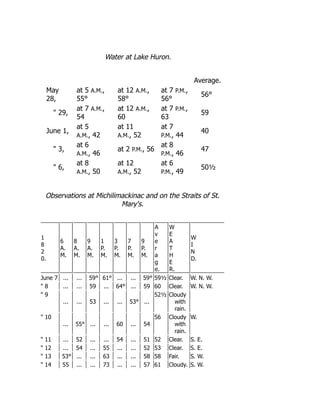
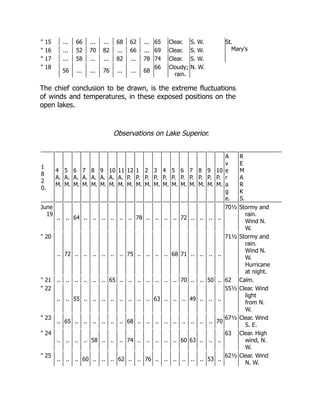
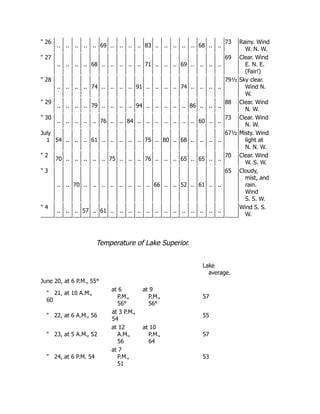
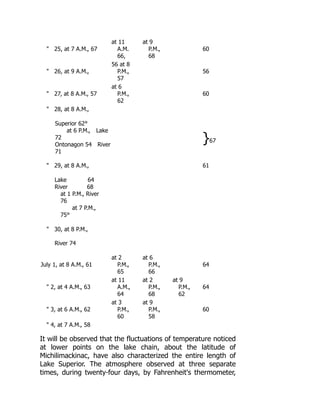
![during the months of June and July, has varied from an
average temperature of 62° to 88°, agreeable to masses of
clouds interposed to the rays of the sun, and to shifting
currents of wind, which have often suddenly intervened. Its
waters, spreading for a length of five hundred miles from E. to
W., observed during the same time by as many immersions of
the instrument, has not varied more than two degrees below
or above the average temperature of 55° in mere surface
observations.
Observations on the Sources of the Mississippi River.
5
A.
M.
7
A.
M.
8
A.
M.
12
P.
M.
2
P.
M.
8
P.
M.
9
P.
M.
REMARKS.
July
17
... ... ... 76° 80° 79° 78° Morning rainy, then fair.
18 ... ... 51° 64 66 53 50 Fair.
19
... ... 46 63 70 55 ...
Night rainy, morning cloudy, then
fair.
;
20
... ... 60 80 84 75 ...
21 ... ... 68 86 88 85 74
22 ... ... 73 88 90 77 ... Cloudy, some thunder.
23
... ... 70 82 88 78 ...
Night and morning rain,
afternoon thunder.
24 ... ... 74 87 80 78 ... Fair.
25 ... ... ... ... 85 74 ... Fair.
26
61° ... ... ... 81 61 ...
Morning fair, evening cloudy and
rain, clear.
27 62 ... ... ... 80 75 ... Morning fair, evening fair.
28 62 ... ... ... 76 61 ... Morning fair, rain in afternoon.
29 50 ... ... ... 74 52 ... Clear.
30 ... 60° ... ... 76 ... 63 Wind N. W., weather clear.
31 ... 65 ... ... 81 ... 69 Wind W., weather clear.
Aug.
1
... 67 ... ... 83 70 ... Fair.
2 ... 72 ... ... [263] ... ... Fair.](https://image.slidesharecdn.com/5253484-250619014510-e70191c6/85/Soft-Computing-Techniques-For-Engineering-Optimization-Kaushik-Kumar-35-320.jpg)
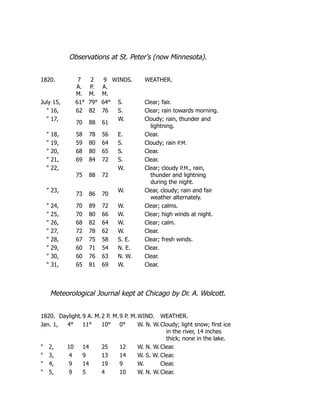
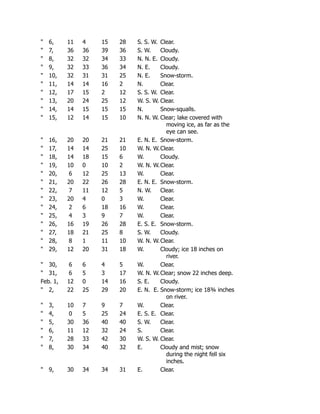
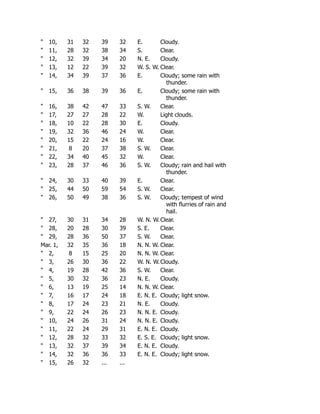
![Agreeable to a register kept at Council Bluffs during the month
of January, 1820, the highest and lowest temperature at that
place were, respectively, 36° and 22°, the month giving a
mean of 17.89. Compared with the observed temperature, for
the same month, at the following positions in the United
States, both east and west of the Alleghanies, the Missouri
Valley reveals the fact of its being adapted to the purposes of
a profitable agriculture. [264]
Mean temperature
of the month.
Highest. Lowest.
Council Bluffs 17.89° 36° 22°
Wooster 16.69 36 zero
Zanesville 25.34 42 zero
Marietta 28.42 45 zero
Chillicothe 32.48 48 10
Cincinnati 28.76 46 11
Jeffersonville 23.05 50 6
Shawneetown 32.91 52 8
Huntsville 36.43 62 12
Tuscaloosa 46.63 74 17
Cahaba 65.87 73 54
Ouachita 34.16 68 10
New Orleans 52.16 78 25
Portsmouth, N. H. 19.31 40 4 [265]
Washington City 29.19 45 4
Council
Bluffs,
lat. 41°
45
´,
long. 19°
50
´
W. of the
capitol.
New
Orleans,
29 57 12 53 W.
Portsmouth, 43 05 6 10 E.
Difference
of lat.
13°
48
´.
Difference
of long.
26°.
Nor does it appear that the same quantity of snow falls in the
Missouri Valley which is common east of the Alleghany
Mountains. At the Council Bluffs, on the last of January, snow
was but twelve inches deep; at the same period, it was three
feet or more throughout the Eastern States.](https://image.slidesharecdn.com/5253484-250619014510-e70191c6/85/Soft-Computing-Techniques-For-Engineering-Optimization-Kaushik-Kumar-39-320.jpg)
![A snow-storm fell over the middle and eastern latitudes of the
United States, for the first time, during the autumn of the year
(1820), in the first half of November. As a precursor to this,
slight drifts and gusts of snow had showed themselves at
Albany on the 25th, 26th, and 28th of October. [266]
Montreal, Canada, October 28, 1820.—On Wednesday last we had
the first fall of snow this season. It commenced in the
forenoon, and continued slightly during the remainder of the
day. Although expected to disappear, the frosts in the nights
have been pretty severe, and a considerable quantity still
remains (Saturday) at the moment we are writing.
Salem, N. Y. October 31.—On Saturday last (27th), we had our
first snow for the season. It fell during most of the forenoon,
and for an hour or two the atmosphere was quite filled with it.
Some cool and shaded spots still remain whitened, though
yesterday was one of our pleasant autumnal days, with a mild
west wind.
Early Sleighing.—The Burlington (Vt.) Sentinel of the 27th ult.
says: On Tuesday night and Wednesday, the snow fell in this
place about eight inches deep on the level. It is said to be
twelve inches deep in some of the adjoining towns.—October,
1820.
At Philadelphia, it began on Saturday, 11th (morning), snow-
storm from the east, and continued all day. At night a
hurricane, accompanied by torrents of rain and snow, which
did not subside until the 12th in the morning. Weather
unsettled on the 13th.
At Worcester, a severe snow-storm, from northeast, on the
11th and 12th. On the 13th, snow was ten inches deep, the
weather cold, and sleighing good.
Snow in Poughkeepsie fell twelve inches deep, and produced
excellent sleighing.
At New Haven (Conn.), it began with snow, hail, and rain, on
Saturday evening, 11th. The day before was wintery cold. The
storm continued, without intermission, till Monday, 13th.](https://image.slidesharecdn.com/5253484-250619014510-e70191c6/85/Soft-Computing-Techniques-For-Engineering-Optimization-Kaushik-Kumar-40-320.jpg)
![During the preceding winter, he had visited a tribe of the
Chippewas upon this pacific mission, and had, with the aid of
the agent, Mr. Talliafero, prepared the minds of both tribes for
a permanent peace. The Sioux and Chippewas met in council,
at which we all attended, and smoked the pipe of peace
together. They then, as they say in their figurative language,
buried the tomahawk so deep that it could never be dug up
again, and our Chippeway friends departed well satisfied with
the result of their mission.
I trust that Mr. Bolvin, the agent at Prairie du Chien, has been
able before this to communicate to you a successful account of
the negotiation which I instructed him to open between the
Sacs and Foxes, forming one party, and the Sioux. Hostilities
were carried on between these tribes, which, I presume, he
has been able to terminate.
We discovered a remarkable coincidence, as well in the sound
as in the application, between a word in the Sioux language
and one in our own. The circumstance is so singular that I
deem it worthy of notice. The Sioux call the Falls of St.
Anthony Ha ha, and the pronunciation is in every respect similar
to the same words in the English language. I could not learn
that this word was used for any other purpose, and I believe it
is confined in its application to that place alone. [267]
The
traveller in ascending the Mississippi turns a projecting point,
and these falls suddenly appear before him at a short distance.
Every man, savage or civilized, must be struck with the
magnificent spectacle which opens to his view. There is an
assemblage of objects which, added to the solitary grandeur of
the scene, to the height of the cataract, and to the eternal roar
of its waters, inspire the spectator with awe and admiration.
In his Anecdotes of Painting, it is stated by Horace Walpole,
that on the invention of fosses for boundaries, the common
people called them Ha Ha's! to express their surprise on
finding a sudden and unperceived check to their walk. I
believe the word is yet used in this manner in England. It is
certainly not a little remarkable that the same word should be
thus applied by one of the most civilized and by one of the
most barbarous people, to objects which, although not the](https://image.slidesharecdn.com/5253484-250619014510-e70191c6/85/Soft-Computing-Techniques-For-Engineering-Optimization-Kaushik-Kumar-50-320.jpg)
![propounded and examined in connection with the
contemporary traditions and languages of other tribes. These
traditions had been communicated to the Pennsylvania
Historical Society, in 1816, and were published under the
special auspices of Mr. Duponceau, in 1819. From the internal
evidence of the letters themselves, the critic pronounces them
to be reproductions of Mr. Duponceau himself; and it is an
evidence of the aptness of this deduction to be told that Mr.
Gallatin admitted (vide my Personal Memoirs, p. 623), that the
letters of Mr. Heckewelder had all been rewritten previous to
publication. It could no longer be a subject of admiration to
philologists, that from such imperfect sources of information,
that distinguished scholar should have pronounced the opinion
that the Delaware language rather exceeds than falls short of
the Greek and Latin in the affluence of syntactical forms and
capacities of expression. Trans. Hist. and Lit. Com., Am. Philo.
Soc., vol. i. p. 415.
XXII.
A Letter on the Origin of the Indian Race of America, and
the Principles of their Mode of uttering Ideas;
addressed to John Johnston, Esq., late of St. Mary's
Falls, Michigan. By Dr. J. McDonnell, of Belfast, Ireland.
Belfast, April 16, 1817.
My Dear J.: I feel always as if I am guilty of some great crime, in
not writing to you.
An account came to Sir Joseph Banks, of very curious rocks,
with odd stripes and colors, having been seen, this last war, by
sailors on the lakes, I think on Lake Superior. [268]
Pray keep up
your thoughts to the geography of rocks. I got some lately
from Bombay, exactly ditto with our Causeway. [269]
I shall ever regret the not having seen your daughter. I think it
likely that mingling the European blood and character with the
Indian might bring out some superior traits of character. Lest](https://image.slidesharecdn.com/5253484-250619014510-e70191c6/85/Soft-Computing-Techniques-For-Engineering-Optimization-Kaushik-Kumar-53-320.jpg)