Examples of Supply Chain Optimization projects Initiated and Managed by
Vladimir Krasojevic
Due to confidentiality only projects older than 5 years included
Assembly Lead Time reduction
Context: High WIP inventory & assemblage time
• 15 steps=Total
activity time 4
hours+36 hours
thermical test
• Lead time = 35 days
• Batch
management
• High
quality/craftmans
hip/activity
• Final Quality
check after
thermical test
• Full batch release
© vladimir krasojevic
Assembly Lead Time reduction
Results: 65% improvement of WIP/LT
• CHANGES:
– Thermical test multiple
changes of temperature in 12
hours instead of stable high
temperature for 36 h;
Bottleneck: QA
– Release of good watches from
the batch: specific pieces
retained: Technology solution
for batch management
improved
– Process group activities
– Cash-flow (WIP) & lead time
reduced from 35 to 12 days
© vladimir krasojevic
Material PULL and Heijunka
• High volume factory
• Supplier with European DC
• Distance: 60 km
• Order lead time according to standard ERP
configuration: Make to order, based on production
plan, safety stock, price according to EOQ
• Expensive material
• Simple portfolio : 3-5 different item materials SKUs
• Average stock in factory 25 days
Context: High value stock and ERP ordering
© vladimir krasojevic
Material PULL and Heijunka
Results: 60% improvement with weekly Pull
• CHANGES:
– Change in ERP – weekly requirements and
stock by AT item ; Bottleneck: Purchasing,
QA, IS
– Weekly requirements submitted: Full truck
load sent during the week.
– Price list adapted to reflect continuous
flow: flat price per item independently on
quantity in delivery
– Cash-flow (factory AT stock) reduced from
25 to ~ 10 days
© vladimir krasojevic
Supplier driven VMI
Context: No warehouse in factory: VMI
• New factory built in residential area
• No on-site direct material warehouse (max 1 day
stock)
• Supplier of blanks is «next door»
• New VMI process is established to «help-out» factory
• Daily exchange of scheduling, stock and production
plan of cigarette factory
• 1 truck used to replenish by pallete according to
scheduling
• Average stock in factory 1 day. Supplier: 17 days
© vladimir krasojevic
Supplier driven VMI
Results: 97% (60%) less vs. other factories
• CHANGES:
– Daily exchange of stock and
scheduling in EXCEL; Bottleneck:
IS integration
– Expert (informal) rules for
printing at supplier(slow movers
25 days, fast movers 3 days).
– Commitment & price through
daily orders: no remuneration for
Supplier stock (recompensated by
lower paper stock)
– Cash-flow (factory blanks stock)
1 instead of 45 days (18 with
supplier)© vladimir krasojevic
Process flow optimization
Context: Different lead time & WIP inventory
• Repacking process is highly manual
• 2 different social-work companies have
been used for the same task
• Bottleneck identified with time needed
for repacking (lack of resources and
long lead-time)
• Field visit and analysis of the process
identified major difference in process:
– Small cell, continuous repacking in teams of
two vs.
• Batch repacking, team work by activity
• Repacking time 45 days in
bigger of two companies
Company 1
Company 2
© vladimir krasojevic,
Process flow optimization
Results: 50% time reduction with same teams
• CHANGES:
– Use of the same process in 2
companies: 50 % reduction of lead
time and work in progress
– Initial questions whether specific social
work company process could be
transferred to another place
– Higher satisfaction of operators (they
see results of their work, every day)
– Elimination of unnecessary control
steps (quantity & quality)
– New lead time for market: 20 days and
reduced WIP stock
Company 1
Company 2
Company 2
© vladimir krasojevic
Cost-to-serve optimization
Context: Cost, stock and availability
• Activity Based Costing from manufacturer to
Retailer – simulation and estimates
• Assumption might be wrong (ie: delivery
frequency and minimum stock in POS)
• OoS in POS – holly grail of FMCG stock
management service level 98%
• Manufacturer push to retailers
• Plannograms: retailers paid to expose all
products in portfolio
• Manufacturers stock 30 DOI, Retailers
distribution system 12 DOI, POS estimate
20-30 DOI (previous assumptions 3-7 DOI)
© vladimir krasojevic
Cost-to-serve optimization
Results: Improvement initiatives started
• CHANGES:
– Retailer to eliminate back-office stock and
store all in shelves: 25 % reduction of OoS
potential (implemented in other categories)
– Introduction of fiscal warehouse status in
Switzerland 1 day of retail stock value = 20
days of manufacture value (bonded
warehouse status): potential to reduce retail
distribution stock from 12 to 3 days (75%)
– Higher interest for collaboration,
consumption driven supply : demand sensing,
daily deliveries, portfolio optimization (retail
stock potential from 20-30 to 3 DOI (80%)
© vladimir krasojevic
Replenishment and Stock Optimization
Context: Replenishment of Vending Machines
• Vending machines visited once in 1-3
weeks to be replenished
• Machines are usually filled up to their
capacity – «column size»
• Operator use the rule defined by back
office
• If he decides to change the rule, handheld
computer has to be reprogrammed
• Most of operators are not changing
quantity in order to be more efficient
• Stock in vending machines is up to 50
days of inventory
© vladimir krasojevic
Replenishment and Stock Optimization
Results: 60% potential of stock reduction
69%
1315%
0
100
200
300
400
500
600
700
800
1 2 3 4 5 6 7 8 9 10 11 12 13 14 15 16 17 18 19 20 21 22 23
0%
200%
400%
600%
800%
1000%
1200%
1400%
Stock loaded Sales Remaining Safety factor
• CHANGES:
– Detailed analysis of sales, stock,
replenishment not in line with consumption:
60% reduction potential identified
– New rules defined: load standard quantity in
multiple of 5 packs (slow movers), 10 packs
fast movers
– New order preparation proposed on
automatic line, based on historic sales
– Higher frequency of delivery proposed to
reduce time for cash collection
– Total cash-flow improvement potential up to
75%. Project not implemented.
© vladimir krasojevic
Direct Store Deliveries Optimization
Context: Van Sales - Portfolio Planning Complexity
• Gemba walk
• Complex population with different SKUs by nationality
• Delivery specific portfolio picking and preparation
• Complex Order Cheking process (Manual and without
system support)
• Van sales deliveries supported by complex delivery
planning and forecasting process
• 2.5 hours (total) spend in the morning and at the end of
the day on order control, checking and reconciliation
• 60% returned from delivery (not sold)
© vladimir krasojevic
• 2 hours considered as «lost for sales» daily from deliverymen
Direct Store Deliveries Optimization
Results: 2 hours more for sales, better FA, low return
• CHANGES:
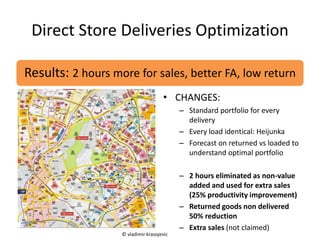
– Standard portfolio for every
delivery
– Every load identical: Heijunka
– Forecast on returned vs loaded to
understand optimal portfolio
– 2 hours eliminated as non-value
added and used for extra sales
(25% productivity improvement)
– Returned goods non delivered
50% reduction
– Extra sales (not claimed)
© vladimir krasojevic

Optimization projects examples VKrasojevic

  • 1.
    Examples of SupplyChain Optimization projects Initiated and Managed by Vladimir Krasojevic Due to confidentiality only projects older than 5 years included
  • 2.
    Assembly Lead Timereduction Context: High WIP inventory & assemblage time • 15 steps=Total activity time 4 hours+36 hours thermical test • Lead time = 35 days • Batch management • High quality/craftmans hip/activity • Final Quality check after thermical test • Full batch release © vladimir krasojevic
  • 3.
    Assembly Lead Timereduction Results: 65% improvement of WIP/LT • CHANGES: – Thermical test multiple changes of temperature in 12 hours instead of stable high temperature for 36 h; Bottleneck: QA – Release of good watches from the batch: specific pieces retained: Technology solution for batch management improved – Process group activities – Cash-flow (WIP) & lead time reduced from 35 to 12 days © vladimir krasojevic
  • 4.
    Material PULL andHeijunka • High volume factory • Supplier with European DC • Distance: 60 km • Order lead time according to standard ERP configuration: Make to order, based on production plan, safety stock, price according to EOQ • Expensive material • Simple portfolio : 3-5 different item materials SKUs • Average stock in factory 25 days Context: High value stock and ERP ordering © vladimir krasojevic
  • 5.
    Material PULL andHeijunka Results: 60% improvement with weekly Pull • CHANGES: – Change in ERP – weekly requirements and stock by AT item ; Bottleneck: Purchasing, QA, IS – Weekly requirements submitted: Full truck load sent during the week. – Price list adapted to reflect continuous flow: flat price per item independently on quantity in delivery – Cash-flow (factory AT stock) reduced from 25 to ~ 10 days © vladimir krasojevic
  • 6.
    Supplier driven VMI Context:No warehouse in factory: VMI • New factory built in residential area • No on-site direct material warehouse (max 1 day stock) • Supplier of blanks is «next door» • New VMI process is established to «help-out» factory • Daily exchange of scheduling, stock and production plan of cigarette factory • 1 truck used to replenish by pallete according to scheduling • Average stock in factory 1 day. Supplier: 17 days © vladimir krasojevic
  • 7.
    Supplier driven VMI Results:97% (60%) less vs. other factories • CHANGES: – Daily exchange of stock and scheduling in EXCEL; Bottleneck: IS integration – Expert (informal) rules for printing at supplier(slow movers 25 days, fast movers 3 days). – Commitment & price through daily orders: no remuneration for Supplier stock (recompensated by lower paper stock) – Cash-flow (factory blanks stock) 1 instead of 45 days (18 with supplier)© vladimir krasojevic
  • 8.
    Process flow optimization Context:Different lead time & WIP inventory • Repacking process is highly manual • 2 different social-work companies have been used for the same task • Bottleneck identified with time needed for repacking (lack of resources and long lead-time) • Field visit and analysis of the process identified major difference in process: – Small cell, continuous repacking in teams of two vs. • Batch repacking, team work by activity • Repacking time 45 days in bigger of two companies Company 1 Company 2 © vladimir krasojevic,
  • 9.
    Process flow optimization Results:50% time reduction with same teams • CHANGES: – Use of the same process in 2 companies: 50 % reduction of lead time and work in progress – Initial questions whether specific social work company process could be transferred to another place – Higher satisfaction of operators (they see results of their work, every day) – Elimination of unnecessary control steps (quantity & quality) – New lead time for market: 20 days and reduced WIP stock Company 1 Company 2 Company 2 © vladimir krasojevic
  • 10.
    Cost-to-serve optimization Context: Cost,stock and availability • Activity Based Costing from manufacturer to Retailer – simulation and estimates • Assumption might be wrong (ie: delivery frequency and minimum stock in POS) • OoS in POS – holly grail of FMCG stock management service level 98% • Manufacturer push to retailers • Plannograms: retailers paid to expose all products in portfolio • Manufacturers stock 30 DOI, Retailers distribution system 12 DOI, POS estimate 20-30 DOI (previous assumptions 3-7 DOI) © vladimir krasojevic
  • 11.
    Cost-to-serve optimization Results: Improvementinitiatives started • CHANGES: – Retailer to eliminate back-office stock and store all in shelves: 25 % reduction of OoS potential (implemented in other categories) – Introduction of fiscal warehouse status in Switzerland 1 day of retail stock value = 20 days of manufacture value (bonded warehouse status): potential to reduce retail distribution stock from 12 to 3 days (75%) – Higher interest for collaboration, consumption driven supply : demand sensing, daily deliveries, portfolio optimization (retail stock potential from 20-30 to 3 DOI (80%) © vladimir krasojevic
  • 12.
    Replenishment and StockOptimization Context: Replenishment of Vending Machines • Vending machines visited once in 1-3 weeks to be replenished • Machines are usually filled up to their capacity – «column size» • Operator use the rule defined by back office • If he decides to change the rule, handheld computer has to be reprogrammed • Most of operators are not changing quantity in order to be more efficient • Stock in vending machines is up to 50 days of inventory © vladimir krasojevic
  • 13.
    Replenishment and StockOptimization Results: 60% potential of stock reduction 69% 1315% 0 100 200 300 400 500 600 700 800 1 2 3 4 5 6 7 8 9 10 11 12 13 14 15 16 17 18 19 20 21 22 23 0% 200% 400% 600% 800% 1000% 1200% 1400% Stock loaded Sales Remaining Safety factor • CHANGES: – Detailed analysis of sales, stock, replenishment not in line with consumption: 60% reduction potential identified – New rules defined: load standard quantity in multiple of 5 packs (slow movers), 10 packs fast movers – New order preparation proposed on automatic line, based on historic sales – Higher frequency of delivery proposed to reduce time for cash collection – Total cash-flow improvement potential up to 75%. Project not implemented. © vladimir krasojevic
  • 14.
    Direct Store DeliveriesOptimization Context: Van Sales - Portfolio Planning Complexity • Gemba walk • Complex population with different SKUs by nationality • Delivery specific portfolio picking and preparation • Complex Order Cheking process (Manual and without system support) • Van sales deliveries supported by complex delivery planning and forecasting process • 2.5 hours (total) spend in the morning and at the end of the day on order control, checking and reconciliation • 60% returned from delivery (not sold) © vladimir krasojevic • 2 hours considered as «lost for sales» daily from deliverymen
  • 15.
    Direct Store DeliveriesOptimization Results: 2 hours more for sales, better FA, low return • CHANGES: – Standard portfolio for every delivery – Every load identical: Heijunka – Forecast on returned vs loaded to understand optimal portfolio – 2 hours eliminated as non-value added and used for extra sales (25% productivity improvement) – Returned goods non delivered 50% reduction – Extra sales (not claimed) © vladimir krasojevic