An overview of the open source ecosystem, a collection of software, tools, communities, and
practices that promote collaboration and transparency in software development.
The Open Source Ecosystem
Open Source Software Projects
- Software projects developed and maintained by
communities of developers
- Shared openly and collaborate to build better
software
Introduction Open Source
Ecosystem
Open source ecosystem is a term used to describe the
network of people, organizations, and technologies that are
involved in the development and maintenance of open
source software. It encompasses the open source
communities, the development processes, the tools and
technologies used, and the governance and licensing models
that are used to manage the software.
Open source is a way of developing software that
encourages collaboration and participation from the public. It
allows anyone to view, modify, and redistribute the source
code of a project. This transparency and collaboration leads
to better software, faster development cycles, and more
innovation.
Benefits of Open Source Ecosystem
Open source software often has better quality and fewer
bugs than proprietary software. This is because open
source projects are more likely to have more people
involved in testing and debugging the code. Additionally,
open source projects are typically more secure than
proprietary software since the source code is open for
anyone to review.
Open source software is also often cheaper to use. Since
the source code is freely available, developers can use it to
create their own version of the software without having to
pay licensing fees. This can save companies a lot of money
in the long run.
Tools and Platforms
- Range of tools and platforms support
development and distribution of open source
software
- Examples: Git, GitHub, SourceForge
Open Source Ecosystem Tools and
Technologies
open source ecosystem is made up of a variety of tools
and technologies that are used to develop and maintain
open source software. These include version control
systems, bug tracking systems, and code review tools.
Additionally, open source projects often use open source
libraries and frameworks to help speed up
development.Open source projects also leverage a variety
of different development processes, such as agile and
waterfall. These processes help ensure that the software
is developed in a timely and efficient manner, while still
maintaining high quality standards.
Open Source Communities
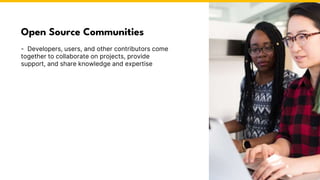
- Developers, users, and other contributors come
together to collaborate on projects, provide
support, and share knowledge and expertise
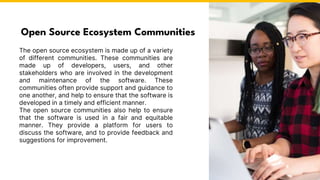
Open Source Ecosystem Communities
The open source ecosystem is made up of a variety
of different communities. These communities are
made up of developers, users, and other
stakeholders who are involved in the development
and maintenance of the software. These
communities often provide support and guidance to
one another, and help to ensure that the software is
developed in a timely and efficient manner.
The open source communities also help to ensure
that the software is used in a fair and equitable
manner. They provide a platform for users to
discuss the software, and to provide feedback and
suggestions for improvement.
Open Source Licenses
- Set of open source licenses ensure software is
freely available and can be modified and
distributed by anyone
- Examples: MIT License, GNU General Public
License (GPL), Apache License
MIT License:
The MIT License is a permissive open-source license that allows anyone to
use, copy, modify, merge, publish, distribute, sublicense, and/or sell copies of
the software. The license requires that any copy or substantial portion of the
software must include the original copyright notice and disclaimer. It is
considered one of the most liberal open-source licenses because it places very
few restrictions on the use of the software.
GNU General Public License (GPL):
The GNU General Public License (GPL) is a copyleft open-source license that
requires anyone who distributes or modifies the software to make their source
code available under the same license. This ensures that the software remains
open-source and that any derivative works remain free and open. The GPL is
often used for software that is meant to be used and distributed as part of larger
software projects.
Apache License:
The Apache License is a permissive open-source license that allows
anyone to use, copy, modify, merge, publish, distribute, and/or sell copies of
the software. The license requires that any copy or substantial portion of the
software must include the original copyright notice, disclaimer, and
attribution notices. It also includes a patent license that grants users the
right to use any patents held by the copyright owner. The Apache License is
often used for software that is meant to be used as part of larger projects,
including commercial projects.
BSD License:
The BSD License is a permissive open source license that allows anyone
to use, copy, modify, and distribute the software without any restrictions
on how the code or work can be used. The license requires that any copy
or substantial portion of the software must include the original copyright
notice and disclaimer. There are three variants of the BSD License, with
different levels of restrictions and requirements.
Mozilla Public License (MPL):
The Mozilla Public License (MPL) is a copyleft open source license that
requires anyone who distributes or modifies the software to make their source
code available under the same license. The MPL also includes a patent
license that grants users the right to use any patents held by the copyright
owner. The MPL is often used for software that is meant to be used as part of
larger projects.
Eclipse Public License (EPL):
The Eclipse Public License (EPL) is a permissive open source license that allows
anyone to use, copy, modify, and distribute the software without any restrictions
on how the code or work can be used. The license requires that any derivative
works of the original code must also be made available under the same license.
The EPL is often used for software that is meant to be used as part of larger
projects.
Creative Commons License:
The Creative Commons License is a set of licenses that allows creators to
share their work with the public while retaining copyright ownership. There
are several Creative Commons Licenses, each with its own set of
conditions, but they generally allow others to use, distribute, and modify
the work as long as they attribute the original creator and follow any other
specified conditions.
The Unlicense:
The Unlicense is a public domain dedication that allows
anyone to use, copy, modify, and distribute the software
without any restrictions. The Unlicense is intended to be a
simple, permissive license that eliminates any legal barriers to
the use and distribution of the software.
Open Source Ecosystem Governance
and Licensing Models
The open source ecosystem is governed by a
variety of different licensing models. These models
are used to ensure that the software remains open
source, and that it is used in accordance with the
terms of the license. Common open source licenses
include the GNU General Public License (GPL), the
Apache License, and the MIT License.
These licenses determine how the software can be
used and distributed. They also ensure that the
software remains open source, and that it is used in
accordance with the terms of the license. This
helps to ensure that the software is used in a fair
and equitable manner.
Companies and Organizations
- Participate in the open source ecosystem by
contributing to projects, using open source
software, and providing funding
Power of Open Source
- Dynamic and rapidly evolving space
- Force for innovation, collaboration, and
democratizing access to technology
Summary
Open source ecosystem is a term used to describe the network of people, organizations, and
technologies that are involved in the development and maintenance of open source software. It
encompasses the open source communities, the development processes, the tools and technologies
used, and the governance and licensing models that are used to manage the software.The open
source ecosystem has many benefits, including better quality and fewer bugs, faster development
cycles, and more innovation. It also helps to ensure that the software is used in a fair and equitable
manner, and that it is developed in a timely and efficient manner.
An overview of open source engineering, including its principles, applications, and benefits.
The Benefits of Open Source Engineering
What is Open Source
Engineering?
- Collaborative, transparent approach to
engineering
- Based on principles of open source software
development
- Open source hardware, software, and
documentation
Introduction to Open Source Engineering
Open source engineering is the practice of designing and
developing software with the intent of making it freely available to
the public. It is a form of collaborative software development,
where individuals from around the world work together to create
and maintain software projects.Open source engineering provides a
platform for individuals to share their knowledge and expertise in
the field of software engineering. It also allows for the development
of software that is free from the constraints of commercial software
development.
Benefits of Open Source
Engineering
- Drives innovation and accelerates development
of new products
- Reduces cost and complexity of engineering
projects
- Promotes greater transparency and
accountability
Benefits of Open Source Engineering
Open source engineering provides many benefits to both
users and developers. By making software freely available,
it allows users to access the latest features and updates
without having to pay for them. It also provides developers
with a platform to share their knowledge and expertise with
the world.Open source engineering also encourages
collaboration and innovation. By working together,
developers are able to create more powerful and efficient
software. This in turn leads to faster development cycles
and improved quality of software.
Examples of Open Source
Engineering
- Arduino microcontroller platform
- RepRap 3D printer
- Open Source Ecology project
Tools for Open Source
Engineering
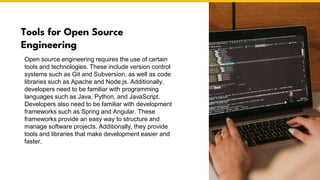
Open source engineering requires the use of certain
tools and technologies. These include version control
systems such as Git and Subversion, as well as code
libraries such as Apache and Node.js. Additionally,
developers need to be familiar with programming
languages such as Java, Python, and JavaScript.
Developers also need to be familiar with development
frameworks such as Spring and Angular. These
frameworks provide an easy way to structure and
manage software projects. Additionally, they provide
tools and libraries that make development easier and
faster.
The Power of Open Source
Engineering
- Used to drive positive change in the world
- Real world examples demonstrate potential of
open source engineering
Thank you for your time and attention 🙂

OPS Ecosystem and Engineering.pptx

  • 1.
    An overview ofthe open source ecosystem, a collection of software, tools, communities, and practices that promote collaboration and transparency in software development. The Open Source Ecosystem
  • 2.
    Open Source SoftwareProjects - Software projects developed and maintained by communities of developers - Shared openly and collaborate to build better software
  • 3.
    Introduction Open Source Ecosystem Opensource ecosystem is a term used to describe the network of people, organizations, and technologies that are involved in the development and maintenance of open source software. It encompasses the open source communities, the development processes, the tools and technologies used, and the governance and licensing models that are used to manage the software. Open source is a way of developing software that encourages collaboration and participation from the public. It allows anyone to view, modify, and redistribute the source code of a project. This transparency and collaboration leads to better software, faster development cycles, and more innovation.
  • 4.
    Benefits of OpenSource Ecosystem Open source software often has better quality and fewer bugs than proprietary software. This is because open source projects are more likely to have more people involved in testing and debugging the code. Additionally, open source projects are typically more secure than proprietary software since the source code is open for anyone to review. Open source software is also often cheaper to use. Since the source code is freely available, developers can use it to create their own version of the software without having to pay licensing fees. This can save companies a lot of money in the long run.
  • 5.
    Tools and Platforms -Range of tools and platforms support development and distribution of open source software - Examples: Git, GitHub, SourceForge
  • 6.
    Open Source EcosystemTools and Technologies open source ecosystem is made up of a variety of tools and technologies that are used to develop and maintain open source software. These include version control systems, bug tracking systems, and code review tools. Additionally, open source projects often use open source libraries and frameworks to help speed up development.Open source projects also leverage a variety of different development processes, such as agile and waterfall. These processes help ensure that the software is developed in a timely and efficient manner, while still maintaining high quality standards.
  • 7.
    Open Source Communities -Developers, users, and other contributors come together to collaborate on projects, provide support, and share knowledge and expertise
  • 8.
    Open Source EcosystemCommunities The open source ecosystem is made up of a variety of different communities. These communities are made up of developers, users, and other stakeholders who are involved in the development and maintenance of the software. These communities often provide support and guidance to one another, and help to ensure that the software is developed in a timely and efficient manner. The open source communities also help to ensure that the software is used in a fair and equitable manner. They provide a platform for users to discuss the software, and to provide feedback and suggestions for improvement.
  • 9.
    Open Source Licenses -Set of open source licenses ensure software is freely available and can be modified and distributed by anyone - Examples: MIT License, GNU General Public License (GPL), Apache License
  • 10.
    MIT License: The MITLicense is a permissive open-source license that allows anyone to use, copy, modify, merge, publish, distribute, sublicense, and/or sell copies of the software. The license requires that any copy or substantial portion of the software must include the original copyright notice and disclaimer. It is considered one of the most liberal open-source licenses because it places very few restrictions on the use of the software.
  • 11.
    GNU General PublicLicense (GPL): The GNU General Public License (GPL) is a copyleft open-source license that requires anyone who distributes or modifies the software to make their source code available under the same license. This ensures that the software remains open-source and that any derivative works remain free and open. The GPL is often used for software that is meant to be used and distributed as part of larger software projects.
  • 12.
    Apache License: The ApacheLicense is a permissive open-source license that allows anyone to use, copy, modify, merge, publish, distribute, and/or sell copies of the software. The license requires that any copy or substantial portion of the software must include the original copyright notice, disclaimer, and attribution notices. It also includes a patent license that grants users the right to use any patents held by the copyright owner. The Apache License is often used for software that is meant to be used as part of larger projects, including commercial projects.
  • 13.
    BSD License: The BSDLicense is a permissive open source license that allows anyone to use, copy, modify, and distribute the software without any restrictions on how the code or work can be used. The license requires that any copy or substantial portion of the software must include the original copyright notice and disclaimer. There are three variants of the BSD License, with different levels of restrictions and requirements.
  • 14.
    Mozilla Public License(MPL): The Mozilla Public License (MPL) is a copyleft open source license that requires anyone who distributes or modifies the software to make their source code available under the same license. The MPL also includes a patent license that grants users the right to use any patents held by the copyright owner. The MPL is often used for software that is meant to be used as part of larger projects.
  • 15.
    Eclipse Public License(EPL): The Eclipse Public License (EPL) is a permissive open source license that allows anyone to use, copy, modify, and distribute the software without any restrictions on how the code or work can be used. The license requires that any derivative works of the original code must also be made available under the same license. The EPL is often used for software that is meant to be used as part of larger projects.
  • 16.
    Creative Commons License: TheCreative Commons License is a set of licenses that allows creators to share their work with the public while retaining copyright ownership. There are several Creative Commons Licenses, each with its own set of conditions, but they generally allow others to use, distribute, and modify the work as long as they attribute the original creator and follow any other specified conditions.
  • 17.
    The Unlicense: The Unlicenseis a public domain dedication that allows anyone to use, copy, modify, and distribute the software without any restrictions. The Unlicense is intended to be a simple, permissive license that eliminates any legal barriers to the use and distribution of the software.
  • 18.
    Open Source EcosystemGovernance and Licensing Models The open source ecosystem is governed by a variety of different licensing models. These models are used to ensure that the software remains open source, and that it is used in accordance with the terms of the license. Common open source licenses include the GNU General Public License (GPL), the Apache License, and the MIT License. These licenses determine how the software can be used and distributed. They also ensure that the software remains open source, and that it is used in accordance with the terms of the license. This helps to ensure that the software is used in a fair and equitable manner.
  • 19.
    Companies and Organizations -Participate in the open source ecosystem by contributing to projects, using open source software, and providing funding
  • 20.
    Power of OpenSource - Dynamic and rapidly evolving space - Force for innovation, collaboration, and democratizing access to technology
  • 21.
    Summary Open source ecosystemis a term used to describe the network of people, organizations, and technologies that are involved in the development and maintenance of open source software. It encompasses the open source communities, the development processes, the tools and technologies used, and the governance and licensing models that are used to manage the software.The open source ecosystem has many benefits, including better quality and fewer bugs, faster development cycles, and more innovation. It also helps to ensure that the software is used in a fair and equitable manner, and that it is developed in a timely and efficient manner.
  • 22.
    An overview ofopen source engineering, including its principles, applications, and benefits. The Benefits of Open Source Engineering
  • 23.
    What is OpenSource Engineering? - Collaborative, transparent approach to engineering - Based on principles of open source software development - Open source hardware, software, and documentation
  • 24.
    Introduction to OpenSource Engineering Open source engineering is the practice of designing and developing software with the intent of making it freely available to the public. It is a form of collaborative software development, where individuals from around the world work together to create and maintain software projects.Open source engineering provides a platform for individuals to share their knowledge and expertise in the field of software engineering. It also allows for the development of software that is free from the constraints of commercial software development.
  • 25.
    Benefits of OpenSource Engineering - Drives innovation and accelerates development of new products - Reduces cost and complexity of engineering projects - Promotes greater transparency and accountability
  • 26.
    Benefits of OpenSource Engineering Open source engineering provides many benefits to both users and developers. By making software freely available, it allows users to access the latest features and updates without having to pay for them. It also provides developers with a platform to share their knowledge and expertise with the world.Open source engineering also encourages collaboration and innovation. By working together, developers are able to create more powerful and efficient software. This in turn leads to faster development cycles and improved quality of software.
  • 27.
    Examples of OpenSource Engineering - Arduino microcontroller platform - RepRap 3D printer - Open Source Ecology project
  • 28.
    Tools for OpenSource Engineering Open source engineering requires the use of certain tools and technologies. These include version control systems such as Git and Subversion, as well as code libraries such as Apache and Node.js. Additionally, developers need to be familiar with programming languages such as Java, Python, and JavaScript. Developers also need to be familiar with development frameworks such as Spring and Angular. These frameworks provide an easy way to structure and manage software projects. Additionally, they provide tools and libraries that make development easier and faster.
  • 29.
    The Power ofOpen Source Engineering - Used to drive positive change in the world - Real world examples demonstrate potential of open source engineering
  • 30.
    Thank you foryour time and attention 🙂