Mining and Sentiment Analysis
Presented By:
DIVYA JAIN
Under the Guidance of:
DR.S.F.SAYYAD
AISSMS COE , PUNE
Points to be Discussed…….
 Introduction
 Opinion Mining
 Motivation for Opinion Mining
 Challenges in Opinion Mining
 Sentiment Classification
 Document Sentiment Classification
 Sentence Subjectivity
 Applications
INTRODUCTION :
• A Sentiment is a thought, view, or attitude, especially one based
mainly on emotion instead of reason.
• There are usually two types of information available on the web
which can be said as : Facts and Opinion.
• Sentiment can be also called by other names as
1. Opinion Mining
2. Opinion extraction
3. Subjectivity Analysis
• The opinion mining is computational study of opinions, sentiments
and emotions which can be expressed in text.
• The most important reason behind using Opinion mining is huge
amount of opinionated text available on the web.
OPINION MINING :
 Opinion is very important for us because whenever we have to make
any important decision at that time we seeks opinion of other people
for business purposes and many more.
 Expression of opinion is not limited now a days ,it can be in the forms
of interviews, reports, question-answer format, forms , discussion ,
blogs etc.
 It uses the natural language processing (NLP) and computational
techniques to automate the extraction or classification of sentiment
from typically unstructured text.
 For opinion mining we can use the various approaches as:
1. Machine Learning
-> Naïve bayes , Support Vector Machine , Entropy Classificaton
2. By unsupervised Learning
-> Using lexicons
Motivation of opinion mining :
The motivation behind using the opinion mining is
Buisness and Organization
-product and service benchmarking , Market selling
Opinion Retrival/ Information Search
- a general search
Ad placement
-placing ad in user generated content
People
-opinion regarding new products.
Opinion Mining :General Model
 Opinion holder (source) :person who holds the sentiment.
E.g. I love playing hockey.
E.g I agree to what pope said “hate the sin not the sinners”
 Object (Target) :product, person, organization or a topic on which
sentiment is expressed.
E.g. I like nano. But I don’t like the steering of nano.
 Opinion/sentiment a view or appraisal on an object
E.g. It’s a pity(negative) that she didn’t marry.
Challenges in the Opinion Mining :
Contrasts with standard text-based categorization
Domain dependent
Identifying source and target:
Differentiating feature and attributes
“I hate the ipod but I like the scroll technology”
Role of semantics
“How could anyone sit through this movie?”
 Issue of Ideology
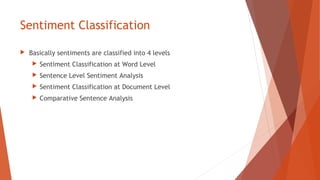
Sentiment Classification
 Basically sentiments are classified into 4 levels
 Sentiment Classification at Word Level
 Sentence Level Sentiment Analysis
 Sentiment Classification at Document Level
 Comparative Sentence Analysis
Word Level Sentiment Classification :
Used for grammatically coherent text like short news paper
headlines. It can be directly computed using the lexicon resources , for
eg : SentiWordNet.
Sentence level Sentiment Analysis:
For Sentiment analysis at Sentence level contextual information
is necessary. It can not assign prior polarity to all words.
Document Level Sentiment Classification :
It classifies the document as positive or negative . And
classification is based on the overall sentiments which author holds.
Comparative Sentence Analysis:
It is known as preferential emotion detection. For eg “ I like X
to Y “.Most common feature is use of Comparative word like as to ,
better etc.
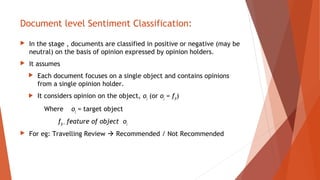
Document level Sentiment Classification:
 In the stage , documents are classified in positive or negative (may be
neutral) on the basis of opinion expressed by opinion holders.
 It assumes
 Each document focuses on a single object and contains opinions
from a single opinion holder.
 It considers opinion on the object, oj (or oj = fjk)
Where oj = target object
fjk = feature of object oj
 For eg: Travelling Review  Recommended / Not Recommended
Document Level Classification …..
Extract phrases - 2 words long(with context) e.g. good
place
Calculate the semantic orientation of extracted phrases
using PMI with “excellent” & “poor”
Classification based on Average semantic orientation of
the phrases
Classify based on average threshold
SO(Phrase) = 





excellent)poor)hits(nearehits(phras
hits(poor)excellent)nearehits(phras
log
Sentence Subjectivity :
 Sentence-level sentiment analysis has two tasks:
 Subjectivity classification: Subjective or objective.
 Objective: e.g., I bought an iPhone a few days ago.
 Subjective: e.g., It is such a nice phone.
 Sentiment classification: For subjective sentences or clauses,
classify positive or negative.
 Positive: It is such a nice phone.
 The linguistic expression of somebody’s opinions, sentiments,
emotions, evaluations, beliefs, speculation.
 Subjectivity analysis classifies content in objective or subjective.
• subjective sentences ≠ +ve or –ve opinions
E.g., I think he came yesterday.
• Objective sentence ≠ no opinion
Imply –ve opinion: My phone broke in the second day.
APPLICATIONS :
1. Information Extraction
2. Product Review Mining
3. Review Classification
4. Prediction
5. Tracking Sentiments
6. Text Semantic Analysis
7. Text Summarization
Conclusion :
 Opinion mining is now a days very important concept in the field of
web mining. Because every thing we do in a real life Is related with
the opinion of someone else.
 Opinion or Sentiment analysis can be performed by using machine
learning techniques (Naïve bayes , SVM) .
 Classification of Sentiments are used for classifying the expressions on
various levels .
 Basically Opinion Mining concept is used for getting accuracy , from
which technique we are getting higher accuracy will be used.
References :
 B. Liu, “Sentiment Analysis and Subjectivity.”
 Opinion Mining and Sentiment Analysis, Foundations and Trends in Information
Retrieval, B. Pang and L. Lee, Vol. 2, Nos. 1–2 (2008) 1–135, 2008.
 http://en.wikipedia.org/wiki/subjectivity
 http://www.answers.com/sentiment
 https://people.cs.kuleuven.be>teaching
 www.facweb.iitkgp.ernet.in>my-opinion
 www.cs.cornell.edu/home/llee/opinion-mining-sentiment-analysis-
survey.html
THANK YOU……!!!!!!

Opinion mining

  • 1.
    Mining and SentimentAnalysis Presented By: DIVYA JAIN Under the Guidance of: DR.S.F.SAYYAD AISSMS COE , PUNE
  • 2.
    Points to beDiscussed…….  Introduction  Opinion Mining  Motivation for Opinion Mining  Challenges in Opinion Mining  Sentiment Classification  Document Sentiment Classification  Sentence Subjectivity  Applications
  • 3.
    INTRODUCTION : • ASentiment is a thought, view, or attitude, especially one based mainly on emotion instead of reason. • There are usually two types of information available on the web which can be said as : Facts and Opinion. • Sentiment can be also called by other names as 1. Opinion Mining 2. Opinion extraction 3. Subjectivity Analysis • The opinion mining is computational study of opinions, sentiments and emotions which can be expressed in text. • The most important reason behind using Opinion mining is huge amount of opinionated text available on the web.
  • 4.
    OPINION MINING : Opinion is very important for us because whenever we have to make any important decision at that time we seeks opinion of other people for business purposes and many more.  Expression of opinion is not limited now a days ,it can be in the forms of interviews, reports, question-answer format, forms , discussion , blogs etc.  It uses the natural language processing (NLP) and computational techniques to automate the extraction or classification of sentiment from typically unstructured text.  For opinion mining we can use the various approaches as: 1. Machine Learning -> Naïve bayes , Support Vector Machine , Entropy Classificaton 2. By unsupervised Learning -> Using lexicons
  • 5.
    Motivation of opinionmining : The motivation behind using the opinion mining is Buisness and Organization -product and service benchmarking , Market selling Opinion Retrival/ Information Search - a general search Ad placement -placing ad in user generated content People -opinion regarding new products.
  • 6.
    Opinion Mining :GeneralModel  Opinion holder (source) :person who holds the sentiment. E.g. I love playing hockey. E.g I agree to what pope said “hate the sin not the sinners”  Object (Target) :product, person, organization or a topic on which sentiment is expressed. E.g. I like nano. But I don’t like the steering of nano.  Opinion/sentiment a view or appraisal on an object E.g. It’s a pity(negative) that she didn’t marry.
  • 7.
    Challenges in theOpinion Mining : Contrasts with standard text-based categorization Domain dependent Identifying source and target: Differentiating feature and attributes “I hate the ipod but I like the scroll technology” Role of semantics “How could anyone sit through this movie?”  Issue of Ideology
  • 8.
    Sentiment Classification  Basicallysentiments are classified into 4 levels  Sentiment Classification at Word Level  Sentence Level Sentiment Analysis  Sentiment Classification at Document Level  Comparative Sentence Analysis
  • 9.
    Word Level SentimentClassification : Used for grammatically coherent text like short news paper headlines. It can be directly computed using the lexicon resources , for eg : SentiWordNet. Sentence level Sentiment Analysis: For Sentiment analysis at Sentence level contextual information is necessary. It can not assign prior polarity to all words. Document Level Sentiment Classification : It classifies the document as positive or negative . And classification is based on the overall sentiments which author holds. Comparative Sentence Analysis: It is known as preferential emotion detection. For eg “ I like X to Y “.Most common feature is use of Comparative word like as to , better etc.
  • 10.
    Document level SentimentClassification:  In the stage , documents are classified in positive or negative (may be neutral) on the basis of opinion expressed by opinion holders.  It assumes  Each document focuses on a single object and contains opinions from a single opinion holder.  It considers opinion on the object, oj (or oj = fjk) Where oj = target object fjk = feature of object oj  For eg: Travelling Review  Recommended / Not Recommended
  • 11.
    Document Level Classification….. Extract phrases - 2 words long(with context) e.g. good place Calculate the semantic orientation of extracted phrases using PMI with “excellent” & “poor” Classification based on Average semantic orientation of the phrases Classify based on average threshold SO(Phrase) =       excellent)poor)hits(nearehits(phras hits(poor)excellent)nearehits(phras log
  • 12.
    Sentence Subjectivity : Sentence-level sentiment analysis has two tasks:  Subjectivity classification: Subjective or objective.  Objective: e.g., I bought an iPhone a few days ago.  Subjective: e.g., It is such a nice phone.  Sentiment classification: For subjective sentences or clauses, classify positive or negative.  Positive: It is such a nice phone.
  • 13.
     The linguisticexpression of somebody’s opinions, sentiments, emotions, evaluations, beliefs, speculation.  Subjectivity analysis classifies content in objective or subjective. • subjective sentences ≠ +ve or –ve opinions E.g., I think he came yesterday. • Objective sentence ≠ no opinion Imply –ve opinion: My phone broke in the second day.
  • 14.
    APPLICATIONS : 1. InformationExtraction 2. Product Review Mining 3. Review Classification 4. Prediction 5. Tracking Sentiments 6. Text Semantic Analysis 7. Text Summarization
  • 15.
    Conclusion :  Opinionmining is now a days very important concept in the field of web mining. Because every thing we do in a real life Is related with the opinion of someone else.  Opinion or Sentiment analysis can be performed by using machine learning techniques (Naïve bayes , SVM) .  Classification of Sentiments are used for classifying the expressions on various levels .  Basically Opinion Mining concept is used for getting accuracy , from which technique we are getting higher accuracy will be used.
  • 16.
    References :  B.Liu, “Sentiment Analysis and Subjectivity.”  Opinion Mining and Sentiment Analysis, Foundations and Trends in Information Retrieval, B. Pang and L. Lee, Vol. 2, Nos. 1–2 (2008) 1–135, 2008.  http://en.wikipedia.org/wiki/subjectivity  http://www.answers.com/sentiment  https://people.cs.kuleuven.be>teaching  www.facweb.iitkgp.ernet.in>my-opinion  www.cs.cornell.edu/home/llee/opinion-mining-sentiment-analysis- survey.html
  • 17.