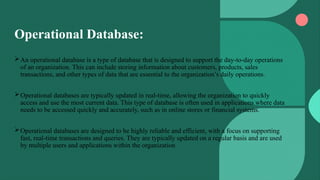
Operational Database:
An operationaldatabase is a type of database that is designed to support the day-to-day operations
of an organization. This can include storing information about customers, products, sales
transactions, and other types of data that are essential to the organization’s daily operations.
Operational databases are typically updated in real-time, allowing the organization to quickly
access and use the most current data. This type of database is often used in applications where data
needs to be accessed quickly and accurately, such as in online stores or financial systems.
Operational databases are designed to be highly reliable and efficient, with a focus on supporting
fast, real-time transactions and queries. They are typically updated on a regular basis and are used
by multiple users and applications within the organization.
3.
Why operational databaseis used?
There are several reasons why organizations use operational databases, including the following:
To support real-time transactions and queries: Operational databases are designed to support fast, real-
time transactions and queries, which are essential for running the day-to-day operations of the organization.
To store and manage transactional data: Operational databases are used to store and manage the
transactional data of the organization, including customer information, sales data, inventory data, and other
similar information.
To ensure data integrity and reliability: Operational databases are designed to be highly reliable and
efficient, with built-in mechanisms to ensure data integrity and accuracy. This ensures that the data stored in
the database is always accurate and up-to-date.
4.
To supportmultiple users and applications: Operational databases are typically accessed by multiple
users and applications within the organization, which allows them to share data and collaborate on
projects.
To improve decision making: Operational databases provide organizations with real-time data and
insights, which can be used to make informed business decisions and improve the overall efficiency of the
organization.
Operational Database Examples:
This type of database typically contains current and up-to-date information that is used to support the
daily operations of the organization.
Examples of operational databases include customer and product databases in e-commerce websites,
financial transaction databases in banks, and inventory databases in manufacturing companies. These
databases are often accessed and updated in real-time by multiple users in the organization, and they are
typically optimized for fast access and retrieval of data.
5.
Advantages of OperationalDatabase:
Real-time data and insights
Enhanced collaboration and coordination
Increased operational efficiency
Reduced data duplication and errors
Disadvantages of Operational Database:
High maintenance and operational costs
Limited scalability
Complexity and expertise required
Potential security risks
6.
Relational Database:
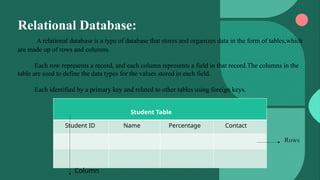
A relationaldatabase is a type of database that stores and organizes data in the form of tables,which
are made up of rows and columns.
Each row represents a record, and each column represents a field in that record.The columns in the
table are used to define the data types for the values stored in each field.
Each identified by a primary key and related to other tables using foreign keys.
Student Table
Student ID Name Percentage Contact
Rows
Column
7.
Relational Database Examples:
Forexample, a database for a library might have a table for books, with
columns for the title, author, and publication year of each book. Each row in the table
would represent a different book, with the title, author, and publication year stored in
the corresponding fields.
Advantages of Relational Database:
Simplicity of Model
Ease of Use
Accuracy
Data Integrity
Security
8.
Disadvantages of RelationalDatabase:
Maintenance Problem
Cost
Physical Storage
Lack of Scalability
Complexity in Structure




![[DSC Europe 25] Laila Kakar - Leveraging AI for Strategic Excellence: Enhanci...](https://cdn.slidesharecdn.com/ss_thumbnails/eykmhrtsqmaaftwkexh7-dsc-lailakakar-1-260119101520-5f3b5616-thumbnail.jpg?width=640&height=640&fit=bounds)

![[DSC Europe 25] Andrzej Kowalczyk - AI - how to start small and grow in the f...](https://cdn.slidesharecdn.com/ss_thumbnails/oy1zmo94qv6vpcqjvno2-andrzej-kowalczyk-ai-how-to-start-small-and-grow-in-the-future-1-260119121559-cf093b23-thumbnail.jpg?width=640&height=640&fit=bounds)
![[DSC Europe 25] Tali Fulman - Guild Meetings, Then What? Building Data Commun...](https://cdn.slidesharecdn.com/ss_thumbnails/fgohhi33rwmhqdowdj5k-tali-fulman-guild-meetings-then-what-building-data-communities-that-actually-ch-260120105855-528492c3-thumbnail.jpg?width=640&height=640&fit=bounds)
![[DSC Europe 25] Milos Belcevic - Product Professional's Journey to Full-Stack...](https://cdn.slidesharecdn.com/ss_thumbnails/1zovd6fgsycdg4wvgvls-milos-belcevic-product-professionals-journey-to-full-stack-product-developer-260123083019-d993120d-thumbnail.jpg?width=640&height=640&fit=bounds)


![[DSC Europe 25] Marcos Heidemann - Beyond the Hype: Making AI Coding Assistan...](https://cdn.slidesharecdn.com/ss_thumbnails/eexkhvldrjsopspdjbur-marcos-heidemann-beyond-the-hype-getting-real-value-out-of-ai-assisted-coding-260121115910-7e9d41ec-thumbnail.jpg?width=640&height=640&fit=bounds)
![[DSC Europe 25] Bojan Banjac - AI is always right when it comes to the matter...](https://cdn.slidesharecdn.com/ss_thumbnails/syoxtqierpydwxm5srcb-4-bojan-banjac-ai-is-always-right-when-it-comes-to-the-matters-of-taste-260119101519-694ee7d7-thumbnail.jpg?width=640&height=640&fit=bounds)

![[DSC Europe 25] Dubravko Culibrk - Deep Learning for Mammography.pptx](https://cdn.slidesharecdn.com/ss_thumbnails/yiscimuktacgqoiu4dkp-deep-learning-for-mammography-260119121559-aad59182-thumbnail.jpg?width=640&height=640&fit=bounds)
![[DSC Europe 25] Josip Saban - Career building for data professionals.pptx](https://cdn.slidesharecdn.com/ss_thumbnails/zroflcttkm1vmli0txea-josip-saban-career-building-for-data-professionals-260123083019-587cdb8c-thumbnail.jpg?width=640&height=640&fit=bounds)

![[DSC Europe 25] Egor Krasheninnikov - The Control Stack: Building Guardrails ...](https://cdn.slidesharecdn.com/ss_thumbnails/3lzcz7hxqmo51mtalv4u-the-control-stack-260119101520-ea90841a-thumbnail.jpg?width=640&height=640&fit=bounds)


![[DSC Europe 25] Bojan Djuricic - Predictive Design Process.pdf](https://cdn.slidesharecdn.com/ss_thumbnails/5awdrbedqdek3gqu2ezy-4-the-predictive-design-bojan-djuricic-260120105856-6c399e9b-thumbnail.jpg?width=640&height=640&fit=bounds)

