This project has received funding from the European Commission’s Horizon 2020 Research and Innovation programme under grant agreements No 101037643. The information and
views of this website lie entirely with the authors. The European Commission is not responsible for any use that may be made of the information it contains.
This project has received funding from the European Commission’s Horizon 2020 Research and Innovation programme under grant agreements No 101037643. The information and
views of this website lie entirely with the authors. The European Commission is not responsible for any use that may be made of the information it contains.
Presenter Name(s):
Presenter Organisation(s):
Email/Contact Information:
Location:
Date:
Marco Amaro Oliveira
INESC TEC
marco.a.oliveira (at) inesctec.pt
Brest, France
16 June 2025
Operationalising OGC Processes with Application Packages in ILIAD:
A Service Deployment Pathway Towards EDITO
Marco Amaro Oliveira (INESC TEC), Pedro Gonçalves (TERRADUE), Fabrice Brito (TERRADUE), Miguel Correia (INESC TEC) and João Campos (INESC TEC)
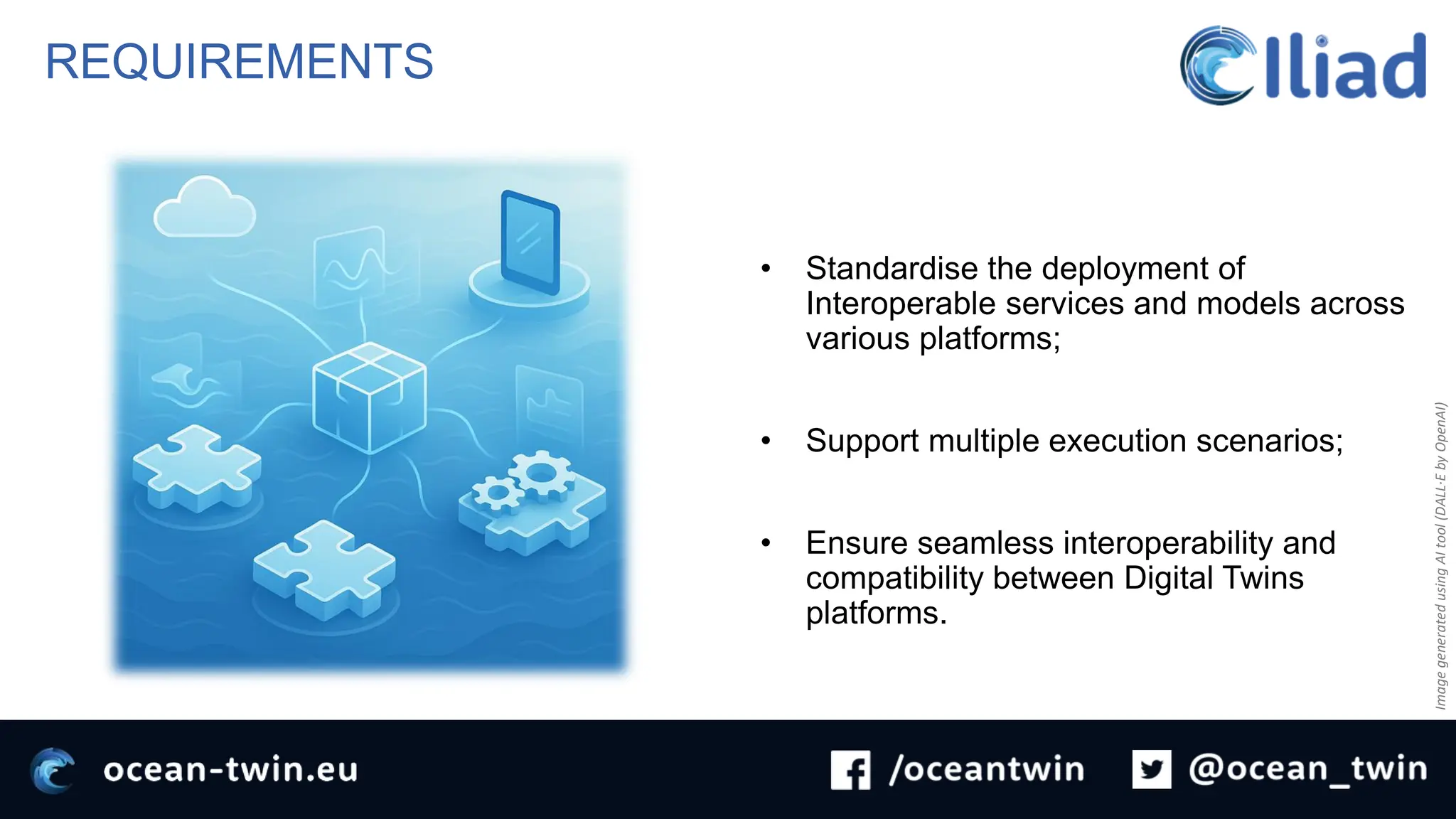
REQUIREMENTS
• Standardise the deployment of
Interoperable services and models across
various platforms;
• Support multiple execution scenarios;
• Ensure seamless interoperability and
compatibility between Digital Twins
platforms.
Image
generated
using
AI
tool
(DALL·E
by
OpenAI)
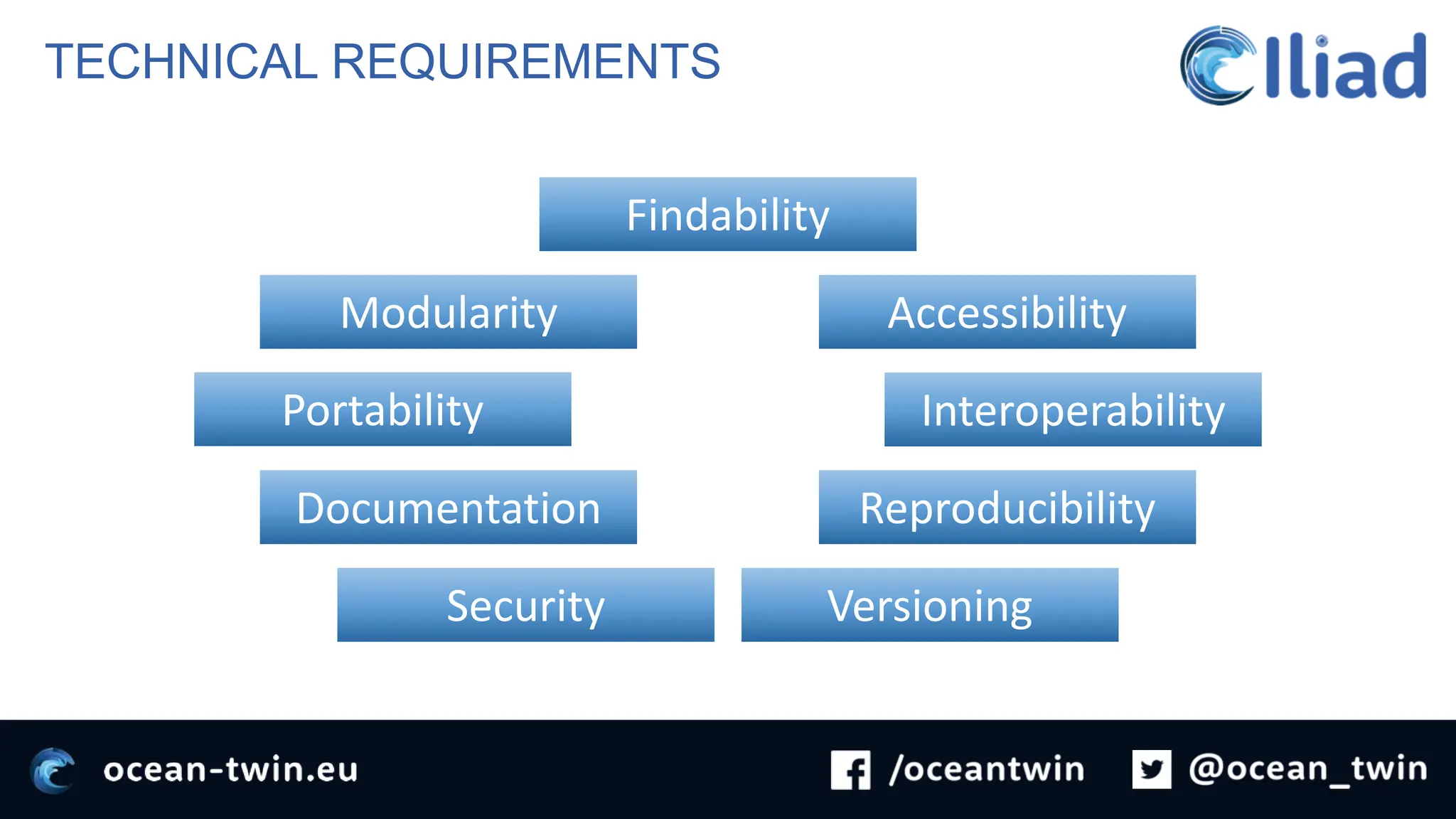
TECHNICAL REQUIREMENTS
Portability
Reproducibility
Interoperability
Modularity
Documentation
Versioning
Security
Findability
Accessibility
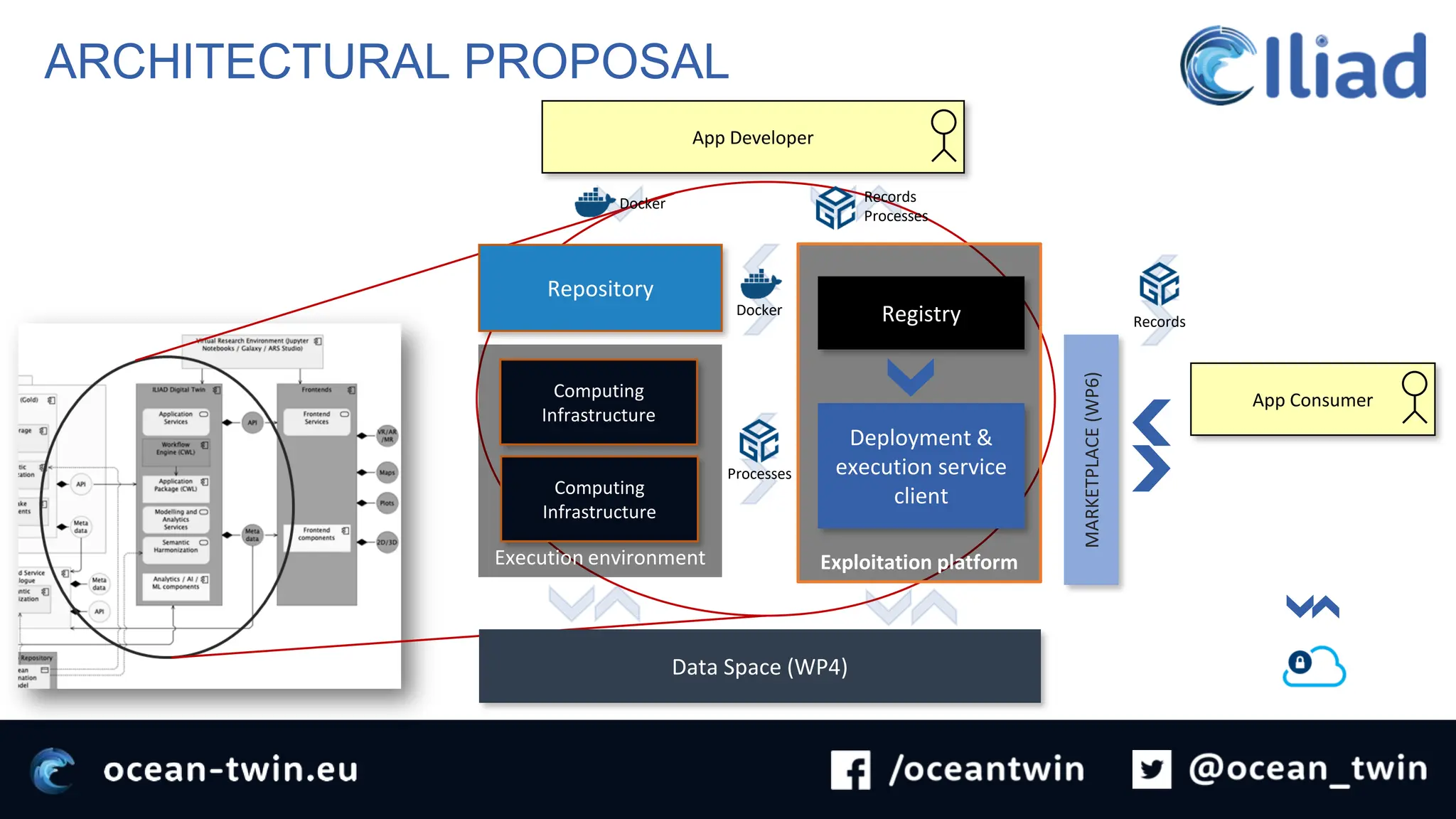
ARCHITECTURAL PROPOSAL
Processes
Exploitation platform
Data Space (WP4)
Registry
Deployment &
execution service
client
App Developer
Repository
App Consumer
MARKETPLACE
(WP6)
Execution environment
Computing
Infrastructure
Computing
Infrastructure
Records
Processes
Docker
Docker
Records
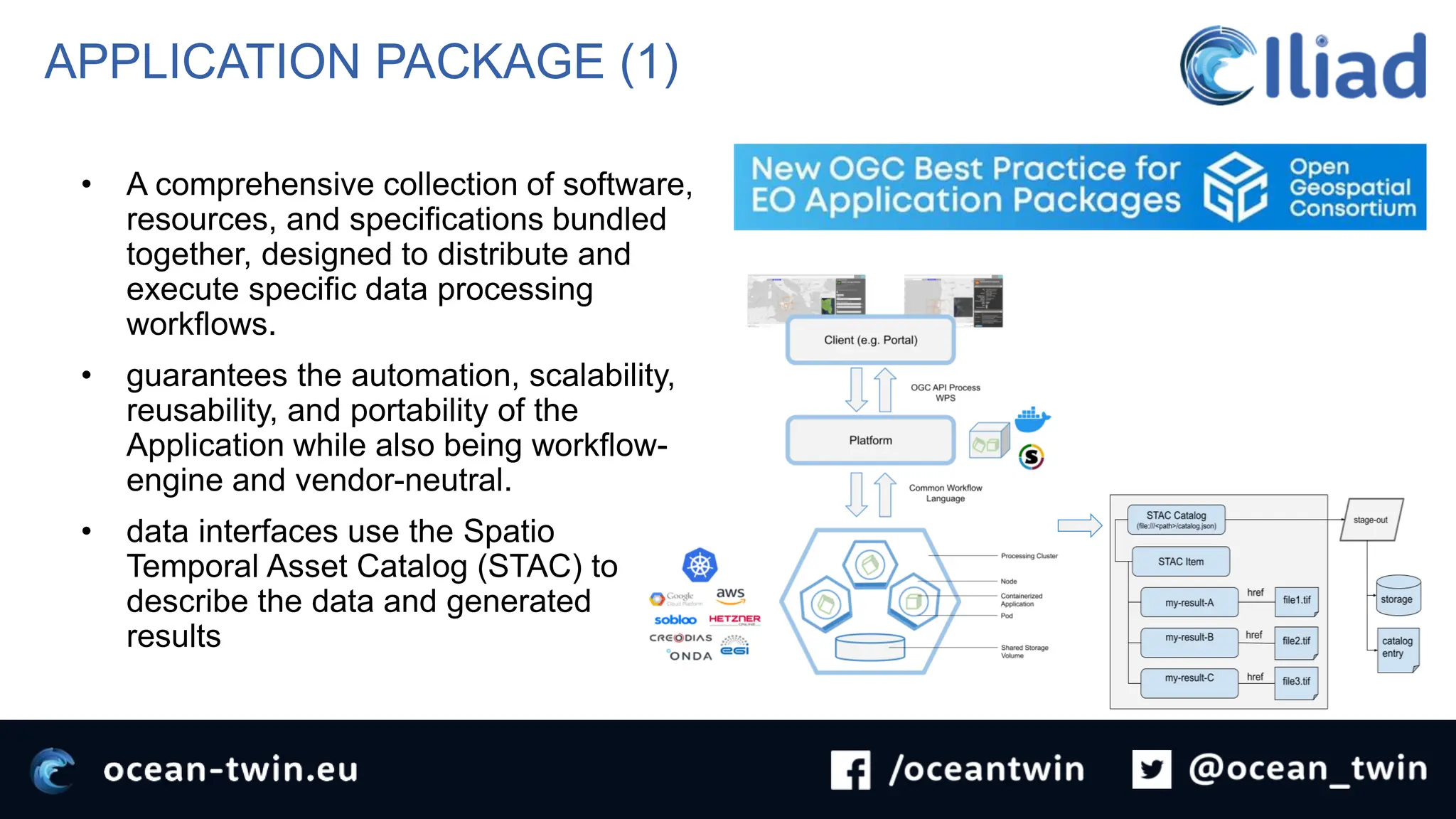
APPLICATION PACKAGE (1)
• A comprehensive collection of software,
resources, and specifications bundled
together, designed to distribute and
execute specific data processing
workflows.
• guarantees the automation, scalability,
reusability, and portability of the
Application while also being workflow-
engine and vendor-neutral.
• data interfaces use the Spatio
Temporal Asset Catalog (STAC) to
describe the data and generated
results
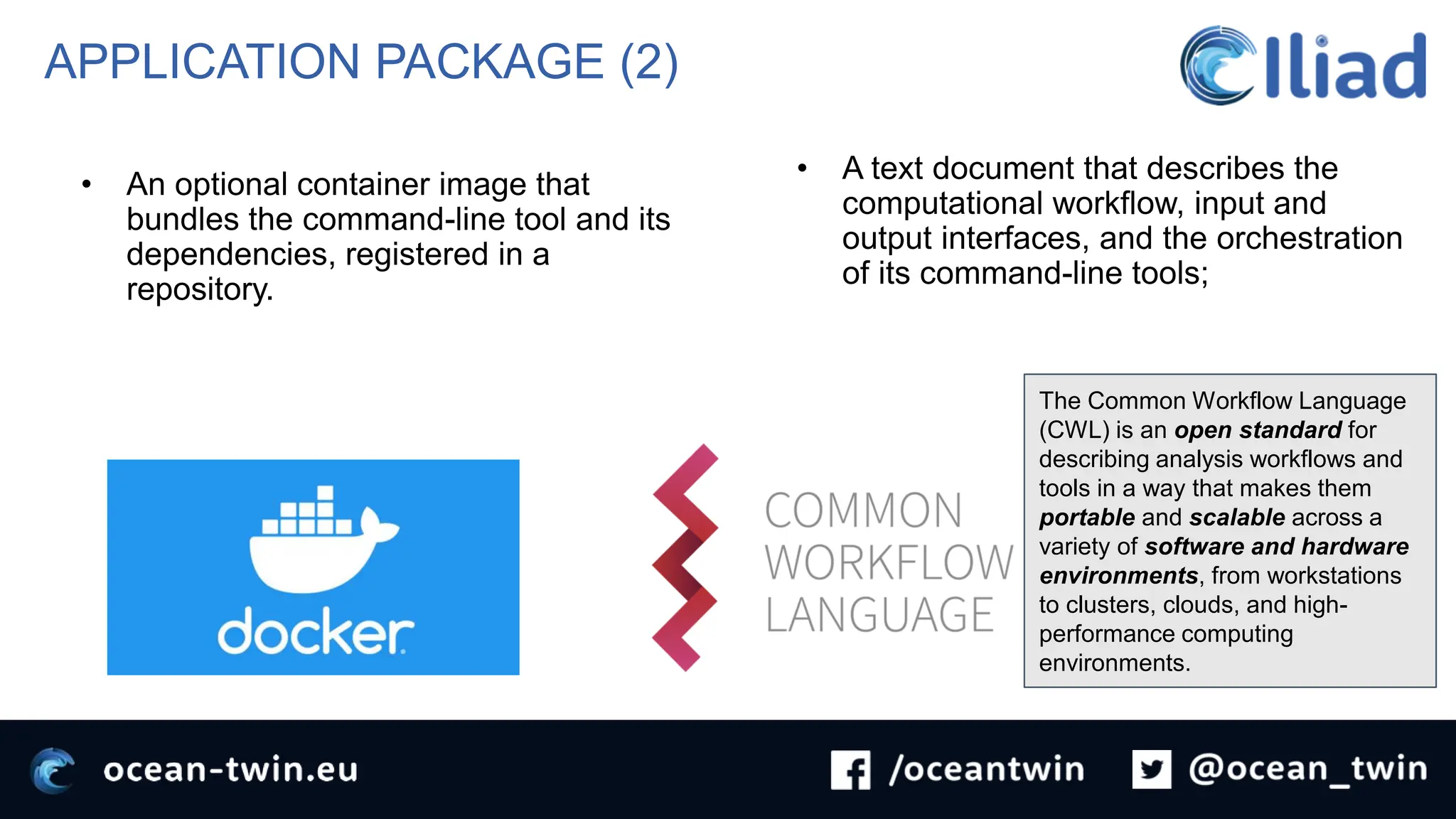
APPLICATION PACKAGE (2)
• An optional container image that
bundles the command-line tool and its
dependencies, registered in a
repository.
• A text document that describes the
computational workflow, input and
output interfaces, and the orchestration
of its command-line tools;
The Common Workflow Language
(CWL) is an open standard for
describing analysis workflows and
tools in a way that makes them
portable and scalable across a
variety of software and hardware
environments, from workstations
to clusters, clouds, and high-
performance computing
environments.
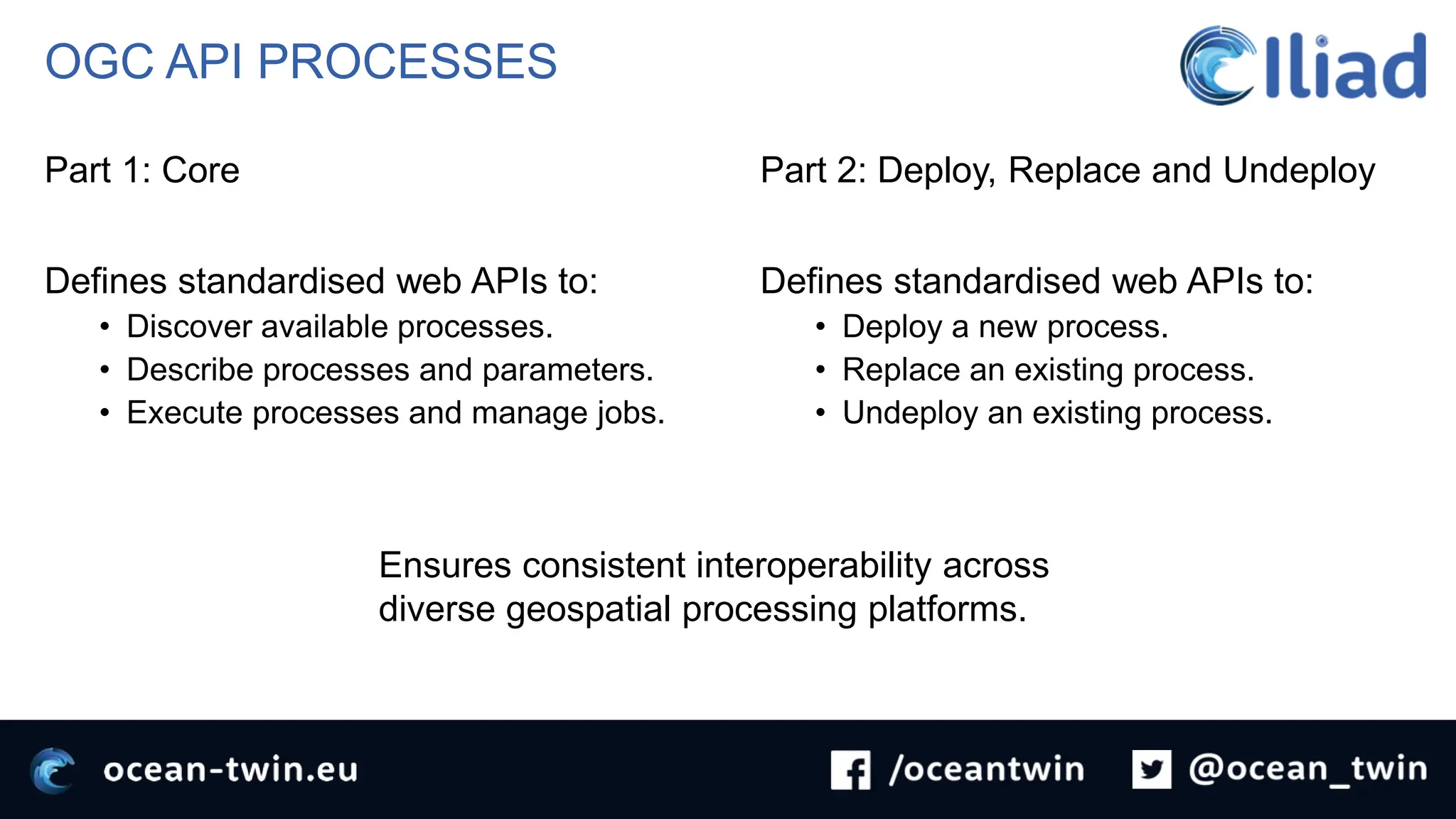
OGC API PROCESSES
Part 1: Core
Defines standardised web APIs to:
• Discover available processes.
• Describe processes and parameters.
• Execute processes and manage jobs.
Part 2: Deploy, Replace and Undeploy
Defines standardised web APIs to:
• Deploy a new process.
• Replace an existing process.
• Undeploy an existing process.
Ensures consistent interoperability across
diverse geospatial processing platforms.
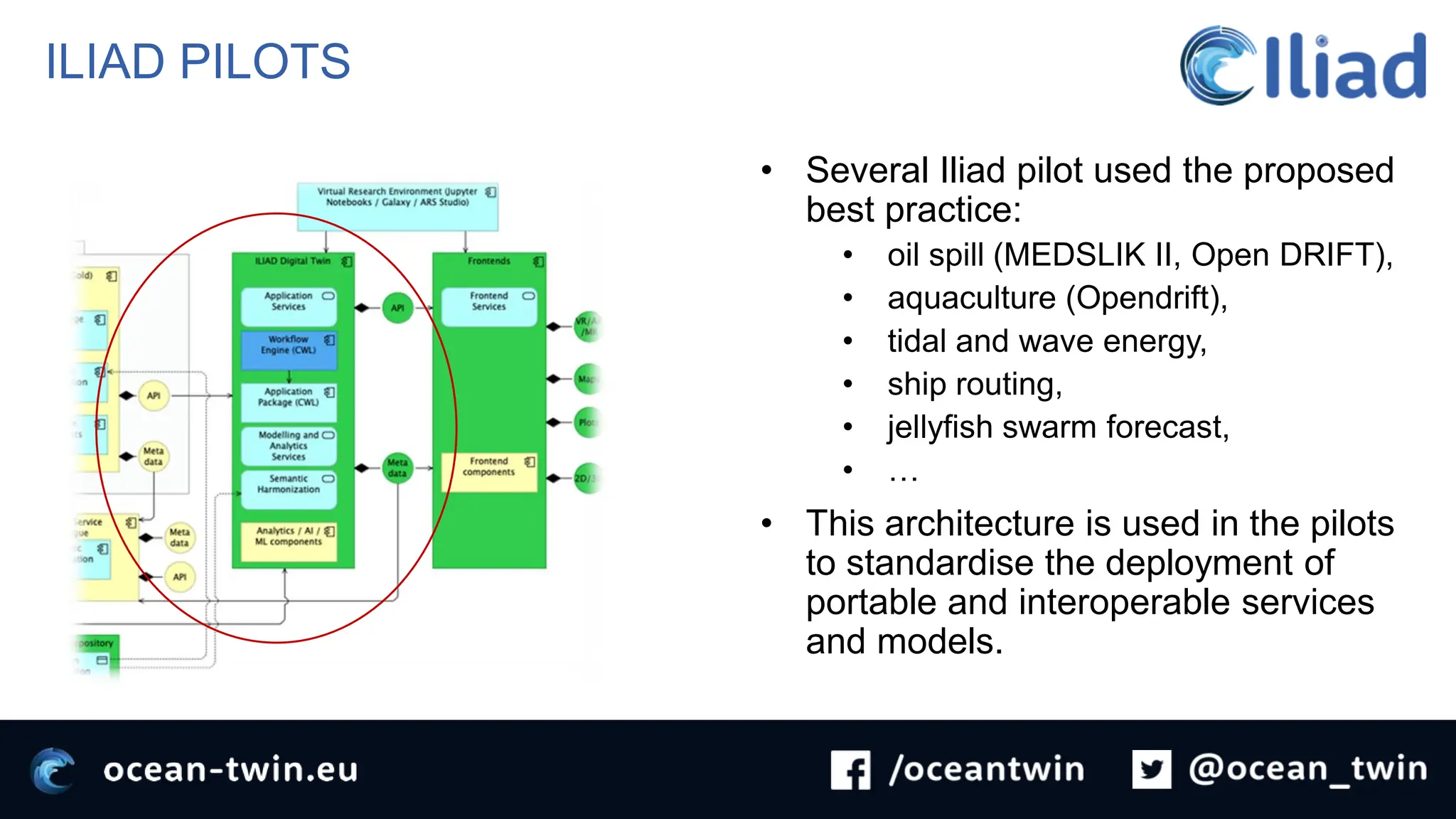
ILIAD PILOTS
• Several Iliad pilot used the proposed
best practice:
• oil spill (MEDSLIK II, Open DRIFT),
• aquaculture (Opendrift),
• tidal and wave energy,
• ship routing,
• jellyfish swarm forecast,
• …
• This architecture is used in the pilots
to standardise the deployment of
portable and interoperable services
and models.
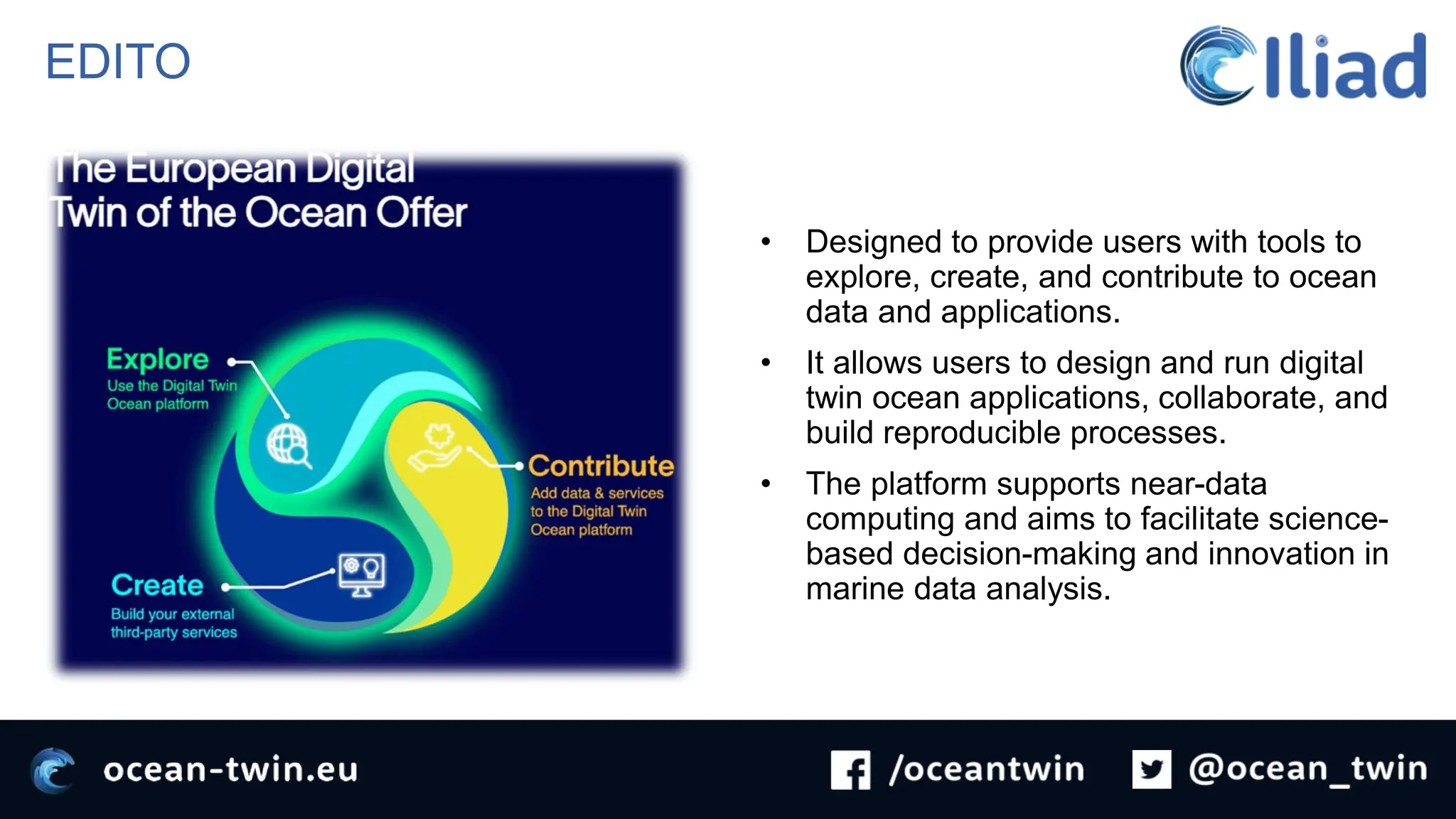
EDITO
• Designed to provide users with tools to
explore, create, and contribute to ocean
data and applications.
• It allows users to design and run digital
twin ocean applications, collaborate, and
build reproducible processes.
• The platform supports near-data
computing and aims to facilitate science-
based decision-making and innovation in
marine data analysis.
INTEROPERABILITY CHALLENGES
Ensure seamless interoperability and compatibility between ILIAD and EDITO
platform architectures to enable standardised, scalable execution of containerised
workflows.
• Different Workflow Execution Models:
• EDITO has no direct support for Application Packages. The workflows rely on Helm
charts and inputs as environment variables,
• Limited Portability and Reusability:
• Without a common interface, workflows developed in one environment can't easily
move or scale across platforms.
• EDITO supports OGC API Processes part 1 – core:
• No support yet for deployment, Replacement and Undeployment of application
packages through the API.
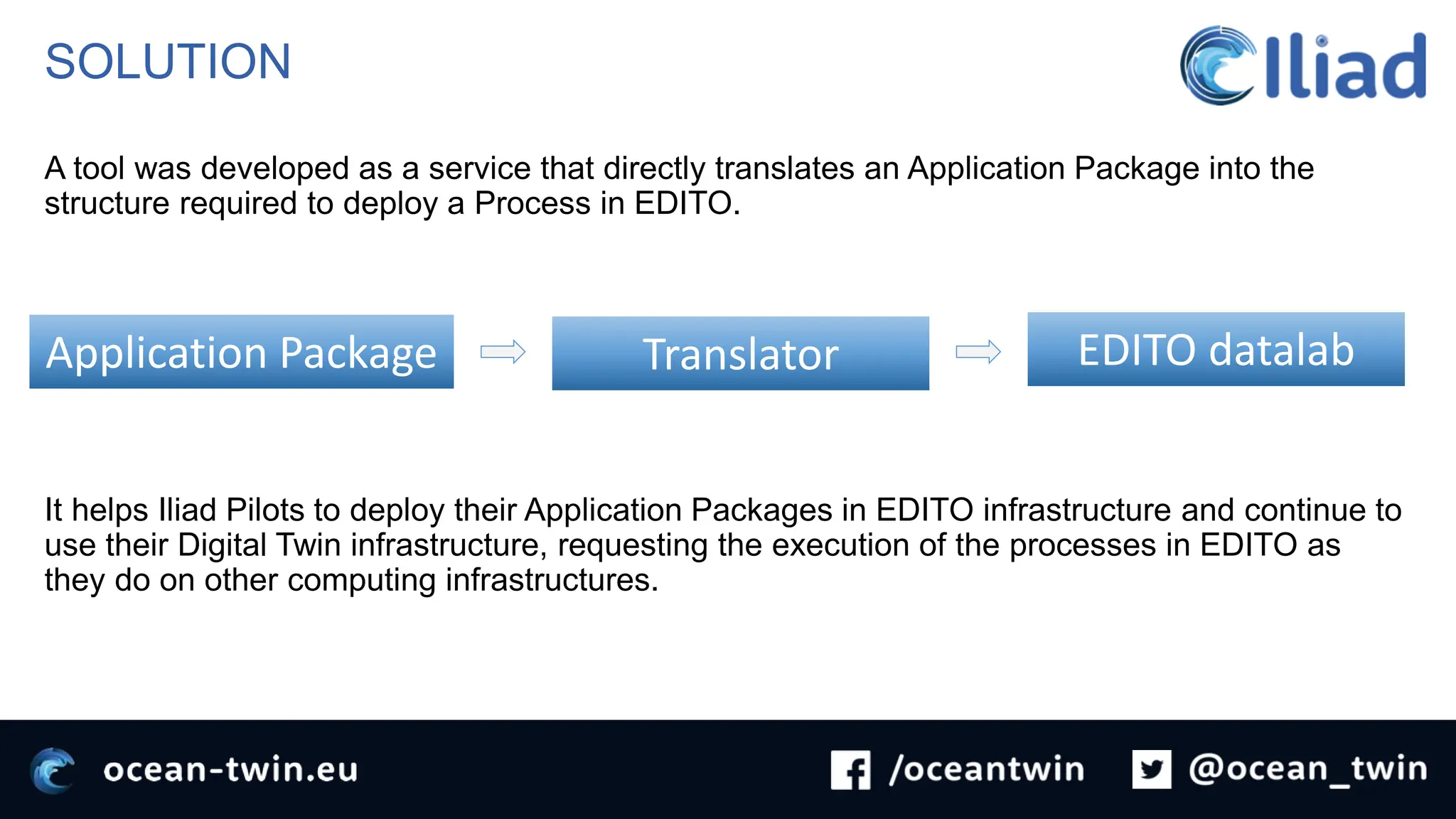
SOLUTION
A tool was developed as a service that directly translates an Application Package into the
structure required to deploy a Process in EDITO.
It helps Iliad Pilots to deploy their Application Packages in EDITO infrastructure and continue to
use their Digital Twin infrastructure, requesting the execution of the processes in EDITO as
they do on other computing infrastructures.
EDITO datalab
Translator
Application Package
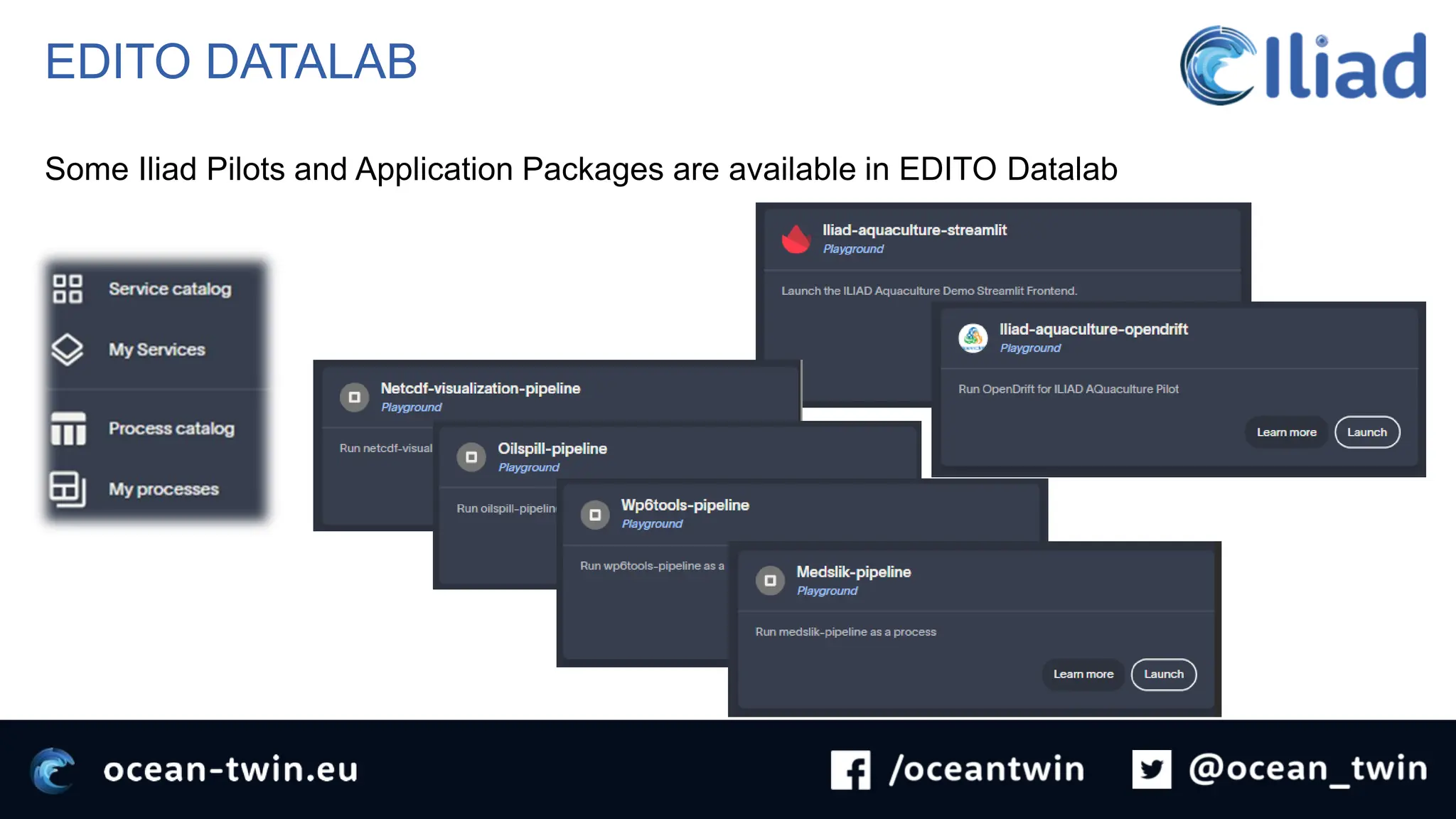
EDITO DATALAB
Some Iliad Pilots and Application Packages are available in EDITO Datalab
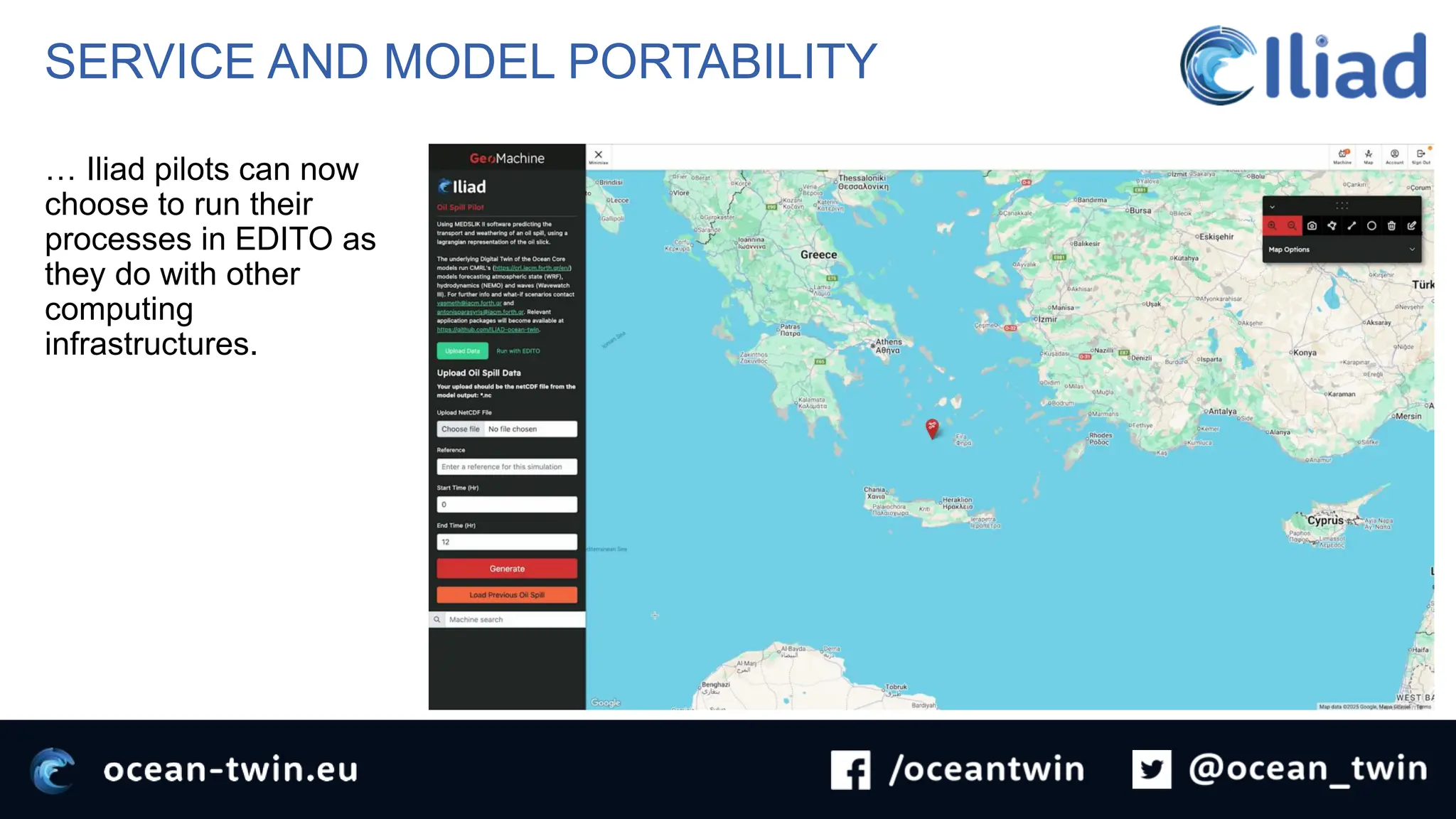
SERVICE AND MODEL PORTABILITY
… Iliad pilots can now
choose to run their
processes in EDITO as
they do with other
computing
infrastructures.
CONCLUSIONS AND FUTURE WORKS
• Architecture and specifications applied in a real-world operational context;
• Pilots integrated with both OGC API Processes DRU and EDITO service architectures;
• Reproducible processes in different computing platforms;
• Identification of key implementation patterns, interoperability challenges, and interface
improvements;
• Directly contributing back into the ongoing development of Best Practices, standards and
Platform improvements;
• These results have proven valid with the Iliad pilots and can further support the
enhancement of EDITO’s flexibility and (technical and semantic) interoperability.
This project has received funding from the European Commission’s Horizon 2020 Research and Innovation programme under grant agreements No 101037643. The information and
views of this website lie entirely with the authors. The European Commission is not responsible for any use that may be made of the information it contains.
Presenter Name(s):
Presenter Organisation(s):
Email/Contact Information:
Location:
Date:
Marco Amaro Oliveira
INESC TEC
marco.a.oliveira (at) inesctec.pt
Brest, France
16 June 2025
Thank You

Operationalising OGC Processes with Application Packages in ILIAD: A Service Deployment Pathway Towards EDITO

  • 1.
    This project hasreceived funding from the European Commission’s Horizon 2020 Research and Innovation programme under grant agreements No 101037643. The information and views of this website lie entirely with the authors. The European Commission is not responsible for any use that may be made of the information it contains.
  • 2.
    This project hasreceived funding from the European Commission’s Horizon 2020 Research and Innovation programme under grant agreements No 101037643. The information and views of this website lie entirely with the authors. The European Commission is not responsible for any use that may be made of the information it contains. Presenter Name(s): Presenter Organisation(s): Email/Contact Information: Location: Date: Marco Amaro Oliveira INESC TEC marco.a.oliveira (at) inesctec.pt Brest, France 16 June 2025 Operationalising OGC Processes with Application Packages in ILIAD: A Service Deployment Pathway Towards EDITO Marco Amaro Oliveira (INESC TEC), Pedro Gonçalves (TERRADUE), Fabrice Brito (TERRADUE), Miguel Correia (INESC TEC) and João Campos (INESC TEC)
  • 3.
    REQUIREMENTS • Standardise thedeployment of Interoperable services and models across various platforms; • Support multiple execution scenarios; • Ensure seamless interoperability and compatibility between Digital Twins platforms. Image generated using AI tool (DALL·E by OpenAI)
  • 4.
  • 5.
    ARCHITECTURAL PROPOSAL Processes Exploitation platform DataSpace (WP4) Registry Deployment & execution service client App Developer Repository App Consumer MARKETPLACE (WP6) Execution environment Computing Infrastructure Computing Infrastructure Records Processes Docker Docker Records
  • 6.
    APPLICATION PACKAGE (1) •A comprehensive collection of software, resources, and specifications bundled together, designed to distribute and execute specific data processing workflows. • guarantees the automation, scalability, reusability, and portability of the Application while also being workflow- engine and vendor-neutral. • data interfaces use the Spatio Temporal Asset Catalog (STAC) to describe the data and generated results
  • 7.
    APPLICATION PACKAGE (2) •An optional container image that bundles the command-line tool and its dependencies, registered in a repository. • A text document that describes the computational workflow, input and output interfaces, and the orchestration of its command-line tools; The Common Workflow Language (CWL) is an open standard for describing analysis workflows and tools in a way that makes them portable and scalable across a variety of software and hardware environments, from workstations to clusters, clouds, and high- performance computing environments.
  • 8.
    OGC API PROCESSES Part1: Core Defines standardised web APIs to: • Discover available processes. • Describe processes and parameters. • Execute processes and manage jobs. Part 2: Deploy, Replace and Undeploy Defines standardised web APIs to: • Deploy a new process. • Replace an existing process. • Undeploy an existing process. Ensures consistent interoperability across diverse geospatial processing platforms.
  • 9.
    ILIAD PILOTS • SeveralIliad pilot used the proposed best practice: • oil spill (MEDSLIK II, Open DRIFT), • aquaculture (Opendrift), • tidal and wave energy, • ship routing, • jellyfish swarm forecast, • … • This architecture is used in the pilots to standardise the deployment of portable and interoperable services and models.
  • 10.
    EDITO • Designed toprovide users with tools to explore, create, and contribute to ocean data and applications. • It allows users to design and run digital twin ocean applications, collaborate, and build reproducible processes. • The platform supports near-data computing and aims to facilitate science- based decision-making and innovation in marine data analysis.
  • 11.
    INTEROPERABILITY CHALLENGES Ensure seamlessinteroperability and compatibility between ILIAD and EDITO platform architectures to enable standardised, scalable execution of containerised workflows. • Different Workflow Execution Models: • EDITO has no direct support for Application Packages. The workflows rely on Helm charts and inputs as environment variables, • Limited Portability and Reusability: • Without a common interface, workflows developed in one environment can't easily move or scale across platforms. • EDITO supports OGC API Processes part 1 – core: • No support yet for deployment, Replacement and Undeployment of application packages through the API.
  • 12.
    SOLUTION A tool wasdeveloped as a service that directly translates an Application Package into the structure required to deploy a Process in EDITO. It helps Iliad Pilots to deploy their Application Packages in EDITO infrastructure and continue to use their Digital Twin infrastructure, requesting the execution of the processes in EDITO as they do on other computing infrastructures. EDITO datalab Translator Application Package
  • 13.
    EDITO DATALAB Some IliadPilots and Application Packages are available in EDITO Datalab
  • 14.
    SERVICE AND MODELPORTABILITY … Iliad pilots can now choose to run their processes in EDITO as they do with other computing infrastructures.
  • 15.
    CONCLUSIONS AND FUTUREWORKS • Architecture and specifications applied in a real-world operational context; • Pilots integrated with both OGC API Processes DRU and EDITO service architectures; • Reproducible processes in different computing platforms; • Identification of key implementation patterns, interoperability challenges, and interface improvements; • Directly contributing back into the ongoing development of Best Practices, standards and Platform improvements; • These results have proven valid with the Iliad pilots and can further support the enhancement of EDITO’s flexibility and (technical and semantic) interoperability.
  • 16.
    This project hasreceived funding from the European Commission’s Horizon 2020 Research and Innovation programme under grant agreements No 101037643. The information and views of this website lie entirely with the authors. The European Commission is not responsible for any use that may be made of the information it contains. Presenter Name(s): Presenter Organisation(s): Email/Contact Information: Location: Date: Marco Amaro Oliveira INESC TEC marco.a.oliveira (at) inesctec.pt Brest, France 16 June 2025 Thank You